The blog for Mets fans
who like to read
ABOUT US

Faith and Fear in Flushing made its debut on Feb. 16, 2005, the brainchild of two longtime friends and lifelong Met fans.
Greg Prince discovered the Mets when he was 6, during the magical summer of 1969. He is a Long Island-based writer, editor and communications consultant. Contact him here.
Jason Fry is a Brooklyn writer whose first memories include his mom leaping up and down cheering for Rusty Staub. Check out his other writing here.
Got something to say? Leave a comment, or email us at faithandfear@gmail.com. (Sorry, but we have no interest in ads, sponsored content or guest posts.)
Need our RSS feed? It's here.
Visit our Facebook page, or drop by the personal pages for Greg and Jason.
Or follow us on Twitter: Here's Greg, and here's Jason.
|
by Greg Prince on 5 September 2012 9:50 pm Now he’s at 18. Now this is getting to be a whole other kind of fun.
Oh, it was good, clean, dry fun — no rain, please; it disturbs everything for which he stands — from early on this season. And it was a veritable overflowing fountain cup of fun in the middle of the year so big that if Michael Bloomberg knew about it he’d have tried to restrict its consumption. But now it’s September, and the fun is getting something close to historic. And if you can’t have historic team fun in September, the individual kind is a very, shall we say, appealing consolation prize.
When the Mets went to the trouble of noticing Adron Chambers failed to touch second base on his way back to first base after the second out of the ninth inning and converted his mistake into a 9-4-6 double play approved by the eagle-eyed umpiring crew working this Mets-Cardinals series, R.A. Dickey nailed down his 18th win of the 2012 season. R.A. Dickey nailed it down with three arms to hold it aloft — those belonging to Josh Edgin, Jon Rauch and Frank Francisco — but it was he who could take the leonine share of the credit for salvaging some Met dignity in St. Louis, with the 6-2 win landing squarely in the Dickey column.
If it were anybody else putting up any lesser number at this point in the schedule, we wouldn’t care and we probably wouldn’t notice. Quick, how many wins does any other pitcher on the Mets’ roster have at the moment? I watch this team every single day and I have mostly no idea.
Not unlike last September when we put aside our reservations over promoting the efficacy of batting averages when one of our own closed in on having the best one in the league, I think we’re all willing to forget that we long ago figured out that a pitcher’s wins are an outmoded, no more than marginally useful metric. Remember how it felt baseball had just gotten a little bit smarter when Tim Lincecum won the National League Cy Young Award with 15 wins in 2009? And smarter still when Felix Hernandez won the American League version with 13 wins in 2010? It was validation of something so many of us had been learning and espousing: that being the best starting pitcher and compiling a stack of individual victories were not necessarily overlapping competencies. Skill informed the former. Luck had a lot to do with the latter.
But now, as R.A. Dickey carries a record of 18 wins and 4 losses into the final weeks of 2012, I can assure you I don’t care about any of that. The WHIP and the ERA+ and the BABIP…save it for calculus class, Poindexter. R.A. Dickey has 18 wins. It’s the most wins any Mets pitcher has had since 1990, when Doc Gooden had 19 and Frank Viola had that many plus one. There have been only 15 such seasons of 18 or more wins in Mets history, and only seven Mets pitchers have crafted them.
Current Met R.A. Dickey’s current season is one of those seasons.
It’s history, but it’s going on right in front of us. It’s persevered from April to September. It’s unfolding (as opposed to unraveling) like nothing’s unfolded for a Met pitcher in 22 years. There are always dreadful reasons for why it never happens anymore. Pitchers aren’t left in long enough. Relievers are flammable. Offenses offer no support. Yet in 2012, R.A. Dickey and the Mets have short-circuited all the problems and brought him to this rarefied air. Dickey throws a knuckler and doesn’t require hair-trigger removal as pitch counts rise. The bullpen that costs non-knuckleballers wins isn’t as much of a factor for him, and Thursday afternoon in St. Louis (as has amazingly been the case for a while now), its inhabitants proved themselves Met assets. And somehow, unlike every acelike pitcher in the post-Gooden/Viola era — stretching from Saberhagen to Santana — Dickey regularly gets enough runs with which to work wonders.
He has this year, anyway. He got five against the Cardinals (three on an Ike Davis dinger), plus one that came later. He and his successors gave up two. Luck? It rained on Busch Stadium in the morning, and Dickey won. The tarp was on the field ten minutes past the game’s designated start time, and Dickey won. David Wright didn’t play, and Dickey won. Adam Wainwright homered, and Dickey won. Chambers overran second base in attempting to get back to first after the second out of the ninth inning was secured and the Mets appealed. The Mets appealed a play against the Cardinals in this series and these umpires upheld the appeal. With that, the Cardinals lost. The Mets won. Dickey won. Dickey won his 18th game against four losses.
R.A. Dickey is an 18-game winner, which would be impressive enough if this was his last start, but he has, more or less, another five starts on tap (though who can tell exactly with this nonsensical six-man rotation?). R.A. Dickey is closing in on a 19-win season, something achieved only 11 times in times in Mets history, by five Mets pitchers. Beyond 19, if one dares to lean forward, is a number that, for all the statistically advanced insights we’ve garnered as a people over the past generation, still looms as magical. I almost don’t want to say it for fear of jinxing it. Let’s just say R.A. is one win away from 19 for now, and if he can get that, we’ll inject the magical number then.
The circumstances surrounding Jose Reyes winning the Mets’ first batting title grew unnecessarily messy, but boy did I enjoy the journey. It was like nothing I’d ever experienced as a Mets fan, which I think is why it was so much fun. I’d never seen a Met hit 40 homers before Todd Hundley did it in 1996 or drive in 100 runs before Rusty Staub did it in 1975, and those were fun for the same reason. They were new to us. There was the surge of the unknown transforming into something intensely familiar, a Met reaching a milestone previously nonexistent in our experiential vocabulary.
R.A. Dickey reaching an 18th win, on the other hand, isn’t new to any Mets fan who can remember 18 wins not being that big a whoop. Between 1968 and 1976, Jerry Koosman won an 18th game twice and Tom Seaver did it six times. Between 1985 and 1990, David Cone did it once, Bobby Ojeda did it once, Viola did it once and Gooden did it three times. That’s what makes this a different kind of thrill. Pitchers winning lots of games is in our DNA. It’s Seaver and it’s Gooden and it’s Koosman. It’s who we are so much more than anything regarding hitting. It’s a part of our being that I didn’t realize was missing until I began to feel it come back.
When R.A. won his 17th game against the Marlins in his previous start (also with Ike homering), it truly registered in my Mets fan soul. We hadn’t had a 17th win since Al Leiter got one in 1998, which was the most since 1990 and hadn’t been touched for a baker’s dozen years thereafter. We talked for so long about how could a team with Seaver and Gooden and Koosman not yet have a no-hitter? I quietly wondered how a team with Leiter and Jones and Reed and Hampton and Trachsel and Martinez and Gl@v!ne and Santana couldn’t get another 17th win between 1999 and 2011. When I was growing up, 17 seemed like what separated “very good” from merely “good”. Leiter was very good in 1998 (2.47 ERA), and all he could get to was the baseline of “very good” by my deep-seated reckoning. Al had to deal with premature hooks and bullpen implosions and offensive brownouts and the vagaries of misfortune…just like all Mets starters seemed destined to do.
Over the next 13 seasons, I incrementally lowered my expectations, reasoning a pitcher’s individual wins weren’t what they were cracked up to be when I was a kid, and that win totals of 16 and 15 — reached 11 times by nine Mets pitchers between 1999 and 2011 — were perfectly representative of good, sometimes very good pitching, and that there was so much more to the panoply of metrics that determined what constituted good and very good pitching. But then, in late August of 2012, R.A. Dickey won his 17th game of the year, and I was reminded what a season’s worth of sustained great pitching — sans excuses — looked like. And in early September of 2012, he won his 18th, and I had every good reason to invoke Koosman and Gooden and Seaver, because for the first time in an eternity, we had a man ascending their mound, toeing their rubber, joining their echelon.
This really is fun.
by Jason Fry on 4 September 2012 11:53 pm Matt Harvey wasn’t great, particularly when the Cardinals put up a quartet of singles against him for a three-run second inning. But he wasn’t bad either — the rest of his five innings were solid, he seemed to gather himself and make adjustments against a good team, and talking to reporters afterwards he was dissatisfied and coldly furious, which is a point of view we could use more of around here. It was the kind of night an optimist would say is part of a young pitcher’s education — and if you can’t be an optimist about young power pitchers in September, perhaps you’re doing it wrong.
Jeurys Familia also made his Mets debut, and it was a glass-completely-full sight, even if it did come with an admonitory side of EXTREMELY SMALL SAMPLE SIZE. Familia began by fanning Lance Berkman with a riding 97 MPH fastball, gave up a hit, then induced a double play. I’m not sure how to say Familia’s first name: Gary Cohen and Ron Darling pronounced it “Jay-rees,” but others on Twitter said it should be “Jay-uh-rees” or “Heh-ooh-rees.” If Familia keeps pitching like that, we’ll get it figured out; for now, it’s comforting to think that with Harvey, Familia, Zach Wheeler and Jon Niese (at least when he’s interested in pitching), our future isn’t quite as dark as it may seem when nothing’s happening with runners in scoring position.
The rest? Well … umm … Andres Torres made a sensational catch. David Rackley called balls and strikes without offering further proof that baseball desperately needs to expand instant replay. Oh, and Fred Lewis made his Mets debut. That’s something, right? (Perhaps MattTuiasosopo didn’t get a call-up because navigating his last name and Familia’s first name would have been too much for us.) Jordany Valdespin returned with a cocky double, but Ike Davis quickly popped out before the veterans could get too upset by the way Valdespin smugly eyed third. And so on we go.
by Greg Prince on 4 September 2012 3:08 pm Reminders of a couple of worthwhile events that are coming up this weekend, each intended to give a hand to those who could use it:
On Saturday, Mets fan Tommy LaBella, who passed away earlier this year at the way-too-soon age of 22, will be remembered at the first annual Tommy LaBella Softball Tournament at D’Onofrio Field in New Rochelle, beginning at 9 AM. Proceeds will benefit the Tommy LaBella Sky’s The Limit Fund — whose mission is to “allow Tommy’s spirit to continue to touch the lives of many by giving back to his community” — and the New Rochelle Little League. There’ll be a silent auction of sports memorabilia (autographed by the likes of Cliff Floyd, Johan Santana, David Wright and Ike Davis) and all kinds of fun and games to honor the memory of someone who remains in the hearts of those who knew him best. Visit the fund’s Facebook page here for more information on the event and get a sense of what Tommy meant to his loved ones here.
On Sunday, Ike Davis will be doing his usual big part for Solving Kids’ Cancer and the Liddy Shriver Sarcoma Initiative. Ike and several Met teammates will be on hand guest-bartending, and country music star Lee Brice will provide the entertainment. The good times for a good cause start to roll at City Winery on Varick Street at 7 PM, after the Mets kiss off Chipper Jones for the last time at Citi Field. Details here.
by Jason Fry on 3 September 2012 7:06 pm I know it, you know it, the players know it, the fans know it. I suspect Bud Selig knows it. The question is what he’s going to do about it.
Let’s get rid of some preliminaries: Before the pivotal call by first-base ump David Rackley, the Mets hadn’t played a particularly good game. Collin McHugh, so marvelous in his big-league debut, got whacked around by the Cardinals — in the postgame, Bobby Ojeda was certain that he was tipping his pitches, lifting his arm high on the curve and coming with a three-quarters delivery on the fastball. (If so, one hopes that’s the kind of thing that gets communicated between former pitchers working for SNY and current pitchers working for NYM.) McHugh wasn’t great, but he had plenty of company — whether it was Lucas Duda misplaying a first-inning liner into a triple or Kelly Shoppach not backing up first on a bad throw by Daniel Murphy or Bobby Parnell being ineffective in relief or the Mets’ inability to hit with runners in scoring position. More about Rackley’s call in a minute, but to be fair, it was more coup de grace than out-of-nowhere knife in the back.
The Mets looked dead for much of the early going against Joe Kelly, but they fought back on homers by Shoppach and Murphy, followed by a fizzled rally that began with a one-out walk by Ike Davis and a single by Jason Bay. Frustrating, but they looked poised to complete the comeback in the ninth: Andres Torres did a terrific job against Jason Motte, working a deep count against a closer who’d done hard duty in the eighth and then hustling into second for a leadoff double. I was explaining to Joshua that this was a case where bunting the runner over did make sense, because it was more important to maximize the chance of scoring at least one run than it was to try to maximize the number of runs scored, and … but wait, what was happening over there at first?
Oh no he hadn’t.
Oh God he had.
Rackley, an ump I’ll wager none of us had ever heard of before, had emphatically punched out Torres for missing first.
Looking at a little TV set in the beach house at LBI, I couldn’t be sure. But the consensus from those with better sets was clear: Torres had too hit the bag, clipping it with his front foot as he turned the corner. Torres stared at Rackley in disbelief and then headed for the dugout; Terry Collins protested briefly but futilely; and a few minutes later, the Mets had lost.
On his way off the field after making the last out, Murphy paused to exchange pleasantries with Rackley. In the postgame, he and Collins both explained that the guys in the dugout had seen the replay; Murph had some sympathy for Rackley, who didn’t have the same advantage.
Which is really the heart of the matter, and why I’m tired of talking about the human element, or hearing worries about the game being slowed down further. Technology has changed the experience of calls and the expectations around them, and the game needs to catch up.
First of all, we already have instant replay in baseball — we just don’t have it on the field, where it would do some good. At Citi Field and many other parks today, any close call is followed by at least half the fans swiveling their heads left or right, to look at one of the many HDTVs hanging from the level above their seats. You can hear it in the broadcasts: a kind of mutter that follows the freeze cam being shown in the ballpark.
And it’s not just the fans. As Murph made clear, the players can see those plays too — I don’t know if they’re ducking into the tunnel, rushing of to the clubhouse or looking at a cameraman’s monitor, but they know. And this trend will continue: Before too long fans (and team staffers close to the dugout) will look at their smartphones a couple of seconds after a play to check the replay. Calls are scrutinized in ways that weren’t possible a decade ago, disseminated in ways that were unimaginable then, and deplored instantly and then at length by wired fans and commenters. In that situation, it’s unfair to expect umpires to rely on nothing but real-time calls when everybody else will pick those calls apart with a slew of camera angles and freeze-frames.
OK, but how to fix this? I love baseball, but there comes a time in nearly every game in which I think, “Gee, this is taking forever.” So why would any sane fan want to introduce more delays?
I’ll tell you why: Because the problems with instant replay are theoretical, and the problems with blown calls are real.
David Rackley’s emphatic wrong call is so far from the first one blown at a critical juncture in a game. We’ve seen Armando Galarraga and Jim Joyce, the Pittsburgh Pirates and Jerry Meals, along with call after call after call in games played by the Mets and others, a seemingly daily drumbeat of incorrect umpiring.
Yeah, I know we would have lost our one and only no-hitter in a world with instant replay. I don’t regard Johan’s no-no as tainted because Carlos Beltran got a hit that was called a foul ball, but I would have sacrificed it to remove the spreading stain of bad umpiring on baseball. Instant replay isn’t needed just because it’s a presence in the stands and the dugout — it’s needed because baseball’s umpires have become so routinely incompetent that the ultimate oversight of the national pastime needs to be taken out of their hands. [Edit: This is unfair, as was pointed out to me on Twitter. Umps are probably about as good/bad as they always were; the difference is that technology has let us detect their mistakes. Regardless, expectations have changed, and we have the same problem.] The human element should be limited to the successes and failures of players, not referees who are supposed to be invisible and anonymous.
So how would instant replay work? I don’t know — but at this point the onus should be on those who think the daily parade of blown calls is a problem that doesn’t need solving, not those of us who’d like it fixed.
That said, let’s try some basics. We want the umps to get it right and we want reviews to be as speedy as possible. So let’s start with NHL-style review of critical calls. Within a minute of a call, the announcers for both teams have usually established to viewers’ satisfaction whether the ump was right or wrong. So why can’t someone in an MLB control room do what Gary, Keith and Ron do?
I don’t see any reason to limit managers’ challenges, NFL-style — the idea is to get calls right, not to get a certain number of them right when coaches are really mad. Would some manager abuse this by demanding that call after call get reviewed? I doubt it, honestly — and if one did, that’s why the commissioner’s office can suspend people. Moreover, why does an instant-replay plan have to be perfect from Day 1? Let it evolve, and solve problems as they become apparent.
The one thing I would do is keep balls and strikes out of it. That’s the Rubicon I wouldn’t cross, because the game really would grind to a halt. (I reserve the right to change my mind on this as technology advances.) Aside from balls and strikes, though, let’s get things right — because we’ve seen far too many calls that are wrong.
David Rackley’s mistake robbed the Mets of a key runner at a critical point in a ballgame they lost. But he’s not the first ump to make such an error, and he won’t be the last. Technology has progressed to the point where this doesn’t need to happen. The tools available to fans and players have progressed to the point where we increasingly don’t tolerate this happening. It’s clear that baseball has to find an answer. The question is how long it will dither before giving us one.
by Jason Fry on 2 September 2012 5:29 pm For nine straight summers, Emily and I have spent a week in the same beach house on Long Beach Island. Last night, sitting in a familiar spot and waiting for Kelly Shoppach to ambush Steve Cishek, I remarked to Emily that by now we’ve seen a lot of baseball here.
A lot of that baseball has involved the Marlins, with results both good and bad.
Back in 2005, I sat on this couch listening to the surf and watched Jerry Manuel summon Shingo Takatsu to bring the funk against Miguel Cabrera with the bases loaded. The funk led to a three-run double that cleared the bases and turned the Mets’ 4-2 lead into a 5-4 loss. When we’d gone to LBI that year, the Mets were potential wild-card winners; by the time we returned they’d been exposed and on their way to being done — that was the same week Braden Looper blew a save twice in one game, a disaster that still makes me faintly ill to recall. (The link, BTW, goes to a really old Faith & Fear post, from the days in which Greg and I still wrote primarily to each other, largely because we barely believed anyone would want to read over our shoulders.)
Baseball against the Marlins on LBI hasn’t been all bad, though: Back in 2008, Carlos Beltran stepped to the plate against the Marlins with the bases loaded, two out in the ninth and the Mets down 2-1. Down to his last strike, Beltran connected against Kevin Gregg for one of those drives that’s obviously and marvelously and joyously gone the second bat and ball intersect. The Mets would win 5-4 after a scary save by closer-of-last-resort Luis Ayala. When we returned from that trip, the Mets seemed poised to shake off the disaster of 2007; we couldn’t know yet that they would not.
This year’s Mets said farewell to any realistic wild-card hopes a while back, but there are still games to play. For a good chunk of July and August that seemed like a chore; recently, the team has righted itself and started playing reasonably crisp, entertaining baseball once again. They’ve now won seven of eight, which has some diehards asking why they couldn’t be this year’s St. Louis Cardinals. I suppose that’s possible, but I’m content just to be looking forward to their games again. I want to see R.A. Dickey win 20, I’d love to see the Mets finish third ahead of the Phillies, and I’d be over the moon if they could finish .500. (17-11 would do it — difficult but possible.)
Like the Mets, Jason Bay long ago slipped out of contention and was written off as a failure. I doubt even the most optimistic Mets fan imagines that he can win an appeal of this judgment: Bay is in the third year of a four-year, $66 million deal and hitting .160 with 18 RBI. He has already lost his job as a starter, and the expectation is the Mets will cut him loose sometime next spring, sending him the way of Luis Castillo and Oliver Perez. Sandy Alderson denies that’s the plan, but of course he does — what do you expect him to say?
Minaya-era free-agent busts are nothing new for the Mets — so far the bulk of Alderson’s work has been to clear them away. But unlike Castillo and Perez, Bay has remained well-regarded among the writers and in his own clubhouse despite his struggles. It’s fair to ask whether language barriers have played a role in that perception, but it’s hard to find a Met or person connected with the Mets who has a bad word for Bay, whether offered on the record or from within a cloak of “one Met said.”
The fans haven’t followed suit — one of the more shameful moments at Citi Field came earlier this year, when Bay concussed himself against the outfield fence and was booed off the field. Some of that booing was no doubt reflexive, an expression of frustration at the team being so luckless and snakebit, and it was much easier to see that Bay had risked real injury if you were watching HD at home than if you were seeing the play from the stands. Still, it was embarrassing: No Mets fan who’s been paying attention can claim Bay hasn’t tried his hardest, however poor the results have been, and there was a time when the bulk of Mets fans were smart enough to tell the difference between a good effort in vain and a poor one.
I don’t mean Bay’s been a martyr — $16.5 million a year is enough to soothe a lot of hurts. But these three years can’t have been easy for him. Bay arrived after a solid tenure as a power hitter and adequate left fielder in Boston, and while there were questions about how his skills would age even back then, most fans and scribes thought his contract seemed like a reasonable bet. (This was never true of his Omarpalooza option years, which blessedly won’t be an issue.) Bay went from disappointing to dismal, following poor days at the plate with an inability to stay on the field and a frightening lack of confidence — at his nadir earlier this year, he looked about as lost as I’ve ever seen a baseball player look.
Today, then, came as a relief — the Mets and Bay snatching victory from the jaws of defeat instead of enduring the reverse. In the first, Ronny Cedeno let off with a double and Justin Turner followed with a double of his own, thanks to a Giancarlo Stanton misplay. A bit of luck, but still — consecutive doubles and no runs was the kind of apparently impossible thing the Mets have specialized in since the All-Star break. David Wright grounded out to drive in a run, but Scott Hairston popped out and it looked like Mark Buehrle would wiggle free with minimal damage.
Buehrle walked Ike Davis and hit Kelly Shoppach, bringing up Bay and anticipatory sighs on a lot more couches than mine — sighs that turned to happy exclamations as Bay drove a 1-0 pitch over the fence in right-center for a grand slam. The Mets wouldn’t score again, but they wouldn’t need to: Chris Young and a succession of relievers kept the Marlins at, well, bay and the sweep was safe.
Bay would chip in another single and just miss making a great catch diving for a foul ball down the left-field line. The ball went into his glove, which bent under his body, sending the ball squirting free. This time Bay got to his feet uninjured, and none of the many visiting Mets fans booed.
The day won’t be enough to change our review of Bay’s time in New York — that time passed a long time ago — but it was a welcome reminder of the player he used to be, and the player he would still be if only effort were the only ingredient in getting results.
by Greg Prince on 2 September 2012 9:02 am After wrapping up their current series in Miami, the Mets re-enter the general baseball conversation for a little while, which has its upside and its down. The upside is everything the Mets do in their succeeding nine games against St. Louis, Atlanta and Washington potentially impacts the playoff picture. The down is that what appears to be Met momentum stands a decent chance of being stifled.
The Mets have been playing games that definitely matter to us as Mets fans and theoretically to them as Mets players but are otherwise second-tier in the late-season scheme of things, and that’s never clearer than in what Frank Sinatra would have called the wee small hours of the morning. See, when I’m not up here writing through the night, I have a tendency to nod off on the living room couch instead of getting up and going to bed like a person when sleep begins to pervade my consciousness. Lately, usually at the persistent suggestion of a ravenous cat, I seem to unwillingly open my eyes in the latter half of a given hour, say at 3:45 AM. When it happens, my thoughts have tended to go like this:
1) “Shut up, Avery, I’ll feed you guys in a minute.”
2) “Gotta go to the bathroom.”
3) “If I turn on MLB Network, I can probably catch Met highlights again.”
When the sub-.500 Mets are playing sub-.500 competition, I know that no matter how scintillating the action — and on Saturday night the Mets scintillated the hell out of the Marlins in the ninth inning — that they are strictly 3:58 AM programming on the likes of Quick Pitch on MLBN. I’ve noticed it all week in my nocturnal maneuvers. Did the Mets take it to the Astros sometime before I went into snooze mode? The Phillies? The Fish? Great! I could always watch the key hits again, no matter my state of alertness. So I look at the clock, I fend off my kitties, I put my bladder on hold and I think:
“Oh good, it’s not quite four in the morning yet. I wanna see Ike’s homer for the eighth time.”
The Mets are playing well again, but they’re playing off the grid. In a vacuum, that’s fine. We don’t need no stinking context to enjoy a rally that would have fit beautifully with the narrative they seemed to be constructing in the season’s first half. Sometimes base hits are base hits. But the ninth-inning hits strung together by Daniel Murphy, David Wright and especially Lucas Duda against Steve Cishek (or Not Josh Johnson, thank Ozzie very much) carried that “late & close” air of CLUTCH! And when they combined to close the gap from 3-1 to 3-2 — despite Ike Davis’s clever attempt to bunt for the first time in his life going awry — I was ready for Mike Baxter to make us love him even more than we already do. But I had also been expecting Ike to not square to bunt but launch a three-run bomb, and he’d struck out, so I shouldn’t have been surprised when Mike from Whitestone popped a ball foul and it was picked out of the air, à la LeBron crowding the boards, by a leaping Jose from Flushing.
Reyes’s nifty grab meant there were two outs but still two on (one of them a pinch-runner named Jason Bay who looked familiar from defensively replacing Duda the night before; man is that guy versatile!) when Andres Torres came up, faced a two-two count and seemed very much struck out by Cishek/Not Johnson to end the game. Jerry Meals, however, called strike three “ball three” and Torres had the good sense to not question it. Two pitches later, he received legitimate ball four and loaded the bases for Kelly Shoppach (or Not Josh Thole).
Shoppach joined the CLUTCH! parade, going straight up the middle with the game-tying RBI, allowing center fielder Justin Ruggiano to do the same, albeit in the helpfully opposite direction. Kelly’s ball darted from the infield into center; Justin’s feet darted from center toward the infield; Justin’s glove was only vaguely involved in the proceedings and allowed Kelly’s ball to keep on darting. Not only did Wright score from third, but Bay pinch-ran home from second and Torres motored on in from first. Shoppach wound up on third, the Mets led, 5-3, default Marlin closer Cishek was ironically replaced by deposed Marlin closer Heath Bell and Frank Francisco, hold on to your hat, was perfect yet again.
What a great win for so many reasons. A comeback is always great. The aggressive approach of Duda on a two-one pitch suggested progress since his involuntary trip to dazzling downtown Buffalo. The removal of Johnson after he threw eight innings of dominating three-hit ball indicated that whatever you think of him, Ozzie Guillen is a gracious host. Torres’s eye on “ball three” was a thing of beauty. Thole patiently waited until September 1 to emerge from his oh-for-ever schneid, which was key because, given the break glass in case of emergency presence of Mike Nickeas on the slightly expanded roster, it meant Terry could securely pinch-run for Josh in the eighth, which got his wet noodle of a bat out of the game in plenty of time for the ninth, otherwise Collins probably doesn’t use righty Shoppach against righty Cishek, and Kelly Shoppach is the best hitting catcher the Mets have had since anybody who wasn’t everybody else they’ve used this year.
From an opposition standpoint, I got to enjoy Jose Reyes, my favorite Met of 2003 to 2011 — and, honestly, still my favorite Met in 2012, albeit in absentia, the way Tom Seaver remained my favorite Met in the late ’70s despite the wacky Red getup he insisted on wearing — looking dashing on defense, professional at the plate and bubbly along the basepaths, and I didn’t have to get stuck with a Marlin victory to do so. And while I have nothing except their affiliation against Cishek or Ruggiano per se, I got a kick out of their being particularly culpable in their team’s loss since David Samson disingenuously campaigned for one or the other, based on very small sample sizes, to replace Giancarlo Stanton on the All-Star team in July when Stanton was injured. Samson is Jeffrey Loria’s longtime accomplice in franchise crime. Anything that reflects badly on Loria or his stooge is a welcome development.
Met wins proffered in pleasing plurals are welcome developments, too, and it’s always preferable to play pluckily rather than get plucked, yet I can’t reflexively take this recent surge as proof that they have suddenly refound their footing. Consider the not so random starting point of August 20, or the beginning of the 13-game stretch when the sub-.500 Mets began playing nothing but sub-.500 competition. Against the similarly lousy Rockies, Astros, Phillies and Marlins, the Mets have gone 6-6, with one to go. If you want to be all Pythagorean about it, the Mets have scored 33 runs in these last dozen games while allowing 33 runs. Overall, for two weeks, they’ve been just as good as the bad teams they’ve been taking on, and vice-versa.
In the last seven games, they’ve stopped being the lousiest among the lousy, and it’s injected those 3:58 AM highlights — right before the Barbasol commercials — with some badly needed joie de vivre. But after Sunday’s finale at the South Florida Lime-o-torium, the Mets move to the front end of Quick Pitch, toward the top of Baseball Tonight, to an element of relevance that transcends our irrevocable obsession with them.
The Mets figure to be part of the pennant race for the next nine games. Everything they do against the Cardinals will matter, and not just to their core loyalists. St. Louis is in a birdfight for the Wild Card. Grounding their winged asses would be a lot bigger than reeling in the Marlins, no matter our distaste for all things aquatic. Then it’s the last visit to Queens from those kings of ancient Met hurt, the Braves, an even more legitimate contender. Chopping Chipper and his disciples at this stage of 2012 would be a lot bigger than having taken it to the Phillies at this stage of 2012, and that’s factoring in that they’re the Phillies. Then, the Nationals come around, a team that’s been the anti-Astros all year long. We took two of three from the hapless Houstons; oh, to do something similar to the wily Washingtonians.
I miss pennant races. I miss watching scoreboards for more than recreational purposes. I miss mattering. Yeah, the Mets always matter to me, but you know what I mean. Impressing the highlight-packaging producers isn’t my cause. I want the Mets to be spunky and feisty while playing up to their competition, not just across it. I want to see them rise above their lousy ranks and give the good teams what for.
Yes, to invoke the hoariest of misunderstood Met clichés, I want relatively meaningful games in September, at least until we’re back to fighting at our weight class again in Milwaukee in a couple of weeks. Beat somebody with something on the line as long as you’re playing somebody with something on the line. That would constitute a true highlight.
by Jason Fry on 1 September 2012 12:37 am R.A. and Matt, three days of this ‘n’ that.
Not the most inspiring slogan, but we’re not the most inspiring team unless R.A. Dickey is continuing his magical season or Matt Harvey is launching his promising career.
Tonight it was the former, with Dickey his usual masterful self, supported by the enlivened bat of Ike Davis and tidy defense from Andres Torres and David Wright and Daniel Murphy. (Yes, that Daniel Murphy.) R.A. won his 17th, going all the way. He should get six more chances to win three more games — in fact, circle that series three weeks from now, against these same Marlins at Citi. I’ve got a feeling.
The only shame was that R.A. had to win No. 17 surrounded by the Super Mario green walls and ultra-blue fish tanks and vomiting-Eurotrash uniforms of the Marlins, the tackiest franchise in the history of sports.
I called them that back in April, and I’m not backing it off by the width of a hair on Greg Dobbs’s chinny-chin-chin pubes.
What’s more, back then I double-barreled my assault on the Marlins with a bitter eruption and a snarling prediction that Team Tasteless and pestilent owner Jeffrey Loria would soon return to their usual cheapjack ways. By “soon,” I meant “two or three years.” In fact, it was two or three months. With a fifth of the season left to go, the Marlins are in last place, have held a fire sale, and are playing to the usual mix of enemy fans and empty seats. In their first year in the new park they sought for so long and lied to half of South Florida to get, the Marlins are third from the bottom in NL attendance.
Bud Selig must be very happy.
Ah, Selig. You can argue all night about what the history books will ultimately say about his reign. Selig played a key role in launching a labor nuclear war, which his side lost, and since then has presided over a generation of peace. He expanded the playoffs this way and that way and every damn way, making a mockery of a 162-game season but also (it must be admitted) ensuring pretty thrilling final weeks of those seasons. He was blind to PEDs, but has belatedly taken part in helping ensure a cleaner game. He is painfully slow to force change (just ask the A’s) and easy to mock, but behind the scenes he’s patiently pushed a group of fractious, childish rich men towards consensus. He’s not an easy man to champion, but he’s also not so easy to dismiss. His legacy as commissioner will be … complicated.
Well, except for one thing that I find hard to forgive. And that’s his cynical plot to contract the Minnesota Twins and the Montreal Expos.
Selig’s contraction plan depended on Carl Pohlad, the horrible skinflint owner of the Twins, and Loria, the New York art dealer who bought the Expos in 1999. Loria’s Expos played the 2000 season without English-language broadcasts while the owner tried to strong-arm Montreal into a new stadium deal; when that failed, the Expos were ticketed for the contractioneer’s ax. The plan fell apart when the Metrodome’s owners won a court case forcing the Twins to honor their stadium lease, after which Pohlad held up Minneapolis for the bulk of the funding for a new stadium. The Expos wound up as the wards of MLB after a complicated bit of faintly obscene congress that saw John Henry acquire the Red Sox and sell the Marlins to Loria, who in turn sold the Expos to MLB. Loria took the Expos’ entire staff and even their office equipment to Miami — I wouldn’t be surprised to hear he personally yanked the thumbtacks out of the walls. MLB, needing two teams for its contraction plan, was stuck with the Expos and so kept them in a kind of baseball coma — when the team had the temerity to enter September 2003 as wild-card contenders, MLB wouldn’t pay pennies on the dollar to let them have September call-ups. Two years later the Expos became the Nationals, who promptly unretired the Expos’ numbers and began pretending they never existed.
Selig’s legacy will be complicated, but he should be embarrassed by that part of it. Which leads me to a theory that I kind of like — that the Marlins are Selig’s karmic comeuppance. Because honestly, this is the team he should have plotted to contract — a dismal franchise in a state that’s only interested in March baseball, a franchise with a succession of repugnant owners, a history of purchased World Series and cynical fire sales, zero identity and half-assed fans who can’t even show up for the first 81 days of an empty, overpriced spectacle, which you’d think life in Miami would have more than prepared them for.
Loria, Selig’s designated grave robber, now sits in a near-empty stadium, his dead eyes skittering from his fish tanks to his ludicrous outfield sculpture to the members of his last-place team that he hasn’t sold yet. Good. There’s no franchise or owner more deserving of such misfortune.
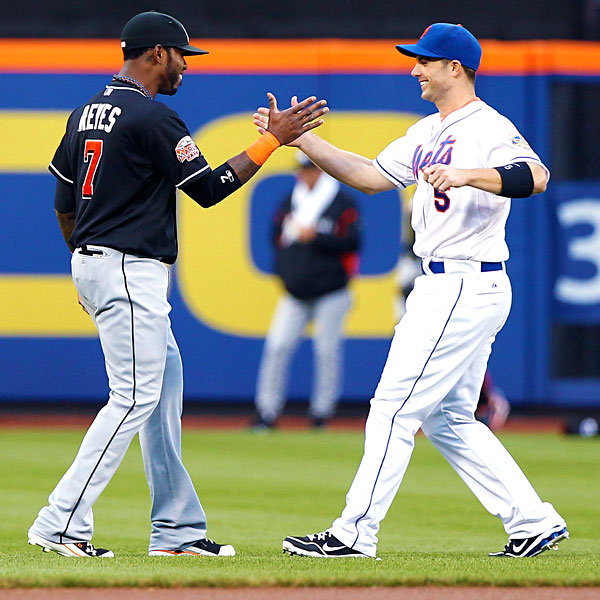
by Greg Prince on 31 August 2012 9:26 am  So we meet again this weekend…
by Greg Prince on 30 August 2012 8:57 pm Crazy how the baseball schedule sometimes does this:
On Thursday afternoon, August 30, 2012, the New York Mets finished a series with the Philadelphia Phillies at Citizens Bank Park.
On Thursday afternoon, August 30, 2007, the New York Mets finished a series with the Philadelphia Phillies at Citizens Bank Park.
The circumstances surrounding the respective one-run losses that resulted from these coincidentally slated finales couldn’t have been more different, yet my mind shot directly back five years as I paid half-attention to this year’s model, a 3-2 defeat that prevented a Mets sweep and leaves the Mets one game behind the Phillies in the nonexistent race for third place in the N.L. East. Jon Niese pitched OK, but not as well as Kyle Kendrick. Mike Baxter and Scott Hairston flashed some power but the bigger hits were spun by Kevin Frandsen and endless Ty Wigginton. Jimmy Rollins…
Well, Jimmy Rollins has been around a while now, hasn’t he? Five years earlier to the day, Jimmy Rollins was rolling up MVP points as part of the 17-hit attack that effected the harrowing 11-10 Mets loss of that final Thursday afternoon in August, which ended a four-game series that gone 100% in Philadelphia’s direction. By slapping the Mets every which way but loose between August 27 and August 30, the Phillies pulled to within two games of the first-place Mets, scaring the complacency out of a fan base that snickered the previous winter when Rollins had the temerity to announce his team — and not our team — was the team to beat in our division. Rollins backed up his insouciance with a 9-for-19 series and, along with a raging hot band of Phillie teammates, seemed to knock the “in” clear out of the Mets’ inevitability.
Then, for two blissful weeks, it was as if it had never happened. The 2007 Mets, so prone to lethargy since the end of May, got their act together and swept Atlanta in Atlanta, took two of three in Cincinnati, swept the Astros at Shea and then won two of three at home from the Braves. The New York lead returned to a rightful bulge of seven games with seventeen to play.
We know what happened directly thereafter and what hasn’t happened since. The Mets became distressingly and perennially evitable, the Phillies won the division and the Phillies kept winning divisions. Though there was a gap between the August 27-30 sweep and the collapse that commenced in earnest the weekend of September 14-16, when the Phillies came to Shea (accompanied for the very first time by their fans) and swept three more, I think it’s fair to say our world changed five years ago today. Or at least it offered evidence it was about to change for the much, much worse.
As for Rollins and the Phillies, five division titles, two pennants and a world championship is a pretty good half-decade’s work. That’s all ending for them now, as they, like us, are light years removed from the 2012 pennant race and it would take about six Worst Collapses Ever to catapult them into contention at this late stage of the season. Rollins could do no wrong five years ago at this time; he left that to the likes of Billy Wagner, who blew the save that would have salvaged the series for the Mets and maybe held off history for one more year or, if you’re a baseball romantic, forever. If the Mets emerge from that Thursday, August 30, with a win, it’s as possible as it’s not that they repeat as N.L. East champs in 2007, go to the postseason and who knows? Instead, we do know.
Jimmy, by the way, isn’t contending for MVP honors this year. As he’s gotten older, he’s somehow grown less mature. On this Thursday, August 30, he loafed to first base on an embarrassing dropped infield popup in the sixth and kept his head hidden well up his rear as he got tagged out in a rundown between second and third in the same inning. Charlie Manuel reintroduced his veteran shortstop to the bench shortly thereafter.
None of which helped the Mets in 2012 and none of which reverses the fortunes from 2007. But strange that the same teams were playing on the same day of the week at the same time of day on the same date on the calendar in the same ballpark so close in the same standings, and that Jimmy Rollins was once more at the heart of the story.
by Jason Fry on 30 August 2012 12:37 am In a season turned disappointing, Matt Harvey’s performances just get more encouraging.
Harvey throws a fastball in the high 90s and supplements it with a good curve and slider and a developing change-up, so this statement wouldn’t seem to be edging too far from the tree trunk. But none of Harvey’s pitches was working particularly well tonight — especially when the batter was Tyler Paul Cloyd, who’d never seen a pitch thrown in anger in the big leagues. (For whatever reason, Harvey was incapable of throwing the least-threatening hitter in the Phils’ lineup a strike, which seems weirder than it is, baseball being baseball and all.) Harvey tinkered and fought and gutted his way through, though, and the Mets did just enough to support him.
We haven’t thought much about Lucas Duda in weeks, but there he was, socking a two-run homer inside the foul pole, making a moderately difficult running catch in left-center to deny Ryan Howard, and even stealing a base. Duda is a player you root for, one who was put in a less-than-ideal situation and lived down to it, leading to his Buffalo exile. When he’s right, Duda has a precocious eye at the plate and very quick hands, not to mention enormous power. Those things aren’t easy to find. Unfortunately, Duda is also a first baseman who can’t play the positions available to him, something that was made painfully clear this year. His other potential flaw is more interesting to think about: Numerous accounts make it plain that Duda is too open about his self-doubt, which is perfectly forgivable in the real world but a sin in the baseball world. I remember Jason Jacome being shipped out soon after admitting to self-doubt — and Billy Beane’s painful recollection of being unable to get out of his own way mentally, coupled with the realization that dumb, blithely assured Lenny Dykstra had the better recipe for being a baseball player.
Where Duda’s concerned, the Mets seem stuck. He’d be better off somewhere he could play first or be a designated hitter, which would keep his mind (and everybody else’s) off his defense. But his poor year at the plate — which quite possibly began with his own struggles on defense — has turned him from prospect to suspect, decreasing his value. So the Mets are left hoping that Duda can find his way in left, which isn’t substantially an improvement over the plan that just landed him in Buffalo. And so we have a dog chasing its tail: Duda needs a change of scenery, but the Mets can’t get enough back for him to make that change of scenery happen.
Harvey doesn’t have this baggage — he’s a power pitcher, with no obvious weaknesses except a lack of experience, which ought to fix itself. But things happen to baseball players that you can’t see coming — in fact, such things happen to the vast majority of them. The arc that began with celebrating a childhood phenom gets interrupted somewhere before Cooperstown: Players get hurt, or fail to keep up with opponents’ adjustments, or age before their time, or somehow just misplace that unshakeable belief in themselves. Harvey looks tough and promising, and he is — but so were Hank Webb and David West and Paul Wilson and Bill Pulsipher and Patrick Strange and Philip Humber and Mike Pelfrey. Eventually we all realized they needed a change of scenery.
You probably came here expecting a rah-rah post — the Mets have won four in a row, tied the Phillies for third place, and their bullpen suddenly looks like it’s found its footing. And I was planning a rah-rah post, because this is fun and because it would be very, very nice to finish the year looking down at the City of Slovenly Thugs. But something about Harvey and Duda emerging as the heroes of the game derailed that plan. Matt Harvey is a key piece of our future, but not too long ago so was Lucas Duda. Nothing is forever and nothing is assured.
|
|