The blog for Mets fans
who like to read
ABOUT US

Faith and Fear in Flushing made its debut on Feb. 16, 2005, the brainchild of two longtime friends and lifelong Met fans.
Greg Prince discovered the Mets when he was 6, during the magical summer of 1969. He is a Long Island-based writer, editor and communications consultant. Contact him here.
Jason Fry is a Brooklyn writer whose first memories include his mom leaping up and down cheering for Rusty Staub. Check out his other writing here.
Got something to say? Leave a comment, or email us at faithandfear@gmail.com. (Sorry, but we have no interest in ads, sponsored content or guest posts.)
Need our RSS feed? It's here.
Visit our Facebook page, or drop by the personal pages for Greg and Jason.
Or follow us on Twitter: Here's Greg, and here's Jason.
|
by Greg Prince on 29 August 2012 4:47 pm I’ve always been fascinated by one-and-done Mets. Like Joe Hietpas and his one ninth-inning appearance behind the plate on the last day of the 2004 season. Like Mike Hessman and his one Mets home run across two months of 2010 despite his being billed in advance as the minor league home run king of minor league home run kings. Like Ray Searage and his 1-0, 1-for-1 Mets career pitching and hitting mark from 1981. Like Brett Hinchliffe’s emergency start in 2001 that resulted in an SOS calling of a cab to get him off the roster before he could cause any more of an emergency (2 IP, 9 H, 1 BB, 8 ER). Like — until further notice — the way Garrett Olson came up on August 8, made one appearance, left it with an ERA of 108.00 and was sent down probably not to be invited back.
Matt McDonald, Mets fan, FAFIF reader and talented producer of sports documentaries (including one of my ESPN 30 For 30 favorites, Small Potatoes, about the rise and fall of the USFL) alerts us to an intriguing baseball cause centered on a similar one. He’s working with One At Bat to, as the name would imply, get somebody one at-bat in the major leagues. The would-be batter in question is Adam Greenberg, a vaguely familiar name when Matt brought it up to us. By watching the promotional video Matt’s company, Triple Threat TV, put together, I was reminded of exactly who Adam is.
He’s the guy who came up with the Cubs in 2005, made his debut by stepping in the batter’s box against the Marlins’s Valerio De Los Santos and getting plunked on the very first pitch he saw. Or didn’t see. Adam Greenberg suffered a concussion and was removed from the game, never to make it back.
It’s not like Adam hasn’t tried to get back, and that’s the cause here. Seven years later, Greenberg is still working, still trying to get an official AB in MLB. He doesn’t have that. All he has is the one PA and one HBP, and he didn’t even get to stand on first. He was pinch-run for by Carlos Zambrano and his career was over.
One At Bat asks that it not be so, that Adam gets one more chance before this season is over. Ideally, it would be with the Cubs. They play the Astros late in the campaign in a game that most would describe as meaningless. It would be fantastic if the Cubs could inject a little meaning into it by adding Adam to their roster and sending him up one more time. If he walks and still lacks an official AB, that’s his problem. But he’d get a chance, which is all anybody is asking on his behalf.
Watch the brief film Matt sent over and, if so moved, sign the One At Bat petition. Do it for someone whose second chance would really be a first chance. Or do it because Mike Glavine nepotismed his way into seven big league at-bats with the 2003 Mets and this is a lot less creepy than that.
by Jason Fry on 29 August 2012 1:45 am In lost seasons — a subject about which we’re now experts — this is the toughest time. The dreams of contention are gone, and you’ve worked through the disbelief and the anger and come round to acceptance. Yet nobody’s moved on yet. The veterans who have shown themselves to be past their shelf life are still stumbling around out there, with the September call-ups yet to arrive and give you the distraction of hopeful maybes. Players who have had good years are trying to cement favorable impressions, while those who have had bad ones are waxing philosophical or insisting they’ve just found a hitch in their swing/shifted on the rubber/discovered a new regimen. Either way, minds are mostly made up. The exceptions are those few players in the middle, the ones whose seasons aren’t defined yet. (Take Ike Davis and his weird, weird year.) They’re the most frantic ones, hoping to claw success from the last few weeks. Elsewhere there are statistical goals to reach, most obviously 20 wins for R.A. Dickey, but mostly everybody’s getting ready to go home and we’re getting ready to let them.
It’s practically a Faith and Fear cliche for me to insist that in such days baseball does still have its pleasures — most notably that, hey, it’s baseball. Which is true, but can sound awfully hollow. The Mets got beat 16-1 and everybody booed and the place was empty but the ushers still enforced ticky-tack rules and Jason Bay struck out nine times and Lucas Duda fell down in the outfield and Ramon Ramirez gave up eight earned in a third of an inning and there was no 7 Super Express but hey, it’s baseball. See what I mean?
But then tonight was actually fun. One of the joys of this season turned sour has been the Mets giving the Phillies hell. We spanked them in April, swept them in May, and gave their crabby, violence-prone rooters ample evidence that their reign was over. The Phils have admitted as much, sending Shane Victorino this-a-way and Joe Blanton that-a-way (actually the same way, but hush) and playing out the string with Chase Utley and Ryan Howard returned from injuries and surrounded by fill-ins. They’re a third-place club, and we might still have something to say about that. Finishing third isn’t any great shakes, but finishing third in front of the Phils and Marlins really would make me happy.
The Mets certainly did their part tonight, coming back from a 4-1 deficit that saw poor Chris Young down a quartet of runs before he ever recorded an out. Young hung in there, and the Mets clawed back, raising the specter of some crazy 11-10 barn-burner that would be decided in extra innings. As it turned out the game did go extra innings, but not in that fashion: The Mets tied it on a two-run homer by Mike Baxter, evened things up on a David Wright sacrifice fly, lost the lead again on an Utley blast, then used a succession of effective relievers (???!!!) to hold the fort until they could draw even again on a Kelly Shoppach double that Domonic Brown played like a guy walking into a DMV. Then, in the top of the 10th, they ambushed the large, luckless B.J. Rosenberg, with Ike doubling in David, Lucas Duda driving Ike home despite Tim Teufel’s stop sign, and Shoppach paying tribute to the late Neil Armstrong with a blast halfway to the Sea of Tranquility. Mets 9, Phillies 5, thanks to their slugging catcher and effective relievers — the kind of statement that would have got you hauled to Bellevue for most of the 2012 season, but was true tonight. Crazy or not, didn’t it feel a whole lot better than that whole mess at home against the Rockies?
It’s not much — the Mets are 60-69, and a .500 season would be quite an accomplishment. But we’re resilient folk. Knock us down with a post-All-Star death spiral and after a little winning streak you catch us looking around and talking about how much fun it was. Because hey, it’s baseball.
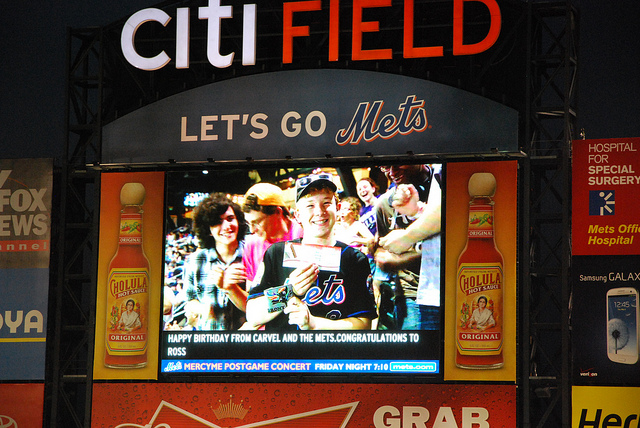
by Greg Prince on 28 August 2012 3:17 pm  Party in the park! As noted yesterday, nice things can happen to people at Citi Field even when they’re not happening to the Mets. When they’re not happening to the Mets, I find myself too grumpy to dwell on them. But with the Mets on a scintillating two-game winning streak, I’m in a good enough mood to mention a couple of nice things I respectively witnessed and was told of recently.
Sometimes it helps to not be too handy with one’s devices. A few weeks ago I was at Citi Field, fiddling with my phone during BP, noticing my home page had disappeared. It hadn’t actually disappeared, it turned out. It was just hiding, but I didn’t know that, so I kept messing around with it. And the more I mess around with my phone at Citi Field in particular, I’ve noticed, the quicker its battery life gets sucked up. Kind of the way the battery life of Chris Young and Josh Thole would get sucked up that night.
I just happened to have the phone out and in the palm of my hand while a recent Mets-Marlins game was in progress in my presence — the kind of behavior I usually frown upon in myself — when I noticed that literally 36 seconds earlier my Twitter feed was urging anybody celebrating a birthday tonight at Citi Field should Tweet that fact to @Mets.
My birthday’s in December, but the reason I was sitting where I was was that night was, in fact, celebrating a birthday. It was Ross Chapman’s 16th, and because it was Ross Chapman’s 16th, where else would he be but at a ballgame? His parents Sharon and Kevin had arranged for a veritable ballpark party for Ross and his friends, inviting a few adults along in the process, me included, for which I was grateful. In a moment of full cognizance, I Tweeted the appropriate hashtag as directed, gave our seat location and explained in as few characters as I am capable that I was with a birthday celebrant this very minute. Maybe, I mused to myself, somebody will swing by with a cake or something.
Then, because my battery life was getting dangerously sucked up, I turned the phone off and forgot about it. By doing so, I missed the following four messages from @Mets:
• “Congratulations on winning this evening’s #mymetsbirthday. please send your name and hometown.”
• “Greg…are you there? We need your response this inning. Your guest must be in his/her seat in the 4th inning”
• “Greg we are going to have to offer the prize to another contestant. My apologies”
• “Going once…..Going Twice…..”
I’m sitting there blissfully ignorant that Ross has won Birthday Fan of the Game because my home page disappeared hours earlier and because my battery does what it does and, for that matter, because three months earlier I had gotten stuck in the elevator in my building, which makes me very conscious of preserving battery life because without being able to call 911 that day in May on my phone, I’m not convinced anyone would’ve noticed me in there for innings on end (a different Mets-Marlins game had just started and I was damned if I was going to miss it while stuck in an elevator…though, to be fair, I did have my radio on me). Anyway, I didn’t know what was going on, until I thought I heard somebody calling my name.
Somebody was calling my name. It was the Mets Birthday Crew or whatever they call themselves for this promotion. Maybe I was the only one who Tweeted a birthday 36 seconds in to the promotion. Or maybe somebody figured a birthday celebrant shouldn’t suffer in the face of somebody else’s technological neglect, a.k.a. my not monitoring my phone properly. Whatever, the Mets showed up, Ross was pointed out, he was presented with his Carvel gift certificate (which I’m told a certain Carvel in the middle of New Jersey refuses to honor, but that’s another story) and the birthday boy’s party was featured on CitiVision for the whole park to see, as his mom’s photo can attest.
But it doesn’t even have to be your birthday for something good to happen to you out of the blue/orange at Citi Field. Hell, you don’t even have to be Ike Davis taking one final swing against the Astros.
At the beginning of the last homestand, the one with all those losses to the Rockies, I detoured from my lovely Monday evening with Sharon and fellow bloggers Taryn Cooper and Ray Stilwell to say hi to my buddy Jim. He and his friend George were raving about those new Pat LaFrieda steak sandwiches, and not just for the usual tasty reasons. See, Jim and George had arrived at the ballpark not long after the gates had opened. After reading the rave reviews, they made a beeline to Pat’s stand beyond center field and were the very first customers of the night. A coupla sandwiches, a coupla beers…it was all looking very promising.
Except for one thing. The cash register wouldn’t work. Wouldn’t open. Wouldn’t operate. Nothin’. There’s the food and drink on the other side of the glass and Jim and George are apparently irrevocably separated from it because there’s no practical way to effect a transaction. Jim would not have been surprised to have been expelled from the stadium as some sort of penalty for ordering the stuff in the first place. Yet the matter was resolved in a manner that left our patrons happily dumbfounded.
“OK, you get the sandwiches for free.”
Whaa…?
No, they really did. Jim was disbelieving and offered up compensation, but no, the register malfunction meant this was their lucky day, except for one caveat.
“But you don’t get the beer.”
“Oh no!” overruled a manager on the scene. “They get the beer, too!”
Jim repeated the dialogue for me as if he couldn’t believe that was the outcome. It was almost less believable than how badly the Mets were going to waste R.A. Dickey’s sublime pitching that night.
“But you don’t get the beer.”
“Oh no! They get the beer, too!”
More dumbfoundedness. That’s two steak sandwiches and two beers, approximately $46 in consumable merchandise, on the arm, as Jim likes to put it.
Yes, this was real. Yes, they ate and drank free. Yes, they enjoyed it very much.
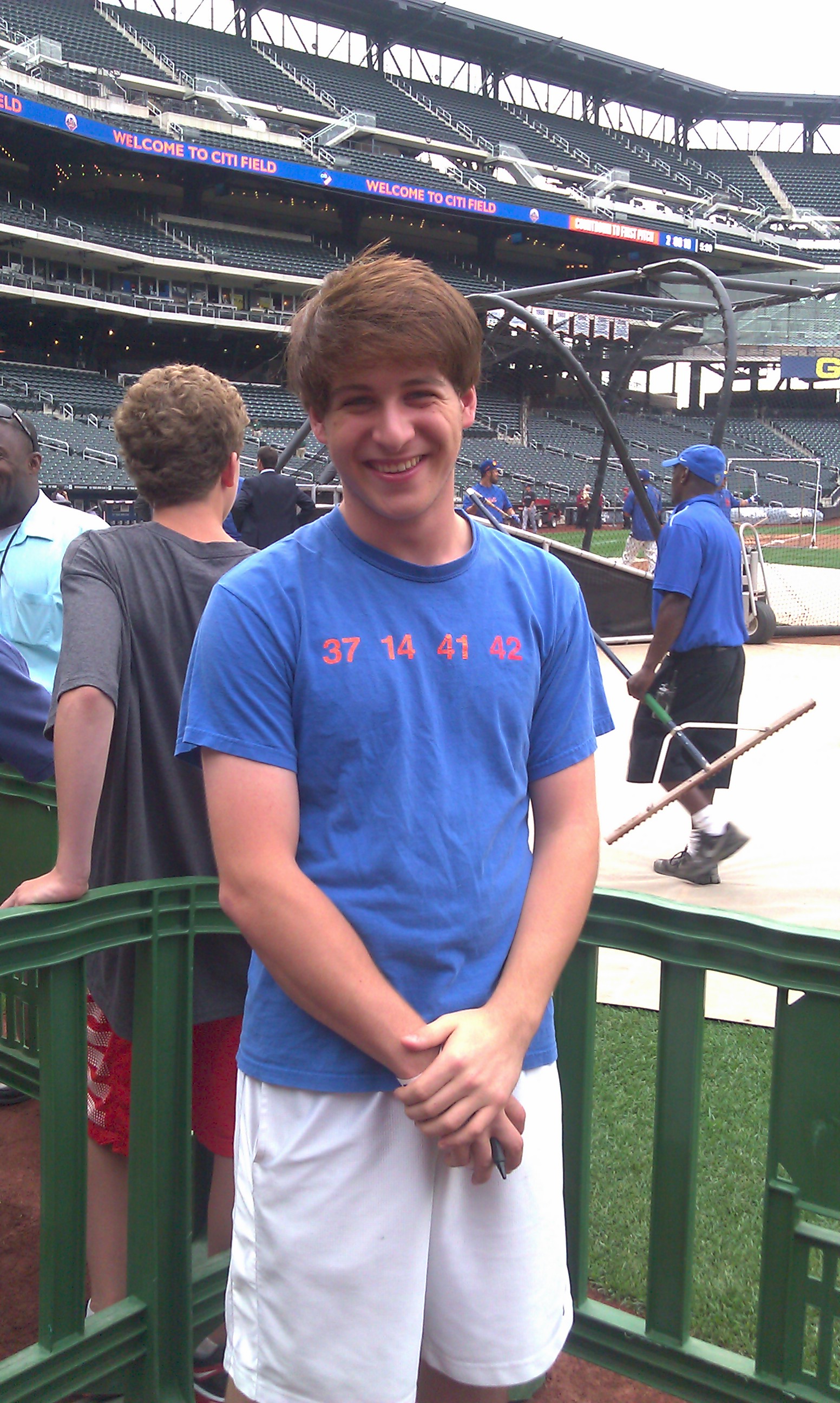
by Greg Prince on 27 August 2012 8:27 pm 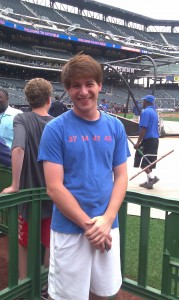 Ryder takes his FAFIF shirt out for a Citi Field on-field spin. Stephanie and I have enjoyed telling people we know Ryder Chasin since the day we met him at his Bar Mitzvah in the fall of 2009. If that sounds like an unusual place to meet somebody for the first time, Ryder was no ordinary Bar Mitzvah boy and the site for the celebration of his “becoming a man” not the kind of place where you’d necessarily figure on being any time of year, let alone a windswept November afternoon. That story is here, but I’m happy to report it merely serves as prelude to further chapters of our story together, the latest of them unfolding last Tuesday night at Citi Field — which included some time on the field with Ryder and his dad, Rob. Rob, it happens, knows somebody who knows somebody and…well, we took in batting practice from our own little barricaded alcove (SAT word!); sat in some incredibly close and cushy seats; enjoyed unusually personal attention from the Mets (including two autographs for Ryder from actual Mets Jordany Valdespin and Justin Turner); discovered what the little-known Payson entrance is for (consider it the Citi Field equivalent of Henry Hill’s Copacabana shortcut through the kitchen in GoodFellas); were directed to a complimentary pregame buffet; and watched our favorite team look typically horrible in losing to the Rockies.
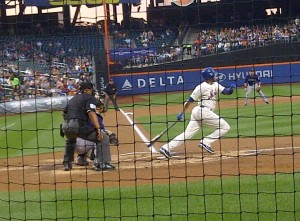 ‘Spin takes a shot at getting the Mets going before all turned typically horrible. But we could see it from so close! OK, so you can’t have everything. But with friends like Ryder and Rob, you can come pretty close to feeling like you do. Our thanks to them and whomever they know for letting us all pretend we were not just VIPs but VVIPs for a night. And, of course, thanks to the increasingly vertical Ryder Chasin — not yet 16 but already featuring more height than I’ll ever possess — for still fitting into his Faith and Fear t-shirt and thinking to wear it in a most appropriate setting.
by Greg Prince on 26 August 2012 11:46 pm “And it’s…GONE! Ballgame!”
“Ugh! I KNEW I shouldn’t have thrown that pitch!”
“But ya did! I win! Wanna play again?”
“Can’t. Gotta go.”
“OK. What about tomorrow?”
“Can’t.”
“Well, there’s always next time for you to try to get even.”
“Listen, I’ve been meaning to tell you…”
“What? That I just kicked your ass two out of three?”
“Nah, man. This is serious.”
“What?”
“I can’t play with you anymore.”
“What’re you talking about? We play each other all the time! Like since we were born, which was practically the same day!”
“Yeah, I know, but we’re moving.”
“Moving? Where you moving to?”
“The other league.”
“The other league? You’re kidding! We always make fun of the other league!”
“Yeah, I know, but my dad says that’s where he’s gotta go for work, so…”
“Aw, that’s stupid. There’s plenty of work in this league.”
“I know, but what can I do?”
“You and me not in the same league anymore? That’s crazy!”
“They say it’s nice over there.”
“Nice? You’ll get killed! You couldn’t even beat me, and I’m terrible!”
“Hey, I beat you the last time we played. I swept you!”
“That was like forever ago. And I was taking it easy on you.”
“Taking it easy on me? What about all those times I beat you?”
“You beat me? Ha! When?”
“Lotsa times! What about that time you won the championship? Who was it who you could NEVER beat?”
“Who won the championship, though?”
“I should’ve won the championship. I beat you and you beat that kid from the other league, so really I was the champion.”
“You’re nuts!”
“Uh-uh! I beat you like 10 out of 12 times that year!”
“But I won the championship! And that wasn’t the only one!”
“Shut up!”
“Shut up yourself! You were a big cheater and a sore loser that year!”
“Cheater? Says who? Prove it! Prove it!”
“I don’t have to prove it. I won! Even when you tried to get me in trouble, I won!”
“I didn’t tell you to do all that stupid stuff. Only an idiot would’ve gone to a place called Cooter’s after a game!”
“Cooter’s was cool. You were just chicken!”
“Chicken? You were chicken! You were afraid of a little sandpaper!”
“I can’t hear you. My championships are making too much noise.”
“That doesn’t even make sense!”
“What doesn’t make sense is you think you would’ve won if we’d kept playing except I won because I beat you fair and square.”
“I still beat you more. I beat you that time we stayed up all night, too!”
“I beat you that time we just kept playing and playing even though our moms were calling us to come inside!”
“Big deal! You didn’t even make the playoffs that year!”
“‘What’s that, championships? You’re both talking at the same time, and I can’t make out what either of you is saying, something my chicken friend over here doesn’t have a problem with because he doesn’t have any championships and now he’s afraid to play me anymore, so the big chicken is moving to the other league!’”
“Oh, you take that back!”
“Or what? You’ll close your roof?”
“I’m glad I’m moving!”
“I’m glad you’re moving, too!”
“You’re such a loser!”
“You’re a bigger loser!”
“Yeah, well…you only just got a no-hitter this year. I’ve got a BUNCH of ’em!”
“Yeah? Where do you keep ’em, on that stupid hill?”
“My hill’s better than that stupid apple!”
“That apple went up twice today! It means I kicked your sorry ass!”
“You’re just lucky I am moving, because otherwise I’d beat your behind so bad next year!”
“Some threat. Where ya gonna do it from, the other league?”
“Don’t you worry, I’ll be back at some point. Maybe not next year or the year after, but we’ll run into each other.”
“Yeah, well…I hope we do.”
“Yeah, well…me too.”
“I can’t believe we’re never going to play each other like regular ‘play each other’ again.”
“Me neither.”
“Seriously, watch yourself over there, OK? They can be real dicks in that other league.”
“You’re just saying that to scare me.”
“I’m not, man, really. They don’t even let you bat normally over there.”
“They don’t?”
“Nope. And you know how you and me play, like with a lotta pitching and just a little hitting?”
“Yeah?”
“It’s the total opposite over there.”
“What?”
“It’s messed up. I’m just saying watch yourself.”
“Don’t worry, I will.”
“Good. Because when we run into each other I want you to be in good enough shape for me to KICK YOUR ASS AGAIN!!!”
“You mean the way I KICK YOUR ASS most of the time?”
“You sure we can’t play just one more game?”
“Nah. I gotta go.”
“Good luck. I mean it.”
“Yeah. See ya.”
by Greg Prince on 25 August 2012 11:08 pm I went to the game Saturday, had a great time and the Mets won. Oh, how I’ve been waiting what seems like ages to say that.
No “despite” need be spoken. Nobody has to say, “Despite the way the game turned out, I had a really great time.” That’s the sort of thing I’ve been saying almost every instant I’ve left Citi Field over the past too many weeks. Lotsa laughs, swell food, pleasant weather, the whole bit.
But not the whole bit, because the Mets were biting it whole. The Mets were pitching but not hitting. Or, going back a thousand years, not pitching but maybe hitting. Yippee, there’s a new steak sandwich. Hooray, I took home a batting practice ball. Good for me, I got invited to sit in some beautifully primo seats. And, oh, what marvelous conversation!
The Mets lost. The food shouldn’t have tasted good. The balls should’ve been thrown back. The seats should’ve been flipped up in disgust. And the only thing we should’ve been saying to each other is, “This frigging team.”
I guess we did say that, but what we really should’ve been saying was stuff like:
• “Way to go not wasting R.A.’s seven innings!”
• “Fantastic that Turner finally homered!”
• “Some kinda catch, Scotty!”
• “Jason Bay’s not always completely useless.”
Here’s what we didn’t have to say on Saturday: Nothing about how much the bullpen blew because the bullpen was solid and stable for six outs; nothing about how we got beat by a bunch of bananaheads like the AAAstros because we have thus far split two games with those bananaheads; no assigning all our Player of the Game points to a miniature version of Mike Piazza because he’s the only one in a Mets uniform whose bobble was intentional; and no wondering if BTO could remember the words to “Takin’ Care Of Business”. Surprise, surprise, though the Mets win only once a week, Randy and Fred are still capable of getting up every morning from their ’larm clock’s warning to help us celebrate what is hardly routine enough to be considered businesslike (but tradition is tradition).
The Mets won! The best part of a very good day at the ballpark was the Mets winning! I went with one of my good friends; I ran into some other good friends; I had a nice if typically overpriced World’s Fare Market gyro for lunch; an uncrowded elevator magically opened on Field Level and whisked my party to Promenade; the vista from 517 was brilliantly expansive; the clouds didn’t threaten; I didn’t absorb a sunburn; no stranger in my vicinity bugged the spit out of me; the LIRR conductor asked me if I was going to “Shea”; and on the way home, at Jamaica, I answered some drunk wearing a BELTRAN 15’s cry of “LET’S GO METS!” with my own “LET’S GO METS!” I love all that stuff.
But what I really love is a Mets win. A Mets win — as Liv Tyler said toward the end of That Thing You Do!, I’d forgotten what you fellas looked like.
by Greg Prince on 25 August 2012 6:34 am There was a celebration in one clubhouse at Citi Field Friday night, where somebody actually found something unusual in beating the Mets. Houston’s interim manager Tony DeFrancesco — not to be confused with ’70s heartthrob Tony DeFranco of “Heartbeat (It’s A Love Beat)” fame — had just won his first game as a major league manager, as his 40-86 Astros downed Terry Collins’s 57-69 Mets, 3-1. Given that the 2012 Astros have been playing like the 2012 Mets not just for a half but for a whole season (except when they’ve played the 2012 Mets, in which case they might as well be the 1975 Reds) and that DeFrancesco is a local product who slogged through the minor leagues forever before getting what amounts to his big break when he was named Brad Mills’s successor last week, why shouldn’t somebody be a little extra happy in Flushing for one evening?
So Tony’s players doused him with champagne and Tony’s family and friends jammed into his office and Tony offered up giddy quotes about how “we’re going to change the attitude, we’re going to change the momentum,” which might indicate a lot of champagne flowed, considering all Tony’s team did was beat the Mets. But what the hell, a lot of people in the man’s life were happy for him.
“I’m sure my phone has got a few text messages,” DeFrancesco smilingly told reporters.
Terry Collins’s phone, on the other hand? His voice mailbox was pretty nearly full.
“Hello, Terry? This is Gil Hodges. I understand you’re having some trouble with those darned Astros. Don’t worry about it. In my best year, we lost to Houston an awful lot, yet things worked out for us. What you need to do is remind your players they’re to conduct themselves like professionals at all times, even when they’re mired in a slump. I found it helpful to march slowly but purposefully from the dugout and remove my left fielder when he wasn’t necessarily giving his all, even though my left fielder was batting .346. According to the statistical printouts I still receive up here, your left fielder is batting…hmm, must be a typo. It says your regular left fielder is batting .148. If that’s not a typo, Terry, I assume you’ve already marched slowly but purposefully from the dugout and removed your left fielder not just from left field but from the premises. And if you have a regular left fielder hitting .148, I also have to assume you have bigger problems than I can advise you on. You’d need a bigger miracle-worker than me to help you out with players like those. Good luck.”
BEEP!
“Is this Terry Collins? Yeah, hi, this is George Bamberger. I just wanted to thank you for managing the first Mets team in 30 years to not score more than two runs in seven consecutive games. Kind of nice for me not to look like the only stooge in the room anymore. No offense, huh? Hey, ‘no offense’ — that’s pretty funny, right? Seriously, pal, you might wanna think about taking a break next year. I told Frank Cashen I didn’t really wanna manage the Mets, but Frank was an old friend and talked me into it. Said I’d be working with the pitchers mostly. You know why? I had no hitters! I guess you know how that song goes. I’m lookin’ at the numbers and see you and me have similar stories. My team in 1982 got off to a nice start and everybody was really happy with the job I was doing and then…poof, there went that ‘magic’ crap. We lost 15 in a row that August. Try not to do that if you don’t wanna get hooked on the Maalox like I did. OK, bye.”
BEEP!
“Terry? Joe Frazier here. Ah’m real sorry it’s come to this. Managin’ in New York can be thankless and Ah’ll bet nobody’s thanked you lately for nothin’. ’Course when your team can’t score, can’t catch a break and the front office can’t give ya no help, it’s like tryin’ to trap a possum with raccoon bait. When mah Mets began tumblin’ downhill in 1977, Joe McDonald went out and got me Lenny Randle. He’s the fella who done punched his old manager in the face in Texas. Turned out to be mah best player for mah last few weeks at Shea Stadium. Maybe you gotta play your new guy Kelly Shoppach more or somethin’. He didn’t punch his old manager in the face, just stabbed him in the back, ah hear. Ah dunno. Ah never did, really. Hey, keep after ’em.”
BEEP!
“Hello? Hello? Terry? Hello? Uh, I don’t know if this is working. If it is, this is Wes Westrum. Listen, uh…hello? Ohmigod, isn’t this connection awful?”
BEEP!
“An’ I wanna say that furthermore when ya gotta team that ain’t scored more than a run in a week that ya gotta shake things up, that ya can’t keep runnin’ the same nine men out t’ the field an’ expect different results because Mister Webster defined that as insanity an’ I’ve been called some things in my time an’ insane was certainly among them, though they called me worse than that in Boston when I was managin’ the Bees as they wuz known at the time an’ they said ‘there goes Casey, his Bees don’t sting, they just stink,’ an’ they cheered might-ee-ly when I got hit by that cab an’ couldn’t come to the ballpark no more even though it was the only hit I saw all year that wasn’t given up by one’a my pitchers, but I learned not to take that kinda jibe personally because it all comes with the territory an’ when ya manage in New York City, the territory is hee-yuuuge an’ furthermore ya gotta chance to make a fine livin’ an’ get those endorsements even though sometimes the commissioner comes down an’ brings the hammer on ya because ya wear yer officially licensed uniform in a commercial for the sponsor’s product which may be meant for adults but ya gotta set an example for the kids who’re watchin’ but when yer team plays like my team did ya can be forgiven for takin’ a nip now an’ then between innings though I was always partial to playin’ the youth even though they stuck me with the old an’ infirm when I come outta retirement an’ I wuzn’t gettin’ any younger an’ our games wuz makin’ everybody age rapidly but not as rapidly as we wuz losin’, but that’s gonna happen in this game an’ what ya gotta do is take everybody’s mind off how yer trimmin’ the attendance an’ remind ’em of just how Amazin’, Amazin’, Amazin’, Amazin’ the club really is an’ hope nobody stops an’ asks what ya mean by that because between you, me an’ the center field flagpole, I never did but nobody ever asked an’ that’s maybe how ya distract yer writers long enough so yer youth can gain experience an’ come along slow fast an’ then yer a genius like I wuz when I had some players but until then ya gotta shake things up, an’ another thing…”
BEEP!
by Greg Prince on 24 August 2012 2:50 am “Pack it up. Pack it in.” Those are the words that usually play over the Citi Field loudspeakers when the Mets’ best player comes to bat. I’ve noticed the song before but was never quite moved to put the lyrics into proper context until Thursday, when I sat again through nine gnawing innings at the house of pain and watched the Rockies anesthetize the Mets for a fourth straight game — or would the proper term here be euthanize?
No, because the Mets have yet to be put out of their or our misery. They owe their fellow National Leaguers 37 chances to get their momentum on against them. It worked wonders for the Rockies, who didn’t look like world-beaters in effecting their four-game sweep, but they weren’t taking on the world. They were taking on the Mets. All they had to do was wait out another superb starting pitching performance and…that was basically it.
Let’s review:
• Monday night, R.A. Dickey throws seven innings of one-run, three-hit ball. Mets lose, 3-1.
• Tuesday night, Chris Young begins his evening by throwing five perfect innings. Mets lose, 6-2.
• Wednesday night, Matt Harvey strikes out nine while giving up one run and three hits over six innings. Mets lose, 5-2.
• And on Thursday afternoon, a beautiful day for a ballgame if only the Mets had decided to take part in one, a young fellow named Collin McHugh made his major league debut, shut out Colorado for seven innings on two hits while striking out nine. Mets lose, 1-0.
To be fair, the Mets were facing Christy Mathewson, Bob Feller, Sandy Koufax and Randy Johnson, which would explain why they scraped together only five runs over four days.
Correction: the Mets were facing Alex White, Jhoulys Chacin, Jeff Francis and Tyler Chatwood, which didn’t really seem to have anything to do with the Mets’ inability to score. Those guys — none sporting a remotely impressive WHIP or ERA+ in 2012, could have been any guys Jim Tracy picked up outside the Flushing Home Depot for a day’s work. The Mets who weren’t Dickey, Young, Harvey and McHugh conducted themselves across four games as if they’d packed it up, packed it in and prepared to jump on the first plane to their autumnal hunting and fishing trips.
McHugh looked very solid, albeit against the Rockies, who somehow have a worse record than the Mets, but men with bats are men with bats, and those men wearing the purple tops (which always appear blue on television) didn’t do a thing with the kid. Conversely, the Mets apparently did a few things with Chatwood, Adam Ottavino, Rex Brothers, Will Harris and Matt Belisle, though they were only commendable in the version of baseball in which getting to second base — as a Met did in seven of nine innings — is considered an outstanding achievement. Perhaps Coach Terry is handing out self-esteem ribbons for advancing 180 feet, but the rules by which everybody else plays dictate trips to third and home are prerequisites for success, and the Mets opted not to visit either of those sites Thursday.
The defense, this time in the guise of second baseman Jordany Valdespin in center field, committed its customary lapse; the bullpen, represented by hard-throwing liability Bobby Parnell, found a way to not hold the fort; and Terry Collins undermined what tiny chance of redemption his group had by calling for a sacrifice bunt in the ninth inning because the Mets can easily afford to give up outs. Baserunning was also abominable, as admirable Mike Baxter, whom we promise to ply with pilsner in the offseason, staggered tipsily between first and second on a fly ball just tricky enough to trick him into an out.
All this sizzling 1-0 action took 190 minutes to complete, which gave me plenty of time to engage in baseball and sundry conversation with fellow blogger Sam Maxwell on my right and award-winning photographer Sharon Chapman on my left while we occupied a shady swath of seats out in left field. It was midday human contact I surely appreciated (just as I enjoyed my time with several swell Mets fans Monday and Tuesday nights), but I really wouldn’t have minded a little yappus interruptus so we could ooh and aah at some Met home runs. Or run-scoring hits of any kind. Or runs generated by any means necessary. Or maybe a first-and-third situation.
There was none of that. Just a canyon of zeroes accompanied by the steadiest of dull aches.
by Greg Prince on 23 August 2012 2:42 am There are several numerical ways to flesh out the state of the Mets after Wednesday night’s rerun of Tuesday night, which was a carbon copy of Monday night (assuming that creepy dude from W.B. Mason still sells carbon paper), which wasn’t materially different from Sunday afternoon’s defeat, if you can remember back that far in this abysmal blur of a second half. The differentiator most recently was Matt Harvey’s tough, brilliant, faultless six innings of nine-strikeout pitching. No other Met meaningfully distinguished himself. The Mets lost, 5-2, after losing, 6-2, after losing, 3-1, after losing, 5-2.
Or you could say they’re losing, 19-7, and will likely resume losing at 1:10 this afternoon.
The Mets have lost 28 of their last 39 games, just about all of them by a score of 5-2, or so it seems. Their last comparable extended stretch of second-half futility occurred in 2009, the year when everybody was seriously injured or spectacularly inept, occasionally both. They stumbled to 27 losses in 37 games at one point. The 2004 Mets lost 29 times in 40 games down what others would call the stretch but what we recall as the last days of Art Howe.
That’s the company your 2012 Mets are keeping right now. Also, the Houston Astros. That is to say that unless there is a dramatic reversal of fortunes, the Mets and the ’Stros will go down as the only two National League teams to have not compiled a winning record over any of the last four seasons. With the welcome ascension of the Pirates and the unstoppable surge of the Nationals, everybody else will have had at least one 162-game span of competence in the current quadrennium. But nobody from the Expansion Class of 1962.
The bullpen has at least a little something to do with the Mets’ tragic number for ensuring a fourth consecutive non-winning campaign is suddenly 14. Here’s something to chew on that — unlike Tums but like the Mets — will give you no relief: The Mets have eight pitchers on their books in 2012 with ERAs over 6. Some are no longer here, some are very much here, some of the samples are thankfully small, but each pitcher in question did his worst to contribute to the damage:
• Frank Francisco: 6.42
• Elvin Ramirez: 7.30
• Robert Carson: 7.36
• D.J. Carrasco: 7.36
• Manny Acosta: 8.39
• Pedro Beato: 10.38
• Chris Schwinden: 12.46
• Garrett Olson: 108.00
Schwinden absorbed most of his blows in two starts, and Olson’s three-digit earned run average was compiled in all of one-third of an inning, but when you’re talking 12.46 and 108.00, the moment for niceties has passed. Speaking of which, after Francisco raised his ERA from 6.06 Wednesday night, he took his frustrations out by hurling a Gatorade cooler as hard as he could.
Naturally, some random Rockie rookie lined it to right for a double.
Overshadowing miserable Met relief pitching and even Harvey’s singular progress was the news that the Mets came up with a relatively graceful way to shut down Johan Santana for the rest of 2012. They took an MRI, they found something not good but (supposedly) not terrible with his back and now he’s on the disabled list. This is what passes for good news in the August 2012 Mets’ world. I had hoped Johan could be eased off the mound for the year after throwing five solid innings — consecutively, not cumulatively — but I’ll accept that he was periodically capable for a few batters at a time over his last five historically horrid starts so that we don’t have to spend all winter wondering if he has anything at all left.
I’m sure he does, but everything since Reed Johnson crunched his ankle on July 6 has been such a nightmare that one is entitled to wonder if rest and rehab is going to bring him back to the pitcher he was for the first three months of 2012. It’s such an eerily familiar refrain: Johan will go to Florida and get ready for Spring Training. It’s as if “Florida” is where the Mets tell kids where their favorite injured players went — kind of like That Farm Upstate. This makes it four of five years that he’s been a Met when a season ends with Santana long absent from their rotation as the year ends. The cycle of long-term contract grief just goes round and round in that regard.
But it had to end this way after he slid from three perfect frames to start against Washington last Friday to frighteningly ineffective over the next two. He stood bravely in front of his locker later saying he planned to make his next start, the one that will now be assumed by Collin McHugh. I didn’t believe it when Johan said it. I don’t believe Johan believed it when Johan said it. When I saw Johan say it, I thought of Spencer Tracy as aging Mayor Frank Skeffington in The Last Hurrah, voted out of office after an eternity of dedicated service to his constituents. In his concession speech, Tracy announced he planned to run for governor.
A couple of scenes later, he was dead.
Which brings us back to the Mets and how they’ve played this August and every August since 2009. They’ve participated in 103 games in these past four Augusts and lost 64 of them. The Mets of 2009, 2010, 2011 and 2012 haven’t necessarily been great from April through July, but when make-or-break time rolls around, the Mets roll over. Translating that 39-64 mark to a full MLB season, they’ve howled their way to a 61-101 pace, or as “dog days” as it gets.
Make no mistake: “dog” is an appropriate phrase to apply to this August edition of the Mets, and not in the man’s best friend sense. The Mets haven’t just given up. The Mets give up over and over. The Mets do not play hard. The Mets do not play to win. The Mets do not play not to lose. The Mets play to get it over with. You can see that on SNY and WPIX (unless Cablevision prevents you from the latter). I saw it from very up close Tuesday night as I was privileged to sit next to some of my favorite folks in one of those cushy seats three rows behind home plate — which is part of a nicer story that deserves telling in a sunnier context — and observe from as near a vantage point as one can what a baseball game really looks like when the home team is neither trying nor succeeding.
The Mets looked so beaten from the start, so overmatched — by nine guys wearing Rockies uniforms, eight of whom I’d never heard of before Monday night. What killed me about it, as I watched each Met take his on-deck swings; study the opposing pitcher; step to the plate; and theoretically compete was how little effort seemed to inform their approach. There was very little hustling to first base. There was very little hustling in general. There was an air of que sera, sera to the whole enterprise and very little ability visible to the not wholly untrained eye. Sure, I show up in a good seat and now I’m an expert, but I’ve been watching the game for 44 years. I’d recognize a spark if I saw one. I saw none.
Then just to make sure my eyes weren’t lying to me, I watched Wednesday on TV to see if I was missing something in person. I don’t think I was. These guys these last two nights, excepting Harvey for six innings and Chris Young before he hit his predictable wall, are lacking purpose. They show up at the office because they have to. I watched BP Tuesday night from the field, not the first time I’ve done that in this current malaise period. BP may rightly be described as a “colossal waste of time,” but whose fault is that? If you play for a team that’s lost massively more than it’s won for more than a month, why on earth wouldn’t you use your time seriously and intensively to improve yourself? The Mets come on the field, get in the cage, do what their routine dictates and prepare to be beaten by teams as good as the Nationals and as bad as the Rockies.
That’s how it looks from here, anyway. When Terry Collins insists his teams don’t play fundamentally unsound baseball, he’d be advised to take a look, too. Because the only team he has does play fundamentally unsound baseball. Their lack of talent — which even Sandy Alderson explicitly acknowledged to Mike Francesa Wednesday afternoon (can somebody tell me his vaunted “plan” again?) — is forgivable on an individual basis. But a) not doing things full-out and b) not doing things correctly are the baseball equivalent of sinful. Alderson is charged with constructing a representative roster, which he and his staff haven’t done (due partly to lingering Minaya and Madoff effects and partly to his own staff’s misjudgments). Collins is charged with having the players who are here en pointe, as they say in ballet. He should have them ready to go from the first pitch and ready to fight to the last pitch.
He has them ready to go home. Or they’re ready to go home, and he and his staff haven’t done enough to maintain their readiness. Collins isn’t responsible for the first two dismal Augusts noted above but the last two are all his, especially this one. Collins was congratulated far and wide for having this bunch playing the right way in April, May and June. There’s nothing to recommend whatever he’s doing since July got going and August proceeded to sink its claws into the Mets’ will to live. I’m not calling for the manager’s head, because honestly I’m tired of regime change, but as a longstanding advocate for and customer of this team, I am yearning for some kind of shakeup. He’s gotta do something different now, just as Alderson has to get him a whole lot of somebodies different eventually. The pixie dust from the season’s first third has left no residue. It’s another awful August in another awful era.
And man, it is awful. Sunday afternoon, in my de facto drug-induced state, I listened to Eddie Coleman take calls while he sat in Nationals Park riding out the rain delay. A cheer went up behind him. It wasn’t the tarp coming off the field, he explained, but the crowd reacting to the Dodgers doing something to the Braves on DiamondVision. The Nationals are in a pennant race. Their fans — whatever their caliber of fandom — have something to cheer about, something to be invested in this August. The Braves fans have that. The Phillies and Marlins fans don’t, but at some point in the past four years, they’ve been able to take their team varying degrees of seriously. Across the National League Central and West in August from 2009 to 2012, acolytes of every team but the Astros have been able to pay attention to the scoreboard like it matters in at least one August because it has mattered to them.
It hasn’t mattered to us since 2008, which is now a very long time ago. Never mind how 2008 and 2007 ended in shame. At least we had an August. We’re barren now. We’re reduced to straining to eavesdrop on others’ Augusts. Good for the Nationals fans. Good for the Braves fans. No good for us now or lately.
Yet I do watch and I do listen and I do attend, even when there are no cushy third-row seats waiting for me. I was at three consecutive Mets-Marlins game two weeks ago. I will be at today’s Mets-Rockies game after having been at Monday’s and Tuesday’s. I will be at Saturday’s Mets-Astros game. I’m there with people like me who don’t give up our affinity just because the Mets have taken away the significance of our Augusts. We love our team and our habit too much, no matter that we are shy of a logical reason why we should. We love the game even though the games are detestable. We love the ritual no matter that losing has uncomfortably become part and parcel of it. We love baseball and we’re not severely interested in anybody else’s version of it except ours.
It is our blessing when we anticipate it and arrive to be immersed in it, and it is our curse as it unfolds unhappily before us. Yet here we are caring about it, because once August becomes September and September becomes a memory, lousy Mets baseball will be vaguely preferable to none at all. Not by much, but by enough.
Still, it shouldn’t be this way. This fan base deserves better. Every fan base would say so on its own behalf, but it’s really been so long since our Augusts bristled with anything but disgust that one can objectively say it’s our turn to have a whirl in the pennant race spotlight. The Nats are finally getting theirs. The Pirates are finally getting theirs. The Orioles in the other league are finally getting theirs. The Mets are getting nowhere except deeper into their annual August nothingness.
Run to first, at least. Run to first and sprint to September. It won’t kill you and it can only make us stronger.
by Jason Fry on 22 August 2012 12:32 am As I wrote yesterday, the Mets do nothing and then they do bad things and then they do dumb things. That was true again tonight, except it was far worse. Yesterday’s game was depressing and discouraging. Tonight’s was infuriating — a bone-headed, brain-dead disaster that was sickening to witness.
The Mets are utterly horrible and completely unwatchable. This is the worst stretch I can remember since the Mo Vaughn days of winless months at Shea, in terms of a team plummeting through apparent rock bottom after apparent rock bottom. It’s true that bad teams — and by now it’s clear that’s what the Mets are — have stretches like this. But there’s a danger to this 11-27 disaster beyond what it does to the club in the standings and to our blood pressure in the stands.
This isn’t the last two weeks of the season — the Mets have 39 games left, which will be played over the next 43 days. That’s a long time — longer than God made it rain to wash everything off the Earth that wasn’t on an ark, to invoke a disaster that right now seems only slightly larger. If you average out speedy games on getaway days and extra-inning slogs, it’s a good 117 hours of baseball yet to play.
One hundred and seventeen hours is a lot. At a comfortable pace you could use that time to walk from Manhattan to Pittsburgh, or see the entire run of “The Sopranos,” start over and get halfway through it again. If the Mets are going to play 117 more hours of lethargic, horrendous baseball — which right now seems all too likely — those 117 hours are going to have a corrosive effect on a fan base that is already battered and cynical. It will obscure the message that there is a long-term plan aimed at restoring the Mets to respectability and contention. The effect will be measurable in tickets not renewed and fans who wait to come out to see Matt Harvey and Zack Wheeler and other names we don’t know yet, or who never turn out at all. It will make things that are hard enough even harder.
Yes, this was fundamentally a year about stepping away from the old, bad Mets of Omarpalooza contracts, and not yet a year about putting finishing touches on a winning team. The horror of the second half doesn’t invalidate that plan — though the fundamentally disappointing or derailed campaigns for Ike Davis, Lucas Duda, Josh Thole and Dillon Gee sure don’t help. But it makes it a lot harder to sell the future to free agents and fans and everybody else. Waiting for the future demands patience, yes — but there’s patience, and there’s enduring a disaster of these proportions. The latter makes it a lot harder to ask for the former when you need to.
I don’t know what the hell the Mets ought to do, but they need to do something — even if it’s just for the sake of doing something. Maybe it’s firing coaches, or putting dirt on the corpse of Jason Bay seven months early, or dispatching players who can’t seem to pay attention to baseball for three hours to Buffalo or the unemployment line. Would any of that fundamentally change the product on the field? I doubt it. But as Terry Collins noted in a different context tonight, in denying/admitting/waxing philosophical about whether his team had quit or not, sometimes perception is reality. The perception around the Mets right now is rotten to the point of dangerous. That can’t be allowed to become reality any more than it already has.
|
|