The blog for Mets fans
who like to read
ABOUT US

Faith and Fear in Flushing made its debut on Feb. 16, 2005, the brainchild of two longtime friends and lifelong Met fans.
Greg Prince discovered the Mets when he was 6, during the magical summer of 1969. He is a Long Island-based writer, editor and communications consultant. Contact him here.
Jason Fry is a Brooklyn writer whose first memories include his mom leaping up and down cheering for Rusty Staub. Check out his other writing here.
Got something to say? Leave a comment, or email us at faithandfear@gmail.com. (Sorry, but we have no interest in ads, sponsored content or guest posts.)
Need our RSS feed? It's here.
Visit our Facebook page, or drop by the personal pages for Greg and Jason.
Or follow us on Twitter: Here's Greg, and here's Jason.
|
by Greg Prince on 14 August 2012 6:22 am Forty seasons of home games at Shea Stadium and Citi Field. Literally hundreds of visits. Wins. Losses. Elation. Heartbreak. The gamut of human emotions. The whole bit.
Except for a ball. I had never gotten a ball from the field of play. Not foul, not fair, not batting practice.
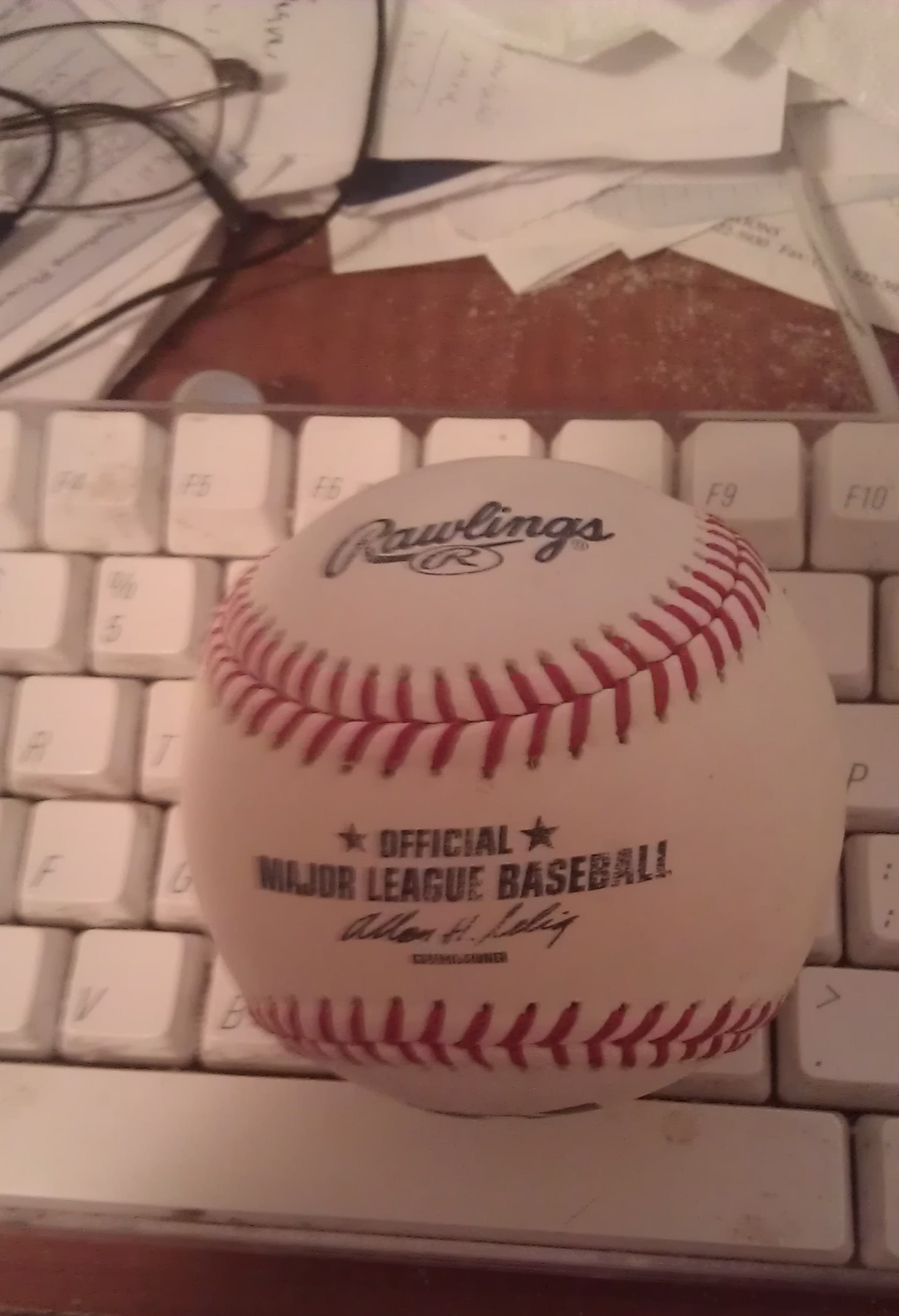
 Mine. But that has changed. Thirty-nine years and one month after attending my first Mets game without my glove — because my camp counselor Marvin told us we’d just lose ’em if we brought ’em — I got a ball. A glove wouldn’t have done me much good in the process of getting the ball. A catcher’s mask, however, would have been dandy.
This was last Wednesday evening, a little more than an hour before gametime, the Blogger Night portion of my second visit to Citi Field over three consecutive days. A little later I’d be a regular fan, sitting with some good friends who had kindly invited me to join them before I knew this would be a Blogger Night, but for now I was being quasi-media, specifically part of the blogger gaggle (or bloggle) interviewing Bobby Ojeda in a Pepsi Porch huddle during Marlin BP.
I was diligently taking notes, mentally preparing my own question for Bobby O about why announcers are suddenly referring to “little” cutters and not just cutters lately, when someone in our ranks shouted, “LOOK OUT!” In that once-a-generation way I have of not reacting properly to onrushing trouble (like the night I graduated from college, opened a can of Old Milwaukee and didn’t think to aim its contents at the nearby sink when they exploded like a geyser, instead mindlessly spritzing the veritable beer fountain at everybody else in the room), I didn’t look up. We’re all the way up here, I thought. What are the odds of a ball reaching us?
My mistake came from forgetting that these weren’t the Mets practicing batting. A little while earlier I stood on the field and watched the Mets swing, at best, for the warning track. Only Daniel Murphy got one over any fence, and then just barely. He surely didn’t reach the Pepsi Porch. No Met did. But this Marlin — and at first I couldn’t tell which one it was — seemed to be doing OK in terms of loft and distance.
“LOOK OUT!” someone shouted again.
There was a commotion and lots of sensible ducking in our tightly gathered group. Even Bobby O, fearless on the mound in his Met heyday as he is behind his SNY desk now, isn’t anxious to take on flying horsehide without a mitt. The ball hits something or somebody. And then it ricochets off the cement and…
…ouch. I mean OUCH! Really OUCH! Damn ball got me in the right jaw. A Major League Baseball when hit by a Major League Baseball player after it’s been tossed slowly by a Major League Baseball coach is HARD! Nothing on my face or in my head seems broken or out of place, but it’s definitely a jarring experience, comparable to being tapped on the rear bumper in stop-and-go traffic. You’re pretty sure you’re OK if you’re not the litigious type but you’re honestly not sure.
The ball smacks my right jaw and then it goes I don’t know where. Somebody, I don’t know who, has it. Then somebody, I do know who, announces that it glanced off his hand in the first place and therefore he is entitled the spoils. He is handed the ball and stands up waving it in the air pretending to be a fan who has caught it on the fly.
Three thoughts instantly cross my mind.
1) Ouch, still.
2) We’re pretending to be working journalists up here, so it’s unbecoming pretending to be fans, thus I find the waving of the ball a little out of place…even though we’re all really just fans with blogs (this Blogger Night business is always put forth courteously and professionally by the Mets, and I’m continually grateful for the opportunity to take part and have a bit of behind-the-scenes access that allows me to write with a different perspective from time to time…but, honestly, the we’re media but not we’re not really media conceit never quite hits the experiential mark as squarely as the ball hit me in the face).
3) I will be goddamned if this story becomes “the ball hit me squarely in the face and I didn’t even get the ball.”
Really, that’s mostly what I’m thinking as Bobby O returns to his seminar on pitching and I reflexively take my reporter’s notebook and whap the guy with the ball on his left shoulder. I whap him once…twice…on the third whap, I get his attention. He turns around.
“Hey! The ball hit me in the face!”
Without a word, the guy stops waving it and wordlessly, honorably hands it to me. I fondle it briefly and then drop it in my bag, returning to my note-taking, stealing only five or six glances at it for the rest of the Ojeda availability.
A few followup thoughts:
1) It’s a BP ball, which is to say it has no 50th Anniversary Mets logo, which is too bad, but after decades of waiting, bloggers can’t be choosers. To be clear, however, it is an OFFICIAL MAJOR LEAGUE BASEBALL for sure; it says so right over Allen H. Selig’s signature.
2) If there was as much poetry in baseball as we like to believe, the ball would have been hit by Carlos Lee, because Carlos Lee hit the only ball I ever retrieved in an OFFICIAL MAJOR LEAGUE BASEBALL game, on July 26, 1999, at new Comiskey Park. Lee is a Miami Marlin these days, so theoretically he could have been reaching out to me again. But it wasn’t Lee. Putting together the fact that it was a lefty and it was a player wearing what from a distance appeared to be “25” (but that’s a coach’s number on the Marlins), I have since deduced that the Marlin who socked me in the jaw was No. 26, Greg Dobbs, who socked Jorge Sosa with a grand slam on September 16, 2007, when he was with the Phillies at one of the hundreds of Mets home games at which I didn’t get a ball (and one of the dozens involving heartbreak). Dobbs and Lee — and Ken Landreaux, my Spring Training 1982 patron — are now forever linked for me. But I still can’t stand him more for the grand slam and everything else he’s done to us as a Phillie/Marlin than I appreciate him for the ball.
3) To be on the field before a game, you have to sign a waiver saying, essentially, that if a ball hits you, the Mets are not responsible. I don’t think that mattered once were in the stands, where your ticket says basically the same thing. Anyway, there was nobody to sue and nothing to sue over. Our PR tender did express concern and I’m sure would have summoned medical help if needed. But I was fine. Or was by morning when the “jarred” feeling dissipated for good.
4) There’s a guy who apparently lives to nab zillions of balls in BP and during games. One is plenty for me, though I make no guarantees I won’t lunge for a second should a ball head toward me in less aggressive fashion in the future. Actually, I’ll probably just do a better job of ducking.
5) Thanks to Chris McShane’s Amazin’ Avenue transcription, I can tell you exactly what Bobby Ojeda said when I asked him what the deal was with the “little cutter,” which I took as some kind of slap at any pitcher who didn’t throw big manly fastballs:
“I think it’s just a word, a descriptive word people use […] You’ll hear, ‘he’s got a deep slider, it’s got some tilt to it.’ We all know tilt, this [gestures as if he’s throwing a slider] is the tilt of a slider. The cutter’s a little bit flatter. The cutter is meant to go in and just get off of the barrel and get inside the label, if you will. That’s the cutter. So when they say, “he’s got a little cutter,” it’s just a term that we throw out there when you have to talk every single day — or write every day, as you guys know — you throw out words, you don’t really mean it as it’s written, you mean it as mildly descriptive.”
Nice of Bobby Ojeda to frame himself as just another communicator groping for a linguistic changeup the way any of us seated around him not sporting a 1986 World Series ring would…except he was the only one sporting a 1986 World Series ring, so that — and the preferring not to take on a red-stitched projectile missile off the bat of Greg Dobbs — might be the only thing he and I truly have in common.
by Jason Fry on 13 August 2012 12:36 am Whoa. I just woke up from the weirdest dream.
The Mets were up 6-1, and it was a laugher. Totally easygoing Sunday night game, the kind you kind of stop paying attention to while still enjoying because you’re tired and starting to think about the week ahead and anyway you’ve won. All this cool stuff was happening in the dream, too. Jordany Valdespin hit a homer instead of flailing at an offspeed pitch at his ankles. And Jon Niese was pitching well, really well — I knew it was a dream because he wasn’t having one of those Jon Niese innings where something goes wrong and then something else goes wrong and then Niese pouts and sulks and acts like he’s too cool for this noise and the next thing you know he’s given up three or four runs in the frame and is looking stunned and resentful, like a big part of the problem isn’t his own inability to bear down.
I even dreamed Ben Sheets was back, wearing a Braves uniform. I think that one’s a recurring thing. Like I said, weird.
But the thing is, then it turned into a nightmare. 6-1 in the ninth, ho hum, right? Josh Edgin was pitching, which wasn’t a surprise because I’d been dreaming that we had an effective reliever since, oh, April. But Edgin walked our old friend Chipper, and then he hit Freddie Freeman right in the back, and I started to toss and turn and mutter things in my sleep. Then he struck out Dan Uggla and got Brian McCann to fly out, and I must have sighed and tried to sink out of the dream and back into a deep sleep, because now the Braves were down to their 27th out.
Except I dreamed Edgin walked Paul Janish to load the bases. And so Terry Collins brought in Frank Frank, and Frank Frank walked Juan Francisco after an at-bat that lasted several days, which is the kind of weird thing that happens in dreams, so it was 6-2 and the Braves had the tying run at the plate.
And so I kind of woke up a little, you know, when you wind up talking back to your dream? And I was like, Yeah right, dream. You’re just trying to scare me, but c’mon. Enough with the dramatics; I’ve got stuff to do in the morning.
But then Frank Frank walked Michael Bourn, almost hitting him in the chin, and it was 6-3 and the tying run was a very fast man on first base, and now I was trying to wake up but I couldn’t.
And then Frank Frank gave up a two-run double to Martin Prado and it was 6-5 and I was frantic and managed to claw my way up out of sleep, like you’re at the bottom of a deep dark lake, and I thrashed and thrashed and finally broke the surface and was AWAKE. Like, whew. That was freaky.
So I put my head back down — but the dream started up again. Picked up right where I left off, only now Jon Rauch was pitching, and in my dream he was even bigger than in real life — like twelve stories high and made of radiation. (Great but NSFW.) And Jason Heyward was up and this was suddenly a full-fledged nightmare, with cold sweats and the whole works.
Rauch got to two strikes and then threw a little slider in the dirt and it was like the dream slowed way down. The ball was right under Rob Johnson’s butt, spinning there in the dirt, only Johnson couldn’t find it. AUGGHHHH!!!! NOOO!!!!! Johnson looked this way and he looked that way and he looked behind him and I was trying to yell NO! ROB! RIGHT UNDERNEATH YOU! but no sound was coming out and Heyward was sprinting towards first. And finally Johnson found the ball and everyone was screaming, including me. But, see, he had to take a couple of steps into foul territory so he’d have a throwing angle and not hit Heyward in the back, and he rushed the throw — alligator-armed it into the dirt. It actually bounced and Ike Davis put his glove on the ground right at first base and Heyward was less than a step from the bag. And I’m thrashing around trying to wake up, freaking out that the ball will bounce away or hit Heyward in the ankle or Heyward will actually step on Ike’s glove and tear it off and the glove will go one way and the ball will go another way and the umps will have to look at the rulebook while everybody tries to figure out what to do and of course the call will go against us because we’re the Mets.
Except somehow Ike dug it out and didn’t get stepped on, and Heyward was out by an eyelash and the Mets all came off the field looking pretty sheepish about things, but they’d won. And I woke up.
What’s that? Why can’t I just dream something normal? I don’t know. I’d like to, I really would — I was enjoying my dream of being up by five and thinking good thoughts about Jon Niese. I don’t know what to tell you. Since about the All-Star Break my dreams have been kind of a disaster — they’re either nightmares or I can’t quite remember what happened and am pretty sure I don’t want to, or else so much weird stuff happens that I’m like, C’mon, seriously? Though rarely are they as weird as tonight’s, and thank God for that.
I dunno. I guess I’m in a slump or something.
by Greg Prince on 12 August 2012 5:26 am Cassandra: One who predicts misfortune or disaster
Pollyanna: A person characterized by irrepressible optimism and a tendency to find good in everything
CassieClub: OMG!!! Johan DONE!!!!!!
PollyPorch: Johan looked fine. A few tough breaks.
CassieClub: Whats ERA since no no??? A THOUSAND??????
PollyPorch: Mechanics OK. Velocity OK. Some lucky hits.
CassieClub: NEVER SHOULD HAVE LET HIM THROW 134!!!!!!
PollyPorch: That was 2 months ago. Needed some rest was all. Will be fine next start.
CassieClub: WE HAVE NO PITCHING!!!
PollyPorch: Just 1 start. Loaded with pitching.
CassieClub: Gee OUT FOR YEAR!!! Young TERRIBLE!!! Niese GETTING WORSE!!! Harvey ONE & THREE!!!!!!
PollyPorch: Dickey gonna win 20. Harvey just getting going. Wheeler here soon enuf. Gee back in 2013.
CassieClub: Whos pitching now? HEFNER?!? HE SUCKS!!!!!!
PollyPorch: Hefner provides depth.
CassieClub: OMG!!!!!! WHERE FREEMAN HR LAND??? OVER APPLE!!!!!! WE SUCK!!!!!!!!!
PollyPorch: Clears bases. Fresh start. Can give us innings.
CassieClub: FREEMAN HR LIKE A THOUSAND FEET!!! WHATS SCORE NOW??? THOUSAND NOTHING?!?!?!?!?!?!
PollyPorch: Just 2nd inning. Mets can rally.
CassieClub: Mets NEVER win at home!!!
PollyPorch: We just won Thurs. Got a tan.
CassieClub: OMG!!! Were losing by like a THOUSAND RUNS!!!!!!!
PollyPorch: Torres RBI just cut lead. We can still come back.
CassieClub: I cant believe i came here again FOR ANOTHER LOSS!!!!!! OMG I HATE THIS!!!!!!!
PollyPorch: Such a nice night to be @ park. <3 baseball. <3 Mets.
CassieClub: Whos up now??? Murphy??? NO POWER!!! LOUSY 2B!!!
PollyPorch: Murph lots of doubles. Improved D. #imwith28
CassieClub: Whens Wright free agent??? WERE GONNA LOSE HIM TO BRAVES!!! DAVID GONNA REPLACE CHIPPER!!! OMG!!!!!!!!!!
PollyPorch: David not going anywhere. Face of franchise. #mvpmvp
CassieClub: Ike hitting like a THOUSAND BELOW ZERO!!!
PollyPorch: Ike on upswing. #startmeup
CassieClub: I MISS REYES!!!!!!!!!
PollyPorch: Tejada having better year @ SS. #ruben #rubenrubenruben #ruben #ruben
CassieClub: BAY IS WORST SIGNING EVER!!!!!!!!!!!!
PollyPorch: Jason plays game right way. #alwayshustles
CassieClub: OUR BULLPEN SUCKS!!!!!!!!!!!!!!!
PollyPorch: Tonite good chance to get Acosta some work. #mannyhappyreturns
CassieClub: WORST TEAM since all star break!!!
PollyPorch: Mets better than Houston. #wekickastro
CassieClub: Gonna finish with ANOTHER LOSING RECORD!!!!!!
PollyPorch: Turn it around soon & get to 500. #giveemhellhairston
CassieClub: Terry TERRIBLE MGR!!!!!!!!!
PollyPorch: Collins communicates real well. #tcforme
CassieClub: Sandy DOES NOTHING TO IMPROVE TEAM!!!!!!!!!!!!
PollyPorch: GM very smart. No trades for trades sake. These things take time. #aldersonthemoonandthestars
CassieClub: SELL THIS TEAM NOW!!!!!!!!!!!!!!!!!!
PollyPorch: Stable ownership important.
CassieClub: NO HOPE!!!!!!!!!!!!!!!!
PollyPorch: Were gonna keep getting better.
CassieClub: CANT BELIEVE THIS STUPID GAME STILL GOING ON!!!!!!!!!!!!!!!!!!!!!
PollyPorch: Wanna meet between innings to split steak sandwich?
CassieClub: ANYTHING TO NOT WATCH THIS STUPID GAME!!! How much is sandwich?!?
PollyPorch: 15.
CassieClub: DOLLARS?!?!?! OMG!!!
PollyPorch: I know. Great value right?
by Greg Prince on 11 August 2012 7:14 am Each Matt Harvey start transports me to a better place — a better place than third, even if the Mets have been stuck there since well before he came up and will have to keep what’s left of their act together to remain there. (Hard-to-believe fact: the Mets, despite losing 20 of their last 28, still have a better record than seven National League teams.) Four starts into his major league career, Harvey is technically on a downward slide, having gone from 1-0 to 1-3 since his splashy debut in Phoenix, but by any reasonable assessment, he’s getting better and better.
Friday night, he mapped out an ideal trajectory for his future: get the struggling out of the way early, persevere through the inherent challenges he will inevitably face and then shift into cruise control. Granted, the six-inning microcosm of what we’d like to take as a metaphor didn’t do the Mets much good in the face of Mighty Paul Maholm, master of the offspeed and invincible to the tune of a three-hit shutout. When was the last time Maholm pitched as well as this? Measured by Bill Jamesian Game Score, never.
Maholm chose MercyMe Concert Night to be at his most unmercifully effective, though perhaps there should be an asterisk attached to his performance as the Mets’ lineup included .152-batting Jason Bay, who was presumably playing as part of some Make-A-Wish arrangement. Old hat for Maholm, who once faced a New York team whose leadoff hitter for a day was 60th-birthday boy Billy Crystal.
So Big Bad Paul, who couldn’t have looked like a better pennant race pickup for Atlanta, rendered opposition irrelevant, but that didn’t stop Harvey from making the rest of us feel at least a little Metfully good once he honed his location and stopped walking Braves. Control wasn’t an overriding issue in Matt’s first three outings, but as long as he’s serving up a smorgasbord of starts (dominant vs. Diamondbacks; hard-luck vs. Giants; shaky at San Diego), why not this kind? Why not the kind where he looks hopeless early and reverts to hopeful for the duration? The five walks were not pleasant, but except for his pitch count, the only harm came from Jason Heyward homering with the first base-on-baller, Michael Bourn, on base. That made it 2-0 after three batters.
Four walks awaited between the first and the third, but no more runs. For that matter, only one more hit materialized after the first inning en route to retiring his last nine in a row. That old chestnut about getting to great pitchers early if you wanted to get to them at all floated by in my mind. Matt Harvey isn’t a great pitcher yet, but he continues to show signs he can be and he continues to comport himself like he expects to be. “I don’t like to lose,” he said, in an echo of his San Francisco self-assessment. “I don’t like to give up runs. Tonight I didn’t do my job very well […] I’ve got to do better.”
Nothing there about not getting breaks or going up against a tough opponent or, thank heaven, making his pitches but they just found holes. Even the Freddie Freeman sizzler that smacked off his right thigh before becoming a third-inning putout wasn’t about to get the best of him:
“I’m going out and walking people. And then I go out and get smoked by a line drive. It pissed me off, to be honest with you.”
That response reminded me of one of my favorite lines from one of my favorite episodes of one of my favorite shows, Six Feet Under — when David Fisher (Michael C. Hall) tells his hunky cop boyfriend Keith of the first time he noticed him:
“I just noticed how you locked your car. You pointed the button at it like, ‘Fuck you, car, now you’re locked.’”
If I’m swooning over anything regarding Matt Harvey, it’s his implicit attitude that nothing — not wildness, not Heyward, not a car alarm — is supposed to be an unscalable obstacle. It feels like he insists on winning. The Mets, as a rule, don’t insist on winning. I’m sure they prefer it to the alternative, and I don’t doubt they strive toward it with hard work and diligent preparation, but even when they were going well for a third of a season, I didn’t get the sense they expected to win to the point of not accepting losing. Their bouts of success, which never added up to a record better than eight games over .500, always seemed laced with amazement that, Gosh, we did it! We won a game! Maybe we’ll take two of three! Let’s dress up like cowboys and hockey players for the next road trip!
Then two out of three became one out of three (if that) and it was back to Terry Collins explaining yeah, we got beat, but the game was close and the other team deserves credit; and David Wright mournfully issuing respectful quotes in deference to the victors; and one youngster after another, once the blooms receded from their respective roses, essentially admitting, “I’m sorry, I’m lost.”
Unlike my friend Howard Megdal, I don’t intuit that this is 1977 incarnate talentwise. Howard made an intriguing case on Capital New York that this August’s square one shares uncomfortable similarities with that August’s square one, yet having lived through that August — Friday was 35 years to the day since I lived that August most tangibly — I will attest bringing your kids to see these kids is a damn sight less horrifying than bringing oneself to see those kids. Nevertheless, having framed this year early and often as the year when we needed to see meaningful steps forward by the eight homegrown players under 28 who’d been around here for parts of the last three to five seasons (Thole, Davis, Murphy, Tejada, Duda, Niese, Gee, Parnell), it’s rather disappointing to realize their collective net progress has been barely positive, and that’s if you’re grading on a generous curve. 2012 doesn’t feel like 1977, the beginning of the dread times, but I don’t believe it feels like 1983, when the light began to flicker fitfully but convincingly at the end of the tunnel.
Most nights for the past five weeks, 2012 hasn’t felt like anything at all. Except when Matt Harvey pitches. Then it really feels like something.
by Jason Fry on 10 August 2012 5:12 am First off, a fearless prediction: R.A. Dickey is not going to win the Cy Young award.
He’ll be deserving — he’s got a good chance to lead the league in strikeouts and maybe wins, and he’ll be up there among the ERA leaders. And I have no doubt that he’ll be mentioned alongside Ryan Vogelsong and Matt Cain and Kyle Lohse and Johnny Cueto.
But he won’t win.
Why not? Because he’s a knuckleballer, and because too many baseball writers and coaches and front-office people still regard knuckleballers as sideshow attractions, somewhere between freaks and cheats. During Dickey’s recent run of less-than-stellar starts, you could see this narrative come to the fore — even his own manager followed the script. (As did I, back in the beginning.) Dickey wasn’t just having a bad stretch, like nearly every pitcher does during a long season, for reasons that can rarely be pinned down beyond shrugs and guesses. No, the problem was that Dickey’s knuckleball — that fickle weirdo muse of a pitch — had deserted him. That’s the conventional wisdom, which in baseball gets carved in stone: The knuckleball is in charge, and the pitcher is just its agent. Which is a fancy way of saying a knuckleballer isn’t a “real” pitcher.
This same knuckle-dragging prejudice kept Dickey from starting the All-Star Game, as he should have. (Plus denying R.A. gave the vile Tony La Russa one last chance to make everyone to talk about him instead of the game.) Get used to it: Even if Dickey winds up redefining the knuckler by demonstrating that you can change speeds with it and locate it fairly precisely, he won’t get the credit for a long time, if ever. Baseball is slow on the uptake: It will take an additional generation of Dickeyesque knuckleballers using the pitch like a tumbling cousin of the split-fingered fastball to change perceptions and shut up the last few Neanderthals.
Fortunately, we won’t be among them — though but for some shrewd scouting by Omar Minaya (OH MY GOD YES I TYPED THAT) we could have been. Not so long ago, as Mets fans we knew about as much about the knuckleball as we did about no-hitters: Momentary Met Dennis Springer had thrown one, as had Bob Moorhead way back in the day, but besides those two all we had were guys who’d toyed with it here and there. Now, every fifth day we’re knuckleball aficionados. Certainly we were yesterday, when a masterful R.A. gave us our first win since before the All-Star break. He’s now 15-3, and in line to become our sixth 20-game winner* and our first since Frank Viola in 1990, which all of a sudden is an ungodly number of years ago. (Well, unless something goes wrong. Which it sure could, as that “first win since before the All-Star break” thing should remind you.)
R.A. aside, the marquee name in the matinee was Andres Torres, who tormented Josh Johnson (and Chad Gaudin) with a double, homer and triple. (Nobody much mourns when you wind up a triple shy of the cycle, but the lack of a single stings, doesn’t it?)
I don’t have much use for Torres, who hasn’t been much of an upgrade over Angel Pagan: He doesn’t walk hit enough [actually he leads the team in walk rate — must have been my dislike for him talking] and mixes graceful outfield play with too many head-scratching misplays. (Before you start complaining, remember we were all pretty tired of Pagan by the end.) So I was a bit taken aback when the Mets arrived in San Francisco and Torres got a standing ovation, stepping out of the box and doffing his helmet. But of course the Torres of 2010 was a wonderful player on a championship club, reaching heights he’d never reached before and most likely never will again. I may not have much use for him, but he’ll never buy a beer in San Francisco, which isn’t a bad thing to have in your back pocket. With more days on his resume like yesterday, maybe we’d feel the same way.
* Seaver (four times), Koosman, Gooden, Cone, Viola.
by Jason Fry on 9 August 2012 2:30 am Let’s get the part that made me mad out of the way: In the bottom of the first, Mike Baxter came to the plate for his first Citi Field at-bat since he was helped off the field on the night of June 1, after the amazing sprawling catch that preserved Johan Santana’s no-hit bid. In making that catch, Baxter displaced the sternoclavicular joint between his collarbone and breastbone and tore the cartilage attaching the ribs to his sternum. I assume there’s a sternoclavicular joint somewhere in my mouldering wreck of a body; should I ever do anything that displaces it, I will probably squeak that I must immediately be taken to an emergency room, after which I will lie in the fetal position in a dark room for several months.
Not Baxter. As I’ve written before, he made that catch for his teammate and inflicted that damage on himself when his career was at a potentially crucial crossroads: this way and in a few years you’re tell people at your job that you once played in the big leagues, that way and you spent 10 or 12 years in the bigs and then never have to work again. Baxter had a very good spring, pushing himself into the conversation as a Mets regular. No one would have blamed him if he’d come up short making that catch, if he’d shied a bit from contact with the wall. But he went all out, slamming into the wall and threatening everything he’d worked for. And in that moment he ensured another moment would soon happen — one that may be the only thing about the 2012 season that we regularly recall a few years from now.
Anyway, having done all that and paid the price, Baxter was back. And the reaction? I’d describe it as ambient noise. No standing ovation, not even a detectable acknowledgment. It was infuriating — at that moment, if I’d been given the authority to DFA 26,193 worthless fans, I gladly would have sent them all home.
There’s no possible alibi for such mass obliviousness — remember when people understood that as Mets fans we were too romantic and long-suffering but knew our baseball? But if pressed, I can think of two vaguely plausible excuses.
1. The fans were on line for the new Pat LaFrieda steak sandwich. I was out at Citi Field tonight because the Mets had invited a few bloggers — me, Greg and some other dwellers in mothers’ basements — out for the evening. We listened to Terry Collins’ pregame (or the others did — I was late) and watched BP and then repaired to the Pepsi Porch to chat with Chris Carlin and Bob Ojeda before they set up for pregame. (Ojeda, no surprise, is just like he is on TV — awfully smart about pitching and intense to the point of being slightly scary.) Then we went down to the left-field landing and tried the new steak sandwich, with Pat LaFrieda and Mark Pastore themselves in attendance. LaFrieda and Pastore are the reigning god-kings of the New York City burger religion, of which I am a zealous adherent, so I have to confess that I was possibly more starry-eyed about meeting them than I’d been about quizzing an ’86 Met about pitching.
The sandwich? It’s great — pieces of tender, perfectly cooked filet mignon, with cheese and caramelized onions, on a bun robust enough that it holds together until you’re done, which is where a lot of sandwiches falter and become messes. (Here’s a more in-depth review from Ted Berg, connoiseur of both words and sandwiches.) In fact, I’d put it up there with the carnitas at Verano and the fries at Box Frites as Citi Field must-haves — as proof, an hour after our free sample (which was by no means stingy), I was back in line. A tip, though: One sandwich will feed two, unless one of you is a linebacker or a yeti. Anyway, consider this a rave — and get yourself one before the lines get Shake Shackian.
What’s that? We were talking about fans not cheering for Mike Baxter? Oh yeah, we were — I got distracted thinking about steak sandwiches. Back to the other vaguely plausible excuse for being oblivious…
2. The fans could see the future. The Mets got beat. Oh boy did they get beat. Holy Sweet Mother of Jesus did they get beat. They got curb-stomped. Pasted. Atomized. Nullified. Carbonized. Annihilated. Taken out with the trash. Made extinct.
Chris Young got two outs, and then it was 1-zip thanks to Jose Reyes yanking one into the front row of the Pepsi Porch, a section over from where Gary, Keith and Ron had set up temporary quarters. (Long night for those gentlemen.) Two hitters later it was 3-zip thanks to Giancarlo Stanton knocking one into the party deck. Young hung around till the fifth, while the Mets did next to nothing against Nathan Eovaldi, and then Carlos Lee drove in two and Stanton hit another one. 7-zip, farewell Mr. Young.
7-zip is bad, but the Marlins were just getting started. They treated newcomer Garrett Olson roughly, making it 10-zip. Manny Acosta got nicked — 11-zip, and I was wondering how many times Keith had muttered “oh boy” or just sighed and/or groaned out there in the Pepsi Porch. Hello Frank Francisco, and then it was 13-zip. The Mets haven’t won a Citi Field game since before the All-Star break; they probably deserve two losses for whatever the hell it was they were doing out there tonight. By the time it was over — and I stayed until the pathetic end — it looked like 1983, with a handful of ironists and die-nevers cackling at each misfortune.
But it was fine. Weird thing to say, but it was. Getting beat 5-4 when a comeback doesn’t quite make the grade stinks. Getting beat 2-0 stinks. But 13-0? Somewhere along the way to that you let go and let the baseball gods do what they will.
It’s like being caught in the rain: It happens to all of us at some point, and none of us like it. You turtle your head down into your collar as if that’s going to do anything, and try to go faster but wind up kind of scuttling because you don’t want to stomp in puddles, and when you finally get to wherever you’re going your clothes are spotted and blotted and you’re winded and unhappy. Sucks, right? But you’ve probably also been really caught in the rain a time or two — so thoroughly drenched that you’re soaked through to the skin and can’t even see for the water running down your face. When that happens you give up — your life has turned into an unexpected trip to the water park, and you’re half-drowned and it’s a disaster, but it’s too late, so what the hell. If it’s happened to you, you maybe even remember that eventually you just started laughing.
That’s the difference between getting beat 2-0 and getting beat 13-0.
I was in the press box when I realized that Jeff, an old baseball acquaintance, was in the park too. So we exchanged some messages and met up for that previously mentioned second go at a LaFrieda sandwich. Then we hung out for the rest of the game talking baseball, trading memories about great games at Shea and wincing about not-so-great games at Shea and talking baseball cards and autographs and everything else. Sure, down there on the field outfielders were falling down and relievers were trudging into the dugout and it seemed possible that Giancarlo Stanton might kill someone with his next line drive, but up in the stands we were reliving 1992 and 1999 and 2006 and June 1, 2012, and we were having a grand time.
Would we rather have been reminiscing with one eye on a crazily dramatic 7-6 Mets walkoff win? Well of course we would have. But baseball doesn’t always work that way. Sometimes you get caught in the rain. You might as well laugh.
by Greg Prince on 8 August 2012 1:21 am “You should pull a Bobby O and unload on Niese. He lost that game because he is lazy, immature and uninterested in his craft.”
—Jason Fry, e-mail to his blogging partner, seven minutes after final pitch
In recognition of Tuesday night’s Mets License Plate Holder giveaway, clearly the highlight of the pancake-flat 4-2 loss with which the Mets opened their August home schedule (today is 8/8; Mets haven’t won at Citi Field since 7/7), the New York State Department of Motor Vehicles has issued the following series of commemorative vanity plates.
1BADINNG
—Jon Niese
NOURGNCY
—Terry Collins
QUIETBAT
—David Wright
RUNRSAFE
—Josh Thole
WONTTAKE
—Jordany Valdespin
BADROUTE
—Andres Torres
AVOID9TH
—Bobby Parnell
TIMEISUP
—Jason Bay
NOTMOVIN
—Team Bus
A DMV spokesperson added, “Yeah, that was a pretty pathetic performance, but what did you expect? It wasn’t like they were facing Wade LeBlanc and five Marlin relievers.”
by Greg Prince on 7 August 2012 2:40 pm The First No-Hitter in New York Mets History can be watched (and listened to in two languages) again and again by the five Faith and Fear readers who were first to correctly answer all 15 questions of our Monday night quiz. Congratulations to Chris D’Orso, Josh Himmelsbach, Brock Mahan, Stephen Malone and Joe Nunziata, and thanks to A+E Home Entertainment/MLB Productions for providing five copies of the Baseball’s Greatest Games DVD focusing on the events of June 1, 2012. We appreciate the participation of everybody who played and highly recommend the disc, available for purchase here.
Here are the answers:
1) The last time a Mets lefty threw a one-hitter, I played left field for the losing team. Who am I? I am current Mets outfielder Scott Hairston, a Padre in 2010 when Jon Niese one-hit us.
2) I caught the last no-hitter a St. Louis Cardinal pitcher threw. Who am I? I am 2006 Mets utilityman Eli Marrero, though in 2001 I was catching the best game Bud Smith ever pitched.
3) Johan Santana didn’t get to bat in his first major league game because of the silly rule the American League has about such things. But I batted because I was the designated hitter on Johan’s team. Who am I? I am Butch Huskey, Met third baseman, first baseman, right fielder and occasional power bat from the 1990s.
4) You know how frustrating it was to watch all those pitchers for other teams throw no-hitters but not see a Met throw one? Well, you wouldn’t have minded me throwing one in that regard because I threw the last one in the majors before the Mets existed. Who am I? I am Hall of Famer Warren Spahn, pitcher and pitching coach for the 1965 Mets and author of a 1961 no-hitter for the Milwaukee Braves.
5) I made the last out of the first inning Johan Santana pitched as a major league STARTER. Who am I? I am Carlos Beltran, in 2000 a Royal of immense promise, later a Mets superstar, even later the Cardinal batter who only the grace of Adrian Johnson prevented from preventing this quiz, this DVD and everything else.
6) The last time the Mets threw a combined one-hitter, I was the staring second baseman for the losing team. Who am I? I am Omar Quintanilla, a Rockies infielder in 2008 (when Pedro Martinez left early with an injury and four relievers finished up spotlessly for him) and the Mets shortstop behind Santana during his no-hitter.
7) I was the losing pitcher in the last no-hitter pitched by a St. Louis Cardinal. Who am I? I am Bobby Jones, the one who threw a one-hitter in the 2000 NLDS clincher for the Mets.
8) I was the only teammate of Johan Santana’s on Johan’s first professional team to later play for the Mets. Who am I? I am obscure 2005 Mets lefty reliever Tim Hamulack, obscure even then, but I was a major leaguer, which is more than can be said for most of the 1997 Gulf Coast League Astros…besides Johan and me, that is.
9) The last time a Mets pitcher didn’t give up a hit for the first seven innings of a game against the Cardinals that eventually became a one-hit victory for the Mets, I was the Cardinals’ second baseman. Who am I? I am Jose Oquendo, 19-year-old shortstop for the Mets in 1983, utilityman who played second for the Cardinals when David Cone threw the aforementioned one-hitter in 1991 and the third base coach who argued vociferously with Adrian Johnson over Beltran’s ball that might have landed on the edge of the left field line on June 1, 2012.
10) I drove in the go-ahead run that stood up as the winning run in Johan Santana’s first major league victory. Who am I? I am 2001 Mets center fielder Matt Lawton.
11) We are the only THREE Mets who played on June 1, 2012, who, as of August 6, 2012, have been on the Mets’ active 25-man roster every day of the 2012 season. Who are we? We are Ike Davis, Daniel Murphy and David Wright, your Mets first, second and third basemen, respectively; everybody else from the sacred box score has spent time on the DL, dressed as a Bison or since been sent packing.
12) I was the leadoff batter for the team that lost the last major league no-hitter thrown before the Mets existed. Who am I? I am Chuck Hiller, Mets infielder from 1965 to 1967, leadoff batter for the Giants on April 28, 1961, when Warren Spahn victimized us.
13) I made my major league debut for the losing side in the last game in which the Mets were victimized by a no-hitter. Who am I? I am, once again, Butch Huskey, who chose September 8, 1993, for my big-league welcome, and who was there to greet me and my Mets teammates but Darryl Kile, who chose to no-hit us in the Astrodome?
14) I was the losing pitcher in the game in which Johan Santana gained his first major league win. Who am I? I am 2006 Met Jose Lima.
15) I made the last out of the first inning Johan Santana pitched as a Met. Who am I? I am Recidivist Met first baseman Mike Jacobs, though at that moment in 2008 I was a Marlin.
by Greg Prince on 7 August 2012 8:40 am When I meet a Mets fan from anywhere outside the Metropolitan Area, my instinct is to ask him or her how he or she got to be One of Us. I did so with a Mets fan from Australia a couple of years ago. He gave me the strangest answer imaginable.
He said it was because of Bobby Bonilla.
I’d literally heard people swear off the Mets on account of Bobby Bonilla being on the club (especially the second time around), but this was a new one on me. It would have been a new one from me. As begrudgingly willing as I am to give Bonilla his props as not necessarily all that bad an offensive player during parts of his first term with the Mets, he wasn’t someone for whom I relished rooting from 1992 to 1995, and I know I’m not alone in that perspective, given the plethora of well-known episodes that made Bobby Bo’s Met Hell credentials impeccable before he was invited back to burnish them. Bobby Bonilla’s ultimate Met exit, following his 1999 tenure, brought out in me the same sentiments I had regarding my fourth roommate in college — when he moved out, I did a Mark Gastineau-style sack dance in the hallway of my dorm.
But I didn’t have the experience the fellow from Down Under had. I found his tale fascinating and, when it came up again recently, I asked him if he wouldn’t mind sharing it with Faith and Fear readers. Let’s call it the first entry in an occasional series entitled, Every Met is Somebody’s Favorite Met. I don’t know if there will be a second. I don’t know if anybody else can match this one.
To preserve his viability within the international Mets fan community, our guest author has requested his name be withheld. Just know he’s the guy whose favorite Met is Bobby Bonilla. There’s more to him than that, but for our purposes, that’s plenty.
***
1993 was an unlikely year for anybody to fall in love with the Mets. What perhaps was even more unlikely was the source of this infatuation.
My mother moved to Montreal in 1992 on a three-year work assignment. I had just started my college years, so the opportunity to go on exchange in a different country was too good to pass up. I arrived in Montreal just before the end of the NHL regular season with the city gripped in Stanley Cup delirium (the Canadiens’ last championship, as it turns out). Though I managed to attend a few games, Habs playoff tickets at the Montreal Forum were rarer than tartare aller-retour, so my attentions turned elsewhere.
After dealing with the disappointment of not being able to acquire tickets for the opening two games of Wales Conference Finals (which coincidentally involved the New York Islanders), a work colleague of my mother’s asked if I’d be interested in going to watch the Expos with him.
At this point baseball was not foreign to me. It enjoyed its peak popularity in Australia in the mid-’80s to the early ’90s during the heyday of its first professional league. The Sydney Metros (who also played in orange and blue and compiled a miserable 3-36 record in the only season of their existence) played their home games literally a 10-minute walk from house. My only previous exposure to American baseball was the major league playoffs, which were screened on television on delay at ungodly hours. While I appreciated the game’s beauty and idiosyncrasies my allegiances were uncommitted. The Expos (naturally) and Orioles were the two teams that initially competed for affections.
The visiting team on my fateful day at Stade Olympique was the New York Mets. Even though it was still early in the season, the team was reeling 7 games below .500. Frank Tanana was the starting pitcher for the Mets that day; suffice it to say the team had few likeable qualities. The only player on the team I recognized was Bobby Bonilla, from preceding years’ NLCS tussles with the Reds and the Braves when he was a Pirate. I recall the Montreal media was particularly scathing at the state of the Mets in the lead-up to the series and in particular Bonilla’s slow start.
Most of the game was a blur. As far as I was concerned, this was a one-shot deal, so towards the end of game I took the opportunity to walk around sampling every vantage point around the stadium. In the top of the 9th, with the Mets trailing by two runs, Bobby Bonilla stepped up to the plate and crunched a monster home run off Mel Rojas (a player who would haunt Mets fans several years later) to right-center field, which must have travelled at least 450 feet.
The ball landed about 15-20 metres from where I was standing and was hastily devoured by another fan. However, the ball’s proximity to me was the baseball equivalent of Cupid’s arrow — as if it was a proposition of marriage to the team. Even though the Mets eventually lost the ballgame, that event forged a bond with the club that was never broken.
I attended the following two games by myself completely ignoring the hockey series being played that several days earlier I was pining for. They say love is blind and I was certainly oblivious to the Mets’ copious deficiencies (living in Montreal I was somewhat sheltered from the negative press the Mets were receiving in New York on a daily basis). The Mets were swept in the series but my disturbing infatuation had taken over logic and reason.
I missed the Mets’ return to Montreal later that year as we had taken summer vacations overseas. However, I made plans to visit New York in late August. I purchased a ticket for my first game at Shea on August 30th, my 19th birthday. (The fact I was prepared to forgo legally drinking, again, in favour of watching the Mets provides a pretty good insight into where my priorities lay at that point in time).
A major hitch to my plans came from my mother, who was reluctant to allow me to travel to New York City on my own, primarily because of the World Trade Center bombings earlier that year. This became a significant source of friction in our relationship at the time. I boycotted my own birthday party in protest and watched the game with an unused ticket in my pocket at some seedy sports bar in Montreal.
Bonilla did “come to the party” for me, so to speak, in that game with 3 RBIs and a HR in a narrow victory over the Astros. What added significance to this was the fact when I returned home after the game, my mother, who was totally ignorant about anything baseball-related, said to me “The Mets won on your birthday and Bonilla had a great game tonight.” This went a long way to mending our relationship. In fact, if you recall the episode of Seinfeld where Kramer asks Paul O’Neill to hit 2 home runs for a sick kid, well, I harboured some inner, albeit delusional belief that my mother had reached a similar arrangement with Bonilla as recompense for not allowing me to travel to New York.
All this just made my yearning to see the Mets and Bobby at Shea even stronger. I realized more drastic measures needed to be taken. So I met a fictitious girl from Toronto and told my mother I intended to travel there to meet her. In reality, I purchased three tickets to a meaningless series in September against the Cubs at Shea and a flight to LaGuardia (fulfilling my fantasy of seeing Shea for the first time from the air.)
When I arrived at the ballpark I was so overwhelmed by the intense atmosphere of Shea, notwithstanding the murmurings of discontent that at that point in the season were deafening, that I didn’t realize Bonilla wasn’t in the line-up. “No problem” I thought, “He probably has the day off. He may pinch hit or I’ll see him tomorrow”.
When I came to the ballpark the next day and realized he was again absent from the line-up, a panic set in. I asked a few people and didn’t get particularly helpful responses. (In the pre-Internet days tracking a player’s status was not as simple as it is these days). When he was absent again for the final game of the series, my heartache was complete (ameliorated only by a masterful four-hit complete game shutout by Sid Fernandez.).
So I was resolved to return to Montreal without seeing my hero play at Shea. For my last night in NYC, I met up some with people I knew from McGill University who took me to a prominent Manhattan nightclub at the time. (This was the first and only time in my life I used a fake ID).
In the nightclub, there was a VIP area cordoned off from the rest of the club, filled with people I didn’t recognize. I overheard somebody say: “What a bum. He’s okay to go out clubbing but can’t play,” or words to similar effect. My heart skipped a beat at the remote possibility they were talking about Bonilla, and when it was confirmed that they were, I knew I would never get another chance to see him. I never believed in fate or destiny until that night.
However, between me and my hero was a large burlesque, menacing-looking “attendant” standing in-front of the VIP area. In those days I was a shy and timid young lad and, after 15 minutes of deliberation, I finally mustered enough courage to approach him. I said:
“Hi, I’m a huge fan of Bobby Bonilla and would like to say hello”. I probably sounded like a giddy little schoolgirl to him.
In a stern voice he replied: “Bobby don’t like to speak to fans outside the ballpark. This is Bobby’s private time. Please vacate this area.”
I walked away dejected and once again heartbroken. I was so close to him. It was as if my moment of destiny was abruptly altered.
I stared at Bonilla across the room as if I was looking into the eyes of my Maker. I caught his leering, disapproving eyes. I bowed my head. I had to try again. If all else failed, I thought it would make for a really cool story telling my friends how I got beaten up by this rather large attendant, in an effort to meet Bobby Bonilla. I decided my last hope was to play the Australian “card”.
In an exaggerated Australian accent I approached the attendant again and pleaded my case:
“Look, I travelled all the way from Australia just to see Bobby. I was devastated I didn’t see him play, but I believe it is destiny that brought me to this place tonight.” The last part clearly wasn’t a lie. “I just want to say hello to him.” This time my voice reeked of desperation. He thought about it for half-a-second and the look on his face suggested another rejection was incoming.
“Wait here” he said, as he entered the cordoned off area. He walked towards Bobby, bent over and spoke into Bobby’s ear, pointing to my general direction. It was a glimmer of hope, but I was certain that Bobby would reject any contact, based on his well-documented feelings towards the Shea boo-boys.
Bobby initially looked irate, hesitated for a moment and then got up. He began to walk towards me. I was still under no illusions. As far as I was concerned, he coming to me “to show me the Bronx”. I was genuinely scared and regretted initiating the whole episode.
As Bobby approached, his eyes seared at me, like he was trying to ascertain the plausibility of such an implausible story. “Did you really come all the way from Australia to see me?” was the first thing he asked me.
Tongue-tied, partly because I was awestruck and partly because I could not bring myself to confess to the lie I had just told to my idol, I could only nod my head. Then I sensed a look of pride in his eyes that became tattooed in my brain. It was as if his faith in Mets fans had been restored.
He asked the attendant for a pen and signed a drink coaster and shook my hand. I was touching the same hand that held the bat that inflicted so much hurt on opposing pitchers!
Then he said: “Order whatever you like and put it on my tab.” (For the record, I ordered an Appleton’s and Coke — probably in an effort to confirm my “Aussieness”. Dark rum and Coke is like Australia’s national cocktail.)
Indeed, he had showed me the Bronx, but in a different way. There was no turning back for me now. The Mets were my favourite sporting organization in the world. The whole meeting may have lasted just over a minute but it will live with me forever. For a 19-year-old kid, this was the thrill of an eternity.
I politely thanked him and then blurted out: “I love you Bobby. I’ll never wash this hand again.” He smiled as he turned and walked away.
My experiences with Bonilla led me to believe that the Shea faithful never gave him a fair chance. I am often perplexed and reviled by the level of vitriol and indignation shown by Mets fans towards Bonilla, despite the fact he led most offensive categories during his first tour with the Mets. At a time when the club is burdened by gross ineptitude of Jason Bay, it is somewhat of an injustice that Bonilla holds such a negative place in Mets folklore. It often makes me wonder whether we deserve the cruel twists of fate we are all-too-often subjected to.
by Greg Prince on 6 August 2012 9:01 pm ***WE HAVE OUR WINNERS. THANKS ALL FOR PLAYING.***
You haven’t lived until you’ve listened to the Spanish-language call of the ninth inning of the First No-Hitter in New York Mets History synced to the video. And if you’re wondering where you can do that, boy do we have a DVD for five of you!
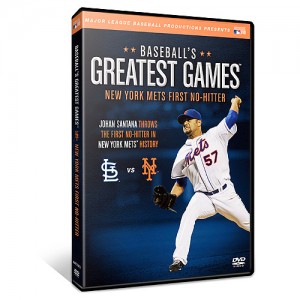 Watch. Listen. Love. Meet the latest Metsian must-have Baseball’s Greatest Games release from A+E Home Entertainment/MLB Productions, the one from June 1, 2012, the one with Johan Santana’s no-hitter. It’s got the entire SNY telecast; it’s got Gary, Keith and Ron (who was never better than he was in this ninth inning); it’s got the WFAN audio of Howie Rose and, in relative morsels as the night wore on, Josh Lewin fill-in Jim Duquette; and it has the little-heard by non-Latino listeners call from Max Perez Jimenez and (subbing for longtime en Español voice Juan Alicea) Nelson Rosario, as heard over WQBU-FM.
You know from Gary. You know from Howie. And, language barriers notwithstanding, you should know from their compadres. Based on a small sample, the Spanish-language Mets broadcasts sound like a veritable throwback party, from using the Glenn Osser Orchestra version of “Meet The Mets” to introduce each inning to picking up an onslaught of crowd noise that leaks happily through the broadcast’s background. My one (minor) disappointment with the SNY and ’FAN broadcasts of June 1 was I never really got the sense that the crowd was as excited as Gary and Howie were in their own professional way. My friend Kevin — whose invitation I cleverly declined that fateful Friday — told me the “buzz” was kind of a mixed bag in the stands. Then I read two stories from reporters who rather effetely downplayed the significance of being there. I began to wonder if anybody besides Gary, Howie and my buddy Kevin was thrilled to have attended the First No-Hitter in New York Mets History.
Thanks to La Qué Buena’s feed on this disc, I can feel the excitement that much more, even if I can’t understand much more Max is saying in the ninth besides “¡johansantana!” and “¡citifield!” — and that’s despite my having taken six years of Spanish from seventh through twelfth grade. I’m not sure why WQBU transmitted more of the crowd noise than its counterparts. Perhaps they planted a microphone outside their booth’s window.
Anyway, the audio tracks are merely a bonus to this DVD. The heart of it is the First No-Hitter in New York Mets History, which remains as breathless an experience now (DL visit for its protagonist be damned) as it was two months ago. And thanks to A+E Home Entertainment/MLB Productions, you can own it for a very reasonable price…or you can have it for FREE if you are one of the first five Faith and Fear readers to correctly answer all the questions on the following quiz and e-mail your answers to faithandfear@gmail.com. (These contests usually run pretty quickly, but if we don’t have five completely correct sets of answers by Friday, August 10, 12:01 AM EDT, then we’ll take the ones that come closest that we received first.)
Each question is at least tangentially related to the subject of this game: the glorious outcome; the franchise’s history in seeking such an outcome; the Mets’ opponent that night; the pitcher we welcome back to the Mets’ rotation this weekend. Each answer, you’ll discern, has a recurring theme. My only guideline is if you know your online resources, this will go pretty smoothly.
But you don’t need to know how to speak Spanish.
***
***WE HAVE OUR WINNERS. THANKS ALL FOR PLAYING.***
THE QUIZ
1) The last time a Mets lefty threw a one-hitter, I played left field for the losing team. Who am I?
2) I caught the last no-hitter a St. Louis Cardinal pitcher threw. Who am I?
3) Johan Santana didn’t get to bat in his first major league game because of the silly rule the American League has about such things. But I batted because I was the designated hitter on Johan’s team. Who am I?
4) You know how frustrating it was to watch all those pitchers for other teams throw no-hitters but not see a Met throw one? Well, you wouldn’t have minded me throwing one in that regard because I threw the last one in the majors before the Mets existed. Who am I?
5) I made the last out of the first inning Johan Santana pitched as a major league STARTER. Who am I?
6) The last time the Mets threw a combined one-hitter, I was the staring second baseman for the losing team. Who am I?
7) I was the losing pitcher in the last no-hitter pitched by a St. Louis Cardinal. Who am I?
8) I was the only teammate of Johan Santana’s on Johan’s first professional team to later play for the Mets. Who am I?
9) The last time a Mets pitcher didn’t give up a hit for the first seven innings of a game against the Cardinals that eventually became a one-hit victory for the Mets, I was the Cardinals’ second baseman. Who am I?
10) I drove in the go-ahead run that stood up as the winning run in Johan Santana’s first major league victory. Who am I?
11) We are the only THREE Mets who played on June 1, 2012, who, as of August 6, 2012, have been on the Mets’ active 25-man roster every day of the 2012 season. Who are we?
12) I was the leadoff batter for the team that lost the last major league no-hitter thrown before the Mets existed. Who am I?
13) I made my major league debut for the losing side in the last game in which the Mets were victimized by a no-hitter. Who am I?
14) I was the losing pitcher in the game in which Johan Santana gained his first major league win. Who am I?
15) I made the last out of the first inning Johan Santana pitched as a Met. Who am I?
***
Best of luck! And if luck doesn’t do it for ya, try links:
This one, this one and this one, in particular.
And if you don’t want to be bothered, there’s always this one.
***WE HAVE OUR WINNERS. THANKS ALL FOR PLAYING.***
|
|