The blog for Mets fans
who like to read
ABOUT US

Faith and Fear in Flushing made its debut on Feb. 16, 2005, the brainchild of two longtime friends and lifelong Met fans.
Greg Prince discovered the Mets when he was 6, during the magical summer of 1969. He is a Long Island-based writer, editor and communications consultant. Contact him here.
Jason Fry is a Brooklyn writer whose first memories include his mom leaping up and down cheering for Rusty Staub. Check out his other writing here.
Got something to say? Leave a comment, or email us at faithandfear@gmail.com. (Sorry, but we have no interest in ads, sponsored content or guest posts.)
Need our RSS feed? It's here.
Visit our Facebook page, or drop by the personal pages for Greg and Jason.
Or follow us on Twitter: Here's Greg, and here's Jason.
|
by Greg Prince on 27 July 2012 12:00 pm Scenes from the end of a losing streak:
• Matt Harvey striking out 11 in five-and-a-third shutout innings.
• Matt Harvey showing command of multiple pitches.
• Matt Harvey oozing poise and maturity.
One night in Phoenix and the world’s our oyster.
For one night, anyway.
Per the epidemic of being cautioned against what I’m not supposed to read into the debut outing of a promising pitcher (because Mets fans have zero experience with being let down and thus must have things explained to them as if they just woke up and decided to become Mets fans), I pencil Matt Harvey in for no more than his next start and a hearty “we’ll see.”
Pencils have erasers, Bob Murphy was fond of reminding us, yet you can’t erase what we just saw, no matter what follows, which itself is wholly unknowable and only moderately projectable…even if what we just saw was wholly remarkable and intensely satisfying.
(And why would you want to erase it anyway? When a transcendent pitching performance drops from the heavens into your lap, I recommend cherishing it rather than eyeing it suspiciously as if it’s a prop from an “if you see something, say something” PSA.)
I’m a maestro with facts, figures and context from the past but a perpetual novice where the future is concerned. I don’t get caught up in prospects because they so lack certainty. Precedent lingers in the subconscious to confirm that disconcerting aspect of the Metsopotamian condition. I can truly believe only what I’ve seen and and consider the hint-laden breadcrumbs it leaves behind.
What I saw for five-and-a-third innings hints at hoping the kid can and is allowed to go six next time. That much, I am certain, projects as something to see.
by Jason Fry on 27 July 2012 2:12 am As it turned out, Matt Harvey didn’t need our prayers.
He was superb, fanning a Seaveresque 11 over 5 1/3 innings, surrendering no runs and even hitting for half of the cycle. Then — and this was perhaps even more surprising — the bullpen didn’t blow it. Fireplug reliever Josh Edgin, a fellow 2010 first-round pick, looked very impressive in 1 2/3 innings, Jon Rauch faltered but was picked up by slider-slinging Tim Byrdak, and then Bobby Parnell frightened the bejeezus out of everybody by needing 31 pitches to tiptoe through the ninth, but eventually came out unscathed, freezing Jason Kubel on a fastball to preserve Harvey’s first win.
But back to Harvey.
As I wrote about Stephen Strasburg, there’s just something about a power pitcher. Harvey looks a bit like Tom Terrific, with his butt and legs the engines that drive his fastball, the foundation upon which everything else is built. Harvey gets swinging strikes with that hard fastball that runs a bit — contrast that with, say, Parnell, who throws hard but sees his fastballs turned around all too often. He’s got a diving slider, what looks like a decent curve and a change-up he’s still shaping. A pretty good arsenal, to be sure, but it all works because he can rear back, fire and not get cooked.
Before we anoint Harvey as the Metsiah, though, a couple of caveats.
First of all, he’s young — just 23. He’ll have bad starts, probably a run of them. But we all know this, right?
Second, it looked like all those secondary pitches were very sharp tonight — sharper than we’d heard they were at Buffalo. That’s not always going to be true — it isn’t for the likes of Johan Santana, so it’s certainly not going to be true for a rookie still refining those pitches.
Third, I thought Harvey got some high strikes early — calls I wouldn’t necessarily have expected a rookie to get — and that helped him. It made the Diamondbacks conscious of the high fastball, and took them out of their swing planes, and made it easier for Harvey to change their eye level, and to do everything else. Later in the game, as Harvey tired, his pitches were elevated — and without those early high strikes, I wonder how Harvey would have fared.
But enough caveats. I was glad just to see Harvey up here, as a down payment on the future of the Mets, and I was willing to accept that he’d struggle, and try to be patient. But he didn’t struggle — he was wonderful. He fanned a big-league hitter 11 times and then strode around calmly behind the mound thinking about how to attack the next one in line, and he wasn’t the other team’s fireballer out there; he was ours. At least for a day, that bright Metsian future we keep talking about and hearing about felt more like a when than an if. And boy, did we all need that.
by Jason Fry on 26 July 2012 10:04 am
Brian: I’m not the Messiah!
Arthur: I say you are, Lord, and I should know. I’ve followed a few.
Bill Pulsipher. Jason Isringhausen. Paul Wilson. Octavio Dotel. Billy Traber. Pat Strange. Tyler Yates. Yusmiero Petit. Scott Kazmir. Brian Bannister. Philip Humber. Kevin Mulvey. John Maine. Mike Pelfrey. Alay Soler. Jenrry Mejia. The list goes on and on.
Let’s please remember that Matt Harvey is 23 years old and has never thrown a pitch in anger to a major-league hitter. He’s never walked in from the bullpen and seen that there are 30,000 more people watching than he’s pitched in front before. He’s never seen how big-league hitters ignore that yet-to-be-refined curveball, or watched them coil their bats for that fastball — and not miss it.
He had nothing to do with losing the last 12 of 13. Even if he begins his career with one of its best stretches, he is incapable of making us win the next 12 of 13. He’s a young pitcher. He’s probably going to get beat around and exposed, with the best baseball players in the world providing a pitiless assessment of exactly where he is as a young pitcher. Or if it doesn’t happen the first couple of times through the league, video and word of mouth will do the job soon enough.
He’s here, and that’s good. He’s worked hard enough to get this shot and see where he stands, and that’s deserved. But he can’t save us. And his hard work is just beginning.
by Jason Fry on 25 July 2012 11:06 pm … the Mets went 0-for-August at Shea Stadium.
I remember it all too well. They were 0-13 for the month, with game after game a despairing, infuriating question of when, not if. They then lost the first two home games in September, making the home futility streak 15 straight. The final loss was a 3-2 defeat in 12 innings at the hands of the Marlins, in the first game of a doubleheader. The Mets won the second game 11-5 and the disaster was over — in fact, that win was the first of seven in a row, a streak that came too late to matter and so mostly just aggravated us further.
If you weren’t around for it, well, this current stretch is an excellent re-creation.
This time around the Mets can’t go 0-for-July, as they beat the Phillies (twice!) and the Cubs before the All-Star break, but otherwise things feel awfully familiar. The team looks variously listless and overamped, losing by doing too little and losing by trying to do too much. Should the scenario repeat itself, the only surprising thing would be for this year’s Mets to somehow rebound and win seven straight. Seven more wins before everybody packs up their lockers at Citi Field? More plausible, but let’s not get cocky.
Today’s matinee offered relatively few pleasures. If you’re a Mets fan, there was Ike Davis’s line-drive homer into Utleyville, a fairly courageous start by Jeremy Hefner marred by a couple of gopher balls, and some nice plays by Davis and the recently spiked Ruben Tejada. Otherwise, well, it was all Nats — particularly the work of 24-year-old Stephen Strasburg.
At least on some level, any good pitching performance is a pleasure to watch, whether it’s R.A. Dickey redefining a pitch dismissed as a sideshow or Greg Maddux making the sum of average but perfectly located pitches far more than the sum of their parts. But Strasburg is something else — a classic power pitcher, with thunderbolt fastballs and knee-buckling curves and the power pitcher’s assurance that the game is in his hands. When Strasburg’s on you may not get the done-with-mirrors glee of a solid Dickey outing or the head-shaking thrill of watching a Maddux outthink everybody, but what you get definitely has its pleasures: the sight of a superb physical specimen making a very difficult game look easy. Which is what Strasburg did, from the three pitches he needed to fan Tejada leading off the game to the five required to erase Kirk Nieuwenhuis closing out the seventh. It was a clinic, with no confrontation more impressive than his showdown with David Wright at the end of the sixth. Wright was the tying run, and he got to 2-0 on Strasburg, but the Nats hurler dueled David to a 2-2 draw and then left him looking at a perfect curve settling at the knee. If you’d told Wright it was coming, maybe he’d have been able to flick it into the seats behind first or pop it up. Maybe.
It will be fascinating to watch what the Nats do with Strasburg as he approaches the innings limit mandated for young pitchers coming back from Tommy John surgery. On the one hand, Strasburg is obviously a rare talent, one who might be a 15-game winner for a generation if his golden arm is treated with the TLC it deserves. On the other, one should never assume a good club is the beginning of a dynasty — sometimes the tumblers never again align, and if you don’t go for it you’re soon left with a bunch of Plan Bs and what-ifs. Just ask the 2006 Mets about that one.
If only the 2012 Mets had such dilemmas to ponder. They’re looking at two weeks of bad road — off on a long trudge west, playing at strange hours and in distant cities, with the fresh memory of a winless homestand, Tim Byrdak barking at Josh Thole and Dan Warthen in front of Mr. Met and everybody, and a manager incandescent with frustration. As baseball fans, if nothing else we can say “ya never know” — that incantation is all that keeps the darkness at bay sometimes. But while it’s true that ya never know, there are times when you’ve got a pretty good guess. One shudders to think what the Mets’ record will be on Aug. 7, when they return home to the suddenly unfriendly confines of Citi Field. 2013 may have always been the target year for turning things around, but 2012 was fun until it turned to ashes — and all of a sudden there’s a lot of ashes left to wade through.
by Greg Prince on 25 July 2012 2:06 am Out in Section 106, where a couple of Mets fans willing to plop down in seats about 18 rows behind where they were assigned could spread out and enjoy the night if they ignored the fundamental awfulness of the main attraction, Stephanie made one of the most astute observations of the season that used to be. It was when Justin Turner came to bat in the bottom of the sixth, pinch-hitting for R.A. Dickey after Dickey all at once stopped being statistically unbeatable. A swift 1-1 duel versus Gio Gonzalez had become, without pausing to as much check its GPS, a deadly 5-1 stomping. And now here came Turner, stepping to the plate to his chosen walkup music, “Call Me Maybe” by Carly Rae Jepsen.
“That’s really his song?” Stephanie asked me, surprised that something so poppy infiltrated the ranks of the hardcore, bass-thumping cross-genre jams that are supposed to intimidate opposing pitchers.
“Yup.”
“That’s not very badass.”
No, I said, it’s not. And neither is our team.
They never were. They were plucky as the dickens when the season that used to be was in full optimistic swing, but even then, they were the first team you’d bring home to meet your mother and the last team you’d suspect of elbowing you out of the way to get that last seat on the Super Express. Year after year they admire in hushed tones the elusive element of “swagger” as if it’s a foreign object hidden inside a villain wrestler’s shorts, just out of the view of the ref. The Mets will pose for pictures with any reality show star who can produce a Shea Stadium ticket stub and Tweet pictures of their special dress-up road trips, but you never get the feeling they, in the immortal words of Leo Durocher describing Eddie Stanky, come to kill you. “Nice boys” is what Tom Hanks’s Mr. White would have termed them in That Thing You Do! These days they seem intent on holding open doors for less polite baseball teams as those squads roar by on their way to the pennant race.
It’s not about the music they choose. It’s about the beat that goes on like crazy, to the tune of eleven beatdowns in twelve increasingly poorly contested rumbles.
Turner, by the way, flied out. Everybody flied out or struck out or grounded out or popped out. Almost everybody, that is. Alleged bad seed Jordany Valdespin was permitted a pinch-hitting appearance as the Mets wallowed four runs from the Nats. He strode to the plate to lead off the home eighth to some very harsh-sounding Reggaeton number and whacked his fifth pinch-home run into the Nationals’ bullpen, as if to let them know at least one Met was ready to throw down. That fifth PH HR was a team record for one season. It’s close to a major league record for one season. A small, brief chant of “LET HIM PLAY!” went up around us in deep right, to which I happily lent my vocal support. Valdespin was indeed rewarded by being allowed to hang around and play center field until the otherwise total 5-2 loss was over.
I carry no personal brief for Jordany Valdespin. I’m not selling apparel on his behalf or wrapping myself in his hashtag, but I’m pretty sure that when a cold team has a hot hand, it would be best served by letting that hand grip as many at-bats as possible from the first inning on. Enough with the tired veterans and the nice fellows who the Harpers and Morses and Espinosas look forward to stampeding let alone spiking for years to come. Enough with David Wright, who was once part of a great teamwide future, having to tip his cap to the Washington bleeping Nationals the way he had to tip his cap to the Braves when he was getting his feet wet and the Phillies as his best clubs’ moment passed. David’s had a wonderful season, and he will always be the most gracious, most polite, most genuinely decent superstar in any Met setting, but wow do I groan when I read quotes in which he is compelled to refer to the bleeping Nationals as a team that can “exploit you pretty quickly,” as he did Tuesday.
The Nationals. The Nationals can exploit you pretty quickly. When did that happen? They were entitled to get better, but so were we. I saw a guy in our section wearing a HARPER 34 t-shirt, and I wondered where our shirtworthy everyday rookie lurks, the guy we wait for breathlessly and the guy who rewards us daily almost immediately. For all the happy horsespit over homegrown lineups, I’m pretty sure our last HARPER 34 was WRIGHT 5. The next one may not technically be VALDESPIN 1, but for now, he will do. So let him do already yet. Other than Daniel Murphy, nobody’s been hot of late like Jordany Valdespin is right now, and right now is what matters when you were 46-39 and you are 47-50.
As the Mets faded from view Tuesday and failed to offer any followup to Valdespin’s homer, my mind wandered back to a story about Eddie Murphy’s first season on Saturday Night Live, when the show was in deathly unfunny flux and Murphy, only 19 and not yet a full-fledged cast member but obviously immensely talented, was consigned to mostly background parts in group sketches. He lobbied for more airtime only to be told by idiot producer Jean Doumanian, “You’re a featured player. You’re learning. You have to understand that you have to be guided by us.”
In a matter of months, Doumanian was fired and Murphy was shooting to stardom. Something similar might not happen with Valdespin, but how you can go 1-11 and just keep bypassing the guy who keeps succeeding in the most limited opportunities does not speak well for the management of a team in deathly uncompetitive flux.
Jason Bay — a real sweetheart, everybody insists — was in the starting lineup, however. He went his usual oh-for-whatever but at least the Citi Field A/V squad was merciful enough to blast the volume on the Pearl Jam when he trudged to take his ups so the booing would be drowned out and his feelings wouldn’t sink any lower than his average. (Seriously, “State Of Love And Trust” was twice as loud as Ike’s trusty “Start Me Up” and did have the effect of audibly smothering the new “BOOOOO” overture.)
You could ask what the pluck has happened to these Mets who never gave up and were sweetly stubborn enough to withstand eight daunting frames before turning steely and indefatigable when ninth innings rolled around. I couldn’t tell you where they went, but I would guess they grew discouraged after all the near-misses they’ve been engineering since the All-Star break (which, I think we’d have to agree by acclamation, must have been the Worst…Break…Ever).
They put the potential tying run on second in the ninth Friday night and did not score.
They brought the potential tying run to the plate in the ninth Saturday afternoon and did not score.
They put the potential winning run on second in the ninth Sunday afternoon and did not score.
The Mets put the potential winning run on second in the ninth Monday night and did not score.
By Tuesday night, there was no pluck and no luck. There were two strikeouts and a groundout in the ninth. It couldn’t have been over faster, which was great news for those of us who wanted to catch the 10:17 at Woodside but worse news for those of us who hoped to catch a team or two ahead of us in the season that used to be but isn’t anymore.
by Jason Fry on 24 July 2012 1:25 am Before tonight’s game, our bloggy colleagues at Amazin’ Avenue asked readers to predict how many wins the 47-48 Mets would wind up with.
My answer: 47, though I admitted that might be overly pessimistic.
Tonight the Mets played the kind of game that they’ve specialized in since the break: Fall behind, catch up thanks to a brief insurrection of competence, then wait around doing not much of anything until their defense betrays them, the bullpen implodes, or both. This time, the disaster began with Ruben Tejada dropping a ball thrown into his glove, and metastasized with Pedro Beato getting whacked all over the park. As a result, for the second straight day the Mets wound up having managed to combine extra innings with a blowout loss, which is the kind of difficult maneuver they can stop performing any time now, thanks.
Witnessing it were my poor wife, a bunch of folks dressed as stormtroopers, and Snooki.
Yes, it was Star Wars Night at Citi Field, and no, I didn’t go. I felt doubly disloyal for not doing so, but a) it was hot and nasty out; b) the Mets are demoralizingly terrible right now; and c) at my house it’s pretty much always Star Wars Night anyway.
Instead I lay on the couch and watched it rain and waited for my team to lose.
I definitely felt sorry for Emily, fuming in the rain. Just like I felt sorry for the guys dressed as stormtroopers — from my cameo in armor last year, I can tell you that it’s oppressively sweaty in those outfits on a pleasant night, which tonight was not. I even felt kind of sorry for Snooki. I don’t really mind Snooki — she was sufficiently ridiculous as a regular person that someone thought she should be on TV, so now she’s ridiculous and famous, which isn’t exactly splitting the atom but is kind of a neat trick. And she really is a Mets fan, for which I give her credit, as it’s far from the obvious choice these days. My objection to Snooki had nothing to do with Snooki herself, but rather with the Mets’ tweeting out breathless updates about her doings, as well as giving her the run of the place. Such sad desperation smacked of a middling Arthur Avenue red-sauce joint taking photo after photo of some C-list celebrity for its wall, to be hung between the images of third-rate bandleaders nobody can remember and blowsy actresses who never got their names above the title. I mean, honestly — the Mets usually reserve such royal treatment for Yankees achieving career milestones at their expense.
I’d say we’re better than all that, but the truth is that we’re not. The Mets are astonishingly horrible right now, undone by a combination of bad luck and long-existing flaws. The former will pass; the latter will take considerably more work. And before the game, the man who will have to do that work made the rounds, muttering about buyers and sellers and things having changed over the last four or five days.
Sandy Alderson knows the Mets aren’t buyers, unless they’d like to get busy locking up plane tickets home for the night of Oct. 3. They realistically ought to be sellers, unloading Scott Hairston and Tim Byrdak and listening to offers for Daniel Murphy and Lucas Duda. (Murph doesn’t have enough punch to overcome his defense, and Duda needs to play first base somewhere.) But reading the various beat-writer reports, the impression is that nobody wants what the Mets are selling. Heck, Duda appears ticketed for Buffalo so they can clear roster space for Matt Harvey, promoted a start too late. At least Miguel Batista is gone. I’ve been deprived of my 2012 Mets scapegoat, though fortunately the current roster offers no shortage of fill-ins.
Oh, and Manny Acosta’s back. Yay?
Part of our job is to record stuff for posterity, so here you go: Chris Young was pretty good, deviating from his usual pattern by giving up a two-run homer to Bryce Harper early but then hanging around later than expected. The Mets clawed back on homers by David Wright and Ike Davis and were a hit away from winning it in the ninth after Murph smacked a hit down the line and outran Harper’s arm for a muddy double, but Jason Bay shocked absolutely no one on the planet by grounding out. Roger Bernadina opened the Nats’ 10th with a bloop single off Byrdak, who then got Sandy Leon to hit a comebacker for a sure double play — except Tejada dropped Byrdak’s throw, getting spiked by Bernadina on a hard but clean takeout slide. That opened the floodgates, with Beato coming in and doing ill-advised things and departing with the Nats up 8-2. In the bottom of the 10th, to add insult to injury, the singularly useless Andres Torres approached second base with the delicacy of a hostess seeing a speck of paprika out of place on a deviled egg, politely not disturbing Danny Espinosa in his duties turning the double play. That incensed Keith and Ron, to the extent they were still capable of it, and led Gary Cohen to grouse about optics. Then a few seconds later the game was over and it was time for Bobby Ojeda to yell and point.
After finishing up with the Nats, the Mets head to the west coast — not a prospect any sane fan looks forward to at the end of July when their team is playing well. Buyers? Ha. The Mets ought to have the decency to warn the Marlins and Phillies about the deadweight plummeting toward them.
To answer Amazin’ Avenue’s question more seriously, I’m sure the 2012 Mets can win around 50.
by Greg Prince on 23 July 2012 5:40 am 
Our pal Shannon Shark at Mets Police has an interesting theory that the Mets aren’t an organically occurring baseball team as much as they’re a serialized television drama that I’ve been writing since 1962, which is flattering of him to suggest, but I must reject the notion because I maintain the last few installments of Season 51 have been a little too hacky to be believed.
I’d like to think if I were indeed writing The Mets, I’d come up with something more original than another string of horrifying post-All Star break episodes in which the Mets go down the tubes faster than you can say “nine losses in ten games.” Anybody who’s ever worked with me would know I’d insist we can’t do another story arc like that — we just did a variation of the second-half swoon in Season 50.
And Season 49.
And Season 48.
Yet there are Metsian tics and tendencies that do get repeated over time. Like the casting of Miguel Batista as this year’s Tim Redding. Or Matt Harvey being given essentially the same role Bill Pulsipher won the audition for in Season 34 (only to be mostly written out of the narrative by Season 35). Or the reimagining of kitschy false-hope losses from 1962 as plucky not-quite wins in 2012.
 You don’t wanna get mixed up with a guy like Jordany Valdespin. He’s a loner. A rebel. (Photograph by Sharon Chapman.) This is to say nothing of a development deal for a sequel to Kevin Mitchell, circa 1986: the character is conceived as a fearless and brash rookie who plays almost everywhere and hits everywhere he plays yet scares the bejeesus out of the establishment; they whisper he’s not a “solid citizen” and has “problems with authority figures,” so he mostly languishes on the bench. The dramatic tension revolves around whether the character will be spun off to a new team where he’ll become the star of his own series, tentatively titled ’Spin Off.
Anyway, the Mets, who are real and not a figment of my fevered imagination (I think I’d have written them at least eight more championships by now), lost again on Sunday in classic fashion. They used extra innings, a ton of hits and hardly any runs. How is that classic? The only other time, according to Baseball Reference, that the Mets produced at least 16 hits but no more than 3 runs was in their longest game ever, the 25-inning affair they lost to the Cardinals, 4-3, on September 11, 1974. That night and morning, the Mets went 1-for-17 with runners in scoring position and stranded 1 baserunner for every inning played.
The Mets revived that storyline Sunday, when they produced 16 hits, scored 3 runs and lost again, this time 8-3, which both belies the closeness of the game for the first four hours and represents perfectly how far the Mets ever seemed from prevailing. The RISP totals were a little less brutal than they were 38 years ago — 4-for-19 — but the rate of LOB exceeded one per inning, with 14 Mets reaching base but never coming home. And though the Mets required 13 fewer innings in which to be utterly defeated in 2012, the time of game was a mere 2:21 shorter than 25 innings took in 1974.
Honestly, the Mets didn’t need a dozen innings or nearly five hours to do what they did against the Dodgers. They didn’t need the slick relieving of Ramon Ramirez nor the occasionally accurate umpiring of Mike DiMuro, either. They just needed the bottom of the fifth to illustrate what kind of day it had already been and what kind of day it was going to turn out to be. As an audience member (because, remember, I don’t write this stuff, I just watch it), the whole thing was telegraphed to me in a five-batter sequence.
Batter One, Ruben Tejada: The kid who never takes a bad at-bat mounts an outstanding at-bat. With his team down, 2-1, Ruben swings through two pitches and then goes to work, alternating a foul and a ball before fouling off three pitches in a row. Then he takes ball two. A pair of fouls ensue until ball three. That is so Ruben! But on Nate Eovaldi’s twelfth pitch, Tejada strikes out. That’s not supposed to happen.
Batter Two, Jordany Valdespin: Of course now that Ruben softened him up, Eovaldi will be easy pickin’s for the rest of the patient Mets. Except the next Met up is the notoriously impatient Jordany Valdespin…and why should ’Spin be patient, since he’s obviously a young man in a hurry, his squishy citizenry/allergy to authority be damned. First pitch, Jordany does what Ruben couldn’t do in twelve — he reaches base on a perfectly executed bunt. When was the last time you saw a Met do that?
Batter Three, David Wright: This most solid of Met citizens and hitters had been in a mini-slump, but no more. David lines Eovaldi’s second pitch up the middle for a base hit. Jordany, because he’s Jordany, races to third. It’s first and third, one out, Ike Davis, tenuously not sucking so much lately, is due up, so Don Mattingly lifts Eovaldi before he can be a winning pitcher and brings in lefty Scott Elbert.
Batter Four, Ike Davis: With a golden RBI opportunity before him, Davis goes back to sucking. What appears to be a hard slider away ties him in knots for strike three. Keith Hernandez lets out an audible moan of disgust. As he should.
Batter Five, Daniel Murphy: After a sensational four-hit Friday night, Terry Collins sat Murphy Saturday because Terry Collins bet on the Dodgers, and like Pete Rose, he should be banned from baseball at once because there are signs in every clubhouse reminding uniformed personnel gambling on games is verboten. That’s just one theory. Another is Collins was playing the percentages, and that robotic reliance on lefty-righty matchups paid off when lefty Murph’s understudy, righty Ronny Cedeño, homered off lefty Chris Capuano to turn a 6-2 deficit into a 6-3 deficit. Cedeño also doubled against Capuano, so Terry must have known something the numbers weren’t telling him, since prior to Saturday Ronny was a robust 3-for-23 against Chris while Daniel was a tellingly pathetic 0-for-3. Later in Saturday’s game, Murphy pinch-hit a triple. Sunday, the regular second baseman was back in the lineup and would go 4-for-5 off Dodger pitching, finishing off a weekend during which he went 9-for-11. So…knowing all that, is it possible that the scalding Daniel Murphy would come up and not get the hit to bring Valdespin home from third, tie the score at two and change the complexion of the game and maybe shift the momentum of the Mets’ season? It was indeed possible to the point of being what actually happened. Daniel lifted the fly ball to left that Ike needed, except when Daniel did it there were two out. And once the ball was caught, there were three.
To quickly review the above sequence, Tejada did exactly the kind of thing he is lauded for, but it didn’t pay off; Valdespin and Wright did exactly the kinds of things they are lauded for, and it paid off provisionally; Ike, who had to do just a little something, did absolutely nothing; Murph, who’d been doing everything and would continue to do everything, wasn’t able to do it at that particular moment.
Two hits, no runs, two LOB. Mets still trailing, 2-1.
I’m not sure where I’d seen that kind of half-inning before, but boy it felt so perfectly Mets. Then again, every inning feels that way when you find yourself saying, at whatever speed you prefer, “nine losses in ten games.”
by Greg Prince on 22 July 2012 2:09 am “This is the bad time.”
—Henry Hill, GoodFellas
If I may use the present tense while it’s still technically valid, Miguel Batista doesn’t so much throw pitches for the New York Mets as he contemplates them. Not that any Mets fan necessarily wants Miguel Batista to throw his next pitch unless it’s his last, but my goodness that man is Zen between ball one and ball two, never mind the spiritual journey he takes between ball two and ball three.
I’m sure he’s read Leaves of Grass, but I could swear I saw him staring at blades of grass.
Oh, and then came ball four, twenty or thirty minutes after ball three.
The theme of this series thus far (all seven hours and three minutes of it) seems to be it was slow, but at least it was painful. That would pretty well sum up the 81 pitches Batista contemplated in the first, second and third innings, almost none of them effective, eight of them directly producing baserunners, four of them turning into runs, none of them making a case for the present tense to remain a valid tense for Miguel Batista and the New York Mets.
***
“Tick. Tick. Tick. That’s the sound of your life running out.”
—Jordan Chase to his victims, Dexter, Season Five
Is there any reason think the Mets’ season isn’t on the brink of plunging into its traditional final-third abyss? In All The President’s Men, Deep Throat advised, “Follow the money.” At Citi Field, you could simply follow the bouncing pitchers Saturday and discern how tenuous this .500 team’s competitive standing has become.
One press release and five public address announcements said all you needed to know.
1) The New York Mets today announced the team placed lefthanded pitcher Johan Santana on the 15-Day Disabled List with a right ankle sprain.
2) …and batting ninth and pitching, Number Forty-Seven, Miguel Batista.
3) Now pitching and batting ninth for the Mets, Number Fifty-Three, Jeremy Hefner.
4) …and pitching and batting fifth for the Mets, Number Sixty-Six, Josh Edgin.
5) Now pitching and batting fifth for the Mets, Number Forty, Tim Byrdak.
6) …and pitching and batting seventh, Number Forty-Three, R.A. Dickey.
That’s four pitching changes, each more desperate than the one before it, thanks to the Hail Mary nature of starting Batista. And that bland pronouncement about Friday night’s starter? That seemed to cast a pall on everybody who toes a rubber for a living.
Santana was placed on the DL before the game for Johankle reasons because there’s apparently nothing medically wrong with his shoulder and the Mets couldn’t claim the vapors, the blues or a bad case of lovin’ you as an acceptable reason to shelve him. Maybe the two-week old mishap is throwing his motion out of whack. Something sure is. For the record, Johan says he could keep pitching through his morass. But maybe that’s just the vapors talking.
With Johan cleared from the roster to make room for Hefner, the rest of the available staff responded as if they couldn’t wait to get a league-approved blow themselves. Not a single Mets pitcher retired the first three batters he faced upon entering Saturday’s game. The only Met who threw a one-two-three inning against Los Angeles was Batista, in the second, which was after he allowed a run in the first and before he permitted three in the third, all with two out.
The Dodgers batted seventeen times before the Mets could get to the bottom of their own order. By the time they got there, they wouldn’t let Batista bat. It was the second consecutive game in which the Mets’ starting pitcher never made it to the plate.
Hefner gave up a run in the fourth with two out and a run in the fifth with two out, leaving the Mets behind, 6-2. They endured the indignity of Chris Capuano for seven innings and trailed him, 6-3, upon his exit. The ballpark was more subdued than angry. Batista was long gone and Jason Bay had snuck an RBI single through a friendly hole many frames before and then had the good sense to be double-switched out of the game at some point because it’s not like Jason Bay is indispensable to the cause of a team trying to forge a comeback. So with Batista out and Bay out, there was nobody left worth getting riled up toward.
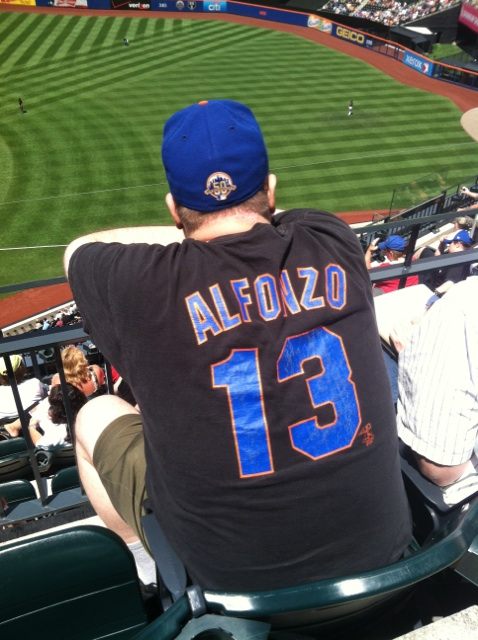
Subdued, with an undercurrent of mournful. That was Citi Field after seven innings, even with Edgardo Alfonzo bobbleheads tucked safely under seats.
 We Edgardo Alfonzo acolytes not only turned out in droves to accept our Fonzie bobbleheads, we dressed for the occasion as well. Then two Met runs in the eighth, which was exciting. And Dickey in the ninth, which was downright thrilling. It’s always thrilling to see a starting pitcher thrust into any role that’s out of the ordinary. It says somebody seems serious about winning a game in a way not starting Daniel Murphy (four hits Friday night, immense pinch-triple Saturday afternoon) or Jordany Valdespin (the Human Thunderbolt Friday night, pinch-bunt instigator Saturday afternoon) doesn’t.
It was beautiful the way “The Imperial March” blared and R.A. materialized fully formed on the mound to start the ninth. Like Batista in the first, Hefner in the fourth and Edgin in the sixth, Dickey retired the first two batters he faced. But when Dickey did it, mourning became electric. Citi Field was juiced. Just the sight of our savior coming down from the mountain to keep us within 6-5 brightened our late afternoon. He got Kemp. He got Ethier. And if he’d gotten a call from James Hoye, he might have gotten out of the ninth unscathed, sending a charge through his teammates and inspiring them to short out Kenley Jansen for at least one necessary run in the bottom of the inning…maybe two!
But Dickey didn’t get a call — the way the Mets can’t ever get what they want lately — and Loney singled and Uribe homered and it was 8-5.
You couldn’t blame the knuckleball starter turned desperation reliever for not rescuing 24 men stranded up a creek and a season on the brink. But it would have been beautiful if he had.
***
“The Mets got two runners on in the ninth, but couldn’t get over the hump, and went down to their 12th straight defeat. That was to be a Met pattern for their early years. They would get themselves into a seemingly hopeless position, only to rise up off the mat to stage a desperate rally, which invariably fell just short. In their 120 losses, the Mets brought the tying run to the plate in the last inning 56 times. Thirty-nine of their losses were by a single run. ‘He concedes defeat almost daily,’ Robert Teague wrote of the Met fan, ‘but only after the very last Met has been retired.’”
—William Ryczek, The Amazin’ Mets, 1962-1969
Scenes from a Polo Grounds homestand, from just about this time of year, 50 years ago:
• On July 7, 1962, trailing the Cardinals, 3-2, Marv Throneberry tripled with two out in the bottom of the ninth. Gene Woodling grounded out to end the game with the potential tying run on third.
• On July 12, trailing the Dodgers, 3-0, Sammy Taylor walked with two out in the bottom of the ninth. Cliff Cook was then hit by a pitch. Jim Hickman, representing the potential tying run, grounded out to end the game.
• On July 13, the Mets came to bat in the bottom of the eighth, tied at three with the Dodgers. Woodling led off with a triple against Don Drysdale. Hickman went into run. Chris Cannizzaro struck out. Felix Mantilla tapped to Drysdale, who got Hickman at the plate. Throneberry struck out. Al Jackson gave up a leadoff home run in the top of the ninth to Ron Fairly. The Mets went down in order in the bottom of the inning to lose, 5-4.
• On July 15, the Mets went to the bottom of the eighth down seven runs to the Giants. They scored six and had runners on first and second with two out. Juan Marichal came into relieve. He flied out Rod Kanehl to end the inning. The Mets would lose, 9-8.
• On July 16, the Giants increased their lead from 2-1 to 3-1 on a two-out wild pitch in the top of the ninth from Bob L. Miller. In the bottom of the inning, Charlie Neal and Elio Chacon each walked. Choo Choo Coleman popped out and Hickman struck out. Richie Ashburn singled home Neal and sent Chacon to third as the potential tying run. Kanehl flied out to end the game, the Mets losing, 3-2.
• On July 19, Throneberry broke a 5-5 tie against the Pirates with an RBI single in the bottom of the eighth. With Marv on first and Chacon on third, Jay Hook struck out and Ashburn popped out. Hook started the visitors’ ninth by walking Bill Mazeroski, advancing him to second on a wild pitch and seeing him go to third and then home on two flyball outs. It was tied at six. In the bottom of the ninth, Hickman singled with one out but was caught stealing second. The game went to the tenth, where Hook — still pitching — surrendered a leadoff home run to Bob Skinner. In the bottom of the tenth, after Kanehl flied out and Neal fouled out to the catcher, Chacon doubled and Throneberry was intentionally walked. With the tying and winning runs on base, Joe Christopher flied to center. The Mets lost, 7-6.
On July 21, 2012, the Mets trailed, 8-5, in the bottom of the ninth against Dodger closer Kenley Jansen. After Lucas Duda fouled out and Ruben Tejada flied out, Andres Torres and David Wright walked. Scott Hairston then struck out to end the game.
This followed the 7-6 loss of July 20, when the potential winning run, Torres, popped up with two out…two days after July 18, when the Mets trailed the Nationals, 4-1, in the ninth, before Wright homered to lead off, Ike Davis and Duda each struck out, Bay homered and Valdespin struck out to end the game in a Met loss, 4-3…and that happened on the heels of July 17, which was when Valdespin’s three-run pinch homer converted a 2-0 deficit in the top of the ninth into a 3-2 lead, before a Nationals run tied the score in the bottom of the ninth, which was before Josh Thole put the Mets in front, 4-3, in the top of the tenth, which was before the Nationals scored two to win it, 5-4, the last of the runs coming on a wild pitch Thole couldn’t block.
All of which is to say chronically battling back and falling short doesn’t work any better now than it did a half-century ago.
by Greg Prince on 21 July 2012 2:33 am We didn’t miss winning Friday night’s ballgame by much. Another inch or so batwise, and either Wright or Davis gets much more than a sacrifice fly in the first and we’re tied at three. The pitcher’s glove that deflects Jerry Hairston’s grounder away from Ruben Tejada keeps a runner off base in advance of Luis Cruz’s first-ever home run in the third. And a more generous, possibly more accurate call at second by the revered Jim Joyce when Andre Ethier was probably tagged out by Daniel Murphy (who did his job a helluva lot better than Josh Thole) means a runner who becomes a run is erased. Oh, and throw in however close Terry Collins came to writing VALDESPIN on his lineup card but failed to as another measurement by which a game of inches inched into the Dodgers’ column.
But even had the Mets gotten the microbreaks they needed to effect a grand-scale comeback or prevent the need for anything overly dramatic, a theoretical win against L.A. wouldn’t have felt free-and-clear fabulous, not when Johan Santana was pitching as he was pitching.
Dreadful was how he was pitching. As dreadful as he’s pitched in a Mets uniform, probably, and that includes those horrible Yankee Stadium starts and the last two games when he also surrendered six earned runs. Those six-packs weren’t as resolutely flat as this one. You could kind of blame the ankle tripping him up against the Cubs at Citi Field right before the All-Star break and note that until C.B. Bucknor brought his inept magic to bear in Atlanta he was doing pretty well at Turner Field.
Nothing, however, was doing here against the Dodgers. The game of inches — even the inches to which Johan contributed with his glove on the “other” Hairston’s ball — didn’t reflect the miles that were missing from his pitches, particularly that home run to Cruz. Changeup or not, a Johan Santana delivery at 73 MPH, by SNY’s reckoning, is too slow to be believed or to be of any use. No wonder Luis Cruz looked like Matt Kemp…who, unfortunately, looked a lot like Matt Kemp when he took Johan over the wall on another pitch that appeared thrown in Super Slo Mo.
One pet theory of mine is Johan could have pitched better, but he was showing solidarity with Miguel Batista in advance of the kind of outing we all expect Saturday. Another wishful thought is Johan wanted to boost his bullpen’s confidence by setting the bar low and then giving them plenty of innings in which to stretch out. What a perfect teammate he is! But no, I’m pretty sure Johan’s night of misery was genuinely unintentionally wrought. That was really and truly bad pitching, and the postgame interrogations of Collins and Santana didn’t yield much in the way of understanding beyond “something’s wrong” and “we’ll try to figure it out.”
One explanation I will not accept is the 134 pitches thrown seven weeks earlier were lethal. Hogwash. As the handy chart printed here illustrates, three starts after Santana’s nine innings of no-hit, shutout ball versus the Cardinals on June 1, Johan threw six innings of four-hit, shutout ball against the Orioles; the start after that, it was six innings of five-hit, two-run ball dropped on the Cubs, blemished only by the evil Joe Mather; the start after that, these very Dodgers — or a Kempless, Ethierless facsimile — were subject to eight innings of three-hit, shutout ball. Santana’s had his downs since the night of The First No-Hitter In New York Mets History, but he crafted several legitimate ups along the way.
If something’s wrong, it isn’t from an extra 15 to 20 pitches seven weeks ago only now truly getting the best of him. I’d have bought it if the lousy start against the Yankees and the lousy start against the Rays had been followed by this lousy start. But he looked very good twice, pretty darn good (save for Mather) once and good enough to have escaped, save for ankles and Bucknors, another two times.
But if you’d like to use 134 pitches as your crutch (and I’m not a doctor, athletic trainer or pitching coach, I just play one on Faith and Fear, so how would I know what’s right and what’s wrong?) and tell me oh dear, that extra inning worth of exertion was too much strain for the surgically repaired shoulder, there goes the man’s career, there goes our season and present irrefutable evidence to support your assertion, I’d have nothing to say except what Lyndon Johnson had to say in 1963 in response to fears that he’d expend too much political capital too early in his unforeseen presidency if he attempted to push controversial civil rights legislation through a recalcitrant Congress:
“Well, what the hell’s the presidency for?”
Except replace “the presidency” with “a great pitcher” and switch out “controversial civil rights legislation” for “long dreamed of franchise milestone whose fruition is as cherished in its existence as it was in fantasy”.
He’s Johan. He’ll figure it out.
If you need me for anything else, I’ll be in 405 this afternoon, cradling Edgardo Alfonzo’s bobblehead so it doesn’t fly off with Miguel Batista’s real one. Come say hi if you’re in the vicinity. I’ll be wearing No. 13 and loudly inquiring of Terry, should his lineup be yet again lacking the Human Thunderbolt, “Well, what the hell’s Jordany Valdespin for?”
by Greg Prince on 20 July 2012 5:17 pm They sold the jerseys, they sold the dirt, they sold replicas of the tickets they didn’t sell…the Mets were so anxious to cash in on Johan Santana’s no-hitter that they even put the game-used shortstop up for sale! Didn’t necessarily think there’d be any takers, but the Orioles just had to have a piece of history and asked the Mets how much it would take to install Omar Quintanilla at Camden Yards as a reminder of that historic night at Citi Field. The answer was “cash considerations,” and the Orioles agreed. Now, seven weeks after the blessed event, one-tenth of the players who secured the First No-Hitter In New York Mets History have been shipped to Baltimore.
Is nothing sacred?
|
|