The blog for Mets fans
who like to read
ABOUT US

Faith and Fear in Flushing made its debut on Feb. 16, 2005, the brainchild of two longtime friends and lifelong Met fans.
Greg Prince discovered the Mets when he was 6, during the magical summer of 1969. He is a Long Island-based writer, editor and communications consultant. Contact him here.
Jason Fry is a Brooklyn writer whose first memories include his mom leaping up and down cheering for Rusty Staub. Check out his other writing here.
Got something to say? Leave a comment, or email us at faithandfear@gmail.com. (Sorry, but we have no interest in ads, sponsored content or guest posts.)
Need our RSS feed? It's here.
Visit our Facebook page, or drop by the personal pages for Greg and Jason.
Or follow us on Twitter: Here's Greg, and here's Jason.
|
by Greg Prince on 17 May 2012 8:03 pm Jason and I took advantage of our self-employed status to enjoy an ad hoc self-employed businessman’s special at Citi Field Thursday afternoon. Our respective gaggles of gigs may not guarantee the most secure of financial existences, but when you can get up and go to a weekday afternoon game, I’d have to say there are advantages to a State of Independence.
Heaven Knows I’ve been to a lot of games over the years, whenever they’ve been scheduled. Thursday’s was my 500th regular-season home game — 402 at Shea, 98 at Citi. It’s a symptom, I suppose of my Unconditional Love for the Mets, even though you never know how these things are going to turn out. You walk into the ballpark and you ask yourself Could It Be Magic today? Or will the game frustrate you to the point of wanting to cry? You take this stuff too seriously and you’re ready to declare No More Tears (Enough Is Enough). We do get emotional; let’s face it, when you’re a Mets fan, Love Is In Control.
Turned out to be a very good day to attend my 500th regular-season home game…although I have to admit I did get up for a bit to find something to eat and wound up being quite The Wanderer for an inning and change. Don’t worry, though: I was back in my Mo’s Zone seat for the best part of the game.
As you probably know if you were with us at Citi Field, watched it on SNY or caught it On The Radio, it was a very good game. The Mets beat the Reds, 9-4, despite falling behind, 4-0. Many Mets contributed to the comeback, but the key blow was struck by David Wright, whose world-leading batting average of .411 certainly qualifies as Hot Stuff. (Imagine what he’d do with consistent Protection in the lineup.) David’s go-ahead double in the eighth scored Rob Johnson, who started the big rally by bunting, which was wonderfully shocking. I see a backup catcher demonstrate that kind of cunning — and enough speed to come around on Wright’s double — well, I gotta tell ya…I Feel Love.
Johnson’s run made it 5-4. An RBI single from Justin Turner increased the Mets’ lead to 6-4. And when Ronny Cedeño surprised everybody with a three-run homer to left, you could Dim All The Lights on the Reds’ chances. Even the shakiness of Frank Francisco couldn’t prevent the top of the ninth from being the Last Dance for Cincinnati.
The Mets had nice stretches the last two years yet they ended up fading. But This Time I Know It’s For Real. I’d like to think so, at any rate. After a brilliantly warm day in the sun, sometimes you simply want to enjoy the things that have made you happy across your life, whether it’s the opportunity to spend an afternoon taking in your 500th regular-season home Mets game or just sitting back and letting the music play.
Technically, it was a spring day. But it sure felt like the best of Summer.
by Jason Fry on 17 May 2012 12:43 am Try to be cool and analytical all you want, but if you’re a fan eventually you’ll give in to fury and bloodlust.
I’M NEVER ATTENDING ANOTHER GAME UNLESS THEY RELEASE LUIS CASTILLO BY MORNING!
AARON HEILMAN MUST BE MAROONED ON A DESERT ISLAND WITHOUT EVEN A VOLLEYBALL FOR COMPANY!
CHAIN DOUG SISK TO A ROCK AND SEND AN EAGLE TO EAT HIS LIVER — EVERY DAY!
While I feel for athletes who have to develop rhino skin to withstand or ignore such assaults, I’ve come to believe fan apoplexy is mostly harmless venting — booing Aaron Heilman off the mound may be unfeeling and anti-social, but it keeps us from screaming and biting out the throat of that jackass from marketing who renders the microwave unusable by nuking some disgustingly rank exotic chow and always sneaks away when the copier’s jammed or out of paper even though THE PAPER IS KEPT RIGHT NEXT TO IT.
But that’s for fans. Most of the time, the general manager’s job is to be the anti-fan — to coolly assess a baseball team’s state of affairs in terms of the long- or at least middle-term plan, make sure the manager is building according to the organizational blueprint, and not blow one’s cool when the approach is sound but the results are lacking.*
So far I give Sandy Alderson high marks for that, though his final grades are still a big Madoffian INCOMPLETE. (Looks at watch, waits for Joe to comment.) But I’ll say this for the man — when things go bad, he doesn’t wait around.
Last night D.J. Carrasco distinguished himself by surrendering a bomb to Rickie Weeks and hitting Ryan Braun. Carrasco was then ejected, forcing his tired bullpen mates into service in a lost cause and making Terry Collins and David Wright go all emo in the dugout, which created an annoying one-day story. Carrasco’s job was the simplest and least consequential one on the bullpen chores list: Get rid of these remaining innings without sucking unbelievably conspicuously. He managed to do the opposite.
Tonight, declared innocent of malevolent intent by Collins, Carrasco actually came in with something on the line, relieving Tim Byrdak with the Mets down 4-3. This time, Carrasco never even got a pitch into Mike Nickeas’s glove before screwing up — Todd Frazier walloped his first offering over the fence for a 6-3 Reds lead. (Which is how things would end.)
The fans hadn’t even made it to the phone to scream about it on the FAN when word hit Twitter: Carrasco had been designated for assignment.
Made to disappear posthaste.
Reduced to a smoking spot by an Aldersonian thunderbolt.
Thus endeth a not very impressive Mets career. Carrasco’s 2011 was a nightmare — he put up a 6.02 ERA and the Mets were a Stengelian 10-32 in games when he appeared. But he had a vaguely plausible excuse, beyond never having been that bad before: He’d torn an intercostal muscle during the winter, which threw off his mechanics and took away his sinker’s bite. Given another chance, as guys with guaranteed two-year deals generally are, he promptly sprained an ankle in spring training. When he finally returned, well, it was ugly: His ERA stood at 7.36 when his pink slip arrived.
Carrasco’s total effort for 2012: 48 pitches. That’s not a lot. It’s three innings of Jon Niese when he’s fighting himself. But it was enough for Sandy, who promptly Emaus’d him.
That was grounds for celebration in Faith & Fear land, where we were more than ready to greet our new favorite player, Anyone But Carrasco. The new guy is Robert Carson, who was rumored to be getting a call-up last year and was actually Phantom Met for a couple of days when Mike Pelfrey got the call from the elbow doctor. Carson is a second lefty, which should give Collins more maneuverability, and presumably fewer times when he has to explain his bullpen strategy to a bunch of reporters tiptoeing through a conversational mine field. (Like why not bring Bobby Parnell back for the eighth, with Tim Byrdak LOOGYing Joey Votto, and then Jon Rauch coming in with two outs and … oh, enough. I’m tired and it sucked the first time and I don’t feel like it.)
Anyway, it seems like a good plan, as right now most scenarios light on D.J. Carrasco are apt to, except for the fact that Carson has never pitched above Double-A.
Good luck, kid. And don’t dawdle.
* Unless you’re Omar Minaya, in which case your job is to make it rain option-year money, keep players missing limbs on the active roster and launch crazy jihads against respected beat reporters. I sure don’t miss him, yaknowwhatimsayin?
by Jason Fry on 16 May 2012 3:23 am John Axford, the Brewers’ closer who looks enough like George Custer that he could spend the offseason taking part in re-enactments at Little Big Horn, recently blew a save and had to depart before facing to the media. So left behind an apologetic and rather charming note, one that ended with “Cliché… cliché… cliché… another cliché. Gotta go! Love, Ax.”
So it is with games like last night’s.
Every team’s gonna win 60 and lose 60; it’s what you do with the other 42 that determine your fate.
Momentum is tomorrow’s starting pitcher.
And so on.
For posterity, Dillon Gee didn’t have it, getting spanked by Travis Ishikawa, among others. Zack Greinke did, striking out a parade of Mets with an evil diving slider. By the bottom of the sixth it was 5-0 Brewers, and we were stuck with one of those games where players bring out their issues to work on, and never mind the results or what 5,000 diehards may think about watching a minute bit of string being played out.
And so it would have gone on a foggy night at Citi Field, except right after surrendering a home run to Rickie Weeks, D.J. Carrasco hit Ryan Braun with a sinker that did the opposite of what normally intends a sinker to do.
It looked bad to Gary Darling, who excused Carrasco for the duration. Terry Collins, fearing a welt-for-a-welt HBP for David Wright, pulled Wright and Daniel Murphy from the lineup, sending up Jordany Valdespin and Justin Turner instead. The cameras caught an obviously upset Wright speaking very animatedly with Terry in the dugout for a good chunk of the rest of the game. Which was fortunate, in a way, because the game had nothing further to recommend it.
The unfortunate part is that this seems certain to stir the usual NYC tempest in a teapot, with a lot of definitive talk about What It Means and What Has To Happen There and all the usual empty yip-yap that keeps me away from WFAN, Chris Carlin and Bob Ojeda and all the other loudmouthery that fills the 21 hours between games. I thought Terry made the right move — Wright and Murph needed a blow anyway and ironically were set to get one before Carrasco’s errant heave, and the last thing the Mets need is a Wright trip to the DL right now. (Seriously. Can you even imagine?) Terry was forthright about what he’d done and why he’d done it in the press conference, which probably made things a bit worse, but that’s Terry. For those who think he should have downplayed the Disarming Retribution angle, looking stone-faced while explaining he was resting regulars, there was no way he was going to get away with that after the very visible, animated conversation with Wright. Not in this town, at least.
Wright said and did the right things too — one of the more gratifying things about this season has been watching him finally stride into the leadership role he seemed to want no part of a couple of years ago. (Seeing him hit .408 and play a terrific third base has been pretty neat too.) Wright wanted to stand up there and take whatever the Brewers felt needed to be given, and clearly disliked the perception that he was being protected and lesser players were being sent up to be targets instead. He’s not wrong, and I’m glad he reacted that way, but then Terry wasn’t wrong either.
The hope is that when the Brewers return until September, the whole thing is so long ago that nobody wearing blue and gold feels the need to balance the scales.
Or if they do, perhaps they can wait for a blowout and hit D.J. Carrasco.
Standing mournfully at his locker after the game, Carrasco sounded fairly convincing — why would he hit a guy when he knew his job was to eat innings and spare his teammates in the pen? If all you heard was the audio, you probably came away thinking Carrasco was appropriately mournful and thoughtful. But on TV it didn’t come across that way: Carrasco kept his eyes averted, as if the cameras and microphones were so many Medusas. It was weird. Maybe he was embarrassed by having screwed up. Or maybe he was embarrassed that he’d given in to a moment of frustration. Who knows?
I wouldn’t be astonished if this accelerates Carrasco’s departure. He’s already on the thinnest of ice after a lost season and nobody sounded particularly happy with him last night. Wright said Carrasco’s motivations would be addressed in the clubhouse, which was startlingly blunt from a guy whose pronouncements are usually straight from the Derek Jeter School of Vanilla Non-Quotes. Terry, meanwhile, sounded like he’s about to make like Dallas Green and give Carrasco the Mike Maddux treatment, saving him for when it’s 10-1 or it’s the 18th inning and Mike Baxter’s already pitched.
Baxter, by the way, got another pinch-hit and followed that with another safety. Mike Baxter is unexpectedly awesome. I’d much rather think and talk about that than the other thing. Since tomorrow’s radio chatter is unlikely to be wall-to-wall Mike Baxter, though, hang in there.
You’re gonna lose 60 no matter what you do.
Momentum is Johan pitching against the Reds.
Gotta go!
Love,
Jace
by Greg Prince on 15 May 2012 2:40 pm  After re-editing the 1985 highlight video in such a manner to reignite the whole Roe v. Wade controversy (because it was such an abortion), SNY tries to make it up to us by presenting Mets Yearbook: 1962. It debuts Thursday night at 8:00 and reairs at 10:00, in concert with the channel’s 50 Greatest Mets show (which is on at 7:00 and 9:00). After re-editing the 1985 highlight video in such a manner to reignite the whole Roe v. Wade controversy (because it was such an abortion), SNY tries to make it up to us by presenting Mets Yearbook: 1962. It debuts Thursday night at 8:00 and reairs at 10:00, in concert with the channel’s 50 Greatest Mets show (which is on at 7:00 and 9:00).
Assuming there is no musical licensing they’re trying to work their way around, this journey to the Mets’ origins figures to be a trip worth taking. Hell, it’s a big enough deal to have caught the notice of Ken Belson in the New York Times, who advises, ” To Mets fans who bleed Orange and Blue, the video […] is a precious time capsule. Filmed before the Mets had played an exhibition game, the Mets were still undefeated and fans could dream that George Weiss, the team’s stuffy president, had a plan to produce a contender.”
If that isn’t Metnip, I don’t know what is.
Also encouraging from Belson is the word from SNY that the remaining holes in its promised 1962-1988 Mets Yearbook library will be filled his year, albeit with one glaring exception. We will see the films from 1964, 1974, 1983 and 1987. No mention was made of 1986, but honestly, that’s sort of OK with me, since A Year to Remember, like 1985’s No Surrender, is chockful of MTV-style musical montages set to recognizable songs. They so shredded and sullied the 1985 version with inexpensive generic production music that I don’t want to see 1986 watered down. Give me “Like A Rock” or give me dearth, you might say.
Oh, and Citi Field’s hosting of the 2013 All-Star Game is finally going to be announced as official Wednesday, according to Ken Davidoff in the Post. That’s nice, too. But Mets Yearbook: 1962 is truly stellar news.
Image courtesy of kcmets.com.
by Greg Prince on 15 May 2012 12:29 am Seven scoreless from Jamie Moyer’s spiritual younger brother from another mother Miguel Batista…spectacular.
Daniel Murphy skipping a ball between Kirk Nieuwenhuis’s strides and through the shortstop hole Gary Cohen had detected a moment earlier…delicious.
Terry Collins ordering a squeeze bunt and Ronny Cedeño executing it to two-nothing perfection…wunderbar!
David Wright…superlatives implied.
So many marvelous morsels to chew on for eight innings of reasonably robust New York Mets baseball, yet the whole night felt like one of those overlong prerace shows with which NBC fills two hours in advance of the Kentucky Derby, a.k.a. “the most exciting two minutes in sports”. Except we weren’t sipping mint juleps. More likely we were questioning our decision to not install a home oxygen bar as the ninth approached.
Make way for the most stressful three outs in baseball. Make way for this year’s model of the Mets closer whom none of us trusts, even if none of us can come up with a definitively better long-term solution besides “closers are overrated” and/or “FUCK!”
Make way for Frank Francisco, one day after The Weekend That Was for the latest in an endless line of recriminations and misgivings where short Met leads and long ninth innings are concerned. While in Miami, Francisco undid whatever goodwill he rustled up from saving three consecutive games a week earlier…which in turn helped us forget how bad he looked a couple of times in the middle of April…which blotted out the image of him registering three saves in the Mets’ first three wins of the year.
Somebody’s a little streaky here. It could be Frank or it could be us as fans. Whichever, the race was on in the top of the ninth to get the Mets’ 3-0 lead safely in the paddock. Who would cross the finish line first? The Mets? The Brewers? Our and Collins’s trust in Francisco? The closer’s reputation, or at least the one that earned him his lucrative contract?
Enough prerace yak. The ninth inning gate is lifted…and he’s off!
Per usual.
Ryan Braun singles to start the ninth. It isn’t the most encouraging of indicators, but it was Braun, who almost won a batting title in 2011 (but didn’t). Not the end of the world.
All right, deep breath, settle down, it’s just one baserunner.
Braun takes off for second essentially unimpeded. Safe.
That’s not good, either, but that’s what that insurance run in the eighth was for. Breathe.
Aramis Ramirez grounds out uneventfully. Good man, I can’t believe I’m saying — about Ramirez, I mean. He gives Frank a breather, just like he gave us that insurance run by dropping the ball in the rundown that didn’t run down Wright. I’m still mad at Ramirez for working a critical leadoff walk versus Dave Mlicki in 1998 when he was an 0-for-19 rookie, but his grounder to short is helpful in the here and now.
Another breath. Not as deep. Not as stressed out.
Corey Hart singles Braun home. Oh, that’s not good. Earlier Hart looked more pissed about a called strike three than even Francisco could have gesticulated when he didn’t get his strikes called on Sunday. So now it’s 3-1, and sating Hart isn’t doing any good for my heart.
Tying run up. Just ’cause bad things happened Friday and yesterday doesn’t mean they’re predestined. Prince Fielder’s not with this Crew anymore. Just breathe.
Taylor Green, whose existence is news to me this night, introduces himself a little better with a walk on a three-two pitch. Tying run on first, go-ahead run coming to the plate.
WHERE’D THEY GET THIS GUY FROM? FRANK FRANCISCO, I MEAN! I KNOW WHERE THEY GOT HIM FROM, BUT “FREE AGENT MARKET AFTER RELATIVELY SUCCESSFUL AMERICAN LEAGUE CAREER” WON’T DO IT RHETORICALLY! WHERE’D THEY GET THIS GUY FROM?
Brooks Conrad, notorious for his hands of stone as a Brave, is up. He manages to hold on to his bat as strike three is called for the second out. It might upset Corey Hart standing over there on second, but all we care abut is soothing Frank Francisco. And ourselves.
Breathe, man. Make like Faith Hill and just breathe.
George Kottaras is the next batter, and on a two-one count, he lifts a fly ball to what appears no man’s land.
FUCK! FUCKING FRANCISCO! FUCK! I CAN’T PUT IT ANY MORE PLAINLY THAN THAT!
I should note it appears that way because I have the TV in my office set up at such angle that if I’m sitting at my desk, as I was, I can’t see the right third of the screen. It’s not a good way to judge fly balls that weren’t really heading for no man’s land — just Lucas Duda’s able glove after a brief trot.
So the Mets won and Francisco saved, placed, showed and didn’t spit the bit whatsoever. Our confidence in our closer, renewable via a perpetual series of 24-hour options, is bolstered for literally another day.
Normal breathing may resume.
by Greg Prince on 14 May 2012 3:55 pm That darn Giancarlo Stanton really did it to us Sunday. What a bastard.
The walkoff grand slam that added a fashionable dent to the fishy Home Run Sculpture? No, not that (though that sucked, too). I’m talking about Stanton’s first hit, the single to center that opened the bottom of the second, which was the Marlins’ first hit of the game. That’s the one that did the historical damage to the Mets.
Stanton’s single extended the most ignominious regular-season streak going in baseball, a streak built upon the work of 1,524 baseball players in all, including…
Honestly, it would probably be easier to start listing players who hadn’t preceded Giancarlo Stanton (who did it once before, back when he was Mike Stanton), but I don’t have that list. I have this other list. And this other list includes, in addition to Stanton/the Stantons…
• Julian Javier first, chronologically.
• Pete Rose first, cumulatively.
• Dick Groat, four times almost immediately, and fourteen times besides.
• Jimmy Rollins and Juan Pierre, early, often and lately.
• Gary Carter 18 times, Lenny Dykstra 15 times, Keith Hernandez 14 times, Ray Knight and Wally Backman three times each and Darryl Strawberry twice.
• Bill Buckner 25 times.
• Jose Reyes just once — very, very recently, though.
• Leron Lee four times, though he’s known best for this one time; Joe Wallis just the one time you would guess; and Jimmy Qualls not once but twice!
• And if you think that rates an exclamation point, consider Tom Seaver did it once, too.
I mean, Tom Seaver did it once, too!
As soon as you saw the name “Qualls,” you probably figured out this list has something to do with breaking up Met no-hitters. Actually, this list has everything to do with breaking up Met no-hitters, which goes a long way in explaining why the Mets have no no-hitters.
Why? Because somebody’s always getting the first hit of a game against Mets pitchers.
When we think of Met no-hitters being broken up, we tend to veer instinctively to the heartbreakers, like the only three times one of them was carried into a ninth inning, all by Tom Seaver. Those were ruined with one out by Jimmy Qualls in 1969, with one out by Leron Lee in 1972 and with two out (albeit in the bottom of the ninth in a scoreless game) by Tarzan Joe Wallis in 1975. We also tend to think of near-misses that inched almost as close, those spoiled by the likes of Paul Hoover against John Maine in 2007 or Chris Burke against Pedro Martinez in 2005 or Wade Boggs against Rick Reed in 1998 or Ernie Banks against Gary Gentry in 1970, to name four that left marks as deep as Stanton’s homer did within the infrastructure of Red Grooms’s conversation piece.
We never think about something as pedestrian as M/G Stanton singling off Jon Niese in the second inning, but the second inning is where nearly 24% of all Met no-hitters are taken from us. That’s the second-most common inning for the death of our dreams, behind only — you got it — the first inning, where just about 58% of Met no-hitters meet their untimely end. It may not be as dramatic as Chin-Hui Tsao or Kit Pellow or Cole Hamels or the rest of those schlubs breaking things up just as we’re beginning to believe this is the one, but the bottom line is just as definitive.
Met no-hitters are broken up at all junctures by all kinds of batters — famous and obscure, cozily familiar and utterly nefarious, from 1962 to 2012, until whenever a Met no-hitter finally isn’t broken up at all.
That date is purely TBD, and it’s about the only fact the guy who put together the data from which I quote can’t tell me. For this treasure trove of perversely entertaining statistical goodies (as Tex Antoine might have ill-advisedly quipped had he done sports instead of weather, if the breaking up of a Met no-hitter is inevitable, lie back and enjoy it), I have absolutely committed Mets fan and FAFIF reader — is there any other kind of either? — JoeNunz to thank. Without a Web site of his own or any cause greater than loitering at the corner of obsession and curiosity, Joe has dug into Retrosheet and discerned the initial hit-getting killjoys in every one of the Mets’ first 8,002 regular-season games.
Joe’s explanation of why this list exists? “Somebody cares about this stuff, I suppose.”
Talk about selling one’s creation short. His so-called “data dump” is found art, beautiful in its lack of judgment. For 8,002 games, a Met no-hitter has failed to ignite. Joe tabbed the 1,524 culprits and spread them out across an amazing Excel spreadsheet. “WANTED” posters couldn’t do a better job of illustrating what a rich tapestry of baseball villains remain unavenged after 50+ years.
The tally starts on April 11, 1962, when it was Julian Javier singling to left off Roger Craig in the bottom of the first inning at the original Busch Stadium in St. Louis, unleashing the original “there goes the no-hitter!” cry from Mets fans. Say this for Craig: he waited until the second batter to allow the breaking up to commence, having retired Curt Flood on a fly to center before Javier did his extremely imitable thing. Longtime Cardinal Julian Javier would go on to break up 17 Met no-hitters in all — and a generation later, his son, Stan Javier, broke up seven more.
Breaking up Met no-hitters: It’s a family affair.
You can’t help but notice how present Dick Groat is almost right off the bat, probably because he was the second Pirate hitter Met pitchers saw every time the Mets played Pittsburgh in April 1962, which was a lot. As the Mets were going 0-for-9 in their first nine games, Groat was establishing a sizable lead among breaker-uppers, eventually becoming the cad responsible for ruining 18 potential Met no-hitters in his career. By comparison, the leadoff hitter he hit behind, Bill Virdon, put the kibosh on only a dozen Met no-hitters.
To really etch a lasting place on a list that encompasses everybody from Hank Aaron (24) to Paul Zuvela (2), you have to stick around. That would explain why baseball gods in the twilight of their careers when the Mets began their existence in a haze of futility don’t necessarily dominate these ranks. Stan Musial, for example, collected a mere three first hits against the Mets, meaning The Man did no more such damage than passing fancies/intermittent Met killers like Cody Ross, Mark Whiten, Raul Ibañez and Joe Randa — who, in turn can claim as many first hits as accumulated by Ricky Ledee, Joe McEwing, Ken Boyer and David Segui, to name four Mets from when they weren’t Mets. That’s the non-judgmental nature of JoeNunz’s list. The names fall where they fall when they fall, not unlike those darn base hits.
Leading off a game against any Met starter from Juan Acevedo to Victor Zambrano would figure to give a batter a leg up on shooting the clown, as they say, and indeed roughly a quarter of all Met no-hitters are taken out of commission by the first rival batter in any contest. Thus, it’s not surprising that leadoff hitters who stuck around forever are the ones who tend to stick it to the Mets forever.
You thought we hated Pete Rose because he took out his frustrations on Buddy Harrelson? Maybe it’s really because he there-wented the no-hitter a staggering 86 times (plus once in the 1973 playoffs, with a fourth-inning single the day after he got physical with our beloved shortstop). Charlie Hustle’s category leadership is an inevitable symptom of being a nagging National League top-of-the-order pest across almost half of the Mets’ existence to date. Rose dashed Met no-hit aspirations for the first time on June 15, 1963, at Crosley Field against Tracey Stallard and for the last time (as a second-place hitter) against Rick Aguilera at Shea Stadium on July 24, 1985.
You can bet nobody’s close to Rose on this list, but a couple of those who are remotely nearby have been getting on base and our nerves throughout the last decade. Jimmy Rollins increased his total to 52 Met no-hit breakups last week, which puts him one behind Rose runner-up Ryne Sandberg. Fellow Phillie and erstwhile Marlin Juan Pierre did the deed twice in the same series at Citizens Bank Park, giving him 36 clown-shootings, thus winning him sole possession of ninth place just ahead of ancient tormentors Andre Dawson, Ozzie Smith and Guy For Whom Ozzie Smith Was Traded Garry Templeton.
Templeton, in case you zoned out for a few months in 1991, tried to make up for his bad behavior by donning a Mets uniform prior to retiring. It didn’t begin to compensate for wrecking 35 potential Met no-hitters, but it did provide Garry an additional fragment of Met notoriety as he was starting to depart from active duty. Nobody who ever played for the Mets broke up more Met no-hitters than Templeton.
Garry leads the likes of Larry Bowa (30), Brett Butler (30), Joe Torre (30), Rusty Staub (26), Tim Foli (26), Willie Mays (24, natch), Ron Hunt (24), Luis Castillo (24) and Gary Sheffield (24) in earning varying degrees of cognitive Met no-hit dissonance. If you’re a Met completist, you have to blink twice before realizing guys you rooted for — like Carter, Hernandez and a passel of 1986 Mets — helped keep the ignominy alive.
Bowa’s Met tenure was brief and ineffectual, plus he was a Phillie; no wonder he’d screw with our no-hitters. Mays was great for a pre-Met eternity; surely he ruined everybody’s no-hitters. But Le Grand Orange being such a royal pain in this regard is a little surprising until you acknowledge that for all his essential two-term Metness, he did play a lot of seasons for Houston and Montreal. And Luis Castillo? The guy who was shy about using two hands found the time to strangle two-dozen no-hitters from our grasp (most notably in a one-hitter improbably tossed by Aaron Heilman)? Makes sense if you think about it: He batted high in the Marlins’ lineup for many a year, and the Mets play a hundred games annually against the Marlins.
But if you don’t think about it, you’re better off, because it’s Luis Castillo.
You are also well off to not dwell on one more reason to not want to bid Chipper Jones a fond adieu, just an adieu (25 first hits); should never feel bad about changing the course of Bill Buckner’s future from Game Six onward (25 first hits, plus Games Five and Seven of the 1986 World Series); and even you “ya gotta respect what a great player he is” apologists will shudder to learn there’s one player here who has never spent a day in the National League yet has notched as much Met no-hitter wreckage as Mays, Hunt, Castillo, Aaron, Davey Lopes, Barry Bonds, Dave Parker…yes, Derek Jeter has snuffed out our hypothetical hopes in their larval stages a staggering 24 Interleague times.
That’s not counting his leadoff home run off Bobby Jones in Game Four of the 2000 World Series. ’Cause to do that would just be mean.
The idea informing the mining of JoeNunz’s data is not cruelty but capriciousness. It’s celebrating the weird unpredictability of how our no-hitters haven’t come to be. Granted, the upper tier is not that unpredictable. Really, who wouldn’t have assumed Rollins, Jones and Jeter had embedded into their souls an extra layer of evil devoted to ensuring so many Met pitchers wouldn’t pitch no-hitters? And JoeNunz had no problem predicting weeks in advance of this past Friday that milestone Met game without a no-hitter No. 8,000 would be the product of a Jose Reyes leadoff triple — because, let’s face it, how could it not have been?
To steer this thing in a more lighthearted direction, let us consider Jimmy Qualls, whom even the most slightly prepared student of Mets history recognizes as the one-hit wonder who stabbed Tom Seaver’s bid for a perfect game in the back with a vile clean single to left-center at Shea Stadium on July 9, 1969, when Tom was a mere two outs from keeping the lack of Met no-hitters from being a thing. What only Jimmy Qualls would know is Qualls did it again the very next week. Granted, the circumstances weren’t nearly as epic, but it was still the Mets and Cubs, it was still a battle to gain footing in a pennant race and it was still Qualls with the first hit, this one off Gary Gentry on July 15, 1969: leadoff single, bottom of the third at Wrigley Field. As happened six days earlier, Qualls’s devilishness wasn’t enough to puncture the Met balloon, as Gentry led the upstarts from New York to a 5-4 victory.
Gary gave up 121 first hits in his four seasons with us, or seventeenth-most among Met starting pitchers, wedging him between Jack Fisher (133) and Pat Zachry (112). The leader on this side of the non-no-hitters is, as you’d suspect, Tom Seaver, with 394 games started and zero no-hitters accomplished. That’s despite being Tom Seaver and all that implies. You know about Qualls. You probably (I would hope) have heard that Lee of the Padres and Wallis of the Cubs also got in the way of the Franchise burnishing his legacy that much more. And no doubt you know Seaver finally threw the no-hitter he deserved in 1978, even though the color scheme of his uniform that day was a sad shade of Cincinnati red.
But who knew…I mean WHO KNEW…that Tom Seaver has a place in the grab bag of no-hitter breaker-uppers alongside a jumble of Pat Borques, Colby Rasmuses, Alex Cintrons, John Tamargos and too many to sanely name with ONE Met no-hitter broken up to his credit. Or discredit, if you’re scoring at home.
At Shea Stadium on August 28, 1981, after his catcher, Mike O’Berry, had walked with one out in the top of the third inning, Seaver the Red beat out a sacrifice bunt attempt against Ed Lynch. It was scored the first Cincinnati hit of the evening. Therefore, when he landed on first, Tom had made sure his name would carry a touch of bizarre infamy within the broader, already bizarre discussion of Met no-hit attempts gone bad.
Which, of course, would be every Met no-hit attempt ever. At least until tonight.
by Jason Fry on 13 May 2012 10:42 pm Oh, your 2012 Mets. They bite and claw and fight and come back, so you can never ever give up on them. It’s an endearing quality in a team, particularly one pegged as a second-division outfit.
Oh, your 2012 Mets. The second you get giddy, they crash and burn, leaving you in the fetal position. It’s an aggravating quality in a team, particularly one you desperately want to believe in.
Some games are ones you’d like to immediate flush out of memory, never to be spoken of again. This afternoon’s debacle would be a prime example.
Unfortunately, part of being a daily blogger is having to write with posterity in mind. So bear with me for a minute, while we go back into the abyss and look down.
The horror, the horror….
I don’t know if this is better or worse, but we saw this game on tape delay, TiVoing it so we could go to Mother’s Day brunch and making our leisurely way across lower Manhattan before heading home, with a web/social-media blackout strictly enforced. Usually I find that tape delay robs a game of its tension — knowing what I’m seeing isn’t live makes things sag in my mind — but today’s game was good enough that I was riveted. There was the weirdly jovial Carlos Zambrano, smiling genially at anyone and everyone even after falling behind 2-0. There was David Wright snagging a heat-seeking missile from Hanley Ramirez, which almost tore off his arm and turned him around nearly 180 degrees. Wright coolly waited for physics to fail to hurl him into short left field and threw Hanley out. There was Jon Niese, pitching gamely around occasional trouble and winning a terrific matchup with Giancarlo Stanton, from whom more was unfortunately to be heard. And there was Justin Turner, once again turning in a terrific at-bat against Heath Bell. This one wasn’t quite Dunstonesque, but it was still pretty good: Turner knew Bell’s curve ball could be more or less safely ignored, and worked Heath to a full count, got his pitch and rifled a double to right for a 4-2 Mets lead.
Bedlam! Excitement! Why, just three outs from Frank Francisco, and we’ll be headed merrily home….
Nope. The bottom of the ninth was a slow-motion train wreck, ended definitively and by then somewhat mercifully by something very loud and very fast.
When did you know we were screwed? When Emilio Bonifacio hit third? When Todd Tichenor decided John Buck deserved a couple of extra strikes for an afternoon’s worth of warm companionship and witty repartee behind home plate? When you saw Greg Dobbs fit his custom-designed helmet over his horns? When Manny Acosta came in? When Hanley Ramirez walked? When Austin Kearns got hit? When Stanton dug in with the big Red Grooms Pachinko thing whispering to him a la Todd Hundley and the Coors Field upper deck?
I can’t remember exactly when I saw Doom waiting at the door. All I know is that as the ninth cratered, I started scrubbing dishes, neatening piles of magazines and returning household objects to their proper places. That’s my instinct once the DEBACLE warning light is lit — perhaps to extract something positive from a bunch of negatives, or because long ago having cleaned up the apartment made me less likely to throw things in a fury.
I thought Frank Frank deserved an asterisk for Friday night’s failure: Stanton hit a ball so hard that Ronny Cedeno felt lucky not to have been in front of it, Francisco got Sanchez to fly out, Bonifacio smacked a hit through a drawn-in infield, Francisco struck out Buck, and Dobbs’s game-winner came on a broken bat. That’s a fair amount of buzzard’s luck there.
Not so this afternoon — he was awful, with Tichenor’s magically shrinking strike zone unfortunate but not an excuse. Frank Frank’s ERA is now 8.56. In 2012, that just means he’s a member of the endangered species known as “closer” (Bell’s ERA is 10.03), but that’s little comfort right now.
Honestly, it was a kindness that Stanton brought the game crashing down in regulation. It was obvious the Mets weren’t going to win this one, that the Ghost of Soilmaster had them by the neck again. The only question was how they would lose. On a Jose Reyes bleeder that rolled away from the fingertips of a sprawled Jordany Valdespin in 10? On a HBP by Bobby Parnell with the bases loaded in the 11th? On a fielder’s choice with Bonifacio beating the relay throw to Daniel Murphy by an eyelash in the 12th? It was going to be something soul-shriveling and awful, as any Mets fan who’s watched innumerable Miami horrors knew. Given that, it might as well have been Giancarlo Stanton, in the ninth with the wound still fresh.
And now posterity has been satisfied, and we shall never speak of this one again.
by Greg Prince on 12 May 2012 7:21 pm  Spiritual predecessors of your 2012 Mets? Listening to Terry Collins in his postgame media sessions makes me think he is the model for a dozen “manager” characters from a dozen underwhelming baseball movies: focused, straightforward, likes fine what he does for a living, only dabbles in nuance if so compelled by reporter’s interrogation. But watching Terry Collins’s team play to its fullest capabilities under his direction makes me think of the best manager character in any baseball movie, Coach Morris Buttermaker from The Bad News Bears. I’m just sorry Collins doesn’t sound very much like Walter Matthau, because I can just hear it now…
“Nieuwenhuis, you’re playing left.
“Torres, you’re in center, don’t gimme any guff about it.
“Nickeas, go get the big mitt, you’re catching Dickey — and everybody quit smirking about R.A.’s last name. He can’t do anything about where his parents came from.
“Murphy, go stand near second base and for crissake don’t get yourself hurt, you’re batting this inning.
“Davis…don’t tell me Davis is hiding in the tree again. Goddammit, somebody go get Davis down from the tree.
“Baxter — sit tight, Baxter, we might need you later.
“And Turner, quit fooling around with the sunflower seeds! Those are for the ballplayers.”
The Bears were only grudgingly admitted to the North Valley League, while the Mets’ inclusion in the National League East this year was supposed to be no more than a technicality. Four other, stronger teams were going to need somebody else to practice against when not beating up on one another.
Script’s changed from the initial treatment, hasn’t it?
David Wright, the temperamental opposite of Kelly Leak, collected four hits, R.A. Dickey pitched through as much pain as Amanda Whurlizer could handle and the Miami Marlins were once again reminded that two-four-six-eight, the Mets are not a team you should underestimate.
A sunny Saturday afternoon inside the Marlins’ green-screen sound stage was the perfect antidote for the production that went awry Friday night (and so many nights nearby), especially when viewed through the prism of the third baseman’s performance. David was starry, starry Wright — surpassing the Four-Hundred mark as late into a Mets season as I can recall any Mets hitter doing (Cleon Jones dipped below the Williams Line after 31 games in 1969), plus showing enough range to throw out Austin Kearns from Big Never Mind Little Havana. Fox’s emergency fill-in announcer made a huge deal over Wright’s general torture of Ricky Nolasco, but David didn’t play favorites. Three hits came off the starter and then he shelled Cishek by the seashore for another.
Did I mention .402? That’s not a batting average. That’s Marlins Park’s short porch.
Here’s where a Mets fan predictably jumps in and bashes Magic City’s latest landmark because it belongs to the legitimately hateful Loria Marlins, but honestly, I like it on TV thus far. I see its absurdities — is Bud Light With Lime subliminally sponsoring the fences? — and it probably tries too hard to overwhelm, but I say go for it. Baseball didn’t need an eighteenth knockoff of Camden Yards (that’s probably more accurate count than hyperbole) and anything that isn’t Your Name Here Stadium from up the Florida Turnpike should be given a wide berth to repel as well as impress.
Besides, I like the fishies swimming around behind home plate, especially when a school of Mets is crossing in front of them.
Anyway, David is scalding, R.A. and his wrist are built Ford tough, Kirk Nieuwenhuis would have fared better in a Bad News Bears remake than Greg Kinnear did, Mike Baxter is ready for anything (he pinch-hits a double that’s called foul and then pinch-hits another one that’s undeniably fair) and, well, this is fun. These Mets are fun. They’re fun until they’re not. The Mets rolled out a stretch of 39-24 baseball in 2010 and one measuring 50-38 in 2011. Both editions were quite a bit of fun for quite a while. Then, like the Clevelander at last call, the music stopped. I guess what I’m saying is I haven’t read the entire 2012 script yet, mostly because it hasn’t been fully written, but there’s a decent chance David Wright won’t hit .402, and the 19-14 Mets might…might…not maintain their death grip on the second Wild Card spot from here through October 3.
But they have it in hand on May 12. Fun, I tell you. Fun.
***
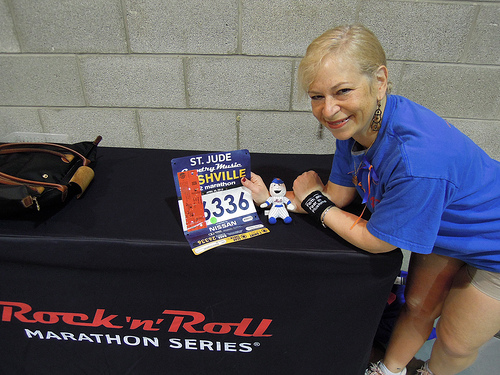
 Sharon Chapman represents FAFIF and Tug in Nashville. And now for a few links…
• I was a guest on The 5 Tool Show the other night, hosted by Kerel Cooper of On The Black and Tanya Mercado of Citi Field of Dreams. Had fun there, too, talking Mets history and so forth. Have a listen here.
• Taryn “Coop” Cooper of A Gal For All Seasons (and other worthy precincts) is off and running toward the New York Marathon in the footsteps of Team McGraw’s Sharon Chapman, raising funds for the Tug McGraw Foundation in memory of Gary Carter. Look into helping a terrific blogger, Mets fan and humanitarian here.
• Heading to Savannah for a Sand Gnats game? If you are, Stadium Journey has the scoop on historic Grayson Stadium, home of the Mets’ South Atlantic League affiliate. Check it out here.
by Jason Fry on 11 May 2012 11:59 pm The high-flying, temporarily much-beloved, pitch-count-focused, never-say-die Mets arrived in Miami to find the Marlins in the home version of their horrible new uniforms and ensconced in their horrible new park before a somewhat larger number of their horrible non-fans than we’re used to seeing.
There was a lot new there, on both sides, but one thing was very familiar: The Mets lost in a fashion that was, well, horrible.
Does it sound familiar that Johan Santana pitched well in Miami but was victimized by his defense? Yes, he looked shaky early — Austin Kearns’s home run was a no-doubter out of a big park, sending Jeffrey Loria’s idiotic giant Pachinko machine into spastic motion. But Andres Torres should have caught Jose Reyes’s leadoff drive — it wasn’t an error or a misplay, just a ball you expect a good center fielder to run down. Which was bad enough. I’d been waiting six months to see Reyes come skidding into third wearing the wrong uniform while David Wright stood forlornly to one side, but seeing it was still depressing. Omar Infante then followed Reyes’s hit with a little parachute into no-man’s land for a very speedy Marlins lead. Set Torres on a slightly better route and it’s 2-0 Marlins after an inning instead of 3-0 — or perhaps Johan pitches differently to Kearns and much else changes, too.
Does it sound familiar that the Mets clawed back in thrilling fashion, only to spit the bit defensively and be undone by a Marlins rally? I don’t want to go back and look at how many times this has happened before, because it will just make me mad. But if memory serves I remember about 53,299 games at Soilmaster that ended with the Mets undone by little bloops, or infield hits, or HBPs, or any other variety of wretchedness that in retrospect seemed inevitable. With the bottom of the 9th nigh, I tweeted out a warning that the Marlins were sending up an insane slugger, a Met killer and an anything-that-happen speedster. My advice: Believe, but buckle up.
Being a prophet is no fun sometimes.
None of this is to discard the Mets’ latest thrilling comeback, which tonight was keyed by not one but two pinch-hit doubles, courtesy of Kirk Nieuwenhuis and Mike Baxter. None of this is to discount that Ike Davis looks like he’s finding his way, that David Wright remains awesome, or that from top to bottom Mets hitters seem to have absorbed the lessons of Dave Hudgens: working counts, making pitchers throw strikes, tiring starters out, getting into bullpens, waiting for mistakes and then clubbing them. When the likes of Ronny Cedeno and Andres Torres are drawing walks, you know the students are paying attention in class.
Nor did Frank Francisco’s trudge off the mound in defeat mean the rest of the bullpen didn’t continue to shine. Ramon Ramirez struck out two in his inning of work, Bobby Parnell gets a pass because he was victimized by Ike’s awkward attempted ole of what should have been a Reyes groundout, and Tim Byrdak was superb. And look, Francisco will blow saves; a starter can have one bad inning and survive, while a closer wears the resulting headline around his neck until the next time he succeeds.
Marlins Park turned out to be something of a non-factor for me, perhaps because I’d seen it on ESPN at the beginning of April and had my chance to gape at it in horror then. Yes, it’s terrible: The lime-green walls make the eyes spasm, the Red Grooms thing is ghastly, the letters set in the pavement are stupid, and the throb of bass from the outfield nightclub (???!!!) is distracting. (Speaking of which, Mr. Loria, since you have a nightclub out there whose bass rattles teeth throughout the stadium, why play square old-timey organ fare? In for a dime, in for a dollar.) Maybe it’s just that I already thoroughly hate the Marlins and everything about them, but my reaction to three hours of Marlins Park was more supercilious eye-rolling than active disgust.
Weirdly, the new park reminds me a lot of Joe Robbie, or whatever the hell the old football stadium was called at the end there. The walls are randomly tall, the outfield grass looks unhealthy and abused, and lots of good seats are either empty or filled with visiting fans. I even spotted sacks of Soilmaster out in the bullpen, instead of in a storeroom where they belong. Perhaps the storerooms are still filled with office supplies Loria robbed from the Expos’ grave.
(The fish tanks are cool, though. And the bobblehead museum is an amusing idea. Which means Loria and his architects are batting about .020.)
We all knew the Mets weren’t going to win every game the rest of the way out. Still, they almost pulled off another one, a 12th come-from-behind victory in what’s still a very young season. I wasn’t worried when they were down 3-0 to Mark Buerhle. I expected them to come back, to tie up the game and then to take the lead. Which is nice, but not normal. When baseball teams are leading charmed lives, it’s your duty as a fan to remember these times are fleeting. Soak in as much as you can, because before you know it there will be a stretch where absolutely everything goes wrong and you’ll spend a week gaping at the TV in horror like Alex in A Clockwork Orange.
And even when your team is leading a charmed life, remember the baseball proverbs.
A run unscored is a run regretted.
Give no extra outs as gifts, lest more precious things be taken from you.
Yes, that eighth inning was fun. But it would have been more fun if Rob Johnson had bunted the ball fair with Cedeno coming down the line, making the score Mets 6, Marlins 3. Just as it would have been highly preferable for Torres to corral Reyes’s leadoff hit, and for Ike to play a step back on his little grounder. Taken together, that’s three runs against us, in what turned out to be a one-run loss.
Oh, and one last baseball proverb before I say goodnight.
Beware Greg Dobbs, in whatever raiment he cloaks himself, for his allegiance is to Satan.
by Greg Prince on 11 May 2012 10:32 am If you’re a Mets fan who likes to read, read George Vecsey recounting his recent visit with 1962-1964 Met pitcher Craig Anderson, who finished his career on an 18-game losing streak but not before he crammed two wins into one day, fifty years ago tomorrow. For a man whose name became statistically synonymous with “loss,” Anderson sure sounds like one of life’s winners.
As Vecsey puts it in typically eloquent terms, “Craig Anderson is much more than a has-been. In this milepost season, he is part of the DNA of every fan who agonizes over the Mets.” A hearty Let’s Go Mets! to that sentiment and to all the 1962 Mets who are still with us…and deserve to be with us en masse at Citi Field (and us with them) sometime this season. Vecsey again:
Fifty years is a perfect time for gauging this franchise, built on hope and dreams and irrationality and humor — the veritable human condition, one could say. Those first weird days flavor everything fans feel about these current Amazing Mets, who are somehow over .500 under their pepper-pot manager Terry Collins.
The current Mets are 18-13. The Original Mets didn’t notch an 18th win until they’d already piled up 47 defeats. Their 18th win, on June 22, 1962, came as Anderson’s final two wins did: in a doubleheader. It was pitched by Al Jackson and happened to be the franchise’s first one-hitter. You may have heard we’re about to turn the odometer over on our No Games With Fewer Than One Hit Allowed journey. We play our 8,000th game tonight, with the roundest of numbers, 0, describing just how many no-hitters Mets pitchers have thrown. The same round number can be used to total all the wins Craig Anderson racked up over his final 47 major league appearances, every one of them as a Met, the last of them in a game the Mets required 23 innings to lose…also in a doubleheader.
What’s it all mean? It means read George Vecsey’s article; consider reading David Bagdade’s devotedly researched book about 1962, A Year In Mudville; appreciate Craig Anderson and all those early Mets who did the hard work of getting us off the ground floor (if not out of the basement for five years); and if Johan Santana pitches a 1-2-3 first tonight in Miami, don’t hold your breath.
Or hold it. It’s not like anything else has worked where all those zeroes are concerned.
|
|