Never thought it would happen.
But it did.
 
Faith and Fear in Flushing made its debut on Feb. 16, 2005, the brainchild of two longtime friends and lifelong Met fans. Greg Prince discovered the Mets when he was 6, during the magical summer of 1969. He is a Long Island-based writer, editor and communications consultant. Contact him here. Jason Fry is a Brooklyn writer whose first memories include his mom leaping up and down cheering for Rusty Staub. Check out his other writing here. Got something to say? Leave a comment, or email us at faithandfear@gmail.com. (Sorry, but we have no interest in ads, sponsored content or guest posts.) Need our RSS feed? It's here. Visit our Facebook page, or drop by the personal pages for Greg and Jason. Or follow us on Twitter: Here's Greg, and here's Jason. |
Never thought it would happen. But it did.  47 comments - (Comments closed) | | 47 comments - (Comments closed) | |  Print This Post | Print This Post |  First No-Hitter in New York Mets History, Johan Santana First No-Hitter in New York Mets History, Johan Santana I don’t usually make predictions, but I’ll go on record projecting Carlos Beltran will skewer Mets pitching for the next three or four days, and I’m only hedging on how many because I figure Monday afternoon following a Sunday night he might be rested. He’s already having a bang-up season for the Cardinals, a year after having a bang-up season while the Mets were preparing to send him away. Never mind the mole on the ear. This guy’s gonna be playing with a chip on his shoulder all weekend. For anyone who ever doubted his desire to return from injury, for anyone who thought he didn’t show enough fire, for anyone who focused exclusively on the things he didn’t do as opposed to reveling in how much he accomplished as a Met for seven years…yeah, he’s gonna come out swinging. I’ll enjoy it for the first home run, which I assume will come in the first plate appearance. I’ll appreciate it less and less as the series goes on, but I’ll accept it as the cost of doing business. Carlos Beltran will leave here bat scalding, and we can get back to the Wheeler watch…which will be fine in the long run. In the short run, though, it’s gonna be something else. Just a hunch. Hey, for the first 6 2/3 innings that was a helluva fun game. Swing and a drive from Lucas Duda, his first ever off a left-hander, Mets up 3-1, about to go seven over .500, take the first series in their gantlet of contests against powerful clubs, run their record against the hated Phillies to 7-2, and … The hanging knuckle-curve that Bobby Parnell offered Chooch Ruiz was the needle scraping off the record, causing a roomful of partygoers to reach for their ears and drop their drinks. But if so — to continue a metaphor from another millennium — Andres Torres’s ill-fated pursuit of Brian Schneider’s fly ball a batter before was the sketchy friend of the guy you didn’t want to invite stumbling across the room, hands splayed out in a vain effort to catch his drunken self before falling headfirst into the record player. Which would make the misadventures of Jon Rauch and Tim Byrdak and Ramon Ramirez and Chris Schwinden a dog’s breakfast of teens throwing up in the bushes and the cops coming to break everything up and knowing you’re totally busted and Mom and Dad are going to wreak a terrible vengeance in the morning, which will be here way too soon, terrible and bright. It’s like that Katy Perry video, only with Shane Victorino refusing to stop playing Xbox in your TV room. The Mets’ bullpen has an ERA of 5.45, which is 30th in the big leagues and would probably be 50th if there was suddenly an enormous wave of expansion. Thinking about that, you find yourself wondering where these overachieving Mets would be if the pen was merely worrisome instead of awful, and you quickly realize they’d probably be in first place, thumbing their collective orange and blue nose at a nation of baseball scribes. If someone in the postgame had asked Terry Collins about his bullpen’s execution, I bet he’d have said he was in favor of it. Despite this, I find myself philosophical and upbeat. Yeah, the bullpen’s bad — but it can’t be this bad. Byrdak’s been great. Rauch has been pretty good all told. Parnell doesn’t have great body language but has grown into a pitcher instead of a chucker — he chose a lousy time to hang a curve to a .366 hitter, but those things happen. Ramirez looks horrible now but has been an effective reliever before — and if you want to give up on him, remember that Frank Francisco looks lights-out now, where a couple of weeks ago we were ready to tie him up and stash him in one of Willets Point’s chop shops. Manny Acosta was awful and so is gone. Should the significance of that be lost on anybody, there are potentially useful reinforcements available or nearly so in Jenrry Mejia, Josh Edgin and Elvin Ramirez. We can hope that some guys’ struggles are behind them, that we see some regression to the mean, and that some new recruits can help. Meanwhile, suppose back in January I’d offered you the chance to be 1.5 games out on June 1, with David Wright and Johan Santana looking rejuvenated, R.A. Dickey having a superb year, Daniel Murphy and Tim Byrdak and Scott Hairston and Mike Baxter having emerged as solid players, Kirk Nieuwenhuis looking like a keeper, and signs of life from Dillon Gee, Lucas Duda and Bobby Parnell. You’d have taken that without questions or reservations. And here we are. The Mets were 13-10 in April, 15-13 in May, and it’s not crazy talk to think they may be able to keep it up or even get better — not with Josh Thole and Ruben Tejada returning and Ike Davis maybe finding himself and the young guns in Buffalo and Binghamton getting closer. Yes, I’d have taken that in January quite gladly. As I’ll do at the end of May. Nobody can unearth a personal baseball milestone the way I can, yet other than acknowledging their existence — My 200th Win at Shea! My 500th Mets Game Anywhere! My 500th Regular Season Home Mets Game! — I don’t seem to do anything about them. Not this time, though. Not when I saw my 100th game at Citi Field coming from a couple of exits away and gauged that this could be a special evening. I’d love to tell you I ordered up the first home run hit by a Mets pitcher in two years and a heretofore AAA infielder recording three hits and a pinch-hitter taking over the team lead in longballs all in the service of putting away a certifiably hated division rival, but that part was out of my control. If I could control events that effectively, I wouldn’t only have Shane Victorino flop down in center field and a line drive leap off the tip of Jimmy Rollins’s glove, but I’d keep the Long Island Rail Road moving when I have a personal milestone celebration to indulge and I’d keep the rain away for nine consecutive innings. I can’t do it all, dammit. But I can, after hesitating mightily over the expense, observe my own take on Treat Yo Self Day, which entailed not just my 100th game at Citi Field (we don’t count the exhibition against the Red Sox), but an hour in a room with a guy who has been Citi Field’s signature success story; a door prize sealed with the signature of the signature success story guy; a seat in one of the few sections of the ballpark where I’d never sat; and — this is a loaded proposition for me since February 10 — all I could eat. To celebrate my hundredth game in my version of style, it would cost me a hundred bucks (plus galling “processing” fees). I hesitated mightily because it’s a hundred bucks for a baseball game. I unhesitated over the course of a week as I amortized the expense and decided it was actually a pretty good deal. And I went for it because if I don’t treat my personal milestones with reverence, ain’t nobody else gonna. The guy at the center of the celebration was, you might have deduced, R.A. Dickey, author of Wherever I Wind Up, which made the New York Times bestseller list recently. He’s also R.A. Dickey, National League Player of the Week very recently. The Mets offered him up as the highlight of their hundred-buck special. Buy that ticket, get an autographed copy of that book, get to maybe ask a question of him and his “collaborator” (not ghostwriter) Wayne Coffey. If you can get people to pay to see an author, says an author no one’s ever paid a dime to see, that’s some pretty effective book promotion right there. But he is R.A. Dickey and there was a baseball game and food thrown in, so again, good deal. The R.A. portion of the evening required my showing up at Citi by 5:30, which was going to be a breeze, until the Long Island Rail Road announced it was suspending all service west of Jamaica, which I learned while at Jamaica waiting for the Woodside train. This presented something of a problem for those of us who had bought hundred-dollar tickets and saw them forming wings as if to fly away à la so many clever Archie comics illustrations. Why the commutation disruption? I learned second-hand that a train hit somebody. The face I made and the comment I muttered when so informed immediately disqualified me from Humanitarian of the Year consideration…and discovering later that it was a “successful” suicide attempt didn’t improve my empathy quotient one little bit. (He had to do it during rush hour?) I can’t decide if this means I’m a rotten person or just a New Yorker in a hurry. As I abandoned the LIRR and scrambled to the E, I mulled what R.A.’s reaction would have been to this tragic development and decided it would have been spiritual, selfless and uplifting, whereas all I could think about was my inconvenience and possible missing of a thing I was looking forward to. Then I remembered I don’t wear a WWRADD? bracelet and boarded my alternate means of transportation. I got to the ballpark in time despite the detour, was handed the promised signed copy of the book, grabbed a last-row seat in the press conference room and gave myself over to the spellbinding nature of Mr. Dickey once he took the stage. He pitches like an All-Star. He talks like a Nobel Laureate. What category? Does it matter? Geez, if you think he’s R.A. Dickey in soundbites, you should hear him in extended riffs. He’s so…R.A. Dickey, in every good sense that implies. He’s light without being empty, he contains gravitas without being full of himself, he gets under your skin without getting on your nerves, he is truly one of a kind. I thought about taking notes so I could add to the collected wisdom of the best knuckleballer in captivity, but I found myself not wanting to jot. I just wanted to listen. Funny how none of the questions from a roomful of Mets fans was in the realm of “what was it like facing Joey Votto with the game on the line?” There was curiosity about his curious pitch and a few tidbits relating to baseball stories from the book, but it was mostly about the things that make R.A. stand out if not exactly apart from his peers: his tastes in the arts; his education; his climb up Kilimanjaro (on which he managed to be funny and poignant in the space of a spoken paragraph); and his writing process, which is something Coffey was clear on Dickey actually having, as opposed to the athlete-autobiographers who don’t read their own books, never mind write them. How did R.A. approach Wherever I Wind Up? “I wrote it hard,” Dickey said. “I wrote it raw.” Gads, I thought, if I said something like that about myself, I wouldn’t have to throw myself in front a train because I’d die of embarrassment. But when R.A. Dickey said it, you could tell he meant it, you could tell it was a code of honor for him and you could assume the book — which I look forward to ingesting in full after having read only excerpts to date — was that much better for it. I would have liked to have asked a bunch of questions of my own, but it was a crowded scene and the room voted for group photographs over extended Q&A, so there we were, lining up by row to stand around R.A. and grin. The Mets photographer asked if I, the tall one, wouldn’t mind standing next to the pitcher. No, I said, I wouldn’t mind at all. R.A. gave us every minute of the hour that was promoted, but except for a quick “thank you” I offered with my handshake, I didn’t get to say anything to him or, as was my grand plan, exchange Mets-tinged memoirs with him. My book is listed in the Library of Congress catalog; I’d be more excited if it was on the top shelf of R.A. Dickey’s locker. Ah, but there was to be no real disappointment affixed to Treat Yo Self Night, for as R.A. exited for the clubhouse, I found my celebration would include an unexpected element. I had bought one ticket, pricey as it was, and was resigned to watching the game alone, which would have been OK, I guess, but also a little on the solitary side. Good thing I was paying attention to the questions and not just the answers at R.A.’s non-bull session because one of them came from a woman who mentioned working at the Metropolitan Opera. Sure enough, it was Susan Laney Spector, whom blog aficionados should recognize as the oboist behind Perfect Pitch, the lately (and sadly) dormant journal of a Met musician/Met fan. Susan, her husband Garry and their daughter Melanie had come to hear R.A.’s linguistic symphony and were headed to the same slice of the ballpark I was, happily guaranteeing me delightful company for the duration. Our destination was the Champions Club, which I had last infiltrated (through the good graces of one of the Best Mets writers going) when it was still the Ebbets Club, back when I’d been to only a dozen Citi Field games. This was 2009, when anything I liked about Citi Field was overshadowed by how much I couldn’t stand Citi Field. It and I have made strides since then. I wouldn’t have dreamed I’d get to a hundred games there so quickly. Some of that is due to the thoughtfulness of the fellow Mets fans you meet when you blog a lot but I’d also credit the comfort level the ballpark and I began achieving in 2010, once the Hall of Fame and Museum was installed and the place as a whole began feeling less sterile. In what was either a coincidence of timing or an irony (I’ll have to check with Professor Dickey), a friend of Stephanie’s marveled Tuesday that in my Banner Day story in the Times, “Greg didn’t mention how he hates Citi Field.” I found that observation jarring, because in 2012, I’m so much more mellow on the subject. In 2009, I was bitter that Shea had ceased to exist and was thus turned off by the Mets spewing happy horsespit about all the amenities I never asked for and generally couldn’t afford. I’m still capable of going to a dark cul-de-sac of the soul and stewing about the destruction of my temple, but nothing in that stew can bring Shea back from the hereafter. What’s left in its approximate geographic place is where I go to see the Mets. You can’t voluntarily go somewhere 100 times in a span of less than four seasons and legitimately claim you haven’t come to kind of like it. As for the former Ebbets Club, it works better with a Mets theme. My early visits to it, courtesy of Matt Silverman, were on the first base side, where the clubbiness is now devoted to the 1986 Mets. My special R.A. ticket sent me for the first time to the third base side, which is a 1969 Mets shrine. My guess is you can’t go wrong with either Champion. You also can’t go wrong with dinner at the Champions Club, which, as noted, is an all-you-can-eat affair. It was tempting to take them up on their dare. Whereas the Ebbets Club sold you a buffet that your better college cafeterias could have matched, Champions serves you real food. It’s got some ballpark fare around the edges because you’re in a ballpark, but the culinary draw is the roast beef…and the flounder…and the pasta of some sort…and the pork loin (though I didn’t have any)…and the dessert stations (though I didn’t touch any of it)…and the unlimited bottled water and fountain soft drinks. Think about how much any two edible and/or potable items cost at Citi Field, and you begin to see there’s some economy in this arrangement. Then throw in that it’s indisputably real food, and that hundred-dollar expense is suddenly looking not so bad. And we haven’t even had our ballgame yet! Third base side of the Champions Club is, simply, as sharp a view as you can get at Citi Field. Except for the corners where Mike Baxter might turn an opposing double into a triple, you see everything at what feels like eye level. If you like a ballpark vista that spreads out before you, try it if you can swing it. Under most circumstances, I couldn’t. For comparison’s sake, I had looked into the Champions Club for Banner Day, and the asking price, by the Mets, was $220 per ticket. I love Banner Day, but not that much. Yet for one c-note, when you receive that pitch-perfect tableau, that real food, that book, that author…plus those bonus Spectors…I’m tempted to call it a bargain. But only if you throw in Jeremy Hefner homering. And Omar Quintanilla ingratiating himself. And Scott Hairston homering. And the Phillies not catching catchable balls. And the paucity of Phillies fans where we were sitting. And Jeremy Hefner outpitching the storm clouds. And the storm clouds not gathering in full force until the Mets had a lead and five innings had been played. The Spectors and I were waiting for the skies to unload and were therefore rooting for the tarp to trump any silly ideas about a Philadelphia comeback. As it happened, the Mets took a bone dry 6-3 edge to the bottom of the eighth before the downpour we’d been anticipating for an hour finally came to pass. Susan, Garry and Melanie had already left in deference to the impending deluge and a long day besides. Now with no immediate companionship, an indeterminate delay and a room filled with ice cream and cookies (delectable I’m sure, but verboten to me), I decided it was time to treat myself to an exit of my own. It rained just enough to vindicate my decision to bolt until it stopped raining once I was safely east of Jamaica and they wound up playing the final six outs to successful completion. But that was OK. I had Howie, Josh, my little radio and a functioning LIRR getting me home at a reasonable hour. And a very reasonable marking of a milestone, if I say so myself. 13 comments - (Comments closed) | | Print This Post | Citi Field, Commuting, Empathy, Jeremy Hefner, Milestones, Omar Quintanilla, Pitchers Hitting, R.A. Dickey, Scott Hairston, Treat Yo Self 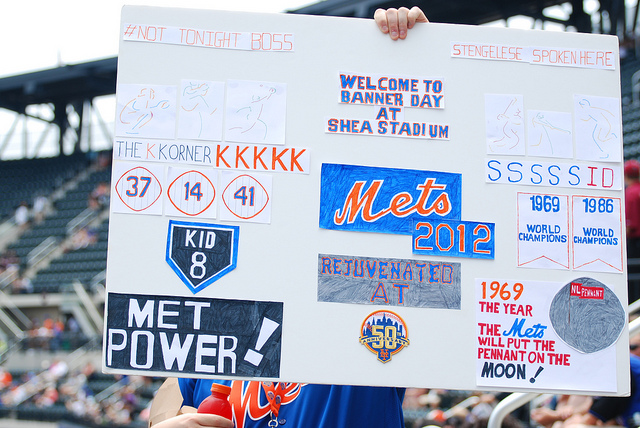 It's a sign of the times. Joyously watching the (mostly) 50th Anniversary-themed banners go by on Sunday from a carefully staked perch on the Delta Club patio, I couldn’t help but think about the banner parades that nobody seems to remember seeing — you know, the ones from after 1996 and before 2012. Somebody claimed the Mets stopped having Banner Days during that rich and textured period in Mets history, but how could a franchise with that kind of brand equity in something as singularly beloved as Banner Day allow such a crime against tradition to transpire? Nah, nobody would’ve been that dense for that long. Still, it was hard to find any solid information from those years…even my usually reliable Met memory was coming up empty…but by the time I got home, chock full of bedsheet goodwill as I was, I was able to dig deep into the Oughta Be archives and recapture some of the best banners from 1997 through 2011. Banner Day 1997 Finalists Banner Day 1998 Finalists WE’VE GOT ONE PIPING HOT PIAZZA Banner Day 1999 Finalists THERE’S NO “E” IN OUR INFIELD, BUT PLENTY OF “D” Banner Day 2000 Finalists MOJO’S RISIN’ AGAIN Banner Day 2001 Finalists TIMO’S REDEMPTION: COMING TO A SERIES NEAR YOU Banner Day 2002 Finalists SCOREBOARDS AREN’T SAFE WHEN MO BEGINS TO STRAFE Banner Day 2003 Finalists JOSE CAN YOU SEE REYES WILL BE ROOKIE OF THE YEAR Banner Day 2004 Finalists KAZ IS THE BEST MATSUI IN TOWN Banner Day 2005 Finalists FLOYD WILL PUSH THE BRAVES OFF THE CLIFF Banner Day 2006 Finalists JULIO FRANCO PLAYED BALL WITH YOUR GRANDPA Banner Day 2007 Finalists YOU CAN’T HIT ’EM OVER ENDY Banner Day 2008 Finalists SEND THIS PARK OUT A WINNER Banner Day 2009 Finalists I LEFT THE SHAKE SHACK LINE TO BE HERE Banner Day 2010 Finalists YOU WON’T LIKE FRANKIE WHEN HE’S ANGRY Banner Day 2011 Finalists DANIEL MURPHY IS BLESSED WITH VERSATILITY I trust now that we’re all pretty sure Banner Day took place at Citi Field this year, we won’t have any more problems confirming its existence in the future. Later this week: An on-field photo essay from Faith and Fear photographer Sharon Chapman, who (as evidenced above) followed the procession from beginning to end and beyond. The story of the banner pictured at the top of this column can be found at Remembering Shea. Some Metsian bookkeeping from Memorial Day 2012, when the caps were ugly and Jon Niese didn’t look much better: • Jack Egbert, a righthanded reliever with a last name reminiscent of a weird comic I recall from my childhood (all the single-panel action took place in utero), pitched two-thirds of the ninth inning, making him the 930th Met since there have been Mets; the 35th Met to see action since Opening Day; the thirteenth new Met of 2012; and the 183rd Met to debut as a Met since Faith and Fear in Flushing began blogging. • Vinny Rottino became the Mets’ 149th third baseman, or the twentieth to first try his hand at the position since David Wright made the traditional comical tracking of every Met who ever took an ultimately futile turn at the hot corner largely a thing of the past. One-timers since July 21, 2004, include Andy Green, Wilson Valdez, Josh Satin, David Newhan and Eli Marrero. I guess it’s still a little comical. • Wright played shortstop for the second time as a Met, but while nobody can doubt he’s what they used to call a good team man, David’s no shortstop. At least on a potential 1-6-3 DP he wasn’t. But he’s David Wright and it was an emergency, so we won’t hold it (or his alarmingly sudden sub-.400 average) against him. • The Mets have three shortstops, none of whom is available to play. Ruben Tejada is rehabbing. Ronny Cedeño is day-to-day. Justin Turner, after tripping over first base, is on the DL. (The Mets’ last full-time starting shortstop, the one alleged to be overly injury-prone, has played in 48 of his team’s 49 games thus far this season.) Omar Quintanilla is en route from Buffalo to become Met No. 931 Tuesday night. • Chris Schwinden is also coming, presumably to replace Manny Acosta on the roster. Technically this is a pitcher supplanting another pitcher, but if you’ve seen these guys pitch in 2012, you’d question those job titles. • Two days after becoming a member of Club Hessman — so named for minor league slugger Mike Hessman, whose home run on August 6, 2010, wound up being his only Met home run — Rottino has exited the group, thanks to homering again, if barely. Current Mets who remain club members in good if mostly powerless standing: Cedeño, Andres Torres, Jordany Valdespin, Mike Baxter, Tejada and Johan Santana. Charter members, from 1962, are Gus Bell, Hobie Landrith, John DeMerit and Rick Herrscher. • Scott Hairston has taken sole possession of thirteenth place on the all-time Mets Citi Field home run list with four. One more dinger will tie him with Gary Sheffield and Rod Barajas for eleventh. One more after that will earn him a share of tenth place with…any guesses? Yes, that’s right: Fernando Tatis. Wright tops the chart with 25 blasts since 2009, giving him a ten-tater edge over Angel Pagan, who himself is one ahead of Carlos Beltran and two up on Ike Davis and Jose Reyes. Daniel Murphy’s next home park home run — he awaits his first homer of 2012 anywhere — will make him the sixth Met to reach double-figures lifetime at Citi Field. The same can be said for Jason Bay, who I’m told, somewhat surprisingly, is still a Met. • With six runs batted in to lead the Phillies to an 8-4 victory Monday, Ty Wigginton, a Met between 2002 and 2004, has officially expended all residual goodwill from his heretofore moderately fondly recalled Shea tenure and should now feel free take a hike. 2 comments - (Comments closed) | | Print This Post | Jack Egbert, Mets Third Basemen, Omar Quintanilla, Scott Hairston, Ty Wigginton, Unhealthy Obsession with Mike Hessman, Vinny Rottino Hot day at Citi Field: Emily and I easily spent $25 on bottled water, an expense I’d normally decry but accepted uncomplainingly as the cost of remaining upright. Besides his usual helping of hot dogs, Joshua got a massive “fresh-squeezed” lemonade (squeezed from a factory, by the taste of the stuff), a cherry Sno-Cone and a steady flow of instructions to take it easy and not jump around so much. Down there on the field, R.A. Dickey’s knuckleball was jumping around plenty. It had Padre bats slashing above and below fluttering objects when those bats weren’t parked on shoulders or pinwheeling away from their owners. Over on ESPN New York, Dickey talks about having found new wrinkles in his knuckler: how to change speeds with it, so he effectively has a fastball knuckler and a change-up knuckler, as well as how to elevate the pitch instead of simply letting it tumble through the air on its plateward journey. One of the things that’s fun about Dickey — besides his W.P. Kinsella musings, thoughtful candor and pitbull competitiveness, of course — is the way he treats his knuckleball alternately like a scientist with a tricky experimental subject and an artist with a fickle muse. On Sunday, his knuckler was so good that R.A. sounded like a man who’d proved his theorem and harnessed that muse, even if only for an afternoon: “If you [radically change speeds] and still throw strikes with it, it can be ruthless.” If ruthlessness was the order of the day on the mound, joy was top-line in the stands. Banner Day was back after 16 years, and it looked very much like a success to me. No, there wasn’t a huge crowd or banners in the thousands — blame jungle weather, years of losing, a multitude of newborn distractions and the once-annual rally having taken an entire generation off. (About which, here’s Greg in the Times.) But the parade was pretty good nonetheless — hundreds of banners, trooped proudly in a loop around the ballpark that took them by judges Howie Rose, Evan Roberts, Rusty Staub and Dwight Gooden. Standing by the railing above the warning track in short left, Emily and Joshua and I offered cheers and raised thumbs. Shannon Shark, who deserves thanks and congratulations for tirelessly campaigning for Banner Day’s return, has a from-the-field perspective here. He reports that the Mets were cool, fan-friendly and organized, adding that he saw no knucklehead behavior. We didn’t either — of all the banners, I noticed one lament for the lost Jose Reyes (expressed in gentle rhyme) and a single scrawled anti-Wilpon slogan. But the last one was being carried around by some yutz in a Yankee cap, so it barely counts. That’s a success too: My fear was that some fans would see Banner Day as an outlet for the frustration and anger of the last few years, combined with a chance to put one over on the guys in maroon. Which, besides being lousy manners, would have ensured at least another generation in the wilderness for Banner Day. But that didn’t happen. What we saw instead was banner after banner that fairly sang with the joy, wild hope and occasional self-deprecation of being a Mets fan. Invocations of famous numbers (1o! 41! 16!) and names (Tug! Cleon! Mookie!). Calls to bring back Mettle the Mule. “Camptown Races” rewrites featuring Lucas Duda, Duda. Assurances that no-hitters are overrated anyway. A grinning Endy Chavez against a banner that read THE STRENGTH TO BE THERE, with a real glove emerging from a hole at the wrist. Praise and pride for homegrown Mets, flowers in an NL East garden. Mr. Met, lovingly drawn and held aloft by small hands. A defiant insistence that “WE DON’T STINK LIKE THEY THINK” followed by the quiet addendum “We’re over .500.” Oh, and meanwhile, the PA was playing Casey Stengel talking about the fans’ placards and how he’d gotten distracted reading them. Nice touch!) There were predictions of 2012 World Series titles, of course. But most of those came with question marks — which is really what being a Mets fan is all about. If you can allow yourself to imagine a spectacle as soulless and awful as a Yankee Banner Day, you know there wouldn’t be a question mark in sight. Mets fans live adorned with them: Where others guarantee victory and expect rewards, we imagine good things that might happen if this goes right and that goes right and if you believe. (After all, ya gotta.) In recent years the people who run the Mets let two unfortunate tendencies get between the fans and the team: They treated the Mets’ history as an embarrassment to be minimized or ignored, and they looked at any potential situation and tried to figure out what could go wrong. Those same people have made great strides in undoing the first mistake, restoring the classic uniforms, adding a very nice Mets Hall of Fame and starting to fill Citi Field with Mets memories. Today, they took a big step toward undoing the second. Sure, Banner Day could have been a parade of anti-Wilpon signs, or a PR black eye if such signs hadn’t been allowed, or the kind of thing the Yankees wouldn’t do, or some other morsel for the sharp teeth of ravenous back pages. But Banner Day wasn’t any of those things. Instead, it was a pageant of beaming fans showing off placards Casey would have appreciated, the products of hours and hours of hard work and years and years of crazy love for a team that’s often star-crossed and a sport that’s often cruel. Banner Day is back, a good new beginning for an old tradition. And its return is more evidence the Mets are back, too. Maybe not back as it’s measured in the win-loss column quite yet. (BUT JUST YOU WAIT!) But back in the way that’s always mattered more.
The Saturday game was a matinee. Planes could be heard rumbling overhead on TV. Rusty Staub was in evidence. High and deep fly balls hit by the home team left the home park for home runs. So-called scrubs excelled. A masterful pitching performance was completed by the ace who started it. A romp became a rout. The whole thing took 2:18. And Banner Day was at hand. Was this Shea, circa 1973? It was close enough. I got a very good feeling watching the Mets overwhelm the Padres this afternoon. Not just a 9-0 feeling, but a feeling that this was a throwback game, the kind of game I could’ve watched on Channel 9…the kind of game when Rusty Staub wasn’t a bobblehead, but a 3-for-5 right fielder robbing Johnny Grubb of a double. Alas, the real Rusty was confined to the SNY booth, but we were OK on the field anyway. After all, we had Vinny Rottino. Vinny from Racine (by way of Buffalo) was filling in as we might have had George “The Stork” Theodore do once, and Rottino inked himself in the Met annals with his very first home run. The Stork’s very first home run, walloped off Balor Moore of the Expos on Independence Day 1973, was half of his career output, which is as many as have been hit by modernity’s yeoman catching answer to Duffy Dyer, Mike Nickeas. Nickeas’s second career home run, which put a lovely bow on things in the eighth, was a grand slam. Of course it was. On a day like this, it would have to be. Scott Hairston, a little more credentialed but not materially different from your Dave Schneck type, started the Met power trip with a three-run shot in the first, a blast good enough to go out of Shea in 1973 or Citi Field in 2012, if not the old Citi. Same for Vinny, same for Mike. That absurdly dimensioned Citi, however, is so 2011. Today was a hot day, so the ball jumped. When the ball jumps, it should have a chance to clear the outfield walls. Three of ours did. Nothing the Padres hit was a threat to scale any wall (other than Kiddie Field’s), but to be fair to San Diego, they didn’t hit much of anything. They were facing this Met generation’s version of Tom Seaver, Johan Santana. Righty-lefty stuff notwithstanding, Seaver is the clearest antecedent for Santana in Mets history, especially on a day when Johan is so Terrific. Bob Murphy would have said Santana was wearing the Padres hitters on his watch chain, and indeed our robust ace dealt as if he had early supper reservations in the Diamond Club and was in no way planning on dining late. The Johan line: 96 pitches, 74 strikes, zero walks, seven punchouts, four hits, no runs obviously, no relievers obviously, nobody like him when he’s this much in command obviously. I’ve often thought if something’s obvious, there’s no need to say “obviously,” but why not be sure to call attention to how obviously untouchable Johan Santana was during as much of the afternoon as he needed to go the distance (which wasn’t a big chunk of it)? His performance was strongly reminiscent of the way Seaver used to handle the Padres. From 1969 through 1975, encompassing 21 starts, Tom’s record against San Diego ran to 18-1, his ERA was an itsy-bitsy, teeny-weeny, yellow, polka-dot 1.57, and in 183 innings, he struck out 189 Padres while walking only 42 of them. In one game, he fanned 19 Friars, including the last ten in a row; in another, he prevented them from collecting a base hit until the ninth inning. In an era when complete games by ace pitchers were the rule, Tom Seaver threw 14 in those 21 starts. Johan being 1-for-1 versus the Pads since returning to apparently full health will do for now. All that’s left to make the nostalgic element of this weekend resonate that much more sweetly would be for thousands to have their bedsheets festooned Sunday morning and for tens of thousands to turn out well before gametime to watch them as Banner Day rises from the ashes. I will be there, not judging the results (I’ll leave that to the likes of Rusty, Doc and Howie) but appreciating that the most Metsian promotion ever is on the march again. My friend Shannon at Mets Police will be happy to cajole you into showing up tomorrow. And I’ll throw in another link to my Banner Day retrospective that ran in Saturday’s Times to provide a little context as to what this is all about on the off chance that not everybody reading here was a kid at Shea in 1973. But if you watched the game today, you might as well have been. 10 comments - (Comments closed) | | Print This Post | 1973 Mets, Banner Day, Dave Schneck, Duffy Dyer, George Thedore, Johan Santana, Mike Nickeas, Rusty Staub, Scott Hairston, Tom Seaver, Vinny Rottino The Mets, despite being admirable scratchers and clawers, needed a laugher. Or at least a chuckler. I no longer believe that winning builds character — it seems more likely to me that winning leads others to ascribe character to you — but you can convince me that eking out narrow victories and getting crushed by wide margins causes a young team to be exhausted by July. Tonight the Mets could relax a little. After a rough first inning (made smoother by a Spider-Man catch against the wall by Mike Baxter), Dillon Gee was in control of the Padres and the game. After a Met three-spot in the fifth, he could cruise. His stuff was good but his location was better — Gee’s best pitch of the night might have been his last one, the culmination of a nine-pitch battle with pinch-hitter Chris Denorfia. It was a 3-2 fastball on the outer edge, at the knees, perfectly placed and unhittable. Denorfia leaned over the plate to regard it with faint hope, then leaned back in dismay as Gee trotted off the mound. The other happy development in Metland? It was that David Wright went 0 for 3. To be more specific, Wright went 0 for 3 (dropping his average to a mere .397) but the Mets still won. So far, David Wright’s 2012 has surpassed the sweetest dreams of the most optimistic Mets fan. (I’ll grant you the existence of such a creature is generally discussed in the same breath as unicorns, yeti and the Loch Ness monster.) At the plate, Wright looks like his pre-Citi self, the precocious hitter for whom an 0-2 count wasn’t a death sentence but the Alfonzoesque prelude to the rest of the at-bat. In the field he looks smooth and sound in a way we haven’t seen since … well, since ever. In the on-deck circle or the dugout, he looks like what we always urged him to be — the unquestioned leader of his baseball team. It’s pinch-me stuff. But Wright can’t be the whole story. Tonight’s Mets offense began with Lucas Duda banging a home run off the sign overhanging the Mo Zone. It kept rolling with a double from Mike Baxter and a single from Kirk Nieuwenhuis, young outfielders pushing Jason Bay and Andres Torres towards Where Are They Now? status. It concluded with a double down the left-field line from Daniel Murphy and a single rapped back up the middle by Ike Davis. Yes, there was an Ike Davis sighting — though nothing was sweeter than seeing Murphy ambling back to the dugout sending fist pumps and attaboys Ike’s way. The hope is that Wright will remain to see the Mets emerge from the doldrums of ill luck and thin wallets. But if better times are in the offing, it won’t be because of Wright alone. That won’t work. A brighter future depends on complementary players emerging to share the load — to go 3 for 10 with three runs scored when Wright’s 0 for 3 and never sees second base. At least for one night, the supporting cast was there, and the reviews were excellent. * * * Today is Rusty Staub Bobblehead Day, event and player both appreciated by Greg right here. Tomorrow is Banner Day, a wonderful Mets tradition now happily restored. I’m going to send you somewhere else to read about that — to the New York Times, no less. But you’re not really leaving home, because that essay is also by Mr. Prince. It is, to no one’s surprise, wonderful. Enjoy. Comments closed | | Print This Post | Daniel Murphy, David Wright, Dillon Gee, Ike Davis, Lucas Duda Interrupting Dillon Gee’s good work and some hockey game of local interest to note Saturday’s New York Times includes an essay by yours truly on the Mets’ revival of Banner Day, coming to a ballpark near you Sunday. You can read it here. |

Piazza: Catcher, Slugger, Icon, Star by Greg Prince is available from Amazon, Barnes & Noble and other online booksellers. 
Amazin' Again: How the 2015 New York Mets Brought the Magic Back to Queens by Greg Prince is available from Amazon, Barnes & Noble and other online booksellers. 
Volume I of The Happiest Recap: 50+ Years of the New York Mets As Told in 500+ Amazin' Wins by Greg Prince is available in print and for Kindle on Amazon. 
Faith and Fear in Flushing: An Intense Personal History by Greg Prince (foreword by Jason Fry), is available from Amazon, Barnes & Noble and other online booksellers. |
|
Copyright © 2026 Faith and Fear in Flushing - All Rights Reserved |
||