Faith and Fear in Flushing made its debut on Feb. 16, 2005, the brainchild of two longtime friends and lifelong Met fans.
Greg Prince discovered the Mets when he was 6, during the magical summer of 1969. He is a Long Island-based writer, editor and communications consultant. Contact him here.
Jason Fry is a Brooklyn writer whose first memories include his mom leaping up and down cheering for Rusty Staub. Check out his other writing here.
Got something to say? Leave a comment, or email us at faithandfear@gmail.com. (Sorry, but we have no interest in ads, sponsored content or guest posts.)
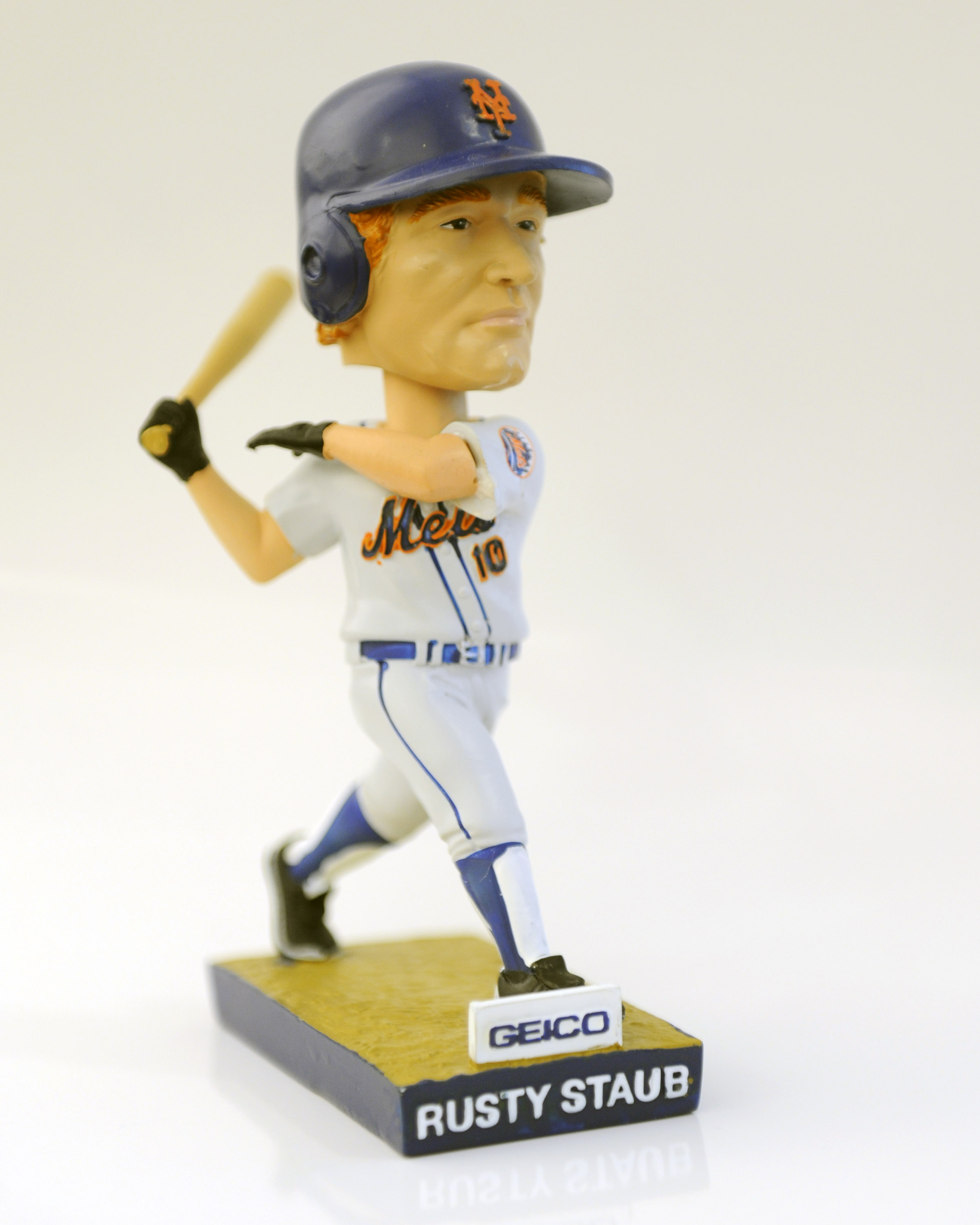
On Saturday, the Mets will distribute 25,000 bobbleheaded likenesses of Daniel Joseph Staub, which is not the same thing as actual likenesses — the resemblance is primarily hair-deep — and may not be enough for the club to satisfy the honoree’s stated wish that “everyone comes out and gets one.” Nobody likes to imagine Customers No. 25,001 and beyond going home emptyhanded.
Still, Rusty Staub Bobblehead Day is inspired stuff, probably the Mets’ boldest bobble choice in their 50th anniversary series. Rusty will be bubble-wrapped, boxed and presented to represent the 1970s Mets, which isn’t the player-decade linkage I would have made off the top of my non-bobblehead. My choice was Tom Seaver, but he got the ’60s and apparently you can’t make everything about Tom Seaver (though I can dream). Staub, however, is the worthiest non-Seaver candidate imaginable. Rusty was here for only four years of the ’70s, and only wore No. 10 for one of those years, but he was a huge impact player during the part of the decade when things were generally going well.
Orange you glad Rusty made the 1970s less blue?
Rusty’s bat, dislodged from the Expos in April 1972, transformed the Mets once the strike-delayed season got underway, making the lineup dangerous and the team a 25-7 powerhouse. His broken hand — which he played with for two weeks — loosened the Mets’ grip on contention, but a year later, a recovered Staub helped lead the charge that resulted in the come-from-behind capture of the 1973 division title. Staub sacrificed his body to make a brilliant catch in Game Four of the NLCS against the Reds, played with searing shoulder pain in the World Series yet hit .423 against the A’s and finished the ’73 postseason with four roundtrippers. Two years later, he became the first Met to drive in more than a hundred runs, racking up 105 ribbies in 1975.
Then he was traded to Detroit for Mickey Lolich for no good reason. Not for no discernible reason — M. Donald Grant wanted him, his 10 & 5 status and his independent thinking out of the clubhouse — but certainly for no good reason. Frank Cashen blessedly brought him back as a free agent in the next decade, and Rusty Staub enjoyed the best second act any Recidivist Met ever had, emerging from 1981 to 1985 as one of the game’s premier pinch-hitters and a budding contender’s gray eminence.
Or orange eminence.
The Rusty Staub of 1972 through 1975 is the one being toasted tomorrow, and the Rusty Staub of today was gracious enough to join the blogger corps on a Mets-arranged conference call the other night. Many fine questions were asked and many forthright answers were offered (read ’em here, courtesy of MetsBlog’s transcription), but left out of the conversation is what an incredibly charitable force he’s been in this community since his playing days wound down. It was Rusty’s Foundation for the families of firefighters and police officers lost in action that was at the fore of New York’s post-9/11 recovery efforts, and it’s Rusty who’s still front and center with his long-running group, hosting another of his annual picnics at Citi Field for its benefit on June 20. Rusty has been listed as one of the Mets’ ambassadors these last thirteen seasons, but the title is almost a formality. Nobody has represented the Mets or baseball better since we first got to know Rusty Staub four decades ago.
Yes, it’s been a long time, which is another thing about Rusty Staub that struck me as I sat on the line and waited for my turn to ask a conference call question. Rusty’s career stretched with the kind of longevity that would impress anyone this side of Jamie Moyer. He came up to the bigs as a Houston Colt .45 in 1963 under manager Harry Craft and he lasted, with distinction, through the Mets’ near-miss pennant race of 1985 under manager Davey Johnson.
Which is when it hit me that a guy who was playing major league baseball in 1963 once played for a manager who is managing in 2012.
When I was given my opportunity to query Ambassador Staub, I asked Rusty for his impressions of Davey, his final skipper in 1984 and 1985 when Johnson was in his first managerial gig, and the current pilot of the first-place Washington Nationals.
“We got along great. He knew as much about when to use me as anybody. I had respect for the way he handled the game. The whole team lacked a little bit of discipline — there’s no question about that. We all know what happened off the field with this team. This was a great group which probably should have won more. But he was very, very good on the field. He doesn’t need my OK to understand that because he’s done well every place he’s ever managed.
“He is his own guy, he goes about it his own way and doesn’t care what anyone else thinks, and that’s probably a good thing for a manager to be. I was happy for him [that] he got another shot in the big leagues, and […] the team is spending a little money on players and doing pretty good.”
If the Johnson Nats keep it up — which conflicts mightily with our contemporary parochial interests, but better them than the rest of the division on the off chance if it can’t be us — we can assume Davey will garner a great deal of attention for doing yet another heckuva job with yet another team. And he should. But though any 2012 success Davey Johnson has is a Davey Johnson story, there’s something about Rusty Staub’s presence at the beginning of Davey’s first chapter as a manager that tickles me no end.
• There’s a guy managing today who managed a player who first played 49 years ago (April 9, 1963, at Colt Stadium, his first hit coming off the Giants’ Jack Sanford in the sixth inning, leading Alvin Dark to bring in future Met Jack Fisher to face future Met Bob Aspromonte).
• There’s a guy managing today who managed a player who hit a home run in the Polo Grounds (July 16, 1963, top of the seventh, nobody on, cutting Al Jackson’s lead to 3-1 in a game the Mets won, 4-3, in walkoff fashion when Norm Sherry singled home Rod Kanehl in a ninth-inning rally set up when a pickoff attempt of Hot Rod went awry at first; the first baseman was…Rusty Staub).
• There’s a guy managing today who managed a player who first played when John F. Kennedy was president (and Barack Obama had just turned 20 months old).
• There’s a guy managing today who managed a player who first played before the Mets ever won a World Series…which was accomplished when that same guy managing today hit a deep fly ball to left field at Shea Stadium on October 16, 1969.
On that last point, the Davey-Rusty duo isn’t exactly alone. A little checking on Baseball Reference, which is as valuable for a curious baseball fan as Rusty’s bat was to Davey’s strategizing 27 years ago, reveals there are three managers active who once managed players whose careers commenced in the 1960s. From longest ago to most recent (relatively speaking), they are:
1. Davey Johnson and Rusty Staub (debuted 1963), Mets, 1984-1985;
2. Bobby Valentine and Nolan Ryan (debuted 1966), Rangers, 1989-1992;
3. Davey Johnson and Mike Torrez (debuted 1967), Mets, 1984;
4. Bobby Valentine and Toby Harrah (debuted 1969), Rangers, 1985-1986;
5. Davey Johnson and George Foster (debuted 1969), Mets, 1984-1986;
6. Jim Leyland and Jerry Reuss (debuted 1969), Pirates, 1990.
From there, a couple of handfuls of early ’70s debuts can be found on the respective all-time rosters of the three veteran managers who helm the Nats, Red Sox and Tigers today. Davey’s other charges who were playing while Richard Nixon was in his first term include Larry Bowa, Dick Tidrow and Tom Paciorek. Bobby V had Paciorek, too, along with future Met pitching coach Charlie Hough, while in Texas.
The three aforementioned managers have truly endured. Leyland endured without pissing too many people off, which explains why his MLB managerial gap — seven years between Colorado and Detroit — wasn’t quite as long as Valentine’s (a decade) and Johnson’s (eleven years). It also indicates managers who are old now once managed when they were pretty young. Although Leyland has had the air of death-warmed-over about him ever since he started steering the Pirates’ ship at the age of 41, he’s nearly nine months younger than Staub. Johnson, who managed his first Mets game at 41, is Rusty’s senior by only about fourteen months. Bobby V was hired away from Davey’s staff by Texas a few days after his 35th birthday.
The Davey-Rusty spread, though nearing a half-century, isn’t a record. It’s probably not all that close to being one. Just for comparison’s sake, in 1935, while running the show as Brooklyn’s second-year skipper, Casey Stengel managed Cooperstown-bound Dazzy Vance, who commenced his major league career in 1915. Thirty years later, at the end of his Met tenure, Casey nurtured rookie Tug McGraw, who would pitch in the big leagues from 1965 until 1984. That puts the Stengel player span, from Dazzy’s introduction to Tug’s finale, at 69 years.
And that’s not necessarily the record, either. Consider that Connie Mack was a player-manager with the 1894 Pirates and managed a shortstop by the name of Bones Ely, who broke in with the Buffalo Bisons of the National League (not to be confused with the Bison-populated Mets of today’s very same National League) in 1884. In 1947, during the twilight of Mack’s fifty years managing the Philadelphia Athletics (owned by the ever-versatile Connie Mack), he brought up young Nellie Fox, whom he traded to the White Sox two years later for the not nearly as immortal Joe Tipton. Soon on his way to the Hall of Fame, Fox lasted clear to 1965, when he finished up as a Houston Astro, a teammate of…yup, Rusty Staub. That makes the Mack player span, from Ely to Nellie, a formidable 81 years.
I’m guessing that’s the record for this sort of thing. And I’m guessing anything involving Connie Mack won’t ever be surpassed for longevity (not even by Jamie Moyer). But Davey’s probably going to be able to give Casey a run for his Dazzy-Tug money down the road. Remember, he’s managing a pretty bright prospect named Bryce Harper, who is the same age in 2012 that Rusty Staub was in 1963. If 19-year-old Harper doesn’t altogether flame out, he’s probably a decent bet to be playing well into the 2020s, maybe into the 2030s. Davey isn’t likely to be his manager then, but Johnson will rightly have him on his permanent record, same as he has Staub. We could be talking by then, if we’re still around, about the Davey span, from Rusty to Bryce, closing in on 70 years.
Which is really just an excuse for us right now to be talking about Rusty Staub’s bobblehead. As the man himself said, everybody should go out and get one.
In light of the dreary weather through which all concerned were compelled to muck Thursday night, the New York Mets have announced tickets from their 11-5 loss to the San Diego Padres can be redeemed for complimentary admission to tonight’s game.
But only if you’ve been bad.
Your conscience would have to wracked by a gaggle of guilt to voluntarily submit to the punishment of another Mets-Padres tilt under dicey skies so immediately soon. “I haven’t suffered enough for my sins, I should also wear a promotional replica batting practice cap that looks like a novelty yarmulke run amok but is even more tasteful thanks to the humongous auto parts chain logo I will display as if a bumper sticker affixed itself to my head.”
Hey, nobody said you had to be a Mets fan. You could’ve quit the habit before 7:10 last night. You could’ve looked at the oddball lineup card Terry Collins handed Jeff Nelson…
Cedeño
Murphy
Wright
Hairston
Duda
Rottino
Torres
Johnson
Hefner
…and begged off, citing, “Who?” Granted, that might not hold up in a court of Met law, since if you’re a murky-Thursday-night kind of Mets fan, you are expected to know your inventory, even if it’s stock from the back of the Quadruple-A warehouse, yet you’d be perfectly within your rights to ask yourself, “How?” How did it come to be that as the 45th game of a generally pleasing season (disturbing frequency of blowout losses notwithstanding) arrived that we wound up with a batting order we’d pick apart for using fake names if we saw a shot of it in the Original Lifetime Movie presentation of The David Wright Story?
Rottino? Johnson? Hefner? The Mets never had anybody on the team like that the year David hit .400 — did they? Who’s ‘Torres’ supposed to be? And Cedeño leading off? David never played with Roger Cedeño — I call continuity error! Oh, and Hairston batting cleanup? That’s totally unrealistic.
The other story point that seemed off was the umpires deciding the game would start in a downpour, though to be fair, the Mets were never better than when the Padres couldn’t properly handle a wet baseball. Even with that element of nature working for us, we could build only a 1-0 lead before the umps determined they could no longer officiate without an ark.
Things became immensely more entertaining during the rain delay, thanks to the airing of Mets Yearbook: 1968 (Kooz still wants spaghetti for dinner) and Mets Yearbook: 1972 (Willie still disembarks from that cable car), but then somebody with no sense of reverence rolled up the tarp and somebody with no sense of what 68-minute rain delays do to starting pitchers sent Jeremy Hefner back to the mound to replicate his two-inning magic.
It couldn’t be done, which was sad less for the predictable outcome than to think about a pitcher making his first major league start, having had his family fly in from Montana to witness it, and then throwing helplessly as it all unraveled like a cheap giveaway cap. Maybe other starters have been allowed to pitch after an hour and eight minutes on pause, but I couldn’t think of any recent examples (other than Eric Stults, I suppose, but we already knew he’s superhuman). Then I realized the Mets wouldn’t have tried this with any of their shall we say real starters. This was the kind of night when you protect a valuable arm and send some stray Bison onto the field to soak up the innings when the gales of November came early. As Jeremy Hefner was that Bison…well, good luck, kid.
When you buy a ticket, you’re not entitled to a win, but you are entitled to something approximating a legitimate attempt to attain one. The Mets (save for Wright, of course) seemed to approach Thursday as if it was a predestined defeat. So why not keep Hefner in the game? Why not roll out whoever in whatever spots in the lineup? Why not forget how many outs there were in any given inning, as Rob Johnson did in the seventh, leading to two Padre runs that made the score 9-3 and the outcome academic…as if it wasn’t already since how were we supposed to beat the baffling Eric Stults anyway?
Other than Mr. .405, the only Met who came out of this looking better than he went into it was Ike Davis, who it was decided will try to find his mojo not way the hell upstate as popularly suggested but while dancing between the major league raindrops when not sitting against Stultsifying lefties. Before Mets Yearbook ran, Sandy Alderson gave some half-Omar’d explanation to Gary and Ron that everybody likes Ike and who knows if a Buffalo miracle cure would work anyway? Resounding vote of confidence cast, Ike came off the bench and delivered a two-run pinch single in the eighth that cut the Padres’ lead from enormous to merely formidable. Ike’s on a two-game hitting streak now and the ol’ average has risen clear to .164.
So it’s not like the Mets were all wet last night.
On Friday the Toronto Blue Jays made Jon Niese into their personal pinata, whacking him all over the ballpark. It was the worst start of his young career, a game that ended with Rob Johnson on the mound and doing a lot better than the guy he’d started the game catching.
Today, Niese handcuffed the Pittsburgh Pirates rather convincingly, using his cutter and change to great effect, as the Mets just got enough offense and left PNC Park with a 2-1 series win. (And a 19-19 all-time record in the beautiful stadium where horrible things happen, believe it or not.)
What happened in between? A lot of stuff, much of it fascinating — and invisible to us except through secondhand accounts.
After the Toronto debacle, Dan Warthen got excellent distance in heaving Niese under the speeding wheels of a very heavy bus, saying he needed to study more, particularly against teams he hadn’t faced before. It was a pretty damning critique, particularly of a guy who’d just had his free-agent years bought out by a cash-strapped team.
Then, as Adam Rubin reports over at ESPN New York, Niese was summoned to a pitching skull session that included Niese, Warthen, bullpen coach Ricky Bones, Johan Santana and R.A. Dickey. It sounds like it was a Come to Jesus moment for Niese, courtesy of some apostles of pitching, and oh what I wouldn’t have given to be a fly on the wall for that congregation. Niese, one presumes, listened — at least for one start. This was Warthen afterwards, demonstrating his bus-throwing muscles are still in fine shape should he have to use them again: “Sometimes [Niese] trusts his stuff more than realizing that he has to pitch. Today I thought he pitched as well as using stuff.”
Johnson, back in as Niese’s catcher, also helped out by keeping it simple. During today’s pregame bullpen session, he saw that Niese’s cutter and two-seam fastball were particularly good and he was locating them very well. So he leaned hard on those pitches, with Plan B waiting until the Pirates showed they could hit them. They never did.
I have no inclination for advanced stats, unfortunately — but I’m fascinated by them, convinced that they have a lot to teach us about the game we love to watch, whether it’s by confirming hunches, illuminating murky events or exposing biases. It makes me crazy when smart broadcasters who love baseball reject advanced stats haughtily (I’m looking at you, Howie Rose), and merely disappointed when smart fans who love baseball dismiss them cavalierly.
You can’t discuss Ike Davis’s troubles without understanding that his BABIP this year is ridiculously low, or prepare yourself for what’s to come with David Wright without understanding that his BABIP is ridiculously high. And if you rolled your eyes because BABIP sounds funny, c’mon. You’re better than that. Keith Hernandez talking about rib-eye steaks sounds goofy too. FIP and K/BB can tell us interesting things about pitchers and their defense (or lack thereof), and those metrics undoubtedly informed the Mets’ decision to extend Niese. Fielding remains the area where advanced stats are still searching in the dark, experimenting with different models — but even here, the research is no longer theoretical. Joe Maddon and the Tampa Bay Rays are employing defensive shifts with regularity, practices that get Maddon called a mad scientist today (sometimes on SNY, unfortunately) but will be common among the smart teams in five years and reach the dumb teams in 10. It’s all fascinating to me — as is anything that helps me understand baseball better.
But advanced stats aren’t everything, and they aren’t the only lens through which baseball can be illuminated. This isn’t a counter-case to the above — the only people I’ve heard make such universalist claims are old-school traditionalists bashing away at straw men. But it is a useful reminder. I can’t quantify the effect of Niese getting hauled into a room for schooling by Santana and Dickey, but I’m pretty sure it made a difference. I have no numbers to pinpoint Niese’s effort doing prep work in Toronto vs. his effort in Pittsburgh, but the latter sure seems to have been larger than the former. And was Niese’s performance on the field different because of those things? I’m quite confident it was, even though I can’t measure it. Advanced stats teach us that the pitcher can do little or nothing to influence what happens to the ball after it’s hit, which is useful to know. But it’s also useful to better understand what the pitcher did — or didn’t do — before that point. And in the case of today’s game, that process seems to have begun over the weekend, in another country.
Intangible and unquantifiable things are important — but they’re also a catch-all category for a lot of lazy thinking and myth-peddling. I don’t know what the hell “Derek Jeter knows how to win” means, or what “Alex Cora/Jeff Francoeur/Mr. Met is a great clubhouse guy” has to do with anything. For that stuff, well, WFAN awaits. But if you’re going to tell me that Niese was effectively locked in a room with Santana to learn how to size up batters during a game, I’ll listen. If you’re going to tell me what Johnson saw through the bars of his mask and how that shaped the game he called, I’m all ears. Those are intangibles and unquantifiables worth discovering and discussing — and in this case, celebrating.
Ike Davis is neither here nor there right now, which is a shame for Ike and a shame for the Mets. He’s not here in the sense of looking like he’s a part of a team when it’s having its ups, as it did Tuesday night behind R.A. Dickey’s 11 dancing strikeouts, and it’s become impossible not to notice what a contributor he’s become to its intermittent downs. Lord knows he’s not the only one who’s been in a statistical funk. Andres Torres is 1-for-about a million and Mike Nickeas was the hitting equivalent of Rheingold — ice cold and extra dry — before rustling up his biweekly RBI.
But they’re Andres Torres and Mike Nickeas. It would be too blithe to dismiss them as unimportant to the Mets’ short- or long-term fortunes, but there are enough outfielders floating around the roster to sit Torres (or dump his one-year contract if circumstances grow dire enough) and Nickeas is a backup catcher exposed as such when given the opportunity to play, his yeoman handling of R.A.’s knuckleball notwithstanding. They come off as nice guys and I hope they find their groove soon for the sake of their careers and whatever help they can provide the greater good…but they’re Andres Torres and Mike Nickeas.
Ike Davis is a whole other thing, maybe a day from being optioned to a whole other town in a whole other league. Short of going 5-for-5 against Charlie Morton and a passel of Pirate relievers, Ike — a favorite son of Flushing whom we’d prefer not to think of as simply another partially proven youngster — seems inevitably Buffalo-bound. That much is easy to project if tough to swallow, especially for a fan still prone to wearing his WE LIKE IKE shirt with pride. The temptation is to wave off Davis’s potential demotion with “c’mon, this is Ike Davis we’re talking about,” but at the rate he’s gone (.156/.212/.291), Ike has no star left to dim. In the major leagues, more than a quarter of a season into a personal baseball nightmare, the goodwill and the merchandising from 2010 cuts Ike no ice. At this level, there can be no sacred cows, just Bisons in waiting.
Ike’s not there in the sense that he’s not in Buffalo yet. But he should be soon. He has to be.
What’s most painful about watching Ike slouch toward Triple-A is how he’s flailing in his rush to get there. This is the team that takes pitches, works counts and manufactures baserunners, right? If so, Ike’s already on another team. There is no approach from him at the plate right now. Ike faces pitchers like he’s just passing through, knowing that in a matter of minutes he’ll be sitting and stewing again.
His at-bat in the eighth seemed to sum up his season. The Mets had just caught an enormous break when Pedro Alvarez couldn’t pick up Daniel Murphy’s grounder, which allowed an insurance run to score. The Mets had first and second with two out and were facing a pitcher, Juan Cruz, who’d already been driven to distraction by not getting a call he wanted and by Andrew McCutcheon not getting a firm grasp on a fly ball over his head. Never was there a better time to take the first pitch and let the reliever feel a little more pressure in a 3-1 game.
Ike felt the pressure. He swung and lofted a fly so lazy Andy Samberg is making a digital short about it right now. Threat over, inning over, funk deepened.
The Mets won anyway, with Terry Collins popping his nightly dose of Vitamin Byrdak and Frank Francisco keeping everybody’s language suitable for children, but Ike didn’t appear to be any part of it, and not just because he went 0-for-4. 0-for-4? Big deal. The greatest hitter in the universe, David Wright, went 0-for-4. James McDonald made most everybody look more like .156 neophytes than .403 worldbeaters. But, man, the ohfers Ike takes lately are just brutal and his visibly insular reactions to them cringe-inducing. There are brushes with moments of clarity, when an occasional hard-hit line drive shoots toward a rudely waiting webbing, but they’re not built on. He’s totaled two hits and one walk in his last ten games. Whatever defense he brings to bear as the only legitimate first baseman on call doesn’t come close to compensating for the acres of barren production he leaves in the wake of his sullen plate appearances.
If this were about a lousy May after a shaky April, maybe it wouldn’t feel that urgent. But it does. And it’s not because the Mets are in a white-hot, four-way battle for that last Selig-mandated Wild Card spot. The Mets should endeavor to win every game on their schedule, obviously, but this season is really critical for what it starts to tell us about the next few seasons. Ike Davis is a tentpole for what this franchise is supposed to become as it evolves — we hope — from earning pats on the head for not being as bad as people thought to administering kicks in the ass to anybody would get in its way.
If Ike is the Ike of most of 2010 and the part of 2011 before his ankle gave out and valley fever took its toll, then we know we have a genuine force at first base. If Ike is that Ike (which is the only Ike we’d ever seen since he first came up), we know we’re that much closer to contending; and we know re-signing Wright won’t be about gestures or sentimentality but about building a dangerous lineup that will have something to compete for sooner than later; and we can guess David the free agent will be that much more likely to want to stick around if he’s part of that kind of attack in that kind of context.
If Ike is this Ike — the one who couldn’t look more miserable at the plate or on the bench — there’s every reason to question his place in the Mets’ plans, which is a question no one was anticipating having to ask. The phrase Bobby Ojeda would throw around when Mike Pelfrey would get lit up seems applicable in Ike Davis’s case: there are no scholarships at this level. A trip to the next level down, ideally brief but as long as is required to be effective, seems imperative. The kid (all of 25) seems too good and usually too preternaturally confident to be this lost. There’s time to find that Ike Davis, but there’s no point in delaying the search.
I’m not that worried about the Ike Davis of 2012. It’s the Ike Davis of 2013 and beyond that concerns me.
I’m not sure why I did — the ball Neil Walker hit to begin the bottom of the Pirates’ eighth wasn’t going out and wasn’t parachuting in. It was ticketed for short of the warning track, a quick trot at worst for either the left fielder or the center fielder. But for whatever reason, I sensed trouble. Trouble with a mournful, mocking Chris Isaak croon, trouble like a sign reading DANGER HEARTBREAK DEAD AHEAD. Trouble like Luis Castillo scuttling crablike under the lights at Yankee Stadium, like Shawn Green’s old legs taking a creaky first step along the path of Scott Spiezio’s drive, like Juan Samuel hitching up Todd Hundley and Howard Johnson and Keith Miller for a stagecoach ride through Out of Position Canyon.
The ball alighted briefly in the space occupied by both the glove of Kirk Nieuwenhuis and the shoulder of Mike Baxter — the third left fielder of the night — then bounded away. So did Walker, who wound up at third, where the baleful glare of Jon Rauch was of no particular effect. After the inning, I joked that poor Baxter was going to search for the spot in the dugout equidistant between the Mets’ diminutive but scarily intense manager and their gigantic and scarily intense setup man, but I wasn’t exactly laughing. (For the record, SNY’s cameras caught Terry Collins between innings with his arm around a despondent Baxter, looking calm and downright fatherly.)
Of course by then a number of things had already gone wrong.
Like Johan Santana being given a four-run lead and then handing it back, with the first two runs coming via a flurry of doubles in the fourth and the last two coming all at once off the bat of Mike McKenry in the seventh. Not to get all Francesa on you, but you can’t blow a four-run lead against the Pirates. To be saner about it, the post-surgery Santana has been better than any of us could have hoped for, but he’s now mortal — as indomitable as ever above the neck, but inevitably eroded and stretched between the shoulder and the fingertips. This is not to complain or cast aspersions, but to be realistic about things.
After jumping on the glacial Erik Bedard (“Bedard” is apparently French for “Trachsel”), the Mets got handcuffed by a parade of Pittsburgh relievers, but were poised to take the lead in the top of the eighth, with Nieuwenhuis on third with one out. But Mike Nickeas K’d feebly, Baxter walked, and ice-cold Andres Torres grounded a ball up the middle, with Baxter forced at second by an eyelash. The Mets could really use Josh Thole back — he’s no slugger, but he’s become a patient hitter and rarely strikes out; with that needing more time, I agreed with Ron Darling that they might have tried to steal a run (or force the Pirates into more incompetent fielding) by sending Baxter. Instead, the run didn’t come home, and was soon to be mourned.
Of course, this is PNC Park, where all manner of things are mourned. Since the stadium opened — with an exhibition against the Mets, who somehow won — the Mets are 17-19 here, but it feels like a couple of zeroes are missing from that last number. The Mets media guide was no help: It omits 2007 in favor of an extra 2003, which normally I’d blame on the Mets except it’s entirely fitting for that to be screwed up too. Since being wowed by AT&T Park, PNC is the big-league stadium I most want to visit. But I think any Mets fan will understand that I’ve made up my mind to see it when the Pirates are playing one of the other 29 teams.
Frank Francisco walks the first batter of the ninth and allows a shift-confounding single immediately thereafter. There’s two on, none out, a one-run lead and every reason to believe that the eight runners the Mets had gotten into scoring position but neglected to score were lining up for a big, juicy bite of cosmic retribution. With a, say, 9-5 lead, Francisco could futz around for a couple of batters, yet lurking grand slam specter notwithstanding, we could feel reasonably confident in his ability to push (if not slam) the door shut on the deadly international conspiracy known as the Toronto Blue Jays.
But it wasn’t 9-5. It was 6-5. And I wouldn’t have given you a plug Canadian nickel for the chances of it not being 7-6 or something like it in a matter of metric minutes. The Jays sure like to swing and our closer sure likes to melt. This was not a recipe for a clean getaway day.
Yet here we are, in the cool of the evening, sipping on a refreshing 6-5 win whose peril was real but danger never grew any graver than first and second, nobody out. Francisco defied the rising, thundering snarls of the Rogers Centre throng (the way we’ll sound when Frank revisits Citi Field in another uniform someday…or next time we see he’s still with the Mets) and, à la Andy Dufresne after his crawl through a river of edited-for-television spit, came out clean.
Francisco fell behind Edwin Encarnacion one-and-oh, yet managed to strike him out.
Francisco fell behind J.P. Arencipia two-and-oh, yet managed to strike him out.
Francisco fell behind Eric Thames — now there’s a name that seemed worth reserving for recriminatory reference purposes during future ninth-inning unravelings (“goddammit, this is turning into another fucking Eric Thames at the fucking SkyDome atrocity!”) — two-and-one, yet managed to strike him out.
When Frank got Thames, I had to count to make sure he’d really recorded three outs. He’s out of the inning? We won the game? Really? No way it could have been…not so much “that easy,” because it wasn’t easy, yet I just assumed it would take bases-loaded agony and some David Eckstein type coming up and fouling off 23 or 24 pitches to get even close to a third out.
But mostly I expected Eric Thames to homer.
No, that’s not completely true. I expected Jose Bautista to homer, but Frank held him to that measly single. Maybe we won the game right there. It’s hard to fathom we didn’t put the durned thing away much earlier while Mike Baxter was enjoying his child’s-size cycle — Whopper not included — and David Wright was leaving Met legends in the artificial turf cut-out dust, passing Jose Reyes for second in Met hits and Mike Piazza for first in Met interleague RBIs, and Dillon Gee was showing irrefutable evidence that Texans Do It Better Without Beards (Dear 7 Line: there’s your next shirt). By the light and lively way the Mets were playing, I kind of assumed we were unassailably good for Sunday.
But then we kept forgetting to tack on runs. And Gee ran out of gas. And Parnell was location-optional. And the home team kept swinging. And David dared to strike out with the bases loaded in the eighth. And Darren Oliver, who used to be a Met, and Francisco Cordero, who I’m sure I used to think was Frank Francisco, shut us down in the ninth. And here came the actual Frank Francisco. And Marlins Park came to Toronto. It was going to be last Sunday all over again, except worse, because a series sweep was in the offing.
Until it wasn’t. Which is no small thing when there’s a plane to catch and PNC Park to provide its own time-tested aggravational pull.
The Mets look great, but nearly blow an incredibly winnable game. The Mets look shaky, yet a 41-game season would have them in a one-game Wild Card play-in versus Miami to determine who’d be in the actual one-game Wild Card playoff. We can argue that this second Wild Card spot is a cheap gimmick that rewards teams barely floating above .500, but the Mets are one of those teams and a quarter of the real season in, they are on track to be rewarded. Can’t say their contending status is a phenomenon that will keep up, and I sure as hell wouldn’t bet on it on injury-riddled, experience-lacking principle, but I’m also not ready to bet against these Mets, Frank Francisco and all.
Give me and them another week and I’ll let you know if I’m quite so generous in my weighing of admirable character over assembled talent.
It’s not a lot of fun listening to Brandon Morrow and a bunch of Blue Jays you mostly know from fantasy teams throttle an undermanned Mets squad in another country. The final score was only 2-0, but given a punchless Mets lineup with too many dudes looking up at the Mendoza Line and David Wright sitting woozily on the bench, it felt a lot like yesterday’s shellacking. Plus it came with a side of injustice — Mike Baxter was safe at second in the ninth, nailed by a combination of Jose Bautista’s good defense, Yunel Escobar’s good acting and Brian Knight’s bad positioning. One of the biggest stories of this baseball era will be how routinely bad umpiring became, and how it took the ubiquity of overhead TVs and fans’ smartphones for Major League Baseball to take action and decide that serial incompetence on the part of its employees should no longer pervert the outcome of games. (Tigers fans aren’t big Knight supporters either — see the video here for some prime douchebaggery.)
But umpiring is a subject for another time. (And the way things went today, I bet you Baxter gets doubled off on Daniel Murphy’s liner anyway.) The game wasn’t much fun, but it was still a little fun. Which time and again is baseball’s saving grace.
I was out and about on errands, with Howie Rose and Jose Lewin in my ears, and I was struck — as I often am — by how listening to baseball seems to knit everything together, whether you’re talking about the baseball world or the slightly larger one that occasionally contains other things. The game on a headset while you’re doing stuff is the grown-up equivalent of smuggling a transistor set under your covers — sure, I’m at the bank/the Gap/Target/the farmer’s market, but I’m also getting to play hooky from all that mundanity, because I’m really at the Rogers Centre, living and dying on each pitch and imagining gray-clad Mets down there on gray-green artificial turf, now happily a rare sight.
And it wasn’t just the game — which was best, since the game itself wasn’t anything to cherish. It was everything around the game, getting shaped by it and shaping it in turn.
* It was hearing Howie Rose sounding happy and loose in a way he never was with the unlamented Wayne Hagin. In discussing the suspension of Toronto’s Brett Lawrie, Howie noted that umpire Bill Miller had been grazed at worst by Lawrie’s bounced helmet, but reacted like he’d been shot. In jumped Josh Lewin with a good line about Miller overacting like a gunfighter in a spaghetti western. Or there was Murphy’s mysterious relay throw for an unnecessary fourth out, which prompted Lewin to crack that Murph was being mindful of the exchange rate and Howie chiming in that Murphy’s Law is that the play’s not over until Daniel Murphy says it is. Lewin’s genuinely funny, without overdoing it, and he makes Howie far better.
* It was the air of intrigue settling over the Mets, who right now are caught between anxiety that their roster has been rendered dangerously thin by injuries and incompetence and hope that reinforcements are coming. The reinforcements are pretty good — but they’re not getting here as quickly as they’re needed. That’s made the ears hypersensitive, scanning eagerly for each and every personnel update: Why was Jenrry Mejia pulled after three innings in Binghamton? Will Manny Acosta be the next to catch a thunderbolt from Mount Alderson? Is Josh Thole riding a bike yet? Is Ruben Tejada running? Is Jason Bay swinging the bat? Is Wright feeling any better? How’s Chris Young’s shoulder? And what about Matt Harvey? Jeurys Familia? Are they closer to the Show? How about now?
* It was knowing my phone was the gateway to so much other baseball. The audio of any other game was a few clicks away if I wanted it. (Same with video, if I give in and pay $25 a month for MLB.TV Premium, which increasingly seems less like an indulgence than it does like common sense.) Or there were the Foursquare alerts popping up: A mutual friend with whom I took a Citi Field tour once upon a time was at the game in Toronto (sorry Mike!) while another guy I know was at the Hall of Fame.
* It was baseball’s ability to make yesterday seem like today and vice versa. Howie and Josh noted that Jeremy Hefner’s last start was for Buffalo against Gwinnett. Now, I know those are Triple-A clubs, part of the structure of organized baseball. And I know traveling between Buffalo and Gwinnett means airplanes and security checks and all that boring familiar stuff. But darned if it doesn’t sound like barnstorming, whistle-stop baseball from 50 years ago, with Hefner some busher who just signed for $25 and a train ticket to a Class-D town.
Would all of the above had been more enjoyable with the Mets leading 16-2 and the Jays trying to figure out who could be their Rob Johnson? Of course it would have been. But that’s not for us to decide. You get the baseball you get, and you take whatever pleasures it gives. Happily for all of us, even on the bad days that’s quite a bit.
That’s not meant to be a slam on the level of Bill Terry’s notorious “is Brooklyn still in the league?” or Charlie Dressen’s equally karma-busting “the Giants is dead!” But the dynastic Jays of the early ’90s and their dome that seemed so of the moment haven’t been front and center in baseball’s consciousness much recently, Jose Bautista’s power displays notwithstanding. One who pays only fleeting attention to the other league could be forgiven for thinking both entities had been the sports equivalent of pulled from the shelves…or maybe flat-out cancelled. Like Pop Rocks. Or Cops. Except somebody still manufactures Pop Rocks and Fox still airs Cops. Some things don’t go away. They just fall into the background.
Sure enough, the Toronto Blue Jays haven’t disappeared. There’s a SkyDome in Toronto, still, even though it’s officially a Centre and in recent years it hasn’t struck visitors as particularly cutting edge. The home team enjoyed it just fine Friday night, however, much to the consternation of those who follow the road team, which for the first time since 2006 happened to be the Mets.
It’s too early in the annual N.L. vs. A.L. maneuvers to be fed up with Interleague play, and despite the 14-5 pantsing that wasn’t as close as the score makes it appear (and the ninth Met defeat by five or more runs this season), it seems a little hair-trigger to be overly disgusted just because Jon Niese and Manny Acosta were slugged to bits and our only mound salvation came from two guys who never pitched in the major leagues before: rookie Robert Carson and catcher Rob Johnson.
Carson is the third No. 73 to pitch for the Mets and has no doubt left the best impression of any of them. You probably don’t need to be reminded how Kenny Rogers ended his tenure in those numbers. The less-remembered Ricardo Rincon was last seen blowing up Pedro Martinez’s final Met start and endangering the Mets’ 2008 playoff chances (as if the 2008 Mets needed additional help doing that). Robert Carson is a blank slate with an ERA to match. Keep it up, kid. And maybe try a new number.
Johnson is the third No. 16 to pitch for the Mets since the righthander SNY’s Thursday night program tabbed as the second-greatest Met ever stopped doing so. You would have thought a ceremony would have been held to declare Dwight Gooden’s number would never be worn again as the good Doctor made his way to Cooperstown, but both of those ships sailed (or were sadly snorted) long ago. Doc’s 16 was held in abeyance for four years following his exile from Metdom until Hideo Nomo brought what was left of his Tornadic appeal to Shea in 1998; Nomo’s last Met start was about as bad as Niese’s most recent.
The next Met to pitch in 16 was someone wearing it in tribute to Gooden…but pitching in the image of Bill Pecota. That was 2000 right fielder Derek Bell, who came into a game in which the Mets were getting hammered and ensured they’d get clobbered. Then, like a pair of traveling numerals, 16 continued on its journey only to those who had some compelling reason to wear it: David Cone (another Doc homage), Doug Mientkiewicz, Paul Lo Duca and Angel Pagan (like Nomo, 16s in their previous MLB lives).
Rob Johnson, like Bob Geren, is a journeyman catcher who had no reason to be assigned a number that resonates resoundingly in Met history. Except unlike Geren, who isn’t enhancing the digit of Ed Kranepool and Jose Reyes by sitting on the bench next to Terry Collins and advising “maybe hit and run here,” Johnson is lately lighting up Metsopotamia as Doc did in 1984 and 1985. Well, on a really limited basis he is. Thursday there was that bunt that sparked the eighth-inning rally that beat the Reds. And on Friday, Johnson pitched the greatest 1-2-3 eighth a team losing by nine runs has ever known, simply by virtue of being catcher Rob Johnson pitching.
It’s a shame things really have to get desperate for a position player to pitch, because when it works, it’s so much fun. Johnson popped up the first guy he faced on one pitch. He popped up the second guy he faced on two pitches. And he struck out the third guy he faced. The names of those guys are being withheld as a protest against the circumstances that led to a catcher pitching, but it was fantastic.
As is David Wright, head cold notwithstanding. David, 1-for-3 before calling it a night, is batting .409. He hit .333 on the evening, yet his average dipped two points. That’s fantastic in its own way. Wright was ranked eighth on that SNY special regarding great Mets, one spot ahead of Reyes, one behind Carlos Beltran (whose number is presumably on reserve for whenever the Gerenesque Val Pascucci returns). Reyes — tied for second in career base hits by a Met once David collected his 1,300th at Rogers Centre — is no longer here and Beltran is no longer here, but Wright is most definitely still here. I thought of him going into this series because of what I wrote the last time the Mets were in Toronto:
If we all agree on the not-such-a-stretch principle that David Wright is the best regular player ever produced by the Mets…make that if we all agree on the not-such-a-stretch principle that no regular player produced by the Mets has ever come as far as fast as David Wright has, then I won’t feel I’m rushing things to reveal a revelation I had last night.
The revelation had something to do with drawing a parallel between 1969 and 2006 (which looked logical in June) and another between Tom Seaver and David Wright vis-à-vis Met Greatness. Seaver was ranked first in Thursday’s SNY program. He’d have been ranked first in any “greatest Met” program from 1967 on. David, in his ninth Met season, continues climbing such charts, with any rank of his necessarily provisional because he’s not done accomplishing great Met things.
Should anybody who doesn’t follow the National League all that closely ever ask, “David Wright? The Mets still have him?” let’s hope the answer remains an emphatic “yes” for a good long while…even if his average drops to .405 by Sunday.
Jason and I took advantage of our self-employed status to enjoy an ad hoc self-employed businessman’s special at Citi Field Thursday afternoon. Our respective gaggles of gigs may not guarantee the most secure of financial existences, but when you can get up and go to a weekday afternoon game, I’d have to say there are advantages to a State of Independence.
Heaven Knows I’ve been to a lot of games over the years, whenever they’ve been scheduled. Thursday’s was my 500th regular-season home game — 402 at Shea, 98 at Citi. It’s a symptom, I suppose of my Unconditional Love for the Mets, even though you never know how these things are going to turn out. You walk into the ballpark and you ask yourself Could It Be Magic today? Or will the game frustrate you to the point of wanting to cry? You take this stuff too seriously and you’re ready to declare No More Tears (Enough Is Enough). We do get emotional; let’s face it, when you’re a Mets fan, Love Is In Control.
Turned out to be a very good day to attend my 500th regular-season home game…although I have to admit I did get up for a bit to find something to eat and wound up being quite The Wanderer for an inning and change. Don’t worry, though: I was back in my Mo’s Zone seat for the best part of the game.
As you probably know if you were with us at Citi Field, watched it on SNY or caught it On The Radio, it was a very good game. The Mets beat the Reds, 9-4, despite falling behind, 4-0. Many Mets contributed to the comeback, but the key blow was struck by David Wright, whose world-leading batting average of .411 certainly qualifies as Hot Stuff. (Imagine what he’d do with consistent Protection in the lineup.) David’s go-ahead double in the eighth scored Rob Johnson, who started the big rally by bunting, which was wonderfully shocking. I see a backup catcher demonstrate that kind of cunning — and enough speed to come around on Wright’s double — well, I gotta tell ya…I Feel Love.
Johnson’s run made it 5-4. An RBI single from Justin Turner increased the Mets’ lead to 6-4. And when Ronny Cedeño surprised everybody with a three-run homer to left, you could Dim All The Lights on the Reds’ chances. Even the shakiness of Frank Francisco couldn’t prevent the top of the ninth from being the Last Dance for Cincinnati.
The Mets had nice stretches the last two years yet they ended up fading. But This Time I Know It’s For Real. I’d like to think so, at any rate. After a brilliantly warm day in the sun, sometimes you simply want to enjoy the things that have made you happy across your life, whether it’s the opportunity to spend an afternoon taking in your 500th regular-season home Mets game or just sitting back and letting the music play.
Technically, it was a spring day. But it sure felt like the best of Summer.
Try to be cool and analytical all you want, but if you’re a fan eventually you’ll give in to fury and bloodlust.
I’M NEVER ATTENDING ANOTHER GAME UNLESS THEY RELEASE LUIS CASTILLO BY MORNING!
AARON HEILMAN MUST BE MAROONED ON A DESERT ISLAND WITHOUT EVEN A VOLLEYBALL FOR COMPANY!
CHAIN DOUG SISK TO A ROCK AND SEND AN EAGLE TO EAT HIS LIVER — EVERY DAY!
While I feel for athletes who have to develop rhino skin to withstand or ignore such assaults, I’ve come to believe fan apoplexy is mostly harmless venting — booing Aaron Heilman off the mound may be unfeeling and anti-social, but it keeps us from screaming and biting out the throat of that jackass from marketing who renders the microwave unusable by nuking some disgustingly rank exotic chow and always sneaks away when the copier’s jammed or out of paper even though THE PAPER IS KEPT RIGHT NEXT TO IT.
But that’s for fans. Most of the time, the general manager’s job is to be the anti-fan — to coolly assess a baseball team’s state of affairs in terms of the long- or at least middle-term plan, make sure the manager is building according to the organizational blueprint, and not blow one’s cool when the approach is sound but the results are lacking.*
So far I give Sandy Alderson high marks for that, though his final grades are still a big Madoffian INCOMPLETE. (Looks at watch, waits for Joe to comment.) But I’ll say this for the man — when things go bad, he doesn’t wait around.
Last night D.J. Carrasco distinguished himself by surrendering a bomb to Rickie Weeks and hitting Ryan Braun. Carrasco was then ejected, forcing his tired bullpen mates into service in a lost cause and making Terry Collins and David Wright go all emo in the dugout, which created an annoying one-day story. Carrasco’s job was the simplest and least consequential one on the bullpen chores list: Get rid of these remaining innings without sucking unbelievably conspicuously. He managed to do the opposite.
Tonight, declared innocent of malevolent intent by Collins, Carrasco actually came in with something on the line, relieving Tim Byrdak with the Mets down 4-3. This time, Carrasco never even got a pitch into Mike Nickeas’s glove before screwing up — Todd Frazier walloped his first offering over the fence for a 6-3 Reds lead. (Which is how things would end.)
The fans hadn’t even made it to the phone to scream about it on the FAN when word hit Twitter: Carrasco had been designated for assignment.
Made to disappear posthaste.
Reduced to a smoking spot by an Aldersonian thunderbolt.
Thus endeth a not very impressive Mets career. Carrasco’s 2011 was a nightmare — he put up a 6.02 ERA and the Mets were a Stengelian 10-32 in games when he appeared. But he had a vaguely plausible excuse, beyond never having been that bad before: He’d torn an intercostal muscle during the winter, which threw off his mechanics and took away his sinker’s bite. Given another chance, as guys with guaranteed two-year deals generally are, he promptly sprained an ankle in spring training. When he finally returned, well, it was ugly: His ERA stood at 7.36 when his pink slip arrived.
Carrasco’s total effort for 2012: 48 pitches. That’s not a lot. It’s three innings of Jon Niese when he’s fighting himself. But it was enough for Sandy, who promptly Emaus’d him.
That was grounds for celebration in Faith & Fear land, where we were more than ready to greet our new favorite player, Anyone But Carrasco. The new guy is Robert Carson, who was rumored to be getting a call-up last year and was actually Phantom Met for a couple of days when Mike Pelfrey got the call from the elbow doctor. Carson is a second lefty, which should give Collins more maneuverability, and presumably fewer times when he has to explain his bullpen strategy to a bunch of reporters tiptoeing through a conversational mine field. (Like why not bring Bobby Parnell back for the eighth, with Tim Byrdak LOOGYing Joey Votto, and then Jon Rauch coming in with two outs and … oh, enough. I’m tired and it sucked the first time and I don’t feel like it.)
Anyway, it seems like a good plan, as right now most scenarios light on D.J. Carrasco are apt to, except for the fact that Carson has never pitched above Double-A.
Good luck, kid. And don’t dawdle.
* Unless you’re Omar Minaya, in which case your job is to make it rain option-year money, keep players missing limbs on the active roster and launch crazy jihads against respected beat reporters. I sure don’t miss him, yaknowwhatimsayin?
Piazza: Catcher, Slugger, Icon, Star by Greg Prince is available from Amazon, Barnes & Noble and other online booksellers.
Amazin' Again: How the 2015 New York Mets Brought the Magic Back to Queens by Greg Prince is available from Amazon, Barnes & Noble and other online booksellers.
Volume I of The Happiest Recap: 50+ Years of the New York Mets As Told in 500+ Amazin' Wins by Greg Prince is available in print and for Kindle on Amazon.
Faith and Fear in Flushing: An Intense Personal History by Greg Prince (foreword by Jason Fry), is available from Amazon, Barnes & Noble and other online booksellers.