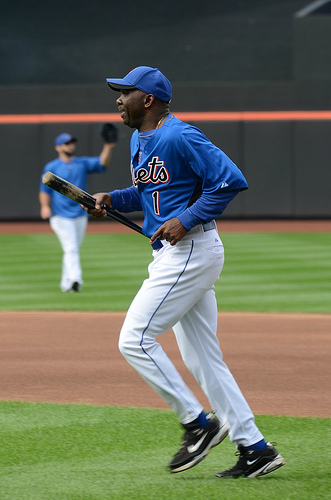
Welcome to The Happiest Recap, a solid gold slate of New York Mets games culled from every schedule the Mets have ever played en route to this, their fiftieth year in baseball. We’ve created a dream season that includes the “best” 157th game in any Mets season, and we keep going from there until we have a completed schedule worthy of Bob Murphy coming back with the Happy Recap after this word from our sponsor on the WFAN Mets Radio Network.
GAME 157: September 24, 1969 — METS 6 Cardinals 0
(Mets All-Time Game 157 Record: 22-24; Mets 1969 Record: 96-61)
“Tonight the New York Mets and the Saint Louis Cardinals. The Mets have a magic number of one. This afternoon, the Chicago Cubs won their ballgame from Montreal by a score of six to three to keep alive their chance for a tie for the championship. So the Mets’ magic number is one; a Met victory here tonight would clinch the championship in the Eastern Division of the National League. So we have a big, big crowd on hand for this concluding game of the series.”
—Lindsey Nelson, pregame
Seven years removed from the humblest beginnings imaginable. Two years removed from 101 losses. One year removed from a place so low that the standings didn’t include it anymore. Light years removed from what the human imagination could have dreamed up six months before. The longest of long shots six weeks earlier. Yet for two weeks, nobody couldn’t have known this was coming.
Still beyond the realm of the imagination, but there was no stopping it. The New York Mets were about to become champions. Champions of the National League’s Eastern Division, but it might as well have been the universe. Just by arriving on the edge of clinching, they were the champions of possibility. They were the champions of wishing and hoping and praying, if not necessarily thinking, because thinking would have guided any sane person away from this scenario. They were the champions of faith.
And this Wednesday night, the final scheduled home game of 1969, may merit the title of champion of all regular-season games in Mets history. Considering where the Mets had come from and where they would go shortly thereafter, no Mets win in the first half-century the team existed — or maybe ever — could possibly mean quite as much.
“Hello everybody, it’s Lou Brock coming around to lead off now for the Saint Louis Cardinals in what is, for the Mets and Mets fans, the biggest baseball game ever played in this stadium.”
—Lindsey Nelson, top of the first
Was there any way the Mets were going to lose this game? Putting aside whatever latter-day metrics might tell us retroactively about win probability; and the factors that might have influenced this matchup — Steve Carlton was 17-10, Gary Gentry was 11-12, the Mets were 11-6 vs. the Cards; and the eternal truth that it’s anybody’s ballgame, particularly before one starts…no, the Mets were not going to lose this ballgame.
The Mets were going to use this ballgame as the template for all celebratory events to come. They and the 54,928 on hand needed the practice. They’d never had anything concrete to celebrate before other than themselves. Mets fans led the league in mere happiness to be here — that there were Mets to root for and that they were the ones doing it.
Even Leo Durocher’s Cubs cooperated. The former frontrunners had lost 9 of 14 coming into their afternoon action. Had they dropped their matinee to sixth-/last-place Montreal, the Mets would have been in Anticlimax City. But they beat the Expos, less keeping their own chances alive than making sure the party in Flushing would be more than hugs and hearty handshakes.
“Carlton strikes out Jones. First strikeout for Carlton. Donn Clendenon’s coming up. Clendenon’s hitting Two Forty-Six, he has thirteen homers and forty-five runs batted in. Lefthander Steve Carlton checks the runners, here’s the pitch to Clendenon, swung on and hit DEEP to center! Way back, Flood goes back into the track, it’s going, going, it’s gone, it’s a home run! A home run for Clendenon! Donn Clendenon hit a three-run homer over the center field fence. The Mets are out in front by a score of three to nothing, one man out, nobody on and Ron Swoboda coming up.”
Donn Clendenon, 34, was acquired for nights like these. Not that there were nights like these in the Mets’ past, but GM Johnny Murphy and manager Gil Hodges were intent on making sure there’d be a few in the near future when they pulled the trigger on a four-for-one deal with Montreal at the June 15 trading deadline. They had to give up a quartet of youngsters. One of them, Kevin Collins, had been a Met on and off since 1965 — he pinch-hit on Opening Day against the Expos. One of them, Steve Renko, had pitched at Wrigley Field that very afternoon of September 24, taking the well-timed loss in front of 52,711 fewer people than would be at Shea Stadium this night. The other two fellows, Bill Carden and Dave Colon, never reached the majors. Collins played in the bigs until 1971. Renko had a representative career, winning 134 games (while losing 146) from 1969 until 1983.
Steve Renko was still pitching and occasionally winning more than a decade after Donn Clendenon retired. Renko theoretically could have helped the Mets throughout the 1970s and into the 1980s. But that didn’t matter. The distant future, that time toward which the Youth of America had been mythically developing since Shea Stadium was under construction, was no longer the Mets’ nebulous aim. The Mets in the middle of June 1969 decided they were a “now” team. They now needed a power-hitting first baseman, a veteran righty complement to the prematurely ancient if technically 24-year-old Ed Kranepool.
Clendenon’s three-run homer off Carlton marked the instant “now” arrived. Four prospects were a scant price to pay for that 3-0 lead.
“Low and away for a ball, it’s two-two. I got a letter this week from an army chaplain in Korea saying that the United States servicemen there were pulling for and following the fortunes of the New York Mets day by day. Here’s a swing, a fly ball to deep right field, Flood going back into the track, he’s way back there, and he leaps up, can’t get it! Home run! A home run for Ed Charles! A two-run homer! Ed Charles hit his third home run of the year over the right field fence, the right-center field fence, a two-run homer that scored Swoboda ahead of him, the New York Mets are leading five-nothing, and that is all for Steve Carlton! The sign has gone to the bullpen now for Dave Giusti.”
—Lindsey Nelson, bottom of the first
Ed Kranepool, born in November 1944, made his major league debut in 1962. Ed Charles, born in April 1933, made his major league debut in 1962.
Something was wrong with this picture, and it had nothing to do with the high hopes and big bonus applied to 17-year-old Kranepool. Charles should have been a major league infielder in the 1950s. He was a .300 hitter in Class C ball at age 18. He maintained that level his next couple of seasons as he climbed the Braves chain before and after a stint in the military. He reached Triple-A for the first time in 1956 and put all the lower minors behind him by 1958.
And there, it seemed, Ed Charles was left, an experienced, skilled minor leaguer in his sixth…seventh…eighth…ninth year in the pros. The Braves never brought him up from Triple-A.
Couldn’t have anything to do with a quota system that informally limited the number of black players on any given roster, could it?
Charles thought so. Prevailing evidence doesn’t suggest otherwise. Ed Charles may not have been a player the caliber of incumbent Braves third baseman Eddie Mathews, but he certainly should have been given a shot long before Eddie Kranepool got one. Charles was a native of the Jim Crow South, Daytona Beach, Fla. His inspiration was the sight of Jackie Robinson playing Spring Training baseball in 1946, the year before he broke the major league color line (another “informal” obstacle) with Brooklyn. Jackie may have integrated baseball, but he didn’t make the business end of it color-blind.
Ed didn’t get his break until Milwaukee traded him to the Kansas City A’s, where he put up respectable numbers for a hopeless organization. As he established himself in the American League, the Glider, as he was known, became intent on making his own luck as much as he could, displaying “a discipline and humility that is rarely seen in the clubhouse,” by George Vecsey’s Joy in Mudville reckoning. “He began attending college in his late twenties and wrote inspirational poetry, paying for the printing and mailing it to young fans who asked for autographs.”
When the Mets traded Larry Elliot (and cash) to Kansas City in May 1967 to get Charles, they got more than a third baseman. They got a man who, per Vecsey, “drew the Met players closer together with his warmth and maturity.”
Twenty-eight months later, as the righthanded half of a third base platoon on a first-place team, Ed drew them two runs closer to a championship.
“In case you joined us along the way, the New York Mets got five runs in the bottom of the first. Harrelson singled and Agee walked. After Jones struck out, Clendenon hit a three-run homer. Swoboda walked and Charles hit a two-run homer, and that was all for the starter Steve Carlton. Dave Giusti came in to relieve him, here’s Giusti’s pitch. Hit DEEP to right, that’s WAY back there, it’s going, going…and it is GONE for a home run for Clendenon, his second home run of the night! The Mets are leading six to nothing. Home run number fifteen for Donn Clendenon, over the right field wall and into the Met bullpen.”
—Lindsey Nelson, bottom of the fifth
Has any in-season trade in Mets history paid the immediate dividends that the Donn Clendenon deal did? They got him in the middle of June and well before September was over, they had a single-digit magic number. Who else effected that kind of result? Even Keith Hernandez, acquired exactly 14 years later, didn’t make that quick a difference.
In Stanley Cohen’s 1988 retrospective, A Magic Summer, it is instructive to reread how Donn Clendenon’s teammates recalled him almost twenty years on. “The catalyst,” according to Art Shamsky; “a take-the-pressure-off kind of guy,” said Tug McGraw; “probably the key to our whole season,” in Wayne Garrett’s mind — “the ingredient we needed.”
Were 35 RBIs ever as important as those Donn Clendenon collected between June 22 and September 24, up to and including the bottom of the fifth when his second home run of the night increased the Mets’ lead to six? He played in only 72 games for New York in ’69 because he platooned with Kranepool. Think about that for a moment. The fortunes of a franchise, a city and maybe the sport pivoted on the presence of a man who split time with, well, Eddie Kranepool. But Kranepool plus Clendenon, along with Ken Boswell plus Al Weis, Wayne Garrett plus Ed Charles, and Art Shamsky plus Ron Swoboda added up to the sum of Gil Hodges’ parts. Their individual numbers may have matched their reputations, but their collective contribution was writing a fairy tale.
Clendenon was clearly the most accomplished of the 1969 Mets’ irregulars. He’d had two seasons of better than 90 RBIs as a Pirate and in ’68, The Year of The Pitcher, drove in 87. The Mets didn’t have anybody with those credentials. The expansion draft made him an Expo. Good sense — Clink’s no-BS threat to retire — prevented him from becoming an Astro despite Montreal’s attempt to trade him to Houston. A college education and off-season planning gave him a path outside baseball, working for the Scripto pen company (as a VP, no less). Foresight and fortune, though, had a different script in mind. Commissioner Bowie Kuhn convinced him to play in Quebec. Johnny Murphy convinced his employers to send him to Queens.
It’s no wonder Donn Clendenon stood out as a veteran, accomplished, professional power hitter on the New York Mets. He was that good and they hadn’t had anybody quite like him before. Yet he meshed as well as he mashed. Consider Tom Seaver’s recollection of the Mets’ first home game after Donn joined their ranks. It involved his wife, Nancy, introducing herself to hubby’s new teammate, and Donn “putting on a little show” in return, suavely charming the ace’s better half as only a veteran, accomplished professional power hitter might.
“Hi Donn,” Tom greeted him after perhaps enjoying the show enough. “What are you kissing my wife’s arm for?
“It’s great to be a Met,” Donn replied.
It was even better to be up 6-0 with 14 outs to for a divisional flag.
“So two cast aside by Gary Gentry here in the seventh inning, it brings up Tim McCarver. The Cardinals’ talented backstop has fouled to third and fouled out to first, nothing for two. In the Astrodome tonight, the Atlanta Braves will call on Pat Jarvis and Houston will pitch Tom Griffin. Over the inside corner, strike one called. Tom Griffin of Houston and Gary Gentry of the Mets the two top rookie pitchers in the league this year. Interestingly enough, both are trying for their twelfth win tonight. Ground ball hit hard, but right at Al Weis, he has it. Throws to Clendenon and the side is out. No runs, no hits, no errors, none left. Now seventh-inning stretch time for the huge crowd at Shea Stadium. At the end of six-and-a-half innings, the New York Mets six and the Saint Louis Cardinals nothing.”
—Bob Murphy, middle of the seventh.
How did they do it? How did the Mets keep churning out hard-throwing young arms? Seaver in ’67, Koosman and Ryan and McAndrew in ’68, now this year Gary Gentry? You could piece together lineups from what others would consider spare parts if you could pitch like the Mets. And boy could the Mets pitch.
Gary Gentry sure could. He was drafted out of Arizona State in June 1967. It was off to Double-A Williamsport, where his ERA sat under two and his strikeout-per-inning rate was nearly nine. Promoted for a full year at Triple-A Jacksonville, he threw 198 innings in 1968 and won 12 games.
Gentry was ready. In his first start, on April 10, he came within one out of a complete game, giving up two runs to the Expos. Tommie Agee hit a home run to Shea Stadium’s highest fair perch and the Mets were a game over .500. The team was 2-1. The rookie was 1-0. Gary Gentry slotted in nicely behind Seaver and Koosman. He may not have been quite at the level in his rookie year that they had been in theirs — Seaver was Rookie of the Year, Koosman finished a hair behind Johnny Bench — but there was no shame in holding down a spot every five days with this crew. He had the stuff and he had the self-confidence to fill an important role on a team that didn’t necessarily think it was making a miracle. Gentry was just doing what he had always done.
“I never played on a team that didn’t expect to win,” Gary told Cohen, recounting his squads’ successes through college and the minors. “So when I came up with the Mets in ’69, I never thought about anything except winning. I didn’t know much about the team’s history.”
Yet here he was, 33 games into his big league career, emphatically rewriting it. Through seven visiting innings, the Cardinals landed only three baserunners, and two of those were erased on double plays. The Mets of this new era, of these days of Gentryfication when winning was the norm and losing was for the other guys, had their eyes on the finish line. They were going the distance, and Gentry would be damned if he wasn’t going to be the one to take them there.
Gentry, as befit a pitcher pitching behind Seaver and Koosman, liked completing games, even if he wasn’t given that many opportunities relative to his more-established teammates. In 1969, pitchers were geared to finish what they started. Mets starters completed 51 of their starts and that was good for only sixth in the National League. Just as Gil Hodges wasn’t shy about platooning, he didn’t hesitate to deploy an effective bullpen led by the likes of righty Ron Taylor and lefty Tug McGraw. It was all about the team winning.
Nevertheless, Gentry preferred to complete games. He finished five entering the action of September 24: a number stellar in modern terms (as many as Clayton Kershaw would compile in 2011, for example), a total that wasn’t even on the radar in 1969. In retirement, Gentry would rue that he was a victim of “the relief syndrome,” the budding pattern in baseball that didn’t demand nine innings out of every starter. Gentry wanted that demand made of him. He wanted Hodges and pitching coach Rube Walker to leave him in. “That was my style of baseball,” he told Cohen. “I always felt that I got to the majors ten years too late.”
Actually, after he worked the eighth and prepared to take the ball in the ninth, the Mets still out front by a half-dozen runs, it was clear Gary Gentry was right on time.
“Lou Brock will lead off against Gary Gentry. The crowd is standing, waving and cheering. The Mets are three outs away from a divisional crown. Fouled back to the screen, strike one. This is the moment Mets fans have waited for. Ed Charles in close at third against Lou Brock. Brock has one of the two hits given up by Gary Gentry, who has turned in an absolutely magnificent performance with the pressure on. Now the lean righthander stands and pitches. Call strike on the outside corner! It is two strikes. And the standing room crowd will be roaring with each delivery.”
—Bob Murphy, top of the ninth
Brock produced a grounder up the middle that Harrelson made a play on, but Buddy couldn’t throw out the speedy Redbird. St. Louis had a man on first. Vic Davalillo was up next.
“Not a soul is leaving the stadium. Everybody just jamming the aisles and standing right by the exits. Now the Glider comes over from third to have a word with his young pitcher. This has to be a huge moment in the life of Ed Charles. He has known about as much hard times as anybody. Ground ball hit toward the middle, Harrelson can’t get it. It’s a base hit to center for Davalillo, and the Cardinals are slowing things up on back-to-back base hits by Brock and Davalillo.”
Gentry had hoped for an “easy game,” and that it had been for the longest time. The confident rookie was nervous for the first four or five innings and then was “just more or less in a hurry to get the game over with so that everyone could enjoy what was happening.”
The nerve of those Cardinals to delay such a well-planned party. But Gentry got two quick strikes on the next batter, Vada Pinson, before the St. Louis right fielder fouled one off.
“Now Gentry up in pitching position. And the pitch on the way…swing and a miss, he struck him out! The Mets are two outs away. Strikeout number five for Gary Gentry. Now the hitter is Joe Torre. The infield is set at double play depth.”
Joe Torre grew up in Brooklyn before there were Mets. In the borough of Dodgers, he was a Giants fan. Then he left to become a Milwaukee Brave. There was talk through the spring that the kid who had grown into a five-time All-Star catcher might come home. The Braves were looking to trade him in the aftermath of his role during the Spring Training player job action (more a boycott than a formal strike). Torre was sitting out camp — “sulking” in Manhasset, by Vecsey’s account — waiting for resolution. In March, the Mets still needed a power-hitting first baseman, and Joe could certainly fit that bill. He’d played the position intermittently since the Braves had moved to Atlanta in 1966. With a hitter of Torre’s caliber, Hodges wouldn’t have to platoon at first.
What would it take to make it so New Yorkers could come see what this Brooklyn kid could do in Queens? A lot, Joe Durso recounted in Amazing. The first request filed by Atlanta GM Paul Richards was for Ryan, outfield prospect Amos Otis, and Jerry Grote (which would have sent Torre back behind the plate). After Johnny Murphy presumably stopped laughing at the audacity of the proposal, he countered with something less Met-onerous: Grote’s backup J.C. Martin, Kranepool, either Ryan or Jim McAndrew, and somebody else for Torre and third baseman Bob Aspromonte. This time it was Richards who demurred.
Murphy held on to all his young players until Clendenon became available in June and then stayed in possession of the ones he really liked. Richards, meanwhile, swapped Torre to St. Louis for Orlando Cepeda. If the division leads held over the next week, the Mets and Braves would meet not at the trading table but in the first National League Championship Series. Atlanta had just the night before wrested control of the wild West from San Francisco by winning their fifth in a row.
The Mets, meanwhile, were still looking at Joe Torre, but in a very different context than they did six months earlier.
“Torre, the cleanup batter, has lined out, bounced out and popped up, nothing-for-three. Al Weis shaded toward the middle of the diamond. And the pitch on the way…low and outside, it’s ball one. The crowd chanting We’re Number One. The Mets made up fifteen-and-a-half games since the thirteenth of August. And the pitch thrown…fouled into the air, back toward the crowd. It’s one ball and one strike to Joe Torre. Tim McCarver is the on-deck hitter. Mets have the infield hoping for a chance to make a double play that would end it. Tommie Agee just a stride to left-center. Now the ballboy brings out some balls for umpire Al Barlick. Lou Brock is on second and Vic Davalillo is the runner on first with one man out. Ninth inning, six-nothing New York, and the pitch…ground ball foul, down the third base line. He went after a curve from Gary Gentry.”
Ralph Kiner, Bob Murphy reported over Mets flagship WJRZ-AM and affiliates like WKAJ-FM in Saratoga Springs, was down in the clubhouse awaiting to “talk with the players as they come in”. Lindsey Nelson was handling play-by-play duties on Channel 9. The three men had been Original Mets, chronicling every move Casey Stengel made, dating back to St. Petersburg in the runup to 1962, and following the fortunes of his successors Wes Westrum, Salty Parker and now Hodges. They weren’t “we” announcers, though. They were even-handed — complimentary to the other side when the other side deserved it, which was most of the time from 1962 through 1968. Life was different now, though. The Mets were the heart of the story Murphy and Kiner and Nelson told. The Mets were the story everywhere. They had been on the cover of Time and Life that September. They would dominate the front page of the New York Times the next day. And the Mets fans were the story every bit as much as the Mets team.
“[T]he roar that is going to come out of this stadium on the final out, if the Mets are still in front,” Murphy predicted in the seventh, “is going to be something to hear. After seven agonizing years and many frustrations, the Mets fans, the best and most loyal baseball fans to be found in this land, are really going to have something to cheer about.”
It’s easy enough to butter up your listeners, but Murph wasn’t saying anything that wasn’t easily verifiable. The Mets opened for business in a crumbling Polo Grounds with a roster that was every bit as dilapidated, and the best and most loyal baseball fans were born. They accepted the Mets and their flaws. They took them to their heart and didn’t let them go. The 40-120 Mets drew 922,530 to a neighborhood most (including the erstwhile New York Giants) were bent on avoiding. This was in an age when a million fans was not a given for any team and nearly a million for a historically horrendous team was as laughable as the idea of trading Ryan, Otis and Grote all at once.
In 1963, the Mets barely improved to 51-111, the Polo Grounds crumbled a little more and attendance leapt to over a million. Those fans, identified immediately by Metsologists as a New Breed, made noise, made banners, and made a pledge of undying love with no evidence their ardor would be rewarded with anything but more losing.
The love affair continued in a new ballpark in another borough. The Mets drew 1,732,597 to beautiful Shea Stadium in 1964. The facility sparkled. The team (53-109) was mostly grim as ever. Novelty? The Mets were a shade worse in 1965 (50-112) yet they drew a shade more. They showed the slightest sign of forward progress in 1966 — not finishing last, not losing a hundred games (66-95) — and attendance soared toward 2 million. The gate leveled off in 1967 and 1968, but the Mets were still bringing more fans through the turnstiles for tenth- (61-101) and ninth-place (73-89) baseball than just about anybody in the National League was attracting for outfits sporting better records. And if Mets attendance didn’t lead one and all in sheer body count, nobody beat it for enthusiasm generated.
Why? Why were Mets fans so giving of affection when the Mets couldn’t possibly reciprocate in the win column? Theories abounded from the first day Ol’ Case set to putting the most human face in captivity on what could have been a very dismal enterprise. Mets fans were the way they were because they were imps…or ironists…or inveterate optimists…or enthralled by being in on the ground floor (or basement) of what was brand spanking new — at a moment in time when Camelot was in full swing and the Beatles were first tuning their instruments…or reassured by a well-orchestrated throwback to what had recently departed (Senior Circuit successors to the Giants and Dodgers, the Mets held an Old Timers Day during their very first year of existence)…or underdogs in life, so therefore they couldn’t help but identify with the most clearly identifiable underdogs of baseball.
“The Metophile,” the Times’s Robert Lipsyte wrote with tongue a touch in cheek as he attempted to explore what made Mets fans tick in 1963, “is a dreamer. He believes that one day he will punch that arrogant foreman at the plant square on his fat nose; that he will get in the last word with his wife; that he will win the Irish Sweepstakes; that the Mets will start a winning streak.”
Early in that second season, Lipsyte predicted the Met Mystique would wear thin soon enough. “The pure Metophile,” he warned, “is likely to disappear in a few years. Even now, more and more ordinary people go to the Polo Grounds to watch a baseball game. As the Mets progress from incompetency to mediocrity, their psychological pull will be gone.”
The Mets, however, breezed right by mediocrity and bulleted to overwhelming success. Their appeal required little analysis now. As the franchise’s top executive, M. Donald Grant, would put it with the kind of grace and accuracy with which he wouldn’t forever be associated, “Our team finally caught up with our fans. Our fans were winners long ago.”
“This,” Bob Murphy assured his listeners in the seventh inning on September 24, 1969, “has truly been an amazing year for the New York Mets.”
What else was left to say?
“It’s two-and-two on Joe Torre with one out in the ninth. The pitch by Gentry is…fouled, out of play behind the third base dugout to the crowd. Everybody right on the edge of their seat. I’ll bet Cleon Jones sets a track record getting to that dugout from left field when that final out is made.
“Gentry, working hard here against Joe Torre, now in the set position, here’s the pitch. GROUND BALL HIT TO SHORTSTOP. HARRELSON TO WEIS, THERE’S ONE, FIRST BASE, DOUBLE PLAY! THE METS WIN! IT’S ALL OVER! OH, THE ROAR GOING UP FROM THIS CROWD! An unbelievable scene on the field. Fans are POURING onto the field, the ballplayers trying to get to the dugout. A six-four-three double play, and it’s all over. Congratulations to Gil Hodges, the coaches and the ballplayers — what a year! It’s hard to believe.
“The Mets are on their way into the clubhouse, final score, the New York Mets six and the Saint Louis Cardinals nothing, they knocked Steve Carlton out in the first inning, Donn Clendenon hit a three-run homer, Ed Charles hit a two-run homer, later in the game, Clendenon hit another home run, and Gary Gentry, the rookie righthander from Phoenix, Arizona, pitched a marvelous FOUR-hit shutout.
“THOUSANDS and THOUSANDS of fans are out on the playing field. Banners are being paraded. The Mets are IN the clubhouse. And in just a very few moments, we’ll be joining Ralph Kiner as he picks up the comments from the players.
“Ah, it’s almost too much to believe. Imagine finishing ninth a year ago, one game out of tenth, although it was a vastly improved club…Gil Hodges, who a year ago today suffered a heart attack in Atlanta, Georgia, fighting back from a heart attack to take his ballclub in his second year and MOLD a championship team.”
“Well, we’ll be back with the locker room show now in just one moment.”
But first, after a commercial break, and as the microphones picked up Jane Jarvis’s happy organ accompanying the nonstop elation in the background, Bob Murphy offered a coda from the booth that would eventually bear his name:
“THOUSANDS and THOUSANDS of Mets fans are out on the field, all shouting We’re Number One, We’re Number One. You have to see this scene to believe it. All the happiness comes pouring out.
“For the first six years of their lives, the Mets were laughed at, kicked around. They were the ballclub that was the big joke. They never believed it themselves, they knew they were going to be a ballclub.
“George Weiss, the first president of the Mets, had put together a good organization. The SCOUTS, the best he could get his hands on, turned out to be exactly that, the very best. They started signing GREAT young pitchers. It took a short time to develop them in the farm system. It took the guiding hand of a Gil Hodges to put it all together. And now THIS is the climax, a scene that Mets fans, I’m sure, since that first day eight years ago, have longed for.”
On July 31, 1994, Bob Murphy stood at a podium in Cooperstown accepting the Ford C. Frick Award for baseball broadcasting. In his acceptance speech, Bob singled out his favorite Mets team of them all.
“They were my boys of summer,” the Hall of Fame announcer said. “You’ll never enjoy a year any more than following the 1969 Mets.”
Though he never used his signature phrase that Wednesday night at Shea Stadium when Clendenon, Charles and Gentry starred and first place was clinched, chances are pretty good that September 24, 1969, endures as Bob Murphy’s Happiest Recap of them all.
ALSO QUITE HAPPY: On October 1, 1985, the clock was ticking on the Mets’ playoff chances. Good thing they employed a slugger who could make time stand still.
Of course if the Mets could have done that sooner and longer, they’d have been in better shape entering their final week. But things had not gone to plan since their dramatic three-game series at Shea against the rival Cardinals three weeks earlier. They came out of that showdown up one game on St. Louis. Alas, their advantage was short-lived. Within 48 hours, they had dropped a half-game behind the Redbirds. As the Mets were splitting six games against the Expos and Phillies, the Cards were off on a seven-game winning streak.
There was no momentum for New York. From September 13 through September 27, while the Cardinals were ripping off 14 wins in 15 games, the Mets scuffled as a barely .500 team, going 9-7 and never stringing together two consecutive wins. Dwight Gooden was blazing through September — in his three post-Cardinal starts totaling 26 innings, Doc drove in seven runs…or seven more than were charged to his microscopic earned run average. Gary Carter was catching him superbly and knocking in practically every Met he saw: 19 RBIs in 15 games played. But the team as a whole was sagging at the worst possible juncture. Not only was it getting late, but the Cardinals had gotten unbeatable.
The nadir came on Friday night the 27th in, not surprisingly, Pittsburgh. Pittsburgh represented rampant bad news for the Mets in September 1985, dating back to Keith Hernandez’s detour there to testify in the baseball drug trials early in the month. The last-place Pirates were an unlikely crew to sidetrack the Mets, but when they sailed into Shea the weekend of the 20th, it was more “oy” than “ahoy”. Despite Doc’s breakout offensive game on Saturday the 21st — which included his first major league homer — the Pirates took two of three in Flushing. Then, on the night when, thanks to the ravages of Hurricane Gloria, much of Metropolitan New York had to listen to the Three Rivers opener on battery-operated radios, the Mets’ chances practically blew away.
Early leads of 2-0 and 5-2 were gone with the wind in Pittsburgh as Ed Lynch left with recurring back spasms after two, and Tom Gorman, Wes Gardner and Randy Niemann each imploded in a six-run bottom of the third. The Mets were down 8-5 and lost 8-7. The defeat left them 4½ out with eight to play, an almost impossible hill to climb given how hot St. Louis had been.
A series of small miracles unfolded from there. The Cardinals displayed elements of being human and lost two of three in Montreal, the rubber game there turning on a two-run triple from ex-Met Hubie Brooks. Back in Pittsburgh, the Mets recovered from their devastating Gloria Night defeat to take the next two from their Buccaneering tormentors. Saturday afternoon’s 3-1 win was keyed by a George Foster home run and eight solid innings from rookie Rick Aguilera.
That would have been no more than a footnote had Sunday not been rescued at the last minute. Roger McDowell and Jesse Orosco let a 6-4 lead slip away in the eighth when they allowed three horrifying runs. Now down one run with three outs remaining in the competitive portion of their season, Howard Johnson tied the game at seven when he homered to lead off the ninth against Cecilio Guante. And Gary Carter capped his National League Player of the Month bid when he blasted a two-run home run off Larry McWilliams in the tenth; it was Kid’s 13th dinger in September. Orosco straightened up in the bottom of the inning to preserve the 9-7 win that literally saved the Mets’ 1985 season.
The Pirates, who had taken 8 of 18 from the Mets on their way to 104 defeats (while losing 15 of 18 to St. Louis), may have threatened the Mets’ viability, but their effect on the pennant race no longer mattered once Orosco grounded out Sammy Khalifa to let the Mets squirm out of Three Rivers with two wins. Their attention was focused squarely on their next destination: Busch Stadium.
“The only thing we were hoping for was to have our fate in our own hands,” said HoJo after doing his part to ensure the Mets’ fighting chance. “We’re three games back. There’s still a ways to go.”
“It was so important to go into St. Louis and be no more than three out,” Carter assessed of where the Mets stood with six to play. “It’s up to us to prove we can beat them. We basically have to beat them all three games. We have to play our best baseball of the season in the next three.”
Over the next eleven innings, you could say they did. Unfortunately, as had become the Mets’ burden, the Cardinals were no slouches, either. “St. Louis has been so hot lately,” HoJo said, “every mistake we’ve made has been magnified.”
The answer was to make no mistakes, starting with the manager and to whom he’d give the ball in the do’est-or-die’est game the Mets had played since the 1973 World Series ended badly in Oakland. A dozen years earlier, Yogi Berra skipped over one of his well-rested hot hands, George Stone, and prevailed on Tom Seaver in Game Six and Jon Matlack in Game Seven to finish off the A’s on short rest. It didn’t work out. While it wasn’t exactly analogous, Davey Johnson had options entering the Tuesday night opener in St. Louis. It was Ron Darling’s turn to pitch, but because Monday was an off day, Gooden was clearly available. His last outing, a shutout in Chicago, had taken place five days earlier. Gooden hadn’t allowed an earned run since August. With everything riding on this game, how could Davey not go with not just his ace, but baseball’s premier pitcher?
“I got telegrams telling me that I was a fool not to start Dwight against [John] Tudor,” Johnson wrote with Peter Golenbock in Bats. “I received one telegram from a doctor in Brooklyn suggesting I pitch Gooden the last five innings of each of the last three games! One fan suggested that if Darling was really going to start, I should fool the Cardinals by letting Doc take batting practice and then have him walk down from the bullpen just before the game, as though he was going to warm up. Very clever.”
Somehow, Johnson remained unmoved. Darling kept his spot in the rotation. The second-year righty may not have been Doc (17-1, 1.36 ERA in his past two-dozen starts), and he may not have been Tudor (19-1, 1.46 ERA in the same span), but he wasn’t a desperate choice. Entering October, Ron was 16-5, sporting a 2.94 ERA. He had been an All-Star selection in July. “All I knew,” Darling reflected nearly a quarter-century later in The Complete Game, “was that it was my turn to pitch and that we needed this game, so I went at it hard.”
That made two of them, for Tudor, too, was competing at an elevated level. Less was at stake for the Cardinals, given their three-game edge, but beating the Mets a night before Gooden showed his face would be tantamount to the knockout blow the Busch Stadium crowd craved. One placard held aloft beyond the outfield fence described what everybody on both sides was thinking:
LET’S GET IT ON
Hernandez, vilified in his first post-drug trial trip to St. Louis — he had testified that he had done coke as a Cardinal — became the first baserunner of the game when he walked with two out in the first. But Tudor stranded him there. Irrepressible rookie speedster Vince Coleman (109 bags and counting) led off for the Cardinals by walking, but was forced at second, and Darling didn’t give up anything else in the inning.
A pattern was established. Tudor and Darling were shadowing each other. A man on here, a man on there, but nothing substantial of an offensive nature could be sparked. Mets 0 Cardinals 0 for the longest, tensest time. The first serious threat arose in the top of the seventh when the bottom of the Mets’ order sprang to life. With one out, Ray Knight singled. Howard Johnson ran for him and raced to third when Rafael Santana doubled. Second and third, Darling up. Davey Johnson attempted to squeeze HoJo home.
Ronnie didn’t get the bunt down. Howard was a dead duck. Two out, with Santana taking third on the failed attempt. Swinging away, Darling popped to third. Inning over, still no score.
Darling went back to doing what he did well. He got a first out in the bottom of the seventh before allowing a double to Terry Pendleton and a walk to Mike Jorgensen. Ozzie Smith was next and he rapped into a 1-6-3 double play.
Still no score.
The eighth was three up, three down for Darling, then for Tudor. The ninth showed potential for the Mets when Carter doubled to start it, but he never got any further than second. Darling pitched the ninth as well as he pitched the previous eight: Tommy Herr fouled out, Darrell Porter grounded to second and Andy Van Slyke grounded to first. When Darling took the toss from Hernandez, he had just completed nine shutout innings. Four hits, three walks, no runs. “Quite simply,” Hernandez judged, “Darling pitches the game of his career.”
“It was the first time,” Darling would write with Daniel Paisner, “I experienced the full intensity of the professional game.”
But it was still 0-0 going to the tenth. Darling was pulled for pinch-hitter Tom Paciorek. And Tudor was still on the mound for St. Louis. The lefty flied Paciorek to right, Mookie Wilson to left and grounded Wally Backman (technically a switch-hitter, but notoriously feeble against southpaws) to short. Jesse Orosco would now be charged with matching Tudor’s latest zero. It was a little dicey — stretch drive pickup par excellence Cesar Cedeño walked and stole second — but Jesse escaped trouble when he retired aching pinch-hitter Jack Clark. Most encouragingly from a Met perspective, the Cards’ aborted rally saw Whitey Herzog send up Tito Landrum to bat for Tudor. The Mets had officially withstood the best the White Rat could possibly throw at him. Tudor went ten and allowed no runs, but like Darling, he was now irrelevant to the outcome.
At 0-0 in the eleventh, the heart of the Mets order had to skip a beat knowing that instead of taking on Tudor, its task at hand was reliever Ken Dayley. Except Dayley was pretty tough himself. The lefty struck out Hernandez and Carter. Strawberry, 0-for-4 versus Tudor, was next.
LET’S GET IT ON
“Oh baby, that one is WAY outta here!” Steve Zabriskie declared. The time was 10:44 PM Central Daylight. We know that because WOR’s replay showed Darryl’s rocket on Dayley’s 1-1 pitch — “one curveball too many,” according to Ralph Kiner — smacking into and bouncing off the clock along the facing of Busch Stadium’s right field upper deck.
Zabriskie: “Right fielder Andy Van Slyke didn’t even move.”
Van Slyke had something in common with Mets fans back in New York, where the remote controls in 6.7 million households throughout the Metropolitan Area were staying put on Channel 9. This riveting game at the climax of this riveting season had drawn the highest rating of any WOR program in the station’s 36-year history. But the occupants of the previously still Mets dugout moved, with everybody leaping up and out onto the Busch Astroturf to swarm Darryl upon his triumphant arrival following his 28th home run of the season, the 80th home run of his career and the biggest home run he’d ever hit in any regular-season at-bat.
“When I hit it,” Straw said in a masterstroke of understatement, “I knew it was gone.”
Oh, and the scoreboard certainly moved. It had just clicked to Mets 1 Cardinals 0.
Darryl’s mighty blow provided enough of a lead for Orosco to protect in the bottom of the inning. The Mets came away 1-0 winners when they absolutely had to gain some kind of advantage. They were two games back with two more to go in St. Louis, and five left on the schedule overall. They were still in second, but suddenly it seemed as if they weren’t running out of time…not the way Darryl had just stopped it in its tracks.
“Tell me,” Davey asked reporters afterwards, “is the clock still working?”
The Mets were, and they knew it. Darling: “I’d never seen my teammates so emotional, so invested. Ray Knight actually had tears in his eyes in the clubhouse after the game. He was pumping his fists for sheer joy, that’s how much the game meant to him and it meant much the same to every guy in that room.”
In the standings, it offered another day of hope, though Herzog was happy to point out his club was still the one with more of that where a postseason appointment was concerned. “We’ve got to win a game,” the Rat appraised. “They’ve got to sweep.”
But “they” had Doc Gooden ready for his closeup, just as Davey had planned. No telegrams were necessary from Mets fans who tuned right back in to Channel 9 on Wednesday night. That viewership record from the night before was smashed — just like that clock in right field. More than one of every four television households in the Metropolitan Area tuned in Doc’s October 2 start; four of every ten sets that were in use were used to watch Gooden strike out ten Cardinals. If he wasn’t at his sharpest (nine hits and two actual earned runs), the Doctor was as in as he had to be. With a Nielsen-boggling 61 percent of the New York viewing audience hanging on every pitch, Gooden nursed a nervous 5-2 lead home in the ninth. The Cardinals had loaded the bases with two outs, and Herr lined one final delivery (Gooden’s 136th of the night) in the general direction of right field. Fortunately for those about to gasp, Backman stood in its way and caught Herr’s ball for the final out.
Gooden had won again. His 1985 numbers were now etched for posterity and immortality: 24-4, 1.53 ERA, 268 strikeouts in 276 innings, 16 complete games. The Mets, of course, had won again. Their 20-year-old ace had brought them to a 97-61 mark, just one game behind the 98-60 Cardinals. They needed to sweep three games. They were two-thirds of the way there.
The Mets would not complete the job. Channel 9 attracted yet another record-setting audience, Hernandez answered his St. Louis detractors with five hits in five tries, and Aguilera battled gamely across six innings, but the Mets went down, 4-3, in the Thursday October 3 finale. They took it to two out in the ninth, Keith on first, Gary up, but Cardinal reliever Ricky Horton drew a fly to right from September’s Player of the Month. This ball wasn’t headed where Strawberry’s two nights earlier had gone. This one landed in Van Slyke’s glove.
Time had run out on the 1985 Mets.
At two out with three to go, they weren’t mathematically eliminated, but spiritually, it was all over. The Mets flew home to play Montreal Friday night. They won, but so did their rival. The Cardinals clinched on Saturday afternoon by beating Chicago. When Shea’s out-of-town scoreboard flashed the final from St. Louis, 45,404 Mets fans ignored the game in front of them and stood as one to salute a 161-game pennant race like no other.
It was Fan Appreciation Day in Flushing. Scarves were distributed to help the Mets faithful through the cold days ahead. Yet all the scarf recipients could think to do was create a breeze by waving them in swirling acrylic acknowledgement of the spring, summer and early fall they had just lived and died through.
The scarves were nice enough. But the memories of 1985 were what would warm Mets fans down to their souls.
Their team had never been more than five games from the lead all year long, and was in first or second every day from July 8 on. They spent a composite 68 days atop the N.L. East. But that didn’t begin to describe the passion 1985 elicited for the committed Mets fan. No numbers, not even Doc’s, could express the urgency of a full season of living on the edge with these Mets.
Gary Carter began it with an introductory home run to beat the Cardinals on Opening Day. Darryl Strawberry extended it with a home run to beat the Cardinals 155 games later. Gooden excelled the next night, Hernandez the night after that. HoJo, with Kid, in Pittsburgh over the penultimate weekend. Mookie homering in L.A. at the end of the last California trip. Mookie rushing home from second to win the first St. Louis series in New York four days later. Everybody in Atlanta on the longest and strangest night of them all. Doc essentially every fifth day for six months. And Rusty…can’t forget Rusty zipping (in his fashion) between left and right that April Sunday at Shea, Davey trying his darnedest to keep the ball from being hit to him, and the ball finding Rusty anyway, and Rusty, a 41-year-old pinch-hitter, finding the ball before it could fall in in the 18th inning.
Rusty wouldn’t be forgotten in Game 162, either. Twenty-three Sundays after making his last outfield putout, he stepped up to the plate wind down his 23-season major league career with two out in the ninth inning in the only allegedly meaningless game the Mets would play in 1985. But how could it be without meaning if Rusty Staub was batting?
The final appearance of Le Grand Orange, as a pinch-hitter for Ronn Reynolds, was greeted by the final Shea crowd of the year as everything else was that weekend: warmly, sentimentally, maybe a little mistily. Rusty Staub came to the Mets in 1972 the way Gary Carter had come to the Mets in 1985, an established big bat imported from Canada in exchange for promising youth…the missing ingredient intended to put a talented team over the top. It wasn’t to be in ’72, just as it hadn’t been in ’85, but Rusty powered the Mets to a pennant in ’73, the last pennant Shea had seen. He was petulantly traded away after ’75, but reacquired prior to ’81. A new Mets contender grew up around him in the early ’80s. He wouldn’t be in uniform to see how much it would grow after 1985, but he was still wearing No. 10 for now, and the final 31,890 Sheagoers of the year (part of the 2,761,601 who established a New York City baseball attendance record) stood to thank Rusty for both of his Met terms and all of his Met swings.
His last one, against Jeff Reardon of the Expos, didn’t result in anything more than a groundout. The game ended. The Mets lost. The season was over. But the applause didn’t quite die down. Anybody who wasn’t there Saturday was going to get his appreciation in on Sunday before letting the team scatter for winter. This was a different kind of fan appreciation day. This was sincere appreciation by the fans for the team; for 1985; for 98 wins that somehow didn’t qualify for the playoffs; and for the palpable sense that 1986 would end later and better. Rusty might not be back, but everybody else who mattered would be.
Doc. Darryl. Keith. Gary. HoJo. Mookie. Wally. Lenny. Rafael. Ronnie. Jesse. Roger. Aggie. Sid. Ray. George. Danny. Doug. Davey.
And us.
A special The Happiest Recap thank you goes out to FAFIF readers Joe Dubin (September 24, 1969) and Larry Arnold (October 1, 1985) for their respective archival material contributions to this installment.