The blog for Mets fans
who like to read
ABOUT US

Faith and Fear in Flushing made its debut on Feb. 16, 2005, the brainchild of two longtime friends and lifelong Met fans.
Greg Prince discovered the Mets when he was 6, during the magical summer of 1969. He is a Long Island-based writer, editor and communications consultant. Contact him here.
Jason Fry is a Brooklyn writer whose first memories include his mom leaping up and down cheering for Rusty Staub. Check out his other writing here.
Got something to say? Leave a comment, or email us at faithandfear@gmail.com. (Sorry, but we have no interest in ads, sponsored content or guest posts.)
Need our RSS feed? It's here.
Visit our Facebook page, or drop by the personal pages for Greg and Jason.
Or follow us on Twitter: Here's Greg, and here's Jason.
|
by Greg Prince on 16 September 2011 1:04 pm Overheard high atop 514 Thursday afternoon…
ROB EMPROTO: What’s the worst game you’ve ever been to?
ME: September 15, 2011, Mets versus Nationals.
To be fair, across two Logs that have tracked the 522 official Mets games I’ve attended, Collapse games have been worse. Johnny and Armando late-inning specials have been worse. Anything where “NY” won and it wasn’t us was worse. There was a Merengue Night in 1998 that forever ensured my disavowal of an entire musical genre. “Worst” is highly subjective, and when it comes to the Mets, it’s far too broad a category to plop on the table without being prepared to dissect it for hours on end.
Which was how long yesterday’s game took.
Nationals X Mets I — misery too epic to be left to Arabic numerals — will endure as especially horrendous because it had going for (or against) it something I don’t think any of the other 225 Mets losses I’ve witnessed in person could claim.
Gloom. It was the gloomiest day I’ve ever spent in the company of the New York Mets. And friends, I’ve spent some dark nights with my team.
But not in broad daylight I haven’t.
Rain I’ve sat through. Rain delays I’ve sat through. Severe chill I’ve sat through. The winds of Flushing Bay have annually whipped my psyche as they have my unprotected exterior. Yesterday, though, was an extraordinarily brutal afternoon of elements. Temperatures plunged. Precipitation spit. Skies darkened. Then darkened some more. Then turned as black as any three Mercury Mets jerseys. It was the kind of weather where if you sit through it, maybe the home team does you the solid of offering you tickets to another game.
Except after yesterday, that would have been cruel.
Yet it wasn’t just the sharp right turn into December.
Or the miserable score (Nationals X Mets I truly understates the intensity of the blowout).
Or the caliber of opponent that was kicking our ass.
Or how limply the once-feisty 2011 Mets are fading into oblivion.
Or my having been in the same stadium fewer than 24 hours earlier for what seemed like a heartbreaking 2-0 loss but was, by comparison, the last gasp of the feelgood phase of the Terry Collins Era.
Or the thought of the eager schoolkids I saw on the 7 whose field trip wasn’t likely to go down as a cherished childhood memory.
Or the fellow in the ATF cap who — before exiting to enjoy his stock of alcohol, tobacco and/or firearms — snorted that the Mets were a bunch of millionaires too scared to play in a little rain.
Or the fellow wrapped in orange and blue angrily informing all six of us in our section that the Nationals were running up the score so their agents could get them more money in the offseason.
Or the balks, the errors, the LOBs, the high fences and the centerfielder who could’ve sworn he’d seen a ghost.
Or the time of game, which broke three clocks and five calendars.
Or the nerve of the Mets putting two runners on in the bottom of the ninth when Rob and I were too stubborn or too stupid to turn our backs on them.
It was how incredibly private this game was that boosted this one’s status into Worst territory. It was how I got up to use the bathroom in the middle of the seventh or eighth or fifty-fifth inning and, upon descending into the Promenade Food Court, I heard nothing. Not a sound. Not a soul. Almost everything was shuttered. Everything else could have been. And when I returned to my seat, it wasn’t any different…except a regulation baseball game was taking place below us.
In August of 1981, after a seven-week strike had been settled, the Mets invited people to attend their intrasquad games for free. Baseball-deprived since mid-June, I jumped on a Long Island Rail Road train or two (including one that wasn’t scheduled to stop at Shea, but the conductor was very nice to a clueless 18-year-old version of me) and practically ran to Gate C so I could be part of the first Mets baseball since June 11. This was the summer before I left for college, so I wanted every drop I could get. There were no tickets necessary. Just walk in and take a seat on the Field Level.
I figured it would be a festive afternoon in Flushing, but not really. The Mets basically chose up sides and played ball. I might be imagining this, but I kind of remember Lee Mazzilli serving as manager for one side of Mets and Doug Flynn managing the other. I also don’t think they bothered turning on the scoreboard. There were no concessions open. No public address announcements were made. It was just a bunch of guys in blue Mets warmup tops shaking off the rust and reacquainting themselves with the tools of their trade very, very quietly. There were maybe 500 of us taking in their maneuvers. We made a little noise, but after a while, not that much.
That’s basically what yesterday was like, except it was sunnier thirty years ago and I actually wanted to come back again.
by Jason Fry on 16 September 2011 1:46 am The game begins in the spring, when everything else begins again, and it blossoms in the summer, filling the afternoons and evenings, and then as soon as the chill rains come, it stops and leaves you to face the fall alone.
That, of course, is by Bart Giamatti, a sweet, sad salute that will be quoted as long as there are baseball fans. But there’s a wrinkle Giamatti didn’t cover. The transition from summer to fall feels a lot less elegiac when your team is spent and playing such horrible baseball that you’re either bored and infuriated.
When that happens — as it has been happening to the Mets for the last week — you want your team to cut it out already, to exit stage nearest as soon as possible. It’s time for football, or catching up on season box sets of shows you didn’t watch because 7:10 was taken, or whatever it is you do with the winter. You’ve known for a few weeks at least that they aren’t going to win, but now they’re playing out the string with all the intensity of a McDonald’s cashier, and you can no longer stand the sight of them.
You know you shouldn’t do this. You know these last few games are precious, that pretty soon you’ll be starving for the merest morsel of Mets news or opinion or rank speculation. But you can’t make yourself remember that, because right now if David Wright makes one more error or Angel Pagan takes one more bad route or Manny Acosta serves up one more meatball you really might slam your head into the desk or hurl the TV out the window or do some other rash thing.
The Mets just finished a 1-8 homestand that went awry pretty quickly, what with hatgate overshadowing a well-done 9/11 tribute, and ended with Terry Collins incandescent with rage. I wouldn’t be surprised to hear Terry decided to make his charges walk to Atlanta — they’re down around Trenton somewhere about now, rolling bags dragging. Terry is hoarse but still yelling. By limping to the finish line, the Mets are threatening to undo what had been a pretty good story of overachievement and resilience, marked by encouraging campaigns for a number of young, useful players.
There’s still time to correct that. But not a lot. And yesterday, even the weather seemed engineered for a grimmer tale. The day started off relatively warm and summery, and the Mets hung in there in the early innings. But then the rain came, and so did the Nationals’ bats, and when the wet weather trickled out it was cold and clammy and the Mets were beaten again and somehow it was fall.
by Greg Prince on 15 September 2011 5:13 am It was during Willie Harris’s at-bat in the ninth inning Wednesday night that I was trying very hard, from way out in the right field corner, to will another ball out of Drew Storen so as to build the slightest of rallies and increase the slightest of chances that the crappiest of games might reverse its useless course right then there at the very end.
That’s when it hit me, in that watching myself watching the Mets way these things have of materializing, what was really taking place.
“I’m hanging on a ball-strike count as if it’s the single highest priority in my life. Two weeks from now, there will be no more ball-strike counts on which to hang, at least where the Mets are concerned. This game has sucked, this season has been erratic at best, this final lap has grown futile, yet I sit here, outside on a Wednesday night so warm it requires no jacket, imploring this Met — of whom I’m not particularly fond — to succeed against this National for a few pitches longer. I wish vocally for Storen to be wild and for Harris to take advantage by not swinging. I wish out loud for Harris to join Bay on the basepaths. I wish for those two baserunners to become runs and keep this game, whose suckage to this point cannot be denied, in progress. I wish for an optimal Mets resolution here in the ninth, but failing that, I wouldn’t mind if a tie could be worked out now, and a win arranged in an extra inning to be determined. Will ya listen to me worrying about this? I’m however old I am, which is older than I’ve ever been, yet I’m wearing a baseball cap and a shirt with the name of a baseball team on the front and the name and number of a long-retired baseball player on the back, and it’s September 14, and the Mets have been freshly eliminated from everything but my consciousness, yet I can’t or won’t let it go. I need Storen to throw a fourth ball to Harris at once.”
Storen threw ball four. Collins told Turner to bunt, which was bizarre, considering the Mets were down two and you were giving up your first out to no clear end. Turner bunted lousily. Pridie grounded into a near DP. And they still almost got what they needed out of little more than eight balls and wishful thinking when N.L. batting leader Jose Reyes lined Storen’s 21st pitch into the center field gap…except that distant patch of real estate was inconveniently blockaded by Rick Ankiel’s glove.
When Ankiel dove, stretched and caught Reyes’s otherwise surefire two-run double to end the game at the same 2-0 it had been when the ninth started, I was no longer outside myself thinking about it. I was totally present and disgusted. I grumbled about it from the instant it happened until I changed at Jamaica for the train to Babylon.
In two weeks, such distasteful pleasures will no longer be available to me. They will disappear to wherever it is warm nights in right field corners go when baseball seasons end.
Which probably explains why I’ll be back to the same ballpark in a matter of hours for another round of Mets and Nats.
If you’re going to any of the remaining seven Mets home games in 2011, pick up a copy of Mets Magazine (a.k.a. the program and scorecard) and read a profile of this here blog on page 154.
by Jason Fry on 14 September 2011 2:26 am … I was a stormtrooper for the New York Mets. For a night.
Some of you may know that the Mets aren’t my only dorky obsession. I’m also a lifelong Star Wars fan, and author of more than a dozen Star Wars books. So when the Mets announced they were hosting Star Wars Night — a celebration of the imminent release of the movies on Blu-Ray, with a portion of the proceeds donated to Stand Up to Cancer — both Star Wars fans and Mets fans wanted to know if I were going.
Was I, as one friend put, going to cross the streams?
In fact I was — and thanks to some kind folks, I had a pretty cool opportunity for doing so. The 501st Legion is a world-wide group of Star Wars fans whose hobby is costuming — generally, wearing stormtrooper armor. If you think that’s a bit goofy (and obviously not at all similar to attending a game wearing half a New York Mets uniform, maybe one that has someone else’s name on the back), consider that the 501st often wears their armor for visits to children’s hospitals and appearances on behalf of charities. They also often accompany authors like me for book appearances, which is awesome — kids love being able to see a stormtrooper or Darth Vader up close, and getting to meet a Star Wars character breaks the ice and makes them less shy about asking questions.
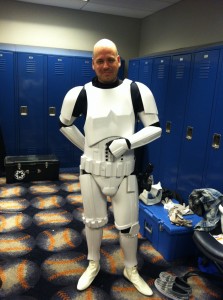 Geared up and ready to go beneath Citi Field. Anyway, Steve Iervolino and the other members of the 501st’s Empire City Garrison were gracious enough to let me join their ranks for an evening, with Dave Braun (whose many good qualities include being a serious Mets fan) even lending me a spare set of stormtrooper armor. Once we were outfitted in the auxiliary locker room in the bowels of Citi Field, it was time to meet our public.
Next time you watch Star Wars and snicker that the stormtroopers can’t hit anything, have some sympathy: When Luke Skywalker complains that he can’t see a thing in this helmet, he ain’t kidding. Your field of vision becomes two offset triangles, and anything below your chest is invisible. The moment this starts to bother you, you’ll notice your lenses fogging up. You can’t breathe all that well, even in a helmet modified by an expert for some airflow. You can’t hear. You can’t bend — I’d left my iPhone on the floor, and when it buzzed I stared at it helplessly, realizing it may as well have been on the moon. And you immediately start to sweat — not a surprise, since you’re wearing a black bodysuit covered with a Christmas tree of white plastic held on by Velcro, straps and snaps.
Encased in armor, I clattered off after the far more experienced troopers, hoping to God I wouldn’t fall over anything, manage to lose some piece of Dave’s armor, or make some other rookie mistake. Our first assignment was to accompany the Mets’ Pepsi Party Patrol for Star Wars trivia. The familiar concourse was like some crazed video game, glimpsed through two wedges, with people rising up out of nowhere, and I felt at once very conspicuous and anonymous — lots of people wanted pictures with us, but no one had any idea who I was. I kept squashing my helmet down on my rather pointy nose so I could see slightly better, kept my eyes on the back of the trooper in front of me, and hoped I wasn’t about to plow into an overeager kid who’d raced into the massive blind spot below my chest. To my relief, everything went OK — we all posed for lots of pictures, did some medium-fiving (it’s also hard to really lift your arms), and got through the scrum to our destination. (Points to the Mets’ staff for very kindly looking after all of us, by the way.)
Then I realized that the trivia contest was being held halfway down the field level. There were steps. Lots of steps. And I couldn’t see any of them.
I’ve walked up and down the various Citi Field steps lots of times, often taking them two by two, never really giving any thought to them. This time, every step got my virtually undivided attention, and I kept one hand firmly affixed to the railing. This was a fine strategy, but next time you’re at Citi Field, look at those railings. There are breaks in them every few feet so fans don’t bunch up behind a slow person, which is great for everybody except virtually blind rookie Imperial soldiers. Those railings are also varying lengths — there’s a few feet of railing, then a gap, then a railing that ends almost as soon as it begins, then a gap. I couldn’t see the railings either.
I’m sure I wasn’t a particularly impressive stormtrooper — I basically tiptoe’d down the stairs with one hand constantly fumbling for purchase — but hey, I didn’t fall down. (Which is good, as I might still be there.) We got back to the locker room with one mission accomplished and the Mets and Nats tied 0-0.
I took my helmet off, managed to Nureyev my phone into my hand, caught my breath and mostly stopped sweating and decided I could handle one more mission, particularly since the next one wouldn’t involve steps. Besides, it was pretty irresistible: We were headed onto the field to toss t-shirts into the crowd above the third-base dugout. We assembled in the tunnel (really more like a slot) that the umpires use and waited for the bottom of the fifth to end.
Except it didn’t.
From that vantage point, I could really only see second base, which was home to a rotating cast. First Josh Thole was there. Then Jose Reyes was. Then Ruben Tejada took his place. Then it was Lucas Duda’s turn. After each play, I’d duck around Darth Vader to peek at the scoreboard and see what had happened. Except I was weirdly ambivalent about the Mets’ rally. On the one hand, all this offense was obviously terrific; on the other, I was sweating freely behind my fogged lenses and various straps had come undone. (Add those to the roster of things I couldn’t see.)
The inning ended and then we were on the field. (I almost got plowed into by Michael Morse, who’s the size of a Wookiee.) People handed me t-shirts I couldn’t see (only one of which I dropped) and I clattered my arm back and flung them as far as I could, which wasn’t very far. Did I think to myself, Wow, I’m on the field dressed as a stormtrooper throwing t-shirts to fans? Why yes I did.
We got off the field with reasonable speed, and we were done; I extracted myself from Dave’s armor, got back into civilian clothes, and found the game only half-over. I social-butterflied my way around field level, checking in on my friends Amanda and Carl and recounting my adventures while guzzling Mountain Dew and water. (Here’s hoping the Mets keep using the video skit with R.A. Dickey and Vader, by the way — it’s hilarious.) Meanwhile, the game had slowed to a crawl, with both Terry Collins and Davey Johnson deciding that every batter deserved his own pitcher. And the Mets were out of offense; they put up a fight against Drew Storen in the ninth, but Lucas Duda — OH MY GOD YOU GUYS IT’S AN OMEN LUCAS CAN DELIVER A WALK-OFF WIN ON STAR WARS NIGHT — struck out and that was that.
In the annals it’s another dreary loss in a season stumbling to its conclusion. But I had a grand time — thanks to some kind folks, crossing the streams turned out to be enormous fun, and I got to help out for a good cause. It was a blast, even if the Force wasn’t with the Mets.
by Greg Prince on 13 September 2011 1:23 pm Welcome to The Happiest Recap, a solid gold slate of New York Mets games culled from every schedule the Mets have ever played en route to this, their fiftieth year in baseball. We’ve created a dream season that includes the “best” 139th game in any Mets season, the “best” 140th game in any Mets season, the “best” 141st game in any Mets season…and we keep going from there until we have a completed schedule worthy of Bob Murphy coming back with the Happy Recap after this word from our sponsor on the WFAN Mets Radio Network.
GAME 139: September 9, 1969 — METS 7 Cubs 1
(Mets All-Time Game 139 Record: 20-28; Mets 1969 Record: 82-57)
Tuesday night. Shea Stadium. A black cat appears.
Is that all she wrote?
With apologies to Homer the Dog and Mettle the Mule (and, for that matter, George “The Stork” Theodore), the unnamed black cat that crossed in front of the visitors’ dugout when it was full of Chicago Cubs is the most famous animal in New York Mets history. He was plainly working for the home team when he seemingly sought out — depending on whose version you believe — Glenn Beckert, Ron Santo or Leo Durocher, and irreversibly altered the luck quotient of the 1969 pennant race. The Cubs who came to town as the holders of the longest-lived lead the National League East had ever seen (in, granted, the first year there was a National League East), would be leaving with their proverbial tails tucked between their hind legs.
And the Mets were clearing their collective throat to roar the roar of a fresh, new frontrunner.
It was a night to say hello to one legend and bid a derisive adieu to another.
Foregoing the question of where that cat came from anyway, who was he intending to spook? The whole Cubs team, broadly, but specifically? A wire-service photo that appeared in papers nationwide the next day identified the Cub in the on-deck circle past whom the Flushing feline of the moment padded as second baseman Beckert; his face and uniform number were obscured, but he was the second batter in visitors’ lineup, and since the episode is generally recalled as occurring as the game got underway, Glenn was a logical candidate. Later accounts, however, fingered the victim of furry misfortune as Santo, and, indeed, the third baseman turned announcer definitely created a sideline from autographing copies of the image in retirement.
Rick Talley, in The Cubs of ’69, meanwhile, deduced the kitty had another target in mind:
“Somebody released the feline in front of the Cubs dugout early in the no-contest, and while some players chuckled as the cat ran back and forth in front of the bench as if trained, Leo the Lion stared straight ahead. Perhaps the King of Beasts knew.”
On whomever he set his gaze, the black cat was recognized immediately as bad luck for one team, and not the other. Richard Dozer in the next day’s Chicago Tribune described a first inning in which “the frightened feline reversed his course and dashed under the stands to safety on the other side, next to the Mets’ dugout.” And years later, Shea’s head groundskeeper Pete Flynn recalled in the book, Moments in the Sun, “He looked in the dugout and gave them the jinx. The cat came from behind home plate and went in front of the Cubs dugout. It was a bizarre moment.”
Most bizarre of all, at least from the perspective of past performance, was how the Mets had making their own luck dating back to August 16. They’d won 21 of 27 entering the Night of the Cat, while the Cubs didn’t need any superstitions gone awry to tell them things weren’t going their way any longer. Since August 20, they’d lost 12 of 19. The table-turning had placed the Mets only a game-and-half-back before the cat reared head (depending on your allegiance) adorable or ominous head.
Once the cat had his say, it was the Cubs who were put out. In the bottom of the first, after Chicago had gone down in order, two Ferguson Jenkins walks set the stage for Ken Boswell to double home two runs and give Tom Seaver as much lead as he’d need. Seaver was money by this point in the 1969 season. Certainly his manager thought so. As Bob Sales of the Boston Globe noted, Gil Hodges’s neatly printed on his lineup card, as the Mets’ ninth-place hitter, “$eaver – P”.
Tom didn’t give up anything for three innings, long enough for the Mets to increase their margin, thanks to a botched Cubs pickoff attempt that didn’t erase leadfooted Art Shamsky at second and a succeeding two-run homer from Donn Clendenon. The Cubs manufactured one run in the top of the fourth, but Seaver personally got it back when he doubled in the bottom of the inning and came around on a fielder’s choice and sacrifice fly. A Shamsky home run and a Jerry Grote RBI double eventually elevated the Mets’ advantage to 7-1.
Which wasn’t enough to bring out the cat for an encore but was plenty of cue for the 58,436 in attendance (51,448 paid) to serve as Hallelujah! chorus behind Seaver. They took out handkerchiefs, they waved them in the general direction of the third base dugout and they serenaded the Chicago manager with a new twist on an old favorite.
Goodbye Leo!
Goodbye Leo!
Goodbye Leo!
We hate to see you go!
It was splendid accompaniment to Seaver’s 21st win of the season, as was Karl Ehrhardt’s extraordinarily topical sign held aloft in the box seats no far from where the serenadee sat and fumed:
TOOTHLESS CUBS —
JUST A LOTTA LIP
“These fans,” Durocher was heard to grumble as he was heckled en route to the team bus, “they’re not goin’ after any maiden.” Yet in other, seemingly distant lifetimes, Durocher was one of them. He had been a New Yorker. He played (albeit without distinction) with Babe Ruth on the Yankees. He cajoled the Dodgers to the 1941 pennant, Brooklyn’s first in 21 years. His guile was behind the miraculous Giant comeback of 1951. Now, however, Leo the Lip was on the wrong side of the field and the wrong end of a miracle in the making. The usually garrulous manager had only this to say to reporters after Seaver completed the 7-1 defanging of the once proud Lion and sliced what was left of the Cubs’ divisional lead to a fragile half-game:
“No comment. No fucking comment.”
ALSO QUITE HAPPY: On September 7, 2006, the fastest set of wheels in the National League showed what they could do upon accelerating. The suspicion was they — and the team for whom they revved so effectively — couldn’t be stopped.
In the bottom of the sixth on a Thursday night at Shea, as the Mets led the Dodgers, 4-0, Jose Reyes shot a Brad Penny pitch up the right-center field gap with two on. The ball eluded Matt Kemp, so Jose just kept going. Kemp tracked down what seemed likely to become Reyes’s 17th triple of the season.
It was destined to be more. In this year of Ho-ZAY! HozayHozayHozay!, three bags just weren’t enough for the speedy Met shortstop. He rounded third and headed for home well ahead of the relay throw that had no chance of catching him. Reyes slid headfirst, bellyflopping onto the plate for no better reason than it appeared to be fun.
Jose Reyes was nothing but fun by this point of the 2006 season. His three-run inside-the-park home run gave the Mets a 7-0 lead they’d hold for the rest of the game and put them 35 games over .500 for the first time since 1988, the last time they won the N.L. East. Appropriately enough, the win reduced the Mets’ magic number for clinching another division title to the one on Reyes’s back: 7.
GAME 140: September 10, 1969 (1st) — METS 3 Expos 2 (12)
(Mets All-Time Game 140 Record: 24-24; Mets 1969 Record: 83-57)
The Mets were going to ascend into first place sooner or later. It’s just that nobody would have ever bet on sooner.
Ever…at least not the ever that started in 1962 and rolled on until a few weeks before, when the Mets were improved, but still a light year or two from first. But that was all ancient history now. The New York Mets who couldn’t be mentioned in the same sentence with first place no longer existed. They’d been replaced with a couple of dozen fellows who wore uniforms eerily similar to that of their predecessors, but the resemblance ended once these Mets took the field and deposited their results in the standings.
This was a franchise for whom finishes above last place were news, and there were only two of those in seven seasons. Precedent indicated that would be a reasonable Met goal again. In 1969, the birth of the first expansion team in their time zone since them figured to guarantee the newly created six-team National League East’s basement would be furnished with Montreal Expos paraphernalia. Sure enough, the Mets didn’t spend any time in sixth.
More aspiration? The Philadelphia Phillies — featuring a disgruntled Richie Allen and little else — loomed as pretty crummy; the Mets finished only three games behind them in 1968. The Phils fell into fifth to stay by late May. That meant one last and next-to-last were occupied by teams who weren’t the Mets.
Higher up the food chain were the Pittsburgh Pirates, a sub-.500 team the year before and, despite the dangerous bats belonging to Roberto Clemente and Willie Stargell, not considered pitching-laden enough to be a serious contender heading into ’69. By June, the Mets had put the Pirates in their rearview mirror.
The St. Louis Cardinals were a heavy favorite to contend for their third consecutive league championship — or divisional championship, anyway. But the Redbirds were grounded early. Save for a brief Cards resurgence in mid-August that coincided with the Mets groping to find themselves, St. Louis was not a direct challenger to ascendant New York. The Mets spent the bulk of 1969 ahead of the once-formidable Cardinals.
Let’s review:
Sixth place? Not the Mets.
Fifth place? Not the Mets.
Fourth place? Not the Mets.
Third place? Not the Mets.
Second place? That was the Mets most every day from June 3 through September 9. It was a helluva accomplishment considering the humble beginnings that never completely shook off their humility for seven years. The Mets were better than everybody in their immediate sphere except for one team: the mighty Chicago Cubs.
But the Cubs, as the Mets had just witnessed, were no longer mighty by September. Leo Durocher had brought them to Shea for two games and they left town with two losses. The separation between Chicago and New York in the standings — which, when the Cubs were running away with the division, felt like the 789.4 Rand McNally miles — was down to a half-game.
A half-game? That’s a day’s work as baseball math goes. You win and your prey loses, you’ve got it. You’ve got first place. The Mets couldn’t take on the Cubs directly, but they could make a pretty significant push on their own, as they were playing the last-place Expos twice this Wednesday evening at Shea. True, the Cubs were down in Philadelphia, taking on a the next-to-last place Phillies, but in their case, other teams’ positions hardly mattered.
The Cubs had met the enemy, and it was as much them as it was whomever they were playing. They were also going up against the specter of the Mets, who suddenly couldn’t lose, and the surging relentlessness of the schedule. That the Cubs had to play anybody was bad news for them. That the Mets would have two shots at the Expos…let’s just say moving day loomed.
The Mets made their move first. Their doubleheader started well ahead of the Cubs’ single night game at Connie Mack Stadium. To add a little drama to the prevailing trends, the Mets and Expos — knotted at two from the fifth inning on — needed to go to extra innings in their opener. Until they had a final, the standings couldn’t budge even temporarily…no matter how much they were plainly dying to.
In the bottom of the twelfth, after Bill Stoneman got two quick outs, Cleon Jones singled and Rod Gaspar walked. Ken Boswell came to the plate. Here is how Ralph Kiner described the climactic swing:
“The pitch is hit through the middle, it’s gonna go into center field, a base hit and the Mets will win it! Coming around to score is Cleon Jones, and the Mets have won the ballgame, three to two, on the base hit.
“So for the first time in the history of the New York Mets, they have gone into first place!”
The standings, as of September 10, 1969, 8:43 PM Eastern Daylight Time, couldn’t have been more provisional. The Mets and Expos had another game to play, while the Cubs and Phillies were still in progress down the New Jersey Turnpike. Nevertheless, the fans knew they were in on an unprecedented moment, declaring, in case anybody missed it…
WE’RE NUMBER ONE!
WE’RE NUMBER ONE!
WE’RE NUMBER ONE!
Their assertion was confirmed by the Shea scoreboard:
LOOK WHO’S NO. 1
It wasn’t the Cubs anymore. The NY METS were listed as having WON 83 and LOST 57. That information was posted one line above the record of the CHI CUBS, who had WON 84 and LOST 58. The all-important PCT. was included to let every Sheagoer and the entirety of the free world know the Mets held an advantage of .593 to .592.
That was it. It would be referred to as one percentage point, but technically it was one one-thousandth of one percent. In the jargon of Chesterfield Cigarette ads of the day, the Mets’ winning percentage was no more than a silly millimeter longer than the Cubs’. But it was longer. And larger. And bigger. And better.
The Mets were No. 1. By the end of the night, the Phillies downed the Cubs, 6-2, and the Mets (behind Nolan Ryan’s complete game, eleven-strikeout three-hitter in the nightcap) swept Montreal, 3-2 and 7-1. That translated to a full one-game lead for the Mets.
The first-place Mets, that is.
ALSO QUITE HAPPY: On September 8, 1970, what was once the stuff of miracles was now mired in the relatively mundane business of defending what had been previously, if miraculously, attained. Then again, the concept of a title defense in baseball is more myth than reality. Once the season after a championship begins, everybody is even. Everybody is Oh and Oh. Everybody has to start from scratch and attempt to build a new championship.
That’s what the 1970 Mets were doing in September…almost desperately. They dropped out of first place in early August and had been clawing to get back on top for more than a month. They closed in on their 1969 perch against Montreal this Tuesday night at Shea when they put five runs on the board in the eighth inning, extending their lead to 10-2. The key blows were a three-run double from Ken Boswell and a three-RBI single off the bat of reliever Tug McGraw. McGraw replaced starter Gary Gentry in the fourth and had tamed the Expos ever since. He’d stay in the game in the ninth, but after surrendering a three-run homer to Bob Bailey, Gil Hodges called on recent pickup Ron Herbel to get the final two outs and preserve the 10-5 win.
Also starring for the Mets was Cleon Jones, whose season to date was a far cry from the All-Star campaign he put up in 1969. His 3-for-5 evening (a triple and two doubles) allowed the .340 hitter from the year before to build his hitting streak to 15 consecutive games. By the time it was over, on September 15, Cleon would make it 23 straight to establish a new club record. But even with the recent surge, Jones was batting only .277, or more than 60 points lower than his 1969 average.
As for the Mets as a whole, the triumph over Montreal, combined with a Pirate loss, lifted them to within a half-game of first place. They would forge a tie with Pittsburgh the next night and share a piece of the penthouse as late as September 14, but 1970 was destined to provide nothing of a championship nature for the Mets, save for the rapidly fading memories of what had been so miraculous so recently. They’d finish in third, six games out.
GAME 141: September 7, 1984 — METS 10 Cubs 0
(Mets All-Time Game 141 Record: 19-29; Mets 1984 Record: 79-62)
So close. So gosh darn close. Even for the annals filled with the darnedest, closest attempts to carve into the record books the very first no-hitter ever thrown by a New York Met, this one was excruciating.
But this effort had a twist. Most of the not-a-no-hitter heartbreak stems from longevity. The longer a no-hit effort goes, the harder the fall when the first hit falls in. But here, on a Friday night at Shea when a massive crowd was dying for as big a Met moment as possible, it wasn’t closeness to the finish line that nailed their dreams. It was how close the one gosh darn hit came to being an error.
Which nobody could be blamed for thinking it should been scored.
Rookie Dwight Gooden had already been magnificent in 1984. Now, pitching to the first-place Cubs, against whom the Mets were making their last desperate lunge (from seven games out), he turned almost invincible:
• No hits and two strikeouts in the first.
• No hits and two strikeouts in the second.
• No hits and two strikeouts in the third.
Sense a pattern? With Mookie Wilson and George Foster each driving in three runs by the bottom of the third, the Mets didn’t have to worry about offense. And with Doctor K on the mound, pitching wasn’t a concern.
History, however, was growing on everybody’s minds. The appetizer came in the second when Doc passed Grover Cleveland “Pete” Alexander for the National League rookie strikeout record. That rated hearty applause from the more than 46,000 on hand, but it felt like there could be more…like there should be more. In the fourth, the feeling escalated as Gooden set down the Cubs in order again. By the fifth, the Mets had a 7-0 lead (on Mookie’s fourth ribby), and the buzz intensified.
Dwight Gooden, so good…but no-hitter good?
The leadoff batter was Keith Moreland, an earlier strikeout victim. This time, though, he made contact…if not a lot. He rolled a grounder up the third base line. It rolled like Moreland ran: slowly. Third baseman Ray Knight, playing deep, had to charge it. He fielded it, but by no means cleanly. Knight couldn’t and didn’t make a throw.
On NBC, where the game was airing nationally, and throughout Shea, Mets fans awaited the word: Hit? Error? Error? Hit?
Hit.
Or so the official scorer said.
The groan was palpable. Twenty-three seasons had conditioned Mets fans to recognize a no-hitter as it was getting away from them, and this one shouldn’t have been that. This one was shaping up as the real thing, the one that was going to break the disappointing mold.
Hit.
“I couldn’t throw it,” Knight said later. “I never got a grip on the ball.”
Doesn’t sound like a hit, didn’t necessarily look like a hit, but it went into the books as a hit — the only Chicago hit in the Mets’ 10-0 win that was swell in terms of the bottom-line result and the necessary inching up on the Cubs, but deflating considering what it could have been. Dwight Gooden struck out eleven batters in going the distance. It was the fourteenth double-digit performance of his young career.
And it was his first one-hitter.
Knight, an August acquisition from the Astros, had no equity with the Shea crowd yet, so he drew boos. The no-hitter-starved fan base probably wouldn’t have acted too kindly toward him, either, had they heard him say, as he did after the game, that he would have scored it a hit, although he did allow, “I’d gladly take an error on it.”
Davey Johnson brushed it off as “a hit all the way,” and the man who came one clean grip and throw from making the most immense Met history imaginable was relatively nonchalant about what he lost while gaining his 15th win of the year. “I’m not disappointed,” Gooden said. “The hit doesn’t matter. I just wanted to win the game.”
Dwight Gooden was a great Mets pitcher. But it was obvious he had never been a Mets fan.
ALSO QUITE HAPPY: On September 7, 1973, the long, hard slog from a frustrating last to an improbable first continued in two languages. The Mets traveled to Montreal for a Friday night doubleheader, and if you had to ask anyone to choose which team was the surprise contender at Parc Jarry, the standings would suggest you take a close look at Les Expos, who entered play in second place, three games out. It was the first time the ’Spos — now in their fifth season — were in anything resembling a pennant race. The Mets, on the other hand, had only, in the space of the previous week, tiptoed from sixth to fifth and then fifth to fourth. But if customs didn’t stop them, why would the Expos?
Vous devez croire, incidentally, is a rough French translation of “You Gotta Believe.”
After Jon Matlack, aided by a one-out save from resurgent Tug McGraw, made Wayne Garrett’s leadoff homer hold up for a 1-0 win in the opener, the two teams settled in for a very long Canadian night. Jerry Koosman extended his then club-record scoreless innings streak to 31⅔, before Bob Bailey drove home Felipe Alou in third to give the Expos a 1-0 lead. It held up until the seventh, when a Pepe Frias error and a Mike Torrez fit of wildness (three consecutive walks) allowed the Mets to tie the score.
It stayed tied for a very long time, as relief aces Mike Marshall and Tug McGraw (following Harry Parker’s three scoreless frames) steered the game deep into extra innings. Tug wriggled out of a bases-loaded jam in the tenth by striking out pinch-hitter Clyde Mashore. Marshall, who would go eight-and-a-third, danced through figurative raindrops as well, grounding out Rusty Staub with Mets on second and third to escape the fourteenth.
The big breakthrough came in the fifteenth: John Milner singled, Ed Kranepool doubled and, one out later, Don Hahn lifted a fly ball to push the Mets’ second run across. McGraw would be allowed to bat for himself and he singled home two runs later in the inning, though he’d be thrown out trying to take second.
Yogi Berra, tuned into McGraw’s hot-handedness (going for his sixth win or save in his last six appearances), left him to pitch a sixth inning, but after one Expo run scored, he finally removed him in favor of Ray Sadecki. The veteran lefty retired Pepe Mangual and Alou, and the Mets came away 4-2 winners. They had swept the Expos and climbed to within four games of first-place St. Louis and a half-game of now third-place Montreal in the most fluid pennant race anybody had ever seen. Five teams were within five games of first, yet none of them was more than three games above .500. The Mets, at 68-73, were smack dab in the thick of things.
Vous devez croire, indeed.
by Greg Prince on 13 September 2011 7:01 am The New York Mets wish to thank New Era and Major League Baseball for setting aside standard uniform regulations so Mets players and coaches could honor the bravery and courage of New York’s first responders and service agencies in memory of the lives given so selflessly in the heinous attacks of September 11, 2001. The Mets’ wearing of caps bearing the insignias of those agencies is but a small way of continuing to remember the enormous contributions of the men and women who came to the aid of those in need at a most crucial hour in our city’s and our nation’s history.
Something like that. A couple of announcements, read at the ballpark and over the air…maybe with the most subtle of reminders that if you are interested, a Mets cap with an American flag patch sewn on the side is available, too, and a portion of its proceeds will go to the 9/11 Memorial and Museum, Flight 93 Memorial and Pentagon Memorial (a hefty portion, in an ideal world). Take care of MLB’s licensed apparel partner and let the Mets play ball one night a year in the caps of the FDNY, the NYPD, the PAPD, the OEM, the EMS, the K-9 corps, the Court Officers and anybody else I may have failed to list.
Everybody nods, everybody applauds and life goes on as best it can.
Too bad nobody could come to this kind of solution, or a realization that this kind of solution — and it didn’t necessarily have to be this exact version — would have made everybody feel better and nobody look bad. Terry Collins, sick of the whole thing’s dissection by now, says, “It was not what we had on our heads. It was what was in our hearts.” True enough, and if you couldn’t see into the Mets’ hearts Sunday night, then you weren’t looking closely enough at the classy, heartfelt tribute that preceded their game with the Cubs.
But it is a little about what was on their heads. Or, more specifically, what wasn’t.
Blame the Mets for that, but only in the sense that you’re blaming them for having done the right thing ten years ago and continuing to do the right thing, capwise, for another six years thereafter. The Mets wearing the caps of the first responders to 9/11 — in some cases the actual caps worn by the actual responders, as Todd Zeile recalls — was as heartfelt a statement as a baseball team could make about being part of something bigger than they were. It’s one thing to wear an “N” and a “Y” and say you play for New York. It’s another thing to borrow, with blessings, the crests of those for whom you play and literally play for them.
That’s what the Mets did in 2001, with heads held high for 18 games. That’s what the Mets did again, in commemoration of the most chilling acts of heroism imaginable, every year thereafter from 2002 through 2007. In 2008, MLB stepped in and told teams to wear other caps, with jury-rigged red, white and blue team logos, and they kept that up through last year. The Mets dutifully complied.
They sought to do differently this year for the tenth anniversary. MLB had a problem with it. It is to their everlasting discredit that they did.
MLB was shortsighted, to put it extraordinarily kindly, in rejecting the Mets’ efforts, no matter how the decision was made, no matter who said what to who or who threatened who with what. The Mets wanted to wear the kinds of caps they wore in 2001 in 2011. They were told not to. We can implore the Mets to show more backbone or cojones or whatever phrase you choose to indicate a stronger stand of defiance, but it shouldn’t have come to that.
MLB should have recognized, as ESPN’s Buster Olney suggested, that the Mets wearing the caps of first responders was not only the right thing to do, but a part of their heritage. It’s an established tradition, a serious one. MLB should have said, “Look, we want to sell caps with American flags. But what the Mets do to honor their community transcends merchandising opportunities by so much, that even we’re not so thick-skulled that we can’t recognize it. So let’s get them to make a few announcements plugging New Era and let them play ball. Tomorrow we’ll go back to business as usual.”
Monday night, by the way, was business as usual. The Mets wore regulation caps, didn’t hit and lost for the fifth time in six games. So there, Joe Torre, is your cherished “uniformity”.
Oh, and one more announcement that could still be made:
In 2012, Major League Baseball will inaugurate Community Service Recognition Day, when each of our 30 teams will promote the organizations in their communities who are dedicated to helping others by having its players and coaches wear the caps of those groups on the field for one game. Major League Baseball thanks the New York Mets for setting an example we can all follow.
Instead of worrying in corporate dunderheaded fashion (per Olney’s reporting) that, “heaven forbid, there might be another tragedy…and then what we would do about caps?” (as opposed to worrying about the consequences of the tragedy itself), MLB can embrace its unique role as unifier rather than marketer. Do they realize how many community-based agencies across America wear baseball caps despite not being baseball teams? Don’t they see what baseball means to people beyond licensed branding? There is an inherent connection still between this game and this nation. The cap is a statement unto itself, one that isn’t translated strictly in an accounting of receipts.
Why is there an FDNY cap anyway? Don’t firefighters have helmets? Don’t the police have hats of their own to match their uniforms? Yet there is an NYPD cap and an FDNY cap. Everybody, at some level, wants to wear a baseball cap of their own. Everybody wants to be part of the team. MLB, in turn, can be part of their teams — part of a lot of teams. This doesn’t have to be solely about New York and its first responders. There are agencies and organizations in other cities that do great things for those communities. Let the teams there follow the Mets’ path in that regard. Let the Nationals, as they wanted, honor the Navy SEALs. Let the Rockies honor those who make a difference in Denver. Let the Mariners do it in Seattle and the Dodgers do it in Los Angeles and so on.
For one day, MLB, use your heads. It doesn’t have to be on the emotionally loaded day of September 11, but that does seem ideal, given that it’s more and more being promoted as a day of service. It doesn’t have to be just one organization per team. Look what the Mets meant to so many in ’01 by wearing the caps of several different agencies.
Let it be a local decision, ballclub to ballclub. Give New Era (or whoever) their props as suggested above and let the teams say to their cities, you’re with us, so we’re with you. You and and our entire community mean so much to us that you are, literally, top of mind. Look at us — we honor you right from the very top of who we are.
Y’know what? It should be about what’s in the heart, but sometimes you can tell what that is much quicker by seeing what’s on the head.
Especially in baseball.
by Jason Fry on 12 September 2011 2:25 am You know that Toshiba ad where they ship the laptop without the shock-resistant hard drive, and there’s a nationwide power outage and a guy drinks bad milk and turns into a zombie and bites his roommate and then there are zombies everywhere? (You’re a Mets fan, you have to know it.) I imagine Major League Baseball must had that warning in mind when they refused to let the Mets wear caps honoring first responders during tonight’s game.
Sure, to those of us not gifted with the foresight of MLB mandarins, it seemed natural and right for the Mets to honor first responders on the 10th anniversary of the 9/11 attacks, seeing how the Mets were a) the New York team playing at home on Sept. 11, b) had just participated in a nicely done, nationally televised ceremony honoring those killed that day, and c) were paying homage to the 2001 team’s gesture of remembrance.
But let the chain of dominoes fall before you judge MLB too harshly. If the Mets had received permission to wear those caps, the Yankees might have asked to do the same, seeing how they also represent the city wounded so grievously 10 years ago. And then the Nationals might have wanted to don such caps, since a hijacked plane struck the Pentagon on that terrible morning. And then the Pirates might have decided to honor first responders, given their proximity to Shanksville, where Flight 93 crashed after its passengers saved untold more lives in D.C.
And then, if the Mets, Yankees, Nationals and Pirates had worn such caps, more and more teams might have wanted to do so. You might even have had the nightmare scenario of 30 teams honoring their local firefighters, police officers, EMTs, Coast Guard members and others, inspiring fans both to remember 9/11 and to give thanks for the people in their hometowns who run towards danger instead of away from it.
And if that had happened … well, I’m not sure what would have befallen us next, but thank goodness Bud Selig and Joe Torre were vigilant and protected us from whatever it would have been.
* * *
As for the game, it was actually something of a relief when extra innings arrived and the crowd thinned out and the parade of visiting ex-Mets stopped.
I’m not saying there was anything wrong with what had come before — the ESPN crew was properly solemn and reflective, with Bobby Valentine interesting as always whether talking about the aftermath of 9/11 or the game in front of him; the Mets did a fine job with a poignant, understated commemoration; and the ex-Mets were thoughtful, particularly John Franco with his pitch-perfect recollection of the team as “a little Band-Aid on a big wound.”
Rather, it was that the emotional weight of the entire day had been so crushing that it was hard to get invested in the game — which made it a very faint echo of what Greg and Emily and I and others felt on Sept. 21, 2001, before Mike Piazza’s bolt off Queens-raised Steve Karsay let all that accumulated tension and sorrow blow, to be replaced (at least for a little while) by joy. There wasn’t and couldn’t have been any such release tonight, though ESPN kept trying to cast various Mets as the Piazza-esque hero in waiting, and it was impossible not to remember and do the same thing in the stands or at home. But what we did get was a game that crossed so thoroughly into funhouse-mirror territory that the solemnity receded, with the Mets and Cubs taking turns refusing to win it until the Mets’ relievers were so awful that the Cubs basically had no choice but to prevail.
(The frustration of the Mets’ inability to get the big hit when it mattered was an unhappy reminder of what happened to the Brooklyn Cyclones Saturday night, when their season ended with a 1-0 loss to the Staten Island Yankees. But I’m going to wait and write about that on a night when we’re not all so wrung out.)
* * *
Anyway, back to the damn hats, which I found myself getting angrier and angrier about as the night went on. (With an interlude during which I demanded of poor Jason Pridie why he couldn’t have dented a seat in the Pepsi Porch in his previous at-bat.) I got angrier, but also found myself baffled and saddened that someone had done something so inexplicably dumb, making the Mets’ efforts feel unfairly hollow. Until I found myself trying to wish the whole thing away.
I wish MLB had come to its senses this morning and not issued an edict that was tone-deaf, ridiculous and ensured they’ll be cleaning up Augean stables of thoroughly deserved bad PR.
Failing that, I wish the Mets organization had shown more spine and told MLB to stick it, they were going to support their city with the same gesture that accompanied their selfless efforts of a decade ago, and would now stand for everything they’ve continued to do through programs such as Tuesday’s Children.
Failing that, I wish the Mets players had shown a little spine and told the organization and MLB to stick it, because they were honoring their city the way their baseball forebears had. (David Wright’s acquiescing limply to MLB orders and then tepidly rebelling by wearing a first-responder cap in the dugout only made manners worse.) [Struck given R.A. Dickey’s tweet that someone from MLB took Wright’s hat away after the fourth inning. You can’t make this shit up.]
And since no one was willing to say no to a terrible decision enforced by the guy a rung above them, well, I wish the Mets had at least beaten the Cubs.
by Greg Prince on 11 September 2011 11:51 am I’ve been watching the reading of names at the Ground Zero memorial. What gets me, besides the cruel endlessness of the list and the heartbreaking personal codas family members send skyward to those they lost, is the sheer randomness of it. People who happened to be in the wrongest place at the wrongest time — them and the people who doubled down on fate and rushed in to maybe save some strangers — those are the victims and the heroes. It didn’t have to be them, it shouldn’t have been them, it shouldn’t have been anybody.
And that has not a thing to do with baseball, just as baseball had not a thing to do with the horror of ten years ago. I keep reading Mike Piazza’s home run “healed” the city. It didn’t. It was a grand and wonderful element of a baseball game, and it made for a helluva sidebar and I begrudge no one whatever they choose to take from it. But watching those sons and daughters and husbands and wives and mothers and fathers and brothers and sisters still grappling with the emotions attached to losing their loved ones, I don’t know what the definition of healing is in this context.
Still, I’m glad Mike hit it and I remain glad the Mets played that game when they did. It was on the schedule, but the schedule, so inviolate that teams play through veritable monsoons so as to adhere to it, was already off its moorings. Everything was up for grabs. A few weeks of baseball games? In the days following the acts of madness and their tragic consequences, who cared? Honestly, I didn’t.
But they played and people showed up, your co-bloggers among them. And before you knew it, they played again (and we kept showing up). One week later than planned, every team finished out its schedule. The Mets played all 162 in 2001, including 81 at Shea Stadium. Not much could be expected to stay intact in September and October of 2001, but baseball did, especially the Mets.
Ten years later, the Mets keep their hands on the legacy they cultivated then. They still visit firehouses. They still do their part for the families most directly affected. Tonight they’ll give over Citi Field to remembrance of a moment bigger than themselves, yet one whose fabric they are inextricably woven into, if just for a stitch here and a stitch there.
The Mets do the right thing more than we’d suspect. This is one of those times. It makes me proud to count myself among their fans.
by Greg Prince on 11 September 2011 1:55 am Saturday’s Mets game can be broken down into three convenient segments.
1) Top of the first through the top of the eighth
Cubs, taking advantage of dopey defense and ordinary Capuano (which is to say solid yet relentlessly unexciting), build 3-0 lead over Mets, who, in turn, do nothing with Randy Wells.
No further comment necessary.
2) Bottom of the eighth
Now this part was fun.
Willie Harris walks as a pinch-hitter, thereby negating the strong impression that Willie Harris never does anything as a pinch-hitter.
Jose Reyes, with a hitting streak on the line and a batting average lead in perpetual jeopardy, lashes a double into the gap, which is in itself exciting.
Harris turns on the speed I forgot he has (remember when Willie Harris seemed so otherworldly — before he was a Met?) and scores to put the Mets on the board at last.
The Second Baseman Known as Ruben Tejada singles, though in such a way so that Jose can only motor to third (Jose doesn’t seem quite as quick as he used to, does he?).
David Wright singles like he means it, driving home Reyes, making it 3-2, and suddenly this Saturday didn’t seem so somnambulant after all.
With Tejada on third, Wright moves himself up to second on a daring steal.
Pagan is no help, but then Jason Bay — who is help after serving nearly two seasons as the human equivalent of an S.O.S. flare — does what the Jason Bay of the moment does. He singles hard to left, bringing home the tying and go-ahead runs.
As if they are that would-be flash mob from that cell phone commercial, the Mets offense (sans trenchcoats and disapproving expressions) gather without warning and produce a 4-3 lead — an excellent phenomenon on its own terms, plus it carries the potential to make a winning pitcher out of Daniel Herrera, of whom a little goes a long way.
3) The rest of the game
Bay gets picked to apply an abrupt dimmer switch to the Mets’ flash.
Then Wright makes an error to start the Cubs’ ninth.
And Parnell — who, it took me five months to decide, reminds me greatly of Kenny Powers’s brother on HBO’s Eastbound & Down (though Kenny Powers’ brother has a real Rise to the Occasion scene late in Season One) — continues to shrink in stature, and I don’t mean in the Daniel Herrera sense, ’cause that dude stands a little figuratively taller every day by getting batters out when needs to…unlike Parnell.
And Aramis Ramirez is intentionally walked, which I find silly, no matter that the idea of loading the bases with Parnell pitching is just as silly.
And the idea that Parnell is a closer is silly, too; I’d rather see Daniel Herrera at this point; or Manny Acosta; or Josh Stinson; or Kenny Powers, for that matter.
And the Mets fall behind, 5-4, en route to losing by the very same score, the same one they won by in such exhilarating fashion on Friday night.
It is as if the Mets didn’t get the message that they had to keep playing (well) clear to the end of every game. Perhaps they, like the guy who breaks into his dance routine at Grand Central a half-hour too early, should look into a new plan.
by Greg Prince on 10 September 2011 3:20 am “Everything changed” after September 11, 2001. No need to delve deeply into the litany of all that implies. But to keep it relatively light, has “everything changed” when it comes to going to a Mets game?
I mean once you endure security’s dutiful searches, wandings and pat-downs…and salute the Veteran of the Game…and are asked a second time, if it’s Sunday, to remove your cap for “God Bless America”…and notice that red, white and blue ribbon on the old Shea scoreboard skyline and how the bulbs on two of the buildings remain permanently unlit.
Taking that kind of stuff into account, has everything changed Metwise?
Given what we’ve known for ten years as of tomorrow, those aren’t particularly subtle alterations to the routine of going to a Mets game, and on some level, they and anything else that hints at what went on in New York a decade ago always gets my attention. It reminds me I no longer live in a time when…
• I can walk straight to my gate without pause if I choose;
• “Take Me Out to the Ball Game” and “Lazy Mary” constitute the entire seventh-inning stretch repertoire on any given Sunday or other day;
• ballpark allusions to “veterans” refer primarily to the likes of Lenny Harris;
• and all the lights glow atop that scoreboard skyline.
The awareness that 9/11 happened never fully leaves you at a Mets game, but why should it? It never fully leaves you as a person. The sadness never fully leaves you. Chances are it never will. Think about it too long, and you wonder about Mets fans who went to plenty of games before 9/11 but never again had the chance to do something they no doubt assumed they’d be doing for years to come.
But like I said, I want to keep it as light as possible here. You’ll get all the heavy you can handle by the time Sunday’s over. So excuse me if I skip over the graver, weightier issues inherent in “everything changed.” I’m thinking only in terms of Mets games, as that is what we do in this space if we can help it.
A Mets game, I’m happy to report, is still a Mets game in that way that a Kiss Cam is still a Kiss Cam and a Cy Young is still a Cy Young. It’s not really a fundamentally different experience than it used to be ten or more years ago.
Sure, Shea became Citi, and balls down the line became harder to track, and ticket prices cried out for readjustment, and people didn’t necessarily follow every pitch even if they could see them…but we knew that already. One same old story at a time, please. I’m just talking about some variation on the recurring sentiment that It’s Friday night, it’s six o’clock, I gotta get going ’cause I’m meeting my friend at the Mets game.
You can still do that.
I did that last night, the way I did almost precisely ten years ago. As America prepares to remember (as if it could forget) September 11, 2001, on September 11, 2011, I was reminded of September 1, 2001, on September 9, 2011. 9/1/01, if you will, was the last game I attended at Shea before, you know, “everything changed”. It was a Saturday night with my friend Joe, who was, even then, one of my steadiest Mets companions. We had known each other and been going to Mets games for more than a decade to that point. It’s a decade later and here we are, Joe and I, still going to Mets games.
Did “everything change”? Quite the contrary, I’d say. Mostly, nothing changed.
There are still people in your section you wish would shut up or at least lower their volume.
There’s still too much crap on the video screen between innings (though you’ll never, ever, ever see another animated “airplane race”).
There are still lulls in the action whose pace you dearly wish would pick up already.
There are dratted bottoms of innings that end too quickly.
There are dreaded tops of innings that drag on endlessly.
There are still reasons for Joe and I to hiss not altogether good-naturedly at schools of Marlins, flocks of Cardinals or packs of Cubs. If we’re really hissed off, we’ll take out our frustrations on whichever Metropolitan we deem most culpable.
But — and you knew there had to be a but — there are also people in your section who make the night more entertaining without realizing it (like the round, boisterous woman who kept advising Pelfrey when Cubs were on base, “TAKE YOUR TIME! HE AIN’T GOIN’ NOWHERE!”). And occasionally the PA announcer surprises you delightfully (by telling you, for instance, that John Olerud is not just the answer to our trivia question but he’s right here at Citi Field…and we applaud heartily). As for those lulls, those really aren’t so bad. They let you fill in literal and figurative blanks, depending on whether you’re keeping score or just catching up.
Best of all, there are some tops of innings that couldn’t go much faster and there is the occasional bottom of an inning that lasts the perfect length. When you get one of the latter late, as we did in the ninth on 9/9/11 or in the eleventh on 9/1/01, and it ends with an RBI double delivered by a likable reserve with the initials J.T. (Justin Turner now, Jorge Toca then), well, that’s what you came for, isn’t it? You came to obtain the small thrill you ideally associate with your obsession of choice. You got a Mets game that, with one fortuitous swing, turned into a Mets win. It’s a soothing, satisfying, stimulating sensation writ a bit more large because you were there to see it, hear it and feel it.
So you let out a roar of approval.
And you high-five your friend.
And you concur with your temporary neighbors — acquaintances with whom you will probably never cross paths again — that this was a fine thing we witnessed together.
And we all scurry off toward home or wherever a little happier than we were when we came in. Maybe a lot happier if the game was that good or the standings are that amenable.
Joe and I are old shoes after knowing each other since 1990, especially when it comes to the Mets. Our steps to, at, and from the ballpark —whatever context the season provides, whatever circumstances the outside world inflicts on the periphery of our chosen obsession — are as sure as can be. We know what we’re doing at Citi Field, just as we knew what we were doing at Shea Stadium. We like it when it works as well as it did on Friday night. We’re not put off by it when it’s not nearly as good. We’ve got a cherished familiarity in progress: as fans, as friends, as guys who go to Mets games.
That’s the familiar part. As for what’s not necessarily the same as it ever was, we’re significantly older than we used to be (that’ll happen if you’re lucky). We’re each more mellow or perhaps just a little less intense than the guys who went to these games in the suddenly distant past. And, of course, we go through security; and we applaud those who’ve served our country; and we stand a little extra longer on Sundays. Yeah, things have changed since we went to that last pre-September 11 Mets game in 2001.
But not that much.
|
|






