The blog for Mets fans
who like to read
ABOUT US

Faith and Fear in Flushing made its debut on Feb. 16, 2005, the brainchild of two longtime friends and lifelong Met fans.
Greg Prince discovered the Mets when he was 6, during the magical summer of 1969. He is a Long Island-based writer, editor and communications consultant. Contact him here.
Jason Fry is a Brooklyn writer whose first memories include his mom leaping up and down cheering for Rusty Staub. Check out his other writing here.
Got something to say? Leave a comment, or email us at faithandfear@gmail.com. (Sorry, but we have no interest in ads, sponsored content or guest posts.)
Need our RSS feed? It's here.
Visit our Facebook page, or drop by the personal pages for Greg and Jason.
Or follow us on Twitter: Here's Greg, and here's Jason.
|
by Greg Prince on 6 October 2011 12:37 pm The Cardinals keep drawing well in the intolerability seedings. No way under most circumstances imaginable would I have pulled for them to have captured the Wild Card, but their opponent was the Braves. Advantage: Cardinals. After they clinched that, I thought I couldn’t possibly have pulled for them to capture their current NLDS. But their opponent is the Phillies.
Advantage again: Cardinals.
We’re only two weeks removed from the Mets playing the Cardinals in a crucial game for one of those two teams. Seems longer ago. After all, the Mets were still a baseball team back on Thursday, September 22, not merely an East Coast testing laboratory for dynamic pricing. And there was no doubt that when you saw Jose Reyes, you’d see him wearing a Mets uniform (as opposed to nothing at all) and you’d see him for nine or more innings. We were all so much more innocent back then.
When the Mets charged from behind in the ninth inning of what became the “best” 156th game the franchise ever played, it was sweet as any 2-6 deficit that turned into an 8-6 victory could be on merit, but just a touch sweeter because it was the Cardinals who stayed stuck on 6. That it might have helped the Braves, while unfortunate, didn’t faze me all that much.
Whereas my lifelong antipathy for the Cubs remains relatively steady no matter how little they play the Mets nowadays, my disdain for the Cardinals is more of a renewable energy source. It flared up in 1985 and remained incandescent for the rest of that decade. Then the disgust (except retroactively) went into strategic reserve. 2006 — a seven-game span, specifically — relit it to a point where it’s prone to flicker all out of proportion to the impact the Cardinals have on my life since that most fateful Thursday night five years ago.
My recurring Redbird disdain tends to be pretty selective. The 2007 & later guys are a situational call. For example, two weeks ago, I had it in for the reliever whose name I can’t spell without looking up because he was a consonant-laden obstacle to my happiness. Last night I learned his teammates call Marc Rzepczynski “Scrabble,” and I find it adorable. Not unless we’re engaged in 13-, 14- or 20-inning wars of attrition with St. Louis do I make enemies with them gratuitously, at least not with those Cards who came on the scene in 2007 or later.
There aren’t many October 2006 Cardinals are extant this month, and only a couple really get under my skin. One is the manager and one is the catcher. Mostly the catcher. Totally the catcher, really. I could conceivably root for a team helmed by Tony La Russa (he did manage Tom Seaver, after all), but one that includes Yadier Molina is another matter entirely. If one of Playboy’s centerfold questionnaires ever accidentally landed in my mailbox, I’d fill it out just so I could write in “Yadier Molina” under “turn-offs”. (But I wouldn’t include a picture — I’m no Jose Reyes.)
Molina, however, is just one man. Loathsome for the events of 10/19/06, but there’s only one of him. The Phillies, on the other hand, have like twenty Shane Victorinos. And twenty Shane Victorinos are marginally more abhorrent than a single Yadier Molina.
Even if the contest is much closer than the score would indicate.
On some level, I admire the Phillies’ sustained success — the seeds of which were planted before they had loads of money and prospects to throw at free agents and the Astros — and, if there existed a way of looking past Phillies fans being Phillies fans, I’d admire the passion their long dormant base has conjured for its team. When you read Gary Smith on the topic (and you should, despite the topic; he’s just that great a writer), the current Phillie fever seems more genuinely contagious, albeit like a plague, than that Best Fans In Baseball crap from St. Louis. But anyone who’s been to a Mets-Phillies game in New York lately (never mind Philly) isn’t about to find anything admirable there. Thus, you’re left with a vat of Victorinos versus a lone, loathsome Molina. Given that choice, I believe you simply have to Yadier it up for one more game.
But I’m totally with the Brewers in the next round. Or the Diamondbacks. Or actual poisonous diamondback rattlesnakes who pass some sort of anti-Molina venom on to those squirrels that keep romping around Busch Stadium. The squirrels would just be carriers, mind you. Like “Scrabble,” I find them adorable.
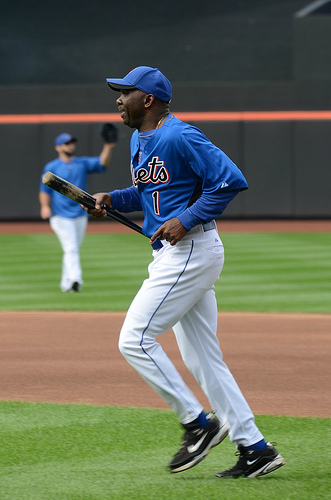
by Greg Prince on 5 October 2011 7:33 pm Not long ago I was at a game with somebody who loves the Mets but isn’t necessarily on top of their day-to-day machinations. He noticed from where we stood a very familiar figure he hadn’t noticed previously during the 2011 season.
“Mookie Wilson’s a coach?” he asked with a bit of surprise.
Yes, I said, first base coach. Funny thing was I wasn’t shocked that this particular Mets fan might have missed Mookie’s presence after several months of him standing in the same box night after night. If anything, I gauged my friend’s reaction as fairly savvy in its way. To me, there’s always been something just a little…let’s say off about Mookie Wilson serving as the Mets’ first base coach.
I felt it this year, and I felt it during his first stint in the role, from 1997 to 2002. It’s not a reflection on Mookie’s skills for the job, whatever it is a first base coach does exactly. Mookie coached baserunning as well as outfield play. Apparently he didn’t do it smashingly enough to pass muster with the Mets, for he, along with several of his colleagues, have been dismissed and/or will be reassigned. I couldn’t tell if you if Mookie was great at coaching or not particularly suited for it. During my last on-field visit, I saw him doing, if you’ll excuse me using sophisticated baseball jargon, coach stuff. Mookie was hustling in and out of the dugout, hitting grounders, providing tips, carrying gear. He was doing what coaches do.
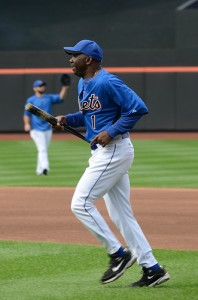 Mookie, doing what coaches do. (Photo by Sharon Chapman) Maybe that’s it. Maybe it’s that your legends becoming workaday baseball men is at odds with the mind’s eye. Make no mistake: Mookie is one of our legends. Mookie is — not was, is — one of our champions, and I mean that in a more transcendent sense than he was on the roster the last time the Mets won a World Series. Howard Johnson was a coach for several years. As good as he was as a player, and as authentic as his 1986 credentials are, I didn’t find his descending from his lofty status among the Mets’ all-time statistical leaders to work on the swings of mere Met mortals all that strange. When Tim Teufel is third base coach next year, he’ll be Tim Teufel, the old infielder doing what old infielders do. If he gets a runner thrown out at the plate, I won’t find his playing identity trumping his errant decision.
Mookie, however, will always be Mookie. I never needed him to be anything more. His being something that by the nature of the job isn’t legendary couldn’t help but be a letdown. When I’d listen to him talking about pedestrian issues like how a generic runner gets a good jump, or what a youngster like Lucas Duda has to do to craft himself into a legitimate right fielder, I felt a tad disappointed. “You’re Mookie Wilson,” I would think. “Your being Mookie Wilson is plenty. You shouldn’t have to take Chin-lung Hu’s helmet at the end of an inning on those extremely infrequent occasions he’s on base. You shouldn’t have to hit fungoes to the likes of Scott Hairston. You’re Mookie Wilson! Isn’t that enough?”
Actually, I’m sure it wasn’t. Mookie Wilson is a legend to and for us, an avatar of everything we wanted our Mets to be, but ultimately, he’s a person who worked in an industry and wanted (after a hiatus) to make a living in it. Few are the stone immortals who can write their post-athletic ticket on image alone. Mookie wasn’t quite that, at least outside of Queens (and maybe Toronto). He’s a baseball man. Baseball men work in baseball. Coaching first base and baserunners and outfielders at the major league level is a pretty good gig. Of course Mookie deserved a shot at such a job if he wanted it, particularly in a Mets uniform.
And yet…he was Mookie. He was Mookie who streaked down the line, and Mookie who never gave up on fly balls, and Mookie who treated second to home like it was ninety feet and Mookie who ran hard but never appeared overheated…and Mookie who hit the grounder. I was trying to go as far as I could without playing the Buckner card, but let’s face it, it’s a helluva card. Yet Mookie’s not Mookie because he hit that grounder. Mookie hit that grounder because he’s Mookie.
Kind of zen, but so is Mookie Wilson, I’ve always believed. Unlimited exposure to Mookie, however, made him seem almost ordinary, as if he was hiding in the coaching box in plain sight. I want him to grace us with his presence reasonably regularly, but at the risk of messing with another man’s money, I didn’t want him held to some boring standard of whether runners ran bases better because of him or outfielders tracked deep fly balls properly because of him. I want Mookie around, but now and then, not as wallpaper. I want him to offer a wave, to tip a cap, to answer a question about what it’s like being Mookie Wilson. That’s worth compensating handsomely in the Mets universe. I never wanted a Mookie Wilson sighting to be rendered ordinary.
He’s too extraordinary for that.
by Greg Prince on 4 October 2011 8:07 pm The Mets announced a new “dynamic” ticket-selling plan today. I was going to call it a ticket-selling “scheme,” but that carries such negative connotations, just as “dynamic” carries positive connotations. Dynamic sounds exciting — like Jose Reyes when we knew for sure that he was a Met. Even in a 140-character, “Like” button, “This” world, words carry weight.
You can read the Mets’ words here. You can read some of Dave Howard’s words to a graciously arranged blogger conference call here and a good analysis of what’s going on here. Overall, I wouldn’t call the plan a scheme in that you’re the consumer, so you can decide what you want to consume. It is, however, dynamic in that the Mets have put in place a mechanism to let the prices for single games rise (a lot) or fall (a little) depending on how much demand any given game generates. If the Mets are dynamic, one imagines the lines at the box office or, more modernly, the queue at the Web site will be somewhat dynamic, too.
And if the Mets fail to sustain on-field dynamism for a fourth consecutive season, then seller beware.
There are deals and perks to be had for season-ticket buyers, a group Howard rightly referred to as just as important to the Mets as their corporate clients. There is more club access on the horizon if you have a full season-ticket ticket, and, if I was interpreting Howard correctly, there will be more to come if you have a partial season-ticket plan (they’ll tell us more next month). There will be, no doubt, the opportunity to come to the park and put your plastic through its paces if you so desire and can afford it. Who among us wouldn’t do it as much as we could if a) we had the resources and b) we were continually tempted by the super exciting dynamic Mets?
If I don’t sound overwhelmed by the dynamism or, for that matter, no more than modestly moved regarding schemes and plans, it’s probably because five years ago today, I was watching Paul Lo Duca tag out two Dodgers on the same play, Carlos Delgado register four hits and John Maine personify “emergency starter” successfully. I was at the Mets’ first playoff game of 2006. It was electric. Every seat was filled. Nobody was quiet. Baseball was like it oughta be.
My god, I miss that sort of thing. There isn’t a Next Year ticket promotion in the world that could be anywhere near as good as playoffs Right Now.
Phillies bloggers, Rangers bloggers, Cardinals bloggers, even Rays bloggers had better things to do today than think about the structure of season ticket plans for 2012. Tonight, such diagrams and calculations will be the furthest thing from the minds of Tigers bloggers, Brewers bloggers, Diamondbacks bloggers and You Know Who bloggers. Those poor saps won’t have to have dynamism explained to them. They’ll look for it on a field or television near them and figure it out for themselves.
Full transcript of the call, from Chris McShane of Amazin’ Avenue here.
by Greg Prince on 4 October 2011 1:48 pm With apologies to the late Warren Zevon:
Hurry home early, hurry on home
The Rays and the Rangers, and you’ll hear Gary Cohen
Fortunately, you don’t have to hurry home. At 2 o’clock Eastern, just flick on ESPN Radio (1050 AM in New York) wherever you happen to be. Or go to espnradio.com. Fire up the appropriate app. Hitch a ride to St. Petersburg and stand outside the broadcast booth if you have to.
Gary Cohen is doing baseball on the radio. How can you not listen?
OMG (which stands for ohmigary), it’s been a thrill having Cohen on the radio once more this fall, even if it’s for a division series in the other league, even if it’s in the company of tyro/bogeyman Aaron Boone, even it’s ultimately only going to be a four- or five-game reminder of when Mets radio broadcasts were something to seek out, not shy away from.
It’s not like we don’t get 150 or so games of Gary on TV, which is a fact that makes my cable bill worth paying. But this is different. This is where Gary Cohen’s voice belongs. All of Gary can continue to be on TV, expertly conducting the orchestra of Keith and Ron and Kevin and updates from the studio and Toyota Text Polls and all that. The man deserves the exposure SNY has brought him. He’s fantastic there, too.
But my radio deserves Gary Cohen. My ears deserve Gary Cohen. I want OUTTA HERE! back where it belongs. I want the ebb and flow of nine or more innings that baseball on the radio is supposed to be, the way Gary brought it to me with Bob Murphy from 1989 to 2003 and the way Gary brought it to me just as satisfyingly with Howie Rose in 2004 and 2005. I’m tired of crossing my fingers that Wayne Hagin will have the inning off.
I love Howie, but I loved him way more when he and Gary bounced Metsiana off each other. Howie without Gary, but with Wayne (or anybody else) is a voice in the wilderness. He’s become a bit of a kvetch, actually. A lovable — and knowledgeable — kvetch, but a bit cranky. Black uniforms tick him off. Odd start times tick him off. Coffee shop menus on the road tick him off. Commercials featuring Randy Johnson (“he’s not cuddly!”) tick him off. Howie’s become noticeably prone to bouts of irritability…which is understandable, given that he loves the Mets. Yet I don’t remember him sounding so less than thrilled doing his dream job before he was left to fend for himself against the inanity of Tom McCarthy first and Wayne Hagin now.
But this isn’t about merely craving Radio Free Hagin, and it isn’t even about getting the band back together. It’s about figuring out a way to get Gary Cohen some kind of Vin Scully deal down the road. Vin does a simulcast for three innings and then slides over to TV for the rest of the game. Can Gary do something like that, maybe? Vin works alone. Gary wouldn’t have to do that. He shouldn’t do that. He makes every announcer better. He made Ed Coleman an almost decent listen.
We’ve got a great thing going with GKR, but a lousy thing going where G&H used to reign supreme. I don’t want to lose the great thing, but I want to fix the lousy thing. Mets games on WFAN have been less than optimal since 2006. They’re OK when it’s Howie talking (kvetchiness notwithstanding) and Wayne getting a coffee or something. But they’re not the showcase for broadcasting they used to be. They’re not an end unto themselves anymore, not in that “turn the radio on, game’s about to start!” sense. They’re a means to an end: “We are on our way to a television, but until then, we should probably settle for the radio, lest we be tempted to hit refresh while driving.” The best Mets radio announcer alive isn’t doing Mets radio. He’s busy being the best Mets TV announcer alive. There’s got to be a way to properly apportion those competencies.
I knew the Rays and Rangers would be having a better October than us, but I didn’t realize how much better.
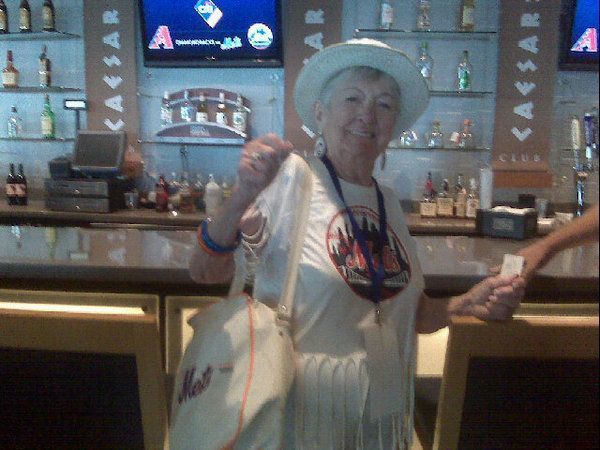
by Greg Prince on 3 October 2011 8:48 am  Vivacious Field equaled Victorious Shea 25 years ago. If you watched the 1986 World Series or have seen enough of the footage, you know there was a vivacious lady who did her part to win the damn thing for the Mets by rolling, rolling, rolling her arms from a seat behind home plate while Red Sox hurlers hurled. The distracting maneuver was obviously effective because the Mets won the World Series (don’t tell Pythagoras how our logic works). Anyway, Mark Simon of ESPN New York, a longtime friend of FAFIF, is looking for the rolling arms lady — her name is Bo Field. Why? We’re not fully certain, but if Mark’s seeking to contact her, there must be a good Mets story in the offing.
She’s been to Citi Field all decked out in her Mets finery, so we know she’s still rooting if not rolling for the home team. If you happen to know a way to get in touch with her, please contact us at faithandfear@gmail.com. Many thanks.
Image courtesy of Mets Police.
by Greg Prince on 2 October 2011 4:53 am Welcome to The Happiest Recap, a solid gold slate of New York Mets games culled from every schedule the Mets have ever played en route to this, their fiftieth year in baseball. We’ve created a dream season that includes the “best” 154th game in any Mets season, the “best” 155th game in any Mets season, the “best” 156th game in any Mets season…and we keep going from there until we have a completed schedule worthy of Bob Murphy coming back with the Happy Recap after this word from our sponsor on the WFAN Mets Radio Network.
GAME 154: September 16, 1998 — Mets 4 ASTROS 3 (11)
(Mets All-Time Game 154 Record: 23-24; Mets 1998 Record: 86-68)
The goal was the National League Wild Card. But, really, could it have been any wilder than what was transpiring under the Astrodome? This was already the greatest show on turf.
The Mets and the Astros, two franchises linked by their 1962 expansion births and their 1986 NLCS for the ages, were engaging in a tug of war maybe unsurpassed in the annals of regular-season four-game series…Mets’ four-game series, that is, but it’s hard to imagine any better were played by any other teams.
“A real every-pitch kind of baseball series,” Bobby Valentine called it.
First, there was Brian McRae homering in the ninth to prevent the Astros from clinching their division once, on Monday night the 14th, and doubling in the thirteenth to keep them from celebrating altogether; the Mets won 7-4 and stayed tied with the Cubs for the Wild Card lead.
Second, in the opener of a rare scheduled indoor doubleheader on Tuesday the 14th (the Astrodome was needed later in the week for a rodeo), Carlos Baerga did the champagne postponement honors by homering in the ninth to send yet another game into extras. The teams traded big RBI hits in the eleventh (Rey Ordoñez with a double, Jeff Bagwell with a homer) to keep things tied until the bottom of the twelfth, which was when rookie Jeff Tam surrendered a walkoff wallop to Derek Bell (who did a lot of standing and admiring at home plate); the Astros clinched by winning, 6-5.
Third, in the nightcap, with the Astros probably at least a little distracted by having clinched their N.L. Central title (yet with most of their regulars still playing), John Olerud’s three-run homer in the eighth put the Mets in front, 5-3. The Astros would edge to within a run before the visitors broke it open in the ninth; the Mets arranged for a split, 8-4, leaving them a half-game behind the Cubs.
Every one of those games was as tense as it was tight. Nothing about any of them was decided prior to the eighth inning, and two of them went far longer than nine.
But those were just the appetizers for Wednesday night the 16th.
That marathon-in-waiting was disguised as a pitching duel for a very long time, Mike Hampton for the Astros, Bobby Jones for the Mets. The only costly mistake either made came from the right hand of Jones with Craig Biggio on first, and it landed over the right field fence in the third inning via the bat of ex-Met Carl Everett for a 2-0 Astro lead. Jones wasn’t otherwise enjoying a very effective 1998, but he went eight here and gave up nothing else of consequence. Unfortunately, Mike Hampton also went eight. The lefty surrendered eight hits and walked six, but the Mets couldn’t figure out how to score off him. They left eleven runners on in those eight innings.
The 2-0 game was transferred to the care of fireballing Astro closer Billy Wagner in the top of the ninth. A leadoff single by pinch-hitter Todd Pratt appeared headed for the same Dumpster-brand trash bin where all those other hits and walks went once Tony Phillips struck out and Edgardo Alfonzo flied to right. But John Olerud, who’d had three hits already, worked Wagner — lefty vs. lefty — to three-and-two before the slowest man in the majors (he had to be) singled to third base. Despite Olerud’s feat of feet, he was removed for pinch-runner Ralph Milliard. Two were on, though two were out. The Mets’ last hope was Mike Piazza.
He was also the Mets’ best hope. That was what Mike was brought to the Mets to be in May. He, along with a raging hot Olerud, was the reason the imperfect Mets were perfectly positioned to lunge at the team’s first playoff berth in a decade. They and the Cubs were neck and neck, with the Giants lurking in the shadows. Taking three of four from Houston in Houston would be an immense step in the right direction. But they already knew that. Doing it was a different matter.
Mike Piazza was all about doing over talking. On a two-two pitch from Wagner, Piazza swung and drilled the longest home run in Astrodome history…and one of the clutchest the Mets ever had. It went 480 feet and its vibrations could be felt all over the National League map. The Mets were suddenly ahead 3-2 and were three outs from pulling into a temporary tie with Chicago (who would be playing later that night in San Diego).
The final three outs were usually the province of John Franco, who’d been a major leaguer since 1984 and a Met since 1990 but never a playoff participant. Franco, however, was gassed after pitching again and again down the stretch, so Valentine turned to Dennis Cook, the most dependable lefty non-closer the Mets had deployed maybe ever. After a generation spent cringing at the likes of Tom Gorman, Randy Niemann, Gene Walter, Doug Simons, Rich Savueur, Paul Gibson, Eric Gunderson, Bob MacDonald and Ricardo Jordan, to name just a few, Mets fans generally felt relieved when Cook was doing the portside relieving. But Cook, too, had been asked to go to the well quite a bit — all of Bobby V’s bullpen was. Nevertheless, Dennis was sent to the mound in the bottom of the ninth to get those three crucial outs.
He got them, but not consecutively. Between the first and second of them, Houston catcher Brad Ausmus homered to tie the game at three. The Mets and Astros had played four gripping games in an attempt to close out their 1998 business, yet they weren’t done. Extra innings beckoned.
Larry Dierker had left Wagner in to bat (and strike out) for himself in the ninth so he could keep pitching in the tenth. Undeterred by Piazza’s bomb, Billy partially redeemed himself by tossing a scoreless frame. Valentine countered with Greg McMichael, who didn’t make it easy on himself. After two quick outs, he loaded the bases on a walk, a stolen base, an intentional walk and an unintentional walk (to Moises Alou on a three-two pitch), but escaped when he struck out Ricky Gutierrez.
The eleventh brought on Sean Bergman, who had no problem with his first two batters, Phillips and Alfonzo. Up next was what had been Olerud’s spot; it was now McMichael’s. Valentine’s man in a pinch here would be Todd Hundley, simultaneously one of the Mets’ best power hitters ever and one of the current edition’s most superfluous parts.
It was Hundley’s unhealed elbow that forced management to take proactive steps when Piazza became available from the Dodgers (though laundered by the Marlins) four months earlier. The original plan had been to wait for Hundley, two-time Met All-Star and holder of the franchise’s single-season home run record, with 41, to come back as soon as he could. But Todd left a gaping void in his absence and his return was off in the distance. The Mets tried Tim Spehr, Alberto Castillo, Jim Tatum, Rick Wilkins and Pratt as starters. None of them produced worth a damn. Hundley was nowhere near ready. Piazza may have been a dramatic stroke of marketing for a Mets club that wasn’t drawing even as it was contending, but he was mostly needed for catching…catching and hitting.
As Mike acclimated to New York (where a surfeit of double play ground balls created some ill will early on), Todd went about his rehabilitation from surgery. Finally, in July, the Mets’ starting catcher since 1991 returned to Shea, only to find home plate blocked by a better-paid megastar. Hundley sucked up the change in the weather and trotted out to left field for the first time in his major league career. He’d had no experience there ever, save for trying it on for size at Norfolk.
It wasn’t a good fit. The Mets wanted to inject Hundley’s offense into a lineup that depended mostly on Piazza and Olerud, but he was no left fielder. He was a catcher trying to learn a new position on the fly, and any fly that came near Hundley was a painful adventure to watch unfold. In the meantime, the slugger who had racked up 71 homers in the previous two seasons wasn’t hitting at all. He stepped to the plate in the eleventh inning batting all of .159, slugging a tepid .246.
Which is what made Hundley’s pinch home run to center off Bergman every bit as electric as Piazza’s off Wagner.
Piazza you were learning to expect enormous things from in a Mets uniform (he was batting .415 in September). But Hundley? Hundley was the ghost of Metsmas past in this first full-out playoff charge since 1990. Not totally unlike John Stearns circa 1984, he was a catcher who waited and waited through a veritable eon of mediocrity for the Mets to get good enough to challenge for all the marbles, and when they got deadly serious at last, he wasn’t nearly physically capable of fully contributing.
But Hundley gave his all in Houston in the eleventh inning of the fourth game. The 124th and final home run of Todd’s Met career was easily his biggest. One wished there could be more — especially when you saw the next batter in the inning, Piazza, greet him at home plate, and you imagined what might have been had left field worked out — but if you were an experienced Mets fan, you deep down knew this was it for Hundley in New York.
Yet you didn’t think the end was nigh for the ’98 Mets. Workhorse Turk Wendell struck out the side in the Astro eleventh to secure the 4-3 win. The Mets were heating up. Olerud was positively scorching. That infield single in the ninth sparked a 9-for-9 stretch that catapulted him to a second-place finish in the N.L. batting race and a new Met single-season batting average best of .354, easily supplanting Cleon Jones’s 29-year-old .340. Despite an irritating blown save by Franco against the Marlins in their next game, on Friday the 18th, the Mets won two of three in their subsequent series against Florida. A crowd of more than 52,000 watched as Franco wriggled from a bases-loaded jam to save a 4-3 angstfest on Saturday the 19th, and another crowd of the same size luxuriated in eight innings of Al Leiter mastery en route to a 5-0 win on Sunday the 20th.
By then, the Mets had opened a one-game lead on the Cubs, while the Astros were positioned to finish with the second-best record in the league, behind the Braves. That meant if the Mets won the Wild Card, there’d be yet another series — a National League Division Series — opening in a little more than a week between the Mets and the Astros at the Astrodome. What a terrific next chapter that would make to follow the scene Vic Ziegel described in the News when the Mets’ most recent trip to Houston was done:
“They’re still playing, aren’t they? The Mets and Astros, who were scheduled for four games in three days, gave us so much more than that. You want Wild Card baseball? This was Wild Card baseball. Somehow, the Mets managed to pull out last night’s game, 4-3, in 11 innings. The teams stared at each other for 45 intense innings and 15 hours and 25 minutes. The Mets won three of the games because they were the kind of nailbiters the Mets make a habit of winning.”
The habit eluded them after the Marlin series. Two games at home against Montreal and three in Atlanta versus the long-clinched Braves resulted in no wins, which left the Mets one game shy of the Cubs and the Giants when all was said and bitterly done. Those two teams played off for the Wild Card, the Cubs taking it in Game 163. The Mets, meanwhile, went home after 162 contests, trying to picture a 1999 that would be longer and, consequently, more successful.
Next year would come for the Mets. But what a shame it couldn’t arrive earlier.
ALSO QUITE HAPPY: On September 21, 2002, a Met with no record of accomplishment before or after accomplished the one thing for which he would become known, at least by those who witnessed it. The Met’s name was Esix Snead, a seemingly ideal name for a September callup from whom you expect little. But for one night, Esix Snead delivered all he could.
Promoted from Double-A Binghamton for his speed (66 stolen bases in 2002), Snead entered this Saturday night tilt at Shea versus the Expos as a pinch-runner for a pinch-hitter. Raul Gonzalez singled in place of Timo Perez to start the home eighth — the Mets down, 3-2 — and after Roberto Alomar struck out, Bobby Valentine inserted Snead. As Mo Vaughn attempted to drive him in, Snead took off for second…and was picked off by Scott Stewart. He was thrown out bolting for second, leaving Vaughn with empty bases (and Mo struck out anyway).
It wasn’t an auspicious showing for Snead who was a Met in September only for his base-stealing ability. Yet with both Perez and Gonzalez out, Valentine stuck with him as his center fielder. Esix’s fourth defensive appearance might have gone into the agate type of history unnoticed, except in the bottom of the ninth, a bad throw by the usually surehanded Andres Galarraga allowed the Mets to tie the score at three, sending the game to extra innings.
Thus, Snead was playing longer than anticipated, which allowed him to make a putout to start the top of the tenth, when he caught Brad Wilkerson’s fly ball. It also gave him the chance to register his very first major league base hit in his sixth MLB at-bat, when he singled off Joey Eischen to begin the bottom of the tenth. He advanced to second on a wild pitch, but was stranded there.
The game went to the bottom of the eleventh tied, and didn’t necessarily appear headed for resolution when Snead came up again, this time with two on yet two out to face Dan Smith. But with Mets who come out of nowhere, things are rarely apparent. Thus, Snead belted Smith’s second pitch into the Mets’ bullpen for a three-run homer that gave the Mets an utterly unforeseen 6-3 win.
“I was just hoping and praying it would get out,” he said. “I was blowing at it: ‘Get out, get out!’”
It got out — and immediately and forever became the highlight of Esix Snead’s big league stay. He only appeared in four more games for the Mets: three in 2002 (once as a starter) and one time in 2004, when he pinch-ran and scored for Mike Piazza.
And that was it. That was Esix Snead’s Met career, not to mention his major league career. He spent the bulk of 2004 with Norfolk, his second consecutive year in Triple-A, before drifting through the Atlanta and Baltimore systems over the next two seasons.
But so what? Esix Snead (through 2011, one of 54 non-pitching Mets to hit exactly one home run as a Met) won a game for the Mets with one big swing. At the moment something like that happens — no matter how hard you have to hope and pray it goes out, no matter how much you blow at it and implore it — there’s nothing obscure about you.
GAME 155: September 25, 2004 — METS 4 Cubs 3 (11)
(Mets All-Time Game 155 Record: 24-23; Mets 2004 Record: 68-87)
Welcome to the plight of the would-be spoiler. More specifically, welcome to the plight of the fan of the would-be spoiler. One Mets loyalist who attended this Saturday afternoon game between his fourth-place home club and the Wild Card-leading Cubs of Chicago was moved that night to jot down his dissatisfaction with how his ballpark was populated:
“[M]an, this was just wrong. Shea Stadium was no better than Miller Park, just another convenient depot for Cubs fans to strut their stuff. Yeah, I know, we suck. We don’t deserve support. If this were the Pirates and Mets in late September, you couldn’t get enough fans of either team for a minyan. The Cubs were a draw, no doubt about it. I imagine the self-hating Mets management, which once garishly honored Sosa to bring in otherwise disinterested Dominicans, will institute a Cubs Fan Appreciation Night next year. But it’s still wrong. Engaging in throat-to-throat combat with Yankees fans at Shea is one thing. It’s to be expected. But a house — our house, to be dramatic about it — half (at least) filled with Cubs fans really, really, really turned my stomach. And that’s a lot to turn.
“They cheered their heroes. They cooed ‘Ah-looooo.’ They greeted Sammy and Nomar like royalty. They were loud on behalf of relatively obscure visitors like Todd Walker, who rocked this house divided against itself with a two-run homer in the second. They bared (beared?) foam Cubs claws. Those things were cute on TV last fall. They were disturbing in person, in Flushing. As were the fans, the long-suffering, by my gauge, outnumbered by the trendy. How can you front-run for a team that’s 96 years removed from its last parade down Michigan?”
The Mets didn’t need this game in the pennant race sense, but their fans didn’t need this,. Cub-o-philes were everywhere. Where they came from, heaven or a somewhat lower environ only knew. In college football parlance, they — like some big-time Big Ten school — traveled well. Real Mets fans found it bizarre. Real Mets fans like New Jerseyite Al Leiter, who told Steve Popper of the Times, “There were a lot of Cub fans. I don’t know if they flew up from Chicago. I don’t think there’s a lot of Cub fans here in Manhattan or New York.”
Of course frontrunners know no address. They just root for whoever seems hot, and the Cubs burned much brighter in the baseball consciousness if 2003 and 2004 than did the Mets. You wouldn’t have seen this type of Cubbie turnout at Shea in 1969 or 1984, years when the teams threw down head-to-head for N.L. East honors, but times had certainly changed in these parts. The Mets were in a definitive down cycle. The Cubs had come one fan’s foul-ball reach from winning a pennant the October before. They were taking another shot at it this year.
And who were the Mets to stop them? Here’s what our 2004 correspondent had to say primarily to himself that night:
“The Mets’ first and likely only serious threat summed up their shattered season. With the bases loaded in the fifth and nobody out, Jose Reyes bounced to first. Took a nice play, but Derrek Lee threw home to nail Valent. One out. Old Gerald Williams, who probably came up alongside Don Buford and Paul Blair, flied to Alou in relatively deep left. Jason Phillips, the most glacial man in the bigs, Jason Phillips, who got tagged out Friday night on a throw 10 feet to the right of home, was on third. Even Jason Phillips could tag up and score.
“However, Jason Phillips had gone halfway. He hadn’t tagged up. Two outs, no sac fly. Bases still loaded. Jason Phillips officially sliced from my favorite players list and mentally traded to Toronto. Wilson Delgado, who furtively subbed for Kaz Matsui, flied out.”
And so it went for eight-and-a-half innings. Aaron Heilman and his relievers (Tyler Yates, Mike Stanton, Bartolome Fortunato and Heath Bell) hadn’t pitched terribly, but Chicago starter Mark Prior had pitched brilliantly. The end result was a 3-0 Cubs lead heading to the bottom of the ninth.
Which is where times changed back in these parts to 1969.
Ryan Dempster had come on in the eighth to get the last out for Prior, a grounder from Mike Piazza. He opened the ninth by striking out Todd Zeile. But he walked Valent and Phillips, which moved Dusty Baker to exchange Dempster for LaTroy Hawkins. It seemed like a pretty good idea after Hawkins flied Jeff Keppinger to right for the penultimate out of the game.
But it didn’t seem particularly helpful to the Cubs’ cause when the Mets’ final hope, September callup Victor Diaz, belted a three-run homer to right field. Quite suddenly, quite shockingly, the moribund Mets had tied the contending Cubs at three apiece.
The Cubs fans grew quiet. The Mets fans exulted. Was it any wonder? As our resuscitated chronicler from ’04 declared of Diaz, a Chicago kid raised on the enhanced splendors of Sammy Sosa, no less, “To the spoilers belong the Victor.”
Two innings later, Mets could would also lay happy claim to Craig Brazell, another recently promoted prospect. Brazell chose the bottom of the eleventh to launch his first major league home run. His shot out of the dark and out of the park, off veteran Kent Mercker, decided this game in the Mets’ favor, 4-3. The Cubs lost the next day to Leiter and slid right out of the Wild Card and into the same also-ran status that plagued the Mets when the season ended the following week.
As for the fan who was compelled to write down the details of what he saw at Shea, he had to, by prior arrangement, bolt the stadium after nine that Saturday. He caught word of Brazell’s big moment on his Walkman radio. But it was enough, to him, that he saw Diaz tie it as he did, when he did. Yet like Brazell, the fan made his final swing count.
“I didn’t get to the concourse before I let out a “HA!” at a cluster of younger, very recently sullen Cubs fans. And a “HA!” on their house for acting up in my house. Of all the places on the face of this earth, Shea Stadium is not where a Cubs fan wants to get cocky, not even in 2004, not even in a game started, respectively, by Mark Prior and Aaron Heilman.”
That fan, so miserable for the preceding several seasons, was beyond jubilant come Saturday evening. He took his wife out to dinner and couldn’t believe what he saw was on tap: Rheingold, the official beer of the New York Mets back when black cats roamed the earth. He didn’t normally drink beer with dinner.
But he sure did that night.
ALSO QUITE HAPPY: On September 24, 1983, eight solid innings of Tom Seaver’s pitching nearly went to waste. Pulled after allowing only one Cub run on seven hits, Seaver — bolstered by four Brian Giles RBIs — took a seat and waited for his 7-1 win at Wrigley Field to go final. But manager Frank Howard’s decision to give slumping starter Mike Torrez some work in a mopup role backfired immediately. Torrez surrendered a homer, a triple and a wild pitch before recording one out. Hondo then let Mike give up a double and another walk before, at 7-3, calling on lefthanded specialist Carlos Diaz. Diaz was only modestly special, getting the second out of the inning by striking out Bill Buckner, but then allowing a two-run pinch-double to Gary Woods. Suddenly it was 7-6, Mets. Out went Diaz and in came righty reliever Doug Sisk, who grounded Ron Cey to Hubie Brooks at third. Brooks threw to Gary Rajsich at first to preserve the win for Seaver.
This rather innocuous Saturday afternoon affair between the sixth-place Mets and the fifth-place Cubs became, thanks to bizarre front-office machinations that wouldn’t come to pass for another four months, the final victory of Tom Seaver’s New York Met career. His final Met record would go into the books as 198-124, with 2,541 strikeouts and an earned run average of 2.57.
All of those marks, unsurprisingly, are franchise bests.
GAME 156: September 22, 2011 — Mets 8 CARDINALS 6
(Mets All-Time Game 156 Record: 26-21; Mets 2011 Record: 74-82)
In a New York inning, everything can change.
Take the top of the ninth on the final Thursday of the 2011 season, the last road game of the Mets’ fiftieth year. If the Mets had literally come to the end of the road, they were also figuratively going nowhere at the end of an up & down campaign…but they weren’t going quietly.
They trailed St. Louis at St. Louis, 6-2, and based on all you’d seen all day (it was early evening in the Midwest after a lengthy afternoon rain delay) you wouldn’t have bet against the Redbirds flying away with an easy win. The Cardinals were chasing the faltering Braves for the National League Wild Card. After miles had separated them in the early September standings, the two old Met rivals were now almost inches apart. If the Cards held on for three more outs, they’d be just a game behind Atlanta.
The Mets hadn’t put up much of a fight for eight innings, which wasn’t like them. Terry Collins, in his first season as manager, had proved a surprisingly masterful motivator. After losing his teams’ confidence in Houston and Anaheim during his aborted ’90s tenures, the professionally reborn Collins related well to these Mets, most of whom were too young or unaccomplished to have egos, or simply too menschy to not buy into Terry’s program of hustle and selflessness.
There were occasional slipups, however. For example, one week earlier, the Mets exhibited an astounding display of amateurism in losing an absolutely unsightly game to the noncontending Nationals at Citi Field, 10-1. After watching his team flail helplessly and somewhat stupidly, Collins used his postgame press conference as an opportunity to read his charges the riot act.
“The perception I have right now,” he announced to the assembled media, “[is] we folded it up. And I won’t stand for that … Our fans should be upset. I don’t blame them a bit. No energy, none at all, on the field. This is not the way we played all year long.”
As if to prove they were listening, the Mets went to Atlanta and took two of three from the Wild Card-leading Braves. They were less successful in St. Louis, however, losing the first two of a three-game series, and appeared incapable of mounting a rally let alone showing a pulse when the ninth inning of the finale rolled around. They seemed so irrelevant to a game involving a playoff contender that the big story surrounding the Mets that day was whether the Mets would sell their scheduled starter, Chris Capuano, to the pitching-strapped Red Sox, another Wild Card leader that was losing its grip on its spot in its race.
Capuano stayed a Met and pitched something less than his usual adequate game, departing with two outs in the fifth after falling behind 4-1. Given the eight hits and two walks allowed by Caps, it was surprising St. Louis didn’t lead by more. Eventually, however, they would, when a Yadier Molina double and a Tyler Greene single increased their margin to five runs in the seventh. The Mets scrounged one tally in the top of the eighth when Molina — an all-time Metropolitan villain since homering to beat them in the last postseason game Shea Stadium ever hosted in 2006 — couldn’t handle a pitch from long-ago Met reliever Octavio Dotel. The passed ball that scored Ruben Tejada from third base cut the Redbird advantage to 6-2, but Angel Pagan and David Wright struck out to end the inning.
After Manny Acosta kept the Cardinals from doing further damage, the Mets came up for their last licks against Jason Motte. There was no reason to believe that a series sweep and a one-game deficit weren’t in St. Louis’s immediate future.
But in a New York inning, everything started to change.
• Willie Harris led off with a walk on a 3-2 pitch. It was the fifth walk allowed by Cardinal pitching.
• Nick Evans grounded an almost certain double play ball to shortstop Rafael Furcal, a trade deadline acquisition from the Dodgers, and an ancient thorn in the Mets’ side from his Atlanta days. Furcal was picked up to tighten the Cardinals’ infield defense. But he made a temporarily costly error the night before, and now he bobbled Evans’s grounder. Harris was safe at second. Evans was on first. Nobody was out.
• Josh Thole, the object of affection for 300 residents of nearby Breese, Ill., who bused to the game to make Thursday “Josh Thole Day” at Busch Stadium couldn’t quite be a hometown hero against the team for whom he grew up rooting. Thole flied to center.
• Jason Pridie pinch-hit for Josh Satin and walked to load the bases. “The Mets,” Gary Cohen noted, “are being very patient with Motte.”
• Justin Turner was the next pinch-hitter, batting for Acosta. Justin made the most of his plate appearance, underscoring Cohen’s commentary. He went ten pitches deep into his at-bat before taking ball four and driving in Harris. On three walks and an error, the Mets had put a run on the board. It was 6-3, Cardinals.
Motte hadn’t entered in a save situation, but now he left one for Tony La Russa’s next pitcher, Marc Rzepczynski, a lefty who had never saved a game in his brief major league career. Now would be a good time for him to get one.
But the New York inning continued apace.
• Jose Reyes, ever so slightly behind Ryan Braun for the National League batting crown, decided patience wasn’t a virtue at this juncture of the ninth. He attacked Rzepczynski’s second pitch (breaking his bat in doing so) and lined a ball over second baseman Ryan Theriot. It landed for a single that tightened both Jose’s batting race and his team’s game. The Mets trailed, 6-4, and the bases were still loaded.
So much for learning to spell Marc Rzepczynski. La Russa went to his overworked bullpen and produced club save leader Fernando Salas.
• Tejada, the 21-year-old second baseman with the proverbial 35-year-old head, was up next. Collins couldn’t have asked for a better batter. Ruben with the bags full in 2011 to date: 5-for-10 with three walks. This kid was as patient as he was preternaturally baseball-wise. Almost predictably, he worked the count full. Then he pulled Salas’s sixth pitch to deep left — National League managers tended to play the young man too shallow — where defensive replacement Shane Robinson made a diving, lunging grab…and came up less than an inch short of a spectacular catch. Tejada’s ball ticked off Robinson’s glove, chasing home Pridie and Turner to tie the score, 6-6. Reyes went to third, Tejada to second.
• Pagan was intentionally walked to load the bases again.
• Wright went down swinging. There were two out.
• Harris batted for a second time in the inning. Willie was a notorious Met-killer in the uniforms of the Braves and Nationals, yet Mets fans were left throughout 2011 to wonder why that guy never showed up in their threads. Willie finally began flashing his trademark style the night before when he robbed Lance Berkman of a probable three-run double, so you might say he was back in the Willie Harris groove. And when he singled home Reyes and Tejada — “a great secondary lead by Tejada provided that run,” noted Ron Darling — to put the Mets up, 8-6, the Mets as a whole had gotten their groove back.
“Late in the game,” a satisfied Collins said, “we settled into what we do best, and that is make sure we get something good to hit. We came through in the ninth.”
Indeed, those six runs turned the game upside down. When Bobby Parnell retired the Cards 1-2-3 in the bottom of the frame (the last out coming on a Jason Pridie dive ‘n’ grab off the hated Molina), it appeared they had changed the complexion of the National League season, too. Cardinal momentum was halted dead in its tracks. St. Louis was two behind the Braves with six to play. The Mets were being called spoilers.
“A stunning ninth-inning comeback,” Cohen labeled it. The Mets had “put a dagger in the heart of the St. Louis Cardinals.”
That wasn’t their goal, however. Their goal was to keep playing and keep playing hard for themselves, if no one else. Harris reflected the 2011 Mets’ M.O. as their season wound down when he said, “When you go to work, you should go to work hard. I think today shows these guys in this locker room care about each other and we want to win. We go out and try to win every game. It just so happens tonight, those guys are fighting for a Wild Card. We’re fighting just to get a W.”
One of the beleaguered relievers the Mets outlasted, Motte, admired his tormentors, even in defeat: “You’ve got to give credit to those guys. Those guys went up there and they took good at-bats, good approaches. They didn’t go up there and swing at balls. Those guys did their job, too.”
St. Louis recovered, or more accurately, Atlanta kept self-destructing. Within the week, the Cardinals would win the National League Wild Card — maybe because the Mets beat them only once after beating Atlanta twice down the stretch, maybe not. The Mets, meanwhile, evoked their own memorable past with their New York inning when everything did change.
It was the first time since May 17, 2007, that the Mets recovered from as much as a four-run deficit (when they trailed the Cubs, 5-1) to win a game in the ninth inning.
It was the Mets’ biggest ninth-inning comeback on the road since they overcame the Braves’ 7-1 lead on July 17, 1973, to prevail, 8-7.
It was right in line with the kind of improbability that the Mets had been pulling from their bag of tricks for a half-century, whether their exploits involved overcoming a ten-inning no-hitter, running out a ninth-inning inside-the-parker, blasting a last-ditch grand slam, or coaxing a ball off the top of a wall. It was the kind of Mets Magic that had captured two World Championships, and millions of hearts in lesser times. It was why devoted Mets fans kept tabs on a rain-delayed Thursday afternoon game at the tail end of a season in which the Mets weren’t going anywhere but home.
It was why Mets fans, after a half-century of Mets baseball, remain Mets fans.
ALSO QUITE HAPPY: On September 23, 1962, the Mets said goodbye to the only home they had ever known…or so they thought. They were playing their final scheduled game ever at the Polo Grounds. Come 1963, the Mets were destined to move to their new home in Flushing Meadows, Shea Stadium. Hence, the big horseshoe-shaped yard on the edge of Harlem, site of baseball history since the Giants rebuilt it after a devastating fire in 1911, was about to host its last baseball game.
The Mets may not have made much history there in their one year at the Polo Grounds — certainly not the triumphant kind — but they treated the occasion with requisite significance. Public address announcer Jack E. Lee provided an appropriate soundtrack of pop standards throughout this sentimental Sunday afternoon, starting with “This Ole House” and heart-tuggingly proceeding to “Auld Lang Syne”. In between, the Mets placed their own punctuation on 48 seasons of Manhattan baseball when, in the bottom of the ninth, Frank Thomas singled home Choo Choo Coleman with the winning run to create one final great New York victory under Coogan’s Bluff, as the Mets beat the Cubs, 2-1.
That it was only the Mets’ 39th win of 1962, and only their 22nd in this ole house, didn’t make it any less marvelous. That Thomas, the man who got the final hit, was the same man who (as a Pirate) caught the final putout in the first “final” game played there five years earlier as the Giants vacated certainly made it more intriguing. That it included the first hit in the career of 17-year-old rookie Ed Kranepool couldn’t help but make it hopeful. That it came against Chicago on the 54th anniversary of Merkle’s Boner (which was committed by the young Giant against the enemy Cubs at the version of the Polo Grounds that predated this one) made it all the more historically poignant. Not that poignancy was in short supply, per Robert Lipsyte, in the Times:
“After the game, as Thomas and the Mets and Cubs ran toward the center field clubhouse, the spectators merely stood. They did not rush off to exits or cheer. They merely swayed to the strains of “Till We Meet Again,” and perhaps thought of [Mel] Ott, of Christy Mathewson or Carl Hubbell … With great respect, they watched [Casey Stengel] dogtrot, alone on an empty field, 475 feet to the clubhouse with his right hand in his back pocket and ‘Auld Lang Syne’ filling a stadium that someday must be torn down to make room for new housing.”
What a perfect way to go out…which probably explains why the Mets, who were indelibly imperfect from they day they played their very first home game (they were already 0-1), stepped on their graceful farewell. They had to — Shea Stadium wasn’t going to be ready for Opening Day 1963. It wasn’t going to be ready at any time in 1963, thus the final baseball game ever at the Polo Grounds that 10,304 thought they’d attended was actually the 82nd-to-last.
The actual final game ever at the Polo Grounds came to pass on September 18, 1963, an unceremonious 5-1 defeat at the hands of the Phillies in front of 1,752. Counting the Giants’ departure in 1957, this was the third time in a six-year span New York was compelled to bid “Auld Lang Syne” to the PG, so it wasn’t really a very big deal at that point. No pomp or circumstances attached itself to Goodbye III — “I don’t remember any fanfare,” Craig Anderson recently told Nick Diunte of examiner.com — but a legend was born even as a ballpark was being given its third set of last rites.
The Times reported, “Movies were taken as part of a Met promotional film. Casey Stengel waxed eloquent Stengelese all over the place for a couple of hours prior to and following the game.” That alleged rambling was, in fact, the classic “Metsie, Metsie, Metsie” rant that has lived on in the Mets fan consciousness for most of a half-century (and remains in heavy rotation, thanks to SNY’s Mets Yearbook: 1963).
For the record, the final Mets win in the Polo Grounds came a week earlier, on September 11, as the home team defeated its predecessor in this space, the now San Francisco Giants, 4-2. Tim Harkness went 3-for-5 that Wednesday with a pair of RBIs and Al Jackson went the distance on a seven-hitter. Of course there was no way of telling that was the final Mets win in Manhattan, even though that would have been a reasonable guess, considering this was a 49-97 club. They had seven more home games remaining and they lost all seven. Their subsequent nine-game road swing to end the season brought them another seven losses, consigning the Mets to a 51-111 sophomore season.
Not that everybody minded. As Gordon White noted in the Times, “What seems most amazing is that this club, though still a sad bunch of major leaguers, drew 157,754 more fans than in 1962, when the newness of the Mets was the main factor in their good showing.” Indeed, these cellar-dwelling Mets of 1963 cracked the one-million mark in attendance back when that sort of thing simply wasn’t done by last-place teams. Obviously, Mets fans would be back for more in ’64, which led White to extend a helpful bit of commuting advice after the final final Polo Grounds game was over:
“For those New Breeders who want to see the next Met game, remember, don’t take the D train to 155th Street; take the IRT to Willets Point.”
by Jason Fry on 29 September 2011 8:00 pm Dear brethren in Atlanta and Boston,
We’ve been where you are. We know how you feel.
Braves fans, on Aug. 25 your team led the Giants by 9 1/2 and were given 99.2% odds of making the playoffs. Sox fans, on Sept. 3 you were up by nine games on the Rays, with playoff odds of 99.6%. You both now know that doesn’t mean bulletproof. (Numbers — and a good read — from here.) You’ll never forget these things, just like any of us Mets fans will always wince at the formulation “seven up with 17 to go.”
Hopefully by now the hangover is fading and you did not, in fact, take out last night’s disaster on your kids, pets, spouse, friends or co-workers. Hopefully you punched neither walls nor windows, are uninjured and still have a clean arrest record. Assuming this is so, let us tell you what’s going to happen next.
October baseball is going to seem like it was expressly designed for your torment. Try to resist this feeling — before you know it, it will be winter and there will be no baseball and you’ll be faintly irritated that you didn’t see any of the games played by the [INSERT TEAM HERE] on their way to a World Series title. But be advised that rooting fervently against the Cardinals or Rays won’t make you feel better. If your tormentors are ousted, you will just get madder at your own team for having failed to do what some other band of 25 schmoes managed to accomplish.
With the season truly over, you’ll sulk for a bit, but gradually things will get better.
Until spring training.
In February everyone will dredge the collapse up all over again. It will be a pain in the ass and a distraction to your team, and then eventually it will stop and you will play the 2012 season. At which point you will be at a crossroads.
If you make the postseason in 2012 or at least play generally sound and admirable ball, the collapse of 2011 will become a blip. You will never forget it — it will be lurking in the dark, waiting to ambush you at 3 a.m. or while you’re doing something else, and all of a sudden you’ll realize you’ve been seething about Carl Crawford not making the catch or Craig Kimbrel walking guys or the Astros doing nothing or the Yankees not fielding a big-league lineup in St. Petersburg. But the team will move on, and the memory will pop up like some obscene jack-in-the-box less and less often, pushed back in the collective consciousness by other seasons.
It’s if you collapse again in 2012 — or play poorly enough down the stretch for someone to utter the word — that you’ll have real problems.
This is where dots turn into lines and people start constructing narratives. The columnists and talk-radio baboons will do it. So will the dumber, more reactionary fans that we’re all stuck with. This narrative can then metastasize, until it becomes a self-reinforcing part of every move, every bad stretch and every damn thing. It can become a lazy rationale for why completely unrelated things happen, and eventually this stupid fantasy can become a psychological issue for players, agents, front-office folks and everybody else. Then, well, you really do have a mess. You’ll turn over the roster completely and have baffled newcomers from AAA forced to run a gantlet of microphones wielded by reporters and pundits who will ask them questions about culture and attitude and little black clouds that follow a franchise around.
Trust us on that one. We know.
Should that come to pass, all you can do is resist. We are all of us storytelling monkeys, who construct tales from facts that may or may not fit together because that is how we make sense of a world that is sometimes senseless. This is utterly irrational, but it’s not particularly a surprise that we do it. For being a sports fan is itself irrational — it’s crazy to give 25 callow millionaires power over your emotional well-being, yet that’s what we all do for six months of the year.
But while granting the irrational its place — for sports would be no fun without it — you can’t let it run roughshod over everything. You know better. So resist the narrative. The 2011 Red Sox weren’t chokers. Neither were the 2011 Braves. Choking is a story we tell when confronted with a run of injuries, failures and bad luck — an ill-timed statistical valley that happens to coincide with someone else’s perfectly timed statistical peak. Those teams that were sound, successful and lucky? They had intestinal fortitude, or knew how to win, or were gritty, or wanted it more. Sure they did. At least that’s what everybody will say.
Collapses happen. They befell other teams long ago, but have receded sufficiently for the choker label to be shed. Well, mostly — yell “1964” at a Phillies fan of a certain age and he’ll belt you. (And, OK, no Bosox celebration ever lingers on 1978 for long.) The Rays’ turn is coming, at a date and time yet to be written. Same for the Cardinals. And the Orioles, and the Phillies, and us again, and everybody else. It was your turn was all. Heck, at least you had company.
When it happens to the next team and fan base, be glad it wasn’t you. But remember everyone winds up on the wrong side of the decimal point sometimes. And so spare whatever sympathy you can muster.
Unless it happens to the Yankees. Because they’ll deserve it.
Sincerely,
Mets Fans
by Jason Fry on 29 September 2011 12:30 pm For a from-the-seats perspective on Closing Day, I’ll bow to my partner, who was actually there.
I saw it on SNY, and like a lot of you wound up with emotional whiplash: My euphoria at Jose Reyes’s hit was followed in uncomfortably short order by bafflement that his day was done practically before it began, which curdled into fury. Those at the ballpark booed in confusion and then fell silent — for the next inning or two it sounded like the stadium had been evacuated. On TV, Gary and Keith and Ron were dumbfounded — struggling, for possibly the first time ever, to get their bearings. I vented my anger with a mildly embarrassing though undeniably cathartic Twitter meltdown.
Having tired myself out, my first thought was to get some work done and listen to the rest of the game on WFAN — with Reyes gone, Closing Day was devoid of interest to me. (At the end of a long season, even I have trouble working up much enthusiasm for watching Josh Satin try and solve Edinson Volquez.) But then I remembered that a) WFAN would soon have Mike Francesa in its booth; and b) in two more hours I’d be staring down the barrel of six months without the Mets. So I stuck around, and was grateful that I had. Mike Baxter hit his first home run for the hometown fans, Miguel Batista was terrific in what might have been his final big-league appearance, and baseball is a pleasure, period — on further review, watching Josh Satin try and solve Edinson Volquez is pretty cool. The Mets won, tossed their caps and we were done.
Regarding L’Affair Reyes, my anger was misplaced. As it turns out, Reyes had wanted to protect his lead in the batting race and make his final day a cameo, and Terry Collins was accommodating him — in his emotional postgame presser, Collins seemed to basically admit that it wasn’t the way he would have preferred to handle it, but he had been backing a request from one of his veteran stars.
Honestly, I have no particular gripe about Reyes protecting his lead. I know, I know, rather than sit on a .400 average, Ted Williams played both games of a doubleheader to close out the 1941 season, a feat that unfortunately came 70 years to the day before Jose’s cameo. But while that’s an ideal for how we’d like athletes to compete, the episode lives on in baseball lore because it’s exceptional — it was baseball practice even back then to sit on statistical leads, and leaders from Willie Wilson to Bernie Williams have not played or abbreviated closing days since then. (Shock your Yankee friends: Yes, Sainted Yankee Joe Torre aided and abetted such behavior before his current noble service as Bud Selig’s chief hat inspector.) Reyes is so much fun to watch on a baseball diamond that we imagine him playing the game on off-days, at night and possibly while he sleeps, but that isn’t true. It’s his vocation, and a long season of daily grinds, injuries and contract chatter had undoubtedly worn him down far more than we would guess.
I’ll put this one, reluctantly, on Terry. Looking ahead to next year, he needs to work on the pageantry of player exits. The shame of Reyes’s departure was that the Citi Field faithful got no chance to give him a proper farewell, a problem compounded by the fact that many of them were there primarily for that reason. Terry should have acceded to Jose’s wishes and given the fans the moment they craved by having Jose run the bases, take his position for the top of the second, and then sending Justin Turner in to replace him. The fans would have had time to realize what was happening and cheered Reyes off the field. With the exception of his fetish for bunting, Terry’s done most everything right, so there’s no reason to make this A Thing. I wish it hadn’t happened, but it did, and the absence of Jose (hopefully for 18 weeks and not forever) and more Mets games to play dictates that we’re moving on, whether we like it or not.
We never really go dark around here, so there will be time to assess the 2011 Mets, and how they may shape the 2012 club. I head into the off-season quietly hopeful — yes, the Mets won two fewer games than the final team commanded by Jerry Manuel and Omar Minaya, but I still feel strongly that this group was better constructed and better led. (Honestly, two games is significant if it means the difference between the postseason or going home, but not so much in the dregs of the second division.)
Collins had to contend with a horrific run of injuries that rivaled what befell the 2009 team, and kept his charges focused and competitive far longer than I thought was possible. He arrived with a reputation as a Napoleon type who would burn his players out, but seemed to have outgrown whatever mistakes he made back in his Angel days. His guys played hard for him, and seemed to like and respect him.
A number of players — most of them, in fairness, brought in by Minaya — improved significantly this year, going from maybes to credible parts of a much better team. Most guys Ruben Tejada’s age are Brooklyn Cyclones, but Tejada seems poised to become the spiritual successor to my beloved Edgardo Alfonzo. Lucas Duda, Dillon Gee, Jon Niese and Manny Acosta all made strides. Ike Davis was having a promising sophomore season before being felled by an out-of-the-blue injury, while Daniel Murphy had a breakout campaign. Josh Thole had a curious year that might prove a learning experience. Statistics suggest Angel Pagan’s poor campaign was largely a product of bad luck. Stats all but shouted that the same was true for R.A. Dickey. And Johan Santana will be back.
Sandy Alderson was far better in choosing complementary players: Tim Byrdak, Pedro Beato, Scott Hairston and Willie Harris all had pretty good years. Sandy spared us final obligatory seasons from Luis Castillo and Oliver Perez, got free of Frankie Rodriguez’s horrid vesting option, brought back some value for Carlos Beltran, and yet opted to hold on to Reyes, which might prove short-sighted from a cold baseball perspective but I think was the right move for our sensibilities. It’s not a good thing if your best potential ticket buyers are jumping off New York City bridges; that might have happened if we’d been shorn of Jose along with everyone else.
The fences are coming in, which I think could help Jason Bay and David Wright more than we might realize. And it looks as if the Wilpons won’t be put out of business by the Madoff scandal — while predicting such things is a fool’s business, it’s possible they’ll have to pay out somewhere around $80 million, which while a nasty check to write is a lot better than the alternative. (It’s also in line with what the Mets are expected to lose in 2011, meaning it can be fit into the framework of normal business.) If you’re disappointed because you wanted them to sell the team, I hear you. But look at it this way: The real enemy for 2012 and 2013 is uncertainty, and there’s a chance the next couple of months will end it. Or, to break it down another way, the chances of re-signing Reyes might now be a lot better. Perhaps we’ll get to give him the standing O that went missing yesterday against the Reds on April 5 against the Braves.
With winter upon us, that’s a comforting thought.
by Greg Prince on 29 September 2011 2:37 am It wasn’t long ago that I was a fan of a franchise that never had a batting champion but was saddled with the Worst Collapse Ever. Neither is my problem anymore.
The Mets still Collapsed with a capital C in 2007, but it was a stumble in the park compared to what we as a baseball-loving people have just witnessed from the Braves and the Red Sox. THUD! THUD! And the way they thudded! Jesus…and I don’t mean Alou.
The series of events that had to unfold to dislodge two surefire playoff teams from the postseason before they could ever get there was mind-boggling enough before the final night of the schedule. Then the boggled mind rocketed into the stratosphere. Braves blow lead in ninth, lose in thirteen to Phillies after Cardinals rout Astros. They were up by 8½ on September 6. They’re behind by 1 now.
How did this happen? Easy: the Mets beat the Braves twice down the stretch while they chose to beat the Cardinals only once. We determined this Wild Card race, obviously. And good for us, for while I hate the thought of the Cardinals, I detest the sight of the Braves. Something to do with repeated exposure and Fredi Gonzalez.
The National League change of fortunes was incredible, yet it rather paled by comparison to what happened in the American League, certainly on the final night. You knew the Red Sox were tumbling and you figured the Rays could take advantage, but still…
• A six-run eighth to pull the Rays from 0-7 to 6-7.
• A two-out homer from Dan Johnson in the ninth off whoever was pitching for Scranton/Wilkes-Barre to tie it at seven.
• Jonathan Papelbon having Omir Santos flashbacks in the ninth at Baltimore.
• Carl Crawford proving Carl Crawford money can’t necessarily buy you glove.
• Evan Longoria. The twelfth inning. The Red Sox out. The Rays in.
Holy crap.
There’s probably some very good reason to credit the Rays and the Cardinals for their late elevation into the playoffs, but as in 2007, this doesn’t feel like it’s about those who rose up. It’s about those who fell down.
Glad somebody else fell farther and faster than we did. I wouldn’t even say it’s the usual Sheadenfreude making me giddy. It’s nothing personal against the Red Sox (up 9 on September 3), and it’s not even about traditional antipathy for Atlanta. I’m not happy it happened to those teams. I’m just glad it happened to somebody else.
As for that batting championship, congratulations to Jose Reyes, no matter how unideal the denouement of his chase turned. When he bunted his way on to lead off Closing Day and ramp his average up to .337, I jumped in the air and clapped. My feet weren’t yet on the ground of Section 108 and my palms hadn’t yet fully separated before I saw Justin Turner trotting to first from the dugout.
They’re taking him out? Is something wrong with him? He looked fine beating out the bunt. Why is Terry doing this? What’s his bleeping problem? He had talked about not playing him at all, and now you give him only one at-bat in what might be his last game ever as a Met?
Wednesday marked my 17th consecutive Closing Day (a.k.a. final regularly scheduled home game of the year), my 19th overall. I hold Closing Day sacred. I can miss Opening Day. I can’t miss Closing Day, not if I can help it. A year ago I stuck it out into the fourteenth Oliver Perez-riddled inning and would have stuck it out fourteen more if necessary. I don’t understand how anybody comes to the last baseball game of the year and leaves early.
But honestly, after Reyes left the field, I wanted to follow him. If I was at the game alone, I would have left. As it was, I sank into a snit that lasted the second, the third and the fourth. I had to get up and walk away from my seat and imbibe a Blue Point Toasted Lager to calm me down.
Eventually I got over how weird it was that Jose would be pulled, even if it was in the service of the batting crown, which I desperately wanted for him (and for us). The night before, the fella I was with asked me if I could have only one choice between a Mets win and Jose taking the collar, or a Mets loss in which Jose goes 5-for-5, which would it be? After remarking how this seemed like the kind of decision fans of certain other teams probably don’t mull, I didn’t hesitate with my answer: Jose, 5-for-5, batting title. On Tuesday night I was en route to losing “my” fifth in a row at Citi Field, and all I cared about was that Jose homered twice and gathered up three hits altogether. I’d gladly sacrifice Wednesday, too, if it meant my favorite player could do something no Met had ever done.
Calculations were made and Jose was removed. The calculations, however, didn’t seem to take into account that this was potentially Jose’s last game as a Met, and that the maybe 15,000 in the house were there primarily to see him. One of those joining me Wednesday had to arrive late. The last time Jose Reyes batted (whether in 2011 or forever in our colors), he had to watch it on the radio.
Then, after Mike Baxter made his childhood dreams come true by homering halfway to Whitestone and Miguel Batista turned back time with a two-hitter, word spread that it wasn’t Collins’s idea to take out Reyes. It was Reyes’s idea to take out Reyes, though Collins signed off on it.
It was growing weirder, even as it was kind of understandable. That .337 wasn’t all crafted in one day, so why endanger a lead that probably would have been larger had Jose’s hamstrings not barked twice in midseason? Plus, baseball lore is chock full of these kinds of machinations. These aren’t accumulative numbers; they’re averages. You play the percentages, assuming you have no compelling reason to play nine innings.
Did Jose? Depends on your priorities, I suppose. I suppose if your goal was to watch Jose bat as often as possible before he might not bat for you again — and why wouldn’t you want to see Jose bat again and again? — you feel somewhat betrayed. I suppose if your goal was the batting title, you could get with the math and say (as some businessman type who noticed my REYES 7 shirt at Jamaica did), “Smart.” Hike your average, make it challenging on Braun, play that percentage. Or you could still strive for that crown but want it to land on Jose’s head in a more sportsmanlike fashion. “Did I ever tell you the story of how in Two Thousand And Aught Eleven Jose Reyes insisted he be deducted three points from his batting average so as to give the rest of the league a fair chance to catch him? And then he played twenty innings even though the game wasn’t tied!”
Ultimately, these are the Mets, and few are their clear-cut triumphs. Three years earlier to the day, they couldn’t kiss their stadium goodbye cleanly because they had to miss the playoffs just before the farewell. Five years ago next month, they couldn’t fully enjoy arguably the greatest defensive play in their history because they had to be ousted from the playoffs shortly after that play was made. In some other year, something else went well, but it wasn’t unsullied because something else went awry. It just bleeping happens that way for us. This time it was Jose’s turn to not do everything right…except hit for a higher batting average than anybody else over the course of an entire National League season.
Which he did. If somebody wants to find a reason to not enjoy that, I welcome that person to his or her problem with it.
I’m inclined to let Jose off the hook (and won’t he be relieved?) because he’s Jose; and because he emerged from the Met dugout a good ten minutes after the game was won to greet the many who congregated behind it to wish him well; and because he partially gets how much the fans love him, even if maybe somebody should have told him the fans didn’t want him only to wave at them but to play for them. Above all — even above that batting crown — was the chill I felt watching him being replaced by a pinch-runner. That was a signature scene too often these past few seasons: Jose busts it down the line, Jose grabs something, Jose has to come out, we wait and wait for Jose to heal so we can watch him bust it down the line with no encumbrance.
It’s horrible enough when that sort of thing happens organically. Why court the image?
For now, Jose earns a line in the record books, and I’m happy. I’m happy I got to see him for nine seasons. I’m happy I got to see his bunt single Wednesday. And I’m happy that Blue Point drank some sense into me and I stayed for the remainder of Closing Day. I’m happy I got to spend precious innings with a few good friends and happy I ran into several more over the course and the aftermath of the finale. Who would go to see the 77-85, fourth-place Mets take their last gasps as a bedraggled unit? Me and seemingly everybody I know.
I love that. I love this, the part where I get to write about the game I just attended. I will miss it all before long. I always do. I missed it when Shea shuttered annually for what we baseball fans prematurely call winter and I miss it now that Citi Field is our ballpark-in-residence. I wound up inside its overly precious walls on 29 separate occasions in 2011. I had, at the very least, a good time on 29 separate occasions, despite the wan 13-16 record the Mets gave me for my troubles. It took three seasons, but I’m at peace with Citi Field. It’s where the Mets play. It’s where I seemed to go more than anywhere else I technically didn’t have to be this spring, summer and early fall. It’s where I spent Sunday, Monday, Tuesday and Wednesday. It used to be I’d go the final home game of the year. Now I take in the entire last series. I guess I’m chronic where the Mets are concerned.
To my enablers and friends who made those 29 occasions never worse than not bad, I thank you from a place much higher than fourth. To all who read this blog and occasionally seek us out to tell us what it means to you, I thank you, too. To my fellow Mets fans, with whom I anticipate sharing the otherwise barren months ahead in this space, I am moved to invoke the words of lyricist Phyllis Molinary:
May all your storms be weathered.
And all that’s good get better.
One of those with whom I parted ways on Closing Day reassured me that it will be April soon enough. I sure hope so. After all, it became September awfully quick.
by Greg Prince on 28 September 2011 10:01 am We interrupt this annual limp to the finish line to remind you baseball is wonderful and the Mets aren’t so bad themselves.
Put aside the third consecutive losing record, the now-perennial fourth-place finish and all that has contributed to the long-term disappointment that seems to define this franchise around this time of year. Consider instead what baseball can do for its fans sometimes, and what the Mets did recently.
 Roger vs. the Elements, heading up Denali. In June, Faith and Fear shared the story of David Roth and Roger Hess. David’s the Mets fan who was diagnosed with a brain tumor while on a family vacation late last summer. Roger’s the Mets fan who’s been his friend going back to elementary school and the mountain climber who dedicated his ascent up Denali in Alaska to David by using it to raise funds for the Tug McGraw Foundation. Longtime readers of FAFIF will recognize TMF as an organization founded by one of the all-time Mets greats to work toward treatments and improved quality of life for those burdened by the disease that afflicted Tug and afflicts David.
Roger made it pretty far up that mountain and pretty far up his fundraising goal, too. He returned from Alaska having garnered more than $10,000 for the Tug McGraw Foundation, including donations from some thoughtful Faith and Fear readers. It was a compelling enough story to get the attention of Otis Livingston, one of Channel 2’s sports anchors. Otis had David and Roger on CBS 2’s Sunday Morning in July, where early birds got to hear about what one Mets fan will do for another. You can see their appearance here.
The Mets took note, and as alluded to in Channel 2’s coverage, they wanted to thank these fans of theirs by having them out as their guests for batting practice. Roger and David weren’t about to say no.
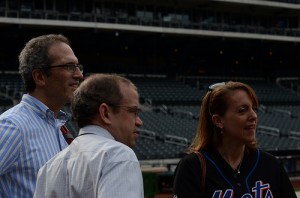 David and Bonnie get the lay of the land from the Mets' Ethan Wilson. Given our interest in how David and Roger had persevered — and with their blessing — I asked the Mets’ Media Relations department if Faith and Fear could be credentialed for BP that same day, September 1, so I could follow them around and report on their experience. I’d been on the field pregame a couple of times in 2010 and noticed there were always knots of people (kids as well as adults) on the edges of the action. These were guests of the Mets, too. The Mets generally didn’t call attention to their presence. It was just one of the pieces of the pregame mosaic, easy enough not to notice. But there was usually a generous reason the Mets made it available to those people who formed those knots.
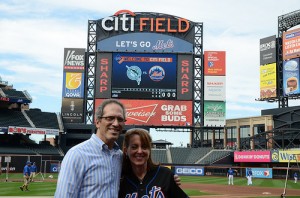 Not a bad place to be welcomed. I wanted to notice it. I wanted to see how it worked and explain, if I could, what it meant for a couple of fans like Roger and David to have this kind of moment so close to the players and the diamond and everything a Mets fan usually watches from relatively far away. I also wanted to bring along crack photographer and longtime Tug McGraw Foundation supporter Sharon Chapman to capture the scene in pictures. Any photos you see with this story that aren’t from mountaintops she took.
Mets Media Relations, in the person of Shannon Forde, couldn’t have been more accommodating of my request, which I greatly appreciated. Sharon and I picked up our Field Passes the same time David and his wife, Bonnie, were picking up theirs. Somebody in the office where media checks in made a call on the Roths’ behalf, and out came Ethan Wilson, one of Shannon’s colleagues. He had been the point of contact between the Mets and Channel 2, I gathered, and was ready to lead David and Bonnie to the field (Roger and his son, Josh, were stuck in traffic and would join them a bit later). I quickly explained to Ethan what Sharon and I were doing — this was coincidentally the same night the Mets had invited bloggers to a function for Tuesday’s Children, so Ethan at first thought we were making a wrong turn when we started to follow him — and Ethan shrugged, said OK and we all set out for BP.
I won’t endeavor to weave a narrative from here. Rather, I’ll just share my observations.
Though it was a particularly busy day for Media Relations, Ethan took the time to provide a condensed guided tour for David and Bonnie as we walked through the labyrinth of corridors “regular” folks don’t usually see. He pointed out why certain artifacts hung on the walls. Here was a blowup of the lineup card from the first game at Citi Field. Here was a 2009 team picture, the ballpark’s inaugural squad. Off to the left, unmentioned by Ethan, were three Mets broadcasters — Gary Cohen, Howie Rose and Ron Darling. They bantered as they waited for the elevator, three guys whose day at the office was just starting. We hung a right and were headed down one more short hallway, the one that leads you to the field.
This was empathetically exciting to me. I’d been down here a few times, but I have a way of switching into professional mode (even if nobody pays me to blog), so my reflex is to play it cool even in a situation that rates as cool in its own right. But Roger and Bonnie were under no such obligation; nor was Sharon, who’s been taking pictures from the stands all year and now she was going to be able to do it from up close. I was getting goosebumps not for what I was about to see but for what these people were about to see. (I got all my “IT’S THE FIELD!” goosebumps out of the way on September 6, 1998.)
 Mets fan, about to meet the Mets' field. It was September 1, the day callups join the team, the erstwhile minor leaguers who insist they are just happy to be here. I’m pretty sure David and Bonnie — and Sharon, for that matter — were happy to be there. And I was happy they were happy.
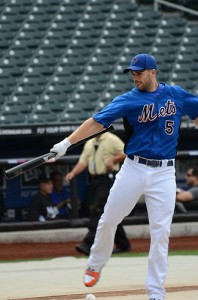 David Wright, practicing the taming of his Citi Field demons. Once we got positioned somewhere between the Mets’ dugout and the batting cage, David’s phone sounded. It was Roger. The Whitestone traffic had been punishing, but now he was closing in on Citi Field. David was standing feet from the players on his favorite team and in the midst of that kind of proximity, he was navigating his friend into the parking lot and toward the correct entrance. He could have been doing it from anywhere, but I had to smile when I heard him say, “I’m on the field.” You don’t get to say that every day.
 As close as one can get to batting practice without a bat. Bonnie and David planted themselves at the special-guest barricade. Sharon wandered a little further down the right field line (as the Field Pass allows). I sort of hung back to take in the scene, to see who else showed up, to watch how people react to being almost in the heart of Metsdom. I was amazed how quickly a person gets used to it. “I’m on the field,” is where you are, so it’s where you belong. Why shouldn’t you be on the field?
One of those on the field was a gentleman in a PAPD cap — Port Authority Police Department. Part of the Tuesday’s Children contingent, I assumed. I’d learn later he was former PAPD Officer Will Jimeno, and his 9/11 tale is as chilling as any. Still, I overheard him tell somebody, he “doesn’t regret” any of it.
Mr. Jimeno was trapped in the rubble of a fallen tower almost exactly ten years earlier. He was one of the last to be pulled out. He was injured badly and he lost comrades-in-arms.
But he was at Mets batting practice wearing his own smile.
 It's not only the batters who practice during BP. Only if you show up early enough for a Mets game do you necessarily glean how much commemorating and honoring the Mets do of different causes and groups, and only then do you see how much preparation is involved. Among other things, September 1 was Hispanic Heritage Night, sponsored by Goya. Several ladies in Goya-branded outfits came out for national anthem rehearsal. One of them, Nicole Toro, belted it out hours in advance, just to make sure her and the stadium’s pipes worked. Both did.
“The Star Spangled Banner” is a touchstone of any baseball game. Everybody rises when it’s delivered a few minutes before first pitch. When it’s delivered early, it maybe gets a little light applause. Maybe.
For a supposedly unpopular team, the New York Mets sure do inspire a frenzy when they’re feet away from you. People want to be on the same field with them. People want to stand next to them. People want them to sign whatever they’ve brought with them. Every Met, no matter his statistics or his prospects, is a star when you’re in their midst.
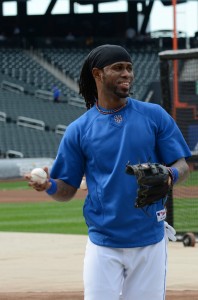 Jose: Nobody's more magnetic. Nobody is more of an attraction as the final month of the 2011 season commences than Jose Reyes. Nobody. David Wright was the bigger attraction last year. He’s still pretty attractive to many — Bonnie’s wearing a WRIGHT 5 jersey and wouldn’t mind an autograph — but Jose’s magnetic. He draws the most squeals. He’s asked to sign the most things. He is the most recognizable. He’s also taller and more muscular than you’d assume somebody who plays “shortstop” could possibly be.
If you were brought up reading phrases like “standing around the batting cage” in baseball columns, you might be surprised no reporters actually stand around batting cages. They loiter in the dugout until the given player they want is done. Maybe they follow him into the clubhouse to get what they need. I don’t know what happens when the field is vacated. But I do know I only saw one Mets writer cross right behind the batting cage, presumably en route to talk to somebody on the Marlins’ side of the field: mlb.com’s Marty Noble, who’s been covering the Mets longer than anybody. That, I decided, is why Marty is Marty. He doesn’t sit back and wait for the story to come to him.
In the stands, Citi Field’s environs seems almost tiny. I can pick out individual sections by number from wherever I am. Sometimes I can make out faces in those sections. At ground level, though, the field itself is huge. The outfield is green acres. No wonder Jason Bay can’t hit a ball out of this yard. Please, by all means, bring in a fence or two. Lower a wall. We don’t have the outfielders to cover all that space and we don’t have the sluggers to overcome its dauntingness. If we improve our pitching even a little, we’ll cope with that end of the equation.
 Also happy to be here: September callup Josh Satin. Batting practice produces batted balls. They lie on the infield as if dropped by a flock of overhead geese. If one bounced to a fan, a fan would go wild. Yet they just sit there, scattered about like Rawlings confetti on New Year’s Eve.
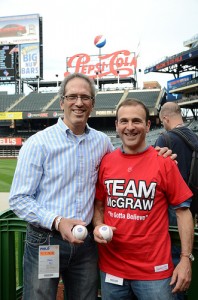 Roger makes it through traffic and past security in time to have a ball with David. Roger fought through traffic and then talked his way past Hodges entrance security. My big contribution to the evening was when I told David to tell Roger to tell the guard who didn’t want to let him in because he didn’t have his and Josh’s ticket yet, “I need to go to media check-in.” I can’t believe I actually knew something approximating magic words, but it worked. When Ethan brought Roger and Josh out to join us, I asked Roger what was more difficult: climbing 13,000 feet or getting by an overofficious guard.
The guard, he said.
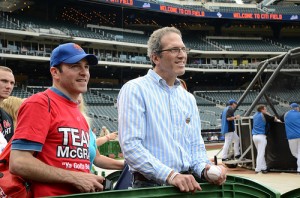 Two Mets fans enjoy well-earned Met proximity. Together again at last, David and Roger filled me in a bit on their Mets fan story. We’re of more or less the same vintage. They were eight years old in 1969. The Mets became their team up in Connecticut. Done deal for the rest of their lives, no matter that it wasn’t necessarily the thing to stay over the next bunch of decades. They recalled a “vehement Yankees fan” of their childhood acquaintance whose mere existence seemed to confirm their choice as the right one.
Without much provocation, Roger took me on his journey up Denali. During the retelling of one particularly tense episode, he clutched my arm as he described the severity of the elements and the self-doubt he faced (“I thought I was toast”). He mentioned, too, how much it took out of him, that when he was back at his job in early July, he found himself nodding off at his desk. Yet he expressed no regret for taking on the challenge. Way the hell up there, as close to the heavens as a human being could reasonably hope to get, he looked around, and he said, “it felt like being an astronaut.”
Ethan had earlier suggested that because the Mets finish their half of batting practice by 5:30, that might make a good time to go and grab some dinner. Once the visitors begin to take BP, he joked, “the thrill is gone.” We laughed when he said it, but when the Mets left and the Marlins were swinging in their place, we didn’t even seem to notice. You’re on a major league field, even one swimming with Marlins, the thrill doesn’t vacate.
“I still have cancer.” David says it matter-of-factly, not for shock value, just to keep you updated when you ask how he’s doing. But he’s here at the ballpark. You wouldn’t have bet on that a year earlier. He’s doing a lot of things. There are checkups and there are tests and there are steps he’s taking and his own mountain-climbing, figuratively speaking, is pretty damn impressive. After a while, though, we’re not talking about David’s cancer. We’re talking about how each of us met our mutual friend, Jeff, the unseen hand in making this night happen. We’re trading Jeff stories on the field where the Mets play. I’m stunned at how quickly two people fall into casual conversation on the same grounds that a little more than an hour ago they approached with at least a little awe.
 Bonnie and David, Roger and Josh...they seem to have a good time. Bonnie Roth didn’t acquire a WRIGHT 5 autograph. But HYDE 17 of the Marlins — our new all-time favorite bench coach Brandon Hyde — tossed her a BP-used baseball. She clamored for it, but respectfully. So he tossed it gently. A real baseball from real batting practice from a real coach…a real mensch. Dozens of balls were strewn behind the pitcher’s mound, but this one was truly special. It belonged to one of us.
Roger had climbed a mountain. David had made it through a year of cancer. Bonnie had a baseball. Everybody was no more than an arm’s length from the ballplayers. Everybody was standing on the same sod where the ballplayers stood. Everybody was leaning forward over barricades. Everybody was getting their picture taken. Nobody was in a rush to leave. Nobody wasn’t thrilled.
Everybody was an astronaut.
If you can, please contribute what you can to Roger Hess’s continued fundraising for the Tug McGraw Foundation in honor of his friend David Roth by visiting here.
If you like to run, Sharon Chapman would love to have you run with Team McGraw in the New York Rock ‘n’ Roll 10K on October 22. Registration details are here.
|
|