The blog for Mets fans
who like to read
ABOUT US

Faith and Fear in Flushing made its debut on Feb. 16, 2005, the brainchild of two longtime friends and lifelong Met fans.
Greg Prince discovered the Mets when he was 6, during the magical summer of 1969. He is a Long Island-based writer, editor and communications consultant. Contact him here.
Jason Fry is a Brooklyn writer whose first memories include his mom leaping up and down cheering for Rusty Staub. Check out his other writing here.
Got something to say? Leave a comment, or email us at faithandfear@gmail.com. (Sorry, but we have no interest in ads, sponsored content or guest posts.)
Need our RSS feed? It's here.
Visit our Facebook page, or drop by the personal pages for Greg and Jason.
Or follow us on Twitter: Here's Greg, and here's Jason.
|
by Greg Prince on 30 June 2011 7:25 am Perhaps only somebody who has spent the past fifteen months immersed in every box score of every game the Mets have ever won can truly appreciate the absurdity of absolutist statements along the lines of, “The Mets have never done anything like this!”
The Mets have absolutely done things like what they’re doing during this Interleague interlude, and you don’t need to be a Happiest Recap researcher to know it. Every time the Mets do something offensively extraordinary — which is blissfully frequently over the past few days — Gary Cohen alludes to its most relevant precedent in Mets history: the 1990 series at Chicago, for example, when Dave Magadan ousted Mike Marshall at first base and the Mets scored 43 runs across three games in two days; or the 2005 desert storm when Mike Jacobs led successive 14- and 18-run attacks on Arizona; or (as Ron Darling brought up) the 9-1 road trip to L.A., Phoenix and Philadelphia in 2006 when the Mets were scoring early and routinely often every single night and day.
When stretches like those are being brought up during Mets games, then those Mets games must be going awfully well. And that is very, very good for all of us in the present. Yet it’s a little bit the euphoria talking when precedents are dismissed (by Darling, by Bobby Ojeda, by whoever) as not possibly as good as what we’re seeing right now. Of course they were as good, give or take a run here — or another run here…and a couple more runs here (and, oh look, another run here!). The Mets were or felt unstoppable for a handful of games in 1990 and 2005 and 2006 because the Mets didn’t stop hitting, at least until they did. Eventually all teams stop hitting.
These 2011 Mets weren’t hitting as recently as a week ago. A week ago, I stood damp and disgusted after midnight in the Promenade beseeching Justin Turner to just take one for the team and get it over with in the bottom of the thirteenth because there was no way he and his teammates were ever going to score another run if they relied on proactive methods like swinging their bats. That clever use by Justin of his uniform fabric gave the Mets a 3-2 win. The next day, they scored four runs and won. The night after that, they scored one run and lost.
Eventually all teams start hitting, too, but you usually get a sense something’s coming. These Mets, however, offered no such hunches or hints before touching off this current round of hostilities toward American League pitching. Three games in which they scored eight runs indicated no sign of what was to come — no expectation, certainly, that 14 runs, 8 runs, 14 runs and, most recently, 16 runs would cross the plate on our behalf in consecutive contests. The Mets have now set two franchise records that a week ago were not just unimaginable but mostly unknown (even to your Happiest Recap research team).
As of Wednesday night in Detroit, the Mets have scored more runs (52) in a four-game span than they ever have before; and the Mets on Wednesday night scored more runs in a single game (16) than they ever have without benefit of a home run. Like the record they set in ’06 by scoring in the first inning in more consecutive road games than anybody in major league history, or Jacobs homering four times in his first four games in ’05, who even knew these were records? Who’s been sitting around since June of 1990 waiting for the Mets to finally put more than 50 runs on the board in four straight games?
I’m glad some tangible records have been involved in the offensive onslaught of 2011 since what’s being accomplished certainly deserves to be marked down somewhere. Left to anecdote, it’s likely to get lost. All these sorts of things fade, just as lineups that can’t be gotten out suddenly start taking ohfers. The 1990 Mets cooled off. The 2005 Mets cooled off. Even the 2006 Mets returned to Earth after seeming incapable of having their upward trajectory impeded by gravity. Depending on what becomes of our 2011 edition, I’m guessing years from now, when the Mets’ bats are scalding for four games or if they don’t hit homers yet string together singles, doubles and triples in almost endless fashion, it will come as news to most that there was precedent, that there was a Mets team that did something like this, first at Texas, then in Detroit. Whether four-hit names like Pagan and Paulino resonate or draw blank stares is probably dependent both on the intensity level of the Mets fan watching and what Angel, Ronny and their teammates do once the inevitable cooling effect sets in.
The precedents set in the aforementioned outbursts of 1990, 2005 and 2006 resonate for me because each takes me back to a respective moment of heightened Met expectation. The 1990 Mets were making a long-delayed move on the Pirates for first place. The 2005 Mets, after playing footsie with .500 for so long, were climbing in the Wild Card race. The 2006 Mets were inexorably separating themselves from the rest of the N.L. East. Each of the seasons in question took off in different directions once the bats ceased being magic wands, but while the balls were flying around and out of various yards from coast to coast, I couldn’t believe the Mets weren’t on their way to ever bigger and unquestionably better things.
That, maybe, is where 2011 parts company with precedent in my eyes. I honestly believed the Mets would continue to pound pitchers in 1990, stay in their groove in 2005 and rampage without pause in 2006. All those Mets convinced me they were destined to compete at a high level. These Mets? They seem destined to show up at Comerica Park today and do their best against Justin Verlander and then they seem destined to fly home to take on the Yankees before repacking their stuff and heading for California. Even after 52 runs in four games and even after showing they don’t need four-baggers to generate sixteen tallies, I have no expectations for these Mets’ continued success.
But there’s a flip side to that, because I also don’t expect them to utterly fail. I don’t expect them to “revert to form,” because I don’t expect they have a form. These numbers these last four games may be an aberration in the sense that, literally, 52 runs in four games never otherwise happens to the Mets, but their ability to succeed is as genuine as their ability to do the opposite. They could do either. We could be back to imploring Turner to stick an elbow out over the plate. We could be cringing at bases-loaded balks. We could be wondering why this one can’t find his knuckleball and what that one was thinking by trying to steal third in a situation that demands the runner stays put. But we could also be exhilarated and heartened and satisfied that these 2011 Mets never quit and often win, sometimes when the runs pile up in pleasing stacks, sometimes because they find a way to produce with only the most minimal of production.
I don’t know what to expect from this club that has won slightly more than it has lost with just about half a season in the books. But I’ve rarely been more willing to let a Mets club surprise me.
Thanks to Paul DePodesta for spending a half-hour on the phone with a bunch of bloggers last night. Read what the Mets VP of player development & amateur scouting had to say to us via the transcript diligently and courteously posted at Amazin’ Avenue.
by Greg Prince on 29 June 2011 11:48 am In 1979’s Breaking Away, Dave Stoller (Dennis Christopher) wants to race his bicycle in Indiana University’s Little 500, except Dave needs to be part of a team of four cyclists and none of his three fellow “cutters” (they’re not students at snooty IU, rather townies born and raised in Bloomington, thus the elements of conflict) know the first thing about bike-racing. Nevertheless they enter as a unit and let Dave do all the pedaling for as long as he can. Once the race is underway, we see Dave whooshing by his teammates as they look on in ever lessening degrees of engagement. Their major contribution for the balance of the race is to stand by semi-interestedly and issue as sincerely as they can muster a series of “way to go, Dave” nods of encouragement. Of course at some point, buddies Mike, Mooch and Cyril have to take turns on the bike and contribute to the team effort — and because they do, Team Cutter wins the race.
So yeah, about time we saw some Met sluggers slug some grand slams last night. But really, this night, like this year, belonged to Jose Reyes.
***
Jose Reyes leads the Mets in base hits…the 1972 Mets. No Met in that 156-game season had even 100 hits; Tommie Agee led the team with 96. Granted, no Met played in more than 122 games that season, but Jose Reyes has played in only 76 games in 2011 and he has 117 hits.
Jose Reyes leads the 1972 Mets in base hits by more than twenty and he hasn’t even played half a season.
Jose Reyes is currently tied for second on the 1994 Mets for base hits. He has his 117 in 76 games. Bobby Bonilla had 117 in 108 games. Jeff Kent led the club with 121 in 107 games. Those Mets played only 113 games in toto because of a strike, but Reyes has played only 76 games, and he’s right there with them and on the verge of leaving them all behind before this year’s halfway point.
Injecting him into random FULL Met seasons that ranged from 144 to 163 games, the Jose Reyes who has played 76 games in 2011 is second on the 1963 Mets in hits. He is second on the 1968 Mets. He is third on the 1977 Mets. He is fourth on the 1989 Mets. He is fourth on the 1995 Mets. He is third on the 2001 Mets. He is fourth on the 2009 Mets, which included Jose Reyes, albeit for 36 pre-injury games.
None of the above Mets teams’ full seasons was particularly swell. Want a sweller point of hypothetical comparison?
Jose Reyes is fourth in base hits on the 1973 National League champion Mets, trailing only Felix Millan, Rusty Staub and Wayne Garrett. Garrett had 129 in 140 games. Reyes has 117 in 76 games (he missed three to attend his grandmother’s funeral). Reyes leads John Milner, who had 108 hits in 129 games, or more than 50 than Reyes has played to date.
Not swell enough for ya? Try this:
Jose Reyes is third in base hits on the 1969 World Champion New York Mets, trailing only Cleon Jones and Tommie Agee. Gil Hodges liked to platoon, so none of his regulars or semi-regulars played in as many as 150 games that championship season. But eleven of them played in more games than Reyes has thus far. And only two of them have more hits for that entire magical year than Reyes has in his current magical year.
Or this:
Jose Reyes is third in base hits on the 1988 Eastern Division champion Mets, who, like the ’69ers, won a hundred games in the regular season. Reyes has more hits in 76 games than anybody but Kevin McReynolds and Darryl Strawberry collected across a generally triumphant 160-game schedule. And Davey Johnson wasn’t platooning all that much.
Individually speaking, Lance Johnson owns the Met record for most base hits in a season, with 227 in 1996, accomplished during a most prodigious offensive era in baseball. Through 79 team games that year, Johnson had 105 hits — or a dozen fewer than Reyes has now. For ALL of 1996, only Johnson, Bernard Gilkey, Todd Hundley and Rey Ordoñez had more base hits than Reyes does for not quite half of 2011. Rey Ordoñez played in 151 games to get to 129 hits. Jose Reyes has played in 75 fewer games and has 12 fewer hits.
Implicit in all this is Jose Reyes leads the 2011 Mets in base hits by a wide margin: 39 ahead of Carlos Beltran, 41 ahead of Daniel Murphy. Jose Reyes leads the 2011 Mets in just about every hitting category, save for home runs and runs batted in.
Jose Reyes leads the Mets.
***
There’s a hoary quote, legendarily offered as calming advice by the old Brooklyn Democratic boss Hymie Shorenstein to a concerned judgeship candidate who didn’t think his individual race was getting enough attention from the party. As hoary quotes from someone named Hymie Shorenstein tend to do, it comes in various iterations. This one, as related by Teddy White in Making of the President 1960, will suffice:
“Ah, you’re worried? Did you ever go down to the wharf to see the Staten Island ferry come in? You ever watch it, and look down in the water at all those chewing-gum wrappers, and the banana peels and the garbage? When the ferryboat comes into the wharf, automatically it pulls all the garbage in, too. The name of your ferryboat is Franklin D. Roosevelt — stop worrying!”
Grand slams following a grand slam drought are wonderful. Rising above .500 after a 5-13 start is marvelous. Tranquilizing the Tigers is outstanding and definitely worth watching from beginning to end. But mostly last night, as I have most of this year, I kept my gaze fixed on Jose Reyes as he singled twice, doubled, tripled, walked, stole a base, scored three times and led the Mets as Jose Reyes tends to do.
And I didn’t worry one bit.
Baseball-Reference examines the broader historic nature of Jose Reyes’s 2011 here, and what he’s doing is pretty darn expansive (never mind that it’ll be expensive).
by Jason Fry on 29 June 2011 12:04 am I admit it, the only parts I heard were the boring parts.
I got a late start on the evening, grabbing my iPhone as I dashed out the door. I fumbled my way into MLB At Bat and noted, with a certain cheerful approval, that it was already 2-0 Mets. Walking to pick up Emily in the top of the second, I heard a modest Mets uprising, with my phone cocked up by my ear and people on the street regarding me with the usual mixture of disdain/interest/envy. (I get the first reaction, but the other two baffle me: The game is on the radio. That’s the whole point. You could be listening yourself if you would part with an extremely modest amount of money and plan slightly ahead.) Willie Harris lined out to end the second, I met Emily and we got a cab, and the Tigers did nothing of note as we coaxed the cabbie down to Red Hook.
At the Good Fork we of course weren’t going to be listening to Mets-Tigers, though my wife made a tacit concession by not objecting to the phone placed on the table between us, silent but updating itself with Gameday highlights, the little batter figurine turning right and left as warranted. The Mets, I kept noticing, kept batting. There were two outs, but suddenly it was 3-0. Then Jose had tripled. Then it was 4-0. Every time I glanced over, the Mets still somehow weren’t out. Then, with Jason Bay up, there was that vaguest of digital-age pronouncements: In play, run(s).
They weren’t kidding. Bay had done something we all thought the Mets had forgotten how to do: He had hit a ball over the fence with a teammate on first and another teammate on second and yet another teammate on third. Hooray Jason Bay! Hooray everybody! My iPhone put up a silhouette of a new batter and a line of dispassionate explanatory text. Confronted with the Mets’ first grand slam in 299 days, I was somewhat more excited. Long ago, I had a Motorola SportsTrax, and in the first days I didn’t know how to use it or what it was telling me with its Artoo-Detooesque bleating and chriping. For some reason we had a work retreat scheduled for a Saturday in lower Manhattan, so around the fourth inning of a Mets day game we were sitting around some conference table drinking bottled water and eating Cosi sandwiches when my little pager went ballistic, whistling and blatting and flashing every part of its LED screen.
“Gentlemen,” I said after peering at the screen for a moment, “I believe that’s the grand-slam noise.”
An inning after Bay’s feat in 2011, the grand-slam noise sounded like this.
Me: Ha. No way.
Emily: What?
Me: Beltran.
Emily: You’re kidding. [appreciative laughter]
By the time we were done and walking back up Van Brunt, the fireworks were over and the Mets and Tigers were just trying to get back to the hotel and their homes (respectively) without aches and pains. (Seriously, how is it that Jose Reyes can go 4-4 and it feels like the undercard?) Perfunctory play-by-play took us as far as a bus stop, where my phone gave a final sigh of expiring batteries and lapsed into silence. I didn’t mind — if ever a lead was safe, it was this one. When I got home, SNY was showing a happy Bob Ojeda and Chris Carlin, and I knew all was well.
Sorry I missed it? Sure, a little. But glad it happened? You bet.
by Jason Fry on 28 June 2011 1:16 pm Last week I went on a road trip, for a number of reasons: I wanted to get some junk out of our apartment, a problem I solved by selling CDs and sticking my parents with boxes of baseball cards; I wanted to see Gettysburg; I wanted to drive around for a couple of days; and I figured the road might be good for some thinking and career self-counseling.
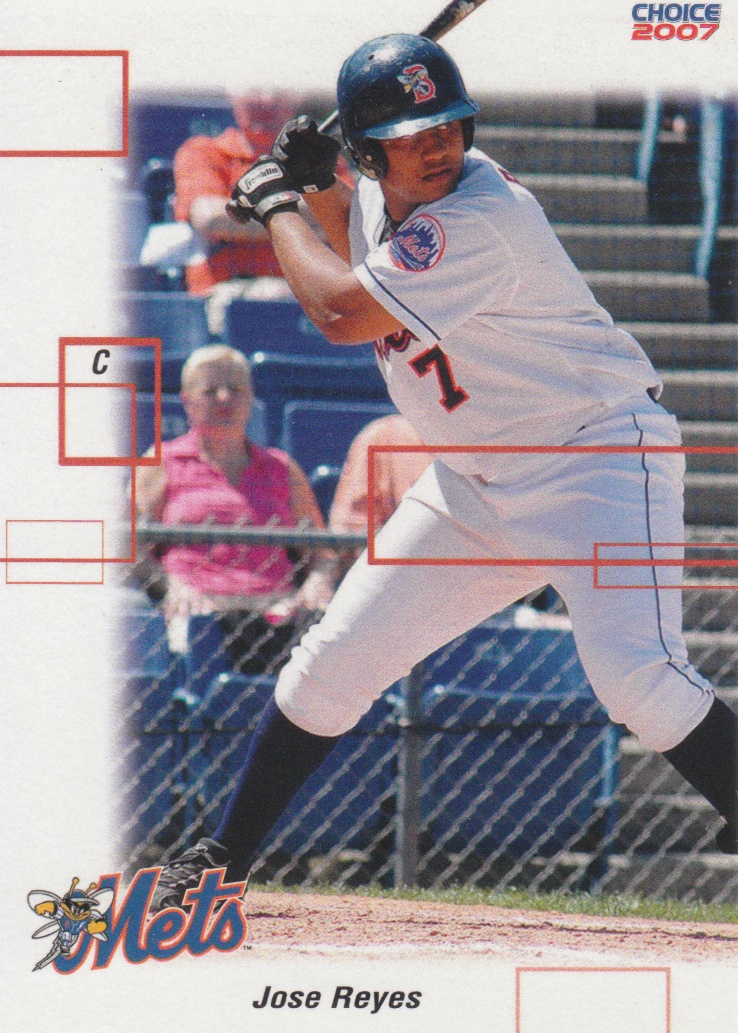
We’ll see how the last item progresses, but all the others got accomplished. In Virginia, I was thumbing through a fan of long-forgotten cards and had two happy discoveries, minutes before the boxes would have gone into the attic, likely never to be seen again. One was a 2007 Binghamton Mets card for Raul Valdes, whose previous card in The Holy Books had been a Bowman card showing him in a Cubs uniform and identifying him as Raul Valdez. I grabbed that one for transport back to New York, then noticed something else — a 2007 Binghamton card of Jose Reyes. Wearing No. 7 and everything.
No, not that Jose Reyes, the one we’re all voting onto the All-Star team. (You are, right? Get to it.) I mean the other one.
You might remember Jose A. Reyes — the A. is for Ariel, as opposed to the more famous Jose’s B. for Bernabe — in camp with the Mets in 2007 with a bunch of other non-roster catchers. Jose A. was barrel-shaped and catcher-slow, prompting David Wright to joke that “I’m going to go out on a limb here, but I’ll say that the shortstop is a little faster.” Jose A. wore 77, which led to more jokes. They were both from the Dominican Republic, born less than four months apart in 1983, though Jose A. was from Barahona, in the interior, while Jose B. was from Santiago, on the coast. The New York Times had fun with it. We all did.
 What kept it from being too cruel was that Jose A. himself was a good sport about it, and he wasn’t one of those non-roster guys you knew would never make The Show, because he already had. Jose A. had logged five plate appearances over four games with the Cubs at the end of 2006, including a big-league hit. He was a made man. What kept it from being too cruel was that Jose A. himself was a good sport about it, and he wasn’t one of those non-roster guys you knew would never make The Show, because he already had. Jose A. had logged five plate appearances over four games with the Cubs at the end of 2006, including a big-league hit. He was a made man.
Baseball can be cruel in terms of family connections and common names. We first learn this when we’re kids and are flabbergasted to learn that Hank Aaron had a brother; later, when we’re older and have learned something about the disappointments of life, we may wonder if Tommie Aaron might have been happier in some other line of work. Other examples abound. Jose Canseco’s brother Ozzie was also his identical twin, which at the time was a fascinating starting point for arguments about nature and nurture, though pharmacology would now be part of the discussion, too. The Mets employed Mike Maddux as Dallas Green’s designated scapegoat while being regularly beaten by Mike’s brother Greg, but at least Mike was a different sort of pitcher than Greg and forged a respectable career as a pitching coach. Robin Yount played for 20 years, collected 3,142 hits and is in the Hall of Fame; his brother Larry hurt himself warming up for his big-league debut with the Houston Astros and departed, having never thrown a pitch in anger. Sons get it too: Spend a few minutes looking over the career of Pete Rose Jr. and you’ll wonder what Shakespeare or Faulkner might have done with it.
Then there are common names. The two Jose Reyeses weren’t the first such Mets duo, of course: The ’62 club employed two Bob Millers at once, with the traveling secretary rather pragmatically rooming them together. Thirty-eight years later, the Mets pulled the same trick with the two Bobby Joneses. At least those pitchers weren’t light-years apart in terms of notoreity: The Mets have also employed pitchers Bob L. Gibson and Pedro A. Martinez, though thankfully (for their sakes) neither of them overlapped with famous Cardinal and momentary Mets pitching instructor Bob Gibson or Pedro J. Martinez, who requires neither his middle initial nor his last name to be instantly recognizable.
So whatever happened to The Other Jose Reyes?
He was sent to minor-league camp in mid-March of 2007 and didn’t get a call-up — not surprising given that he hit .214 in Double-A. He didn’t play in pro ball in 2008, but I assume he wore a uniform somewhere in the Caribbean, because the Orioles signed him at year’s end and brought him to spring training in 2009. They sent Jose A. to minor-league camp in mid-March and after that there’s no trace of him. He’d had elbow woes with the Orioles, which for a catcher who couldn’t hit much might have been the final straw.
Or maybe Jose A. is still out there in a Dominican league, hoping to catch the eye of some team seeking organizational depth. And why not? He, like his more famous countrymate with the same name and number, is just 28. He knows by now that few positions offer more longevity while demanding less hitting ability than catcher, particularly if you can make the transition to wise old catcher. I hope he’s still plugging away somewhere and lining himself up for a stint as a roving instructor. Or, if the elbow betrayed him, I hope he’s at least happy — happy enough to smile patiently at the 10,000th person who makes a joke about his stolen bases or his impending free-agent riches, and happy enough to talk about his two weeks with the Cubs, when someone else carried his bags and he hit white balls for batting practice, and if you’ll stop being an ass for a moment he’ll show you the ball he hit for an eighth-inning single off Milwaukee’s Derrick Turnbow on Sept. 26, 2006. Drove in two. You could look it up.
by Greg Prince on 28 June 2011 3:24 am Welcome to The Happiest Recap, a solid gold slate of New York Mets games culled from every schedule the Mets have ever played en route to this, their fiftieth year in baseball. We’ve created a dream season consisting of the “best” 73rd game in any Mets season, the “best” 74th game in any Mets season, the “best” 75th game in any Mets season…and we keep going from there until we have a completed schedule worthy of Bob Murphy coming back with the Happy Recap after this word from our sponsor on the WFAN Mets Radio Network.
GAME 073: July 3, 1990 — METS 12 Astros 0
(Mets All-Time Game 073 Record: 20-29; Mets 1990 Record: 43-30)
This was the Darryl Strawberry we had been waiting for. He took eight seasons to arrive, but boy was he present.
Darryl had been good, sometimes very good since his debut in 1983. His numbers made an occasional case for great. Yet there was always the sense something was holding him back. Call it immaturity or a learning curve or a matter of there being holes in his game as he developed.
By the middle of 1990, there were no longer negatives. He was a superstar in full. And didn’t the Houston Astros know it? Then again, why should have they been any different from the rest of the National League?
The Astros showed up at Shea this Tuesday night in time to learn that Darryl would be gracing the cover of the new Sports Illustrated, a tribute to “The Amazin’ Mets,” which may not sound like the world’s most original coverline, except the word “Mets” was inserted where the word “Mess” was crossed out. A few weeks earlier, SI bemoaned the Mets’ fate. Now they were printing what amounted to an enormous retraction.
Darryl was an enormous part of the instant revisionism that surrounded the 1990 Mets. The most enormous part, really. Their midsummer roll was one of the most unstoppable in club history, a 27-5 stretch that redefined their fortunes and seemed to be writing them a ticket toward the postseason. That was a ways away in June and July, but if any one player seemed capable of carrying them to October, it was Straw. In a 29-game span roughly coinciding with the Mets’ surge, their cleanup hitter launched 15 home runs and drove in 36 runs while hitting .389.
You couldn’t get the guy out. The best you could do was duck and maybe turn and admire what he did to your best stuff. It would have been the sporting thing to do if you were Astros reliever Xavier Hernandez.
Hernandez’s team was already in a hole of someone else’s making when he entered to pitch the bottom of the fifth. Starter Mark Portugal was flash-filleted by the Mets’ scorching bats right away. He got his first Met hitter out in the bottom of the first, and the Mets got him: Dave Magadan singled; Gregg Jefferies singled him to third; Darryl singled Magadan home and Jefferies to third; Kevin McReynolds homered them all home.
Mark Portugal had thrown 16 pitches since retiring Howard Johnson to begin the first and they had netted his opponents four runs. It wasn’t going to be Mark Portugal’s night.
How could it be? He had to face Darryl Strawberry again.
The bases were empty, there was one out, it was still “only” 4-0 Mets, but Portugal may as well have been stranded on an island (or the Iberian Peninsula) given how alone he must have felt on the mound having to divine a way to not have one of his pitches turn to jelly against Strawberry.
Darryl chose his second delivery and then…SPLAT! All the way to the picnic area bleachers over the left field fence, some 425 feet from home plate…an opposite-field shot for Straw. Or, as he might have called it, a stroll in the park.
No picnic for Portugal. The Mets ruined his Third of July a little more when they loaded the bases in the fifth and brought home a sixth run. With the Mets having pounded Portugal to a pulp, Astro manager Art Howe took mercy on his starter and pinch-hit for him in the visitors’ fifth (with ex-Met Alex Treviño). Houston didn’t score and handed their 0-6 deficit to Hernandez.
As Julia Roberts said in 1990’s big flick, Pretty Woman, “Big mistake. Big. Huge.”
On a 1-0 pitch, Darryl Strawberry swung and everybody, Hernandez included, was compelled to look up in awe. Ooh! Aah! Where did that thing land?
It didn’t so much land as crash into the highest obstacle in its path, which in this case was the massive Shea Stadium scoreboard. As described by Joe Durso in the Times, it “carried 450 feet from home plate and struck halfway up the scoreboard against the lighted word ‘Ball,’ where the count on the batter is recorded but where baseballs rarely carry.”
This one — one of the farthest-traveling Shea had ever seen — carried, much as Darryl was known to carry the Mets on his back. He didn’t have to do it all by himself in June and July of 1990, however. He had help. Hell, he had another Daryl. Two batters after Strawberry, Hernandez saw his seven-run deficit grow larger, courtesy of the Mets’ other Daryl.
What? The Mets have ANOTHER one?
In 1990, they sure did, platoon centerfielder Daryl Boston, and he tagged a Hernandez pitch that made its way literally as well as figuratively onto the same scoreboard the first Darryl tattooed. Alas, Boston’s blast merely banged into one of the ads on the lower righthand corner of the edifice (piker), putting the Mets up 8-0…and they weren’t likely coming down. Frank Viola continued to shut out Houston, while the third Astro pitcher of the night, Jim Clancy, found four more runs to give the Mets in the seventh. The Mets held on from there for the 12-0 win.
It was a team effort, but how could you ignore the player in the middle of it all? Manager Buddy Harrelson couldn’t and wouldn’t miss his not-so-secret weapon. Darryl Strawberry, the Mets’ skipper marveled, “is a beautiful thing to watch. He’s like a well-oiled machine out there.”
And in the midst of the Mets’ 27-5 renaissance, he just kept humming along.
ALSO QUITE HAPPY: On June 22, 1997, Bobby Valentine didn’t have a starting pitcher, but the manager of the Mets wasn’t supposed to have a contender on his hands, either. Thus, on a steamy Sunday at Shea, he found both. The contender we knew about. The Mets were hanging right in there with Florida and Montreal for the National League Wild Card lead, and they were asking reliever Cory Lidle to keep them close. Lidle got the call to start because Armando Reynoso was unavailable, having sustained a shot to the knee from a Luis Sojo line drive in the previous week’s Subway Series (which must be what they meant when they said the Yankee hitters were dangerous). Valentine asked Lidle to give the Mets as many innings as he could against the Pirates. It didn’t add up to many, but he had assistance on both sides of the ball.
Lidle was staked to a 4-0 lead, but couldn’t hold it. The Mets got him an extra run, but Pittsburgh knocked Cory out and brought home the go-ahead run in the fifth versus Juan Acevedo. Tough stuff, but the Mets were tougher, scoring four runs in the bottom of the sixth to take a 9-6 lead. Acevedo gave way to Ricardo Jordan, and the spirit of middling middle relief couldn’t quite be shaken. Jordan gave up a run to make it Mets 9 Pirates 7. In the eighth, Greg McMichael became the first Met pitcher of the day to not allow a runner (his own or an inherited one) to score. But John Franco…well, a two-out walk, a steal and a Kevin Young double happened and the Bucs tied the Mets at 9-9.
Not a lot of great Met pitching by their all-relief corps, but you may have noticed there was plenty of hitting. And sure enough, after Takashi Kashiwada held the Pirates scoreless in the top of the tenth, the Mets drew two walks and, with two out, Carl Everett collected his fourth hit of the day — his biggest yet: a three-run walkoff homer for a 12-9 Met victory. Kashiwada was credited with the win, but it was Everett who earned the save.
GAME 074: July 3, 1986 — METS 6 Astros 5 (10)
(Mets All-Time Game 074 Record: 28-21; Mets 1986 Record: 53-21)
It couldn’t have been more patriotic around Shea this Thursday night. Fireworks awaited in the postgame on this Independence Day’s eve, and all of New York was preparing to celebrate the Statue of Liberty’s centennial the next night. The Mets contributed to that sense of red, white and blue with their own version of manifest destiny.
This land was their land. This league, too.
It had been the story of 1986 from almost the word go. Go? The Mets went and couldn’t be hailed down. An 18-1 stretch in April and May elevated them permanently above the N.L. East pack. The Expos lingered within wishing distance for a while, but a six- and then seven-game winning streak had irrevocably separated the Mets from Montreal. Yet another streak — six and counting — was in progress when one of the Mets’ prospective playoff opponents, the West-contending Astros, landed at Shea for a holiday weekend series.
Prospective playoff opponent? Houston was indeed in a dogfight for first with the Giants in their division, but wasn’t it the height of presumption to infer it had anything to do with the Mets? After all, more than half the season had yet to be played.
But no, it wasn’t presumptuous. The Mets held an 11½-game lead over the Expos, much bigger over everybody else. It clearly wasn’t going to recede. They needed a new challenge. Hence, Houston.
Versus Ron Darling, the Astros entered swinging. Ty Gainey and Glenn Davis each drove in a first-inning run and the Mets trailed 2-0 almost immediately.
That would not stand.
In the bottom of the second, lightly used backup catcher Ed Hearn homered off Astro starter Jim Deshaies to put the Mets on the board. Jose Cruz’s sac fly got the run back in the fourth, but Darryl Strawberry’s eleventh home run of the season, with Kevin Mitchell on base, tied the game 3-3 in the fifth. After that, the two starters traded zeroes into the eighth. Charlie Kerfeld replaced Deshaies — who had struck out eleven — but the Mets didn’t score. Darling went nine but left with the game tied. Kerfeld got out of the ninth as well.
The Grucci pyrotechnics spectacular would have to wait a little while as the Astros and the Mets played on. Sadly for the 48,839 in attendance, Jesse Orosco, picking up for Darling, dampened the skies. With two out, Jesse walked Jim Pankovits. Phil Garner, pinch-hitting for Kerfeld, homered. The Astros led 5-3.
In another year, the Mets fan default attitude might have been “so much for fireworks,” but this was 1986, a year like no other. So what happened next, while not necessarily a lock, couldn’t have seemed all that surprising.
Frank DiPino came on to attempt to close out the Mets in the bottom of the tenth. But the first thing he did was walk Lenny Dykstra, who entered the game as a pinch-runner in the eighth. One way or another, walking a Met leadoff batter wasn’t a good idea. Usually it meant a stolen base was in the offing. This time it meant Dykstra could trot home in front of Strawberry, who whacked the lefty DiPino’s first pitch 430 feet for his second home run of the game. Suddenly it was 5-5, and Shea had more explosive things on its mind than fireworks.
Met momentum stalled briefly as Gary Carter (that night’s starting first baseman) grounded out and Rafael Santana struck out. Ray Knight, who had fanned in his four previous at-bats, seemed an unlikely candidate to regenerate Met momentum. But he did, with the final swing of the game.
“This ball is outta here,” Tim McCarver exclaimed over Channel 9, “this ballgame is over and I don’t believe it! Ray Knight hits a game-winning home run and the Mets have won seven in a row! They are spreading the news that they are, right now, the dominant team in this game…in either league!”
Was McCarver looking ahead, too, and not just to the fireworks display? In case it wasn’t enough that the Mets had just beaten the Astros 6-5 in ten innings, Tim alluded to the undeniable fact that the Mets (now 12½ up on their nearest Canadian rival) had the best record in all of baseball, 4½ games better than that of the best the American League had to offer, the Boston Red Sox.
Why anyone would think a Mets’ 6-5, ten-inning triumph at Shea in which Ray Knight scored the winning run would be of interest to the 1986 Red Sox is another story for another time.
ALSO QUITE HAPPY: On June 26, 1963, the Mets gave a game away, which was nothing unusual given their brief, inglorious history. But then, in stunning fashion, they took it back. To be fair, the Mets did a nice job of burrowing their way into this Wednesday matinee versus the Cubs at the Polo Grounds. Down 4-0 by the middle of the fifth, Duke Snider drove in Ron Hunt with a sixth-inning double and Frank Thomas followed behind him with a two-run homer. Frank was Thomas on the spot in the eighth, driving in Choo Choo Coleman in the eighth to knot the score at four. The Mets pitching staff was doing a heckuva job in the meantime: starting with Al Jackson getting the last out of the fifth and going through his next inning of work, then two from Larry Bearnarth, one from Tracy Stallard, two from Carl Willey and two and two-thirds from Galen Cisco, the Mets actually threw the equivalent of a no-hitter for nine innings’ worth of Cubs outs. That streak was snapped, however, when, with two out in top of the fourteenth and Don Landrum on first via walk, Billy Williams lined a ball to left that Thomas — known as the Big Donkey — got a poor jump on. It took off to distant precincts of the PG outfield and Williams’s hit became a two-run inside-the-park home run, giving the Cubs a 6-4 lead.
If the game had climaxed there, it would have been…not unusual. But the Mets had hung around this long, so they might as well hang in there a little longer. Jim Hickman singled to open the home fourteenth and the Mets seemed to have a rally going when rookie Ron Hunt singled, too, but Hickman, in his haste to make something happen, overran second base for the first out of the inning. After Jimmy Piersall walked, Cubs head coach Bob Kennedy opted to change pitchers, replacing Jack Warner (who’d produced boffo results since entering the game in the ninth) with Paul Toth. Toth was assigned the heavy task of getting out Thomas, who had four hits on the day. The strategy worked, as Frank flied to left for the second out. Toth was then removed in favor of Jim Brewer. Brewer experienced a prohibition on control, walking Sammy Taylor to load the bases for first baseman Tim Harkness.
Harkness had three hits already, including two in his previous at-bats in the eleventh and the thirteenth. Extra innings were apparently Tim Harkness’s kind of innings, the fourteenth in particular. Harkness ended the game right then and there, on a 3-2 pitch, with his first career grand slam, a mighty wallop over the right field wall that gave the Mets an 8-6 win that unleashed delirium among however many hundreds of fans who stayed to the joyous end. Although the numbers were fewer and the stakes absolutely lesser, Harkness was called out by Mets fans who gathered at the foot of the steps to the Mets’ center field clubhouse (as fans were permitted to do in days of yore) and cheered “WE WANT HARKNESS!” until the man of the moment emerged on the balcony to acknowledge their rapture much as Bobby Thomson did a dozen years earlier when the home team at the Polo Grounds was the Giants and the shot that set off shock waves was heard ’round the world.
“We just about had to end it there,” Casey Stengel offered with impeccable logic after deploying 20 players across four hours and eight minutes of baseball, “because I’d run out of men.”
“I couldn’t believe it was me who hit that,” Harkness, a .208 hitter when the day began, confessed. “It doesn’t seem like good things happen to me.” That might have been a blanket statement for the Polo Grounds Mets, but their New Breed of loyalists recognized the good thing that had befallen them and they never forgot it. Witness the stream of reminiscences this game has generated in the past decade at Ultimate Mets Database:
• “Having seen hundreds of games at Shea, Yankee Stadium, Oakland Coliseum, Candlestick Park, AT&T Park, and a few other places, that afternoon in 1963 at the Polo Grounds is still my most memorable and favorite baseball recollection.”
• “I remember listening to that game on my portable transistor radio. School was over for the day, and I was in the playground in front of my building in the projects. I was eight years old and just about to finish fourth grade. When Harkness came up with two outs and the bases loaded, I recall thinking how great it would be if he hit a grand slam. But that was too much to hope for; the Mets were such a bad team in those early days. When it really did happen, you can imagine how great it felt.”
• “I remember sitting on the first base line. The count was full. Everyone in the Polo Grounds stood and started yelling. Harkness swung and you could hear the ball whistle on a line toward the right field wall. It cleared. It sounded like 50,000 people were there.”
• “Playing stickball or baseball we always imagined; last at bat, two outs, trailing by 3 with a full count. It was nearly perfect. I was out in right, standing in a position that would allow a dash to the IND. I was high the entire 2 hour train and bus trip home. I attended ‘game 6’ with my wife and kids but I always rate this 1963 Cub game as number 1 in my Met memory bank. Probably because it is only a memory.”
• “Based on these comments, there sure were a lot of 13-year-olds at that game. I was one of them. What I remember was the pandemonium after the game, in the corridors leading out of the Polo Grounds and down into the subway. Everyone was just chanting ‘Let’s Go Mets’ and the sound was bouncing off the walls. It was so much fun.”
GAME 075: June 24, 1997 — METS 6 Braves 5
(Mets All-Time Game 075 Record: 27-22; Mets 1997 Record: 43-32)
If the Yankees weren’t exactly slain in the first Subway Series ever, the Mets had more than held their own: a win in the Mlicki opener, an unfortunate loss in the middle, a riveting extra-inning affair that felt a bit like a tie in the finale (though, technically, it was a loss). It was an exciting, draining three-game set, and there was some speculation among Met doubters in the New York media that the Mets couldn’t possibly get themselves up for more mundane opponents once they finished playing the Yankees.
But they hadn’t really been paying close attention to the 1997 Mets — and the 1997 Mets were worth everybody’s attention. They proved it in the week that followed the New York-New York production.
First, a four-game set against the surprising Pirates, contenders in the N.L. Central for the first time since they were winning the East five years earlier. But Pittsburgh came off more like pretenders when they encountered this latest iteration of Met magic. In four successive games, the Bucs succumbed four heartbreaking ways — or exhilarating ways, from a Mets perspective.
The Mets blew a 6-1 lead on Thursday, the first night after the Subway Series, but Jason Hardtke redeemed everybody when he drove in the winner in the bottom of the ninth. Bobby Jones, in budding All-Star form, took a 1-0 lead into the ninth the next night, one handed successfully for the final out to John Franco. The day after, it was Edgardo Alfonzo emerging as the clutchest of Mets, turning a 2-1 deficit into a 3-2 lead in the bottom of the eighth with a home run off reliever Marc Wilkins, a margin preserved by Greg McMichael. And, to cap it off, Carl Everett launched a three-run, tenth-inning homer to sweep the Pirates out of Shea.
A four-game winning streak presenting evidence that the Mets weren’t hopelessly distracted by having been in the presence of the Yankees. Now the competition would stiffen again as the Braves came to town. Bobby Valentine, having used his entire bullpen in the Pirate finale, asked Rick Reed to go deep on Monday night, and the righty who came out of something approximating nowhere obliged his manager, beating John Smoltz in a 3-2 dual complete game. So that was five in a row for the Mets.
Could it continue? The Braves may have been in the same division as the Mets, but it was hard to say the Mets were in the same league as the Braves. Atlanta won three straight N.L. West titles before realignment and Rand-McNally figured they belonged in the East. Bad news for the Mets and other co-habitants as the Braves cruised to the first two Eastern Division titles in their grasp in ’95 and ’96 (1994 having had no champ due to strike). The Mets, only recently asserting themselves as a legitimate Wild Card combatant, couldn’t be concerned with first-place Atlanta from a competitive big picture. Or could they? A win on Tuesday night and not only would the Mets keep up with the second-place Marlins, they’d be, somehow, not far off the tails of the perennial powerhouse Atlantans.
The two teams battled to a 3-3 tie through six, the Mets knotting it on a Bernard Gilkey sacrifice fly. But as fast as the Mets got themselves back into the game, they seemed to fall away from it. In the top of the seventh, Jeff Blauser singled in a run against Cory Lidle and 25-year-old Chipper Jones did the same to Takashi Kashiwada. The Braves led 5-3, and Mike Bielecki made it stand up in the succeeding half-inning.
The bottom of the eighth, however, was a different matter, one with a definite Met twist. Carl Everett (a .500 hitter across these six games since the Subway Series) doubled and Carlos Baerga, generally a disappointment since being acquired from Cleveland the summer before, rose up and satisfied every Mets fan on the planet by homering. It was a 5-5 tie, heading to the ninth.
McMichael was Valentine’s choice to keep Atlanta from regaining the lead. The former Brave was up to the task, if barely. Michael Tucker struck out to lead off the ninth but reached when strike three eluded Todd Hundley. Chipper’s groundout erased Tucker, but Jones — being the Jones the Mets were coming to know all too well — stole second. Bobby V ordered an intentional walk to Fred McGriff on a 3-1 count. McMichael struck out erstwhile teammate Ryan Klesko, a fine thing on its face, except Jones and McGriff executed a double-steal to place themselves on third and second, respectively. Another intentional walk was issued on another 3-1 count to another Atlanta batter (another Jones: Andruw) and McMichael was left to face Eddie Perez. He struck out the Brave catcher and left the bases loaded….bases that were loaded on no hits, no errors, no hit batsmen and no unintentional walks, yet the Mets needed 29 gut-check pitches to get out of the inning.
Welcome, per usual, to Atlanta Braves baseball.
But now it was time to show the Braves what 1997 New York Mets baseball looked like: a one-out walk to Hundley by Mark Wohlers; a single by Everett that drove Todd to third. And, finally, Baerga, sneaking a ground ball past Blauser for the single that scored Hundley and clinched the 6-5 Mets win.
Six wins in a row for the unfathomable, indefatigable, contending Mets, and only four behind the heretofore impregnable Braves, not to mention a tiny game-and-a-half off the Marlins’ Wild Card pace. These Mets — “getting to be a group to be reckoned with,” in Valentine’s words — had little in the way of starpower, but everything in the way of resilience. And now, for the first time since 1990, they had a share of a playoff race.
Two of them, technically.
ALSO QUITE HAPPY: On June 30, 1989, the Mets proved they learned something from one of baseball’s most famous managers despite vanquishing his forces two decades earlier. Orioles skipper Earl Weaver was known for preaching a formula of pitching and three-run homers. The Mets mixed his ingredients quite effectively this Friday night in Cincinnati. The pitching came from Ron Darling, who put eight fine innings on the Riverfront Stadium board — six hits, one run — before giving way to Don Aase to complete the 11-1 Met win. The three-run homers were plentiful, too: one from Darryl Strawberry, off Rick Mahler; one from Howard Johnson, off Kent Tekulve; and one from…Ron Darling? Indeed, the Mets’ starting pitcher helped his own cause with a three-run home run off Norm Charlton in the sixth inning, giving himself a 7-1 lead. Of course it was almost old hat for Mr. Darling, considering that in his previous start, against the Phillies, he contributed to his own well-being by launching a home run at Shea versus Floyd Youmans (he got the win then, too). Ronnie clouted home runs in consecutive starts, yet the 1989 National League Silver Slugger for pitchers went to the Giants’ Don Robinson. The surehanded Darling instead had to settle during the awards season for becoming the only Met hurler to win a Gold Glove.
by Greg Prince on 27 June 2011 6:30 pm • The Mets are holding a blood drive on Thursday, July 7, at Caesars Club, 10 AM to 5 PM (enter through the Hodges VIP gate; parking available in Lot G at Roosevelt & 126th). You open up a vein to help save lives and the Mets will thank you with two tickets for a home game in August and a 15% discount in the team store the day of donation. Call 1-800/933-BLOOD for more info.
• If you’re deriving pleasure watching Jose Reyes play for the Mets, treat yourself to one extra game in which he starts and potentially steals the show. Vote Reyes for the N.L. All-Star team. He’s 250,000 votes behind Troy Tulowitzki. Troy Tulowitzki is leading on the backs of Mets pitchers who gave up four home runs to him in April while the Mets were still trying to remember their locker combinations. What’s Tulowitzki done since? Nothin’! What’s Reyes done since? Everything! Go to mlb.com and Vote Reyes as often as the law will allow. Even you who are too cool to do such hometown boosting — be a good Mets fan and support your shortstop. (Voting for Brad Emaus optional.)
• There’s a new sports cartoonist on the Web, and he’s tried his hand at dissecting the Reyes non-negotiations. Check out Gary Finkler’s 7th Inning Sketch here.
• GKR’s celebration of the life of Dana Brand will take place at the Shea Stadium home plate marker prior to the Saturday July 16 Mets-Phillies game. Tickets — for the gathering and the game — available here. I look forward to seeing you there. (And don’t forget the annual GKR Citi Field outing on August 7.)
• Ike Davis (remember him? — good player, fine young man) is scheduled to be taking the figurative field Sunday evening, July 17, at Michael’s of Brooklyn in a charity event organized to help Solving Kids’ Cancer and the Liddy Shriver Sarcoma Institute, both extremely worthy causes. ESPN’s Linda Cohn — big Mets fan — will be emceeing. More info here.
• Mets fan Roger Hess’s climb up Denali to raise funds for the Tug McGraw Foundation in honor of his Mets fan friend David continues apace, June snowfall notwithstanding. Read of his progress and (if you can) make a donation here.
• New York Mets Hall of Famer Davey Johnson is a major league manager again. Good for him. Hopefully not bad for us, given that he’s helming the Nationals (helming the Nationals…that would sound better coming out of John Facenda). ESPN New York’s Mark Simon offers a brisk take on the man who came to us in 1984 with a computer on his desk and left us with a gleaming World Series trophy.
• Vote Reyes. Whaddaya waiting for? Do it while he’s still wearing a Mets uniform.
by Jason Fry on 27 June 2011 12:04 am One of the formative stories for me as a Mets fan comes from 1969. As it’s told in George Vecsey’s marvelous Joy in Mudville, after the Mets reached 18-18 with a win over the Braves, reporters entered the clubhouse expecting “a wild champagne party,” but found the Mets drinking postgame beers and sodas as usual. According to Vecsey, Jack Lang asked Tom Seaver why the team wasn’t celebrating, to which Seaver replied, “What’s so good about .500? That’s only mediocre. We didn’t come into this season to play .500 ball. I’m tired of the jokes about the old Mets. Let Rod Kanehl and Marvelous Marv laugh about the Mets. We’re out here to win. You know when we’ll have champagne? When we win the pennant.”
Even as a kid, I kind of doubted anyone had actually expected a wild champagne party in May, but I knew that wasn’t the important part of the story. The part that mattered was Seaver’s cool, slightly imperious statement, which struck me then as full of wisdom about leadership, expectations and effort, and I suppose still does.
But this year .500 has become a peculiar measure — a mark the Mets just can’t seem to rise above no matter how hard they try. They’ve been above it for all of four days, back in the first week of April, when their high-water mark was a mighty 3-1. They’ve been at it six times. The first three deserve an early-season asterisk: April 2 (1-1), April 7 (3-3) and April 9 (4-4). Those days were followed by a plunge into dark, cold waters, with the lowest sounding at 5-13 on April 20. Remarkably, the Mets then fought all the way back to .500, re-achieving the meh-gical mark on May 20 (22-22) against the Yankees. They didn’t get back there until June 15 (34-34), and have now regained equal footing on June 26, at 39-39.
Don’t get me wrong: To get back to level against the big, bad Texas Rangers is an impressive feat, particularly considering the Rangers bashed seven home runs in the three-game series while the Mets countered with zero, instead bedeviling the Rangers with about a billion singles. Also helping today: well-timed solid defensive play and horrific umpiring, all of which went against Texas. Listening to the game while gallivanting around the city on various missions, I often couldn’t hear Wayne Hagin (rats) over the sustained booing. Later, I was amused to learn that Terry Collins, apparently perfectly happy to look a gift horse in the mouth, had tried to persuade the umps to eject Michael Young after they ran Elvis Andrus and Ron Washington. A guy who’ll push for that kind of advantage when it’s eleventy-billion degrees in Dallas certainly doesn’t need Jeff Wilpon barging into the clubhouse looking for a buffet to overturn because he’s feeling old school.
So the Mets are back at .500, with an off-day before heading to Detroit. I assume there was no wild champagne party this time either, for all the reasons Tom Terrific had to offer 42 years ago. .500’s nothing, even if it does come with the likes of Justin Turner and Daniel Murphy and Lucas Duda filling in. .500 is a foundation, not a house. Let Jason Phillips and Ty Wigginton laugh about the Mets. I want them to be out there to win.
If they hit .506, on the other hand, I’m breaking out the bubbly. Because that would feel fricking spectacular.
by Greg Prince on 26 June 2011 1:46 am I got fixed up Saturday afternoon with a half-inning: the top of the sixth of the Mets-Rangers game from Arlington. I picked her up right after the bottom of the fifth was done.
“Where you wanna go?” I asked her.
“Nowhere in particular,” she said. “You can just drive around.”
Seemed to be going well. The top of the sixth was more easy-going than any inning I had been with in a while.
“Hey,” I asked, “do you mind if I stop at the bank for a minute? Really, it will only take a minute.”
“Take your time,” the top of the sixth replied. “I’ll wait for you in the car.”
I like a half-inning that’s that agreeable.
“I’ll be right back,” I told her as I parked. “I promise.”
“No rush. I’ll be here.”
I conducted my ATM business as efficiently as I could and I came back.
“Hope I wasn’t gone too long,” I said.
“Don’t worry,” she said. “I’m not going anywhere.”
While I was gone, the top of the sixth had gotten a couple of runs.
“Say,” I asked, as we pulled out of the bank lot, “did you have those before?”
“What?”
“Those runs. I don’t remember you having that pair of runs before we got here.”
“Why, aren’t you the observant one?” the top of the sixth teased me.
“I hope I’m not out of line, but where did those come from?”
“Observant and curious — that’s cute.”
She didn’t really answer my question, but if the top of the sixth wanted to be that coquettish with me, who was I to get in the way?
“Hey,” I was compelled to ask as we drove a little further on. “I don’t mean to be a pain, but I have to make another stop, at the supermarket.”
“That’s OK.”
“Are you sure? I don’t know how long it’s going to take.”
“I swear, I’m fine. Just relax and do your shopping.”
“It’s not really shopping. Just a few things I need to pick up.”
“Whatever. I’ll wait in the car.”
“You will?”
“Why not? It’s a nice day.”
“Yeah,” I said as I found a space at the supermarket. “But you know how lines can be in stores.”
“Look,” the top of the sixth said, “I appreciate that you’re being considerate, but really, you don’t have to keep asking. Do whatever you have to do, I’ll wait out here.”
“Um, OK. I swear I won’t take too long.”
“Whatever.”
The top of the sixth had a great attitude, though I couldn’t be sure if she was as amenable as she seemed. I’ve learned not to expect much from half-innings. I certainly never expect them to stick around. One comes, one goes, it’s the nature of the, shall we say, beast.
Anyway, I go in, I pick up my items, some in appetizing, one all the way over in dairy. I take a quick look at beverages and then cleaning supplies. It’s not taking forever, but it’s a big store. It’s a lot to ask any half-inning to have the patience to put up with that. Plus, they’ve installed these new self-checkout aisles. I never know if they’re gonna work or what.
I scan. I pay. I bag. I gather up everything and I take it to the car.
And there’s the top of the sixth, right where I left her, right where she said she would be.
“You’re still here!” I said.
“Surprised?”
“A little.”
“What — you didn’t believe me? You’re accusing me of lying to you?”
Oh great. Now I’d gone and insulted the top of the sixth. I began to phumpher out an apology when she shushed me.
“I’m just kidding around! Here, I got you these while you were in the store.”
It was five more runs.
“Five more runs?” I was incredulous. “Where did you find five more runs?”
“Well, I had to do something while you were in the store, silly.”
“That’s, what…seven runs? Wow. You’re full of surprises.”
“There’s more where that came from,” the top of the sixth said with a wink.
“Well, we can get going now, finally,” I said. “Geez, seven runs. I feel bad I didn’t get you anything while I was in the store.”
“Just take the seven runs and enjoy them.”
What a caring, giving half-inning. I couldn’t believe my luck as we pulled out of the supermarket lot and headed back in the other direction. We didn’t get more than a few blocks when the top of the sixth got a little more playful with me.
“Oh,” she said. “I think you dropped something on the floor here.”
“What?”
“This!”
It was an eighth run.
“Eight runs? Oh, you shouldn’t have! You’re being almost too generous.”
“Do you have some kind of complex about half-innings that want to make you happy?”
I was afraid I’d hurt the top of the sixth’s feelings and attempted to explain.
“That’s not it,” I said. “It’s just that I’m not used to being treated this well by half-innings.”
The top of the sixth took it all in stride: “Well, I am kind of a rare beauty, aren’t I?”
“Are you ever! I don’t think a half-inning has given me eight runs in over a year.”
“Sometimes you get lucky, big boy,” the top of the sixth said, motioning for me to pull over. “You can drop me off over here.”
“OK,” I said, not wanting to seem too forward (though I was hoping she’d stick around for a few more runs). “I had a really great time with you today.”
“My pleasure.”
“No, the pleasure was all mine.”
“If you say so.”
And just like that, the top of the sixth was gone. But I still had the eight runs to remember her by.
What a schmuck I am — I should have asked her if she has any friends I can hook up with Sunday.
by Jason Fry on 25 June 2011 2:16 am Nostalgia is a product of dissatisfaction and rage. It’s a settling of grievances between the present and the past.
That’s Don DeLillo, in the great novel White Noise — and a quote that was uncomfortably top of mind as I watched the Mets make outs and drop balls and get whacked around by the Texas Rangers’ endless parade of sluggers. I thought of it not just because watching gigantic Rangers jog around the bases grew tiresome — it was also because I was still mesmerized by the footage of Jose Reyes in his first big-league game, eight years ago against these same Rangers.
He was the same, obviously, from the enormous grin and the slightly pop-eyed stare to the uniform and the number on the back, the number that at some point stopped being Ed Kranepool’s and became his. But not completely the same: He’s bigger, his arms are wreathed in tattoos, and the hair has exploded into a majestic, Predator avalanche of dreads.
As for the number and uniform, we’ll see. Possibly we’ll see very soon.
Rob Emproto, via my blog partner, makes a very good case for why a farewell to Reyes might be a wise strategic choice. All of us — including Rob himself, I know — can make the emotional case for why, at least in the medium term, it would be a horrible scar for a fan base that has no lack of them. It may come to head vs. heart for the front office and ownership. Or it may not — it may already be a foregone conclusion based on budgetary realities, in which case Sandy Alderson’s job is to maximize the return on Reyes.
If so, it is a task I do not envy him, since — as Gary and Ron noted — that return may be larger in July than it would be with a December IOU cashable next June. July, as Gary and Ron also noted, is suddenly very close.
The Mets are surprisingly OK for a team stripped of David Wright and Ike Davis and Johan Santana. But that won’t blind the front office to the qualifiers attached to that “OK” like barnacles, and it shouldn’t blind us, either. I suppose David could return and Ike could return and Johan could return and Beltran could stay healthy and effective and Gee and Niese and Tejada could continue to develop and Paulino and Turner and Murph and Capuano and K-Rod could remain productive and Bay and Hairston and Harris could see their fortunes turn for the better. All that could happen, but is it likely to? Or is it better to play the odds and turn arms dealer, looking to transform the useful, high-salaried veterans into prospects, or at least depth?
And if that’s the strategy, isn’t Reyes an obvious part of it?
That’s what I was thinking about instead of pondering how much Manny Acosta sucks, and that’s why the sight of Jose in that still-familiar uniform had an unexpected sting. Back then everything about the lithe, shorn young Jose amounted to possibilities, and the half-giddy knowledge that those possibilities were ours to hope came true. Now, the possibilities are different. They revolve around the knowledge that we may be watching the final acts as a Met for the still lithe, decidedly unshorn, still pretty young Jose. He is still ours, but soon — perhaps very soon — he will be someone else’s. Half-giddy has yielded to half-sick.
We know it will hurt, even if it wind up admitting it was a smart move in 2013 or 2014 or some date that seems impossible and science-fictiony now. We know it will hurt, but the hurt is still abstract, still something we hope to avoid.
And this is because we know, on some level, that it will hurt even more than we already fear it will.
* * *
Assuming everybody hasn’t headed for a convenient stairwell to hang themselves, I wrote a guest column for Baseball Prospectus about how technology has struck down distance on a barrier to fandom, with some further ruminations on nostalgia. (I promise they’re far less depressing.) I’d be honored if you’d give it a read.
by Greg Prince on 24 June 2011 3:23 pm Welcome to The Happiest Recap, a solid gold slate of New York Mets games culled from every schedule the Mets have ever played en route to this, their fiftieth year in baseball. We’ve created a dream season consisting of the “best” 70th game in any Mets season, the “best” 71st game in any Mets season, the “best” 72nd game in any Mets season…and we keep going from there until we have a completed schedule worthy of Bob Murphy coming back with the Happy Recap after this word from our sponsor on the WFAN Mets Radio Network.
GAME 070: July 4, 1972 (1st) — METS 2 Padres 0
(Mets All-Time Game 070 Record: 26-23; Mets 1972 Record: 43-27)
Has anybody seen the Mets’ humidor? And if they have, why are there no cigars in it?
So close to lighting up that elusive no-hitter stogie. So close. But no…games with no hits allowed. So who needs a humidor anyway?
You’d think Tom Seaver would have been stocking a humidor by the middle of the 1972 season. Lord knows National League batters (and a few Orioles besides) had gotten smoked by the young flamethrower who was always getting better with age. Here he was, a veteran of 5½ seasons, all of 27 years old, with 105 wins to his credit, going for 106, and something more besides that. Tom Seaver was trying to go where no Met, not even him, had gone before.
Tom Seaver was going for the first no-hitter in Mets history.
He’d been as close as anybody. He’d been closer more often than anybody. By Independence Day 1972 — the occasion for a doubleheader at Shea against San Diego — Tom had rolled up a one-hitter per year every year for the previous three years, and the year before that, he carried a perfect game into the eighth against the Cardinals, an effort that went into the books as a three-hit victory after being broken up by Orlando Cepeda.
Here he was again on this Tuesday afternoon, pitching his way through familiar territory. First inning, second inning, third inning: nine Padres up, nine Padres down. Perfection for a third of the opening game of the holiday twinbill. The first two batters from the top of the first inning, Derrel Thomas and Dave Roberts, reappeared in the fourth and did more or less what they did before. Eleven up and eleven down.
Then Seaver walked Leron Lee. So much for perfection. He walked the next batter, Nate Colbert, directly after. Didn’t seem like a Seaver thing to do, but perhaps Padre starter Clay Kirby has infected the mound. In the bottom of the third, San Diego’s ace lost control. With two outs, he allowed a single to Buddy Harrelson, who stole second. In rapid succession, Kirby walked Wayne Garrett and John Milner to load the bases and Jim Fregosi and Ed Kranepool to unload them. The four consecutive walks provided Tom a 2-0 lead, one Seaver made hold up when he shook off the prevailing wildness and struck out Cito Gaston to get out of the fourth with his no-hitter intact.
The Mets would keep walking, collecting ten bases on balls versus the Padre staff, but wouldn’t score anymore. Seaver just kept throwing strikes from the fifth through the seventh when he retired all nine San Diego batters, four of them on K’s. He had ten on the day thus far. He permitted no more baserunners until two out in the eighth when the wildness bug bit again, with consecutive walks to Larry Stahl and Garry Jestadt. Again, Tom responded, grounding Thomas to second.
Eight innings. Four walks. Eleven strikeouts. No runs. And no hits.
But plenty of awareness. “As that game against the Padres progressed,” Tom reflected a couple of offseasons later, “my teammates seemed to get farther and farther away from me. I couldn’t find anybody to talk to. No one was around. In the eighth inning only the batboy was there, and he was looking at the opposing pitcher.”
Come the ninth, everybody would be looking at Seaver. In 1969, Seaver had famously taken a no-hitter into the ninth at Shea. Got one out then. He got one out to start this ninth, on a grounder by Roberts to Garrett at second. The next batter would be Lee, a .311 hitter when the day started, 0-for-2 today, along with that fourth-inning walk.
Seaver threw Lee a sinking fastball. Author John Devaney (Tom Seaver: An Intimate Portrait) followed its path from there:
Lee golfed his bat at the ball. Catcher Duffy Dyer heard the bat splinter. The ball rose in the air, a hump-shaped lazy looper that seemed likely at any moment to drop into the gloves of Garrett or Harrelson, both of whom were running under it toward center field, gloves outstretched. But the ball hung in the soft summer air until it had outdistanced Harrelson and Garrett. Only then did it come down to plop once on the grass and lie still.
One hit. Then a double play ball to Colbert to seal the 2-0 victory as a one-hitter. For Seaver, for the Mets, it was their ninth one-hitter in eleven seasons of franchise history.
“I wasn’t disappointed after the hit because I knew I had to get Colbert,” Seaver said afterwards. “Now, with the whole thing over, I do feel disappointed.”
Close to a no-hitter, but no cigar. A familiar refrain to Mets fans then. A familiar refrain to Mets fans for how much longer nobody could be sure.
Smoke ’em if ya got ’em.
ALSO QUITE HAPPY: On June 29, 1990, there was no indication that all good things must end. The Mets were going for their record-tying eleventh consecutive win and if they reached it, why was there any reason to think the streak might stop? One more win after that would be twelve. Then thirteen. Then who knows how many? The Mets weren’t losing to the point where they gave the impression they’d never lose. So it was at Shea, as Bobby Ojeda took on the West-leading Reds, a team that had been in first place in its half of the circuit since the season began. But now the Redlegs were running into the Mets and they were probably thanking their lucky stars that geography wasn’t the National League’s strong suit when divisions were aligned in 1969. If Cincy was in the East, they’d be on the verge of being steamrolled by these Mets. It’s just what these Mets were doing on a regular basis at this juncture of 1990. It’s just what they did for the eleventh consecutive game, a Friday night 4-2 win in which Bobby O scattered ten hits and struck out eight Reds before giving way to Jeff Innis to get the last two outs in the ninth. Darryl Strawberry and Mackey Sasser each homered.
Eleven in a row: first achieved by the 1969 Mets, then equaled by the 1972 and 1986 clubs. Two of those three teams put the streak to very good use. 1990 was promising the same kind of utility. Before winning the first of these eleven, the Mets sat in fourth place, seven games in arrears of the Pirates. With eleven of eleven put in the books, the Mets had forged a first-place tie with Pittsburgh, actually leading the Bucs by .003 in the Pct. column.
GAME 071: June 23, 1963 (1st) — METS 5 Phillies 0
(Mets All-Time Game 071 Record: 26-23; Mets 1963 Record: 27-44)
Gary Sheffield hit his 500th home run as a Met. Duke Snider and Eddie Murray hit their 400th home runs as Mets. Gary Carter and George Foster hit their 300th home runs as Mets. Those were considered pretty significant milestones as they were approached, and they got a good bit of attention when reached. Caps were tipped, bows were taken, action was resumed.
Not exactly how it was for another veteran player’s 100th home run. Not as much of a milestone, but oh the production values of this 1963 round-numbered blast.
Jimmy Piersall was one of a kind. As Leonard Koppett recalled in The New York Mets: The Whole Story, “A decade before, as a young Boston infielder, he had suffered, and recovered from, a nervous breakdown. His story was told in a widely read book and a popular movie, and he continued to make headlines by strange behavior as he developed into a first-rate player in the American League. Was he a little crazy, or was he a master put-on? Straight baseball people leaned toward the first views, while more and more evidence pointed to the second.”
Fear may have struck out in the ’50s, but Piersall was still active come 1963, a 33-year-old Washington Senator whose game was falling off as he aged. Naturally, he became a Met — unofficial compensation for Gil Hodges (the straightest baseball person imaginable) being let out of his Met player contract so he could manage Washington. If Piersall’s reputation as a character preceded him to New York, whatever he was known for as a player had pretty much abandoned him.
Piersall was batting .210 in the month since the Mets acquired him, knocking in only eight runs, stealing no bases — one of his specialties in the A.L. — and remaining stuck on 99 career home runs. Not hitting homers gave him plenty of time to think about what he might do once he launched his first as a Met, his prospective hundredth as a big leaguer. Piersall’s goal became to “do something different”.
Boy, did he ever.
In the fifth inning of this Sunday doubleheader opener at the Polo Grounds, the Mets were leading Philadelphia 1-0 primarily on the strength of Carl Willey’s sublime pitching. The Maine native had a perfect game going into the fourth and kept his shutout through the top of the fifth. He would keep his shutout all the way to a most pleasing 5-0 complete game, a two-hitter as it turned out. But it also turned out that nobody would remember this game as the day Carl Willey blanked the Phillies.
This was Piersall’s show, at least once he got hold of a Dallas Green delivery and took it over the Polo Grounds fence. Jimmy did it — he got his one-hundredth home run, not the stuff of the Duke, exactly, but a pretty admirable total.
What he did next was a matter of taste. Piersall turned around and ran to first…backwards. He continued his trot facing the wrong way, until he arrived at home plate, the number 34 on his back greeting the next hitter, Tim Harkness.
“I hit my four-hundredth homer and all I got was the ball,” Snider told Piersall. “You hit your one-hundredth and go coast-to-coast.”
It was different, all right. It was different from Piersall’s original plan, which was to run first to third, then to second and so on, but the umpires told him to forget that idea. It was also the beginning of the end of Jimmy Piersall’s Mets career. Casey Stengel (who, as a player, once doffed his cap to reveal a sparrow) did not particularly care for Piersall’s act even before he stuck his baserunning in reverse. And Piersall didn’t much care for Stengel: “He isn’t a manager anymore. He’s just on display.”
The outfielder was entitled to his opinion, but Stengel was plenty capable of displaying his managerial prerogative of wanting nothing more to do with a showboat, a malcontent and, most significantly, a player who wasn’t producing anything else besides a single home run and accompanying spectacle in forty games as a Met. With his Met average down to .194 in late July, Piersall was released…along with a parting shot from the perpetually self-aware Stengel:
“There only room for one clown on this team.”
Per Snider’s analysis, Piersall literally went coast-to-coast, being picked up by the Los Angeles Angels and sticking with them until 1967. He hit four home runs in parts of five seasons in Southern California, the last of his dingers being dung before they moved to Anaheim, next door to Disneyland.
Thus, there went Jimmy Piersall’s chance to do something really Goofy on a home run trot.
ALSO QUITE HAPPY: On June 29, 1969, Tom Seaver did something as he did everything in his young career: quietly, professionally, methodically. But in doing so, he established a standard no Met would come anywhere near. By throwing a six-hit complete game 7-3 victory against the Pittsburgh Pirates at Shea Stadium — striking out ten Bucs along the way — Tom raised his season record to 12-3…and in doing that, he collected the 44th win of his major league career, all with the Mets. Before the midpoint of the third big league season, he set a new mark: most wins by any Mets pitcher, 44. It was as much a commentary on Seaver’s immediate excellence as it was on how hard it was for even pretty good pitchers to get anywhere in the win column for the Mets before 1969. Al Jackson, pretty darn good as top lefty starter for the Mets from 1962 through 1965, was the previous record-holder, with 43 wins. Those were counterbalanced, however by 80 losses. The L’s had a way of having their way with the W’s on Met pitching ledgers in the team’s first few years. Jackson actually had a second go-round as a Met, in 1968 and 1969, compiling a 3-7 mark mostly in relief. He was a teammate of Seaver’s then, but not when Tom passed Little Al on the win charts — the Mets sold his contract to Cincinnati a couple of weeks earlier. Seaver, meanwhile, went on to raise the all-time record for most wins by a Mets pitcher to 198. Nobody’s come within forty victories of it yet.
GAME 072: June 26, 1964 — Mets 8 BRAVES 4
(Mets All-Time Game 072 Record: 28-21; Mets 1964 Record: 21-50-1)
Records were made to be broken, but first they have to be set. Take runs in an inning, for example. It was a cause for much notice and ample celebration when a last-place bunch of Mets scored ten runs in one inning in a 1979 game against the Reds. Why not take notice and be happy? The Mets broke their single-inning scoring mark. That mark would hold a long time thereafter.
But the mark it broke, one that had been relatively forgotten because it had happened such a long time before? It was set by a club similar to 1979’s — that is, it took a last-place Mets team to score more runs in one inning than any other Mets team had scored before or would score again for nearly a generation.
The Mets might get really bad for a year or more, but they can rise up and bite their opponents hard at any moment, in any inning. For the 1964 Mets, the biting took place in the second inning on a Friday night at County Stadium in Milwaukee. The pitcher was the merely immortal Warren Spahn, appearing in his 693rd game, setting the record for most appearances by any lefty pitcher in major league history. The first hitter was the only slightly acclimated 19-year-old Ed Kranepool.
Ed singled.
Next up was Charley Smith. He homered.
The Mets led 2-0.
George Altman flied out.
Amado “Sammy” Samuel singled to left.
Starting pitcher Tracy Stallard doubled. Samuel went to third.
Jim Hickman drew a walk. The bases were loaded for the Mets catcher, Hawk Taylor.
Taylor singled. Samuel scored.
The Mets led 3-0.
Braves manager Bobby Bragan figured this must not be Spahnie’s night, no matter how historical his presence made it. So out went Warren and in came the more pedestrian Bob Sadowski. He was going to the more effective of the two Milwaukee moundsmen when he got Ron Hunt to ground to third baseman Eddie Mathews, but this future Hall of Famer (factor in Hank Aaron in right, and the Mets were taking on three of them) bobbled the ball, which let Stallard score to give the Mets a 4-0 lead.
And the bases were loaded again.
Joe Christopher stepped up and unloaded them.
A grand slam for the right fielder from the Virgin Islands and an eight-spot for the Mets in the top of an inning that was only one-third done. The scoreboard — so often virgin territory to Met numbers that weren’t zeroes — must not have known what to make of the 8 the visitors had just hung on it.
Comprehending the indignity of having allowed these Mets to build an early, insurmountable lead in a single frame (half of it on a single Christopher swing), Sadowski did the only thing a pitcher in 1964 was conditioned to do.
He frustratedly brushed back the next batter, young Kranepool.
It earned him a fine of $50 from the National League and a warning from home plate ump Mel Steiner. Eddie, unfazed, rose, stood in the box and accepted a walk.
He was the tenth batter of the inning and the ninth to reach base.
That was it for the Mets, however. Smith struck out and Altman fouled to Mathews, who handled it for the final out. The Mets would have to “settle” for eight runs in one inning, six of them charged to Spahn, all of them plenty for Stallard, who cruised to an 8-4 complete game victory.
And as if they felt bad about the whole thing, the Mets allowed the Braves seven runs in the second inning of their very next game.
ALSO QUITE HAPPY: On June 29, 1962, the Mets weren’t very experienced, but on this Friday night in Chavez Ravine, they demonstrated that they knew enough to take what was given them…and run like hell with it. Against Joe Moeller of the Dodgers, the Mets started their evening accepting one gift after another. Richie Ashburn led off with a walk. After Rod Kanehl mysteriously swung and flied to right, Gene Woodling picked up on Ashburn’s cue and walked. Then Frank Thomas walked. Then Charlie Neal walked. The Mets went up 1-0 by not taking their bats off their shoulders.
Ron Perranoski replaced Moeller in body if not in spirit. He walked Sammy Taylor with the bases loaded. He walked Felix Mantilla in the exact same situation. Those successive bases on balls made it 3-0 Mets. Elio Chacon tried to follow his teammates’ example but struck out looking for the inning’s second out. But pitcher Jay Hook — the Mets’ ninth “hitter” of the inning — was more successful just standing there. Jay walked and it resulted in the fourth Met run, every one of them scored the same way. Finally, Ashburn decided to mix it up by swinging; Whitey singled in two of the previous walkers (or walkees) to put the Mets ahead 6-0. That was it for Ron Perranoski to say nothing of Dodger dignity. Phil Ortega came on to get Kanehl for the third out of the inning, the second Hot Rod had to endure. Totals for the top of the first: six runs on one hit, seven walks and no errors. The score: Mets 6 Dodgers coming to bat.
By the time the night was over, the Mets would walk SIXTEEN TIMES, eight of them courtesy of L.A. reliever Stan Williams, en route to a 10-4 victory. It’s still the record for most walks by any Mets team in any one game. Hook himself would walk three times, or one fewer than the number he himself permitted in going the distance. It was the first win the Mets earned against (or were handed by) one of the former National League ballclubs they replaced back home. The Dodgers and Giants had been a combined 13-0 against the expansion Mets to that point in 1962. It was about time one of them sent a baby gift.
|
|