The blog for Mets fans
who like to read
ABOUT US

Faith and Fear in Flushing made its debut on Feb. 16, 2005, the brainchild of two longtime friends and lifelong Met fans.
Greg Prince discovered the Mets when he was 6, during the magical summer of 1969. He is a Long Island-based writer, editor and communications consultant. Contact him here.
Jason Fry is a Brooklyn writer whose first memories include his mom leaping up and down cheering for Rusty Staub. Check out his other writing here.
Got something to say? Leave a comment, or email us at faithandfear@gmail.com. (Sorry, but we have no interest in ads, sponsored content or guest posts.)
Need our RSS feed? It's here.
Visit our Facebook page, or drop by the personal pages for Greg and Jason.
Or follow us on Twitter: Here's Greg, and here's Jason.
|
by Greg Prince on 23 June 2011 6:00 am I love backstories. I love tales of how we got where we are. I love marking the spot in space and time where what wasn’t became what is. Thus, I love now and again retracing my steps, now matter that I might wear out the carpet in illustrating the path that led me to now.
I’m fairly certain the date was June 11, 2001, a Monday morning at work following a Sunday afternoon in St. Petersburg. The Mets had beaten the Devil Rays, 10-0; Kevin Appier went seven and struck out nine. Hot stuff, right? Except the Mets had lost the two before to those awful Devil Rays. We got beat first by Ryan Rupe and then by Tanyon Sturtze. Who the hell were Ryan Rupe and Tanyon Sturtze? They were the Tampa Bay starters who raised their team’s record to 18-43 at the expense of the relentlessly disappointing 2001 Mets. Thus, there wasn’t much to be giddy about despite that 10-0 whitewashing. That was what you call salvaging one out of three.
That’s what I was calling it in conversation that Monday morning. I was bemoaning how little we did against Rupe and Sturtze, how little we were doing at all in defense of our 2000 National League pennant, how little there was to look forward to where the rest of this godforsaken Mets season was going. It was two Mets fans in a pretty typical Mets bitch session for 2001 when another person — a fellow employee from another department but otherwise a total stranger — walked by and asked a question.
“Hey, whose Mets stuff is that?”
Why, it’s mine, I said. The guy was asking about my cubicle filled with Mets pictures and paraphernalia. It was how I decorated every aspect of my life as long as I could remember. It was how my office looked when I had an office, when my magazine was owned by smaller concerns who thought I rated an office. My magazine had been gobbled up by successively larger corporations and my status within them shrank in inverse proportion. I wasn’t downsized, but my workspace was. The Mets’ presence within it, however, remained proportionally substantial.
This was ten years ago. I’m still bitter, you might have inferred, about losing my office. But it occurs to me now that if I hadn’t, there’s a likelihood the guy who walked by and asked about my Mets stuff because he, like me, was a Mets fan, would have just kept walking if it and I were obscured by an office door.
And if he had, then who would have I gone to Wednesday night’s Mets game with?
***
“The mind reels,” Jim responded when I alerted him we met ten years ago this month. But he agreed it was a significant milestone in the lives of “two married, middle-aged guys from Long Island who bonded over a mostly lousy baseball team and lousy employers,” as he put it, so yes, he agreed “our ten years” (my phrase) merited a Mets game of its own to go with all the other Mets games that had no occasion attached to them except a predilection for Mets stuff and lots of it. Lots of it lousy, some of it swell, all of it, in spite of itself, more fun in retrospect than real time would have indicated.
I will say the same for the thirteen innings we dedicated to our ten years Wednesday night. Ask me about them in another ten years, maybe another ten minutes, and I will tell you what a grand night and, technically, early morning it was: how the Mets hung in there against an Interleague opponent (that was my idea, too — the Rays in 2001, the A’s in 2011); how they refused to lose; how they walked off in celebratory fashion, the perfect punctuation for a decade of Mets-laced friendship that’s run on like the world’s longest sentence.
Ask Jim about it, particularly if his clothes and bag are still as damp as mine are, and I sense he’ll tell you first that it was…what’s that word Jim likes to use to describe anything that goes awry?
“HORRIBLE!”
Yeah, that’s it. It was HORRIBLE! We get up to the Promenade, we go to Mama’s of Corona, we order up a couple of turkey and mozzarellas (I give him my peppers, he gives me his mushrooms; we each despise what the other embraces) and then there’s an absolute deluge that we’re caught right in the middle of, just as the Mets are posting notices about how fans should avoid their seats and stay under covered areas until the furious downpour passes. This isn’t rain. This is Mother Nature in a Chiffon Margarine commercial. It’s coming down in bathtubs. And Jim and I are standing there, holding our sandwiches with nowhere viable to eat them. The best we can do is join a dozen like us who duck under what little awning the Big Apple Brews island in the middle of the food court provides. It doesn’t provide much, but it’s better than floating off to sea.
(Kudos, by the way, to the employees of Big Apple Brews for ignoring whatever Citi Field policy presumably discourages non-customers from using their station as a storm shelter and lunch counter.)
We take a bite of our sandwiches, we get soaked. We take a gulp of our beverages, we get soaked. We turn our heads and notice the dissonant presence of the sun loitering among the clouds in the western sky, we get drenched. The deluge probably didn’t last more than the length of our sandwiches, but as they say at Mama’s, boy did it have gravy.
Yeah, it was pretty horrible, and we got pretty wet, but it passed. There was going to be tenth-anniversary baseball soon enough. Jim gathered up napkins, I found paper towels and it was off to our seats to be ushers unto our own selves. (Not greatly effective, but oh what you save on tips.)
Wet seats. Wet ground. Wet jeans and shirts. Wet backpacks and the like. Wetness to the point of mildew if given the chance to fester. Good thing we were outside, I guess.
***
Game started an hour late. But then it moved along. R.A. Dickey, whom I suspected would blame or credit the climate for whatever his knuckleball did or didn’t do, had Oakland in a tizzy. None of them touched him, not even that annoying Hideki Matsui for whom I’d maintained a particularly acerbic grudge ever since he was a free agent who decided the only way he was coming to America was to play for the other New York team. That was in the 2002-03 offseason. By then Jim and I were starting a new magazine together. Its first incarnation — the one with us — barely made it into the 2004 season. My grudge against this Matsui had yet to subside. Our mutual grudge for the Matsui with whom we wound up and how he never came close to living up to his notices but some idiot decided to move Jose Reyes to second base to accommodate him? Much larger and deeper, but Kaz Matsui was not at Citi Field Wednesday night.
It doesn’t take much or take long to get Jim and/or I off on a tangent like that; such is the nature of our ten-year run-on sentence of a relationship.
Jim brought up “Sweet Caroline” as Dickey nursed his 1-0 lead to the fifth. I don’t remember why. I can remember when he first asked whose Mets stuff that was, but I don’t know how “Sweet Caroline” re-entered our dialogue. Everything enters, nothing ever really leaves. All he had to do was lower his register into his aggressively clueless executive voice — “…and let’s play ‘Sweet Caroline’” — and I probably missed about six knuckleballs dying of laughter.
The Mets go tone deaf and co-opt Fenway’s “Sweet Caroline” as if it was their idea to make it “our” singalong…Kaz Matsui usurps Jose Reyes’s position against all better judgment…a mostly lousy baseball team never stops being at least somewhat lousy — it’s all of a piece. It’s the Mets as Jim and I have come to know them together, a team that comically disappoints us, though it’s never as funny in the experiencing as it is in the reminding each other generally well after the fact.
My favorite Jim concoction is the Tom Seaver SUCKS Bus Shelter. This he came up with in 2009 and revealed after the Subway Series finale, while we waited on the steps of the Flushing library for his wife, Daria, to pick us up. I was complaining, per usual, about the opening of Citi Field and its total lack of allowance for acknowledgment of Mets history. Jim told me his biggest fear in that regard and wasn’t kidding about it, I don’t think: the Mets would respond to all the gripes about there being no Tom Seaver statue by naming a bus shelter somewhere nearby. It would be the Tom Seaver Bus Shelter. And that’s all they’d do. It would sit there solitarily, somewhere in Flushing, until some Met-hater with a spray-paint can vandalized it with the word SUCKS and, thus, it would become the Tom Seaver SUCKS Bus Shelter.
***
Dickey should have had a no-hitter going by my reckoning. He was charged with a hit when Scott Hairston surrounded a Ryan Sweeney fly to center rather than catch it. He did a great imitation of “I GOT IT” with his arms but was really more fighting it off. Did he lose it in the lights? I thought he might have, though in the direction where Hairston was looking, there aren’t any lights. Scott Hairston, we had decided earlier, is shaped like a Rock ’Em Sock ’Em Robot, so it’s no wonder he fought the ball off.
That second-inning hit should have been scored an error. I told Jim in the fifth if they changed the ruling, which is done all the time, Dickey could be working on a no-hitter. And as soon as I said that, Kurt Suzuki (he of the happiest DiamondVision picture I’ve ever seen) smacked a homer to left to make that discussion moot.
I couldn’t believe I had just jinxed a no-hitter that wasn’t even a no-hitter.
Still, we moved along. The Mets had scored one early and then forgot to score again. Forgot or weren’t capable. What a lineup. It started with Reyes and Beltran and seven other guys, one of whom was a pitcher with a torn plantar fascia. Generously allowing for Jason Bay’s heretofore major league credentials to be dumped like so much damp laundry into the cleanup hamper, the Mets basically batted one No. 8 hitter after another starting in the five-hole until they got to Dickey, who can’t run. And that’s when the lineup was at its peak. I thought they’d get away with it, too. After Dickey’s eight sparkling innings of one-run, three-hit, nine-strikeout ball (the humidity must have been just right), we got our go-ahead run the best way possible: Reyes tripled and the A’s foolishly played the infield in.
The game started an hour late but now it was on the verge of finishing right on time. Frankie comes in and nails it down and I’m on the same train I was on the night before when everything started on time but then dragged forever. I even allowed myself a glance at my watch to confirm to myself, with two out in the top of the ninth, that I can easily make the 11:08 at Woodside.
Then some A who isn’t Hideki Matsui drives in some other A who isn’t Hideki Matsui and it’s tied. Jim and I debate briefly whose fucking fault this is: K-Rod’s for giving up the key hits? Or Justin Turner for not timing his dive accurately?
Like it fucking matters. It was tied.
***
The Mets try so hard to convince you extra innings are fun. They’re not. They play one montage after another of Ruben Tejada and Angel Pagan getting base hits. They don’t. The lineup you thought was Reyes, Beltran and seven non-entities comes into clarity as it doesn’t score. It’s really just Reyes by now. Beltran is aging before our eyes. The rest are just the rest. You know how basketball coaches shorten their benches, relying on only a certain number of go-to reserves to give their starters a breather? If Terry Collins could do a baseball version of this, he’d play only Jose Reyes. He’s all we’ve got right now. Extra innings becomes a battle of figuring out how fast we can get Reyes to the plate and whether the A’s will score in the interim.
Changes are made, but none of the substitutions seem particularly effective. Collins, when he sees a baserunner, demands a bunt. What he gets is what he deserves: he gets an out, but no run. Reyes still isn’t up.
No, extra innings aren’t fun, and there’s no better advertisement for their lack of festiveness than Jim Haines. When Oakland tied the score, Jim’s half of our run-on sentence went silent. It usually does for a half-inning or two in any given game, but Jim appeared to be taking this latest installment of Met futility as a personal affront. Deep inside him I could see (since it was more interesting to observe than the Mets trying to score) him retracing his own steps.
Why did his father have to introduce him to the Mets?
Why did he have to go back to Shea once his father got fed up with paying more than four bits for parking?
Why did he have to ask whose Mets stuff that was?
Why did he have to be sitting here as midnight approached and the Mets were getting nowhere near home plate?
Why didn’t the Mets ever fix the Tom Seaver SUCKS Bus Shelter?
Those were good questions. I didn’t volunteer answers. I had none.
***
The 11:08 was long gone. So was the 11:43. I was now looking at the AM side of my (wet) LIRR schedule. 12:14? Not a chance. 12:50? If everything went right. But does everything ever go right for this team?
This can’t be worth staying for, can it? There was a fairly huge crowd at the beginning despite the rain — see how many the Mets draw when they charge Value prices? — but now all but the irresponsible, the lunatic and the tenth-anniversary celebrants are left. Jim clearly hates the first two groups and I’m betting he isn’t crazy about us anymore.
What if this is a record-setter? What if this is the 26-inning game? Do I leave the 26-inning game? Jim wouldn’t possibly stay. Would I? There’s a 1:49 at Woodside, the last remotely reasonable train home…unless you count the 3:11. If not the 3:11, I’m looking at the 5:05. After that, I’m getting a ticket for my car being at the station when the real commuters begin to show up.
The A’s still haven’t scored. They’ve played some defense (as some remarks are exchanged about Hideki Matsui’s high-class porn collection) but they’re no less inept than us when it comes to offense that isn’t helped along by K-Rod. Isringhausen, Byrdak, Beato, Parnell…take notes, Frankie. They didn’t give up a run. I thought I spied some daylight when Michael Wuertz came in. Four years ago I watched Michael Wuertz, as a Cub, walk Carlos Delgado with the bases loaded in a ninth-inning tie. I’m not proud. I would have accepted the Wuertz that could happen. But no such luck.
Bob Melvin goes from Wuertz to Brad Ziegler, no relation as far as I know to Toby Ziegler, communications director from The West Wing. I’m tempted to do a run of West Wing jokes for Jim, but he’s clearly in no mood. Nor should he be. This is the worst game ever, at least since the last worst game ever we went to, though none of those lasted thirteen-plus innings, and we didn’t remain as physically dampened as our spirits for hours thereafter (man, did it rain).
Ziegler loaded the bases in the twelfth, but Pridie can’t deliver the filibuster. Ziegler takes the podium again in the thirteenth. After the first out, Duda singles, which is surprising. Murphy singles, which is astonishing. On better nights, base hits by two Mets not named Jose Reyes don’t seem out of the ordinary. Tonight, now this morning, I can’t believe any of this will add up to anything. Pagan adds to that assurance by flying out. The Mets are now 0-for-Eternity with runners in scoring position. Reyes comes up and Melvin eventually stops screwing around and orders him passed. The winning run isn’t on third at that point. The winning run is on second. But he’s Jose Reyes and every other Met is not.
(Sign Jose.)
So now the bases are loaded and it’s Turner, as good a choice as anybody else, which is to say I’m resigning myself to paying the parking ticket that will be on my car when this game is in the bottom of the 28th. The only hope, I ascertain loudly — there are so few in the ballpark that I echo with only a little effort — is for Justin to get hit. Not hit so badly that he joins Ike Davis on the forever unable to play list, but just enough. I helpfully stand and demonstrate how he might want to position his elbow to avoid injury.
And son of a gun, on the very first pitch Ziegler throws him, Turner does just what I’d instructed. He leans into one. HBP! Mets win! Mets win!
Jim snaps out of his funk. “YOU CALLED IT!” he credits me. Me and the other eight-dozen people who populate the Promenade, I’m thinking, but yeah, how about that? The first thing to go indisputably right since calling for turkey and mozzarella when it was only drizzling and I came up with it. The irresponsible, the lunatic and us all high-five and chant a little LET’S GO METS! We all echo.
“I can’t wait to read about this in the morning,” Jim tells me before we part ways. At first I think he means in the Daily News or something, but then I realize he means me, here.
Which is why I’ve yet to go to sleep since Ziegler hit Turner. That’s all right. It’s just more Mets stuff here at my workspace, and I’m delighted to report none of it was HORRIBLE!
Not in retrospect, anyway.
by Greg Prince on 22 June 2011 3:10 am “I was in his house in Greenwich, Connecticut. Nancy Seaver gave me lunch. This was one of the strangest experiences of my life, and since I did not share it with anyone other than a few people I had never seen before and never saw again, there are even times when I do not feel that it actually happened.”
—Dana Brand, “Meeting a Met,” Mets Fan
Here was me. And here was Dwight Gooden. We were this close Tuesday night. Closer than Dillon Gee was to the strike zone, though that’s not saying much.
My proximity — or Docximity, perhaps — was chance. He was standing at the border of the Mets museum and the main team store. I was wandering in that direction mostly for the hell of it. There’s a knot of people. One has his back to me. His form is too familiar to be missed or mistaken…not that it couldn’t be, apparently.
“That’s Darryl Strawberry,” one man tells his wife. “It’s Darryl Strawberry.” I can see where somebody would make that mistake. One wore 16. One wore 18. That made them hard to tell apart.
But otherwise Dwight Gooden, even deep into retirement from playing baseball, resembles Darryl Strawberry not at all. But did Dwight Gooden look anything like Doc? Could anyone ever look like Doc? There was only one Doc, and he was Doc, really, for a very short time.
I saw Doc at the border of the museum and the store, but only by peering through the slightly chunky man in the red designer t-shirt who shared Dwight Gooden’s face and staring a good 26 years into his and my past. Yet I didn’t want to do that for too long. It’s not polite to stare.
It’s also not polite to plop oneself into the middle of a knot of people. The Doc’ening, if you will, wasn’t stringently organized (imagine that — but at least the Mets aren’t erasing his autograph from walls these days). There was a wavy line on the museum side of Doc. Maybe there was one on the store side. Doc stood patiently and graciously for pictures and autographs. I didn’t hear what everybody said to him, though I did catch a “thank you” that was clearly for more than a snapshot.
My instinct was to get nearer, my Doc, to thee. Then I quashed that instinct in favor of a second instinct, one intent on drifting away from the pack that surrounded him. I wanted to wander into the store, though not to shop and not to browse. I wanted a different angle on Doc. I also wanted distance.
That’s Doc Gooden. Doc Gooden is Doc Gooden. I don’t care that he’s older, chunkier, not pitching, not striking out 16, not going 24-4, not on his way to the big Hall of Fame. He’s Doc Gooden.
And I’m me. He’s Doc.
Do you understand what I’m saying? This wasn’t any random former Met, no matter how random this almost-encounter. This was Doc Gooden. I idolized Doc Gooden in a way I only otherwise idolized Tom Seaver. I idolized Seaver when I was kid, when you’re supposed to idolize your idol. I idolized Gooden as my contemporary. I’m two years older than Doc Gooden and I looked up to him. Later, as the idolatry wore off, he let me down, he let us down, he let himself down…but he was still Doc and all to me.
As I absorbed the presence of Doc so darn close to me, I considered the imaginary conversation-openers I’d use on him. I wouldn’t tell him how much I loved him in 1985, because that would be so pathetic. My best friend Chuck used to kid me in those days that if I was anywhere near Doc, I’d yell or perhaps hold up a sign: “WE LOVE YOU DOC!” No, I was not going to bring that scenario to fruition.
I wouldn’t mention all the letting down he did. When did he do that? 1987? 1994? Would I want to be reminded in 2011 of stupid things I did in the 1980s and 1990s? I thought about mentioning Gary Carter, but what purpose would that serve? Like he doesn’t know Gary Carter has cancer? “Hey Doc, your old teammate’s ill. Sad, huh?” No, don’t bring Doc down.
How about our Tampa connection? Doc is from there. I went to school there. I only thought of that because I was wearing my USF t-shirt. Doc didn’t go to USF, but he was said to have occasionally shot hoops outside my off-campus dorm. “Hey Doc, we have something in common!” Yes, some ancient geography. And would Doc want to hear “Tampa”? Isn’t Tampa where he kept getting into trouble? Would I unwittingly trigger some demon in Doc’s soul because I was pretending he and I were down somewhere off Fletcher Avenue?
Oh, and what if Doc and I hit it off? Would I be letting our newfound simpatico get in the way of Doc’s well-being? How long before Doc would be asking me, “Hey, Greg, there’s something I need, and it wouldn’t look good if I went out and got it — maybe you can stop by this address and get it for me?” I can’t believe Doc is using me as a drug mule! I can’t believe I just assume Doc still requires drugs. I hate myself for thinking that.
I’m standing there and I don’t want anything from Doc. I just want to be near him. It seemed impossible to imagine when I was idolizing him. When he and I still had Tampa a little bit in common, a friend told me he’d wrangled a gig as a photographer’s assistant for Doc’s wedding, too bad I wasn’t going to be in town that weekend. I was so envious. Then the wedding got called off. I never heard about the photographer thing again.
I didn’t need an autograph from Doc. I have an autograph from Doc. He didn’t give it to me directly. A friend I worked with when Doc was in Spring Training with the Mets for the last time had detoured into St. Lucie on his way from or to Miami Beach. There was Doc, signing autographs, posing for pictures. This was the year after 1993, when the Mets got PR religion and made sure their players signed and posed. My friend stumbled into that 1994 knot of goodwill. Got a couple of pictures of Doc signing for his fans. Thrust a piece of Howard Johnson stationery at him and asked him to make it out to Greg, with one “g”.
“I know how to spell ‘Greg,’” Doc Gooden actually said of my name when I was nowhere near him.
My friend framed the whole thing for me: the pictures, the autograph, the Howard Johnson stationery (so it makes me think HoJo signed it, too). Took care of my Doc autograph needs forever. So I wasn’t lining up for that.
And a picture? Me and Doc? That hadn’t ever occurred to me. It occurred to Sharon, though. Sharon was who I was going to see at Tuesday’s game a little later but we ran into each other just to the right of the Doc knot. Sharon happened to be dressed almost perfectly for the occasion, wearing her No. 16 jersey. Weirdly, GOODEN was spelled PAGAN, but not everybody’s as good with names as Doc. Anyway, Sharon’s quite the crackerjack photographer (and great friend) so she attempted to break me out of my inertia.
“You want me to take your picture with Doc?”
I wasn’t sure. I was back in “what am I doing next to the greatest pitcher I ever saw, no offense, Tom, but nobody was ever as great as Doc in 1985, not even you in 1971” mode. Doc was Doc then. Doc was why we were disappointed later. Doc was why I just stood there Tuesday night and sorted out all the things I wouldn’t say to him for when we were never going to speak because I was just standing there, just being shocked that I was experiencing Docximity.
Then again, I thought of what Brennan said to Dale in Step Brothers when Dale asked, “Why do you have Randy Jackson’s autograph on a martial arts weapon?”
“’Cause I bumped into him and all I had on me was this samurai sword. And you’re not gonna not get Randy Jackson’s autograph, right?”
So, OK, I guess I can make myself part of the knot and pose with Doc and…
Too late. The Citi Field security guy (just one) assigned to Doc was leading him away, out of the knot, back into the museum and toward the door to the Rotunda. I think they might have slowed down by Doc’s plaque. I’d like to think they did. I’m sure Doc has seen it, but I’d like to think if you’re a Mets Hall of Famer, you stop and stare at your plaque every time you’re near it.
This was my last chance to act toward Doc. No signature. No photograph. No dialogue. But I knew what I wanted to do.
I was going to applaud. Just straight out applaud. Applaud for back in the day, the good part of the day. Applaud for 24-4, 1.53, 268 K’s, the whole bit. For Doc being Doc and nobody else being Doc.
But I didn’t. One, I was too self-conscious. Two, I was kind of waiting for somebody else to start applauding (if not the “that’s Darryl Strawberry” guy) and was a little surprised and insulted that nobody did. Three, I feared I would be an enabler to whatever foible awaited Doc in an existence sadly filled with them. I’ve written who knows how many thousands of words on how Dwight Gooden let a career go all to hell and then kept sending his life in the same direction. Yet I still wanted to applaud Doc because he was that great a pitcher for my favorite baseball team a very time long ago. “I can do anything I want,” I worried he’d think. “People applaud me just for being me or just for having been me. They’ll always overlook my missteps no matter what I do. I’m Doc Gooden.”
He didn’t say it, but he didn’t have to. He knew me all too well.
by Greg Prince on 20 June 2011 8:43 pm Welcome to The Happiest Recap, a solid gold slate of New York Mets games culled from every schedule the Mets have ever played en route to this, their fiftieth year in baseball. We’ve created a dream season consisting of the “best” 67th game in any Mets season, the “best” 68th game in any Mets season, the “best” 69th game in any Mets season…and we keep going from there until we have a completed schedule worthy of Bob Murphy coming back with the Happy Recap after this word from our sponsor on the WFAN Mets Radio Network.
GAME 067: June 16, 1997 — Mets 6 YANKEES 0
(Mets All-Time Game 067 Record: 25-24; Mets 1997 Record: 37-30)
According to the indispensable Baseball-Reference.com, the pitcher to whom statistical profiles suggest Dave Mlicki compared most closely the season he turned 27 was Jack Brewer, a New York Giant righthander during and just after World War II. The pitcher to whom Dave Mlicki compared most closely the season he turned 28 was his contemporary, righty reliever Tim Worrell, just then embarking on a journeyman career. In 1997, the season Dave Mlicki was 29, bb-ref pegs Mlicki’s historical near-doppelgänger as onetime Met Juan Berenguer. But for that year — certainly for one unprecedented Monday night inside it— Mets fans required no Bill Jamesean similarity score to determine the pitcher Dave Mlicki was most like.
Dave Mlicki was Tom Seaver.
Dave Mlicki was Dwight Gooden.
Dave Mlicki was Seaver and Gooden combined, with a dash of Christy Mathewson thrown in.
Dave Mlicki borrowed the right arm of the Lord, and it would, per Samuel L. Jackson’s climactic speech in Pulp Fiction, strike down upon thee with great vengeance and furious anger those who would attempt to poison and destroy his brothers, and you would know his name was Mlicki when he laid his vengeance upon thee.
Thee, on the evening of June 16, 1997, referred to the Yankees.
It was the first time every hypothetical schoolyard, bus stop and barroom debate came to a proving ground near us. Who would win if the New York Mets played the New York Yankees for real? Not in St. Petersburg. Not in Ft. Lauderdale. Not for some garish trophy the mayor was offering up in the name of sandlot baseball…even if Casey Stengel insisted to Hizzoner Robert F. Wagner, Jr., that after fifty years in baseball and accepting “many gifts from playground committees,” the Mayor’s Trophy his club captured in 1963 was:
“…possibly, for the Mets, the biggest gift that I have to give to the ownership, from my players, in beating such a wonderful team, the Yankees, but I realize that at my age, and the cities that I have attended, that this is the biggest thing that we feel you’ve done this year for the youth of America.”
The biggest thing Dave Mlicki could do for Mets fans and the biggest gift Dave Mlicki could give to Mets fans was pitch the game of his life in the first-ever Interleague meeting between those Mets’ descendants and the “wonderful” team facing them at Yankee Stadium almost exactly 34 years after Casey’s new boys (25-43) beat Casey’s old boys (36-23), 6-2. As on June 20, 1963, the Yankees hosted the Mets as defending world champions. But this was not an exhibition game. It was a real game. It was a game that counted every bit as much in the standings as it did in your gut.
Dave Mlicki, in his previous start, at Wrigley Field, won but wasn’t smooth in doing so, allowing the Cubs a four-run fifth that was forgivable only because the Mets had staked him to a seven-run lead. In his start before that, versus Florida, he was on the generous side of adequate: three runs on seven hits and four walks over eight innings in an eventual 5-2 loss to the Marlins at Shea. And in 36 previous career starts for the Mets, glimpses of the talent that convinced Joe McIlvaine to trade budding slugger Jeromy Burnitz to Cleveland in exchange for Mlicki and two other young pitchers (Paul Byrd and Jerry DiPoto, both gone from the Mets by ’97) but never any kind of consistency.
Except maybe that he was consistently frustrating to watch. Among the five starters who constituted Bobby Valentine’s surprisingly effective rotation over the first two-and-a-half months of the surprisingly buoyant 1997 season, most Mets fans would have preferred Bobby Jones, Mark Clark, Armando Reynoso or Rick Reed to take on the historic task that awaited Mlicki (it was a popular topic on WFAN, to say the least). But Valentine danced with those what brung ’em in terms of whose turn it was to pitch. Clark and Jones had started the Mets’ last two games — in the Mets’ first Interleague series of any kind, a rematch of the 1986 World Series vs. the Red Sox — and Reynoso and Reed were scheduled to take on the Yankees in the final two games of this three-game set. Hence, it was Mlicki’s ball.
But first, it was Mlicki’s teammates’ bats that took center stage as probably the most hotly anticipated Mets game since the 1986 World Series got underway.
In front of 56,188 fairly frenzied spectators — a midseason mixture of fans unlike any gathered in any city’s stadium in recent or distant memory — the Mets took advantage of their first ups. With one out, Bernard Gilkey doubled off Andy Pettitte and John Olerud did the same. The Mets had scored the first run in the history of the Subway Series. After a Todd Hundley walk, they scored the second, as Butch Huskey singled home Olerud. Then they stole the third: Todd, who took third base on Huskey’s hit, swiped home while Butch made off with second. It was a double-steal against a pitcher with one of the best pickoff moves in baseball.
The Mets had just scored three runs against the Yankees. And they all counted. Then they all stood up. Mlicki gave up a hit to Yankee leadoff batter Derek Jeter but then retired second baseman Pat Kelly on a grounder and struck out Paul O’Neill and Cecil Fielder.
The first inning was done. The Mets led the Yankees. Not only was the game really happening, but the Mets were really winning. And Mets fans at Yankee Stadium were really enjoying it.
Well, of course they were. Although Pettitte settled in, Mlicki gave no ground: a hit here, a hit there, but no runs. In the seventh, Olerud padded Mlicki’s lead with a two-run single to make it 5-0.
Now whose Stadium was it? Mike Lupica in the Daily News divined the answer as “Let’s Go Mets” became the pre-eminent cheer there.
“It was like a loud, raucous baseball voice from the past, on the wrong side of town, in the wrong ballpark. Almost like some wiseguy voice from the wrong side of the baseball tracks. A Queens voice sounding like a Bronx cheer to the Yankees. This wasn’t about interleague baseball. This was something much deeper and more important, on such an important night for the New York Mets and their fans. This was about interboro baseball.
You go tell the Mets they weren’t going for the championship of the city last night. You tell the Mets they didn’t knock Yankee Stadium right on its ear.”
“There were a lot more Mets fans than I expected,” John Franco would say. “They were loud. It was a great atmosphere.”
Mlicki made it all the better for the visiting fans, the ones who had just endured six consecutive losing seasons, the last of them that much more painful because it coincided with a world championship for the other team in town. Those Mets fans had heard all about it in their schoolyards, at their bus stops, from the Yankees fans at the bar stool or in the cubicle next to them. They were told they were on the wrong train as the mid-‘90s grew late. They were told they had cast their lot with the losers, that the smart set knew what was what in New York, that the Yankees were where everything was at in this town.
In October 1996, that was hard to argue. In June 1997, the point was moot. The Mets were winning. The Mets were beating the Yankees. The Mets of those fans who showed up at Yankee Stadium in greater proportions than predicted. The Mets of those fans who never gave them up amid the losing of the first two-thirds of the decade. The Mets of Gilkey, Olerud, Hundley, Huskey.
The Mets of Dave Mlicki.
In the bottom of the eighth, the Yankees put a baserunner on third for the first time all night, but Mlicki left him there. In the top of the ninth, Gilkey lifted a sacrifice fly off Graeme Lloyd to drive in Matt Franco, making it Mets 6 Yankees 0. In the bottom of the ninth, Mlicki allowed two singles, but erased one of them on a fielder’s choice after one erased itself when the baserunner (Charlie Hayes) tried to stretch it into a double. But he then gave up another single, his ninth hit permitted in the game. With Yankees on first and second, Jeter was up once more. Dave worked the count to 1-2 and sent a third strike past the sophomore shortstop.
Jeter looked as it landed in Hundley’s mitt.
Called strike three. Third out. Mets win, 6-0. Yankees lose, 6-0. The Mets’ record climbs to 37-30. The Yankees’ record falls to 37-30. As of June 16, 1997, New York’s two baseball teams are equally good.
Except one has just proven itself a little bit better.
Lupica, in the next day’s News:
“For this one night, the Mets were the best team in town. The star of the game was not Andy Pettitte, World Series hero, it was Dave Mlicki, who is 18-21 lifetime, who had never pitched a shutout, whose record was 2-5 coming into Mets vs. Yankees. The star of the game was Mlicki, from start to finish, on the night when he became part of the city’s baseball history. He is the reason the Mets are 1-0 lifetime against the Yankees this morning.”
It was a game that belonged to every Mets fan, every descendant of every Giants fan and Dodgers fan, maybe. It was a game that Bobby Valentine could build on, that the young and astonishing 1997 Mets could use to insinuate themselves a little further into their unforeseen competition for the National League at-large playoff berth. Nobody picked them to do anything, yet here they were, in third place in the mythical Wild Card division, just three games behind the Marlins.
Eternally, it was a game that belonged to Dave Mlicki, who would have a few more moments as a Met before being traded less than a year later to L.A. for Hideo Nomo, but only six more wins and no more shutouts. Certainly nothing like the night of June 16, 1997, when Dave put the Mets on the board and kept the Yankees completely off of it.
“Tonight,” Mlicki told reporters as he soaked in his accomplishment, “was great.”
Or as Lindsey Nelson asked rhetorically after listening to Casey Stengel describe the wonders of winning that first Mayor’s Trophy Game, “Well, what more could any Met fan ask for than being baseball champions of the city of New York?”
ALSO QUITE HAPPY: On June 15, 2002, Shawn Estes couldn’t win for winning. Oh, he won, all right. Had himself a helluva day as judged by the Shea Stadium scoreboard this Saturday afternoon, shutting out the Yankees on five hits over seven innings, piling up eleven strikeouts along the way. And if that wasn’t enough, Estes hit a home run against one of the best pitchers of the previous two decades. It also bears mentioning Shawn’s impeccable control: only one walk and no hit batsmen…though that’s where winning a Subway Series game by the score of 8-0 couldn’t quite get Estes an untarnished W in the court of public opinion.
Every Mets fan watching appreciated Shawn’s scoreless pitching, and they were absolutely tickled at his home run, considering who it was hit off, but what they wanted most of all was that opposing pitcher to be hit literally. This was less a game pitting Shawn Estes, first-year Met, versus the New York Yankees as it was a grudge match two years after the fact.
On July 8, 2000, Roger Clemens — hopelessly outclassed on the field of play — beaned Mike Piazza at Yankee Stadium, endangering the superstar catcher’s well-being and signaling total cowardice on his own part. The “Rocket” had been lit up by Piazza for a career .583 batting average. Incapable of getting him out through his widely renowned pitching skills, Clemens resorted to headhunting. That was certainly the Mets fan’s view of the issue, and it wasn’t meaningfully altered in the 2000 World Series when Clemens flung half a broken bat at Piazza allegedly by mistake (the pitcher said he thought the bat shard was a foul ball that had mysteriously trickled fair). As that game took place in the Bronx, Clemens didn’t have to worry about retaliation, not until 2002, when his number finally came up unavoidably in Joe Torre’s rotation, and he had to pitch at Shea. If he pitched there, under prevailing authentic baseball rules, Clemens had to bat there, too. There was no DH for him to hide behind. By the same token, there was no way for Estes to avoid assuming a role in a controversy with which he had nothing to do in 2000, when he was a San Francisco Giant.
Nonetheless, all eyes were on Estes when Clemens strolled to the plate in the top of the third. Everybody expected Clemens to be hit. Clemens expected to be hit. Weighed down by universal expectation, Estes threw behind Clemens…behind Clemens’s behind, as it were. He missed that rather large target. It was Shawn’s one shot at direct revenge on behalf of the 2000 Mets in 2002. Merely by taking aim at Clemens in such obvious fashion, he triggered home plate ump Wally Bell’s predictable warning to both sides that ejections would be risked if there was any more funny business.
The only business from there was profitable to the Mets’ bottom line: Estes’s pitching, Estes’s batting and Piazza taking care of his own business by blasting a homer off Clemens in the bottom of the sixth to extend the Mets’ lead to 4-0. Clemens (who actually doubled off Estes in the top of the sixth) was soon gone and Estes was soon victorious, 8-0. But the lefty never quite lived down the fact that he left one piece of business lingering unfinished. Clemens would never again pitch — or bat — at Shea Stadium as a Yankee. And he would never take one off his enormous ass.
GAME 068: June 25, 1970 — Mets 8 CUBS 3
(Mets All-Time Game 068 Record: 25-24; Mets 1970 Record: 37-31)
There are statement games and there are statement series. This one was surely the former and confirmed that it would be the punctuation of the latter.
The Mets and Cubs, bitter rivals in 1969, were at it again in 1970 — at it for an extended stay at Wrigley, too. Thanks to a May rainout, the Mets would be playing a five-game set on the North Side of Chicago. It would be, by definition, long on innings and, as the divisional race was developing, fraught with implications. When the series began, Gil Hodges’s second-place Mets trailed Leo Durocher’s Cubs by 3½ games, sitting just a game ahead of the Cardinals and Pirates. The quintet of contests presented the Mets with a rare opportunity to gain massive amounts of ground in the standings. Or it could backfire and send them reeling in the other direction. Anything in between could happen, too.
How would this five-part midsummer sequel to the soap opera that made 1969 famous unfold? Very favorably, it turned out.
First Game: A back-and-forth affair sees the Mets go forth and claim victory after Donn Clendenon clouts a three-run pinch-homer in the eighth to break a 5-5 tie. Tommie Agee’s fifth-inning home run helps the club overcome Gary Gentry’s shaky start. Mets win 9-5, move within 2½ of first place.
Second Game: A seven-run fourth inning, featuring consecutive run-scoring singles from Jerry Grote, Ray Sadecki and Agee, puts the Mets up 8-5. But it’s not enough. Cubs storm back to lead 10-8 after five. A Ken Boswell two-run single ties it in the ninth. Duffy Dyer, the personification of “light-hitting backup catcher,” gets ahold of a Phil Regan pitch and sends it out of Wrigley for the decisive tally. Mets win 12-10, move within 1½ of first place.
Third Game: A four-run eighth in this doubleheader opener blows open a game firmly in Tom Seaver’s control. Perhaps Seaver loses a bit of control thereafter, as his 8-1 lead is reduced to 9-5 in the bottom of the ninth when Ernie Banks socks a three-run pinch-dinger, the 505th tater of his career. Well, they are playing two. Seaver holds on to beat Bill Hands, striking out eleven in the process. Mets win 9-5, move within a half-game of first place.
Fourth Game: It’s actually kind of quiet batwise in the nightcap. Nolan Ryan gives up one hit in seven innings. Tug McGraw gives up one hit in the next two. Mets collect all the runs they need off prototypical second-game-of-a-doubleheader starter Archie Reynolds. Mets win 6-1, move into first place with a half-game lead.
That would be enough of a high to leave Chicago on, but the Mets can’t go until they play some more. Nobody would rightfully complain about a 4-1 series versus the dangerous Cubs, but a loss in the finale would undo some serious Met momentum and send them out of first place almost as soon as they arrived there. The Mets had thus far in 1970 made only a token appearance at the top of the division, in the middle of May. All the struggling the erstwhile Miracle workers had done might be for naught if they couldn’t get out of Wrigley in first.
So the struggle continued this Thursday afternoon. And if it had been a struggle for the Mets, imagine the state the Cubs were in: they had given up an instantly legendary large lead in 1969 and now, in 1970, they were fumbling another sizable margin. As recently as a week earlier they led the pack by 4½. Now they were behind. But a win would flip the order and give Durocher’s darlings something to cackle about.
No such luck, Leo.
The Mets dug a hole for Cub starter Ken Holtzman in the top of the second, kicked the lefty in and proceeded to methodically shovel dirt all over him. Clendenon led off with a single. Ron Swoboda doubled him to third. Joe Foy’s infield hit scored Clink, while Rocky raced to third when All-Star shortstop Don Kessinger made a poor throw to first. A Wayne Garrett single brought home Swoboda and put Foy on second. Red and Joe put themselves a base ahead on a double steal, with Foy scampering home as catcher Jack Hiatt’s throw landed in the outfield.
Mets led 3-0 by now and were positioned to do a little more damage as Holtzman walked Grote. Jerry Koosman struck out on a bunt attempt, but that was just a temporary reprieve for Holtzman and the Cubs. Agee singled in Garrett and Bud Harrelson doubled home Grote, with Agee taking third. Now it was 5-0 and Durocher was removing Holtzman. Roberto Rodriguez came on in relief and got Ken Singleton to ground to Glenn Beckert at second base, another All-Star infielder.
And another All-Star infield error for the Cubs. Beckert booted the ball for Chicago’s third miscue of the inning. Agee raced home and the Mets led 6-0.
From there, it was mostly Koosman. He’d give up an RBI single and a two-run homer to Jim Hickman but would keep the Cubs ice cold otherwise. And for insurance purposes, Foy singled Clendenon home in the seventh inning for the Mets seventh run and scored the Mets’ eighth run when he stole home on the back end of yet another double steal (notorious speedster Grote taking second).
Ahead 8-3 in the ninth, Kooz closed the deal: Hickman flied to right, Ron Santo popped to first and Banks — who was not known to suggest, “Let’s play five in four days!” — grounded to short. The Mets held on 8-3 and swept the five-game series to go up a game-and-a-half on the Cubs, two on the surging Pirates and five on the fading Cardinals.
The Mets had never before taken every game of a five-game series. But they had won a division title and were suddenly positioning themselves to possibly win their second straight. If “Let’s win two!” wasn’t their rallying cry, they were sure playing like it was.
ALSO QUITE HAPPY: On June 19, 1994, Dwight Gooden could have been forgiven for wondering where everybody went. No offense to Fernando Viña, Jose Vizcaino, Joe Orsulak, Bobby Bonilla, Jeff Kent, David Segui, Todd Hundley and Ryan Thompson, but none of these were the players who supported Doc as he grew into the National League’s most ferocious starting pitcher in 1984 and 1985 and a world champion in 1986. Ten years after setting the baseball world on fire, Gooden was the last Met who remained from the heart of that glory era. With the exits of Sid Fernandez and Howard Johnson in the previous offseason, Gooden was the sole ’86er still on the active roster by ’94. The Mets were clearly in rebuilding mode this Sunday night at Joe Robbie Stadium as they took on the Marlins.
More than their last-place standing at the moment, the most obvious sign that the Mets were looking ahead could be found in the Mets’ TV booth, where SportsChannel’s special guest was recent No. 1 draft choice Paul Wilson. Wilson was the top pick in the nation (available to the Mets because they were the worst team in the land in 1993). He was projected as the next Dwight Gooden, the pitcher who would lead the Mets to their next glory era.
In the meantime, down on the JRS mound was the current Dwight Gooden, struggling to overcome a toe injury let alone regain the form that made him Dr. K. He seemed to be progressing. In his last start, on June 14 at Shea, he limited the Phillies to two runs and five hits over seven innings, striking out a vintage eleven batters in a tough 3-2 loss to the Phillies — not that many noticed, considering the big story in New York that night was the Rangers’ winning their first Stanley Cup in 54 years. Not many would notice what Gooden (2-3, 6.43 ERA) would do in Miami, either, since the Knicks were in Houston trying to nail down their first NBA championship in 21 years.
Gooden wasn’t trying to do anything so lofty. He was just trying to keep pitching well. And he did: eight innings, three hits, one walk, only one run allowed, on a homer to Greg Colbrunn. Doc racked up 6 K’s and, as he did so often when he was capturing New York’s fancy, he showed he know how to use a bat, recording a base hit off Marlin starter Charlie Hough in the second and scoring the Mets’ third run.
With the 6-1 win, Doc raised his 1994 record to an even 3-3 while lowering his 1994 ERA to 5.25. It was still unsightly and still most unDoclike, but the man had been injured. Now he was putting it back together again. In two starts, he had struck out 17 batters in 15 innings of eight-hit ball. Doc was only 29. He had 157 wins, 41 fewer than Tom Seaver’s Mets-best. The Rangers were done. The Knicks would be done soon enough. Maybe Doc Gooden’s comeback could be the next great New York sports story of 1994. Maybe Doc would retain his groove and pass Tom Terrific in a few seasons, get his 200th win, get back to the level where we were used to seeing him. Maybe if the Mets successfully rebuilt behind him, maybe the back end of a Hall of Fame career was still ahead of him. He was, it is worth repeating, only 29.
That scenario seemed more plausible than what happened next: one more start (a terrible one at Shea, versus Pittsburgh) and an imminent announcement that Dwight Gooden had violated the terms of his drug aftercare program. His suspension from baseball, seven years after he tested positive for cocaine, was automatic. By the time his banishment was over, his contract would be, too.
Nobody knew it, but in beating the Marlins 6-1 on a little-noticed Sunday night in South Florida, Dwight Gooden had just won his final game as a New York Met.
GAME 069: June 17, 2003 — Mets 5 MARLINS 0
(Mets All-Time Game 069 Record: 19-30; Mets 2003 Record: 32-37)
A perfect game is 27 up, 27 down. Squint and you could see, on this Tuesday night in Miami, perfection…or something an awful lot like it.
Near-misses were suddenly surrounding the 2003 Mets in mid-June. Two days earlier in Anaheim, Steve Trachsel allowed only a sixth-inning single to David Eckstein plus four ultimately harmless walks in what became a one-hit, 8-0 shutout of the defending world champion Angels (in the same game that rookie shortstop Jose Reyes launched the first home run of his career, a grand slam off Jarrod Washburn). The Mets flew to Florida in time to take part in another one-hitter the next night, though not as they would have preferred. This time, the winner was phenom Dontrelle Willis, completely baffling every Met but third baseman Ty Wigginton (a one-out single in the fourth) as he bested T#m Gl@v!ne in a 1-0 duel of youth vs. experience.
Yes, something was in the air as the Mets prepared to take on the Marlins once more, just maybe something that had eluded the Mets across their first 41 seasons.
For three innings, it appeared so. Or Seo, as in impressive rookie righty Jae Weong Seo. He went through the Marlin order untouched the first three innings he pitched, needing only 29 pitches to retire all three sides. It was nine up, nine down. In the fourth, he needed only seven pitches to put away Juan Pierre, Luis Castillo and Pudge Rodriguez. Jae Seo was perfect through four.
The perfection continued into the fifth when Seo struck out cleanup batter Mike Lowell to start the inning. That was Jae’s third strikeout and his thirteenth consecutive batter. Lucky thirteen, perhaps?
Perhaps not. On the 45th pitch he threw, Seo gave up his first hit, a single to left by right fielder Juan Encarnacion. With the Mets’ bid for perfection foiled yet again, Jae had to turn his attention to tamping down a potential Marlin rally. It was, after all, 0-0, as Carl Pavano was shutting out the Mets in slightly less dramatic fashion than Seo was handling the Fish.
Encarnacion, meanwhile, was intent on manufacturing a run. He took off for second on Seo’s second pitch to Derrek Lee. Catcher Jason Phillips nailed him trying to steal. The first Marlin baserunner of the evening had been erased for the second out of the bottom of the fifth. A couple of pitches later, Lee flied to Timo Perez in center to end the inning.
The no-hitter and all that was gone, but something fairly interesting was happening. Seo had faced 15 batters through 5 innings: the minimum. It’s the kind of number associated with a perfect game, but even with a momentary flaw, the minimum could be attained as long as the flaw was deleted. Encarnacion’s caught-stealing was just the delete key Seo needed to tap.
Jae Weong Seo was, thus, working on a perfect game lite.
His work continued without blemish in the sixth as he got Alex Gonzalez on a grounder to second, Todd Hollandsworth on a fly to left and Pavano on a called strike three. That was 18 Marlins up, 18 Marlins down. Pavano went back to the mound for the seventh and, after grounding out Cliff Floyd, gave up a home run to Jeromy Burnitz. At last, Seo had a lead with which to work, and he put it to good use, teasing groundouts from Pierre and Castillo. But then the righty from Korea called for the Mets’ trainer. His right index finger was giving him problems — he had split a nail. In pain, he agreed to leave. David Weathers came on to ground out Rodriguez. Two Mets pitchers had now accounted for 21 Marlins up, 21 Marlins down. Weathers stayed in and stayed on top of the situation, getting out Lowell, Encarnacion and Lee in the eighth. 24 Marlins up, 24 Marlins down.
Three outs from something approaching perfection, the Mets offense gave their pitchers some breathing room at last. Wigginton led off the visitors’ ninth with a homer off Pavano. After Roberto Alomar reached on an error, Jack McKeon removed his starter. The Marlins fell apart immediately. After a wild pitch, another error and an intentional walk, Phillips singled home a run; Reyes and Roger Cedeño did the same. The game moved to the bottom of the ninth with the Mets up 5-0.
Weathers was replaced by Armando Benitez. Benitez was no Mets fan’s idea of perfect, but then again, a game that included one opposition hit wasn’t really perfect, either. With no obvious pressure on him, Benitez delivered: a grounder to third from Gonzalez, a fly to right from Hollandsworth and, on a 1-2 pitch to pinch-hitter Andy Fox, a swinging strikeout.
Seo, Weathers and Benitez did it: a combined one-hitter, the third one-hitter the Mets had won or lost in three games, setting some kind of record. Further, it was a game in which no Marlin scored and no Marlins was left on base. That added up to a 5-0 Mets win and 27 up, 27 down: the perfectly minimum number of batters a team can face in a nine-inning contest. You couldn’t call it a perfect game, but you could call it something remarkable the Mets never did before and haven’t done since.
ALSO QUITE HAPPY: On June 17, 2001, the Mets were dead asleep and so were many of their fans. It was a Sunday Night Baseball presentation, which meant a start time after 8:00 PM. Then it was a long, slow game with a discouraging score of Yankees 5 Mets 2 as it headed to the eighth inning at Shea. When Turk Wendell gave up a two-out, two-run double to Alfonso Soriano, that was all the motivation Monday-minded Met viewers needed to give up the 7-2 ghost and turn off their sets in favor of bed.
Imagine their surprise when they learned what transpired as the fourth hour of this Interleague followup to the previous fall’s World Series unfolded.
Robin Ventura, leading off versus Randy Choate, reached on a Derek Jeter error. Choate then hit Joe McEwing. Desi Relaford singled Ventura home and McEwing to third to make it a 7-3 ballgame. Rey Ordoñez walked to load the bases with nobody out. Choate, at last, got an out, fanning Mark Johnson. He gave way to Carlos Almanzar. Almanzar gave way to more Met forward progress: a Benny Agbayani single that scored McEwing and Relaford to cut the Met deficit to 7-5.
That was just about that, however, as Almanzar induced Tsuyoshi Shinjo to ground to Soriano at second. Agbayani was forced there and a double play appeared about to occur, but Shinjo ran as hard as he could — lunging so determinedly that he strained an already ailing quadriceps muscle as he slid — and beat out the return throw to first from Jeter. Ordoñez, in the meantime, had scored to make it 7-6.
The Mets were very much awake.
As Timo Perez came in to pinch-run for Shinjo (who would go on the Disabled List for the next month), it seemed an obvious call for Yankee skipper Joe Torre to bring in relief ace Mariano Rivera to face Mike Piazza — Rivera had flied out Piazza in Saturday’s Yankee win and had saved both games of this first ’01 Subway Series — but Torre didn’t want to overwork his world-class closer. Or maybe he needed to put his repeated insistence that these games against the Mets weren’t that big a deal into action. Thus, he stayed with Almanzar, and thus Almanzar gave up one of the longest home runs Piazza ever hit. With Mike’s shot clearing the fence and landing somewhere near Bayside, the Mets took an improbable 8-7 lead.
Midnight had struck for Almanzar (in two days he’d make the final appearance of his brief Yankee career), but it was never exactly morning in America for Met closer Armando Benitez, who was infamous for his skittish relationship with both the other New York team and save situations. Nevertheless, twelve o’clock was passed as Benitez set down Chuck Knoblauch and then Jeter for the first two outs of the bottom of the ninth. His last obstacle was Bernie Williams, and he was some kind of obstacle where Armando was concerned. Williams owned a lifetime .857 batting average versus Benitez: 4-for-5 when Armando was an Oriole and 2-for-2 since he’d become a Met. One very long foul ball (barely foul, definitely out) underscored what Armando and Mets fans were up against.
But it was foul, so it was just a strike. And there’d be a third strike. At 12:03 AM, Williams swung through it. Piazza dropped it, but picked it up and threw it to Johnson at first to end the Mets’ first win over the Yankees since they lost the World Series at Shea nearly eight months earlier. It was definitely worth staying up for
Then again, for well-rested Mets fans who learned about the result from the back page of Monday morning’s Daily News…
MIDNIGHT EXPRESS
Piazza spoils Yanks’ sweep dream with late blast
…they had the good fortune to start their week with a helluva bedtime story.
by Greg Prince on 19 June 2011 10:45 pm Why have the Chicago White Sox never visited the New York Mets?
I hold no brief for the White Sox as currently constituted and, save for a few personal and historical attachments, have no surpassing interest in the White Sox any more than I do the Angels, whom we just saw, or the Athletics, whom we are about to see. The White Sox rushing to Flushing is not something that would necessarily quicken my pulse, but for cryin’ out loud, how is it they are the only American League team in now fifteen seasons of Interleague competition to have never come to Shea Stadium or Citi Field?
Where in the world are the Chicago White Sox? And why in the name of Charley Smith, Lance Johnson and Robin Ventura are they afraid of playing us in New York?
They beat us two of three at what was then called new Comiskey Park in 2002, the only time we’ve played them outside of Spring Training — which stopped being convenient when the Mets moved to St. Lucie in 1988 and ceased to be possible once the Sox abandoned Sarasota for Arizona in 1998. The Mets have gone longer without an official game versus the White Sox than they have against any opponent, active or otherwise, from either league. Defunctitude isn’t a dealbreaker; the Mets have played the Montreal Expos more recently than they’ve played the Chicago White Sox (though the Sox still have the Milwaukee Braves beat by 37 years).
Since Rocky Biddle bested Al Leiter 2-1 on June 12, 2002, we have taken on, from the American League…
• Toronto (most recently in 2006) and Tampa Bay (2009) 3 times
• Kansas City (2004), Oakland (2007), Texas (2008), Boston (2009) and Cleveland (2010) 6 times
• Seattle (2008), Baltimore (2010) and Detroit (2010) 9 times
• Minnesota (2010) and Anaheim/Los Angeles of Anaheim (2011) 12 times
• The other New York team far too often (57 times through May 22, 2011)
Barring acts of Bud, you can add 3X to Oakland, Texas, Detroit and the other New York team as of two weeks from now. Thus, by the Fourth of July, we will have seen the Mets compete against representatives of 13 junior circuit clubs 156 times since June 12, 2002 — nearly an entire season’s worth of games — and we’ll have had no dates with the White Sox. Furthermore, just prior to that June 10-12, 2002, series at the future U.S. Cellular Field, we had a three-game set in Cleveland. For the five seasons prior, we regularly saw every non-New York club from the A.L. East for three games a year, alternating annually home and away.
Thus, before we ever saw the White Sox, we had these American League opponents in official MLB contests:
• Baltimore for 16
• Boston for 15
• Cleveland for 3
• Detroit for 3
• Tampa Bay for 12
• Toronto for 15
Throw in 27 regular-season Subway Series dates and that’s 91 consecutive Interleague games of the non-White Sox variety for the Mets once the sacred boundaries between N.L. and A.L. were blurred forever in 1997. Thus, out of 250 Interleague games in toto, we’ve seen the White Sox less than we’ve seen anybody, and we’ve seen the White Sox here not at all.
(FYI, the White Sox were 6-6 at Shea against the Yankees in 1974 and 1975. Their last game in the environs of Citi Field was a 2-1 win on August 21, 1975; the winning hit was delivered with two out in the top of the ninth by left fielder Jerry Hairston, father of current Met and Sunday afternoon ninth-inning pinch-hitter/umpire-screwee Scott Hairston.)
I don’t care so much that forces have aligned to allow the White Sox to avoid us and our ballpark(s) as I want to understand why. I understood when it was East vs. East through 2001. I understood why that was considered repetitious after a while. I understood that these things would cycle and even out from there.
Because we are forced/fortunate to play six NY-NY games every year, I realized there would be an occasional inequity, but I figured it would all come out in the wash. In 2003 and again from 2005 through 2009, we were one of those National League teams that landed an extra National League series via whatever math deprived us of getting, say, an entire American League West slate. But eventually those opponents we missed would materialize in our midst, which I thought was kind of the idea of Interleague play. Fans who didn’t get to see teams from the other league as a matter of course would, sooner or later, get to see every team from the other league once in a while. Or once.
I’m still waiting to see the White Sox.
I’ve gone to see every Interleague opponent Bud Selig’s half-assed scheme has sent my way since blasphemic stunt-scheduling commenced, including the Texas Rangers, whom I never got to actually see, except for a few sticking their heads out of Shea’s visitors’ dugout amid a Saturday night downpour of biblical proportions on June 14, 2008 (and would have accepted an invitation for the makeup doubleheader that Sunday except it was Fathers Day and telling my dad, “I have to go watch the Texas Rangers so I can mark down in my Log that I have,” didn’t seem quite in the familial spirit). I never asked for Interleague play — I sure as hell didn’t ask for Sunday’s sleeper against the Angels — but as long as it was coming to Shea, I was on board for the sake of history or novelty or whatever it was that made me think, “I can’t miss Tampa Bay’s first game ever against the Mets!”
But never the White Sox. Never at Shea. Still never at Citi. And not at the Cell since before it became the Cell. The White Sox have a two-year lead on the Royals in the American League race to avoid the Mets and are at least four years ahead of everybody else from over there. The Royals, whom we haven’t played since 2004, at least had the decency to make an appearance at Shea in 2002. It was so long ago that they had Carlos Beltran and we had Tony Tarasco, but they showed up. The Blue Jays haven’t been by since 2001, but they were the perfect guests for three series: nine games with us, nine losses for them. The A’s (putting aside the events of October 1973) remained at large long after the rest of the West touched down next to LaGuardia, but they squeezed themselves onto our home schedule in 2007 even though we weren’t playing the Angels, Rangers or Mariners that year. I considered that very considerate of them.
Everybody and everything has been done in terms of Interleague. Done to death. So done to death that some powers that be think they can now parlay their blasphemic blurring into some sort of ridiculous realignment. But they forgot one little detail. They forgot to send the White Sox to play the Mets where the Mets play. I’d go to see the White Sox at Citi Field because I go to see every American League team play at Shea or Citi at least once, even in the rain. Whether the American League team gets to play the Mets is up to the heavens, but I’ll show up.
After the White Sox visit the Mets, kill the whole Interleague thing, Subway Series and all. I used to modestly defend it. I have no use for it any longer. I just watched the Mets play the Angels for three days and felt nothing — and the Angels are the closest thing to a favorite American League team I’ve had in the last decade. If the Angels can’t move my needle, the A’s, the Rangers and the Tigers aren’t going to, either…and the possibility of some local A.L. opponent’s 3,000th hit occurring during a Mets game definitely won’t. Hand Interleague its hat, call it a cab and tell it we’ll remember it intermittently fondly as it’s driven away. We don’t have to hurt its feelings, but we do need to get rid of it already.
But first get the White Sox here. Or, failing that, tell me why they won’t come.
by Jason Fry on 19 June 2011 3:04 am On Friday night the Mets looked like a team that had been up all night, which they were. Balls got muffed, the Angels took full advantage, and .500 retreated from view once again. It was predictable, perhaps even understandable, but dispiriting nonetheless.
On Saturday night things were different.
Emily and I were there, sitting in awesome seats thanks to a benefactor, in perfect weather, and we got to watch the Mets play a basically perfect ballgame. (The whole thing, it should be noted, was Emily’s idea. My wife is a lifelong Mets fan, a baseball fan whose knowledge extends to stuff like catcher’s interference, and she thought that a June Saturday night was best spent at the ballpark. Oh, and she got me Verano while I sat on my butt. I do not deserve her in any way, which we both know but she has the charity not to point out more than is absolutely necessary.)
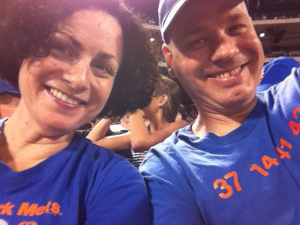 We look happy because we were. Any Saturday night in my wife’s company is marvelous, but I didn’t have a lot of hope that the Mets would do their part. My trust in Mike Pelfrey has been eroded to basically nothing, and Pelf was going up against the supremely talented, impressively leonine Dan Haren. But Pelf made it clear early on that this night he was trustworthy, throwing all his pitches for strikes and working with speed and purpose. Meanwhile, speed and purpose were the Mets’ calling cards as well. They ran wild against Haren and Hank Conger, throwing off Haren’s rhythm first and then starting in on his location. Reyes’s first steal led to Carlos Beltran serving a high curveball into center for a 1-0 lead; Angel Pagan’s first steal led to Jason Bay smacking a pitch for another run (and a nice semi-standing semi-ovation for the resurgent Bay); Bay’s steal led to a carom shot by Lucas Duda off Russell Branyan’s glove and past Howie Kendrick; and Reyes’s second steal set up Justin Turner’s RBI hit to right.
And then oh my goodness.
We were sitting a couple of rows behind third base, from which juncture the center-field fence of Citi Field is quite a ways off. It’s a big park (maybe you’ve heard), one in which a lot of fly balls look promising but wind up in the gloves of outfielders, or elude those gloves in the big spaces out there and turn into doubles or triples. You can be teased by fly balls anywhere in the park; from field level it’s even easier to be fooled.
But none of this mattered when Beltran connected. One of the many things I adore about baseball is how when a batter really tears into one, the sound and the trajectory quickly make you think the ball was struck by a man twice as tall as any man could be. Everyone in the park knew the ball was gone — the only question was how gone. The answer: gone enough to bounce off the Shea Bridge, way out there in Davis/Duda/Dunn territory. Standing at home plate, Beltran gave his bat a slightly little jaunty mini-flip, a pose that Sammy Sosa might have struck for a middling sac fly, but was downright boastful for Carlos. No Angel took exception — hit the Shea Bridge and you’ve earned the right to style.
That ended Haren’s night and made the rest of the game basically academic, with the sole remaining drama concerning whether Terry Collins would let Pelfrey go back out for the ninth. He did and Pelf was superb, save for poor Turner extending the game by muffing a Bobby Abreu grounder with two outs. While Turner looked for a divot deep enough to vanish into, all eyes in our section turned to Collins, now pacing in agitation by the bat rack.
Stay there, we urged him. He did, and one Vernon Wells pop-out later all was well.
by Greg Prince on 18 June 2011 2:22 am No Braves. No balk. No lead blown. No comeback dashed. No sense of drama, really, until the ninth, and then no drama. Nothing like Thursday night’s manic Holy Hellfest, so named per what I just kept muttering to myself over and over and over as I pieced together what happened to K-Rod by intermittent earbud and to Carrasco by underground Droid. “Holy hell. Holy hell. Holy hell. I can’t believe they lost. Holy hell.” Thursday night was, in baseball terms, a disaster, a debacle, a disgrace, made all the more disdainful because the Mets have been playing such fiery baseball of late. They don’t have the barrelful of wins to show for it that a really good team would, but they used their jaunt to Milwaukee, Pittsburgh and Atlanta to earn our full attention, support and respect. Thursday night, when they couldn’t close the deal in Atlanta…holy hell.
Friday night, against some American League team I used to kind of like, the Mets played with torpor instead of fire. They were all out of position in the infield, all out of sorts at the plate. They forged exactly one moment when the 2011 Mets as we’ve come to admire them — the incarnation that dates back to approximately June 2 and the seven-run comeback versus the Bucs — materialized from thick, soggy air to raise our hopes. That was the bottom of the ninth, Mets down 4-3. Jose Reyes’s sheer determination won him a walk. Jose Reyes’s unmatched talent stole him a base. Justin Turner refused to not join him on the paths. The Los Angeles Angels’ kid closer, Jordan Walden, faced two on, none out, and what passes for the heart of the Met order. Unofficially, Jose Reyes is the heart of the order, but in traditional terms, we had 3-4-5 coming up: Beltran, Murphy and Pagan.
And there we were waving Beltran, Murphy and Pagan goodbye, each stranding the tying and winning runs, all striking out against Walden’s heat. Back into the humidity and the torpidity they went. Appropriate ending to a decidedly imperfect game. Chris Capuano was good enough to win for a team whose offense could forgive a lack of sharpness, not really good enough to win on merit. Manny Acosta seemed quite effective, or perhaps the Angels were tired by then, too.
I was at this game and I barely remember its contents. I’m glad, I suppose, that it wasn’t more holy hell. It was barely heck. Not all one-run losses eat you up inside.
Which is good, if not particularly interesting.
***
Thanks to the Spencers of the U.K. for arranging to meet Stephanie and me during the pregame rain delay. Brian and Chris (or Kris; didn’t get a spelling) are visiting America on one of their periodic ballpark jaunts, and Brian happens to be a FAFIF reader, to boot — which, I learned, is what the British refer to as the trunk of a car. Their hood is a bonnet, and their scallions are spring onions, though they used to be known in England as scallions. Fascinating stuff. If only the ballgame that followed it was as intriguing as the linguistic discussion that preceded it.
by Greg Prince on 17 June 2011 3:30 pm Welcome to The Happiest Recap, a solid gold slate of New York Mets games culled from every schedule the Mets have ever played en route to this, their fiftieth year in baseball. We’ve created a dream season consisting of the “best” 64th game in any Mets season, the “best” 65th game in any Mets season, the “best” 66th game in any Mets season…and we keep going from there until we have a completed schedule worthy of Bob Murphy coming back with the Happy Recap after this word from our sponsor on the WFAN Mets Radio Network.
GAME 064: June 20, 1982 — Mets 5 CARDINALS 4 (10)
(Mets All-Time Game 064 Record: 23-26; Mets 1982 Record: 34-30)
Strange how pieces get moved around the chessboard of Major League Baseball, at least when you pull back with hindsight and consider where those pieces sat before you completely focused on their positioning and what it would mean to you. One year you have your pieces and you react accordingly to how they are moved on your behalf. Another year, they’re not your pieces and you will be destined to remember them differently.
But before that happens, while they’re still your pieces, you root for yours and you root against the ones that aren’t yours yet. After all, you have no idea that they one year will be.
In a game like this Sunday afternoon’s at Busch Stadium, Mets fans’ rooting interest was pretty clear. With Joaquin Andujar trying to preserve a 2-2 tie in the top of the ninth, John Stearns, eventually the 1982 Mets’ all-star representative at catcher but here playing third base, doubled. Ron Hodges, catching in Stearns’s stead and generally hanging around as he had for nearly a decade, bunted the runner to third. George Bamberger went to his most dependable pinch-hitter, trusty Rusty Staub, to drive in Stearns, but he never got the chance, as Whitey Herzog ordered Kaat to put Le Grand Orange on first base. Wally Backman replaced the less mobile Staub at first. Mike Jorgensen replaced starter Charlie Puleo at bat. Jorgy walked to load ’em up.
If the Cards had a lead, perhaps the White Rat would have tabbed closer deluxe Bruce Sutter to face the next batter, Mookie Wilson. Then again, Wilson had taken Sutter very deep the previous September, essentially costing St. Louis the second-half 1981 division title. So Herzog opted for Jim Kaat. Kitty — who had 279 wins banked from a career that stretched back to the 1959 pre-Twin Washington Senators — didn’t quite roar like he used to. Wilson, on the other hand, was regularly on the prowl for base hits in 1982, and he collected his second of the day to put the Mets up 3-2. There was, however, a bit of Redbird salvation as Backman tried to score on Mookie’s single to left but was thrown out by Lonnie Smith at home, avenging an earlier play when second baseman Bob Bailor nailed opposite number Mike Ramsey at the plate. (Staub wouldn’t have scored, either, but Staub probably wouldn’t have tried.) Mookie was Kitty’s only batter. Doug Bair came in to retire Bailor to end the inning for the visitors.
The Cards, down to their last chance, tried to make something happen against Bamberger’s latest idea of a fireman, Mike Scott. Scott had washed out of the rotation but was something of a hot hand coming out of the bullpen, recording the saves in the Mets’ previous two wins in the series. Perhaps the 27-year-old righthander was finding his calling as a closer. He grounded out Darrell Porter and Ken Oberkfell on consecutive groundouts. Scott was one out away from three saves in three appearances. All he had to do was put away Keith Hernandez, pinch-hitting for Ramsey. Of course Hernandez was not a pinch-hitter of the Staub/Jorgensen variety — the kind who filled out the Met bench crew that was known as Bambi’s Bandits. He was about as everyday a player as Herzog had, even if Whitey was giving him a blow for a change.
To the consternation of Mets fans everywhere, it was Hernandez striking the next blow, homering off Mike Scott to tie the game at three. Mets fans rooting for Mike Scott to get Keith Hernandez out couldn’t have been more disappointed. Except, that is, when Ozzie Smith singled to keep the inning going. Frowns turned upside down, though, when Scott picked the so-called Wizard off first base. It was the fourth pickoff of the day, two for each side.
A tenth inning materialized. George Foster, obtained by the Mets to clear the air traffic from over Shea Stadium (Foster’s words), beat out an infield hit. Another Rusty came off the bench to run for him — Rusty Tillman. And another of Bambi’s Bombers entered as well. Joel Youngblood, the Mets’ lone All-Star of ’81, had lost his right fielder role to Ellis Valentine (who had homered for both of the Mets’ early runs in the fourth) and was now asked to fill in here and there. At this moment, he was asked to pinch-hit for Scott. Youngblood, who likely figured he’d sacrificed plenty, was asked to sacrifice again…literally. He bunted Tillman to second and was safe at first on the attempt. With two on, Valentine struck out (no evidence exists that Youngblood rubbed his hands together in glee). Up stepped Stearns, who had gotten the Mets back into things in the ninth with that leadoff double. And against Sutter, who would join him on the All-Star team in July, Stearns tripled, scoring Tillman and Youngblood for a 5-3 Mets lead.
It was the third consecutive save versus the Mets that Sutter had blown, dating back to the previous September, dating back to that fateful encounter with Mookie.
Hodges, perfectly suited to loitering given his almost incidental occupation of a roster spot since 1973, stood at home plate long enough to be intentionally walked by Sutter. With a golden opportunity to tack on further runs, Backman grounded into a double play.
The bottom of the tenth was handed to Jesse Orosco, the 24-year-old lefty whose 1982 had been hit or miss to date. Sunday at Busch, Jesse was a little too much in between. After getting Julio Gonzalez to ground to Stearns at third for the first out, he gave up a double to Lonnie Smith, who advanced to third on an error by Mookie (who also made an error in that September ’81 game he eventually saved with his home run off Sutter). Rookie Willie McGee’s fly ball to Wilson scored Smith and now it was 5-4, with runs having scored in the top and bottom of the ninth and the tenth.
After a walk to pinch-hitter Gene Tenace, Bamberger removed Orosco for his next de facto closer, Ed Lynch. The soft-tossing righty earned his second save of the season when George Hendrick lined out to Bailor, who had moved to short. Ten different Mets registered saves in 1982, nobody with as many as twenty. Sutter, on the other hand, would recover from his Met mishaps and nail down 36.
The Cardinals would recover, too, this 5-4 loss no worse than a bump on I-70. Far from being unnerved that the third-place Mets had crept to within three games of their National League East lead, St. Louis would shake off losing three of four games this weekend and go on to win the World Series for the first time in fifteen years. Bruce Sutter would record the final out and the save in Game Seven. Jesse Orosco would someday do the same thing for the other team here, but that couldn’t have been known then. Nor could it be imagined that among the other pieces on the Busch board that day, Cardinal mainstay Keith Hernandez would be a Met within a year’s time and that the greatest obstacle to his and Jesse’s and Mookie’s and Wally’s ultimate happiness would be the guy who blew the save for the Mets in the bottom of the ninth, the guy who allowed the homer to Keith Hernandez, Mike Scott…an ex-Met within a year’s time, a Met thorn before long.
All anyone knew then was that Hernandez homered off Scott and it meant bad news for the Mets. Hard to read a fact like that when you’re wearing the glasses they prescribe for hindsightedness.
ALSO QUITE HAPPY: On June 15, 1999, the Mets ate their Wheaties…or whatever ballplayers ingested back then to give them strength. They began their Tuesday night game against Brett Tomko and the Reds at Cinergy Field by bashing their opponents into submission. Top of the first: Rickey Henderson homered on a 3-2 count;Edgardo Alfonzo walked without seeing a strike; John Olerud homered; Mike Piazza homered. Four batters, three homers, a 4-0 lead for the New York Mets, all accomplished in a span of 13 pitches. Fonzie made up for his non-homering gaffe by homering in the fifth. Matt Franco, getting a rare start at third, took advantage of his opportunity to impress in the sixth and also homered. That was five Met homers off Tomko, four of them solo jobs, so he trailed “only” 6-1. Still, he had to leave. Jason Bere started the seventh — threw one ball to Henderson and then a strike…that was driven over the left field fence for Rickey’s second homer of the night and the Mets’ sixth. A bunch more hits followed and the Mets won, 11-3. Players sure did to like to eat their Wheaties circa 1999.
GAME 065: June 15, 2006 — Mets 5 PHILLIES 4
(Mets All-Time Game 065 Record: 33-16; Mets 2006 Record: 42-23)
What a long, rewarding trip it was. Nothing strange about it, save maybe for just how rewarding it became as it proceeded. By the time it neared its end, it didn’t feel strange at all that the Mets could hit the road and hit everything in sight.
Any team could take two of three in Los Angeles, as the Mets did. Any team, conceivably, get ungodly hot for four days as the Mets did in Arizona and continued to be for the first two games of a three-game series in Philadelphia. But wins like the finale’s, on a Thursday afternoon…the one that sealed a sweep and, it surely appeared, the fate of the 2006 Phillies, are what separates the top of a division from the remainder of a division.
Steve Trachsel provided six serviceable innings (subtract Met-killer Pat Burrell and they’d have been tremendous). The Mets’ four-run first was more than adequate, even though four-run firsts had become something of a Met trademark as they traveled. The Mets scored in the first inning in every one of their nine wins on this continental sojourn, making them the first team in big league history to win eight consecutive away games when scoring in the first inning.
And this quiet sequence from the top of the fifth at Citizens Bank Park, when the Mets were leading 4-2, exemplified how many cylinders they were firing on:
• Jose Reyes doubles.
• Endy Chavez bunts him to third.
• Carlos Beltran drives him home with a fly to right.
There. That was it That was the beauty of these Mets on what was about to become their record-setting 9-1 road trip to L.A., Phoenix and Philly. That’s what a Met sponsor might have called the Build-A-Run Workshop.
That cleverly constructed run provided Trachsel enough breathing room to give into Burrell (his usual two-run homer, added to an earlier solo shot) when it got to 5-2. From there, at 5-4, the back end of the Mets’ bullpen stretched out successfully.
Aaron Heilman, Duaner Sanchez and Billy Wagner had established themselves as keys to clumps of close wins as the Mets made themselves at home in first place in April and May. With the offense marauding quite a bit on this trip, the troika assigned the seventh, eighth and ninth were not necessarily as vital to the Mets’ overall rampage. But when it came time to get them fully involved, they made their presence felt.
Or not felt, really. You only notice late-inning relievers when they fail.
Heilman, Sanchez and Wagner did the opposite. They succeeded. They were perfect. Each man faced three Phillies and retired three Phillies in order. When Wagner got the last of them (Sal Fasano) for the final out of the 5-4 win, the first-place Mets could look over their collective shoulder and see…
… no one. Rearview mirrors weren’t strong enough to pick up on the Mets’ nearest rivals, who happened to be the second-place Phillies. In the middle of June, they were 9½ out. The distance between New York and Philadelphia may have well as been 90½ miles. Teams had been known to let large leads like these get away, but these 2006 Mets didn’t look like one of those teams. They looked, at the end of a 9-1 road trip — the road trip from heaven, if you will — like a team that had no genuine competition in its division.
Which they didn’t.
ALSO QUITE HAPPY: On June 22, 1962, the Mets began a tradition that would seem just fine on its own if not for one fundamental flaw. Certainly Al Jackson was fine. He was never better — no Mets pitcher ever was and, in a sense, no Mets pitcher ever would be (as far as we know). Jackson gave up a one-out single to Joey Amalfitano of the Colt .45s, the second batter he saw in the opener of this Friday twinight doubleheader at the Polo Grounds. And then he gave up no further hits to Houston, going all the way for a 2-0 win…a one-hitter, the first in Mets history. Over the next half-century, Mets pitchers would pitch 34 more. Some were combined, a couple were rain-shortened, one went into extra innings, but none outdid Jackson’s. They were all one-hitters. Put another way, none was a no-hitter. But one-hitters are pretty good, too.
GAME 066: June 25, 1990 — Mets 3 CARDINALS 2
(Mets All-Time Game 066 Record: 20-29; Mets 1990 Record: 37-29)
The beat went on. The Mets kept pounding their winning rhythm into the brains of their opponents. Summer was here and the time was right for the 1990 Mets to assert themselves in ways few clubs in the franchise’s history ever had.
Set it to any music you like. Mets fans were practically dancing in the streets to celebrate their club’s latest slew of winning ways.
On a Saturday night at Shea, for example, Dwight Gooden shut out the Phillies on two hits. Mets win their fifth in a row. The next afternoon, despite trailing 5-3 heading into the bottom of the ninth, the Mets won their sixth in a row, with Gregg Jefferies driving in a run off former teammate (and occasional foe) Roger McDowell and pinch-hitter Tim Teufel bringing home they tying and winning tallies when there were two out. Come Tuesday night in St. Louis, for their eighth consecutive win…
Oh wait, we’re skipping one. When there are that many wins happening all around you, it’s easy enough to do. But why would you want to? So let’s rewind slightly to Monday night at Busch Stadium, the Mets’ winning streak at six, the Mets picking up ground almost daily on the first-place Pirates. The Mets couldn’t get a shutout like Doc had on Saturday because David Cone let a second-inning run score (albeit on an Ozzie Smith double play ball). They couldn’t manufacture a walkoff rally because they were on the road. So what would they do to keep the winning going?
Well, let’s see…how about they get to the ninth tied at two. How about Mackey Sasser pinch-hits for Cone with one out and singles off fearsome Lee Smith. How about after the second out of the inning Dave Magadan doubles, sending Sasser to third and, just for kicks, we have the Cardinal right fielder, Milt Thompson, have a tough time making a clean play? That way, we can have Sasser race all the way around from first to put the Mets up 3-2.
And then, finally, we can have John Franco come in and retire the Redbirds 1-2-3 in the home ninth for the Mets’ 1-2-3…seventh win in a row. Yes, a 3-2 victory like that would work fine. The same could be said for the next four games the Mets would play. Such uninterrupted patterns would result in an eleven-game winning streak for the 1990 Mets, tying the team record set in 1969 and equaled in 1972 and 1986. Once the streak reached its peak, the Mets had reached a first-place tie with Pittsburgh. By then, the Mets had taken 18 of 20 overall.
The beat went on. The streets got danced in. The Mets couldn’t have been any hotter.
ALSO QUITE HAPPY: On June 21, 1977, somebody who, in theory, couldn’t have been less welcome at Shea Stadium made himself completely comfortable, and nobody minded at all. It’s 2-2 in the eleventh inning, working out to approximately one inning for each thousand fans who were in the house this Tuesday night. No, the Mets aren’t a big draw in the week following June 15, 1977, and the trade of Tom Seaver to Cincinnati. The Mets attempted to keep their diehards preoccupied nonetheless. Ed Kranepool kept them around by homering off Andy Messersmith in the bottom of the ninth, tying the game. Kranepool kept them there a little longer when he flied out with the bases loaded in the tenth. With Krane making the last out, Joe Torre pulled him from left field in a double-switch, replacing him with brand new Met rookie Steve Henderson, one of the four Reds/Reds prospects the Mets received in exchange for Seaver. It wasn’t how a young player would want to get to New York, but there Henderson was, in New York. And there he was again, up in the bottom of the eleventh with two on and one out. And there it went…a pitch from Don Collins that Steve cracked over the Shea fence for a 5-2 Mets win. Nice way to ingratiate yourself with an embittered fan base.
by Jason Fry on 16 June 2011 11:10 pm It’s wonderful to be a Mets fan right now. It really is. While everybody tells jokes, the Mets have assembled a Quadruple-A lineup of guys who don’t do too much but do just enough, playing the game the right way, not shooting themselves in the foot and —
DICKEY! WOULD YOU NOT DO THAT? I KNOW KNUCKLEBALLS ARE CRUEL MISTRESSES AND SOME NIGHTS THE THINGS JUST WON’T DO WHAT YOU NEED THEM TO DO, BUT NOT TONIGHT! NOT WITH A CHANCE TO SWEEP THE BRAVES AND MOVE A GAME OVER .500!
Ahem. As I was saying, the Mets are playing within themselves, despite missing key players and facing financial uncertainty. Leading the way tonight, as usual, was the marvelous Jose Reyes, who seems like he can do anything that needs doing at any point in any game. It’s an absolute pleasure to —
MURPH! LOVE YOU, BUT YOU NEED TO PLAY FIRST BASE, NOT SOME IMAGINARY POSITION THAT’S NOT REALLY FIRST AND NOT REALLY SECOND! STUFF LIKE THAT COULD COME BACK TO BITE US, YOU KNOW!
Could we keep it down over there? Justin Turner, AKA Ginger Thunder, was back and on base any which way he needed to be, and Jason Bay showed more signs of coming around, turning in much more confident at-bats and racking up his second straight multiple-hit game. And then there was Scott Hairston, nearly forgotten, cranking a three-run bomb into the left-field stands to finish a comeback from four runs down. And the bullpen was spectacular, what with Manny Acosta (of all people) and Pedro Beato and Tim Byrdak and Jason Isringhausen and —
K-ROD! NOOOOO! AUGGHHHHH!!!!!! THAT WAS SO NOT SPECTACULAR! THAT COMPLETELY SUCKED!
Look — I have the floor here. It sure helped that the Braves played the kind of game that’s typically followed by Coach driving the station wagon angry and not making jokes or letting you tune the radio until even the dumb kid figures out that the usual postgame trip to the Tastee-Freez isn’t happening today. Fredi Gonzalez is well on his way to actually becoming Bobby Cox: He’s dumpy and looks perpetually unhappy and fumes and carps and fusses at umps and engages in low-level gamesmanship all the time. Which is —
DUDA! DIDN’T WE JUST COVER THIS WITH MURPHY!!!!
That’s enough outbursts. Sheesh! Even after K-Rod’s lamentable homer surrendered to Brooks Conrad, I had faith. The Mets weren’t playing efficiently, but they’d pull out a wild and woolly one somehow. As usual, I put my faith in Reyes. It seemed entirely possible that he would hit a home run because he had to, or steal second and then steal third and then force some hapless Brave who knew better to balk in a —
CARRASCO? REALLY?
Ugh. After which we never, ever spoke of it again.
by Jason Fry on 16 June 2011 1:38 am OK, actually half-bad is exactly what we are. But compared to what we were not so long ago….
It turns out nothing can stop Dillon Gee except thunder, lightning, lunatic gales and cruel but sensible precautions related to long rain delays and surgically repaired labrums. Our favorite advanced-stats conundrum mowed down the Braves for four innings, scratched only by an Alex Gonzalez double, but was denied a chance to go 8-0 because he couldn’t go five innings. (The win, arbitrarily, went to Bobby Parnell.)
I remain fascinated by Gee, who’s a confounding specimen whether you’re an advanced-stats guy or fan who talks intangibles. ESPN New York’s Mark Simon did a nice job digging into Gee’s numbers today, and you can still see the red flags: Going into tonight’s game, his fly ball:home run rate was 16:1, where 10:1 is typical; his xFIP was 3.91, not bad but not matching his otherworldly ERA; and his BABIP was .244, a lot less than the typical .290-to-.310 range.
If any or all of those numbers regress to the mean, Gee won’t look so fantastic, and writers and fans will start intuiting negative things from how he carries himself on the mound, where right now we see positives. I liked Brian Costa’s Wall Street Journal piece on Gee, which came complete with wise quotes from R.A. Dickey and Terry Collins about how nothing fazes him, but I worry such analysis is a variant on a timeless baseball Just So story: If you’re a young pitcher who doesn’t outwardly fret about things, a 7-0 record means you’re cool and mentally tough, but an 0-7 record means you’re bloodless and selfish. This isn’t a shot at Costa, who’s a lively writer with a nose for interesting tales. Rather, it reflects my worry that we’re all hard-wired for this kind of storytelling, for constructing narratives and sniffing out motives to fit whatever facts we think we have. It’s very hard not to do it, even when conclusions may be premature.
But whether Gee is just on a lucky streak or has qualities that will become clearer and more appreciated as we amass more information, he’s a joy to watch and wonder about. (I could have waxed rhapsodic for 400-odd words about whether Manny Acosta is average and unlucky or actually bad, but you’d have lost interest and gone back to watching Canadians behaving deplorably on YouTube.) Gee can throw his change to either edge of the plate, his location is generally terrific (Bill Miller handed out several unwarranted balls to veterans), and he throws harder than you think. He works quickly and unfussily, with the little pause in his windup the only thing about his motion that stands out. The way I’d describe Gee is uncomplicated, which I mean as a compliment: He conducts himself like a man who knows he’s doing something inherently difficult, the outcome of which is out of his control to an aggravating degree, and therefore thinks he should go about it with a minimum of mechanical and emotional fuss and bother.
That’s storytelling again. I don’t know if it’s true, but it seems to fit the facts we have. And I sure want it to be true.
* * *
With the rain falling for a second time, the Mets yielded to Game 7 of the Stanley Cup Finals, then very politely returned a couple of minutes after the Bruins finished dismantling the Canucks. Gee was gone, but D.J. Carrasco, Parnell and K-Rod all pitched beautifully to finish what he’d started, shutting out the Braves on two hits, two rain delays, about 35,000 empty seats, one bobblehead and an excess of lightning. The Mets played a crisp game in the field and on the basepaths, with one Angel Pagan Class of ’09 headscratcher the only real blemish. Daniel Murphy played a beautiful game at third, Jose Reyes was his habitual dangerous self with the bat and in the field, Lucas Duda looked surehanded at first, Jason Bay looked sounder at the plate and all was well — a winning road trip is assured, and the Mets are back at .500 despite all their missing players and payroll.
Which leads us dangerously close to storytelling again. The Mets are getting terrific starting pitching and riding a Beltranesque salary drive by Reyes, and it wouldn’t be much of an oversimplification to stop there. But OK, beyond that they seem a bit like my characterization of Gee: They’re playing unfussy, sound baseball and as a result they’re winning a lot more often than not. Baseball is always fun, but it’s a lot more fun when you begin to trust your team. I was genuinely surprised that the Mets didn’t beat the Pirates on Monday night, not because the Pirates are the Pirates (they’re having a glass happily half-full season just like we are) but because I’d come to expect the Mets to not make mistakes and beat themselves. When they did, I wasn’t angry so much as I was startled.
When your team’s playing like that, you see the familiar ghosts are made of tissue paper and string, and you dismiss apparent portents as mere noise. Frankie Rodriguez came in for the ninth against the heart of the Braves’ order in a non-save situation, which historically has coincided with his attention being a bit fitful. He calmly retired Dan Uggla and Brian McCann on fly balls to Bay, then faced Chipper Jones.
Chipper, in the Mets’ traditional house of horrors.
He struck out, at Turner Field no less. And I realized I hadn’t been worried.
* * *
Some things to note:
- If you haven’t read Ted Berg’s meditation on baseball and family, love and loss, . It’s amazingly good.
- Tonight at 7 p.m., Greg and Howard Megdal will read from the late Dana Brand’s books at the Tappan Library in Rockland County. I can’t make it, but I hope a lot of you can. More details here. And if you’re up and about this morning at 7:35 a.m., check out Greg on WKNY, 1490 on the AM dial in the Kingston area.
- Mets fan Roger Hess is currently climbing Denali in Alaska to raise funds for the Tug McGraw Foundation to help battle brain cancer in honor of his friend and fellow Mets fan David, in the midst of his own battle with that insidious disease. Read their story here and, if you can, please give what you can here.
by Greg Prince on 15 June 2011 4:00 pm In the wake of Dana Brand’s passing, Howard Megdal had a fine idea. He noticed Dana had a date scheduled well in advance to read from his books Mets Fan and The Last Days of Shea at the Tappan Library in Rockland County, not far from where Howard lives. Wouldn’t it be something, Howard suggested, to keep the date? Wouldn’t it be something to go and read for Dana? Sounded like something plenty good. He asked me to join him, and I said yes. Like Howard, I couldn’t be more humbled at the prospect.
The date is tomorrow night, Thursday June 16, 7 o’clock ’til 9. Howard and I will read what Dana wrote, discuss as best we can why Dana wrote and, hopefully, meet some Mets fans and fans of Dana’s. If we can introduce anybody unfamiliar with either to both, all the better. (And don’t worry: all action from Atlanta will be subtly and respectfully monitored.)
If you’re in the vicinity of 93 Main Street in Tappan, we hope you can join us. (Also keep in mind the date of July 16 for the celebration of the life of Dana Brand at Shea Stadium/Citi Field; details here.)
Speaking of authors of Mets books worth delving into, check out Howard’s latest, Taking the Field: A Fan’s Quest to Run the Team He Loves. It’s an engaging trip through the mind of the would-be general manager of the New York Mets, and a worthy addition to your baseball library.
Oh, and I think you might hear me on WKNY, 1490 on your AM dial in the Kingston area, Thursday morning at 7:35, though when I checked them out during drive time Wednesday morning, they were playing “Faithfully” by Journey. Hmm, maybe that was a plug for Faith and Fear. Anyway, you can listen in here.
|
|






