The blog for Mets fans
who like to read
ABOUT US
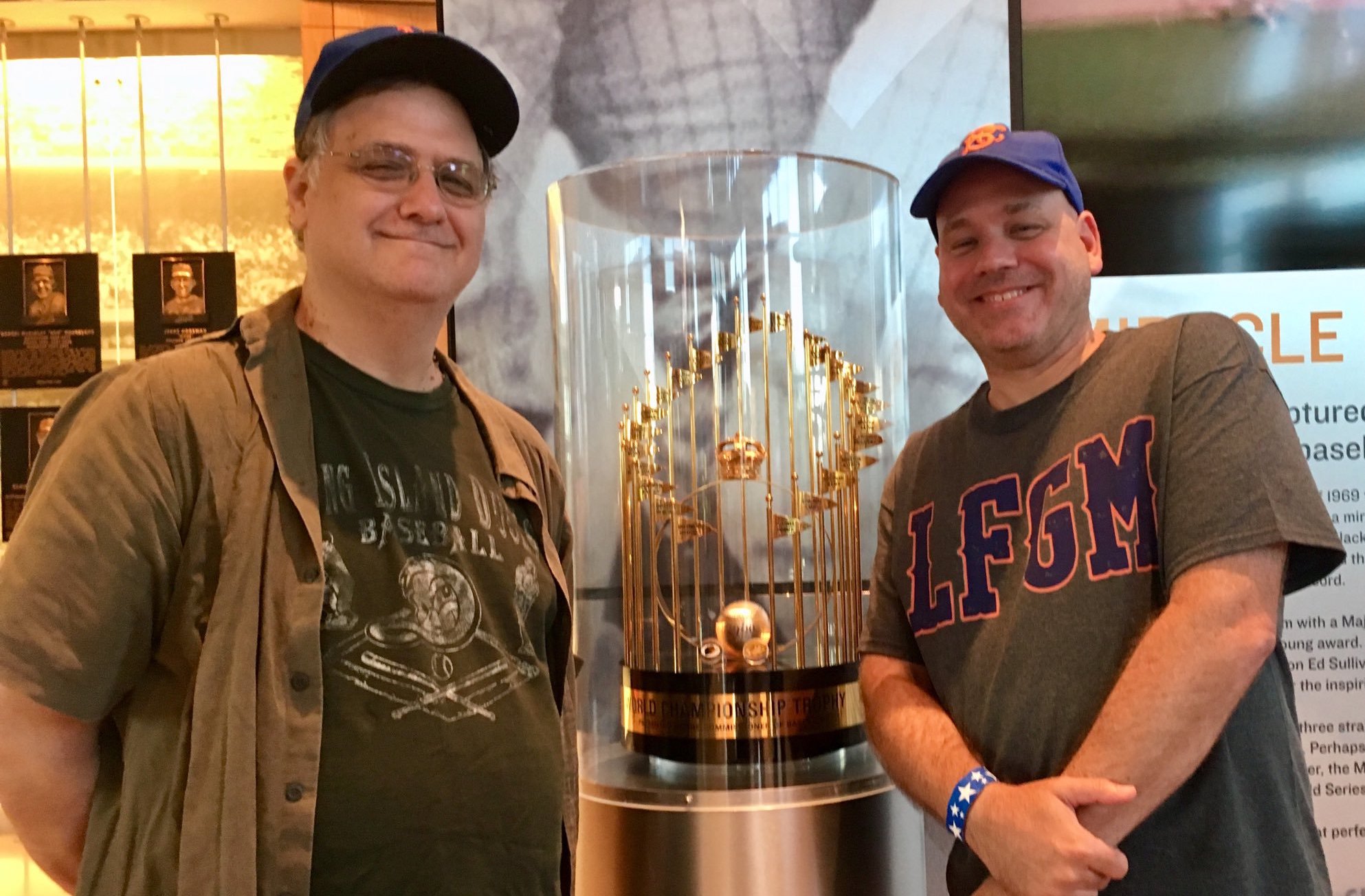
Faith and Fear in Flushing made its debut on Feb. 16, 2005, the brainchild of two longtime friends and lifelong Met fans.
Greg Prince discovered the Mets when he was 6, during the magical summer of 1969. He is a Long Island-based writer, editor and communications consultant. Contact him here.
Jason Fry is a Brooklyn writer whose first memories include his mom leaping up and down cheering for Rusty Staub. Check out his other writing here.
Got something to say? Leave a comment, or email us at faithandfear@gmail.com. (Sorry, but we have no interest in ads, sponsored content or guest posts.)
Need our RSS feed? It's here.
Visit our Facebook page, or drop by the personal pages for Greg and Jason.
Or follow us on Twitter: Here's Greg, and here's Jason.
|
by Greg Prince on 11 April 2011 1:30 pm Some of you nice Faith and Fear readers occasionally make the gracious comment that you’d like to buy us a beer the next time you see us at Citi Field. Well, we’re ready to take you up on your generous offer, but we don’t want a beer from you, per se. We don’t even want a soft drink.
Here’s what we do want:
If you’re coming to the Mets-Astros game on Thursday evening, April 21, we’d like to meet you at McFadden’s between 6 and 7, prior to first pitch. And as we meet, we’d really, really appreciate it if you could help us and our good friend Sharon Chapman in her ongoing efforts to raise funds for the Tug McGraw Foundation.
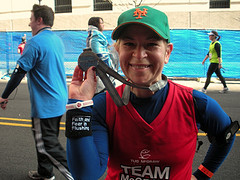 Sharon Chapman, keeping Tug McGraw's memory alive one race at a time. Sharon, as she’s been doing virtually nonstop since early 2010, will be running again soon with Team McGraw — in Philadelphia (while wearing a Mets cap, of course) on May 1 in the Blue Cross Broad Street Run. She and they do all this running to raise awareness as well as money for the Tug McGraw Foundation. This wonderful organization was started prior to Tug’s untimely 2004 death from brain cancer and serves as a living tribute to the spirit of the ultimate Believer as well as a beacon of hope for those fighting the same battle Tug knew too well.
The Foundation seeks to accelerate new treatments and cures to improve the quality of life for children and adults affected by neurological conditions such as brain tumors, Post Traumatic Stress and Traumatic Brain Injury. You can learn much more about its work by clicking here.
We’ve hocked on you good people several times in the past fifteen months about the Tug McGraw Foundation and you’ve come through like champs for this worthy cause. We’re hoping we can engage your patience and better angels just a little more in advance of Sharon’s next race.
We have three ways of asking for your help and hope you can get on board with whichever one works best for you.
1) Come to McFadden’s on April 21 and don’t buy us a beer — buy Tug a beer. We’re going to have a fundraising jar and will ask you to contribute the price of a beer — domestic, imported, whatever you’re comfortable with — to our container. All of the proceeds will go to Sharon’s fundraising kitty and from there, it all goes to support the research being done by the Tug McGraw Foundation.
2) If you yourself would like a drink or two before the game (and we can’t blame you if you do), we have a deal that you might like. McFadden’s has arranged to make available special wristbands that night. For $20, you get all the beer or well drinks you can responsibly enjoy between 6 and 7 on April 21, and 25% of that total will go to our Tug McGraw Foundation fundraising. So in essence you’re paying $15 for “all you can drink” (responsibly) for that hour and $5 to help further the Foundation’s important work. We thank McFadden’s Citi Field for their cooperation in putting this arrangement together.
As an added enticement (we hope), anybody who goes to the trouble of purchasing a wristband will be automatically qualified for a drawing (at around 6:45) for a signed copy of Faith and Fear in Flushing: An Intense Personal History of the New York Mets. This is the soft cover 2010 edition that includes an epilogue regarding the first year of Citi Field, in addition to a few hundred pages devoted to exploring a lifetime spent at Shea Stadium. We’ll have a few copies, actually, so your chances of winning are already increased.
3) We’d love to see you at McFadden’s. We’d be thrilled by a massive turnout for Tug, but we understand that not everybody will be going to that particular game (though plenty of good seats are still available). Thus, we’d like to remind you that you can make a contribution anytime by going to Sharon’s dedicated fundraising Web site here. If you can spare the price of a beer, that would be plenty.
We look forward to meeting you at McFadden’s on April 21 between 6 and 7 prior to that night’s Mets-Astros game. We look forward to talking Mets with you, talking Tug, talking running (ask Sharon about that part; I’m more of a sitter), talking Faith and Fear, talking whatever you’d like. We obviously seek your support for the Foundation, but we’d be happy to have you simply stop by and say hello.
And if you could buy Tug a beer, I’m guessing somewhere he’d really appreciate it.
by Jason Fry on 11 April 2011 12:47 am Mike Pelfrey’s ERA is 15.63. He’ll get another start tomorrow. And another one four days after that. And so on for a reasonable distance into the future.
Blaine Boyer’s ERA is 10.80. He threw 119 pitches this year. His Mets career is presumably over: He was designated for assignment after yesterday’s debacle, a 3-2 Mets lead turned into a 7-3 Nationals win.
This isn’t exactly a cosmic injustice: Boyer was ghastly today and not much better earlier this year. But every player on every big-league roster is going to be ghastly for the majority of a five-game stretch sometime this year. If you’re an established player, it means you’ll have to face a wall of microphones, offer penitent platitudes, and talk of making adjustments, which really means futz with little things while waiting for a regression back to the mean. But if you’re a fringe guy — a middle reliever, a pinch-hitter, a fourth outfielder, a fill-in starter, a backup catcher — a bad stretch instead of a good first impression means you’ll be hitting the bricks before you can say “Frank Catalanotto.” Was Catalanotto really hopeless, or did he just fail too often before his first equally lopsided run of success? Go back in Mets history and you could ask the same question dozens and dozens of times, from Jon Switzer to Jon Nunnally. If R.A. Dickey had taken the mound for his first Mets start in frozen conditions that left him with no feel for his knuckleball, he could easily be a fitfully recalled funny name instead of The Most Interesting Man in the World.
I won’t particularly miss Boyer, particularly since his departure means the arrival of prodigal pitching son Jason Isringhausen. Nor am I surprised: There’s always a middle reliever (or two or three) who’s somewhere else before you put the winter jacket away for good, with his cause of death ill-timed ineffectiveness. And hey, fringe guys know this — it’s part of the job description, unfairness and all. Screw up and the next look will be at another guy. But when the 2011 Holy Books are assembled and Boyer gets his snarky/pithy summation, I’ll try to remember that while it would be certainly accurate to write something like “ginger-bearded ex-Brave sucked, disappeared,” it would be a lot more fair to write something like “ginger-bearded ex-Brave sucked at the wrong time, disappeared before getting a chance to not suck.”
* * *
As for the rest of yesterday’s unhappy affair, we should all give praise to Chris Young, the hulking, good-humored-looking pitcher who certainly deserved a second Mets win for maneuvering National after National into sending balls airborne on short, harmless arcs. (It was particularly fun to watch Jayson Werth stomp away from the plate with a sour look on his face.) In the early going it sure seemed like Young would wind up smiling and trading high fives (medium fives in his case) with his teammates. While obviously taking his craft very seriously, Young somehow always looks like a man who’s thinking of something amusing and about to betray himself by twitching the corners of his lips; that’s quite a contrast to Jason Marquis, who pitches as if he’s being shuttled between identical lines at the DMV, stalking around and muttering to himself. But Marquis hung in there, the Mets stopped hitting, and then the bullpen … did that.
Over the life of this blog there have been a number of run-ins about booing the Mets. When is it acceptable, assuming it ever is? What’s the threshold for booing? Can you boo by proxy? Are there physical errors so hideous or ill-timed that you can boo them, or should it be reserved for mental mistakes? And so on.
I’ve always felt that booing is acceptable for painfully boneheaded or lazy play, for a string of failures so metronomic that the mere sight of a player sucks the life out of the crowd, or for when a player is so consistently misused that booing him is obviously aimed at the stubborn GM or owner who’s refusing to do what everybody knows has to be done. I suppose it’s also acceptable when you’re so upset that not booing might cause you to turn around and claw the face off the drunk guy behind you who’s been loudly broadcasting his idiocy since the top of the third. But whatever the case, booing is the fan’s tactical nuke, to be used only in battlefield conditions when peril seems existential.
Which means if you’re booing, you damn well better know your baseball enough to justify it. Which is where I part company with a good chunk of today’s Citi Field crowd, who sent D. J. Carrasco dugout-bound with plenty of ill tidings. Yes, Carrasco let in two runs and turned Young’s W into an ND. But how did that happen? You’ll never know by looking at the play by play; if you were watching the actual goddamn game in front of you, on the other hand, you have no such excuse.
Ivan Rodriguez led off the top of the seventh with a drive to right field that a natural right fielder would have caught on a loping run; unfortunately, Lucas Duda isn’t a natural right fielder, so a bad route and Duda’s plodding strides let Pudge’s ball go over his glove for a double. Carrasco got eventual villain Laynce Nix to fly out, walked Matt Stairs (not a horrible outcome under the circumstances), then watched helplessly as Ian Desmond dropped a meek but perfectly placed pop-up between Brad Emaus and Angel Pagan. After Desmond stole second, Rick Ankiel grounded to second, with the fielder’s choice bringing in the tying run and sending out Terry Collins. BOO, said too many of the fans, ignoring the fact that if not for a misplay and some ill luck, Ankiel’s grounder would have been the fourth out.
In a situation like that, boo physics, fate or God if you like; unless you loathe high socks to an unhealthy degree, booing Carrasco was just stupid.
On the other hand, those of you who chose to boo Blaine Boyer an hour or so later probably didn’t notice my objections, quiet and perfunctory as they were.
by Jason Fry on 10 April 2011 1:36 am Even for my baseball-obsessed family, it was a wall-to-wall day.
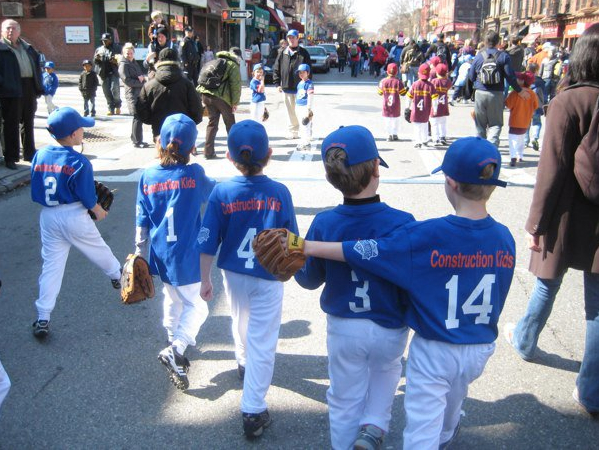
Saturday began with the annual Little League Parade, an exercise in genial chaos in which a rainbow of teams assemble on a block of 1st Street whose residents I imagine make sure to be out of town this particular weekend, then march down 7th Avenue to 9th Street, then up the hill to Prospect Park. “March,” you’ll understand, is a somewhat approximate description: It’s more a kind of Brownian motion, with kids racing around and tossing balls and stealing each other’s hats amid a mass of parents and siblings and dogs and cops and bands and miscellaneous well-wishers and the occasional defeated-looking driver wondering what the heck this is and wishing he’d known about it. It’s about as Brooklyn as it gets, the borough become a very big small town.
And Joshua even gets to wear the right colors, as you can see for yourself. Yes, those are Mets colors — and with a Brooklyn Cyclones logo on the sleeve, no less.
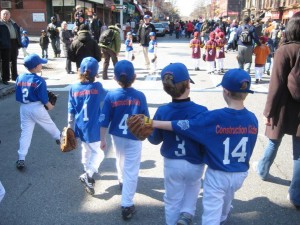 Five Tornadoes march proudly through Brooklyn. Having paraded in the morning, in the afternoon our newly christened team (the Tornadoes) went out and claimed their first victory, a contest that would have been perfectly concluded by Bob Murphy announcing that “the Tornadoes win the damn thing, 28-26.” Standing behind the catcher and the umpire to prevent passed balls from rolling into the dog pond (a position the teenaged ump dryly and correctly noted “sees the most action on the field”), I had an excellent view of my kid’s three-run double, which made me want to throw another parade on the spot, even though an older third baseman might have kept it from shooting past into left field and it might not have driven in three except this kid threw it over the head of that kid who threw it over the head of that other kid who was prevented from throwing it over the head of another kid by the ump declaring the ball dead, which is the way most plays end when the players are all eight. A father’s pride knows no asterisks, which is as it should be. And Brooklyn Little League is for the most part a genial affair, with coaches offering positive reinforcement and teenaged umps getting respect even when the score is approximate and parents working together to keep kids away from teammates swinging bats in the on-deck circle. All of which is as it should be too.
With victory secured, we headed home for Baseball Part 3: Mets vs. Nationals, and my first look up close and in HD at Citi Field in 2011. I’d absorbed yesterday’s rather discouraging proceedings via MLB At Bat while on Amtrak, with my decrepit iPhone insisting, to my mounting fury, on losing the audio data whenever a Met had a chance to drive in a run. I wasn’t mollified in the least that the Mets themselves seemed to be missing key data in this situation, and so watched the TiVo’ed pregame festivities with the surly awareness that they’d preceded a dreary, frustrating loss.
But you start over every day, and there were the Mets in the increasingly familiar green and black and brick and orange confines of Citi, and once again properly attired in pinstripes and blue caps. (The phony-retro cream still annoys me, but all in all I’ll take it.) There were happily familiar sights such as Jose Reyes and his smile and his mane, which has reached Predator dimensions, and Ike Davis alternating looking pitifully gawky and enviably graceful inside a single plate appearance, and David Wright inspecting his bat and yanking at his shirt before turning his gaze to the pitcher with an intent, vaguely worried look on his face. There were not-yet-familiar sights, too, such as Terry Collins’ pop-eyed stare and the way his crossed arms and furious gum-chomping convey kilojoules of nervous energy being spun up with nowhere to go, or Chris Capuano’s smooth, rubber-band leg kick, echoed by his oddly aerodynamic features.
The most welcome sight of all was Carlos Beltran’s gorgeous swing employed in service of the forces of good, not once but twice. The first Beltran homer seemed impossible, a high and outside pitch that he somehow pulled into the seats above the Great Wall of Flushing, while the second was a classic case of a pitcher putting a ball in a very bad spot and watching what happens after it’s intersected by a perfect arcing swing. I was so thrilled by those two at-bats that my enthusiasm tacked a phantom 20 feet onto Beltran’s third drive: It wasn’t a third homer, as I happily proclaimed upon seeing Jerry Hairston Jr. retreating toward the warning track, but it also somehow wasn’t an out, as Hairston tried to throw the ball before catching it, which isn’t advised whether you’re a Tornado, a Met or a National.
Just behind that on the Most Welcome list was Ike Davis, Daniel Murphy and then finally Jose Reyes halting a stretch of Met futility with runners on. Ike’s triple ended with a slide into third that was more of an exhausted tumble; Reyes’ double ended more gracefully, with a patented Jose whoosh on the belly across second, the back foot grabbing the base in much the same way a jet fighter catches a cable on the carrier deck. Great to see, and not just because it looked like the Mets would manage to turn bases loaded and nobody out into nothing through the unlikely combination of Ike Davis interfering with Ian Desmond, K-Rod trying to hit and Jose coming up empty. After that, even a sudden flurry of K-Rod walks couldn’t keep us from the win column, and from feeling better about things.
It was enough to make a Mets fan want to throw another parade.
by Greg Prince on 9 April 2011 1:17 am I’m striking a bargain with the 2011 Mets. The arrangement is one I’m confident they can live up to. It goes like this:
You don’t have to play for anything this year, but you do have to keep playing.
I made this deal with them in the ninth inning of their dreary Home Opener loss to the Washington Nationals, a drab late-afternoon affair that made even our dependable R.A. of sunshine appear gloomy. The box score will indicate a distressing lifelessness to the Mets’ offense. My instinct would be to say they didn’t come through in the clutch, except it seems absurd to suggest the Mets were anywhere in the vicinity of the clutch. Their batters had ten opportunities to hit with runners in scoring position and they took a pass on all ten.
Gandhi only wished he could have exercised such passive resistance.
And yet, come the ninth inning, there was something about these Metsies. Except for the you-never-know quotient, I didn’t believe they were going to stage a stunning comeback (though I did allow myself to think, “if they could come back from seven down in Philadelphia, why not from four to the Nationals?”), yet I was encouraged anyway.
Why? Because they kept playing. They kept hustling. They kept their heads in the game. Reyes and Emaus kept playing defense up the middle. Pagan kept on top of a ball to deep center so intently that he turned it into a sparkling 8-6-3 double play. They all kept running to first. With two out in the bottom of the ninth, as the equipment (and what remained of the crowd) was begging to be packed in, Thole went the other way and found a hole. He dashed to first like he knew he was setting up a rally, not merely extending our stay in the chill mist another two minutes. It was small, small stuff on an unfortunately small, small day, but it added up in my esteem.
Yes, the results are eerily resembling 2010 right now, but the attitude is from another time. It’s from this time, and this time is a good time to watch the Mets try to improve. If they can do it from ahead, great. If they have to do it from behind — if they are relegated to a lot of behind in 2011 — so be it. In a way, the final innings as afternoon turned to evening smacked of Spring Training…nothing on the line in the way of winning or losing, but everybody still trying to impress, everybody still giving the impression he hadn’t yet made the club, so every ounce of effort and energy offered really, really mattered.
The way some of these players were going — particularly most of the bullpen — you would assume they’d be on the verge of getting cut if this was still March. But they’re here and they’re giving it what appears to be their all. As one who watched countless motions gone through from the middle of July to the third of October, I can’t emphasize enough how much this teamwide resolve is appreciated.
Let’s remember that before the giddiness of 3-1 and whatever contrarian “hey, you know, they’re really not that bad” optimism we talked ourselves into as Spring Training wore on, the general consensus when Sandy Alderson and Terry Collins were hired was the new regime was going to be given this year to figure out what it had. There were to be no unreasonable expectations for 2011. I’d like to stick with that. My one expectation is, I think, reasonable: play from the first pitch to the last out. It is reluctantly understood and grudgingly accepted that the level of play might need additional time and talent to truly gel. But it is understood and it is accepted.
So no, a 6-2 loss to a team that lowered the inherent effusiveness of a Home Opener just by lining up for introductions is not encouraging. 0-for-10 with runners in scoring position is downright discouraging. Ike Davis just missing every ball in his range wasn’t part of the pact. And relievers not named D.J. Carrasco not looking at all competent was, in a word, lousy. Yet drab as it was, it wasn’t insulting to the passion of the fans. It never is when you detect passion among the players.
Passion won’t necessarily win you many games but it makes them all a lot more palatable even when they’re lost.
And what the hell, it’s the Home Opener. Your team is playing in your veritable backyard again. You’re wearing more clothes than you would ideally for baseball, but much of it has your team’s logo, so you’ll cope. You’re taking the route you always take to your ballpark. If you’re lucky — and boy was I ever — you’re greeting your friends and partaking in their tailgate. You’re tipping your cap to the Willie Mays banner in the plaza and making eye contact with your personalized brick. You’re finding your favorite security guard for the first time in six months, the one who urges you to enjoy the game like he actually means it.
You’re inside and you’re recognizing faces. You’re even running into one of your favorite media figures who, when you’re informing him how much you enjoy his work, graciously shakes your hand and thanks you. You’re applauding the Shea family when it presents its floral horseshoe to Terry Collins to kick off the pregame festivities as Sheas have always done with Met managers — and you’re taming goosebumps when Ralph Kiner makes like a cat and sheds his winter fur to cap the pregame festivities. You’re elated when Ralph fires the first pitch in from the moral equivalent of sixty feet six inches away, straight into the glove of Moooooookie Wilson. You’re elated, too, when the next pitch, Dickey’s first of the day, dies in the sodden atmosphere above left field (and you remind the kid you’ve just met, sitting to your right, not to worry about fly balls like that in this ballpark; you are reassured about the next generation when he gets it immediately).
You’re buying a scorecard even though you don’t keep score because you like to keep at least one scorecard from every season that you go to see the Mets, and this is the 39th season you’re doing that. You’re purchasing an official yearbook by the same force of habit (always go with the “official” yearbook — beware knockoffs). You’re slipping out of the cold (while Mets runners shiver into extinction on base) so you can slip into a couple of Citi Field’s more obscure retail locations to indulge your inner eight-year-old with a few packs of baseball cards. You get home, you open them, you discover you’ve got a Josh Thole and an Angel Pagan and it’s not a lot different from when you were a genuine eight-year-old and you got a Jerry Grote and a Tommie Agee.
You’re in season again. The Mets started playing last week, which counted, but it counts more now that you so naturally fall back into physically being a part of it. You had your Home Opener. It was your holiday, it was your event, it was — per The Pajama Game — your once a year day. Everything else from here on out will be normal. Because it is baseball, and because you will, as if by instinct, take yourself out to it as much as you can, now and then it is bound to be extraordinary. On too many days and nights, however, once it’s stripped of pomp, circumstance and Ralph Kiner’s big daddy coat, it will be too drab to countenance casually if relievers can’t get outs and batters can’t drive in runs.
Mostly, though, it will be normal. If normal for the Mets means running everything out and never giving up on anything, you will not hesitate to cheer for what will become the amiably ordinary.
by Greg Prince on 8 April 2011 10:22 am Welcome to The Happiest Recap, a solid gold slate of New York Mets games culled from every schedule the Mets have ever played en route to this, their fiftieth year in baseball. We’ve created a dream season consisting of the “best” fourth game in any Mets season, the “best” fifth game in any Mets season, the “best” sixth game in any Mets season…and we keep going from there until we have a completed schedule worthy of Bob Murphy coming back with the Happy Recap after this word from our sponsor on the WFAN Mets Radio Network.
GAME 004: April 7, 1984 — Mets 3 ASTROS 2
(Mets All-Time Game 004 Record: 23-28; Mets 1984 Record: 3-1)
As befits a legend in the making, the numbers grab your attention: The hotel was a 4-mile walk from the stadium; the fence that had to be scaled was 8 feet high; the pitcher who was too antsy for his 1st start was to wait for the team bus or for the Astrodome gates to officially open showed up 4 hours early. “I beat the trainers there,” the kid would recall later, when he was a little more mature. No wonder he was so full of nervous energy, though — he was only 19 years old.
Actually, you can’t say “no wonder,” because there was ample evidence Dwight Gooden was a wonder, which is why he made the big-league roster out of St. Petersburg more than 7 months shy of his 20th birthday. As 1984 would prove, he was nearly as close to 20 wins as he was to 20 years. The proving began on the Mets’ initial road trip of the season when new manager Davey Johnson had the bright idea (the very bright idea) of throwing him in the proverbial fire almost immediately. Johnson handed his potential-laden phenom the ball in Houston, and seeing what Gooden had.
Gooden had plenty. Gooden definitely had enough so that his very first big league batter knew it right away. “It took only one pitch to know this guy was headed for greatness,” Bill Doran would say several years down the road. In the present of April 1984, the Astros’ second baseman would ground out to second to lead off the bottom of the first; right fielder Terry Puhl would do the same; and shortstop Dickie Thon would become the first strikeout victim in what promised to become the mythic career of Dwight Eugene Gooden, just then making himself known to Mets fans as Dr. K.
It would make for better legend if the strikeouts came fast and furious from there, but it was a relatively human start. Gooden kept the home team off the Dome scoreboard through four innings, by which time his teammates had built him a 3-0 lead. There was a little trouble in the fifth. With two on and two out, Doran (who had struck out in the third) singled home Denny Walling. But Gooden’s first night was destined to be his and his alone. The kid drew a fly ball to center out of Puhl and the Houston threat was over. Ahead 3-1, and conscious of building rookie pitchers’ confidence like few skippers before him, Johnson pulled Gooden after five.
Doc’s first line: 5 IP, 1 ER, 3 H, 2 BB and, most alluring of all, 5 SO. More K’s would come. More W’s, too. The bullpen held Gooden’s lead, making him the youngest Met since reliever Jim Bethke in 1965 to post a win, and the only starter in Mets history to earn a victory before the age of 20.
Dwight Gooden was a young man in a hurry in Houston that night. And the rush of 1984 was only beginning.
ALSO QUITE HAPPY: On April 4, 2003, Shea Stadium hosted an unforeseen homecoming, when hurling stud of yore David Cone made his first Met start since August 23, 1992. Cone’s career, which continued to blossom after the Mets traded him to Toronto, appeared to be over when he didn’t pitch at all in 2002. But the competitive itch got to him and he made a (very) makeable Met rotation in Spring Training ’03. A frigid Friday night in Flushing thus became Turn Back the Clock Night for five innings, as Cone held the Montreal Expos scoreless, striking out five batters, including the dangerous Vladimir Guerrero to finish the first and third with flourishes (and singling off Tomo Ohka to help his own cause). The Mets won 4-0, giving Coney the 194th and final win of his major league career and hardy Coneheads one last chance tip their, uh, hats in their old hero’s direction.
GAME 005: April 19, 1964 — METS 6 Pirates 0
(Mets All-Time Game 005 Record: 15-36; Mets 1964 Record: 1-4)
Two years of waiting didn’t dim the enthusiasm one iota. Once it opened, there was no holding back the thrill Mets fans felt at having a ballpark of their very own. “You’ve gotta see this stadium,” announcer Bob Murphy urged his radio listeners in advance of the inaugural game there. “Every seat is a beautifully painted individual seat.” It was probably no accident Murph mentioned that little fact, as the scramble to ready Shea Stadium for its previously postponed closeup was so frenzied that the paint was still drying as customers were finding their way up its 21 gleaming banks of escalators.
Something else wasn’t quite 100% ready that sunny Friday afternoon: the Mets. As was the case in 1962 and 1963, the 1964 Mets were masters at not getting off to a good start. They lost their first pair of games in Philadelphia, then came home to big, bright, beautiful Shea Stadium only to blow a 3-1 lead to the Pirates. As the stadium settled in Saturday, so did the Mets…into their usual rut, absorbing yet another defeat, this one 9-5 to Pittsburgh.
Can’t anybody here christen this thing?
It fell to “Little Al Jackson,” as Murph was fond of calling him, to make the Mets winners in their new home for the very first time. Jackson figured as the prime candidate for the assignment, as it was he who tossed the first Met shutout ever two years earlier. Now Little Al would put the team on his formidable back and do at Shea what he did as admirably as any early Met could possibly hope to at the Polo Grounds — lead the worst team in baseball to one of its infrequent triumphs. Jackson threw nine scoreless innings versus the Bucs on Shea’s first Sunday, scattering six hits and striking out six batters. A four-run fourth, built on a two-run singles from Rod Kanehl and Ron Hunt, provided Jackson ample support.
Bigger wins awaited in Shea’s future. That was hard to imagine in 1964. The way the Mets played back then, it was hard to imagine any wins awaited in Shea’s future, especially the immediate future. Good thing Little Al Jackson came up so big.
ALSO QUITE HAPPY: On April 14, 1985, Mets fans could quit biting their fingernails, assuming they had any left from the first four games of the season. Every contest to that point had been a matter of collective breath-holding, but the exhaling was always victorious. The 1985 Mets began their year prevailing by scores of 6-5, 2-1, 1-0 and 2-1. Three of those were last at-bat episodes; two went to extra innings. On the season’s first Sunday — Kodak K Kard Day at Shea — the picture developed a little less stressfully. Dwight Gooden (he for whom the free posters were distributed) threw a complete game shutout, striking out 10 Cincinnati Reds and, for once, the Mets kind of cruised. Gary Carter belted a homer in the sixth (his third) to break a scoreless tie and drove in another run in the eighth on a sac fly. When the Doctor struck out Davey Concepcion in the ninth, the Mets had won 4-0 were off to a 5-0 start. It remains the best they’ve ever strung together.
GAME 006: April 10, 2005 — Mets 6 BRAVES 1
(Mets All-Time Game 006 Record: 21-30; Mets 2005 Record: 1-5)
The worst variety of panic is the perfectly reasonable sort. It’s irrational to panic after losing one game. You’re a nervous Nelly if you’re sweating and shuddering after losing two games. Take the collar after three games…it happens.
But then you lose your fourth game. And your fifth game. And your patience. And your perspective. 0-162 doesn’t appear all that illogical when you’ve fallen in that deep a hole to start your season. At times like those, your best hope is that someone down there with you in that hole knows the way out.
Enter Pedro Martinez.
2005 was intended to be the year of the New Mets. Decorated free agent Martinez came aboard from the world champion Red Sox the previous December. Glittering superstar Carlos Beltran, fresh off lucratively timed playoff heroics in his abbreviated stint as an Astro, accepted a generous Met contract offer in January. That was two superstars with varying degrees of prime remaining added to a stew that included one revered if fading icon (Mike Piazza), two kids charging fast along the rail (Jose Reyes and David Wright) and a mélange of Mets befitting a team in transition.
But the transition was supposed to be to a team better than the one that finished 2004 a mostly indifferent 71-91. The Mets of Pedro Martinez were supposed to energize New York, not put it to sleep. With a six-game road trip hitting nothing but potholes, the Home Opener that awaited this team if it didn’t start driving its way north in the standings promised to offer a most unwelcoming reception.
That’s where Pedro enters. His first Met start, on Opening Day in Cincinnati, was made-to-order brilliant, but the script got fouled up at the end as closer Braden Looper blew the lead Martinez built. So on this Sunday, to ensure nothing like that could possibly occur, Pedro left little to chance…or the Met bullpen. Through seven innings at the den of Met iniquity known as Turner Field, Martinez allowed only three baserunners to the perennially first-place Braves. Unfortunately, two of them (from a Chipper Jones walk and a Johnny Estrada double) were arranged in an inconvenient enough fashion to give Atlanta a 1-0 lead. Inconvenient as well was the presence of John Smoltz on the mound in the tops of innings. Smoltz kept his opposition not so much scoreless but helpless through seven, striking out a Met-boggling 15 batters.
0-6 was a distinct possibility. 0-162 was only 156 losses away. But then the eighth, and a real chance. Reyes singled. New and presumably desperate Met pilot Willie Randolph instructed Miguel Cairo to bunt Jose to second, which he did. Beltran then struck the mightiest blow of the young season, homering to deep right, ending the shutout, ending Smoltz’s day and ending the Mets’ role as the team trailing. Lefty specialist and ex-Met Tom Martin came in, and slugger Cliff Floyd picked up where Carlos left off, homering to left-center. Doug Mientkiewicz followed with a double. Roman Colon came on to pitch, but to no avail for Atlanta. Wright homered and suddenly, shockingly and thankfully, the Mets owned a 5-1 lead.
From there, it was back to Pedro. He retired the Braves in order in the eighth and the ninth. The Mets came away with their at-long-last first win of 2005. Martinez’s first Met win, too, of course, and it was exactly the kind of gem GM Omar Minaya had in mind when he signed him to a four-year contract: a complete game two-hitter; one walk; nine strikeouts; plus the biggest sigh of relief any April Met starter ever generated.
ALSO QUITE HAPPY: On April 15, 1976, a Wrigley Field kind of day to be sure, Dave Kingman brought the Mets from behind 8-7 on a ninth-inning three-run homer off the Cubs’ Tom Dettore. It wasn’t just that Sky King had blasted his second homer of the game and fourth homer of the season or had driven in five runs or even that he put the Mets ahead to stay at 10-8. What made this Kingman blast particularly memorable was where it landed: well out of the so-called Friendly Confines, crossing Waveland Avenue on its own power and, according to Jack Lang’s account, “hit[ting] the porch roof of the third house up the block on Kenmore Street.” Maybe it was 550 feet. Maybe it was 600. What was certain was North Siders now knew to pull in their patio furniture whenever the Mets were in town.
by Greg Prince on 7 April 2011 8:19 pm Goodbye to the road. Goodbye to Whatever It’s Called Stadium in The Middle of Nowhere, Fla. Goodbye to that LandPhil where fly balls grow jet-packs in flight. Goodbye, for now, to Roy Halladay who doesn’t seem to mind pitching in that silly little bandbox. Goodbye to early evidence that we can hold our own against iffy teams but may be bound to take our lumps versus the more capable kind. Goodbye to all that.
Hello Dickey Field!
Home is going to look, sound and feel oh so good Friday. It’s only been two series since the season started, yet there’s also been a full Spring Training, an endless winter and a 2010 that wouldn’t exit stage left until Oliver Perez walked in its final run. Ollie loading the bases and then marching in one last National was a perfect capper to two years of live, streaming Met folderol. What a blue and orange period we have just lived through. Then again, there was a true saving grace to 2010, and it should be noted and cherished.
It introduced us to R.A. Dickey. Tomorrow he introduces Flushing to 2011.
This morning, I flipped WFAN on and was prepared to flip it off (so to speak) when I heard R.A. Dickey was going to be the guest in a little while. So I stayed tuned and wasn’t disappointed.
R.A. Dickey has never disappointed as a Met. He’s had a few subpar outings since we’ve gotten to know him, but we had no idea how impressive his par was going to be. Could have you imagined at this time last year that a) R.A. Dickey would be our Home Opener starter in 2011 and b) that would be a bigger enticement to attend than even a Mr. Met bobblehead?
I listened to Dickey in a way I never listen to, say, Ed Coleman. If I’m up on a Saturday morning staying awake against all odds as Richard Neer speculates, conjectures and drones (“maybe Santana thinks, ‘well, I’ve already got my contract and you know, I don’t have to rush back from rehab,’ so he takes it easy in Florida away from the watchful eyes of Terry Collins and Sandy Alderson…”), I’ll inevitably perk up when he tells me Eddie Coleman’s Mets report will come on after the 8:40 update. Great, I think, a full 15 minutes of Mets news, yet come 8:58, I realize I’ve instinctively tuned out everything Eddie is going to the trouble of telling me. Same thing, generally, when a FAN host teases the appearance of some stray Met. There’s always a jolt of anticipation — “Oh boy! Vance Wilson’s gonna be on with Sid Rosenberg!” — and then the words just dissipate into inanity on their way out of the speakers and I’ve forgotten whatever was said before the next 20/20.
But not R.A. Dickey. Never R.A. Dickey. R.A. Dickey remains, in his second year as ours, the E.F. Hutton of Metsopotamia. When R.A. Dickey talks, I listen. I listen for the verbiage (this morning he said “arrest” as in “stop” or “halt” when the rest of us would have stopped or halted at “stop” or “halt”); for the heart (he was practically massaging Mike Pelfrey’s brain after his teammate’s abysmal outing from the night before); for the compassion (how he got to know a woman suffering from Cystic Fibrosis, how she was going to meet him at the ballpark, how she passed away over the winter and how he met her family after the fact and invited them to a game as a tribute to her); for more verbiage (the knuckleball is a “chaotic” pitch); and for the sheer R.A. Dickeyness of the man.
A few years ago, we were amused and a little horrified to learn Keith Hernandez withstood a tornado as a minor leaguer by opting to run “outside into a gully”. This morning, I had a similar retroactive reaction to finding out that as a bored Triple-A pitcher who had made one too many visits to Omaha, R.A. Dickey decided to try and swim across the Missouri River…except being R.A. Dickey, he actually decided to try and “traverse” it. In case you’re wondering, the traversal wasn’t successful, but the pitcher survived the episode.
And now he’s about to bring us another installment in the adventures of The Most Interesting Man in the World. I thought somewhere along the way the novelty of R.A. Dickey would wear off, but it’s only intensified. But novelty is too trivial a classification for this one-of-a-kind wonder. He is an American original — and I rather doubt there are a whole lot of him in other countries.
One more thing I absolutely embrace about this guy is that as he was audibly thinking and then speaking on WFAN this morning, I began to picture him doing what we really like him to do. I pictured him on a sunny day, taking the mound, making his warmups, preparing his game plan and pitching for the New York Mets. And when I did, I pictured him doing so at Citi Field.
Natural portrayal to conjure, right? I suppose, yet as the image formed in my mind, I realized R.A. Dickey may be, in addition to everything else wonderful, the first genuine Citi Field Met of our time. Lots of Mets have worn one or more of the several home uniforms the Mets feature since 2009, but I don’t know that when I consider them, I consider them in their certified habitat. My connection to Shea Stadium is so stubborn that I don’t particularly want to think about David or Jose or any of the long-timers as playing home games anywhere else (not that there are many Mets who’ve made it from 2008 to now). Meanwhile, those who became Mets in the Citi Field era haven’t distinguished themselves quite enough to make me consider them all that much when they’re no longer right in front of me.
In the first two seasons of the place that’s been tough to call home, there have been passing fancies I can picture there and picture fondly in snapshot form: Gary Sheffield swatting his mercenary 500th homer; Omir Santos emerging from nowhere and touching cult hero status; Liván Hernandez completing what he started (once anyway); Cory Sullivan totally getting the born-to-triple dimensions of his temporary environs; the accidental closerhood of Hisanori Takahashi. There have also been a few Shea Mets who evolved into breakout acts in the new venue; Angel Pagan, Jon Niese and poor, abused Pedro Feliciano became much bigger deals in our world once Citi Field opened. And, of course, there are the youngsters — Davis, Thole, Tejada (I hope) — who have begun to make a mark on Citi bricks without ever having set foot inside an official Shea Stadium game.
But it’s R.A. Dickey I see when I want to close my eyes and see Citi Field at its idealized best. The sky is bright. The ballpark is full. The seats are occupied. The pinstripes are in effect. The Jane Jarvis recording of “Meet The Mets” fills the air. And the bearded righthander, wearing No. 43 with a verve and panache even Jim McAndrew couldn’t match, crosses the first base foul line, finds the rubber and seeks out his catcher.
I open my eyes. The home season is about to start. R.A. Dickey is about to start. Citi Field is about to start.
For keeps.
FAFIF readers: Save the date of April 21. Details coming Monday.
by Jason Fry on 6 April 2011 11:25 pm It’s an age-old fan question: Your team’s down seven runs, and not destined to win. Given this, how would you prefer them to exit stage final? Biting and scratching and clawing, even if all’s in vain? Or quickly and quietly, so as not to waste valuable pluck and luck? (Pluck and luck don’t actually work this way, of course, but there are no rationalists in baseball foxholes.)
The Mets died hard tonight, leaping out of the casket to all but tear the face off the Phillies before being clubbed back into submission in a curious, ultimately futile game. There were bad omens early — despite what happened Tuesday night, I moaned and groaned over Jose Reyes reaching third with nobody out and not scoring in the first, a missing run I kept coming back to as the night got weirder. Granted, for a while that lack looked merely cosmetic: Mike Pelfrey was horrible in about every way a pitcher can be horrible, from bad location to flat pitches to a truly original mental lapse in the field.
One of baseball’s many totally 100% all-true cliches is that if you pay attention, you’ll see something you never saw before. And most of the time I appreciate that. But not when the thing I don’t think I’ve ever seen before is a pitcher making a smart play under pressure as precursor to making a dumb play moments later. In the second, with one out and a runner on first and a fair number of horses already out of the barn, Joe Blanton popped a bunt up behind the mound. Pelfrey let it drop, leaving Pete Orr stranded a step off first. Great play — and one few fielders make in the heat of the moment, and fewer pitchers even try. Pelf had Orr dead to rights at second and was about to record an easy double play or at least replace Orr on first with Blanton, but before I could even bring my hands together to applaud, Pelfrey plucked the ball out of the grass and fired it to first … past Brad Emaus. I’d say I’d like to hear an explanation of that one — I guess Pelf thought going to first initially would let them get Orr in a rundown, which is too greedy — but in truth I’d rather expunge it from memory this instant. Orr would come around to score, and an inning later Pelf got no one out and wound up perched in the dugout looking like he needed smelling salts.
For that, the Mets did come all the way back, removing the hook from Pelfrey’s back with an Angel Pagan homer and then a barrage that chased Blanton in the fifth and dented Antonio Bastardo, who’d like to pre-emptively point out that Fry is Low Alemannic for “basement scribbler,” so shut up. If Bastardo continues to delve into etymology, perhaps he’ll emerge to tell us that, ironically, Rollins is derived from an archaic Dutch word meaning “stationary” — on multiple plays Jimmy displayed the approximate range of a stack of boxes being pushed over. Between that and Chase Utley’s injury and the fact that Raul Ibanez and Shane Victorino have the arms of Johnny Damon crossed with a boneless chicken, the Phillies had better hope their vaunted aces strike out guys in bushels.
One of the things about baseball that’s either comforting or galling is that over a large enough sample size it’s usually pretty fair — stuff evens out. In the bottom of the fifth, Blaine Boyer was victimized by a Victorino check-swing double, a little parachute by Placido Polanco that evaded Carlos Beltran by six inches or perhaps another three weeks of right-field experience, and a Ryan Howard grounder that Boyer deflected to land 20 feet in front of a horrified Emaus. Buzzards’ luck, to be sure, but an inning later Boyer was greeted by a Ben Francisco drive that might have landed in Portugal if it were summer. After that the Mets and Phils both seemed pretty spent, or all the randomness had already been squeezed out of the game, and things loped along to a tidy but unhappy conclusion.
The Mets fought back for seven runs. Wish they’d gotten that eighth run when it was there for the taking, that Pelf’s brain hadn’t unhooked itself when it did, that Boyer and Beltran had placed their gloves slightly differently, that Reyes’s fifth-inning drive had risen a bit farther as Ibanez staggered under it. But none of that happened, and so the Mets lost. If you shut this one off in disgust when it was 7-0 and did something else with your night, did you salvage the evening or miss out on something inspiring? You tell me.
by Greg Prince on 6 April 2011 2:40 am If I hadn’t recognized the onslaught of orange by sight, my posterior would have know that texture of plastic anywhere. It was a 100% genuine Shea Stadium seat, one of four aligned against the front window of the Pine Restaurant at the Holiday Inn LaGuardia on 114th Street. Positioned as it was, it meant that once I sat down in it — the first I time I experienced that reassuring rump sensation since 9/28/08 — my back was turned on Citi Field and I was facing straight ahead at a Shea Stadium Final Season crest nailed proudly over the Pine bar. If I turned my head a little up and to the left, I could comfortably, from the vantage of my Shea Stadium seat, watch a baseball game in which a Mets pitcher seemed to be reaching base far more effectively than the opposing batters attempting to hit him.
That Pine Restaurant is my kind of place. And that Chris Young is my kind of pitcher.
And hitter.
Good night there on the edge of Corona. The occasion was Matt Silverman’s Maple Street Press Mets Annual soirée, but a Mets pitcher getting two hits in one inning — and three overall while striking out seven Philadelphia Phillies — well, that’s cause for unbridled celebration. It may not have provided instant impetus for parade planning, what with 158 games remaining on my crisp, new 2011 pocket schedule, but 3-1 beats all but one of the alternatives, so let’s savor that.
 The new pocket schedules are here! Very good night there on the edge of Corona. Young’s two third-inning singles…one setting up five Met runs, the second driving in a sixth…represented the Ripley’s Believe It Or Not portion of the evening. The rest of the game was good, old-fashioned romp ‘n’ stomp. David Wright failed to bring home runners in the first but then atoned with four hits, two runs, two ribs, even a stolen base. Jose Reyes grabbed himself a bag, as did Angel Pagan. Ike Davis drove in a run somewhere in there. New fellers like Brad Emaus, Scott Hairston, D.J. Carrasco and Tim Byrdak continued to contribute as well.
And I got to sit in a Shea Stadium seat, so very close to where Shea Stadium used to smile back at me when the Holiday Inn was the Ramada and the Pine was Bobby V’s. Now Citi Field eyes me warily in the distance; I don’t think it was expecting me until Friday. Me and it will be fine by then. But last night was for sitting in the seats from the ballpark it displaced. I must say, they’re way more comfortable than I remember, but maybe that’s because there wasn’t a row in front of me and a row behind me and intrusive elbows on either side of me.
Also, at Shea, it was pot luck regarding the quality of my neighbors for a given game. Tuesday night, by contrast, I had the cream of the local blogging crop in my midst: the aforementioned genial Silverman; Jon Springer, the visionary who created Mets By The Numbers when the rest of us were picking out mouse pads; Paul Lukas of Uni Watch; Ed Leyro of Studious Metsimus; and The Coop, of practically everything (but primarily this site). We even had a visit from longtime print chronicler Andy Esposito, a byline familiar to anybody who’s ever maintained a subscription to New York Mets Inside Pitch.
Big-time Mets fans in a big-time Mets establishment watching a big-time Mets win over a big-time Mets foe and engaging in a rolling big-time Mets discussion, the contents of which seemed to revolve around all that has gone wrong for our favorite team these last few years. It was good to get it off our collective chest. It’s always good to get it off our collective chest. It never stays off for long, of course. That’s Mets fandom’s biorhythms in action. I’m not criticizing, mind you. I’m recognizing it for what it is. Had a psychic entered the bar while the Mets were scoring those six third-inning runs, she would have — despite the cheering of the news from Philadelphia — advised us, “There is much pain in this room.” And then she would have found my ass clinging to my orange seat and added, “I feel separation anxiety, as if there was something nearby that was taken from you and you are still not fully recovered.”
Maybe I would have ignored the psychic as I pulled for Chris Young to stay in long enough to go 4-for-4. Or maybe I would have gone on to my recurring rant, now in its 22nd record-breaking season, about how Randy Myers never should have been traded for John Franco…which, come to think of it, I did, even though the Mets were winning by plenty in the present.
Someday when I again run into one of those big-time Mets fans with whom I spent Tuesday night, we might be moved to remember that time we watched the Mets beat the Phillies at the Pine and Chris Young became the first Met pitcher to collect two hits in the same inning, but I have a hunch that will be far down the list of Met topics that occur to us organically. First we’ll remind each other of disappointments ancient and recent. Then we’ll implicitly congratulate ourselves for sticking with our guys anyway. Then maybe Chris Young, big-time hitter and pretty good pitcher for at least one start in Philadelphia, will arise as an example of how good it used to be, in 2011, when the Mets would beat Cole Hamels like a drum; and they’d get a winning streak going early in the year; and a whole bunch of savvy acquisitions would chip in; and Reyes and Wright and Beltran were still together; and, Hey, do you remember they had those seats from Shea? Yeah, right up against the window. God, it felt good to sit in those again, if only for a night.
I have a strong sense that encounters like those, much like the ones in which I engaged as if by second nature Tuesday night, are what I live for.
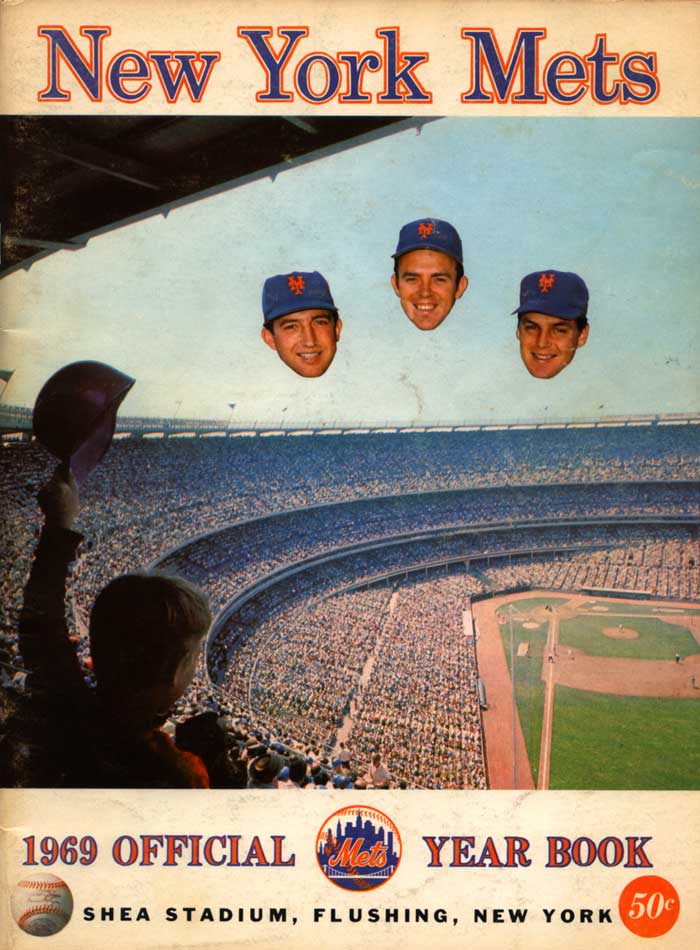
by Greg Prince on 5 April 2011 4:49 pm 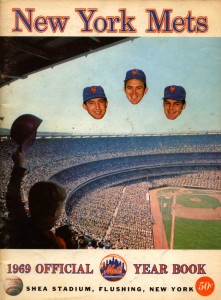 SNY is breaking out the good stuff, Thursday night at 6:30. It’s the return of Mets Yearbook, and the edition they’re opening is 1969. SNY is breaking out the good stuff, Thursday night at 6:30. It’s the return of Mets Yearbook, and the edition they’re opening is 1969.
Is there anything else you need to know? I don’t think so.
Image courtesy of kcmets.com.
by Greg Prince on 5 April 2011 9:40 am Welcome to The Happiest Recap, a solid gold slate of New York Mets games culled from every schedule the Mets have ever played en route to this, their fiftieth year in baseball. We’ve created a dream season consisting of the “best” first game in any Mets season, the “best” second game in any Mets season, the “best” third game in any Mets season…and we keep going from there until we have a completed schedule worthy of Bob Murphy coming back with the Happy Recap after this word from our sponsor on the WFAN Mets Radio Network.
Quick prologue in honor of the only “game number” that has its own universally recognized name. It needs no introduction. It is our introduction — and reintroduction — to the baseball season. It tells us it’s here, it’s real and, if we win, it’s especially spectacular.
There is no such thing as a bad Opening Day win; that is to say there’s no such thing as an Opening Day win that’s “worse” than any other. I guess that’s all self-evident, but there’s nothing run-of-the-mill about winning on Opening Day, even for a franchise that — 2011 notwithstanding — has almost trademarked the habit. There are no also-rans among Met Opening Day wins. Every Opening Day win is, at the moment it is achieved, the best win of the year.
It can go downhill from there, but there’s no way it can get much better.
You’ve waited all winter for Opening Day. You’ve invested every bit of symbolism in it that you can. If your team wins, this day will validate you. It will validate your offseason. It will tell you that whatever happened last year, if it was bad, is erased. It will tell you that whatever happened last year, if it was good, was merely prequel.
You can’t go wrong with an Opening Day win. They all provide the Happiest of Recaps. Yet in the spirit of what we’re constructing here, one must stand out as Happier than all the others.
GAME 001: April 9, 1985 — METS 6 Cardinals 5 (10)
(Mets All-Time Game 001 Record: 33-18; Mets 1985 Record: 1-0)
A rather famous baseball player came along in the 1980s and declared an intention to announce his presence with authority. His name was Ebby Calvin “Nuke” LaLoosh, hard-throwing righty phenom for the Durham Bulls. But obviously LaLoosh was cribbing from a more famous ballplayer who arrived in New York a few years earlier in the very same decade.
Gary Carter loomed as a game changer. He all but promised he’d be a game changer. After the Mets exchanged four young players of considerable promise to have him, he stood up at a press conference, pointed to his right ring finger and said he was saving it for a World Series rock.
How’s that for announcing one’s presence with authority?
It would become something of a teamwide tic for the mid-’80s Mets to let you know what they were going to do before they could possibly do it. Carter may have set the trend in December 1984. He definitely showed the Mets were set on being a team of their word in April 1985.
Gary Carter was a game changer before he ever played a game as a Met. He wasn’t imported à la George Foster to make the Mets respectable. The Mets respected themselves plenty in 1984. They won 90 games without the benefit of a massive offensive superstar. Foster wasn’t that anymore. Strawberry wasn’t that yet. Hernandez was wily and able and as clutch as they came, but he — and we — needed a companion piece. A massive offensive superstar…and then some. Gary Carter was that guy. He was the catcher in the National League since the sun set on Johnny Bench. Despite the wear and tear crouching and blocking wrought, he led the league in runs batted in as an Expo. He’d been around for ten years, and though Montreal was, by their own assessment, through as a contender, Carter wasn’t.
He was what the Mets needed. He landed at Shea and in the Mets fan imagination as that proverbial last piece of the puzzle. The puzzle had only been unveiled in ’84, but here we were, frenzied to finish it. Gary Carter made us view our team differently. Maybe for the first time ever, we entered the upcoming season looking at ourselves not as a contender, but as a favorite. As the favorite in the National League East. We had Hernandez, who wasn’t getting any dumber. We had Strawberry, who was only going to get better. We had Foster, who at least had stopped being altogether awful. And we had all that pitching — Gooden and Darling fronting the rotation, Orosco capping the bullpen. Look who was going to catch them! And look who was going to hit in the middle of all those other hitters!
Look! It’s Gary Carter! It’s the 1985 Mets! They’re going to kick ass! WE are going to kick ass!
This was a change to our thinking, and that itself was a game changer.
And then there was the first game Gary Carter changed, Opening Day, one packing as much anticipation as any in the half-century there have been Met seasons. Dwight Gooden pitching to Gary Carter. Gary Carter batting after Keith Hernandez and before Darryl Strawberry. How could we not win on a massive scale?
Yet it didn’t come so easy at first. The Opening Day on which Gary Carter put his right ring finger where his mouth was unfolded as a frozen slog. Vice President George Bush showed up at Shea for first-pitch duties, but it was too cold for Tampa native Gooden to get a good grip; he lasted into the seventh, leaving with a 5-2 lead. Foster (homer), Hernandez (a pair of RBI singles), fellow new acquisition Howard Johnson (bases-loaded walk) and shortstop Rafael Santana (run-scoring double) built the lead. With Gooden gone, Carter turned his attention to catching Doug Sisk. But Sisk, a weakening link as 1984 wound down, gave up a two-run single to Andy Van Slyke in the seventh.
It was 5-4. It grew colder. And then it turned positively icy. Sisk loaded the bases in the ninth. With two outs, he faced Jack Clark. Carter caught ball four. Tie game.
Gary Carter didn’t promise that.
The game moved to the bottom of the ninth. The Mets loaded the bases this time, but failed to score. It was extras, now. Tom Gorman came on to pitch, relieving Jesse Orosco, who had bailed out Doug Sisk. Gorman escaped the top of the tenth. To the bottom of the inning, then, where Neil Allen, a Met from 1979 to 1983, faced the man for whom he was traded, Keith Hernandez. It would be dramatic as anything if Hernandez (who reached Allen for a game-winning single the previous summer) could end this now-frigid game with one swing.
But Hernandez struck out.
Drama, however, didn’t. Allen vs. Carter would do fine.
“Welcome to New York, Gary Carter!” is how Channel 9 announcer Steve Zabriskie called it when the Kid’s game-winning home run soared over the left field fence. “That’s what he’s here for,” is how Hernandez described it in the clubhouse. The Mets had won 6-5, courtesy of the game changer. Carter, like the Mets, was 1-0 in 1985. Welcome to New York, indeed. Nobody had ever made himself at home so quickly at Shea Stadium.
One great ending is enough for one Opening Day, but there really was a beginning there at the end. Carter’s benediction seemed to charm the atmosphere around him, and the 1985 Mets would take the stage 161 more times and produce enough drama to match anything playing on Broadway. The only thing they couldn’t produce was quite enough wins to extend their run that fall.
Thus, they took a winter’s intermission, added a few more (if less massive) puzzle pieces and picked up just about where they left off in ’85 come ’86. With hindsight, you could say they created one almost unbroken two-year singular sensation of a season, lifting the curtain the night we learned Gary Carter became a Met, and taking their final and customary curtain call the night Gary Carter caught strike three to seal the 1986 World Series (and decorate his right ring finger).
That, young Nuke, is what it means to announce — and sustain — your presence with authority.
ALSO QUITE HAPPY: On April 5, 1983, Tom Seaver returns from Cincinnati exile, electrifies Shea Stadium and pitches six shutout innings as the Mets beat Steve Carlton and the Phillies, 2-0. The unlikely winning pitcher is rookie Doug Sisk. The hitting hero, soon to completely disappear from view, is right fielder Mike Howard. He drives in the winning run in the seventh and he never plays for the Mets again.
GAME 002: April 11, 1968 — Mets 4 DODGERS 0
(Mets All-Time Game 002 Record: 26-25; Mets 1968 Record: 1-1)
If we lose on Opening Day, there’s always tomorrow. Tomorrow is what the Mets depended on after every Opening Day that commenced their earliest campaigns, back when the only luck they had on Opening Day was typified by getting stuck in an elevator (as happened to many of them before their first Opening Day in 1962).
Ergo, you had to seek solace in the second game of the season, and the Mets really needed it in 1968. They came so close to breaking their first-game jinx in their seventh year. They had their first certified ace, Tom Seaver, starting his first Opening Day, in San Francisco, and he carried a 4-2 lead into the ninth. Alas, even Tom Seaver, sophomore deluxe, wasn’t impervious to whatever it is that kept the Mets from getting off on the good foot. Seaver came out with a lead. The Mets lost 5-4.
Which made Jerry Koosman’s emergence as the ultimate No. 2 starter in the second game of the 1968 season that much more crucial. Kooz had sipped his share of coffee during brief stints in 1967, but he had yet to make an impression in the win column. He, like the ’68 Mets, had something more in mind when they headed down the coast to Los Angeles to try and even their record.
Koosman was a revelation. The lefty from Appleton and Morris, Minn., went the distance, shutting out the Dodgers 4-0. New manager Gil Hodges considered taking the rookie out when he seemed to be tiring but explained afterwards, “When you see a kid still have that kind of stuff so late in the game, you know he’s got the ability to win up here.” Hodges proved a prophet, as Koosman’s victory was the first of 19 he’d collect in 1968 (still a team rookie record) and the first of 140 he’d garner as a Met (third-most behind Seaver and Dwight Gooden). And in what would become known as the Year of the Pitcher, Jerry Koosman stepping up and joining Tom Seaver atop the Mets’ rotation assured us we’d be able to use the plural — “pitchers” — for many years to come.
ALSO QUITE HAPPY: On April 8, 1978, Ed Kranepool, the man who’d been a Met in every Met season since the first, pinch-hits with one on and two out in the bottom of the ninth at Shea against Stan Bahnsen of Montreal, the Mets down by one. For the first and only time in his Mets-llustrious career, the Krane launches a walkoff homer, pulling out a 6-5 win for the suddenly 2-0 Mets.
GAME 003: April 10, 1969 — METS 4 Expos 2
(Mets All-Time Game 003 Record: 26-25; Mets 1969 Record: 2-1)
How often does a home run leave a mark that requires a full demolition crew to remove? We can think of one in particular whose aftermath you couldn’t help but notice nearly four decades after it occurred.
Tommie Agee crushed a Larry Jaster pitch in the second inning of the third game of the 1969 season.
Crushed it? Mashed it.
Mashed it? Pulverized it.
Whatever he did to it, two things were immediately apparent:
1) Tommie Agee was emerging from his miserable 1968 (.217-5-17) and setting the tone for a different kind of season for him, and hopefully the Mets, in 1969.
2) Tommie Agee had struck the first fair home run to ever land in the Upper Deck of Shea Stadium — and the first of two home runs on the day as the Mets captured their first series of the year.
Few were there to witness it, not even 9,000 on this April afternoon (when Gary Gentry made his major league debut), and nobody was sitting anywhere near where it smashed into way above left field. Yet everybody who was on hand swore it traveled to where no other ball had dared to soar. “That one today,” Ron Swoboda admired, “would have gone over the third fence and hit the bus in the parking lot if it hadn’t hit the seats.”
Funny Rocky put it that way, because other sluggers would go on to dent buses and the like, but never again in the life of Shea would a home run make it fair to the Upper Deck. If it wasn’t immediately clear how significant a wallop Agee unleashed that day, it came to be understood as something unmatched in the quarter-century to follow. Come 1994, at Mets Extra host Howie Rose’s urging, the Mets commemorated the approximate spot where Tommie’s homer touched down. A generation of Sheagoers would make pilgrimages up to Section 48 to check it out and gasp in awe. That marker — listing the batter’s name, his number and the date — stayed painted in place clear through to Shea’s demolition in 2008.
ALSO QUITE HAPPY: On April 17, 1966, Ron Swoboda walks with the bases loaded in the bottom of the ninth to allow the Mets to beat the Atlanta Braves 5-4. A Ken Boyer two-run double had tied matters for the home team in the eighth. By coming back late, the Mets raise their record to 2-1…the first time the Mets peek their heads above .500 in their brief history…and the last time they’ll do so until Tommie Agee’s power-packed third afternoon of 1969.
|
|