Faith and Fear in Flushing made its debut on Feb. 16, 2005, the brainchild of two longtime friends and lifelong Met fans.
Greg Prince discovered the Mets when he was 6, during the magical summer of 1969. He is a Long Island-based writer, editor and communications consultant. Contact him here.
Jason Fry is a Brooklyn writer whose first memories include his mom leaping up and down cheering for Rusty Staub. Check out his other writing here.
Got something to say? Leave a comment, or email us at faithandfear@gmail.com. (Sorry, but we have no interest in ads, sponsored content or guest posts.)
If I go down
I’m gonna go down swingin’
If I grow old
It won’t be gracefully —The Rainmakers
“I’ll show you something today,” Ty Cobb told reporters, or so the story goes. “I’m going for home runs for the first time in my career.” It was May 5, 1925, the year of Babe Ruth’s bellyache, as it was called, though what actually ached the Bambino remains an urban myth. Ruth may not have been atop his game in ’25, but he was still on top of The Game, as in baseball. Slugging had overtaken hitting in the public’s estimation. Ruth had overtaken Cobb, and Cobb — aging, cranky and the possessor of eleven batting titles from when home runs were rarities — didn’t care for it. Ty Cobb didn’t care for a lot, but this was one of his deeper snits.
So Cobb, per legend, went out that day at Sportsman’s Park 86 years ago and popped not one, not two but three home runs against St. Louis Browns pitching. The 38-year-old player-manager of the Detroit Tigers had made his point.
Carlos Beltran has never reminded me of Ty Cobb. Really, more DiMaggio — Joe, not Dom or Vince. What brought them together in my mind was one word: grace. Both made it look so easy, though no one ever thought DiMag was taking off innings or easing up even a notch. That was a centerfielder who gave it all he had all the time no matter the stakes because, he figured, somebody was seeing him play for the first time. The key for Joe D. was he made it look like he wasn’t trying all that hard.
Grace. It probably worked better when the media was mostly radio and newspapers.
Carlos Beltran’s grace came off better when he had two good knees and a few fewer years than the 34 he carries around now. Grace’s value has diminished since Joltin’ Joe has left and gone away, since SportsCenter came on the air, since a critical mass of opinion formed that it wasn’t so much what you did but how interested you looked while you were doing it. If you did it the hard way and succeeded, you were that much more impressive. If you made it look — because that’s just how you rolled — easy, and you made the mistake of not succeeding every time out…well, why isn’t that guy giving it his all?
We can only guess how difficult it’s been for Carlos Beltran to give it his all since his legs began to betray him a couple of years ago. It didn’t look that easy for him trying to come back from too much injury in 2009 and 2010. The obvious effort didn’t necessarily translate to the desired results. Yet he didn’t much let us see him sweat. Carlos Beltran isn’t given to the grimace. He has maybe two expressions: the one that’s practically blank and the one where he smiles. He wears the former about 95% of the time.
He wore the smile after Thursday’s game in Denver. It wasn’t a gloat, but there was definitely a twinkle to it, just a touch of “I could tell ya so, but I think my bat just did.” I saw that look back in December, at the Mets’ holiday party when all the questions were of the “will you be well enough to play?” nature. Beltran was unremarkably upbeat with his words, but just enough “watch me” with his eyes.
There was plenty to watch at cold, damp Coors Field. There were three home runs, to be specific: from the left, then the right, then the left, all with Willie Harris on base, each accounting for one-third of what the Mets needed to beat the Rockies. They won 9-5. Beltran drove in six of the nine runs. He didn’t have to grimace. He just had to trot.
After the third home run — a total produced in one game by only seven Mets before him — I caught a glimpse of the happy Beltran in the Mets dugout. One of his teammates sitting near him was Fernando Martinez, just called up to take disabled Ike Davis’s place. Martinez has been a hot prospect since debuting professionally as a 17-year-old in 2006, since Beltran was putting up MVP numbers when pain-free and worth every penny the Mets were paying him. Fernando Martinez, I thought, is the oldest 22 I’ve ever seen. He’s never been healthy or consistent for long. But he’s only 22.
Carlos Beltran is 34. He’s in the seventh year of a seven-year Met contract that no one thinks will be succeeded by another Met contract. His successes were what we paid for, so they weren’t automatically celebrated for the accomplishments they encompassed. His everything else? Like his demeanor? Or his non-MVP intervals? They weren’t universally popular, and he still isn’t. While well-meaning Twitterers tend to overcompensate with their increasingly tiresome #blamebeltran irony shtick, there really is a strain of Mets fan who isn’t easily satisfied by Carlos Beltran, who wishes for more expressive grimacing, more obvious sweating, more swinging at hellacious breaking pitches that landed in a catcher’s mitt five years ago and aren’t subject to do-over.
Plenty of swinging today, though. Plenty of reason to want to see Carlos Beltran play some more.
Tom Seaver. Nancy Seaver. Singing with the Lettermen. Awkwardly joking with Eddy Arnold. Referring in detailed fashion to the World Series just recently won. This aired on NBC’s Kraft Music Hall, November 5, 1969, not three weeks after the Mets commenced their reign as Earth’s baseball champions, only 17 days since Tom and teammates confirmed “You Gotta Have Heart” for Ed Sullivan.
Clearly, humanity had reached its peak.
I’d read of this variety show appearance, but I never dreamed I would see it. Great thanks to my old friend Joe F. for finding it.
Bad news is your late afternoon has been ruined by raintime in the Rockies. Good news is your previously pre-emptively ruined entire Thursday has been rescheduled as worthwhile, as the Mets will take on Coloradoans (be wary — they’re very well-schooled) tomorrow at 3 o’clock.
To fill the yawning gap from now until then, you can…
• Wish the best for Ike’s calf, David’s neck, Jason Bay’s who-knows-what and all the pitchers who aren’t able to pitch at this time. Stop getting hurt, Mets.
• Remember the legendary Daily News sports cartoonist and columnist Bill Gallo, who has passed away at age 88 by reading this wonderful profile by Nathaniel Vinton from just a couple of weeks ago. Basement Bertha wasn’t fashionable, but she did love her Mets. Joe Petruccio, not surprisingly, pays a lovely tribute here.
• Buy your Pepsi Porch tickets for Mets Brain Tumor Awareness Night, Saturday May 28 versus the Phillies, and be sure to buy them here. When you do, you’ll be supporting a worthy organization.
• Consider what a fine and consistent voice Howie Rose has provided Mets baseball for nearly a quarter-century, whether as host of Mets Extra, play-by-player on SportsChannel/Fox Sports Net or lead man on WFAN’s broadcasts. Radio has become mostly a reason to bash Wayne Hagin — and he is bashable — but I think we overlook how Metsian a conversationalist we have in Howie when all we do is bitch about the other guy. He also gets eclipsed by the Gary, Keith & Ron electricity a little more than he deserves, but I’d feel lost without Howie in the car, Howie by the bed, Howie while I’m brushing my teeth.
• Put TV and radio into unique perspective by checking out Bob Wolff’s Complete Guide to Sportscasting, a book by the dean of sportscasters. It’s a lot of fun and includes a chapter focusing on how radio announcers for losing baseball teams can still be entertaining. I’ll leave it to your imagination what losing team he picks as his prime example.
Beautiful and beautifully written.
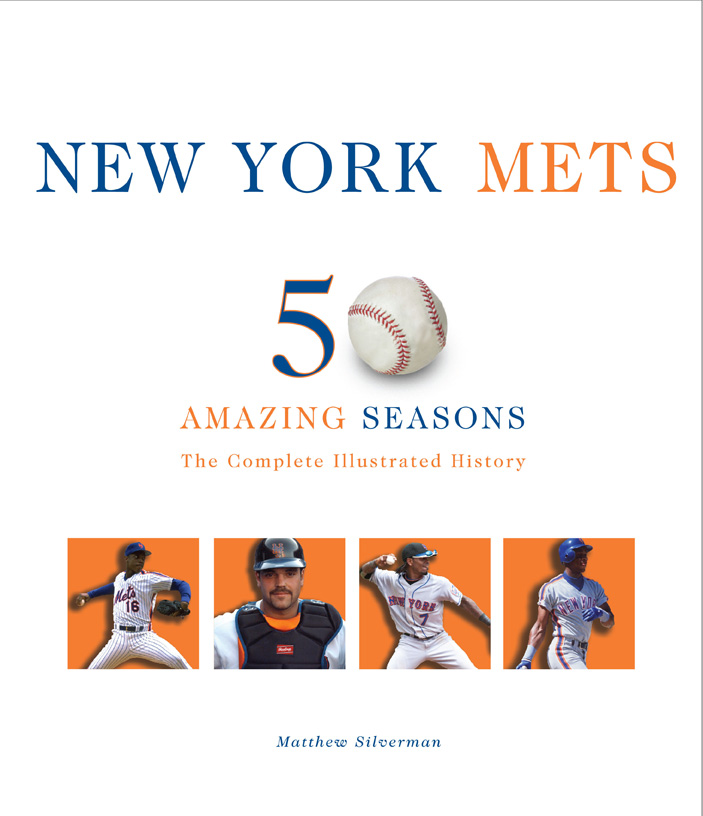
• Give yourself the present of 50 Met years with Matthew Silverman’s The New York Mets: The Complete Illustrated History. Mentioned it before, I’m mentioning it again. It’s an incredible tour of an incredible franchise. As good a looking book as you can imagine, yet the pictures only hold a candle to the writing, which is informed, intelligent and inviting. Buy one for you, buy another for a Mets fan you care about.
• Veer outside the Mets realm and consider The Cambridge Companion to Baseball. Very weighty title, but pretty accessible material on all the stuff you’ve kind of wondered about all your life.
• Come back to the Mets for Howard Megdal’s just-released Taking the Field: A Fan’s Quest to Run the Team He Loves. The cover is orange and blue, so if you didn’t know from Howard (and you should), you would be able to infer the identity of the team in question. You may recall Megdal’s candidacy for Mets GM last summer; the grand campaign and the ideas behind it are presented within. I’ve thus far mostly skipped around various chapters (which is how I tend to engage books when I first receive them), but it’s next on my reading list (though I don’t really have a list) and I’ll share my thoughts on it at a later date. But I’m really happy to see it come to fruition.
• Relive 33/66 great Mets wins through The Happiest Recap archives. If you’ve somehow scrolled right past this twice-weekly salute to the best games by Game Number in Mets history, get the lowdown on what it’s all about here.
• Say “hi” to people you might not otherwise greet and get some things done, but be back at your Met readiness 3:10 Thursday. It’s supposed to stop raining and they’re supposed to play ball.
The Mountain Time Zone and the mountainous rain delay combined to knock me out before the final pitch last night. Hung in there through Mets Yearbook: 1966 and Mets Yearbook: 1967 (which SNY cut away from just as Whitey Herzog was about to announce his intention to draft…what a cliffhanger!) and reveled, as Gary Cohen did, in the fact that it took two pitchers — Mike Pelfrey and Jason Isringhausen — and two batters — Dexter Fowler and Ryan Spilborghs — to complete the same plate appearance when play resumed because of the precipitation interruption and the rash of owwies that were taking down Mets and Rockies left and right. But I was growing very drowsy as their Paulino — Felipe — walked our Paulino — Ronny. And the last thing I remember was something about Willie Harris pinch-hitting.
At which point I assume I closed my eyes in the hopes that he wasn’t really still a Met.
Next thing I knew, it was later. My first thought upon stirring was, “Is it the bottom of the ninth yet? Is K-Rod on? Omigod, what has he done? Is it the fourteenth because he gave up the tying run in typically aggravating fashion?” My second thought was “Mets 4 Rockies 3,” because when my eyes were opened fully, the postgame show was on and the score was on the screen.
“Gosh,” I wondered in the seconds before I conked out again, “I wonder how difficult he made it.”
Color me delighted to have read the pitch-by-pitch transcripts this morning and discover that Frankie Rodriguez kept no one awake. He didn’t extend the game. He didn’t inject anxiety into the game. He didn’t subliminally boost sales for Stranahan’s Colorado Whiskey, the stuff I noticed advertised over the right field fence where Rockie home runs traveled earlier in the game. As far as I know, he didn’t react to anyone after the game the way he did when the sight of Colorado uniforms (or something) enraged him last August. Rodriguez just went out there, pitched the inning he was signed to pitch, pitched it cleanly and steered the Mets to the clubhouse with a win for all and a save for him.
Big-money free agent joins club and (eventually) performs as intended on consistent basis. Or as the headlines never seem to read, SOMETHING DOESN’T GO WRONG FOR METS.
Because of the creative contract to which the Mets signed Rodriguez, schoolkids no longer automatically associate “55” with Orel Hershiser, Shawn Estes or Chris Young (though Young’s shoulder will likely render him a well-meaning footnote in most Met textbooks). Frankie needs to finish 55 games this season — be the last Met to throw a pitch in just over a third of the scheduled contests — to have an option kick in that will allow him to serve as Mayor of Moneyville for another year. When he was Francisco Rodriguez, expensive, plea-bargaining, unreliable head case, this was cause for shudder. Now that he’s something like the K-Rod of American League legend again…still expensive but relatively reliable and no longer noticeably menacing society…I’d suggest taking an eye off his appearance clock.
Ideally, I’d rather the Mets not be on the hook for seventy-bajillion dollars in 2012 ($17.5 million, technically), but the clause is there and through no unfault of his own, Rodriguez is living up to his part of the bargain. The Mets occasionally take leads to ninth or maybe eighth innings; Terry Collins calls on Frankie; Frankie delivers the goods; Terry’s confidence grows; Frankie gets more calls.
He’s doing what he’s supposed to be doing. He’s also not doing what he’s not supposed to be doing away from the mound. I wouldn’t have blamed the Mets had they figured out a clever way to jettison his contract altogether after he attacked his girlfriend’s father last summer, but the Mets aren’t nearly clever enough to pull something like that off, so he’s here. What’s more, he’s presumably followed his proscribed course for good behavior. If we are to believe in redemption, then we have to believe that anger management programs might actually work.
Francisco Rodriguez will inevitably blow another game as the Mets closer. I wouldn’t be surprised if he blows his top, too, hopefully in a manner that harms neither human beings nor innocent animals. No doubt the guy is suspect, partly for a few too many ninth innings that went awry (in the tradition of all the other closers in whom we’ve misplaced faith for the past twenty years), mostly for what we learned about him in the wake of his temper overtaking him. If he slips in either way, we’re not going to be patient, more for Mets fan reasons than humanitarian ones, but in the meantime, he’s walked the straight and narrow off the field and he hasn’t given away much on it.
And unless we turn back time to when a quality start meant consistently going nine, somebody’s going to have to close games the rest of 2011 and into 2012. If the Mets want to be innovators and figure a better way to do it than automatically handing the ball to the same pitcher every time they’re ahead by three runs or fewer, fine. But until then, we have somebody who’s among the best in baseball at his particular core competency…and we don’t have many of those. We might as well get some use out of him.
As far as the $17.5 million fourth year for a reliever who was losing something off his fastball when we signed him…well, thanks Omar. But I’m disgusted enough that the Mets are likely positioning themselves as a small-market team — and not necessarily a good one — that I don’t want to hear about the need to shed gobs of salary to keep them afloat. Get the minority partner in here and act like a New York team. You don’t have to throw the multimegamillion-dollar deals around to impress us, but making it your priority to “unload” your better performers because you “can’t” re-sign them…it’s patently unacceptable. I don’t want to accept it. If you can honestly plot a trade of Francisco Rodriguez (or some other player whose name keeps coming up in this context but I don’t want to mention because I don’t want to think about him in terms of his not being a Met) to better the team in the long term without shooting it in the foot in the near term, you have my blessing. But nix to M. Donald Redux if it gets to that point.
If it’s late September and the Mets are long out of it and Rodriguez is sitting on 52, 53 appearances, I understand sending for a car and wishing him well as he leaves for the airport. If we’re long out of it with little hope of getting back into it right away, maybe a high-priced closer isn’t a priority (though ninth innings are still ninth innings, whatever the price). But if we’re in position to win games across the balance of this season, and there’s no better answer at the other end of the phone when Dan Warthen calls Jon Debus, then in the name of legitimacy, get Frankie up.
Welcome to The Happiest Recap,a solid gold slate of New York Mets games culled from every schedule the Mets have ever played en route to this, their fiftieth year in baseball. We’ve created a dream season consisting of the “best” 31st game in any Mets season, the “best” 32nd game in any Mets season, the “best” 33rd game in any Mets season…and we keep going from there until we have a completed schedule worthy of Bob Murphy coming back with the Happy Recap after this word from our sponsor on the WFAN Mets Radio Network.
GAME 031: May 16, 1983 — Mets 11 PIRATES 4 (Mets All-Time Game 031 Record: 27-24; Mets 1983 Record: 11-20)
There weren’t many people at Three Rivers Stadium this 44-degree Monday night. Maybe most Pittsburghers were home watching the Motown 25 special on NBC. It drew 47 million viewers, most of them, presumably, attracted by the appearance of the biggest star in the land in the spring of 1983, Michael Jackson. Jackson didn’t disappoint, revealing his moonwalk to a nationwide audience that had yet to think of the former Jackson 5 star as Tito’s, Jermaine’s, Jackie’s and Marlon’s brother from another planet.
Thus, it was left to a mere 1,970 to attend the Mets-Pirates game — an unscheduled makeup of a rainout the day before — and watch the first big move made by another performer emerging as a superstar in May 1983. It wasn’t going to do the broadly ignored home team much good, but for the visitors and anyone watching back on Channel 9 in New York, his development was going to be a thriller.
Darryl Strawberry had been up with the big club a week-and-a-half. His elevation was rushed by the reckoning of some, with his previously deemed necessary Triple-A seasoning curtailed to 71 plate appearances, yet it didn’t come a minute too soon considering the Mets were 6-15 when the SOS was flashed south to Tidewater. In the five-game losing streak that preceded Strawberry’s promotion, the Mets scored eleven runs; for their last three games, in which they were swept at home by Houston, they drew 15,719 paying customers.
No, it didn’t seem too soon whatsoever for 21-year-old Darryl Strawberry. Mets fans had been waiting for him since June 3, 1980, the day of the amateur draft when the Mets, by virtue of their abysmal 1979, held the first pick in the nation. Strawberry’s name — and who could forget a name like Strawberry? — first floated into the greater consciousness in Spring Training, when Sports Illustrated’s baseball preview issue (the one with Cardinal batting champ Keith Hernandez on the cover) intimated the long, lanky, lefthanded slugger was another Ted Williams waiting to happen. The 15,719 diehards who filed into a desolate Shea across three spiritless midweek nights, along with the millions of would-be attendees who were staying away from the stadium in droves, were all waiting after six lean years for anything to happen.
The next Ted Williams would do nicely in the imaginations of a superstar-starved fan base. The Mets attracted 15,916 for his debut, which may not sound like many, but it outgated the entire Astro series.
The first pitcher the underripe Strawberry saw was tough Reds righty Mario Soto, who struck him out. No shame in that. Soto struck out twelve Mets on May 6 and held them to one hit — a pinch-homer by Danny Heep, the player whose spot in right Darryl was usurping — until the ninth, when reigning Met power threat Dave Kingman took him deep with one on and two out to send Darryl’s first game into extra innings. Come the eleventh, the young/black/next Ted Williams (he was described as all three) nearly carved his signature in Shea’s concrete when he launched a fly ball that appeared en route to breaking a 4-4 tie and the Mets’ losing streak: both the five-game skid and the six-year horror show. Oohs and aahs followed its flight, perhaps into instant history.
“When I hit it,” the rookie said afterwards, “I thought it had a chance to be fair, but then I saw it hooking.”
It curved foul and Darryl Strawberry had to settle for his first major league walk. In the bottom of the thirteenth, he’d walk again, steal for the first time and be on second when George Foster ended the evening on a three-run home run off Frank Pastore. Darryl Strawberry scored the winning run, capping a pretty decent debut.
Only thing the kid forgot to do on his first night in the majors was hit. He went 0-for-4 that Friday night and struck out three times. Same thing the next day, a Met loss. Now the unreal comparisons were shifting from Ted Williams to Willie Mays, though not just because of talent. Willie, it was recalled, came up to the New York Giants 32 years earlier (also in May) and didn’t get a hit in his first dozen at-bats. In that regard, Darryl beat Mays to a taste of success by one AB. After an 0-for-11 start to his major league career, Strawberry singled off Cincinnati righthander Rich Gale.
His batting average soared to .083.
Now the question turned to when would Darryl Strawberry hit his first big league home run. Mays’s first hit was, in fact, a circuit clout — off the Boston Braves’ Warren Spahn — in his thirteenth at-bat and his fourth game. Ted Williams’s inaugural blast came in his fourth game, too, his fourteenth at-bat overall. Darryl Strawberry, who’d whetted every Mets fan’s appetite by belting 34 homers and swiping 45 bases at Double-A Jackson in 1982, had some catching up to do if he was going to be an immediate legend.
Manager George Bamberger, a rather uncelebrated rookie pitcher for the very same 1951 Giants Mays joined, recognized too much hype when he saw it, even as he was penciling his overmatched phenom into the third spot in the Mets’ batting order. Bambi advised Darryl “not to try to be Willie Mays. Just try to be Darryl Strawberry.”
By May 13, with an entire week of experience behind him, Darryl was surely neither Teddy Ballgame nor the Say Hey Kid. He wasn’t even Danny Heep. He’d played six games, totaled 24 at-bats and accumulated all of three base hits: two singles and a double. The Mets’ offensive savior was batting .125 (and the Mets were still buried in last place). Bamberger sat Darryl against challenging lefties like the Pirates’ John Candelaria and Larry McWilliams. Strawberry was lost enough against righthanded pitching.
Far from the expectations of New York, with Three Rivers’ smallest-ever crowd skipping Motown 25 and the Pirates throwing struggling veteran (and ex-Met farmhand) Jim Bibby, Bamberger started Strawberry in right. His first two at-bats produced a fly ball to center and a groundout to short. Darryl Strawberry, in almost total privacy, had lowered his batting average to .115.
But then, in the top of the fifth, a star was born.
Hubie Brooks was on second, reliever Lee Tunnell was on the mound and Darryl took the swing for which he and so many had waited. The result was also the desired one. The ball Strawberry hit traveled over the 375-foot mark on the left-center field wall to give the Mets a comfortable 7-1 lead.
Talk about a comfort zone. At last, in his 27th major league at-bat, Darryl Strawberry had arrived there, carrying with him his first major league home run, contributing to an 11-4 rout of the Buccos and shedding the proverbial monkey of initial pressure from his broad back.
“What you guys saw him do,” Bamberger told reporters, “he’s going to do a lot of.” Strawberry didn’t disagree: “I’ve been facing good pitching and it’s been tough on me. But I’m starting to get more aware of things. I wasn’t doing that before and if I keep it up, I know I’m going to have success.”
The manager and his right fielder were prophetic. Straw’s shot off Tunnell was the first of 26 he’d smack in 1983, establishing a Met freshman mark that has yet to be broken and earning him National League Rookie of the Year honors. He’d have a hundred home runs by 1986, the Met career home run record by 1988 and, before he left the team as a free agent following the 1990 season, 252 home runs as a Met. More than two decades later, no Met has come within 30 homers of Darryl Strawberry’s standard.
Maybe he doesn’t hold as many records as Michael Jackson was selling in May of 1983, but in the pantheon of Met sluggers, you can’t beat it.
ALSO QUITE HAPPY: On May 12, 1963, the Mets showed they could come out on top in a slugfest — and do whatever it took in the process. One Met in particular knew no limits when it came to effort. Casey Stengel had let it be known that if any Met found himself at bat with the bases loaded, fifty American dollars could be his if he “accidentally” allowed himself to be hit by a pitch. Fifty bucks was not insubstantial to the 1963 ballplayer, yet only one Met cashed in on the offer. With three on and one out, Hot Rod Kanehl stepped up and stepped into a delivery from the Reds’ John Tsitouris. That was using his head and his body, for Rod’s welt extended the Mets’ third-inning lead over Cincinnati at the Polo Grounds to 5-0. Kanehl HBP RBI was truly money because the Mets would eventually require every last run they could scrounge up in the second game of that Sunday doubleheader. Unaccustomed to pitching with a lead, Jay Hook gave it all away, and by the middle of the fifth, the Mets and Reds were tied at six. The Mets, however, came roaring back with five in their half of the fifth, capped by a three-run homer from Duke Snider. Suddenly it was 11-6 Mets. Then, just as suddenly, it wasn’t. Relievers Ken MacKenzie and Larry Bearnarth — “aided” by a Tim Harkness error — allowed the Reds right back into the game, then into the lead by allowing six sixth-inning runs. The Mets trailed 12-11 and stayed behind until the eighth when a pair of walks and a Harkness single set up Jim Hickman’s tying sacrifice fly and Choo Choo Coleman’s go-ahead single. The Mets led 13-12 heading to the ninth and, shockingly, won 13-12, as starter Tracy Stallard came in to stop the madness with a scoreless inning of relief, striking out rookie second baseman Pete Rose (who had been on base four times) to end the game. If this nightcap didn’t contain enough mythic elements already, consider that in their history, the Mets have given up exactly a dozen runs in 59 different games. This is the only one of those they’ve ever won.
GAME 032: May 13, 1970 — Mets 4 CUBS 0 (Mets All-Time Game 032 Record: 22-29; Mets 1970 Record: 16-16)
How close can you come? How close can a one-hitter get to being a no-hitter? Besides one hit, that is?
Gary Gentry found out for himself relatively early along the trail of tears better known as Mets Pitcher Near-Miss Gulch. You could pitch brilliantly, you could vanquish your opponent and, of course, you could earn a Happy Recap for your efforts, but you still missed the brassiest of rings.
In 1970, it hadn’t even been a decade that the Mets had gone without pitching a no-hitter. It didn’t yet stand out like a scorer’s thumb. Things were happening for the Mets. They’d won a World Series a mere seven months earlier, and nobody saw that coming. The no-hitter…it was bound to happen eventually.
As for Gentry, he was as good a possibility to throw it as any Met. He’d put up plenty of zeroes on plenty of scoreboards, judging by what he accomplished in just over a year in the big leagues. He won 13 games as a rookie in 1969, tossing the four-hitter that clinched the National League East title. Though he wasn’t around at its end, he started the game that gave the Mets their first N.L. pennant. And he won the first World Series game ever played at Shea Stadium — with lots of help from Nolan Ryan in relief and Tommie Agee in the field, but it was Gentry’s W.
First, Tom Seaver came up in 1967. Then, Jerry Koosman in 1968. Gentry was the next arm in that logical progression. In a way, it was no wonder Gary Gentry and Tom Seaver were able to fool out-of-town writers covering the 1969 World Series by trading uniform tops during a Memorial Stadium workout and dispensing disparaging quotes about “each other” for laughs. Nos. 41 and 39 were different pitchers, yet it seemed the Mets were cutting a string of hard-throwing righthanders from the same talented cloth. And now, in May of 1970, Gentry was attempting to one-up Seaver, who had thrown an intensely memorable one-hitter ten months earlier.
Like Tom the previous July, Gary was taking aim at a dangerous Chicago Cubs lineup, this time at Wrigley Field. It was the first meeting of the year between the two rivals whose fortunes passed in the midsummer night in ’69. Once again, the Cubs and Mets were one-two in the N.L. East, Chicago up by 2½ games in the early going. They had a hard-throwing righthander of their own, Bill Hands, going for them this Wednesday afternoon, and Hands would give his manager, Leo Durocher, nine innings and twelve strikeouts.
But Art Shamsky homered with no one on in the fourth and Gentry nicked Hands for his first hit of the year in the fifth, singling home Wayne Garrett. With a 2-0 lead, Gary became the story of the day, for he was pitching a perfect game at Wrigley Field.
Perfection lasted only until Ron Santo walked to lead off the home fifth, but Gentry erased that flaw from his ledger immediately, when he got right fielder Johnny Callison to ground into a double play. When Ernie Banks grounded to Garrett at third, the no-hitter was still intact. And when the Cubs could generate no more than two grounders and a strikeout in the sixth, Gentry was nine outs away from untrod Met territory.
Gentry received an enhanced cushion in the seventh when Garrett tripled home rookie Mike Jorgensen and Jerry Grote singled in Garrett to up the Met lead to 4-0. Perhaps Wayne’s presence in the middle of these Met rallies was an indicator that destiny was unfolding. The redhead wasn’t even in the starting lineup. He had come on to replace Joe Foy after Foy was hit by a Hands pitch (on, of course, the hand). Maybe that was the sort of sign Mets fans could take as gospel that Gary Gentry was really going to outdo what Tom Terrific accomplished on July 9, 1969 when he one-hit Chicago at Shea.
When he got through the bottom of the seventh by retiring Don Kessinger, Glenn Beckert and Billy Williams, Gary was only six outs away from making the Mets the fourth expansion team in the modern era to claim a no-hitter. Bill Stoneman of the Montreal Expos recorded one in 1969, his team’s first year. Bo Belinsky of the then-Los Angeles Angels chalked up a no-no in 1962, that franchise’s second season. And the Houston Colt .45s/Astros had been a veritable no-hit machine since entering the National League alongside the Mets in ’62, with Don Nottebart, Ken Johnson and Don Wilson twice turning the trick.
As the bottom of the eighth commenced, Gary Gentry and the Mets stood poised to join their ranks.
First up, perennial All-Star Santo. He flied to Agee in center for the first out.
Next, Callison, the former Phillie who won the 1964 All-Star Game at Shea with a three-run homer. He flied to Shamsky’s defensive replacement Ron Swoboda in right for the second out.
Four outs to go. The next batter would be Ernie Banks, another Cub with All-Star credentials (impeccable ones) and an 6-for-12 track record vs. Gentry in 1969. The two faced off in five games the year before and the pitcher never completely shut down the slugger in any of them.
Gentry worked Banks to a 2-2 count. On the fifth pitch of the at-bat, he threw a chest-high fastball that the pitcher wanted to come in with. “But,” as Gary would recount later, “I didn’t get it in enough.”
The goal was to get to Banks to hit the ball in the air. The wind was blowing in off Lake Michigan and Gentry figured he had a good chance to pop up Mr. Cub. But Mr. Cub had other ideas. He lined a looping fly ball to left. The left fielder, Dave Marshall, came running in and stuck out his glove in hopes of making a shoestring catch. The ball tipped off Marshall’s glove and fell in fair.
All eyes on official scorer Jim Enright…
Base hit all the way.
Marshall had no beef with the decision: “There’s no question but that it was a hit. I slid a little just when I got to the ball. At first I didn’t think I had a chance for it but the ball seemed to stay up and I went for it.”
Gentry couldn’t quibble either: “I’m glad it wasn’t a cheap hit.” But don’t think Gary wasn’t aware of what was going on. “I started thinking about a no-hitter in the fourth inning,” he admitted after finishing off what became a 4-0 one-hitter, “and kept thinking about it until Banks broke it up in the eighth.”
A 4-0 one-hitter over the Cubs…just like Seaver had done, though nobody was going to mistake Ernie Banks for 1969’s spoiler Jimmy Qualls. But as with Seaver’s gargantuan effort, a shutout victory was a shutout victory and a win that pulled the second-place Mets that much closer to the Cubs was what — in the standings, anyway — counted the most.
Gentry’s masterpiece went down as the fifth one-hitter in Mets history, filed alongside one apiece by Al Jackson, Jack Hamilton, Seaver and, earlier in 1970, Ryan. Five one-hitters in less than nine seasons, but no no-hitters…and with so many talented arms of late. Definitely a curiosity of sorts, though not a franchise trademark yet for a team still so relatively young. The Mets had achieved a miracle in their eighth year. Everything next to that world championship had to be considered a small wonder. Certainly they were capable of effecting small wonders after 1969.
Gentry would have to sate himself with the one-hitter and a whitewashing of one of the National League’s fiercest lineups. It was the fourth shutout of his career. Gary Gentry was 23 years old and the owner of a World Series ring. Who would have figured that at that moment in time, the middle of May 1970, he would have all the World Series rings and half the complete game shutouts he would ever collect?
Or that Mets pitchers collectively would still be one hit shy of their brass ring more than four decades later?
ALSO QUITE HAPPY: On May 10, 1994, respectability enveloped the Mets one season after they performed as the most disreputable unit in baseball. With Bret Saberhagen having given up only two runs in eight innings but the Mets trailing 2-1 at Montreal, Dallas Green’s troops made one last stand against Expo closer John Wetteland. With two on and one out in the top of the ninth, center fielder John Cangelosi delivered his fourth hit of the day, scoring pinch-runner Ryan Thompson from third base to even matters at two. One inning later, with two out and nobody on, Joe Orsulak sent another Wetteland pitch over the right field fence at Olympic Stadium to give the Mets a 3-2 lead and Orsulak his fourth hit of the day. Reliever Doug Linton returned to the mound for his second inning of work and, when he struck out Montreal first baseman Cliff Floyd, the Mets had their fourth consecutive win and found themselves four games above .500 at 18-14, in second place in the newly realigned five-team N.L. East, 2½ in back of the recently transferred Atlanta Braves. If a modest winning streak engineered by the journeyman likes of Cangelosi, Orsulak and Linton doesn’t sound particularly momentous, understand that at the same juncture one year earlier, the 1993 Mets had already fallen irrevocably underneath an avalanche of failure and languished in seventh place in the seven-team Eastern Division, eight games under .500, twelve games out of first place with 130 to go. The manager was about to be fired, the general manager would soon follow and a 59-103 nightmare was unfolding in full. Therefore, just by playing competitively and conducting themselves professionally, the 1994 Mets were staking their claim as Comeback Team of the Year.
GAME 033: May 11, 2010 — METS 8 Nationals 6 (Mets All-Time Game 033 Record: 21-30; Mets 2010 Record: 18-15)
Teaching old dogs new tricks may present interspecies challenges, but new first basemen can apparently pick up on incredible acrobatic feats very fast. Ike Davis mastered his trademark trick before his major league career was one month old.
Ike was tearing up Triple-A pitching in the first half of April, just as he had done a number on Grapefruit League hurlers in March. Yet the Mets opted to send him to Buffalo for a bit more experience and to delay the start of his service-time clock, something worth considering in the long term if Davis delivered on his prospect promise. Were the Mets really that worried about losing him to free agentry in 2016? The man who drafted Ike in the first place, GM Omar Minaya, did not appear destined to be around by then — and had never really shown any interest in long-term ramifications of any player personnel moves — but he sanctioned the farming out of Davis and the reinstitution of former Met Mike Jacobs as the club’s starting first baseman to begin the year.
Twelve games into the 2010 season, the decision was clearly not working in anybody’s favor. Jacobs had little life left in his bat and the Mets were off to a 4-8 start. Davis, meanwhile, was hitting .364 and fast becoming a cause célèbre among results-starved Mets fans (WFAN’s Mike Francesa went so far as to hire a stringer from Buffalo to come on his afternoon show and report Ike’s daily progress). The Mets gave in to inevitability on April 19, ditching Jacobs and calling up Davis. Ike did not disappoint, going 2-for-4 versus the Cubs at Citi Field in his maiden game.
Mets fans figured they were getting a solid bat. What they might not have given much thought to was the rookie’s glove. It would in a matter of weeks, become Ike Davis’s calling card.
The first time Davis’s defense caught anybody’s eye was in his third game, an otherwise dreary 9-3 loss to Chicago at Citi. In the top of the first, with one out, Cubs second baseman Jeff Baker popped an Oliver Perez pitch foul to the right side. It appeared to be drifting out of play, but Davis tracked it, stayed with it and, even as it began to fall into the Mets dugout, didn’t give up on it. The rookie leaned in, grabbed it and held on, even as he tumbled head over heels.
“I landed on my feet,” Ike mused after the game, “so that’s good.”
The highlight reel had only begun. A couple of weeks later, the Mets were battling the Giants, again at Citi Field. The two teams were knotted at four in the top of the ninth (Davis had homered twice) when, with two out, Pablo Sandoval lifted a foul pop toward the Mets’ dugout. Once again, it was Ike taking nothing for granted…and taking away an at-bat from an opposing player. He lunged for the ball and held on as he replicated his head-over-heels tumble from the Cubs series. Again, he landed on his feet, with teammate Alex Cora standing by to steady him. The catch sent the Mets to the bottom of the ninth, where Ike would take off his glove, pick up his bat, work out a walk and score the winning run when catcher Rod Barajas launched the first walkoff home run in Citi Field’s brief existence.
Was this a thing now? Could and would Ike Davis make these sorts of plays at will? Once could be a fluke. Twice could also be a fluke. Think about the fan in the stands who catches two foul balls in a row. It doesn’t mean you give the fan a Gold Glove. Ike was just a young man on a hot highlight streak, maybe.
Maybe.
What is known is the Mets were lacking definites four nights after the Barajas walkoff. They were playing Washington in Flushing and were getting nowhere for the longest time, with Jon Niese struggling on a misty Tuesday night and the Mets trailing 6-2 by the middle of the eighth. With no warning or even a sense that warning would be required, the Mets turned their night around: a Jason Bay single, a David Wright double and a Davis ground ball that was thrown away by Nat shortstop Ian Desmond opened the figurative floodgates. Bay scored to make it 6-3 on the error. After the Nationals brought in the much-loathed ex-Yankee Tyler Clippard, Jeff Francoeur struck out swinging, but Barajas doubled in Wright and Davis to cut the National lead to a manageable 6-5.
Cora beat out a bunt to move the leaden Barajas to third. Rod then scored on Angel Pagan’s single to right. Now it was a tie game. Clippard remained in as Jerry Manuel deployed pinch-hitter Chris Carter, just brought up from Buffalo. In Carter’s first Met at-bat, the former Bison — nicknamed the Animal — lashed a double to right field. In loped Cora with the go-ahead run as Pagan sped to third. National manager Jim Riggleman changed pitchers, inserting Miguel Batista, and ordered an intentional pass to Jose Reyes to load the bases and set up a potential double play. But Batista couldn’t shake the wildness with which Riggleman afflicted him. Batista walked Bay, and the Mets were up 8-6.
The Mets had batted around and were still going. Wright struck out but Davis came up for a second time and bid to cap the inning with a dramatic grand slam down the right field line. Was it foul? Was it fair? The umpires initially ruled the former, but it was close enough (and Citi Field’s foul poles short enough) to trigger a video replay review. The Mets had done well in those situations in 2009 — about the only thing they had any luck at that year. Davis was certainly sure he’d hit one fair. For a rookie, even a rookie whose dad was a big leaguer, Ike had no hesitation when it came to expressing his views orally or by body language, and everyone could see Ike beseeching home plate ump John Hirschbeck that he though he’d hit a four-run four-bagger.
But it was not to be. The men in blue checked the video, concurred it was foul and Ike flied out to center to end the inning. Oh well, Mets fans were left to think — a grand slam would have been nice, but we’ve got a two-run lead and we’ll just have to take our chances with K-Rod.
Francisco Rodriguez was no sure thing coming out of the bullpen, despite a contract that paid him to as flawless as humanly possible. Nonetheless, he started the top of the ninth in uncharacteristically efficient fashion, popping up Josh Willingham to second on the second pitch he threw and grounding Pudge Rodriguez to short on his very next pitch.
But this was K-Rod. No sense counting chickens and appraising their hatching capabilities.
Ian Desmond was the Nationals’ final hope, the same Ian Desmond who had thrown away Davis’s grounder in the eighth and made it possible for the Mets to hatch their six-run comeback. He worked Rodriguez to 2-0 before lifting the next pitch foul. It looked like it would go into the seats behind the Mets dugout.
Or maybe…whoa, wait a minute. It can’t be.
But it is. It’s Ike Davis yet again. With the body language yet again. He’s drifting, just like the baseball. The baseball isn’t going into the seats. It’s instead descending through the airspace over the Mets’ dugout. And the Mets’ first baseman is determined to meet it.
The crowd braces spiritually as Ike prepares for impact. Once again, he’s grabbing the ball. Once again, he’s tumbling over the railing, right leg, then left leg. And this time, he has a veritable welcoming committee, as every Met who’s on the bench rushes over to fashion for him the softest of feet-first landings. The kid missed a grand slam by inches a few minutes before. No teammate wants him to make up for it by slamming helplessly into the cement below.
“It’s not that far of a drop,” Davis would say later, exhibiting the lack of fear that had marked the beginning of his Met journey. “I’d rather end the game than worry about getting a bruise.”
Davis holds onto the ball for the final out of a rousing 8-6 victory. The Mets, in turn, hold onto Davis. Fernando Tatis grasps him awkwardly between the legs, but it’s all in the name of safety, of preserving the long-term viability of the 23-year-old who has so quickly solidified his place in the Met future and crafted, via three breathtaking catches in a span of three weeks, a defensive legend.
That’s Ike Davis. You know…the guy who makes those catches.
ALSO QUITE HAPPY: On May 31, 1995, the Mets required rescue from their all-time saves leader. After overcoming a 3-1 deficit with three runs in the bottom of the eighth at Shea and putting Bobby Jones in position to gain a win for his solid eight-inning effort against the San Diego Padres, good old John Franco came in and did what most Mets fans swore he did all the time. Considering that by 1995, Franco had long passed Jesse Orosco for most saves by any Met reliever, it was a statistical fallacy to claim John Franco “always” blew leads. But perception feeds on certain realities, and on this Wednesday afternoon, there was no denying that Franco entered a game in the ninth inning with the Mets up 4-3 and promptly gave up the tying home run to leadoff batter Eddie Williams (the same Williams the Mets selected with their first pick in the 1983 amateur draft). Franco would eventually get out of the ninth and still be pitching in the tenth when he blew the 4-4 tie, though to be fair, this was more the kind of inning Franco usually experienced: an infield error allowing Bip Roberts to reach; Roberts racing to third on Tony Gwynn’s single to center; and Roberts scoring on Ken Caminiti’s grounder to second. Down 5-4, however, the Mets forgot about Franco and recovered. Jeff Kent and Joe Orsulak each singled and pinch-hitter Chris Jones belted a deep fly ball down the left field line for a three-run, game-winning pinch-hit home run. The Mets prevailed 7-5, with the W going to the pitcher of record when they came to bat in the tenth…good old John Franco.
The game the Mets just lost is the kind of game I’ve come to associate with the post-humidor Coors Field: a quiet succumbing, like getting hugged by a python that squeezes a tiny bit more each time you exhale, so that little by little everything goes black. The game starts too late, ends too late, and features the Mets doing a whole lot of nothing before giving up a flukey hit or making a fatal mistake. At least when the Rockies played arena baseball you could huffily declare the whole thing a farce.
Chris Capuano was good, entertaining to watch not just for his masterful mixing of speeds and locations but also for his obvious annoyance at mistakes and misfortune. Capuano is a heart-on-the-sleeve pitcher who must drive umpires crazy, though those who have strike zones like Mike Winters’ rather elastic trapezoidal creation deserve a certain amount of provocation. Capuano, alas, was about all that was praiseworthy: The few Met hits were little chip shots, with the hardest-hit ball of the night — Jason Bay’s long fly to center that backed Dexter Fowler almost to the fence — clearly headed for the wrong part of the yard.
Even as we get nice stories about some 2011 Mets — the resurgence of Jose Reyes and Carlos Beltran, Daniel Murphy playing and learning at second, Ike Davis’s so-far superb sophomore season — we have to overlook some worrisome steps backwards. Josh Thole, for one, looks utterly lost at the plate: Keith Hernandez sounded like he was about to run down to the field and throttle him, channeling an urge felt by most every fan. With Jhoulys Chacin having lost the plate and desperately needing strike one with the bases loaded and two out in the fourth, Thole let a get-me-over fastball go right down the heart of the plate, eventually grounding out. Two innings later, with two on and two out, he compounded the error, ignoring a halfhearted slider on 3-1 and then working the walk, bringing up Capuano to strike out feebly. Thole looks like he can’t figure out which way is up right now, which is neither unexpected nor something he should be pilloried for, but is horribly painful to watch nonetheless.
And as 2011 goes on, I’m more and more worried about David Wright. I know he’s still a hugely valuable player, but remember when we were amazed at how a player so young could be saddled with an 0-2 count and feel like he had the pitcher right where he wanted him? Wright was constantly battling back to 3-2 and getting hits or at least pushing the pitcher’s tank closer to E, and it was wonderful to watch — a precocious young hitter who backed pitchers into a corner and forced them to meet him on his terms. Wright isn’t that player anymore — he racks up gobs and gobs of strikeouts, can’t seem to climb out of pitchers’ counts, and seems desperate at the plate a frightening amount of the time.
On the subject of smaller but still nettlesome problems, can someone send Willie Harris to the Boyer-Emaus Remedial Academy for Underachieving Youth already? Harris finally got a hit on a sheepish check swing past Troy Tulowitzki, then tried to steal second, in whose general vicinity he was spotted after Jonathan Herrera caught Chris Iannetta’s throw, read and annotated a chapter of Moby Dick, shaved and loosened back up with a round of vigorous calisthenics. I’d suggest hiring ninjas for the Harris operation, but honestly these days all it takes to eliminate him is a pitcher with modest ability.
Speaking of ninjas, the 2011 Mets are showing a knack for being done in by initially undetectable injuries. Jason Bay feels something pull on the second-to-the-last day of spring training and is marooned in St. Lucie for weeks. Angel Pagan feels something in his side, is pinch-hit for, winds up in Florida and now won’t be doing much of anything until God knows when. Worst of all, Chris Young — who’s looked very capable when actually pitching — can’t get loose in the bullpen and goes for a just-in-case MRI. Boom, anterior capsule tear, and there (in all likelihood) goes both Young’s season and his Mets career. No cringeworthy collisions, no teammates and trainers carrying grimacing guys off fields — just Mets exiting with some apparently minor ailment that proves major.
But then again, it’s a theme that fit tonight: Your 2011 New York Mets, Quietly Succumbing.
Imagine if there had been no 1969. Perish the thought, but stay with me for a second. Imagine we’d gone from 1968 and its encouraging leap from 61 to 73 wins to the next season taking the Mets from 73 to 83 wins. Tom Seaver would lead the league in strikeouts and ERA while winning 18 games. Tommie Agee would set a team stolen bases record and hit 24 home runs. Donn Clendenon would drive in nearly a hundred runs. And, best of all, the Mets would participate in their very first pennant race, a three-way battle with the Pirates and Cubs, holding a piece of the top spot in the National League East as late as the 148th game of the season.
Looked at that way, 1970 would be a fantastic Met success. And, I’m guessing, if you told Mets fans at the end of 1968 to be patient, just wait, and in two years, you’ll have all that (after experiencing seven seasons when not losing 90 games was a stunning accomplishment), it would have been received gratefully.
But there was a 1969. It was real and it was spectacular. Thus, 1970, all of which occurred as described above, came off as little more than an Amazin’ letdown. We went from the Miracle Mets to merely mundane in the space of less than twelve months, proof that you can’t outdo a once-in-a-lifetime happening.
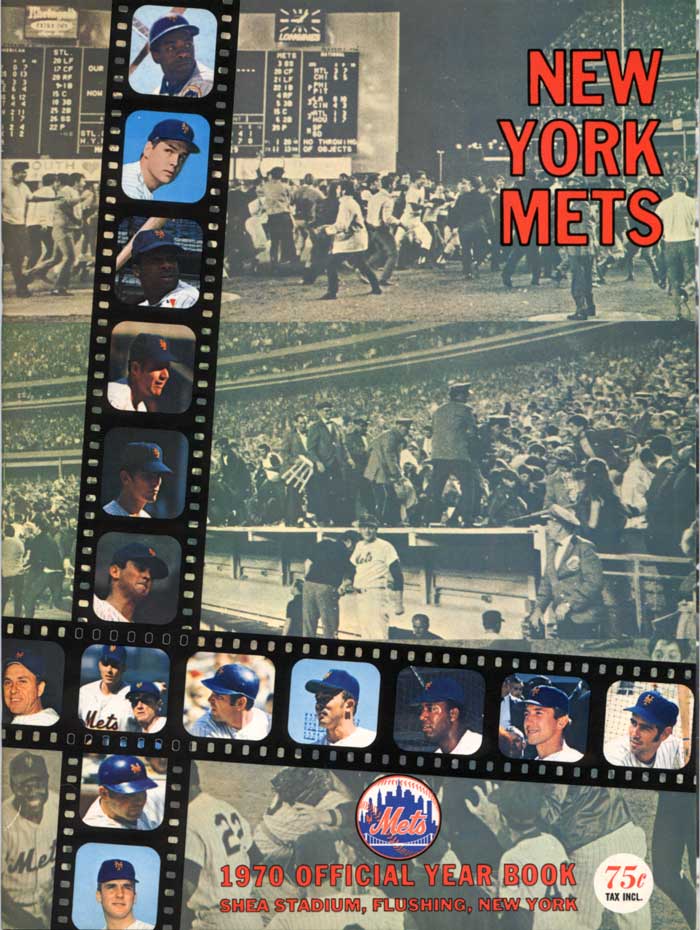
Mets highlight films, however, were never stopped from interpreting recent history in the best possible light. We’ll see how that propagandistic bent manifested itself when SNY debuts Mets Yearbook: 1970, 6:30 Wednesday evening, following the Mets-Rockies matinee.
As a personal aside, just as late summer 1969 was the ideal moment to discover the Mets, I have no problem with 1970 being my first full season as a fan. I must have liked what I saw, ’cause I’m still here.
One of my Little League career’s many lowlights was the day a searing liner was hit out to me amid the clover that covered right field — a place generally unexplored by balls and so not coincidentally where I and millions of other kids not destined for greatness have played. After some combination of misjudging the ball, chasing it and fumbling to pick it up, I got it in my grip and heaved it with all my might, nearly skulling the understandably startled center fielder.
I wasn’t completely useless, though. I had two talents which my coach learned to exploit, and that in hindsight seem like early signs pointing to a future as a blogger:
1. Though I had none of the physical skills required to play catcher, I knew quite a bit about the position from having my nose buried in baseball books all the time. So I was possibly the youngest catcher able to frame pitches and/or bring them back into the strike zone, at least to the satisfaction of the high-school umpires of late-1970s Long Island.
2. I could keep score, which freed up Coach to attend to such essential duties as breaking up rock fights and stopping half the team from making a beeline to the ice-cream truck mid-inning for Fun Dip and Pop Rocks.
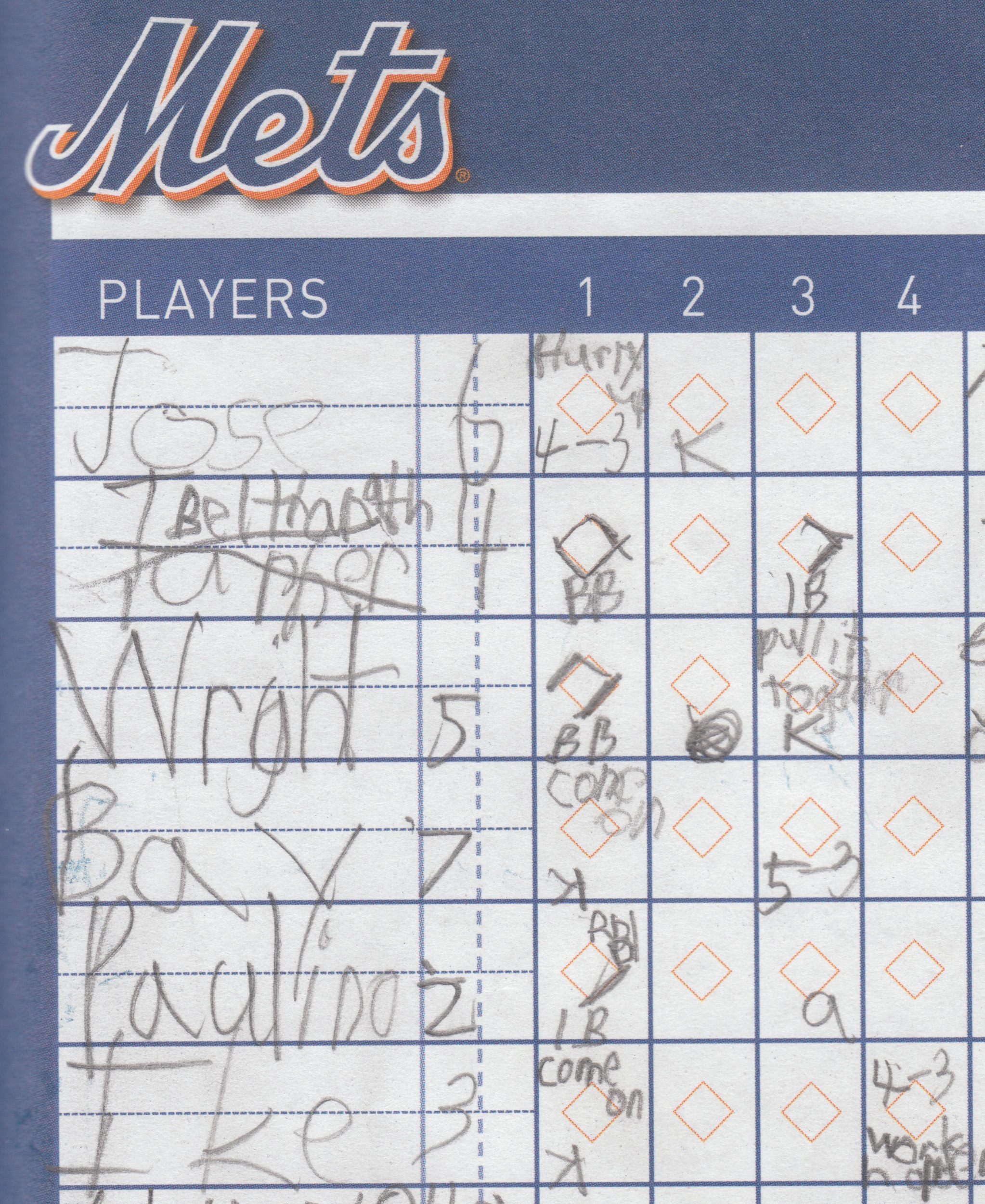
So far Joshua hasn’t had any on-the-field misadventures as cringeworthy as my 9-8 non-putout, thank goodness, and he can actually throw. But that aside, his Little League career is not all that different than mine. But now there’s a positive in that: Today he kept score avidly, save for the time needed to devour a Carvel cup of vanilla with rainbow sprinkles, recording every play from Jamey Carroll’s single to David Wright waving at strike three.
Part of the kid's handiwork
He got the numerical equivalent of the positions at once, even shortstop, and was barely thrown by anything — the only play that caused him to furrow a brow was Matt Kemp’s fifth-inning GIDP, which was pretty challenging to account for up and down the scorecard. He even added editorial comments — Jason Bay’s first-inning strikeout includes a scrawled “come on,” Wright’s third-inning K is accompanied by “pull it together,” and Andre Ethier’s fatal home run is noted with “oh man.” Pretty much what I was thinking at the same time in each instance, minus the profanity and sputtered beer.
The Mets lost today. But all in all, that was a bump in the road:
1. It was my 42nd birthday, or my Jackie Robinson birthday as we decided to call it. I hope my Turk Wendell birthday sees a lot more pennants on the wall of World Bank Economic Liberalization Program Stadium, and doesn’t involve crabbing about the lack of a no-hitter.
2. My lovely wife graciously agreed to share Mother’s Day with me, and to mark it with seats for all three of us in the Pepsi Porch.
3. It was my first 2011 visit to Citi Field, the lack an issue of April deadlines and one brush with bad weather. We got a stupefyingly gorgeous day — hot in the sun, yes, but around the fourth inning the clouds came in and left everything pleasantly warm without the added touch of deep-frying.
4. Joshua proved impressively leather-lunged, bellowing at players and the Mets in general. Emily and I eventually tired of this, perhaps because we were hemorrhaging from the ear canals, but our Pepsi Porch neighbors were amused. Or at least tolerant.
5. Excused myself in the mid innings for a visit to the Promenade behind home plate with Mr. Prince. We drank foreign beers and discussed an upcoming project we’re excited about and hope you will be too.
Not bad for a season debut. On the way out, with Joshua still a bit mopey about the loss, I tried to cheer him up by noting that “the second-best thing you can do with an afternoon is watch your baseball team lose a game.” He cocked his head a bit, curious, and I asked him what he thought the best thing would be.
He got that too. Time to teach him to frame pitches.
Just kidding. Of course I remember Angel Pagan. Angel Pagan was the Mets’ center fielder before Jason Pridie. Pagan was pretty good at one point, I vaguely recall. Finished in the Top 10 in triples among National League batters two years in a row.
You know who else hit a lot of triples? Wally Pipp. Wally Pipp led the American League in triples in 1924 with 19. He was also sixth in games played with 153. There were several years when Pipp barely missed a game. Real fine player, that Wally Pipp. Real good right up to the middle of 1925. You look at his numbers and you see an all-around consistent player who just suddenly disappears from his team’s lineup.
And speaking of Gee, I wonder how many of us on the eve the 2011 season saw the Mets rampaging to a third consecutive victory in early May using a herd of recent Buffalo Bisons. You know how we hang on every element of the Opening Day roster right up until the trucks are packed in Port St. Lucie? Well, we’re idiots. Whatever we obsessed on getting exactly right at the end of March is irrelevant barely five weeks later.
Dillon Gee. Mike O’Connor. Ryota Igarashi. Justin Turner. Ronny Paulino (him we assumed would be here sooner than later though we didn’t much care). Not one of them was an active Met when the Mets met the Marlins to start the season; all of them played a role in beating the Dodgers Saturday night. It started with Gee, who was pressed into service when Chris Young’s tight right shoulder reminded us he’s too good to be true, and it crested with Turner, the second baseman who wasn’t deemed sound enough to beat out All-Star nominee Brad Emaus yet was perfectly fine as a pinch-hitter in the eighth. Together, these recent minor leaguers who weren’t necessarily expected up here so soon teamed with several longer-tenured Mets to short-circuit Andre Ethier and other assorted men in blue.
Leading their charge once again was Jason Pridie, another erstwhile Bison, now a staple of Met lineups for years to come as far as I can tell. Pridie of the Mets, as moviegoers everywhere will someday know, showed up in New York with little fanfare and was soon the everyday center fielder for thousands of consecutive games, many of them stirring. Like the Friday night affair he won with a three-run home run. Like the Saturday night triumph he helped seal with three base hits.
On the day they ran the Kentucky Derby in Louisville, Jason Pridie proved a real iron horse, you might say. Got his batting average up to .300. Galloped home a couple of times. No stopping this fellow. Just pencil him in for the next decade or so.
Being of inferior genetic stock, I don’t have the faintest idea what it must be like to be a major-league baseball player, blessed with amazing hand-eye coordination and fast-twitch muscles and everything else I lack.
But I’m willing to edge not very far out on a limb to say this: It must be awesome being Jose Reyes.
There he was tonight, tripling twice and doubling and walking and stealing and coming home to score. He was everywhere, in perpetual motion, churning legs and flying hair and clapping hands. It must be a blast to be in there doing all that.
When Jose is really on — as he’s been for a happily long stretch now — he doesn’t so much hit balls as he attacks them, slashing at them with his bat and then lighting out after them on the basepaths. He’s around first before you’ve gotten beyond that initial instinctive YEAAAHHHHH!!!!! and you catch up with him making calculations as he nears second. With most balls in the gap, you assume a double and figure if everything breaks right the batter might wind up with a triple. With Jose it’s the opposite — you assume triple and hurriedly downgrade your expectations when you remember there’s a plodding runner stuck in front of him or a particularly rifle-armed outfielder behind him with bad intent. When he’s standing on second Jose tends to look pleased but also slightly disappointed, like a kid who got a nice piece of cake but saw the knife placed just on the wrong side of a perfect frosting rose. Jose on third is something different. It starts with the body hurtling to the ground, dreadlocks aloft, the toes stretched to drag in the dirt. We all know he shouldn’t be sliding head-first, that it’s as crazy for him to put his hands and wrists in harm’s way as it would be for a violinist to punch it up with some drunk at a bar. Yet, at the same time, it’s so cool, the way he locks on to the base as he goes by, using it like a fighter uses the arresting wire on a carrier’s deck. And then the look at the ump, daring him to deny what he’s just seen and all those people have just enjoyed. He gets the safe sign (unless Marvin Hudson is involved), but there’s still all this extra energy from his flywheel trip around the bases. So he has to clap, except when Jose claps he doesn’t clap like you or I clap — he whacks his hands together like a sugared-up kid with the biggest erasers in the world. Or he finds someone to point to. Or he just grins a million watts’ worth. Or maybe he tries out all three.
Two such Reyes trips to third would have been treat enough for most any night at Citi Field, but we also got Carlos Beltran as the undercard.
Beltran is an entirely different player to watch: expressionless where Reyes is exuberant, a quietly graceful machine where Reyes is a manic eruption of windmilling limbs. When Jose’s on he lunges at balls with an almost palpable hunger; when Beltran’s locked in he knows exactly what pitch he wants, identifies it and makes whatever minute adjustments are necessary to catch the ball with the fat part of his bat, employing his lethal swing as he has so many times before. Then he’s off, gliding to whatever his destination is and stopping there, mission accomplished.
None of this inspires Reyesian flights of fancy — if anything it plays into the hands of Beltran’s detractors, who register the absence of grimaces and fist pumps rather than the presence of well-machined execution. But I love to watch him nonetheless: I sometimes find myself surprised that a well-struck Beltran hit went as far as it did, because that sniper’s swing is so quietly perfect that it seems like it shouldn’t send a ball rocketing off into some distant corner of Citi Field, or sailing off to settle down above the Great Wall of Flushing. And seeing Beltran whole again — or as close as he can come these days — feels like a gift. The Mets haven’t been particularly lucky this year, but there has been this: Beltran is an everyday player where we wondered how much we’d have to hear he was resting, and we no longer worry about him when there’s a tricky bloop to right or an extra base that needs taking. He’ll get it and he’ll get there, and then he’ll be in there tomorrow.
There was more tonight, of course: one of Ike Davis’s patented blasts out of the yard; the delightful, unexpected sight of Jason Pridie lashing a game-changing three-run homer beyond the David Wright DMZ; and the oddity of having every Dodger intentional walk backfire soon after enduring every Giant intentional walk working to perfection. Not to mention that the 10-year-old who very capably delivered the first pitch — the son of a Red Hook firefighter killed on 9/11 — was named Chris Cannizzaro and yes he was named for the Mets catcher and yes he really is a fan. “Always hated the Yankees,” he explained coolly. Great all around, but watching Reyes and Beltran was best of all.
The Mets are having a confounding, which-way-is-up year, one in which there are encouraging stories but also too many holes to fill, at least for this campaign. I’ve been a fan long enough to know what’s coming. I understand that Beltran is in his final Mets campaign, and should bring back a decent prospect or two in the summertime, particularly if he’s still looking as sound then as he does now. I understand Reyes isn’t on base as often as he could be, that he’s lost time to injuries, and that he might be too expensive to bring back. But he remains a monster talent at a critical position, and he too might fetch a decent reward from some playoff contender on his way to free agency and a new home.
And perhaps that will be the right thing to do in both cases. Perhaps they will leave us and in two or three years we will love the players we got in return, young stars who have us giddy with the possibilities and whose names are front and center when we crow about the new core. That could happen, and we could be grateful it did. But oh, what a price. Carlos Beltran in Angels red would hurt, but Jose Reyes in San Francisco black and orange, only seen six times a year, might really break my heart.
I’ll savor every sweet swing and tumbling third-base-as-brake slide. We all should. But the more of them we see, the more we will have to wonder how many are left, and how we will feel when the answer is none.
Piazza: Catcher, Slugger, Icon, Star by Greg Prince is available from Amazon, Barnes & Noble and other online booksellers.
Amazin' Again: How the 2015 New York Mets Brought the Magic Back to Queens by Greg Prince is available from Amazon, Barnes & Noble and other online booksellers.
Volume I of The Happiest Recap: 50+ Years of the New York Mets As Told in 500+ Amazin' Wins by Greg Prince is available in print and for Kindle on Amazon.
Faith and Fear in Flushing: An Intense Personal History by Greg Prince (foreword by Jason Fry), is available from Amazon, Barnes & Noble and other online booksellers.