The blog for Mets fans
who like to read
ABOUT US

Faith and Fear in Flushing made its debut on Feb. 16, 2005, the brainchild of two longtime friends and lifelong Met fans.
Greg Prince discovered the Mets when he was 6, during the magical summer of 1969. He is a Long Island-based writer, editor and communications consultant. Contact him here.
Jason Fry is a Brooklyn writer whose first memories include his mom leaping up and down cheering for Rusty Staub. Check out his other writing here.
Got something to say? Leave a comment, or email us at faithandfear@gmail.com. (Sorry, but we have no interest in ads, sponsored content or guest posts.)
Need our RSS feed? It's here.
Visit our Facebook page, or drop by the personal pages for Greg and Jason.
Or follow us on Twitter: Here's Greg, and here's Jason.
|
by Greg Prince on 10 September 2010 9:14 am Welcome to Flashback Friday: Take Me Out to 34 Ballparks, a celebration, critique and countdown of every major league ballpark one baseball fan has been fortunate enough to visit in a lifetime of going to ballgames.
BALLPARK: Dodger Stadium
HOME TEAM: Los Angeles Dodgers
VISITS: 1
VISITED: June 22, 1996
CHRONOLOGY: 17th of 34
RANKING: 12th of 34
“I was in California. Everything is new, and it’s clean. The people are filled with hope.”
—Don Draper, 1963
Perhaps it was overexposure to “Who Will Save Your Soul?” the monster soft rock hit of the spring of 1996, but the word that hit me immediately upon settling into my seat at Dodger Stadium was jewel. “This place is a jewel,” I kept thinking. I may have even said it out loud.
 I don’t know if the Dodger soul can ever truly be saved, what with its theft from Brooklyn — an inside job — on October 8, 1957. Per Jewel, Walter O’Malley told the Borough of Churches that, in essence, 68 seasons as Brooklyn’s representative in the National League had been swell, sweetheart, but it was just one of those things. You can reflexively blame O’Malley; you can be fashionably revisionist and pin it on Robert Moses; you can shrug and reason that a westward move too attractive to pass up, but as long as you’re aware that the backstory of the Los Angeles Dodgers is that they used to be the Brooklyn Dodgers, you can never quite fully give anything they do your unabashed blessing. No, that soul will, at best, forever hang in limbo. I don’t know if the Dodger soul can ever truly be saved, what with its theft from Brooklyn — an inside job — on October 8, 1957. Per Jewel, Walter O’Malley told the Borough of Churches that, in essence, 68 seasons as Brooklyn’s representative in the National League had been swell, sweetheart, but it was just one of those things. You can reflexively blame O’Malley; you can be fashionably revisionist and pin it on Robert Moses; you can shrug and reason that a westward move too attractive to pass up, but as long as you’re aware that the backstory of the Los Angeles Dodgers is that they used to be the Brooklyn Dodgers, you can never quite fully give anything they do your unabashed blessing. No, that soul will, at best, forever hang in limbo.
But I was on vacation the Saturday I alighted at Dodger Stadium, so I was willing to put ancient sins aside and simply revel in the sparkly bauble Walter O’Malley left behind.
Admission to Dodger Stadium served as the climax to the three-ballpark Southern California road trip I simultaneously dreaded and embraced. I wanted it, of course, but I feared the logistics from a driving standpoint, driving no longer being my thing by the summer of ’96, and L.A. being the capital of American car culture. But as noted in previous entries regarding that week’s sojourns to Anaheim and San Diego, I dealt with it and regained my automobile comfort level for as long as it took me to get to those ballparks. The Angels were Wednesday. The Padres were Thursday. By Saturday, it was no big thing for Stephanie and me, enjoying the courteous loan of my sister’s and brother-in-law’s apartment in Marina Del Rey, to jump on the Santa Monica Freeway and head east toward downtown Los Angeles.
Dodger Stadium’s biggest surprise was, in a way, its location. I knew the name Chavez Ravine from all the trips the Mets had taken out there, but I never quite grasped where in the context of L.A. it was. When you see the ballpark on TV, it seems splendidly isolated, nestled among hills, trees and parking. But it’s not. It’s right there in the heart of the nation’s second-largest metropolis…like it’s in the opening credits of L.A. Law or something. Yet when you’re at the stadium, you put all that behind you — literally. The trend in 1990s ballpark construction veered sharply toward showing you the city you were in while you were watching the game. It was a welcome trend. But creating an urban oasis for the pastoral pastime? That wasn’t so bad, either.
Nice to be surprised by Dodger Stadium, though I don’t think I ever went into a ballpark for the first time with more preconceived notions about it or its fans. A quarter-century of being fed the same lines repeatedly will cement your notions in advance, and goodness knows Ralph, Lindsey, Bob and their successors hit the same notes over and over over the Met years:
• Dodger fans show up late.
• Dodger fans don’t pay attention to the game.
• Dodger fans leave early.
But the Met announcers had also always made much of the beauty of the ballpark, that it was, at a time when this wasn’t the rule, constructed for baseball and nothing else. It was a universally shared sentiment. Roger Kahn, who knew a little something about Dodger stadia, appraised it as such in his 1976 pulsetaking, A Season in the Sun:
“Dodger Stadium is a triumph of baseball design. The grass is real. The shape proclaims baseball.”
I was ready to have that preconceived notion confirmed and I wasn’t disappointed. Yes, that shape. It was absolutely perfect. Nowhere else I had been — modern classic or vintage masterpiece — seemed as spot-on in terms of appearing ready for its baseball closeup. The old salesman adage about underpromising and overdelivering was on immensely satisfying display at Dodger Stadium. A jewel?
A diamond.
Even today when visiting broadcasters set up shop in Chavez Ravine they heap praise on how the place is so clean, how a stadium opened in 1962 still looks so modern, how it’s kept up like nothing else. You can curse O’Malley for Bumnapping Brooklyn’s team and Bumrushing Brooklyn’s trust, but you have to grudgingly tip your cap in his direction (down below) for setting an incredible standard with Dodger Stadium. Not that the standard was much followed. Shea came to be a mere two years later and generated more grunge than Seattle at the height of Nirvana. None of Dodger Stadium’s contemporaries held their promise as long, and no park from the ’60s and ’70s was ever nearly as promising.
Damn that O’Malley, getting exactly what he wanted in Los Angeles and making it work to near perfection for decades, even long after he was gone. They gave him the land, he built his own palace and it’s thrived for nearly a half-century. Would that have happened in the downtown Brooklyn location he craved? Could have he created his own kind of miracle in Flushing had he been open to Moses’s crazy notion that the Dodgers could move to Queens? Would have leasing from the city allowed him the flexibility to build as he envisioned in an era when multipurpose facilities were fancied as a sporting panacea?
We’ll never know, and to be honest, I wasn’t thinking about it on our Saturday night at Dodger Stadium. I just knew it was, as Steve Garvey told Roger Kahn in 1976, date night. Garvey analyzed the different kinds of crowds the Dodgers drew depending on the date. Friday crowds were loudest — and harshest if you played badly. Sunday afternoons were for families and positivity. Monday and Tuesday night “you get the fans who really know baseball.” We had our own Garveyesque classification:
“Saturday. Date night. That just about what it sounds. Medium. If the guy and the girl are getting along, they’re with you. If he spills mustard on her skirt, it’s something else.”
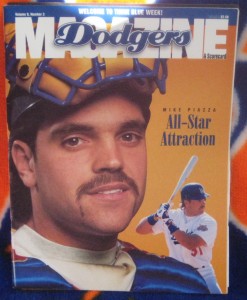
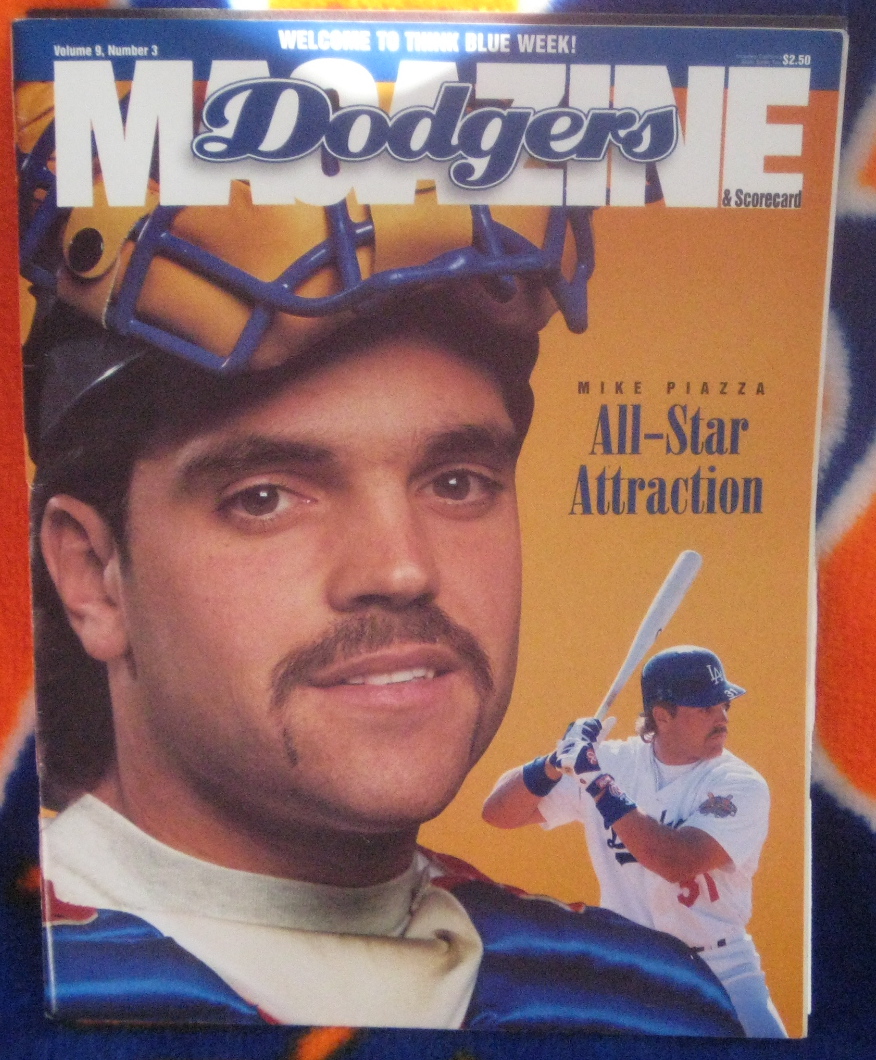
I don’t know if the All-Star first baseman’s analysis held precisely to form two decades hence, but Stephanie and I consciously dated the Dodgers on our Saturday night downtown. We’re always with the home team as long as the visitors aren’t the Mets, but I decided to go all in. I went for the legendary Dodger Dog (no mustard spilled). I nodded approvingly when a customer at a souvenir stand asked if he could buy an Astros cap (Houston being that night’s opponent) and was told in no uncertain terms, “This is Dodger Stadium. We only sell Dodger caps.” I bought a Think Blue t-shirt in honor of THINK BLUE week as proclaimed by the HOLLYWOOD-inspired letters on the Elysian Hills over the outfield fence. And I cheered heartily as youthful Dodger superstar Mike Piazza homered and caught a complete game shutout.
Ramon Martinez vs. Shane Reynolds offered us some vintage Dodger Stadium pitching — maybe not Gooden vs. Valenzuela or Koufax vs. Hendley, but exactly the kind of thing for which I showed up early and stayed past the end. Yet another of those articles of faith I’d absorbed on Channel 9: the mound is higher out here than anywhere else. Of course the pitching’s outstanding. Of course I was into it.
And of course the L.A. crowd got there when it got there and left when it left. In my two hours and twenty-four minutes of temp Dodger rooting (albeit while wearing my Mets cap), I couldn’t adjust to the local custom of ignoring the game at hand. As a beach ball bounced merrily through our section, I briefly betrayed my Brooklyn birth certificate and snarled, “Ramon Martinez is pitching a shutout — watch the game!”
But the Los Angelenos didn’t listen. They were getting by fine without me and they would continue to do so once I flew home and reverted to my sense of vague antipathy toward them. Dodger fans gotta be Dodger fans, I guess, and I imagine they’re only more so in this accursed epoch of the constantly deployed personal digital device that nobody is capable of laying off in the middle of a baseball game. Still, I think I was glad I saw Dodger fans acting as I’d been led to believe they would. What’s the point of schlepping across the country and not seeing what you expect?
The Los Angeles Dodgers I’d grown up slightly envying were reaching the last mile of their own singular freeway when we made our 1996 pilgrimage. Less than a week after we’d left L.A. (and my Southern California driving chops left me for good), manager Tommy Lasorda suffered a mild heart attack and was replaced on an interim basis for a month by Bill Russell before stepping down from the job he’d held twenty years. Lasorda took it over at the end of 1976 — the year of Kahn’s Season in the Sun visit — from Walter Alston, who took it over in Brooklyn in 1954 — the year Kahn left the Dodger beat at the Herald Tribune. An O’Malley, Walter’s son Peter, was still running the club in 1996, but a sale was imminent. I was reminded this week by Lee Jenkins’ dissection of the Frank and Jamie McCourt divorce mess in Sports Illustrated that when Peter O’Malley was in charge, he held the line on ticket prices for a very long time. The article made me remember that Dodger tickets were substantially cheaper than Angel tickets and Padre tickets on our trip…and, at the risk of buying into overbearing myths, these were the Dodgers we were talking about.
If the Los Angeles Dodgers cultivated a pristine image worthy of pre-divorce Steve Garvey, it didn’t endure without a foundation of genuine merit. Those Dodgers, original sin against Flatbush notwithstanding, were something special when I was a kid. They didn’t win their division every year — and didn’t win two World Series I really wanted them to win in 1977 and 1978 — but they were probably, as Kahn said they themselves were fond of telling you circa 1976, “the best organization in baseball”.
The Dodger Way. Dodger Dogs. Topping 2 million in attendance annually when that was an achievement. The first team to top 3 million. Those celebrity seats behind home plate. Vin Scully. Vero Beach. Danny Kaye. Koufax and Drysdale in retirement but talked about as if they were still in rotation. Fernandomania in full bloom. Cey, Russell, Lopes and Garvey together almost forever. Alston and Lasorda, the two polar opposite managers who spanned more than four decades between them. The parade of Rookies of the Year, particularly that Piazza kid.
Those were the L.A. Dodgers I came to see. Roger Kahn wrote in The Boys of Summer that a reporter needs to subscribe to the maxim, “Do not preconceive.” I did anyway. I wasn’t disappointed. Nowadays the Dodgers seem like just another team. They were sold to nefarious Fox. Fox sold them to the combustible McCourts. They plaster ads all over their premises just like anybody else. They run through managers just like anybody else. They stopped producing Rookies of the Year after Todd Hollandsworth was deemed the best of an underwhelming freshman lot in ’96. They traded Mike Piazza…and thank goodness they did.
I’m glad I got the last gasp of the L.A. Dodgers I’d fancied from afar; the L.A. Dodgers I sort of looked up to in the middle of the 1970s; the L.A. Dodgers I’d never fully blamed for the disappearance of the Brooklyn Dodgers because I hadn’t done all that much reading on them until the late 1980s when I finally picked up and dove into the copy of The Boys of Summer I’d purchased for 50 cents at a college flea market five years before. That was when I began to fully comprehend the crime against humanity perpetrated by Walter O’Malley in 1957 (even if it and Horace Stoneham’s loathsome complicity are ultimately the two main reasons we have the Mets). The Dodgers I knew best were the Dodgers from A Season In The Sun, the version Kahn visited when they were at their L.A. peak.
This morning, of the ’70s, Dodger Stadium lay empty. The aisles and seats had been swept clear of litter and gum, deposited by the 52,469 customers the night before. Toward the right lay the ball field, green and white and a reddish tan. To the left, from O’Malley’s office, lay hills that had been barren. They are irrigated and showed the green of watered pines.
“What a pleasant office you have,” I said.
“Not so pleasant,” O’Malley said. “Outside my window there’s a groundskeeper standing in center field with a hose, and I wonder, if he’s going to use a hose, why the hell did I put $600,000 into an underground sprinkler system?”
“Why does he use a hose?”
“Because we brought him out from Brooklyn and he used a hose there,” the owner of the Los Angeles Dodgers announced, impatiently.
Walter O’Malley died in 1979. Chances are nobody who was alive in Brooklyn in 1957 would even think of using a hose on him where he likely wound up.
Speaking of Brooklyn ballclubs, congratulations to our very own Cyclones for defeating the Jamestown Jammers and making it to the New York-Penn League Championship Series this weekend. Now go tame those Tri-City ValleyCats!
by Greg Prince on 8 September 2010 7:39 pm Midweek afternoons were not made for watching baseball, which is why when the two get together, their appeal is so undeniable. Today was the final time in 2010 you needed several hours in the middle of your weekday to fully enjoy your Mets. Twenty-two games remain, some of them in weekend daylight, the rest commencing as the sun goes down. None will intrude on your midweek afternoons.
Too bad. It’s not necessarily convenient, but what a welcome intrusion the weekday day game always is. Don’t you love that your favorite thing can just happen in the middle of a Wednesday? Maybe you can’t give it your full attention, maybe you wind up missing the whole thing, but whatever you derive from it is unlike anything you get from most of your normal day-to-day machinations. For that matter, a Mets-Nationals game on the afternoon of September 8 is going to top the same contest if it were being held at night. At night, a September showdown between the fourth-place Mets and the fifth-place Nats, even one the Mets win, dares you to ignore it. During the day, though…that’s a day game. The Mets are playing a day game? That’s right! Man, I gotta check the score! Who’s pitching again?
It isn’t much, this last chunk of 2010 Mets baseball, but its status as better than nothing peaks on a day when it wanders into your afternoon, as if it made an appointment with you months ago. You work during the day. You go to school during the day. You have things to do during the day. Yet Mets baseball has decided to inflict itself upon your routine. You let it in, and for a little while the end of the season doesn’t loom. For a little while, it’s still summer. There’s still the sense it won’t get dark early and it won’t be cold soon. It’s baseball outside during the day, just like it was when you first encountered it in the street or on the playground or in your imagination.
Midweek afternoons were not made for watching baseball. But maybe they should’ve been.
by Jason Fry on 7 September 2010 11:06 pm Maybe you thought this was the night.
And why not? The baseball gods enjoy a good laugh as much as any other cosmic entities, so why wouldn’t Dillon Gee — he of the Triple-A ERA near 5.00 and the penchant for gopher balls — do what Tom Seaver and Nolan Ryan and Jerry Koosman and Jon Matlack and Dwight Gooden and Ron Darling and Sid Fernandez and David Cone and Frank Viola and Bret Saberhagen and Al Leiter and Rick Reed and Mike Hampton and T#m Gl@v!ne and Pedro Martinez and Johan Santana could not? Why couldn’t Dillon Gee take the mound on a September evening in D.C. and leave it as a Mets hero for eternity? Wouldn’t that be just like baseball, to double down on the Mets out of caprice, and finally give a no-hitter to a Met in his major-league debut?
I’ve taught the Mets countdown tradition (which perhaps may double as the perpetuation of the Mets no-hitter curse) to Joshua: You count down by threes after each inning until a hit is recorded. “Twenty-four to go!” “Twenty-one to go!” And so forth, until a white ball bounds gleefully and nose-thumbingly across an expanse of green grass and you moan, “Another night….” Somewhere in the fourth inning you start thinking about what the next number is, because you’re beginning to depart from the script. In the fifth inning the balance shifts to fewer outs remaining to get than outs safely recorded. I’ve always wondered what happens when you get to the ninth: Do you shift to “two to go” and then “one to go,” mirroring the Bernstein/Fry tradition of holding up fingers for outs as if we were fielders? Do you maintain superstitious silence? Do you scream at Gary Cohen for noting the no-hitter with every other syllable? I’ve never had reason to find out, but suspect I know the answer: Should “three to go” territory arrive, I’ll have crammed myself under the coffee table and be writhing and groaning with every pitch.
Gee got to “12 to go” before running afoul of the inevitable Willie Harris, who I really think spends Christmas Eve popping down the chimneys of Met-fan homes and taking away toys. One misplaced fastball, and Gee was turning around in consternation, watching his no-hitter and shutout get fielded by a spectator. Then, after seven innings and 86 pitches he was sitting on the bench, removed by Jerry Manuel for reasons that remain mysterious as of this writing. (I assume it was the old “manager wants young pitcher to leave with a good feeling” reason, as articulated by Ron Darling and assailed by Gary Cohen and a cranky Keith Hernandez. I’m usually on the Gary/Keith end of the spectrum where this old saw is concerned, but I admit that I then inevitably think of Paul Wilson’s sixth major-league start being reduced to ashes by Sammy Sosa.) Whatever the reason, Gee was out, but the Mets relievers tidied up without an excess of fuss, and a quick, quietly satisfying game was concluded.
So no, Dillon Gee wasn’t the second coming of Bumpus Jones. Looking ahead, those pesky minor-league numbers would strongly counsel against expecting him to be the next Tom Seaver. One of the hard lessons taught by age is that garbage-time starts are the beer goggles of baseball love affairs: Pat Misch looked pretty good late last year, after all, and the only Met to throw a complete game in his big-league debut was the immortal Dick Rusteck. Though to be fair, Rusteck hurt his arm. And why couldn’t Gee be the next Rick Reed, relying on guile and location and rising from unheralded to beloved in the space of a couple of months? Come to think of it, don’t we all love R.A. Dickey for more than his sad-eyed eloquence?
Having watched the Mets decline into fall, it’s easy to forget that our team has had its share of good luck, too. Sometimes we pull a Hall of Famer out of a hat, or are favored by a black cat, or have a right-fielder’s desperate dive come up with the ball, or watch a banjo-hitting reserve stroke two World Series home runs, or watch the ball come off the wall just so, or have a batter jackknife out of a pitch’s path at the perfect time, or watch a little trickling grounder get by Buckner, or have a catcher sense that not one but two runners are inbound. We’ve had successful gambles. We’ve even witnessed a miracle or two. It’s just that none of those miracles involves a game starting and 27 enemy batters recording outs before one records a hit.
by Greg Prince on 7 September 2010 8:41 pm Any way we can get Nyjer Morgan to turn his wrath on Willie Harris?
by Jason Fry on 6 September 2010 9:25 pm I missed all of yesterday’s outburst against the Cubs, monitoring it in dribs and drabs while saying farewell to summer at Coney Island and watching the Brooklyn Cyclones win their season finale, which they used as a tuneup for the playoffs. (If you’re near New York City, instead of enduring horrible baseball, go see the Cyclones — playoff tickets are available, and this looks like a team with some bona fide prospects on it.) Anyway, I saw the Mets had scored 10, gave a little silent cheer, and then shook my head patronizingly about 15 minutes later when the guy in the row in front of me announced they’d scored 18. Let’s not get carried away, I thought, then checked my cellphone again. Wow, wouldja look at that?
I missed the first inning of today’s game because I wasn’t paying attention, but after what happened at Wrigley Field, I wasn’t particularly surprised to find the Mets already up 2-0. Or when they added another run two innings later. I even allowed myself to be briefly annoyed that after a summer of lurching spastically down the road like a 16-year-old with a learner’s permit and a stick shift, the Mets had finally found third or even fourth gear. Watch them go on a run, I thought. Just to annoy me.
But no, all of a sudden the Mets looked around, realized they were the post-San Juan Mets of 2010, and they weren’t supposed to be doing what they were doing. With two outs in the top of the third, the Mets had three hits. With 27 outs in the bottom of everything, they still had three hits. And meanwhile, nobody could pitch. Mike Pelfrey came unraveled in a horrible fourth inning, and afterwards the Mets principals were predictably at odds about what the problems were: Pelfrey said he just couldn’t throw his fastball for strikes, Jerry Manuel said he lost focus, and Dan Warthen helpfully chipped in that Pelfrey had gone off to La-La Land. Raul Valdes, just returned from Buffalo, came in and was horrible. Sean Green, last seen being battered by Dan Uggla in the second game of the season, came in and was horrible. Pat Misch, who’s been mostly horrible, bucked the trend by retiring a batter. Ryota Igarashi — who definitely deserves consideration as one of the more horrible Mets busts — came in and was horrible. Oliver Perez, who can never return from being Oliver Perez, came in and was Oliver Perez.
And then, mercifully, it was over. Soon we’ll say the same about this strange fizzle of a season.
And yet, with two outs in the top of the ninth, I left off listening to Wayne Hagin slop paint on the word picture with his trademark clunky, tardy strokes and strolled over to the set. Why? Because Mike Nickeas, soccer scion, was up in search of his first big-league hit, and even in the worst of times I’m a sucker for a first big-league hit.
But watching Nickeas try to be the first Met in 20 plate appearances to get a hit, I had an unwelcome flashback to the final game of the 2003 season. Back then, there were two outs in the ninth and the Mets were down 4-0 to the Marlins, having collected three hits on the afternoon. All that stood between them and winter was Mike Glavine, looking at what turned out to be his final chance to go into the Baseball Encyclopedia with a ‘1’ under the H column. Glavine singled, which depending on how you felt either kept the season alive or interfered with a staggeringly terrible year’s being mercifully euthanized. (Because you’re curious despite yourself, Raul Gonzalez then reached on an error and Vance Wilson was rung up on a called strike three. None of the three would ever play for the Mets again.)
I remembered that I’d actually cheered for Mike Glavine’s hit, for a number of reasons. Because I’m a Mets fan, obviously. Because even though 2003 had been a horror show, one of the few seasons in which I actively loathed my ballclub, being mad at the Mets was better than winter. Because my dislike for T#m Gl@v!ne’s alibis and subtle shifting of blame hadn’t yet curdled into naked animosity. Because none of that was his brother’s fault. And as previously noted, because I’m a sucker for a first big-league hit.
Standing there watching Mike Nickeas peer at the pitcher, I tried to remember all those becauses, and not get distracted by how harebrained it was letting Mike Glavine be a Met in the first place. But it was already stuck in my head: Mike Glavine, hideous baseball, dopey decision-making, 2003. By force of will I made myself fast-forward to 2010, and watched Mike Nickeas strike out.
by Greg Prince on 6 September 2010 8:37 am Amid an eighteen-run Met explosion, how could there not be a few bangs, pops and whiffs off the bat of the object of my offensive obsession, Mike Hessman?
The best news where Hessmania was concerned Sunday is the admission into Club Hessman — One Met Home Run and One Met Home Run Only — of a 70th member, our second baseman of the present and future, Ruben Tejada.
While the Mets were scoring a month’s worth of runs yesterday afternoon, nobody was having a better year than Tejada, cramming what seemed like an entire season’s offense into this one game. The staggering five runs batted in on two hits and a sacrifice fly speak for themselves, but let us remember, if we can go back that far, that Ruben actually turned this game around in the fifth inning when it was still in doubt. The bases were loaded, the score was tied and the Mets were doing what they always do: nothing.
Lucas Duda struck out swinging. Josh Thole struck out looking (on a pitch Howie Rose grumbled was too close to take). This was Typical Mets, leaving ’em loaded, not taking advantage, preparing to fail…the whole bit. The Mets, as a team, were batting under .200 with the bases loaded for the season. Remember, batting with the bases loaded is supposed to be the most advantageous situation in baseball. The pitcher has to throw strikes. Strike are easier to hit than balls.
Can’t anyone here play this most elemental part of this game?
Young Ruben can. He looped a Ryan Dempster pitch into center field, brought home two runs and changed the trajectory of Sunday from a back-and-forth slugfest to an out-and-out mugging. If there was enough season left, I’d be tempted to put a pin in that hit as the turning point of 2010. As was, it placed us on the straight-and-narrow to a romp of a win, and when you don’t have nearly enough of those, you’ll take what you can get.
Ruben’s first major league homer, the punching of his ticket into Club Hessman, should also prove fleetingly memorable in that it sort of mirrored the hit that has kept Mike Hessman in Club Hessman. You’ll recall Mike should have two Met home runs, but his second, called gone on August 13, was video-reversed into a split-the-difference triple (and thus the legend of Mike Hessman, extra-base anomaly, was born). On September 5, Ruben hit a ball toward left, same general neighborhood at Wrigley where Mike launched his at Citi. And as with Hessman’s homer that became a triple, a fan reached out in an attempt to catch the ball. But at Wrigley, they have a basket atop the left field fence, so ultimately the umps weren’t fooled.
Since the ball bounced back onto the field and Ruben was new to this sort of thing, he kept running until he thought he had earned a triple — slid into third and everything. He hadn’t finished dusting himself off when Ted Barrett broke the news to him that he should get up and trot home. He’d achieved something 33.3% better than a three-bagger.
One guy, 20, hits what he’s sure is a triple and it turns out to be a homer, and it could be a significant step forward in a budding major league career. The other guy, 32, hit what he was sure was a homer and gets mangled into a triple and he remains Mike Hessman.
Nonetheless, let’s tip our cap to Mike the minor league home run king for being a part of the 18-run, 21-hit onslaught as our starting third baseman. Next time a Mets team scores 18 runs and somebody is tempted to look at the boxscore from 9/5/10, they’ll be surprised that the Met at 3B was not David Wright (the last time before this that the Mets scored 18 runs, at Arizona on 8/24/05, the third baseman was David Wright and he homered twice). Mike Hessman may not have had quite been the trigger man Ruben Tejada was Sunday, but he contributed by doubling once, walking once, scoring once — and lining out hard once.
He also struck out twice, the only man on either side to do so on a day that featured 31 hits from all comers. Thus, Mike Hessman continues to do two things in excessive proportions: swing and miss a lot; and collect extra bases when making contact.
Which brings us to our next stops along the Mike Hessman Met Historical Tracker:
• Mike Hessman has struck out 17 times in 41 Met at-bats. The only Met position player to strike out that often in a sample no larger? Spare 1996 outfielder Kevin Roberson, who lasted 36 at-bats, striking out in 17 of them. He also managed three home runs in his brief tenure, including a three-run, ninth-inning tiebreaker of Dan Miceli at Pittsburgh that proved the winning margin on April 27, 1996. Roberson was given a brief shot at the starting right field job, but it didn’t take. The Mets could not settle on anyone as a full-time rightfielder for several months in 1996. Great to know how some things never change.
• Mike Hessman has collected 6 hits in 41 Met at-bats, 4 of them for extra bases. The only other Met position player with a comparable profile is 1990 outfielder Darren Reed. Reed’s Met stopover encompassed six games in May, five more in August and recurring appearances in the denouement of our not-quite ’80s dynasty that September. Darren’s dossier includes 39 Met at-bats, 8 Met hits and only 2 Met singles. Reed put up 4 doubles, 1 triple and, à la Hessman, 1 Met dinger (it came the day the Mets were eliminated from divisional contention). What makes Reed and Hessman baseball soulmates is they were each marvelous hitters when it kind of didn’t matter. Hessman, we know, has crashed 329 home runs in the minors (and, at the rate he’s going, will have the chance to Crash more next year). Reed’s bailiwick was Spring Training production. Before he was traded to the Expos in early April 1991, Darren gave the Mets a .337 batting average, seven homers and 28 RBI in four Grapefruit League campaigns. He was named outstanding rookie in camp in 1989 — anybody else remember that the Mets used to give a watch to the winner of the John J. Murphy Memorial Award? — and drove in more runs than any March Met the spring he was shipped off, yet the big club could never carve out space for him.
• Yes, Ruben Tejada and Luis Hernandez are very recent Club Hessman inductees, but is this a long-term stay or just a layover? You enter the Club when you’ve hit your first Met home run because there’s no guarantee you’ll ever hit another. Obviously, certain contemporary Mets’ memberships loom as more temporary than others. We are hoping, for example, that Fernando Martinez makes it back to the bigs and hits at least one more home run in his Met life. He’s supposed to be able to do that, isn’t he? But what about our new pair of Hessmanites? Hernandez homered once in 221 at-bats as an Oriole and Royal before becoming a Met (but did go yard eight times for Binghamton and Buffalo this season). His long-term utility here is sketchy; seems like a guy who will require many more opportunities before he hits another home run. Best guess: Luis Hernandez stays in Club Hessman for the long haul. As for Ruben, whose previous flirtation with warning track power probably took place on a Little League field (nah, not really — he has eleven minor league homers since 2007), he’ll get more chances this year and probably next. I say another Met home run is in his future.
Ruben Tejada, whose OPS has only now surged to .494, projected to hit a second home run? Really? Listen, when the Mets score eighteen runs in one game, a Mets fan is entitled to go out on a limb.
by Greg Prince on 5 September 2010 9:59 pm Eighteen — as represented by chai — is considered good luck in Judaism. And when you get as lucky as the Mets did by scoring eighteen runs the Sunday before Labor Day at Wrigley Field, then there’s no need to belabor the point by saying much beyond mazel tov!
So sit back and enjoy, knowing that there was one day in the otherwise offense-starved 2010 season when we rooted for a team capable of scoring eighteen runs.
And not giving up nineteen in the process.
by Jason Fry on 4 September 2010 11:23 pm In my last job I shared an office with Steve, an Englishman who was a passionate fan of Liverpool. Liverpool, Steve explained, was the football equivalent of the Mets — badly run, generally luckless and often an object of derision for other football fans. Steve loved them as much as I love the Mets, and so we would trade tales of these teams that were thoroughly hapless and yet somehow commanded our lifelong loyalty.
This morning I couldn’t wait to tell Steve about the newest Met.
Mike Nickeas, it so happens, is the son of Mark Nickeas, who began his football career as an apprentice with Liverpool. (He’d later play with Plymouth Argyle and Chelsea, about which I know nothing.) I’m always happy to welcome a new Met into the fold, and doubly excited when the new Met is also making his big-league debut. But here was a player who was a link between two different sports in different nations — a player Steve and I might have dreamed up except for the fact that his existence seemed so thoroughly unlikely. How great was that?
Mike Nickeas was given the start because he’d worked well with Jenrry Mejia, making his first big-league start and hopefully finally moving beyond the damage his own club did to his development by wasting him in middle relief earlier this year. So how’d Nickeas do? Well … let’s just say it was the kind of day fans of the Mets and Liverpool are all too used to. Mejia did better, showing an effective changeup and curveball at times to complement his fastball. Yes, he lost, but he’s 20 — the youngest Mets starter since Dwight Gooden. Unless you’ve got a Dwight Gooden on your hands, sprung fully formed from the head of the Zeus of pitching, 20-year-old starters are inconsistent and lose a fair amount. They grow up in public, and growing up in public is messy.
So too are the late-2010 Mets. The youth movement is finally here, and they look, well, young. There’s Ike Davis bashing a home run and making several nifty pickups at first, but he’s the same Ike Davis who stumbled through a mediocre summer after a marvelous spring. There’s Ruben Tejada making a season-in-review highlight play to gun down Geovany Soto while airborne from the outfield grass, but this is the same Ruben Tejada who makes us long for the powerful bat of Anderson Hernandez. There’s Jon Niese enduring the ups and downs of a young starter, and Josh Thole trying to prove he’ll hit enough to stick in the lineup. There’s the hulking Lucas Duda, who’s made nice plays in the field grafted onto mental errors. There’s Jenrry Mejia showing good complementary pitches, and then not so good ones. There’s applauding the sight of Mike Nickeas behind the plate and then having to watch him scurry to the backstop.
They’re young players with some genuine promise, but their arrival it means September will be bumpy, with plenty of 2010 bruises we hope turn into 2011 calluses. But that’s OK with me. I’d rather watch young players make young player mistakes than see an excess of old players hanging around because of their supposed intangibles. The Mets who came back from San Juan were not just bad but boring. That team is gone, and turning into something else. We don’t know what yet, but these are the early stages of figuring it out.
by Greg Prince on 3 September 2010 8:43 pm In this new post-realization era of 2010 Mets baseball — in which we fully realize we’re toast — 7-6 losses of games which we once led 3-0 should seem, as R.A. Dickey might eloquently put it, inconsequential. For the big picture, sure, but in terms of leading by three and losing by one, it’s pretty frustrating.
We scored six runs, we had our untitular ace on the mound and we lost anyway. We got the go-ahead run to bat against Carlos Marmol with two out in the ninth, but ultimately Josh Thole couldn’t handle it when Carlos served up his patented spiked Marmol Ade. As is, Josh doesn’t look old enough to drink anything stronger than apple juice.
Wrigley Field was the perfect place for these ever-youthening Mets to spend Friday afternoon. The Near North Side Day Care Center gave them a chance to learn to play with others. Big kid Lucas Duda demonstrated promising social skills, becoming familiar today with his bat (a ringing double to right) and his arm (a laser throw from deep left). And little Luis Hernandez — not so young, but a new kid to us — really took to Show & Tell, sharing his very first home run with the children on the other side of the fence. He gets to take Thole’s recently vacated 69th spot in Club Hessman as a reward.
(Mike Hessman: No kid, but with a .139 average in his knapsack, he’s swinging like a toddler overmatched by tee ball.)
Encouraging moments in the potential redevelopment of this sagging franchise, but not enough to compensate for knuckleballs that didn’t knuckle. And to think they flew R.A. Dickey to Chicago ahead of the ballclub so he’d be well-rested.
That may be the problem. Chicago is notorious among ballplayers for its tempting nightlife scene. Not that ballplayers really need much convincing to partake in a thriving nightlife scene or maybe overdo it on the Jack Daniels. Tim McCarver used to wink at us about road trip evenings spent visiting “museums and libraries” (wink, wink). Thus, my theory is R.A. got into town yesterday and, being R.A., actually visited museums and libraries. Shoot, he was all alone and the Art Institute stays open late on Thursdays.
Why did Dickey look so bad against the Cubs? Maybe R.A. overdid it on the Edward Hopper.
Or maybe the Cubs are just that good. Lemme check the standings…no, they’re not really any good. They’re technically much worse than we are. Who knew? I didn’t.
OK, I did. but the point is we play the Cubs infrequently and at odd intervals. Our last six series against them:
• April 2008 @ Wrigley
• September 2008 @ Shea (sniff)
• August 2009 @ Citi
• September 2009 @ Wrigley
• April 2010 @ Citi
• September 2010 @ Wrigley
Are these regularly scheduled games or some kind of recurring goodwill tour? I suppose all non-divisional opponents kind of pop in and out of our lives without much rhyme or reason, but we never seem to get the Cubs when there’s anything on the line for everybody. Lately it’s because neither of us in any good, but that September 2008 series was strange as could be for a different reason. We were contending and needed it desperately. They’d already clinched and didn’t need it all (which didn’t stop them from impolitely taking two of four). The rest of the time it’s as if the National League carefully constructs its grid of matchups and then remembers at the last minute, “Damn, we forgot somebody.”
Forgetting or barely remembering the Cubs, I was surprised to find out who comprises them these days. Xavier Nady? No kidding! When we were good and he was ours, Xavier Nady was the definition of a complementary player. We’d bat him sixth or seventh, he’d get a big hit now and then, he’d play a competent right field, we’d trade him and act like it was no big deal. If we had him now, he’d be batting cleanup for us (and then he’d suffer a concussion). And Blake DeWitt? On the Cubs? No kidding! That guy used to kill us when he was with the Dodgers?
Now he kills us when he’s with the Cubs.
This seems an appropriate interval to go crotchety and demand to know why we don’t play the Cubs more often, irritating presence of Xavier Nady and Blake DeWitt within their ranks notwithstanding. The Mets and Cubs used to be an event, even if the event was a battle for fifth place. Friday afternoon, Wrigley Field, weird camera angles, hung over ballplayers, Dave Kingman breaking windows for or maybe against us, games suspended on account of darkness…you didn’t need a pennant race to make it interesting. You just needed the Mets and the Cubs doing this regularly.
Well, one trip a year to the ivy-covered burial ground is better than nothing, even if nothing is what we came away with this Friday afternoon. Good to know, per the late Steve Goodman’s timeless lament, that they still play the blues in Chicago when baseball season rolls around. And it’s surprising to know that Omar Minaya takes JetBlue to Chicago when the baseball season has gotten out of hand. If, as Deadspin reported, his fellow passengers were a little frank with Omar, I imagine they might have thrown a Wilpon from the plane.
Though I imagine Fred and Jeff fly private.
Huge dork that I allegedly am, I think I’m going to prepare for tomorrow afternoon’s game by staying in tonight, relaxing with a little Tin Tin and repeatedly checking the forecast for Wrigley Field. You know what they say about the weather in Chicago: If you don’t like it, wait ten minutes and it will change. Let’s see what they’re expecting, nonetheless…
Weather.com says it will be a sunny 65 degrees at gametime, with the wind blowing from the west-northwest at 18 miles per hour. Sounds like it could get a little chilly, and with our best young pitching prospect making his first start, I am — given my terrifying memory — filled with dread and visions of Tim Leary’s aching right forearm from when another long-ago baseball season rolled around.
It was too cold for such a valuable arm to be put at risk that April day in 1981, so my advice for our kid pitcher Jenrry tomorrow?
Take a sweater, Mejia.
by Greg Prince on 3 September 2010 7:36 am Thursday night, the Mets won a baseball game, which is a result any Mets fan welcomes. And I indeed welcome it. (“Hi win, good to see you. I’d almost forgotten what one of you looks like.”) But I have to admit, in one of those “bad fan” episodes to which Jason occasionally cops, I’m not exactly broken up the Mets lost three of four to the Braves during their extended stay in Atlanta.
Perhaps you’re familiar with some variation on the phrase “put it out of its misery”. That, I believe, is what the first three games at Turner Field accomplished for the 2010 Mets. While it wasn’t a happy task, it needed to be completed, and the Braves (assisted by the Mets, I suppose), got it done.
The Mets were ten games out of first place when the week commenced. There were 32 games remaining in the season. Not a few Mets fans I knew — generally as sane as they are loyal — were spinning comeback scenarios. If we sweep, we’re only six out!
I didn’t want to throw cold water on these sad, sweet dreamers, so I didn’t say anything along the lines of, “You’re nuts. This team has more holes in it than the logic applied to the Citi Field ticket pricing structure. If they were any good at all, they wouldn’t have slipped so far from first place in…the first place.”
I didn’t say it, but I sure as hell thought it.
It was crazy. We’d been watching a Mets team dig its own grave for two solidly depressing months. Why should we, beyond the instinctive act of Believing, actually believe they could — as one urban-myth foreign-language translation of “Come Alive! You’re in the Pepsi Generation!” had it — bring their ancestors back from the grave? Why would the Mets do at the dawn of September what they couldn’t do throughout July and August just because we wanted them to? Just because arithmetic and a handful of isolated precedents said it was remotely possible?
Because I was pretty good at arithmetic as a kid and because I was a pre-adolescent witness to one of the most famous isolated precedents in which a team — our team — arose from the family graveyard, I continued to consider the possibility that something akin to a 1973 could occur in 2010. I considered it plenty but, ultimately, I rejected it. I had to. I had to be Lloyd Bentsen in this regard and set the record straight:
2010, I rooted in 1973.
I knew 1973.
1973 was a friend of mine.
2010, you’re no 1973.
Well, you’re not. If you had shown the slightest sign of being similar once you began ignoring your snooze alarm and sleeping through almost every series from San Juan on (22-33 between June 28 and August 29), then I would have Believed. But it became more and more difficult to take you, 2010, seriously.
Yet you sat out there, winning one and losing one, losing one and winning one, slipping further from where you’d been last time you were in Atlanta, even if you never fully fell away from remote possibility. It was ludicrous to peer into a ten-game deficit and extract from it a potential four-game sweep. It made no sense whatsoever.
But I couldn’t argue with absolute certainty that it couldn’t happen. As lousy as the Mets had been for two months, one month theoretically could change everything. Games that aren’t yet played, after all, are games that aren’t definitively lost.
This conceivably ajar casket annoyed me more than it should have. I knew…I mean I knew the 2010 Mets were going nowhere after they left Atlanta in early August. But I gave them the weekend in Philadelphia to change my mind. They didn’t. Nevertheless, I quietly reserved the “stranger things have happened” exception to which just about every fan is entitled just in case strange things began to occur.
They did not. The Mets grew slighter and shabbier and sloppier and more and more out of it.
Still…ten games out…sweep four…then it’s six…and anything can…
I wanted this to stop. I wanted the tease to come to a halt. It wasn’t even a good tease, but it teased nonetheless. It teased against everything I understood about our current club, which was it was in no way, shape or form capable of turning on a dime and blitzing its statistical betters. I was tired of my last shred of innate optimism being played for a sucker by the largely lackadaisical 2010 Mets.
And, on some level, I think I wanted the desecration — however unintentional — of the blessed memory of 1973 to stop.
You know why 1973 is special? Because it happened only once. The Mets were a lousy team for five months, still wallowing well under .500 and still planted in last place just before August ended. In a division in which nobody was taking control, they pulled themselves together, began winning ballgames in relatively prodigious amounts and passed all five of their competitors in just over three weeks.
It was remarkable. It took guts and talent and luck and everything for the 1973 Mets to become the 1973 Mets. And if it were easy to apply that kind of alchemy to a flailing baseball season, 1973 wouldn’t stand out.
There have been a few comparable late-season comebacks since then, but none quite as at odds with the larger sample that preceded it. The Rockies’ mile-high rise to the 2007 Wild Card, for example, was appropriately dizzying, but they weren’t stubbornly trending in the wrong direction through July and August. The 1995 Mariners refusal to lose was a thrilling demonstration of what the human spirit could achieve, provided it was aided by the exploding talents of Ken Griffey and Randy Johnson and aided by a shaky California Angel club. The team ahead of them wasn’t as good as the 2010 Braves or 2010 Phillies, and they themselves weren’t ten games under .500 on August 30.
The Mets, of course, have never had another 1973 since 1973. We’ve had lots of Mets teams flounder well into August, yet only one since 1973 has remotely approached what their ’73 predecessors pulled off. That was the 2001 Mets, a team whose chances I wouldn’t have wasted a plug nickel on after 122 games, when they wallowed in fourth place in the N.L. East at 54-68, 13½ behind the Phillies and Braves following their seventh consecutive loss. Hell, the Mets were 5½ in back of third-place Florida.
The 2001 edition was about as dispiriting a Mets team as I can remember over those 122 games. They came off a pennant but carried no momentum forward. Every slight sign of progress was painted over by a stubborn coat of futility. They were never over .500 after the first week of the season; they fell 8½ games out of first by the middle of May; their longest winning streak was five games, once. Yet one of my friends kept insisting these alleged “defending league champions” were not done. He insisted it so much, it began to piss me off. C’mon, I implored will you look at this team? They’re dead! They have no chance! Stop bringing up 1973 — it’s not fair to 1973.
Through June and July and half of August, I was as right as I was miserable about the Mets. Then, stealthily, the Mets began to win. Nothing so bold as a lengthy winning streak or, at first, a series sweep, but a palpable, steady, undeniable turn in fortunes. A couple in L.A.; a couple at home to Colorado; then a loss. Three more wins, against San Francisco, followed by a frustrating loss to the Giants and an even more maddening defeat at the hands of the Phillies. But then we beat Philadelphia twice, and take two from Florida. A loss to them, but down to Philly and, at last, a three-game sweep. Then the first three of a four-game series in Miami.
The depressing 2001 Mets were, all at once, the uplifting 2001 Mets. With virtually no fanfare, they’d won 17 of 21. They weren’t a force of nature like the ’86 team or pulling rabbits out of every hat as in ’69, but they were methodically winning every series they played. The Phillies had gone into the tank over the previous three weeks, posting a dismal 7-14 (1-5 against the Mets) and were only 3½ ahead of us in second. The Braves, so reliably the default winner in the division, were stuck in neutral: 10-10 between August 17 and September 8. We were in third, seven games behind Atlanta. That should have been daunting given that only 19 games were left on the schedule, but six of them would be us versus them.
Striking distance, in other words.
The next three weeks in September 2001, of course, would be unlike any three weeks New York or the Mets ever experienced. Keeping to the narrow parameters of our pennant race discussion, however, suffice it to say that amid an environment that first rendered baseball irrelevant and then seemed to imbue it with impossible amounts of meaning, the Mets would continue to make up ground. On the eve of the first of those six games against Atlanta, the Mets had crept to within 5½ games of the Braves. The Mets — at 74-73, a game over .500 for the first time since they were 2-1 — were as alive as alive could be after winning 20 of 25.
In what was almost a footnote to the sense of urgency, solemnity and occasion at Shea Stadium on Friday night, September 21, the Mets picked up another game on the Braves, winning 3-2. The next night, they did it again, topping the division leaders, 7-3. The Mets, who had been 54-68, 13½ games out on August 17 were 76-73, 3½ games out on Saturday, September 22.
There’d be a horrible loss (as perverse as it feels, even nine years later, to use such a phrase to describe a baseball game in the context of those times) on Sunday, September 23. There’d be a tantalizing rebound sweep in Montreal in the week ahead, though, making the final three games between the Mets and the Braves, at Turner Field, immensely consequential…at least where a baseball schedule was concerned. The Mets entered this second series three games out of first place and, with Philadelphia having found its footing again, two games out of second place. The team that was once 54-68 was now 79-74.
A 25-6 August/September spurt, a pickup of 10½ games in the standings and maybe the most welcome diversion a grieving city was ever granted would have to be the Mets’ legacy for 2001. That would have to do as their miracle. They’d lose Friday night, September 28, in Atlanta. They’d lead late Saturday afternoon, September 29, but a second, possibly more horrible loss materialized in the ninth inning. The Mets, who had won ten consecutive series, needed desperately to win an eleventh. It didn’t happen. The 2001 Mets faded one week shy of the season’s end, finished 82-80, in third place, six games behind Atlanta and, save for one incandescent Mike Piazza home run, were quickly forgotten by most of New York. Forgotten by most Mets fans, I’m guessing, too.
When it was over, I got in touch with my optimistic, insistent friend from May and June and apologized for questioning his sanity and for not digging deep and having a fraction of the faith he never gave up. I had been proven wrong, but — to the extent one could be, considering all that was going on around us in New York the fall of 2001 — I was happy. Happy about the Mets.
And yet, it cannot be overstated that despite pulling themselves together and charging against two contenders and overwhelming odds, the 2001 Mets didn’t get where they wanted to go.
They didn’t win their division.
They didn’t go to the playoffs.
They were, in the standings, an also-ran.
Don’tcha see? Don’tcha see how mind-bogglingly hard it is to attempt to resurrect a foregone conclusion of a losing season as August closes in on September? The 2001 Mets were striving first as a baseball team and then as a repository for municipal hope. They were wearing NYPD and FDNY and PAPD and all the rest of those caps. They were playing with the wind at their back. And they — Piazza, Alfonzo, Ventura, Zeile, Payton, Leiter, Benitez, Franco, Payton, Valentine — at last, showed why they had been defending champions.
Yet they couldn’t do it. The 2001 Mets came the closest after 1973, and they couldn’t do it.
That’s how hard it is to do what the 1973 Mets did. Again, it takes guts and talent and luck and everything. The Mets had those elements working for them for 31 games in 2001, and it still wasn’t enough.
In 1973, such alchemy over the final 29 games (21-8) was just barely adequate to the task at hand. But this one time, bare adequacy did the trick. The 1969 Mets won 100 games. The 1986 Mets won 108 games. The 1973 Mets won 82 games…barely. Yet all three Mets teams captured the same immediate prize by the end of their respective regular seasons. Each was a division champion.
Guts and talent and luck and everything accomplished what the 1973 Mets had to accomplish and created what the 1973 Mets left us for as long as this franchise shall stand. It created a reason to Believe.
And such powerful Belief should be deployed judiciously.
At the risk of contradicting myself as regards previous assertions of allegiance to particular Met seasons, Met stretches and collections of Met players, the 1973 Mets’ roar from last place at the end of August to first place on the First of October may stand as my signature “moment” as a Mets fan. I’ve romantically linked myself to many Mets teams, and outstanding timing allowed me to privilege of celebrating both Met world championships, but 1973 may have no equal in my personal pantheon. My team was 10 under, 6½ back and behind 5 teams with a month to play and it overcame everything. Your soul never forgets that sort of thing.
This is why suggestions that the Mets of 2010 could do something along the lines of what the Mets of 1973 did struck me as almost sacrilegious let alone spectacularly unrealistic. If you’re going to weave miracle September scenarios, you had better come correct. The Mets of 2010 showed no signs they would ever get anything right prior this series in Atlanta — and that may be why the Mets of 2010 ending August and beginning September with three losses in four games to the first-place Braves was a not an altogether unwelcome development where my psyche was concerned.
The tease was over. The grave was nailed shut. The spirits of the Mets’ ancestors from 37 Septembers previous wouldn’t be coming out to play.
I knew, I knew, I knew they wouldn’t, but now I know they won’t. I guess I knew it after Monday’s loss and Tuesday’s loss and Wednesday’s loss, but I fully appreciated it, at last, after Thursday’s win. I appreciated that nobody I knew would be telling me that it’s a steep hill to climb, but we’re not out of it yet, we could still get hot, the Cubs aren’t any good and neither are the Nationals and we play well at home, and if the Phillies start losing and then we have the Braves come in and…
No. No more of that. No stranger things will be happening. The 2010 Mets are done. It was going to happen eventually, just as well it’s happened with undeniable clarity.
I knew it was good we won Thursday because it’s good for the Mets to win. I knew if we got anything out of Lucas Duda and Joaquin Arias, it wouldn’t a spark, just a glimpse, maybe for 2011, probably just for the hell of it. I knew Johan Santana leaving with a strained pectoral muscle represented a discordant note because it’s never good to have your ace leave a game in discomfort, not because we might not have him for his next big start. There are no more big starts. We didn’t pick up ground on the Braves Thursday night. We won and they lost, but there is no common ground between us anymore.
Oh, that it wasn’t so. Oh, that there be a reason to obsess on the standings. It was wonderful in June to track every move our competition made. Such a sense of purpose is one of the gifts of any successful baseball season. For all the obnoxious taunts Phillies fans aimed in the general direction of my Mets garb when I was in Philadelphia last month, the most hurtful remark I heard any Phan make came a week later, after we lost to them at Citi Field. What was said wasn’t said directly to me, but within a conversation I overheard on the train afterwards.
“The Braves,” one of them reported to the other, “are losing.”
Damn, I thought, they get to worry about the Braves. And the Braves fans, however many or few of them there are, get to worry about the Phillies. They have matrixes and spreadsheets and numbers dancing in their heads. They have Games Ahead and Games Behind and Games Remaining. They have Head-to-Head and Home Field. They have a playoff chase and a pennant race in their immediate future.
We didn’t. I knew it then. I knew I knew it. It was only a matter of time before I knew it for absolute certain.
I do now.
Meanwhile, somebody’s giving away a Mets book written by some “huge dork” with a “terrifying memory”. I don’t necessarily dispute either characterization. Try to win it here.
|
|

 I don’t know if the Dodger soul can ever truly be saved, what with its theft from Brooklyn — an inside job — on October 8, 1957. Per Jewel, Walter O’Malley told the Borough of Churches that, in essence, 68 seasons as Brooklyn’s representative in the National League had been swell, sweetheart, but it was just one of those things. You can reflexively blame O’Malley; you can be fashionably revisionist and pin it on Robert Moses; you can shrug and reason that a westward move too attractive to pass up, but as long as you’re aware that the backstory of the Los Angeles Dodgers is that they used to be the Brooklyn Dodgers, you can never quite fully give anything they do your unabashed blessing. No, that soul will, at best, forever hang in limbo.





