The blog for Mets fans
who like to read
ABOUT US

Faith and Fear in Flushing made its debut on Feb. 16, 2005, the brainchild of two longtime friends and lifelong Met fans.
Greg Prince discovered the Mets when he was 6, during the magical summer of 1969. He is a Long Island-based writer, editor and communications consultant. Contact him here.
Jason Fry is a Brooklyn writer whose first memories include his mom leaping up and down cheering for Rusty Staub. Check out his other writing here.
Got something to say? Leave a comment, or email us at faithandfear@gmail.com. (Sorry, but we have no interest in ads, sponsored content or guest posts.)
Need our RSS feed? It's here.
Visit our Facebook page, or drop by the personal pages for Greg and Jason.
Or follow us on Twitter: Here's Greg, and here's Jason.
|
by Greg Prince on 9 August 2010 4:08 am The 2010 Mets emerged from their hole in the ground one final time Sunday and I got as close to them as I could and looked hard to see their shadow. I sought the sight of the shadow of a doubt to which I’d been clinging through ever darkening times.
I kept searching for a sliver of a reason to continue to believe this Mets team’s season was not practicably over. If there was the thinnest shaft of light shining on them, any hint that implied they were still part of the conversation when it came to talking playoffs, I’d tell you to keep hope alive, keep your spirits up, keep the faith.
The shadow, however, completely disappeared over the course of nine innings on a brilliantly sunny afternoon in Philadelphia. By the end of the day I spent at Citizens Bank Park, I saw nothing — nothing that indicated any chance whatsoever that the 2010 Mets will play a meaningful game across their final 51 scheduled contests.
There is no shadow of a doubt for these Mets anymore. The last shred of it was overshadowed by a road trip during which they lost two of three to the first-place team in their division and two of three to the second-place team in their division. A third-place team that wants to be in the same league as the teams ahead of them has to win at least one of those series.
This third-place team did not. Thus, I can report with the certainty of Staten Island Chuck on Groundhog Day that the competitive aspirations of this Met season have been thoroughly eclipsed…eclipsed by the Braves, eclipsed by the Phillies, eclipsed by a Wild Card mob scene and eclipsed by six dreary weeks when these Mets played 36 baseball games and lost 24 of them.
The forecast: Seven additional weeks of winter, starting 7:10 Tuesday night at Citi Field.
Fifty-one games of baseball are still 51 games of baseball, and I will partake in as many of them as I can, just as I have the previous 111 — I’ll be at the first of them, in fact. But it’s different now. I won’t say there’s no sense of purpose, but the purpose has changed. The stakes have changed. The standings have changed. When the Mets began the road trip that nailed their 2010 coffin shut, they trailed Atlanta by 6½ games. They come home from their journey 9 games out. Not taking a series and losing ground? That’s not what a team that plans to make use of its August does.
The Mets have done nothing with their August. They did nothing with their July and they let a promising June curdle. They may have their shortcomings, but it wasn’t foretold they’d be a .333 ballclub for 22.2% of the season. That’s 12-24. Extrapolate that out to the whole year, and that’s 54-108. That’s not a contender. That’s a disaster.
Which is what they’ve been since June 28. Why I thought they’d pull decisively out of that state on August 2 or August 3 or clear up to the top of the ninth inning on August 8 I do not know, though I suspect it had something to do with their record prior to June 29: 43-32, a half-game from the division lead and two games in front of all comers for the Wild Card. This was after they’d taken four of six from Detroit and Minnesota, not long after they’d taken six of six from Baltimore and Cleveland.
The Mets should have put in for a transfer to the A.L. Central — for themselves and for the Orioles. It was the only way they weren’t going to become what they became in 2010: a disaster.
But they did have that one final shot in my mind Sunday. Sure it was against Roy Halladay, but I looked at it this way: the Phillies would have to do what they had to do against R.A. Dickey. And for a while there, both lineups were doing unto each other’s top-flight pitcher what seemed unlikely when the game began. The Mets got to Halladay early, and it was beautiful. Jose Reyes hadn’t heard Roy Halladay is unbeatable, because he hit him like he was using a fraternity paddle.
Sadly, Jose fielded his position like he was using a frying pan.
The defense let down R.A. Dickey once the Mets staked him to a 2-0 lead, but for the only time since he’s been a Met savior, it is accurate to say R.A. Dickey let the Mets down. The early margin was obliterated, the Phillies were up by four, Citizens Bank was in full yahoo mode — which doesn’t take much to achieve — and the countdown was on to end the Met season.
Strangely, they hung in there. After Dickey joined the ranks of the dearly departed (from the mound, that is), the Met pen stiffened and the mostly young, mostly homegrown Mets eventually went after Roy Halladay like he was Roy Lee Jackson. They took back one run in the sixth and what appeared to be a dead issue showed signs of life — we were only down by three. And then, the seventh…the last inning in which the 2010 Mets played for something and almost succeeded.
Five Mets in a row did something productive off one of the best pitchers in baseball, the theoretically immovable object in their path. Fernando Martinez (leadoff single); Josh Thole (double); Ruben Tejada (fielder’s choice RBI groundout to short); Chris Carter (pinch RBI double); and Reyes (walk) resisted the inevitability of Halladay. Their combined efforts left the Mets down by one run, with first and second, one out and the consistently clutch Angel Pagan up.
If the 2010 Mets were ever going to extend their season, this was going to be the moment. It is as much a comment on the progress of Pagan as it is on the offensive futility of his teammates — especially David Wright, who has driven more Lincolns than runners home — that there was nobody I wanted up there with everything on the line than Angel.
But Angel flied out to center. I wished it farther than it flew, but even in the Citizens Bank bandbox, wishes and fly balls can only travel so far.
The once great Carlos Beltran then struck out to allow Roy Halladay to escape with a lead. Pedro Feliciano and Manny Acosta followed up on the stellar work of Raul Valdes and Hisanori Takahashi and kept the Phillies from increasing their advantage. The notoriously mediocre Phillie bullpen appeared to give us a potential toe in the door in the eighth and ninth, but Ryan Madson was perfect in the eighth and Brad Lidge, despite Thole’s leadoff single and subsequent advancement to second and third, didn’t yield a run in the ninth.
We needed that run. We didn’t get it.
We needed this game. We didn’t get it.
We needed this series. We didn’t get it.
We needed a lot. We got very little.
And now it’s nine games out with 51 to play and two golden chances to not so much make a statement but just whisper “We’re not dead yet” gone by the wayside.
When those opportunities were tossed, there, too, went 2010, a surprisingly pleasant year until it became surprising how unpleasant it had grown…which was before it stopped being at all surprising that it was such a disaster.
The Mets are done except for 51 games they are slated to play. It’s exponentially better than nothing, but not nearly as good as we briefly dreamed it could be.
***
As for being in Philadelphia, I wasn’t there to personally certify the time of death for the last remote possibility of Met contention — 4:08 PM — but for a much happier occasion that my wife and I were tickled to be a part of. Sunday was the 14th birthday of FAFIF favorite Ross Chapman, and his parents threw him quite a party, taking over a slice of the lovely Hall of Fame Club Deck at Citizens Bank and making everything about the day absolutely wonderful, save for two details:
1) The outcome of the game as described above.
2) The presence in Philadelphia of Phillies fans, which is hardly the fault of Ross, Sharon or Kevin Chapman.
Citizens Bank Park is a whole other story from this particular contest, and I’m pretty certain we’ll get to it on a future Flashback Friday, but I will reiterate from previous trips that I am a fan of that ballpark and how it is operated. Except for attracting Phillies fans to Phillies games, they do everything right.
Speaking of the Citizens Bank customer base, my experience with multiple individuals Sunday indicates to me they lack the ability to enjoy good fortune in what one might quaintly refer to as a sportsmanlike fashion. Thus, I’d like to take a moment to answer a few questions that were thrown at me in the course of Stephanie’s and my visit to the City of Brotherly Love.
• No, I will not be looking for a new team.
• Yes, I am aware that six runs surrendered in two innings could be considered “pitiful”. Thank you, however, for volunteering to go to your Thesaurus and pass that assessment along while I was drying my hands.
• There were “so many Mets fans in Philadelphia” because that’s where the Mets happened to be on this day and geographic proximity made a visit feasible.
• My team indeed came up short against your team. The score speaks for itself in that regard.
• I do not agree it was “quite a game,” but I can understand your interpretation of the events as such.
• Your sentiment, if sincere, that it’s a “shame” the Mets are not playing well because you’d like to see the “rivalry” retain a certain level of intensity betrays, I believe, your unhealthy obsession with New York. We don’t particularly care about this matchup when we’re not playing your team. And except for pondering its historical significance every Fourth of July, we don’t think about your city whatsoever.
But I will admit, after spending an afternoon in your company, I do find myself, for the first time since the 1996 World Series, feeling kindly toward the Atlanta Braves. If it can’t be us for the division title — and I now know it can’t — I really and truly want it to be them.
Because I sure as hell don’t want it to be you.
Don’t be fooled by the headline on this fine Jesse Spector piece in the News. It’s really about Doug Flynn and it includes a little perspective on the great Met defensive second baseman from yours truly.
by Greg Prince on 8 August 2010 2:06 am Francisco Rodriguez did not evoke visions of Neil Allen Saturday night. He was simply Francisco Rodriguez, the closer we hoped we’d be getting when he was signed in December 2008. Ever since trying his hardest to blow the final game in San Francisco, that’s pretty much been the K-Rod we’ve received.
The Mets’ 1-0 gem included Frankie’s seventh appearance since the afternoon Phil Cuzzi went to sleep by the bay. In that span, he’s faced 28 batters and retired 25 of them. He’s allowed no runs of his own, nor have any of the four runners he’s inherited scored.
Maybe the best 28-batter performance since Armando Gallaraga.
Johan Santana’s aborted cruise to history (yeah, I thought he’d keep the no-hitter going long enough for its demise to be crushing rather than incidental when he lost it) had grown a bit choppy by the eighth, though it wouldn’t have been my first thought to take him out with runners on first and second and one out. Aside from removing your ace pitcher, you were depriving yourself of one of your best gloves. Johan’s quick fielding — nailing Jimmy Rollins at third on Polanco’s bunt — was one of the reasons Philly’s rally was 90 feet farther from happening than it could have been. K-Rod, on the other hand, is not known for fielding his position…or being anywhere near his position after he’s pitched.
Perhaps because it worked, it goes down as the equivalent of a gutsy call by Jerry Manuel. When the manager came out to make a switch, I was thinking, “Gosh, I hope this is Manny Acosta and no one else,” since Acosta’s been pretty good and everybody else pre-ninth has been dreadful. No, instead it was Frankie, the titular main guy, coming on in the eighth of a game that would either kill our season right there or save it for more day.
Not really that gutsy in retrospect, but a good call. No screwing around with eighth-inning roulette. The only guy I trusted in that role this year was Jenrry Mejia, and that was in March, when he was being talked about in theory as an eighth-inning setup man. Nieve, Feliciano, Igarashi and Parnell all did OK for a little while before imploding. After losing three of four to the division rivals directly ahead of us, this was no time to spin the wheel again.
Thus, Johan’s beauty was passed along to K-Rod, and K-Rod did not give it harrowing makeover. The recently inserted Ike Davis took care of Mike Sweeney’s soft liner and then (following one careful walk to Jayson Werth) handled the recently recalled Ruben Tejada’s shaky toss from second of Ross Gload’s grounder. Tejada can be excused since he made three very fine plays in the course of the evening.
An uneventful ninth followed, both halves. It would be nice if the Mets could do something with a lead besides let it hang in the wind and dare it to be taken, but Saturday night we had Santana and Rodriguez, each earning his immense keep, so no sense wasting resources on premiums for insurance runs, I guess.
We had Jeff Francoeur, too, making like Rasputin and refusing to die easily as a starting player. Every time it’s mentioned that Jeff Francoeur will no longer be the everyday right fielder, Frenchy seems to respond with an important home run (three of them in the past eleven games, anyway). It’s not really pulling the wool over anybody’s eyes, but whatever it takes to get something out of Francoeur is appreciated.
Just as Jerry made what seemed like a gutsy call with Rodriguez for a decelerating Santana, Minaya (or whoever told him to do it) was right in jettisoning Alex Cora and replacing him — and essentially Luis Castillo — with Tejada. Ruben is too smooth, skilled and full of life to be held back by a technicality like doesn’t much hit yet. He’s one of those rare players to whom if I were managing I’d say, “You’re in my lineup every day, I don’t care what you do with the bat.” Easy to say after a rousing 1-0 win, but I mean it. That infield is transformed with him at second and he looks long-term like he’ll be more than a five-hour energy shot.
Fernando Martinez in for Francoeur (by way of the optioned-out Jesus Feliciano) is a move worth trying, too, if just to get an idea of where Wonderboy stands these days. How is he only 21? I’m sure I’ve been hearing about him since the days of Victor Diaz (probably because I have — he was signed at 16). Just as the Mets know what they had in Cora and are saddled with in Castillo, they’ve likely figured out Jeff Francoeur’s core competencies aren’t suddenly evolving, two opposite-field home runs this week notwithstanding.
Does inserting Tejada full-time and Martinez as at least the lefty half of a platoon imply the Mets are giving up on their chances for 2010? I don’t believe that. Castillo’s return didn’t electrify them. Francoeur’s stubborn refusal to be anything but Francoeur didn’t prevent a brownout. And Cora…great guy, I’m sure. They obviously didn’t want his option to vest and maybe it sunk in that projecting him as a future manager/coach/GM wasn’t helping anybody here win a single ballgame in the dwindling present.
It will be exciting when the Mets field a lineup that includes Thole, Davis, Tejada, Reyes, Wright, Pagan and Martinez. Seven homegrown players, all under 30, most with a significant ceiling they’ve yet to approach. It will be exciting when those games start, even if it might feel frustrating nine innings later. As beautiful as Davis has been, he’s struggled a lot in the second half. Thole is still learning (aren’t we all, I suppose, but he’s still learning while we need our team to be winning). Fernando Martinez is no polished gem, which is understandable in the abstract. Angel Pagan took until now, his eleventh professional season, to grow into a top-notch everyday hitter and outfielder. We love Angel this year. We were hiding our eyes and banging our heads into walls over him last year.
There’ll be some losses in which these kids drive us crazy from their state of unreadiness from now to the end of the season, but there’ll be some wins when they excite us no end. And it’s not like the chemistry professors Cora, Barajas and Francoeur were necessarily stirring up victories in their clubhouse laboratory, no matter what great guys I’m sure they all still are.
I’m not one for automatically dancing for joy at the sight of youngsters getting at-bats, just as I don’t immediately recoil because a veteran with some mileage showing is given another shot. Depends which youngster and which veteran and what the circumstances surrounding their activity are. But right now, with the Mets as fringe a factor in the playoff picture as they could be, it feels right to veer to the new and see where it goes.
by Greg Prince on 7 August 2010 5:49 am My contempt for my team was utter and total as the bottom of the ninth inning unfolded at Citizens Bank Park Friday night. I imagine yours was, too. What a travesty this evening had been. At the risk of proving everything Bobby Ojeda, Andy Martino, and Brian Schneider have been saying about the Mets lacking the confidence their weekend opponents apparently possess in spades, I knew it was coming — I mean I knew it was coming. I just didn’t have a precise idea how it would get there.
I made the easy pick: K-Rod, blowing it in the ninth, conjuring up ancient visions of Bo Diaz, Neil Allen and the upper reaches of Veterans Stadium.
Yes, Bo Diaz. This is how I watch the Mets lose — in the present and 27 years ago, simultaneously.
Wanna know why Neil Allen was so tradeable for Keith Hernandez? I’m almost certain the route to the trade that changed the face of the franchise began nine weeks earlier, April 13, 1983, when the Mets carried a 9-5 lead into the bottom of the ninth at Philadelphia. Big offensive night for the Metsies: 17 hits, including four for Dave Kingman. The Mets were only 5-for-20 with runners in scoring position and left 13 on base, but so what? They had outlasted the Phillies through 8½ innings, and all they needed were three little outs.
Yeah, you know how that goes.
Rick Ownbey, later thrown in with Allen for Hernandez, but at the time considered a real comer, was in his sixth inning of relief. He had taken over for an ineffective Craig Swan and had carried the Mets this far, giving up only one unearned run in five innings. Manager George Bamberger asked him to carry them a little further. Just those three outs.
Ownbey justifies Bambi’s faith, to a point. He retires Pete Rose on a fly to left, but then walks Gary Matthews and Joe Morgan. Bamberger was big on throwing strikes, and from the fourth to the eighth, Ownbey had walked but one Phillie. Now he was losing the strike zone. Mike Schmidt came up, but Ownbey got him to fly to left. Two on, two outs. Just one more.
But Ownbey can’t put it away. He walks pinch-hitter Len Matuszek to load the bases. So that’s it — Bamberger takes out the kid and brings in the still unproven Jesse Orosco. Phillie manager Pat Corrales counters with another pinch-hitter, Bill Robinson.
And Orosco walks him. It’s now 9-6 Mets. The bases are still loaded. Catcher Bo Diaz is coming up. Bamberger removes Orosco and calls on his relief ace, Neil Allen, he of the 59 saves (when saves weren’t necessarily or automatically one-inning affairs) in the previous three seasons; he who was trustworthy enough to permit the trade of Jeff Reardon to Montreal for Ellis Valentine; he who was the hidden star of the very first Rotisserie League in 1980.
Neil, Bambi essentially said, go take care of Bo.
Bo hit a grand slam off Neil.
Mets lose 10-9. Allen’s off to a miserable start in what becomes a miserable season for him and the Mets. By June, he’s gone. The Hernandez part works out, of course, but I’m sitting here, 27 years later, and all I can think is it’s 2-1 Mets at Philly, and pretty soon, somebody on that other team is going to play the role of Bo Fucking Diaz.
Yet I was wrong. There was no Bo Diaz for the Phillies Friday night, just as Francisco Rodriguez did not have to play the role of Neil Allen. That’s because the Mets couldn’t hold their lead all the way to the ninth inning to get it to Frankie. No, they coughed it up in the eighth — coughing like they were auditioning for a Robitussin commercial.
It’s not that Bobby Parnell helplessly turned a one-run lead into a furball. It’s not that Pedro Feliciano couldn’t suppress the coughing after Parnell left with what had turned into a chronic hack. It’s not even that Jerry Manuel checked the meter on Jon Niese and decided anyone who had pitched as well as he had deserved the rest of the night off.
It’s that I knew it was coming and it came. There was no stopping it. In fact, it arrived early by an inning. No time for Neil Allen to reincarnate himself in the Met bullpen. The Mets let the Phillies score six runs in the bottom of the eighth.
Not that I wanted to end the game shellshocked à la Diaz. It’s just that it wouldn’t have given me time to think and stew and hate. Instead, the Phillies left me with an opportunity to gather my contempt in big, bulging buckets. My contempt for Manuel. For Parnell. For Feliciano. For Wright not knowing how to play a bunt. For Beltran being creaky. For the elder Wilpon’s idiotic response about the sun coming up when asked about whether Minaya was gonna be GM next year (he couldn’t have just waved?). For the whole lot of them, save maybe Niese. Niese did his job. The rest of them didn’t.
Well, check that — they didn’t do their job, but they did play their part. They drew just close enough to victory to allow us a shred of optimism and then they pulled back. Between the Mets and victory grew an ever widening gap. First we were up a run. Then we were tied. Then we were behind by one. Then two. Then so on. And so on. And so on some more.
Mets 2 Phillies 1 became, in as methodical a fashion as any mass production efficiency expert would admire and recommend to clients, Phillies 7 Mets 2. Mike Sweeney turned into Pat Burrell, even wearing that fucker’s number, 5, for good measure. Sweeney, Burrell, Bobby Abreu, Bo Diaz…what’s the fucking difference after a while?
The top of the ninth had to be played despite the game being over. More stewing, more brooding. When I finished berating every Met who wasn’t Jon Niese, I began berating myself not just for falling for the Mets over and over and over, but for enabling them.
That’s it, I concluded: I’m an enabler. This blog is an enabler. Sweet, sincere posts enumerating reasons to feel good about being a Mets fan — a hansom cab ride designed to ferry us from losing disgustingly in Atlanta to losing nauseatingly in Philadelphia — are enablers. Jason and I and our writing…we ought to be taken into custody by protective services. We’re not good for you. We’re not good for ourselves. Stop us before we tell you again why you should root for the Mets. Run for your lives. Run for your sanity. Run!
After there were two out in the ninth, because I’d run out of beratings and enablements, I just took off my glasses. Would the Mets suck any less if I couldn’t see them clearly? It seemed an odd protest, and it was giving me a headache, so I put them back on. And when I did, I saw Jeff Francoeur tap a ball about three feet and watched it roll…roll…roll…fair. It was so fair even Bob Davidson wouldn’t dare call it foul.
Jeff Francoeur had an infield single. Now I was even madder.
1) This game wasn’t just over already.
2) Francoeur looked way too pleased with his good fortune. You hit it three feet, you’re down by five runs, stop smiling, even if it’s from embarrassment.
3) I had to take this fucking thing semi-seriously now, didn’t I? Ike Davis had somehow gotten on base while I was stewing, so we had first and second and the Phillies bullpen may be our only saving grace — not having to face Ryan Howard, Chase Utley or the schmuck from Hawaii certainly wasn’t.
4) Forty-two seasons of never giving up in the face of the logic that forty of those seasons have presented to the contrary kicked in.
Damn it, I have to believe, don’t I?
Jerry Manuel’s gonna send up Chris Carter. Charlie Manuel counters with J.C. Romero, whose history of undependability makes me wonder how he’s never been a Met. Anyway, Jerry Manuel, true to The Book, sends up a righty to face the lefty. He sends up Mike Hessman, the king of minor league swing. the dude who pounded a two-run double in his Met debut last week and has done close to nothing since then.
Hessman rips into the third pitch he sees from Romero and becomes the only Met to fully comprehend that Citizens Bank Park is a bandbox. It’s a three-run homer, and the Mets are within 7-5. Get a guy on, and Reyes up, and…
I should point out that I didn’t believe for a second this would work out. Not consciously. Not seriously. In fact, I couldn’t even get the kinks out of the You Gotta Believe reflex completely because just as I earlier imagined Bo Diaz, now I was whisked into the land of Prentice Redman.
Anybody else remember Prentice Redman?
Don’t feel bad if you don’t. He was more recent than Allen and Ownbey but left little reason for you to recall him, and I’ll hold to that assessment even if he someday comes back to seek revenge. He could, too. Despite a major league career that lasted just over one month seven years ago, Prentice Redman is still playing baseball. For the seventh consecutive season, he a Triple-A outfielder, at the moment with the Dodgers’ Albuquerque affiliate. He has ten homers in a notorious hitters league, but ten homers is ten homers in any league.
Prentice Redman hit one homer in the major leagues. It came on a night that felt not altogether unlike this one. Same city, too. The Mets were playing the Phillies on September 4, 2003. Back then, the Phillies were scrambling for a Wild Card spot. The Mets had been eliminated from the ’03 race sometime in February. We would try our hand at spoiling others’ chances, and we would fail miserably. We lost constantly that September to every contender we played. But we didn’t know that on September 4, for this was the beginning of that stretch of taking on teams with something to play for.
The Phillies led the Mets 4-2 after six and 5-3 after seven at the Vet. Ty Wigginton, the absolute embodiment of those 2003 Mets, reached base when Jim Thome couldn’t handle a throw. It allowed Mike Piazza to score and make it 5-4 in the eighth. That was the score Jose Mesa was asked to protect to start the top of the ninth.
Instead, Prentice Redman took him deep. Tie ballgame. The lousy, last-place Mets had tied the contending Phillies. It was 5-5. Prentice Redman had his first homer. His first of who knew how many to come.
The answer, by the way, was none. No more came. That was Prentice Redman’s only homer. That was also the Mets’ only resistance of note where Mesa was concerned. There’d be a Timo Perez single, but he wouldn’t be driven home. Then, in the bottom of the inning, Mike Stanton and David Weathers did their thing (Armando Benitez had been traded in July, leaving Art Howe to go closerless), and the Phillies won 6-5. They wouldn’t win the Wild Card in 2003, but it wasn’t because the Mets spoiled their chances.
Prentice Redman was on my mind when Mike Hessman’s ball cleared the right field wall. It’s not that I had particularly high hopes for Redman, then 24 and sold to us as a prospect. It’s not that I had high hopes for spoiling anybody else’s September. It’s that I allowed myself to think something good had happened for a moment on September 4, 2003, when his blast made it 5-5. I remember thinking, nah, probably not, they’ll find a way to not cash in, but I tamped that thought down for a few minutes and clung to the concept of it not being over until it was over, et al.
I did that with Hessman, and for a couple of minutes I believed the 2010 Mets — who had blown a narrow lead in the eighth and were falling inexorably from whatever smidgen of respectability they left Atlanta with — weren’t totally dead. I saw Lidge come in. I saw Blanco called back in favor of Jesus Feliciano and I let myself think…
Never mind what I thought. It didn’t happen. But I did stop berating the Mets and myself and instead kept mulling the similarity between the Redman home run and the Hessman home run, and it got me wondering about Mets who hit no more than one home run as Mets.
Thus, I spent a couple of hours exploring Baseball Reference and have since divined the following:
• Mike Hessman is the 69th Met to hit exactly one home run. Perhaps by tonight, he will be off the list, but until then, he’s in the club.
• The most recent entrant to Club Hessman before August 6, 2010 was Josh Thole, who interrupted Barry Enright’s unforeseen brilliance in Arizona on July 20. Before Josh, it was Johan Santana, who slugged the twelfth pitch he saw from Matt Maloney on July 6 (called in advance by yours truly).
• Of the 67 Mets with exactly one home run as a Met, 17 are or were pitchers. Three of those pitchers hit their single Met home run off future Hall of Famers: Al Jackson off Warren Spahn; Craig Swan off Ferguson Jenkins; and Tim Leary off Steve Carlton. In limbo: Shawn Estes’s home run off the mysteriously bulked up Roger Clemens (which is a separate issue from how Estes could have possibly missed Clemens’ bulk when he attempted to graze it).
• Though the Atlanta Braves made the Mets’ lives decisively miserable for a generation (and still do on occasion), the pitchers who formed the nucleus of their torture chamber each gave up a One And Only Met home run. Pat Tabler’s sole Met homer came off Greg Maddux when he was a Cub, in 1990; John Smoltz surrendered Raul Casanova’s lone Met longball in 2008; and when Darrin Jackson went yard once and only once as a Met, it was off T#m Gl@v!ne, in 1993. Gl@v!ne, incidentally, had his number retired by the Braves Friday night, perfect symmetry considering Gl@v!ne’s three-start implosion in September 2007 paved the way for the Phillies to become the Phillies as we know them.
• Say, let’s forget T#m Gl@v!ne and note Darrin Jackson and the guy for whom we traded him are both members of Club Hessman — Tony Fernandez’s only Met home run also came in 1993, albeit off someone less automatically recognizable than Gl@v!ne…unless you are achingly familiar with the work of the San Diego Padres’ Kerry Taylor.
• Seem strange that the Mets trade a guy for a guy and neither hits more than one homer for them? You’d think — yet Fernandez-Jackson wasn’t the first time it happened. Two-termer Tim Foli hit one Met homer (1978, off the immortal Tom Bruno of the Cardinals), then he’d be swapped the following season for Frank Taveras, who would also hit one homer — August 18, 1979, versus Mike LaCoss of the Reds at Cincinnati.
• Solitary Met home runs were in vogue at Riverfront that series. One day after Taveras cashed in, Gil Flores did the same: August 19, 1979, against Bill Bonham.
• But if you want proximity, you can’t beat Stanley Jefferson and John Gibbons. They each hit their only Met home run in the same game — the only Mets to pair their lonely dingers. At Shea on September 20, 1986, with the Mets having clinched the N.L. East three nights earlier, Davey Johnson stacked his lineup with youngsters. He’d be rewarded when Jefferson arrested a Tom Hume pitch in the sixth and Gibbons laid a glove on Mike Jackson in the eighth.
• Since we’re talking about the Phillies, and got off on this tangent because we were contemplating Prentice Redman by way of Mike Hessman, you might wonder if anybody else hit his only Met home run at Philadelphia. Why yes, it’s happened eight times. Leary’s shot off Carlton took place at the Vet. Pepe Mangual reached Lefty there, too. Pete Falcone and Paul Wilson, pitchers both, took nicely to the Vet’s hitting dimensions. Brian Daubach was the first Met to play one-homer trick pony at Citizens Bank, in 2005. That’s seven Mets hitting their only Met home run in Philadelphia. The eighth? Bob Bailor, off Sid Monge. The date: April 13, 1983…the very same game in which Neil Allen gave up that grand slam to Bo Diaz.
I could throw a few more One And Only factoids at you (three were good for Met walkoff victories; two were thrown by the same pitcher seventeen days apart; one was a grand slam hit by a Met pitcher off an ex-Met pitcher in what became a losing cause; one turned out to be the last swing of a playing career by a future Met manager; another was served up by a future Met manager and is legendary for who hit it and how he rounded the bases after hitting it; and one, amazingly enough, was hit by Alex Cora), but I’ll stop here, I think. The larger point is not so much that Mike Hessman became the 69th Met who has hit, to date, exactly one Met home run. It’s that after a positively revolting loss, I latched onto this little Met curiosity and immersed myself in it from like midnight to three. I am thrilled to have distracted myself from that 7-5 debacle in Philadelphia. I went from having no idea how many Mets hit only one Met home run to knowing every Met who hit only one Met home run and I find myself caring deeply about it.
Yet again, I have enabled myself, damn it.
by Greg Prince on 6 August 2010 10:30 am Welcome to Flashback Friday: Take Me Out to 34 Ballparks, a celebration, critique and countdown of every major league ballpark one baseball fan has been fortunate enough to visit in a lifetime of going to ballgames.
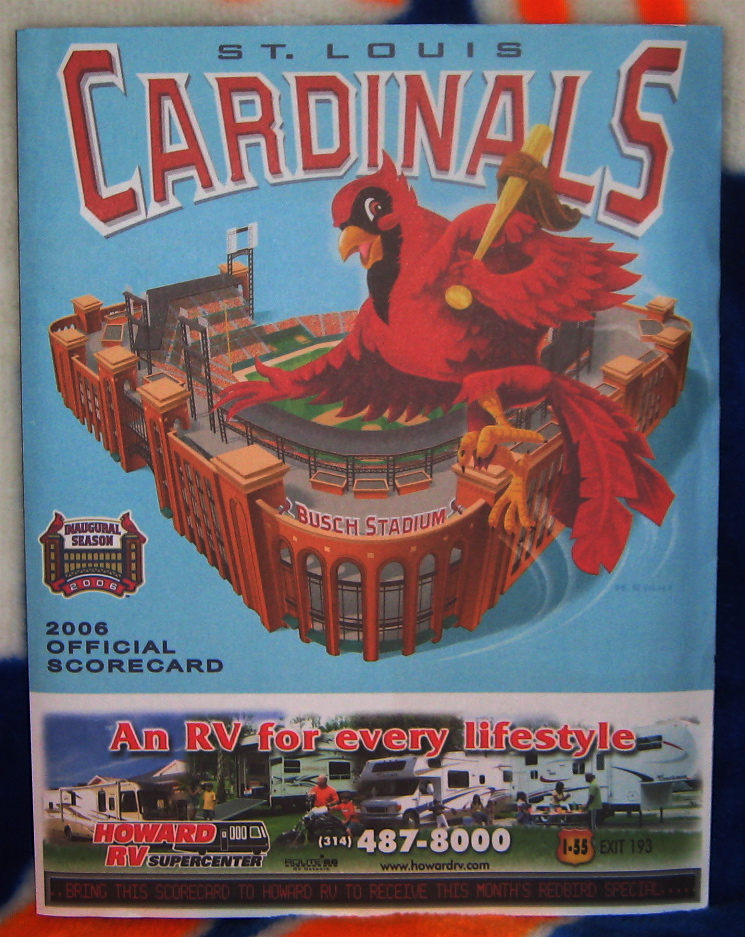
BALLPARK: Busch Stadium (New)
HOME TEAM: St. Louis Cardinals
VISITS: 1, including a tour
VISITED: August 2, 2006
CHRONOLOGY: 30th of 34
RANKING: 15th of 34
Oh dear lord, it was hot.
I thought it was hot in Phoenix in 1999 and in Cincinnati in 2003, but they take a cool, refreshing back seat to the swelter of St. Louis in early August 2006. The Dunkin’ Donuts commercials that ran incessantly that summer — the ones in which somebody sweaty and in need of a Coolatta sang about how it’s like one million/billion/trillion degrees — had to be written with Missouri in mind.
Or perhaps in Missouri.
It’s impossible for me to think about visiting new Busch Stadium without thinking about the literal heat that surrounded it upon our arrival. It all seemed like a great idea in April to spend one of our periodic ballpark-centered vacations there. We saw Busch’s opening via the magic of the Extra Innings package and it looked plenty cool in digital cable. I was up for it. Stephanie was up for it. So I planned our itinerary.
1) Fly to St. Louis.
2) Enter the flaming fires of hell.
 Seriously, it was hot. Within seconds of exiting the air conditioned comfort of Lambert Airport, the oppressive furnace of St. Louis turned full blast on me and my Nordic-blooded bride. Guess who wasn’t crazy about triple-digit temperatures and killer humidity — I mean really not crazy about it. I am often reminded my wife is a good sport for indulging my ballpark wanderlust and all, but the truth is she’s generally a willing co-conspirator in these trips. She likes seeing each of them once. Seriously, it was hot. Within seconds of exiting the air conditioned comfort of Lambert Airport, the oppressive furnace of St. Louis turned full blast on me and my Nordic-blooded bride. Guess who wasn’t crazy about triple-digit temperatures and killer humidity — I mean really not crazy about it. I am often reminded my wife is a good sport for indulging my ballpark wanderlust and all, but the truth is she’s generally a willing co-conspirator in these trips. She likes seeing each of them once.
I fear, however, her enthusiastic participation in our baseball outings is subject to instantly melting when placed within the figurative equivalent of, per Johan Santana’s warmup music, seven inches from the midday sun. We couldn’t have waited more than a few minutes for the light rail into downtown, but it may as well have been hours. And I wouldn’t leave anyone I love to broil for hours in the St. Loo sun if I could help it…even if it was literally only minutes.
Hence, Stephanie’s goodwill toward this visit became a minute-by-minute proposition. I had to deploy St. Louis judiciously to transport her in one dry piece from our drenched arrival on Monday afternoon to our game Wednesday night. Any local explorations that involved more than incidental walking would have to be completed by noon; everything else would have to take place within approximately a three-block radius of our hotel.
And god help anyone who turned the in-room air conditioning below anything but ARCTIC.
The good news is we chose our hotel for its proximity to Busch. Everything we really needed (save for our mandatory pilgrimage to Steak ‘n’ Shake, but for that there were plenty of cabs) was in our midst. Metrolink landed us practically outside the ballpark, practically around the corner from the hotel. The hotel was called the Ballpark Hilton and the baseball special package came with not just an Albert Pujols Build-A-Bear but a view of all things Redbird. We could see not just the ballpark from our room, but most of the field. The game we weren’t attending unfolded right before us in our veritable glass-enclosed luxury box. The Cardinal Hall of Fame, which used to share space with the Bowling Hall of Fame for some reason, was just as conveniently located. And when we got hungry, we could enjoy a lovely dinner downstairs at Mike Shannon’s restaurant, bearing the name of the old Cardinal third baseman and long-running Cardinal broadcaster.
The bad news is it was still frigging hot, and I had the not-so-sneaking suspicion that I couldn’t change it.
In any event, Busch was beautiful from the outside. I rank it a hair ahead of Citi Field and that’s probably because it did unquestionably better with the aesthetics in my purely subjective opinion. The interior reds and greens are perfect. Busch’s exterior, meanwhile, looks like it belongs where it’s situated. The bricks hum in harmony with nearby buildings. The arches pay homage to that one really big one a few blocks east. There are reminders that we are near a bridge, the Eads, laced into the steelwork. And when you’re inside the park, particularly if you take the tour — as we did, mid-morning — and get the home plate vantage point, the St. Louis skyline makes for a glorious backdrop. All those years watching the Mets play in an enclosed Busch (and Three Rivers and Riverfront) revealed nothing of the environs they were visiting. It was nice to know that baseball teams actually played someplace.
The attractiveness quotient was, like the temperature, high enough, but once we actually went to our game (praise be, the mercury plunged to 89 degrees at sunset and there was the slightest of breezes), it was less thrilling than I hoped it would be. I’d been far enough removed from despising the Cardinals during the Davey/Whitey wars of twenty years earlier to look forward to getting in on some of that Best Baseball Town in America stuff of which we were always hearing. It was indeed impressive watching the sea of red flow into Busch; Stephanie was overcome by a “when in Rome” impulse and purchased a Cardinal t-shirt (or maybe it was a symptom of heat stroke). Yet once inside, it felt like…
…it felt like Citi Field would three years hence.
Though Baseball’s Perfect Warrior/Perfect Knight Stan Musial stood guard at the third base entrance, and though we enjoyed fine displays of Cardinal heritage on the suite level when we took the tour, the regular folks en route to their regular seats got mostly ads. The Busch version of the outfield plaza seemed to exist only to sell Fords and phones. Carving out a direct path to our ultimate destination in the Outfield Terrace (how come an upper deck can’t be called an upper deck anymore?) proved difficult, as the presence of some fancy club forced us to take a circuitous route the same way the Acela thwarts any Promenade-bound fan who takes the wrong escalator at Citi. Once we were seated, as nice as St. Louis was to look at, I felt pretty far removed from the action below — we may as well have been watching from our air conditioned room.
As for the fans, a.k.a. The Best Fans In Baseball, it may not be fair to form impressions about a tribe based on a small sample you encounter only once, yet these people, synchronized outfits or not, did not strike me as the good-natured baseball geniuses they were cracked up to be. They booed bad things, they cheered good things, they said lame things, they wore red things.
Except for the color scheme, the same could be said of ballpark patrons anywhere, even Shea in those days. Still, they were supposed to be better than us, better than everybody. They were supposed to be so supportive and tradition-minded and the great red mass in front of whom every major leaguer desired to play.
I didn’t see any evidence of this magic fandom. Perhaps I just didn’t find the right Outfield Terrace row. Perhaps there were guys two sections over trading charming remembrances of Stan the Man while showering unwavering support upon Jeff Weaver, that night’s starting pitcher. Perhaps, but I doubt it. Where Stephanie and I sat, we were subject to the rantings of a Missouri moron (unless he crossed the Eads Bridge from Illinois, in which case, sorry Show Me State). As Weaver wove his way into deeper and deeper trouble, this is what one of The Best Fans In Baseball yelled over and over and over:
“Hey! Do you wanna be in the MINORS or do you wanna be in the MAJORS? Do you wanna be in the MINORS or do you wanna be in the MAJORS? Do you wanna be in the MINORS or do you wanna be in the MAJORS?”
There was also an adjacent slack-jawed yokel exchange that went something like this:
“You say you like to play catch?”
“Yeah.”
“Then why don’t you go catch us some beers?”
Tough to judge 42,000 by the actions of a few, but I didn’t sense a great deal of baseball savvy at Busch Stadium on one particular hot August night. Not a lot of engagement, just a lot of red. Blame it on lousy play (Cards were losing all week), blame it on that heat wave, blame it on me falling for Bob Costas’s perpetual odes to the local wonderfulness, blame it on Midwestern bearing…which is not a crime, just a difference; let the record show I love Midwesterners so much I married a gal from Wichita.
Whatever the cause, Cardinals fans could have been Astros fans if I didn’t know where I was. That’s not a compliment.
Naturally I didn’t know it at the time, but loads of foreshadowing hovered over our visit to Busch, beyond the ample evidence that global warming was in full swing. When we flew out of LaGuardia, everything was peachy in Metsland. We had just swept the Braves out of Turner Field for the first time ever, we had a mammoth lead in the East and WFAN was sizzling with talk of the Mets maybe, just maybe getting Roy Oswalt at that afternoon’s deadline. Moments after we settled into our room and turned up the AC, I tuned into ESPN to find out what our team was up to.
Well, let’s see:
• Duaner Sanchez was in a Miami taxi accident overnight and was out for the season.
• The Mets, desperate to fill Duaner’s bullpen innings, sent starting right fielder Xavier Nady to the Pirates to reacquire Roberto Hernandez.
• The Buccos threw in erratic lefty starter Oliver Perez, though the ESPN crawl was reporting Perez would be flipped to San Diego for another reliever, Scott Linebrink.
• Nope, scratch that. No Linebrink. We’re keeping this Perez guy. It says he was a good a couple of years ago. Sounds like a project.
The 2006 season became unnecessarily more interesting in the time it took us to fly halfway across the country. The 2006 postseason was still a couple of months away, but it, too, would involve flights between LaGuardia and Lambert along with evidence that we missed Duaner Sanchez pretty badly. No, I wasn’t done watching ballgames from, if not at, Busch Stadium. The last one the Mets played was Game Five of the NLCS, with T#m Gl@v!ne being outpitched by Jeff Weaver, who apparently decided he preferred the majors. I must say, seeing Busch on TV in the context of the Mets trying to win the pennant so soon after visiting it for kicks was quite odd.
Seeing the Cardinals extend their postseason at Shea was something else altogether, but you didn’t need a trip to St. Louis to figure that out. FYI, Stephanie’s innocently purchased Cardinal t-shirt was cast out of rotation about the moment Yadier Molina rounded third — and the Pujols Build-A-Bear had already been given a Met makeover in September.
As for the other foreshadowing from August 2006, let’s just say I saw the future of the Mets’ under construction home, and its name might as well have been Busch Stadium.
Busch Stadium and Citi Field strike me as very close in their reasons for being: the Cardinals and Mets each went from memory-laden large stadia where loyal fans could almost always score a reasonably priced ticket — and were showing up in healthy numbers right to the end of their respective hulking existences — to substantially smaller facilities where demand would theoretically be goosed and prices could rise accordingly. Each team’s marketers laid in the amenities (great root beer floats at Dizzy’s on the Terrace level) and gussied up their trimmings so as to evoke a mythic, bygone era when baseball was so much simpler, yet both new places felt on contact as if they had simply been plucked from Ye Olde Retro Catalogue and outfitted mainly with a ton of ads and ATMs. Neither necessarily felt anymore like a “ballpark” than either of the immense structures they replaced. Really, they both felt like craven cash grabs.
What really surprised me is new Busch felt lacking in Cardinal history the way Citi would feel devoid of Metsiana its first year. I’d have an easier time signing up for U.S. Cellular service than I would divining inspiration from the likes of Pepper Martin unless I detoured to that since-shuttered bowling museum (which was pretty cool, actually). Before Yadier Molina made me hate the Cards as I had in the ’80s, I rather wanted to be wrapped up in Redbird rapture for a few hours. It wasn’t happening.
To be fair, as I’d learn in 2009, it takes some time to imbue a ballpark with a soul. I’m guessing the 2006 world championship with which the Cardinals were able to instantly decorate their gilded cage helped immensely in that task.
Just the thought of it leaves me cold.
by Jason Fry on 5 August 2010 10:03 pm 1. Ike Davis made an ugly error last night. But you were surprised, weren’t you? When Daniel Murphy or Carlos Delgado made an error, you weren’t surprised at all. And Ike’s still learning.
2. Somewhere out there, some kid spent today staring at the back of his or her first Mets baseball card, soaking up information like a sponge and secretly delighted by how much there was to learn.
3. Pretty soon you’ll have one of those days where it’s beautiful weather, everything goes smoothly at work, and you leave a bit early because you’ve got tickets for Citi Field.
4. Pretty soon you’ll have one of those days when you saunter through the subway in your Mets gear waiting for someone to ask you who won today, because you’ve got a tale to tell.
5. We get Gary Cohen, Ron Darling, Keith Hernandez and Howie Rose to tell us what’s going on down there on the field.
6. Baseball fandom is full of Ryan Thompsons and Lastings Milledges and Alex Escobars who go from prospect to suspect in the blink of an eye. But every so often an Angel Pagan figures it out while he’s wearing your uniform.
7. Mr. Met’s new ads — yes, the ones by Citi — are fricking awesome. As is Mr. Met.
8. The black cat really did cross Beckert’s path. Swoboda really did catch it. Agee really did catch both of them. They really did nail Zisk at the plate. The Mets really did beat Atlanta at 4 in the morning. Lenny really did go deep to end it at Shea. Gary really did finally get to Kerfeld. It really did get by Buckner. Jesse’s glove really didn’t ever come down. Darryl really did hit it off the clock. Pratt really did hit it over the fence. Dunston really did work the walk. Robin really did hit it back to Georgia. Piazza really did cap the comeback on Mulholland’s first pitch. Franco really did freeze Bonds for strike three. Mike really did beat the Braves on the first game after 9/11. Lo Duca really did tag out two runners on one play. Endy really did make the catch. Close your eyes and you can see all these things any time you like.
9. There will never be another ’69, but there will be another year that feels like ’86, or ’73 or ’99 or ’00 or ’06. Sooner than you think, you’ll be jumping up and down in the stands with your arms stuck kind of halfway up, waiting to throw them all the way into the air and scream like a happy idiot.
10. That moment when you get to scream like a happy idiot again? It just got a few seconds closer.
by Greg Prince on 5 August 2010 5:38 am As Games Behind go, my rule of thumb for holding out the slightest Met hope before September is 7½. I adopted it in August of 1973. The Mets were buried in the National League East cellar, but it was a shallow enough grave so that I could invest a modicum of faith in the concept of life after death. I’m not sure why 7½ seemed doable and 8 seemed impossible, but that was my view on things. Baseball Reference shows us the 1973 Mets were last 7½ out of first place on August 17, when they sat in sixth place with a record of 53-66.
So in that regard, You Gotta Believe the 2010 Mets — in third place, 54-54, 7½ games behind — are still alive, still reasonably well, still something of a presence (besides that of a speed bump) in the N.L. East race.
But that’s the only regard. Otherwise, they’re dead and they’re buried and they did it to themselves as much as the first-place Braves did it to them.
I’m not delusional, I swear I’m not. I knew it was a long shot once the West Coast beckoned and the Mets slipped through the San Andreas Fault by losing nine of eleven. Contending teams, even barely contending teams, have to win on the road once in a while. That’s about as often as the Mets do. If you’re going to go 2-9 in your most daunting road trip of the year, you have to do better than 3-3 where you allegedly enjoy a trademarked Home Field Advantage. Finally, if you’re going to remain ever so slightly viable heading into a six-game journey through the ballparks of the two teams ahead of you, you can’t not, at the very least, win one of those series — preferably the first, against the statistically better team of the two.
The Mets were zombies Monday night. They pulled themselves together Tuesday night. They were in position Wednesday night, at 6½ back, to gain ground from where they began the week.
They didn’t. They emphatically didn’t. They didn’t at every phase of the game. They didn’t pitch well. They didn’t hit at all. They fielded atrociously. They were managed poorly.
They failed as a team.
It was a Must Win, but they didn’t heed the the urgency of the moment. Now all they have going for them is my 7½-game rule of thumb; the slightest of chances to partially redeem themselves against the other team ahead of them; and the precedent of 1973.
It’s probably not enough to plan one’s final of a third season around, but at the moment, it’s all I’ve got.
THE METS DIDN’T HIT
The Mets almost never hit anymore. The Mets have scored 8 runs in 4 games, or as many as the Braves scored last night. The Mets have scored as many as 4 runs in only 8 of their last 25 games, more than 4 runs only 5 times. The Braves’ good young starter Kris Medlin left in the fifth inning with an injury, and the Mets still couldn’t hit.
There’s nobody doing the job with a bat in his hand. Nobody. Angel Pagan was the last consistent difference-maker. He’s on an eight-game hitting streak, actually, yet it’s not making any difference. He’s driven in three runs in those eight games, which may be why he attempted to bunt his way to first with Reyes on second early — it served as a sacrifice but more as an admission. I assumed Wright and Davis would bust out at some point. My assumption has been sadly mistaken. They are both in helpless funks that show no signs of relenting.
Reyes hasn’t been right since the oblique. Thole is a rookie again. Jeff Francoeur takes one effective swing per week. Carlos Beltran is, as we speak, a former star. Honestly, if it wasn’t for Luis Castillo, there’d be nobody doing anything. And if you’re relying on Luis Castillo to carry that weight you’ll be waiting on your delivery for a mighty long spell.
THE METS DIDN’T FIELD
Best Infield Ever, Jr. — the three-quarters that’s here anyway — sure had its growing pains Wednesday night. Reyes (twice), Davis and Wright all rushed things and forced errors that the Braves gladly took and ran with. Yip City. Davis is a rookie. What are the excuses for Wright and Reyes at this stage of their careers? Why does David still sidearm balls to second. On his double play attempt in the sorry sixth, when I instantly wished he would have gone for the one out at home, you could see the car wreck developing from clear on the other side of I-85. David’s gonna throw this away, isn’t he? He is so much a better third baseman than that, yet I get the feeling he thinks he can make up for his lack of bat by growing six extra arms. Dude, you’re David Wright. You don’t have to be an octopus.
Jose? He was having his best defensive season to date until a few weeks ago. Finally gonna get the Gold Glove, I thought. But he just seems clueless sometimes, rarely more so than he did in firing poorly to Davis at first. You look past one error as one of those things, but you get concerned when there are two from one guy or four from three, especially when three of them occur in the same damn inning.
On the other hand, Luis Castillo was quite sharp defensively.
THE METS DIDN’T PITCH
I stared at two sets of numbers before the season as if they held within them some magic answer for something I was anxious to divine. The numbers were these:
510 Innings
29 Wins
38 Losses
493 Strikeouts
3.58 ERA
1.398 WHIP
and
479 Innings
28 Wins
32 Losses
275 Strikeouts
4.58 ERA
1.489 WHIP
Different results born of different roles, different times and different skill sets, but similar sample sizes and a similar sense of frustration linked Nolan Ryan’s Met years and the first four seasons in which Mike Pelfrey pitched in the bigs. Pelfrey never threw as hard as Ryan, while Ryan was always more wild than Pelfrey. Ryan had some adventures. He could strike out eight, he could walk eight and he could do it in the same three-hit complete game victory (no wonder he preaches against pitch counts).
It’s often mentioned that the Nolan Ryan deal was one of the worst any team has ever made, yet it is rarely mentioned what a handful a Nolan Ryan start could be between 1966 and 1971, that the stupendous results — like the 16-strikeout four-hitter of May 29, 1971 — never left him free and clear of suspicions that he was really the pitcher he was on September 28, 1971: four consecutive walks and a two-run single to start the first and then removed for the last time as a Met. Nolan Ryan could be the best and worst of John Maine and Ollie Perez rolled into one tantalizing, exasperating package.
Then the Mets traded him and he almost immediately became Nolan Ryan.
Mike Pelfrey’s a different story, but often over his first four seasons, particularly his fourth, 2009, I was personally ready to give up on him. Maybe the only thing that held me in check was that Nolan Ryan didn’t look like much after a comparable time frame and trading a pitcher of Ryan’s potential before he turned 25 years old — washed up Jim Fregosi or no washed up Jim Fregosi in exchange — was dadburn stupid.
Pelfrey, 26, made me feel none too bright for doubting him once 2010 got underway. It took approximately 500 innings, I decided, but the kid had figured it out. If it’s not Ryan all over again, it’s close enough. We had faith in this guy and he has affirmed it. Mike Pelfrey, ERA down 2.23 on June 8, had arrived.
Well, that Mike Pelfrey has departed, and this Mike Pelfrey (ERA up to 4.10 on August 4) is every bit as much a handful as Nolan Ryan before he underwent his Angel metamorphosis or — shudder — John Maine and Ollie Perez the last time we saw either of them start.
Mike Pelfrey, quite simply, has reverted. His starts aren’t even tightrope affairs. He doesn’t stay aloft long enough for that. Big Pelf crashes through the net below as if he was drawn by Tex Avery for Warner Bros. He’s a cartoon catastrophe every frigging start now. You know the plunge is coming — and it saddens you because you know there’s no trampoline below the net.
He doesn’t bounce back. He gets down on himself. He gets distracted. He loses his focus. He loses his confidence. I don’t know what it is with Mike Pelfrey since June. Before June, I was convinced he had turned the corner, that holding onto him was the smartest thing the Mets had done in years. I am now wondering what they could have gotten had they sold high.
In general, I root for the starting pitcher, whatever name on the back of the jersey on a given night. I don’t like to see starters come out of games if they have any chance at all of wriggling out of a jam. Ideally, that’s a choice to be made late in a game — the manager considers his options and sticks with a Seaver or a Gooden or a Santana reaching back and firing and justifying the faith. Let the ace take care of Bench or Schmidt or Pujols. That’s baseball at its best.
The fifth inning is no time to conjure such manfully competitive visions, not when the batter, Brian McCann, is as close to that Hall of Fame level as you need to see right now and is on a killing spree against your staff; not when the fifth inning may very well be the last inning anything you do really matters for the rest of your season; and not when Mike Pelfrey has grease on his tightrope shoes.
Jesus, what was Jerry Manuel doing letting Mike Pelfrey pitch to Brian McCann with the inning, the game and pretty much all of 2010 on the line? It’s first and third, there’s two out, the Mets are down by one, Pelfrey just semi-intentionally walked Chipper Jones and it’s only two innings since McCann homered off him. Before the fateful fifth, he was 14-for-33 lifetime against Pelfrey.
After the fateful fifth, he was 15-for-34, with another double and another RBI. Yet Pelfrey remains on the mound. He intentionally walks Eric Hinske to get to Matt Diaz. Then he hits Diaz. It’s 5-2 Braves.
That was it. That was it for Pelfrey in the fifth. That was it for my Nolan Ryan comparison, too. Mike Pelfrey’s Met career has consisted of two or three very nice months in 2008, two or three very nice months in 2010 and pitching in circles otherwise. Whether it’s mental, physical or that he’s just not that good, I am re-convinced that it’s never going to happen for Mike Pelfrey with the Mets. I don’t care how much stuff he has. He doesn’t know how to use it, and this organization apparently has no one capable of teasing it out of him for an extended period.
Somebody will think he can figure out what to do with Big Pelf. I invite all bidders and encourage the Mets to entertain all potentially beneficial offers in the offseason. This time, however, if you do go that route, please get more than Jim Fregosi in exchange.
Until shopping Pelfrey can be thoroughly explored, he’s not automatically in my rotation. He goes to the pen or Buffalo or wherever before he gets the same opportunities we shouldn’t have kept giving Maine and Perez. Brooklyn Cyclones manager Wally Backman recently told Bob Klapisch of the Record, “At this level, it’s supposed to be about player development, but to me, development is winning.”
Wally was talking about Single-A ball. He could have been talking about the majors. Development is winning. Pelfrey’s development has clearly stalled and the Mets stand little chance of winning with him as a starter. Thus, if you’re going to cut Ollie (good god, please do), you can’t keep pretending Pelf is one start from finding himself again. He is too lost for that.
Whether the Mets are 7½ back and barely breathing or prohibitively out of it, there is something to be said for trying to win games. Mike Pelfrey in his ongoing state, is not positioning them to do that.
Not even close.
THE METS DIDN’T MANAGE
What exactly is it that Jerry Manuel does? Two or three very nice months in 2008, two or three very nice months in 2010 — he’s the Mike Pelfrey of skippers, except I can understand why people have seen potential in Pelfrey. Manuel? What has he ever been for this team other than Not Willie Randolph when that was considered therapeutic?
He leaves Pelfrey in to face McCann Wednesday just as he left Feliciano in to face McCann Tuesday. McCann was 8-for-24 against Pedro and came out of that battle 9-for-25. Do they keep track of batter-pitcher matchups for the edification of fans or do they share them with the manager?
And what was with Pagan bunting in the third inning? Is there no NO BUNT sign in Jerry Manuel’s arsenal? Or did Angel just think that’s what we’re supposed to do on the Mets? If the players show no confidence, it’s no wonder. The manager thinks it’s 1908 and that he’s John McGraw. It isn’t and he’s not. You’re allowed to play for more than just one run these days.
There are all kinds of minefields to negotiate as a major league manager among the fragile egos and the glaring media eye and the need to balance a sense of urgency with the reality that no game is statistically more than 1/162nd of your season. Those caveats invoked, what exactly is it that Jerry Manuel does other than chuckle mordantly? Is a manager responsible for motivating a team that appeared revved up when it won in dramatic fashion the night before? Those Mets who lost 8-3 to the Braves looked like the motivation got sucked right out of them once McCann doubled off Pelfrey.
It may not be Jerry Manuel’s fault, but none of what’s been going on since June 28 (11-22) is to his credit. You can release Perez and seek new homes for Castillo and Francoeur (though Bay’s extended DL stay makes immediately jettisoning Frechy somewhat impractical) and kick Cora to the curb before his 80-game option vests, but you really want to help this team in the short-term?
Say goodbye to Jerry Manuel.
Don’t wait. Why wait? When was the last time you thought to yourself, “Good call, Jerry” or “Nice move, Jerry” or “Jerry showed good judgment sticking with that guy”? Pagan got a chance to shine because there were no other options once Gary Matthews was given multiple opportunites to not succeed. Same for Dickey in the wake of the John ‘n’ Ollie mess. Other than deciding to not put up with Maine fibbing about the condition of his arm, I’m at a loss to see how Manuel’s made a positive, lasting impact on this club in 2010.
It so happens that we have reached the two-thirds juncture of the 2010 season. I’ve continued to track that bromide about how “You win one-third of your games no matter what you do, you lose one-third no matter what you do, it’s what you do in the other third that determines your season.” True to what I discovered through the first third of this year, the math is off. Here are my updated Determining Third Index Standings:
28 Wins of the “gonna” win variety
25 Losses of the “gonna” lose variety
26 Wins that “determine your season”
29 Losses that “determine your season”
That’s slightly more than half of your games deciding your fate. Usually I’d slot Game 108, Wedensday’s desultory five-run defeat, among the losses that are going to be losses no matter what you do. But I list it among the 29 that are serving to screw us over. it may have definitively determined our season, and it was not out of these players’ or this manager’s hands. It wasn’t fate that they’d slide to the very outer edge of viability on Wednesday. They had a lead. They could have played better. They could have been managed better.
They didn’t. That’s not fate. That’s them, all of them.
On Sunday, before the Mets were so fired up by the presence of their 1986 predecessors that they stormed forth and lost by thirteen runs to a last-place team, Davey Johnson spoke to the enduring meaning of this franchise’s last championship season:
“The one lesson we all learned from that year is no matter what in life, we always have a chance, no matter how bleak it looks.”
Easy for him to say, what with a rotation so deep that his best pitcher in the second half, Rick Aguilera, didn’t even get a start in the postseason. But yeah, like Davey said, we always have a chance. The ’86 Mets didn’t need to worry about 7½-game margins, but the ’73 Mets overcame one in August…as did the ’69 Mets, come to think of it.
Ancient history but our history. It’s what keeps me hanging on — that, and what Richard Gere cried to Louis Gossett, Jr., in An Officer and a Gentleman:
“I got nowhere else to go!”
C’mon, I’m a Mets fan. This is the Mets’ season. The moment the Mets dip absolutely out of the pennant race with which they are, at most, technically associated, what good is that? This, the season, is what I wait October to April for. I want it to continue in ways that encompass more than motions being gone through. And please don’t tell me about football training camps, for crissake. I’m here for the Mets. The Mets start playing out the string, it’s that much closer to not being baseball season. 2011 means nothing to me until 2010 is all the way over, and even then, 2011 has to wait another six months, another October to April, another altogether unending winter in a lifetime that includes too many of them already.
Why would I welcome that void? I did last year because last year yearned to be gotten on with, yet all that did was leave me in the cold and dark of it not being baseball season. Sheesh, what’s the rush? The urgency should be for the Mets to win a game Friday, another Saturday and another Sunday. The rush should be to leave Philadelphia, at minimum, with two wins in their steamer trunk and, with any luck at all, a little closer to first than they are now. Can’t do anything about the Braves at the moment. Had our chance and didn’t take advantage. We’ll have another chance at the end of August. I’d like that chance to represent something other than a chance to briefly hinder their chances.
After Philadelphia, it’s Colorado and the Phillies at home. Then it’s two lousy teams on the road, Houston and Pittsburgh (though lousy Arizona on the road didn’t exactly yield gold). Then it’s home cooking again with the Cantu-less Marlins and the lousy Astros. Then, on August 30, back to the Ted. By then, with 22 games between visits to Atlanta, the idea that somebody sat here on August 5 and calculated the Mets’ schedule with any sense of purpose because the margin was “only” 7½ will almost certainly look absurd.
Almost certainly. As Davey said, we always have a chance — though it couldn’t look a whole lot bleaker than it does right now.
by Greg Prince on 4 August 2010 1:47 am ’Twas a victory of and for the Damned. Damned Castillo. Damned Francoeur. Damned Rodriguez. Damned Mets and their perpetually damning fans.
We won the damn thing!
Y’know what, I’m not even gonna give ya the spiel about it’s just one game. Of course it’s just one game. That’s what a baseball season is: 162 episodes of just one game. Tuesday night, the night after a damned awful game, we were treated to a damned lovely game, thanks in great part to the second baseman none of us wants and the right fielder we’ve all dismissed as fatally flawed and the closer whom nobody trusts. They’re all issued checks by an ownership group we’d all wrest the keys from if we could — and we’re not so hot on the upper-level management it employs to keep an eye on things.
Things haven’t been so great lately. Boo-bleeping-hoo.
Y’all can bury; I’ll be contrary.
It’s baseball season. Still.
It’s 2010. Still.
The Mets are alive ’til they’re not. Still.
The Mets have picked up a game on the Braves. For a change.
Hey, you know who else is having a season that could be going better by the druthers of those who follow them? The Atlanta Braves, that’s who. Check out this lede from Dave O’Brien in the Atlanta Journal-Constitution:
The Braves were miserable again with runners in scoring position Tuesday night against the New York Mets, and this time that recent deficiency came back to haunt them. So did a former Brave.
After new Braves reliever Kyle Farnsworth blew a 2-1 lead in the seventh inning, Jeff Francoeur hit a ninth-inning home run off closer Billy Wagner to lift the Mets to a 3-2 win against his former team at Turner Field.
“They’ve been struggling just as much as we have to get that one run across, and tonight they got it,” said Wagner, who has two losses and two blown saves in his past six appearances. “It was a good pitch. Pull hitter, hits the ball to the opposite field — tip your hat.”
Everybody’s got their problems, according to the sage John Mellencamp, ain’t no news here. The Braves have problems. The Phillies, minus Howard and Utley and Victorino, have problems. Their problems aren’t quite as daunting as ours given that they’ve each won an extra handful or two of games (and made some pre-July 31 roster renovations), but the season is just as unfinished for them as it is for us. They’ve clinched nothing…and all we’ve been eliminated from is an easy route from here to whatever comes next.
In the meantime, a couple of big hits and nice plays from Castillo; a monstrously huge home run from Francoeur; an untraumatic ninth from Rodriguez; invaluable contributions from Chris Carter and Manny Acosta; and, as always, nothing but good out of the heart, head and knuckles of one R.A. Dickey, the pitcher so tough he’s got extra guts where his ulnar collateral ligament is supposed to be.
Is R.A. Dickey supposed to be anywhere near a major league rotation in 2010? Near the top of ours? At the core of our comfort zone? He persevered on a night when he said conditions weren’t “optimal”. He actually used that word. He also likened pitching in humid and rainy conditions to “straight guerilla warfare”. Again, how many pitchers talk like R.A. Dickey? Better yet, how many pitchers stand in and battle like R.A. Dickey? After Francoeur turned Melky Cabrera’s single into a run-scoring triple in the sixth, a Met meltdown would not have been unexpected. It certainly would not have been unprecedented. But R.A. did not give into either Matt Diaz or Omar Infante, and our deficit remained no more than one.
That was impressive. Acosta bailing out Feliciano (why let him face McCann?) on a double play grounder was impressive. Francoeur’s homer to right off Wagner? Shoot, that was just doggone enjoyable. It no more makes Francoeur a long-term fixture than Castillo’s run in the third or double in the fifth or sacrifice in the seventh calls for an extension to be grafted onto Luis’s already endless contract. But you gotta, just gotta love it if you’re a Mets fan who is willing to remember the future is utterly unknowable and that the present — any present — requires nights like Tuesday.
Maybe it was just one game. Or maybe it’s the game before the next game that can be another just one game. Team Torpid from the game before gave way to a bunch that had rarely looked as alive as it appeared after Frenchy’s homer. Dickey spoke afterwards of recapturing the “fire” this team had when it was going gangbusters. My pitcher is R.A. Dickey, and R.A. Dickey says…
Well, when R.A. Dickey pitches, Mets fans listen, whereas when Mike Pelfrey pitches, Mets fans have cause to cringe. But look at it this way: Big Pelf is listed at 6’7” — the good Pelf from earlier in the season has got to be hiding in there somewhere.
The good Mets from earlier in the season aren’t necessarily off hunting and fishing already, either. They could have found themselves just in time. They are an imaginable (if not particularly manageable) 6½ out of first with yet another Must Win staring them square in the Pelf. Turner Field is an unoptimal a place as one would choose for a stay of contention execution, but they’re getting another shot at the team they Must Win against if they are to have any hope at all. Jerry Reed, in serenading the legendary Banditry of Mr. Burt Reynolds, once apprised us that, “The boys are thirsty in Atlanta.” Now would be a good time for them to be hungry, too.
Let it all hang out, ’cause we got a run to make.
by Jason Fry on 3 August 2010 12:33 am By now I’m not even mad at them.
No, the worst I can manage while watching the Mets stagger around and lose is a weary exasperation. The competitive portion of the 2010 season is nearing its end, and whatever disappointment I felt over that has dissipated by now. You never know, as baseball sages will tell you, but sometimes you can make a pretty educated guess: The Mets don’t have the horses to stay in this thing. I know it, you know it, and the Mets themselves know it.
Which is not the end of the world. Really, it isn’t. Provided the Mets don’t spend the next two months trying to put one over on us, it could even be a good thing.
Tonight belonged to the past tense awful quick, as the Mets were quickly awful. There was Johan Santana struggling with the first inning again, Luis Castillo botching a double play, Angel Pagan juggling a transfer, and Carlos Beltran looking very sluggish in turning a single into a double. Then it was a sad parade of pop-outs and grounders until Billy Wagner walked off the field triumphant, dropping the Mets to .500. If .500 seems dispiriting, just wait: It will be a minor miracle if they end this firing squad of a road trip at that level.
So enough about tonight.
Look, despite the usual blaring New York headlines, the Mets were absolutely right not to make a move at the deadline, unless you count trading Mike Jacobs for Someone Who Isn’t Mike Jacobs as of note. My biggest fear was that Omar would try to save his own battered skin with Kazmir for Zambrano II, shipping out Josh Thole or Jenrry Mejia or Wilmer Flores or even Fernando Martinez for some middle-of-the-rotation starter who wouldn’t move the needle in any meaningful way. (Let’s be generous and assume that not doing so was an act of responsibility, instead of speculating that it was cheapness or a failure to execute whatever plan was formulated.)
The 2010 Mets’ streakiness has hid that they’re pretty much what we figured they’d be back in March: an OK team with a good core and lousy complementary players. But they’re more or less healthy, and they play hard, and while they may be a disappointment right now, they’ve never been an embarrassment the way the ’07 and ’08 teams were at the bitter end and the ’09 team was from midsummer on. In fact, they offer plenty of reasons to be optimistic about the future: Ike Davis, Josh Thole, Angel Pagan, Jon Niese, Bobby Parnell, R.A. Dickey and Ruben Tejada have been great fun to get acquainted with and cheer for and wonder about. Going into this year, I figured the Mets would struggle in 2010 and then fall off a cliff in 2011. Now, I think I was half-right — and I’m very happy about where I was mistaken. Give the aforementioned players some more seasoning, add them to David Wright and Jose Reyes and a healthier Carlos Beltran and a more relaxed Jason Bay and Johan Santana and Mike Pelfrey, and I feel pretty good about the starting point of 2011.
Which isn’t to say that the Mets should sit around and wait for next year. They can reward our faith by starting to position themselves as well as possible for the 2011 season. A deplorable amount of time was wasted in 2010 on the likes of Jacobs, Gary Matthews Jr., Frank Catalanotto and a too-young Mejia. A deplorable amount of time is being wasted on the likes of Luis Castillo, Alex Cora, Jeff Francoeur and Oliver Perez now.
It’s not realistic to expect the Mets to excise all four of those guys, not to mention Omar and Jerry Manuel. But I would like to see them make two moves that would clearly show us that the team won’t continue penalizing us for its own mistakes: Dump Castillo and Perez posthaste.
Castillo’s inability to do anything of use to a major-league team was once again on sad display tonight: Even if you believe in ancient canards about wasting the No. 2 spot in the lineup on a banjo hitter with bat control, Castillo’s lack of range is a liability that will continue to kill this team until the final minute of his unfortunate contract. And do I even need to make the argument about Perez? Very well: I will be astonished if Oliver Perez ever has three good starts in a row, and promise not to blame the Mets even one little bit if he somehow does.
Those would be expensive displays of penance, I know — just as I know it’s not my money. But they would send the right signals about where this club is going, and reassure us that better days are coming sooner than we might think.
by Greg Prince on 2 August 2010 5:20 am “Thank you. This is really, really amazing. And it feels so good to be home.”
So said Doc Gooden Sunday as he was inducted into the New York Mets Hall of Fame, and he couldn’t have been more correct — for him or for us.
On some level, Dwight Gooden’s been wandering the periphery of Metsdom since the day after his team won the World Series in 1986. He didn’t show up for the ticker-tape parade a grateful city threw its champions. Five months later, he tested positive for cocaine and wasn’t present on Opening Day when the flag his team earned was raised and the rings with which they were to be rewarded were distributed. He’d be pitching again in June and would be a mainstay of the rotation for another seven years, but Doc was never quite at the heart of this operation again.
If he had been, it would have seemed more tragic or heartbreaking when he tested positive a second time in 1994. It may have been tragic yet it didn’t seem all that heartbreaking. Regrettable, yes, but the hue and cry was muted. He had his problems in 1987, he was welcomed back. They reignited in 1994, the door was over there — be sure to use it. The Mets of post-1993 were a whole different story, a whole different vibe from the Mets of post-1986. There was no patience for an addict or a junkie or a recidivist user, whatever he was. Go away, Doc, was the prevailing verdict. Fix your life on your own time.
We stopped caring diligently about Dwight Gooden because Dwight Gooden apparently didn’t care about himself. We had to move on. We did and he did. He had his moments of success and so did we. We had our slipups and so did he. We’d hear about him from time to time, but he wasn’t our concern and there was no way of telling if we were any of his. Any opportunity that arose when he might have re-emerged, he wouldn’t or, more likely, couldn’t. Whether by conflicting commitments or by law or by personal discomfort or even choice, the estrangement proved immovable.
It would go on that way until September 28, 2008, when Doc Gooden materialized out of the shadows and into the Met midst. The occasion was the final afternoon of his old address. He was one of dozens of former players to take the Walk of Shea that day, but he was the one who jumped out at you. He was the one who owned the place as no more than maybe three or four others owned it, and he was the only one to never set Met foot in it after his title on the property lapsed.
Doc was just visiting, just checking in before Shea would check out. But after fourteen years in which his absence was occasionally noted, his presence was genuinely felt.
Two years after that, he came home for good. Dwight Gooden — Doc — is a Met again. Not because he signed a one-day contract in order to symbolically retire as a Met. Not even because there now hangs a plaque that says he was a Met. It’s because every effort to certify his standing as a pre-eminent Met of Mets was made and achieved. The Mets did their part and so did Gooden.
He’s no longer the NO PHOTO AVAILABLE in our alumni newsletter. He’s no longer on the outs. There are no grudges or grumblings or self-imposed exiles anymore. Doc’s one of the Met family again. Better yet, a Met family at last exists for him to be a part of.
My happiness for Doc Gooden’s happiness on Mets Hall of Fame Day is an emotion I reproduced in quadruplicate Sunday so as to include Darryl Strawberry, Davey Johnson and Frank Cashen in my loud ovations and quiet satisfaction. I was beaming on each of their behalves from the Promenade as each made brief but heartfelt remarks about what it meant to them to be inducted into the New York Mets Hall of Fame.
Did you hear that? There’s a New York Mets Hall of Fame! It’s real. It’s a living, breathing, functioning entity. It’s not shunted away in the Diamond Club. It’s not just two display cases of sculpted heads. It’s not just those couple of pages in the media guide that never require updating. There was an election for it in January, there’s been a museum housing it since April and there’s been a parade of promotional announcements beating the drum that there’d be inductions into it for weeks. Yet not until I actually saw Cashen, Johnson, Gooden and Strawberry express their thanks for being a part of it did I really and truly believe it was real and true.
Each of those gentlemen treated membership as an honor of the highest order, a pinnacle to their long and distinguished baseball careers. I’d been to three previous HOF days at Shea — Mookie Wilson in ’96, Keith Hernandez in ’97, Gary Carter in ’01 — and while those were delightful, they didn’t rise to this occasion. Those were outliers, nice tributes, but essentially a “Day” the same way you might see Copiague Day recognized forty minutes before first pitch.
This was serious, nearly solemn business. I don’t mean to imply it didn’t have its lighthearted moments (Davey complimenting us as the most intelligent fans in baseball because he always heard us on the radio telling him how to manage was a hoot), but this ceremony had gravitas. The Mets organization made as big a deal as it could out of this and the honorees seemed truly humbled. It wasn’t just one more rubber chicken circuit award they were scooping up. These guys actually cared about being Mets Hall of Famers.
What a worthwhile endeavor this was, reviving this thing that barely existed before, and making it bigger, better and more beautiful than it’s ever been. Kudos to all involved on a classy, meaningful presentation — and some unsolicited advice below to Dave Howard, who rained, or at least drizzled in advance, on his own parade when he told Brian Heyman of the Journal News, “I don’t think it’ll necessarily be an annual thing.”
Make sure it’s an annual thing, Dave. Build on this tradition. You just did it for the first time in eight years. The last time you did it, you inducted a great Met, Tommie Agee, a year after he died and thirty years after he last played for the Mets. Then you let it wither. It’s back and it’s blossomed on your watch. You should be proud of these ceremonies and that museum and those plaques (even though the end date on Doc’s plaque says 1995 and his last Mets game was 1994). You should be proud to honor Met greats and even Met very goods every single year.
Mike Hessman just became the 890th individual to play as a New York Met. Fourteen players are in the New York Mets Hall of Fame. I’m thinking there have to be at least a couple of Mets worthy of strong consideration on an annual basis among the 876 Mets who aren’t in our (yes, our) Hall. Take that momentum, sir, and run with it. Just as I was this year, I will be among the first to buy tickets next year for Mets Hall of Fame Day. And I’ll bet more will join me as it becomes an established event.
One other thing I particularly enjoyed about Hall of Fame Day and presumably will for a very long time is that the speakers invoked the name “Shea Stadium” repeatedly. Shea lives! Lives on in the official memory again, that is. 2009 was the year we were told Mets history began ten minutes ago and their only home ever was Citi Field. Now, in 2010, I sat in Citi Field and heard the village elders speak fondly of Shea. There’s nothing to lose in remembering it existed, that the franchise’s greatest baseball was played there and that it sure was fun at Shea.
Now, it sure is fun at Citi. Like Doc Gooden, I’m home…whatever drawbacks the current house engenders.
After the ceremonies ended, the 2010 Mets played a baseball game that was as dreadful as the ceremonies preceding it were beautiful. But I had a really good time, hanging back, no thoughts of streaks (and little of possible contention) in the air. I was with my old friend Dan for the first time since the Home Opener in 2008 (with a welcome half-inning cameo from Sharon) and we just talked non-stop Mets/life for nine innings, much as we might have in the Upper Deck or Mezzanine or Loge in Shea days of yore. In my 54th regulation game there, it was the first time feeling at home felt effortless. Just as I’d been waiting for Doc to return to the Mets for fourteen years, I’d been waiting to for my own sense of ballpark estrangement to completely evaporate for most of two seasons.
Me and Doc, we arrived together where we belong. And we are so happy to be home.
In case you missed ’em, some perspective on the Mets Hall of Fame tenures on Davey Johnson here, Dwight Gooden here and Frank Cashen and Darryl Strawberry here.
by Greg Prince on 1 August 2010 7:50 am In the spring of 1980, the New Yorker’s Roger Angell was making his incomparable annual rounds and alighted on St. Petersburg for a morning B-squad game between Joe Torre’s Mets and their neighbors, Ken Boyer’s Cardinals. The rookie getting everybody’s attention that March was St. Louis’s big first baseman Leon Durham — “he is called Bull, of course.” Bull Durham was turning the Grapefruit League into his own personal china shop, destroying John Pacella’s pitches in particular. Would he make the big club? Probably not right away, Angell reported. The Cards had reigning co-MVP Keith Hernandez at first, so they were trying to convert Durham into an outfielder. But they had a set outfield of Bobby Bonds, George Hendrick and Tony Scott, so there might be no room for Durham at Busch Stadium.
“Joe Torre,” Roger Angell wrote, “should have such problems. The Mets have no one like Bull Durham at any level of their organization.”
In March 1980, they didn’t. Three months later, they would — no bull. And when he surfaced, he would change everything about how the Mets would perform and be perceived for a very long time.
It would be disingenuous to say they were the two definitive decisions of his tenure as general manager of the New York Mets, for there were other momentous choices made in between, but you can almost chart the trajectory of the franchise by two moves Frank Cashen made ten years apart.
June 3, 1980: He drafted Darryl Strawberry as the first pick in the amateur draft.
November 8, 1990: He didn’t re-sign Darryl Strawberry when he became a free agent.
As we watch the two of them enter the Mets Hall of Fame in the company of Dwight Gooden and Davey Johnson today, we can comfortably declare the first decision represented the cornerstone of the ensuing decade of Mets baseball. To a great extent, the same could be said of the second decision.
• By taking the best athlete available in his first draft as Met GM, Cashen guaranteed himself (as much as any guarantees can be made regarding 18-year-old phenoms) a potential superstar around which he could build a contender, a champion and perhaps a dynasty.
• By eschewing a continued association with the same man after he had proven himself the best everyday player ever developed by the Mets, all Cashen guaranteed was a gaping void for the Mets and Mets fans that wasn’t really filled until one of Cashen’s successors traded for Mike Piazza. That was in 1998, eight years later.
Eight long years later.
The Mets of the ’80s, when they were at their best, were never Strawberry’s alone, which may explain why it wasn’t considered essential to keep him at any price as he approached free agency in 1990. Darryl was one of four pillars upon whom the club that competed year in and year out at the top of its division was built. Selecting Dwight Gooden in the first round of the 1982 draft would prove transformative. Trading for Keith Hernandez in the middle of 1983 would be most callers’ guess if there was a Foxwoods Resort and Casino Turning Point of the Decade contest. Dealing for Gary Carter in December 1984 communicated a seriousness of purpose, that the surprising Mets of the previous season were as for real and real could get. And there were probably at least a dozen other transactions worth mentioning as crucial to Cashen’s construction of a winner.
Yet drafting Darryl Strawberry came first. From the moment he was chosen, we knew he was coming. If it didn’t cause a mania on the plane of a Stephen Strasburg, it was instantly the most famous amateur draft pick the Mets had ever made. And though it would take Strawberry three years to land at Shea, Darryl was instantly the most talented player in the Mets organization, major leaguers included. The Mets may have been making a spirited run toward the .500 barrier in the summer of 1980, but anyone who wasn’t 17 and mesmerized by the exploits of Steve Henderson would have agreed with Roger Angell’s assessment from that same spring, a couple of months before Darryl Strawberry became our future.
The Mets had nobody. And they were nobody.
You know the best part about Darryl Strawberry’s Met tenure? For all the majestic home runs he’d dispatch to the nether regions of National League stadia, I don’t believe it was anything he did in a New York Mets uniform. It was that we knew he was going to put on a New York Mets uniform — that his summers in Kingsport, Lynchburg and Jackson, along with his holding room month in Tidewater, were leading to the grand entrance. Someday, we’re going to have Darryl Strawberry on the Mets. And when we do, watch out world, we’re gonna get real good.
When the big moment came and we learned Darryl would be at Shea and in right field on May 6, 1983, batting third between Tucker Ashford (!) and Dave Kingman, I have to confess I was 90% excited and 10% let down. So much of being a Mets fan from the day Darryl Strawberry was drafted was waiting for Darryl Strawberry to be called up. Then it happened and I felt a bit at a loss.
Now what was I going to look forward to?
Darryl Strawberry’s at-bats took care of that pretty quickly. I looked forward to those every game. I looked forward to the long swing and the long trips those balls took when he connected. I looked forward to his loping stride toward first when he couldn’t trot; to his 6’ 6” frame sliding safely into second on a stolen base attempt; to how he made up for his refusal to reposition himself from of his worn Strawberry patch of grass by turning as needed toward the wall and grabbing the would-be opposition home run (Endy without the obvious effort); to the gun of a right arm that left the other team a little shy of going first to third on the basepaths. The phrase “five-tool player” was gaining resonance around 1983. I don’t think it was a coincidence that it came up around the same time as Darryl Strawberry.
Still, there was no escaping the sense that the five tools weren’t always necessarily put to optimal use. Shouldn’t have the “black Ted Williams” (a phrase his high school coach made famous in Sports Illustrated) hit .300 at least once? Walked 100 times? Launched 40 homers? Won an MVP? Straw never did hit much for average, with .284 the best he ever managed as Met, in 1987, the same year he collected a career-high 97 walks and established a career-best .398 on-base percentage. He set the Met record for homers then, with 39, and matched it a year later when he came closest to attaining his only Most Valuable Player award. Darryl finished second in 1988 for MVP, behind the gritty, gutty Dodger Kirk Gibson (who, ironically, can watch Darryl’s induction today from the Diamondback dugout).
Ted Williams was elected to the National Baseball Hall of Fame as soon as he was eligible. Darryl Strawberry was on the Cooperstown ballot once, received the support of 6 of that year’s 516 voters and dropped off the ballot for good immediately. If you go by Bill James’ Similarity Scores, he wasn’t Ted Williams for the next generation. He was a template for Jeromy Burnitz.
So what? Darryl basically asked at a Citi Field press session Saturday. “Everybody has their opinions of where we should be,” Straw said of himself and Gooden and the massive expectations they didn’t live up to. “Should we be in the Cooperstown Hall of Fame? Well, guess what — we’re going into the Mets Hall of Fame, and that’s what’s most important. That’s all I really care about.”
It’s the right sentiment for 2010. It’s a good enough explanation for 1983-1990, even if it papers over that Darryl Strawberry in real time was as perplexing a Met who ever was. It’s not just that he didn’t ascend to immortality beyond the village limits of Flushing. Nor is that he never quite had a season for the ages on offense that was comparable to Dwight Gooden’s 1985 on the mound (though you’d pretty much have to be Ted Williams in 1941 to claim one of those). You couldn’t watch him, love him, root for him without deep-down knowing he could be doing more. He could be running a little harder to first. He could be paying attention to Bill Robinson or the scouting reports when it came to moving over a few steps for a hitter who might not hit it directly to where he was standing. He could not seem intermittently sullen or surly or less than fascinated by the niceties of baseball.
As one of his predecessors among local pop culture icons might have observed had she been around deep into the 1980s, With Darryl Strawberry, it’s always something. If it’s not one thing, it’s another. With apologies to the incisive commentary of Gilda Radner’s Roseanne Roseannadanna, we sure do ask a lot of our greatest position player for fans from a team without any other players anybody ever compared to Ted Williams.
But honestly, it was always something: a police report; an alcohol rehab stint; a rap recording session the day of a game he’d call in sick for; clubhouse feuds gone public; an interview with an L.A. Times reporter in which he said it sure would be nice to play for his hometown Dodgers while he was still very much a Met.
Perhaps because his 1985 was so transcendent and he seemed so ideal a person in the process and he did it before turning 21, we get reflexively wistful over what Doc Gooden could have been. I don’t know if the coulda-been quotient attached to Darryl Strawberry is quite as romantic or, more precisely, as graspable. The best we saw out of him — 37 to 39 home runs three times, 101 to 108 RBIs those same three times (’87, ’88 and ’90), 30-30 once — was phenomenal Metwise, yet just very good in any given season of its era. They were the batting and running equivalents of Doc’s post-’85 Met years, which were perfectly fine 18-9 type campaigns, but not the stuff that layers our memories of him with regret for what he didn’t do.
Darryl did plenty. We just wish he’d done it longer and with us.
If you wanted to frame Darryl as something more than not quite as great as advertised, you had to look for an angle as Allen Barra did in the Voice in 1989 when he made much of Straw outhomering and outstealing Willie, Mickey and the Duke when you lined up all four New York outfield legends’ first six full seasons…and if you took the pitcher’s park nature of Shea into account, Barra added, Darryl might have been better than Mays or Mantle or Snider.
It may have been true, and it may have told an underreported story — Barra insisted we weren’t fully appreciative of what we had in our midst — but even as I cheered the evidence, because I very much wanted Darryl Strawberry to be my Willie Mays, I didn’t quite buy it. I read that Sports Illustrated sidebar in the 1980 baseball preview issue with the black Ted Williams quote. I thrilled to our drafting him, especially when I read the Mets gave serious thought to drafting Billy Beane with that first-in-the-nation pick (the future Moneyball hero was still available later in the first round and we grabbed him at No. 23). I salivated at the coverage Newsday gave his professional debut in Kingsport, how they were immediately scheduling strawberry-themed promotions. I teetered between accepting and rejecting the organization’s assessment that he wasn’t ready coming out of Spring Training in 1983 despite totaling 34 homers in Double-A in 1982. Yeah, he hadn’t yet faced Triple-A pitching, but how much International League did the black/young/next Ted Williams need anyway?
I didn’t think Darryl Strawberry was going to be another Ted Williams or Willie Mays. I took it on faith that he’d be Darryl Strawberry and that the top prospects who came after him would be touted as another version of him.
It didn’t really work out that way — but it wasn’t exactly a misfire, either. Darryl did win the Rookie of the Year award on merit, did make the N.L. All-Stars seven consecutive years as a Met (often on merit), did pair 30+ homers with 30+ thefts in 1987, did lead the league in long balls in 1988 and, when he wasn’t physically, mentally or spiritually AWOL, made for an unmatched presence in Met reality and Met lore.
You watched Doc every fifth day. You watched Mex batting with (or holding) runners on base. You watched the Kid when he saw the cameras. But you could not take your eyes off Darryl Strawberry when he came up to bat because you never stopped imagining what he might do and how far he would do it. In legend, his long balls are still traveling.
• There goes the one he hit just foul in the bottom of the ninth the night he came up to the majors to stay. George Foster would hit one fair in extras to win it for us, but Darryl had suddenly and emphatically served notice that more and straighter clouts were coming.
• There goes the one off the clock in St. Louis in the last valiant week of 1985, where he added an extra hour to our pennant savings time.
• There goes Al Nipper’s self-esteem in the last half-inning we would need before making a formality of clinching the last World Series we won.
• There goes one on Opening Day 1987, with Doc Gooden at Smithers and Doc Gooden’s pants worn by his power-stroking buddy who managed to stay out of official trouble to that point. Who the hell wears a teammate’s pants as a tribute? I wondered, but maybe it was just a different way of walking a mile in someone else’s shoes.
• There go two on the next Opening Day, at Olympic Stadium. The second clanks off the top of the Big O. We all learn the phrase “tension ring” on April 4, 1988 because that what it hits. Without a roof, it would have rung the North Pole.
• There goes the Shea scoreboard, bruised halfway up in the middle of the hottest of hot streaks, in 1990. As Joe Durso reported it in the Times, it “carried 450 feet from home plate and struck halfway up…against the lighted word ‘Ball,’ where the count on the batter is recorded but where baseballs rarely carry.”
That’s where Darryl Strawberry sent baseballs: into uncharted territory and off toward eternity. He did it 252 times as a Met, most ever by one of ours. He was doing it and everything like crazy in what turned out to be his final Met year. Strawberry was in yet another of his phases of carrying the ballclub on his back (he had a knack for imbuing clichés with doses of accuracy). The Mets were on a 27-5 roll in June and July of 1990. Darryl was doing about as well, with 15 home runs and 36 runs batted in over a 29-game span. He batted .389 from June 8 through July 13. Keith Hernandez was gone. Gary Carter was gone. Dwight Gooden was finding himself after a wretched (for anybody, not just him) start. By 1990, the Mets were Darryl Strawberry’s team.
By 1991, they were not.
That’s the flip side of Frank Cashen’s Hall of Fame general managership. Darryl wanted to be paid like the best player on the Mets, one of the best players in the sport. Frank Cashen chose not to concur with that desire. For all the letting go of Ray Knight and Kevin Mitchell and Wally Backman and Lenny Dykstra, this may have been the worst decision Frank Cashen made as Met GM.
Darryl did not maintain the Mets on his back the rest of that season, but nobody else’s back on that club was near broad enough to even broach the possibility of carriage. Nobody had the presence of Darryl Strawberry in the Met lineup or the Met imagination. Howard Johnson proved capable of hitting one more homer (38) and driving in nine more runs (117) in 1991 than Darryl did in 1990, but let’s be serious: Howard Johnson was no Darryl Strawberry. Nor was good old Hubie Brooks, reacquired from L.A. to play Darryl’s former position when Darryl headed west to play it for the Dodgers. Nor was the oddball Met signee of the winter of 1990-91, Vince Coleman.
Cashen built his Mets on trades and from the farm. He hated free agency. When he was hired to re-create the Mets from the ground up in 1980, he gave free agency one legitimate shot — trying for Dave Winfield and Don Sutton in his first full off-season but settling for Mike Cubbage, Dave Roberts and the second coming of Rusty Staub — before removing that distasteful arrow from the organizational quiver.
“Fans think that because of free agency, you can turn a ballclub around very quickly,” Cashen told Angell the spring before, “but that isn’t a useful way to go about what we have in mind here.” Thus, the open market went largely untapped by Cashen…and it didn’t hurt a bit in the buildup to 1986.
Mazzilli for Darling and Terrell.
Terrell for Johnson.
Allen and Ownbey for Hernandez.
Brooks, Winningham, Youmans and Fitzgerald for Carter.
Bailor and Diaz for Fernandez.
Young, Lee and Cook for Knight.
Christensen, Gardner, Schiraldi and Tarver for Ojeda.
Beane, Klink and Latham for Teufel.
Even Treviño, Kern and Harris for Foster.
Heck, even Scott for Heep.
Frank Cashen didn’t always fleece the other guy, and not every guy he got was the equal of what he gave up (Mike Scott) or the equal of what he thought was getting (George Foster), but every part contributed to a beautiful whole. Mix the fruits of those deals with Strawberry and Gooden and Dykstra and Elster and Aguilera and Mitchell and McDowell and Sisk, all drafted by the Cashen regime — along with pre-Cashen holdover youngsters Wilson, Backman and Orosco — and you have a contender that became a champion if not a dynasty. Hardly any free agency was involved in making the Mets great in the 1980s.
So why not keep Darryl Strawberry, the homegrown star you nurtured when he was tempted to test the free agent waters? And why on earth would you break with your philosophy and throw big money at a poor fit and questionable human being like free agent Vince Coleman?
1990 was different from 1980, both for Strawberry the superstar and Cashen the GM. The short answer is both were older and more recalcitrant than they were ten years earlier. Strawberry had done his blossoming. Now he wanted to do his banking. Cashen didn’t care for that attitude, certainly didn’t care for the money Straw wanted, which was in the neighborhood of what then reigning face of baseball Jose Canseco had re-signed for with Oakland — $4.7 million a year for five years. The Mets offered three years, a little over $3 million a year. The Dodgers ultimately gave him five years at approximately $4 million per year.
The numbers, as obscene as they are to the average fan twenty years later, don’t sound all that ludicrous in the context of the megastar money that would be flowing soon enough in the 1990s. Cashen, though, was standing on his version of principle when he snorted his best ballplayer wasn’t worth anywhere near $5 million a season. Maybe Darryl was standing on principle, too, when he accepted all the money he could get out of L.A.
Hindsight tells us neither one of them was right.
Vince Coleman — four years, not quite $12 million — was not a logical solution for any challenge regarding the Mets post-Darryl, not as a leadoff batter, not as a natural grass hitter, not as a positive influence on the roster, certainly not as a gate attraction. He was more Al Harazin’s idea than Cashen’s — the GM in the bowtie was moving toward stepping down, calling it quits after the 1991 season — and typified the Harazinian quick-fix thinking that would hamper the franchise as the new Met decade rapidly disintegrated. The Mets were kind of desperate once Straw signed with his hometown team, so they lunged at a guy who used to regularly beat them.
What Vince Coleman did to the Mets as a Cardinal barely compared to what Vince Coleman did to the Mets as a Met. In the context of Darryl and Frank, he represented collateral damage of a relationship gone awry. By not reaching accord with Darryl, we got Vince. And with Vince, we got tsuris.
The toxic outfielder helped wreck the Met winning ways from within in 1991 by breaking down (72 games played, on base at less than a .350 clip), acting up (unleashing a “profane outburst,” as the Times put it, at coach Cubbage) and being generally miserable. The Coleman solution to the Strawberry void shoved the Mets down a hole that made Harazin double down on desperation…in other words, 1992 and Bobby Bonilla. Bonilla was more bad news, as was all of 1992 and 1993 and so on for the Mets who extracted every wrong message possible from everything episode that went sour. It was like the opposite of teachable moments.
Players got in trouble after 1986? Get rid of potential troublemakers.
Less troublesome players not playing well? Sign whoever looks good.
Guys we spent on making the situation even worse? Stop spending — and look out for troublemakers.
Cashen served the Mets as a consultant but was retired from active duty. Strawberry had a good first year as a Dodger, two lousy, injury-riddled seasons and was released after substance abuse and Tommy Lasorda got the best of him in 1994. By then, the Mets were a shell of what the two men had begun to build together in 1980. Coleman was gone. Bonilla would go. The Mets would spin their tires in the mud of a few more mostly lost seasons and scrounge around for replacement parts before Bobby Valentine pounded together a scrappy competitor in 1997. The following year, Nelson Doubleday ordered Steve Phillips to trade for the suddenly available Mike Piazza, and it was only then that the Mets could be said to have replaced Darryl Strawberry as a presence and a player.
The Mets are on their fifth general manager since Cashen. Three of his successors — Joe McIlvaine, Phillips and Omar Minaya — can be said to have been successful, but none on the level of Cashen. Edgardo Alfonzo, Jose Reyes and David Wright are the only homegrown position players the Mets have signed and developed since Strawberry bolted to establish themselves as legitimate stars while wearing the Met uniform. That’s three in two decades. Alfonzo was more technically sound, Reyes has been pound-for-pound more exciting. Wright is no doubt more consistent and will likely wind up as more productive.
But you only get one Darryl Strawberry in a lifetime. No wonder Frank Cashen picked him first.
|
|