The blog for Mets fans
who like to read
ABOUT US
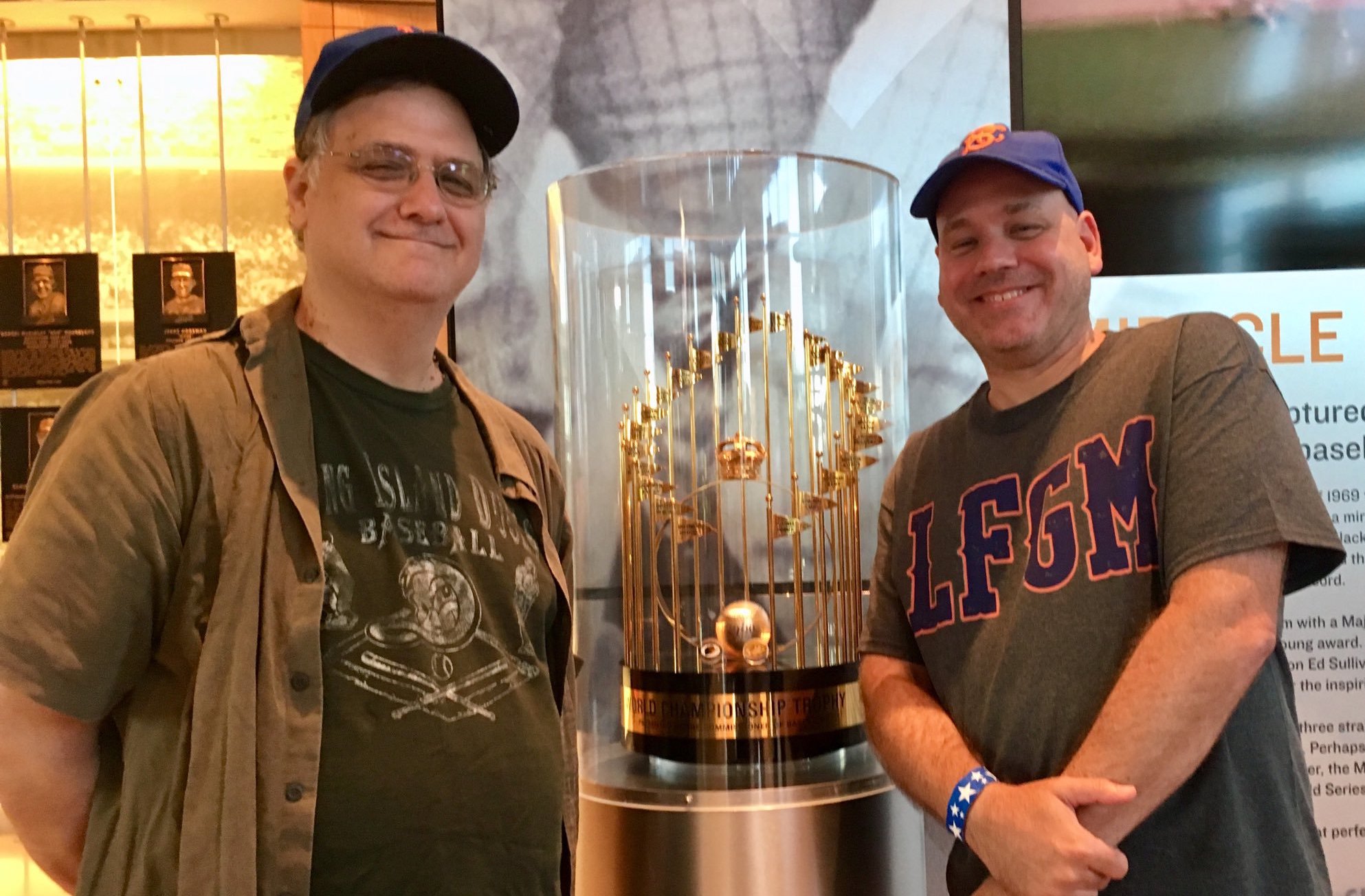
Faith and Fear in Flushing made its debut on Feb. 16, 2005, the brainchild of two longtime friends and lifelong Met fans.
Greg Prince discovered the Mets when he was 6, during the magical summer of 1969. He is a Long Island-based writer, editor and communications consultant. Contact him here.
Jason Fry is a Brooklyn writer whose first memories include his mom leaping up and down cheering for Rusty Staub. Check out his other writing here.
Got something to say? Leave a comment, or email us at faithandfear@gmail.com. (Sorry, but we have no interest in ads, sponsored content or guest posts.)
Need our RSS feed? It's here.
Visit our Facebook page, or drop by the personal pages for Greg and Jason.
Or follow us on Twitter: Here's Greg, and here's Jason.
|
by Greg Prince on 3 July 2010 7:54 pm Fuck you, K-Rod. Honestly, fuck you. And you too, Bay. I wanted you both here, I liked you in other uniforms, you’re both fucking worthless. Take your huge fucking contracts and sleep on them tonight. FUCK YOU!
Jesus…and I don’t mean Feliciano.
Not to take this overly personally, but I had a real nice post composed in my head for 8 innings about the halfway point and the Mets having, as David Wright says in those Lincoln commercials, officially changed the game, what an uplifting half-season it’s been and — and this is the kicker — how you look at Francisco Rodriguez’s game-by-game performances and, drama aside, he’s been incredibly effective in a bottom line sense so get off his ass already.
But now, fuck you K-Rod. And Bay, who couldn’t get a big hit in the late innings if it was waiting in the mailbox for him.
R.A. Dickey outshines Stephen Strasburg and it goes to waste. Alex Cora becomes a triples machine and it goes to waste. There’s insurance runs all over the place (though Allstate, State Farm and Geico together wouldn’t insure anything Frankie Rodriguez touches) and they go to waste.
The Nationals. The fucking Nationals. What the fuck more do you want out of the schedule? Jesus.
UPDATE: K-Rod says after the game he’s ashamed of himself, he’s embarrassed and he apologizes to the fans. Stand-up guy. Horrible closer at the moment, but stand-up guy. I’d prefer a dependable closer who’s kind of a weasel.
by Jason Fry on 3 July 2010 2:51 am The good thing about 5-0 leads, besides the obvious Us > Them factor, is that it lets you screw up a fair amount and not have it be fatal. Which Jerry Manuel and Frankie Rodriguez promptly did, with a little help from Elmer Dessens. Elmer has somehow been fairly reliable, certainly reliable enough to be able to secure another out, but Jerry had to manage by the rulebook and be ruled by a perfectly stupid statistic, so out he came and up went his hand and in came K-Rod, who didn’t actually record an out on his own, but benefited from more Mets shenanigans around second base. It’s fitting that a game whose first inning saw David Wright give Nyjer Morgan’s foot an assist away from the base ended with Ruben Tejada dropping his foot between Roger Bernadina’s hand and the base in the ninth. Jim Riggleman’s Medusa gaze from the dugout was priceless; if I were Bernadina, I might have considered spending the night lying beside second base, rather than have to speak to Jim Riggleman before he had a chance to get a good night’s sleep and enjoy a nice breakfast.
A nifty play, to be sure, and God bless Tejada for his hustle, talent and welcome precociousness, but it was ridiculous that things had descended so far, or that for the second night in a row Jerry’s managerial goal seemed to be trying to make us all hang ourselves. Gary Cohen was killing Jerry on the air for managing with saves in mind; I was hiding behind the couch muttering nasty things about him; and Amazin’ Avenue’s Eric Simon was concocting the best rant of the night: “Before making any pitching decision, ask yourself whether you’d make that same decision if there was no such thing as a save. If the answer is clearly ‘yes’, go ahead and make the move. If the answer is ‘no’, go back to the drawing board.”
This, as the kids say.
(By the way, Eric Holder needs to stop telling people how he left Game 6 so he wouldn’t have to see the Red Sox win. That was some embarrassing bullshit there. Plus this interview with ESPN New York reveals he’s one of those civic-minded asshats who roots for everybody. Boo!)
The Mets’ revival is a marvelous thing, but I can’t help but see foreboding signs and imagine disaster. And a lot of those hypothetical disasters involve K-Rod doing something dreadful, as he has done far too often in his nine rather unimpressive months here. His quotes about making things dramatic but always having a plan are cute; they’d be a lot cuter if I believed more than half of that statement. As for Jerry, I almost believe he enjoys torturing us. Witness his pregame musings that there’s no place for Tejada once Luis Castillo returns — because Luis’s veteran status is magical enough that we should overlook the fact that he’s a gimpy hitter who struggles to hit the ball 110 feet or reach any ball he can’t crumple on top of. I should have learned by now to pay what Jerry says no particular attention, but that agitated me. There’s been far too much praise given to the Mets for ceasing to do idiotic things several weeks after everyone else concludes they’re idiotic; let’s see them get ahead of the curve for once and consign Castillo to the bench or the beach, rather than hurt the club by removing Tejada from what’s been a wonderful mix.
But anyway, enough crying. We won, didn’t we? David Wright got lots of hits. Alex Cora got one big hit. Jon Niese was great, winning a game in which he looked like he had to think hard and work hard.
We won, and R.A. Dickey faces Stephen Strasburg later today in a game that could be enormous fun, if we allow ourselves not to make too much of it. It’s not for all the marbles, just one out of a bag of 162. It might be a wonderful clinic in two or three very different ways you can make hitters miss a baseball, each of which can be wonderful to watch. From the way he wrote his preview story, I take it David Waldstein tried out his metaphor on Dickey, suggesting Strasburg is supersonic jet and Dickey is an old Piper Cub. Dickey’s response made me love him even more than I thought I could love a gentle, ligamentless knuckleballer who reads actual books: “It’s the F-15 vs. the butterfly. I like that because the butterfly is alive.”
by Greg Prince on 2 July 2010 7:31 am Welcome to Flashback Friday: Take Me Out to 34 Ballparks, a celebration, critique and countdown of every major league ballpark one baseball fan has been fortunate enough to visit in a lifetime of going to ballgames.
BALLPARK: Yankee Stadium (New)
HOME TEAM: New York Yankees
VISITS: 1
VISITED: June 30, 2009
CHRONOLOGY: 34th of 34
RANKING: 19th of 34
But it’s all right
’Cause we all need a place to call home
It’s all right
Yes, we all need a room of our own
—Billy Joel
They build it, I go. That’s the deal I have with MLB. I can’t always make it right away, but as Michael Jackson promised long ago, I’ll be there. It’s been the case since I looked longingly north to SkyDome, it was the case through the baseball construction boom of the ’90s and ’00s and it brought me all the way home to Citi Field in April 2009.
So yes, you build a ballpark, I’ll make an effort to stop by. There are some that have been out there a while now that I haven’t gotten around to, but that’s what the rest of life is for — for Safeco, for Comerica, for the one that’s gone up in Minneapolis and for whatever they get in Miami. I’m content to wait until someday to collect them all.
 That was my thinking for the third iteration of Yankee Stadium, though I had a someday in mind: 2010. I had a streak of seeing at least one ballpark I hadn’t seen before per year, new or otherwise, dating back to a corporate junket to Busch Stadium in 1992. As you may have heard, a player on a streak has to respect the streak. The streak reached 18 consecutive years with the emergence of Citi Field as my recurring destination. In the era of the fiscally virtuous staycation, Yankee Stadium lurked as an ideal fit for this year. That was my thinking for the third iteration of Yankee Stadium, though I had a someday in mind: 2010. I had a streak of seeing at least one ballpark I hadn’t seen before per year, new or otherwise, dating back to a corporate junket to Busch Stadium in 1992. As you may have heard, a player on a streak has to respect the streak. The streak reached 18 consecutive years with the emergence of Citi Field as my recurring destination. In the era of the fiscally virtuous staycation, Yankee Stadium lurked as an ideal fit for this year.
Then Yankee Stadium jumped the line as one might expect Yankee Stadium would do.
Through professional channels, four tickets landed in the laps of my Mets fan friends Sharon and Kevin Chapman, pretty thorough ballpark chasers themselves. They make a point of seeing every stadium, field, park, yard, what have you usually almost immediately, and this one was inevitably next on their dance card. The tickets — spectacular, cushy, field level, behind home plate seats just behind those notorious “moat” seats you’ve seen empty and heard so much about — carried a face value of insane. The cost to them and their son Ross was mostly enduring the heebie-jeebies attached to going to a Yankees home game…plus parking and tolls, presumably.
The fourth ticket, they graciously posited, could be mine. It would mean limbo for my 2010 plans. It would mean, barring an unforeseen burst of travel, that the annual ballpark streak would end with 2009. It would mean obvious heebie-jeebies. But when was such an offer going to come my way again? From bona fide Mets fans, no less? You don’t get many seats priced like body parts just handed to you, and you don’t find too many friends quite like Sharon and Kevin.
So I said yes. The ticket for June 30 was in my hands in late April. Now and again over the next two months, I would take it out of its envelope and contemplate it. I’m going to Yankee Stadium. I said that half out of anticipation for the new ballpark experience and half out of dread for who plays there, who goes there and who knew what it would feel like to be so decisively out of my element?
***
My city was gone. That’s all I could think as I rode the D from 34th Street up to new Yankee Stadium. It might be 2009 above ground, but in my mind, down here, it’s somewhere between 1958 and 1961. There are no Giants. There are no Dodgers. There are not yet Mets. There are only Yankees. If I want to see a baseball game in New York, this is it. This is my option, singular.
To the left of me, Yankees fans. To the right of me, Yankees fans. All around me, save for a couple of stray Seattleites and one brave soul wearing a subtly stylized Mets cap, Yankees fans. And it’s not just that they’re all wearing Yankees stuff. It’s that they’re being Yankees fans. It’s palpable.
I want to see a baseball game in New York tonight, but not this badly.
My most comforting thought on this endless ride uptown is that it is not, in fact, 1958 to 1961. It is 2009. There are Mets. They’re not very good, but they exist, and for that I am moved— particularly by having recently read a wonderful book called Bottom of the Ninth by Michael Shapiro — to want to kiss Bill Shea.
Even though he is dead at the present time, I’m thinking, I want to thank him all over again. Bill Shea is the best friend I’ll ever have. Bill Shea is my sweetheart of sweethearts. Bill Shea did more to ensure my long-term happiness (even in 2009) than any individual I will ever personally know.
Bill Shea, I reminded myself on the D, kept me from having to do, as a matter of course, what I did one year ago. He kept me from going to Yankee Stadium on all but the most random, investigatory occasions.
If you’re a Mets fan who prays, keep the spirit Bill Shea in your prayers. Think the best thoughts possible for Bill Shea’s family. Go kiss the five parking lot markers that serve as evidence that Bill Shea did you the biggest favor of your life. Go inside Citi Field and kiss Shea Bridge. Kiss Citi Field while you’re at it — and the housing project that stands where the Polo Grounds sat and Ebbets Field Apartments, for that matter.
Kiss the National League logo. Kiss a National League All-Star next time you see one…I don’t care if he’s not a Met. I don’t care if he’s wrapped in a shirt that says Phillies or Braves or Marlins. Just be glad teams like those have a place in New York to wear their road grays on a regular basis. Kiss and thank your lucky stars that you have a place to boo them versus a home team to call your own. Kiss and thank your lucky stars that trips to Yankee Stadium never became your only option for baseball in New York.
When they built the new version of Yankee Stadium, I planned exactly one trip there: to see it, consider it and then get the hell away from it. Thanks to Sharon and Kevin, the trip came sooner than expected.
Now I don’t ever have to do it again, praise Bill Shea.
***
There was a time when Shea Stadium was the undisputed best ballpark in New York. That time was before Shea Stadium was built, before it was known as Shea Stadium. Shea Stadium, or whatever it was going to be called, was going to blow Yankee Stadium out of the water.
The Yankees knew it and the Yankees feared it. The Yankees did what they could to stop it.
In Bottom of the Ninth, Shapiro’s compelling account of Branch Rickey’s machinations to launch the Continental League, we meet the stadium in Flushing Meadows in all its paper glory. This facility looms as the linchpin of the next phase in baseball history. Mr. Rickey, with considerable assistance from Mr. Shea, is going to change the game with a third league. It’s going to put down stakes in seven cities that, as of 1958, are going unserviced by the majors and one — New York — that it can’t possibly thrive without.
New York in the Continental League means Queens…Flushing Meadows. That’s where the action will be come the 1960s and beyond. Ebbets Field is dead. The Polo Grounds is dying. Yankee Stadium is next on the obsolescence block. With the Dodgers and Giants gone, the Yankees have the city to themselves. They don’t want to give up exclusivity, not to a new league and certainly not to a new stadium that all agree will transcend any of the relics it is essentially replacing.
Nobody wanted another Yankee Stadium then. Nobody wanted the current Yankee Stadium then — certainly nobody who wasn’t already going to Yankee Stadium by 1957 was rushing to get there in 1958.
In one of the most oft-cited statistics of the second half of the twentieth century, Yankee home attendance dipped in the first year there was no competition for the baseball dollar in New York. When the Giants and Dodgers were still here, in ’57, the Yankees drew 1,497,134. When the two National League clubs were all gone, in ’58, the Yankees drew 1,428,438. They were coming off a third consecutive pennant, eight in the previous nine seasons and were headed for their seventh world title in ten years, yet the Yankees — the nation’s largest market to themselves for the first time — attracted 4.6% fewer guests for their product than they had the year before.
No wonder the Yankees feared competition in the city in a way they almost never had to in the standings. There wasn’t much built-in advantage to being the only show in town, not this town. Phillie attendance, according to Baseball Reference, jumped the year after the A’s moved to Kansas City. Cardinal attendance jumped the year after the St. Louis Browns became the Baltimore Orioles. Red Sox attendance sagged when the Braves bolted Boston for Milwaukee, though by 1952, the last season of the Boston Braves, it could be argued there weren’t many Brave souls to be harvested in Beantown (attendance: 281,278). Every market carries with it its own distinctions and New York’s was that it was objectively considered a National League town, with two distinct fan bases having supported two distinct National League franchises simultaneously for close to 70 years.
If New York couldn’t be a National League town, it could very well be a Continental League town. The American League team did not care for that possibility even though it’s not as if the Yankees were unpopular among their kind. They led the American League in attendance every year from 1949 through 1959. And, oft-cited statistic notwithstanding, they did reverse the dip from 1958 and increase their gate each of the next three seasons, culminating in 1,747,725 attending Yankee Stadium in 1961, the year of the great Maris and Mantle chase of the single-season home run record. The net Yankee attendance gain from 1957 — the last year in which there were three baseball teams in New York — to 1961 — the last year in which there was one baseball team in New York, was 250,591 attendees…or a shade less than 15% of the attendance the Giants and Dodgers totaled in 1957.
There’s no knowing how many former Giants and Dodger patrons accounted for the quarter-million people who went to Yankee Stadium in 1961 who weren’t there in 1957. But we can deduce that more than 85% of those who attended baseball games at the Polo Grounds and Ebbets Field in their final Giant and Dodger seasons were never lured to Yankee Stadium across the four years when there was no other live major league baseball available in the City of New York. The Yankees would win a World Series in 1958, an American League championship in 1960 and another world title in 1961, yet potential new business stayed away in droves.
The last thing the Yankees wanted was somewhere else for those people to go.
***
Emerging from the D at 161st Street in the Bronx, a couple of blocks east of my destination, brought relief and rain. It was good to be out from under the streets, carried along with nothing but Yankees fans for company. It wasn’t so great that it was raining, but at least there were people up here who weren’t going to the Yankees game. People who lived here, people who worked here, people who sprang from heavy air to sell unmarked ponchos for far less than they’d cost inside the stadium. It somehow gave me some hope to which to cling vis-à-vis humanity. There would still be a world out here after the game.
The game would take a while to start given the rain, but that was all right. I wanted to see up close the exterior of this edifice, this Yankee Stadium that was supposed to out-Yankee Stadium the team’s previous renovated residence, recalling in full what it was like to see it circa 1923. My blog partner Jason had taken one look at the pictures of the soaring columns, the imperious stone and the two eagles flanking the gold letters spelling out the name of the place and immediately dubbed it Leni Riefenstahl Stadium.
Funny, but a little off in real life. Even as Yankee Stadium III attempted to restore the glory of Yankee Stadium I, it felt smaller than I imagined. It felt something close to human scale (albeit for humans with a pretty puffed up opinion of themselves). I didn’t feel I wandered into 1930s Germany or 1940s Bronx. It paid homage, but it was its own creation. It was too well done to be anything but new.
Following the surprisingly light security patdown — with no bags allowed, I stripped myself to my absolute essentials, which included a small radio so I could keep tabs on the Mets in Milwaukee — I saw the scale explode.
***
I encountered the Great Hall, a wide walkway whose purpose is just to be. It is filled with oversized tributes to great Yankees, plus retail. There’ll be more of both the further in you delve.
More is not hard to come by. If I admire anything immediately in this new Yankee Stadium it’s the “all in” ethos with which they’ve imbued it. In the summer of 2009, with the first half of the first season at Citi Field wrapped in a plain, brown wrapper, it’s appealing to see somebody step up and be who they are. Before beginning to cop to their identity crisis in August, the Mets’ new home could have been called Generica Park. Contrast that with new Yankee Stadium, the Yankee historical cues and the pervading sense of Yankeeness.
Oh, it gave me hives, but that’s what you’re supposed to feel at Yankee Stadium when the Yankees, per Austin Powers, aren’t your bag, baby.
Which you can’t carry inside either way. A bag, I mean. Good thing my hives were figurative, since Lanacane is one of the things I have stashed in my bag for emergencies.
The Yankees didn’t require an army of bloggers to remind them to restore their trademark facade. The Yankees didn’t have to take heat over not building a team museum at the same time they built their stadium. The Yankees didn’t forget to be obvious or even whimsical. One of my favorite pieces was the way the gigantic food court — a mess hall, really — was adorned by oversized pictures Yankee legends (aren’t they all Yankee legends — and isn’t everything there oversized?) digging in at the plate, so to speak. Yogi and his spaghetti; Reggie and his candy bar; the Mick and his chicken. Holy cow, as the Scooter might have said over a burger, that was clever.
Food was everywhere at Yankee Stadium. Because of the rain delay, the mess hall was jammed and the concessions were doing gangbusters business. I started with a deli sandwich from the Great Hall because it was the first thing I saw that didn’t have a line. I later tried a Japanese noodle bowl which wasn’t much more exotic than lo mein, but it was different for a ballpark. Even after a generation of ballparks that offer lots more than so-called traditional fare, Yankee Stadium broke all kinds of records for menus. It was like wandering the oversized Oceanside Nathan’s of my youth, back when they had all kinds of delicacies, including frog’s legs and chow mein on a bun. Those might have been the only two things you couldn’t eat at Yankee Stadium.
Plentiful (and pricey) food choices. Plentiful (and pricey) retail options. There was a store dedicated to selling fine art work bearing the Peter Max imprint. There was just so much to buy. Maybe it wasn’t Nathan’s in 1970. Maybe it was Roosevelt Field, the mall of my youth. After a while I began to wonder why they even bothered with a ballgame.
Oh yes, the game. The rain eventually let up and I eventually found Sharon, Kevin and Ross. Like I said, these were very special seats, the kind Yankees fans would have really enjoyed. We got a perverse thrill occupying them — plus we seemed to be in a row occupied mainly by visiting Mariners fans. Only problem was our wonderful seats were wet, but Kevin, ingenious sort he is, realized the Yankees had the foresight to help us out on that count.
“Will ya look at these rags they gave us to clean our seats?” he asked theatrically as he produced the giveaway Inaugural Season Yankee Stadium t-shirt (with a classy Supercuts logo printed on the back) we each received for being among the first 18,000 fans to enter the park. I wondered what I was going to do with mine. Kevin showed off the answer, gleefully wiping down our four seats with something he wouldn’t be caught dead wearing.
Y’know what he was wearing? A Seattle Pilots cap. He’s a native of Washington state who knows exactly how to dress for a Mariners game.
I’m not usually in the habit of offering hints and tips on what to do at a given ballpark. You can make your own discoveries and have your own experiences. But here’s one pointer I’ll gladly share:
You won’t be sorry if you go with Kevin Chapman.
***
Before the delayed game got underway, the Yankees had Mariano Rivera throw out the first pitch, the inverse of what he usually did (get it?). Rivera was being recognized for having earned his 500th save a couple of nights earlier at Citi Field. The crowd didn’t seem particularly uplifted that the Mets were his most recent victim. If we ever had anybody set a record during a Subway Series game, we’d petition the Mets to name a staircase for him. But Interleague was behind us now and we had ceased to exist in Yankees fans’ minds.
Just like 1958.
One more pregame ceremony involved some high school softball team from Connecticut that had apparently been screwed by league officials out of a playoff tournament. Brian Cashman, Fairfield County resident, had read of their plight and decided to make up for their disappointment by letting them stand next to Yankee players during the national anthem (standing next to Yankee players considered a prize, somehow). I’ve since read up on the girls’ case and there were indeed blown calls up and down the line, yet there was something loathsome about watching them rewarded for griping. Complain enough and you’ll be consoled handsomely, courtesy of the Yankees front office.
(And now, a year later, I wonder what Nelson Figueroa would have had to say to those “softball girls”.)
Once the game started, the consensus was this place was OK for ballgame watching, but it didn’t set any new standard for excellence. If you peered hard enough, beyond facades and pictures of championship teams in the concourses (and they’ve had a few) and the massive video board above the left field bleachers, there was something Natsy about Yankee Stadium — it wasn’t a whole lot different from Nationals Park. I had that sense at Citi Field in April and now I got it here. You could sell a lot of stuff and you could put up a lot of pictures, but when you got right down to it, there was a throbbing adequacy to Yankee Stadium. It was new, it was clean, it had ATMs…after a fashion, no matter how much pride and pinstripes one franchise can claim, all these new places — Nationals Park in 2008, the two New York parks in 2009 — seem to have their core come out of a kit.
I had no interest in what the Yankees and Mariners were doing on the field, so I took out my radio and listened to the Mets and Brewers (direct descendants of the Pilots, come to think of it). Best thing about Yankee Stadium: excellent WFAN reception. I excused myself for a few minutes to tour a bit more. Rode an escalator up a level to check out the museum. It was more impressive than the one the Mets had in 2009 because the Mets had none in 2009. Not as open and airy as the one the Mets would build in 2010. I did notice that within the Yankees Are Great timeline, the eras were described by player: The Babe Ruth, the Joe DiMaggio…and the most recent of them named for Derek Jeter. That was quite an admission, I thought. When his contract comes up, how can they possibly tell him he’s dispensable?
Though I had the swell field level view downstairs, I took a look at whatever tier was directly above. It was all right, kind of Mezzanine-ish in Shea terms but bigger and more modern and, of course, with more concessions. I lingered at a kiosk devoted to selling old Yankee junk — magazines, cards, whatever. It was leased to some outside dealer. Nice touch. I couldn’t imagine the Mets doing something similar and was disappointed to realize the Mets could give the Yankees a run for their paranoid money.
***
By 1964, Branch Rickey’s dream of a third league was long dead. Shapiro’s book makes the case it was a big mistake for baseball to let it die. Expansion made four markets happy quickly, but the Colt .45s, the Angels and the second edition of the Senators would have their novelty wear off and their competitive aspirations dulled before long. What Rickey wanted to do with the Continental League, the author argues, is exactly what the owners of the new American Football League accomplished. They started their own circuit, they nurtured champions among their new franchises and they attained parity with the old guard NFL within a decade of their founding, resulting in the merged powerhouse National Football League we know today. In the 1960s, with baseball losing its longstanding grip as “national pastime,” professional football’s ascension couldn’t be seen as anything but bad news for the summer game.
Nevertheless, things looked great in Queens once the third-year Mets moved into their permanent home. Sports Illustrated covered its debut approvingly.
Shea Stadium has 55,000 seats, and each one of them has an unobstructed view of the field, in sharp contrast to Yankee Stadium, with its broad girders and peculiar angles that in some places eliminate from sight wide areas of the playing field. The five levels of the new stadium are colored green, blue, orange, yellow and white. Tickets and escalators — yes, escalators — will be colored to correspond with the proper levels, so that no fan should lose his way.
Like most new stadiums, Shea has a special club for season box holders, equipped with a pair of fancy bars and a restaurant. There is also an extra-special hangout called the Combo Room with its own bar and escalator. But of more interest to the average Met fan will be the series of attractive concession stands serving decent food instead of the tired fare that New York sports crowds have been held captive by for so long.
Big, expensive scoreboards are nothing new these days, but Shea Stadium’s is something else again. On top of it is an 18-by-24-foot screen that could show movies when rain delays a game. It could also replay on video tape the home run that was hit just seconds before, plus a closeup view of the man who hit it.
Shea Stadium, as it came to be called, blew Yankee Stadium out of the water, aesthetically and popularly. The last pennant of the grand Yankee dynasty — their 29th in 44 years — was captured in 1964. Paid attendance at the original House That Ruth Built: 1,305,648. Paid attendance for the American League champions at state-of-the-art Shea Stadium for the 109-loss team that finished last in the National League: 1,732,597.
The Shea Stadium Mets of the National League would outdraw the Yankee Stadium Yankees of the American League every year from 1964 through 1973. Then the Mets would outdraw the Yankees during the two years they shared Shea. It would take a substantially reconfigured Yankee Stadium, a return to perennial contender status by the Yankees and a complete collapse by the Mets to reverse that trend from 1976 to 1983. Then the Mets got good and outdrew the Yankees annually from 1984 through 1992. The Mets have had their downs and ups since then while the Yankees have had an uninterrupted string of ups. They outdrew the Mets every single year from 1993 to 2008 when both played in comparably sized stadia. Now that the Yankees play in a stadium with a seating capacity approximately 10,000 greater than the Mets do, it will take utter Yankee failure combined with spectacular Met success to give the Mets an attendance edge.
But never forget, should you find yourself riding the uptown D on an exploratory mission, that:
1) Utter Met failure and spectacular Yankee success didn’t keep the Mets from outdrawing the Yankees by nearly 427,000 as soon as the Mets had their own ballpark.
2) Shea Stadium represented, by contemporary consensus, an immense improvement over the status quo that was Yankee Stadium.
3) Two National League teams could leave New York, but New Yorkers, given ample opportunity to choose differently, never left the National League.
***
None of us was going to stay in our great, shirt-dried seats for the full nine innings. The rain delay had made this a late evening and my friends had an early day the next day. I knew I preferred a relatively uncrowded subway ride downtown. Thus, after six or so innings, I thanked Sharon, Kevin and Ross for their hospitality, parted ways and clung to my radio en route to the 161st Street station. The Mets and Brewers played blissfully in my ears (if less so in real life), drowning out whatever I was leaving behind.
The Yankees would score their usual surfeit of runs after we exited and execute yet another successful comeback victory. It wasn’t all that loud in there during the early innings, though I’m sure it picked up later. The same could be said, I assume, as the Yankees got rolling toward October and November and their eventual 27th world championship. By the time they vanquished the Phillies in the World Series every Mets fan was just dying to see, perhaps the new place felt more like the old place. I wasn’t nostalgic for the renovated Yankee Stadium of 1976 to 2008. I felt isolated there in sellout crowds, but I figured I was supposed to. It wasn’t there for my enjoyment, definitely not once Bill Shea went to work.
Great Halls and mess halls and built-in propaganda and spectators-in-residence notwithstanding, the new Yankee Stadium didn’t feel totally offputting to me — not really, not the way its predecessor had, not the way the uptown D train did. Because I could be marginally psychically comfortable there for even six innings, I have to believe it wasn’t doing its job properly as of mid-season 2009. I imagine it’s gotten the hang of being Yankee Stadium somewhat more since then, so I’m very glad I got the opportunity to sample it while it was still finding its footing…even it means I don’t necessarily have a new ballpark to visit in 2010.
Oh well, I can always take always another trip to Citi Field — and thank Bill Shea that I can.
by Greg Prince on 2 July 2010 2:25 am GOOD SIGNS FROM THURSDAY NIGHT
• Johan Santana had the breaking pitch working, thereby forestalling by at least one start the precipitous decline feared on his behalf in this space five days earlier.
• Ruben Tejada displays incredible intelligence and instincts no matter where he plays. Whatever way you figure out to get Cliff Lee here, the one place I insist Tejada doesn’t play is Seattle.
• Jesus Feliciano’s minor league hot streak continues in the majors. He doesn’t look good doing what he does, but he does it pretty well.
• We continue to score in first innings even without the services of Jose Reyes.
BAD SIGNS FROM THURSDAY NIGHT
• Liván Hernandez did not take our collective advice from last summer and retire.
• Willie Harris does not require a baseball glove to commit ninth-inning Meticide. A walk will do fine.
• If there’s a way to give up a crucial run, our battery of setup men will find it, particularly when Jerry Manuel is saving Frankie Rodriguez for save opportunities that never materialize.
• We’re not so hot in the eight innings following the first, no matter who is or isn’t in the lineup, particularly if Johan is pitching.
NEITHER HERE NOR THERE
• There are PLENTY of good seats still available for Thursday night’s game. I guess no one has told Washingtonians they’re allowed to go to Nationals Park when Stephen Strasburg merely sits in the dugout and receives pedicures from Bob Costas.
• I don’t miss watching games from Puerto Rico.
• Though I’d prefer Liván Hernandez had found another line of work, good for him for being a regular person and chatting with anyone who wanders by his locker on the day he pitches, as reported by former Nationals television analyst Ron Darling. Good for Al Leiter for having done the same, per Gary Cohen. Generally speaking, starting pitchers can’t be talked to. Starting pitchers have to fly ahead of the team (though Johan didn’t). Starting pitchers have to have somebody cut their meat for them. And the Nationals don’t even let their own and radio people interview Strasburg. I was going to say pitching isn’t rocket science, but I’ll bet rocket scientists aren’t treated this deferentially.
• Funny People came on one of the HBOs after the game. It is the cinematic equivalent of a 2-1 loss that turns out less interesting than the score would indicate.
by Jason Fry on 1 July 2010 2:57 am Last night Emily and I continued our childless week with another excellent dinner and a sunset walk along the High Line, New York City’s startlingly beautiful conversion of an ancient freight railway into a meadowland in the sky. The Mets were even obliging us by being delayed by rain down in San Juan, where they’d staggered through two nights of horror at the hands of the loathsome Florida Marlins.
We got home and tidied up the house as the Mets dealt roughly with Chris Volstad and saw Mike Pelfrey give up hits to everybody except unwanted cameo guitarist Bernie Williams and the tropical-drink vendors. Sitting up in bed, I watched Elmer Dessens come in to finish the fifth, throw five pitches … and at some point after that my eyelids drooped.
It was a horn that work me up — the mating call of a cheap plastic goose, somewhere between the forlorn BRAAAAP BRAAAAP BRAAAAAAAP of an Olympic Stadium trumpet and the synapse-shredding drone of a vuvuzela. I woke up confused. There was a trash-baggy wall behind home plate, open-plan dugouts from another age, and the awful sicked-something-up green of artificial turf, so blissfully absent from the National League. And there were Mets, in gray, stumbling around out there looking unhappy.
Wha? Where are we?
I only saw the last sad inning of Monday’s affair and paid that as little attention as possible, seeing how it was already a debacle by then. On Tuesday night Emily and I turned on WFAN on our way home from Red Hook, just in time for Josh Thole’s pinch-hit. We decided to catch the end of the game in a watering hole, amended that to wait until the top of the 10th for safety’s sake, and so had an uninterrupted journey back to Brooklyn Heights. (For the record, though, I totally would have pitched to Dan Uggla over the swinish Cody Ross, whom I loathe with frightening, somewhat mysterious intensity.) Part of my brain must have registered these defeats, but when I woke up and finally understood that we were still in Puerto Rico, it wasn’t the last two games that made my guts churn. No, it was 2003 and 2004 I was remembering in horror.
This is Hiram Bithorn Stadium, where history took a macabre turn in April 2004. The Expos remain marooned here. Bud Selig has refused to allow them to leave the island, and has sold their team bus to buy Jeffrey Loria a beachfront apartment decorated with gold Terry Cashman records. The Expos are forced to hitchhike from the beach, where they spend their days harvesting coconuts and hawking shell art to confused tourists. (Peter Bergeron is a wizard with scallop shells and Krazy Glue.) Foiled in his plan to contract the Mets, Selig has decreed that we must play the Expos until the end of the time, forming a two-team league that plays only exhibition games. Roberto Alomar and Rey Sanchez are still here, losing games, giving each other haircuts and blaming their own laziness and sour dispositions on rookie pitchers. David Wright and Jose Reyes were awarded to the Yankees by the commissioner’s office in exchange for the lifetime rights to Shane Spencer and Karim Garcia. The overgrown wilds of Shea Stadium now serve as a preserve for feral cats. Our record as the perpetual visiting team at Hiram Bithorn stands at 2-1,046, though Art Howe insists he is proud of us for battling. The Mets live in a beach motel without power, and repeated nighttime collisions with their manager in the lobby have provided definitive evidence that Art Howe does not, in fact, light up a room. Needless to say, nothing good will ever happen to any of us again.
And then I woke up for real, and realized two things:
1. Almost none of that was true.
2. We were doing an inept job playing the Marlins, which was nightmare enough.
You saw the rest: The Mets playing like artificial turf was news to them, the Marlins playing like the rudiments of defense and pitch selection were news to them, Edwin Rodriguez driving Keith Hernandez to the brink of a psychotic episode by robotically subbing one inept Marlin reliever for another, and Francisco Rodriguez somehow not blowing it. We’d won, but I shut off the TV with alacrity reserved for games we’d lost, because I wanted to see no more of Hiram Bithorn than I absolutely had to.
A trip to Retrosheet revealed that the Mets had, in fact, won games in this awful stadium before. In 2003 we went 0-4, outscored by 22-8 by Los Expos. But in 2004 we were 2-1. Or so Retrosheet claims. I’m suspicious. Supposedly we won on April 9, 2004, with Todd Zeile driving in Ty Wigginton as the go-ahead run in the 11th and Orber Moreno securing the save by getting Brian Schneider to ground out. None of that seems terribly likely, except for the part about Brian Schneider grounding out, but the supposed events of April 11, 2004 are clearly make-believe. T@m Gl#v!ne got the win and Braden Looper recorded a save? I think I know my Mets history pretty well, thank you — certainly well enough to know neither of those traitors ever so much as recorded an out for us.
And even if I’m mistaken on some of those details (because I am still kind of sleepy and disoriented), I’m quite certain about one thing: San Juan is, on balance, a place where horrible things happen to the New York Mets, and the wisest course of action would be to never return here again.
by Greg Prince on 30 June 2010 3:25 pm You know why Tuesday night’s loss to the Marlins felt as familiar as it felt sickening? Because it was very familiar.
Thanks to Baseball Reference (how did I ever live without it?), I was able to find that the Mets have lost 68 road games to the Florida Marlins since their inception in 1993, including the last two at Hiram Bithorn Stadium. Do you know how many have come down to one potential swing of the bat?
Almost all of them.
Of the 68 games we’ve lost at all the various iterations of Joe Robbie Stadium plus HBS, 62 have been by 4 runs or less. Only six times have the Mets not been at least one grand slam away from tying it before losing it. You could file that under Never Say Die, but we know that eventually they did say “die” and it inevitably involved a great deal of thrashing and coughing up blood.
Before Monday night (which had been a four-run game before Ryota Igarashi extended the deficit into never mind! territory in the eighth), the last time the Mets dropped an overwhelming “oh well, whaddaya gonna do?” decision dropped to the Marlins on the road was September of 2006, shortly before we clinched the N.L. East. Dave Williams was lit up early and often, and we could cuddle with a large division lead for consolation if we needed any. Since then, almost every loss in Miami — 13 of the 14 games we haven’t won — have been by excruciatingly thin Marlin margins:
• 7 by 1 run (5 of them walkoffs plus the loss that hinged on Daniel Murphy’s left field misadventure)
• 4 by 2 runs
• 1 by 3 runs
• 1 by 4 runs (which the Mets led 3-2 before surrendering 5 in the bottom of the eighth)
The only recent outlier prior to Monday was a five-run loss on May 14, and that was an Ollie Perez special, excruciating in its own right for the involvement of Ollie Perez. Hopefully, last night’s two-out festival of futility is not the beginning of yet another trend (and I don’t mean let’s go back to losing by eleven).
By comparison, the Marlins have lost 74 games at Shea Stadium and Citi Field since 1993, and 17 of them have been by more than 4 runs, meaning 23% of their away defeats to the Mets have been dispiriting but not necessarily crushing. When the Mets travel to lose to the Marlins, 91% are by 4 or fewer runs. We may not lose by much, but we are almost inevitably crushed.
Thanks, I think, to Kevin From Flushing for mentioning the proliferation of Met walkoff losses and making me dig into the pain just a little bit deeper.
by Greg Prince on 30 June 2010 3:08 am It may temporarily bear the Marlins’ name, but Hiram Bithorn Stadium reeks of Expos, Expos and more Expos. It’s 2003 and 2004 all over again all of a sudden and we suck in ways we haven’t sucked in years, last year included. I think I may have even seen Eric Valent at the bat rack preparing to pinch-hit for Tyler Yates.
Tropical paradise or not, I can’t wait for somebody to get the Mets off this godforsaken island.
You can bang your drums, you can walk on stilts, you can sell Piña Coladas in the stands and you can leave all the tickets you like for friends and family of Angel Pagan…yet except for it containing life and people, the last two nights have been unlamented Olympic Stadium revisited. It was harshly lit, it was badly carpeted and it screwed with my perceptions of whether we could possibly win or were destined to lose.
At first, it was an Art Howe-style battle to not lulled into a state of relaxed confidence. Relaxed confidence is for playing the Orioles, not the Marlins/Expos. Still, Angel was back and producing dividends in front of everybody he’s ever known. David was having his way with soft-tossing lefty Nate Robertson. Well, this will make up for Monday night.
Then I began to have creeping doubts as I might have had under the full yellow moon of Shane Spencer and Karim Garcia. Why does David keep getting thrown out on the basepaths? I know we’re winning, but we seem to be squandering some additional opportunities.
Then I invested faith in Hisanori Takahashi in the same manner citizens of San Juan might deposit their earnings at Banco Popular. In the bottom of the third, I noticed Tak had retired eight consecutive Fish and had the pitcher coming up. Wouldn’t it be something if the first no-hitter in Mets history took place at a neutral site? It could be taking place on Mars for all I care. Could tonight be it? Takahashi’s in total command…
And with that, Nate Robertson snuck a ground ball just a wee bit past Jose Reyes, so there went that lunatic fantasy, but two out, the pitcher on, we’re up 3-0, it’s all good.
About four seconds later, the bases are loaded and Hanley Ramirez remembers there’s a way he can jog to first and not look bad doing it. Marlins 4-3…and the inning’s still not over yet. Is an inning that includes Jorge Cantu and Dan Uggla ever over? (This is what we in the writing business call foreshadowing.)
When’s Jerry gonna pull Hisanori? Apparently never, and it seems almost brilliant given that we’re down to a paltry ELEVEN PITCHERS on the staff. It was rewarding for the human spirit to see Takahashi recover and get through the fourth and fifth scoreless. It was as if he had a shutout going if you ignored the six runs the Marlins hung on him in the third. Tak almost made it through the sixth, too. Dessens took care of his last jam with one pitch while I was still flipping around thinking SNY was in commercial.
Because the Marlins are the Marlins, I always foresee doom. I honestly picked them to win the East in March on the premise that they must be good against teams that aren’t us. On the other fin, I tend to forget that the Marlins are the Marlins in the sense that they are a sloppy unit that often lets leads get away. So resumed the battle to figure out what would happen next in the top of the seventh.
Arrgh! A Tatis popup! IT FALLS IN! HE’S ON SECOND!
Arrgh! A Francoeur flyout! IT FALLS IN! HE’S ON SECOND! TATIS IS ON THIRD! THERE’S NOBODY OUT!
Old devil confidence was back because this really isn’t 2003 or 2004. It’s 2010, the year when we believe in our Mets again. You just know Tejada might or will do something…and he does! It’s just a grounder to third that the Marlins can’t turn into a double play yet that makes it 6-4. We’re back in it!
As Agent Harris said in the series finale of The Sopranos, we’re gonna win this thing. We have Ike coming up to pinch-hit…oh, he struck out. But that’s OK, because Jose is up and…he struck out, too.
How can somebody with as preppy a name as Taylor Tankersley be that tough?
I was sagging by the bottom of the seventh, but Bobby Parnell lifted my spirits as much as he likely did his own. Wright gets on with one out in the eighth and I’m thinking something could happen here as long as Jason Bay doesn’t hit into an inning-ending…but naturally he does. Couldn’t have saved one of those opposite-field home runs from Monday for tonight when it could have mattered, eh big guy? You are going to go on that hot streak eventually, aren’t ya? Aren’t ya?
There had been some mumbo-jumbo about Jerry giving Frankie some work in the eighth, but I assumed that was no longer in order once we were in a game situation. We’re on the road — whether it was San Juan, Miami or Montreal — and we might need a save guy. Yet while I was flipping around to avoid more commercials, Frankie slipped in, threw eleven pitches, ten of them strikes, two of them for strikeouts, and we were still down two. I guess keeping the game close is as important as closing it, but it’s been so long since a closer was used quite that way I’d forgotten it was legal.
Ninth inning and I have conflicting hunches:
• Hunch 1: My hopes are going to be raised.
• Hunch 2: My hopes are going to be dashed.
Both hunches proved correct but in a far weirder way than I’ve experienced lately.
Barajas lashes a single to left that’s a double on almost any other set of Met wheels than his own. Carter, batting for Frankie (so much for getting another inning out of him), sends one screaming into the right field corner. Marlin phenom Mike Stanton is obviously going to screw us over by making one of those catches that will ratchet up his legend instantly and I’ll be as sick of hearing about “special” he is by tomorrow as I already am of hearing how “proud” Edwin Rodriguez is of managing in his homeland. (Does the universal announcer habit of referring to Latin players and managers as “proud” strike anybody else as condescending?) Except Stanton plays this difficult liner from Carter the way he played that easy fly from Francoeur — he doesn’t catch it. Meanwhile, the only Met who can’t possibly score on it is the one chugging from first to second and then plodding from second to third.
Should have Manuel pinch-run for Barajas as long as he had three catchers? Probably not, given that there were more machinations to come and Rod wasn’t the tying run, but it was painful watching the Barajas Moving Company haul that piano around the horn on its back. I haven’t thought anything like this since the Met heydays of Mo Vaughn and Jason Phillips, but I did hear myself saying, “I could run faster than this guy.” And I could…on my best day…once…and probably only if catching a train was involved…and that train would have to come equipped with an oxygen tank.
Finally a pinch-runner, Cora, is deployed, except it’s for Carter. Well, he’s not fast either. I thought we were such an athletic club and suddenly everybody’s slow. The runner on third is slow. The pinch-runner on second is slow. We’re still losing by two. There’s nobody out, but nobody being out didn’t help Takahashi in the third did it? Leo Nuñez is teetering on the brink as Marlin relievers tend to do, but he’s about to rely on a pitcher’s best friend — no, not a double play, but Jeff Francoeur. Frenchy lunges at Pitch One, which, lucky for us, becomes a fielder’s choice grounder to second that serves the dual purpose of scoring Barajas and moving Cora to third. Nevertheless, it felt less than optimal. Optimal might have involved taking a pitch in hopes of driving a ball, but let us not look gift horses in their kissers when the tying run winds up 90 feet away and due up next is…?
Say, who is up next? What an odd batting order this has been in the ninth. Why, it’s young Josh Thole, pinch-hitting for young Ruben Tejada. This is presumably some sort of percentages move as Tejada has two hits plus that handy fielder’s choice already and Thole is largely untested at the major league level in 2010, but Jerry’s rolling dice left and right and the game isn’t over yet. Perhaps they’ve already hauled Barajas to bed and will be sticking Josh behind the plate should we get that far.
And we do get that far! Josh takes advantage of a drawn-in infield and singles home Cora to tie it at six. Just to recap, these are the Mets who got it done in the ninth:
Rod Barajas
Chris Carter
Alex Cora
Jeff Francoeur
Josh Thole
This is a hot new Met combination, one of those Bambi’s Bombers/Hondo’s Commandoes moments a team requires in the course of a season of overcoming dim expectations. Natch, neither George Bamberger nor Frank Howard led the Mets anywhere beyond expectations (1982: last place; 1983: last place), but those teams’ few swell episodes generally involved some eighth-inning rally led by benchwarmers every third Sunday. We were getting that here, and now we’d get more, because, unlike the benighted squads of nearly thirty years ago, we’re a good team, right?
Here comes Ike again, batting in the ninth position, and he lifts a high fly ball that has a chance…
…to be caught. Two out, Thole glued to first. Then Reyes, like fear, strikes out.
We go to the bottom of the ninth in a 6-6 tie, bereft of Frankie Rodriguez, but the hell with assigned roles. If Frankie can pitch the eighth, why can’t Pedro Feliciano pitch the ninth? Does it really matter when Pedro pitches? Surely he’s snuck a ninth inning in along the way. Pedro pitches so much we should stop counting how many appearances he makes in Met games and start counting how many appearances the Mets make in Feliciano games.
This appearance, his 44th of the season and his eighth that involved a ninth inning, started swimmingly, befitting a game that was taking place on an island against a team named for a type of fish. Like Frankie, Pedro struck out his first two, including the heinous Hanley. Now all he had to do was take care of Jorge Cantu and we could win in extras.
Of course all British Petroleum has to do is sop up a little oil and its executives can get their lives back. Easier said than done. Cantu can and does double to deep center, and then Uggla isn’t walked to bring up Cody Ross.
As if facing Cody Ross with the game on the line is such an enticing option.
Uggla gets enough zip on his grounder up the middle to squirt it past a non-diving Reyes. On grass the ball is slower and Reyes dives. On turf Jose probably doesn’t have much of a chance to begin with, but I wonder if he was gun-shy. I flashed back to a game on the Big O carpet in the summer of 2004, that last Expo summer, when Jose was having hammy problems and Art Howe the genius decided taking precautions with one of the organization’s crown jewels was for sissy boys. “Let him rub some dirt on it” or words to that effect was Art’s prescription for maintaining the health of the future of the franchise. Howe was going to be fired by season’s end anyway. I would have abandoned him at customs without I.D. for that alone.
Uggla’s ball eludes Reyes. Jesus Feliciano, in for a not completely well Pagan by the ninth, rushes it, picks it up and fires it to the plate. Cantu rounds third not looking a whole lot faster than Barajas, but he doesn’t have to be particularly speedy. Feliciano gives it one of those throws that leaves a player’s body on the ground, which is admirable but is usually futile. It wasn’t one Feliciano’s fault that for the first time in 2010 the other Feliciano gave up a ninth-inning run. It’s not either Feliciano’s fault. It’s nobody’s fault.
It’s that Expo residue combined with those loathsome Marlins. It’s this odd predilection somebody has for scheduling the Mets into places like San Juan, Tokyo and Monterrey where by the time they figure out what’s going on around them, there’s at least one loss on their permanent record. The Mets are such good neighbors, traveling hither and yon for the betterment of baseball, but sometimes I wish they’d build a fence around themselves. This was the second of seven consecutive games the Mets are playing in none of the 50 states. Overlooking that three are in a United States commonwealth and four more are in a District called Columbia, I am tempted to ask, “Why do the Mets hate America?”
Puerto Rico, I hear, is beautiful this time of year. No kidding. My friend Jeff just spent a week on vacation there with his family and came home happy. Yet I can’t connect his delighted dispatches with what I see on television. I see not just Met losses but that layer of latter-day Expo film that makes this accursed facility appear as depressing on television as it has allegedly been festive in person. Now that the Nationals have a park and fans and an ace, they no longer hold any connection to the Expos in my mind. The Marlins are their true heirs. Same miserable owner. Same acres of empty seats. And now the same bizarre notion that people in Puerto Rico have any interest in adopting them as their own. The Expos had the excuse of being forced into nomadhood by Major League Baseball. The Marlins are just plain unlikable wherever they wash up. Incredibly talented in spots, but genuinely unlikable.
I’ve stated time and again since MLB conspired with Jeffrey Loria to render the onetime pride of Quebec into the Montreal Extincts that I’ve missed the Expos. That’s still true. I continue to believe a baseball-loving province got the affection squeezed out of it by ugly business machinations. Once a year I wear my tri-color Expos cap to a Mets game because I feel bad there are Expos fans who have no game to which they can wear their Expos caps. But in real time, I hated the Montreal Expos no less than I hate every opponent while they are our opponent. Returning to San Juan has reminded me all opponents present and past are hateful bastards, and this series has been like playing two teams at once: a team of rotten Fish and a team of irksome ghosts. And thus far we haven’t figured out how to effectively counter being double-teamed.
by Greg Prince on 29 June 2010 3:02 pm Two facts of life become apparent every summer in these parts:
1) New York is a humid place.
2) Ralph Kiner is an awesome man.
You know that incessantly run Heineken Light commercial, the one in which the young-ish guy explains how he and his pal Jamie won $94 million in the lottery and relocated to some slice of paradise where sun-splashed retirement seems to be agreeing with everybody on camera, all of whom are “pretty awesome”?
Ralph Kiner belongs in that commercial, except he’s never exactly retired.
Still, I can see Ralph sitting around that table with Terry the sniper in the Big One and Maurice who dated not one but two Pointer Sisters. Ralph might have dated all four, including Bonnie who left the group to pursue a solo career. Shoot, we know he dated Janet Leigh and Elizabeth Taylor.
Even if it wasn’t at the same time, that’s a world-class batting order.
Why choose a sweltering Tuesday in late June to celebrate Ralph Kiner? Why not? Is there a bad time? The Mets gave Ralph his own night three Julys ago. They can give him another one anytime and it would be perfectly appropriate.
Ralph rose to his rightful place in my consciousness once again on Sunday afternoon when he contributed six innings of analysis on SNY. He joined Gary Cohen and Keith Hernandez in the Ralph Kiner Television Booth, which makes sense since Ralph pretty much owned the whole six innings right from the start.
The subject of off days came up immediately. Twins manager Ron Gardenhire was giving one to two of his regulars, Justin Morneau, who was batting .346, and Jason Kubel, who had homered Saturday. It was hot, it was the end of a long road trip and there would be a game in Minneapolis on Monday night, but Ralph wasn’t having any of it.
Why would you ever want a day off? Ralph asked incredulously. He was incensed as I’ve ever heard him. It’s a game. Baseball’s a game. You don’t need a day off. Ralph, whose Hall of Fame career was limited to ten seasons by injury, probably wishes he had gotten to play more games. Not that he hasn’t kept busy for the past 55 or so years — these last 49 with us — but once a Hall of Fame player, always a Hall of Fame player.
Keith, who usually fills the role of vaguely aggrieved icon (and beautifully, I might add), gently attempted to counter that these days players tend to run down with all the pressures of modern life that take a toll on them — all of the airline travel, for example.
Talk about a pitch in Ralph’s wheelhouse.
Teams used to travel by train, Ralph reminded Keith and the rest of us. And the trains weren’t air conditioned.
Keith was humbled. So was I. Ralph Kiner rode on steamy, sweaty trains; led the National League in home runs seven consecutive seasons; twice (because of ties and a trade) played in more than the regulation 154 games; and still found the wherewithal to date Janet Leigh and Elizabeth Taylor.
Ralph doesn’t really play the in-my-day card very often. He is loaded with anecdotes and remembrances, but it’s never been his style to force them on the conversation (though, admittedly, they do flow a little easier now than when he was a play-by-play man). He knows his baseball in the present tense and can analyze a swing from 2010 just as he might dissect one from 1950. But when he wants to, Ralph Kiner can let you know where he’s been and what he’s seen. It’s a blessed event when he does.
As for Keith…son, don’t mow Ralph’s lawn.
by Greg Prince on 29 June 2010 12:27 am I sincerely wish R.A. Dickey had continued his recent Rad ways against the Marlins in festive San Juan instead of throwing his first indisputably Icky start. Of course I do. Still, an infinitesimal bit of me is mildly relieved to discover R.A. Dickey is essentially like the rest of us.
Seriously, I was beginning to have my doubts. The man was not only unbeaten in six decisions prior to Monday night, but he seemed just a little too good to be true, moundwise and otherwise. R.A. Dickey was a walking human interest story everywhere he showed up. His lack of a ligament was interesting. His relationship to his catcher’s mitt was interesting. His comeback from obscurity was interesting. His choice of what he reads and doesn’t read — and the fact that he likes to read — was interesting. R.A. put me in mind of XX, a.k.a. those Dos Equis commercials featuring “the most interesting man in the world”.
His car arrives home before his pitches do.
Batters take two strikes from him and then tip their cap.
His knuckles throw a Dickeyball in tribute.
The final straw, so to speak, came Sunday when I watched Mets Weekly cover the club’s string of admirable “Teammates in the Community” events. One of the stops involved planting a garden in Harlem. Who should be calmly explaining the making of flower beds as if he had a degree in horticulture but Professor R.A. Dickey? I half-expected him to gently touch the dirt and instantly create foliage.
That’s when it hit me who R.A. Dickey really might be: not Phil Niekro or Wilbur Wood or Tim Wakefield but Chance the Gardener from Being There. Simple Chance the Gardener, commonly mistaken as erudite Chauncey Gardener, was the sheltered Peter Sellers character who spoke in nothing but mundane gardening terms, yet his every utterance — “There will be growth in the spring” — came to be taken as the sagest of wisdom. Chance unwittingly rides his obliviousness to Washington’s most powerful salons and, by the end of the movie, he’s considered presidential timber. Chance the Gardener can do no wrong.
Monday night we learned R.A. Dickey is no Chance. But we’ll take our chances with him another day.
As for Ricky Nolasco, who shut down every Met but Jason Bay, I must confess the one thing I always think of when he pitches is this exchange from The Sunshine Boys between cantankerous Willie Clark (Walter Matthau) and clueless Al Lewis (George Burns) upon their first stilted encounter after eleven years of estrangement:
WILLIE: You know Sol Burton died?
AL: Go on. [Pause] Who’s Sol Burton?
WILLIE: You don’t remember Sol Burton?
AL: Oh, yes — the manager from the Belasco.
WILLIE: That was Sol Bernstein.
AL: Not Sol Bernstein. Sol Burton was the manager from the Belasco.
WILLIE: Sol Bernstein was the manager from the Belasco and it wasn’t the Belasco, it was the Morosco.
AL: Sid Weinstein was the manager from the Morosco. Sol Burton was the manager from the Belasco. Sol Bernstein I don’t know who the hell was.
After Monday night, we definitely know who Ricky Nolasco is.
He’s that pitcher from the Mets who threw his glove in the air after he won those big games.
by Greg Prince on 28 June 2010 10:30 am Word is it was 99 in the shade at Citi Field Sunday, yet right here, it feels a bit like ’99 in the Shea: The Mets are hot on the Braves’ heels, Bobby Valentine is basking in the media’s glare and the Mets’ infield has been warming to its task with uncommon aplomb.
Highly uncommon, but wonderfully reminiscent of the way it used to be around first, second, short and third. Very wonderfully. So wonderfully, in fact, I’m going to sprint about a mile ahead of the starter’s pistol on an evaluation I don’t make lightly. Accuse me of jumping the gun. I don’t care. I’m too enraptured by what I’ve been seeing around the diamond lately. So here goes:
Ike Davis, Ruben Tejada, Jose Reyes and David Wright are fielding their positions in a manner comparable to that of John Olerud, Edgardo Alfonzo, Rey Ordoñez and Robin Ventura eleven years ago.
Is that giddy or what? Or is that even in the realm of possibility? Are we witnessing the larval stages of Best Infield Ever, Version 2.0? Or is it just a mirage from the heat?
 Then they were a work of art. Now they are a museum piece. Perhaps you remember the Sports Illustrated cover from that ever more distant steamy summer of 1999, the one that asked instead of flat out declaring the obvious. Yes, it was the Best Infield Ever. A few weeks of watching Oly, Fonzie, Rey O and Robin would convince anyone they were watching maestros at work. I was convinced long before the SI cover appeared. I clearly recall thinking weeks ahead of publication, “You know who should be on the cover together…?” That infield was perhaps my favorite element of what remains my favorite Met season.
Thus, it borders on sacrilege to hear myself now thinking, “THESE guys may someday be as good as THOSE guys…” But I am thinking it. I’m seeing signs. I’m seeing a shortstop who has raised his game from very good to routinely dynamic. I’m seeing a third baseman who has corrected all his bad habits and makes nothing but outstanding plays. I’m seeing a first baseman who was born to play first base. And — this is what’s truly revving my motor — I’m seeing a second baseman who’s smart, agile and fits in perfectly to create this dream infield.
I’m seeing something great developing, I swear I am. I know it’s early. I know this wasn’t the alignment projected even a month ago when some old dude with an onerous contract was dutifully gobbling up every ball hit six inches on either side of him. I know Ruben Tejada is a 20-year-old converted shortstop who’s just getting his feet wet. I know Ike Davis, natural to his position as he is, is also technically a neophyte. But I’m riding the edge of the wave here. I’m seeing this group turn double play after double play, scoop up troublesome ball after troublesome ball, defend like no Met infield has defended since the infield of sepia-toned 1999 memory sealed shut the border between the grass cutout and the outfield.
 C'mon, get happy with Ruben and the Mets. Even better, they’re all hitting. Wright and Reyes have track records on offense. Davis came advertised as heavy and so far there’s truth in advertising. Tejada was the unknown quantity when Luis Castillo entered the Disabled List, but he’s on a ten-game hitting streak and most of his hits during it seem to have been crucial. Ruben’s a cool customer, an ideal complement to his new keystone partner. Jose runs hot at all times. Ike’s shockingly professional, the closest thing I’ve ever seen to the quote I read about Tom Seaver when he was coming up through Jacksonville: a 21-year-old arm attached to a 35-year-old head (the diametric opposite of what the Mets were usually sending to the mound circa 1966). Ike is still learning how to hit everything he sees — it’s a thrilling process to watch — yet he seems to have quietly mastered the art of being The Man on his team already. Check out his dugout interaction with everybody else, including the vets. That’s no timid rookie. David, who never looked comfortable answering those “when are you going to be named captain?” questions, may be more relaxed than ever in response. He now outright owns the Citi Field career home run record and drives a Lincoln (which is what Met home run hitters drive, apparently…hey, it’s better than watching another Ford Edge commercial).
And of course, they’re all ours in a way the 1999 aggregate never could have been. They’re all ours from the beginning. Each has never been anything but a Met. I grant you I didn’t look at Robin Ventura (or Keith Hernandez or Doug Flynn in their Gold Glove heydays) and dismiss him for the crime of once having come from somewhere else. But there’s something exhilarating about an infield consisting of four players who were signed as Mets, developed as Mets, brought up as Mets and are thriving as Mets.
It’s also quite rare. How rare? Let’s put it this way: If you want to scale back my enthusiastic prognostications for this group’s potential greatness and tell me they should first prove they’re the best homegrown Met infield ever, I’d have to tell you they already are.
No kidding.
Here’s the thing about homegrown Met infields: There haven’t been any, not in the strictest sense, certainly not for the long term. Perhaps you heard a note or two from Elias on the subject when Tejada joined the cast at the beginning of this month. First it was reported this was the first all-homegrown Met infield since 1996 — Butch Huskey at first, Fonzie at second, Rey O at short, Tim Bogar at third. Then it was amended in deference to Ordoñez playing 13 games as a St. Paul Saint in 1993, as if an independent minor league stint might render the designation “homegrown” inoperative. I don’t agree, but if we play along with that argument, then the previous homegrown Met infield would have been from 1991 — Chris Donnels at first, Keith Miller at second, Jeff Gardner at short, Gregg Jefferies at third. Their last appearance was in support of David Cone’s National League record-tying 19-strikeout performance on the final day of the season (talk about an easy day at the infield office).
Whether it was 1996 or 1991, the point was it hadn’t happened in a mighty long time. Had it ever happened in any tangible way before then? Spurred by a discussion with a friend who wondered just how rare a homegrown Met infield is, I plunged into Baseball Reference and checked.
It is rare to the point of nearly nonexistent. The Mets have never maintained a homegrown infield for any length of time. Through Sunday, here is a comprehensive list of the homegrown Met infields with the most games started together, using 14 games as our not-so-arbitrary baseline:
1) Ed Kranepool, 1B; Ken Boswell, 2B; Bud Harreslon, SS; Tim Foli, 3B — 15 games started.
2) Ike Davis, 1B; Ruben Tejada, 2B; Jose Reyes, SS; David Wright, 3B — 14 games started.
That’s how rare it is for the Mets to deploy four homegrown infielders in the same starting lineup. It’s so rare, we’re seeing an infield that didn’t exist as such on June 1 on the verge of setting the standard before July 1. Even allowing for Jerry Manuel likely giving Alex Cora a sentimental start in Puerto Rico, Davis, Tejada, Reyes and Wright are on track to break the Most Starts By a Homegrown Met Infield record by Wednesday.
Geez, that was fast! But it’s not like there’s a Garvey, Lopes, Russell, Cey lurking in the Met annals.
Mind you, we’re using the standard definition of homegrown: signed by, developed by and brought up by one team, in this case the Mets. That disqualifies any of the many infields that included Wayne Garrett at third base. While we fondly remember Red as our underappreciated hot cornerman from his rookie season in 1969 through his unfortunate trade to the Expos in 1976 (for the overvalued Pepe Mangual), Garrett was neither signed by nor developed by the New York Mets. He was a Rule 5 draftee from the Braves organization in December 1968. That means he was not homegrown.
But for the hell of it, let’s include Wayne Garrett in our discussion since he debuted in the major leagues as a Met. Wayne played in 24 different infield combinations (lots of platooning, lots of injuries) that could be considered homegrown if we expand our definition to players who played their first MLB games as Mets. The most common of them was Kranepool at first, Boswell at second, Harrelson at short, Garrett at third. That was the starting infield in 50 games from ’69 to ’74. Kranepool, Boswell, Teddy Martinez and Garrett, meanwhile, started in 23 different games.
No other homegrown or quasi-homegrown combination is in the running.
Nothing with Ordoñez, Northern League background or not.
Nothing with Kazuo Matsui, either, who can’t really be thought of as homegrown given his All-Star shortstop status in Japan, but technically he never played with another MLB organization before the Mets. Kaz was part of five quasi-homegrown infields in 2004 and 2005, the most unlikely of which featured Craig Brazell at first, Reyes at second, Matsui at short and Wright at third.
Nothing with Kranepool even, despite his being around forever and being part of the first purebred Met homegrown infield on the night of September 13, 1967 when Wes Westrum’s alignment of choice in Atlanta was Krane at first, Bobby Heise at second, Buddy at short and Joe Moock at third. No double plays were turned, but Moock did double home the tying run to help Seaver secure a 2-1 win.
That first truly homegrown combo lasted three games. In the ensuing days, Boswell would replace Moock at third for three games and then Moock would come back for the final three starts of the year, with Boswell at second and Heise at short (Salty Parker: quite the interim innovator). For eleven games in 1968 and ’69, it would be Kranepool, Boswell, Harrelson and Kevin Collins before Kevin went to Montreal in the Donn Clendenon deal.
Teddy Martinez played third with Ed, Ken and Bud in 1971. Ted was also at second while Foli anchored third the same year. There was a single lineup card made out in September 1974 that listed John Milner at first, Rich Puig at second, Martinez at short and Boswell at third. Fourteen years later, there’d be a two-game cameo by Dave Magadan, Wally Backman, Kevin Elster and Jefferies. Huskey, Alfonzo, Ordoñez and Bogar got five starts from first to third in September 1996, though in one other game Bogar would play second while Alfonzo would start at third.
But that was it before Ike, Ruben, Jose and David. It’s taken 49 seasons to prospectively forge an infield of tenure consisting of nothing but homegrown, quasi-homegrown or even proto-homegrown players. By proto-homegrown, we mean four players who made their debuts as Mets but came along too early in the franchise’s life to have been developed in the team’s minor leagues. These are the infields who beat the 1967 bunch to the punch.
The first proto-homegrown Met infield trotted out to its positions on September 25, 1963, (tail ends of seasons were when many of these types of combos were given a shot, given that minor leaguers had been recalled and nothing was on the line…hence explaining names like Joe Moock, Rich Puig and Jeff Gardner). Casey Stengel started Dick Smith at first, Hot Rod Kanehl at second, Al Moran at short and Jim Hickman at third. Alas, the Mets lost 1-0 to Sandy Koufax and the Dodgers in L.A. that September 25, but don’t blame the proto-homegrown Met infield — Roger Craig threw away a pickoff attempt that was supposed to nail future Met Tommy Davis at first. On April 19, 1964, Al Jackson pitched the Mets’ first-ever shutout at Shea Stadium backed by the second proto-homegrown Met infield: Smith, Ron Hunt at second, Moran and Kanehl at third. They’d get one more start before being broken up for good.
In 1964, Charley Smith would be back in the lineup and Roy McMillan would be acquired from Milwaukee. In later years, there would be an Ed Charles, a Felix Millan, a Frank Taveras, a Howard Johnson, a Carlos Baerga, a Joe McEwing, clear up to the era of Carlos Delgado. Veteran infielders from other clubs, occasionally for better, often for worse, would preclude homegrown infields from blossoming. As long as the Mets were winning, it wasn’t a priority that their infielders or any of their players had blue and orange birth certificates
But who doesn’t love the notion of some baby Met coming of age right before our very eyes? Hunt may have been the first star Mets fans could call their own, but he, like his proto-homegrown compatriots, had been originally signed by another team (in his case, the Braves). Still, he came close to fulfilling Casey’s Youth of America pledge when he played second alongside genuinely homegrown Kranepool, Harrelson and Collins four times in 1965 (after Stengel stepped down). There would be others in the Hunt/Garrett category who helped comprise quasi-homegrown infields down the road:
Amos Otis (originally Red Sox property, he played third on an infield that included Cleon Jones at first); Bobby Pfeil; Gary Rajsich; Jason Hartdke; Shawn Gilbert; Marco Scutaro; Anderson Hernandez; and Argenis Reyes. They were mixed and matched alongside the likes of genuine homegrown infielders like Hubie Brooks, Ty Wigginton and a fellow I vaguely recall by the name of Nick Evans. All such combinations were on display for no more than a handful of games.
I enjoy wading into trivial waters, but the substantive takeaway from all of this is Ike Davis, Ruben Tejada, Jose Reyes and David Wright are doing something unprecedented in Mets history. They are, knock wood, about to commence on a fantastic journey. Two of them are already great players. Two of them have a chance to be, at the very least, good players. Together, the four of them are capable of maturing as a unit and creating a new infield standard. Their combined defensive efforts may never result in anything quite as breathtaking as the legacy John Olerud, Edgardo Alfonzo, Rey Ordoñez and Robin Ventura left behind, but based on the admittedly small sample size to date, I can see envision this infield enduring as no Met infield of any pedigree ever has.
Rationally, it’s too soon to evoke comparisons to the Best Infield Ever. I understand that. I also understand that if by some front office machination, second base were to become manned by, say, Brandon Phillips, it wouldn’t necessarily be a bad move. But this infield with which we’ve suddenly been gifted is exciting, y’know? These guys are here now and these guys are good now. With none of them older than 27, they’re all upside at this point. How often do we get to see something like this or envision it continuing and projecting it to evolve? The homegrown part imbues it with more than a little extra oomph, the kind these four kids are giving it between first and third every game they play.
Too soon? I say it’s never too soon to dare to dream.
|
|