The blog for Mets fans
who like to read
ABOUT US

Faith and Fear in Flushing made its debut on Feb. 16, 2005, the brainchild of two longtime friends and lifelong Met fans.
Greg Prince discovered the Mets when he was 6, during the magical summer of 1969. He is a Long Island-based writer, editor and communications consultant. Contact him here.
Jason Fry is a Brooklyn writer whose first memories include his mom leaping up and down cheering for Rusty Staub. Check out his other writing here.
Got something to say? Leave a comment, or email us at faithandfear@gmail.com. (Sorry, but we have no interest in ads, sponsored content or guest posts.)
Need our RSS feed? It's here.
Visit our Facebook page, or drop by the personal pages for Greg and Jason.
Or follow us on Twitter: Here's Greg, and here's Jason.
|
by Jason Fry on 31 May 2010 12:12 am I’ll admit it: I’ve always thought of the knuckleball as more or less a stunt best reserved for baseball’s cabinet of curiosities. Which perhaps isn’t a surprise given that R.A. Dickey is already a credible candidate for the title of Most Successful Mets Knuckleballer ever. The only Met knuckleballer I can remember seeing is the briefly employed Dennis Springer; this dizzyingly comprehensive page says Bob Moorhead and Tom Sturdivant were also Met knuckleballers, and lists Rich Sauveur, Bob McClure, Dave Roberts, Warren Spahn and Jeff Innis as guys known to throw a knuckler as part of their repertoire. (Todd Zeile grimly throwing knucklers as a fill-in during blowouts doesn’t count; neither does the fact that Mickey Lolich learned the pitch during his thoroughly annoying Padre comeback.)
I always thought of the knuckleball as the last faith tried by every pitcher who finds himself in the foxhole of the minors: If you’re staring at your unconditional release, you may as well say, “But Skip, I’ve been working on a knuckler,” go out to the mound and hope for divine inspiration.
It generally doesn’t come.
But I’ve grown fond of Robert Alan Dickey, and not just because he’s led the Mets to two straight very welcome wins. I’ve grown fond of him because he’s the kind of player you have to root for. How can you not root for a guy who saw his signing bonus slashed by $735,000 after the Rangers’ doctors discovered he didn’t have an ulnar collateral ligament in his throwing arm? Who had to fight not only that prejudice but a back injury that ended his days as a fireballer? Who fell in love with a girl in seventh grade, was stuck in the “just friends” category until they were seniors in high school, and wound up marrying her? (“I kind of went through an ugly phase, so she didn’t want anything to do with me outside of being my friend,” explains Dickey, who does look quite a bit like the Cowardly Lion.)
Heck, the man even reads: Before today’s game he was engrossed in “Life of Pi,” described by the Times’ Pat Borzi as being “about an Indian teenager who forms an uneasy yet necessary alliance with a Bengal tiger.” Points to Borzi for this wry addition: “Dickey has a similar arrangement with his knuckleball”. (Heck, Dickey has an ERA of 2.84. Right now Pi would be a bringdown.)
As I said, the knuckleball generally strike me as a sideshow: It’s amusing watching burly big-league hitters tie themselves into knots swinging over one as it dances past. It’s frustrating in extra innings knowing the other team’s pitcher essentially has no pitch count while your side burns through its middle relievers with terrifying speed. It’s alarming to remember that strike three may just be a prelude to the real drama, given knucklers’ tendency to escape not just the hitter but also the catcher.
What’s enticing about the knuckler, though, is how little it draws on those God-given abilities handed out so rarely that those who have them might as well be another species. Knucklers can be thrown credibly by old men, men without important ligaments, men laid low by back injuries, and baseball players who aren’t men in the first place. Knucklers combine nervous tinkering with pure feel, and they demand a quasi-Zen relaxation: The surest way to throw a bad one is to try and throw it hard. And yet, for all that, sometimes they desert you. And there are few sights more pitiable than watching a knuckleballer whose knuckleball isn’t working. They’re almost literally throwing BP.
Dickey fought through innings today in which his knuckler was AWOL, making for a tense contest whose middle innings were spent waiting for some new disaster to befall the Mets. (It helps that Dickey, unlike many knucklers, can still break out a semi-credible fastball.) But he hung in there long enough for the Brewers to excuse Randy Wolf, who’d exhausted himself throwing 114 pitches and overcoming the urge to strangle wet-behind-the-ears catcher Jonathan Lucroy during one of their 13,551 meetings on the mound. Instead, Ken Macha sent out Jeff Suppan, Wisconsin’s version of Oliver Perez. (Which isn’t to say I wouldn’t swap them in a heartbeat if given the chance.) Suppan was shredded by the Mets about 43 months too late, and the ninth saw the Brewers raise the white flag and throw poor Zach Braddock to the wolves. Braddock threw his first pitch to David Wright at 5:07 p.m. and didn’t record an out until 5:23, a painful performance that would have been a lot worse if he hadn’t located his slider some 30 pitches in.
Braddock is 22 years old, throws 95 and is left-handed, so he’ll be given plenty of opportunities to improve. Who knows what the future holds for him? Perhaps he’ll harness his errant curve, maintain his command of that slider and become someone’s star closer. Perhaps he’ll parlay a couple of good years into a big contract, come up short and trudge off mounds getting booed. Perhaps he’ll be perpetually wild and be exiled to mop-up duty while his front office schemes to figure out how to force him into a minor-league furlough.
Not that I wish this on him, but perhaps he’ll blow out his ulnar collateral ligament, have a run of bad luck and find himself squeezed out of the last roster spot in Double-A. If so, maybe he’ll say, “But Skip, I’ve been working on a knuckler.” Maybe he’ll think of R.A. Dickey, and hope for the best. It probably won’t work. But every once in a while, somehow it does.
by Greg Prince on 30 May 2010 4:12 am Jerry Manuel couldn’t keep pulling unlikely starting pitcher candidates out of his hat (or elsewhere) forever. Hisanori Takahashi and R.A. Dickey each washed ashore from a foreign land — Japan and obscurity, respectively — and became mainstays of the Met rotation. It was probably too much to ask Fernando Nieve to rematerialize from the warm end of 2009 and travel through the filter of bullpen overuse to keep a good thing going.
But we asked anyway. Unfortunately, we were rebuked.
Nieve didn’t have it. Recently repurposed long man/money sponge Oliver Perez didn’t have it, either. By the time we got to Elmer Dessens, there was nothing left to have. The Mets could dress up as New York Cubans but there was no disguising that they had no pitching for the first four innings Saturday night. Dessens, Igarashi and Mejia gave up no runs over the next four, but by then the horse was galloping south on I-94 and Mrs. Lincoln had forgotten how much she enjoyed the play.
Those were, however, sharp uniforms.
Elsewhere in baseball, a perfect game was pitched. Of course it was elsewhere. The Mets are never where a perfect game is pitched unless, as we were inevitably reminded regarding the Philadelphia precedent of June 21, 1964, it is pitched against them. Roy Halladay now has something in common with Jim Bunning, and it’s not random acts of senatorial weirdness. Congratulations to a great pitcher who hasn’t been a Phillie long enough to engender genuine hatred. I got a minor thrill as a baseball fan seeing him retire his 27th consecutive batter. Then I felt a major pang of envy as a Mets fan who has yet to be party to the happy side of a no-hitter.
A time for us…someday there’ll be…
On the brighter side, we’ve had two walkoff home runs this season and nobody broke a leg at home plate. So that’s something.
by Greg Prince on 29 May 2010 7:11 am Friday night was an extraordinary pitchers’ duel. The only thing that would have made it perfect would have been a better result, both in terms of reversing the identities of the winning and losing teams and if Johan Santana had, like Yovani Gallardo, pitched all nine innings in the process.
This is not a rant about Jerry Manuel using rusty Ryota in a game-determining spot (though I question bringing him in when he did). This is a lamentation that we just don’t see sublime duels come to their logical conclusion anymore — we don’t see dual complete games anymore.
1969 has been referenced a good deal of late thanks to the precedent it provided for the already iconic Goose Egg Sweep. Well, there were no dual complete games as the Mets took it to the Phillies thrice late that September, but ’69 was a very good year for dual complete games between a Met starter and his opposite number. Like Brooke Shields and her Calvins circa 1981, nothing got between those pitchers and their decisions on eight separate occasions. No relievers, certainly.
In April alone, the Mets played three games in which our guy went the distance and their guy went the distance. Not surprisingly, our guy was Tom Seaver in two of those dual complete games. Tom Terrific outpitched (if not outlasted) Bob Gibson of the Cardinals on April 19 and Mike Wegener of the Expos on April 30, winning both times by 2-1 scores. Tom would beat Woodie Fryman of the Phils by the same score under the same mutually complete circumstances on June 24.
Gil Hodges wasn’t shy about trusting his starters in 1969, even as he cultivated a clutch bullpen led by Ron Taylor from the right side and Tug McGraw from the left. The Mets posted 51 complete games. Sometimes they were complete game losses. On three occasions, they were countered by complete game wins.
• Dave Giusti, later a Pirate closer but then a Cardinal starter, outdueled former Pirate Don Cardwell, 1-0, at Shea on April 12.
• As Neil Armstrong prepared to take one small step on the moon on July 20, Gary Waslewski and Gary Gentry weren’t going anywhere in Montreal. They each pitched complete games in the first game of a twinbill at Jarry Park, their Gary besting our Gary, 3-2.
• Reds manager Dave Bristol did not see the merit in removing Jim Merritt on August 6 at Crosley Field, and his faith was rewarded as Merritt bested Jim McAndrew in a complete game battle, 3-2.
Two of the most famous games of 1969 — two of the most famous Mets games in franchise history, really — were dual CGs that were put in the books as truly glorious triumphs of the human spirit. On July 8, Leo Durocher stuck with Ferguson Jenkins even as Don Young’s inability to track two fly balls in center extended Fergie’s ninth inning. Eventually, Ed Kranepool made Jenkins pay with what we would now call a walkoff RBI single. By capping that three-run ninth, Kranepool transformed Jerry Koosman (9 IP) from hard-luck loser to most deserving winner.
It would be Kooz at the center of the action two months hence, September 8, when he and Bill Hands exchanged knockdown pitches early — Hands trying to intimidate Tommie Agee, Koosman retaliating against Ron Santo — but with neither ever knocked out of the game. The decisive and instantly legendary play was at the plate, Agee (who had gone deep in the third) sliding home under Randy Hundley’s too-late tag on a Wayne Garrett single, putting the Mets up 3-2 in the sixth. From there, it was all starting pitching, particularly New York’s. Jerry Koosman struck out 13 en route to preserving that 3-2 lead and cutting the Cubs’ incredible shrinking first-place margin to a game-and-a-half.
Relief pitchers existed in 1969 in form if not quite in the substance and numbers we are used to nowadays. But they were an important part of the game already — closers may have been called firemen but the saves rule was officially instituted that year. Relievers were becoming widely accepted as assets and bullpens weren’t regarded as simply a repository for failed starters. In a bit of foreshadowing as to how the sport would evolve, Cincinnati reliever Wayne Granger led the National League with 90 appearances, two more than allegedly perpetual Pedro Feliciano posted forty years later in leading the Senior Circuit. Of course there was a difference in usage. Pedro’s 88 games encompassed 59.1 specialized innings; Granger’s 90 games encompassed 144.2 innings — and 27 saves, tied for second in the N.L. behind Fred Gladding of the Astros, who registered 29.
In 2009, ex-Met Heath Bell led the National League with 42 saves, accumulated across 69.2 innings. For comparison’s sake, the only member of the ten-man Met pitching staff that Gil Hodges took to the postseason who threw fewer innings than the Padres’ Bell was Jack DiLauro, clearly the tenth man on that staff. DiLauro pitched 63.2 innings in 1969, starting four times and relieving nineteen.
In 1969, National League starters averaged 6.5 innings per game, meaning you were unlikely to see a relief pitcher until the seventh on any given night. The Mets’ starters averaged 6.8 innings. Tom Seaver averaged 7.8, Jerry Koosman 7.5. Forty years later, the league average per start was 5.8 innings, the Mets’ (in, granted, a lousy Met year) was 5.7.
The bullpens are deeper these days. Jerry Manuel generally has seven relievers at his disposal (some would say overdisposal) to go with his five-man rotation. Hodges took ten pitchers to the postseason and never found cause to use three of them: DiLauro, McAndrew or Cal Koonce. Davey Johnson dressed only nine pitchers in October of ’86 when 24-man rosters were the fashion. Current bullpen coach Randy Niemann was just along for the ride, while Doug Sisk made only a pair of ninth-inning cameos in relatively hopeless situations.
These days — and by these days, I mean for a very long time now — bullpens are deployed and depleted on a regular basis. In the last postseason series the Mets won, their sweep of the Dodgers in the 2006 NLDS, only one starter, T#m Gl@v!ne, qualified for a win. Gl@v!ne lasted six solid innings in Game Two before Willie Randolph opted for a pinch-hitter amid a Met rally. John Maine didn’t make it out of the fifth in Game One; Steve Trachsel didn’t get out of the fourth in Game Three. Feliciano, Aaron Heilman and Billy Wagner were used in all three games, while Chad Bradford and Guillermo Mota were used in two and Darren Oliver pitched once. It worked, so nobody complained.
That’s the thing. Today’s reliance on relievers works. Or it seems to. Almost nobody gives the alternative, letting starters go as long as they can when they’re going well, much of a chance. Over in the DH league, Texas Rangers president Nolan Ryan — who came through as Hodges’ long man in the deciding game of the ’69 NLCS and recorded a 2.1-inning save in Game Three of the World Series — has been recognized recently for attempting to shatter the pitch count glass ceiling and put an end to “robot baseball”. His pitchers are going longer and the Rangers are clinging to first place in the A.L. West. Maybe what he and his pitching coach, ex-Met Mike Maddux, are doing in Texas will work, and we’ll see more pitches from starters and fewer pitchers coming to their rescue.
Maybe we’ll see more games like Friday night’s in Milwaukee that was, for 8½ innings a true throwback to the days of Seaver vs. Gibson, Koosman vs. Jenkins, even Waslewski vs. Gentry. If it wasn’t a standard sight to see complete games exchanged in 1969, it wasn’t all that uncommon. It happened to the Mets roughly every twenty contests.
You know how often it’s happened to the Mets in the past fifteen years? As far as I can divine (with the help of Baseball-Reference and a hopefully keen eye on my part), four times.
Four times in fifteen years has a Met starter and the opponents’ starter gone to the mound and stayed there for the duration, not counting rain-shortened affairs. Just four times have the Mets’ manager and the other team’s manager resisted the temptation to pick up that phone and make that call to the bullpen. Just four times have the managers maintained confidence in their starters to go all the way. Just four times has the adage “dance with them what brung you” been adhered to in both dugouts.
Twice we as Mets fans were rewarded with wins. All four times we were enriched by drama. I guess I’d prefer wins by any means necessary, but I do love complete games. I even love the other team’s starter getting a complete game…as long as it’s a complete game loss.
Here are capsule recollections of the last four confirmed sightings of what is a sadly vanishing breed in the Met nature preserve, the dual complete game.
May 3, 1996. Paul Wilson carried a two-hitter into the bottom of the ninth at Wrigley Field, leading Jaime Navarro and the Cubs 2-1. Wilson had been hailed as the second coming of Tom Seaver from the instant he was drafted No. 1 in the nation in 1994 and now we were seeing why. Scott Bullett, pinch-hitting for Navarro (9 K’s, 1 ER in 9 IP), led off the home ninth with a single. As Brian McRae went down for Wilson’s ninth strikeout, a speeding Bullett took off for second…safely. Paul stayed focused on the next batter, Ryne Sandberg, getting him to swing past a 3-2 pitch for his tenth strikeout of the afternoon. Dallas Green ordered Mark Grace, who had driven in the only Chicago run, intentionally walked. It was Wilson, not John Franco, who would face Sammy Sosa in an attempt to close it out. Alas, it was Sosa who ended things on the first pitch, which was last seen flying somewhere over Waveland Avenue. Final: Cubs 4 Mets 2. I wanted to throw a fit but I was at work and had just thrown an unrelated fit literally minutes earlier, so I, like Paul Wilson, simply had to suck up the complete game loss and go about the rest of my career not fulfilling lofty expectations.
June 23, 1997. The story of this game has its roots in the game of the day before. Bobby Valentine was shy a starter on June 22 (Armando Reynoso couldn’t go after absorbing a liner off his kneecap from some obscure cretin named Luis Sojo during the first Subway Series), so he gambled on his bullpen stringing together all the outs he would need at home against Pittsburgh. His first arm belonged to righty Cory Lidle, who had been a mild revelation as a reliever, but didn’t have it that Sunday as a starter. Lidle gave up six runs (four earned) in four-plus innings and gave way to two relievers (Juan Acevedo and Ricardo Jordan) who did not distinguish themselves and one who did (Greg McMichael). Meanwhile, the Mets bats were pounding the Pirates all day, so it looked as if Valentine’s plan was a no harm, no foul proposition. But believe it or not, Franco — replacing McMichael even though McMichael was fine in the eighth — couldn’t hold a 9-7 lead in the ninth, which meant a tenth inning, and the use of yet another Met reliever, Japanese trailblazer Takashi Kashiwada. All was well that ended well when Kash held the Buccos scoreless in the top of the tenth and Carl Everett jacked a three-run homer to left to send us home very happy. So anyway, the parade of six relievers (in the rapidly disappearing days of the six-man bullpen) each pitching at least one inning meant Bobby V. required length out of his starter the next night against the Braves, also at Shea. And he got it. Rick Reed took the ball and went to work, beating John Smoltz, 3-2, in an inspiring dual complete game duel. Neither man was brilliant, but both were enduring. The Mets, in particular, needed endurance above all, and Reed gave it to them.
April 26, 2002. Shawn Estes was a Met for less than one season and is remembered by Mets fans for only one thing, and it’s for the one thing he didn’t do — or hit. But forget about his not having very good aim when it came to Roger Clemens’ enormous ass. Even put aside, in case you remember all the details of his Saturday in the uncomfortable spotlight, that Estes beat the Yankees and homered off Clemens on June 15. That may stand as Estes’s most memorable outing as a Met, but this one, from the end of April, was Estes’s best. Going up against ex-Met Glendon Rusch and the Brewers at Shea, Shawn wasn’t just brilliant for six innings. He was perfect. Your bloggers were at this game and they were sensing history in the making. Jay Payton had homered off Rusch for a 1-0 lead in the third, and Estes was making it stand tall. We got to the seventh, smelling that first no-hitter — and it was going to be a perfect game! Was going to be. Eric Young (who grew up a Mets fan in New Jersey) singled to lead off the seventh. Oh well, so much for history. But Shawn Estes kept bringing it nonetheless. Young was erased stealing and, save for a Jose Hernandez walk, no other Brewer reached base. Rusch was good in completing his loss (1 run, 3 hits, 6 strikeouts), but Estes pitched the game of his Met life: a one-hit shutout with 8 K’s and nobody mad that he didn’t hit anybody.
August 14, 2005. More than three years had passed since Shawn Estes didn’t no-hit Milwaukee. In the interim, every Met didn’t no-hit somebody, though several had come close. Trachsel came close against the Rockies in 2003 (curse you, Chin-hui Tsao!). Gl@v!ne appeared on the verge of doing it against the same club in 2004 (curse you, Kit Pellow!). And Pedro Martinez made our eyes pop out in June of 2005, toting a no-no against the Astros at Shea into the seventh. No offense to the previous pretenders, but who better to do it than Pedro, our new ace, one of the premier pitchers of his generation? As Mets fans everywhere totaled up the reasons why this was going to be the one, Chris Burke (curse him!) undid our calculations by launching his very first major league home run for Houston’s very first hit of the night. So much for that fantasy. But the fantasy had legs, and it ran clear across the continent in August, for another rendezvous with destiny. The setting this time was Dodger Stadium, where it all began for Pedro. He was once again in rare form (or rare for others, typical for him). In June, Martinez got to one out in the seventh before Burke ruined his bid for super immortality. In L.A. he entered the eighth inning without having surrendered a base hit. Pedro struck out Ricky Ledee to begin the eighth. Great! Only five outs to go! And in the time it took to realize one should never count no-hit chickens before a Met can hatch them, some person nobody would ever hear of again — Antonio Perez — tripled past Gerald Williams in center field. Gerald Williams? This was a few days after Carlos Beltran had collided with Mike Cameron in San Diego, and maybe a Gold Glove center fielder could have done something with Perez’s drive, but ultimately it was a clean triple that soiled our moment in the sun. Even dirtier was the next batter, some Dodger named Jayson Werth, homering to put Los Angeles in the lead. For you see, while Pedro was carrying the weight of the Mets on his shoulders that Sunday, the Mets were leaving the balance of their batting order on base. They touched Brad Penny for ten hits, but only one run…driven in by Williams of all people. Penny went all the way for the 2-1 win. Pedro went all the way, too, but all he got for his Herculean effort was what Nolan Ryan and Tom Seaver and every other Met who came close to a no-hitter received — nothin’ (curse everybody!).
Of course I can’t believe the Mets have yet to capture a no-hitter. But I’m stunned that they’ve gone nearly five years since participating in a dual complete game. I wonder which will appear on our horizon first — or if we’ll ever see either.
by Jason Fry on 28 May 2010 11:34 pm Ryota Igarashi is a hell of a nice guy: It was his birthday, but he gave Corey Hart a gift — a splitter that hung in the middle of the plate, and which the equally generous Hart promptly regifted, delivering it to the Brewer relievers in the distant bullpen as a game-winner.
Ah well, 35 goose eggs ain’t bad. But 36 would have seemed a lot nicer — particularly if the Mets had managed a bit more on the other side of the ledger.
Yes, the duel between Johan Santana and Yovani Gallardo was pretty great: Both pitchers were able to thread needles, and had the hitters and Ron Darling guessing all night. As the Mets’ scoreless streak kept rolling along, 1969 was a recurring topic of conversation for Gary and Ron (probably best that Keith wasn’t present to comment on the high-kicking Brewer cheerleaders), and this game seemed borrowed from that long-ago year, with two starters zipping through the opposition and looking singularly disinclined to leave the moundwork to someone else.
In fact, 41 years ago tonight Clay Kirby put up nine scoreless innings for the Padres, only to see Jerry Koosman put up 10 in a 1-0 Mets win. Though given the final score, perhaps it’s more fitting to link to this heartbreaker from later in that Magic Summer, one that saw Gary Gentry edged by Ron Reed. I’ll grudgingly tip my cap to the fact that Gallardo got the kind of just reward stalwart starters often deserve and rarely receive: Typically the victory comes with the starter sitting in the dugout looking exhausted with an arm wrapped while some dingbat reliever stumbles into a W.
The wonderful duel at least dulled the pain of that third inning: Bases loaded, nobody out, and the resurrected Jose Reyes at the plate. Bang! One hop to second, Rod Barajas an easy out at home, then Alex Cora grounding into a double play. Or the pain of the ninth, which saw Angel Pagan justifiably furious at being called out on a pitch that crossed the plate at mid-shin. Or the pain of the eighth, with Santana nearly hitting one out (the man was everywhere) but being left on second by Reyes. Or the pain of going from figuring the Mets would find a way to win to feeling a tickle of dread that they wouldn’t. Or the pain of 58,000 more fricking Derek Jeter’s Got An EDGE! commercials. Or if you want literal pain, there was Jason Bay tracking George Kottaras’ drive to left against the backdrop of Kottaras’ own face, as if Bay were going to run into his mouth, and then smacking the plexiglass so hard that the LEDs blinked behind his back. Bay — who’s been nothing short of excellent in left field despite all our doubts — looked more than a little dazed, and who could blame him?
Then there’s the headache of fretting about the Mets’ vanishing act once they put on road grays. The old saw is if you play winning ball at home and .500 on the road you’ll go to the playoffs, but that bit of wisdom comes with a corollary that rarely needs uttering: If you somehow play .285 ball on the road, even a .679 winning percentage at home won’t get you far enough.
Chalk it up, for now, as one more mystery about a thoroughly mystifying baseball team.
by Jason Fry on 28 May 2010 4:19 pm Apparently our favorite sports-radio hyena ripped Matthew Cerrone today for something he wrote about Mike Pelfrey. Francesa lobbed some personal attacks Cerrone’s way and then asked, “Who reads blogs anyway?”
What amuses me more than Francesa’s after-the-asteroid roaring is that is I found out about it on Metsblog. Which might surprise him, but not me. It’s been years since I listened to WFAN outside of Mets hours. Why on earth would I? I get more-timely news from blogs. I get better analysis from blogs. I get better fan comments and reactions from blogs. In fact, except when Mike Francesa says something amazingly stupid and/or reactionary, these days I barely remember he exists.
Who listens to sports radio anyway?
by Greg Prince on 28 May 2010 2:55 am It was a canyon of zeroes along the top line of the Citi Field scoreboard these past three nights. Read ’em, per sweep:
000 000 000
000 000 000
000 000 000
That’s what your defending National League champion Phillies left behind, thank you very much. More to the point, that’s what your homestanding New York Mets gave them.
Twenty-seven goose eggs — the perfect gift for the team that has everything. Or maybe used to.
The Phillies have been an outsized nightmare almost every day of our existence since late August of 2007. Prior to this week, we had actually beaten them some seemingly important games, including 11 of 18 in 2008 when we worked all year to put the year before it behind us. Those wins no doubt served their temporary purpose, yet it was the losses to Philadelphia that defined our relationship to our newest blood rivals. Obviously the four defeats at Citizens Bank Park that presaged The Collapse of ’07 and the three at Shea Stadium that kicked it off in earnest stand out most glaringly, but the single Mets-Phillies encounter that I think probably hurt us most in terms of timing and tonesetting was the Friday night in September 2008 that ended, just as Thursday night at Citi Field did, with a score of 3-0.
That night was about as unspecial as it got. And it shouldn’t have been. That night should have crackled with tension. We held a three-game lead over the Phillies with 22 remaining. We had Mike Pelfrey going for us against Brett Myers. It was our first game at home after a 6-2 road trip that took us through Philly (1-1), Miami (2-1) and Milwaukee (3-0). Shea should have been crackling or roaring or something. Instead, it was flat, just like the Mets. The Phillies scratched out a first-inning run (single, steal, errant throw, groundout), allowing Myers to nurse a 1-0 lead through six. In the seventh, Pelfrey, who had stymied the Phillies after that first run, gave up a two-out, two-run fence-scraper to Greg Dobbs.
And that was the game, 3-0. The Mets stirred in the ninth — a Wright double, a Delgado single — but Brad Lidge retired Carlos Beltran and Ryan Church on fly balls that landed in gloves and the Phillies were winners. It was a tight game, and the Mets were still in first, but the ultimate outcome of that season felt predestined. Over the last 22 games of 2008, the Mets went 10-12, the Phillies 16-6.
Like I said, the Phillies were winners. In any one game and, for that matter, any one division (Wild Card considerations notwithstanding), there can only be one winner, which left the Mets to be something else that year…same as the year before…same as the year after.
Now it’s a different year. It would be a bit hasty, unconscionably premature and overwhelmingly presumptuous to declare in the giddy aftermath of what Gary Cohen instantly dubbed The Goose Egg Sweep that it is a different era altogether, that it is the Mets’ time to be winners and the Phillies’ time to be something else. We shall see what the balance of 2010 holds in store for us, for them and, within the realm of an N.L. East in which all teams are presently all right, for the rest of the division.
But I gotta tell ya: The Phillies didn’t look champs of anything in this series. By the ninth inning of its third game, their dugout was filled by haunted faces, as if each of them had just come back from the morgue to identify each other. They looked dead and they knew it. Even for a Mets-Phillies game that felt more like September than that Mets-Phillies September game from two years ago, we must remind ourselves it’s only May, and that a three-time divisional champ that holds a 1½-game lead with four-plus months to go isn’t exactly what you’d call down for the count.
Yet the Mets…they look pretty good. They may not have looked this good since another September 2008 affair, that bittersweet final win at Shea over the Marlins authored almost solely by Johan Santana. This wasn’t exactly that, but this was, for late May, incredibly special, maybe beautiful. It was also a dandy group effort.
Mike Pelfrey was obviously the instigator, a pitcher so matured that he seems to be a different person from even his alleged breakout year of 2008. On radio and TV, it was noted the change in the rule that dictates when, where and how a pitcher can go to his mouth — which sounds vaguely pornographic — might have something to do with his relaxation and the results that have followed. If that’s the case, then get Big Pelf a bucket of KFC, because he was finger-lickin’ good Thursday night. Not spotless (not with five walks), but totally poised. Like Myers two Septembers ago, Pelf was staked to a 1-0 lead in the first and wasn’t bolstered further until the seventh.
Didn’t matter to the Phillies’ starter on September 5, 2008, and it didn’t much matter to Pelfrey on May 27, 2010. He put a runner on in every inning from the second to the sixth, and it was almost of no consequence. Maybe it wasn’t predestined, but Pelf threw five ground balls to end those five innings, the middle three of them for double plays. That’s using your noggin and your fielders, something I never believed Mike Pelfrey could do on a consistent basis. That’s also the group effort at its dandiest.
5-4-3. 4-6-3. 1-6-3. Three innings. Six outs. Everybody where they were supposed to be, everybody playing a part. The pitches were made. The throws, like Henry Blanco’s to nail Raul Ibañez, were made. The catches, like Angel Pagan’s perfectly timed dive and grab off Carlos Ruiz, were made. The adjustments, like Pagan sliding feet-first at second to steal successfully two innings after his head-first slide led him to an out, were made. Little things that impressed the hell out of me happened: such as Jeff Francoeur playing Shane Victorino’s sinking liner perfectly so Wilson Valdez couldn’t score from second in the second; such as Francoeur questioning Andy Fletcher’s strike three call in the bottom of the eighth, but knowing when to quit questioning so he would be able to go out to right for the top of the ninth and be the right man in the right place to track down a deep line drive from Chase Utley; such as Fernando Tatis running every step of the way to first so that Placido Polanco’s bobble would not go for naught. One batter later, Jose Reyes was doubling him and Blanco home. Reyes himself had been doubled home in the first by Jason Bay and spent most of the evening along some segment of the basepaths.
Even the one thing that I thought was going to blow up this beautiful game, Jerry Manuel’s ritualistic removal of Pedro Feliciano in favor of the paycheck of Frankie Rodriguez in the ninth — even though the first two Phillies due up were who Feliciano lives for getting out — didn’t go against us. At the end of the evening, with Utley, then Howard, then Werth going down, it was comforting to be reminded that Frankie, his touch of Benitez notwithstanding, is actually a pretty effective closer.
It wouldn’t be fair to say the Phillies were no problem to the Mets for the last three nights. It would be more accurate to say they were a challenge the Mets accepted and handled with aplomb. The Mets were breathtaking in their efficiency, actually. The Mets just played 27 innings, scored 16 runs, allowed none and committed no errors. They didn’t exactly kick the Phillies’ ass; it’s more like they tidily swept it to the curb.
That works well, too.
After the Yankee series, I had a grand time referring to us as the Kings of New York. After the first win of this series, I was dying to declare us the Kings of the Northeast. Now that it’s five in a row over two defending league champs, I don’t think I’ll do that. That’s the stuff you do in May when you have nothing else to look forward to. I look forward to Milwaukee. I look forward to the Mets.
***
Somebody please get Gary Cohen a Met no-hitter to call. All that was at stake tonight, besides the bottom-line result, was a third consecutive shutout. Of course it’s significant and symbolic and, with the tidbit that the Mets hadn’t done it in the same series (against the Phillies, no less) since 1969, historic, but all that truly mattered was a win. Didn’t matter if it was 3-0 or 3-1 or 3-2. Yet Gary amped me up exponentially for that 27th zero, investing it with the kind of reverence Vin Scully lent Sandy Koufax’s 1965 perfect game — right up to including the time of night that the Goose Egg Sweep went final. At seven minutes to midnight, Gary tingled my spine every bit as much as K-Rod’s strikeout of Werth did.
SNY offered wonderful production all night (save for not being able to show us Jose’s two-RBI double landing fair), but geez, I wish they would stop doing things just because they can. The tosses to Chris Carlin are brutal. Chris Carlin is brutal. The only upside of a Met loss is the unlikelihood that I’ll stay riveted to the postgame show that he hosts and infects with his relentlessly sour disposition. But he’s not the worst part of the SNY ephemera. The worst is when they direct our attention away from the game and to Kevin Burkhardt at the wrong time of night. Kevin is a fine reporter and a generally welcome presence in these telecasts (his early-inning tour of the realigned bullpens represented value-added substance), but I wish they’d deploy him more judiciously. I as a viewer do not need to see and hear him interviewing the departed starting pitcher while the game is still in progress — not if the game is still very much up for grabs. I can wait until the postgame show to hear Mike Pelfrey’s aw-shucksiness. The more interviews they have during the postgame show, the less Chris Carlin there is. But with Feliciano pitching to Wilson Valdez and Ben Francisco in the eighth, I want Gary and his analyst buddies commenting on the action. I don’t need gee-whiz drop-ins. I don’t need SNY to prove it can get an interview with a player during a game. The novelty of that feature is long worn-off.
Why throw it to Kevin Burkhardt at that moment? I couldn’t say for sure, but I noticed his spot is sponsored as a “Business of Baseball” segment. Yes, I guess the business of baseball is to intrude on the live action with bells and whistles so long as somebody’s paying for it.
Dear SNY: Less business, more sports, particularly when the sports you’re telecasting are this exhilarating. No need for you to step on your own storylines. Thanks.
by Greg Prince on 27 May 2010 8:44 pm 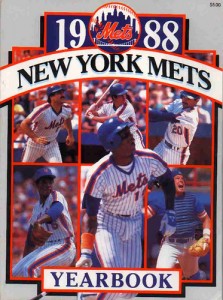 Set your DVRs or just get yourself glued to SNY Friday night at 7:00 for the debut of Mets Yearbook: 1988, the latest installment of the best series on television and the latest one we’ll see in chronological terms. Get ready to revisit the powerhouse Mets who were going to reign for years to come: the 1986 stalwarts plus David Cone, Gregg Jefferies, Dave Magadan, Randy Myers and Kevin McReynolds all in full bloom. I watched this highlight film on VHS about twenty years ago (rented it from a Palmer Video) and by the early ’90s it was already making me nostalgic for the dynasty that never was. Set your DVRs or just get yourself glued to SNY Friday night at 7:00 for the debut of Mets Yearbook: 1988, the latest installment of the best series on television and the latest one we’ll see in chronological terms. Get ready to revisit the powerhouse Mets who were going to reign for years to come: the 1986 stalwarts plus David Cone, Gregg Jefferies, Dave Magadan, Randy Myers and Kevin McReynolds all in full bloom. I watched this highlight film on VHS about twenty years ago (rented it from a Palmer Video) and by the early ’90s it was already making me nostalgic for the dynasty that never was.
Recently, Bronx Banter ran an eerie series on how the Mets could have been a juggernaut for all time across the ’70s and then some. It was fanciful, but not totally, given that it was based on things the Mets could have done, like draft Reggie Jackson, and didn’t have to do, like not trade Amos Otis and Nolan Ryan. (Read it in three parts here, here and here.) The other night I was watching yet another airing of the 1988 division clincher, and I gotta tell ya, there was nothing fanciful about the concept of a Met dynasty. We were about to wrap up the East, the Dodgers would be easy pickings and then the foreseeable future would fall at our feet. How could it not? Strawberry, Gooden, Darling, McDowell, HoJo, Dykstra, Mookie plus all those aforementioned young fellows. Yes, it was going to be great.
Now that you’re all uplifted, make a note to watch Mets Yearbook: 1988 anyway. And don’t forget ALL TEN episodes, spanning 1963 through 1988, will run on SNY on Memorial Day, beginning at 4:30 PM. If you don’t have a DVR, buy one now.
Image courtesy of “Mario Mendoza…HOF lock” at Baseball-Fever.
by Greg Prince on 27 May 2010 2:46 pm 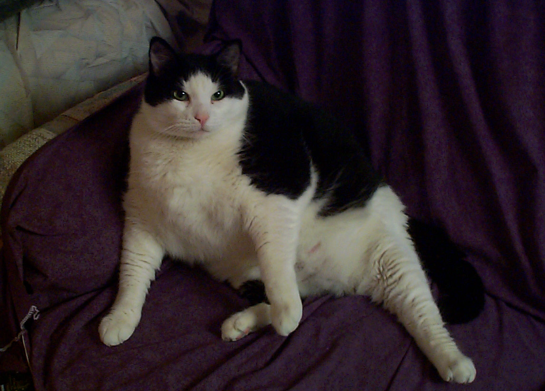
Today is five years since Bernie the Cat was last with us. Right about now, if he were still stationed on the couch, this would be the look from him. It would be easily translated as, “You got me up for this? For four consecutive wins? For Dickey and Takahashi? Wake me when we’re at least in the lead for the Wild Card. And put out some Fancy Feast for when I wake up for real. Never mind. I’ll have some now.”
Typical Bernie, never too high, never too low. But he was always as good as he looked when we were winning and looked better than anything when we weren’t. Bernie was good all over, regardless of the Mets’ performance in a given week or season. He was even good about all those naps of his I interrupted for Mike Piazza home runs, Rey Ordoñez catches and Al Leiter strikeouts. He came along when Doc Gooden was still the ace of the staff and hung in to the early days of Pedro Martinez. Bernie saw the Mets finish last and Bernie saw the Mets finish the World Series. Bernie saw plenty. He saw plenty, he ate plenty and he napped plenty.
Bernie, more than any soul I’ve ever known, had it goin’ on.
Today is five years since Bernie. This, my friends, is what a first-ballot Hall of Famer looks like.
by Jason Fry on 27 May 2010 9:59 am So perhaps I’ve been unfair, and the Mets had a Plan B for their starting pitching all along: “If, somehow, John Maine’s chronic injuries don’t disappear and Oliver Perez doesn’t stop pitching like Oliver Perez, we’ll just substitute a knuckleballer who’s a dead ringer for the Cowardly Lion and a 35-year-old who had a good but not great career in Japan. OK, we’re done here — wait, Beltran did WHAT?”
At least for 48 hours, Plan B has gone swimmingly.
I first really appreciated Hisanori Takahashi watching him battle Javier Vazquez to a standstill: He’s a done-with-mirrors location/finesse type, which doesn’t give you enormous hope for the future — every discussion of those guys begins with Greg Maddux with a local detour to Rick Reed, but ignores how few of those guys get Greg Maddux/Rick Reed results. Still, guys in that mode are enormous fun to watch when they’re on and showing you how pitching is supposed to be done — changing speeds here, putting the ball there, and either being one step ahead of the guy with the stick or having been so consistent about being one step ahead of the guy with the stick that he guesses what’s coming but still can’t hit it solidly. I wonder how long that double hesitation in Takahashi’s delivery — the tiny pause at the top of the windup and the freeze frame with one leg high — will keep scrambling hitters’ timing, but even when it becomes familiar he’ll know what he’s doing out there. I wonder if Oliver Perez has ever been able to say that.
Unintentional bringdown note from ESPN New York’s Adam Rubin: “Takahashi became the first Mets pitcher since Grover Powell in 1963 to allow no runs in either of his first two major league starts.” Who was Grover Powell? Not someone whose career path Takahashi would be advised to emulate. Powell was a Penn econ major who got thrown off the baseball team, agreed to sign with the Mets for $8,000, saw his bonus cut to $2,500 and signed anyway. (Wonder if they covered that at Wharton.) He was called up in 1963, beat the Phillies in his first start (wearing No. 41) and had logged four scoreless innings in his second when Donn Clendenon smashed a line drive off his cheek. He retired shy of 50 innings pitched and that first win was his last. In 1985 Powell drove to the hospital after his son was in a near-fatal crash, wound up seeing a doctor himself, was diagnosed with leukemia and died the same year. His tombstone bears an image of his baseball card — the only one he ever had.
But for now, let’s not worry about what might befall Hisanori Takahashi in 2032. In fact, let’s not worry at all. I’ve done plenty of that about the 2010 Mets, just as I’ve done a bit of pinching myself and thinking they’ll turn out just fine despite their various flaws. Either way, every time I find that I’m a lagging indicator: The Mets have either looked unbeatable or hapless, which is one way to be average but puts a lot more mileage on stressed-out fans than repeatedly winning one and losing one. Is the current run of good starting pitching a fluke, or guys who figured out how to pitch getting a chance to prove it? Are the statistical cylinders lining up favorably at the moment, or has Jason Bay relaxed and Jose Reyes returned and Angel Pagan matured — which might give David Wright the peace of mind to ease up on himself? Have the Mets caught the Phils and Yanks in a lull, or found a formula that should work for a while? Who knows. Tell me when to tune in and I’ll hope for the best.
And maybe I’ll even see some of it. Last night I put Joshua to bed with my eyelids already trying to stay above half-mast and trudged upstairs to the couch. I fell in and out of dozing, but sat bolt upright when I saw it was the sixth and the Phils had runners on first and third with one out and Ryan Howard at the plate. Takahashi sliced away at the strike zone and erased Howard on an evil low-and-away changeup. I sank back into the couch, but struggled up to one elbow as Jayson Werth and his ridiculous facial hair arrived. Werth promptly hit Takahashi’s first pitch to the moon, but he was too early, so more accurate to say his drive went harmlessly left of the moon. Takahashi, chastened, went back to work, got Werth to hit a harmless fly to Jeff Francoeur, and I let my eyes close. It was only 2-0, but something told me it would be OK, and it was.
by Greg Prince on 26 May 2010 1:14 am When the Mets score eight to win by eight and give me my personal-record eighth victory in a row, you know what that means?
I don’t know. But it sure feels good. I’ll take serene eights over the crazy kind any day.
When last we saw the Phillies in New York, they were no help whatsoever, ich bin eining us against each other en route to shoving us into yet another November of discontent. And the last time we saw them in our neck of the woods, we were subject to those saddest of possible words: Bruntlett to Bruntlett to Bruntlett.
Feh on 2009. Everything sucked then. Everything’s great now. Great may sound like an overstatement for a team that just reached .500 for the first time in ten games, but I’m going with the feel, and there’s a feel in the air that it’s fun to be a Mets fan until it isn’t. That moment could come any second, so let’s just let it be.
Hey, has it really been only ten games since we owned as many wins as losses? Is that all? Seems like we were buried about a hundred below and a thousand out as recently as the last road trip, but you inject an R.A. Dickey into your life, everything looks better. The whole year looks better. Goodness knows the rotation has a certain spin only an effective knuckleballer can put on it.
This is no average knuckleballer, this R.A. Dickey. This guy is fearless. We know he’s ligamentless. We know he doesn’t mind sacrificing a non-pitching elbow as necessary, per Ryan Howard’s hot liner that never saw the outfield. That may be the best sacrifice executed under the auspices of Jerry Manuel since Spring Training.
Do we have problems? No, not tonight, not after a rousing 8-0 win when the weather was perfect, the Blue Point Toasted Lager was sublime and my wife made another unlikely Tuesday appearance at Citi Field (we were there along with dozens of her colleagues…best workplace outing ever). There were Phillies fans in attendance, but the Fightin’ was sapped out of them early and nobody sitting anywhere near us in red could even work up a good vomit.
And how about that Raul Valdes? Not to jump around, but that guy is to relieving what R.A. Dickey is to starting, which is to say excellent. Wayne Hagin mentioned something about 16 starts between John Maine and Oliver Perez and one win registered by the two of them. Well, nine innings Tuesday night between R.A. Dickey and Raul Valdes and the Phillies still haven’t scored. And I still haven’t lost, as a spectator, since the grim late afternoon reaping of Willie Harris. That seems longer than 6½ weeks ago.
Eight in a row. I’ve never been in on eight wins in a row in my life, a life which now spans 461 games and two home ballparks. I’ve gotten comfy at Citi Field. Maybe it’s the Blue Point Toasted Lager, available only from the Catch of the Day stand (all Met dingers, not that we seem to generate them all that often, need henceforth be known as Blue Point Blasts). Maybe it’s that Stephanie, who likes a good walk the way Oliver Perez can create a bad one, has room to roam. “You want me to get you that Blue Point?” she asked as she and one of her social worker friends got up to amble a middle inning away.
Why yes, I would like that very much.
Sure enough, my wife came back with the beer (a phrase I’ve never written, said or thought in my generally temperate life), I flagged down a pretzel vendor and the rest was a Met run here, a Met run there, the Phillies and their unwelcome battalion of would-be vomiters left scoreless and silent. Let ’em choke on our eight runs, our thirteen hits, our delicious Long Island microbrew and our pitchers nobody was counting on when the season began. Let the Mets continue to peck away in Build-A-Run Workshop fashion at opposing pitchers whose careers began when Reagan was president, the first Cuomo was governor, Koch was mayor and our first baseman wasn’t quite yet an embryo. Let Darryl Strawberry, who always hustled and never dogged it (ahem), preach the Strawberry Way anytime, anywhere, to any current Met he likes. Let Frankie Rodriguez remind Randy Niemann which ’86 Met did the least and celebrated the most. Let John Maine deny his pitching arm is a problem except when he tries to pitch.
The Mets have just taken three straight from last year’s World Series. The Mets have just given me eight consecutive in-person wins. The Mets have Blue Point Toasted Lager. The Mets have R.A. Dickey. The Mets have Raul Valdes. The Mets have it goin’ on at least until the next torrent of sniping, aching and whatever usually goes wrong with them.
Let it be.
|
|