The blog for Mets fans
who like to read
ABOUT US

Faith and Fear in Flushing made its debut on Feb. 16, 2005, the brainchild of two longtime friends and lifelong Met fans.
Greg Prince discovered the Mets when he was 6, during the magical summer of 1969. He is a Long Island-based writer, editor and communications consultant. Contact him here.
Jason Fry is a Brooklyn writer whose first memories include his mom leaping up and down cheering for Rusty Staub. Check out his other writing here.
Got something to say? Leave a comment, or email us at faithandfear@gmail.com. (Sorry, but we have no interest in ads, sponsored content or guest posts.)
Need our RSS feed? It's here.
Visit our Facebook page, or drop by the personal pages for Greg and Jason.
Or follow us on Twitter: Here's Greg, and here's Jason.
|
by Greg Prince on 12 May 2010 10:48 pm That was a brutal way to lose a baseball game. I’m referring to Wednesday afternoon against Roger Bernadina and the Nationals, though I could be referring to Monday night against the Nationals, Sunday afternoon against the Giants, last Wednesday against the Reds or last Monday against the Reds. Actually, the same could apply to the previous Sunday night and Saturday afternoon against the Phillies. Those two were blowouts and not nailbiters, but brutal is brutal.
That means we’ve experienced seven defeats in our last eleven games. Within that time frame, we’ve also enjoyed four exhilarating wins, each of them attained in the last inning the Mets batted — the ninth against the Reds, the ninth against the Giants, the eleventh against the Giants and the eighth against the Nats. There has been glory interspersed with the brutality, but it’s been more brutal than glorious these last eleven games.
And before that? Practically uninterrupted glory. That was when, if you can remember back that far, we were all but unbeatable. We won two games against the Cubs pretty easily, then absorbed a loss, then reeled off eight only partially contested wins versus Chicago, Atlanta and Los Angeles. Those were the days and nights of the 9-1 homestand, topped off by our first game at Philadelphia. That added up to 10-1, a solid shield that has protected us to a certain extent against the harmful effects of the 4-7 stretch that has followed.
You didn’t think we’d ten of every eleven for five months now, did you? No, you didn’t think that. Maybe you didn’t know what to think of your Metsies when they surged from a hopeless 4-8 to a triumphant 14-9. Most of that was the now legendary 9-1 homestand, which we were told a few dozen times was unmatched in Mets history, save for 1969 and 1988. In both of those seasons, we were National League East champs, winning 100 games on the nose.
We wouldn’t mind locking that in as precedent, eh?
I don’t know that there was anything specifically magical about playing a homestand of exactly ten games and winning nine of them. It was uplifting as hell, of course, but the Mets play homestands of various lengths across a given season. They also play spans of ten games that take place partly at home and partly on the road. Sometimes they’re all road games. There was probably more to going 9-1 at home two weeks ago than simply matching a rather incidental record.
I did a little checking and found that Mets had played ten or more consecutive games on 38 discrete occasions in the life of the franchise without losing more than once. I was curious to see if there was a pattern to going 9-1 or better vis-à-vis the seasons in when the Mets did it. We knew about the 9-1 homestands of ’69 and ’88 and that those seasons begat postseasons. But do 9-1 stretches necessarily mean playoffs?
No, but they sure do help.
It’s not so much that you’re a good team because you go 9-1 a lot; you go 9-1 a lot because you’re a good team. Good teams tend to win much more often than they lose, you might have heard. That’s probably why the Mets, notorious for not being good prior to 1969, never enjoyed a 9-1 stretch before 1969. In 1969, however, they went, at various intervals, 11-0, 12-1, 13-1 and 9-1. That right there is 45-3. That’s quite a leg up on going 100-62, which was the final regular-season record of 1969.
A similarly delightful situation arose and kept arising through 1986. There was the 18-1 run that defined April and May, a pair of 9-1 stretches in June and July, an 11-1 to wind down August and another 9-1 to finish off the schedule. The Mets went 56-5 in five distinct periods that constituted almost 38% of their season. Breathtaking, ain’t it? Maybe even more remarkable is that when they weren’t at their absolute hottest — a.k.a. the rest of the season — there were still a winning club, posting a record of 52-49 to finish 108-54.
If you’re curious to know just how good our two world championship clubs were, this provides you with some evidence. They were both about as outstanding a baseball team could be.
We remember 1988 today for its shortcomings in the NLCS, but the business about 9-1 homestands remind us that was a sensational team, too. Those Mets went 10-1 between April 26 and May 8. Come September, they’d overlap a couple of similar stretches, 13-1 and 11-1, equaling a 16-2 mark at one point. The Mets were hot early and scorching late.
The 2000 Mets maintained similar stretches of momentum. They were 11-1 at one point in April, 9-1 at the end of June and the beginning of July and 10-1 about a month after that. Quietly and efficiently, the Mets banked a 30-3 mark, which helps explain why their 2000 Wild Card was achieved without the terrible angst we tend to associate with the ends of Mets seasons. In more recent memory, the 2006 Mets made their bones on a 9-1 run in April, a 9-1 road trip in June and an 11-1 victory lap in August. The rest of the year, which varied from fine to dandy, was essentially gravy.
Win a lot of games at once often is an almost foolproof formula for making the playoffs. Do it a little less often and you’re on your own. The 2008 Mets had a 10-1 and a 10-0 but they still fell a game shy. The 2007 Mets, it’s easy to forget (if you can forget 2007), went 9-1 between August 31 and September 10. They split their next two and then, all too memorably, lost twelve of seventeen. Thud!
The 1999 Mets went 9-1 once and barely made the playoffs. The 1998 Mets went 11-1 once and just missed the playoffs. From June 12 to July 6, 1990, the Mets ran off overlapping 16-1 and 15-1 skeins, adding up to an imposing 20-2 stretch. The rest of the year, however, they were just a wisp over .500. They finished a wisp behind the Pirates for first.
Two other Mets teams put up a pair of non-overlapping 9-1 or better stretches without getting postseason bang for their buck. In 1985 there was a 13-1 record and a 12-1 record a few weeks apart. In those pre-Wild Card days, it wasn’t enough. In 1976, the Mets enjoyed two 9-1s; they weren’t nearly enough. Four years earlier, the 14-1 sunburst of May 1972 was completely obscured by a barrage of injuries and resulting mediocrity.
If you’re looking for some reasonably encouraging sign, it may be that if a Mets team wins nine of ten at some point, it’s probably going to give us a minimally good show. The only Mets teams that posted a stretch of ten or more games with no more than one loss and didn’t enjoy a winning record for the season were the 1974 Mets and the 1991 Mets. The ’74 edition was dead and buried when it unspooled its 10-1 in late August. The ’91ers seemed to be gathering steam when they won ten in a row in the first half of July. Alas, it was just a prelude to disaster.
Otherwise, in sixteen of the eighteen seasons in question prior to this one, you at least get a team that finishes over .500. You may not get a pennant or even a pennant race, but after 2009 (when there was no 9-1) and after the beginning of 2010 (when we were 4-8), I personally would be pretty happy to maintain a few threads of hope and feel there’s a chance for success well into summer.
In that sense, it’s already a pretty good season. But you know the old adage: you have to take baseball eleven games at a time.
***
Here is the entire list of discrete stretches when the Mets played at least ten games and lost no more than once. I also threw in some home record data in deference to the 9-1 homestand that helped inspire this train of thought.
We’re using stretches here where momentum was at its peak, leaving out overlapping duplicates (taking the last nine wins of a ten-game winning streak and slapping on the loss that follows, for example). All stretches began with a win.
• 10-1 from April 19 to April 30, 2010, encompassing a 9-1 homestand.
• 10-1 from August 12 to August 22, 2008 encompassing 4 consecutive home wins.
• 10-0 from July 5 to July 17, 2008, encompassing a 6-0 homestand.
• 9-1 from August 31 to September 10, 2007, encompassing 4 consecutive home wins.
• 11-1 from August 17 to August 30, 2006, encompassing an 8-1 homestand.
• 9-1 from June 5 to June 15, 2006, all on the road.
• 9-1 from April 6 to April 17, 2006, encompassing 6 non-consecutive home wins.
• 11-1 from September 3 to September 22, 2001, encompassing 2 consecutive home wins.
• 10-1 from August 29 to September 8, 2001, encompassing 4 consecutive home wins.
(All relevant overlapping considered, the Mets went 15-2 from August 29 to September 22, 2001, encompassing a home record of 6-1.)
• 10-1 from July 25 to August 5, 2000, encompassing an 8-1 homestand.
• 9-1 from June 22 to July 1, 2000, all wins at home (part of a 9-4 homestand).
• 11-1 from April 13 to April 25, 2000, encompassing 8 consecutive home wins.
• 9-1 from June 15 to June 25, 1999, encompassing a 3-0 homestand.
• 11-1 from May 19 to May 31, 1998, encompassing a 6-1 homestand.
• 10-0 from July 1 to July 13, 1991, encompassing 3 consecutive home wins.
• 16-1 from June 17 to July 6, 1990, encompassing homestands of 5-0 and 5-1.
• 15-1 from June 12 to June 29, 1990, encompassing 7 non-consecutive home wins, including a 5-0 homestand.
(All relevant overlapping considered, the Mets went 20-2 from June 12 to July 6, 1990, encompassing a home record of 11-1.)
• 11-1 from September 14 to September 26, 1988, encompassing 8 consecutive home wins.
• 13-1 from September 8 to September 22, 1988, encompassing a 9-1 homestand.
(All relevant overlapping considered, the Mets went 16-2 from September 8 to September 26, 1988, encompassing a home record of 9-1.)
• 10-1 from April 26 to May 8, 1988, encompassing 5 consecutive home wins.
• 10-1 from July 28 to August 7, 1987, encompassing 5 consecutive home wins.
• 9-1 from September 25 to October 5, 1986, encompassing 3 consecutive home wins.
• 11-1 from August 17 to August 30, 1986, encompassing 3 home wins.
• 9-1 from June 25 to July 6, 1986, encompassing 4 home wins.
• 9-1 from June 6 to June 16, 1986, encompassing a 6-1 homestand.
• 18-1 from April 18 to May 10, 1986, encompassing 10 home wins.
• 12-1 from July 29 to August 13, 1985, encompassing 8 home wins.
• 13-1 from July 2 to July 18, 1985, encompassing 3 home wins.
• 12-1 from July 1 to July 14, 1984, encompassing 9 home wins.
• 9-1 from June 23 to July 4, 1976, encompassing 6 consecutive home wins.
• 9-1 from April 24 to May 4, 1976, encompassing a home record of 7-1.
• 10-1 from August 25 to September 4, 1974, encompassing a 6-1 homestand.
• 14-1 from May 7 to May 21, 1972, encompassing a home record of 10-1.
• 9-1 from September 21 to October 1, 1969, encompassing 5 consecutive home wins.
• 13-1 from September 6 to September 18, 1969, encompassing 7 consecutive home wins.
• 12-1 from August 16 to August 27, 1969, encompassing a 9-1 homestand.
• 11-0 from May 28 to June 10, 1969, encompassing 7 consecutive home wins.
Thanks to my compatriots at the Crane Pool Forum for facilitating the thought process on this topic.
***
Speaking of trains of thought, AMAZIN’ TUESDAY makes its Grand Central Terminal debut at the Two Boots in the Lower Dining Concourse. Read about our Mets reading series here.
by Greg Prince on 12 May 2010 11:23 am You think the Mets bringing in Rod Barajas, bringing up Ike Davis and blotting out Frank Catalanotto with Chris Carter were winning moves? Sure they were. But if this organization really wanted to do nothing but win, they would bring somebody else to the ballpark every single game.
They would bring me.
They want me on that wall. They need me on that wall. They need me somewhere within the walls of Citi Field whenever they play ball.
There is no need for me to be coy about this any longer: I Am Home Field Advantage. Believe in me, Mets. When I’m literally with you, you can do no wrong.
The Mets are 34-11 at the ballpark I didn’t particularly want built when I’m inside it. They’re 8-1 in 2010, including 7-for-7 since Willie Harris besmirched this season’s bid for perfection. They did well with me in attendance last year; they are all but impenetrable with me on hand this year.
Who do you think made this particular Tuesday as Amazin’ as it was? Barajas with his clutch double to the left field corner? Davis with his third tumbling dugout catch (which, unlike his cake-icing grand slam over the foul pole, counted)? Carter the Animal attacking bad luck charm Tyler Clippard in his first Met at-bat? Yeah, whatever.
It was me. I showed up, the Mets won. They needed six runs entering the eighth, but they were going to get them. They were going to get them because they were, eventually, going to pick up my vibe.
Took them longer than usual. For that, I apologize. I was hard to track down Tuesday night. I was all over the place. Perhaps they think I was hiding my vibe from them. I wasn’t. It was a special occasion — besides the six runs in the eighth, I mean.
On May 11, 1987, I was minding my own business, listening to WHN on my Walkman as Rick Aguilera began to lose it in Cincinnati. The Mets lost that Monday night, but I got on a winning streak that’s now at 23 years and counting. That was the night I met my future wife. Four nights later she met the Mets (our first date: Mets 8 Giants 3) and the three of us were off and running from there.
May 11 rolls around, we usually take note of it. These past few years, the Mets have made our anniversary a threesome. In 2007, we spent part of our day at the Met (close enough). In 2008, we double-dated with the Mets and Reds, echoing the same matchup that was in my ears in ’87 (with a better result). Last year, we revisited the neighborhood where we met, Lincoln Square, and giddily clicked pictures of the window at the Barnes & Noble on 66th and Broadway. I tried to imagine my 1987 self imagining this moment: married to the woman I’d just fallen for with my new book about the Mets on display for all to see. But I never had very much imagination about those sorts of things back then.
So May 11 rolls around again and, it happens, somebody offers to sell me, on a Value night, a pair of Field Level tickets for the Mets and Nationals. I probably wouldn’t have bit except I was thinking maybe Stephanie, who almost never wants to go on a weeknight and never ever wants to go when there’s the slightest chance of a chill in the air, would think it would be a fun anniversary outing.
I’ll be damned, she did. It helped that she’s on vacation this week and it helped just as much that she’s been exposed to the Mets for 23 years. The other night when Jeff Francoeur made a nice catch, she let out an unprecedented and enthusiastic “FRENCHY!”
Where the hell did that come from? Oh right, me.
Anyway, one of the selling points of these tickets, besides it being May 11, was that the Mets have widened access to their clubs this season. A Field Level seat means you can wander into the Promenade Club (unlikely that you would from downstairs), the Caesars Club (big whoop, unless it’s cold and/or raining) and the Acela Club.
Stephanie and I spent a memorable afternoon in the Acela Club last November, courtesy of Ryder Chasin upon his ascent to manhood, but I’d never been in there during the actual baseball season. Several times in 2009 I sat on either side of it, not exactly dying to get in but a little curious as to what the fuss was about, or whether there was fuss. For the prices they charge, there ought to be. For the prices they charge, I was never planning on finding out.
But this was going to be May 11. On May 11, we do things we might not otherwise do. Yesterday, I did something I can’t remember having done in at least fifteen years: I made a reservation for dinner. As long as our microwave is working, the only reservation I have regarding dinner is wondering how many preservatives are safe for human consumption. But May 11 is our Night We Met anniversary. This May 11 would present us with the chance to dine finely while overlooking a baseball game.
Couldn’t not do it. And when I called for the reservation and was asked if I wanted a windowside table, I couldn’t not say yes. Oh, there’s a surcharge per person, I was told. Good information to have, but it was too late. Of course I wanted the window. What’s the point of the Acela Club if I can’t see the ballpark? If the rest of the ballpark can’t see me?
We showed up, per our reservation, at 6:45. Somebody with a clipboard greeted us and asked us nicely to show a ticket to prove we were allowed up here, lest we be denied the privilege of willingly forking over beaucoup bucks. We had our ticket. And we forked.
You walk into Acela with your reservation, you’re sent to the front desk. The front desk confirms you, and you are passed along to somebody else with a headset. There’s an army of people in headsets throughout the Acela Club. The Acela Club’s aura is less gracious living than military precision. They are going to get you to that table if it’s the last thing they do.
Correction: The last thing they do is present you with your check. The surcharge is on there. So is everything else. It’s not a cheap night out (never mind that you already bought Field Level tickets so you could be up here). But it’s May 11, so you rationalize your head off. Well, we don’t this very often. Well, I never ate at the Diamond Club. Well, we can buy groceries next week.
Is it worth it? I decided it would be, so it was. Your prix fixe dinner entitles you to unlimited access to a super salad bar (it’s called the Market Table and it’s very generous in its offerings, but really its spiritual ancestor is the Ponderosa) plus a serious entree. Stephanie ordered the swordfish. I went with the lemon chicken. Neither one of us was going hungry. The whole thing was very good and very filling. The service was very courteous and our waitress was extremely friendly, particularly when we mentioned it was our Night We Met anniversary. The field spread out below us. The windows were sealed shut in deference to the gametime temperature of 52 degrees, so we felt rather removed from the action, but the action was there to be taken in from a distance.
The only problem was that dinner was served with an Adam Dunn three-run homer, so that can kill an appetite. (Only kidding — when you’re paying the Acela Club prix, your appetite will remain robust for the duration.) The night was developing as a lovely detour into heretofore untrod territory and, oh by the way, the Mets were going to lose. They were down 3-0, Niese was struggling, let’s try the carrot cake (prix fixe does not include dessert, but Night We Met anniversaries must).
Consumed by the Acela experience, I didn’t realize why the Mets were losing. They were losing because they didn’t think to peer through the window to see me. Remember, I’m the key. If I’m there, they win, but I guess they have to know that I’m there. After three innings, we took our Field Level seats. The Mets apparently didn’t know I was there either. That had to be why Niese got knocked out and Acosta got touched up and the score was 6-1 by the middle of the fifth.
Then it began to rain. Barely, but rain is rain. Me, I sit in light rain at ballgames. I sit — and stand — through gale-force winds. It’s what I do. But Stephanie…not so much. First sign of rain reminded her of why night games before Memorial Day aren’t her cup of tea. It was quite obviously time to take advantage of that Caesars Club access.
This is where all those headsets came into play. They weren’t just for seating Acela Club customers. They were to get the word out to the Mets that I was in the house — me and my winning vibe. They couldn’t confirm it until Stephanie and I settled at a table in the Caesars Club (which should be called the Seavers Club or, better yet, the 41 Club). The headsets went to work; somebody tipped off somebody; somebody else let the dugout know it was safe to start hitting and start winning. I’m pretty sure I saw Jerry Manuel wink at me through one of the TVs over the Caesars bar.
At first, per usual, it was kind of lame in there, with nobody besides us seeming to pay much attention to HD heaven. But then, in the eighth, when the game got intensely interesting, suddenly everybody was watching the Mets at the Mets game. Caesars went from being the place you take your wife to get out of the rain to one of the better Citi Field crowds I’ve ever been in. Sure, it was a little bro-ey in there, but what the hell? The Mets were loading and clearing bases with spectacular alacrity. It deserved the bro treatment. Let us all bump fists like the Romans did! A deep chant of RE-PLAY! went up for Ike’s ghost slam, which charmed Stephanie. She was also amused by Howie Rose’s kvetching about Milwaukee, which she heard in the ladies room prior to the six-run outburst. I love that they pipe play-by-play into the men’s room. It never occurred to me they do the same next door.
Stephanie’s been listening to Howie and Wayne a little bit lately. She’ll get ready for bed in the late innings. The bathroom radio is sometimes tuned to the FAN and she simply doesn’t change it. Or maybe she changes it to the FAN so she can follow along while she brushes her teeth. When did that start happening?
Oh right, 23 years ago.
Everybody’s vibe was perfectly synced as we headed to the ninth. The rain had dissipated and a cup of hot chocolaty water had fortified my bride enough so that we could head back outside to watch Frankie maybe hold a two-run lead. Having gained access to the almighty Excelsior level, we grabbed two of the many empty seats behind first base and watched Ike sacrifice his body to the greater good one more time. In the Mets’ dugout, Ike was grabbing the last out and six Mets were grabbing Ike. In the Citi Field rest rooms, Howie was putting it in the books. On the anniversary of the night we met, we — the Mets and me, Stephanie and me, Stephanie and the Mets — all kept our intertwined winning streaks intact.
The Acela Club was fine, and I enjoyed my introduction to Chris Carter, but what I’m really a big fan of is May 11.
Next Tuesday will definitely be Amazin’, as AMAZIN’ TUESDAY makes its Grand Central Terminal debut at the Two Boots in the Lower Dining Concourse. Read about our Mets reading series here.
by Jason Fry on 12 May 2010 1:07 am Even fans of juggernauts endure a fair number of four-run deficits in the eighth, as games that haven’t felt particularly close trudge to a merciful conclusion. Being a baseball fan means putting up with God knows how many such affairs — lousy, irritating games that you stick with because bad baseball is ever so slightly better than the absence of baseball, after which you forget them as quickly as possible.
Most of last night’s game followed this dreary template: Jonathon Niese was wild and thoroughly unimpressive, beginning his night by serving up a meatball to Adam Dunn and ending it by watching Manny Acosta further drive up his ERA. The Met hitters, for their part, were specializing in hitting into double plays. Occasionally they looked frustrated or peeved; most of the time they looked as listless as the sparse, chilly crowd muttering amid the sea of forest-green seats.
If you were at the game and stayed, I applaud you. If you were at the game and left, I don’t blame you. I heard the whole thing, but I’m not patting myself on the back too heartily: I spent most of the second half sitting at my desk writing, ever so often registering via Howie and Wayne that the Mets had done something else that would have annoyed me thoroughly had I still been in front of the TV, a level of commitment the Mets clearly didn’t deserve.
But then there were interested voices behind me. It was late, but Scott Olsen was out of the game, and the Mets were showing fitful signs of life.
Now, I feel it’s my duty to make something very clear for any newly minted Mets fans who’s happened by these parts.
Most of the time, teams that fall behind 3-0 and then deepen that hole to 6-1 don’t come back.
Most of the time, ekeing your way back to 6-2 is as close as you come to a moral victory. Which isn’t very close.
Most of the time, deciding to change the channel or turn off the TV isn’t punished.
Wishing for it to be otherwise is the sign of a good heart, and believing it will be otherwise reflects admirable loyalty. But most of the time, these praiseworthy traits yield no reward — unless you count watching hours and hours and hours of dull, dispiriting baseball as a reward. (In the middle of the winter you’ll think it would totally count. This only proves that the middle of the winter is no time for perspective.)
But every once in a while, something different happens. One hit turns into another, there are walks and errors and goofiness and the world turned upside down.
Every once in a while Jason Bay singles and David Wright doubles and Ike Davis is safe on an error and there’s an out but no big deal because Rod Barajas doubles and you laugh at Josh Willingham’s imitation of a left fielder and realize you’re within one somehow and turn on the lousy little TV by the treadmill but then think there’s luck in the radio and scurry back to your desk to not screw up that luck and then Alex Cora bunts but it’s a single so Cora is brilliant and the TV is about five seconds behind the radio so you have time to hear that something good has happened and rush to the TV and then Chris Carter is up for his Mets debut and now it’s like you have springs in your behind because you’re so eager to rush to the TV for another highlight and the Animal equals five weeks of the jettisoned Frank Catalanotto with one swing and holy cow we’re up by one and there’s a pitching change and Jose Reyes is walked and Jason Bay walks for an insurance run and there’s another out and then Ike Davis HITS A FUCKING GRAND SLAM rats hits a really deep foul ball and then flies out but oh my goodness it’s Mets 8, Nationals 6.
And then, if you’re really lucky, Ike will end a 1-2-3 ninth inning with his third Spider-Man catch over the dugout rail, capping just about the best night a rookie can have while going 0 for 5 with runners in scoring position, and Frankie Rodriguez will laugh and the Mets will high-five and you’ll imagine that you all might actually be able to walk on water right now. (Just in case, don’t try it.)
When that every once in a while comes around, it’s pretty fun. You’ll flip around for the highlights and listen to the entire postgame show and the normally insipid callers and periodically giggle and high-five imaginary people.
And then the memory of that game will keep you watching for the next 160 to 180 hours of baseball in which every once in a while doesn’t happen.
by Greg Prince on 11 May 2010 3:58 pm AMAZIN’ TUESDAY is pulling into a new location! It’s headed to one of New York’s most revered landmarks and one of my favorite places anywhere
On May 18 at 7:00 PM, we will reconvene the rookie sensation of 2009 (and Spring Training 2010) at Two Boots Grand Central, located in the lower dining concourse of the world’s most famous train station, Grand Central Terminal. The move was necessitated by the closing of Two Boots’ Lower East Side location (a moment of silence…), but owner Phil Hartman wanted, like we do, to keep our Mets reading ‘n’ rallying program on track.
What better place to do it than Grand Central, renowned icon of Beaux Arts architecture and the third stop on the 7 to Mets-Willets Point? Phil has his restaurant there, and the spirit as well as the reality of AMAZIN’ TUESDAY will live on adjacent to the 7:48 to Darien. Two Boots Grand Central includes a wall of Mets memorabilia, the Mets on the big screen taking on the Braves at Turner Field, Mets-themed culinary offerings and the popular exchange of one beer for one Mets baseball card per customer.
To do the location its just and inaugural due, Jon Springer of Mets By The Numbers and I are proud to bring you two very special guests: Taryn Cooper (a.k.a. Coop) of Metsopotamian favorite My Summer Family and Josh Wilker of Cardboard Gods, the beloved blog that is now a highly praised book. They, along with Jon, me and hopefully you will engage in some delectable baseball talk to go with Two Boots’ excellent pizza and such.
Feel free to admire Grand Central on the way in — and ignore those Yankees fans headed to Westchester.
Two Boots Grand Central is in the Lower Dining Concourse of Grand Central Terminal, 42nd Street and Park Avenue, accessible via Metro-North as well as the 4, 5, 6, Times Square Shuttle and, of course, the 7 trains. Phone: 212/557-7992.
by Jason Fry on 11 May 2010 12:18 am …Dave Howard can spin anything.
Here’s the master, talking about the trash seen piling up on the field at various points in recent days: “It’s sort of good now that there is debris to be blown out there. It shows people are spending some money and buying food and drink and enjoying themselves.”
Truly, Dave Howard’s talents are wasted on the Mets. He ought to be tackling larger issues in need of a honey-tongued makeover. Like global warming (“the majesty of hurricanes is sort of good to witness, particularly for people who don’t normally get to see them thanks to old-fashioned weather patterns”), AIDS (“anything that allows us to display our compassion for others is sort of good, even if it involves dying”) or civil wars in Africa (“it’s sort of good those kids are learning to shoot straight and develop bonds outside the family, now that their family members have been executed by drug-crazed rebels”).
Happily, Dave continues to employ his talents closer to home, where we can enjoy them and have our lives be bettered by them. We are truly blessed.
Seriously — Dave, I’m sure you love the Mets. I’ll assume you’re good at your job. But every time you talk to a member of the media, you make the Mets look smarmy and pathetic.
Please stop doing that.
by Greg Prince on 10 May 2010 12:09 pm [T]his appreciation for diverse views may also come in handy as a diehard Mets fan serving alongside her new colleague-to-be, Yankees fan Justice Sotomayor — who I believe has ordered a pinstripe robe for the occasion.
—President Barack Obama, May 10, 2010
Elena Kagan has been nominated to serve as the next Associate Justice of the Supreme Court of the United States. And Elena Kagan is a Mets fan.
Let’s be nonpartisan about this. Let’s celebrate that the president’s choice to be one of nine members of the highest court in the land has already shown Amazin’ judgment. Let’s hope that if confirmed she disbars Paul Schrieber from ever umpiring again.
Can Supreme Court justices do that? She’s a Mets fan whose robe will definitely not be pinstriped. It will be Mets black, with blue and orange undertones. Constitutional parameters notwithstanding, she can do what she wants.
Bill Clinton came to Shea Stadium to retire Jackie Robinson’s number. He kept coming to coming games after he left office. The George Bushes were related to one of the Mets’ original directors, G. Herbert Walker. The first George Bush threw out of the first ball of the 1985 season to Gary Carter. The second George Bush appeared on the Shea Goodbye DVD recalling attending Spring Training at St. Pete with Uncle Herbie in 1962.
This is nonpartisan. This is about the Mets being a part of the lives of the last three presidents. Now a fourth has done more than go to a game. He’s got a Mets fan potentially making nation-altering decisions. She’s already decided to be a Mets fan, which is pretty good. We as a nation can take our chances from there.
Barack Obama is a White Sox fan. He graduated from Columbia University in 1983. I’m reading a biography of him right now that fails to include an anecdote about how, as a senior, he and a friend decided to break the tension of studying for finals by hopping on the 1 downtown to the 7 at Times Square and heading to Shea Stadium to see Tom Seaver early in his second go-round as a Met, not on Opening Day, but on a chilly April night when there were only 4,000 people in attendance. It’s not included, I’m guessing, because it never happened, but I’d like to think it did.
“It was a makeup doubleheader,” the president recalls in my fantasy passage. “Tickets were cheap, which was good, because we didn’t have much money, being students and all. Yet nobody minded that we sat in those orange seats that were always empty on TV. We could only stay for a little of the second game — had to get back to the apartment to study.” Obama, in my dream bio, would then go on to mention how he met Seaver at a White Sox alumni function when he was an Illinois state senator and how Seaver remembered tripling that night more than he remembered pitching a shutout. Then, turning serious, Obama recalls the perfect form form for which Tom Seaver was known (“I used to watch him on the game of the week in Hawaii and I loved how he used his legs”) and how he adapted late in his career when he didn’t have his fastball, and how we, as Americans, can take a lesson from that.
Barack Obama never said any of that. Never went to a Mets game while attending Columbia as far as I know. Too bad. All presidents should go to Mets games. If Ronald Reagan were still alive, he could urge Jeff Wilpon to tear down that wall in left. If Franklin Roosevelt managed the Mets, we’d have nothing to fear from seeing Gary Matthews and Frank Catalanotto soak up at-bats because he would institute a New Deal and trade them both. If William Henry Harrison had managed the Mets…oh wait, he did — reincarnated as Salty Parker (and again as Mike Cubbage).
Republicans, Democrats, Whigs, whoever. Now is the time for all good Mets to come to the aid of their country. And vice-versa.
A Supreme Court justice may be a better fit for the Mets than a president. The Mets exist mostly because of the brilliant mind of a lawyer named Bill Shea. Supreme Court justices are supposed to be shielded from the day-to-day nonsense of political bickering. We like to sit quietly in our chambers and contemplate the great issues of the day, like why is Oliver Perez still here? And let us not forget the note Justice Potter Stewart’s clerk delivered to him on October 10, 1973, one Stewart shared with Justice Harry Blackmun:
V.P. AGNEW JUST RESIGNED!!
METS 2 REDS 0.
The Mets would go on to win the game and the pennant. Spiro Agnew would be replaced by Gerald Ford, who would replace Richard Nixon. Nixon went to Mets games as he lived out his political exile in New Jersey. In July 1990, he told Larry King the Mets were going to the World Series: “The Mets will make it because of pitching.” Like Nixon versus Kennedy, the Mets finished second. Still, he did shake Tom Seaver’s hand at a reception for major league All-Stars in 1969.
“Oh,” Nixon greeted him, “you’re the young man who won for the Mets even when they were losing.”
A good Tom Seaver anecdote helps every president look good. Failing that, putting a Mets fan on the Supreme Court is a step in the right direction. Good luck to Elena Kagan, one of ours. If she’s confirmed by the Senate, and her gavel happens to slip and conk Sonia Sotomayor on her Yankee-lovin’ noggin during some future oral argument, well, let’s just chalk that up to a lack of pine tar on the handle.
by Jason Fry on 9 May 2010 10:27 pm By the late innings it was pretty clear that someone wasn’t going to win today’s game as much as they’d survive it. Oliver Perez was awful. Raul Valdes, admittedly asked to do something difficult, could not. Jenrry Mejia failed, as young men finding their way must. David Wright did nothing at the plate except scream at an umpire for his own recent shortcomings. And in the end, the fatal mistake wound up on the Mets’ side of the ledger. Which you had to admit was altogether fitting: The Giants were bad; the Mets were worse.
Well, not all the Giants were bad. Aaron Rowand hit one to the right place in the wind tunnel that was Citi Field at the right time. Brian Wilson correctly deduced that his catcher was the only person on the field he could trust to record a putout, and pitched accordingly. And earlier, before everything became the stuff of farce on both sides, there was Tim Lincecum.
There’s a pleasure in baseball when it’s played wisely and beautifully, and I’d argue even more pleasure in seeing someone play it who hasn’t been altered by the dead hand of baseball tradition. Like every other religion, baseball itself is beautiful and blameless, but ceaselessly dragged down by the failings of its human institutions.
A couple of years ago, Tom Verducci wrote a wonderful article for Sports Illustrated about Lincecum, one he used for a deeper inquiry into the science of pitching. Lincecum is about my height and build — next to the likes of Mike Pelfrey or Barry Zito he looks like, well, a blogger. (Though let’s not take this too far — he’s a superb athletic who’s gymnast enough to be able to walk on his hands, where I can barely stand upright.) His success comes not from size or power — the right arm replaced by a genetic thunderbolt — but from the perfection of his mechanics. Everything about his motion, from the odd cock of his head to his enormous stride to the vicious downward snap of his arm, is designed to maximize the torque and power with which a human being can throw a baseball. Tim Lincecum is the equation that solves a knotty physics problem, and leaves you smiling at the elegance and beauty of the answer.
The wonder of Lincecum is that he went from Little League hurler to Cy Young pitcher without anybody screwing him up. Because that’s a lot of what organized baseball is: an initial winnowing of players who don’t fit ancient, preconceived notions of who is what, followed by ceaseless attempts to dismiss or diminish anyone who escapes that first cut with some individuality intact.
In discussing the mechanics of Lincecum and Mark Prior, Verducci delivers a stinging indictment of organized baseball: Even when discussing mechanics, most scouts and front-office types are really discussing body types, extending the phrenology of the Good Face to the region below the neck. Prior basically pitched from the waist up, with horrible mechanics that put ungodly stress on his shoulder, but was praised as mechanically sound because he looked like what baseball people think a power pitcher ought to look like. Lincecum was passed over by team after team that criticized his mechanics because he looked like a blogger. Miraculously, he got results so quickly that he rocketed through the minor leagues: He pitched 30-odd innings in the Northwest and California leagues in 2006, destroyed the PCL in early 2007 and was in the big leagues with just 62.2 innings in the bushes. That meant there wasn’t time for some Pleistocene pitching coach to force him to pitch like Mark Prior, or cast him as a ROOGY because he was small and slung the ball. He escaped all that and landed at the pinnacle of his profession before anyone could convince everybody else he couldn’t do it.
I knew Lincecum was taught his unique delivery by his father, and had recalled that the father was a Boeing engineer. Which made for a neat story, for Lincecum’s delivery is the kind of thing an extremely smart, intellectually rigorous aerospace engineer might have created.But I hadn’t remembered things quite right. Lincecum’s father, Chris, is indeed smart and intellectually rigorous and does work for Boeing — but in parts inventory. Chris Lincecum is of a similar build to his son, and taught himself to pitch the same way. He taught his older son Sean his mechanics on a backyard mound, then trained Tim. Every start of Tim’s was videotaped and analyzed. His full ride to the University of Washington was contingent on no coach messing with him. “He was the prototype, and I’m Version 2.0,” the younger Lincecum told Verducci. (If that sounds uncomfortably close to the stage-manager dad, a la Gregg Jefferies, Lincecum seems to have always been a good teammate, and to be very much his own person.)
Lincecum wasn’t perfect today — he had trouble commanding the fastball early, and got touched up late. But he kept at it, tinkering with his pitches and repeating that perfect motion, while Oliver Perez fell off mounds and endangered batboys and looked like the pitching equivalent of a weekend golfer carving divots and slinging clubs and shanking balls into the woods. It was a pleasure to watch the other guy, even if he was wearing the wrong uniform.
But then Lincecum is always a pleasure to watch. He does backflips for fun in the clubhouse and doesn’t ice his arm after starts. He is utterly himself, atop a sport that views those who dare to be themselves with fear and horror. It makes you appreciate him all the more.
by Greg Prince on 8 May 2010 8:37 pm It was one of those days when it’s a minute away from snowing and there’s this electricity in the air, you can almost hear it. And this bag was, like, dancing with me. Like a little kid begging me to play with it. For fifteen minutes. And that’s the day I knew there was this entire life behind things, and…this incredibly benevolent force, that wanted me to know there was no reason to be afraid, ever.
—Ricky, the video-obsessed neighbor, American Beauty
Plastic bags floated above Citi Field. Everything lighter than a Collector’s Cup floated above Citi Field. The last item that anybody watched float above the relentlessly windy Citi tableau was a 1-0 fastball thrown by Guillermo Mota to Henry Blanco. Mota didn’t give it much movement. Blanco gave it plenty, and an afternoon that could have blown either way was whisked along most satisfyingly into the victory column.
The wind — not a cold one, praise be, but as persistent as the left field wall is tall — roared for eleven innings. The Mets’ offense simpered for many of them. Johan Santana was stronger than the gusts that surrounded him for seven and two-thirds. He should have been granted an opportunity to finish the eighth. Had he succeeded, the day would have been successful sooner. But if the day had been shorter, we never would have been compelled to hail Henry Blanco for that which he hit very long and tall enough, so we shall, without further ado.
HAIL HENRY!
Gotta love journeyman catchers who hit game-winning home runs to left, whether it’s remarkably often or once in a very great while. If I were as sturdy and indefatigable as Henry Blanco, I’d have inked my arms in tribute by now, but there’s only one Henry Blanco, and I ain’t it. That job is taken, as was this game from the grubby mitts of the Giants who had obnoxiously snatched it from Fernando Nieve and Pedro Feliciano, who had no business gingerly handling it when it was Johan’s to win or lose in the eighth.
But that’s all swirling trash under the Bill Shea Bridge now. Everything kind of drifts away gently in the shadow of a walkoff homer.
There was a point Saturday as I sat and sat and sat in Promenade when the contest below me felt as if it was going to waft into that category known as Games It Really Sucks (or blows) To Lose. The Mets maintained no given rally for more than about four minutes. The one instance when it seemed they’d get lucky was when a no man’s land double followed a no man’s land single. Had the double preceded the single, again, two fewer innings and much less worry would have ensued.
Then, however, we likely wouldn’t be so emphatic in declaring what we must be shouted from the windiest of rooftops again:
HAIL HENRY!
Better to Hail the Met Hero than duck from the hail I half-expected when today’s forecast included thunder, lightning and wind. Only wind showed up in gale force. But what’s a little wind when there’s a lot of Henry? Better Hail than gale any day.
“Sometimes,” as Ricky in American Beauty told Jane, “there’s so much beauty in the world I feel like I can’t take it, like my heart’s going to cave in.”
I could always take a little more beauty like that which was presented by Henry Blanco in the eleventh inning Saturday.
***
And speaking of beautiful Americans as they relate to May 8, happy birthday to Harry Truman, who was born in Missouri 126 years ago; John Maine, who is now a 29-year-old starting pitcher for the New York Mets; and the greatest co-blogger I know, Jason Fry, who’s whatever age he says he is.
Tune into The Happy Recap Radio Show, 6 PM, Sunday, to hear Jason and Me talk, oh, probably Mets baseball. Listen here.
by Jason Fry on 8 May 2010 12:15 am Well!
The endgame of tonight’s completely thrilling, slightly silly, altogether amazin’ Mets win was the perfect culmination of a sloppy, wacky, thoroughly entertaining affair, one that saw Mike Pelfrey fail just enough not to succeed and the Giants’ Jonathan Sanchez succeed just enough not to fail. The early frames brought that rather uncertain contest, as well as the latest chapters in the lavishly illustrated storybook TALL TALES OF IKE DAVIS, BASEBALL HERO. (Didja know Ike lives in an apartment in Yorkville with a blue and orange ox? It’s true — I heard Ike hangs his laundry on the beast’s horns. Big apartment.)
Every time I feel my affection for Ike threaten to topple over into the stuff of besotted fan bromance, it’s like Mike Vail and Daniel Murphy pop up on each shoulder, tut-tutting about small sample sizes. But goodness is there a lot to like. I’m all for tape-measure home runs, but what impresses me even more is how few rookie jitters Davis seems to have. He works the count like — well, like Daniel Murphy. (See? There it is happening again.) And at first base he’s not just smooth, but smart — witness the game a while back in which he unhurriedly arranged his long legs and considerable wingspan in foul territory to give the catcher a better angle on a dropped third strike. A reliable first baseman has a calming effect on a team, and the Mets have been without that sense of calm on the other end of throws from the infield since John Olerud.
That ninth inning was anything but calm, though — it was an overstuffed parade of weird, goofy, unfortunate and thrilling plays. Consider the following, all of which might have stood out as the lone thing to remember from your average run-of-the-mill May game:
* Against John Bowker with one out in the ninth, Francisco Rodriguez’s 1-2 curve is pretty obviously a strike. K-Rod is twirling somewhere between the mound and first when Hunter Wendelstedt gives a little shoulder fake but otherwise remains still, forcing Francisco to reel himself back onto the mound mid-pirouette. Instead of trudging back to the dugout as the home fans began to rise and cheer, Bowker is even in the count against an upset closer.
* Two foul balls later, either Gary or Keith or Ron (I don’t remember which one, because I was crabbing about K-Rod needing strike four) notes that Rod Barajas is calling for an inside fastball but has been shaken off by Frankie, who wants to throw the change-up. That’s not a good idea, I think to myself on the couch. WHAM! Bowker swings at a high change and the ball stitches a line across the sky, vanishes from Citi Field, and comes sizzling back to earth in the middle of the Iron Triangle, where it strikes an eminent-domain lawyer who is using a dented Honda Civic door to fend off three chop-shop owners armed with welding torches, after which it is devoured by a feral dog. OK, not quite, but Bowker does hit it a really long fucking way. Tie game. Pelfrey’s work wasted. Boooooo.
* With two out, Aaron Rowand on second and Mark DeRosa at the plate, DeRosa fouls a ball off with Rowand running to make the count 3-2. Except he doesn’t: Paul Schrieber has called a balk on K-Rod. One you don’t see every day in an inning with no lack of them.
* DeRosa then hits a little worm-killer up the middle, a Luis Sojo special that seems like a cinch to bring home Rowand and leave me writing a really angry post about Francisco Rodriguez. Except Luis Castillo flops onto the outfield grass, slightly on the shortstop side, and just corrals it with the tip of his glove, leaving Rowand skidding like a cartoon character on the downhill side of third base and scampering back to it. Still tied, but Pablo Sandoval tramping to the plate, and K-Rod doesn’t throw high fastballs. Uh-oh.
* So of course the Kung Fu Panda hits a pop-up that’s clearly ticketed for the first-base seats. No, make that the dugout roof. No, make that the dugout. No, make that Ike Davis’s mitt where it sits at the end of Ike’s just-long-enough arm, followed by Ike toppling over the dugout railing like a construction crane, his body pivoting around Good Samaritan Alex Cora, his feet winding up more or less firmly planted on the dugout floor, and holding up a mitt with white showing in it. “And he sticks the landing!” crows Gary Cohen. (Ike then picks his teeth with a sequoia. At least that’s how I heard it.)
As if that weren’t enough, we got a bottom of the ninth.
* Jeff Francoeur cues an ugly little excuse-me hit to the left side of the field, and is clearly safe, except Angel Hernandez — grinning evilly before stuffing a wad of dollar bills into his back pocket to keep his autographed Michael Tucker photo company – calls Francoeur out. Gary is apoplectic, and apparently about to begin reciting all the times Angel Hernandez has screwed the Mets. Except the replay shows that Francoeur was actually out. Even amid this inning’s wonders, Angel Hernandez getting an important call right when it involves the Mets might be the most amazing thing of all.
* Ike Davis takes one step north, creating Long Island Sound, and plucks a peak from the Adirondacks. He shapes it into a granite bat and smacks his third home run of the night. Oh wait, he just walks. Very calmly, though.
* Rod Barajas — who has a home run himself tonight, as well as a smashed finger that causes him to obviously grimace whenever he does anything — gets a 1-0 hanging slider from Sergio Romo. This afternoon Mark Simon — part of the very, very good crew covering the Mets for ESPN New York — noted that the Mets hadn’t had a walkoff home run since David Wright made the Padres very sad in August 2008, meaning they’d never had one at Citi Field. I thought of this as Barajas came to the plate. I really did.
Anyway, Barajas squares up Romo’s hanging slider and hits it into the air, as Barajas is wont to do. The ball seems like it will follow the longest parabola a ball hit to left field in Citi Field can follow without being a home run. DeRosa is going to press his entire body against the fence, lift his glove as high as he possibly can, wait for a moment, and have the ball whistle into the very top of his mitt. He will hurl the ball back to the infield and let his shoulders slump in amazed relief. Ike will calmly return to first and frown. Barajas will shake his head and be consoled in the dugout. Those of us in the stands or on couches will boo and/or roll around in dismay, while those of us near keyboards or smartphones will furiously begin pecking out typo-ridden diatribes about dismantling the Great Wall of Flushing. It’s going to be very disappointing.
But no, it’s just over the fence, sending fans leaping and yelling and waving their arms and Barajas floating around the bases for the receiving line and happy helmet pounding at home plate. Mets win, and all’s right in the world. Just another tall tale of Ike and Rod. Except it’s all true. So I heard.
by Greg Prince on 7 May 2010 1:37 pm Welcome to Flashback Friday: Take Me Out to 34 Ballparks, a celebration, critique and countdown of every major league ballpark one baseball fan has been fortunate enough to visit in a lifetime of going to ballgames.
BALLPARK: Network Associates Coliseum
BETTER KNOWN AS: Oakland Coliseum
VISITS: 1
VISITED: July 5, 2001
CHRONOLOGY: 23rd of 34
RANKING: 26th of 34
When you watch a baseball game on television, you have a sense of what the playing field looks like. You recognize the outfield walls, the scoreboard, the seats behind home and the dugout. Yet you rarely get any kind of definitive look at the exterior. If you’re not dealing with an already iconic ballpark, you have no idea what it’s like to approach the place.
In the case of what was then known as Network Associates Coliseum, just as well. I’ve never encountered less grandeur en route to a major league stadium. That hoary quote from Gertrude Stein was obviously written with the home of the Oakland A’s in mind.
There is no there there. It didn’t feel like there would be when Stephanie and I stepped off a BART train from San Francisco nine years ago and looked for something approximating a ballpark. Normally I’d just follow the crowd, but for a Thursday afternoon game in Oakland, there was no crowd. There was barely any “there”. There was, however, a bridge. There were some panhandlers. There was then a loading dock. Then there was an enormous pile of concrete.
That’s the Coliseum. Welcome to A’s baseball. It’s going on in there somewhere.
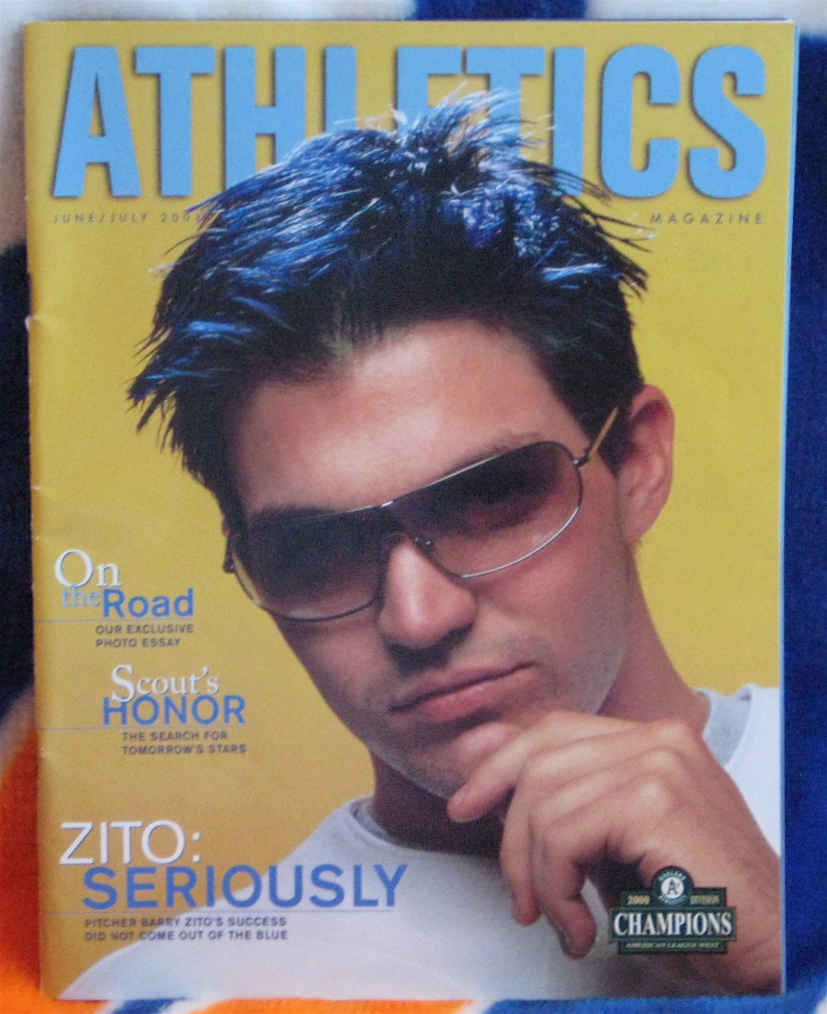
Perhaps it was because the outside was so uninspiring that once we were inside “the Net” (or as our local friends called it, “the Ass”), it actually surpassed our expectations. We expected a quarry, I suppose. We got a pretty decent setting for baseball, all things considered.
You had to take a few things into consideration as you settled in for a day of baseball in Oakland. You had to take football into consideration. That’s what the city had to do to lure the Raiders back from their extended Los Angeles stay in 1995. They built Al Davis a wall of luxury boxes that killed the view of the mountains over the center field fence. “Mount Davis,” they called this atrocity. It was the moral equivalent of Mr. Burns blocking out the sun and plunging Springfield into eternal darkness.
But it wasn’t the practical equivalent, because while you couldn’t see anything beyond Mount Davis, you got plenty of sun. The sun never stopped pounding us, which was too bad because having unnecessarily bought tickets well in advance, I got us some great seats behind home plate. They were so great, my fair lady of a wife — Scandinavian heritage, burns easily — wanted no part of them. Darn. We asked a friendly usher if it was OK if we moved back some (there’s a request I never made at Shea). No problem, he said, pointing us to some still very good and blessedly shady seats a little further back of home. Paid attendance that day was under 13,000; it wasn’t like we’d be sitting in somebody else’s seats.
Lots of concrete, lots of sun and lots of green. Green, green grass in particular. The one thing I’d learned watching A’s games on TV over the years was a surfeit of foul territory made for a verdant festival of popouts. Surely it frustrated batters, but at least it went well with the A’s caps. You can’t go wrong with green in baseball. And while you could go wrong with width in the foul territory department, I noticed and liked the extraordinarily wide concourses behind the stands. They were darker than Shea, but they were twice as wide. If you needed to escape the midday sun some more, there was refuge to be had.
While I didn’t know what it looked like outside until we got there, the Coliseum felt familiar enough as we waited for the game against the Angels to begin. The A’s were a featured actor on the October stage for half the ‘70s, so whenever I’d find an A’s card in my Topps pack, I probably lingered on it a little longer than I would have if a given Athletic had been a White Sock or a Twin. One feature that felt very familiar was the last row of the upper grandstand — it just cut off, like they ran out of money for it. Surely I’d seen it on a card in 1974 or thereabouts. The Coliseum in those portrayals always looked like Bobby Brady’s backyard to me in those days (sans the Astroturf lawn) and that memory rushed back in 2001.
Also back, not shockingly, was my awareness of the four-game cameo this building had in Mets history. The Mets have lost only one World Series on the road in their existence, and it was here. Up close, it didn’t bother me. In some twisted way, I was happy to forge that connection on a stray July day 3,000 miles from home. Sure, we lost, but we lost to a great team (or so I told myself until 2005). It didn’t bother me that this was where George Stone went unused and Willie Mays was blinded by the light and Augie Donatelli was simply blind to Ray Fosse not tagging Buddy Harrelson. The Mets kind of mattered in the scheme of things here. This was the only place besides Shea for which there was a banner hanging that said “1973”. This was the only place besides Shea on whose DiamondVision highlights from the 1973 postseason got a workout — though I booed World Series MVP Reggie Jackson when he was presented as A of the Day.
It had been 28 years. I think the rivalry had died down. My Mets cap was greeted with a smile from the guy who sold me my program. He was friendly. The usher who let us move about freely was friendly. The vendor who sold frozen dairy products may have been unnerved, however, when I felt compelled to resort to Default Flushing Etiquette to flag him down.
“MAAWWLLT!!!” I screamed at him. I was just trying to get his attention the way I might have at Shea. I mean, c’mon, that’s how we do it, right? The mellowness inherent in a Northern Californian afternoon was lost on me. He was a whole two rows away when I bellowed, and with few of the 12,719 on hand vying for his attention, he looked a little hurt that I yelled at him. Nothing personal, pal, we just want your MAAWWLLT…I mean malt.
He was nice about it. They were all nice about it. When you’re Oakland competing with San Francisco, the Coliseum competing with Pac Bell, the A’s (muddled under .500 at the time) competing with the Giants and record-pursuing Barry Bonds, you’d better be nice. Only baseball-oriented tourists like us, on an otherwise all-San Fran vacation, were going the extra few miles to be here. Whatever it was that kept fans out of the Coliseum, it wasn’t a bad attitude. Mount Davis notwithstanding, there was no Black Hole here. A’s Nation — including the fans who teamed on the occasional Let’s Go OAK-land chant and particularly the lady who for some reason thought I would know whether Johnny Damon was Korean — was comprised of nice people doing their best to create a nice atmosphere, even as the A’s went down lamely to the Angels. It left us in a good mood before we braved the pedestrian bridge and its panhandlers to return to the BART and the other side of the bay.
You could do worse on a Thursday afternoon in the middle of almost nowhere.
|
|