The blog for Mets fans
who like to read
ABOUT US

Faith and Fear in Flushing made its debut on Feb. 16, 2005, the brainchild of two longtime friends and lifelong Met fans.
Greg Prince discovered the Mets when he was 6, during the magical summer of 1969. He is a Long Island-based writer, editor and communications consultant. Contact him here.
Jason Fry is a Brooklyn writer whose first memories include his mom leaping up and down cheering for Rusty Staub. Check out his other writing here.
Got something to say? Leave a comment, or email us at faithandfear@gmail.com. (Sorry, but we have no interest in ads, sponsored content or guest posts.)
Need our RSS feed? It's here.
Visit our Facebook page, or drop by the personal pages for Greg and Jason.
Or follow us on Twitter: Here's Greg, and here's Jason.
|
by Greg Prince on 3 March 2010 8:26 am Truth in advertising creeps into Metspeak, according to the Times‘ Bats blog:
Mets fans had a tough time feeling comfortable in Citi Field ast season, mainly because the team performed so poorly. But some fans were also irked that they could not see parts of the field from their seats, especially in left field.
In the third deck there, for instance, fans often cannot see the left fielder, and occasionally the center fielder drops out of view.
Mets executives said the obscured views were the trade-off for putting fans closer to the action in Citi Field, which is cozier than Shea Stadium. That explanation did not placate some people who felt the team should have affixed warnings to the tickets.
The Mets appear to be correcting that lapse. When ordering tickets for certain seats online, fans receive a warning that reads, “View: Limited portions of the playing field may not be visible from this seat location.” The disclaimer, in bright orange, was attached to seats in 300, 400 and 500 level seats in left field.
Don’t be fooled by the Times‘ subtlety, for, in the context of Citi Field’s growing pains, this is worthy of screaming Post hyperbole. It’s really quite substantial: an acknowledgment by the typically admit-nothing Mets that what they’re selling isn’t close to perfect, even if took them a year to nod toward the reality that everyone else discovered upon trying to take in the entire outfield from any given seat in Promenade. I assumed the Mets would instead dig their heels in deeper and insist that these were actually the best tickets you could purchase; my wife came up with a fantastically Metsian term for the areas from which you couldn’t clearly make out the left fielder: Vantage Point Seating. We expected to receive a brochure hyping it as New For 2010.
Admitting imperfection in bright orange represents a sea change — or Bay change, since we’re talking left — from deny, deny, deny, as Dave Howard did last April on WFAN when he was asked to respond to the rising tide of complaints from ticket buyers who could not see all for which they had paid (transcript courtesy of Mets Today):
“Here is the issue, this is with regard to seating in fair territory in the outfield, which is something different that we have at Citi Field, that we really did not have much of at Shea Stadium. … the reality is … a little seating we had in fair territory in the outfield at Shea Stadium did have some blind spots on the field, it is NOT obstructed. The way we characterize “obstructed” is if you have an obstruction, something in front of you — a beam, a pillar, something that’s blocking your view. That’s not the case here. It is a function of the geometry of the building. And it is a conscious decision that we made along with the designers and the architects, that we wanted people to be lower and closer to the field, and have great views, and great views of the action. By doing that in fair territory, you are going to have situations where you are going to lose certain blind spots in the deep outfield of those sections. That is something we understood to be a factor. It is true in every new ballpark that has seating in the outfield …”
I barely passed ninth-grade geometry, yet I think if there had been a question on the Regents Exam about something blocking my view, I probably would have chosen “obstruction” over “blind spot” if the question was multiple-choice…and, in the “show your work portion,” I wouldn’t have tried to explain how not being able to follow the track of the ball or the fielder(s) chasing it is an asset at a baseball game (even a 2009 Mets baseball game). I’m still confused over how seeing less of the action was supposed to give me “great views” of the action. But again, geometry was never my strong suit.
The “conscious” decision to build a baseball stadium in which significant swaths of the baseball game would not be readily visible to a critical mass of baseball fans would be tough to square with the logic statements inherent in geometry. Rebuilding is something the Mets do clumsily when it comes to their roster, so I guess it’s not surprising that building a grandstand (and a case for its drawbacks) would befuddle them. At the very least, they can label the tickets with a proper warning. And they’ve done that.
They’ve done the very least.
Blue Cap tip to Mets Police for being on this well ahead of the Times. If there’s a Paper of Record for recording Mets fan indignities, surely it’s MP.
by Greg Prince on 2 March 2010 2:08 am Continuing the recent theme of leaning forward into the schedule of meaningless exhibitions until we are so close to Tradition Field that we’ll be called out for fan’s interference, there’s a game today.
Today has a game. A baseball game. A Mets game.
It’s Today’s Game.
Today’s Game is scheduled to start at 1:10.
Today’s Game will air on SNY.
Pitching in Today’s Game will be whoever. Same for the catcher. Same for the batting order.
Whoever, whatever…we’re not picky. We’re starving. We’ll be sated by Today’s Game. Just the thought of Today’s Game fills us up.
Today has a game. A baseball game. A Mets game.
Can’t wait for Today’s Game.
So what else is new?
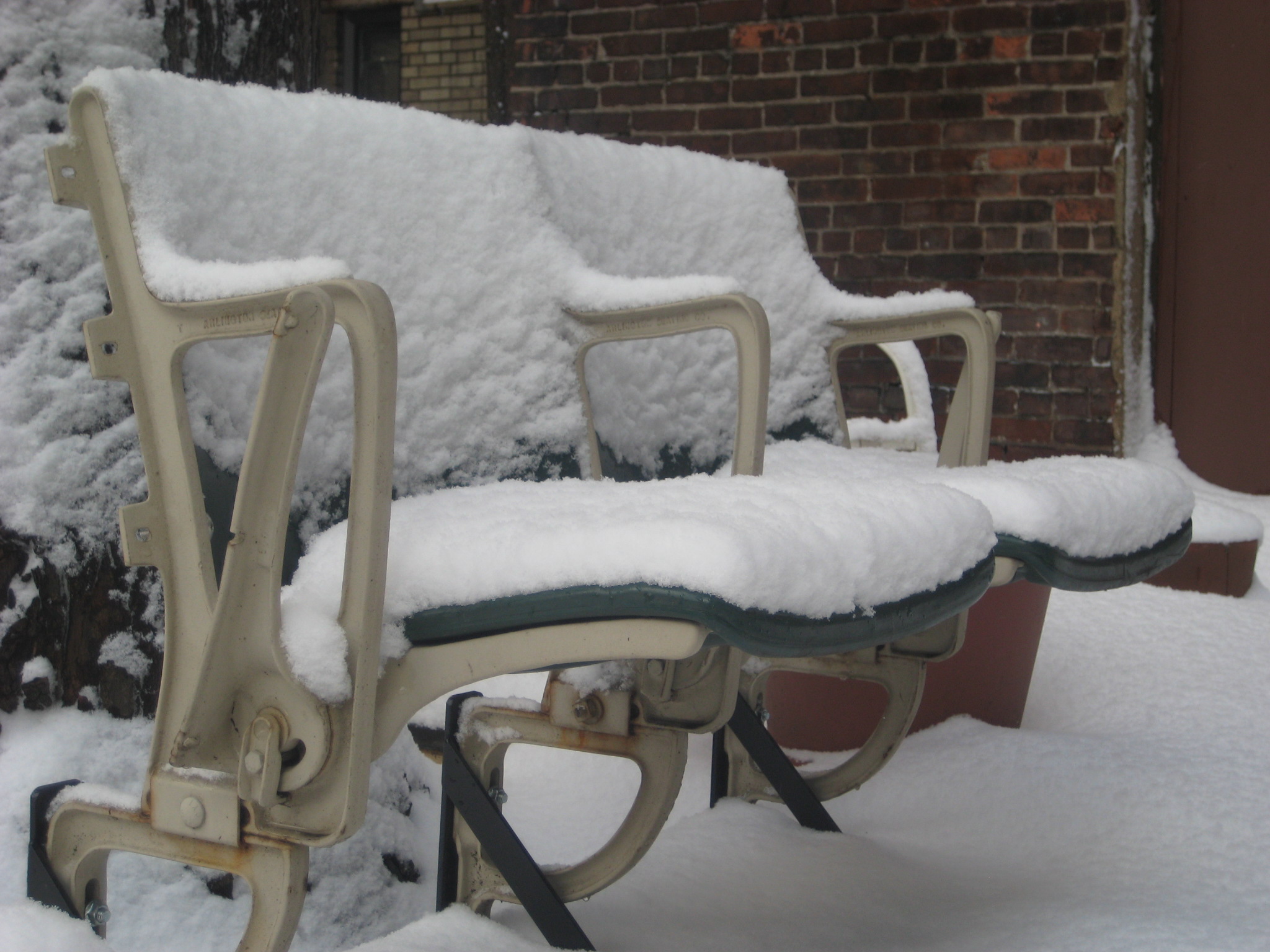
by Jason Fry on 1 March 2010 9:33 am 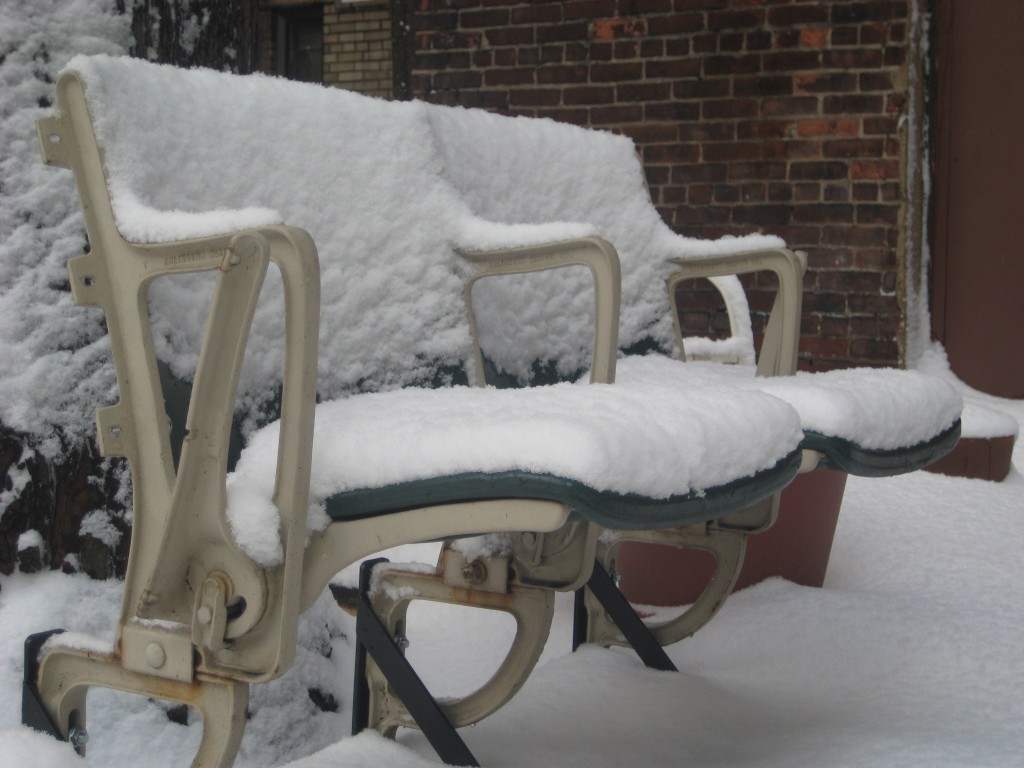 The building that contains the Fry manse has had a tough winter. First the heat was kaput for several days. Now, following the season’s 242nd blizzard, the roof is leaking. Through a quirk of intrabuilding geography that I find less than delightful, the water’s chosen route was to descend three floors and pool atop our bathroom ceiling. Cue a leak and, after two days of soaked sheetrock, the inevitable. Which came at 4:15 a.m., as these things do. The building that contains the Fry manse has had a tough winter. First the heat was kaput for several days. Now, following the season’s 242nd blizzard, the roof is leaking. Through a quirk of intrabuilding geography that I find less than delightful, the water’s chosen route was to descend three floors and pool atop our bathroom ceiling. Cue a leak and, after two days of soaked sheetrock, the inevitable. Which came at 4:15 a.m., as these things do.
WHAM!
Emily (groggily): What the hell was that?
Me: I’m gonna assume the bathroom ceiling.
Correct. Which at the time seemed like a good thing: The water had eliminated that pesky sheetrock from its path, we had a bucket, etc. But no. Now the water is descending an additional floor and pooling atop our downstairs bathroom ceiling.
Being a Mets fan here is somewhat helpful in making predictions: The upstairs bathroom ceiling is done collapsing; the downstairs ceiling is up 3 1/2 with 17 games to play.
And yet, as I sit here in the bowels of my snowbound, falling-apart house, I’m … happy.
And why is that? Because tomorrow the Mets play the Braves, and things like 1:10 and 7:10 and Ws and Ls and SNY return to my lexicon. It’ll just be a small step closer to spring, but it’ll feel like a giant leap. And while ceilings may still be falling, I’ll no longer feel like the sky is, too. Hang in there, everybody. We’ve almost made it.
by Greg Prince on 28 February 2010 5:33 am The Department of Sudden Realization is reporting the New York Mets will play the Atlanta Braves in two days. Well, it’ll essentially be random fellows wearing Mets uniforms versus unknown guys wearing Braves uniforms after the third or so inning, and it won’t count in any serious standings, and the outcome will be forgotten minutes after it is registered.
But the New York Mets will play the Atlanta Braves in two days.
Professional baseball players under contract to our favorite team will pitch against and hit against and maybe even field against professional baseball players under contract to another recognizably branded organization. People will pay money to sit inside a stadium and witness it. A score will be kept and displayed. Shouts of encouragement and bites of frankfurters and purchases of programs…all those pleasing signs of spring will, for the first time in an eternity, be sprung.
Baseball! It’s February 28, it’s freezing, half the world remains snow-encrusted, yet in two days, there will be baseball. New York Mets baseball is coming to a life near you.
We can start living ours again any hour now.
Billy Heller of the New York Post says Faith and Fear in Flushing: An Intense Personal History of the New York Mets — available soon in paperback, with a brand new epilogue exploring the first season of Citi Field — is Required Reading. Read all about it here.
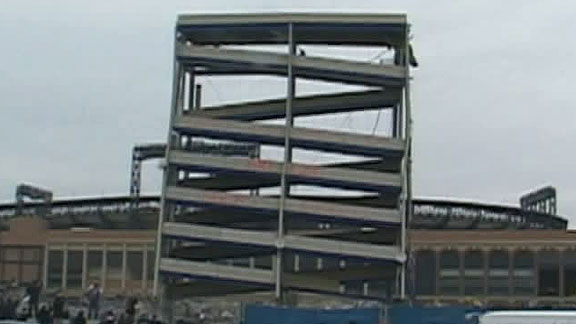
by Greg Prince on 26 February 2010 7:59 pm On October 28, 1961, eight dignitaries in suits — including Mayor Bob Wagner, master builder Bob Moses and future villain Don Grant — plunged spades into the ground and touched off the beginning of construction on a project tentatively titled Flushing Meadow(s) Stadium. It took 902 days to get from ceremonial shovels to the first official pitch thrown on that site, one fired by Jack Fisher of the New York Mets to Ducky Schofield of the Pittsburgh Pirates. By then, April 17, 1964, the structure in question would be called Shea Stadium…and the pitch from Fisher would be called a strike by home plate umpire Tom Gorman.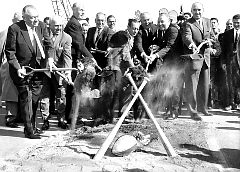
On September 28, 2008, Ryan Church would lift a deep fly ball to centerfield in the same place. Deep, but not deep enough. Cameron Maybin caught it and, in essence, ended the life of the stadium. A ballpark can’t be a ballpark unless it’s got some ball in it, and dratted Maybin made off with the last one. Nevertheless, Shea stuck around after the final out, first for another ceremony — one in which Fisher, followed by 42 other former Mets, would bid adieu to the stadium’s last assemblage — and then for the gruesome business of the building’s disassembly.
Breeze Demolition, a subcontractor from Red Hook, dug its hooks into Shea Stadium within hours of Fisher’s fond farewell. It took 143 days to pull apart what required 902 days to put together. For those of us who couldn’t help but monitor its methodical deconstruction, it seemed like it took forever for Shea to come down, yet in actuality, erasing it took less than one-sixth the time it took to create it.
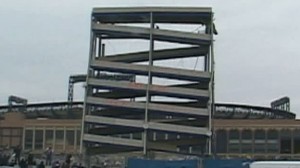 The disappearance of Shea from the New York cityscape, save for the dust and debris that would linger into May, was completed just over a year ago, when on the morning of February 18, 2009, the last immediately discernible sign of its existence vanished from the Queens skyline. Save for four brass bases and an accurately if curiously named pitcher’s plate in a parking lot, it’s now like Shea Stadium was never there. The disappearance of Shea from the New York cityscape, save for the dust and debris that would linger into May, was completed just over a year ago, when on the morning of February 18, 2009, the last immediately discernible sign of its existence vanished from the Queens skyline. Save for four brass bases and an accurately if curiously named pitcher’s plate in a parking lot, it’s now like Shea Stadium was never there.
Shea, of course, lives on anyway. It lives on in our memories, our souls, our imaginations and our Mets fan DNA. It also, thankfully, continues to exist in print, most notably in the pages of several recent and terrific books. One of them — Bottom of the Ninth by Michael Shapiro — tells thoroughly if almost incidentally of Shea’s conception as part of a larger story of baseball’s late ’50s and early ’60s evolution. Two others whose reach is closer to home — Dana Brand’s The Last Days of Shea and Shea Good-Bye by Keith Hernandez and Matthew Silverman — offer loving encomia crafted on the eve of the park’s passing. Each of them is a worthy companion to the way you remember Shea, whether from its beginning, its middle or its end.
I’ve only recently gotten automatically used to the idea that there is no longer a Shea Stadium. No wonder: 2010 is the first calendar year in 50 during which there has been no immediately discernible sign of Shea Stadium. Still, the slow realization that it’s not around and that it’s not coming back goes beyond the longevity of an entity that began to stir in 1961 and ceased to exist in 2009. It goes beyond what Brand’s textured eloquence or Shapiro’s fresh history or Silverman’s expert editing of Hernandez’s occasionally random recollections can capture, too. It’s gets to the simple fact that Shea Stadium was my idea of what a ballpark was. It couldn’t help but be. It was my first ballpark.
It was my first park on TV. It was my first park in person. It was the park that defined what it meant to watch baseball for me. Shea shaded my view of every other park I’d ever visit, particularly the one I now technically call home.
I’ve been lucky enough to have attended Major League Baseball games in 34 different parks, 10 of which, like Shea, have either left the face of the earth or have stopped functioning in the MLB realm. On some level, that means I’ve been to…
• Shea Stadium;
• 9 parks that weren’t Shea Stadium;
• and 24 parks that are not Shea Stadium.
It won’t surprise you a bit that Shea defines my perspective on ballparks. It may surprise you, however, to learn I don’t consider Shea my favorite ballpark. Most beloved and most resonant to me, absolutely. But there are some I hold in what I guess you’d call higher esteem.
Oh, there’s none I hold as dear as Shea, but I’ve got the ability to delineate. I know when I’ve been somewhere that’s…I don’t know if “better” is the word I would use here, but I’ve been to parks that transcended Shea for me — which is no small feat. That’s the litmus test I wound up applying once I began visiting other parks and ranking them. If I really felt that, all things being equal (though all things rarely are), I was having a Shea-plus time at a ballgame elsewhere, I had to be honest with myself. I had to say, y’know what? I have to rank this place ahead of Shea.
Not many ballparks made it over that hurdle. The uninitiated — anybody’s who’s not a Mets fan, probably — would not get that. But I imagine most of you who are Mets fans do.
Over the next several months, I plan to devote Flashback Friday to ballpark talk in a series ambitiously dubbed Take Me Out to 34 Ballparks. Starting Friday, March 5, I will revisit my 34th-favorite ballpark. The week after, we’ll go to my 33rd-favorite ballpark. Then…well, you get the idea. It’s a countdown because I like to count things down, but it’s less about my immensely subjective rankings than a chance for me to explore with you what these places mean to us as baseball fans.
It’s also an attempt on my part to place Citi Field in some kind of context besides it not being what Pedro Martinez memorably called my beloved Shea. With Shea Stadium off the map, I hope to begin to view Citi Field apart from the ghost hovering over its third base shoulder. Figuring out where it stands for me is an unfinished assignment. Take Me Out to 34 Ballparks might provide me with some guidance.
I tend to rank my ballparks as soon as I see them. Most of them I’ve seen only once, and I know I’ll likely never see again. Citi Field is different in that respect. I didn’t rank it right away. In fact, I kept it unranked until I’d finished a full season there, and even now I view its status as provisional. I have a hunch Citi Field will always be a work in progress for me, which is fine. Shea was always going to be the static standard by which I measured every other ballpark. Citi’s place in my head (and maybe, eventually, my heart) can’t help but be more dynamic. My thoughts on it will be more subject to change than the other 33 parks combined.
But it does have a ranking, so it will show up where it shows up — same for Shea, same for the other 32 where I’ve been fortunate enough to experience big league baseball.
I like some parks more than I like other parks. It’s no secret that I like Shea more than I like Citi. But (again with all things being equal) I’d take being in a ballpark — any ballpark — over being anywhere else just about any day. So I’m pretty excited about going to one every Friday for the next 34 Fridays.
I hope you’ll find it a worthwhile trip.
Unless you’re soaking up the pleasures of practice fields in Florida or Arizona this weekend, consider spending an inning of more at the 24 Hour Talk-a-Thon to benefit Operation Homefront, a joint production of Baseball Digest, FantasyPros911.com and BlogTalkRadio.com. Details on this impressive undertaking for a worthy cause here.
by Greg Prince on 24 February 2010 7:47 pm Pity Mike Francesa. He’s a very insecure man. Today he interviewed James Hirsch, the author of the wonderful Willie Mays: The Life, The Legend, and turned the conversation as well as the remainder of his show into a referendum (with his vote the only one that counts) on Mickey Mantle being better or more clutch or more forthcoming or a nicer person than Willie Mays. Even in begrudgingly acknowledging Mays’ unsurpassed all-around greatness, Francesa had to keep injecting Mantle, Mantle and more Mantle into the program.
I found this fascinating, not for the content, but for what it reveals yet again about Francesa, New York’s most listened-to sports talk host and highest-profile über Yankees fan. He couldn’t stand the idea that his childhood idol Mantle wasn’t being celebrated. The book, mind you, covers Mays’ entire life and career. It’s not a comparison of centerfielders at whom New Yorkers and baseball fans were fortunate enough to marvel during the same era. Mantle is not disrespected in this book. He’s just one character in a sweeping biography. Hirsch wrote about Mays, not Mantle. There are plenty of books about Mantle. This simply isn’t one of them.
Not good enough for Francesa, who immediately told Hirsch — because it mattered to Francesa — that he’s “pro-Mickey Mantle” and, therefore, “anti-Willie Mays”.
This is a delineation a six-year-old makes.
It also fits the pattern of Francesa endlessly dismissing the Mets, the Jets and just about anything that isn’t the Yankees or that he can’t somehow connect to the Yankees. The football Giants, since they used to play in Yankee Stadium (and employ a coach who once served under his onetime BFF Bill Parcells), seem exempt from such condescension. I noticed on his performance art showcase that aired on Channel 4 the Sunday night after the Jets clinched their playoff spot that Francesa had to lead with an observation on how badly the Giants had played that afternoon, but we’ll get to them later…oh yeah, the Jets made the playoffs.
This was obviously the fault of the Jets for rhyming with Mets, which automatically devalues them to Francesa, the six-year-old who can’t stand attention being paid to anything that doesn’t smack of pinstripes.
Willie Mays? An all-time great? The subject of a new book, which is why you have on the guest you have on? So what? WAAAH! I WANNA TALK ABOUT MICKEY MANTLE! HE WAS MY FAVORITE PLAYER WHEN I WAS LITTLE! Reminded me of another misguided listening adventure many years ago when I tuned in to hear Francesa and his erstwhile brain-free partner speak to actor and Mets fan Tim Robbins. First thing Francesa said to Robbins was, hey, we should get you together with Chazz Palminteri, he’s an actor and a big Yankees fan!
Robbins was too polite to ask what I would have in that situation:
“What the fuck does Chazz Palminteri have to do with me at this moment?”
I don’t recall the impetus for Tim Robbins appearing, but I do know it wasn’t Subway Series Smack Talk or anything like that. Alas, Robbins was a Mets fan, and that couldn’t be taken at face value. Francesa had to make it about the Yankees, because that’s what a preternaturally insecure, hopelessly childish Yankees fan does.
Perhaps you’ve encountered examples of such behavior in your own life, off the air.
I have a hunch Mike Silva’s interview with Hirsch this Sunday evening at 9:00 on NY Baseball Digest will be far more focused on the subject matter at hand.
by Jason Fry on 23 February 2010 9:18 pm Ignore, this will be gone soon.
PEN4EN22868X
by Jason Fry on 23 February 2010 3:37 pm Back in 2007, the Mets brought up a young man named Carlos Gomez. Gomez could burn — he and Jose Reyes used to race each other out to their positions, which I thought was adorable. He was just 21, but pretty big — the kind of guy you see as a doubles and triples hitter who might mature into a slugger. Meanwhile, the incumbent in right field was Shawn Green. Green was 34 and looked to my eyes like he was 54, particularly in the field, where ball after ball seemed to strike earth and take one gentle hop into his glove. Let’s all pause and remember Scott Speizio’s ball just eluding Green’s grasp, though it was really Guillermo Mota’s fault. Ugh that sucked.
Anyway, I loved Carlos Gomez. He was young. He had promise. He was not Shawn Green.
Greg, stuck sitting beside me on multiple occasions while I yelled at Shawn Green for not being someone else, was more cautious than this. Too many Benny Ayalas and Jay Paytons and Alex Escobars have done too much damage to his psyche for him to get overly excited about callow youth. It wasn’t so much that he was a Shawn Green fan as it was that he wanted to be sure we had a better answer before consigning existing ones to the scrap heap. He’s logical that way. It’s kind of infuriating.
As it turned out, neither one of us can claim much in the way of bragging rights there, not that that’s what we do anyway. Green was done after 2007; Gomez proved periodically talented but mostly maddening as a Minnesota Twin and is now a Milwaukee Brewer.
I know it’s spring training because in recent days I can feel myself coming down with another case of Rookie Fever. Josh Thole, he of the curious inside-out swing and stuff to learn on defense? Well, did you read this awesome New York Times story about him by David Waldstein? He spent the offseason playing for Leones del Caracas and hit .381! The Caracas fans nicknamed him el Infierno — the Inferno! He played in Caracas, which most things you read portray like it’s Grand Theft Auto with better graphics! And he didn’t bat an eye despite growing up in a town the Times called “an Illinois hamlet”! (Though the Times being the Times, that could be anything that isn’t St. Louis.) [Withdrawn. First of all, St. Louis ain’t in Illinois, genius. Second, a pointless, cheap shot about a terrific story and a good get. Not my proudest moment.] And his fiancee sounds like a badass too! After reading Waldstein’s profile, I was not only demanding that Thole be the opening-day catcher but also inclined to suggest that Kathryn Poe immediately replace Luis Castillo.
Or take Ike Davis. He’s an above-average defensively first baseman who says modestly that he has a lot to learn. He’s being respectful of David Wright, who’s taken him under his wing, recalling that Ty Wigginton treated him wonderfully when he might have resented the rookie’s arrival. He can hit! He can field! He’s well-mannered! He’s got a big-league pedigree! He was a Cyclone! I’m getting more and more excited!
We will love Thole and Davis. I’m sure of it. Well, I’m certain we’ll love them … until.
What’s that? You want me to define until? OK, that can be tricky. It might be “until we expire on our deathbeds, thinking of numbers on walls and World Series trophies and trips to Cooperstown.” Seriously, it could happen. But yes, I’ll admit that most of the time until arrives a little more quickly.
We might love Thole and Davis until they commit the sin of revealing themselves to be better than only 99.925% of people on Earth who play baseball instead of 99.975% of those folks. We might love them until they get hurt and are never quite the same. We might love them until they’re traded or seek professional homes closer to their real ones for more money than the Mets feel like offering. We might love them until they get old a little too early for our tastes.
And, yeah, we might love them until they’re competing for jobs with someone just a little bit younger and less defined by reality than they have been. Throughout this discussion Daniel Murphy has been jumping up and down yelling “I’m 24 years old! I was born in freaking 1985!” Quiet down, old man.
That’s the way it goes. But for now, it’s February. Which means Rookie Fever is loose. Just try not to catch it.
by Greg Prince on 21 February 2010 7:50 pm In a post to Twitter, Rick Coutinho of ESPN Radio says RHP Sean Green has modified his delivery, and his sidearm motion is even more pronounced than it was last year.
—A leading indicator (via MetsBlog) that Spring Training is already too long
Anybody who was caught up in the peer pressure of seventh grade in the winter and spring of 1976 will remember dutifully watching Happy Days every Tuesday night at 8 o’clock on Channel 7. Between the aaays and the whoas of Henry Winkler as the Fonz, there was Pat Morita as the eponymous proprietor of Arnold’s Drive-In (and — when “Fearless Fonzarelli” attempted to jump 14 garbage cans on You Wanted To See It — Milwaukee Fried Chicken Stand). Arnold was generally taciturn toward the kids who frequented his establishment, but when something tickled his fancy, he’d let out a cackle that sounded, I swear, something like this:
BA-RA-HA-HA!!
So that’s basically all I know and all I’ve known or thought of when it comes to our prospective new catcher, Rod BA-RA-HA-HA!!s…I mean Barajas. That and he hit seven more home runs than any Met in 2009 without being particularly noted for his slugging prowess. Boy, did the Mets not hit home runs in 2009, and boy, despite the crowd in the clubhouse on the day they and pitchers reported, did the Mets apparently suddenly realize they need an experienced, but hopefully not overripe starting backstop.
All that stands in the way of Barajas squatting as a Met now is a passed physical and a firm contract. Given that these are the Mets we’re talking about — helmed by an owner who called the just completed offseason “torture,” though one presumes he had a say in its composition — nothing’s a done deal until it’s a done deal, but all signs point to yes, Rod Barajas will be catching and batting anywhere from first to ninth come Opening Day.
First to ninth? Remember, these are the Mets, where even leadoff hitters aren’t leadoff hitters.
Oh, rats. I swore I wasn’t going to get sucked into the Great Batting Order Kerfuffle of February 2010. These are the most pointless kerfuffles of any season, kerfuffling as they do six weeks before any manager has to submit any batting order that counts for anything. Didn’t Jerry Manuel make some noise about batting Jose Reyes third last year? Did Jose Reyes ever bat third? The answers are yes and no, respectively. In our first spring of blogging, a spitstorm erupted over Willie Randolph suggesting David Wright might bat eighth once the season started. Care to guess how often Wright batted eighth? Hint: His next time will be his first time.
Once Pitchers & Catchers are in place, it’s only a matter of time before Pollyannas & Cynics follow. Like most fans, I will veer between the two as the footage from St. Lucie grows repetitive and the novelty that somewhere on this continent there are Mets stretching wears off. For example, I caught a moment of Frankie Rodriguez talking up his physical and mental well-being and I imagined one 1-2-3 ninth after another, with “Sandungueoso” blaring, high-fives flying and magic numbers dwindling in our favor. Then, with images of the two walkoff grand slams he surrendered in 2009 slithering through my head, I realized, what the hell else is he going to say? “I really seemed to be losing something off my fastball there by the end, don’tcha think?” What are any of them going to say? Is Johan Santana going to choose anybody besides himself as the N.L. East’s best pitcher? Is the Daveotronic 5000 going to pick anybody besides the Mets to win the division? Is anybody going to take seriously anything Jerry Manuel says right now?
Among the rites of spring is the right to grow quickly jaded, to slide from yayI to yawn without notice. Or as Fonzie’s ABC Thursday night doppelgänger Vinnie Barbarino of Welcome Back Kotter put it when he went on to play Tony Manero in Saturday Night Fever, “I’m bored with it, all right?” Honest to god, how can anybody get worked up over Sean Green modifying his delivery on February 21?
If you don’t get bored with it, you’ll get immersed in nonsense and drown in it long before the games that don’t count are finished (and just wait and see how bored you’ll be with those). The classic case of Spring Training folderol that meant nothing in the long run occurred five years ago when Carlos Delgado wasn’t a Met.
He was going to be. It looked good, in that way you want it to look good when a free agent is left dangling in the marketplace for a long while. Delgado hadn’t signed with anybody entering the fourth week of January 2005. The Mets were very interested. Omar had picked off Pedro Martinez, then Carlos Beltran…by gum, can you believe they might get Delgado, too? Too good to be true, it turned out. Delgado signed with the Marlins during one of the rare offseasons when they were adding rather than shedding players and we summered instead with Doug Mientkiewicz.
It was vastly nothing from nothing as Spring Training commenced until Delgado’s agent David Sloane spread the word that his client was turned off by what Delgado felt was an overemphasis on Omar Minaya’s and Tony Bernazard’s part regarding the Latin heritage they each shared. Sloane was also busy that spring letting it be known Recidivist Marlin Al Leiter had helped lure Carlos to Miami by saying not so kind things about Al’s old club. What made Sloane’s contretemps du jour memorable were less the content than how, after engaging the New York baseball media, he expressed horror that a reporter had the nerve to call him on his cell for comment while he was off enjoying a Joe Cocker concert.
All at once, every Mets fan had the same thought: Joe Cocker in concert? 2005? As Jason asked, “Is David Sloane marching against Vietnam, too?”
It was nonsense, but — no disrespect to Sean Green’s awesome arm angle — at least it was different nonsense.
Whatever misgivings Carlos Delgado felt toward how he was courted as a free agent were rendered meaningless the following November when the Marlins traded his massively backloaded contract to the Mets for latent ’05 wunderkind Mike Jacobs (and Yusmeiro Petit, one of the myriad pitching prospects the Mets have given up who didn’t turn into Scott Kazmir). Jacobs, of course, is a Met again, which is nice for those of us who retain a touch of romanticism about this game. On September 18, 2005, the Mets fielded, from left to right, David Wright at third, Jose Reyes at short, Anderson Hernandez at second and Mike Jacobs at first. It was, by my reckoning, the first all 1980s-born infield in Mets history, the blossoming Met youth movement in microcosm.
Two out of four weren’t bad…literally. Fortunately, the two who were indisputably good stayed. Somehow, because of injuries last year and provisional suspicion of Daniel Murphy this year, Hernandez and Jacobs have found their way home. If they join Reyes and Wright to compose the infield for significant swaths of 2010, it’s probably not the future we were hoping for in late 2005, but once or twice won’t necessarily hurt us.
Delgado? He hurts now, sadly. After spending most of 2009 out with a bad right hip, he’s had it operated on once more and he’s going to be sidelined anywhere from four months to for good as a baseball player. Carlos is approaching 38 years old and will have been inactive at the major league level for more than a year when he’s projected as fully recovered. David Sloane has taken off his earbuds long enough to let one and all know this isn’t stopping Delgado from planning on playing again, but planning and playing are two different things.
Adding Delgado when we did, even if meant parting with young Jacobs just as Jacobs was finding his home run stroke (the only stroke he ever maintained), surely didn’t hurt. No, I’d say it helped a great deal. Even though he wasn’t quite the Carlos Delgado at whom we’d marveled on SportsCenter and in fleeting American League glimpses — seems we use that type of description a lot — he was the right man at the right time for the 2006 Mets.
Willie Randolph didn’t much screw around with the batting order then. Carlos Delgado was his cleanup hitter 124 times. Reyes led off 148 times (missing his only significant time when Jacobs the Fish stepped on his hand and cost him his All-Star start); Paul Lo Duca batted second 118 times; Carlos Beltran was in the three hole 137 times; and Wright hit fifth 117 times. David took a few turns at cleanup, usually moving Delgado to third. Otherwise, it was all very stable from one through five, and the Mets were generally unstoppable.
Is this an endorsement of stability in batting orders? If you have five guys performing at or near their respective peaks, sure. It rarely works that way (which may provide a hint as to why 2006 has been so difficult to replicate). Otherwise, Jerry Manuel will — like any manager — juggle, improvise, pick names out of a hat. The best batting order is the one that works. The trial and error involved tends to bury everybody’s Spring Training quotes.
Still, it sure is nice when you have those first few names regularly present and accounted for. It’s even better when you have eight, but that’s rarely the case. Recall 2008, the last great year of Carlos Delgado. Last great half-year, really, since CD was plagued by the hip through ’07 and the early months of ’08. Then he turned it on, MVP-style, and seemed to carry the Mets into first place for stretches of summer. His hip may have been sore, but his back was strong, his shoulders were broad and oh my, was his swing lethal.
It wasn’t really Carlos Delgado by himself recasting the 2008 Mets from irritating, addled chumps to invigorating, almost champs. Reyes, Beltran and Wright were playing every single day, too. You knew Jose would lead off (159 times) and David would bat third (158 times). Beltran was often fourth (118 times) and sometimes fifth (36 times). Delgado was dropped to sixth 32 times in an effort to let him find himself. Once he did, he was generally entrusted with the five-hole (74 times) or cleanup now and then (40 times).
Batting second? Everybody. Luis Castillo, Endy Chavez, Ryan Church, Nick Evans, Argenis Reyes, Daniel Murphy, Damion Easley, Marlon Anderson, Angel Pagan…whoever worked. As Manuel discovered, none of them did for more than a few games here or a few games there. Perhaps it was telling that with everything on the line in the final weekend of the season, Jerry crafted a front four that may have been the most top-heavy half-lineup in the history of Shea Stadium:
Reyes SS
Beltran CF
Delgado 1B
Wright 3B
One pure leadoff hitter and three sluggers, no muss, no fuss. Not a Millan, a Backman or even a surprisingly powerful Alfonzo in the bunch — just punch.
Batting Beltran second — two hits in the final win, a homer in the final game — wasn’t unprecedented. That’s where he generated his power during his legendary 2004 postseason salary drive and that’s where callers to WFAN have intermittently demanded he be inserted regularly since 2005. The alignment was by no means insane, but it did strike me that Saturday and Sunday as incredibly desperate. Jerry Manuel was down to four offensive players he thought he could trust against any pitcher the Marlins threw at the Mets. Screw it, he seemed to say, I’ll just bat ’em all at the top of the order and hope for the best. A Church who wasn’t slumping, a Castillo who wasn’t hopeless or a Ramon Martinez who might have revealed himself just a touch sooner as untapped dynamite and the lineup wouldn’t have looked so top-heavy. But nobody south of Wright inspired any confidence, thus the makeshift philosophy of Inflict Some Pain, Then Pray For Rain.
Would it have made the difference in how 2008 wound up had Jerry been able to effectively spread the wealth at the end? Who the hell knows? Given a few more games, maybe Manuel would have found the right combination. Unfortunately, you only get 162 games to sort it all out.
I was thinking of that particular lineup construction because of some admittedly esoteric research I recently undertook for another article slated to appear soon in another venue. It started with the foggy recollection that the 1997 Mets, befitting their never-say-die feistiness, were particularly compelling in the eighth inning. It rang a bell considering there’s no better inning than the eighth to decide to not say die. Well, OK, the first through seventh are fine innings on paper, and the ninth is technically not too late, but the eighth is properly dramatic and reasonably pragmatic. You don’t have to win it in the eighth. If you tie it up, you’re doin’ good.
Y’know what? I wasn’t crazy, at least not where my image of the ’97 Mets was concerned. Bobby Valentine’s first club did indeed make the most of their eighth innings. They were, essentially, the best eighth-inning club in baseball that season. They scored in 57 of 162 eighth innings, totaling 114 runs in the process. Only the Indians scored more often in the eighth (58 games) and only the Mariners (124 runs) crossed home plate more. Those were playoff teams. The 88-74 Mets felt like they might be, which, after six consecutive losing seasons, was plenty.
Anyway, as long as I was looking up eighth innings, I decided to see if there was anything to be divined from other innings in Mets history. I found a dozen or so nuggets that I found far more fascinating than Sean Green’s arm angle, but this one item in particular, in light of Manuel’s musings about Reyes batting third and the de facto end of Delgado’s Met tenure, struck me:
The most prolific inning any Mets team has ever enjoyed across a single season was the first inning in 2008.
The 2008 Mets scored 139 runs in first innings two years ago. Not only that, they scored in 74 different first innings, also a Met record for any inning in any year. With Reyes just about invariably leading off, Wright consistently batting third and a Delgado-Beltran combo cleaning up, the Mets went out and put points on the board right away in 46% of their games. That was with nobody in particular batting second, mind you.
Next best inning in Mets history for total runs as well as frequency of scoring? The third inning of…2008. Manuel, when he was a genius, had a batting order that exploded in the first, took a breather in the second and created more noise in the third: 135 runs in 63 games. The Mets would fairly regularly turn over the lineup and produce like it was the first inning once more.
I don’t know that there’s a pattern to be gleaned here. What I’m fond of is the metaphor it presents for the most recent Met club to post a winning record: they were fast starters but dismal finishers. Met pitching — the dreaded 2008 bullpen — was giving up a ton of runs in the seventh, eighth and ninth innings, certainly more than they were scoring. The simplistic view (though I don’t know that it’s altogether inaccurate) is great first- and third-inning production got them 89 wins. It was the rest of the game kept them out of the playoffs. I find it some combination of telling, characteristic and vaguely damning that the 38th of Delgado’s 38 home runs in 2008, cracked in the 158th game of that ultimately unsatisfying season…
a) was a grand slam;
b) was blasted in the third inning;
c) capped a five-run onslaught;
d) was rendered a footnote when Wright couldn’t bring home Murphy from third with nobody out and the score tied in the ninth, as the Mets went on to lose in ten;
e) and represented the final time the 2008 Mets, even with their Big Four intact, scored more than two runs in any one inning — a span covering the last 43 innings of 2008.
Start fast. Finish dismal.
You can read as much as you choose into this sort of thing and you probably wouldn’t be wrong either way. For instance, the most productive ninth-inning team in Mets lore was the 2007 Mets, a unit we tend to consider the quittingest bunch of quitters in the history of quitting. It actually kind of makes sense when you realize the Mets were a distinctly bad home club (41-40) for a technically good overall club (88-74). Losing at home means you’re batting quite a bit in the bottom of the ninth. Know which Mets team scored the most ninth-inning runs in the first quarter-century that there were Mets? The 1962 club, the one that lost 58 games in the Polo Grounds and 62 more elsewhere. Were they never-say-die or just granted ample opportunity to score not quite enough to win very often?
I don’t know. I also don’t know if Delgado will play again. I don’t know if Jacobs will actually be here come April. I don’t know if Reyes batting third in Beltran’s absence is necessarily an unspeakable idea. I don’t know that Barajas will fundamentally alter the Met dynamic. I don’t know how a local greaser is supposed to guide his motorcycle over 14 garbage cans. I don’t know what to make of Sean Green’s pronounced sidearm motion.
It’s the first week of Spring Training. It’s hard to know anything. But it’s tough not to wonder about everything.
by Jason Fry on 19 February 2010 4:14 pm Last night I was at a thing and fell into conversation with a fellow Mets fan. We talked about this and that, with indifferent optimism, and then he asked, “But Reyes is running?”
He wasn’t really asking; he knew. It was more that he was looking for confirmation. And all of a sudden I found myself smiling.
“Reyes is running,” I said. “I mean, he had to get away from the Mets to heal and who knows what’s going to happen and ….”
That was all wrong. I stopped and tried again.
“Reyes is running,” I said. And then I was smiling again.
Close your eyes and you can see him. His head is down and his arms are churning. In another second his helmet will fail to keep pace with the rest of him and fly off for retrieval later, and another second after that he’ll be popping up out of the dust with that huge ear-to-ear grin, slightly pop-eyed, his spiky hair sticking up like a startled cat. If it’s a particularly big moment he’ll smash his hands together a few times in a way that looks like it hurts. He’ll look slightly winded, but mostly he’ll look like you like to imagine you’d look if you could only do what he does. He’ll look like that was an enormous amount of fun and he can’t wait to do it again.
You know what? It’s been a while. Close your eyes and let yourself see that again.
Somewhere, perhaps, Mets front office people are doing something ill-advised.
Somewhere, it’s entirely possible, Mets business people are being cheap and short-sighted.
Somewhere, it may be, Jerry Manuel is chortling when he ought to be listening to someone who’s crunched numbers.
Somewhere, if we’re not lucky, Kelvin Escobar is wincing, Carlos Beltran is limping, or both.
Of late too many of these somewheres have been located too close to home for us to feel at ease. But sometimes somewhere is a good place to find yourself.
Somewhere Jose Reyes is running. Think of that and be not afraid.
|
|