
The second installment of the highly acclaimed SNY series Mets Yearbook debuts tonight, Thursday, at 7:30 with a return to 1984. Be sure to catch Keith Hernandez, Jesse Orosco, Darryl Strawberry and all the Rising Stars.
Image courtesy of kcmets.com
 
Faith and Fear in Flushing made its debut on Feb. 16, 2005, the brainchild of two longtime friends and lifelong Met fans. Greg Prince discovered the Mets when he was 6, during the magical summer of 1969. He is a Long Island-based writer, editor and communications consultant. Contact him here. Jason Fry is a Brooklyn writer whose first memories include his mom leaping up and down cheering for Rusty Staub. Check out his other writing here. Got something to say? Leave a comment, or email us at faithandfear@gmail.com. (Sorry, but we have no interest in ads, sponsored content or guest posts.) Need our RSS feed? It's here. Visit our Facebook page, or drop by the personal pages for Greg and Jason. Or follow us on Twitter: Here's Greg, and here's Jason. |
The second installment of the highly acclaimed SNY series Mets Yearbook debuts tonight, Thursday, at 7:30 with a return to 1984. Be sure to catch Keith Hernandez, Jesse Orosco, Darryl Strawberry and all the Rising Stars. Image courtesy of kcmets.com As the fires of the season from Hell cool to a smoldering pain, I’ve caught myself thinking about what the most agonizing part was. And I think I’ve figured it out. It was the anticipation of disaster. As the season wore wearily on, we were a beaten people by the middle innings. Then by the bottom of the first. Then by the Star-Spangled Banner. Then by late afternoon. It wasn’t a question of whether something disastrous would happen, but what form, exactly, the disastrous something would take. Bases-loaded walk? Flurry of GIDPs? Appalling error? Walkoff grand slam? Game-ending unassisted triple play? By the end you might be surprised by how we lost, but not by the fact that we had. Maybe this was just a function of being a horrible team (and maybe wins like this always fit the formula) but the win that was arguably the best of the year — this 10-9 victory over the Phillies — was doubly astonishing because the Mets somehow hadn’t hit a Phillie with the bases loaded or had someone erased on an ill-advised steal of third or done some other stupid thing that would eat at you come 3 a.m. (I’d call Santos taking Papelbon deep the other great win of the season, but that happened before we had to accept the year was a total loss.) So that part was the worst. The second-worst thing? It was the sorry part. By late summer when I’d run into other baseball fans on the street or at parties, the conversation would take its inevitable turn and I’d grit my teeth, waiting. Hey, sorry about the Mets. Tough year, hate to see that. How are you holding up? The sentiment was genuine, the impulse was laudable. It’s what decent fans say, knowing full well that their team has a plague year in its future. Heck, I’ve offered back pats to friends whose teams are channeling November around the All-Star Break. But man oh man, had I forgotten how much it sucks. It sucks more than grudging respect: I didn’t think it would happen, but that’s a pretty good team. You guys have a chance. It sucks a lot more than finger-wagging warnings against complacency: I dunno, you’ll probably win the division, but are those the starters you want in a short series? It sucks a lot more than reflexive woofery: You guys are having a good year, but we’re going to totally smoke you in the playoffs. It sucks way more than the attempted jinx disguised as surrender: It’s your year! We have no chance! And yeah, it sucks more than outright, unvarnished hostility: Sorry man … but I HATE THE METS! 2007 and 2008 were different — there was pity, but not the endless drip-drip-drip of condolences. The ’07 and ’08 attaboys felt lousy too, but they didn’t eat at you day after day. You didn’t wind up bracing for them. Before the 2007 season, I wrote a Mets season preview for Deadspin that was equal parts loving look back at 2006 and paranoia about the fact that Omar Minaya hadn’t done much to improve that team. (I daresay that part looks prescient now.) To which one Deadspin commenter had this to say: “I hope at least one of these season previews will be somewhere along the lines of ‘My team is fucking great and we will rape our way to the World Series.’ Enough of this wishy-washy bullshit!” I ignored that because, well, we’re the Mets. With the brief exception of the Bad Guys Won era, that’s not our style. (And even back then our CBA — Converted Braggadocio Average — was a lousy .200.) Ours is a legacy of miracles and humiliation, which doesn’t lend itself to strutting. But after half a season of pity, I find myself coming back to that long-ago comment. I don’t want enemy baseball fans to feel sorry for us. I want to hear some grudging respect, some attempted jinxes, some outright hatred. Some Paul Lo Duca discussion of ending the other guy’s season. Some Wally Backman talk of opponents being buried and having no worries unless there are another 20 fucking car wrecks. (Good timing!) We’re nowhere near rampaging our way to much of anything, but next time we look like we might be, I’m not going to worry about baseball gods I might offend. Because honestly, what the hell have they done for us recently? One of my favorite sages famously remarked that baseball has to be played with fear and arrogance. We’re missing half of the set, and I’m tired of it. Enough of this wishy-washy bullshit, indeed. Too bad the story is apocryphal. Too bad lefty Giant reliever Don Liddle — after retiring lefty Vic Wertz in Game One of the 1954 World Series with two on and none out — didn’t actually declare to his teammates upon being pulled in favor of righty Marv Grissom, “I got my man.” It’s too bad because Liddle got his man on account of Wertz having the bad luck to blast Liddle’s pitch to deep center field in the Polo Grounds…where the incomparable Willie Mays raced to catch it. It’s too bad because “I got my man,” given the context, is one of the great lines in baseball history. Yes, Don Liddle, brought on in relief of Sal Maglie specifically to face Wertz, got his man — albeit with a little help from his friend Willie. No, Don Liddle didn’t stroll into the dugout and casually take credit for his perfect third of an inning. “Not in front of Leo the Lip” he didn’t, Liddle’s son Craig told George Vecsey on the occasion of the fiftieth anniversary of The Catch in 2004. “My dad heard people tell this story on television. You would never say something like that while the game was still on.” But Don could be wry after the game, once Dusty Rhodes‘ tenth-inning pinch-homer sent the New Yorkers to victory. In the clubhouse, Liddle could shake manager Durocher’s hand and take deadpan credit for putting down Wertz. “My dad told Leo, ‘I got my guy,'” Craig Liddle recalled to Vecsey. “But this was after the game, not during it.” Nevertheless, the legend usually outstrips the truth. Thus, “I got my man” still gets around. Getting one’s man, however one does it, is worthy of remembering and retelling. It’s worthy of our respect, whether it’s a matter of taking care of a dangerous hitter in the eighth inning of a World Series game or somewhat less intense circumstances. The 2009 Mets ran out of intensity pretty early in their dismal campaign, but one Met lived up to the pressure with which he was presented over and over — and over and over — again. It is for being out there as much as he was and getting his man repeatedly that we proudly announce the Faith and Fear Most Valuable Met of 2009 is Pedro Feliciano. Yes, Pedro Feliciano. Yes, the lefty specialist. Yes, one of the most anonymous figures of any significance in Mets history even if he has been in our midst longer than some of our most indelible figures ever were. Yes, it was that kind of year. But this award is based on something more than wryness. It is in appreciation for a player who, when all around him were crumbling, stood tall…or as tall as the 5’ 10″ Feliciano could. He stood tall and he stayed in there. Few Mets could make that claim in 2009. Most every Met, it seems, disappeared for discernible stretches of time last year. Injuries eliminated many of them. Others vanished in plain sight, victims of their recurring shortcomings. Few Mets could have measured up to Woody Allen’s barometer for success in life, that most of it is just a matter of showing up. Not Pedro, however. Pedro kept showing up. Pedro kept getting the call and, more often than not, Pedro kept getting the key out. Maybe it was only one out, but Pedro got his man. One man in particular, who literally towers over Pedro Feliciano, was made to look small in his presence. That alone was awfully impressive in an otherwise depressing campaign. Ryan Howard has six inches and 70 pounds on Pedro Feliciano if you believe official listings. Goodness knows you couldn’t trade Pedro Feliciano for Ryan Howard. But would you trade Pedro Feliciano knowing Ryan Howard is looming somewhere on your schedule over and over — and over and over — again? When the Mets dismantled most of their disaster-laden bullpen after 2008, they left one mainstay in place. No more Heilman. No more Schoeneweis. No more Smith or Sanchez or Ayala. But yes, more Pedro Feliciano. Always more Pedro Feliciano. Why? Beyond why not? On the surface, a surface strewn with shattered late-inning hopes from ’08, you might not have noticed if Pedro Feliciano had been among the missing entering ’09. You wouldn’t miss anybody from that bullpen. Pedro didn’t stand out in a crowd. If anything, he was the kid in gym class who survived those thuggish dodgeball games by loitering in the back behind the more aggressive kids. Still, he had a couple of things going for him: 1) a functioning left arm; 2) an uncanny knack for using it to retire Ryan Howard of the division rival Phillies. Have you heard of Ryan Howard? Big fellow. Hits lots of home runs, drives in lots of runners. Plays every day. A constant threat. But not to Pedro Feliciano, a gentleman who know a bit about constancy himself. In 2008, Howard came up to the bat against the Mets seven times only to see his personal Kryptonite staring him down from sixty feet, six inches away. It was Kryptonite in a blowout: Ryan Howard went 0-for-7 against Pedro Feliciano. So, sure, that could be useful. Out went Heilman, Schoeneweis and the rest of the relief debris of 2008. But we’ll keep Feliciano. We’ll keep him and we’ll send him out there in record-breaking fashion per usual. We used him 86 times in ’08? We’ll use him 88 times in ’09. We’ll see more of the southpaw specialist than we’ll see of Carlos Beltran. We’ll see more of Feliciano than we will of Carlos Delgado and Jose Reyes combined. We’ll see only seven position players on the Mets more than we’ll see Feliciano. And unlike most of them, we’ll generally like what we see out of Pedro. Especially when it comes to Ryan Howard. Ryan Howard took his cuts against Pedro Feliciano a dozen times in 2009. Ryan Howard departed those encounters almost uniformly extremely disappointed. Twelve plate appearances, two bases-empty walks, no hits. None. There were four groundouts (one that resulted in a double play) and six strikeouts, all swinging. The last of them, on September 12 with the bases loaded in the eighth inning at Citizens Bank Park, proved crucial in securing perhaps the most satisfying Mets win of the year, the 10-9 comeback over the Phillies — a.k.a. Damn Thing III. Across two seasons, Pedro Feliciano has pitched to Ryan Howard 19 times. Ryan Howard is 0-for-17 against him, producing 18 outs. Ryan Howard is a lefty threat. Pedro Feliciano is a lefty nullifier. The nullifier has won every time. This is not to be underestimated as a positive factor in any season, particularly one as bereft of them as 2009. Feliciano’s role in a given game was to come on and get the big lefty hitter on the other team. There was no bigger lefty hitter on the Mets’ docket last year than Ryan Howard. Feliciano always got his man. Perfect? On the 2009 Mets? Within the parameters of Feliciano v. Howard, you betcha. Otherwise, nothing and nobody was perfect, not even our MVM. Pedro mowed down Howard, but others got to him now and then. He had been marvelously successful against that other lefty scourge of the N.L. East, Chase Utley, in ’08 (1-for-6), but was far less so in ’09 (4-for-8). He balked in the winning run in Citi Field’s first game. Only once was he stretched out beyond six batters. Twenty-three appearances were one batter and one batter only. But that was his job and he did it well as a rule. How many Mets could say they did even that much last year? 2009 was the kind of season when you didn’t want to watch much more than one at-bat in a typical Mets game, yet don’t dismiss the value of an assignment the likes of which Pedro Feliciano tackles. Years have turned on the guy who came in to get the big lefty and were, instead, gotten by the big lefty. Mets fans with any kind of long-term memory would do well to recall the concept of the lefty specialist as it’s played out over the past quarter of a century or so. Carlos Diaz acquitted himself nicely for a season (1983) and was then packaged with Bob Bailor to acquire Sid Fernandez. Dennis Cook was solid for an elongated spell (1998-2000) when not blowing his top. And Mark Guthrie was regularly effective during his limited tenure (2002). Otherwise, it was a parade of paws whose talent had essentially gone south or rarely materialized: Tom Gorman; Joe Sambito; Randy Niemann; Gene Walter; Bob McClure; Jeff Musselman; Dan Schatzeder; Doug Simons; Rich Sauveur; Paul Gibson; Lee Guetterman; Jeff Kaiser; Eric Gunderson; Don Florence; Bob MacDonald; Ricardo Jordan; Yorkis Perez; Tom Martin; Jaime Cerda; Graeme Lloyd; Mike Stanton; Dae-Sung Koo; Royce Ring. The lefty specialist was the bane of the Mets fan’s existence from the mid-’80s to the mid-’00s. Then came Pedro Feliciano, first for a while from ’02 to ’04 and then for good in ’06, and suddenly we weren’t cringing with every lefty Verizon Call to the Bullpen. Sixty-four appearances in 2006. Seventy-eight appearances in 2007. Eighty-six appearances in 2008. Eighty-eight appearances in 2009. In each of the last two seasons Feliciano set a club record while leading the league in this department. Overuse seemed to be getting to him by September 2008. Come September 2009, he was thriving on it. Pedro gave up exactly one hit over his final twelve appearances, walking only four. For the season, he registered a WHIP of 1.163, the lowest of his career. And consider his mindset. He, like us, had to watch the Mets from the beginning of the game to whenever he entered. Pedro didn’t enter any game before the sixth inning; eighty-four times he came in in the seventh or later. The game had already taken on its shape by the time he was deployed, and being that it was 2009, it couldn’t have been a very good shape. It was enough to make fans bury their heads in their Blue Smoke by the middle innings most nights. But Pedro went out there and got ’em. He got his lefties. He got a lot of his righties. He got his men. Pedro Feliciano has done it quietly, for what that’s worth. Except for one run-in in 2006 with Willie Randolph, Pedro hasn’t annoyed or embarrassed anybody in the organization, at least publicly. He’s the lefty who does the right thing. The Mets needed somebody to trot outside Citi Field before a late September game to pose for pictures with a sponsor, and in came Pedro. The Gary, Keith & Ron crowd huddled in the Bullpen Plaza needed a reason to stay cheerful during an extended rain delay the final Saturday of the season, and there stayed Pedro. No other Met made himself available to the fans, but Pedro sidled up to the chain link fence and signed anything and everything the fans tossed him for fifteen or twenty minutes. There were no coaches, no PR caretakers, nobody but Pedro getting the job done. It may surprise you to learn Pedro Feliciano is the last surviving Met to have played under Bobby Valentine. He survived Art Howe, too. He was away for a year in Japan, but returned to help Randolph win a division title. He gave his arm over to Jerry Manuel and Manuel has not been shy about taking it out at every opportunity. Of Mets who have never pitched for another major league club, none has pitched in more games than Pedro Feliciano. He leads Jeff Innis by 79 Met-only appearances. Naturally, that mark of distinction could go away if he goes away, but where’s he going, exactly? Feliciano’s been here almost continuously since 2002. He hasn’t sat around, either. Only John Franco, Tom Seaver, Jerry Koosman and Jesse Orosco have pitched in more games as a Met than Pedro Feliciano. If he pitches in ten games in 2010, he’ll trail only Franco and Seaver; if he pitches in at least 35 games next year, he’ll edge ahead of Tom Terrific. Pedro Feliciano, Met icon? By the numbers he’s getting there. For a franchise that doesn’t maintain its most identifiable players indefinitely, Feliciano has carved a niche. He came up when Pedro Astacio was here and he has outlasted Pedro Martinez. His seven seasons in a Mets uniform are more than those posted by Gary Carter, Tommie Agee, Ron Swoboda, Lenny Dykstra, Robin Ventura…you get the idea. “Perpetual Pedro” the announcers started calling him in 2009. “Everyday Pedro” came up, too, which was just as fitting. Not only did he pitch seemingly every day, but every day in every way, unlike just about every other Met, he kept getting better and better. FAITH AND FEAR’S PREVIOUS MOST VALUABLE METS 2005: Pedro Martinez 2006: Carlos Beltran 2007: David Wright 2008: Johan Santana Still to come: The Nikon Camera Player of the Year for 2009.  3 comments - (Comments closed) | | 3 comments - (Comments closed) | |  Print This Post | Print This Post |  2009 Mets, Don Liddle, Most Valuable Met, Pedro Feliciano, Vic Wertz, Willie Mays 2009 Mets, Don Liddle, Most Valuable Met, Pedro Feliciano, Vic Wertz, Willie Mays Part of being a modern baseball fan is learning to be rational. Instead of instinctively praising grit and hustle and a dirty uniform, you look at the numbers behind the cloud of dust. Instead of automatically saluting or bemoaning a move on the field or in the dugout or in the front office, you try to understand it as part of an overall strategy and as a business decision. I’ve tried this, with varying degrees of success. But then you come to news that makes you want to throw all that out the window. News, for instance, that Wally Backman’s back in the Mets organization as the new manager of the Brooklyn Cyclones. At the beginning of this decade, Backman was a much-heralded minor-league skipper for the Chicago White Sox — in fact, he was rumored as a replacement for Jerry Manuel when Manuel was fired in late 2003. (Cue the chatter!) That didn’t happen – instead, Backman moved to the Diamondbacks’ organization, worked his way up again, and was named the big club’s manager in November 2004. He held the job for four days of TV time, never collecting a dime from Arizona because no contract had been signed. Then, as quickly as he’d arrived, he was out. The issue was his past, which Arizona claimed not have looked into. It turned out that Backman had a DUI in 2000, then pleaded guilty to a harassment charge stemming from a fight at his house with his wife and a friend of hers – a fight in which police reports said alcohol played a prominent role, and in which Backman was left was a broken forearm. That was three years beforehand, but the Diamondbacks still changed their minds. And since that day, there’d been no place for Wally Backman as a manager in professional ball. He took a job managing with the South Georgia Peanuts, a gig that was more reality TV than baseball reality, then another independent-league gig with the Joliet JackHammers, a team that sounds like a rival band from the Blues Brothers. This sounds horribly unfair – particularly to those of us who remember Backman as pint-sized trouble in 1986, a little pest sprawling in the dirt somewhere after a drag bunt turned tumbling single or a trip home around, above or through some hapless enemy catcher. But look deeper, and the certainty recedes. This 2005 Karl Taro Greenfeld profile of Backman delves into what happened the night the police were called, and it’s unsettling. Hearing Backman’s version of the story, you want to believe him. You want to believe that he didn’t realize he was on probation for his DUI, that his admission of alcoholism was nothing more than a legal strategy, that the gash on his wife’s friend face inflicted with a baseball bat was actually a pinprick that barely drew blood. You want to believe his wife that the incident has been overblown, and that her friend is telling the truth when she says it was her fault. You want to believe it all, because it’s Wally Backman. But you can’t help thinking that if it weren’t an ’86 Met, you’d look at all the dots the Backmans say don’t connect and conclude that of course they do, as they do in so many other grindingly depressing stories. It feels disloyal to think this. But loyalty isn’t always our friend. It can blind us to the simplest explanation. I’ve never met Wally Backman. (OK, he did step on my foot in 1985 or 1986, in full uniform and cleats, as he and I were hurriedly departing Al Lang Field by adjacent exits. I was surprised to note he was about my size. Anyway, it doesn’t count.) Having never met him, I’m reluctant to put him on a virtual couch and analyze his psyche. But it does seem safe to say that many a hell-for-leather athlete has had trouble adapting to a post-athletic life in which there’s nothing much to win and insufficient outlets for a ferocious drive to compete. We envy ballplayers their youth and superhuman abilities and gargantuan salaries, but we sometimes forget there is a part of that bargain that we’d rather avoid. The arc of our lives is constructed around finding what we’re good at and what our mission in life is, with those of us who are lucky finding an answer before we’re too old to enjoy fulfilling that purpose. Ballplayers are different. They are selected for their purpose absurdly early and often cocooned off from normal lives and normal expectations after that. The lucky ones become rich and famous and never lack for attention – until their superhuman skills fade, the bright lights are shut off, and the crowd surges elsewhere. They are old ballplayers but still young men – young men suddenly left to lead lives without competition, attention or structure. The lucky ones will somehow find a second mission in life. But many won’t be so lucky. They’ll just get lost, living for what’s left of the money they once made and the attention they once commanded. The sadness of Wally Backman’s story so far, if we are to believe his account of unfortunate events, is that he escaped that trap and then was flung back into it. But there is something else we should consider. The Mets – so often comically gun-shy about the mere possibility of bad PR – ran a thorough background check on Backman and pronounced him fit to manage. There have been, as far as anybody knows, no worrisome incidents since 2001 – a long eight years past by now. That has to count for something too, right? We can’t in good conscience ignore the murky doings of what happened in 2000 and 2001, but we also can’t in fairness ignore the quiet since then. The Mets’ introduction of Backman as the Cyclones’ skipper was a bit schizoid: Omar Minaya and Jeff Wilpon were nowhere in evidence, with Dave Howard making the ritual pronouncements, which in this case included a clause in Backman’s contract allowing for his dismissal for any off-field troubles. (That wasn’t the saddest thing for me, though – rather, it was Backman explaining that he finally called Jeff Wilpon because “I didn’t really know who else to call.”) But that wasn’t unexpected. What matters – for now – is that Wally Backman has his chance again. He can work his way back up the ladder, developing players in his image, and dream again of modeling a big-league jersey that says BACKMAN 6, and will be his to keep this time. I’m excited to see him out at Keyspan Park and cheer for him, and hope one day to speculate about his strategic tendencies and how he’d fit at Citi Field. It’s a redemptive story, and a nice one. But along with that, fairly or not, comes a shadow – and the fervent hope that this story doesn’t become more complicated again. 6 comments - (Comments closed) | | Print This Post | Brooklyn Cyclones, Second Chances, Wally Backman Athletes have been known be implored to attend Bar Mitzvahs. Sometimes it’s because a particular athlete is Jewish; there’s a great bit in a movie called Keeping Up With The Steins about an extraordinarily competitive L.A. family trying to get then-Dodger Shawn Green to show up at their son’s affair. Sometimes it’s because the fan issuing the invite thinks an athlete is Jewish — as was the commonly misconceived case when David Cone came to the Mets with a name that sounded pretty darn close to David Cohen. Usually it’s just a matter of a kid liking a particular athlete so much, regardless of background, that he would want him on hand for one of the biggest days in his young life. Usually nothing comes of these entreaties. Maybe in the old days when a few bucks were involved and players weren’t making much dough. In The Complete Game, Ron Darling mentioned accepting any and all invitations during his first offseason as a Met because he really needed the standard appearance fee. But it’s hard to imagine Johan Santana (which is a Venezuelan translation of Stein, I’m pretty sure) making the scene in this day and age. I don’t know how many authors of baseball books get invited to Bar Mitzvahs just because they’re authors of baseball books. And I don’t know how many Bar Mitzvahs are held in big league ballparks. Yet I definitely know of one thirteen-year-old kind enough to send me a note like the one Ryder Chasin sent me in October, one that a) told me his passion for the Mets and my book about my passion for the Mets combined to make me “the iconic person” in his life and b) invited me to his Bar Mitzvah celebration which happened to be taking place in the middle of November at Citi Field. I replied yes, I’d love to attend…though I added that maybe you should schedule an appointment with your guidance counselor to discuss your concept of role models. The big event was yesterday. The sensation of Citi Field in November is a story unto itself that I’ll save for later on, but I can tell you the party, held in the heretofore off-limits Acela Club, made for a warm and tasteful afternoon on a raw autumn Saturday. Ryder was every bit as gracious in person as he was via mail and, based on a few brief conversations with them, I could see how much of it he gets from his parents Rob and Holly. Just wonderful people all around. Stephanie and I were tickled to be included and treated as nicely as we were by folks we’d never met before. Ryder was the star of the day — his image was all over DiamondVision — and I happily cede all big-headedness to the special appearance made by Mr. Met (who works a room like nobody’s business), but I have to admit it was kind of fun being the de facto celebrity guest. Time and again I was asked by strangers, “So, you wrote that book Ryder likes?” It beat the usual Citi Field greeting of “Sir, you can’t stand there, you have to move.” We kept being thanked for coming. And I kept saying thanks for inviting us. It wasn’t because of the setting, though I was quite happy to be in the Mets’ building. It wasn’t because of the sumptuous buffet, though I surely partook. It wasn’t even for the passing sense of semi-celebrity, as gratifying as that may have been to my ego. I wasn’t expecting a Ryder Chasin to materialize a year ago this weekend when I was furiously trying to finish writing Faith and Fear in Flushing. I wasn’t at any awesome buffet in the middle of last November. You know what I was doing? Early on a Saturday morning, consumed entirely by how to transition from one chapter into the next…and how to get it to the finish line…and how to do all that by Monday morning, I wandered into our local Pathmark in search of something that would pass for breakfast. First thing I encountered was a fully cooked, discounted from the night before barbecue chicken. I grabbed it, paid for it, brought it home, tore into it, ate most of it on the spot and — both energized and logy — marched upstairs to type for the better part of the next two days. One breakfast chicken later, a manuscript. One year later, a day like yesterday, a day when a person who read what I wrote indicated what I wrote and what was published meant something substantial to him or to her. I like days like that. On the road from the breakfast chicken to the sumptuous buffet, I’ve had quite a few days like that, actually. Mets fans have been telling me since March that Faith and Fear is the book that tells their story as much as it tells mine. That’s generally how the reaction is parceled out: I love your book — now let me tell you what happened to me that was just like what happened to you. That was the idea behind the book, really. I wanted to present the Mets fan’s view of the world because I knew there was one. In the book, it was ostensibly mine. But I knew somehow it was just as much ours. I love that we’re in this thing together. That’s been the guiding principle of this blog and it’s what helped — even more than early morning poultry — fuel the book. I love that it’s not crazy to want your Bar Mitzvah at Citi Field or to make as much of your Bar Mitzvah celebration about your Mets fandom as the Talmud will allow. Substitute any event for “Bar Mitzvah” and you get the idea. It goes beyond any single game or a lousy season like the one we just had. It’s what we do. We’re Mets fans; we root for the Mets; we, as Ryder put it in his letter to me, “eat, sleep, breathe, drink and daydream about the Mets”. I love that doing so so often brings us together in whatever forum we find ourselves. Sometimes it’s online. Sometimes it’s at the park. But eventually we’re there for each other. This weekend the papers have been full of old Mets friends who are trying to make their respective ways back to our hearts and minds. Edgardo Alfonzo is in the Post wanting to come back, or at least retire as one of us. In Newsday, Wally Backman is part of the way back, about to land in Brooklyn. And in the News, Doc Gooden is, per usual, just trying to stay on the road back. It’s always good to have old Mets friends of that ilk back on the radar. It’s just as good, though, to make new Mets friends, the kind of people with whom you eat, sleep, breathe, drink and daydream Fonzie and Wally and Doc and those who continue to succeed them. That’s what I’ve been doing here for nearly five years. That’s what I was doing in the Acela Club on Saturday. That’s why I kept saying thanks for inviting us. I didn’t mean for this to lead up to a plug, but what the hell? Faith and Fear in Flushing: An Intense Personal History of the New York Mets remains available from Amazon, Barnes & Noble or a bookstore near you. Jason and I are Sunday night guests of The Happy Recap Radio Show, whose rebroadcast you can catch at your convenience here. We join in at the 18:40 mark, but treat yourself to the whole program.
Rarely has anything I’ve anticipated surpassed my expectations the way SNY’s Mets Yearbook did Thursday night. The 1971 highlight film immediately became the second-best thing ever aired on the channel, behind only the 2006 division clincher. The film was titled The Winning Way, which in itself is beautiful given that the 83-79 Mets were as mediocre as all get-out in 1971. But the first installment in this series of vintage propaganda pieces is a victory in SNY programming. It’s like they took a can opener to my subconscious and emptied the contents into the TV. By the time it was over I was looking forward more to 1972 than I am to 2010 (and that’s despite being enticed by the Mets’ acquisition of that wonderful American League infielder Jim Fregosi). We see Ralph Kiner coaching Ken Singleton in the Florida Instructional League. We see a candid and relaxed Bud Harrelson star in what looks like a hostage tape. We see toddlers bobbling on Family Day and Gil Hodges doubling on Old Timers Day. We see fans proving Lindsey Nelson’s assertion that Shea is Where It’s At. We see Ed Kranepool mobile. We see a ton, so for goodness sake don’t miss this thing when it reairs, or when the next edition (1984) debuts this coming Thursday night at 7:30. One thing missing from the panoply of ’71 highlights, however, was a spate of Met home runs. The Mets came up short of a spate that year. They did most years, actually. Only if you listen closely do you glean how power-deprived the Mets were as they pursued their Winning Way. The team lead was a three-pronged affair among Kranepool, Cleon Jones and Tommie Agee, with 14 apiece. Singleton, in far fewer plate appearances than his more established teammates, had 13. The only other Met in double-digits was Donn Clendenon with 11, but he’s not mentioned (Clendenon was released shortly after the season ended and highlight films generally turned those guys into nonentities as fast as those crazy Mets fans could create banners). The Mets of the early ’70s seemed comfortable emphasizing pitching, defense and a vague sense of “excitement” on the basepaths. At one point in the narration, Bob Murphy tells us Don Hahn is not known for hitting home runs and manages to make it sound like a compliment. As I watched the 1971 Mets get known for not hitting home runs, the undercurrent of underproduction made sense to me — and not just because I got used to Mets not going deep in 2009. The Mets never hit home runs when I was a kid. And by never, I mean I never expected them. Thus, each of the 98 home runs they belted 38 years ago each seemed quite exotic. I grew up thinking only the Pirates and Reds were permitted to collect four bags with one swing. Somewhere along the way, the Mets got in on home runs. They have, in their 48 seasons, socked more than 6,000 of those once-rare specimens over the wall in regular-season competition. Ever since Anderson Hernandez made it a nice round number in September, Mets Walkoffs has been celebrating the cream of the crop, or the leading 1%, counting down the Top 60 regular-season home runs in Mets history. It’s more like Top 60 Home Run Episodes, since Mark of MW takes some liberties and makes some groupings. But it’s his list and he’s pretty thorough, so we’ll allow it. He just posted his Top 10, which you can check out here. His No. 10 and No. 9 choices, incidentally, are probably my No. 1 and No. 2 regular-season favorites ever, though sometimes they’re my No. 2 and No. 1 depending on my mood and perspective, with his No. 11 and No. 25 also holding great personal resonance for me. Then again, I’ve yet to meet a Met home run I didn’t like.
No matter the upcoming occasion, nothing fits quite as well as a Faith and Fear t-shirt, available here. Today the New York Post has a brief item about Mets fans who were expecting a 10% cut in ticket prices, but are seeing reductions that are basically a rounding error. Bart Hubbach and Jeremy Olshan quote the ever-reliable Dave Howard, who defends the apparent discrepancy as follows: “It’s very consistent with what we said in the beginning. Obviously, the ‘average’ means there is some higher and some lower, but the average is 10 percent. We haven’t heard outrage about this.” To help Dave Howard out, I thought I’d share an email that came to us two days ago from a reader named Av. It’s worth quoting at length: “I am fuming right now and needed to get this off my chest. As we are all aware, last month, Jeff Wilpon held a press conference to discuss the state of the Mets in which he vowed that ticket prices would be cut across the board by an average of 10%. Last year, I shared Mets’ season tickets with a friend for the second straight year. For a pair of seats in Promenade Infield Reserve (what we used to call Upper Deck, behind the plate), we paid $2,025 each. After the disappointing season, we were not sure what we were going to do about renewing for next year, but were comforted to hear that ticket prices would at least be lowered, making it slightly more likely that we would be interested. “You can imagine my surprise when I opened the ticket invoice and saw that the price of our tickets had been lowered to $1,965 each, a whopping 3% decrease of $60 each for the year. Over the course of the season, that comes out to 75 cents per game! I understand that when they said prices would be lowered by 10% “on average” that it didn’t necessarily mean that every single ticket would go down by exactly 10%. I’m not dumb. But that’s how the Mets are treating me. They tell us that they’re gonna lower tickets by 10% and they lower mine by 3%. I’m sure that they will point to incredibly expensive seats, which they are lowering from something like $500 a ticket to $400 a ticket (so that no normal person can afford them either before or after the price cut, making no difference in the lives of anyone other than corporations) and say that their 20% decrease and my 3% decrease somehow evens out to 10% on average. But trying to convince me with that argument presumes that I’m dumb. And I’m not. “I am so sick and tired of the Wilpons and the way they run this organization. Every single thing they do — whether it’s the way they pursue free agents, the way they cut prices, the way they build a new ballpark, or the way they more generally do right by their fans — they do halfway. They act in a way that gives the appearance that they’re actually going to do something, yet rarely do anything of real substance. This “price cut” is only the latest in an endless series of symbolic gestures by Mets ownership to the Mets fanbase. They talk like they’re big market but act small. “I am a truly good, devoted Mets fan. I own season tickets, usually make it to about 20-30 games a year, and watch the rest on TV. I own jerseys, hats, posters, and t-shirts. I can stay up all night talking about the ’99 Mets or what Darryl Strawberry meant to me as a 9 year old child. I am the fan they want. I am the fan they need to keep. But with every little blip like this, they are coming closer and closer to losing that fan. I’m not brazen enough to claim that I’m gonna jump ship and root for some other team or abandon baseball altogether. I know that’s an empty threat. But they’re making me care less about this team. They’re withering away the fan who has spent the last 26 years of his life allowing a baseball team to define his existence and happiness on a day to day basis. They are coming closer and closer to losing that fan and they don’t seem to care. If this trend continues, that fan will be gone and I am 100% certain that this makes me a lot sadder than it does them.” Hey Dave, did you hear that? On second thought, Dave, you’re right. Av doesn’t sound outraged. He sounds resigned, and like a fan who’s been conditioned to expect platitudes and empty gestures from the organization behind the team he loves. And really, that’s so much worse than outraged. In other words, Dave Howard, he sounds a lot like all the rest of us.
Reminder: The much-anticipated SNY program Mets Yearbook debuts tonight, Thursday, at 7:30, with the 1971 highlight film in the leadoff slot. Can’t wait to revisit the propaganda I’m pretty sure I haven’t seen since some rain delay in 1972. It has been listed on SNY’s online schedule as reairing a couple more times, but one of those is after Jets postgame coverage Sunday and one is after college basketball Wednesday, which indicates it might get bumped or be joined in progress. Do your best to watch or record tonight. Photo courtesy of kcmets.com |

Piazza: Catcher, Slugger, Icon, Star by Greg Prince is available from Amazon, Barnes & Noble and other online booksellers. 
Amazin' Again: How the 2015 New York Mets Brought the Magic Back to Queens by Greg Prince is available from Amazon, Barnes & Noble and other online booksellers. 
Volume I of The Happiest Recap: 50+ Years of the New York Mets As Told in 500+ Amazin' Wins by Greg Prince is available in print and for Kindle on Amazon. 
Faith and Fear in Flushing: An Intense Personal History by Greg Prince (foreword by Jason Fry), is available from Amazon, Barnes & Noble and other online booksellers. |
|
Copyright © 2026 Faith and Fear in Flushing - All Rights Reserved |
||

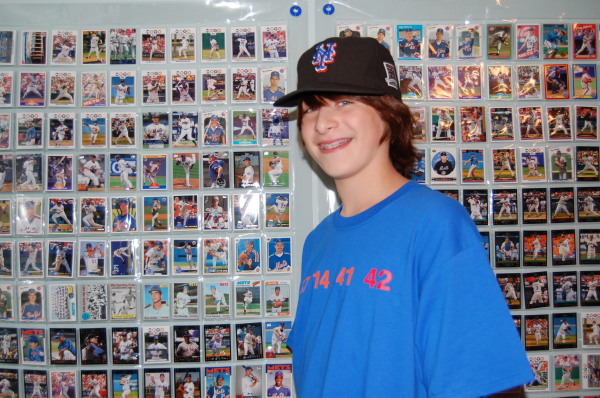 You know what goes well with a wall full of Mets baseball cards? Connecticut’s own Ryder Chasin sure does. We’re happy to see the Faith and Fear numbers complement however many hundreds of cards he has up behind him and we wish him mazel tov! this Saturday as he celebrates his Bar Mitzvah. We hear it’s going to be a home run (in a place where few are hit, no less).