The blog for Mets fans
who like to read
ABOUT US

Faith and Fear in Flushing made its debut on Feb. 16, 2005, the brainchild of two longtime friends and lifelong Met fans.
Greg Prince discovered the Mets when he was 6, during the magical summer of 1969. He is a Long Island-based writer, editor and communications consultant. Contact him here.
Jason Fry is a Brooklyn writer whose first memories include his mom leaping up and down cheering for Rusty Staub. Check out his other writing here.
Got something to say? Leave a comment, or email us at faithandfear@gmail.com. (Sorry, but we have no interest in ads, sponsored content or guest posts.)
Need our RSS feed? It's here.
Visit our Facebook page, or drop by the personal pages for Greg and Jason.
Or follow us on Twitter: Here's Greg, and here's Jason.
|
by Greg Prince on 24 February 2009 5:04 pm Do we blame this on Hubie Brooks? If we give him the credit for starting a trend at one position, do we pin accountability on him for a far more insidious trend at another position?
It’s Mets 101 that third base was the perpetually hexed corner for a very long time, roughly from the dawn of time through Phil Mankowski in 1980. Consider that the third baseman who began to lift the curse of the hot corner was Hubie Brooks, whose competent play as the undisputed starter for four seasons from 1981 to 1984 set the stage, historically speaking, for Howard Johnson, Edgardo Alfonzo, Robin Ventura and, finally, David Wright to turn a longtime liability into an unquestioned asset. Consider as well that the player who took over in right for Darryl Strawberry, starting on Opening Day 1991 and for 97 games that season was…Hubie Brooks, in his second tour of Met duty.
Right field has never been the same since Buddy Harrelson sent Hubie out there. Hubie just kind of disappeared and he’s taken almost all of his successors with him.
Will Ryan Church be the Mets’ regular starting rightfielder in 2009? Jerry Manuel says yes. Recent and even distant history say absolutely not. He probably won’t even be here come 2010.
Why so fatalistic where Churchy is concerned? Because after carefully studying the relevant pages of baseball-reference, I have concluded there is no such thing as a regular starting rightfielder on the New York Mets.
At various stages of Met development, third base, center field, catcher and, in the modern era, second base have all taken turns as sore thumbs on the Met glove hand, sometimes a whole mitt’s worth. These have all been the unfillable positions for lengthy, uncomfortable stretches until a blue and orange knight emerges to stab grounders, track down flies or dig balls out of the dirt. Third is the most mythical of them all, but David Wright seems to have buried the third base hex for the foreseeable future. Center and catcher were particularly gaping voids in the franchise’s developmental years, but Tommie Agee and Jerry Grote put those spots on track and they’ve been fairly well taken care of most seasons. Second base, since Alfonzo was moved off it in deference to Roberto Alomar (boo), has been a throwback…or a woeback, the position that never finds stability. But second base did have Fonzie as recently as 1999-2001 and, at various junctures, it had Kent, Jefferies, Backman, Flynn, Millan and Boswell for at least three or more straight seasons.
Right has had nobody. Actually, right has had practically everybody, but nobody has claimed right field as his own since Darryl Strawberry. Darryl Strawberry left the Mets in 1990. Quite the arid dry spell has ensued without what you could call a regular starting rightfielder.
The Mets have swung from dreadful to delightful and back and forth in the nearly two post-Straw decades, but they’ve never settled on anything approaching a regular starting rightfielder. In the 18 individual seasons since Darryl skedaddled to L.A., the Mets have had 15 different players serve as their most oft-used starting rightfielder — most oft-used not being the same as regular. Right has become an Amazin’ly irregular outpost.
Let’s think about what it means to be a regular. You figure a guy is the everyday starter. Everyday doesn’t necessarily mean he literally starts every single day. You gotta give him a blow now and then, so he sits maybe once a week on average. But when crunch time comes, you send him out there. A reasonable rule of thumb would have him starting 140 games at his position, which works out to 86.4% of the 162-game season, slightly more often than six games in a seven-game week (85.7%).
You know who the last Met rightfielder to meet that 140-game threshold was? Darryl Strawberry. In 1990, Darryl started 146 games in right. He started 149 games apiece in 1987 and 1988. Those, incidentally, were Darryl’s three MVP-candidate years (finishing sixth, second and third, chronologically). In three other years — ’84, ’86, ’89 — when he battled nagging injuries and/or nettlesome lefties, he started 126, 127 and 128 games. 1985, when he tore ligaments in his thumb diving for a ball, was the only Met year when he was limited to fewer than 100 starts.
Darryl ended another noticeable right field drought — a.k.a. the Youngblood years — when he came up on May 6, 1983 and proceeded to start 114 games. Nobody had been around in right even that much (70.4% of the schedule) since Rusty Staub, who was Le Grand Ironman in right for three consecutive seasons, starting 150, 146 and 153 games, respectively, from 1973 to 1975. His first year in New York was ruined by a broken hand (65 starts in 156 games), but otherwise Yogi Berra and Roy McMillan couldn’t have enticed Staub out of the lineup even had they wielded a rack of New York’s most tender baby back ribs.
In 1986, SportsChannel conducted a fan survey to determine the Mets’ all-time 25th Anniversary team. It listed three players at each position. Strawberry and Staub had a very tight race in right, splitting almost the entire vote between them, with Darryl edging Rusty and Ron Swoboda finishing a very distant third. Pending what happens the next couple of seasons, you could run the very same poll for the Mets’ 50th anniversary by listing the same three rightfielders with no accuracy lost. Except for Staub, Strawberry and, to a certain degree, Swoboda, no Met has left a long-term mark in right.
Not one.
Keeping Jerry Manuel’s Team First mantra in mind, none of this matters of its own accord. If the team wins, you can start one rightfielder 70 times, another 61 times and still another 27 times and nobody’s going to get caught up in the math. That was the equation the platoon-savvy Gil Hodges executed in 1969: Swoboda with 43.2% of the starts, Art Shamsky with 37.6%, Rod Gaspar with most of what remained (though only once after August 4). Rocky led Mets rightfielders in starts four consecutive seasons, ’67 to ’70, but never with more than 117 turns. Some of it is attributable to Hodges discovering what worked, some of it was determining what would work. Some Swoboda, it turned, worked better than all Swoboda.
Stability is a desired trait at any position, but no manager is going to be tethered to one player if the player’s not producing. That’s a decision that helps explain why right field, with the exception of Strawberry and Staub, has been a black hole. There is a great tradition of — to put it in layman’s terms — guys not getting the job done full-time. Less organically, you might not have the same guy in right every day less because of performance and strategy and more because of unavoidable circumstances. Injuries happen. Military reserve duty used to happen. Trades happen. Your rightfielder on Tuesday might have to be your leftfielder or first baseman on Wednesday. None of this is particularly mysterious.
What’s mysterious is why it keeps happening to Mets rightfielders, why almost none of them has ever taken the proverbial bull by the proverbial horns and held said proverbials for any significant period of time. It’s always happened to Mets rightfielders not named Staub or Strawberry. It’s not an exaggeration.
• Exactly one Met rightfielder prior to Rusty in 1973 started as many as three-quarters of a given season’s games: Joe Christopher in 1964.
• No Mets rightfielder besides Swoboda, Staub and Strawberry has led Mets’ rightfielders in starts in more than two seasons.
• Only two rightfielders since Darryl have led the team in right field starts in two consecutive years, none in more than a decade.
• This decade we’re on our tenth year of has been an absolute rightfield whirlpool, with nine different rightfielders taking the most starts in each of the past nine seasons.
How transient and treacherous has right field become? Nobody since Jeromy Burnitz in 2002 has started more than two-thirds of the games out there; he wouldn’t be a Met by the end of 2003. The leader in games started in any one year in the 2000s is 2000 rightfielder Derek Bell, with 136 starts. Bell started the first game of the ’00 playoffs, slipped on the grass at Pac Bell and was, in terms of playing for the Mets, never heard from again.
Timo Perez stepped up when Bell fell down and sparked the Mets to series wins over San Francisco and St. Louis. Somehow it’s appropriate that he couldn’t keep his right field job clear to the end of the 2000 postseason. Game Five of the World Series was started by Bubba Trammell — his last game as a Met. Timo trotted out to right in more innings (427) than anybody else in 2001, but the most starts were covered by the fleeting presence of Matt Lawton (a scant 46). Nine different Mets started in right in ’01, with Tsuyoshi Shinjo (28) the most colorful, Alex Escobar (6) the most promising and Darren Bragg (9) fighting it out with Mark Johnson (4) as the most forgettable. No matter: None of these gents was a Met in 2002. Neither was Opening Day rightfielder Darryl Hamilton nor one-day cameo rightfielder Lenny Harris. Perez and Joe McEwing were the only survivors of 2001’s 162-game experiment.
Burnitz would be an essential part of the self-inflicted wound that the Mets brought on themselves in 2002. Jeromy loomed as the regular starting rightfielder in 1993 and 1994, though in each year had fewer starts, respectively, than Bobby Bonilla (shifted to third when HoJo got hurt, no doubt winning friends and influencing people in the process) and Joe Orsulak (48 times to the gate vs. 41 for Burnitz in a strike-truncated campaign), but he was gone after ’94. His homecoming in ’02 was going to be a feelgood story, like Roger Cedeño’s. Cedeño, incidentally, was the starting rightfielder of record in 1999 (89 starts) but was ousted before the century’s end via the Mike Hampton trade.
Neither Burnitz nor Cedeño made anybody feel good in 2002, and the pain continued in 2003, with Roger inheriting right once Jeromy was sent packing to L.A. Cedeño hit pretty well down the nonexistent stretch in ’03, making him just attractive enough to be traded to St. Louis the next spring. 2004 is notorious as the year the Mets skipped the opportunity to sign Vladimir Guerrero and opted for a Karim Garcia/Shane Spencer platoon, the kind of arrangement that was just too good to last. Neither fellow lasted past August, and midseason acquisition Richard Hidalgo led the Mets RF unit with 81 starts.
Natch, Hidalgo was outta here! by 2005, a more star-crossed year than usual in right. Mike Cameron was the Mets’ centerfielder in 2004, generally living up to his defensive notices. But he was no Carlos Beltran, which was a quantity the Mets lacked in ’04, but committed themselves to for ’05 and beyond. To put it just short of politely, that meant they were stuck with Cameron, so they stuck him in right pretty much against his will. Mike missed the first month with an injury and was wiped out in August by his horrendous Petco Park collision with Beltran, two centerfielders diving for the same ball, one of them miscast as a rightfielder. Cameron never played for the Mets again, temporarily giving way to Victor Diaz, who wound up with more starts (74 to 67) than his fallen comrade.
Ah, Victor Diaz. He would trickle ever so briefly into 2006 but march to the front of the brigade of lost rightfielders immediately, never playing the position for the Mets again after 2005. Diaz’s signature swing was the one on which he connected for a ninth-inning, two-out, game-tying homer off the Cubs’ LaTroy Hawkins on September 25, 2004. It was one of those teases in which Met right field prospects seem to specialize, dating back to Ron Swoboda’s bursting onto the scene with a first-half power surge in 1965. Swoboda was otherwise unready for the majors and, some indispensable baseball heroics notwithstanding, never formed fully as a player. Yet since Swoboda, we’re regularly suckered by some come-hither stud who — with the singular exception of Mr. Strawberry — leaves us in the morning feeling cold, alone and used.
• Ken Singleton gave us one year as a young, athletic regular starting rightfielder, 74 games in 1971, before being dispatched to Montreal for Staub. Can’t complain about receiving Staub in return, but the yen for young and athletic would go unsated in right, leaving us vulnerable to the next half-decent prospect who lit up an otherwise dreary September.
• Mike Vail was going to take over for Rusty in 1976 after his rookie 23-game hitting streak. It was going to be worth taking on Mickey Lolich even. But Mike played basketball in the offseason and dislocated his foot before he could relocate from left. Vail led Met rightfielders in starts with 67 in 1977, was waived before ’78.
• Carl Everett could do it all…sometimes. He did it as the starting rightfielder a plurality of 1995 — 67 out of 144 games, but couldn’t hold the job into ’96.
• Alex Ochoa introduced “five-tool player” to the Met lexicon (or revived it from the halcyon days of Ellis Valentine) when he came up in the middle of 1996 and hit for the cycle in Philadelphia. He solved the rightfield problem for 72 starts before recreating it anew when he couldn’t hit for his life in ’97. Alex Ochoa’s legacy was making sure we wouldn’t get too hung terribly hung up when we gave up early on Alex Escobar.
• Butch Huskey was long touted as the best power prospect in the Mets’ system. He was also touted as a third baseman in one of the less accurate toutings in memory. Huskey would settle in right for the duration of 1997 (68 starts) and a majority of 1998 (94 starts) before being exchanged for Lesli Brea, not a rightfielder, but also never a Met.
Huskey was the last man to nominally hold down right for two consecutive seasons, the first since Bobby Bonilla. Bonilla, literally a mammoth presence in right early upon his 1999 return (before inertia and common sense prevailed), was supposed to be an answer of some sort when he was signed prior to the 1992 season. It will be recalled that Bobby Bonilla’s major contribution as a rightfielder in ’92 was wearing earplugs to drown out the fans’ appraisal of his no-tool play. At one point that year, Bonilla said the fans still hadn’t gotten over the departure of Strawberry. The track record in right indicates they’ve had no reason to.
Anyway, Victor Diaz didn’t last and neither did Xavier Nady, whose crime as the regular starting rightfielder for 70 of the first 104 games in 2006 was playing well enough to be desirable to another team (Pittsburgh) who had what the Mets badly needed (relief pitching) when the Mets flukishly (cab accident) found themselves feeling desperate. Roberto Hernandez was not fair market value for Xavier Nady, though throw-in Oliver Perez made it a perfectly decent trade in the big picture. But if you focus just on right field, Nady’s disappearance down the right field hole simply continued a long-running trend of futility.
Into that hole stepped Shawn Green. Bereft of the hitting and fielding skills that made him a star in Toronto and an icon in Los Angeles, Green meandered from adequate stopgap to aging liability, good enough for the eventual N.L. East champs in ’06, not nearly the answer for the far more tenuous division leaders of ’07. Green, who would retire after 2007, started 107 games in right, the most any Met rightfielder started in five years; alas, they and he weren’t enough to help fend off a most infamous finish.
Lastings Milledge and Carlos Gomez were given shots in right in ’07, but, like Green, neither would be a Met by 2008. In fact, no Met who made the most starts in right in a given season during the decade spanning 1998 through 2007 — that would be Huskey, Cedeño, Bell, Lawton, Burnitz, Cedeño II, Hidalgo, Diaz, Nady and Green — would be in the Mets organization by the end of the succeeding season.
Which brings us to Ryan Church, right field starter for 81 of 162 games last year, more than anybody else on the Mets. Acquired from Washington for Milledge, Church had a great start, a dismal end and a dizzy middle, thanks to the second of two 2008 concussions that definitively derailed his first season as a Met. But he was still here when camp opened ten days ago and he was a presumed lock to start regularly in right in 2009. Then, over this past weekend, Manuel mentioned something about Daniel Murphy being the everyday leftfielder and allowed that maybe Church would platoon in right with Fernando Tatis, previously penciled in as sharing left with Murph.
Nah, not really, Jerry says now. The Murph part stands. He’s in left, but Churchy is supposedly secure in his position.
“You’re getting ready to be the rightfielder for the Mets,” Ryan Church’s manager told him Monday.
“I knew that,” the player responded.
Oh, Ryan. If you only really knew what you’re probably in for.
Admittedly, eerie precedent isn’t stone destiny. Ryan Church could possibly break the mold if he doesn’t break his head first. He could become the first rightfielder since Bell to start in more than two-thirds of the Mets’ games, the first rightfielder since Huskey to start the most games out there two consecutive years, the first since Bonilla in ’92-’93 to total 200 starts in a two-year span. Ryan Church is 30 years old and not without talent. He could blossom into if not another Strawberry then maybe a top banana on the Mets for years to come. Hexes, jinxes and whatever else that randomly doom one position on the field to an eternity of misfortune do come to an end.
Back to where we started, with Hubie Brooks, the Mets’ regular starting third baseman from late 1980 until late 1984, traded for Gary Carter directly thereafter, reacquired for Bobby Ojeda six years later. Straw, at the time of Hubie’s homecoming, was heading out west, universally acclaimed as the best everyday player the Mets had ever signed and developed. That acclimation remained universal and largely unchallenged until right about now, with David Wright’s tenure and stats clearly catching up to Straw’s. The Daveotronic 5000 may be an unstoppable machine in this regard.
The Mets’ first top-flight third baseman went to right field. Eighteen years of mishaps ensued in right. A third baseman stands on the verge of usurping a rightfielder’s crown as the Mets’ best-ever position player. I don’t know what it means, but one of these days, somebody’s not gonna get sucked into that vortex.
All the bases are covered and all fields are hit to in Faith and Fear in Flushing: An Intense Personal History of the New York Mets, available for pre-ordering now via Amazon, Barnes & Noble and other fine retailers.
by Greg Prince on 23 February 2009 11:12 am The Academy would like to pause for a moment to remember those Mets who have left us in the past year…
Gustavo Molina, 2008
I was surprised — and, oddly, a little disappointed — to find Gustavo isn’t, in fact, part of the seemingly inescapable Molina catching clan. Perhaps “molina” means “receiver” in some Spanish dialect, much the way someone named Cooper can bet he had an ancestor who made barrels. Or perhaps it will mean that one day.
—March 20, 2008
Willie Collazo, 2007
He’s 28, but he’s also a lefty who strikes people out. Might escape his Zephyr card yet. Might also never be heard from again.
—November 6, 2007
Ricardo Rincon, 2008
Ricardo Rincon has been nailed to a cross constructed of forMicah.
—September 26, 2008
Ambiorix Burgos, 2007
Ambiorix Burgos came into pitch the ninth and get the pretend save. I expected a nine-run disaster that would prompt an avalanche of calls to the FAN that we must trade this guy at once and bring back maybe Jorge Julio, but no, he pitched well.
—March 1, 2007
Jason Vargas, 2007
Dave Williams and Jason Vargas and Aaron Sele are the pitching equivalent of spaghetti hurled at a wall.
—January 31, 2007
Andy Phillips, 2008
Did I know, Ben asked, that the Mets have started 12 different leftfielders this season? I did not. Could I name them now that I knew there were an even dozen? Alas, I could come up with only 11/12ths of them…the one I didn’t get was one-game starter Andy Phillips.
—August 26, 2008
Abraham Nuñez, 2008
Chris Aguila is apparently up, Abraham Nuñez is undeniably down. The Mets are riding ’round in a hole in the ground.
—June 11, 2008
Chris Aguila, 2008
Topps has obviously hired some obsessive Met fan. How can I tell? Because Chris Aguila got a Met card.
—November 22, 2008
Brady Clark, 2002; 2008
Brady Clark was here. Now he’s gone. He left a hole on the bench to carry on…
—May 28, 2008
Trot Nixon, 2008
Moises Alou…Brady Clark…Matt Wise…Trot Nixon…they were all 2008 Mets when I could barely tolerate the 2008 Mets. They’re all getting paid somewhere in this organization to heal. I’ve lost track of Nixon.
—July 26, 2008
Matt Wise, 2008
A long winning streak could begin to unspool as soon as Wednesday night, and Tuesday afternoon would go into the books as an unpleasant stumbling block that had all the staying power of Matt Wise.
—April 8, 2008
Raul Casanova, 2008
There were no weekend express trains — and what locals there were sat like Raul Casanova and crawled like Brian Schneider.
—April 12, 2008
Claudio Vargas, 2008
Even with the bases empty, a tenuous 2-0 lead, built on Wright power and awaiting the benefit of opposing catcher’s interference, needed all the help it could get to keep Claudio Vargas’ goose from being prematurely cooked and to keep the newest era of Met good feeling from dying at the tender age of two days (as eventually we’d be positioned, per usual, to fall victim to the status Kuo).
—May 30, 2008
Ruben Gotay, 2007
Gotay’s loss is a little distressing, especially since he wound up claimed by the Braves (the only thing we’d like them to claim is last place), but I won’t pretend I was his biggest supporter. I liked half his bat — the right half — if little of his glove. But the kid was fast and had moxie, as evidenced by his contribution to the memorable five-run ninth the Mets pinned on the Cubs last May 17, and this team could always use more moxie, to say nothing of speed.
—March 30, 2008
Jorge Sosa, 2007-2008
After lying back and enjoying it, I still can’t get over Sosa, who looked so bad all last year and all spring. I had read his New Orleans pitching coach tinkered with his arm slot. Is that really what it was? An arm slot? These guys get to the Majors, struggle until their jobs are in jeopardy and then it’s something as simple as “hey you, move your arm this way, you’ll throw more strikes”? Wow. Who says pitching coaches don’t earn their paychecks?
—May 6, 2007
Luis Ayala, 2008
A fog rolled in to the depths of Shea Stadium. Everything grew hazier and hazier until I was taken to what was called the piece d’resistance: a ghostly image — a hologram, actually. It was Greg Norton launching a three-run bomb off Luis Ayala in the ninth inning on September 14, 2008. “Whoa!” I said again. “This is already here? This is here with everything else that has destroyed our spirits and represents all that has gone wrong at Shea Stadium over the past twenty-plus years? You’re already listing this in your catalogue of horrors?”
—September 15, 2008
Joe Smith, 2007-2008
I admired Joe Smith’s first-night guts if not his first-night results (he threw strikes, the rest will come).
—April 2, 2007
Scott Schoeneweis, 2007-2008
Has some brains, gives you hope by knowing enough not to get stoned in the woods or to sneak off and make out with the hot counselor from the camp across the lake. But inevitably slips in the wet grass and then scrabbles helplessly in a vain effort to get up as the escaped lunatic fires up the chainsaw. Oogh. That was gross.
—September 18, 2008
Orlando Hernandez, 2006-2007
El Duque was vintage El Duque (vintage in this case possibly referring to the 1940s, but that’s OK).
—June 24, 2007
Damion Easley, 2007-2008
I love when it’s Damion Easley lifting the team on his shoulders because it means Damion Easley will be interviewed by Kevin Burkhardt after the game and Damion always tells Kevin something interesting. Friday night, in response to a question about how the team is feeling, he answered that the team feels confident. Boilerplate, I suppose, but he added, it’s “the earned confidence,” earned through the hard work of a team that had been diddling around for too long, that woke up and got busy living. He didn’t say that part quite that way; he didn’t have to.
—July 12, 2008
Moises Alou, 2007-2008
Alou would show up in those taped messages telling you to not toss your crap on the field. They offered merchandise with his unfamiliar face on it at the concessions. He was listed in the program. You knew he was still technically affiliated with the Mets, but you couldn’t quite put your finger on what he did for them. Now you can. Today reminded us why on the verge of 41 he was signed for a year and why it made perfect sense. He hits the ball hard almost every time up.
—August 12, 2007
Aaron Heilman, 2003-2008
Dorian Gray had a portrait that aged so he didn’t have to. Maybe Aaron Heilman could try that trick. With every bad outing, the portrait would get a little more squinty, a little more hangdog, a little more slump-shouldered, a little more looking like it just built into an industrial-strength lemon or walked into class and got handed a pop quiz. The advantage, of course, is this would leave the real Aaron Heilman looking not at all that way. He’d remain broad-shouldered and impassive, even as batters strolled to first and balls found holes and boos rained down on him.
—May 14, 2008
Endy Chavez, 2006-2008
We knew instantly that people would still be referring to it for years and here we are, 20 years later, and I don’t even have to elaborate. I say “Endy Catch” and you can still see it (I mean in your mind as well as on those ads for the Chavez Defensive Instructional Download). Anyway, we thought we had some momentum. The Mets had a long history of sensational postseason moments and the Endy Catch was surely one of those. We usually won when those happened.
—October 20, 2006
Pedro Martinez, 2005-2008
Sunday reminded us Pedro Martinez is more than a Met. He is the Met on these Mets. Due respect to other names and other numbers that dot the backs of our tribe, it is MARTINEZ 45 that truly cloaks us. He is the flagship player of this franchise. He is our banner, our symbol, our coat of arms. And when he showed up to pitch from the Shea Stadium mound for the first time in 2007, I was reminded as well that there is truth in advertising. It took 142 games, but our season had come.
—September 10, 2007
Mets for all seasons are remembered fondly and otherwise in Faith and Fear in Flushing: An Intense Personal History of the New York Mets, available for pre-ordering now via Amazon, Barnes & Noble and other fine retailers.
by Greg Prince on 22 February 2009 2:17 pm Just saw David Wright on MLB Network declare the Mets need to let “our bats and gloves do the talking” when it comes to competing with the Phillies.
“Hey David,” said his bat, “don't be afraid to make contact with me if there's a runner on third and nobody out.”
“Yeah David,” added his glove, “and steady yourself before throwing to first. Just a little friendly advice.”
Over on SNY, the reairing of SportsNite led with a scare tease about “THE FIRST INJURY OF METS SPRING TRAINING…AND IT'S A PITCHER!” while images of Santana, Rodriguez and everybody else whose health you value at least as much as your own flashed across the screen.
Tim Redding's shoulder is a little strained was the news. Not that that's good news. Projection: he will try to come back too soon, overcompensate in some way, give up some huge homer in long relief and be booed out of The Field @ Shea Point before revealing, probably in late September, “I shouldn't have rushed back.” Not wishing any of that on Tim Redding at all. But if you have Tim Redding injury news, don't show me Johan Santana's picture unless it's to assure me not to worry, this has nothing to do with Johan Santana beyond the empathy he feels for a teammate (what a great guy).
At least five Mets are lookin' good, according to SNY: Putz (throwin' darts), Maine (feelin' loose), Church (dizzy not), Castillo (lighter than air) and Sanchez (at long last not rehabbing, just concentrating on pitching). Jerry Manuel said you don't practice baseball, you play baseball, which is probably the most substantive bulletin you can expect out of Spring Training on the last weekend before the Mets spend every weekend through late October playing baseball.
That is if their bats, their gloves and maybe their balls do the talking.
Amazin' angst and optimism alternate throughout the pages of Faith and Fear in Flushing: An Intense Personal History of the New York Mets, available for pre-ordering now via Amazon, Barnes & Noble and other fine retailers.
by Greg Prince on 20 February 2009 1:23 pm Welcome to Flashback Friday: I Saw The Decade End, a milestone-anniversary salute to the New York Mets of 1969, 1979, 1989 and 1999. Each week, we immerse ourselves in or at least touch upon something that transpired within the Metsian realm 40, 30, 20 or 10 years ago. Amazin’ or not, here it comes.
And there used to be rock candy
And a great big Fourth of July
With the fireworks exploding
All across the summer sky
—Joe Raposo, “There Used To Be A Ballpark”
Scouring the baseball-reference page devoted to the schedule of the godforsaken 1979 New York Mets is like going to Andy Dufresne’s big hayfield up near Buxton. It’s got a long rock wall with a big oak tree at the north end. It’s like something out of a Robert Frost poem. Find that spot. At the base of that wall…I mean in the middle of that schedule, you’ll find a game whose paid attendance has no earthly business on a listing of 1979 home games.
It’s June 16, a Saturday night against Atlanta. The paid attendance is 28,313. The night before, the Mets drew 9,805. The next afternoon, they attracted 12,133. For the six games encompassing the two series preceding it, against the Astros and the Reds, paid attendance was, Friday to Wednesday, 12,196; 10,499; 15,879; 4,917; 9,805; and — following a game in which the Mets scored ten runs in a single inning which you might think would meaningfully goose walkup sales — 12,468.
Those six games added up to 65,764, or 10,961 per date. In June. Against two contenders. One of whom had Tom Seaver on its roster.
Typical. Typical 1979. The Mets averaged 11,433 in paid attendance each time they opened Gates E through A that year, 69 times in all. That includes one tie — The Fog Game of May 25 that was called in the eleventh — and thirteen doubleheaders, only four of which were scheduled ahead of time. A lot of fog and rain descended on Shea Stadium in 1979, and it kept the fans away in proverbial droves. In fact, the more the Mets played, the less the fans came. Weather forced the Mets into four doubleheaders in a five-day span in September. The paid attendance for each buy one/get two special was 4,233; 4,973; 4,229; and, on a Saturday, 8,492.
If you used 1979 and its indelible total attendance of 788,905 as your gauge, you’d wonder why the Mets would build their next stadium with as many as 42,000 seats. It’s not like you’d ever use more than two-thirds of them.
Ever.
That 28,313 on June 16 was the top attendance of 1979. It beat, by 59 souls, the crowd that bought (and used) tickets for Old Timers Day, which was a relatively huge deal in ’79 because it was the tenth anniversary of ’69, which looked enormous in the rearview mirror considering how small 1979 was.
But 1979 blew up on June 16. Literally. It was Fireworks Night at Shea Stadium, the first one.
How could the Mets resist? They had seen firsthand how successful Fireworks Night was in Philadelphia where they provided the opposition on the Fourth of July in 1977. Fireworks Night was enormous at the Vet, never more so than in ’77 when the Phils sizzled and the Mets fizzled while 63,283 bore witness. 63,283? That was practically a week’s worth of business at Shea in the late ’70s.
So the de Roulet Mets got an unlikely promotional clue and scheduled their own. They even borrowed from the Phillies’ playbook and scheduled a team that wasn’t much of a challenge or a draw: the Braves. In 1979, the Braves were the Western Division’s equivalent of the Mets. Then again, it wasn’t like anybody was showing up at Shea to see any opponent in particular. The Mets were a very effective repellent against frontrunning.
But fireworks created a crowd. 28,313 thought Fireworks Night was worth the hassle entailed by putting up with the 1979 Mets and the 1979 Braves. Kevin Kobel made the fuss as minimal as possible by taking only 1:57 to outduel Mickey Mahler. And then…
KABOOM!
It wasn’t a premature attempt to implode Shea. It was the Grucci Brothers (proclaimed for weeks in advance by Murph, Ralph and Steve Albert as the best there were) in action. Fireworks lit up the sky over Flushing. The fans oohed and aahed. Then everybody left and not very many of them would come back to take direct part in the segment of the 63-99 campaign that remained.
But Fireworks Night would return. It was a hit in New York like it was a hit in Philadelphia. Over the years, Fireworks Night maintained its place as the volcanic glass in the Shea hayfield. The Mets in any given season might not be very good and they might not appeal to too many people, but folks would show up for those colored lights, for those resounding bangs, for whatever it is that makes people stare up at the artificially bright night in fascination.
July 6, 1980: Fireworks Night vs. Montreal draws 51,097.
Night before? 12,585.
Day after? 21,880.
July 5, 1982: Fireworks Night vs. L.A. draws 38,270.
Day before? 20,897.
Night after? 20,816.
July 3, 1993: Fireworks Night vs. San Fran draws 44,160.
Night before? 20,811.
Day after? 22,641.
By ’93, incidentally, attendance figures became a bit of a sham as it began to reflect tickets sold (formerly the American League standard), not paying customers who bothered to appear. But there were always more fans — Mets fans, fireworks fans, spectacle fans — who materialized for Fireworks Night at Shea than there were for the generally lousy baseball in those years. More showed up than for the first Fireworks Night in ’79 because you couldn’t have less.
Except in the wake of 1993, which was truly 1979’s bastard nephew.
In 1994, the club scheduled not one, not two but three Fireworks Nights. The scheduling was done after the 59-103 disaster of ’93, so anything that could serve as a distraction loomed as a decent idea — in triplicate, no less. But it was just more, not merrier. The first Fireworks Night of 1994, the Friday of Memorial Day weekend versus the Reds, drew a mere 23,303. Even the Gruccis couldn’t blast away the residue of 1993. And the July 4, 1995 exhibition of sparklers and such couldn’t light up the dark post-strike sky, as only 21,611 dropped by. Better than the 15,993 the night before and the 14,377 the night after, but not classically Gruccilicious by any means.
Certainly not like 1986 when if you had a great team and a great promotion, you rated an extraordinary crowd. The Mets and Astros lured 48,839 — a legitimate 48,839 — to Shea for all kinds of fireworks on July 3, particularly in the tenth inning. Down 5-3, Darryl Strawberry homered with one on before Ray Knight unleashed a cannon shot to win it. When the postgame fireworks came, they weren’t anticlimactic. They were an embellishment. That right there was the golden age of Fireworks Night, back when Channel 9 would stick around afterwards and have George Plimpton, New York City’s unofficial Fireworks Commissioner, give color commentary. Anything beyond “that one there just went boom!” was beyond my interest level, but I loved the feeling that everything the Mets touched was worth commenting upon.
In later years, when Mets Extra with Howie Rose became required listening, I became disappointed by Fireworks Night. Because it was so darn loud, Howie rushed through his postgame wrapup and beat it out of Dodge. Same aural fate would befall Eddie Coleman later on, but I didn’t consider that such a deprivation.
However, one night Eddie stayed on and valiantly recapped over the oohs and aahs, all of which were clearly anticlimactic. That was June 30, 2000, the Friday night when the Mets began the proceedings in the eighth inning down 8-1 to the Braves and finished it up 11-8 over those very same Braves (of course it was still against the Braves, but it always bears repeating). 52,831 of us were unofficial deputy commissioners that night, exultant that Mike Piazza got to wield the big gavel.
Even in 2000, during a season and an era when the Mets weren’t at all hard up for seatfillers, Fireworks Night was a draw that outdrew the games before it (46,998) and after it (44,593). It had survived its mid-’90s malaise to establish itself as the event that brought in those who didn’t go to Shea very often otherwise. Every year, I swear, somebody would tell me about the woes he encountered in taking his family to the game on this night and only this night; how he and his wife and his kid(s) got caught in an impossible traffic jam; how — because much of the main lot was blocked off as the spectacular’s staging ground — they were redirected somewhere south of the tennis center; how they had to pay some astronomical fee to park; how they didn’t get to their seats until the fourth inning; how the game invariably sucked. On those occasions, I never heard all that much about the fireworks.
I was always tempted to say, “they don’t make those ‘take mass transit’ pronouncements for nothing, y’know,” but I resisted.
After the Piazza Brothers lit up Flushing in 2000, what else was there to see that evening? With the Braves subdued, I bolted. I stayed for the literal fireworks the first two times I went to a Fireworks Night, in ’93 and ’95, because I was in situations like those my frustrated friends described, with family on hand solely for what would come after the baseball. In my case, it was my explosives-loving sister and her indulgent husband joining Stephanie and me. My wife and I would arrive by LIRR in time for the game while Suzan and Mark showed up in the fifth or thereabouts, packing sandwiches and utter disinterest. The fireworks were their thing and they’d be giving us a ride home, so what the hell?
In ’96, on one of those lightly attended May Friday Fireworks affairs (24,751), the Mets lost by so many runs (12) it was not at all attractive to stick around, so I didn’t. That became custom for me. As with the Merengue concerts that coincided with Mets games, I discovered I liked the rare treat of beating it out of Dodge ahead of the pack as extraneous noise began to build. I saw the Mets. What else was there to see? Somehow, I enjoyed the happenstance fireworks glances I took in from a distance on the train home more than I would have from my paid-for seat, I’m convinced.
My last Fireworks Night was the last official Shea Fireworks Night of them all in 2006, July 3 — 54,111 for one of those horrible 11-1 losses when everybody complained about the lack of parking. The main lot would be filled to capacity in 2007 and 2008 by a new ballpark, thus putting the kibosh on any more genuine Shea pyrotechnics. The last unofficial Fireworks Night was September 13, 2008, when by sitting in the Upper Deck for the second game of a makeup doubleheader (and seething over your failure to secure a between-games pretzel) you could sneak a peek at a pretty substantial fireworks display going on to the east.
I like fireworks that I’m not expecting. Stephanie and I agree that an unannounced exhibition set off in Washington as part of pre-Inauguration festivities on a cold January evening in 1993 was one of the greatest sights we ever saw. With no advance billing, something illuminated the sky. There was music. Then there were fireworks. Maybe fifteen minutes, maybe half an hour. Everybody on the Mall just stopped and watched and was awed. Kind of like it must have been for those who would line the 7 extension over the right field fence on Shea’s Fireworks Nights; or the impromptu displays that grab our attention when we scan the skies from our upstairs bathroom window every Fourth of July — but grander. It was the kind of thing that takes your breath away and you never forget.
Not as luminescent or earth-shaking as Piazza against Mulholland, mind you, but memorable nonetheless.
The Mets seasons that went boom and the Mets seasons that went bust light up the pages of the upcoming book Faith and Fear in Flushing: An Intense Personal History of the New York Mets, available for pre-ordering now via Amazon, Barnes & Noble and other fine retailers.
MLB Network Alert: Opening Day 1985, highlighted by Gary Carter’s “Welcome to New York” blast, is scheduled to air Saturday at 11:00 AM. Thanks to Joe D. for the tip.
by Greg Prince on 18 February 2009 7:30 pm 
Shea, there it is. And will always be, somewhere.
Thanks again to David G. Whitham for letting us feature his wonderful Shea Stadium portfolio in the winter of its deconstruction. Bet he makes the next joint look just as memorable.
by Greg Prince on 18 February 2009 6:21 pm “You’ve got your new address here. There really isn’t anything else you need.”
“Hold up. That’s it?”
“Sure. You’re golden now.”
“I don’t get it.”
“It’s not unexpected. You’re not the first one to move here and be a little frazzled from the whole experience. But honestly, you don’t need anything else.”
“How about an explanation?”
“That’s fair. I tend to forget you new guys aren’t acclimated.”
“You can say that again. The whole last few months have been a fog. Even worse than the one that used to roll in off the bay.”
“No worries.”
“What do you mean no worries? I get the feeling I’m not really myself anymore.”
“Au contraire, mon frère. If anything, you’re more yourself than you’ve ever been.”
“Once again, I’m lost.”
“I told ya: You’re golden now. We all are.”
“I need more than that.”
“Not really, but I’ll try to clear it up.”
“Great.”
“What’s the last thing you remember?”
“I don’t know. A lot of noise. And a lot of pain. Like I was missing pieces of myself. And they kept taking more of me.”
“Yeah, that’s common. But what’s your last really strong memory?”
“It’s gotta be the cheering. Some booing. A lot of booing, actually. But the cheers eventually drowned out the boos. Some pyrotechnics, I think. Billy Joel, too. ‘New York State of Mind,’ if I’m not mistaken. Yeah, I’d know that song anywhere.”
“And before that? I don’t necessarily mean right before, but you know, in general.”
“Lots of cheering. Mixed with booing, but definitely more cheering. Real noisy, but in a good way. Not like what I’m remembering from the last few months. Sure, some of it over the years was annoying, like the canned stuff over the PA…”
“We didn’t have that in my day.”
“…and those planes.”
“I wasn’t near the planes, but I heard you had those.”
“I bet you could hear those planes all the way up here.”
“You’d be surprised at what you can hear up here. They tell me that afternoon I had in ’51 rattled all kinds of clouds, which makes sense seeing as how it was heard ’round the world — just like that Saturday night you had in ’86 that kept all of us up.”
“You could hear that here?”
“Drowned out the planes even.”
“Really?”
“Tell me more about what you remember.”
“Well, noise. Put aside the unnatural stuff from the PA and the planes — and the bats and balls and all that — and I mostly remember the people.”
“The people?”
“You know, the, uh…oh what were they called again? I’m still woozy from everything going on these last few months.”
“Relax, you’ll get your bearings back in no time. Are the people you’re referring to ‘the fans’?”
“Yeah! That’s it! The fans! They made all kinds of noise!”
“What kinds?”
“Cheering, like I said. And booing. You wouldn’t believe how much booing sometimes. But there was this laughter. It was always there, like a steady stream. The people — those fans — they were so happy usually. I kind of remember the team not always being so good, but it was almost…”
“Beside the point?”
“Yeah! Like whatever the team’s record, it almost didn’t matter in the long run. People, especially the young ones, came to have fun. Like it was their first time.”
“Y’know what?”
“What?”
“At some point, it was their first time. You gave lots of people their first time.”
“Gee, I never thought of it that way.”
“That’s why you’re golden now. Are you getting it?”
“A little.”
“Let me help fill in the blanks. You know that laughter and the chatter and the sense of…”
“Fun?”
“Yes, the fun. That’s what they’re gonna remember you for now.”
“They are?”
“Absolutely.”
“‘Cause I gotta tell ya, I didn’t have the best reputation down there.”
“None of us did in our time.”
“You don’t understand. They called me some pretty nasty names toward the end, made it sound as if they had to play one more inning in me that the world would come to an end.”
“Listen, I heard it in my day, too.”
“You did? I find that hard to believe.”
“We all heard that stuff.”
“No way! People talk about you in such revered terms. They talk about all of you with reverence.”
“Yes, now they do. That’s because we’re not there anymore.”
“That makes a difference?”
“All the difference in the world. Down there, our blemishes show. Up here, the only thing people see or feel are their memories. And y’know what?”
“What?”
“Their memories aren’t about the blemishes.”
“They’re not? ‘Cause, honestly, I had my share of ’em.”
“Their memories are those first times they went. The first time is why they wanted to go back a second time, then a dozen times, then a dozen more times. And those made new memories, more memories, good memories. They didn’t go back to you because they didn’t like you. They may have found things to complain about, but that all paled in significance to the happiness you gave them.”
“I did that?”
“You sure did.”
“And that’s what they’ll remember? Not the nuisances or the inconveniences or whatever wasn’t working on a particular day or night?”
“They’ve already begun to forget.”
“Wow.”
“I think you’re coming around.”
“So that’s why you keep telling me that I’m…”
“Golden now. As of today, you exist solely in memory like the rest of us up here do. People don’t want to remember what they didn’t like about us. They want to remember what they loved. That’s why we all look so good up here.”
“That’s why we’re golden now.”
“You’re catching on.”
“So all that hacking away they were doing to me the last few months until there was nothing left of me?”
“Not an issue. Up here you’re yourself again. Better than new.”
“Do I look brand new? Or like I did later?”
“You look exactly the way the people choose to remember you. Some are going to want to see you as you were when you came to be or when you came into their lives or when you gave them their strongest memories inside you. That’s how they view me now. That’s how they view all of us. And how they view us in memory is all that matters anymore. That’s why I was saying all you need to know from here on out is your new address.”
“I don’t live at 123-01 Roosevelt Avenue anymore?”
“You live here now. You’re home.”
***
Shea Stadium lives on in the upcoming book Faith and Fear in Flushing: An Intense Personal History of the New York Mets, available for pre-ordering now via Amazon, Barnes & Noble and other fine retailers.
by Greg Prince on 16 February 2009 8:08 pm We’re a team. We win together, we lose together, we celebrate and we mourn together. And defeats are softened and victories sweetened because we did them together.
—Toby Ziegler
It was fairly early in the life of this enterprise, which turns four years old today, that I coined the phrase that passes for its mission statement: the blog for Mets fans who like to read. It’s probably one of the most succinct complete thoughts I ever committed to print.
Thing is, back on February 16, 2005, that description was a theory, an aspiration at best. The blog for Mets fans who like to read? You needed readers to validate that appraisal.
Soon enough, we got ’em. We got you, which is all we ever needed. Then we got so much more.
On February 16, FAFIF Day (a Federal holiday since 1971, provided it falls on the third Monday in February), I like to take a few moments and think about who we are and what we do. We write, yeah, but more than that — what makes me smile most about Faith and Fear in Flushing — is that we gather. We gather everybody around this particURLar campfire and we tell each other stories. Not just Jason and me, but all of us. You like to read and you like to write back and we respond in kind. It’s the circle of blog life.
It works. It works here in a way I’ve never seen it work anywhere else where the world is viewed through orange & blue-colored glasses. I’m a devoted and enthusiastic reader of dozens of Mets-themed blogs, but this is the only one that feels, on both sides of the digital railing, like a community in which I would choose to live, a place where I kind of do.
Just before the inauguration of President Obama and in anticipation of the Super Bowl, Newsweek‘s Howard Fineman, a native of Pittsburgh, used current events as an excuse to salute his beloved Steeler Nation, “one of the planet’s most populous and intense sports-fan cohorts” and, eventually, draw a larger point:
[S]uch groupings — what might be called “voluntary tribes” — are assuming a new importance in America. As neighborhoods and schools become more diverse, marriages become more mixed and social hierarchies break down, old lines are getting blurry. Voluntary tribes are a way of recreating a sense of community.
Fineman’s black & gold-tinged conclusion reminded me of an article I read in the Times five years ago this month, about the trend toward making funerals less about traditional religious rites and more about what made the deceased’s life his or her own; Humanists call it “a celebration of the life”. Some clergy grumbled that the “personalization” movement was an affront to what made a funeral a funeral. Said one theologian, ”It’s not as if old rituals are evolving to absorb new needs. It’s as if we’ve broken with tradition and people make things up.”
Which is fine with me, in death or life (which is always up for grabs if you’ve survived two consecutive seasons of Mets relief pitching). I cast my lot with my team a long time ago and I’m most at peace when congregating with those in my tribe, here or elsewhere.
Particularly here.
Leigh Montville wrote a wonderful story in Sports Illustrated in 2000 about what the end of Mile High Stadium would mean to a group of Broncos fans who had autumned together in the South Stands and grown close as a result. One of the regulars summed up the arrangement:
“Everybody knows everybody else in our section. It’s nice. Sometimes you don’t see these people anywhere else except at the games. But when the next season starts, you pick right up.”
During my brief forays into partial ticket plans and packs, I never felt that way about those who wound up by chance my recurring neighbors (a point hammered home by the “BULLPEN IS PIG PEN!” guy on the Final Day), so when the Mets ticket rep called last week to ask if I planned on “coming out” this season (which is a pretty personal question for a ticket rep, even one from the Mets), I continued to pass. I don’t know enough about The Field @ Shea Point, as the Other Jason calls it, let alone a particular section’s inhabitants, to want to commit to as many as fifteen games in the same spot.
But I’m good right here. I’m good here with you guys. I’m good that we, without as much as a memo, subtly shifted Faith and Fear from a blog about a team by its fans to a blog about the fans of a team — and their team. I’m glad that with our fifth Spring Training underway, I don’t feel compelled as I did during our first Spring Training to remark on every little development that drifts north…though Luis Castillo won’t bat leadoff for long if ever and Livan Hernandez won’t make or break this rotation. I’m proud that I can read a comment by one of our regulars and generally detect who left it before confirming the identity of the commenter, and that sometimes I know something’s been written by Anonymous before I see for sure that it indeed went unsigned (I would ask those mystery readers if they plan on “coming out” this season). I’m gratified that a mile-high level of discourse runs through our comments concourse; it runs like Reyes. I’m thrilled that ruminating for rumination’s sake is accepted as currency of the realm by those Mets fans who like to read, who like to read us.
I’m a Mets fan who likes to write. Thanks for playing along at home for another year.
Ruminating on Mets fandom like no book before it, Faith and Fear in Flushing: An Intense Personal History of the New York Mets is available for pre-ordering now via Amazon, Barnes & Noble and other fine online retailers.
by Greg Prince on 16 February 2009 8:07 pm 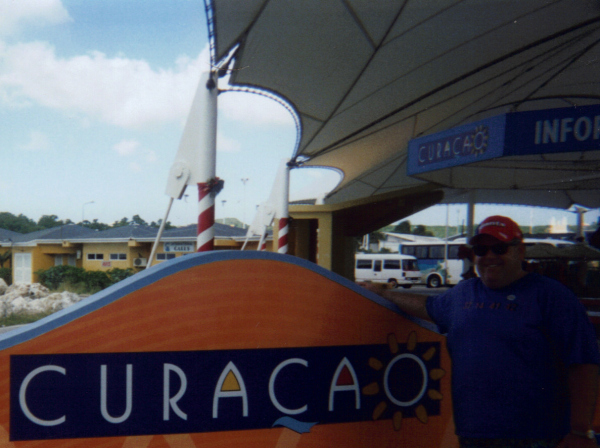
Charlie Hangley, one of the readers who makes our Faith and Fear community such a nice place to live, recently cruised to Curacao to have a word with Andruw Jones, resplendent (if a bit shadowy) in 37, 14, 41 and 42. Buy a Faith and Fear t-shirt and see the world…or just sit around the house. What you do when you wear it is up to you.
But be prepared to answer questions and deflect misconceptions if you’re far from where Shea used to stand.
“We were walking to the beach,” CharlieH says of his and SarahH’s trip south with the shirt, “and the woman behind me said, ‘Faith and Fear in FLUSHING??? What is that?’ So I told her and she said, ‘Oh. I thought it had something to do with the Plumbers Union or something.’ And at least three people I know thought the numbers were from Lost.”
by Jason Fry on 14 February 2009 6:02 am Spring training 2009 is finally here, but last night and tonight I found myself in another season and another year.
I'm not normally much moved by baseball rebroadcasts, much as I wish it were otherwise. No matter how improbable the comeback or triumphant the victory, knowing the end result robs the game of its tension and its drama — I wind up waiting around for the denouement instead of enjoying the story.
But for whatever reason, on Thursday night I knew what I wanted to see. It was the Essential Games of Shea, Game 5 of the 1999 National League Championship Series, Mets trailing the Braves, 3 games to 1. You know the one. The Grand Slam Single.
I can't tell you why, exactly. I wasn't consciously aware of the fact that that season is somehow now a decade old, though perhaps Greg's efforts slipped into my subconscious. It wasn't a sudden burst of affection for Robin and Fonzie and Oly and Big Mike and Tank and Turk and Bobby V., though that thrilling, exuberant team has few if any rivals in my heart. It wasn't sentiment for Shea, so soon now to be reduced to an outline in a parking lot, an apple in a museum and a scattering of souvenir parts. For whatever reason, it just felt right.
I was at the Grand Slam Single with Emily and her dad — the ticket stub says Upper Deck Section 48, Row O, Seat 11, which was high enough that the players were ants, back enough so if you leaned in the direction of Row P you were just under the lighting truss (this would prove important) and down the left-field line enough so there was no view of the DiamondVision and the speakers were all aimed away from us. There was no video to be seen and the PA exhortations were muffled thuds — I remember that during quiet moments you could hear the mumble and buzz of WFAN from handheld radios in row after row around us. Diehard territory for a diehard game, in other words.
On Thursday night Joshua wasn't exactly thrilled with this choice; around the third inning he told me solemnly and with more than faint disapproval that this wasn't very interesting to him because he didn't know these players. Stick with it, I suggested. You might change your mind. By bedtime (106 minutes into the DVD, which is shorter than it was on NBC because the commercials and pitching changes and goofing around in the on-deck circle are curtailed), Joshua was insisting that I write down where he'd had to leave so he could see the rest. As I'd expected.
Tonight I picked the game up from that point and just watched, enjoying a close-up view of a game I'd seen from afar, a warm indoor viewing of a game that had unspooled in increasingly cold and foul weather. I watched and noticed things and remembered.
Like the way the game seemed to encompass an entire autumn: It began in daylight and dry weather, with the crowd looking comfortable and relatively unbundled, then slid gradually into the dark and the cold and the wet, until in the 15th swathes of the box seats were empty (faithless weaklings!) and everybody left was huddled in whatever they brought to wear or bought from the clubhouse store.
Like Rocker and his constant police escort whether he was warming up or just sitting there waiting to do so. Rocker was this game's bomb in the suitcase; you kept waiting for him to appear and being teased by his refusal to do so. I'd forgotten a lot of his infuriating tics: the audible grunt of a released fastball, the stalking around in front of the mound, the shoulder shrugs, and most of all how his eyes (set slightly too close together) seemed to whirl like pinwheels when he'd look in for the sign. Or the way he'd stare into the crowd coming off the mound, walking on the very balls of his feet with a slight smile on his face, obviously trying to hear every last bit of the abuse, and you were never sure he wouldn't suddenly go barreling into the stands and sink his teeth into someone's throat.
Like wondering how many of these guys were on steroids. I'd bet $10,000 that several Mets and Braves (including Mets I loved and love) were juicing. Then there are the Mets and Braves whose name on some list wouldn't surprise me. Which leaves the ones whose presence on a list would surprise me, but not nearly as much as it once would have, because who can believe anything anymore? This line of thinking began to depress me, so I consciously shut it off.
Like the sheer desperation of countering Greg Maddux, that soft-as-silk killer, with Masato Yoshii. How did we ever think we'd get out of this one?
Like catching a glimpse, in the 15th inning, of Maddux and Yoshii on their respective benches. If not for those pesky rules, they probably could have gone back out there.
Like glimpses of non-roster Mets barely remembered. Hey, it's Luis Lopez! Who the hell is that? I think it's … Billy Taylor?
Like Bobby Valentine pacing in the dugout like a caged animal, his brain almost audibly whirring in an effort to extract his team from its predicament. Bobby was a storyline all to himself in this one, from the use of Dennis Cook for two pitches of an intentional walk (tactically understandable though regrettable come the wee hours) to the do-si-do with Matt Franco and Octavio Dotel and who was going to bat.
Like Orel Hershiser, standing beside Bobby for most of the game, as if he were co-managing. Come to think of it, that's a conversation I'd love to have been able to listen in on.
Like all the strands of baseball history you can trace backwards and forwards from the Grand Slam Single. Hershiser, who'd brought the Mets' expected dynasty to a decidedly premature end in 1988, now pitching to keep 1999 alive. Terry Mulholland and Mike Piazza would meet again memorably. So would Brian Jordan and Armando Benitez. We still haven't heard the last of Chipper Jones. A fossilized Gerald Williams would later clutter up a Met roster for an interminable period, an object lesson in how paleolithic baseball front offices can be. Jorge Fabregas would be a Met for about a week. Brett Boone and Andres Galarraga would walk away from baseball during or after Met spring trainings. Five Mets from that '99 team would become Yankees in later years — Ventura, Olerud, Benitez, Dotel and Pratt would all test our affections by donning the Raiment of the Beast, though Tank had the good grace to be cut in spring training. Four of those Mets — Pratt, Dotel, Matt Franco and the despicable Bobby Bo — would return to try and do us harm as Braves.
Like Bobby Bo's pinch-hitting appearance, with the disgust of Shea palpable at his appearance, followed by reluctant and then defiantly reluctant cheering. I suddenly, vividly remembered lecturing myself in the upper deck that if Bobby Bo hit a home run to win the game that was not a bad thing. He struck out. By the way, thanks to his deferred contract, Bobby Bo is still being paid by the Mets. Assuming the Mets have 26 pay periods a year and Bobby's in the top tax bracket, he just got a check for somewhere around $20,000 for 14 days of doing absolutely nothing. He'll get another one before it's March. Why doesn't Dennis Kucinich badger someone about that? (Update: This is wrong. See the comments.)
Like the cruelty of the game being slammed onto the unready backs of Dotel and Kevin McGlinchey, two rookies pitching amid steady rain and a howling mob with the whole world watching. Dotel was just 25. McGlinchey was 22, though he looked 52 by the time Ventura connected. McGlinchey was out of the big leagues at 23.
Like the unlikely heroics of Hershiser and Kenny Rogers. Rogers will always be reviled for throwing ball four in Game 6, with his able pitching in Game 5 remembered only by those watching the DVD as I did. I can feel myself forgetting already.
Like thinking that Bobby Cox looks really young. I never thought of Bobby Cox as ever being young — I figured he came out of the womb looking like a smaller, equally grumpy version of his current self. But go look.
Like the utter, unfathomable uselessness of Rey Ordonez with a bat in his hands. In retrospect, it's amazing how we twisted ourselves into knots trying to convince each other that his bat didn't matter.
Like the terror that I still felt seeing Keith Lockhart barreling around third and Melvin Mora's throw from right take a hard, flat bounce as it skipped home — the kind of throw that all too often winds up tipping over the catcher's mitt and going to the backstop. Piazza snared it, intercepted Lockhart and he was out and we were safe. Whew!
Like the sleepy, sad face of Shawon Dunston, at the plate in the rain wearing Ken Boswell's number. That would be 12, as in the number of pitches Shawn saw from McGlinchey, dragging the Shea fans up the ladder from resignation to rote defiance to admiration to hope to enthusiasm to pandemonium. By the end of his at-bat I was up and stalking around the living room, never mind that earlier stuff about denouement and story.
Like remembering how frightened I was, back in 1999, that Pratt — our burly, beloved, ridiculous and improbable Tank — would hit into a double play, an all-too-possible horror that I was achingly sure would leave me to slump into the soaked upper deck and stay there until around January 2000.
Like how instead Tank walked and flipped his bat in glee, so hard that it went over the stands and is rumored to have come down knob-first in the windshield of an illegally parked 1988 Ford Escort. OK, I made that last part up. But I didn't see it come down. I think it's up there somewhere with Jesse's glove.
Like the final release of ecstacy and astonishment and farce of Robin hitting McGlinchey's pitch “back to Georgia” — with Brian Jordan dugout-bound before it even touched down. Looking back, I love how Ventura tries to remain the cool, collected field general amid the tumult, pointing Roger Cedeno to home (if any '99 Met could have peeled off early or been distracted by, say, a shiny penny or an ice cream, it was Roger) and only giving up once Pratt had him three feet off the ground. God bless you, Robin Ventura, whereever you may be.
Like the fact that there will be another Game 5. Not another one quite like that, goodness knows — that particular mold is broken — but another game that takes you from the bleakest despair to the wildest glee and makes you tuck the ticket stub away and shout YEAH! and YES! like an idiot and cover your eyes and kick your feet and just breathe it all in and you're left exhausted but knowing you'll be up until 4 replaying video and listening to the FAN anyway, just soaking in it. You know, one of those.
I can't tell you when it'll be, just that it's getting closer all the time. And we'll love it and talk about it and get really excited the first time it's on SNY and get somewhat less excited the 41st time it's on SNY and wait for it on DVD and show it to our kids and before we're quite ready we'll be amazed that it's 10 years ago. Amazed, but glad we were there, and glad that we'll always remember.
Want to read more about 1999 (and lots more) in 2009? Get Greg's book, up for pre-order from Amazon or Barnes & Noble.
by Greg Prince on 14 February 2009 1:07 am 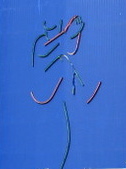
One of the talented photographers capturing what’s left of Shea Stadium and posting the evidence on the Shea Demolition page at Baseball-Fever, johnql, shot an Amazin’ image today, that of an exterior that is down to one neon Met flanked on either side by a few ramps. You can see the whole thing for yourself here. I prefer to focus in on the pitcher. Shea Stadium was built on pitching. Appropriate that the last Met to leave the building is 1 on your scorecard and 9 in the batting order.
View johnql’s entire Friday the 13th album here. Cap tip to him and his compatriots for having been such dogged photojournalists of the deconstruction process.
|
|







