The blog for Mets fans
who like to read
ABOUT US

Faith and Fear in Flushing made its debut on Feb. 16, 2005, the brainchild of two longtime friends and lifelong Met fans.
Greg Prince discovered the Mets when he was 6, during the magical summer of 1969. He is a Long Island-based writer, editor and communications consultant. Contact him here.
Jason Fry is a Brooklyn writer whose first memories include his mom leaping up and down cheering for Rusty Staub. Check out his other writing here.
Got something to say? Leave a comment, or email us at faithandfear@gmail.com. (Sorry, but we have no interest in ads, sponsored content or guest posts.)
Need our RSS feed? It's here.
Visit our Facebook page, or drop by the personal pages for Greg and Jason.
Or follow us on Twitter: Here's Greg, and here's Jason.
|
by Greg Prince on 13 December 2022 3:31 pm On Monday of last week, the Mets signed at top dollar a pitcher on track to land in the Hall of Fame, a pitcher still at the top of his game, a pitcher at the top of the game overall. It made us mostly forget that our best pitcher from the previous nine seasons, our league’s best pitcher from the previous five seasons, had left us the Friday before.
Come Wednesday of last week, the Mets signed what you’d call a solid veteran pitcher who, like that future Hall of Famer, showed his stuff remains up to snuff in postseason play this very October. This lefty’s pending presence in the middle of the rotation was enough to make a Mets fan barely notice that the righty who held down a spot in the middle of the rotation had just left for a division rival. As a chaser to this development, the Mets grabbed a lefty specialist for the bullpen.
Then it was Thursday, and it was the day to ensure the role of The Dean remained filled by a highly regarded longstanding denizen of Flushing, somebody considered to be a very hot item on the open market, but that player — the essential leadoff hitter/center fielder from the previous Met season’s success — chose to stay put in his professional home once his professional considerations were satisfied. Oh, and another chaser: an accomplished closer to serve as setup man for the most brilliant closer in the game at the moment.
Saturday night, traditionally the province of the Bay City Rollers, rolled around, and before you could spell out S-A-T-U-R-D-A-Y twice, the Mets were reported to have reached agreement with one of the plums in the free agent orchard, a pitcher who’s excelled on one continent and is projected to do the same on this one. This Japanese righthander’s repertoire is so tantalizing, word that last year’s No. 3 Met starter was leaving the United States for Canada was greeted with a shrug.
So, to sum up: former Astro Justin Verlander has more or less replaced Texas Ranger Jacob deGrom; former Cardinal Jose Quintana has more or less replaced Philadelphia Phillie Taijuan Walker; former Fukuoka SoftBank Hawk Kodai Senga has more or less replaced Toronto Blue Jay Chris Bassitt; Brooks Raley and David Robertson are filling a potential relief void before it can grow into a gaping bullpen vacuum following the exits of Joely Rodriguez to the Red Sox and Trevor Williams to the Nationals, with the statuses of Seth Lugo, Trevor May and Adam Ottavino yet to be determined; and Brandon Nimmo, like Edwin Diaz, isn’t going anywhere.
Just like that, the Mets have answered many if not all of their questions ahead of 2023 before December 2022 is half over. Just like that, Steve Cohen committed whatever it took to not let the talent level of the team he bought barely two years ago dip from its 100-win level of this year. Just like that, there was little opportunity to wonder if the Mets would do what it would take to continue to contend seriously, because this is serious business the Mets have been conducting.
A pitcher like Verlander would have been a pipe dream before Cohen. A pitcher like Senga would have been one of those “maybe they could…nah” situations that arose so often before Cohen. To have watched the pitchers who left leave would have been a telling blow before Cohen, and one theoretically perfectly good starter like Quintana in the company of an acquired lesser arm, along with whoever emerged from a pile of Quadruple-A possibilities, would have been sold with a straight face as a reasonable succession plan. With Cohen, we move on and at the very least stay on par with where we were and probably improve. If Senga is the real thing, if Quintana keeps up his Cardinal pace, if Verlander is as ageless as he’s seemed, you wouldn’t be quick to turn them down as a package in exchange for deGrom, Walker and Bassitt. That’s pretty much the trade that happened, albeit through three pitchers departing of their own volition to disparate destinations, and three pitchers arriving veritably en masse because all things and payments being something akin to equal, they’re enthusiastically joining the New York Mets.
Plus those bullpen guys (Robertson signed for one year, Raley obtained from Tampa Bay for a promising if far off minor leaguer), alongside the talented Mr. Nimmo opting to not go anywhere. All of this has transpired in a period that had yet to commence two entire weeks ago. This is how the New York Mets of the contemporary era operate. This is our franchise doing very well one year and aiming at doing better the next. This isn’t one of those “win the offseason” sprees easily dismissed. It’s not unlike the last winning offseason, which led to a substanitally winning season, which is now our starting point for constructing a team for the next season, fairly projected as another winning season.
As of this writing, it is Tuesday afternoon. The Mets haven’t made a move since Saturday night. With these Mets, it seems a little odd to have gone so long without one.
This whirlwind of Mets transactional action forms the basis for the latest edition of National League Town, available for your listening pleasure here or pretty much any podcast platform you choose.
by Greg Prince on 10 December 2022 1:57 pm I got a huge kick out of leafing through the 1967 Mets Yearbook years after it was published and finding that even then Ed Kranepool, a mere 24 yet the only Met left from the Mets’ first year of 1962, was referred to as “The Dean” of the Mets in terms of continuous service with the Mets. Until Ed Kranepool ceased playing for the Mets, I had never known a time when Ed Kranepool couldn’t be identified by some phrase indicating that status. He was longest-tenured Met. He was the elder statesman (or statesMet). He had the most seniority among Mets. He was Ed Kranepool and all that implied.
Yet it only seemed like Ed Kranepool was The Dean forever. There was a time before the 1967 yearbook went to press that Eddie’s steadiness may have been noteworthy, but it was yet to be remarkable. Payson Tech had a few The Deans before Ed earned his tenure. There’d be even more in the years beyond the Krane.
Let’s go back to the beginning, to the very first game, to the very first starting lineup. Of the nine men Casey Stengel penciled in that night in St. Louis, April 11, 1962, none would last as long as Casey did in a Mets uniform. Stengel managed his final game on July 24, 1965, whereas the longest-laster among players turned out to be the same gentleman who stands today as the longest-living Met: 93-year-old Frank Thomas. Cleanup hitter Thomas was the only original Original Met from that initial batting order to play for the Mets as late as 1964, specifically through August 5 of the Mets’ third season, until he was traded down the Turnpike to the beef up the Phillies’ pennant drive (a drive that famously careened into a ditch).
Replacing Thomas as The Dean…well, we have to inflict the first of several explanations here, because there was one 1965 Met, post-Thomas, who saw action in the first Met game: Bob Moorhead, who came out of the bullpen in the fourth inning. Moorhead’s claim to fame, certainly to me, is his emergence as the very first Met to make his major league debut as a Met. Bob’s last game of the Mets’ inaugural season was certified as such when he punched a clubhouse door in St. Louis. Moorhead was frustrated with his pitching that September 1 and wound up doing damage to a couple of the fingers on his right hand. In the immortal words of Pete Campbell, “Not great, Bob!” And in the words of the immortal Casey Stengel, “If we were in first or second place, Moorhead would be fined. But we aren’t, so what’s the use?”
Mind you, we’re dredging up Moorhead’s burst of temper here because Moorhead became the only Met to have played in the Mets’ first game and play for the Mets as late as 1965. That makes Moorhead our next The Dean, right?
Not so fast there, Bob. The Dean has to have served continuously within the Mets organization from his Met debut. We’ll allow for stints on the injured list or detours to the minors or other business that can’t be prevented provided that the player in question stayed within the Met realm without interruption. It’s a little murky where Moorhead is concerned. His Baseball-Reference page indicates no transactions casting him out of the Met organization. He pitched for no other major league team besides the Mets. Yet — and it’s a big yet — Moorhead spent all of 1964 pitching for affiliates of the Milwaukee Braves. Even then, it’s not so simple to figure out whether Bob Moorhead altogether stopped being what used to be termed “Met property” and ultimately gets marked down as a Met Once Removed.
I surveyed as many reliable sources as I have at my fingertips and couldn’t nail down a specific trade or sale that connected Bob’s time in the Met system in 1963 (when he was demoted all the way down to Single-A Raleigh) to his sudden shuffle through the rosters of Denver, Toronto and Austin, each of them links in the Brave chain. I found a deal sending Moorhead from Double-A Austin to the Mets’ Triple-A outpost in Buffalo in August of ’64 (a bout of mononucleosis prevented him from reporting ASAP), but it was never quite clear to me how he had found his way to the Braves’ organization in the first place. Nothing in the papers, even in those broadsheets that dutifully printed practically everything that came across the wire. Nothing in The Sporting News, which reported everything of this nature in those days. Nothing by way of expository background in New York media-generated game stories when Bob pitched his way back to the Mets with a newly developed knuckler in ’65 after having “drifted” through the minors for nearly three solid years. Plus it all seemed a little too convenient that this pitcher just happened be traded to Buffalo after a bunch of months away from the Met organization with not even agate-type fanfare to accompany his Brave-tinged stint. It was not wholly uncommon for teams to make arrangements to loan minor leaguers to one another, far from the bright lights of their big league ballparks, but what amounted to practically an entire season of pitching under somebody else’s mortarboard would seem to disqualify Bob Moorhead from assuming his title as The Dean. He can take it up with the academic credentials committee.
If Bob Moorhead doesn’t succeed Frank Thomas as The Dean, who does? We have two worthy candidates in the starting pitcher and starting catcher from the Mets’ third game ever, on April 14, 1962. Al Jackson started that game against the Pirates at the Polo Grounds, throwing the very first pitch to his receiver Chris Cannizzaro. By definition, Jackson (1 in your scorecard) experienced the very first action of that game, just ahead of Cannizzaro (2 in your scorecard). This slicing and dicing of who came first and who came second is relevant in our discussion because, wouldn’t ya know it, Jackson and Cannizzaro also played what appeared to be their final games as Mets on the same date.
But let’s get into appearances. Jackson, the 21st Met overall, gets the nod because he went into the Met annals a few seconds before Cannizzaro, the 22nd Met overall. But Jackson’s apparent final Met game was in the first game of the doubleheader on the final day of the 1965 season, October 3. Cannizzaro took his final Met bow in the second game of that same Sunday, part of a twinbill necessitated by the Mets and Phillies going eighteen scoreless innings at Shea until a city curfew demanded an end to the Saturday night/Sunday morning affair the day/night before (itself the nightcap of a doubleheader). Cannizzaro played one game later than Jackson in 1965, though it’s not like Jackson wasn’t still on the team during what was, when two ties are taken into account, Game 164 of a season that yielded 112 losses.
The fates were penurious with Met wins in that era, so let’s be generous with honorifics and call Jackson and Cannizzaro co-The Deans. And let’s note that while both Al and Chris went on their respective merry Metless way following the 1965 season, Jackson didn’t stay away forever, coming back to the Mets from St. Louis after two years with the Cardinals. As much as we respect the Recidivist Met concept, Jackson, having been a Cardinal in 1966 and 1967, meant he couldn’t resume being The Dean or even co-The Dean. This will come up in our travels through the decades. In the most stark example we can access, Tom Seaver was the only 1983 Met who could say he was a Met as long ago as 1967, but there are pictures offering evidence that Tom was a Cincinnati Red from the middle of 1977 to the end of 1982 (I know, we don’t believe it either). We’ll happily distribute gold stars in the shape of asterisks to Recidivist Mets who went back longer on the calendar than any of their Met teammates despite an interruption to their service, but it wouldn’t be fair to those who never left to rip the cap and gown from their personages.
Tom Seaver is everything to the Mets. But he was never The Dean.
MEANWHILE, there was one more Met who inscribed his name on the all-time roster on April 14, 1962, technically after both Jackson and Cannizzaro, who not only endured to the final games of 1965 but to end of 1966. If we weren’t such sticklers for starting points, we could just say Jim Hickman, who preceded Seaver as the most accomplished of Mets, succeeded Thomas as The Dean, but Hickman didn’t make his Met debut until pinch-hitting in the seventh inning in that third Met game ever, and boy, are we sticklers. Still, Jim got his reward once Al and Chris bolted. He was the last of the truly Original Mets from the very first 28-man roster in April 1962 to stay a Met as late as 1966, playing his fifth and final season for New York before being traded with Ron Hunt to Los Angeles. That swap brought Tommy Davis to the Mets and, as we never tire of pointing out, Davis’s superb 1967 enabled an even more consequential trade: Tommy Davis for Tommie Agee. Most consequential in the context of our discussion is that Hickman’s departure eased the road to The Deandom for Ed Kranepool, who the aforementioned 1967 yearbook noticed had been around since September 22, 1962, when he was a lad of 17, and was already making a habit of never leaving.
I think we’re all pretty familiar with Ed Kranepool’s reign as The Dean. It lasted thirteen full seasons. We won’t hold his 1963 and 1964 optionings for further seasoning nor the brief 1970 demotion to Tidewater manager Gil Hodges thought would snap him out of a mid-career funk against his longevity. It’s not like he was honing his craft with a bunch of Braves prospects à la Bob Moorhead. Ed Kranepool was a Met all the way.
Nonetheless, we come to the end of Eddie’s The Deanship on September 30, 1979, because no Met remains on the active roster forever (though if anybody could, it would be Kranepool) and in 1980 we begin the term that was destined to belong to Ron Hodges, called up to the Mets on June 13, 1973, fortifying a catching corps both banged and bruised. Hodges held his own and presented a professional target for some elite pitchers while Jerry Grote worked his way back from injury. Ron’s highlight was the night he tagged out Dave Augustine on perhaps the most memorable defensive play at the plate in Met history (the ball off the top of the wall, you might know it as) and then drove in the winning run, all of this in the thirteenth inning, all of it in the searing heat of a pennant race so hot that Casey Stengel definitely would have fined a pitcher who chose that evening to bust his fingers punching a clubhouse door.
That night of September 20, 1973, remained Ron’s highlight for a dozen years. Hodges didn’t play all that much from 1974 to 1984, but he was a constant, which really helps a Met become The Dean. The Mets never made a move to get rid of him for an entire decade, so he should indeed have the title for his trouble. And, really, it’s pretty remarkable to realize Ron’s staying power carried him from one of the peaks in the Mets story — the 1973 pennant — to another of the peaks in the Mets story — the 1984 revival and all that ensued — and he had to endure so much valley in between. Well done, The Dean!
The year Ron became The Dean, you wouldn’t have guessed who would ultimately inherit his title, because in 1980, that the future The Dean was down at Jackson after a stint that wasn’t altogether promising once he first dipped his toe into Met waters beginning April 5, 1979. Yet Flushing Meadows remained patient, and once Jesse Orosco returned to town in the second half of 1981, his longevity wouldn’t be far behind. You gotta remember, the Mets had gone through a lot of flux, most of it for the best to get to surefire contending status in 1985. That meant churning through a surfeit of early-’80s players in whom management saw little future and holding onto a precious few while it cultivated its top minor leagues and made savvy trades. Once stalwarts Ron Hodges, Craig Swan and John Stearns had left (all of them in 1984), the only current Mets who dated from the ’70s were Jesse and Rusty Staub. Staub was a Recidivist Met, and as indicated above, continuity is key to The Dean. Orosco’s time as a Tide was essential in finding his groove, and it counts as continuity.
Jesse continued straight through the final strikes of the 1986 National League Championship Series and World Series, and would pitch clear to 2003, but only until the end of 1987 as a Met. After Orosco followed the path of Hickman and was traded to the Dodgers, the torch of The Dean would be passed to one more survivor of the bad old days, Mookie Wilson, who debuted as a Met and major leaguer on September 2, 1980 — same game as Wally Backman, but Mookie led off in L.A., while Wally batted eighth. Further, Mookie outlasted Wally, all the way to the trade deadline of 1989, when the Met whose career was most emblematic of the entire 1980s (he’s the only one to have played as a Met in each year of the decade) moved on to Toronto and another playoff date, because if Mookie is anything, he’s a winner.
In Mookie’s place would come a series of The Deans who barely knew, if they knew it at all, the struggle of being on lousy Mets teams. Darryl Strawberry was promoted to the big club on May 6, 1983, when the Mets could be found at their usual basement address, but in less than a year’s time, they were bona fide contenders. Say, that might have something to do with the presence of Darryl Strawberry! No doubt, whatever the Mets accomplished in the way of a seventh consecutive year of fairly plenty in 1990 (91-71 and another race almost down to the wire) was carried on Darryl’s broad shoulders (37 HRs, 108 RBIs) in what became his walk year.
Darryl indeed walked to his hometown Dodgers, leaving open the slot of The Dean, which brought another upper-case D into the picture: Ron Darling. Ronnie debuted on September 6, 1983, four months after Darryl, and one day in early 1991, he might have turned around and noticed he was the last Met left from the altogether putrid final month of the dismal Met epoch of 1977-1983. Well, Hubie Brooks was at Shea in 1991, but that’s the Recidivism talking. Darling accomplished a lot as a Met, but longevity as The Dean wasn’t on that list. The Mets traded Ron to Montreal in July, which meant there’d be yet another new The Dean in town. It would be somebody who, it was hard to reckon, could be defined by the concept of seniority.
It was Dwight Gooden, forever 19 and 20, in the mind’s eye, but by the second half of 1991, an eight-year veteran, and a Met all eight years, beginning on April 7, 1984. Doc would turn 27 in the coming offseason. Old Man Gooden? For term of continuous service purposes, absolutely. Unfortunately, the teams on whom Doc would elderly state in 1992, 1993 and 1994 would resemble the teams good ol’ Jessie, Mookie, Wally, Hubie, Darryl and Ronnie broke in with more than those on which Doctor K earned his medical degree. Far more unfortunately, a second positive drug test meant a suspension and an abrupt end to Doc’s Met career before the ’94 strike kicked in.
This meant the next The Dean was somebody who you had no problem picturing being the old guy in the clubhouse. We didn’t meet John Franco as a Met until he was 29, and when we did meet him, he wasn’t shy about telling us how he grew up idolizing the likes of Seaver, Koosman and McGraw, so it already felt like he’d been part of the team since at least 1969. Johnny’s career as a Red closer had already been decorated, too, thus he wasn’t an unfamiliar figure by any means when he first took the ball from Davey Johnson on April 11, 1990…and yes, John Franco was here so long that he pitched for the same Davey Johnson we don’t at all associate with the several eras associated with John Franco.
It was a long run as The Dean for Franco, longer than anybody’s after Kranepool’s. No matter what we might have grumbled to ourselves following a save that got away, Johnny wasn’t going anywhere. He was one of us, from Brooklyn and all that. When he finally did leave after the 2004 season, he pitched briefly for Houston, and the sight of it was too weird to wish he’d hung around in another uniform any longer. If anybody who didn’t commence as a Met should have concluded as a Met, it was John Franco.
Fittingly, the All-Star pitcher who came to the Mets and put on No. 31 in 1990 was succeeded as The Dean by a catcher who came to the Mets and put on No. 31 in 1998, the digits courtesy of eventual team captain John Franco. Along with everything else we can say about the great Mike Piazza, we can say he was The Dean in 2005. It was just one year, and it was clearly going to be Mike’s last year, but he was the last direct link to not only the Mets of the 20th century, having debuted in our togs on May 23, 1998, but the last of the Met-hicans from the glorious 1999 and 2000 clubs to still be Metting it up in a decidedly new era. Mike played out his bargain of a seven-year contract on October 2, 2005 (the least official but perhaps most resonant of several Mike Piazza Days), and gave way in the longevity department to somebody most suited to taking one’s time.
Yes! Steve Trachsel! Why the exclamation points? Irony, I suppose. Trachsel came aboard in the fifth year of what this correspondent considers the most gripping five-year period in Mets history, on April 7, 2001, and was still here the next time the Mets ran roughshod over the National League, in 2006. Steve, who pitched our first division-clincher since 1988, would wait out a batter or an umpire or his catcher or the elements between pitches. We would wait with him. We waited six fairly productive if not altogether thrilling seasons with him. It only felt like eighteen years from pitch to pitch.
After not helping the Mets very much in their seven-game NLCS loss to the Cardinals, torpid Trachsel moseyed along and gave way to a The Dean synonymous with speed: Jose Reyes, who raced onto the Met scene on June 10, 2003, or nine months after Pedro Feliciano on September 4, 2002. Famously — in our circles, at least — Perpetual Pedro pitched as a Met as late as 2013 and never pitched for any other MLB team in official competition, but he regularly passed through other organizations (including the Fukuoka Daiei Hawks for all of 2005), so while we appreciate Feliciano’s de facto loyalty to the orange and blue, the continuous service bugaboo that bit Moorhead’s case gets its teeth into Pedro’s situation as well.
Thus, Jose, and he seemed a good bet to keep on The Dean-ing to a ripe, old age considering he came up on the last day he was 19 and he was, you know, Jose Reyes. Except the folks who owned the Mets in the fall of 2011 weren’t Steve Cohen and didn’t have Steve Cohen money and it’s all a Mets fan can do to retcon Steve Cohen into Mets history and have him not only keep Jose a Met his entire career but placate Tom Seaver in 1977 and take on Jim Palmer’s contract as well. The time machine is not currently operable, so we’ll simply acknowledge that young Jose Reyes was the senior Met for five years before moving on (and eventually coming back).
With Jose having gotten a lead off first in New York and sliding into free agency second base in Miami, David Wright took over as The Dean, and who better? “Who better?” in so many ways is a question that can be answered with David Wright. Wright joined the Mets on July 21, 2004, and even through his lengthy injury rehab, never departed. David was named The Captain in Spring Training 2013, he remained The Captain until his final days in 2018 and, as far as I’m concerned, he will always be The Captain. Retiring No. 5 goes without saying. Retiring The Captaincy would work for me, too. There is only one David Wright.
But there would need to be another The Dean once Wright effectively retired with two years remaining on his contract, and the title would go to his fellow Gold Glove-awardee Juan Lagares, a Met since April 23, 2013, and, these eyes here say, the best defensive center fielder the Mets have ever featured (all respect to Messrs. Agee, Beltran and small sample size/large impression Pat Howell). Lagares’s glove was not only where extra-base hits went to die; he robbed Jeurys Familia of The Dean status. Well, not so much Juan but the trade the Mets made in the middle of 2018 to send Familia to Oakland for what amounted to a semester abroad. The Mets picked up Familia at the airport to begin the 2019 season, resuming a Met career that began on September 4, 2012, but being an Athletic, or anything other than a Met for even one game (let alone the 70 Met games Jeurys missed while he wore the green and gold), will derail anybody’s ambitions for being The Dean.
Likewise, Lagares could only serve as The Dean through the 2019 season because he not only tested the free agent waters, he did more than wade in them, signing with San Diego for 2020. Ah, but that’s 2020, and we probably still remember 2020 was a year unlike any other in major league (or contemporary human) history. Bottom line is Juan never actually played for the Padres or any Padres affiliate, the latter impossible, anyway, given that no affiliates were playing anywhere in the COVID season. Somehow, Juan wandered back to the Mets for a dash of Recidivist pinch-running and a couple of cameos in center. It wasn’t the same — they gave him Nos. 87 and 15 rather than the 12 with which he was identified, for cryin’ out loud — and it didn’t renew his tenure as The Dean, for that title had already passed on to…
Jacob deGrom. Or BOO! as I’ve come to think of him when I think of him, which I’m trying not to do, especially since watching his introductory “I’ve always wanted to be a world champion Texas Ranger ever since they paid me to want that” press conference. Before Jacob jilted us, I, like most Met fans, had willingly and lovingly soaked up every inning of his Met career, which began with such promise on May 15, 2014, and continued with such promise all the way to the second game of the 2022 National League Wild Card Series. Someday I won’t be sore when I think about the fella I used to call Jake.
Besides, who can be sore when thinking about a much brighter expression of human emotion, namely smiling? Who isn’t smiling now that we know who the new The Dean is gonna be for as many as the next eight years? Ladies and gentlemen I (and Steve Cohen) give you Brandon Nimmo! That exclamation point is not ironic. I, like most Met fans, am ecstatic that Brandon has been re-signed for 2023 through 2030, even if there’s no knowing what anything beyond today brings. Today we know who our center fielder will be next year, all non-injury, non-pandemic, non-goodness-knows-what things being equal. Conversely, nobody on the market equaled the relatively sure thing Brandon Nimmo represents as our center fielder and leadoff hitter. Since he arrived as a New York Met on June 26, 2016, he’s grinned and he’s grinded (ground in English, grinded in baseball) and he’s gotten better and, when he’s been healthy, he’s crafted himself into a one-of-a-kind OPS threat, particularly the O part from getting on base as he does. I love to watch him play defense. I love to listen to him exude anything. I love that I’ve watched him grow up into the veteran he’s become, definitely coming off as someone who’s been through the Met wringer, but never not happy to be here. He just proved how happy being a Met makes him. One-hundred sixty-two million dollars didn’t hurt, but what a gamer to get “162” in there.
Brandon will play his games, get his walks and his hits and hit-by-pitches, steal his handful of bases, track down his catches, be a fine Met and, most importantly, continue the legacy of The Dean. The Dean is the institutional memory of the clubhouse. The Dean will be able to tell the stories no other uniformed personnel on the premises knows or remembers. When new-for-2023 Mets Justin Verlander, Jose Quintana, Brooks Raley and David Robertson alight in Port St. Lucie, Brandon will take each new face under his wing and show him the ropes. At least that’s what I’d like to imagine will happen. I rather doubt Justin Verlander requires much rope-showing. These other veteran acquisitions, too, but you know if there are questions to be asked, Nimmo will be available in Met colors to answer them.
Seriously, if you have any issues, take them to The Dean. He knows the ropes, he hits the ropes, he flags down the ropes. He’s been around here a while.
THE DEANS: Senior Mets By Continuous Service
Frank Thomas: 4/11/1962; 8/5/1964
Al Jackson: 4/14/1962; 10/3/1965 (1)*
Chris Cannizzaro: 4/14/1962; 10/3/1965 (2)
Jim Hickman: 4/14/1962; 10/2/1966
Ed Kranepool: 9/22/1962; 9/30/1979
Ron Hodges: 6/13/1973; 9/30/1984
Jesse Orosco: 4/5/1979; 10/4/1987
Mookie Wilson: 9/2/1980; 7/31/1989
Darryl Strawberry: 5/6/1983; 9/27/1990
Ron Darling: 9/6/1983; 7/14/1991
Dwight Gooden: 4/7/1984; 6/24/1994
John Franco: 4/11/1990; 10/3/2004
Mike Piazza: 5/23/1998; 10/2/2005
Steve Trachsel: 4/7/2001; 10/14/2006
Jose Reyes: 6/10/2003; 9/28/2011*
David Wright: 7/21/2004; 9/28/2018
Juan Lagares: 4/23/2013; 9/29/2019**
Jacob deGrom: 5/15/2014; 10/8/2022
Brandon Nimmo: 06/26/2016; TBD
First date is player’s first game as a Met. Second date is player’s final game (or final game of his first stint, in the case of Recidivist Mets* or Mets Once Removed**) as a Met, after which the next player on the list takes over as The Dean.
The latest episode of National League Town was recorded before Nimmo laid claim to becoming the nineteenth The Dean in Mets history, but rest assured it revels in the signing of Verlander; ponders the effectiveness of Quintana; and gets something in about Raley. You can listen here or on your podcast platform of choice.
by Greg Prince on 5 December 2022 4:00 pm What I have in common with Baseball Hall of Famer Gil Hodges I could count on very few fingers, but it delights me that one of them is a ring finger. Gil earned three World Series rings, two as a player in 1955 and 1959, one as a manager in 1969. I was presented with what is likely the closest thing I’ll ever claim as a championship ring on Saturday, and it wouldn’t have been possible without Gil Hodges.
Saturday brought around the more or less annual Queens Baseball Convention. QBC has been a staple of the offseason calendar since January of 2014, except when a blizzard canceled it in January of 2016, a Mets-run fanfest in January 2020 rendered it temporarily superfluous, and that pandemic business discouraged crowds from populating indoor spaces a winter later, no matter how much that crowd might have loved the Mets. Other than those pauses, QBC has marched on. Different months some years. Different venues other years. This year it was December in downtown Flushing, at a hotel located a relatively convenient walk (albeit through rain and wind) from the final stop on the 7 train. I almost never take the 7 east of Mets-Willets Point. On Saturday I did and noticed that as you pass Citi Field (the parking lot of which has been transformed into a glittery Christmas village), you get a generous glimpse of the left field Promenade and a full-on view of all those retired numbers the Mets suddenly sport, as if they have a real and proud history.
Which they do, which explains why, other than for fun, I was heading to QBC. My primary role at this offseason gathering spot is to present the Gil Hodges Unforgettable Fire Award, a token of fan recognition for keeping the Met-aphorical torch lit. Recipients prior to this QBC have included Gil himself (presented posthumously to his son Gil Hodges, Jr.), Ed Charles, Bud Harrelson (presented that summer at the Long Island Ducks’ pond in Central Islip, a contingency necessitated by the aforementioned blizzard), Tom Seaver (who couldn’t be there, but his teammate Art Shamsky graciously swung by to pick it up and later bring it to Tom in Napa), Bobby Valentine, David Wright (who accepted it via classy video) and the late communications specialist and friend to all Shannon Forde (with her family on hand to help us pay tribute to her memory). Real and proud history, indeed.
One of the reasons we can feel proud of the Mets, despite sometimes being, you know…the Mets, is the man who holds the titles vice president of alumni relations and team historian for that organization so close to our heart, Jay Horwitz. You can’t ride the rails to Flushing-Main St. and grab that peek at the rafters and not get a sense of some of the work Jay has done. A few years ago it took less time to read the numbers up in the rafters than it did to confirm that there’d once again be no Old Timers Day. Since Jay was appointed to his current positions, we’ve seen three numbers added to the four that sat waiting too long for company. We’ve also stopped confirming that the Mets would never again have an Old Timers Day, because, thanks to Jay’s leadership, Old Timers Day returned in 2022 for the first time since 1994. The vibe associated with the Mets as an entity that lived in the present, was clueless about the future and pretended there was little past to them has done practically a 180 since Jay shifted from public relations to alumni relations. We have a present. We have a future. We salute our past.
That’s worthy of an award. That, the folks who put together QBC decided, was worthy of selecting Jay Horwitz as this year’s recipient of the Gil Hodges Unforgettable Fire Award. They courteously asked me if I agreed. I did. They doubled down on courtesy and asked me if I would present the award to Jay. I agreed to that, too. I’m always up for the ceremonial aspects of baseball. To be a part of this one particular ceremony more or less annually gets my torch lit as is. To do this presentation in the wake of reaching one of the goals of establishing the Gil Hodges Unforgettable Fire Award — contribute in whatever way possible to keeping Gil’s name on people’s minds until he was elected to the Hall of Fame — made the Hot Stove flame burn that much brighter for me.
So through the rain and wind I clomped from the final stop on the 7 to the hotel a little north of Northern Blvd. (getting flummoxed by construction for a few minutes before I found the entrance), shook out my umbrella, stepped into the men’s room and waited to wash my hands behind somebody using the sink on the right when I heard somebody using the sink on the left tell the man using the sink on the right, “IT’S YOU!”
I was standing behind Endy Chavez. Because that’s the sort of thing that happens at QBC. Endy said to the other fellow, “yes” and smiled. When my turn came to wash my hands, I soaped, rinsed and dried quickly so I could casually follow Endy out of the men’s room and blurt the first thing that occurred to me:
“It’s an honor to share a men’s room with you!”
I think Endy smiled. And perhaps picked up his pace to get away from me.
 Just a couple of guys who’ve written Mets books (thanks to my friend Jessie for introducing me to R.A. Dickey). Endy Chavez! R.A. Dickey! Howard Johnson! Bartolo Colon! Nelson Figueroa! DOC GOODEN! Those were the players who were at QBC in one capacity or another. Well, one capacity above others: they were Mets among Mets fans. That goes over pretty well, especially when it’s barely half-a-day since we learned one Met chose to no longer be a Met among Mets fans, even if we agreed to keep our distance and not follow him into or out of men’s rooms. Let’s just say “Jacob deGrom” was no longer a surefire applause line in this environment.
The departure of deGrom (before we knew about the arrival of Verlander) didn’t put any more of a damper on this event than did the howling rain that lasted into mid-afternoon. That was outside. Inside, warmth was in the forecast. People talked Mets. People listened Mets. Mets fans renewed acquaintances. I ran into Dave, a guy I knew in high school. Then, we were two Mets fans happy to find anybody who’d identified as such. There weren’t many of our kind in those days. On this day, “Mets fans” described everybody in sight. For all the procuring of players’ presence, and Mets themselves are certainly a draw, I don’t think it’s the chance to score an autograph or a photograph or even a men’s room sink encounter that makes QBC click. It’s me in my SHEA STADIUM THE GREATEST BALLPARK EVER! hoodie running into Dave from high school in his SEAVER 41 jersey, introducing me to his son who’s a bigger fan than he is, even if unlike his dad and me, he’s still waiting for a world championship — it’s that interaction multiplied by who knows how many hundreds of times in the course of a Saturday. Mets fans running into each other is the lifeblood of a day of this nature.
And, a little bit, it’s prime QBC movers Keith Blacknick and Dan Twohig — aided in their heavy lifting by a raft of volunteers in cleverly designed t-shirts — carving out a few minutes to make sure we talk about Gil Hodges and Mets history. That’s where I come in, and that’s where my championship-style ring comes with me. See, I’m enjoying my impromptu reunion with Dave from high school when Dan pats me on the shoulder and lets me know I’m up next. I excuse myself and, within a couple of moments, I’m sitting on the dais, next to Jay, promising him that I plan to embarrass him with praise any second now. I’m also looking out on the crowd, as we wait for people to sort themselves out after HoJo has given of himself generously in his panel (moderated elegantly by WFAN host and fellow Mets fan Lori Rubinson). In the first row, there’s Irene Hodges. Jay introduced me to Irene, who I recognized from her speech inducting her father at Cooperstown this summer. I shook her hand and thanked her for that. I’m thinking she’s probably heard something like that before, but then again I’m pretty sure HoJo, R.A., Bartolo, Figgie, Doc and Endy have heard what they’re hearing all day before, give or take the men’s room sentiment. I’m gonna guess that they don’t altogether mind the repetition or enthusiasm for aging accomplishments. They agreed to come to a venue for the express purpose of being recalled lovingly to their faces.
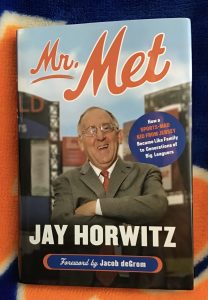 Lest we forget, Jacob deGrom’s Met legacy includes the foreword to an Amazin’ memoir. I’m there for the express purpose of remembering Gil Hodges lovingly. Irene is there to support Jay, which tells you something about Irene as well as a good deal about Jay. Jay stayed in close touch with the Hodges family through the long, long wait for good news from the Hall of Fame. He was a true friend to Mrs. Joan Hodges. He’s a friend to Irene. He’s a friend to more Mets and Mets-affiliated folks that can be counted. If you wanted somebody to say something nice about Jacob deGrom on Saturday, you needed only to turn toward Jay Horwitz if you were lucky enough to be sitting next to him on a dais as you waited to make a formal presentation. Jacob, I reminded him, wrote the foreword to his memoir. Through a bit of a pained expression, Jay acknowledged deGrom’s defection (my word, not his) but wanted to remind me “Jacob’s a very good person.” Well, I said, at least you have another Met alumnus now.
As the room settled down, Dan the co-organizer stood with a mic for a moment and made an announcement. He explained what we were about to do, said a few words about the transcendence of Gil and the worthiness of Jay and that he was about to turn it over to me, but first, he and Keith had something for me: a ring, in appreciation for being QBC’s resident “historian” since the “by the fans, for the fans” fanfest hit the drawing board nearly a decade ago. The ring bears the logo of QBC and evokes the kind of jewelry one receives for winning a title. My title is fan who gets to do the Gil Hodges Unforgettable Fire Award presentation more or less every winter. I wasn’t expecting a ring for doing it. When you’re a Met fan, you learn to never expect a ring, though when one does slip onto your finger, you’re most grateful for what it represents.
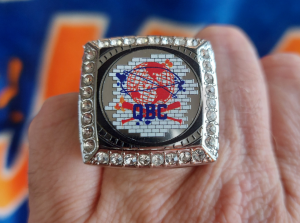 It’s not all about the ring, but it’s pretty nice getting one. I’ve toggled between referring to it for my own amusement as the Gil Flores Unforgettable Fire Award (don’t tell me you’ve forgotten the outfielder who roamed THE GREATEST BALLPARK EVER! when Dave and I were in high school) and the Royce Ring Ring (an homage to both our Closer of the Future c. 2005 and the hastily arranged Francis Scott Key Key from the “Privateers” episode of The West Wing), but mostly I’m touched that Keith and Dan paused amid taking care of the umpteen-thousand details necessary to put on a show of this magnitude and give me this other pat on the shoulder. Or ring finger. Thanks very much, guys. Thanks to everybody who takes a few minutes from roaming around and gabbing excitedly and queuing up for autographs to listen to me doing my Mets historian thing, particularly when I’m doing it with the guy who actually is the Mets historian.
The following is the text I wrote and delivered at this year’s Queens Baseball Convention in honor of Gil Hodges and Jay Horwitz (who made his acceptance remarks all about Gil, because that’s who Jay is). I hope you enjoy it.
***As we close out the 60th anniversary celebration of our New York Mets, I want to wish all of us a Happy Mets Anniversary in the year ahead. Every year is the Mets anniversary of something. In 2023, we will be marking…
• The tenth anniversary of peak Harvey Day and the All-Star Game Matt Harvey and David Wright started at Citi Field;
• The twentieth anniversary of the first base stolen by Jose Reyes and the last broadcast by Bob Murphy;
• The thirtieth anniversary of Anthony Young persevering until he finally won a game after losing 27 in a row;
• The fortieth anniversary of the days we got to Shea hello to Darryl Strawberry, Keith Hernandez and Ron Darling;
• The fiftieth anniversary of Tug McGraw instilling within us the evergreen philosophy, You Gotta Believe;
• And the sixtieth anniversary of a ninth-inning, two-out ground ball to shortstop Al Moran from Jim Davenport of the San Francisco Giants to end the nightcap of a doubleheader at the Polo Grounds on May 5, 1963, a Mets victory sealed when Moran fielded it and threw it to a first baseman you knew would handle just about anything coming his way.
The Mets’ first baseman was Gil Hodges. It was the last play Hodges made in the major leagues, twenty years after his debut for Brooklyn. Gil was an achy 39 in May of 1963, about to be done as an active player. By the end of the month, he’d be traded to the Washington Senators, who immediately appointed him their manager. It was a very quick transition and, from our perspective, made for a very useful apprenticeship. Following the 1967 season, Gil would be traded again, as a manager, back to the New York Mets, and I think we know where this transaction — and this man — would lead us.
When the Queens Baseball Convention conceived of an award to honor members of the Mets community past and present for making us forever proud to be Mets fans, there was only one name that could instantly describe its inspiration: Gil Hodges. At the same time, QBC wanted to make a point of at least once every year calling as much attention as possible to the name Gil Hodges.
Gil, you probably remember, had missed making the Hall of Fame too many times despite being one of the top run-producers and THE premier defensive first baseman of his time before managing the 1969 New York Mets to the most unlikely world championship ever. Not in the record books: the universal esteem in which EVERYBODY in baseball held this man. So we thought maybe, just maybe, we could add our voice to an already strong chorus and raise the volume, however slightly, in service to making sure the unforgettable fire Gil Hodges represents in our Met story would remain lit for all to see.
One year ago this weekend, the fondest wishes of QBC and Mets fans everywhere — really, baseball fans everywhere — came true, and Gil Hodges was elected, AT LAST, to the Baseball Hall of Fame. We got to witness it, his children got to witness it, and, in Brooklyn, Mrs. Joan Hodges, 95 years old and waiting a half-century for the phone call that affirmed the news, got to witness it, and we are so thankful that she lived to see her husband’s election and induction.
I can’t tell you what a thrill it is to sit up here and refer to this symbol of QBC’s affection for contributions to what has made the Mets the Mets in the best sense of the word for more than six decades as the Gil Hodges Unforgettable Fire Award — and to add, it is named for Baseball Hall of Famer Gil Hodges.
I have a feeling Gil would nod in approval at this year’s recipient. This person has given his all to make the Mets better in every way he possibly could. He’s been a team player as long as he’s been with the team. He’s kept the fire burning when it comes to Met history meeting the Met present.
He’s Jay Horwitz, the “sports-mad kid from Jersey,” as the cover of his book “Mr. Met,” foreword by Jacob deGrom, identifies him. Of course he’s from the METropolitan Area. Of course when you see him you think of him as the embodiment of the New York Mets…no offense to the other Mr. Met.
I was a sports-mad kid from Long Island when I first learned who Jay Horwitz was. He’d been in his job as Mets public relations director for less than two months when a Mets game from Pittsburgh went into rain delay, as so many Mets games from Pittsburgh do. While the tarp sat on the field and before Channel 9 fired up — as they invariably did in these situations — the 1969 World Series film and the 1973 World Series film, they needed to fill some time. Thus, invited into the Three Rivers Stadium visiting television booth, alongside Ralph Kiner and Steve Albert, was this fellow who on first glance I mistook for Marvin Kaplan, the character actor who played Henry the lovable telephone repairman on Alice, if that rings a bell.
This guy, however, wasn’t an actor. He was a genuine character. Jay slides into the booth and enthusiastically explains to our announcers and those of us at home that he just came to the Mets from a similar role at Fairleigh Dickinson University, but never mind his story, because he wants to let everybody out there in TV land know what an incredible assortment of personalities is dotting the 1980 Mets roster. Did you know, he asked Ralph and Steve, that Craig Swan has a green thumb for gardening, that Lee Mazzilli was an Olympic-level speed skater, that Doug Flynn has a flair for country music? Jay used his moment in the sun, or technically the rain, to put the players he represented in the best, most fascinating light he knew how, keeping us as Mets fans watching and wanting to know more.
And he’s continued to do exactly that ever since. Jay handled Mets PR for nearly four decades, which meant serving an array of constituencies: a necessarily demanding, deadline-tethered media he strove to inform while building their trust; the hard-working members of his own staff — we were fortunate to honor one of his most wonderful protégés, Shannon Forde, last year; the individuals and groups who benefit enormously from having a friend in Flushing — a shining example being all Jay and the Mets have done and keep doing for the families who lost loved ones in the tragedy of September 11, 2001; the club owners, the front office, FOURTEEN different managers, and hundreds of players who couldn’t help but maintain specific preferences regarding what they wanted or didn’t want publicized; and, in the end, the fans who got to understand the team better because Jay worked so hard to put the Mets in a good yet realistic light. Through no more than simply doing his job, I’d say Jay became as recognizable a face to Mets fans as any Mets player between 1980 and 2018. More recognizable than Marvin Kaplan, certainly.
In 2018, Jay took on a new role, one that was crying to be created, one that he was born to fill, directing Met alumni relations. His efforts and the fruits they have yielded have been a revelation for everybody who cherishes this team, as Jay has connected those of us who love the Mets with Mets who might otherwise not realize that we’ve kept them in our hearts long after they’d played their last game.
Jay won’t take credit for Old Timers Day, and no doubt everybody from current ownership on down helped him make it happen, but give Jay credit for Old Timers Day, the first one the Mets had held in 28 years. Having someone so dedicated to “his players,” which at this point is everybody who’s played for the Mets since 1962, was the difference-maker in bringing us to a party that was unprecedented in Met annals and an event that was SORELY missed by Mets fans in the decades it was absent. Jay also provided a guiding hand in so many of the other signature historically minded moments of 2022: the commemoration of Johan Santana’s no-hitter; the overdue unveiling of the Tom Seaver statue; the overdue retirement of No. 17 for Keith Hernandez; the LONG overdue retirement of No. 24 for Willie Mays; and, through his fervor for a goal we all held dear, the LONG, LONG overdue election of Gil Hodges to the Baseball Hall of Fame. Jay didn’t have a vote, but he did have a voice, and he politely and respectfully raised it at every turn to ensure nobody should forget about Gil and that the Hall of Fame should not go another year without enshrining him.
One other gift Jay gives us on a regular basis is the Amazin’ Mets Alumni Podcast, where he showers attention on Mets and Mets personalities from 1962 forward. When Jay talks into his microphone, he speaks to the soul of this franchise. I also notice Jay introduces nearly every episode as a “special” edition, and he’s absolutely accurate in doing so. It’s truly a portal into living Mets history and I urge you to listen to it, not only because it’s a splendid show for Mets fans like us, but so Jay knows we’re hearing him. I told him once that I really enjoy his podcast. “So you’re the one,” he said. I imagine there’s lots of us, Jay.
I also imagine I could go on about a person who has brought uncommon humility and humanity to the Met cause for so much of his lifetime, but it’s my sense that Jay doesn’t really seek attention, let alone awards. We apologize for giving him both.
On behalf of the Queens Baseball Convention and Mets fans everywhere, it is my privilege to say this year’s SPECIAL EDITION of the Gil Hodges Unforgettable Fire Award goes to the one and only and unforgettable Jay Horwitz.
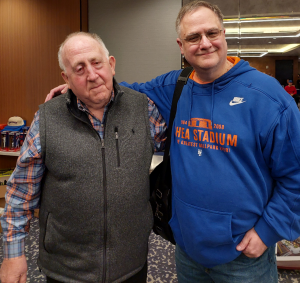 After the awarding, one more moment with Jay. On behalf of Mets fans everywhere, Jeff Hysen and I attempt to put the deGrom defection into something approaching perspective on the latest, hopefully special edition of National League Town. You can listen here or on the podcast platform of your choice.
by Greg Prince on 5 December 2022 1:12 pm I’ll sure miss Jacob deGrom…that is when I’m not watching Justin Verlander pitch for the New York Mets this year and next. So maybe I won’t be actively missing Jacob deGrom quite so much, dashed lifetime Met status notwithstanding.
Yes, the word is out: Justin Verlander will be a Met, landing in a different context from that which the deGrom news did less than three days ago but with the same ratio of surprise/shock to it. We can be surprised. We can’t be shocked. These are the New York Mets of Steve Cohen. Lose one all-time great, go out and replace him with another all-time great. Older, but maybe more durable in the short term. And all-time greater, truthfully. In his most recent term as an Astro, Verlander was a world champion and a Cy Young winner. It wasn’t the first time he’d been either. He comes to a new league and a new city and he’s doing it on the cusp of 40. But he’s Justin Verlander. He’s familiar with Max Scherzer. He’s familiar with getting batters out. He’s expensive, but how is that my problem? (Don’t be a mope and invoke ticket prices and cable subscriptions.)
Friday night was kind of miserable. Monday afternoon is rather ebullient. That’s the opposite of how things are supposed to work. We’re Mets fans who aren’t stuck empty-armed after losing an ace. That’s the opposite of how things used to work. We’ve got Verlander and Scherzer and, I suppose, some other spots to fill. But let’s give ourselves a respite from playing GM. Let the GM do his job. The owner has done his.
Justin Verlander is joining the New York Mets. Enjoy that for today. Enjoy that in 2023. Whatever happens in Texas can stay in Texas. Except for Verlander. He left Houston and is coming to Flushing.
We, too, move on. It’s what we do.
by Greg Prince on 3 December 2022 9:42 am All hail the free market! All hail labor empowerment! All hail the ability of the Texas Rangers to commit as many dollars and years as they choose to Jacob deGrom, and all hail Jacob deGrom’s ability to choose to take the dollars (185 million of them) and years (five, carrying him past his 39th birthday). Enabled by the miracle of the collective bargaining process, we get to see the American way in action.
Isn’t that just swell?
The Rangers figure they’ll benefit from deGrom’s right arm doing its wondrous thing for as long as it can. DeGrom will benefit from being paid at a level commensurate with his level of achievement stretching back the past five years. And Rangers fans will have a closeup view of a pitcher described regularly and with minimal hyperbole by the acronym for Greatest Of All Time.
The only people who might lose out in this scenario are us, the jilted Mets fans who will not see Jacob deGrom continue his essentially incomparable career as a Met. Nine years and out for Jacob, whom I’m no longer in the mood to refer to as “Jake” or deGOAT, for that matter. Jacob exercised his negotiated right to opt out of his contract. Leave a door open on a goat pen and bet on whether the goat will wander away (the commissioner of baseball will gladly process your gamble).
And now it is done. Jacob deGrom is a former Met. I imagine at some point the franchise pitcher on whom we hung our hat and pride since 2014, especially since 2018, will issue a statement thanking the Mets and Mets fans for their support to date. He’ll probably say something out loud when he tries on his new jersey and cap in Arlington or over Zoom from DeLand. I think he’s enough of a mensch to stand and deliver that much. Maybe it will be supplemented by a social media gesture, the contemporary version of departing free agents taking out full-page newspaper ads. We used to rely on daily newspapers. We used to rely on Jacob deGrom.
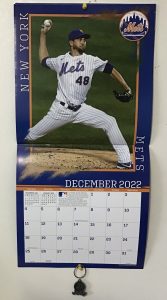 Month’s off to a heckuva start. Those were the days, my friend. Even allowing for cynicism, I kinda thought they’d never end. Why should have they? At every turn, Jacob deGrom exulted in the exultation we as Mets fans devoted in his direction. We shrouded him in our affection, we waited with longing and loving for his return from various trips to the injured list, we stood and swooned over his Lynyrd Skynyrd-scored simplicity. Sure, he’d opted out of his very nice if not absolutely nicest possible contract, but that contract was signed when the signatory on the other side of the pact was a Wilpon. You knew Steve Cohen could take care of business as needed.
Except in Texas, bidness is bidness, if you will indulge the stereotypical oil baron dialect, and their version of Cohen decided it would be great for bidness to take care of bidness to the extreme, offering Jacob deGrom those five years, which math will tell you is two more than the three the Mets apparently put out there. The average annual value for deGrom in New York was reportedly a little more: $40 million per annum versus $37 million. The total was a lot more from Texas: $185 million over five years versus $120 million over three. DeGrom doesn’t have to do math like he does pitching to do the relevant math.
The relevant emotion to a certain strain of Mets fan, perhaps best classified as the unsentimental kind, is how few innings Jacob deGrom threw between July 7, 2021, and August 2, 2022: 0. Intermittently during his Met run, particularly in the most recent years, Jacob became one of those sitcom tropes. Vera from Cheers. Maris from Frasier. Captain Tuttle from M*A*S*H.
“Anybody seen Jake?”
“Ah, ya just missed him.”
“What, again?”
“Don’t sweat it. He’ll be back soon.”
The relevant emotion to a certain strain of Mets fan, perhaps best classified as the sentimental kind, is how few innings Jacob deGrom threw from his debut of May 15, 2014, forward for any team that wasn’t the New York Mets: 0. That data point paired with the hope that Jake (had he stayed here, that’s what I’d call him) would become that rarest of birds, the elite Met starter who was nurtured in the nest and never flew the coop. We know it’s never happened before. We have learned it is not likely to ever happen again.
 Once you let deGOAT opt out of his pen, there’s no telling where he’ll seek greener pastures. The “elite” nature of deGrom was never in question, save for a little collar-tugging and throat-clearing at the sight of Jake maybe running out of petrol in sixth innings as his late-starting 2022 wore on. I chose to believe he was still getting up to speed after not pitching in the major leagues for thirteen months. I chose to believe his excursions to the IL were the exception, not the rule. I chose to believe a lot in Jacob deGrom. I believed he wouldn’t leave us. You can’t always get what you believe.
You can get a replacement. You have to. Emotionally, I’d be OK with inscribing No. 48 on the Citi Field mound and everybody going home the first time what would have been his turn comes up, but business doesn’t work that way, and what would have been his turn will come up approximately 32 times in 2023. The Mets will sign some very fortunate free agent pitcher, whoever it will be. That pitcher’s negotiation position just rose substantially. We don’t have deGrom, but we do have Cohen. This takes the sting out of the news in a way unavailable to us when the Mets were under previous ownership.
It’s all still wrong, mind you. Jacob deGrom slipping into the uniform of the Texas Rangers is wrong. Somewhere in this great country, somebody thought Max Scherzer slipping into the uniform of the New York Mets was wrong, but we cheered it. His wardrobe change gave us the pair of Aces to die for. It gave us a helluva rotation in theory last offseason and in reality for a couple of months. It didn’t yield a division title or a playoff series win. That loading up of Aces worked to its fullest extent only once for Atlanta when they had Maddux, Gl@v!ne and Smoltz, and it never completely panned out for Oakland when they had Hudson, Zito and Mulder. You never know with September and October. But you liked heading into the end of a season and the beginning of a postseason with the likes of deGrom and Scherzer.
Now we’ll go into the beginning of the season with Scherzer and whoever. We’ll look back on nine years of deGrom less and less while he’s doing whatever he does as an American League Westerner. Every time I want to do one of my historical dives about Met starting pitching, there will be an implied ruefulness and an explicit wistfulness to bringing Jacob deGrom into the conversation. One year, it’s all “we” and “our” for a player you understood could take a hike but didn’t really think would. The next year, he’s “former” and “erstwhile,” and we’ve moved on because we have to. Someday down the road, far down the road if the former and erstwhile Met is lucky, he will have a reason to come back in a ceremonial, celebratory capacity. We have Old Timers Days again. At the one we had this year, we warmly greeted Jose Reyes who left to be a Marlin and Daniel Murphy who left to be a National. That, we should all live so long, comes later.
For now, it’s just business.
by Greg Prince on 23 November 2022 8:18 pm When Yogi Berra died in 2015, Dave Hillman ascended to the role of Oldest Living Met. Yogi Berra is among the most famous baseball figures of the past 75 years, perhaps ever. People still quote Berra, still invoke Berra, still remember Berra. He’s been gone seven years, but his legacy is likely to live on for generations.
When Darius Dutton “Dave” Hillman succeeded Lawrence Peter “Yogi” Berra as Oldest Living Met, I had almost no idea who Dave Hillman was, other than “member of the 1962 Mets,” and then mostly from looking at a list of the vital statistics I keep of Every Met Ever: birth date; date of first game as a Met; date of last game as a Met; and, where applicable, death date. Sad to say, I just the other day tabbed to the last column on Dave’s entry and made the necessary revision to his line on the list. Dave died Sunday in Tennessee at age 95, ceding his title of Oldest Living Met to Frank Thomas, 93.
Dave Hillman threw his first pitch for the New York Mets on April 28, 1962, becoming the 29th man to play for them overall. The chronological numbering is modestly significant if you want it to be. The first 28 Mets were the Original Mets who made it out of Spring Training. They won one game with that initial crew — and lost eleven. While cutting down their roster to the mandatory 25, they opted to make some changes besides. Their first in-season moves included bringing in righty Hillman, who washed out in Cincinnati following a robust season of relief in Boston.
In pursuing Dave, a friend also named Dave reminded me, the esteemed Met brain trust of George Weiss and Casey Stengel passed on the opportunity to sign none other than future Hall of Famer Robin Roberts, whose right arm at that moment was considered more done than Dave Hillman’s (the almighty Yankees dropped him), yet actually had several decent seasons left ahead of him. Had the Mets taken a chance on a four-time 20-game winner then at liberty, Robin and fellow Phillie expatriate Richie Ashburn might have shared dugout time reflecting on their Whiz Kids exploits; sizing up their Cooperstown prospects; and plotting to elevate the Mets to a record slightly better than 40-120. But that was a road the Mets were adamant about not taking. “I have spoken to Casey Stengel,” Weiss practically harrumphed, “and he is definitely not interested in Roberts.”
Robin posted double-digit win totals in 1963, 1964 and 1965. His final game in the majors came on September 3, 1966. For context, eight days later, Nolan Ryan debuted. Robin Roberts, 35 in April of 1962, lasted quite a while, Weiss’s or Stengel’s interest in him be damned. Like Roberts and Ashburn, Stengel and Weiss are in the Hall of Fame. Alas, even in the grandest of careers, not every pitch is a strike, not every swing is a hit and not every move proves the best choice in hindsight. The Mets needed a pitcher at the end of April 1962 and went with Hillman. Dave’s major league journey began in 1955 with the Cubs. He was, in the most honorable sense of the phrase, a journeyman pitcher. A journey that takes a man to the Polo Grounds and assume the mantle of (almost) Original Met can’t help but be honorable in our eyes.
The date of the first game Dave Hillman ever pitched as a Met stands as absolutely significant. April 28, 1962, marked the first Mets home win ever, over the Phillies. Jay Hook started and was hit hard. Bob L. Miller entered before the first was over and eventually allowed the visitors to extend their advantage. Dave, however, stood to be the winning pitcher after departing his one inning of work, the sixth, and the Mets taking the lead directly thereafter. The official scorer disagreed, taking into account a) the first batter Dave faced in the sixth (Don Demeter) leading off with a home run; and b) Met ace Roger Craig, the club’s Opening Day starter, coming on and throwing three scoreless innings to seal the 8-6 victory. Craig could have been credited with a save, but saves hadn’t gained official statistical traction by 1962, so Roger was awarded the win. Scorer’s discretion, as they say.
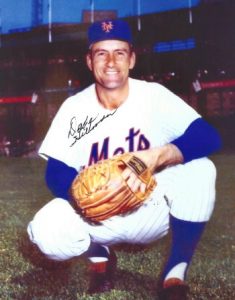 Dave Hillman, living his Met life. At least Dave Hillman was in the big leagues again and at least he took part in a New York Mets win…a historic New York Mets win. So did newly acquired Sammy Taylor and newly acquired catcher Harry Chiti. Chiti, while no Berra at or behind the plate, would become famous in a very Metsian manner a little later in 1962, returned to Cleveland when the Mets decided he wasn’t the receiver for them. The player to be named later turned out to be named the player named Chiti. This transaction went down in Originalist lore as Harry Chiti being traded for himself. Harry batted .195 and was never quoted on the subject of what to do when you come to a fork in the road (“take it” — Y. Berra), but his aftermath read as colorful.
Dave’s Met tenure left fewer footprints in franchise legend and was not much rosier in the way of statistics. He’d contribute to a few more wins and a whole bunch of losses — the song of essentially every 1962 Met — almost exclusively in relief. He notched the sixth save in Mets history. The sixth save in Mets history materialized in the Mets’ 51st game overall, an indicator less that starting pitchers went deep in those days than there weren’t many Met wins to save. Still, it was pretty clutch pitching. Dave came on in the eighth and popped up former teammate Ernie Banks with runners on, then stranded the bases loaded to finish the ninth. That the win Hillman secured improved the Mets’ record to 14-37, or that Hillman’s ERA for the year (including his stint with Cincy) hovered above 8, does not detract from a Mets win being a Mets win nor Hillman making sure it didn’t evolve into something less. In 1962, every win was sacred.
Three appearances later, Dave Hillman sported an ERA under 7, which was progress. It was also the end of the line for an eight-season veteran who’d certainly overcome obstacles to be able to put that many years into big league ball. The Mets wished to send Dave to the minors. Dave wished to move on, specifically back home to Kingsport, Tenn. — you might recognize the town as site of a long-running Mets farm club — with a career in clothes retailing in front of him. The 29th Met ever also became the seventh major leaguer to play his final game as a more or less Original Met. Forty-five players in all were 1962 Mets. Nineteen of them would never play again in the bigs after serving the 40-120 cause (Chiti, who Cleveland sent down to Jacksonville upon reacquiring him, was the sixth of them). In a 2008 interview, Hillman said of his last team, “It was a joke, the ballplayers they had assembled. It was all old players who were over the hill. There were one or two young pitchers that were good, but with the ballclub, they couldn’t get them a run.”
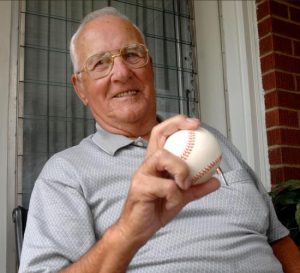 Dave Hillman, enjoying life after the Mets. Hillman, nearing 35, may have resembled that remark, but he wasn’t inaccurate in his scouting report. And he couldn’t be blamed for considering the path of his baseball journey, which had landed him at being told he wasn’t quite good enough for those tenth-place Mets, and deciding trying to get it together at Syracuse wasn’t his best next step. Selling clothes at a store with his family’s name on the door (Fuller and Hillman, owned by his uncle) had more of a future to it than an excursion to Triple-A. This was 1962. Eight years in the big leagues didn’t set a person up for life. Life had six more decades to it in Hillman’s case. He’d be recognized from time to time for having been a ballplayer and he’d kindly answer inquiries about having been a Met or a Red or a Red Sock or a Cub way back when, but he wasn’t, when one ventured outside the borders of Kingsport or completism, what you’d call famous.
Then the famous Yogi Berra died, and Dave Hillman may or may not have thought much about inheriting the status of Oldest Living Met, a distinction that carried with it a note of renown or at least curiosity. I’d see his name and his birth date and get a little curious. When he died at 95, I poked around a little more. The Mets were a small segment of a life that went on and on, the longest life any Met has ever known. Being a 1962 Met wasn’t necessarily Dave Hillman’s calling card. But it’s how we came to know him or know of him. We thank him for the pleasure.
***Not all expansion teams are created equal. The National League didn’t develop much practice in building them between 1962 and 1993 — there were only the Padres and Expos in 1969 — but it seems they figured out how to put together squads whose baseline was much closer to meh than Mets. The brand, spanking new Florida Marlins, for example, didn’t get spanked to extremes, going an ordinarily bad 64-98 rather than a still writing books about it 40-120. Those first Fish finished out of last place, for which they could partially thank the 1993 Mets, and they featured a bona fide league leader, for which they could partially thank the Mets of a couple of years earlier.
The 1993 Marlins featured atop their lineup and tearing around their bases Charles Lee Glenn “Chuck” Carr. Chuck was known in some circles as Chuckie. He’d refer to himself that way first-person style, as athletes exuding self-confidence have tended to do. He’d be referred to that way by colleagues, with varying degrees of affection or disdain. I have one overriding memory of the baseball career of Chuck Carr, a gifted outfielder who died at the indisputably too soon age of 55 on November 12, and it comes from 1993, three years after he’d broken into the big leagues as a New York Met, two years after the New York Mets decided they’d seen all they’d needed to see of him before making him a former New York Met.
It was, I’m pretty sure, from a morning in late June of ’93. The Mets were already certifiably dismal. I mean worst team money could buy dismal, and this was with cognizance that there was a book out that spring about the previous year’s Mets and it was called The Worst Team Money Could Buy. This team was worse. Much worse. But, as even the worst Met teams do, it cobbled together its moments, and one it desperately needed came at the expense of those expansion Marlins. On the night of June 29, following an extended stretch of the worst baseball I’ve ever seen the Mets play — they’d lost 48 of their previous 63 games, which translated to a winning percentage of Basically Never — they limped into Joe Robbie Stadium on a Tuesday night. They had been off Monday. On Sunday, at Shea, Anthony Young had lost his record-setting 24th consecutive decision. The Mets, not just Young, hadn’t won since the Monday before that, a victory that itself was the first since the Monday before that, which itself was the first Met win since the Monday before that. Garfield the Cat hated Mondays. The Mets by June of 1993 were the personification of them. No wonder it’s the only day when they won.
Storm clouds followed the 1993 Mets everywhere. Natch, they’d meet them upon their inaugural visit to Joe Robbie, which would become notorious for summertime rain delays over the next eighteen years, which is why they now play in Big Empty Park with a retractable roof downtown. The damp notoriety began in earnest on the next-to-last night of this particular June. It wasn’t so much that precipitation came blowing in hard on the Mets and the Marlins after three innings. It was that the grounds crew of the facility hadn’t been schooled on the proper method for unrolling and spreading out a tarpaulin. Tim McCarver grew quite amused that right field was well-tarped…which was quite an accomplishment…if that was the goal…which it wasn’t.
In assessing the left side of the infield as “absolutely inundated with water,” Tim took a page from Joe Namath’s most memorable trip to Miami. “I guarantee you,” Tim promised, “that shallow right is dry as a bone!” The men in teal tops and tan shorts missed most of the infield with their efforts, meaning a lot of futile dragging was done in a downpour before the crew rerolled and tried again. The Joe Robbie PA commented on the action like any good movie soundtrack, blaring the theme from Mission: Impossible.
“What,” McCarver asked Ralph Kiner with trademark incredulity, “is going on?” That had been the sentiment surrounding the Mets for nearly three months of a season gone awry. Tim thought about it some more and declared that for the dugout-sheltered players watching another team — “the wet brigade” — struggle, “this is the most fun the Mets have had all year!” By the time the crew, supplemented by additional stadium personnel, hit its mark and covered the entire infield, the rain had come to a full stop. Even Eddie Murray paused from his two-year commitment to taciturnity and broke into a grin.
Fun somehow became the watchword of that Tuesday night, provided the 21-52 Mets hadn’t sucked the good humor out of you and you didn’t mind staying up late. The tarp was eventually taken off the field (no crewmen were lost) and the Mets managed a 10-9 win. “Managed,” as in after the delay of 88 minutes, the Mets broke a 1-1 tie in the fourth; built a 6-1 lead in the top of the seventh; gave it back when the Marlins scored seven runs in the bottom of the seventh; grabbed the lead anew on three runs in the eighth; saw the Marlins even it up in the bottom of the ninth; and finally go ahead for good in the twelfth. Time of game: 4:20. Time when game ended: closing in on 1:30 AM. Saves blown by Mets: two — one by Pete Schourek, another by John Franco. Homers hit by Mets: four — one apiece by Murray, Jeff Kent, Todd Hundley and, before the rains came, Jeromy Burnitz, the rookie’s first as a major leaguer. Not only did the Mets win this game, it kicked off their first winning streak since the middle of April. It was a two-game winning streak in the middle of April and a two-game winning streak at the end of June, but when you’re bracketing a stretch of 15-48, you don’t have to be Crash Davis to know you don’t [bleep] with a winning streak.
In the midst of the madness of June 29, specifically in that seven-run seventh that gave the Marlins an 8-6 lead, Chuck Carr singled home Greg Briley to cut the Mets’ edge to 6-2. Carr had to leave the game after straining a rib cage. That meant by the time Dave Telgheder came out of the Mets bullpen to pitch the tenth, eleventh and twelfth, Carr was not playing. I mention this because either the morning after this game or maybe the morning after the game that followed, Telgheder was a guest on WFAN. I was definitely interested in hearing what he had to say. Dave had been up for a couple of weeks at that point. He’d started one of those Monday Met wins and earned the W. He finished the Tarp Game and rose to 2-0. As far as I was concerned, Dave Telgheder at 2-0 was the 1993 equivalent of Ken MacKenzie.
I remember exactly one thing Dave Telgheder said to whoever was interviewing him. I remember the gist of it, at any rate. The conversation was upbeat, befitting the veritable coming out party for a rookie pitcher who was succeeding when most about him were doing the opposite. I don’t remember who was asking the questions, but I don’t think it was much more of an interrogation than “what did you like best about getting that win in that crazy game?”
According to my memory, Telgheder said something that included his delight at the Mets getting to “shut up little Chuckie Carr.” Dave laughed when he said it, but devilishly. For a more modern reference point, maybe you recall John Buck assuming pie duties from Justin Turner one postgame when Jordany Valdespin was being interviewed about his walkoff heroics in 2013. It wasn’t a gentle “yay, we won!” whipped cream smush in JV1’s face. It was “this is an excellent excuse to hit you who irritate your teammates hard in front of everybody and make it look celebratory.” As I try to reconstruct Telgheder’s tone and words in my head, that’s what it sounds like. Dave, who came up through the Met system, was kidding about Chuck, who came up through the Met system, so maybe it was all good-natured. Or, to borrow a phrase introduced by Al Franken about ten years later, maybe he was “kidding on the square”: kidding…but not kidding.
As I took this all in (which was better than taking in the pennant chances for a team almost 30 games out of first place before the season’s halfway through), I wondered what, exactly, was so bad about Chuck Carr? Was he notably yappy when he was on the Mets? He’d been here for so brief a time, that I can’t swear I’d formed a strong impression. In that way that I was absent from typing class the week we were taught how to type numbers without looking at the keyboard — and therefore I still have to look at the keyboard when I want to type numbers — I wasn’t intently watching the Mets the week Chuck Carr first joined the team. It was the last week of April 1990. I was in the process of moving into my first apartment and flying to Tampa for my fiancée’s college graduation, after which my first apartment would become our first apartment. Big doings in two people’s lives. Three if you count what Chuck Carr was up to.
The 1990 Mets didn’t roar to the sort of start traditionally expected of them. Keith Miller, one of the better utilitymen the franchise has ever employed, emerged out of lockout-shortened Spring Training as the starting center fielder. Notice I didn’t refer to Keith Miller as one of the better starting center fielders the Mets have ever employed. Keith was a stopgap. Then Keith was injured. The Mets weren’t loaded with center field depth. To fortify their ranks, they had to reach down to Double-A Jackson and promote by two levels speedster Chuck Carr. I read New York Mets Inside Pitch and listened to the Farm Report on Mets Extra enough to know Chuck Carr was a speedster. Carr stole 62 bases in 1988 when he was a Mariner minor leaguer, 47 more in 1989 once the Mets got him. If the Mets had a speedster running wild in their system, word rose to New York before the player with the fast feet did. We didn’t have that many speedsters. In the ’80s we’d had Mookie Wilson and Lenny Dykstra. This was the ’90s. They were gone.
Davey Johnson, still managing the Mets in the new decade, shed about as much light as possible on the coming of Carr: “My needs now are somebody who can pinch-run, play some defense. My center fielder [Miller] has a tight hammy, and we needed another outfielder. How much Carr plays or how long he’s here is uncertain at this point.”
Not quite a heralding befitting a prime prospect. Davey was just trying to keep together what turned out to be his last Mets team. Carr played one game for Johnson, a loss on April 28, before returning to Jackson. Center field at Shea would find its groove in short order, with Daryl Boston coming over from the White Sox to platoon with perennial fourth outfielder Mark Carreon, usually a corner man. By the time their skills meshed to create one steady center fielder within a potent lineup, the Davey Johnson era had morphed into Buddy Harrelson’s managerial tenure. Somewhere to the south of New York City, mostly at Jackson and a little at Tidewater, Chuck Carr continued to run. He stole 54 minor league bases to go with one that he nabbed during a swift August jaunt to Queens.
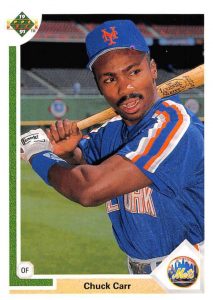 Chuck Carr, living his Met life. In 1991, the Mets decided a single speedy center fielder was exactly what they needed to start the season. Except it wasn’t Chuck Carr. It was Vince Coleman, signed to a four-year deal that isn’t primarily recalled for how it blocked the path of Chuck Carr, but it did that, too, one supposes. Carr was up and down with the Mets the year they stopped altogether contending. The game in which he was granted his first big league start, August 28, was also the game in which he notched his first career RBI (off T#m Gl@v!ne, no less) and the game in which he injured himself in the field while misjudging a fly ball. There’d be one more appearance about a month later. The Buddy Harrelson era was about to end. So, in Met terms, was the Chuck Carr era, such as it was. The Mets swapped him and the 28 bases he stole between Norfolk and New York in 76 games that summer to St. Louis for a Single-A reliever. Across three seasons, Carr stole 128 bases for Mets affiliates and two for the Mets.
Artificially turfed Busch Stadium had been traditionally friendlier terrain for outfielders whose game was defined by their speed. The brief glimpse the Cardinals gave Carr in September 1992 generated Chuck’s kind of results: 22 games, 10 steals — plus a two-run double off Jeff Innis in one of Carr’s first games back in the majors, his way of invoking Simple Minds. Don’t you forget about Chuckie. The franchise coalescing in Florida took note. The Cardinals exposed Carr in the expansion draft. The Marlins took him with their seventh pick. He was about to be an Original Fish.
Within two weeks of the birth of the Marlins, Chuck Carr established himself as every day center fielder and leadoff hitter. By the time the Mets showed up at Joe Robbie for the Tarp Game, Carr was proving the skills he’d hone in the minors could play in the majors. He had 28 steals, en route to an NL-leading 58. A member of a first-year club leading his league in something was something else. As towering as Frank Thomas’s 34 home runs soar in the annals of the 1962 Mets, they placed him only sixth in the National League.
From the perspective of nearly thirty years on, the NL’s Top Ten Stolen Base Leaders of 1993 grabs a Mets fan’s attention. Gregg Jefferies, who wasn’t known for a bag thievery in New York, placed fourth with 46 sacks swiped. Eric Young, Sr., finished seventh with 42 for Colorado (his namesake son would lead the league in that category as a half-season Rockie/half-season Met two decades later). Brett Butler, two years before the Mets would sign him four years too late, totaled 39 stolen bases for the Dodgers, good for ninth in the circuit. Dykstra, as part of his MVP runner-up portfolio for the pennant-winning Phillies, absconded with 37, tenth among NLers. And that guy the Mets thought would be their speedster supreme, Vince Coleman, stole 38 bases, or ninth-best sum in the league. Vince might have swiped more had his Met career not come to an inglorious end in late July after he staged his very own Fireworks Night in the Dodger Stadium parking lot.
Chuck Carr outstole them all. His 58 bases were as many as any Met had ever stolen to that point, matching Mookie’s total from 1982. Chuck was also the most thrown-out base stealer of 1993, caught 22 times. He didn’t walk much for a leadoff hitter, and his OPS, when measured by contemporary standards, doesn’t amount to numbers associated with a spectacularly effective offensive player. But this was 1993. It wasn’t so far removed from the ’70s and ’80s that a base stealer who played fairly spectacular center field defense couldn’t be appreciated on his own terms. Marlins fans (they existed before they didn’t) appreciated Carr plenty. Far from wishing someone “shut up little Chuckie Carr,” they voted the kid from Southern California their Most Popular Marlin after the club’s first year of existence. He rewarded their support by stealing another 32 bases in strike-truncated 1994 while leading the league in singles and continually flashing his trademark smile. Chuckie may have been derided by some peers for the perceived crimes of excessive chatter and personal aggrandizement, but the folks who gave their hearts to the game (and slid their dollars across the ticket window counter) at a juncture when the game was on the verge of walking out on them noticed when a player gave his heart right back to it and them. Chuck Carr didn’t scowl his way to 90 stolen bases over the course of his two best seasons. The Memories section of Carr’s Ultimate Mets Database page confirms that if a person outside the baseball industry crossed paths with Chuck Carr, they were highly likely to identify as a Chuck Carr fan.
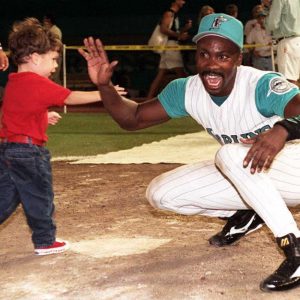 Chuck Carr, enjoying life after the Mets. Against Dave Telgheder’s recommendation, I maintained a slight fondness for Chuck Carr even as his Met affiliation faded from view. We know how Old Friends can be in their wrath toward the team that gave up on them, and indeed, Chuck Carr drove in more runs against the Mets than he did any opponent in a major league run that lasted through 1997. Then again, driving in runs wasn’t exactly Carr’s specialty, so I don’t think it did any harm to give Chuck a light hand when he’d be announced as part of the Marlin starting lineup at Shea. I’ve always tried to acknowledge the prodigal sons when they’re in for a visit, at least until their post-Met success erodes my lingering goodwill.
After Carr left the Marlins, I stopped keeping up with his doings. I didn’t realize, until I read his obituaries, how much injuries depleted his primary skill set as the ’90s wore on. I didn’t know that he pretty much talked himself out of Milwaukee in 1997, albeit in the stuff of an anecdote Ron Shelton has to wish he’d written. It seems Carr swung on two-and-oh against manager’s orders and popped up. When confronted, Carr reasoned, “That ain’t Chuckie’s game. Chuckie hacks on two-and-oh.” Chuckie also packs for his next stop after such an explanation. The good news for Carr was his next stop was playoff-bound Houston, for whom he would hit his only postseason homer, off John Smoltz in the ’97 NLDS.
Then, while I was too busy focusing on the late ’90s/early ’00s Mets to notice, Chuck Carr was out of Major League Baseball. But not out of baseball. Carr’s smile in games and toward fans was genuine. He loved the sport enough to keep working at it wherever he could. He went to China and played on the Mercuries Tigers with future Met Melvin Mora (thus making them Mercuries Mets). He played in the Atlantic League when independent ball in the Northeast was a fresh concept. One of his two indy seasons was as a Long Island Duck, reuniting with Harrelson as Buddy was getting his quackers off the ground. Chuck then took his talents to Italy and then finished up in the Arizona-Mexico League, a 35-year-old player-coach ten years removed from his stolen base crown. Had Chuck Carr’s career crested later, in this day and age, he might have been hailed on social media for his “swag”. Or his flair/bravado might have rubbed some teammates and opponents the wrong way anyway because big league baseball still has more John Buck than Jordany Valdespin at its stodgy core. Or as someone who could run a lot but not hit nearly as much, he might not have been handed more than a cup of coffee — to go.
But if Chuck Carr was the person he was all along, he probably would have kept on talking and kept on smiling and there’d have been a reason to keep on applauding. It’s never too late for a baseball fan to put two hands together for a baseball player who let you know how much he loved the game.
by Greg Prince on 19 November 2022 5:47 pm Those wisps of smoke visible in the autumn sky remind us that this has been a busy birthday week amid the lofty heights of the Mets’ Mount Pitchmore, with Dwight Gooden turning 58 on November 16 and the 78th anniversary of Tom Seaver being born having come around on November 17. Next date to celebrate, commemorate and blow out candles up on that mountaintop: December 23, Jerry Koosman’s 80th birthday.
What each of these three icons of taking the ball; throwing it; and succeeding lavishly have in common, beyond their place atop the topography of Mets hurling, is they started their major league careers as Mets…yet didn’t finish it that way.
You don’t have to be the fourth face on the Mets’ Mount Pitchmore to claim common ground with Seaver, Gooden and Koosman on that count, but more on him in a while. A slightly lesser mountain populated by Met starters who started in the bigs as Mets — pick your pitchers — would say the same thing. Maybe your name is Matlack. Or Swan. Or Darling. Or Jones. Or, of more recent vintage, Harvey or Wheeler or Syndergaard or Matz. Your MLB debut (even if you were first signed professionally elsewhere) came as a New York Met. You would eventually make plenty of pitches as a Met. But you wouldn’t make all of them.
When David Wright stepped aside at the end of a long if not long enough career as nothing but a New York Met, we practically fainted from lack of precedent. With the exceptions of Ed Kranepool and Ron Hodges, nobody who’d lasted double-digit years in the majors did so exclusively as a Met. When we mourned the too-soon passings of Pedro Feliciano and Jeff Innis, we noted they were relievers who provided all the relief they could for the Mets and only the Mets. Feliciano in particular captured our imagination for flitting in and out of other organizations but not wearing their uniform in official action, especially when he took the Steinbrenners’ money for two years and used his time in their employ to rehab rather than pitch for them. True to the orange and blue, indeed.
But starting pitchers, the signature actors on the Met stage, have been a different story. There have been no high- or mid-profile exceptions to the Everybody Leaves Home Eventually rule. While we toast the memory of Tom Terrific every November 17 (every day, really), we try to forget that 38.949 percent of Seaver’s starts came as something other than a Met. The percentages we prefer to remember are 98.84, his Hall of Fame vote; .781, his W-L pct. in his first Cy Young season from going 25-7 in 1969; and 61.051, or the inverse of 38.949. Tom made more than six of every ten of his starts as a Met. William DeVaughn advises cleansing the Seaverean section of your mind of Reds and White Sox and Red Sox imagery and just being thankful for what you got. We got a lot of Tom Seaver.
Not all of him, though. Never all of it with our most substantial starting pitchers. Doc Gooden the no-hitter crafter for the Yankees. Jerry Koosman the 20-game winner for the Twinkies. Jon Matlack placed second in league ERA in 1978 as a Texas Ranger. Ron Darling went to the playoffs in 1992 as an Oakland A. We’ve already hit of late on the sore-ish subjects of Zack Wheeler and Noah Syndergaard. But we could go way back, too. Before Seaver was traded to Cincinnati, Jim McAndrew pitched for San Diego, Gary Gentry pitched for Atlanta and Nolan Ryan pitched for California. Some of the moves that led to those reassignments were better than others for the Mets — the trade of Gentry begat Felix Millan; the trade of Ryan begat Jim Fregosi (plus a half-century of Ryan-related regret) — but within the context of a Met starter starting, continuing and finishing a career as a Met, the outcome was essentially the same.
Anybody of note come notably close to being a Met and nothing but a Met? A few. McAndrew, for example, started 110 games as a major leaguer, 105 of them for the Mets. That’s better than 95 percent made for the Mets. Yet those five times he took the hill as a Padre starter spilled an infinitesimal if indelible brown and yellow blot on Jim’s Metsian purity. A little short of a hundred miles up Interstate 5 from San Diego, another Met starting pitcher of considerable tenure drove off the road of his journey to keeping it 100. Craig Swan started 184 games as a Met between 1973 and 1983. In 1984, the onetime National League earned run average champion was languishing in the Met bullpen. The club released him in May. Swan was 33. Two entities decided he still had competitive pitches embedded in his right arm: Swan and the California Angels. Thus, Craig went to Anaheim, gave extending his career a shot with one more start (and one more relief appearance) before finding himself off MLB mounds once and for all.
One-hundred eighty-five career starts in all. One-hundred eighty-four career starts as a Met. That’s 99.459 percent for us. So, so close. Swannie, you coulda been practically the pitching version of Ed Kranepool. Alas, that probably wasn’t your goal as summer approached in ’84.
How about a loophole? Jason Isringhausen came up to the majors with the Mets, made 52 starts between 1995 and 1999 with the Mets in that period and never made a start for anybody else. Eureka? Fool’s gold. Izzy never threw the first pitch of a game for the A’s, Cardinals, Rays or Angels, but he surely threw pitches at other junctures of loads of games for them. Jason appeared in 724 major league games. In 611, he was something other than a Met, usually as one of the leading closers of his day. The most accomplished of the Generation K trio posted 300 saves overall. His first, in ’99, and final seven, in Recidivist 2011, were for the Mets. The rest were for the A’s and Cardinals.
Verdict: not much of a loophole.
Let’s take a deeper look at this phenomenon through the prism of the first 60 years of New York Mets baseball. Here’s every Met pitcher who a) started his major league career as a Met; b) started at least 50 games for the Mets; and c) didn’t pitch for the Mets in their 61st year.
MOST GAMES STARTED AS A MET BY PITCHERS
WHOSE MLB CAREER STARTED WITH METS
(% of career starts as a Met; excludes 2022 Mets)
Tom Seaver 395 (61.051%)
Jerry Koosman 346 (65.655%)
Dwight Gooden 303 (73.902%)
Ron Darling 241 (66.209%)
Jon Matlack 199 (62.579%)
Bobby Jones 190 (78.838%)
Craig Swan 184 (99.459%)
Jon Niese 179 (90.863%)
Mike Pelfrey 149 (58.203%)
Zack Wheeler 126 (64.615%)
Gary Gentry 121 (87.681%)
Noah Syndergaard 120 (83.333%)
Dillon Gee 110 (85.938%)
Steven Matz 107 (73.288%)
Jim McAndrew 105 (95.455%)
Matt Harvey 104 (57.777%)
Ed Lynch 98 (82.353%)
Nolan Ryan 74 (9.573%…with 295 wins elsewhere)
Nino Espinosa 67 (53.175%)
Jae Seo 66 (64.706%)
Mike Scott 60 (18.809%)
Rick Aguilera 59 (66.292%…and 311 saves elsewhere)
Masato Yoshii 58 (49.153%)
Walt Terrell 56 (19.048%)
Jason Isringhausen 52 (100%…but 292 saves elsewhere)
In case you’re wondering, Sid Fernandez’s big league career had a John Stearns-style start to it. Stearns made one appearance in a Phillies uniform, on September 22, 1974, before his trade to the Mets the following December. El Sid was an L.A. Dodger for two games at the tail end of 1983 — first as a reliever, next as a starter — prior to Frank Cashen gladly taking Fernandez off Tommy Lasorda’s hands. Sid proceeded to make 250 starts for the Mets between 1984 and 1993, fourth-most by anybody in Mets history. Unlike Stearns, who never played for anybody else beyond his Met years, Fernandez logged innings (including 49 starts to bring him to 300 in all) for three other teams from 1994 to 1997. And in case you’re really wondering, Sid Fernandez and John Stearns shared a Met starting lineup exactly once, on September 26, 1984; John was the first baseman that Wednesday night at Shea, as Sid notched a 7-1 win over Jerry Koosman and the Phillies in the season’s final home game.
If you were wondering any of that, I truly value the cut of your jib.
ANYWAY…that’s 25 pitchers who made at least 50 starts as a Met from the beginning of a major league career and none of them spending an entire major league career as a Met through 2022. That tells us how hard it is to hang on to a starting pitcher and how effective the pitchers who became icons for us were, given that they had to establish their iconography in something less than the span of an entire career.
But what about starting pitchers who began their careers as Mets, made at least 50 starts as Mets, and happened to be Mets in 2022? They’ve been left out of the above accounting because there is a TBD nature to their careers. Also “they” are exactly one Mets starting pitcher. Maybe you’ve caught on to where this is going, beyond the chance to acknowledge the birthdays of Dwight Gooden and Tom Seaver.
To be determined, indeed, is the nature of Jacob deGrom’s career, specifically where it will continue in 2023. Free agent Jake is already one-quarter of the Mets’ Mount Pitchmore. If we’d included deGrom’s 209 starts in the list above, he’d rank between Darling and Matlack, but (with no disrespect to Ron and Jon) his peers sit at the top of the chart. Seaver. DeGrom. Gooden. Koosman. Shuffle the second, third and fourth names as you like, but they belong in a row. Jake’s got nine seasons in the books, all of them as a Met. In every one of those seasons, he has never been less than one of the two most significant pitchers in the Met rotation, and usually he hasn’t had even that much company.
In the context of the list above, he not only blew past the likes of Jon Niese and Dillon Gee practically upon arrival, he outlasted contemporaries Matt Harvey, Zack Wheeler, Noah Syndergaard and Steven Matz. Those four plus deGrom shaped up as the core of a pitching staff that was going to grow into full maturity together. As individuals, each of the other four had his extended Met moment prior to a departure that appears inevitable in retrospect. DeGrom’s Met life, meanwhile, self-renewed without a ton of fuss — only a torrent of success. Except for not remaining unfailingly, unquestionably in what we refer to as one piece, Jacob deGrom has done nothing to make a Mets fan wish he won’t be celebrating his 35th birthday in a Mets uniform on June 19.
Of course Jake hasn’t remained unfailingly, unquestionably in one piece in his eighth and ninth seasons in the bigs and, as more than implied a sentence ago, he will turn 35 this coming June. If you want to pick apart the case for never letting him leave, beyond a need to count Steve Cohen’s money or calculate luxury tax impact on the construction of the rest of the roster, there were a couple of walls he hit in some of his September starts and there were a couple of starts where his core competency of being absolutely untouchable wasn’t in evidence inning after inning. A slightly diluted deGrom was still a sensational bet in Rob Manfred’s gambling-obsessed enterprise. Jake notched the first postseason victory by a Mets starter in seven years, and you wouldn’t wager against him notching the next one fairly soon if given the chance to lead the Mets toward another, hopefully deeper October run.
Mount Pitchmore is so named because its occupants are the pitchers good sense told you should pitch more for the Mets. In a given inning. In a given game. In a given series. In a given career. Seaver, Koosman and Gooden weren’t given the opportunity to keep it 100. Maybe in a given moment it didn’t seem off to have them out of the contemporary picture. Yet you look back and you wish you could see each as only a Met. DeGrom still has 100 in play. Began as a Met. Excelled as a Met. Can still go on as a Met and finish as a Met and nothing else. That would be 100% my preference.
If I have to eventually understand that progress moves the Mets and Jacob in different directions, I will pivot as events dictate. I acknowledge the risk/reward ratio of re-signing deGrom entering 2023 looks different than it did heading into 2019. Nevertheless, my choice is to view at least one quarter of the Mets’ Mount Pitchmore is something other than historical perspective. I’d like to watch Jacob deGrom pitch in a New York Mets uniform for all his baseball years to come. And when he’s done, I’d like to see his name ensconced atop the list of most starts by a pitcher who began his MLB career as a Met and never pitched for another MLB team.
Do you know who’s atop that specific list right now? Well, Jake, obviously, but that’s with the TBD caveat. Not only is deGrom first with 209 starts, David Peterson is second with 43 and Seth Lugo — only sometimes a starter (other than in his heart, perhaps) — is third with 38. Peterson’s been on our scene barely three seasons and Lugo is actively shopping his services around the industry. Tylor Megill, a rookie in 2021, is already sixth on this list with 27 starts. You can see the inherent folly of referring to players just getting going or going through free agency as Lifetime Mets.
If we limit eligibility to Met starting pitchers who we know for certain never pitched and never will pitch for another Major League team, the list sits at the foot of Mount Pitchmore. If we remove 2022 Mets from consideration, we can’t use a baseline of 50 starts as a Met. Or 40 starts as a Met. To get a list with enough names to make the exercise worthwhile, let’s set our minimum as a mere 5 starts. That’s pitchers who started their MLB careers as Mets, made at least FIVE STARTS and never pitched for anyone else in the bigs. You wouldn’t think we’re asking for a lot. All we’re going for is the amount equivalent to the quantity of fingers on one standard-issue human hand.
Let’s count upward this time.
BOB MYRICK (5 starts): A reasonably effective lefty reliever from 1976 to 1978. Got his starts for teams going nowhere. Bob’s starting career went the same place. Two of his starts were second games of doubleheaders, usually a tipoff that the manager simply needed someone to eat a few innings. Myrick also got the in-season starting assignment that in most years was the hallmark of a pitcher the manager didn’t have many other starting plans for: the Mayor’s Trophy Game, in 1977 (it doesn’t count toward Bob’s total). Was traded to Texas in 1979 with somebody to be mentioned several slots ahead on this list. Like his trade companion, Bob never made it back to the majors after being a Met.
BRENT GAFF (5 starts): The Mets had lost four in a row and really could have used a boost from their minor league callup on July 7, 1982. They got one for seven innings from Brent, who kept the Giants off the board…until the eighth. He wound up losing, 3-2, in his debut (and the Mets’ losing streak would reach seven), but a potential starter was born. “He really showed me something pitching out of that bases-loaded situation in the seventh,” George Bamberger said. “I wanted him to win real bad. I was heartbroken when he didn’t.” Bambi’s heart mended enough to give Gaff four more starts in ’82. Brent merged anew as a valuable reliever for Davey Johnson in 1984, prior to injury curtailing his career.
CHRIS SCHWINDEN (6 starts): Less remembered for his half-dozen uninspiring starts early in the Terry Collins era — the final results of which were 6-5 losses three times and 10-1, 18-9 and 8-1 losses the other three times— than for his coming through the waiver process with his right arm somehow intact. After what proved to be his final big league appearance in 2012, Chris was waived by the Mets and picked up by the Blue Jays; waived by the Blue Jays and picked up by the Indians; waived by the Indians and picked up by the Yankees; and waived by the Yankees and picked up by…the Mets…all in a span of less than five weeks. Last pitched professionally for the Lancaster Barnstormers of the Atlantic League in 2014; started 25 games and won 14 of them.
BOB MOORHEAD (7 starts): The first Met to make his major league debut as a Met, in the very first game the Mets ever played, too. Bob might have been the canary in the 1962 Mets’ coal mine. In April, he made six appearances in relief; the Mets lost them all. From May 6 through June 9, he pitched in nine games, starting and relieving; the Mets went 5-4. Prosperity took a holiday thereafter, with the Mets posting a record of 1-22 when Moorhead took the mound in any capacity. Bob wouldn’t pitch for the Mets again until 1965: nine relief appearance in nine losses. One hopes he didn’t believe the Mets’ lack of success reflected upon him personally. Most every Met was kind of a bad-luck charm in those days.
ALAY SOLER (8 starts): A lifesaver, or at least a holeplugger, for a spell in 2006. The first-place Mets weren’t exactly drowning, yet they never seemed to have enough reliable starting pitching. They turned to Alay, a Cuban defector whose MLB debut came at age 26, and he threw a couple of early-June gems, most notably a two-hit shutout at Arizona in the midst of the 9-1 road trip that all but clinched the division title. Soler’s effectiveness wore off, Willie Randolph found other options, and the righty fell out of the Mets’ plans before the Fourth of July.
BOB APODACA (11 starts): The reliever who wore the fireman’s helmet between the trade of Tug McGraw and the acquisition of Skip Lockwood — leading the 1975 Mets in saves with 13 — Bob was given handfuls of starts in 1974 and 1976. That would happen with relievers back then. His first came in a contingency role when Matlack was ailing. Yogi Berra handed Dack the ball and Dack handed him five innings of two-run ball and a win over Bob Gibson and the Cardinals. Ultimately, Apodaca’s role would be to sit on the DL for a very long time following ligament damage to his right elbow in a Spring Training game in 1978. He never pitched in the majors again, but sure did a lot of coaching there, including for Bobby Valentine’s renaissance Mets of the late ’90s.
SCOTT HOLMAN (14 starts): Every generation has that Triple-A comer a fan is convinced is gonna come up and be the answer, based on nothing but a vague sense generated by staring at his name in the back of the yearbook or The Sporting News’s Tidewater stats. My guy was Scott Holman. Just wait until Scott Holman gets here, I told myself in the early 1980s. Three quality starts after the rosters expanded in 1982 made me look like a visionary. By the summer of ’83, things grew a little blurry, as Scott receded from rotation to relief. His last MLB appearance came on September 29, 1983. Great days awaited the Mets. Holman would spend them in the minors, striving to get back for a taste.
COREY OSWALT (14 starts): Corey Oswalt called and said he doesn’t belong on this list, that after a dozen Met starts in 2018 and one apiece in 2020 and 2021, he’s still very much active, pointing to his presence with three different organizations in 2022 as proof, that for all I know he’s gonna have another start in the majors. I reluctantly responded that his Triple-A stints in Sacramento (the Giants), Lehigh Valley (the Phillies) and Albuquerque (the Rockies) — and the combined 6.57 ERA he posted at those stops — may not be the compelling evidence he believes it to be. Corey is currently a free agent. He’s welcome to pitch for another major league team and hop off this list ASAP. Until then, he’s sticking around next to Scott Holman. Should Oswalt get another chance at the major league level, may he enjoy the run support he received the day he notched his second MLB win, in the first game of the doubleheader of August 16, 2018. Final score at Citizens Bank Park: Mets 24 Phillies 4; it was the most runs the Mets have ever tallied in one game. The record will show Oswalt protected an eleven-run lead in the fifth inning to secure his victory.
JENRRY MEJIA (18 starts): An alternately promising and injured righty whose starts were scattered within four seasons of mostly relieving. Some of his stints were positively mouthwatering. The afternoon half of a day-nighter in Washington in 2013 stands out in memory: seven innings, zero runs, an 11-0 late-July whitewashing that elevated the Mets to 22 wins in their previous 36 games, or the high point of that otherwise godforsaken season. Jenrry found his groove as the Met closer in 2014, nailing down 28 saves for a team finally on the upswing. Then there was something about PEDs and that was basically that for Mejia.
MIKE BRUHERT (22 starts): You’ve been waiting to find out who was traded alongside Bob Myrick to Texas, haven’t you? Wait no more! It was Mike Bruhert, stalwart of the Mets’ ascent to prominence in April of 1978…or have you forgotten Mike’s six innings of one-run ball versus the Cardinals that raised the Mets’ record to 7-5 and his own record to 1-1? Well, I remember those first weeks of a season that eventually disintegrated fondly. I also remember not knowing in advance anything about either Bruhert or reliever Mardie Cornejo, another righty who, I swore once I saw them on the Opening Day Roster, were gonna make 1978 a total upgrade from miserable 1977. Final record in 1977: 64-98. Final record in 1978: 66-96. So there, says this former fleetingly optimistic 15-year-old. Mike is probably more famous — in circles in which Mike is famous — for having been Gil Hodges’s son-in-law, marrying Irene Hodges, the daughter who gave the touching Hall of Fame acceptance speech for her late dad this past July. (The marriage didn’t last.) The trade of future Fordham pitching coach Bruhert and future Mississippi businessman Myrick to the Rangers, not incidentally, was for a fading Dock Ellis. Bruhert hung in as a minor leaguer for four seasons after 1978, a year longer than Myrick did. Former All-Star Ellis pitched to a 6.04 ERA as a Met before the Mets sold his contract back home to championship-bound Pittsburgh. In his spellbinding 2021 memoir Cobra, Dave Parker remembered “we were all aware of Dock’s record that season,” but the prodigal Buc explained it away by detailing “how the Mets overworked his arm in the bullpen, constantly having him warm up and then sit down”. The Pirates welcomed Ellis back enthusiastically, though he wound up pitching in only three games, the last three of his career, all of them Pittsburgh losses. In all, Bob Myrick and Mike Bruhert for Dock Ellis was one of those trades that can fairly be said to have helped absolutely nobody.
RANDY TATE (23 starts): Like Mike Bruhert, Randy Tate’s not quite two-dozen starts in the major leagues, all as a Met, were confined to one season, in Tate’s case 1975. His signature outing was the near no-hitter against the Expos on August 4. The seven hitless innings, much like Gaff’s debut seven years later, blew up in the eighth and turned into a loss. The rest of Tate’s professional career took place in the minors. I’m still amazed that the starter who started the most games behind Tom Seaver, Jerry Koosman and Jon Matlack on those 1975 Mets is someone who never pitched in the majors the year before and would never pitch in the majors again.
ERIC HILLMAN (36 starts): Eric was a tall drink of water for a parched rotation in August of 1992, shutting down the Pirates for eight innings in his first start (on Tom Seaver Hall of Fame Night, no less). At 6-foot-10, he didn’t throw as hard as one might have imagined, but he had pretty good control. Not great luck, and not a great team behind him. When the Mets let him go in 1994, his baseball future awaited in Japan, where he racked up a dozen wins for Bobby Valentine’s Chiba Lotte Marines in 1995 and another 14 the next season for the same club, albeit for a different manager. Eric must have picked up some pointers, because he has become a staple of Mets fantasy camps, where attendees have raved for years about the man’s coaching. What they may not realize is the distinction Coach Hillman shares with the current Mets pitching coach.
JEREMY HEFNER (36 starts): You know this guy. He comes out to the mound to confer with the likes of deGrom, Peterson, Lugo and Megill. Hef, as a person named Hefner is inevitably known, has become one of the well-regarded pitching coaches in the major leagues. His pitching career may not have hinted at this particular chapter of his life, as he was, at most, a pretty decent starter for a fairly brief period. The year before deGrom debuted, Jeremy shared a rotation with Harvey, Wheeler, Niese and Gee. Over two seasons, before Tommy John surgery derailed him, he started three-dozen times, occasionally very well. In his first Met/MLB start, he got clobbered by the Padres, but did hit a home run, something no pitcher the Mets call up to Citi Field will ever say again. And if Jacob deGrom does re-sign with the New York Mets and spends the rest of his career with the New York Mets, here’s something we’ll never be able to say again:
Eric Hillman and Jeremy Hefner are the all-time leaders in games started by Mets pitchers who we know never pitched or will never pitch for any other major league team.
Attempt to absorb that again, if you will. Fine gentlemen by all indications, fellas who pitched more than regular folks like you and me ever will for the Mets. The same could be said of everybody namechecked from Myrick and Gaff and up through this particular chart. I’ve learned after taking these kinds of historical dives and understanding the talent and effort required in making the majors for even a single inning (and learning the toll injuries can take on potential) to go light on the scoffing at or dismissing of pitchers whose major league careers don’t jump off the virtual page let alone measure up to those of a Tom Seaver or a Jerry Koosman or a Dwight Gooden or a Jacob deGrom. Sure, some of these guys, if we remember them much, it’s probably for the kind of pitching that signaled they weren’t destined for the most bountiful of big league tenures. That said, they had big league tenures. That’s incredible for any portion of any lifetime.
But c’mon. At the top of a list of MOST STARTS/NEVER LEFT, especially when we’re talking about a franchise defined at its peak by the Franchise and by starting pitching in general, we should be able to have a name that isn’t — and I say this with proper accord for two righthanders who wore No. 53 perfectly honorably — Eric Hillman’s or Jeremy Hefner’s. Not when we have a chance to someday have that name be, on a permanent basis, Jacob deGrom’s.
Two-hundred nine starts and counting. Topping this list isn’t the only to reason to keep Jacob deGrom’s total of major league starts as a Met and NOTHING but a Met increasing. But it’s up there.
A new episode of National League Town is out, celebrating Buck Showalter’s Manager of the Year award; praising HBO’s Willie Mays documentary; remembering the late Met Chuck Carr; and visiting Met Lit novelist Kevin Chapman. Give it a listen here or wherever you find your podcasts.
by Greg Prince on 7 November 2022 12:53 pm If Cole Porter were still with us, I can hear him having a field day with the results of the 2022 World Series.
You’re the top
You’re the Houston Astros
You transformed
Phil bats to disasters
Whoever dug deep for the sportsmanship to declare, before the Fall Classic began, “may the best team win,” got their wish. The best team in the World Series prevailed. They were, by far, the best team their league had to offer and they emerged as the best team in the entire sport. The Houston Astros appeared mighty formidable from a distance all year and only more so up close when we glimpsed their prowess first-hand in June. The Mets played a pair of two-game sets against them in consecutive weeks and came away with four dings in their armor. Two of the losses were by blowout, one was at the wrong end of a pitching duel and one ached for that big hit late that never came. Before our own postseason went to Padre hell, I allowed myself maybe five minutes of projecting potential Mets-Somebody World Series matchups. When I got to Mets-Astros, I fortified my confidence with the notion that when we played them months earlier, we didn’t have Scherzer and we didn’t have deGrom and having them could make all the difference. I also thought, man, I do not want to have to play the Houston Astros in the World Series.
Mission accomplished?
You’re the top
You’re the skipper Dusty
We forgot
Your team was not so trusty
If 2017 is too much original sin to overlook, then you’re not interested that the managerial arc of Dusty Baker has been redeemed, on the off chance it needed to be. The man managed four other franchises into October without ultimate success. He inherited a powerhouse in Houston whose morals and ethics were in question, to put it kindly. They shook out their front office. They churned much of their roster. And they brought in the manager you couldn’t boo if you had a heart. The Astros are still a powerhouse, with a mostly different cast from the one that won the World Series with the help of video monitors and trash cans. A core of those ringbearers is still around from ’17, still delivering big hits. “I sure hope Altuve, Bregman and Gurriel win another trophy” probably wasn’t much of a rallying cry outside Southeast Texas, but Baker the baseball lifer of all baseball lifers — winding through the game for most of the past 55 years — grew into a cause that transcended partisanship. Unless you absolutely couldn’t tolerate another Astros championship or you were a Phillies diehard, Dusty wrapped in a mass embrace at the end of Game Six was worth the price of admission. (If I needed a rooting interest in this Series, this story did it for me.)
You were not
Some mere Wild Card entry
May just be
The team of this here centu’ry
It is fashionable every October/November to dismiss any baseball outcome you don’t like as random. Anybody can win a best-of-three, a best-of-five, a best-of-seven. Yet that, give or take a newfangled bye, is the gauntlet that’s laid out for everybody. Losing along the way doesn’t mean you’re suddenly without merit, but winning it all, I truly believe, attests to your quality as a ballclub. World champs are world champs. If the Phillies had scraped together two more wins, there’d be some twisting worthy of a soft pretzel to make their case as more than winners of an extended tournament on a hot streak, though I’d probably try. But it was the 106-win Astros, the Astros who are in the playoffs every single year, the Astros who keep coming back to the World Series. The Astros whose outfield no longer includes George Springer; and whose infield no longer includes Carlos Correa; and whose rotation no longer includes Gerrit Cole; and whose bullpen no longer includes Roberto Osuna; and the beats missed were negligible. Here came Jeremy Peña to take over at shortstop and Kyle Tucker in right and Chas McCormick in center and Framber Valdez to start and a passel of relievers — among them a fella named Rafael Montero — to seal almost every lead. Few outside of Goliath Heights particularly love Goliath, no matter who’s managing Goliath, yet David’s slingshot doesn’t always find its target. If the World Series ideal is to crown the top team in the sport, the 2022 edition achieved its ancient ambition.
It also provided entertainment upon an otherwise baseball-devoid landscape, albeit in spasms. There was a comeback for the ages in Game One, a power onslaught in Game Three, a no-hitter (combined; even still) in Game Four, a genuine nailbiter in Game Five and a second-guesser’s delight that more or less decided Game Six. That this World Series could be fun in spurts if tedious for stretches was likely attributable to the presence of those ever phascinating Philadelphia Phillies, despite their having joined the 1974 Los Angeles Dodgers as the only National League champions to lose both a season series to the Mets and the World Series. The Phillies are rarely boring. It was only when their ability to make contact went dark that you knew it was time turn out the lights on what was left of the baseball year.
There’s something about a Philadelphia rush through a postseason — and it doesn’t have to be baseball’s — that gets your attention, especially when the Philly team in question is fairly fresh on the national stage. We have conditioned ourselves to be averse to their good phortune (and it’s not like they give us any reason to take their side as otherwise neutral observers), but Philadelphia gets behind its teams when its teams give it something to get behind and roars its approval loudly enough to be heard at least to the northbound entrance ramp to the Goethals Bridge. I wasn’t in the mood for any of it from 2007 to 2011, but perhaps because we finished our season series with them on August 21, I could watch their aspirations crash the gates of reality with a pinch of admiration. We’re definitely better off without them as world champions, but it wasn’t gonna absolutely kill me if they’d pulled it off.
The presence of two once-prominent Met pitchers didn’t have as much to do with my lack of animus as you might think. I wanted Zack Wheeler to acquit himself in Game Six, but I wasn’t exactly heartbroken when the Astros jumped him in Game Two. I would have left him in to face Yordan Alvarez with two on rather than call on Jose Alvarado, but it’s not only the Mets who don’t solicit my advice or consent on pitcher moves. I always liked Zack, but I was never what you’d call from a fan perspective in love with him. Noah Syndergaard…ah, Noah. That was love, for a while anyway. It may have faded when his absence didn’t make my heart grow fonder, but we’d always have 2015 and 2016 and even that afternoon at the tail end of 2021 when discovering he was coming back for a couple of innings to test his rehabbed right arm had me practically racing around the house with glee. I actually called my wife at work to give her the big news: “Noah’s pitching tonight!” It felt momentous enough so that a text wouldn’t do.
That was both a little more than a year and a couple of lifetimes ago. Noah wanted that qualifying offer. Noah rejected that qualifying offer. Noah headed to the Angels (where he suddenly needed an extra day of rest when he was on track to face the Mets). Noah was traded to the Phillies (where a similar bout of fatigue suddenly set in). Noah went from our uniform to another uniform to one of the two or three worst uniforms he could wear from a Met perspective. Noah, I’m convinced, wants to make happy whoever he thinks it’s in his best interest to make happy. Maybe we all do, but Thor is Thor. Or was Thor and was ours and is still capable of grabbing our attention. In his Angels guise, he took a mild jab at the Mets’ combined no-hitter when one of his teammates threw an old-fashioned nine-inning no-no. As a Phillie, before pitching Game Five, he couldn’t restrain himself from praising villain from another autumn Chase Utley to the hilt, as if that were really necessary. Thus, when the Astros needed two at-bats to put one run on the board to open Syndergaard’s first World Series start since Game Three against the Royals, I was like yeah!
But when Noah limited the damage to get out of that first inning and proceeded to retire the Astros in order in the second and third, I kind of nodded and said, all right, good job. He indeed went from Syndergaard to Noah if not back to Thor in the span of not too many pitches. I wanted him to implode. I wanted him to succeed. Perhaps I wanted to get back to a relationship that wasn’t so fraught. Earlier this season, I removed SYNDERGAARD 34 from my t-shirt drawers, as monumental a rebuke to an individual as I can issue. The shirt still fit my torso, but not my state of mind.
Syndergaard wound up with a World Series loss. Wheeler wound up with two of them. The Phillies of Harper and Hoskins and Schwarber and Segura and the rest of them came up two wins short of the whole shebang. That they lasted as long as they did says plenty about the system that provided them the opportunity to come so close. That they came so close says something about them as a ballclub, too.
More has been said in this space on behalf of the Astros and Phillies than is normally said here. Apologies to those who cringe at anything that goes beyond THEY CHEAT and THEY SUCK as pertinent commentary. It was the World Series. I valued its company for six nights. I was satisfied it didn’t include the Yankees. Or the Braves. Or the Yankees. Or the Dodgers. Or the Yankees. Or the Cardinals. Or the Yankees. The Mets were so far removed from the postseason they briefly visited that once the final round got underway, I could take it or leave it on its own merits. I’ll almost always take it. It’s the World Series.
I wouldn’t mind a new t-shirt to replace Noah’s. When I watched a couple of Astros cavorting on the field at Minute Maid Park Saturday night, each modeling those WORLD CHAMPIONS shirts that go on sale a nanosecond after the final out, I wondered when I’d get the chance to purchase a version tinged in the proper shade of orange and blue, one that would stay in my rotation probably until the end of time, or my time. My 2006 NL East shirt is still on active duty. The pennant is still rising from 2015 in one drawer and another drawer has been warned that the 2016 Mets have come to reign. (Catch me on the right day, and you’ll learn from the words across my chest that I continue to implore the 2002 New Jersey Nets to BEAT L.A.) Maybe Modell’s would still be in business if they’d had more occasion to sell me more Mets championship gear. I don’t know if the shirt of which I dream will be donned by a Met we already know — can’t you see Pete Alonso putting one on only to tear it right off? — or if it’s going to take another generation of Mets to expand our wardrobes. Plenty of Mets have come and gone since October 27, 1986. None who wasn’t at Shea that night has worn a WORLD CHAMPIONS shirt let alone ring.
I don’t need a ring. I just want the shirt.
Our best-case scenario is Edwin Diaz in a year real soon making like Ryan Pressly this year, notching the World Series-winning save and being handed an officially licensed tee in appreciation. On Sunday, we learned Edwin’s being handed a lucrative new contract that will keep him in Met togs for either three, five or six more years, depending on who opts in or out of what exactly. The contract was well-earned. Edwin Diaz was one of the main reasons I dared to project Mets-Somebody World Series matchups a little more than a month ago. Edwin Diaz was why ninth innings in 2022 felt different from ninth innings in all the seasons that preceded it. Allowing for everything that can and often does go wrong with big deals for big names, there’s no one I’d rather have than Edwin Diaz to bring Mets games to a conclusion. Retaining this closer’s services was a brilliant way to begin this offseason and just what we need in order to imagine how we might conclude next year’s postseason.
Hopefully pawing through the boxes of WORLD CHAMPIONS merchandise that they can’t stock fast enough at Dick’s Sporting Goods or wherever one goes in person nowadays to secure such swag.
by Greg Prince on 28 October 2022 4:47 pm Growing up in the 1970s in New York, where college football showed up in the papers just enough to provide context for gambling lines, I maintained scant awareness of the sport, save for maybe the bowl games played on New Year’s Day. It was therefore a culture shock to me when I arrived at my then non-football college in Tampa and discovered I was living in a state where every Saturday was treated as if it was New Year’s Day (while every Friday night’s high school slate was New Year’s Eve). With limited column inches devoted to baseball in those pre-Sunshine State expansion days, I became hyperaware of college football, whether I intended to or not. You can only read the same wire capsules about last night’s Twins-Royals tilt so many times before your eye wanders to what else is going on.
More or less unconsciously, I chose a team to follow lightly: the University of Miami Hurricanes. This was in the fall of 1981, before they’d won much. They’d been in the Peach Bowl the January prior, I somehow knew. I liked that behind quarterback Jim Kelly they passed the ball by choice rather than out of desperation. They were an “independent,” which seemed less clannish than belonging to a conference. I mostly liked that they weren’t the state’s institutional favorite, the Florida Gators. Gainesville was relatively close to where I was on the West Coast of the peninsula. UF was an overbearing presence in the sports pages, meaning their primary in-state rival the FSU Seminoles also got too much play. Everything was Florida and Florida State, Gators and Noles, pick a side. Miami was tucked away on C-6, 250 or so miles south and east of Tampa on the map, practically off the grid, except in-state and too big to completely ignore. They were covered by the local media but mostly as an afterthought, like the New Jersey Devils are east of the Hudson. Worked for me. I could have a Cane in the fight, so to speak, without getting too caught up in this strange other world where people actually cared to excess about who was going to win on Saturday and what it meant in the almighty polls that determined a national champion.
Funny thing happened in the fall of 1983. “My” Miami Hurricanes lost their first game — by a lot, to Florida — then won their second. And their third. And so on. Baseball season ended. The playoffs and World Series came and went. The Giants under first-year head coach Bill Parcells were a disaster. The Jets, favored to finally make it to the Super Bowl, relentlessly disappointed. I could keep up with either of them only so much from a distance, anyway. The Canes, with Bernie Kosar having taken over for the USFL-bound Kelly, kept winning. I actually paid attention to the previews every Saturday and the game stories every Sunday. I monitored the AP and UPI polls of writers and coaches when they emerged early each week. When Miami finished its schedule with a win over Florida State to wind up 10-1, they were ranked No. 5. Because of the way bowl commitments locked certain conference champions into certain matchups, it would be impossible to have No. 1 Nebraska face No. 2 Texas (Cotton Bowl), No. 3 Auburn (Sugar Bowl) or No. 4 Illinois (Rose Bowl). Thus, the Orange Bowl, to which the Big Eight champion Cornhuskers were committed, would have to invite the next-best option: the Hurricanes.
Everything would have to break right for this to amount to anything more than a formality. Not only was Nebraska considered one of those college football teams for the ages, but there was a pecking order to consider. Three teams had a claim on the national championship should the Huskers stumble…not that that was gonna happen. Miami was a double-digit underdog, a sacrificial ibis. At least they wouldn’t have to travel far to their slaughter. The Orange Bowl — current site of whatever Marlins Park is known as now — doubled as their home stadium.
On January 2, 1984 (New Year’s Day was a Sunday and the NCAA ceded Sundays to the NFL), everything that had to break right for the Hurricanes broke right. Illinois was run out of the Rose Bowl by UCLA, 45-9. Georgia edged Texas, 10-9. Auburn beat Michigan but in a dull, unimpressive fashion (9-7) that wasn’t going to wow the judges. There was no playoff. You had to be voted No. 1. No. 3 Auburn didn’t do itself any favors in the swimsuit portion of this beauty pageant.
The field was wide open for Miami if it could pull an upset. The Canes played wide open and it paid off for most of the game. UM led 17-0 after one quarter and 31-17 after three. Yet this was Nebraska, which meant it wouldn’t be easy, even in Miami. Sure enough, those Huskers closed the gap to 31-30 with less than a minute left. They’d been undefeated and could stay that way by simply kicking the extra point. If Nebraska finished the season 12-0-1, there’d be no reasonable taking the No. 1 ranking away from them. But coach Tom Osborne, to his everlasting, sportsmanlike credit, decided in this pre-OT era that a tie was no way to secure the title. He called for a two-point conversion attempt. Miami stopped it. The Hurricanes won, 31-30, and were voted national champions.
All of which I bring up because while the college football-loving nation caught its breath (it’s still one of the greatest games the sport has ever known) and South Florida (where I was ensconced over the holidays) celebrated, a few sourpusses from the University of Florida poked their heads into a watering hole on Miami’s Coral Gables campus and blurted, according to an item I read a couple of days later, “GATOR BAIT! GATOR BAIT!” They remembered Miami had lost to Florida way back in September, before anybody saw any of this coming. As much as college football rankings hinged on “this one beat that one” in pre-BCS calculations, determining a season’s supremacy didn’t stem from a Week One showdown that was otherwise forgotten. Florida finished 9-2-1 and wound up ranked No. 6 when all was said and done. Miami beat No. 1 Nebraska in the Orange Bowl and ascended to No. 1 itself.
Gator bait, my ass.
But, y’know, the New York Mets took fourteen of nineteen from the Philadelphia Phillies in 2022, and the Phillies are National League champions. Hence…
Nah, hence nothing. It didn’t work that way in a sport that actually sort of factored vibes into its championship reckoning, and it surely doesn’t work that way in baseball with its playoff structure neatly in place. The fact that the Phillies played six series against the Mets and won none of them is not a factor this weekend or next week. The fact that the Mets no-hit the Phillies one night in April or overcame a six-run deficit in a single ninth inning or unleashed Nick Plummer to stun them in another ninth inning or Nate Fisher stymied them or Mark Canha ate them alive doesn’t impact anything where the remaining events on the 2022 baseball calendar are concerned.
Nevertheless, should the Philadelphia Phillies prevail in their upcoming (it still hasn’t started?) World Series versus the Houston Astros, they can send a thank you bouquet to 41 Seaver Way. I’ll even draft an accompanying card for them now in case they plan on being too celebratory to write straight once they obtain victory.
Dear Mets,
We appreciate how you toughened us up by beating the bejeesus out of us all season. Fourteen lumps led to one trophy — thanks!
xoxo
Phils
Since no preceding National League pennant winner who’s gone on to capture the World Series has, to the best of my knowledge, sent its gratitude to Flushing when appropriate, I doubt this courtesy will be followed through on. Nor might it be appreciated. Yet it might be appropriate.
In the 60 seasons of Mets baseball prior to 2022, 59 National League champions have been crowned. One time, amid the ongoing 1994 strike, nobody was crowned anything. Five times the Mets crowned themselves, the most ideal of coronations. One other time, in 2020, when the condensed regular season was played exclusively geographically, the Mets didn’t cross paths with the eventual NL champs, the Los Angeles Dodgers. This leaves us a sample size of 53 non-Mets National League champions to consider in the realm of Mets Versus Champs To Be.
When a team that isn’t the Mets wins the National League pennant, it might figure that the non-Mets team is going to outdo the Mets in head-to-head competition. That other team, after all, is on its way to the pennant, while the Mets, unfortunately, aren’t. This helps explain why in 36 of those 53 seasons when the NL champions weren’t the Mets, those NL champions to be won the season series from the Mets.
Ouch, I know. But it happened. It used to happen without fail. You might be aware that the Mets won a World Series before they ever won on Opening Day. You will learn right here that the 1969 Mets won the last game of their baseball year, and the 1970 Mets won the first game of their baseball year, yet it wasn’t until 1971 that a Mets team took a season series from a National League pennant winner in progress. The 1971 Pirates (8-10 vs. the Mets) didn’t really start a trend. The 1974 Dodgers lost their season series to the Mets (5-7) and the 1976 Reds tied theirs (6-6), but through 1983, one of the most dependable routes to the NL flag was by stomping on the Mets.
The 1962 Giants took the measure of the 1962 Mets 14 of 18 times. The 1963 Dodgers, who fell in a tacked-on playoff to the Giants a year earlier, learned their lesson and took 16 of 18 from the 1963 Mets. On it would go like that for most of the 1960s and 1970s and into the early 1980s. Maybe not so dramatically, but fairly dependably.
Then, in 1984, the Mets got very good and stayed very good for a while. Not good enough to win more than one pennant, but good enough to occasionally ward off or at least match the clubs that would outlast them into October. The Mets tied the season series with the NL champion 1984 Padres (6-6), the 1987 Cardinals (9-9) and 1990 Reds (6-6). There was also a 10-1 slate run up by the 1988 Mets over the 1988 Dodgers, but, um…
When the Mets fell apart for the bulk of the 1990s, their ability to thorn the sides of eventual NL champs went missing, save for 1995, when they took eight of thirteen from the Atlanta Braves, a result clinched by a final-weekend sweep at Shea that sure felt more meaningful to us than to them. Two years later, the Mets debuted as a Wild Card contender, and the 1997 Mets couldn’t blame their shortfall to the Florida Marlins on not sticking it to the eventual NL champs, as the Metsies won eight of twelve in head-to-head competition from the future Orange Bowl site denizens.
The Bobby V Mets’ generally winning ways didn’t necessarily extend to the cream of a given year’s NL crop — though they did tie the 2001 Arizona Diamondbacks 3-3 in that season series. Art Howe’s troops’ performance against the ’03 Marlins (7-12) and ’04 Cardinals (1-5) were apparently part of what Philip Seymour Hoffman studied to create his portrayal of the bumbling Oakland manager in Moneyball. Under Willie Randolph, the Mets held their own against 2005 NL champs Houston (5-5 when you could depend on what league the Astros called home) and outdid 2006 NL champs St. Louis (4-2, and don’t ask about how the Cardinals reached the World Series). The 2007 Mets did lose four of six to the 2007 Rockies, but that was months before anybody took the Rockies seriously as pennant timber or anybody would have dreamed the Mets wouldn’t play in October.
It only seems like the 2008 Phillies stampeded their way to the Series on the Mets’ heads, but the Mets took 11 of 18 from those eventual NL champs. Not so in 2009, when the Phillies helped inaugurate Citi Field and the enveloping aura of ennui by winning twelve of eighteen from the Mets home and away. The quasi-dynasty of the 2010-2014 Giants, with its pennant every even year, was boosted to an extent by their handling of the Mets, winning the season series from New York in 2010 and 2014 while splitting it in 2012. The Cardinals roared from the rear to nab the 2011 Wild Card that allowed them to transfer to the World Series express, thanks not so much to their having split six with the Mets during the season. The 2013 NL champ Cardinals, on the other hand, won five of seven from the Mets.
Since the Mets were last in the World Series, two aspiring National League champions put their lackluster Met season sets out of their mind to focus on the task at hand. The 2016 Cubs went 2-5 against the Mets (we swept them at Citi Field) and the 2019 Nats went 7-12 (despite the sense that Kurt Suzuki took Edwin Diaz over the wall every night for a month). The 2017 Dodgers unfortunately echoed their 1963 predecessors, going a perfect 7-0 against the Mets (it felt worse than that), while the 2018 Dodgers weren’t impaired by dropping two of six to the 2018 Mets. One wonders how L.A. made the 2020 World Series without our help.
The last example we have in this realm before this year comes from the 2021 Braves, who took ten of nineteen from the 2021 Mets, same as in 2022, if not at all the same as in 2022.
Here’s the thing, though. Among the nine National League champions, prior to the current Phillies, who lost season series to the Mets, eight went on to win the World Series.
The 1971 Pirates
The 1988 Dodgers
The 1995 Braves
The 1997 Marlins
The 2006 Cardinals
The 2008 Phillies
The 2016 Cubs
The 2019 Nationals
Only the 1974 Dodgers lost both a season series to the Mets and the World Series.
By comparison, among the eight eventual National League champions who split season series with the Mets, five won their World Series.
The 1976 Reds
The 1990 Reds
The 2001 Diamondbacks
The 2011 Cardinals
The 2012 Giants
No such luck for fellow .500ers the 1984 Padres, the 1987 Cardinals and the 2005 Astros.
What about those greedy bastards who won both their season series versus the Mets and the National League pennant? They’ve gotten what they’ve deserved, going 13-23 in terms of winning World Series. Since 1983 — a period that stretches back even further than the time spanning the present and 1986 — only four National League champions have run the gauntlet of beating the Mets and the American League champions: the ’03 Marlins, the Giants of ’10 and ’14 and last year’s Braves.
Otherwise, karma has looked kindly upon National League champions who demonstrated the good graces to not grind their bootheels into the Mets’ necks. Or, perhaps, getting beaten by the Mets stiffened the spines of NL champs-in-waiting once they got to the big stage.
Does losing 14 times to the Mets in the regular season, more than any National League champion has ever lost to the Mets, bode well for the Phillies against the Astros? Whatever happens, it’s not going to help us in this year’s championship rankings, but they’ve got their thank you note written in case they need it.
You’re welcome, Philadelphia.
by Greg Prince on 27 October 2022 3:16 pm I’m assuming the five-day interregnum between the conclusion of the League Championship Series and the commencing of the World Series was built into the postseason by MLB this year to give us time to get used to the nearly unfathomable presence of the Philadelphia Phillies in the 2022 Fall Classic.
But here we are, four days since the Phillies won the National League pennant and, nope, I still can’t wrap my head around it. Granted, the Phillies don’t play for my phathoming. Usually they exist so we can have phun with alternate spellings of the f-sound. When the Phillies succeed, we tend to make a pretty definitive f-sound.
My reaction to the Phillies’ elevation to National League champions boiled down to “go phigure.” The same Phillies on whose backs the Mets produced a week’s worth of prospective SNY offseason prime time programming — we reveled in at least five instant Mets Classics at their expense between April and August, by my reckoning — are on to bigger and better things, perhaps the biggest and best thing baseball has to offer, the Rob Manfred Memorial Piece of Metal otherwise known as the Commissioner’s Trophy awarded to the team that wins the World Series.
Which could very well be the Phillies…which I can’t get used to. Not that they’re not a team full of highly capable players, not that they haven’t circled the concept of contention for several seasons, not that they didn’t qualify for the playoffs. They’re just so…the Phillies. Perhaps our vision of them is skewed from those fourteen of nineteen games the Mets won from them in 2022. Perhaps we, like Keith Hernandez, couldn’t take their phundies seriously. For all the talent they’ve brought in, they continued to embody the spirit of Don Buddin, the 1950s shortstop immortalized in The Great American Baseball Card Flipping, Trading and Bubble Gum Book, the sort of team that “would perform admirably, even flawlessly, for seven or eight innings of a ballgame, or until such time as you really needed” them, after which they would fall apart like “a cheap watch or ’54 Chevy”.
Maybe that was the Phillies when the Mets played them. Still, an 87-75 record, while adequate to vault a ballclub into its league’s six-team tournament, doesn’t indicate they were avatars of ability against everybody else. Yet here they are, the six-seed that defeated the three-seed Cardinals, the two-seed Braves and the five-seed Padres, who themselves succumbed to Philadelphia after taking down the one-seed Dodgers on the heels of their upset of the four-seed Mets.
Remember that bunch from this postseason? It’s been a while. The Mets were ousted on October 9. The World Series starts Friday, on October 28. On paper, it’s all of a piece. In my gut, it barely registers. Of course, I remember all too well the pertinent details, but the loss isn’t haunting me the way these sorts of losses usually do. The wound, contrary to Billy Joel’s assessment of a sour relationship in “Stiletto,” isn’t so fresh I can taste the blood. Most postseasons that don’t go according to our wishes throb eternally with some degree of phantom pain. That’s OUR next round. That’s OUR World Series appearance. That’s OUR World Series parade. I can feel it, even if it isn’t there. Check Baseball-Reference again!” Some years when we don’t make it to the playoffs come off that way. At the peak of our anti-Phillies animus, in October of 2008, I ached for Shea to be hosting whatever Citizens Bank had going on. This should be in OUR ballpark, dammit.
Not so much these last few weeks. Maybe it’s because given how the postseason now grinds on round by round, series by series, there’s time to shake off the shock of no longer being a part of the party if your team inadvertently made an early exit. Once the NL boiled down to Philadelphia and San Diego, the Mets’ technically recent participation in the very same tourney seemed a footnote.
Or a phootnote.
Before I forget, congratulations Phillies (I’m sure they’re standing around practice at Minute Maid Park waiting to read those words). I wouldn’t say I’m rooting for them to carry the National League banner to ultimate victory, but I also don’t know that I’m wholeheartedly rooting against them. It’s not 2008. It’s a little like 1980, a year when I absolutely did not root for the Phillies, but they did have an ex-Met of note pitching for them, Tug McGraw, and they faced in October an Astros club featuring another ex-Met pitcher of note, Nolan Ryan. That, of course, was in the NLCS, the historical consensus pick as the searingest best-of-five championship series contested between East and West winners.
I rooted like hell for those Astros in that series, partly because they were new blood, mostly because I really hated those Phillies, McGraw notwithstanding. In 2022, the Phillies have three former Met pitchers, two of whom earned serious Flushing cachet — Zack Wheeler and Noah Syndergaard — and one of whom is Brad Hand. Hand was a Met for a month. Wheeler and Syndergaard loomed as the future when the future was all we had. It was a big deal to trade for them as minor leaguers, giving up Carlos Beltran in 2011 and R.A. Dickey in 2012, respectively, so we could secure and nurture such promising right arms. Each developed from dream to reality. The results were mostly good. The first half of the 2010s was all about cultivating young pitchers. Zack. Noah. A kid named Rafael Montero, who didn’t quite pan out as a Met, but maybe you’ve glimpsed him in the Houston bullpen being essential to another American League championship.
Those are the phantoms I’ll keep my eyes on, I suppose. Montero missed most of 2015. Wheeler missed all of it. Syndergaard came up and teamed with 2010 first-round draft pick Matt Harvey, 2014 Rookie of the Year Jacob deGrom and Burt Moller’s southpaw grandson Steven Matz to form a World Series rotation. For a spell, young Met pitching lived up to expectations, a quartet of starters who topped out in age at 27 and in ceiling at unlimited. They’d already forged their potential into a pennant. Wheeler was making his way back from Tommy John, and if we ever got anything out of Montero, it would be gravy.
Wasn’t all of that just yesterday? I swear it seems more recent than the Mets-Padres series.
A new episode of National League Town toggles between dismay that the Mets didn’t go further and admiration for how far the Phillies have gotten. You’ve been warned.
|
|






