The blog for Mets fans
who like to read
ABOUT US

Faith and Fear in Flushing made its debut on Feb. 16, 2005, the brainchild of two longtime friends and lifelong Met fans.
Greg Prince discovered the Mets when he was 6, during the magical summer of 1969. He is a Long Island-based writer, editor and communications consultant. Contact him here.
Jason Fry is a Brooklyn writer whose first memories include his mom leaping up and down cheering for Rusty Staub. Check out his other writing here.
Got something to say? Leave a comment, or email us at faithandfear@gmail.com. (Sorry, but we have no interest in ads, sponsored content or guest posts.)
Need our RSS feed? It's here.
Visit our Facebook page, or drop by the personal pages for Greg and Jason.
Or follow us on Twitter: Here's Greg, and here's Jason.
|
by Greg Prince on 12 July 2022 11:31 am The story before Monday night’s game in Atlanta was discerning what the hell Robinson Cano was doing in a Braves uniform, in the Braves lineup, in the Braves infield. Wasn’t Robinson Cano, having washed out with the San Diego Padres, an El Paso Chihuahua literally the day before? Did the surging Atlanta Braves really need Robinson Cano of all people? They may have had a void at second base with the injury to Ozzie Albies, but that wasn’t new. Suddenly they needed Cano?
Would it have anything to do with the presence in Atlanta of the Braves’ rival for first place, the New York Mets? The same New York Mets who released Robinson Cano months ago? The same New York Mets who were paying the bulk of Cano’s massive salary regardless of who he played for, and now it would be the Braves? Was this supposed to be a psyche-out à la Felix Unger donning a second, albeit rubber, head and Oscar Madison draping himself in a Billie Jean King poster when they played Bobby Riggs in table tennis? The meticulously planned ping-pong mind game didn’t work on The Odd Couple, as Riggs was at the peak of his hustling. Would waving erstwhile Met mentor and MLB suspendee Robinson Cano in front of the team they were scheming to catch make a difference in the Met-Brave dynamic?
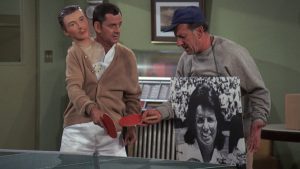 “And then we’ll bring Robinson Cano in to REALLY psyche them out!” Well, Cano played second base very well and garnered a couple of hits in his Brave debut. But it couldn’t be said he made much of a difference in the course of Monday night’s game, because the Mets are also paying Max Scherzer’s salary, and Max Scherzer is still a Met.
Boy is he ever. Forgive the surprise. When Scherzer was fit as a future Hall of Fame fiddle in April and the first half of May, he was top of rotation and top of mind. Then he had the oblique issue that eased him out of direct view, and I kind of forgot we had him. Kind of. I knew he was working his way back — devouring his way back, I imagined, because “working” is probably an understatement — but we were focused on the games at hand. Max would understand. When he focuses on the game at hand, he burns a hole through it.
No chance I’m gonna forget Max Scherzer’s a Met for the rest of this season. I’ll pinch myself now and then, but I won’t forget. A game like Monday’s, with the starting pitcher at the heart of the matter, is the kind you plan to remember, especially in the course of a year with which you plan to do the same. Cano? Curious sidebar. Scherzer?
He was the story. He was the reason whatever odds whichever gambling sponsor flashed on the screen had to favor the Mets, regardless that the Braves have been hotter than Georgia in July, regardless that the Mets appeared prepared to support their co-ace like they supported him last week in Cincinnati and like they’ve supported their other co-ace too often in his brilliant career. Ya think Max Scherzer texted Jacob deGrom after the Mets didn’t score for him in his return start (6 IP, 2 H, 0 BB, 11 SO, 0 R) and ask how to handle such offensive indifference? Or ya think Scherzer sucked it up and figured out how to will the Mets toward a win as much as he could against the Braves?
Ya know what I think or can least infer it from the tone of awe in this essay. I know the pitcher can only do so much, especially since he can no longer grab a bat and drive in a few runs the way deGrom would. But, oh man, Max Scherzer on the mound for your team in what you’re trying to keep from being a battle for first place…that’s a psyche-out. Not that the Braves didn’t bring a formidable Max of their own to bear. Max Fried ain’t easy pickins. We’ve seen that enough through the years. The Mets did pick at Fried’s offerings. Got a guy on base in the first. No runs. Got two guys on base in the second. No runs. Put a run on the board in the third — then another! Two runs! Oh wow! Bust this thing open, boys!
Nah, the Mets weren’t gonna do that. Even if Fried didn’t have the sharpest command, he wriggled out of the fourth and the fifth before departing with an accelerated pitch count. The Mets, minus Jeff McNeil on paternity leave and Starling Marte in day-to-day groin purgatory, left ten runners on base in all and went only 2-for-10 with runners in scoring position. It was better than what they produced in the 1-0 loss to the lowly Reds, but you wouldn’t presume to find it sufficient to beat the defending world champion Braves.
Except once they gave Scherzer the two runs, it was plenty. The only Brave to barely bother Max until the seventh was Cano, with a single Luis Guillorme couldn’t smother (maybe, per Felix Unger’s scheming, he was seeing double). In the seventh, with two out, we were reminded that the Braves are the Braves, as Austin Riley, one of several überBraves, lined a ball high over the left field fence. The only thing that hit harder than Riley’s bat was the disgust on Scherzer’s face. After giving up a two-bagger to the next batter, Marcell Ozuna, I wondered if Max would call timeout, beat the concrete out of the dugout wall, and then come back feeling all better. Maybe in his head. On the mound, he simply struck out Eddie Rosario to end his night at 7 IP, 3 H, 0 BB, 9 SO, 1 R.
While Scherzer was dealing, I remembered Buck Showalter spinning Max’s and Jake’s absences through the bright-side prism, predicting that getting each of them back in the vicinity of the All-Star break would be akin to making a couple of really big trades before the deadline. We’ve all heard GMs resort to this last bastion of inactivity when no swaps were on the horizon. We’ve all invoked it sarcastically when we’ve seen nothing cooking on the transactional horizon. Dillon Gee coming off the DL will be like making a trade for another starter. Yet I took Showalter’s remarks in good faith. They occurred to me Monday night as having proven true, mostly because Max had been so off the immediate-concern radar for a month-and-a-half and now suddenly he was pitching for the Mets…Max Scherzer pitching for the Mets. This really was like picking up an ace before the deadline. Knock wood, it will be like picking up an ace every five days for the rest of the year.
DeGrom is still in rehab mode. Not that we’re exactly suffering starting pitching shorts, but you really wouldn’t mind enhancing your rotation with the pitcher we’ve considered the best in the business since 2018. I still consider Jacob the best in the business, even if his store has had a CLOSED sign hanging from the door for a year, though after these last two Max starts, I have to take this co-ace stuff seriously. No way anybody’s been better than Jake as he’s scaled his Apex Mountain, but no way anybody’s better than the Max we’ve had these two sumptuous spoonfuls of. They’re two of a kind, no matter how different in temperament, repertoire, approach, and anything else. Details, details. They’re both the best in the business. Scherzer’s fire sets off smoke alarms. DeGrom is an ice sculpture. Yet I have the sense that if Jacob deGrom were a vintage Warner Bros. cartoon, we’d have a few frames zooming in on his head or heart or guts, and we’d see a miniature Max Scherzer inside him, going wild.
Except around the plate, because neither of them walks many batters.
Say, for all the thrills over what Scherzer did by himself and what Scherzer and deGrom might do in tandem, we’re still talking about a slim 2-1 Met lead heading to the eighth. If Max was done after 93 pitches, getting an extra run would be ideal. And as that thought bubble formed over my head (as if it hasn’t been floating there for days), Luis Guillorme took Darren O’Day over the right field fence. Not O’Day himself, but one of his pitches. Same difference. A Luis Guillorme home run! It certainly made up for not smothering Cano’s single earlier. And it definitely allowed for easier breathing as the evening’s setup man du nuit, Adam Ottavino, came in for the bottom of the eighth. He couldn’t be Scherzer. He just had to not give up two runs. He gave up none.
In the ninth, the Mets cobbled together an extra insurance run and Edwin Diaz — the sidebar to the Robinson Cano story upon the trade of both former Mariners to New York — was more than cushioned. Sugar was pouring for the third straight day. Yet he’d been so efficient in his two previous games, even as he was striking out basically every Marlin in sight, he was fresh to go. In the least surprising development of the game, Edwin Diaz struck out the opposition in order, using all of eleven pitches to seal the 4-1 win. Doesn’t matter that it was the Braves rather than the Marlins. Edwin Diaz in 2022 blows away opposing hitters, not save opportunities.
After Sunday, the sky was palpably descending if not altogether falling. On Monday, we had Max Scherzer for seven innings, reliable relief for the eighth, Edwin Diaz for the ninth and four runs to back up our three pitchers. The sky, like our lead in the East, rose accordingly. I don’t know if it’s the limit. I do know the Braves can have Robinson Cano.
by Greg Prince on 11 July 2022 12:07 pm So maybe it won’t be a runaway, a rout, a ravaging of the National League East. Maybe things are about to get real. Real challenging. The Mets are in Atlanta for the next three games. The Mets are also on top of Atlanta by a game-and-a-half, which looks precarious from any angle, especially from the perspective of the dawn of June, when the Mets led the division by double-digits. One of those digits was a decent bet to fall away, though I’ll confess I was getting used to the idea of 10½ as a baseline. You don’t get too many summers like that. I was hoping this would be the third of my lifetime. Oh well.
I was also hoping for three out of four from the Marlins this past weekend, Sandy Alcantra notwithstanding. The Mets didn’t lose to Alcantra on Sunday, but they didn’t beat him, either. The same can be said of the Marlins’ relationship to Taijuan Walker, who’s pitched like an All-Star, regardless of National League selection machinations. It was a scoreless duel for seven, for eight, for nine. After that it was a crapshoot, especially with Don Mattingly being able to place his loaded die, Billy Hamilton, on second to start the tenth. Hamilton got to second the best way he knows how — by pinch-running for an unearned runner — and got home the best way he knows how — by running on Tómas Nido. If Hamilton were attempting to steal left field, Nido would’ve had him cold. Instead, Hamilton stole third and scampered in to score as the ball Nido flung wondered what it was doing amid all that green grass.
The Marlins built another run off Tommy Hunter, into whose hands a tenth inning wouldn’t ideally land, and it was 2-0 going to the Mets’ potential last licks. We got the same Manfred man on second but couldn’t do anything useful with him off Tanner Scott. Sometimes the Marlins provide the most generous of gifts (on Keith Hernandez Day, no less), sometimes the Marlins swipe a win when nobody’s looking. They wouldn’t be Marlins if they didn’t poach one now and then.
So much for the Miami Marlins. So much, to a point, for everything and everybody up ’til now. The 53-33 record counts. The lead that’s not as big as it used to be, though it’s still a lead, absolutely counts. The Mets haven’t played badly from June 2 forward (18-16). They just haven’t performed up to their previous standards (35-17 through June 1). But for now, it’s Atlanta Braves time and the beginning of a series in which we, like they, are 0-0. We’ve played ’em four times in 2022, but those games, in early May, are no more than vaguely recalled here in July. The Mets and Braves split at Citi Field that first week of May then diverged for the rest of the month. That’s how we got to June 1 with the enormous advantage that’s slowly if not fully evaporated. As I understand it, the Braves held a clubhouse meeting and more or less haven’t lost since. Who knew it was that simple? I listened to the last couple of innings of their game Sunday versus the hapless Nationals, also extras. Just as I knew the Mets wouldn’t lose to Washington the last series they played, I knew the Braves wouldn’t lose to them, either. And they didn’t. That’s how our lead receded to 1½. I realize tiebreakers will no longer be employed in case playoff spots and postseason seeds are deadlocked, but perhaps in the spirit of the free runner, the Mets and Braves should just settle the division by alternating innings against the Nationals. Whoever leaves the Nats looking more ragged is awarded the crown.
Instead, we get three games this week in Atlanta, five versus the Braves at Citi Field a few weeks later, three more in Atlanta in the middle of August, and the season’s penultimate series at Truist Park as September becomes October. Perhaps that last set will be an afterthought, though the context of how the afterthinking goes is to be determined. Will we have shaken off the Braves? Will the Braves have overcome us? Will the surfeit of Wild Cards — 3 Count ’Em 3!!! — be somebody’s salvation? Whither the not-dead Phillies?
This is why they play the games. This is why winning the games against the Marlins is always a better idea than the alternative.
***When the Mets take the field in Cobb County, their All-Star second baseman/third baseman/outfielder Jeff McNeil won’t be taking Brave aim alongside his fellow Met All-Stars first baseman Pete Alonso, right fielder Starling Marte and closer Edwin Diaz (of course Marte is day-to-day and it would be surprising if Diaz is available after pitching and excelling in two consecutive ninths). Jeff will be off on paternity leave, which will happen when families don’t plan around the baseball calendar. Buck Showalter gave the event his blessing on Saturday — not that he needed to. “I’m sure nine months ago they didn’t look at the schedule,” Buck said before Saturday’s game. “I hope not. This is something a lot bigger than baseball.”
When Buck addressed the question about McNeil’s pending absence while Keith Hernandez waited in the wings to address the media before his number was to be retired, it got me contemplating the life-goes-on of it all. Here we were reflecting en masse on the career of an era-defining Met, but there was still a game to play that day; there was a baby about to born to one of the players; and, a few minutes before Keith’s ceremonies were about to begin, I learned of a Met who had very recently passed away.
Ed Bauta pitched for the Mets in 1963 and 1964. You could say he was the quintessential transitional figure in New York baseball history. Only one man pitched in the final game at the Polo Grounds (1911-1963) and the first game at Shea Stadium (1964-2008). That’s Bauta’s claim to Met fame, and it’s a pretty good one. Only Brian Stokes and Pedro Feliciano could have identified with Bauta’s experience of what it was like to pitch consecutive genuine home games for the Mets in New York and do it in two completely different ballparks. Stokes and the late Feliciano helped finish off Shea in 2008 and open up Citi in 2009.
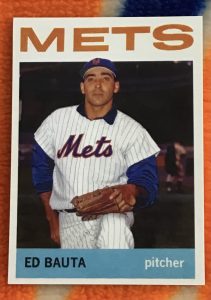 The pitcher who bridged ballparks. But only Bauta can say that in between his appearances in landmark games, he got a little extra action in one of the venues, for Ed also pitched in the last last game at the Polo Grounds, the cult classic Latino All-Star Game held October 12, 1963, matching National Leaguers and American Leaguers representing eight different nations and raising money for retired Latin players and the purchase of youth baseball equipment. Bauta threw the final pitch in the NL’s 5-2 win. Also participating that day were future Hall of Famers Roberto Clemente, Orlando Cepeda, Minnie Miñoso, Juan Marichal and Tony Oliva, with Tito Puente making a non-playing appearance.
Not bad company to keep.
In the years following the Polo Grounds’ demise, Bauta’s bridging was likely forgotten by all but the most hardcore of Mets fans of his day and, as the decades went by, went mostly unknown to future generations. I will admit that before Saturday, my awareness regarding Ed Bauta amounted to his having pitched in Shea’s debut (and knowing that it didn’t go well). I was also pretty sure that he wasn’t a big acolyte of Casey Stengel, but as I began to read up on him, I realized I was thinking of disgruntled first baseman Ed Bouchee.
No, Ed Bauta liked Casey plenty. According to Ed’s SABR biography, “I adored Casey Stengel,” who, by the Cuban-born righty’s reckoning, knew more about the game “than anyone else in baseball”. Ed was grateful for his manager’s attention, particularly on team flights. “Sometimes on the plane,” Bauta recalled for Thomas Van Hyning, “he was drinking vodka and spoke to me.” As cherished a memory as such an encounter might have been, one gets the feeling Bauta would have preferred consistent calls from the dugout to the bullpen. More than fifty years later, the reliever — who persevered despite not having many Spanish-speaking companions on the Mets — maintained he should have been used as a starter by Stengel and, if he was gonna be in the bullpen, he shouldn’t have been warmed up so frequently only to be used so infrequently. In some sense, the relief pitcher’s lot hasn’t changed much.
Bauta’s numbers as a Met may not have won him a ton of work out of the pen, but his seventeen-game tenure across two seasons was only a small part of his baseball story. He made his bones in the Cuban Winter League prior to the Fidel Castro regime, was pitching in the Pirates’ system as early as 1956 and was still plying his craft as late as 1974 in Mexico when he was closing in on 40. Though the ’64 Mets account for the final line of his major league ledger, the former Cardinal kept working to make it back, competing every winter in warmer climes and hurling in Buffalo, Williamsport and Jacksonville between 1964 and 1967. Examine some of those rosters and do a double-take: Gary Gentry, Jim McAndrew, Jon Matlack…and Ed Bauta. His career lasted long enough to cross minor and winter league paths with the likes of Bill Buckner, Mike Schmidt and a teenaged Gary Carter.
Baseball went on for a good, long while with Ed Bauta. Ed Bauta went on for a good, long while without baseball, save for kindly responding to mail from the occasional Mets fan seeking his autograph. Based on the interviews I’ve read with him since learning of his July 6 death, he gave the impression of somebody who lived to 87 happily enough ever after. There is indeed life without looking at the schedule.
by Greg Prince on 10 July 2022 11:18 am The temperature was in the 80s. The energy was out of the ’80s. I needed neither a weatherman nor a meter reader to know which way the wind was blowing or how much the juice was flowing. It didn’t take a meteorology degree to discern it was a warm summer day. You didn’t have to be Frank Cashen to understand the impact of putting together a winner.
The Mets of the middle of the 1980s never leave us. I don’t mean the players themselves, though it’s great so many occasionally come around and a couple have stayed around. I mean the feeling of what it meant to root for this team when we shook off failure and stepped right up to greet success. It explains why so many had descended on Citi Field on Saturday afternoon. Keith Hernandez and the Mets of the 1980s instilled an inextinguishable fire in Mets fans. It’s not always blazing, but it’s really something when you can feel it rekindling.
We often invoke 1969 and 1973 for purposes of never giving up when the going gets tough, and we certainly value the later peaks we scaled after wandering aimlessly through competitive valleys. But only the mid- and late-1980s — 1986 at the heart of that era — live on as aspirational to us. Situationally we might cross our fingers and hope real hard for another Grand Slam Single or Tears of Joy homer, but what we really want is the reincarnation of Baseball Like It Oughta Be. We want to be fans of the one team that we’re certain will get it done, that we’re certain will do in whoever dares to take the field in opposition to them. We want to go 108-54 in the regular season and 4-0 in brawls. We want to face impossible odds and live to repeat stories of how we overcame them because there was no way we weren’t going to. We want to conclude we are invincible.
That sensation has endured deep in the soul of the Mets fan who experienced the Mets as molded on high by Cashen and on the ground, where the leather and the lumber met the road, by Keith Hernandez. For all the woe-is-usness that pervades the Metsopotamian psyche in the 21st century, there resides in a deeper recess the sense that we’re the biggest, we’re the baddest and just you try to fuck with us. It’s alive and it’s dying to come out and play. I could feel it rise up from the throng that was trundling down the LIRR boardwalk around 1:15 Saturday, preparing to merge with the mass of humanity queued up partly to secure a bobblehead, mostly to reclaim the birthright issued unto us on June 15, 1983, and notarized for all time on October 27, 1986.
I wasn’t there for a bobblehead, though I wouldn’t have turned one down. I was on my way to the media will call window, having arranged for press credentials in order to cover a historical milestone, the retirement of No. 17. So on one level, I had the distance to act as dispassionate anthropological observer of the Met phenomenon. Yet I’m never not a Mets fan, even when I waive my Stengel-given rights to yell like an idiot by taking a seat in the press box. That walk from the train through the plaza took me back. I’ve been in loads of Met crowds since 1986. This one was a crowd from 1986. Not just for the retro threads (some of those World Champion t-shirts were vintage) but for the prevailing attitude. We only came here to do two things: kick some ass and grab some bobbleheads. Looks like they’re almost outta bobbleheads.
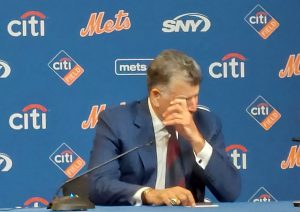 There’s something in my eye, you know it happens every time. This was the gathering crowd that congregated to usher Keith’s No. 17 into official Met immortality, as if a ceremony were required to confirm everything Hernandez did and represents. As with the bobblehead, you’ll take it. The Mets sold every ticket they had because Keith Hernandez was the center of attention Saturday. The 1980s showed us Mets games with Keith in the middle of everything inevitably attracts waves of attendance and enthusiasm. Keith was very much there and very much into it. Keith was on point, as Keith likes to say, from the moment he entered the Shannon Forde Press Conference Room. Keith was as passionate about being honored as he was when he went about earning the honor. He didn’t take a drag from a Winston or a swig from a Michelob as he might have when he addressed reporters in the clubhouse between 1983 and 1989. He spoke to us through teary eyes (a symptom of having trouble sleeping the night before, he swore) and a full heart. A guy who displayed determination rather than a grin on his face while he was plotting ways to attain victory explained what made him smile in 1986:
“When you win 108 games, that’s a lot of fun coming to the ballpark.”
When you arrange to unveil 17 and invite a passel of Keith’s relatives and a sprinkling of his former teammates — Mookie Wilson, Tim Teufel, Ed Lynch, the ever-present Ron Darling — to the field to celebrate it alongside 43,336 who were on hand to thank Keith for making this day absolutely necessary, that’s fun, too. The Mets have upped their commemorative game the last couple of years. The people who choreograph these events understand the beauty is in the details. Hits of the ’80s played throughout the pregame for the man who recorded so many hits during the ’80s, though when the playlist departed its demographic foundation for one very specific track from 1999, “17 Again” by Eurythmics, it couldn’t have been more purposeful. There was a 17 tarp covering home plate. A 17 sculpture rising at second base. A 17 mowed into center field. A 17 emblazoned on The Apple. First base itself was dyed gold. A gorgeous mosaic of Keith’s face pieced together from Keith Hernandez baseball cards and (what a touch) 1986 Mets Strat-O-Matic cards was presented as the loveliest of tokens of appreciation. The owner of the club, who received an uproarious ovation, comprehends the resources devoted to something like Saturday are well worth the emotional payoff.
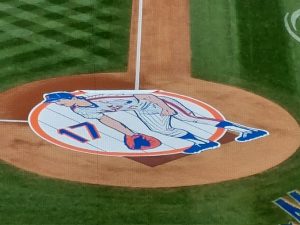 Wrong base, pretty boy. Keith came through, as if with the bases loaded and Hurst on the mound. “Little old me in St. Louis,” he reflected of his mindset in the middle of June 1983, “wasn’t very happy. What did I know? A life- and career-changing event, I cannot tell you.” But he did tell us, recounting his first debriefing by Cashen (“we have not squandered our draft picks and we feel we’re ready to turn the corner”) and his tempered reaction (“I was disbelieving”). But the last-place Mets Keith came to were about to find better places. Second, then second again, then first in the division, the league, the world. Then a few more years when the Keith Hernandez Mets didn’t repeat as world champions but they were still the Keith Hernandez Mets, and what an era it was to realize you rooted for this man and his team. And what a gift it was to hear Keith connect himself to all that came before him and came after him:
“I am absolutely humbled and proud that my number will be up in the rafters, for eternity, along with Casey, Gil, Tom, Mike and Jerry. Sixty years of New York Mets!”
And he reserved a few words for the first-place team representing the sixty-first year, already in progress:
“This current team I love to watch. You Mets fans, you’re on top of it, this teams comes out, it hustles, they play hard and comport themselves like professionals. It is a treat. You should give your support to this team like you gave us in the Eighties.”
We did. I use “we” in the Met-aphorical sense because I spent most of the game that followed in the Jay Horwitz Press Box (gosh, the Mets are getting good at naming things) and could only monitor rather than contribute to the din supporting the 2022 Mets. Except for one inning, the sixth, when I emerged from the air conditioning and embraced the heat of the day up in Promenade with my friend Kevin. There echoes of Shea’s Upper Deck resonated as Francisco Lindor wrapped a pitch around the left field pole to give the Mets a one-run lead of 3-2, regaining an edge that had been briefly yielded in the top of the inning when the Marlins — who weren’t even alive in 1986! — dared cobble a one-run lead of their own. We’d built the first one-run lead of the day, in the fourth, when Pete Alonso homered loudly to make it 1-0. Alonso, you’ll note, is a first baseman like Keith. Not as good defensively. Has more power. Also has a ways to go in growing a mustache, but he’s trying.
Back in Jay’s box, I watched the Mets not add to their three runs in the seventh, eighth or ninth, which was a pity because the Marlins sourced power from Jesus Aguilar’s leadoff at-bat versus Adam Ottavino and tied the game at three. We went to extras, though not exactly as we might have in 1986, because nobody was intentionally putting runners on second to start innings then. The Marlins pushed across their unearned runner ASAP to make it 4-3 and put Keith Hernandez Day in peril.
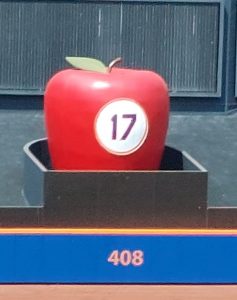 How about that Apple? Not many days featuring Keith Hernandez in Flushing ever stayed in peril. We got our own free runner on second, we got our chance to manufacture a run or, better yet, two, and, after two outs, we capitalized. Don Mattingly’s Marlins facilitated, as Don Mattingly’s Marlins will (Mattingly himself was ejected earlier — and he wants to be our latex salesman?). But what’s a first-place Mets team if it doesn’t accept a bobble like it’s a bobblehead? Tómas Nido, playing in place of a potentially injured James McCann (there was a bit of that going on, with Ender Inciarte having to replace Starling Marte), made contact. Never underestimate contact. I didn’t think the ball Nido sent to third with Mark Canha on second was going to result in a run, but it did. Miami third baseman Brian Anderson couldn’t lay a glove on it and, just like that — snaps fingers, conjures visions of Carter, Mitchell and Knight this other time it was tied in the bottom of the tenth — it was 4-4. Brandon Nimmo came up next with Nido, a slightly more earned runner, on second. Nimmo also made contact, less of it than Nido had, but he hadn’t struck out. Mookie once made contact after fouling off a whole lot of pitches. In Nimmo’s case, he hit a ball all the way back to closer Tanner Scott. Scott had already left the door ajar. He was about to blow it wide open. First he couldn’t handle the comebacker. Then he threw it in the dirt rather than within proximity of Aguilar’s mitt. Nido scampered home. The Mets won, 5-4.
Word from Jacob Resnick on Twitter was this was the first Met victory pulled from the jaws of defeat in more or less this manner — two outs, extra-inning, error, walkoff — since the sixth game of the 1986 World Series. Of course it was. Jake produced his Stathead receipt that showed it had happened twice before in Mets history. One was Buckner, but the other was also in 1986. It was a sloppy game from the end of May that stumbled into the tenth inning at Mets 6 Giants 6. Robby Thompson led off the visitors’ tenth with a home run off Jesse Orosco. If doom was in the air, the Mets didn’t inhale. In the bottom of the tenth, that Hernandez fellow singled to lead off. One out later, Kevin Mitchell, pinch-hitting for sore-thumbed Darryl Strawberry, singled. A wild pitch moved them both up a bag. Howard Johnson walked. Ray Knight lifted a sacrifice fly to score Keith. It was 7-7. The Mets were still alive. As would be the case in late October, and again in a far-off July, the Mets now knew they couldn’t lose in ten. They could very well win.
Light-hitting Rafael Santana — I’m sure that was his full legal name — batted next. He popped up over the infield. Second baseman Thompson moved underneath it to catch it. So did shortstop Jose Uribe. Instead, they caught each other, colliding while Santana’s ball dropped to the ground. “They both called for it,” Will Clark said afterward. “Heck, I was calling for it, too.” (Baseball Reference mysteriously lists the play as a ground ball, but as the 1986 Mets who lost 54 games in the regular season and five more in two postseason rounds could assure them, nobody’s perfect.) Mitchell crossed the plate. The Mets raised their record to 31-11 that night, the best a Met record had ever been after 42 games. There’d be a lot of “best ever” to come for those 1986 Mets, but that Friday night may have been the game that signaled the down/out quotient that would define that team would be its constant. Sometimes down. Never out.
The 2022 Mets seem to have a handle on such an equation. Fans of the 2022 Mets, with a heaping helping of Twisted Sister’s and Keith Hernandez’s shared credo of we’re not gonna take it inhabiting their subconscious, figured it out, too. People stuck around to the coulda-been bitter end. People raised the 17-laden rafters with their vocals when the bitterness of falling behind the Marlins went the way of the Marlins’ short-lived lead. As I rejoined the throng on the staircase, again an impassioned fan rather than a detached witness, “LET’S GO METS” bounced off the walls every bit as much as Scott’s throw bounced in the dirt. I did a little of that bouncing myself.
by Greg Prince on 9 July 2022 12:27 am 1. The Mets ran this ticket special in the 1980s that was incredibly successful. For the price of one admission, you could see the most fearsome competitor in the game, a peerless clutch hitter and first base play that was as revolutionary as it was nonpareil. They were also willing into throw in for that one ticket a consistent .300 hitter, a guy who ran the game like a point guard and a window into the mind of the most intelligent ballplayer you’d ever see or hear. Oh, and if that wasn’t enough to lure you in, you’d watch somebody who was looked up to by almost all his teammates, experience the hit that turned around Game Seven of the World Series and, if you requested it, the second-hand effects from a stream of Marlboros. Actually, you got the cigarettes whether you wanted them or not. Still and all, a really great deal. The Mets sold a lot of baseball with that package, especially in ’86. It was an incredible deal. So was the one they made in ’83 that made it possible.
2. The above paragraph was written, by me, in 2005. I believe it still holds up as testament to the abilities and impact of Keith Hernandez, first baseman for the New York Mets from 1983 to 1989. I wrote it an appropriate 17 years ago to introduce the new blog Faith and Fear in Flushing’s recall of Mets history, and who could recall Mets history without wishing to dwell on the presence of No. 17, Keith Hernandez?
3. No. 17 becomes officially retired this Saturday, July 9, 2022, one day after an aggravating Mets loss to the Marlins and 32 years since the man who wore it last played major league baseball. It’s fair to rhetorically ask, “What took so long?” though at this point the answer is irrelevant (we’ll say it was the Wilpons). Once a number or a plaque goes up, it’s tough to summon dissatisfaction with the flaws in the process that kept the ceremonies from happening all those years.
4. Yet 32 years is a very long time to have waited to bestow an honor on a figure so essential to this franchise’s identity. Then again, the Pittsburgh Pirates waited 32 years from Ralph Kiner’s final game — like Keith, Ralph finished up with Cleveland — until they decided No. 4 should be retired. From the vantage point of someone who’d spent a lifetime learning baseball from Ralph Kiner (and learning what Ralph Kiner did to a baseball in Pittsburgh), that seemed absurdly long, too.
5. Ralph and Keith, besides both theoretically filling out a blank Wordle row, proper noun prohibition notwithstanding, strike me as riding similar trajectories after their distinguished playing careers concluded. Their fame grew in so-called retirement, certainly in New York. The Pirates may not have been directly nudged into action by their erstwhile slugger and matinee idol having become a broadcasting institution for their rivals to the east, but by 1987, they could no longer dismiss all he’d meant to their history. His 4 was too big to ignore at the confluence of the Allegheny and the Monongahela. Ralph said it didn’t bother him that the club that traded him to the Cubs in 1953 waited 34 years to properly honor him, but others where the mighty Ohio River took shape saw it differently. “We’re talking here about one of the greatest players ever to put on a Pirate uniform,” his old roommate Frank Gustine vouched in the Pittsburgh Post-Gazette as the Kinercentric ceremonies approached. “Why it took so long I really don’t know.”
6. Why it suddenly happened for No. 17 in 2022 when every opportunity existed through the 1990s, the 2000s and the 2010s perhaps speaks to the presence of a new team owner in Flushing (come to think of it, the Pirates were under fresh management in 1987). Maybe once the Mets got Mike Piazza’s 31 and Jerry Koosman’s 36 squared away, the prevailing vibe was “who’s next?” Keith’s been next for a while. The Mets were last when Keith showed up. They were first soon enough.
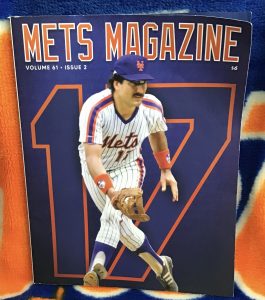 The only number that matters today. 7. Keith Hernandez ranks 13th among all Mets in base hits, 12th in runs scored, 12th in doubles, 10th in his beloved ribeye steaks, 15th in extra-base hits, 12th in total bases, 10th in times on base, 40th in home runs, 6th in walks, 4th in on-base percentage, 26th in slugging percentage and 15th in OPS. Only in batting average, something for which he won a crown in St. Louis, does Keith rank in the career Top Three of a discernible category for the franchise, with his .297 average third, a long way shy of John Olerud (.315) and currently five points behind a surging Jeff McNeil. Keith Hernandez doesn’t rank first in any given offensive grouping that Baseball-Reference bothers to track.
8. Yet if you needed a Met up to continue a rally, to bring a runner home, to tie the score, to win a game, who is the very first Met you’d want up at bat?
9. Defensively, I don’t have a number handy to explain No. 17. I don’t need a number to explain No. 17 in the field. If you didn’t live through the Gold Glove defense, you’ve seen the highlights. As with the hitting, the truth lives up to the legend. From the annals of real-time jaws dropping in disbelief, however, I think it useful to share a few quotes from a June afternoon in 1984 when Keith Hernandez’s positional expertise — first displayed in snagging a Tim Raines liner that appeared destined for extra bases, then by rescuing a double play relay that Jose Oquendo bounced in the dirt, both in the same inning — was making agape the standard formation for mouths all around Shea Stadium.
• “What can I tell you, he’s the greatest. We’ll see that all year, though, not just today.”
— Davey Johnson
• “That was a great play. In fact, that was it right there because that ball was basically down the right field line for a double and a run would’ve scored. He made a hell of a play on it. In fact, I tried to get over to cover first for the double play. Hell, he even ran over to first. He wanted the ball for the double play.”
—Doug Sisk, bailed out by Keith on the play the reliever described
• “I’ve seen more great plays since I’ve been here than I’ve ever seen. I think everyone knows how great Keith is.”
—Bruce Berenyi, who’d been a Met for all of two starts
• “That’s the best-fielding first baseman I’ve seen since Gil Hodges.”
—Murray Hysen, my friend Jeff’s father, sitting in the Field Boxes behind first base and speaking for those whose frames of reference extended back a ways
I didn’t see Gil Hodges play first base, but I have been watching first basemen for 54 seasons. I’ve never seen a better fielding first baseman than Keith Hernandez. If Shea Stadium were still standing, you could fill the joint with people who’d swear the same thing.
10. Keith’s not quite seven seasons as a Met were golden. They shimmered only more in memory as 1989 receded into the rearview. Just as the 1969 Mets came to represent something wistful for those of us stuck watching the 1979 Mets, the failure of the Mets of the early 1990s to sustain the previous decade’s hard-won winning ways cast the 1986 Mets in an impossible role. I remember sometime in the smoldering aftermath of 1993, when the best Mets highlights were to be found by cueing up A Year to Remember on your VCR, a newspaper story that caught up with the recently retired Keith Hernandez. Keith said Mets fans still called out to him on the street in Manhattan that they needed him to come back. Keith being Keith scoffed that he was too old and in no shape to be of any such help. Me being me, I was thinking that if I saw Keith on the street in Manhattan, I would have called out to him that we needed him to come back.
11. During the interregnum between the twilight of Keith the Met ballplaying icon and the emergence of Keith the Met broadcasting icon, Keith Hernandez became a sitcom guest star for the ages. Never mind that Elaine Benes didn’t think the third base coach would be waving Keith in. Never mind that Newman and Kramer were enjoying a beautiful afternoon in the right field stands when their day was ruined by a crucial Hernandez error. Never mind the serendipitous meeting in the health club locker room or what a big step in a male relationship one man asking another man to help him move furniture is. The key to “The Boyfriend,” the Seinfeld two-parter that put Keith Hernandez on a whole other psychic map was Mrs. Sokol, the unemployment official who informs George Costanza that she didn’t miss an inning of the 1986 Mets and who will bend the rules and extend George’s benefits if he can produce Keith Hernandez in her midst within the hour. Mrs. Sokol was every one of us in New York in 1986 with our eyes and/or ears glued to every game. Mrs. Sokol was every one of us as of 1992, when The Boyfriend aired, missing how wonderful it was to have been a Mets fan a few short years before, clinging only to our autographed baseball and the slim chance the strange man begging for an extension will bring Keith Hernandez to our office in sixty minutes or less. It was worth a shot in the dark to believe Keith Hernandez could become part of our lives again. He was, after all, Keith Hernandez.
12. The Keith Hernandez who re-entered our daily consciousness in 2006 (for those who didn’t find themselves thinking about him as a matter of course already) wasn’t exactly the Keith Hernandez on whose every swing, dive or word we hung twenty years earlier. He couldn’t be. That Keith was Mex. The new Keith explained on the air over SNY once that Mex was his ballplaying persona. Mex was intensity personified. Mex needed to bear down in order to compete, to win. Once there were no more games to contest, Mex wasn’t necessary. Neither, eventually, were the Marlboros, thank goodness. The Keith of the booth was an evolved Keith. Older, of course. Goofier, I suppose. The intensity that made him a must-listen on the local news at 11 o’clock and a must-read in the paper the next morning had evaporated. The Keith of the booth wasn’t getting an at-bat in the eighth between Backman and Carter. The Keith of the booth, between Darling and Cohen, could sit back and relax. I have to admit, it took some getting used to.
13. Beautifully, though, Keith was still Keith. Evolved, not overhauled. Goofy at times, but no less fascinating. And still a ballplayer’s ballplayer when ball was being played. I used to roll my eyes a little that Keith Hernandez spoke in the present tense — “I’m a first baseman” — when describing the game played in front of him. Yet once a first baseman, specifically the best-fielding first baseman most of us had ever seen, always a first baseman. Same for the hitter we still wish we could have up in the clutch, never mind that the only physical activity in which we’d seen him engage lately was a rerun of him stretching prior to meeting Jerry and that chucker George. Keith the announcer is still very much in the game.
14. Next game Keith is working, pay close attention when the broadcast begins. Keith really is working. He notices things and he tells us. He notices the pitcher is warming up off the rubber if that, in fact, is what he’s doing and wonders why he’s doing it (it happened with Sandy Alcantra in Miami recently). He’s all over the center fielder shaded this way or that. He’s analyzing the size of the lead taken off first base, both from the perspective of an eleven-time Gold Glover and as someone who plotted to go first to third on a single. The goofiness is still abundant, and it’s charming as all get out — who doesn’t want to know what Hadji is up to? — but you get your baseball’s worth from Keith Hernandez. As masterful as Gary Cohen is at all facets of announcing and as insightful as Ron Darling is when it comes to pitching specifically and life occasionally, the booth is never quite whole without Keith. It’s certainly not the highbrow cocktail party that gets a wee bit out of hand by the middle innings. Just as we cherished the Keith in the middle of the Met order, we cherish every bit as much the Keith in the middle of this lineup. If he’s a little impatient around the margins with modernity or a little anxious to adios and beat traffic or drifts off into Keithland for a pitch or two, so be it. He always comes back.
15. No. 17 is being lifted up where it belongs because Keith Hernandez has done it all for this franchise. He never stopped being Keith, not in a Met championship run, not in Met absentia, not on the Met air. If the less than seven full seasons of playing somehow didn’t seem impressive enough to whoever made number-retirement decisions for decades, the almost forty years of embodying what we wanted the Mets to be pushed him over the top. Like Ralph Kiner might say, the sum of Keith Hernandez definitely adds up to more than his totals.
16. So we thank the number 17 for its service to every Met not named Keith Hernandez who wore it, from Don Zimmer in 1962 to Fernando Tatis in 2010. Some of you did it quite proud and we appreciate it. We also acknowledge utilityman Keith Miller and journeyman Keith Hughes for having played their best for us. But just as there’s truly only one No. 17 to us now and forever, there’s also only one Keith in these parts.
17. He’s Keith Hernandez. But you knew that already.
I engage in a detailed discussion regarding Keith Hernandez with Murray Hysen’s son Jeff on the new episode of National League Town. Listen to it here or via any of approximately 17 outstanding podcast platforms.
by Greg Prince on 8 July 2022 11:42 am When cleaning up after dinner, I gather momentum. It doesn’t matter that the Mets are playing. It doesn’t matter that the Mets are batting. If I have the garbage together, I want to tie it up and take it to the Dumpster. Might I miss something momentous? Probably. My non-Elias statistics tell me approximately 70% of Met home runs are hit when I step away from the television.
Sure enough, as I briefly left the living room during the fourth inning on Thursday night, the Mets ahead of the Marlins, 3-0, James McCann came to bat at Citi Field. And when I walked through the door again moments later, I was greeted with the following eyewitness report:
“You missed a three-run homer.”
I simultaneously sighed and celebrated before reaching for the rewind button of our remote control to see with my eyes what I hadn’t sensed was remotely possible. Maybe McCann would get a hit, but it hadn’t occurred to me he could hit a home run. I don’t mean merely in that situation. I mean not ever.
But James McCann — “Mac” to his manager and batterymate, I learned from the postgame interviews — is a real big leaguer with a real track record with a real ability to pop one over a fence rather than briefly above an infield. Mac homered once in April. He homered ten times last year. He’s now done it 77 times in his career.
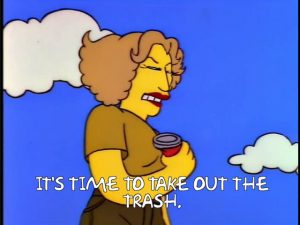 Dispose of the Marlins? You Bette. If I have cleanup momentum some night soon, I’ll still take out the trash when James McCann is batting, not because I don’t have confidence in the light-hitting catcher occasionally hitting heavier, but because if it worked this time, maybe it will work again. If not fully settling in and focusing my attention on a Mets game until the Mets are leading, 6-0, is what it takes, well, let’s get a 6-0 lead every night like it was Thursday night. I was settled and focused when J.D. Davis, somebody else whose at-bats I wouldn’t let the refuse fester an extra minute for, came up in the fifth with the bases loaded. A base hit, which is what Davis delivered when I was tying up the garbage an inning earlier, would have been nice. The grand slam he unloaded on Jimmy Yacabonis was four times better.
The Mets were on their way to a 10-0 win, produced in large part by the batters in the eight and nine spots in the order and protected mostly by Trevor Williams, the de facto sixth starter in the Mets’ normally five-man rotation. Williams has given the club yeoman relief in 2022 and oh no starting, mostly, except when the Mets score 10 runs. Williams has notched two wins this year, both that ended with finals of Mets 10 somebody else 0. Thursday night he shut out Miami on two hits for seven innings. Trevor is definitely a pitcher who can handle prosperity.
The Mets are looking pretty prosperous themselves again. As late as the ninth inning on Wednesday night in Cincinnati, I was beginning to wonder. They hadn’t hit on Tuesday. They hadn’t hit, at least in the clutch, for eight innings on Wednesday. I could feel myself giving into my lesser angels and wondering WTF is wrong with this team after a half-season of almost never removing my Buck-colored glasses. But then Starling Marte roped a line drive double to left that was just fair; the top of the tenth exploded with timely offense; and the Mets we remembered so fondly from previous weeks and months rematerialized. The bottom of the order and the addendum to the rotation took care of the Marlins. The Cardinals took care of the Braves in eleven with me digging deep, beneath my well of anti-Redbird animus, to urge them on — “c’mon you stupid Cardinals” was my polite suggestion. The lead in the division returned to three-and-a-half. Chris Bassitt, who might want to rethink his communications ethic (inform your team if you test positive for COVID; don’t tell everyone else you don’t plan to), is back. We occasionally lose our grip on our faith. The ballclub for which we root maintains its bedrock belief in its abilities despite our simmering fear. They know there are 162 games. They know they are capable each night.
Don’t throw that out. It’s a good quality to keep around.
Keith Hernandez is the focus of this week’s episode of National League Town. Settle in for a discussion of No. 17 here.
by Jason Fry on 7 July 2022 12:26 am With one out in the top of the ninth in Cincinnati Wednesday night, a baseball team and its adherents desperately needed therapy.
Mark Canha had just started the inning by fouling out against Hunter Strickland, conspicuously useless as a 2020 COVID Met and now somehow the Reds’ closer. The Mets had managed two runs against Cincinnati, an improvement over Tuesday night even if one of those runs had come on a Jeff McNeil grounder past a nearly sessile Brandon Drury and the other had come on a broken-bat parachute hit by Tomas Nido. But the Reds had tallied three on a night new father David Peterson looked … well, like a man who hadn’t slept properly in a couple of days.
The Mets had stayed in the picture thanks to some sparkling relief by Adonis Medina (who might get sent down by way of thanks) and the aptly named Colin Holderman, but it sure looked like they were about to lose, and it was just a little frustrating. Most obviously, there was the lack of hitting. More specifically, there was the lack of hitting against the thoroughly lousy Reds, a ragamuffin assemblage foisted on fans who deserve better. The Mets had 11 hits, which normally means three or four runs even when not firing on all cylinders, but their sequencing had been nonexistent and their luck had been inexplicably and almost comically bad. Now add in far too much Dada umpiring — I think home-plate ump Paul Clemons was using a Magic 8-ball for anything near the edge of the strike zone — and word that the horrifying Braves were winning again and it was suddenly just all too much.
Brandon Nimmo singled, but that felt like more proof that baseball is capricious and cruel and engineered to torture you. And then Starling Marte smacked a ball down the left-field line, over the third-base bag and foul. Except third-base ump Alex MacKay called it fair.
I don’t know, maybe it was fair. That’s one of the most difficult calls for an umpire. But it sure didn’t look fair to me — or to Strickland, who stared at Nimmo in disbelief as he scampered home and then spent the bottom half of the inning glowering at MacKay with cartoon steam whistling out of his ears. The game didn’t make any more sense than it had a moment earlier, but now it was the Reds who were gape-mouthed with disbelief.
(By the way, how did a game with so much farcical umpiring not feature a big moment from that cackling gremlin Angel Hernandez?)
Tapped to pitch next for New York was Adam Ottavino, whom I like while not particularly trusting. The lack of trust is a product of that sometimes disobedient slider he depends on; the liking is a product of the fact that Ottavino always looks deeply weary on the mound, weighed down by the psychic tonnage of being a veteran reliever who’s Seen Some Shit.
On Wednesday night Ottavino’s pitches were riding high, but the Reds did nothing with them. On we went to extra innings and ghost runners, with Ender Inciarte replacing Pete Alonso as the Mets’ unearned passenger. McNeil flied out, but Dom Smith snuck a double past Drury (who really shouldn’t be forced to play first) and the Mets had somehow scored. Dauri Moreta — if nothing else there are some wonderful names in that beleaguered Cincinnati pen — buzzed Eduardo Escobar, leading to some barking and brief on-field milling before Escobar flied out. (I was mostly worried that Strickland would use a brawl as cover for an opportunity to shank MacKay, which would probably lead to at least a moderate suspension.) Moreta then intentionally walked Luis Guillorme to get to pinch-hitter James McCann, which is what I would have done, seeing how McCann is 1 for 342,612 in his tenure as a Met with 342,611 ground outs.
Make it 2 for 342,613: McCann somehow lashed an RBI single to give the Mets a two-run lead, because nothing made sense any more. And then Nimmo unloaded, burying a homer in the right-field corner much as he did against St. Louis. It was one of those baseball moments where frustration gets transmuted into joy, a balloon carving madcap zigzags beneath the ceiling as all that stale imprisoned air escapes and blares a PPPPPPTTTTTTTT of amazed happy defiance.
The Mets led by five, a lead they turned over to Edwin Diaz in a non-save situation. That’s not always been a recipe for success, but Diaz was apparently feeling some frustration himself, because he simply erased the Reds with 101 MPH heat and that deadly slider. Seriously, the man had a five-run lead and that was probably the most impressive he’s ever looked in a Met uniform. Maybe the Mets should try to figure out how to keep him frustrated. Or maybe the lesson is the same as it was when the Mets were losing — that some nights nothing makes sense, because baseball is like that, and it’s maddening but OK because this time your team staggered out of the funhouse having somehow won.
by Greg Prince on 6 July 2022 9:13 am You’d prefer a win. No doubt about it, ninety-nine times out of a hundred, you’d look at a 1-0 loss and gnash your teeth. The hundredth, you’d gnash a little, then grit them, then take a deep breath, then rub your eyes, then take in the image at the center of the bigger picture.
Max Scherzer went six innings in his return from an oblique injury Tuesday night, expertly mixed fastballs and sliders, gave up two singles, walked nobody, hit one batter and struck out eleven.
That’s an image that will carry you past a 1-0 loss in Cincinnati. That’s an image that will eclipse your disgust at the Mets managing fewer runs off five Red pitchers than the Reds did off Scherzer, Joely Rodriguez, Tommy Hunter and, ultimately, Seth Lugo, the only hurler on either side who clearly didn’t succeed. Lugo, who gave up the game’s lone run in the bottom of the ninth, was not alone among Mets contributing to your dentist’s askance glances come your next checkup. Starling Marte was an on-base machine (two hits, two walks) and Mark Canha went two-for-four, but nobody else in the lineup did anything terribly useful, which is definitely a drag. Gnash away if that’s where your emotions take your teeth.
Yet Max Scherzer did everything he could after being missing from action for nearly seven weeks. I guess he could’ve gone longer than six innings — so did Max, judging from his expression in the dugout after he was told he was done — but he’d been out too long to take too many chances. Now he’s as back as we could have hoped for. He looked great, he says he feels great and we have him for the second half that begins tonight.
On May 18, the night Max matter-of-factly announced no mas, the Mets elevated their record to 25-14. At the halfway point of the season it’s 50-31, indicating the club held its own in the Scherzerless interregnum. They won 25 games with Max, 25 games without him. They went 16-10 when the three established mostly healthy starters — Taijuan Walker, Carlos Carrasco and Chris Bassitt — took the ball and held the fort. They didn’t play the Braves at all. By next week, when they visit Cobb County, the Mets will have the opportunity to fend off their closest rivals with a much-bolstered rotation. Scherzer is not on track to pitch in that series, but he will pitch twice before the All-Star break. And he’ll pitch after it. Every start Max Scherzer makes is one an inevitably lesser pitcher doesn’t. The effect can’t help but elevate the entire staff and the entire team. Bulletins regarding the co-ace’s progress on the IL and plans for his rehab are no longer in the news. Ruminations on the ups and downs of identifying as a Rumble Pony will emanate from somebody else. When you see Scherzer’s name, it will be because he’s pitching for the Mets.
Did we mention Max is back? That’s the news. The very good news. More to come.
by Jason Fry on 4 July 2022 11:39 pm The Mets, wearing blue, beat the Reds, wearing red and white, by a score of 7-4 on July 4th, and what could be better than that?
OK, both teams were wearing god-awful hats from which independence should have been declared, and the Reds continue to ruin their perfectly good uniforms with a black drop shadow that fell out of MLB vogue about a decade ago. But the basic premise holds. Note also that — as Greg pointed out on Twitter — the Mets celebrated 1990’s Independence Day with a 7-4 win. (That one came against the Astros, whom we have had considerable difficulty beating in 2022.)
Midway through Monday night’s game, my kid asked me a question: Since I’d fumed about how boring the Mets’ home-run-heavy loss to the Rangers was, was I also bored tonight? After all, at that point the Mets led 4-3 and once again the only runs had scored via dingers: Brandons Nimmo and Drury had hit equal and opposite three-run shots and Francisco Lindor had put the Mets back in front with a solo homer.
It was a fair question, and I thought about it for a little bit. My answer was no, for two reasons: For one, Taijuan Walker was pitching marvelously for the Mets, continuing a recent run of solid starts that have the feel of a guy taking the next step in his development as both a pitcher and a pitching strategist. For another, Cincy’s Hunter Greene was interesting to watch — a big raw talent who doesn’t look like he’s ready but should be a lot of fun once he calluses up and figures some things out.
There was also the sight of ex-Mets everywhere: Brandon Drury is having a terrific year for the Reds after being a valuable member of 2021’s bench mob. Matt Reynolds — whom I’d completely forgotten was a 2022 Met for approximately 20 minutes back in April — looked solid with the bat and in the field. There was Albert Almora Jr., who did us a solid on Sunday by beating the Braves. I even caught sight of Hunter Strickland in the bullpen, and you could say that Alexis Diaz counts at least a little. And of course there’s the possibility that the Mets are contenders for the services of Luis Castillo or Tyler Mahle before the the month is over, potentially sending more players to the team with the other baseball-headed mascot.
And then the Mets courteously differentiated their attack after my kid and I had our conversation, with Dom Smith and Eduardo Escobar doubling in crucial extra runs (though Escobar nearly short-circuited his own rally in doing so). Drew Smith somehow survived an inning in which he was strafed by everybody except the bat boy, but Colin Holderman and Seth Lugo acquitted themselves blamelessly and the Mets had won.
They won, and on Tuesday Max Scherzer returns for the last game of the first half of the season, with Jacob deGrom down in Florida throwing actual pitches in anger against actual opponents. That’s worthy of a celebration, wouldn’t you say?
by Greg Prince on 4 July 2022 11:47 am Jacob deGrom pitched to six minor league batters on Sunday night. Five of them turned into smoldering holes in the dirt adjacent to home plate. I didn’t notice what became of the sixth. As far as we can tell, nobody was actually harmed, neither the young Jupiter Hammerheads whose future still remains ahead of them nor deGrom, he whose shoulder was pronounced as feeling “100%,” by the only person with authority on the matter, deGrom. Just as Max Scherzer declared he didn’t wish to any longer be a Rumble Pony after his first rehab start and was therefore ready to move on from facing fodder for his recovery, it’s not surprising Jacob would intimate he speeding along the road to the majors once more.
Grains of salt all around, but Max will be competing in a New York Mets uniform Tuesday night and Jacob, after testing his scapula in St. Lucie, is suddenly visible on the long-range radar. If exchanging Fourth of July presents was how we celebrated Independence Day in this country, happy red, white and blue to us!
The Third of July left us with a nice gift beyond the apparent upward turn in fortunes for the two absent righties. The Mets stopped looking sluggish and returned to slugging against the Texas Rangers. Starling Marte lined a ball out of Citi Field in the first. Eduardo Escobar, who suddenly can’t stop homering, launched one with Jeff McNeil on second, in the fourth. McNeil being on second was particularly sweet because the double to deep right that landed him there felt exactly like what the Mets have been missing of late (besides their two aces). Peaks and valleys notwithstanding, I don’t worry about the top four in the lineup. Nimmo, Marte, Lindor, Alonso…splendid. Things felt dicey from there as June ended and July began. Everything after the cleanup spot dropped off a cliff.
McNeil is well again after nursing his tight hamstring. He was batting fifth Sunday. It’s a good fit. When Jeff doubled, it showed he was in pouncing form — he and the Mets. The fourth had commenced with Pete Alonso striking out, but the pesky third strike got away from Ranger catcher Jonah Heim, which Heim deserved to have happen to him for having homered in the third and making me aware of who he was (like I don’t have enough players to bristle at in the National League). Alonso hustled to first. Heim’s throw went awry. Somewhere J.C. Martin smiled. The ball ricocheted away and Pete vamoosed to second. Opportunity knocked. Jeff knocked it in. Eduardo knocked twice.
Those are the Mets I knew the previous time I’d been at Citi Field, at the end of May. Then came June, with the Mets very much holding their own on the West Coast (5-5), taking care of schedule-mandated business against Miami and Milwaukee (7-3) and appearing sparkless versus Houston (0-4), all while Atlanta swallowed invincibility pills. Splitting the first two with Texas had me, on the eve of my return to the ballpark, if not uneasy, then just a touch antsy. We’d be in first place on the Fourth of July, everybody’s favorite mythical marker, but even the optimist that I’ve become in 2022 acknowledged a division lead that had reduced from 10½ to 2½ represented a disturbing trend. Yet that was OK, I told myself and anybody who’d listen. Take two of three from Texas, then we’re doing what we need to do. We’re winning series. We’re beating who we should beat. We should’ve beaten the Astros at least once, but no season played within the confines of the mind exactly matches reality.
The Mets did take that series from the Rangers, winning on Sunday, 4-1, and sending Texas back to wherever they came from (Arlington, I believe), while Atlanta coughed up a ninth-inning tie in Cincinnati. Three-and-a-half ahead on the Third of July would do nicely. Watching the visitors leave the field in Queens, I thought how much I enjoyed how defeated they looked. Then I thought how odd it is that for three days these Texas strangers were my concern. Interleague play, of which there’ll be more in 2023, continues to strike me as a less than optimal use of time, but what do I know? I’m just a lifelong baseball fan who tunes into every game except for the ones I attend.
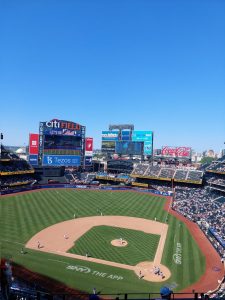 Blue skies shining on Mets fans, whatever section they were supposed to be in. I was in Promenade Sunday courtesy of my triviameister friend Mark Simon, who Saturday posed one of his best questions in ages: “Any interest in going to the game tomorrow?” A deceptively simple query, as “no” wouldn’t have necessarily been wrong (you mean I have to get my ass of the couch?), but yes was definitely the right choice. Rising, shining, commuting…it was all worth it for a beautiful day of talking and watching baseball at Citi Field. We talked more than watched, as is usually the case. This time we didn’t watch the big sign that identified the section that aligned with our tickets. A couple showed up around the bottom of the second and politely implied we were sitting in their seats. That was nonsense, we politely responded, as we’re the kind of people who get here before the first pitch and nonchalantly work references to J.C. Martin into our game recaps. We were just about to ask them to name the two statistical milestones* that would occur if the Mets beat the Rangers when we realized we were one section over from where we were supposed to be and humbly apologized for our mistake. Yet it was too nice a day for that to go down as a costly error. We climbed one largely unoccupied row up, benefited from the extra shade and everybody returned to holiday weekend splendor.
Nobody lived up to Bobby Darin’s ideal of Sunday in New York more than Carlos Carrasco, who experienced neither back tightness nor a surfeit of a baserunners, each of which doomed him in his two previous starts (both against the doomy Astros). Jacob deGrom taught us to not stare at won-lost records. Carlos Carrasco can point to his 9-4 and we can still nod appreciatively at his comeback season. We can also enjoy, as Mark and I did when not yakking, the smooth bullpen work of Joely Rodriguez, Adam Ottavino and Edwin Diaz. Only that pesky Heim, who singled with a man on, got us squirming in the ninth, but Edwin wriggled out just fine. It’s so odd that Edwin Diaz appears and we don’t feel dread. Really, my only gripe with our elite closer coming into nail down saves is that Mr. and Mrs. Met continue to pretend to blow into trumpets on “Narco” when Diaz enters. They’re faking it. Blasterjaxx is for real. Timmy Trumpet is for real. Diaz is for real. And these Mets are for real.
*Buck Showalter secured his 1,600th regular-season managerial win and the Mets notched their 4,600th regular-season franchise win. Now I’ll get out of your seat.
by Jason Fry on 2 July 2022 10:19 pm During the early part of 2022 the Mets were deadly in the clutch.
They were a lot of other things too — strong defensively and gifted with solid starting pitching — but their uncanny ability to collect big hits with games on the line felt like their defining characteristic.
Move forward into summer, and things look a bit different. Suddenly the Mets are coming up empty with runners in scoring position, leading to strings of games defined by frustration, riddled with the coulda woulda shouldas of at-bats that went the other guys’ way. Other things have changed too — most notably the starting pitchers proving physically vulnerable and/or human after all — but as fans, hitting in the clutch looms larger than everything else.
If a team has a run of hitting in the clutch, particularly in the beginning of the season, we confuse it with a lot of qualities that may or may not be present: We see grit, fortitude, preparation, battlefield cool, leadership, camaraderie and a whole lot else. Replace the hot dice with cold ones, as has happened to the Mets of late, and we wonder what moral failings have crept into the clubhouse, turning our baseball Eden into a dismal Nod.
Anyway, these problems were on display in Saturday’s thoroughly dull, dispiriting loss to the Rangers. The Mets did next to nothing in the clutch, scoring on a pair of homers by Starling Marte and Eduardo Escobar; the Rangers scored six of their seven runs on homers, making for a game that was like watching paint dry.
I suspect streaks like this weigh more heavily on fans than on players, who know far better than we that it’s a long season and luck runs hot and cold in ways that can’t be explained and will drive you crazy if you let them lure you down a rabbit hole. Meanwhile, the Braves can do no wrong and have cut the Mets’ seemingly insurmountable double-digit lead to a skinny two and a half games.
The Mets weren’t as good as they appeared then and aren’t as hapless as they’ve looked of late; reverse those characterizations and you’ve summed up the Braves. Despite how things may feel, the Mets are in fact still in first place, with the prospect of adding a pair of Cy Young winners to the rotation. Your inner fan, like mine, is probably screaming otherwise, and I’ve learned it’s somewhere between difficult and impossible to argue with one’s own fandom, but there are other perspectives to keep in mind and consider quietly when fandom tires of howling alarm and needs to take a breath.
Or, if that fails, you could wait for the Mets to regain their moral compass and rediscover their better qualities, with results to match, and praise them when that day comes.
|
|






