

It would be kind of interesting to note Wednesday’s Mets-Diamondbacks game started three hours earlier than originally slated due to frigid conditions at Citi Field, but that happened the day before, so…no, not that interesting nor noteworthy.
It would be kind of interesting to note Wednesday’s Mets-Diamondbacks game got all nine tops of innings pitched by two ostensible starters, David Peterson, who was rocked, and Sean Manaea, who didn’t have great luck, but Manaea backed up Peterson similarly last week in San Francisco, and the game was lost then by the same score as it was lost this time, 7-2, so…no, also not that interesting nor noteworthy.
Did anything of interest or worth noting happen as the Mets went down to a dud of a pre-dusk defeat? Well, Mark Vientos caught a foul pop fly. And he did it after having dropped a foul pop fly a few pitches earlier, which had caused the crowd to audibly groan. And, when he did make a catch, he responded to the crowd’s less-than-sincere cheer by raising his arms to urge them on in their sarcastic appreciation. Because he was wearing one of those winter cowls to keep warm, I couldn’t make out the entirety of his facial expression when the cameras zoomed in, but I’m pretty sure he looked more miffed than amused, though our announcers on both radio and television hailed him for good-naturedly engaging the shivering fans on their own grumbly terms.
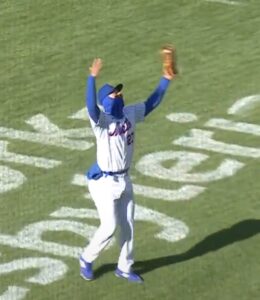
“You try to catch every ball in this weather!”
That was a little interesting, I guess, but what I really noted was Vientos was playing first base. In 2026 among Mets, he hasn’t been alone in being able to say that.
The Mets are through a dozen games thus far. They have started four different first basemen at least twice. Mark leads the pack with six starts. Jorge Polanco, Brett Baty, and Jared Young have each notched a pair. This might strike an attentive observer as an unremarkable teamwide tally if we had not just come through seven seasons when a Mets fan rarely had to wonder who’s on first.
Pete Alonso was the answer to that Costelloan inquiry almost without variation, especially these past couple of years. The Polar Age was singular for its power, but let’s not forget the constant presence in the field. In 2025, Pete started 160 games at first; in 2024, the Bear prowled about the bag 161 times from first pitch forward. The National League’s implementation of the DH (boo) allowed him whatever slight breather he needed. You had to think a lot about whether Alonso would sign to stick around, but as long as he was here, you eventually stopped thinking about who was on first.
Even before his Iron Bear phase, when our erstwhile #LFGMer appeared in the final 416 games that he was a Met, it was a matter of Alonso and cameos at first. Dom Smith had been an intermittent option. Mark Canha was invited in from the outfield now and then. James McCann received five starts in 2021. J.D. Davis, who never quite nailed down assignments in left or at third, got two starts at first in 2022. But these amounted to special guest appearances. Generally speaking, Pete would not be budged from his natural habitat until he was permitted to move on to Birdland.
So when was the last time we had this much first-base variation to start a season? In terms of starting four different first basemen in the first six games, or four different first basemen starting twice in the first eight games?
Never.
Never before, prior to the current campaign, had the Mets shuffled so many starting first basemen with the ink not yet dry on the proverbial pocket schedules. Vientos, foul pop unpredictability on a breezy afternoon notwithstanding, may yet bring some stability to the position, having taken the four most recent starts. Good news, presumably, for neophyte third baseman Bo Bichette, who might enjoy knowing who he’s throwing to on a daily basis from his totally new position.
You have to go back to 1963 to find the Mets starting four different first basemen even once apiece before playing double-digit games. The first-sackers after nine contests that April were Tim Harkness, Marv Throneberry, Gil Hodges, and Ed Kranepool. That’s three extremely different franchise legends plus the author of possibly the most dramatic walkoff home run the Polo Grounds ever saw after Jackie Robinson stood watch to make certain Bobby Thomson touched every base. The year before Tim went deep to quash the Cubs with a two-out, come-from-behind, fourteenth-inning grand slam (6/26/63, you could look it up), when Casey Stengel was inclined to try anything and anybody, the Ol’ Perfesser tried only three different first basemen — Hodges, Jim Marshall, and Ed Bouchee — by Original Game Seven. Marvelous Marv didn’t land within Stengel’s purview until Game 22 of 1962, at which tie Harkness was still a Dodger, and young Edward Emil was still in high school.
In only nine other seasons was there early churn comparable to 2026’s at the corner nobody ever describes as hot, especially in weather like Flushing’s been seeing of late.
1968: Steady Eddie, Art Shamsky, and Greg Goossen had all logged starts at first by Game Twelve.
1970: Sham, Krane, and Donn Clendenon had each taken a turn by Game Ten.
1975: Kranepool’s first base companions through ten games were John Milner and Joe Torre.
1977: Besides Ed (who had to wonder what he had to do to become an everyday first baseman after all these years), there were Torre and Dave Kingman in the books by Game Eleven.
2002: Newly acquired slugger Mo Vaughn was set to take over at first, but after a year of inactivity, his full-time status got a little partial quickly. After four starts, he yielded to John Valentin for a couple of games. Then Valentin gave way to Mark Johnson for four games. By Game Thirteen, the fourth first base starter of the year materialized. It was Joe McEwing, who played just about everywhere, anyway. Vaughn eventually resumed regular starting duties, totaling 131 starts at first by horrible year’s end.
2003: Mo was still on his feet when the season started, yet Jay Bell and Tony Clark also got starts at first before this also horrible year was six games old.
2004: Jason Phillips, usually a catcher, received the first five starts, before Mike Piazza, usually a catcher, received the sixth. As if determined to extend a trend, Art Howe started at first in the season’s seventh game former catcher Todd Zeile.
2010: Jerry Manuel’s final Mets squad shifted between Recidivist Mike Jacobs and the senior Fernando Tatis for the first eleven games, tried Long Island’s Own Frank Catalanotto in Game Twelve, then called up Ike Davis to start Game Thirteen. Ike basically owned the position from then clear to Closing Day, save for periodic dashes of minor league home run king Mike Hessman.
2014: This was the last time prior to 2026 the Mets started as many as three different first basemen while still chilling inside the shadows of a season’s own end zone. Terry Collins went with Ike in the first game, Josh Satin in the second, and Lucas Duda in the third. At that pace, we’d be listing 162 starting first baseman, but you know how it is with paces set at the beginning of the year. Duda emerged as the everyday starter after a couple more weeks. As the year progressed, only Eric Campbell jumped into the soup, and then for only five starts.
When occupation of a position that belonged almost exclusively to one player becomes impermanent, we are jarred enough to muse, “Say, when was the last time…?” and avail ourselves heavily of Baseball-Reference. But these things usually have a way of working themselves out. Maybe Polanco’s Achilles is pronounced A-OK soon, and he’s back playing the position he trained for all Spring. Maybe Baty makes himself indispensable and anchors first because you just can’t take his bat and glove out of the lineup. Maybe Young reveals himself a long-term asset of the first order. Maybe the winds die down and Vientos gets truly comfortable. Or maybe the trade winds kick up and we swap some modern incarnation of Neil Allen or Robert Person for a latter-day Keith Hernandez or John Olerud, and we revel in the production of a first baseman we didn’t see coming.
Anything can happen and often does. That’s never uninteresting or not noteworthy.






One thing is for sure: Ryan Klifford (see what I did there) isn’t the answer. I’m rolling with Vientos. The rest of the INF should be Polanco 2b, Lindor ss, and Baty 3b. Bichette moves to DH. Semien becomes the UTL.
Lindor better get his head out of his ass before he and his noodle arm AND BAT are traded to his same-named chocolate factory in exchange for something useful. This happens year after year, and if he keeps up this poor play, he just may get his number retired (like Beltran).
I loved Carlos Beltran. I loved watching him his entire time with the Mets. But I just don’t think it’s appropriate to retire his number.
Ah, I guess you have to now. Hall of Famer going in with a Mets cap, plus he currently works for the Mets.
Lou: On the First and Fifteen of the month, who gets paid to play First Base?
Bud: Every dollar of it.
Q: Who is up after Lindor?
A: The other team.