The blog for Mets fans
who like to read
ABOUT US

Faith and Fear in Flushing made its debut on Feb. 16, 2005, the brainchild of two longtime friends and lifelong Met fans.
Greg Prince discovered the Mets when he was 6, during the magical summer of 1969. He is a Long Island-based writer, editor and communications consultant. Contact him here.
Jason Fry is a Brooklyn writer whose first memories include his mom leaping up and down cheering for Rusty Staub. Check out his other writing here.
Got something to say? Leave a comment, or email us at faithandfear@gmail.com. (Sorry, but we have no interest in ads, sponsored content or guest posts.)
Need our RSS feed? It's here.
Visit our Facebook page, or drop by the personal pages for Greg and Jason.
Or follow us on Twitter: Here's Greg, and here's Jason.
|
by Jason Fry on 7 April 2021 11:47 pm If a team starts the season 1-1, the third game is a Rorschach test. It usually determines whether you’ve won or lost your first series. It always determines whether you’re 2-1 or 1-2.
It’s undeniably true that the third game also determines whether your winning percentage will be .667, which is the stuff of awestruck recollections a generation later, or .333, which calls for a self-protective case of amnesia.
You probably see the flaw in the logic — that the difference between .667 and .333 means everything after 162 games, most everything after 150, a fair amount after 100, and so forth and so forth, until you get all the way down to three games, at which point it means zero. Nothing. Nada. Zilch. Bupkis. Fuck all.
You see the flaw in the logic, but plenty of people on talk radio and in the comments sections and on Twitter don’t, or more charitably do but were left so overwrought by a lousy Wednesday afternoon that their forebrains short-circuited long enough for them to dial a phone or tap at a keyboard and vomit up some bile. It’s always this way — this is the time of the season when you can remember every game easily and every at-bat if you furrow your brow, when everything seems absurdly magnified, and the smallest thing is a harbinger of gigantic shapes taking shape in the mist. These games and series are Rorschach tests, and after an ill-spent afternoon whose verdict is .333, everything looks like a skull and crossbones.
The beverage that left these particular tea leaves prophesying doom went down like this: David Peterson looked overamped in the first inning, giving up four runs, but then did a commendable job harnessing his emotions, settling in and pitching effectively. (If you’d like to plot the location of horses vis-a-vis their barn, please do, but know that your findings will not be a revelation to your chronicler.) The Mets drove Aaron Nola‘s pitch count steadily up and booted him from the game after four innings, but couldn’t collect the big hit that would have got them back in the game. Any chance at doing so evaporated when Jacob Barnes relieved Peterson and gave up a three-run homer on his first pitch delivered as a Met, a badge of insta-futility not donned since John Candelaria‘s debut as a Plan H or I starter in the cursed ’87 season. Barnes also settled down, though by now the barn was in flames and the horses weren’t even bothering to flee but insouciantly hanging around to light cigarettes from the embers. Dellin Betances made his 2021 debut and looked pretty much exactly like he did in 2020, then mercifully left further duties to Joey Lucchesi, who looked fairly impressive, though by then if you were watching with more than fitful attention I salute you as a better fan than me.
Not the way anyone wanted to spend a warm spring afternoon, but the Mets will be fine. Promise.
They’ll be fine because they’re getting reinforcements, with Carlos Carrasco and Noah Syndergaard and Seth Lugo not so far from returning and pushing whichever pitchers prove marginal off the roster. (Including, if need be, Betances — given Steve Cohen’s source of income, he’s one owner who ought to understand the sunk-cost fallacy.) They’ll be fine because luck evens out, and often does so with a vengeance. (Jeff McNeil, for instance, will go something like 11-for-16 after the BABIP gods forgive whatever they think he’s done.) And most of all, the Mets will be fine because that lineup is deep, talented and relentless. They arrive on a given night with the likes of Brandon Nimmo and James McCann hitting eighth, they work counts and spoil pitches, and they zero in on balls they can damage. That’s a recipe for devouring other staffs’ 3-4-5 starters and the soft underbelly of bullpens, and it will be a path to success on plenty of nights. How many? Couldn’t tell you, but it will be a lot more than one out of three.
Those better nights will come. You know better than to let three games convince you otherwise. Tomorrow we get a new cup and new tea leaves we can study after whatever happens. Stop screaming about hemlock, take a sip, and let the game come to you.
by Greg Prince on 7 April 2021 2:36 am Tuesday night’s Mets triumph in Philadelphia may have been the least convincing 8-4 victory in the history of 8-4 victories, but the key words here are “triumph” and “victory,” both of which the Mets achieved. The win column greets them with no hesitation.
Fortunately, the Style Council is not authorized to award points within the National League East standings even if our never changing mood insists something feels off despite results being right on. If you don’t like the Mets’ methods in achieving their means, take it up with the East German judge.
This game still gets scored a win, albeit on an admittedly askew line of 8 runs, 5 hits and 2 errors. Significantly, two of the hits were two-run homers, one in the fourth from the extra-rested Dom Smith, one in the ninth from Comeback Player of the Week Pete Alonso. The two errors were largely inconsequential, no matter that consistent defensive crispness thus far eludes a team that was impelled to while away three unscheduled off days and went a week playing nobody other than each other. But that comes under the heading of style points and, again, those don’t count.
The sixteen times four Mets stood by in the seventh inning while Vince Velasquez threw them balls certainly didn’t hurt the cause. A bases-loaded walk produced one run. A double-steal that unfolded in slow motion produced another (with Kevin Pillar pilfering home plate, the first time a Met has swiped that particular base in seven years). A good old-fashioned sacrifice fly extended the Mets’ lead further between home runs. If you were waiting for the club and its 1-for-6 with RISP to binge on every opportunity in sight, you were still waiting even as the Mets’ advantage stretched in the seventh to 6-1. Yet if you’re the type to embrace streaming offense with good cheer, this was a night for you.
It was also a night for Long Island’s Own Marcus Stroman, returned from his 2020 opt-out and presumably ready to earn something more than a qualifying offer next offseason. LIOMS courted touches of trouble here and there in the time-honored role of Season’s Second Starter but ultimately steamed through six innings (85 pitches) about as effectively as Jacob deGrom had the night before. Of course Stroman isn’t deGrom, which means it wasn’t a slap in the face of competitive valor when Marcus exited after six. Not being deGrom also means a starting pitcher might have a decision to show for a fine evening’s work of three hits, two walks and one run allowed.
Even when the bullpen gets involved.
The bullpen always gets involved. When the bullpen gets involved, we get a little unhinged. Maybe more than a little. The bullpen is why 8-4 wasn’t fully convincing. Mind you, none among Miguel Castro in the seventh (3 hits, 1 run); Trevor May in the eighth (2 hits, no runs) and Jeurys Familia in the ninth (2 hits, 1 walk, 2 runs if only 1 earned) actually let the game slip into genuine danger. Perceptual danger, perhaps, which is enough agita for us at present. You can’t blame our collective psyche for sensing trauma when there’s barely trouble.
Castro was a well being gone to two straight games — was it one game too many?
Rover T. Yam (my anagram of choice for Trevor May) helped blow the game the night before, and he’s back for more?
Holy crap, is that Aaron Loup warming up, too? Are we really gonna ride this “get back on the horse” aphorism directly off a cliff?
Jeurys Familia? He’s still here?
High anxiety would have its moments. It had to. We were 0-1. We were getting Edwin Diaz up and down and up, just daring him to enter the action and make us forget all the springtime propaganda about how he’s really found himself. We were…
We were comfortably ahead. And we stayed comfortably ahead. Nevertheless, we required in advance a shred of evidence that we could remain comfortably ahead — or at least ahead; and we couldn’t have it until we had it; and by then, we weren’t dead certain we actually did. You mean the game is over? You mean the game went unblown?
Mock all you want the 0-162 doomsayers. Bullpen jitters (and everything else we get nervous over) are a chronic condition around here. Steve Cohen can secure for us the world’s grandest shortstop, but even Daddy Metbucks can’t cure us so quickly of our dime-store late-inning heebie-jeebies. Once bitten, forever shy. So let those who complain like the world has ended after exactly one aggravating loss have their hour of angst. Consider it akin to a side effect you might detect after taking the COVID vaccine. Experts say you should let the fever run its course, then you’ll be fine.
And as we saw Tuesday night, getting a couple of two-run shots has the power to immunize you against the worst that you fear, which in our case was plunging into an 0-2 hole with 160 to play.
by Jason Fry on 6 April 2021 1:22 am Well, those were some complicated feelings to open with.
Your capsule summary: Jacob deGrom was terrific, the Mets’ offense looked like the kind of patient, relentless machine that will chew opponents up, and the team even played some solid defense. Well, until the offense whiffed on multiple knockout blows, deGrom departed having thrown just 77 pitches, the new and supposedly improved bullpen coughed up the lead in part because the defense turned shoddy, and the Mets’ hitters tried to come scrambling back only to have the game end with a Pete Alonso bullet that we all tried to will up and over the fence but that wound up thudding into Bryce Harper‘s glove.
Yeah, that was a lot.
I get being careful with your franchise pitcher, what with the long layoff since last he pitched, the desire to skip a fifth starter before the next time he pitches, and most of all the shadowy uncertainty about workloads and stresses in the wake of 2020. I get it, yet the outcome was an all too familiar script: a lead too small that became a lead lost, and the best pitcher of his generation sitting numbly in the dugout trying not to fume. Funny how the Mets can change the calendar and their ownership and their attitude and yet we all wind up sighing again about watching them take an errant step and then THWAP! grimace at a pratfall that became a cliche years ago. The Mets being the Mets, of course they had to follow the slapstick with a plucky but doomed attempt at a comeback, one that left you feeling simultaneously better and worse about the whole thing. That’s another movie we’ve seen before.
And of course baseball will remind you that only a fool thinks he has it solved. The Mets brought in Miguel Castro to relieve deGrom, the same Miguel Castro who made you mutter and pace after his acquisition in 2020, and he acquitted himself perfectly well. Then they turned to Trevor May and Aaron Loup, veterans brought in to show that Things Are Changing Around Here, and neither man could get out of his own way. Last year the Phillies’ bullpen was as merry a band of arsonists as ever burned down a season; this year a pen that looks no more promising on paper keeps running through the rain without getting wet. Middle relief is spaghetti against a wall, but the whole thing was ridiculous nonetheless.
But you know what? Opening Day is its own reward, even an agonizingly delayed Opening Day that ends with an irritating loss. Win or lose, it’s the day life settles back into its familiar contours, the rhythms and routines of fandom get happily rediscovered, and we once again let ourselves live and die — in miniature, mind you — based on the outcome of an exhibition we can’t control. It’s a crazy thing to do, but it’s so much fun that we return year after year, signing up to do it again.
The Mets lost, and I had more fun watching them lose than I had doing the vast majority of whatever the hell I did during the usual forgettable smudge of winter. I mean, did you see Kevin Pillar field that ball off the top of the fence and fire it to Jeff McNeil who fired it to J.D. Davis just ahead of a very surprised Rhys Hoskins? Did you see Francisco Lindor glide across the grass as he made that flip to McNeil at second? Did you have fun guessing along with deGrom and James McCann as they sized up Harper for deGrom’s final pitches, showing him that slider and then moving his eyeline out and out until he was lunging for a fastball he couldn’t catch? Did you hear Alonso connect and think maybe, just maybe … even if it was only for that split-second before you knew better?
It was agonizing. It was also great fun. When it ended, my first thought was: My heart can’t take 162 like that.
And then, right on its heels, came another thought: When’s the next one?
by Greg Prince on 5 April 2021 4:11 pm What do we want out of Opening Day?
1) For it to arrive.
2) For the Mets to win.
3) For the Mets to homer.
The first is essential, whether we’re talking wishing for the season to start sooner than possible (when Spring Training inevitably drags) or start at all (see 2020…or just the other day). The second speaks for itself. The third? It’s just better when a Met hits a home run in the first baseball game of the year. It’s not necessary to win, and it doesn’t completely redeem the day if we lose, but how can you not love an Opening Day home run? The Opening Day home run is the loudest of home runs. It announces Mets baseball’s presence with authority. If it’s launched at the home of the Mets, the volume is deafening. If it’s launched on the road, as it will have to be tonight in Philadelphia, it hollers over a crowd we wish to quiet down.
Plus, it’s a home run. Home runs are highlights that don’t have to be explained. Boom, as Warner Wolf liked to say.
The Mets are famous for their Opening Day record of success since 1970, going like a million and four. “Like” a million and four translates literally to 40-12, which includes the Second Season Opener of 1981 (clarifying that asterisky point is truly my OCD). In those 40 wins, sometimes the Mets didn’t homer. No longballs in 2015, 2017 or 2018, to cite three recent examples of happy Opening Day recaps. Was our ebullience detracted from because we didn’t blaze a path to victory four bags at a time? Not really. But “Yoenis Cespedes homered and the Mets won!” (2020) or “Robinson Cano homered and the Mets won!” (2019) is so simple, satisfying and powerful. And on a chilly Opening Day like that of March 31, 2014, losing certainly sucked, but the three Mets hit homers and that loudly if briefly raised spirits right out of the box.
You’d rather win and not homer than lose and homer a lot. You’d rather it take fourteen innings — without a runner on second to start every extra half-inning — to win on Opening Day, 1-0, with the one run poked through the infield with the bases loaded in the bottom of the fourteenth. That’s how the Mets won on March 31, 1998, a.k.a. the Alberto Castillo Game, so named for the backup catcher who did the fourteenth-inning poking. No homers, no problems. The recap couldn’t help but be happier than in 2014. It was also a whole helluva lot warmer.
No two March 31s are alike (except that March 31 is too early for baseball) just as no two Opening Days are alike, save for the part that Tom Boswell said about time beginning, however delayed time might find itself. This here 2021 Opening Day/Night is the ninth Mets opener that is taking place later than initially scheduled.
• In 1962, it rained in St. Louis, which was OK, because it gave the Mets extra time to emerge from their stalled hotel elevator; the Mets started existing a day later.
• In 1966, cats and dogs came down on Cincinnati, catapulting the Mets from the honor of contesting the traditional opener at Crosley field on a Monday to starting their season at Shea on a Friday.
• Two years later, in 1968, the funeral of Martin Luther King compelled baseball to push back its openers, including the Mets’ at San Francisco, by a day (though the process was hardly smooth).
• The first modern in-season players’ strike lopped the first week of the season off the schedule in 1972.
• Snow got the best of the Mets and Phillies at the Vet in 1982 (somehow the last time the Mets opened in Philadelphia until tonight), but the carpet got cleared off within a couple of days.
• A lockout forced the sport to scramble a bit in 1990, with openers everywhere coming almost a week late; unlike in ’72, the missing April games were made up rather than simply cancelled.
• The dreaded strike of 1994 had morphed into the dreaded strike of 1995, meaning a late-April start to baseball in the latter year, touching off a shortened schedule of 144 games.
• You likely haven’t forgotten that baseball in 2020 didn’t begin until the end of July…or that the Mets of 2021 cooled their heels this past weekend in D.C.
So yes, start a season. And win the game. And homer! It’s fun!
The Mets have hit 59 homers in their 60 openers to date (or 58 in their 59 openers to date if you insisting on being a Second Season 1981 killjoy). The Mets are 23-14 in openers when they opener and 17-6 when they don’t. The presence of a home run doesn’t always portend a win, and the absence of a home run certainly doesn’t guarantee a loss. But as long as we’re on the subject, what might an Opening Day home run mean in the long term once that first burst of fun evaporates?
For that, I turned to my friend Herbert Hindsight Harbinger to fill me in. Herbie Harbinger has splendid hindsight and can explain in great detail what something means after the fact. When not breaking down decades-old Opening Days for me, he appears regularly on several cable news channel panel shows.
Here’s some of what Herbie Harbinger told me vis-à-vis Opening Day home runs as harbingers of Mets developments to come.
1) The first Mets Opening Day home run qualifies as a hellacious harbinger. It — obviously the first homer in Mets history — was hit by Gil Hodges. Gil Hodges would go on to become one of a handful of the most important figures in New York Mets history. Was managing the 1969 Mets to their world championship and winning universal acclaim for his role in molding heretofore hopeless sad sacks into kings of the baseball universe directly traceable to Gil’s fourth-inning home run from seven-and-a-half years earlier? Let’s say that in the telling of the Hodges Mets story, it’s a fun tidbit. And we did say that home runs on Opening Day are fun.
The Mets lost their first Opening Day, 11-4, despite the homer from Hodges and one an inning later from Charlie Neal. The loss itself was more the harbinger of things to come in 1962.
2) Ron Swoboda homered on Opening Day in 1968 at Candlestick. The Mets lost. The Mets always lost on Opening Day back then. No exaggeration. Swoboda would go on to hit 11 homers in all in The Year of the Pitcher. By the title of the campaign in question, Rocky’s clout clearly wasn’t a harbinger of a Met power surge in general. The Mets hit 81 as a team in ’68, or five fewer than the 2020 Mets hit in sixty games.
3) Duffy Dyer delivered a pinch-home run on Opening Day 1969. It couldn’t have been more dramatic. There were two outs, there were two on, it was the bottom of the ninth inning, and Duffy’s blast put the Mets…one behind the newborn Expos. All right, so it could have been more dramatic. Dyer’s homer ramped up the Mets’ attack impressively, but they went from losing, 11-7, to losing, 11-10, which is what they lost by. Ol’ Duff would hit two more homers all year and the Mets would lose only 61 more times, so you might say this shot, no matter how exhilarating in the moment, was as unharbingery as imaginable.
Yet exhilarating just the same.
4) Ed Kranpeool’s home run in the strike-delayed 1972 opener represented a milestone, marking the first time a Met ever homered in a Mets Opening Day win. It only took eleven Opening Days for the two events to coincide. As with chocolate and peanut butter, you didn’t ask the Reese’s folks what took so long to put them together. You just enjoyed that they had combined forces and you asked for more.
5) On Opening Day 1973, Cleon Jones went deep not once but twice, the first time a Met had homered more than once on Opening Day. Four Mets would do the same on later Opening Days, also sparking wins. And Cleon would do it again on September 19, homering twice to help pulverize Pittsburgh en route to the Mets swiping first place out from under the Buccos. Herbie Harbinger casts Cleon’s moves as excellent foreshadowing.
6) It’s 1975! Dave Kingman has arrived! And homered on Opening Day! He’s going to hit 36 this season! He’s going to set the franchise record! Herbie Harbinger — having brought his kiddies, brought his wife — is hollerin’ and cheerin’ and jumpin’ in his seat because there was, at last, a Met really sockin’ the ball.
7) It’s 1979. Richie Hebner has homered on Opening Day. And we all remember both the season and the player’s production therein as sexy. Or the farthest thing from it. But on Opening Day 1979, as Rod Stewart had been noting on the radio in the weeks prior, who right here was complaining?
8) The Mets didn’t homer on Opening Day 1980. The Mets homered hardly at all in 1980, knocking those home runs over the wall 61 measly times. Who right here was complaining about this, either? It was still fun to win on Opening Day and it was definitely fun to change ownership before Opening Day.
9) The first Mets Opening Day of 1981 featured home runs from two different Mets on Opening Day for the first time since the first Mets Opening Day at all in 1962. Filling the shoes of Messrs. Hodges and Neal nineteen years later were Lee Mazzilli and Rusty Staub. The Mets would win the game in Chicago, then lose a lot of games for a couple of months, then go on strike with their colleagues. Herbie isn’t impressed.
10) The second Mets Opening Day of 1981, introducing the split season concept to a grateful nation (well, me), featured a home run from Kingman, who, like Staub, was a Recidivist Met that year(s). Sky had fourteen before the strike, eight after. Herbie Harbinger wishes he’d hit a few more following the split.
11) Snow week in Philadelphia in 1982 culminated in something the Mets had never done in the City of Brotherly Love and surfeit of live shots of cheesesteaks sizzling in Philadelphia on SNY (though those would air later). Joe Christopher had homered at Connie Mack Stadium on Opening Day 1964, but the Mets lost. No Met homered on Opening Day at Veterans Stadium 1974, and the Mets lost. Here in the ballpark with the jail and the recently revealed secret apartment, the Mets did everything we wanted them to do. They won an opener in Philadelphia and one of them homered. Even better, the homerer of the day was George Foster, who was acquired that February exactly for this purpose.
It wasn’t much of a harbinger. Even still.
By the by, how odd is it that the Mets haven’t opened a season in nearby Philadelphia in 39 years and are doing so this year only because the Nationals couldn’t control their COVID tests? We play the Phillies nineteen times annually most seasons. We’ve played in the same division since 1969. How have we not been scheduled to start our year there since 1982?
As potential near-term harbingers go, the Mets set a franchise record for most home runs in one game at Citizens Bank Park with seven in 2005, and broke that record with eight home runs in one game in 2015 in the same red-bricked facility. In the past two seasons, the Mets have homered at least once in fourteen of their past sixteen visits to CBP covering 2019 and 2020. So?
So maybe bet the homer over tonight.
12) Tom Seaver returned to the Mets in 1983. The Mets won without homering — and, as every Mets triviot knows, with Mike Howard singling in the winning run on what turned out to be his final swing in the major leagues.
But you had us at Tom Seaver returned to the Mets.
13) The Mets got blown out of Riverfront Stadium on Opening Day 1984, finally getting that honor they were rained out of at Crosley in 1966. They lost, 8-1. Some honor. Ah, but in the second inning, in his first Opening Day plate appearance, reigning National League Rookie of the Year Darryl Strawberry homered to right. It was the 27th of a career that would see 252 launched in Met threads and 335 in all. Herbie says that’s pretty Harbingeriffic.
14) Gary Carter won Opening Day 1985 with his first Met home run, struck in the tenth inning off former Met Neil Allen. Gary Carter would hit 32 home runs in 1985, 24 more in 1986 and a couple in the World Series, which the Mets won. Herbie’s still kvelling from Gary Carter.
15) No homers for the 1986 Mets on Opening Night in Pittsburgh. A win, but no homer. In 1969, you’ll recall, they had a homer, but no win. Therefore, we can safely say that the Mets have never managed to homer in their opener; win their opener; and win the World Series in the same season. This season would be a fine season to change that fact. Or just win the World Series.
16) What’s that Darryl’s doing on Opening Day 1987? Swatting a three-run homer in the first inning, leading the Mets to a 3-2 win on a day that would have otherwise been a monumental drag given Dwight Gooden’s drug suspension? And what was that Darryl would do before the season was over? Hit 39 home runs for a new Mets record? Herbie Harbinger approves.
17) SIX HOME RUNS ON OPENING DAY IN MONTREAL! TWO FOR DARRYL, INCLUDING ONE THAT FLEW TO THE ARCTIC CIRCLE! TWO FOR McREYNOLDS! METS WIN! DARRYL TIES HIS FRANCHISE HR RECORD! METS GO 100-60! UPPER-CASE HARBINGER ALERT!!!!
18) Howard Johnson quietly hits a home run as part of a 1989 Opening Day win at Shea. Howard Johnson quietly goes on to hit 36 home runs that season. Howard Johnson quietly made a lot of noise as a New York Met. Herbie heard him.
19) Hojo would do it again on Opening Day 1990, and he’d be joined by starting catcher Barry Lyons. We’re going to be quiet about Hojo because Lyons is the anti-harbinger here because the Mets would demote Barry in the middle of the year and release him in September. Guy hits a homer on Opening Day and he doesn’t last the season. In a sense Barry became a harbinger, because he became the first of three Mets to homer on Opening Day yet be sent packing before long. Oh, and the Mets lost, so all in all not the most unblemished of memories for Barry Lyons.
20) Bobby Bonilla homered twice on Opening Night in St. Louis in 1992, including mashing the game-winner in the tenth, validating the enormous contract the Mets gave him as a free agent the previous winter. Obviously everything’s going to work out great between the Mets and Bobby Bo.
21) Bobby Bo homers in the Mets’ win over the inaugural Rockies at Shea in 1993. See? Told you it was all going swimmingly.
22) The wind’s blowing out at Wrigley on Opening Day 1994. It’s certainly at the back of Jose Vizcaino, Todd Hundley and Jeff Kent, each of whom homer and contribute to a rousing Mets win. The season would be truncated in August by that nasty strike, but all three players had many years in front of them, with Hundley and Kent having many home runs in front of them. Herbie votes yea that this game was a Harbinger, even if Kent would be powerful mostly for other teams.
23) On Opening Day 1995, Rico Brogna hits the first homer ever to ever exit Coors Field. You know, I do believe other homers have flown out of that park since.
24) Hundley, who homered at Wrigley on Opening Day 1994 and Coors on Opening Day 1995, homers at Shea on Opening Day 1996 to commence an epic comeback over the Cardinals. Todd is the OD OG, eh? Not only that, but he winds up breaking Strawman’s single-season franchise mark in 1996. And not only that, but Bernard Gilkey homers for the first of thirty times this season and Rey Ordoñez makes that breathtaking throw home from his knees, hinting at what kind of shortstop he’s going to be.
The Mets win, which is not a harbinger for 71-91 1996, however.
25) Todd is back at it in 1997, homering on Opening Day for the fourth season in a row, this time at San Diego. He’s gonna hit 30 this year, which is great. And the Mets are going to win 88 games and compete for the Wild Card, which is even better.
Never mind that Pete Harnisch and a hundred relievers give up eleven Padre runs in the sixth (only one of those numbers is an exaggeration). A new era is at hand. Sadly, it will have little to do with Todd Hundley, but you can’t have everything.
26) No Hundley on Opening Day 1998, which is why we had Tim Spehr starting and Bambi Castillo heroing if not homering in the aforementioned 1-0 thriller. Maybe the Mets will have another catcher who can homer soon.
27) Beautiful John Olerud homers on Opening Day 1999 in Miami. The Mets lose. But John Olerud is always beautiful. So will be 1999.
28) Say, the Mets got that power-hitting catcher, Mike Piazza. He homers in a Met loss on Opening Day 2000, but it’s in Japan, so that must count for something extra.
29) Piazza homers on Opening Night 2001 in Atlanta, which you’d figure would be the big story considering the era we’re in where we hate the Braves (kicking off a bandwagon that’s gathering steam of late), but it would be Robin Ventura who’d steal the home run thunder by blasting a pair. One of them is off John Rocker to take a lead in the eighth, the other is off Kerry Ligtenberg to win the game in the tenth. As for it being a harbinger, I had to admit to Herbie that I walked around the next day convinced 2001 was going to be another 1986.
Herbie chuckled at my youthful naïveté of twenty years ago.
30) Jay Payton homered as part of a balanced Met attack that vanquished Pittsburgh on Opening Day 2002. The Mets spun that 1-0 start into Wild Card contention gold (gold, Jerry!) by the end of July. So shimmering were the Mets’ chances in the eyes of Steve Phillips that the GM pulled a Barry Lyons and dispatched Payton off the team. Jay was sent to Colorado where he discovered players could still hit home runs out of Coors Field and hence thrived. The Mets got in exchange for Payton John Thomson, a pitcher who was not part of a fierce Wild Card charge. Actually, the Mets stormed off in the other direction. I mean really in the other direction. Like not winning a single game at Shea Stadium in August. And Thomson, who didn’t help, left as a free agent and said some grouchy things about not wanting to pitch here. Herbie couldn’t bear to track down exact quotes.
31) Kaz Matsui homered on the very first pitch he saw in North American in 2004, an Opening Night win at thoroughly unmourned Turner Field. It wasn’t a harbinger of a very good Met career, but it was a harbinger of what Kaz Matsui would do on first pitches he saw during the next couple of seasons to come.
32) Matsui homered. Carlos Beltran homered. Cliff Floyd homered. Pedro Martinez was dynamite. The Mets lost Opening Day 2005 at Cincinnati anyway. It wasn’t a harbinger and, despite the fireworks, it wasn’t that much fun.
33) In 2006, David Wright hits his first Opening Day home run in his second Opening Day. David Wright participates in his first Opening Day win. Herbie hasn’t checked the archives, but I assume David Wright said something to the effect of the home run is nice and all, but the important thing is we won…which is why we loved, love and will always love David Wright.
34) One Met homers on Opening Day 2009 after all Mets skip the Opening Day four-base course for a couple of years. The Met who homers is Daniel Murphy. He’ll hit twelve all year. He’ll lead the Mets. Get a sense of what kind of year 2009 is going to be?
35) David contributes another homer to another victory on Opening Day 2010. He’s going to hit 29 this year, a very nice change of pace after plunging to 10 in 2009. The year won’t be very good for the Mets, but Wright is back! Herbie hasn’t checked the archives, but I assume David said something to the effect of home runs still being nice, but winning…and so on. Still love ya, Captain!
36) Collin Cowgill ices Opening Day 2013 with a grand slam that everybody at Citi Field, no matter how raucously we greet its materialization, understands is a harbinger of absolutely nothing. He’s Collin Cowgill. We know he’s another Tim Spehr, except in the outfield. We’re shocked that he isn’t released by the time we climb the steps to the 7. We can be knocked over with a feather when he’s shipped off to Lyons-Payton territory, traded to the Angels in June.
37) Andrew Brown takes Stephen Strasburg over the wall in the first inning on Opening Day 2014. Strasburg makes it safely back. Brown disappears soon enough. Herbie says he saw it coming.
38) The Mets don’t homer for four consecutive Opening Days from 2015 through 2018, winning three of them. On Opening Day 2019, new Met Robinson Cano homers at Nationals Park, where the Mets really need to stop scheduling openers. Cano convinces nobody that this is a harbinger of a superb season ahead.
Cano, despite a decade or two remaining on his contract, will not be available tonight in Philadelphia. Or anytime this year.
39) Yo! He’s back! For a minute, anyway, appropriate enough for a season that barely lasts half an hour, even if every games runs about 4:23. Mr. Cespedes missed all of 2019 but he was on hand to DH at Citi Field on Opening Day 2020, July 24, in front of no fans (tell me you saw those specs coming a year-and-a-half or so ago). Everything was weird during the last Opener we played, except for Jacob deGrom dealing and Yoenis Cespedes slugging. Then Yo, like the 2021 All-Star Game, hoofed it out of Atlanta and, before somebody could Barry Lyons him, opted out of 2020. Herbie insists the whole thing was a bizarre dream.
40) “Whatever you think is going to happen during the season is definitely not going to happen. Or at least not in the exact way you think. Opening Day is fun and exciting and might be a sign of things to come. Or it might just be a snapshot of how people play in April when it’s mostly too cold to function.”
That’s not from Herbie Harbinger. That’s from ex-Met Ty Kelly, writing for the Metropolitan newsletter. It’s a pretty good take and from a real person. Ty made one Opening Day roster as a Met, in 2017, the same season another real person, Stephanie Pianto, wouldn’t miss Opening Day for anything.
Ty Kelly can continue to lay claim to the most recent base hit in Met postseason history, one of very few the Mets garnered versus Madison Bumgarner in the 2016 Wild Card Game. I’m sure Ty won’t mind if he knows we’re rooting for somebody to take that distinction away from him in about six months.
41) Let’s end the way we’ve begun so many Mets Opening Days, with 41. Tom Seaver never hit a home run on Opening Day. He didn’t have to. But maybe tonight somebody wearing a patch commemorating Tom’s unparalleled impact as a Met will homer and we’ll win and we’ll be on our way to genuinely Terrific things.
Or, as Ty suggests, it might just be a snapshot. Write down the stats, though. It’ll last longer.
by Greg Prince on 4 April 2021 5:45 pm The Mets are about to begin their season and we Mets fans are about to begin it with them. I know we thought we’d be three games deep into this new year by now, but better late than never.
What will 2021 bring? In terms of wins and losses, we’ll see. In terms of what stays with each of us over the long haul, probably a lot more than we realize. Everybody processes these seasons personally and continually. I’m pretty sure two of the main reasons we keep coming back is for what it connects us to in the past and for what it will connect us to in the future. I got a renewed sense of that eternal baseball truth from a message sent our way recently by a lifelong Mets fan named Stephanie Pianto. She’d recorded some thoughts a while back about her fandom, specifically as it pertained to the relationship she treasured with her late father Salvatore. I asked if she’d permit us to publish them and she was kind enough to agree.
For everybody who’s loved the Mets…and for everybody’s who’s loved loving the Mets with somebody else who’s loved the Mets…we proudly share Stephanie’s essay.
***
Baseball starts again soon with a meaning that changed for me four years ago. That season, the 2017 season, began with the death of my father directly after Opening Day weekend. It was the first year I made the leap to becoming a season ticket holder for the first and, as it turned out so far, only time. That decision was made the previous September when the Mets were heading into the postseason for the second year in a row. It was also around then I made the decision to move out on my own and for the first time live completely independently without a significant other or spouse; no kids, no siblings, no parents. That season ticket included access to the 2016 postseason plus every Sunday home game and a few other choice games during the next season. I could see far into the future a life where I spent every spring and summer Sunday at Citi Field in rain or shine.
You see, my love of baseball was a gift that had been handed down to me by my father and my cousin. I felt a part of something when we talked ball. It especially cemented a bond between me and my father — a bond that included carpentry, auto mechanics and bar life. A little blonde petite girl I was, but to him I was “his boy,” being the oldest of two daughters. So, feeling a great sense of accomplishment, I plunked down my $1,500 to sit amongst the diehards and the naysayers and truly become a part of the season ticket universe. At 54 years old, it was a sort of retirement in my mind.
October 2016 came around and the Mets blew their one-chance Wild Card game, ending that season as they had almost every other season: defeated (though I did keep my ultimately unused World Series tickets and the box they came in). Yet I couldn’t be totally let down, because I was graduating to a new identity, as a season ticket holder — with a VIP card and everything come April! Trade talks and rumors abounded just like every year, but it held a new significance now, as if I were on the payroll or the board of directors or something. I had arrived at a point in life where I could say I was in control of my destiny and part of that destiny was spending as much time as I wanted to watching the Mets from my own personal reserved seat. It was exhilarating.
But we all know how life is.
Crushing news came that winter when my father was diagnosed with stage 4 pancreatic cancer. Baseball really wasn’t on my mind at this time, and I began to summon up the fortitude for the most difficult role I’d yet to play, to be the hand of strength and guidance to my dad. He was “my boy” now.
Cancer is a terrible disease. I’m sure I don’t need to go into detail. Everyone has been around someone who has suffered its pitiless, marauding rampage. Watching my father become a helpless child, sometimes calling out for his deceased mother in his sleep and at other times trying to defy the strict bounds that the disease had placed on his freedom, made me realize how much I don’t have control over anything. I kept a poker face so I could keep him from reading the fear in my heart, telling him next summer I’m going to bring him to one of the games. I navigated him through well-wishing friends and relatives with their miracle cures and their sometimes obvious grief when they came to visit him toward the end and saw his obviously withering life. Everyone’s intentions were pure, but there was no simple way to accept death’s inevitable knocking on the door.
In the spring of 2017 my sister and I held his hands on his hospice bed as his pulse and breath halted. We let him leave this earthly realm to hopefully reunite with the loved ones he had been dreaming about every night toward the end.
So, now my story turns back to baseball and why it means so much to me.
***
The Mets’ opening weekend of 2017 was the last weekend my father was in his home, the last time I spent with him in his nest, surrounded by our memories. I forfeited going to every game that weekend except for Opening Day because that was the tie he and I shared. He was proud of me, “his boy,” going to the stadium all by myself, something he himself had done in his youth, and carrying on the tradition of something we loved together. Growing up, I idolized my dad. He was always the “coolest” guy and had a lot of that Italian swagger. He grew up in Brooklyn and Queens and was originally a Dodgers fan but adopted the Mets since they played right in his backyard (and he would never, never be a Yankees fan). From as far back as I can remember, wherever he was was where I wanted to be. On Saturdays and Sundays when I was growing up in the 1960s, that meant our Long Island home, when he was right in front of the TV with my uncle and my grandfather watching the Mets on Channel 9.
My two cousins Tom and Barbara, who were older than me, and I loved to sit around with the old guys and listen to their animated critique of every player, every play and every umpire’s decision. One minute they’d be calling everyone a bum, and then in another minute they’d be jumping up out of their seats in the den and beaming with joy at the incredible talent and good judgment of the whole lot of them. It was funny to hear the nicknames or attributes my father and uncle would come up with. For instance, Eddie Kranepool “runs like a baby elephant” (sorry Eddie, if you’re reading this, we love you and you’re a treasure). Or, overemphasizing the vowels in “Cleooooooon Jones” when he’d make a great catch or deliver a run. But we never touched Seaver or Koosman. Those guys were always given the utmost respect.
In the 1970s there was no chance I’d ever get to play baseball on a team, being female. And softball was out of the question. Nevertheless, I would spend hours talking technique with my dad and he’d give me pointers on how to judge a strike as he lobbed ’em in slowly to me on the front lawn. He even taught me to throw righty because as a lefty I would catch the ball in my left hand and drop my mitt to throw the ball. He said you can’t do that, so pick which hand you’re gonna do what with. I have to say I had a pretty good arm, and when I played catch with the neighborhood kids, they were impressed at how hard I could throw…and with considerable accuracy!
Even after I had moved out of the house and married in the 1980s, the phones would immediately be ringing between me, my dad and cousin when the Mets scored a run or made a stupid play. No matter where we were, we were always connected if there was a game on. If any of us was fortunate enough to be at a game, we’d call each other from the stadium and report on what was going on in the crowd.
So when I left from his house that Opening Day four years ago to get on the LIRR and head for Flushing, I was taking my dad with me in spirit because I knew how helpless he felt being bedridden at that point.
And I did something else which I knew was meaningful to him. I wore my cousin’s 1980s-era royal blue satin jacket with the embroidered Mets logo to the game. My cousin Tommy, one of our original gang of weekend warriors, was my first baseball hero, playing TriVillage Little League in Huntington at shortstop when we were kids. He was the “catch” partner to my father and me whenever we constituted a trio. Tommy had passed away at the age of 33 from cancer. After his death in 1993, I didn’t watch baseball for a very long time. For years. It wasn’t the same knowing he wasn’t also watching from somewhere and calling with updates on the score or to tell me to put the game on because they have a rally going. It wasn’t until I was dating a guy who was a Mets fan and started taking me to games in 2010 that I began to get back on the horse. By 2017 it was my duty to show my dad that things will go on. Things will be remembered. He will be remembered.
Baseball definitely hasn’t stopped for me without my dad as it did when my cousin Tommy died, even though I’ve moved away from the immediate Metropolitan Area and haven’t been back to Citi Field since the year I had those season tickets. I still watch and listen to the games (sometimes with my two-year-old grandson who has a particular leaning to the colors of orange and blue). My dad left an indelible stamp on me. I still celebrate every strikeout, every error and every home run as testimony to our enduring love.
To my daddy, and to baseball.
by Greg Prince on 2 April 2021 6:13 pm The pencil manufacturers of America have been enjoying boom times these past two baseball seasons, what with the folly of penning in ink anything that hasn’t happened yet becoming ever more evident. Or have you seen the Mets open the past two baseball seasons as originally scheduled?
Last year is last year, but this year’s still got a little too much 2020 juice to it, what with an entire series of baseball games — merely the ones the Mets were going to use to open 2021 — postponed by positive COVID-19 tests among unidentified Washington Nationals. You hope everybody concerned is healthy. You wish there was a viable alternative to shutting everything down. A year ago was worse. A year ago we waited four months rather than four days. A year from now figures to be better. A year from now vaccinations figure to have taken hold. For the moment, contact tracing’s gotta do its thing, even if it dares to dampen our weekend.
So instead of marking down the dandy Opening Night pitching matchup of deGrom vs. Scherzer in your scorebook Thursday night and then proceeding with best laid Metsian plans Saturday and Sunday, our season won’t come until Monday night in Philadelphia, Jake still listed as probable pitcher (“probable” proving a very viable word) for us, Matt Moore doing the honors for the Phillies, though it’s unlikely the Phillies will feel particularly honored. They’ve already opened their season. For them, the Mets’ first game will be just another Monday night at the office. Hopefully the Mets will be festive enough for both clubs. Also, Matt Moore isn’t Max Scherzer, which is not a putdown of Matt Moore nor a troll of the baseball gods. Two different pitchers is all.
• Max Scherzer, a righty, is one of the best to ever oppose the Mets on Opening Day or any day, as his vintage 17-strikeout no-hitter attests.
• Lefty Matt Moore’s career ERA is over four-and-a-half and the Mets have spanked him each of the three times they’ve faced him.
• Scherzer’s been a Nat in our side since 2015.
• Moore pitched in Japan in 2020.
• Scherzer’s very likely going to the Hall of Fame.
• Moore can buy a ticket.
But one steamy night in 2013 they were teammates in different uniforms. Scherzer of the Tigers started, Moore of the Rays relieved. Neither gave up a run. That was the All-Star Game at Citi Field. Matt Harvey started for the National League. He’s of the Orioles now. Time drags when you don’t have the series of games you think you have but otherwise flies, eh?
After deGrom vs. Moore, Marcus Stroman and David Peterson are slated to go at Citizens Bank on Tuesday and Wednesday before ol’ No. 99 Taijuan Walker starts the National League season in New York on Thursday. But these days that’s getting way ahead of ourselves. Let’s get to Monday. Let’s get to Philadelphia. Let’s get the ball into the business hand of Jacob deGrom.
And let’s keep an eraser handy, just in case.
by Greg Prince on 1 April 2021 11:52 am A lifetime spent staring at the Mets’ skyline logo inevitably draws the eye to the bridge in the foreground. As the franchise’s official explanation details, the span “symbolizes that the Mets, in bringing National League baseball back to New York, represent all five boroughs.” It’s a helluva Met-aphor, and fairly close to geographically accurate from a Flushing-honed perspective. There are bridges that will carry a person between Queens and the Bronx, Queens and Manhattan, and Queens and Brooklyn (including the Kosciuszko Bridge, a.k.a. the Mientkiewicz). Getting from Queens to Staten Island by bridge, however, is like getting the Moderna or Pfizer vaccine: it’s gonna take you a couple of shots.
 The eye inevitably meets the bridge. Yet thanks to the Mets’ decision to play part of their schedule on (in?) Staten Island this season, you might say Queens and Staten Island will be like Johnson & Johnson. If anything, they’ve grown closer. Or as the old saying goes, you’re gonna win a third of your games, you’re gonna lose a third of your games and some games you’re gonna play somewhere you’ve never played before…maybe even Staten Island.
The convenience factor is selective, but after a year-plus of our lives being upended by COVID-19, I guess it’s not too much of an imposition to have approximately one-sixth of all Mets home games played in (on?) Staten Island until further notice. It’s great news for the Mets fans on, in or near Staten Island. I’m not one of them, but I’m not all the way home in terms of being fully vaccinated, either, so it won’t really matter to me personally. Except that it’s the Mets doing it, so of course it’s personal, if only from a distance.
Make that Francisco Lindor and the Mets doing it. Still can’t get over that deal, even with E-ZPass.
Given that New York City and New York State have expressed concerns about maintaining vaccination momentum at supersites like the one established at Citi Field, I understand why authorities don’t want to take such an ideal locale totally off their map. And Major League Baseball, despite the danger the Rangers may be courting in Texas, is right to be legitimately concerned about sanitization in its facilities. Having close to 10,000 Mets fans not in the building about once per homestand certainly won’t hurt the greater good.
Thus we’ve received the joint announcement that home Saturdays will be known in 2021 as Staturdays with the Mets, Presented by Statcast, Powered by Google Cloud. Each Saturday game the Mets host this season — or at least until vaccination penetration reaches that elusive herd immunity level — will take place not at Citi Field but at Richmond County Bank Ballpark at St. George. (Props to the financial institutions for working out the naming rights niceties.) The first time the Mets ferry to Staten Island will be a week from Saturday, on April 10 at 1:10 PM vs. the Marlins. The rest will be day games, too, either at ten after one or ten after four, depending on whether Fox intrudes. Otherwise the Staturdays with the Mets, Presented by Statcast, Powered by Google Cloud games will air on WPIX, Channel 11 in New York and stream, unsurprisingly, via Google Cloud. It’s unclear whether Gary, Keith, Ron or Steve Gelbs will travel with the team or conduct their business from the Citi Field booth or SNY studios.
Per the regulations put in place for public safety, I won’t be going to a game for a while. Maybe a while longer depending on my own comfort level with crowds. Not that the crowds in (on?) Staten Island will be that voluminous. Density is another story. Capacity at the former minor league ballpark is normally 7,171, but normal remains up for grabs. The Mets are capping SI tickets sold to 5,010, which is, appropriately enough this time of year, quite the Easter egg, as 5,010 represents 69.86% of RCBB@SG capacity.
Nice touch, Mets, as, in theory, is the mandate that all fans attending games on (in?) Staten Island must wear Mets-branded masks, even if they must be purchased cashlessly directly outside the ballpark. The Mets are masking their mandate as an anti-COVID measure, citing studies that show bringing previously purchased masks across bodies of water limits their effectiveness. One of the professional curmudgeons at the Post called it the Staten Island Stimulus, and not approvingly. Whatever. Staten Island residents who show three forms of ID will be exempt from having to buy new masks directly from the Mets, but will, of course, still have to wear a Mets-branded face covering. Just as at Citi Field the rest of the week, fans will also have to show proof of a negative COVID test or full vaccination.
Knowing Governor Cuomo and Mayor de Blasio shared concerns about altogether diminishing Citi Field’s efficacy for vaccinations (about the only thing they share, it seems), Steve Cohen volunteered the Mets to move out of Queens on what amounts to a bi-weekly basis. It may not be as community-minded as it sounds, however. The city and state are each going to give the Mets special “financial considerations,” reminding us that Steve Cohen didn’t get to be Steve Cohen just on Twitter charm. And goodness knows Rob Manfred, whose “Minor Your Own Business” program was going over like a lead balloon, was no doubt pleased to find an otherwise vacant baseball factory up and running again. Should you choose to be a cynic, this can also be framed as a dry run of sorts for the proposed proposed Tampa Bay-Montreal arrangement, though the Mets are at least staying in the same city not to mention country. With Cohen being so accommodating, word is the commissioner is ready to exempt a certain baseball team from certain luxury tax thresholds for having, well, played ball. More incentive to pay Messrs. Conforto, Syndergaard and Stroman what they want, I’d like to believe, though — Mr. Lindor’s compensation notwithstanding — that may be not how Steve Cohen got to be Steve Cohen, either.
The Staturdays with the Mets, Presented by Statcast, Powered by Google Cloud task force was led by Staten Island borough president James Oddo, a huge Mets fan, and recently appointed board of directors member Chris Christie, a former Metropolitan Area governor who Cohen cited as “having special expertise in places many people, including Mets fans, reach by bridge, whether it’s the Verrazzano-Narrows, the Bayonne, the Goethals or the Outerbridge Crossing.” It’s unclear whose idea it was to temporarily rename exit ramps off those bridges Lindor Extensions, but, again, nice touch. Former owner and current board chairman emeritus Fred Wilpon was also cited by the new owner for his input on the intermittent relocation, which figures. Wilpon clearly remembers the Brooklyn Dodgers playing select home games at Roosevelt Stadium in Jersey City before bolting the Tri-State altogether for Los Angeles. The irony may be lost on Fred, but he and his son recently cashed a pretty big check from Steve, so the gain may be his, too. (Geez, I hope this isn’t a stalking horse for a new ballpark far from Flushing. That would be a bridge too far.)
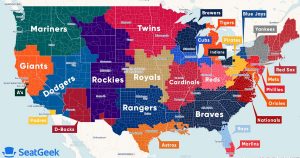 Let’s get a little more orange going around here. Listen, I wasn’t exactly painting my WELCOME CHRIS CHRISTIE placard for Banner Day — coming to Staten Island on June 12 when the Mets play the Padres, incidentally — when Cohen brought the ex-gov shall we say aboard. I could almost hear M. Donald Grant cackling devilishly that this was one board member he’d be proud to chair. Yet, honestly, this Staten Island outreach, whoever hatched it and whoever’s executing it, isn’t a bad idea, not for a franchise whose own logo is explicitly about bridging gaps. Perhaps you saw the Seatgeek map tweeted recently, the one breaking down MLB loyalties by county across the continental United States. The Mets definitely have Nassau (yay!) and Queens (natch). I had to squint to make out if we have Brooklyn, too. Let’s say we did. That’s the extent of extant orange on the East Coast. If we have to fight this fandom battle one borough at a time, so be it. Taking over the former home of the Staten Island Single-A Whatchamacallits and converting Richmond County to orange/blue figures to go a long way in spreading the Metropolitan Gospel. Today, Staturdays with the Mets, Presented by Statcast, Powered by Google Cloud.
Tomorrow? Hopefully back to Queens full-time, but maybe with some traffic heading eastbound. You’d have to ask Christie.
Historically minded Mets fans can’t help but feel a tingle amid all this because we know about the rich Richmond history of the Mets name. Maybe not the Mets since 1962, but the Mets of 1886 and 1887 for sure. Those would be the New York Metropolitans of the American Association, spiritual forebears to our very own Amazins. As Bill Lamb outlined in the essential David Krell-edited book New York Mets in Popular Culture, the Mets of those bygone days “had their moment, highlighted by the capture of an American Association pennant. That achievement notwithstanding, the Mets were mostly an afterthought to the Metropolitan Exhibition Company.”
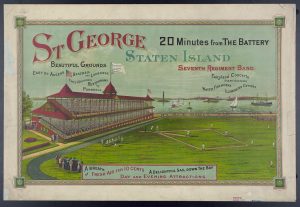 Home again, you might say. Those Mets, like our Mets, started in Manhattan, but unlike our Mets they had no permanent home awaiting them in Flushing Meadows. Instead, when things went awry uptown, those AA Mets vamoosed downtown and across Upper New York Bay to take up residence at the St. George Cricket Grounds. The AA Mets had been a powerhouse when they were based primarily at the oldest of several sites known as the Polo Grounds, going 75-32 in 1884, led by righthanded starters Tim Keefe and Jack Lynch. Each hurler won 37 games, preemptively using all the run support Met ace righties would need for the rest of time. Two years later, as ownership got tangled up in a bundle of conflicting interests, and with the National League’s former New York Gothams gaining traction as the Giants and essentially taking over the territory, the Mets sort of beat it out of town.
Sort of, because the Mets moved from Manhattan to Staten Island. This was before 1898, meaning Staten Island wasn’t officially part of Greater New York, but it was close enough. The Mets, however, weren’t close to the force they’d been. Situated in the future freestanding borough, the American Association Mets pretty much floated out to sea. As Lamb notes, playing outside the borders of what was then considered NYC left them uncovered by the media of the age. What there was to track wasn’t particularly uplifting. The 1886 Mets went 53-82 and finished seventh in the AA. In ’87, their record dipped to 44-89. The Metropolitans came, the Metropolitans went. The St. George Cricket Grounds hosted them for a total of 125 games. In 1889, the Giants briefly set up camp while another Polo Grounds was under construction, playing ball on the Island for 23 games.
So it’s been a while since major league ball had its moment in Richmond County. But that day is coming back. That day will be Staturdays with the Mets, Presented by Statcast, Powered by Google Cloud. Even if all it provides is a port in the remnants of a quarantine storm (another Staten Island echo from the distant past), it’s a legitimate historical bridge to the 19th century. And let us not forget that before the NHL skated to Long Island, one of the names that competed with “just plain Mets” to be what the National League expansion team of the 1960s would be called was the Islanders, a nod to the fact that the Mets would settle on (not in) Long Island. In a slightly westward prism, that little nugget can be seen as setting the stage for this heretofore unseen return to semi-ancestral Metsian roots.
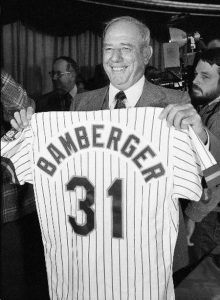 All in the Staten Island family. You can’t say the Mets aren’t planning on making the most of this promotionally and maybe sentimentally. The family of late manager George Bamberger, a Staten Island native, will present a replica of the traditional Shea-delivered floral horseshoe at the Staturdays with the Mets, Presented by Statcast, Powered by Google Cloud opener on the tenth. Relatives of the late Larry Bearnarth, a graduate of St. Peter’s Boys High School, are also expected at some point. Jack Egbert, the only Met player known to have been born on (let’s say “on” already) Staten Island, will be throwing out the first pitch, and I understand celebrity Mets fan Judd Apatow will be bringing cast members of his 2020 comedy The King of Staten Island for some crossover event. The only thing wrong with that otherwise excellent movie was Bill Burr taking Pete Davidson to a Staten Island Yankees game. Maybe they can digitally edit the next version of the Blu-ray to fix that. Among the necessary upgrades to RCBB@SG itself will be installation of a strikeout board that will notch “HelloFresh Kills” of opposing batters, with every “Kill” punctuated by the PA blasting the refrain to Carly Simon’s “Let the River Run” from Working Girl, a film whose protagonist, it will be remembered, commuted daily on a certain ferry.
Come, the new Jerusalem, indeed. To paraphrase Richard Rodgers and Lorenz Hart, we’ve taken as home boroughs Manhattan, Queens and, now, Staten Island. And let’s not forget Brooklyn, home of the Cyclones and our 2020-2021 alternate site. All told, that’s pretty nifty bridgework.
It’s exciting enough that the Mets have secured the services of Francisco Lindor for the ten years after this one. It’s exciting enough that the Mets are planning on playing a full season this year after what we’ve been through the last year. As for the Staten Island part of the plan, you could be tempted to write it off as utter foolishness. But read the calendar. It’s Opening Day almost everywhere. Anything goes — even the Mets to parts previously unknown.
by Greg Prince on 31 March 2021 11:47 pm Multiple sources are reporting the Mets and Francisco Lindor have agreed on a ten-year extension worth $341 million, meaning the all-world shortstop will remain in orange, blue and occasionally black through 2031, or Steve Cohen will be paying him off handsomely to go away after a while.
Just floating the worst-case scenario to ensure it never happens. Because my words are just that powerful.
Let’s get giddy over this. We were giddy to trade for Lindor. We’re giddy to keep Lindor. Imagine what it will be like to actually root for Lindor as a Met doing something besides smiling and negotiating. Happily, we get to do that Thursday night and a whole lot more nights and days over the decade ahead.
I really like the “41” part in $341 million. If Lindor says it was important that be in there because he understands how much the number means to Mets fans, I’ll love that he’s here even more. But I can probably love that he’s here plenty even without explicit Seaverian acknowledgment.
I also love that Steve Cohen is here. Know any other recent Met owners who would have gotten this done? Hell, I love that we’re all here, us and Francisco and the rest of the gang. Opening Night awaits. The Francisco Lindor Mets await. The 2021 season will feature them any hour now.
We were gonna root for the Mets anyway, and now they include Francisco Lindor for the long haul. What a bargain!
by Greg Prince on 29 March 2021 9:26 pm With Spring Training having concluded Monday following a .500 result (3-3 vs. the Cardinals) and a .500 exhibition record (11-11-2), we offer a hearty Faith and Fear welcome to the all-but-official ten about-to-be new Mets of 2021, each of whom appears slated for inclusion on the Opening Day 26-man roster. Mind you, speaking conditionally is a symptom of living in uncertain times.
Jacob Barnes
Trevor May
James McCann
Francisco Lindor, ideally for years to come
Joey Lucchesi
Aaron Loup
Albert Almora, Jr.
Jonathan Villar, hamstring willing
Taijuan Walker
Kevin Pillar
Your blank slates beckon to be filled with Amazin’ accomplishments. We can’t wait to write about all the great things you’re about to do. Occasionally in black, even.
Looking forward? You betcha!
Looking behind? That, too.
This annual interval on the calendar when we get caught between the Spring and New York City provides us a golden orange & blue opportunity, per Academy tradition, to remember fondly or otherwise those Mets who have — in the baseball sense — left us in the past year.
Cue the montage…
___
BRODIE VAN WAGENEN
Executive Vice President & General Manager
October 29, 2018 – November 6, 2020
But no. “Come get us.” I don’t know if front offices in Atlanta, Philadelphia and Washington reverberated with giggles or were too busy preparing their own rosters to notice the Brodie bluster, but if you’ll excuse a fan for thinking like a fan, somehow I’ll bet the Baseball Gods heard. You know their Karma Council took note. They’re worse than Joe Torre when it comes to handing out fines. Brodie, my man. We embrace confidence in winter. We appreciate positivity when it’s merited — and you were making moves that we could process as positive. But we didn’t need to be overly impressed when simply impressed would do, and we absolutely shudder at the thought of karma being disturbed. Think of it as the oral equivalent of Jacob Rhame throwing high and tight at Rhys Hoskins. Do it once, swell. Do it twice, you’re asking for a 900-foot home run in retaliation. Karma’s not known as a sweetheart.
—June 18, 2019
(Relieved of duties, 11/6/2020; joined Roc Nation Sports as chief operating officer, 1/27/2021)
___
JED CARLSON LOWRIE
Pinch-Hitter
September 7, 2019 – September 29, 2019
Mr. L began our session by telling me he had “that dream again,” his very specific variation on the dream in which a person shows up for the final exam and realizes they haven’t been to class all semester. In Mr. L’s case, it’s what he calls “the baseball dream”. It’s not the first time Mr. L has discussed “the baseball dream” with me in therapy, but it had a different twist today. As usual, it starts with Mr. L wandering around in a mostly empty baseball stadium in winter. He says it’s sort of familiar to him, but not a place he knows intimately In the dream, he again refers to “an agent” who was supposed to be “my agent,” except in “the baseball dream,” the agent is now an authority figure inviting him to join a new baseball team. At first, Mr. L is happy for the invitation.
—September 8, 2019
(Free agent, 10/28/2020; signed with A’s, 2/10/2021)
___
ARIEL BOLIVAR JURADO
Starting Pitcher
September 1, 2020
Perhaps someday I’ll find myself engaged in conversation with Ariel Jurado. We’ll likely talk about his baseball career; how it brought him to the Mets; and the challenges he endured, particularly that night in Baltimore in 2020 when, in the process of becoming the franchise’s 1,107th player overall and that season’s tenth Met starting pitcher 36 games into a 60-game campaign, he experienced what Wayne Randazzo termed a “bloodbath”: six hits allowed his first time through the Oriole order, punctuated by a three-run homer from Renato Nuñez. Or maybe we’ll gloss over that part and focus on his final two innings, for after giving up five runs in the first and second, Jurado gave up no runs in the third and fourth. True, it still calculated to an 11.25 ERA and the Mets were en route to a 9-5 defeat, their fifth consecutive loss, but I’d like to think that tact is the better part of discretion. Hopefully, in this hypothetical scenario, Ariel and I will find happier topics to talk about.
(Free agent, 12/2/2020; currently unsigned)
___
RYAN THOMAS CORDELL
Outfielder
July 27, 2020 – September 27, 2020
Over and over we grow used to baseball that isn’t quite the baseball we are whetting our appetite for less than four weeks from today. It’s the baseball with possible stalemates instead of decisive outcomes. It’s the baseball whose broadcast availabilities are piecemeal depending on your subscription choices. It’s the baseball played predominantly under the sun rather than the lights. It’s getting the hang of things on Piazza Drive as prelude to life on Seaver Way. Mostly, it’s numbers and names. The names that we know will be the names we’ll summer with. For two innings, generally speaking, it’s McNeil, Alonso, Conforto, what have you. For the next seven (no extras), it’s vague familiarity that fills in with increased exposure to Mets who’ve never been Mets in the official sense, may never be Mets in the official sense, but are Mets in late February and, presumably, a while in March. I don’t much know them yet, so until they make a lasting impression, they are who I decide they are. They’re Quinn Brodey, a small-town New England operator with an accent to match in the latest Ben Affleck passion project. He can pahk his cah with the best of ’em and doesn’t even use Smaht Park. They’re Ryan Cordell, a cross between Rydell High from Grease and Cordell Hull from FDR’s cabinet. Ryan and the outfield go together like rama lama lama ka dinga da dinga dong.
—February 28, 2020
(Free agent, 10/28/2020; currently unsigned)
___
JAMES BRIAN DOZIER
Infielder
July 30, 2020 – August 14, 2020
In the eighth, the Mets began to rally a bit. Amed Rosario, shortstop of future past, doubled. Brian Dozier, a Met I will be trying to convince you was once a Met by 2022, was granted an iffy walk on a three-and-two count. Then Jeff McNeil comes up and lines a ball above the second baseman’s head, and… NO! IT WAS CAUGHT! DAMN IT! Nice play, though.
—August 8, 2020
(Released, 8/23/2020; retired, 2/18/2021)
___
ANDREW WALKER LOCKETT
Pitcher
June 20, 2019 – August 28, 2020
I’d formed one impression of Walker Lockett during his 2019 cameo appearances — if Walker Lockett had been around when the annual baseball writers hot stove dinner included musical skits, Dick Young or Phil Pepe or somebody of that vintage would have penned this ditty, to the tune of “Love and Marriage”:
Walker Lockett
Walker Lockett
Every pitch he throws
Becomes a rocket
—September 30, 2019
(Selected off waivers by Mariners, 9/1/2020)
___
TODD BRIAN FRAZIER
Third Baseman
March 29, 2018 – September 29, 2019
September 2, 2020 – September 27, 2020
There was a shadow over home plate not long after the 3:07 PM start in Buffalo on Sunday, but the minor league park there doesn’t have multiple tiers, so the effect of the shadow was negligible. As is the feeling that the Mets are still in it. Sometimes it seems the only commonality between the Mets of this September and last September is an overreliance on Todd Frazier.
—September 14, 2020
(Free agent 10/28/2020; signed with Pirates, 2/19/2021)
___
ALI MIGUEL SANCHEZ
Catcher
August 10, 2020 – September 1, 2020
This, therefore, is what 2020 has come to. Seventeen games in, we’ve had a position player pitch, yet our National League franchise hasn’t had a pitcher hit. Guillorme’s catcher was Ali Sanchez, who came in to relieve subdued birthday celebrant Wilson Ramos when the score was a million to nothing or whatever it was by then. Sanchez became the fifteenth new Met of the year, which is almost as many runs as the Washingtonians walloped. We doff our mask to Met No. 1,106 for coming into our world under the bleakest of circumstances and presumably coming back for more.
—August 11, 2020
(Sold to Cardinals, 2/12/2021)
___
HUNTER DREW STRICKLAND
Relief Pitcher
July 25, 2020 – August 31, 2020
Reliever Hunter Strickland was a Met (fourth club in three years) and, for all we know, might be again. His ERA in three appearances ballooned to 11.57, which will make you an ex-anything awfully quick. Strickland is currently off the 40-man roster but at the Alternate Site in Brooklyn. That’s where relievers with 11.57 ERAs are sent to consider the error of the their ways.
—August 9, 2020
(Free agent, 10/15/2020; signed with Rays, 2/8/2021)
___
JACOB SHAWN “Jake” MARISNICK
Outfielder
July 24, 2020 – September 18, 2020
This is what they’re putting out there as a playoff contender of sorts in September? This is what gets somebody like Jake Marisnick, who helped the Houston Astros win Rob Manfred’s memorial piece of tin in 2017, to say, “this team’s too good to not make the playoffs”? He said that two nights ago, after the Mets were blitzed by the Orioles, 11-2, the day after the Mets coughed up a comeback to the Phillies, 9-8. The 2020 Mets remind me of what Whitey Herzog said about the Mets coming into 1986 off a pair of bridesmaid finishes: “They think they won the last two years, anyway.” The Mets haven’t lacked for outward displays of confidence. They’ve lacked for wins.
—September 10, 2020
(Free agent, 10/28/2020; signed with Cubs, 2/20/2021)
___
TYLER MORRIS BASHLOR
Relief Pitcher
June 25, 2018 – September 29, 2019
So went the Mets’ chances to be unstoppable once Tyler Bashlor entered the proceedings. I guess Mickey Callaway wasn’t intent on winning that eighth game in a row. The Mets won nine in a row under Mickey Callaway at the outset of his managerial tenure and see where it got them. Bashlor has good stuff, I’m pretty sure, but it’s rarely been deployed in the service of getting outs in non-playoff chasing circumstances. It doesn’t accomplish much in potentially headier times, either. Tyler commenced his outing by giving up a long fly ball that PNC Park held; followed it up with two singles; and climaxed his appearance by releasing a gopher into the atmosphere. First it made contact with the bat of Starling Marte. Then it was never seen again.
—August 3, 2019
(Sold to Pirates, 8/1/2020)
___
EDUARDO MICHELLE NUÑEZ
Infielder
July 25, 2020 – July 26, 2020
The Mets didn’t respond in kind. They, too, got to have an automatic runner on second, and he indeed scored, but nobody else did, which made the final 5-3 for not us. Hard to miss in the bottom of the tenth, amid a tease of a rally, was erstwhile pinch-runner Eduardo Nuñez serving as designated hitter after Luis Rojas had him take Yoenis Cespedes’s place on the basepaths in the eighth. The burst of speed seemed clever then. In the tenth, with the bases loaded and the situation Cespy-made, Yo’s bat was severely missed. Then again, the DH is an abomination, so maybe karma reaps what we sow.
—July 26, 2020
(Free agent, 10/28/2020; currently unsigned
UPDATE: Signed with Fubon Guardians of Chinese Professional Baseball League, 4/7/2021)
___
JACOB ALAN RHAME
Relief Pitcher
September 2, 2017 – August 3, 2019
Rhame may just have residual vertigo from all the times he’s been down and up in 2018. Standard-issue option action aside, Jacob has three times out of five been the Mets’ choice for 26th man on those occasions when the roster temporarily expanded because of makeup doubleheaders and the like. In other words, when it’s Rhame, it’s poured.
—September 5, 2018
(Selected off waivers by Angels, 7/8/2020)
___
BILLY R. HAMILTON
Outfielder
August 5, 2020 – September 3, 2020
For eight pitches, it mattered to me that Jeff McNeil reached base. On the eighth pitch, Jeff McNeil took ball four. At that instant, I was convinced the Mets would win. Before I could fully weigh the detrimental impact of my unspoken thoughts on the course of events in an athletic contest taking place on my television, Billy Hamilton came in to pinch-run for McNeil. Before Chapman could fully process the danger Hamilton’s two legs encompassed to the work of his left arm, Billy was off to second base. Because Chapman threw to first base as Hamilton ran, it can be said, technically, that the pitcher had the runner picked off first. But, no, not really, because Hamilton — whose already indefatigable speed seemed kicked up a notch by the presence of 42, twice Billy’s usual 21, on his back — was pretty easily safe. He was now a runner in scoring position. Most nights, having one of those doesn’t fill a Mets fan’s confidence coffers. But this night was different from most other nights.
—August 29, 2020
(Selected off waivers by Cubs, 9/7/2020; has since signed with White Sox)
___
JUAN OSVALDO LAGARES
Center Fielder
April 23, 2013 – September 29, 2019
August 25, 2020 – August 26, 2020
In the top of the sixthish, the lone semi-convincing Met threat of the nightcap went awry when pinch-runner Juan Lagares — oh, Juan Lagares is back (and wearing No. 87) — was doubled off first base; Luis Guillorme’s sizzling liner was caught by Miami first baseman Lewin Diaz with Juan on his way to second. Diaz was much closer to first base by then, so, yeah, double play.
—August 26, 2020
(Free agent, 8/31/2020; signed with Angels, 2/6/2021)
___
CHASEN DEAN SHREVE
Relief Pitcher
July 27, 2020 – September 27, 2020
Score one for dependability, predictability and well-ingrained habit. On Monday night, score seven for the Mets versus only four for the Red Sox, resulting in our second win of the thus far four-game season. Michael Conforto homered at Fenway Park. So did Pete Alonso. So did Dom Smith. Michael Wacha registered five innings’ worth of outs. Seth Lugo retired the final four batters. Chasen Shreve acquitted himself adequately in middle relief. Jeurys Familia did not, but little harm was done. Not bad for late July, eh?
—July 28, 2020
(Free agent, 12/2/2020; signed with Pirates, 2/7/2021)
___
GUILLERMO HEREDIA (Molina)
Outfielder
September 21, 2020 – September 27, 2020
Guillermo Heredia played center for the Mets Monday, having been called up to replace Jake Marisnick, who has a tight hamstring, and then inserted for Conforto, who also has a tight hamstring. A good, loose hamstring goes a long way in getting a person into the Mets lineup these dwindling days of 2020.
—September 22, 2020
(Selected off waivers by Braves, 2/24/2021)
___
ERASMO JOSE RAMIREZ
Relief Pitcher
September 7, 2020 – September 27, 2020
Each of the previous twenty-three Unicorn Scores in Mets history that has thus far gone uncloned was registered in a ballpark […] with an implied sense of MLB permanence. This one, at Sahlen Field, happened where the Mets will likely never play again after this series. And it included the first Met save credited for the questionably strenuous preservation of a lead of as many as 17 runs. Such a perfectly regulation save was assigned Friday to the ledger of the newest Met (No. 1,110), Erasmo Ramirez. Erasmo indeed came on in relief, indeed went the final three and indeed didn’t surrender the inflated advantage he was assigned to protect. That’s a save in any season, even if nobody ever conceived of a Met reliever saving that large a lead. Way to go, Erasmo — if you’re gonna make history, you might as well make it count like nothing that’s ever been counted before.
—September 13, 2020
(Free agent, 10/28/2020; signed with Tigers 1/19/2021)
___
WILLIAM JARED HUGHES
Relief Pitcher
August 3, 2020 – September 27, 2020
It’s the middle of February at the beginning of July. We’re talking camp. We’re talking a veritable plethora of non-roster pickups. Now loosening limbs under the auspices of the Metropolitan Baseball Club of New York are several fellows who span the familiarity spectrum from very to vaguely: Melky Cabrera, Gordon Beckham, Hunter Strickland, Jared Hughes. If this were the middle of February, we’d know what to make of the odd veteran signing. Now we are assuming this bunch will add depth to our 60-player pool, a phrase that didn’t exist the last time baseball went camping.
—July 2, 2020
(Free agent, 10/28/2020; retired, 2/14/2021)
___
ROBINSON DAVID CHIRINOS
Catcher
September 3, 2020 – September 27, 2020
Somewhere post-Hessman, I made my list. There were lists begun before it. There’ve been lists begun since. Every Mets game is an excuse to update at least a couple of them. Some baseball fans referred to the 2020 regular season as a distraction from worrying about the effects of the pandemic or facing up to existential threats to representative democracy. Me, I had the opportunity to note, among myriad other occurrences, that on September 23 — one night after Heredia took Curtiss deep and one night before Chirinos took Corbin deep — the Mets’ record landed at 25-31. And? And it was the FIRST time the Mets ever sported a record of 25-31 after 56 games…if one can be said to sport a record of 25-31. It’s more something an obsessive type types quickly, clicks close on and keeps mostly to himself. But then I opened it just now and shared it with you here on the remote chance you might find it interesting.
—September 28, 2020
(Free agent, 10/28/2020; signed with Yankees, 2/15/2021)
___
MICHAEL JOSEPH WACHA
Starting Pitcher
July 27, 2020 – September 23, 2020
Thus, when Closing Night 2020 rolled around, it was just another game to watch at home. None of the emotions attendant to a final visit to the ballpark. None of that sense that this is the last time I’m getting on the LIRR to change at Jamaica for Woodside…this is the last time I’m getting on the 7 to Flushing…this is the last time I stop by my brick, the last time I get felt up by security, the last time somebody hands me a nick-nack, the last time… There were no last times like the last 25 times to be had. There were the Mets and Rays, in living color, courtesy of SNY and me paying my cable bill. There was Michael Wacha looking kind of promising for a while until the promise broke.
—September 24, 2020
(Free agent, 10/28/2020; signed with Rays, 12/18/2020)
___
BRAD BRACH
Relief Pitcher
August 11, 2019 – September 27, 2020
The Nationals, like the Mets and every Wild Card wannabe, have their flaws, but between the genuine talent (Rendon, Soto), the certified Met-killing (Suzuki) and now Cabrera imagining the need to get even, they have enough of a critical mass to make a Mets fan antsy. Good thing, then, that Mickey Callaway was able to turn to a Mets fan who clearly recognized what was going on, namely his second reliever, Brad Brach. Brach is a Mets fan from way back. Not one of those locally sourced “I rooted for the New York teams as a kid” diplomatic-answerers who doesn’t want to piss off his new fans by admitting he didn’t care or preferred another nearby team, but somebody who, had he not been preoccupied getting outs for other staffs in recent years, would have recognized Kurt Suzuki kills us. Brad from Freehold put his Mets fan instinct to good use and flied out Brian Dozier to get us out of the sixth still tied.
—August 12, 2019
(Released, 2/16/2021; signed with Royals, 2/22/2021)
___
RENÉ RIVERA
Catcher
April 30, 2016 – August 16, 2017
August 25, 2019 – July 29, 2020
Against the Rockies in the Mets’ series finale, Noah Syndergaard perhaps put too much faith in the powers of a personal catcher. Despite the residual simpatico Noah feels for René Rivera’s core skill set from their splendid 2016 together, the Syndergaard who faced Colorado wasn’t markedly better than the Syndergaard who faced Los Angeles five days earlier or the Syndergaard who took on Philadelphia five days before that, both times with Wilson Ramos behind the plate. Those previous starts loomed as dead-letter days in the history of the 2019 Mets, each of them among the myriad losses that buried us for good (with probably a couple more death blows in between). This Syndergaard start — 5.2 IP, 10 H, 4 ER, 2 BB, 4 SB — was similarly grabbing the shovel from the garage and commencing to dig.
—September 19, 2019
(Free agent, 10/28/2020; currently unsigned
UPDATE: Signed with Cleveland, 4/14/2021)
___
ANDRÉS ALFONSO GIMÉNEZ
Infielder
July 24, 2020 – September 26, 2020
Necessarily tossed overboard in the general direction of Lake Erie were two members in good standing of the SS Mets, two Mets SSes. One was the future not very long ago. One was the future literally last week. Today they are ex-Mets. You make this trade seven days out of every seven, Amed Rosario and Andrés Giménez plus minor leaguers Isaiah Green and Josh Wolf for Lindor and Carrasco, but you don’t do it without an ounce of sentimental regret. I’ll miss Rosario and Giménez like I missed Neil Allen, Hubie Brooks and the package of potential and heritage represented by Preston Wilson (Mookie’s lad). I felt bad that they were no longer Mets. I felt great that Keith Hernandez, Gary Carter and Mike Piazza arrived because they departed. Which is to say I got over their respective departures.
—January 11, 2021
(Traded to Cleveland, 1/7/2021)
___
PAUL STANTON SEWALD
Relief Pitcher
April 8, 2017 – July 26, 2020
The two were about to leave the room, when a dazed Paul Sewald wandered in. He’d never seen this room before, but there were lots of things the third-year Met had never seen. After having been the losing pitcher fourteen times but never the opposite, not even once, since the Mets first promoted him in 2017, Paul was enjoying a new sensation of his own. By pitching a scoreless top of the eleventh, Sewald was in line to be the winning pitcher should the Mets score. Once Nimmo drew the bases-loaded walk that brought Amed Rosario home from third, Paul got the win. “Guys! Guys!” Sewald asked Wheeler and Horwitz excitedly. “Did ya see? I’m a winning pitcher — a winning pitcher at last. I’m one and fourteen, but I got one! I finally got one!” The starter and the alumni affairs chief smiled and nodded, telling the heretofore hapless reliever how happy they were for him. “I was beginning to think this would never happen,” Paul confided. “But it has. Finally.”
—September 25, 2019
(Free agent, 12/2/2020; signed with Mariners, 1/7/2021)
___
JUSTIN JAMES WILSON
Relief Pitcher
March 30, 2019 – September 24, 2020
Teams build bullpens on the foundation of a core belief that starting pitchers can’t be pushed beyond so many total pitches and so many stressful innings. Well, teams try to build such bullpens. The Mets tried. I swear they did. What they wound up with instead was a coupla guys. The coupla guys, Justin Wilson and Seth Lugo, have held the bullpen together essentially by themselves for weeks, most recently the night before. On Saturday, it was deGrom for seven, Lugo for one, Wilson for one. It worked perfectly. Now Callaway would ask it — them — to work perfectly again on no nights’ rest. It didn’t work.
—September 16, 2019
(Free agent, 10/28/2020; signed with Yankees, 2/15/2021)
___
FREDERICK ALFRED “Rick” PORCELLO
Starting Pitcher
July 26, 2020 – September 26, 2020
One night this abbreviated season, I got in the car after my weekly grocery-shopping trip, turned on the game, discovered it was another Porcello start going quickly awry, and muttered some pretty nasty thoughts aloud in the direction of a fella who couldn’t hear me. But on Saturday night, after the sweep in D.C. was complete and the Mets dangled one game above finishing in a last-place tie, Rick Porcello took it upon himself to basically apologize for how crummy he and the rest of Mets played in 2020. It was enough to almost make me take back my previous grumblings. “I’m sorry we couldn’t have done better for you, and given you something to watch during the postseason,” the righty said, noting that he was happy he could at least be a part of giving us folks at home a distraction from all that swirls about us. “I wish I could’ve done better for this ballclub. Unfortunately, we’re out of time. I gave it my all and it wasn’t good enough for us.” Rick concluded by adding, “I love the Mets, I’ve always loved the Mets since I was a kid.” It would figure that someone who realized a lifelong dream of playing for “a team I grew up cheering for” would know exactly what to say to us, a cohort that surely includes him.
—September 27, 2020
(Free agent, 10/28/2020; currently unsigned)
___
WILSON ABRAHAM RAMOS
Catcher
March 29, 2019 – September 27, 2020
For a solid month of 2019 — August 3 to September 3 — Wilson Ramos played in 26 games for the Mets and hit in every one of them. The hitting streak was the best by any Met in the 2010s (second only to Moises Alou’s thirty in franchise annals), and it couldn’t have come at a better moment. The Mets were making a bid for the postseason, and their mostly everyday catcher was batting .430 and slugging .590 as they strove. That span included four games in which Wilson came off the bench to extend the streak or, more accurately, help his team maintain its momentum. You can also factor into his monumental achievement that by August, a catcher is bound to be physically run down at any age; Ramos turned 32 on August 10. Oh, and don’t overlook that not every pitcher appreciated this catcher’s defensive abilities, and by September word leaked that at least one batterymate (Noah Syndergaard) was asking for someone else to handle his workload. Another, however (Jacob deGrom), clinched a Cy Young Award by tossing three scoreless seven-inning starts, each with Wilson behind the plate. By 2019’s end, Ramos completed his first season as a Met with 141 games played and a .288 batting average. Catch that, why don’t you?
—December 11, 2019
(Free agent, 10/28/2020; signed with Tigers, 1/26/2021)
___
GERMAN AMED ROSARIO
Shortstop
August 1, 2017 – September 27, 2020
We’ll leave that for the future, unknown though it may be, and concentrate in the present on the half-inning of our most recent past. The tenth inning. The one against the Indians. The one Amed Rosario, the shortstop who bloomed into a second-half superstar as soon as the ink was dry on the organizational plan to convert him into a last-ditch center fielder, led off with a double to center. Since the beginning of June, Rosario is a .500 hitter. Since August 1, Amed is batting a thousand. I could look up what the numbers actually are, but I’m comfortable with the hyperbole.
—August 22, 2019
(Traded to Cleveland, 1/7/2021)
___
STEVEN JAKOB MATZ
Starting Pitcher
June 28, 2015 – September 27, 2020
He’s a happening. He’s a happening because he brought 130 friends and family from Suffolk County and because he’s been working his way back from Tommy John so long that the general manager who drafted him was Omar Minaya and because his favorite adolescent baseball memory involves Endy Chavez and he’s 24 yet looks 14 and he knows to professionally tip his cap when thunderously applauded and he lived up to every expectation we had for him and he built new expectations along the way and he exceeded those. We who were grumpy from a lack of offense even after Duda’s growth charts flapped victoriously roared without reservation for Steven Matz. We were holding out for a hero. We received a folk hero. He’s proof, as if we needed any more, that the designated hitter rule belongs on the ash heap of history. If, say, Cuddyer as hypothetical DH had gone 3-for-3, we might be curious what kind of hallucinogenics they were using at Blue Smoke, but we wouldn’t otherwise be terribly moved beyond vague approval. But Matz going 3-for-3? The pitcher? Never mind the Colon sideshow. This is a pitcher not just helping his own cause. This is a pitcher defining the cause. Let other pitchers pray for run support. Matz answered everybody’s prayers before they could be formulated.
—June 29, 2015
(Traded to Blue Jays, 1/27/2021)
___
YOENIS CESPEDES (Milanes)
Outfielder
August 1, 2015 – August 2, 2020
Without Cespedes in the lineup, they kept winning and were plenty imposing. With Cespedes, where between one and eight in their standard lineup is the letup for the opposing pitcher? Mike Broadway picked a very bad night to be an understudy to Jake Peavy. Cespedes, though…what a star. In a ten-pitch span dating to the previous Friday in Atlanta, Cespedes came to the plate five times, took six swings, delivered four hits, totaled twelve bases and drove in eleven runs. And that was all while letting a debilitating bruise heal. Amid the twelve-run inning and eventual 13-1 win, Yoenis set two Met records of his own: most RBIs by one batter in one inning (six); and most consecutive games with at least one extra-base hit (nine). The Mets he surpassed in these respective realms were Butch Huskey and Ty Wigginton. I liked Butch Huskey and Ty Wigginton just fine in their day. The days Yoenis Cespedes and these Mets are giving us, though? Every day is Christmas. And every night is New Year’s Eve.
—April 30, 2016
(Placed on restricted list, 8/1/2020; free agent 10/28/2020; currently unsigned)
___
FRED WILPON
Chairman of the Board & Chief Executive Officer
January 24, 1980 – November 6, 2020
[A]nother theme the self-inflicted media onslaught emphasized was the owner of the Mets loves being owner of the Mets. Take it from perennially reliable source Steve Phillips: “I know how important the team is to the Wilpon family.” Yet, for what little it’s worth in the big picture, I don’t necessarily equate that with loving the Mets. I’ve never gotten the feeling Fred Wilpon does, not in the way those of us who don’t get to shove blueprints at an architect and tell him to shut up and just rebuild Ebbets Field do. I’m sure he loves the Mets as a property, and that there’s more to the Mets to him than there is to this or that building in Manhattan, but I also get the feeling his acumen was most acute in tending to inanimate objects.
—May 25, 2011
(Sold franchise to Steve Cohen, 11/6/2020; retains 5% ownership share and serves as chairman emeritus)
by Greg Prince on 25 March 2021 9:51 pm Certain Mets seem to come up semi-regularly in this space. Not necessarily from being great and, I’d like to think, not from my being cute or ironic. Certain Mets just hover in my baseball subconscious and briefly but habitually waft above the rest.
Randy Tate was a certain Met. He pitched for the Mets in 1975. Not before. Not after. I hadn’t heard anything about him in the minor leagues ahead of his major league debut. He appeared at Shea that April, spent the summer, and didn’t pitch there again after that September. Or anywhere else in the bigs. It never occurred to me to strenuously wonder where he went. I figured the Mets had their reasons for elevating Randy Tate when they did and for going in a different direction when they did.
But in 1975, the season I was 12, which is a prime age for forming impressions and attachments, Randy Tate was the Mets’ fourth starter. The rotation was Seaver, Matlack, Koosman, Tate and whoever else was handy. I was already attached to Seaver, Matlack and Koosman. I was impressed that Tate could hang with them.
 Randy Tate spent a summer in distinguished company. Randy Tate may not have been in a class with the three pitchers he followed, but for a year he was in their league. Once in a while, he was what you meant when you talked about Met pitching depth. I went to Old Timers Day in late June. Casey Stengel came out in a Roman-style chariot and greeted us, his eternal subjects. Rookie Randy Tate pitched. I watched the Ol’ Perfesser — Casey was 84 — wave, and I watched the latest example of the Youth of America — Randy was 22 — take care of the Phillies for a couple of innings. Then the rains came down and my sister, who was kind enough to bring me in the first place, insisted on leaving, not quite buying my explanation that sometimes it stops raining, a grounds crew dries the field and the teams pick up where they left off. The game resumed while we were on the LIRR to Penn Station, where we’d take another train back to Long Beach. We came home to find Randy Tate on Kiner’s Korner. The rookie had just claimed his first complete game victory.
That was the last time Casey Stengel made an appearance at Shea Stadium. It was also the last time I saw Randy Tate pitch there.
Old Timers Day isn’t what most former 12-year-olds and thereabouts from 1975 Metsopotamia remember Randy Tate for. We go almost immediately to Monday night, August 4, when Randy was going to pitch the first no-hitter in New York Mets history. No kidding, this was gonna be it. Fourteen seasons of Mets baseball and it was already an albatross that we had no no-no. That stupid bird was gonna fly away that night. I could feel it. Bob Murphy could feel it. I listened while in the bathtub. That afternoon my mother took me to the dermatologist in search of relief for the nagging psoriasis on my right knee. The doctor gave me a bottle of tar. Or something with tar in it. Add it to your bath, he said. It had a very strong aroma. I swear I can still smell it, just as I can still hear Murph narrating Tate’s total and complete domination of the Montreal Expos.
The no-hit bid lasted into the top of the eighth. Leadoff hitter Jose Morales struck out, Randy’s dozenth K. We were up, three-nothing. Could this be the night? This had to be the night. I wasn’t a naïve 12-year-old Mets fan, mind you. I’d been at Mets fandom since I was six. No Ned in the third reader as Casey would have said. I wanted to believe Randy Tate would get it done, that our lives wouldn’t be defined by not having a no-hitter for another who knew how many years. This wasn’t Seaver or Matlack or Koosman. This was Randy Tate. This was so crazy it might work.
Except Jim Lyttle, the ex-Yankee, singled to break up the no-hitter, five outs from glory. Murph said the fans at Shea were giving Tate a standing ovation. I hung tight in the tub. The next four batters were all future Mets and three of them destroyed the remnants of the dream I dared to dream for the current Mets. Pepe Mangual walked. Jim Dwyer struck out — Randy’s thirteenth — but Gary Carter singled in Lyttle to end the shutout, and Mike Jorgensen, a former Met as well as a future Met, launched a three-run homer that in retrospect was inevitable. I could hear the heartbreak in Murph’s voice. I could feel the heartbreak while soaking in that slimy black water. Yogi Berra let the kid finish the eighth. Today a rookie who was en route to striking out thirteen over eight wouldn’t see the sixth inning
Tate took the 4-3 loss. I never used the tar concoction again. It was really pretty disgusting.
The next day, Berra managed his last two games for the Mets, a doubleheader sweep, each a seven-zip whitewashing from the Expos. Yogi was fired the day after. Within two months, Casey and Mrs. Payson were gone. And though he couldn’t have known it for sure, Randy Tate was finished as a Met, his career line frozen at 5-13, a 4.45 ERA and 99 batters struck out in 26 games, 23 of them starts. He didn’t immediately leave the organization, instead spending two more years in our minors, pitching for Tidewater in ’76 and Lynchburg in ’77. There’d be an additional season of pro ball in the Pittsburgh chain. After that, you have to visit Tate’s Ultimate Mets Database fan memories page, which is thick with talk of the near no-hitter and the turns his life took in Alabama after baseball.
When I learned tonight through Facebook that Randy Tate, 68, had died from COVID complications, it was again raining on Old Timers Day; it was again tar-drenched in the bathtub; it was again 1975 when a righthander who wasn’t Jacob deGrom wore No. 48 for the Mets and a 12-year-old was thrilled to root for him, even if the 12-year-old knew he’d be forever dismayed that Jim Lyttle broke up what should’ve been the first no-hitter in New York Mets history. Or the second after Seaver got Qualls six years earlier.
With certain Mets, that feeling never goes away.
|
|






