The blog for Mets fans
who like to read
ABOUT US

Faith and Fear in Flushing made its debut on Feb. 16, 2005, the brainchild of two longtime friends and lifelong Met fans.
Greg Prince discovered the Mets when he was 6, during the magical summer of 1969. He is a Long Island-based writer, editor and communications consultant. Contact him here.
Jason Fry is a Brooklyn writer whose first memories include his mom leaping up and down cheering for Rusty Staub. Check out his other writing here.
Got something to say? Leave a comment, or email us at faithandfear@gmail.com. (Sorry, but we have no interest in ads, sponsored content or guest posts.)
Need our RSS feed? It's here.
Visit our Facebook page, or drop by the personal pages for Greg and Jason.
Or follow us on Twitter: Here's Greg, and here's Jason.
|
by Greg Prince on 9 October 2019 4:06 pm Baseball’s League Division Series round is completing its 25th iteration today and tomorrow with winner-takes-some drama. St. Louis at Atlanta. Washington at Los Angeles. Tampa Bay at Houston. Lose and go home, win and go on. That’s not winner taking all, but it’s plenty of stakes. That’s stakes that — save for the 1981 postseason and its singular split-season asteriskery — didn’t exist prior to 1994 on paper or 1995 in action. It’s certainly different from what baseball fans who came of age prior to the mid-’90s are instinctually conditioned to accept as the way to go about getting to the World Series.
When the Mets and three other teams inaugurated the League Championship Series in 1969, a.k.a. “the playoffs,” they initiated a break with what might have been considered the Good Old Days of binary win-and-in pennant races. The LDS did the same to the four-division symmetry a later generation (mine) thought was perfect. Easts played Wests, the bests then dueled for every single marble in creation.
Since 1995, it’s not that simple. Three divisions. A Wild Card. Since 2012, two Wild Cards, but only one in the Division Series. Your 107 wins, if you’re the 2019 Astros, get you no more than a deciding game at home. You lose that, and you are home. We’re not necessarily past the hollow “if the Wild Card were around in the ’80s, the Mets would have gone to the playoffs every year” argument, because it makes us feel good to imagine a system in which Doc, Darryl, Keith, Kid, et al winning 90+ games was automatically rewarded, but we don’t seem to have a problem with the possible elimination of a juggernaut prior to the contemporary final four.
On Tuesday night, after tying their ALDS versus the Astros at two, the Rays were talking about shocking the world. A 96-win team doing anything outstanding shouldn’t seem shocking, though the Rays being the Rays carry an aura of shock and awe anytime they conquer an opponent in front of a multitude of their supporters. They inevitably carry an echo of the 100-win Mets of 1969 not having a chance against the 109-win Orioles. As 2019 has served as an excellent reminder of 1969, I find myself less and less shocked that the Mets won four of five games from Baltimore when it counted most. We had the pitching and we’d won a hundred games. Very good teams beat very good teams and vice-versa. The Orioles were no more than a very good team until they won that World Series.
Which they didn’t.
I have no complaints with the competitive implications of submitting very good teams to an extra hurdle of competition. Let the Astros prove themselves this one extra round. Or let the Rays surge. Just let one of them beat the Yankees, of course. In the National League…god, there has been nobody to root for since the Brewers were eliminated in the Wild Card Game. The Brewers were the ghost we chased through September so we could be in that game, but we hadn’t played them since May 5, thus it was tough for me to gin up enmity for Milwaukee the way I’ve stockpiled animus over the years for the Braves, Cardinals, Nationals and Dodgers. I still had a little residual affection for the Brewers from last October when, if you’d hung out with me, you’d have sworn I was from Wisconsin. I listened to every one of Milwaukee’s LDS and LCS games over the WTMJ feed and rooted hard in a distinctively October fashion for the Crew. Bob Uecker! Sausage commercials! Craig Counsell slipping openers onto the scene like it was a Miller Park tailgate! The whole thing rolled out barrels of fun for a baseball-adoring soul otherwise unaffiliated.
Nothing of that nature in the NL at the moment. The Dodgers are the Dodgers. Their presence is oppressive, yet they haven’t achieved anything admirable from this perspective since 1981 (yeah, we haven’t forgotten 1988 — or Utley). The Cardinals we still resent for wrecking 1985 and 1987 let alone 2006. We were just playing and sweeping the Braves like five minutes ago. What are they doing sopping up a segment of the spotlight? Meanwhile, the tangible joy of pointing out the Nationals have never won a Division Series despite their participation in several of them hangs in the balance of tonight’s Game Five. No Sheadenfreude comes clean to us.
Nevertheless, two National League foes of ours will arise from their respective scraps, vanquishing two other National League foes of ours and thus leave us with a whole other series in which there’s nobody to root for. That’s October for ya.
October for me is also the probably unintended retro pleasure of the LDS, despite the LDS being a fairly modern invention, about as old as access to the Internet. I’ve liked that games of import suddenly materialize at 1:07 PM or 4:37 PM. Daytime baseball for which at least a few marbles are the prize. That’s a throwback worthy of a sitdown in front of Ken Burns’s cameras. On Monday afternoon, I flipped on the TV and left it on in the background, listening to Bob Costas call the Rays and Astros, and could have sworn it was a perfectly good afternoon from my youth or relatively early adulthood. I hop in the car to run errands around five o’clock and, after guessing which frequency ESPN Radio has leased time for what its local outlet deems spillover programming, find a national broadcast crackling with static and semi-informed voices. It’s Chris Berman and Rick Sutcliffe telling me what’s going on inside the red-clad heads of everybody filling seats at Busch Stadium, as if they know. If the temperature’s agreeable, I have the window rolled down and 970 AM or 1050 AM blaring and imagine that Game Two of the NLDS is gripping America’s imagination as it is gripping mine. The mostly inaudible signal is not audible from anybody else’s car where I am. It’s probably not of any great concern to anybody outside of St. Louis or Atlanta. But it’s October and it’s the playoffs and I’m all in.
And will continue to be, even as night falls on the first round.
by Greg Prince on 3 October 2019 12:51 pm It’s October of 2017. Mickey Callaway, Cleveland Indians pitching coach and universally regarded hot managerial prospect, has been scooped up by the New York Mets to serve as the franchise’s first new skipper since Terry Collins took over seven years before. He’ll be a breath of fresh air, we were told. He’s analytically savvy, we were told. He communicates brilliantly, we surmised.
It’s April of 2018. Mickey Callaway has the Mets at 11-1, 12-2. The Mets have never been 11-1 or 12-2. This guy really does know what he’s doing, it was fair of us to say.
It’s September of 2019. Mickey Callaway has brought the Mets home on an incredibly strong second half. They won 46 of their final 71 games. They contended for the playoffs. They nurtured several key players who came up to stay under Callaway. We as Mets fans finished the season far more excited about starting the next season than we were when the Mets finished their last season before Callaway.
It’s October of 2019. Mickey Callaway has been “relieved of his duties,” as a press release that praises him for his “consistent work ethic and dedication” puts it. The hot start of 2018 and the sizzling second half of 2019 are not specifically mentioned. Nor, out of politeness and human resources protocol, are the chunks of Callaway’s tenure that can’t be cherry-picked and held at a favorable angle to make them look sharp.
Mickey Callaway’s Mets of 2018 and 2019 won a couple more games than they lost overall. They featured the consensus best pitcher in the National League across that two-year span and the most momentous rookie season the franchise has ever seen in the second year. They also encompassed a ballclub that evinced enthusiasm in every way that seemed to matter. “Never say die” wasn’t merely a cliché with Callaway’s teams. They refused to give up even when their fans gave up on them multiple times.
Ownership, management, whoever makes the decisions gave up on Callaway. We gave up on Callaway. We acknowledge the positive results around Callaway while not losing sight that even with a composite record above .500, the overall picture never seemed particularly positive. Mickey could be positive. He projected a relentlessly positive attitude, which is probably more important than we realize. He also endured difficulties with the nuts-and-bolts aspects of managing baseball games, which was probably more important than those who signed off on his hiring in October of 2017 realized. He was a disaster explaining ballgames. Also important. You manage people, you manage games, you manage expectations. You gotta do all of it pretty well to manage a third season when neither of your first two seasons yielded the fully desired results. Great moments, great segments, yes, but without promise that what was lacking was going to be filled in adequately to advance.
As a human being, I’m sorry to see Mickey Callaway relieved of his duties. As a human being, I’m sorry to see most people relieved of their duties. As a Mets fan, I appreciate the good parts but can’t shake the overwhelming effect of the less good parts. Nether could those making the decisions.
In October of 2019, the Mets are again looking for a manager. Good luck to all of us again.
by Greg Prince on 30 September 2019 5:21 am Someone to hold you too close
Someone to hurt you too deep
Someone to sit in your chair
To ruin your sleep
To make you aware
Of being alive
It was visceral in a way not much of Mets baseball is for me after 50 years of rooting for the Mets and 15 years of writing of the Mets. I think about the Mets constantly. I think about what the Mets have done, I think about how the Mets might do, I think about the ways I will express the Mets for anybody who comes here and is interested in reading that. I think about the Mets’ wins, the Mets’ losses, the Mets’ stories. I think about who will do what for the Mets and connect it six ways to Sunday in terms of who has done what for the Mets before without even meaning to. I go to the final Mets game of 2019 and instinctively immerse myself in the literally dozens of final Mets games I’ve gone to in the literally dozens of Mets seasons preceding this one. “This Closing Day,” I think to myself, “is like that Closing Day in…”
Then something happens that I’d barely given thought to, and only then to conceive it as barely possible and reject the notion altogether, and I don’t know what to think, because I’m not thinking anymore. I’m acting. I’m reacting. Mostly, I’m yelling this from in front of a seat I paid good money to sit in yet I no longer have any need to use for its stated purpose:
“OH MY GOD! OH MY GOD! OH MY GOD!”
That was not scripted. That was not premeditated. That was not a line I workshopped or played out in my head before testing it on social media, and if it worked there, maybe it would fit into the blog tonight. No, this was truly visceral.
“OH MY GOD! OH MY GOD! OH MY GOD!”
I’m not what you’d call religious, but I can be spiritual, and oh my god, after Dom Smith belted a three-run walkoff homer in the eleventh inning at Citi Field on Sunday, minutes after the Atlanta Braves had buried the New York Mets one final time in 2019, I saw the light.
Someone to need you too much
Someone to know you too well
Someone to pull you up short
To put you through hell
And give you support
Is being alive
If you’re new here, or if you’re old here but haven’t paid airtight attention to my various tics, understand that Closing Day — the final regularly scheduled home game of the Mets season — is my jam. I went to my first Closing Day in 1985, returned in 1988, and in 1995 began a streak of Closing Day attendance that has continued to this day, or technically, yesterday. That’s 25 in a row, 27 overall. There was a line in The West Wing once about how President Bartlet would almost rather lose re-election than not win New Hampshire. New Hampshire, you see, was his home state.
Closing Day is my home state. I’d throw tickets to Opening Day and most of the season in between overboard the S.S. Wilpon before I’d give up going to Closing Day. And I would never leave Closing Day before it’s over. I don’t understand people who do. They have the right idea by showing up to put a proper period at the end of this 162-game sentence, yet they ultimately opt for an ellipsis.
Geez…
Before Closing Day 2019, I had an image of what constituted an ideal Closing Day. It was Closing Day 2014. A beautiful, sunny afternoon replete with essential elements.
• A definitive goodbye to somebody of stature, like Bobby Abreu, who singled and then departed for a pinch-runner to ardent applause for what we knew was the last appearance of his long and distinguished career.
• A definitive round number for somebody we’d grown to embrace, like Lucas Duda, who whacked his 30th home run and playfully jogged through an empty dugout as if he was subjecting himself to that year’s mandatory “car wash” cleanup.
• A sense that things were getting better; the 79-83 Mets finished on a 17-11 spurt, the first tentative sign of tangible progress after an era of stubborn stagnation.
• All the trimmings as well: bumping into friends and acquaintances who don’t cross your path outside of a ballpark; reveling in the silly and solemn between-innings rituals that don’t occur outside of a ballpark; enjoying food you won’t partake in when it’s not offered in a ballpark.
• Oh, and a Mets win, obviously. On September 28, 2014, the Mets beat Houston, 8-3. The Mets haven’t beaten anybody by a score of 8-3 since September 28, 2014. That may simply be a statistical quirk…or it could illustrate just how hard it is to nail an ideal Closing Day.
Closing Day 2014 wasn’t the greatest or most momentous Closing Day, but it was what a Closing Day should be, at least according to my standards. It was a day I didn’t want to end even if it was definitively about the end. After applauding the Mets’ 79th victory, my wife Stephanie and I strolled through Flushing Meadows Corona Park, then stopped for dinner in Jackson Heights. These were my tack-on runs, my extra innings. Keep Closing Day alive. Keep the season alive. Keep Mets baseball alive. We couldn’t hold off winter, but we could hang around and soak in the last of summer.
To my surprise, the Mets’ record on Closing Day in the Citi Field era has been almost flawless. I don’t know why I should be surprised. I keep track of this stuff. I know the Mets have lost only one Closing Day since Shea shuttered. Perhaps because the one loss felt so utterly Metsian that I tend to assume it infected most of the years that followed it. The defeat occurred on October 3, 2010, a fourteen-inning marathon (what, you were expecting a fourteen-inning sprint?). It was cold and it was endless, so endless that it required the services of Oliver Perez, previously exiled by Jerry Manuel to a dark corner of the Mets bullpen. Long story short, Perez didn’t get the job done, Mets lost in 14.
Otherwise, we win. Jose Reyes wins a batting crown. R.A. Dickey wins a 20th game. Eric Young, Jr., wins a stolen base title. Good things happen. In 2015 and 2016, the Mets win their final regularly scheduled home game and continue into the playoffs. In 2017 and 2018, the Mets win their final regularly scheduled home game and call it a year. It’s not a dealbreaker for me if a win isn’t included on Closing Day, because I’ll surely plan to be back on the left field side of Excelsior 162 games hence no matter what. But I’ve been getting used to these final regularly scheduled home game wins that it would be a shame to, you know, lose New Hampshire.
There are so few wins we as Mets fans get used to.
Someone you have to let in
Someone whose feelings you spare
Someone who, like it or not,
Will want you to share, a little, a lot
Is being alive
We were doing Closing Day right, Stephanie and me. First off, it was Stephanie and me, which makes Closing Day right, right off the bat. My wife makes all baseball games better, whether she means to or not. “I don’t mean to” is her playful stock response to most of my compliments. Maybe she doesn’t mean to. Maybe she’s a natural. Maybe the theme from The Natural should be what plays when she goes to the game like it plays when Pete Alonso sets a record.
We took a somewhat early train. Stephanie questions the need to show up for 3:10 starts at 1:10, but signs off on the plan with no more than a touch of prodding. We took advantage of a relatively brief line for Shake Shack, our one and only such indulgence this year. We brought our burger bounty up to whatever the airport lounge with the tables is called these days and dined leisurely. We were in our seats well ahead of MLB-mandated 3:10 first pitch. All that was missing from our pregame was erstwhile Shea staple “Sunday in New York” by Bobby Darin. But we heard Johnnie Taylor out on Mets Plaza and the O’Jays in the airport lounge, so we’ll accept substitutes.
Perfectly sated by the Shack, we were hungry for Thor to do his thing. After Noah Syndergaard’s nineteen first-inning pitches resulted in an Atlanta run, driven in by erstwhile Citi staple Adeiny Hechavarria, we were almost perfectly sated by Met hitters. Like every sentient human being in orange and blue, we craved a 54th Alonso homer, but settled for his one-out single. When Michael Conforto singled Pete to third, Robinson Cano drove Pete home with a sac fly and J.D. Davis bashed one so hard into the candy-coated seats in left-center that it bounced back onto the field, I allowed myself to think this game would melt in our mouths and not in our hands. It was Mets 3 Braves 1, the Mets pouncing all over Mike Soroka.
Amed Rosario succeeding the three-spot with a single only encouraged me to relax. Rosario proceeding to get himself picked off ended the first inning and began my tension. It rose only more when Todd Frazier, who was getting a do-over after watching Rosario get picked off, doubled to lead off the second. He brought home the fourth run on Brandon Nimmo’s single to left.
Didn’t he? I could have sworn he brought it home. A misguided umpire at the plate, then a crew of them in Chelsea, swore different. I swore mildly when Frazier was ruled out, though I will admit I thought he both ran and slid less than optimally.
I wished to fall on the ball, to run out the clock, to put a 3-1 lead into the books prematurely. It must have been that glance at the Giants taking it to Washington’s pigskinners in the Meadowlands that allowed football notions to infiltrate a baseball game. A year earlier, Noah needed only 2:10 to shut out the Marlins. This race wasn’t going to the swift. Rosario was too swift for his own good. Frazier was swift mostly in his own mind. Syndergaard is swift on the radar gun, but not so fast that he can spin Closing Day shutouts at will. In the fourth, Rafael Ortega launched a two-run homer to the pavilion that fronts Shea Bridge. We were tied at three. So much for the prevent defense.
In the eighth, after Noah had thrown seven innings that I didn’t appreciate as mostly good (5 H, 2 BB, 9 SO) because I was hung up on the intervals that were subpar, and sudden good luck charm Paul Sewald had notched a scoreless frame, we had our hero. It wasn’t Alonso, as much as we urged him to be. Every time Pete batted, we stood and clapped, and Pete wanted to prove newly worthy of our reverence, but no dice. It appeared we’d have to settle for 53 home runs as our team record. Shucks.
But Joe Panik would do. Panik, who’d been subbed in for Cano when Mickey Callaway was trying to execute some traditional Closing Day managerial maneuvers, did do. Joe from somewhere north of Yonkers sent a Shane Green pitch to right field and then some, putting the Mets ahead, 4-3, and lining up Sewald for his second win of the week, the second win of his career after that nettlesome 0-14 gave us the idea he would never win. Panik, native to the greater Metropolitan Area, would make a nice Closing Day story. Local boy sends local team into winter on a high note. Panik and Sewald, in the shadow of Alonso and Syndergaard. Yes, I thought, I could work with that.
Even allowing for the possibility that a one-run lead might not withstand a ninth inning of Met relief — because I wasn’t born yesterday (which on Sunday would have been Saturday) — I figured an ideal enough ending was in sight. I did what I do at such a Closing Day juncture. I fish my transistor-style radio out of my bag so I can listen to Howie Rose ease the season to its conclusion, and I keep an eye on the clock in right so I can note the exact minute this season ceases to be this season. It’s information that comes in handy come December when I calculate the Baseball Equinox, the precise point on the space-time continuum between last season and next season.
This season was all but over. Or so I figured.
Somebody hold me too close
Somebody hurt me too deep
Somebody sit in my chair
And ruin my sleep
Adeiny Hechavarria could have been a footnote. Veteran defensive infielder. Helped a little for a few months, then he was gone. No big deal one way or another. Ah, but then he wouldn’t be Adeiny Hechavarria, would he? Now he’s “Adeiny Hechavarria”. He’s Willie Harris in reverse. Maybe you don’t remember Willie Harris as a Met. He played for us for one season, in 2011. Pleasant sort, but didn’t make a ton of difference in our lives. It was before he was a Met, as a Brave and a National, that Willie Harris became “Willie Harris,” diving across the outfield grass or climbing the outfield fence and robbing Met batters left, right and center.
Adeiny Hechavarria is Willie Harris, but more so, and you really can’t blame the guy. Hechavarria was a Met minding his own business in early August when the Mets minded his business. Those few months had grown to almost a hundred days in a row of roster residency. Once Hechavarria reached a hundred, the Mets would owe him a million. Dollars, that is. Next thing you know, just as the Mets are picking up Panik from San Francisco, Adeiny is an ex-Met, designated for assignment. Adeiny soon became a Brave, designating the Mets for revenge.
The target date was Sunday. The inning was the ninth, leading off against Sewald, taking Paul painfully deep. The score was tied at four. I could unplug from Howie and take my eye off the clock, but I kept listening and marking time in the hopes that maybe Adeiny the avenger could be overcome. Though Daniel Zamora got the Mets out of the top of the ninth, Met hitters couldn’t do anything in the bottom of the ninth. With two out, Jed Lowrie, whose stats were so scant that CitiVision didn’t bother to post them, lined a ball that looked like it might be the heretofore phantom free agent’s first hit of 2019. But it landed where all Met dreams were headed now — directly into the grip of a vengeful Adeiny Hechavarria.
With Justin Wilson and Seth Lugo scratched for the duration and Edwin Diaz’s luck not to be pressed after his Saturday night save, Callaway decided to place his trust in the myriad horsemen of our bullpen apocalypse. We’d seen Sewald implode. We’d seen Zamora escape. Now, in the tenth, we’d see Tyler Bashlor scathed slightly but not fatally. If there was a silver lining to the Hechavarria cloud that brought us into extras, it wasn’t the gaining of valuable experience for the Bashlor brothers. It was that Pete Alonso would have one more crack at one more homer.
Pete didn’t need one more homer to lead the National League. He had that. Same for the major league lead, a first for a Met to hold at season’s end. I wanted Pete to hit No. 54 on merit — for mathematical symmetry, 162 games divided by 54 home runs equaling one every three games, which struck me as nearly as beautiful as Pete himself. I wanted Pete to match Ralph Kiner’s highest total, 54, because I’d occasionally imagined Ralph marveling at Pete’s power had Ralph still been with us. I wanted Pete to make it to 54 because it would certify that he’d kept the exact pace he was on before the Home Run Derby, the glorious contrivance Pete captured in July that the naysayers brayed was going to ruin the rookie forever, or at least the rest of the year. Pete seemed to recover OK from earning that enormous novelty check they gave him.
Mostly, 54 would look good on Pete because it would win us the game on one swing. Pete had been very good with one swing 53 times already. His final swing of 2018, for Las Vegas, was of the walkoff home run variety, ending the Mets’ affiliation with the 51s along with his own affiliation with minor league baseball with as powerful an arrivederci as could be conjured. His final swing of 2019, however, amounted to no more than a foul pop…caught by Hechavarria.
Still, as easy as it was to overlook in the wake of 53 home runs and 120 runs batted in, the Mets did feature other players, and a couple of them mounted a bid to win us the game in the rest of the tenth. Conforto singled. Panik singled. Rajai Davis, who’d replaced J.D. Davis, presumably to see if the scoreboard operator would notice, was up. Rajai Davis won the Mets a game against the Dodgers when the Mets were still aspiring to join the Dodgers in the postseason. Rajai Davis’s signature moment in a long and distinguished career was a clutch home run in Game Seven of the 2016 World Series. Davis wasn’t necessarily about to retire now, but on Closing Day, every veteran role player without a contract is theoretically facing the end of the line. Wouldn’t a hit of any kind — a Bobby Abreu-style single would suffice — be the perfect capper?
This was me scripting and premeditating, but c’mon, it was Closing Day. Weaving narratives as seasons end is what I do, and I’m pretty sure I’m not alone in this habit. The only element that didn’t fit my narrative was Rajai Davis striking out. Darn. Before I could manufacture a solid reason for why the next batter, Rosario, was the perfect person to deliver the game-winning hit, Amed popped out.
To Hechavarria.
Somebody need me too much
Somebody know me too well
Somebody pull me up short
And put me through hell
I’d formed one impression of Walker Lockett during his 2019 cameo appearances — if Walker Lockett had been around when the annual baseball writers hot stove dinner included musical skits, Dick Young or Phil Pepe or somebody of that vintage would have penned this ditty, to the tune of “Love and Marriage”:
Walker Lockett
Walker Lockett
Every pitch he throws
Becomes a rocket
It’s funny because it’s true, which is why it’s not funny if you’re a Mets fan in the eleventh inning on Closing Day. The eleventh inning! Three innings shy of Ollie Perez in 2010! Our section was emptying of ellipsis people.
The admirably enthusiastic kid who clapped too loud in Stephanie’s ear…gone.
The girl-couple that intermittently shared a seat and, apparently, a lap…gone.
The Instagram addicts who you’d think would photograph the baseball game rather than scroll through cat pictures all day (and I love cats)…gone.
Even the guy who marveled at Stephanie’s first-generation FAFIF t-shirt, both appreciating the Mets retired numbers aspect of it and that it reminded him of the TV series Lost, which is something we’ve heard before even though I never watched that show and am thus lost on the reference…gone.
Also something we’ve heard before: lost, as in “with Walker Lockett pitching, the Mets lost.” In the eleventh, he gave up a leadoff single to überpest Billy Hamilton, but a pitchout was called and Tomás Nido gunned down Hamilton as if Nido were the reincarnation of Juan Centeno (who’s not dead, folks, just not a Met any longer). With Hamilton erased, Callaway emerged. Was he going to challenge the out call that benefited his ballclub? Because, really, I could picture that. No, Mickey came out to theatrically remove Alonso. A decent gesture, but after we’d organically hailed Pete all day, it didn’t generate the torrent of fan appreciation the manger anticipated. Way to read the room, Mick.
If nothing else, taking out Alonso gave Dom Smith a chance to play first base for a half-inning or however many half-innings remained. Dom had been out since late July and was activated Friday. Let him get his feet back in the game after having them on the injured list for two months. Sure, whatever. We’d already let Lowrie bat.
With Smith at first, Lockett reared back and fired…a rocket. It became one once it met the wood of angry Adeiny. Maybe Adeiny was totally chill once he hit his second homer of the day and drove in his third run to make the score Braves 5 Mets 4, which without researching it, I can safely say has been the score of almost every Mets-Braves game I’ve ever been to. Or maybe we can look forward to this kind of punishment for as long Adeiny Hechavarria dots enemy rosters. As Howie put it, “He’s got literally a million reasons” for motivation when he plays the Mets.
Just so we could be sure this game wasn’t solely a provincial grudge by one former member of the home team, another member of the visiting team hit another home run. This time it was Adam Duvall, extending the Braves’ lead to 6-4. Then, because he’s Walker Lockett, Walker Lockett gave up a single, plus another single. It was all Braves, all the time. My gentle jibing of my wife that we’d be here for many more extra innings and, don’t worry, we can stay for all of them!, was ringing hollow. The bright, sunny Sunday afternoon replete with early trains, smooth connections, felicitous encounters, magnetic schedules, earnest schoolkids singing the national anthem, Liz Callaway brightening “God Bless America,” many of us pretending we know the words to “Lazy Mary” when we somehow still don’t after all these years, and Stephanie and me consuming delectable Shake Shack (and whatever supplemental noshes the Excelsior concessions weren’t mysteriously out of) was over. It was dark. It was chilly. It was Sunday evening coming down.
Make me confused
Mock me with praise
Let me be used
Vary my days
Chris Mazza replaced Walker Lockett. Mazza wasn’t terrible, but since when did that matter? Lockett wasn’t terrible until he was. Same for all those arms the Mets kept calling up from and sending back to Syracuse. What was Mazza gonna do that Lockett hadn’t?
Get two outs with one pitch. A double play ball ended the top of the eleventh lickety-split. As doomed as Hechavarria, Sewald, Hechavarria again, Lockett and Duvall had left us, it was only 6-4. It only felt worse.
On to pitch for the Braves was…well, most everybody. September rosters and all that, albeit this is the last September during which managers can pick and choose from among bushels of pitchers to harvest three outs. Specifically, though, on to pitch at the outset of the bottom of the eleventh was old friend Jerry Blevins. I’m not sure why every ex-Met is labeled an old friend. Adeiny Hechavarria will not be sending holiday cards to anyone in the 718 this December.
Blevins, another of those veterans perhaps peering into the career abyss on Closing Day (especially being a lefty specialist in a sport where rule changes are about to make lefty specialization obsolete), fit well into my developing narrative. What could be more darkly poetic than the vicious NL East champion Braves sticking it to us one more time via those old friends Hechavarria and Blevins? Jerry was actually around Queens a while. We knew him well and liked him fine. Ah, Blevins…
Except Blevins gave up a single to Luis Guillorme — who, ages before, had subbed in for Frazier — to start the eleventh. Maybe there was a little hope.
Except Tomás Nido struck out, so there wasn’t much hope.
Except Sam Haggerty was up next, and I liked the idea that Sam Haggerty could get his first big league hit in the biggest spot imaginable that wasn’t really the biggest spot imaginable except if you were sitting here in the eleventh inning on Closing Day, now edging into Closing Night.
Except Haggerty wasn’t going to hit. Wilson Ramos, who’d had the weekend off to this point, was called on to do his Buffalo best to Blevins.
Except Blevins is a lefty and Ramos is a righty, so another old friend came into pitch for Atlanta. It was Anthony Swarzak. Anthony Swarzak is barely an acquaintance, and Ramos treated him like a total stranger, singling. We had two on, one out and not that many September players in reserve. Callaway had been stage-managing so many curtain calls that he wasn’t left with much of a bench for an eleventh inning (not an endearing detail in a marketplace about to be flooded with skippers wielding World Series rings). With Mazza due up, Mickey opted for René Rivera, his third catcher in a row to bat. I don’t know that I’d ever seen three catchers in a row bat. It would be splendid if the catchers were Carter, Hundley and Piazza in their prime. Rivera doing what he’d one the night before, homering, would be fine, too. Except René struck out.
It had been maybe a couple of seconds since Brian Snitker made a pitching change, so he made another, taking out Swarzak and bringing in lefty Grant Dayton, nobody’s old friend in these parts, as far as I can reckon. Before Dayton could face the next batter, Callaway replaced the only catcher who’d reached base, Ramos, with a pinch-runner, Juan Lagares, the last Met who hadn’t played. This is noteworthy because somebody on Twitter — where I’d allowed myself to become engaged, because it’s what I usually do when watching the game at home, and for all I knew, I would be spending the rest of my life at Citi Field watching this game — asked me, “Is Lagares shut down?” Dutiful reporter that I am, I glanced away from the action to respond, on my phone, with a very simple dispatch of “PR,” as in pinch-runner.
And this is noteworthy because the action I was glancing away from was Dayton pitching to Dom Smith.
Somebody crowd me with love
Somebody force me to care
Somebody let me come through
I actually said this out loud to Stephanie before I let Twitter distract me and before Smith entered the batter’s box:
“If Dom can get on, Conforto can come up and win it…or, I guess, Smith can win it himself.”
Except I didn’t believe it. I worked through the narrative possibilities quickly. Yes, of course, Dom Smith, the first-round draft choice from a half-dozen years before; the prospect who all but washed out upon arrival; the kid who meant well but performed erratically, only to work harder and force himself onto the organization’s radar all over again and contribute a plethora of big hits before getting injured…of course Dom Smith getting one more big hit, the final big hit of 2019, would be appealing.
But it would also be nuts. That wasn’t going to happen. C’mon. Be reasonable. Jed Lowrie had more reps in September than Dom Smith. Dom Smith hadn’t been in a game since July 26. That was so long ago that Adeiny Hechavarria was a current friend.
So Smith is batting, to whatever avail Smith could be batting with two out and two on with the Mets down two, and I’m answering that tweet query as quickly as I can, but not so quickly that my eyes are trained simultaneously on my phone and Dayton pitching to Smith.
Stephanie, on the other hand, knows that when you come to a ballgame, especially an eleven-inning ballgame, you keep your eyes where it counts. She tapped me on the shoulder and urged me, “LOOK!”
I looked. It was a fly ball. A high fly ball. A deep fly ball. I didn’t see the swing that produced it, but I sure as hell saw the product of the swing.
Mets 7 Braves 6.
“OH MY GOD! OH MY GOD! OH MY GOD!”
We’d waited all day for the Mets first baseman to blast the heroic home run, and, whaddaya know, the Mets first baseman just did.
And give me support
For being alive
Make me alive
Make me alive
When Dom Smith eventually sashayed toward and stomped on home plate, he was met by every Met in creation. I think they expanded the roster so the celebration would rival Mardi Gras. Hechavarria, Blevins and Swarzak may have swapped out jerseys and joined the frisky fracas. Smith’s teammates mobbed him, doused him, loved him. We who stayed and we who put aside our phones and watched joined the adoration. We screamed the same phrase repeatedly. We jumped up and down. We’re pretty sure we shed a few tears because we couldn’t not shed a few tears.
We did this for a team we had grown to embrace, a team that had grown to embrace us. The 2019 Mets were the team that loved you back. Their affection was contagious. That was no ordinary walkoff scrum. These guys couldn’t get enough of each other. Neither could we get enough of them…even if we just had gotten all that we ever going to get.
It must be said that this was also a team that had just won its 86th game of a season that had now ended, full stop. No playoffs. No play-ins. No nothin’ after Sunday night, September 29, 2019, 6:56 PM EDT, until Thursday afternoon, March 26, 2020, TBD. The Mets were now just another ballclub without another immediate next date. That put them in the company of nineteen other teams with open Octobers.
And we didn’t care. I didn’t care. I knew all of the above, yet was blissfully oblivious as I absorbed Dom’s derring-do. What was it Humphrey Bogart said? “That’s baseball, and it’s my game. You know, you take your troubles to the park and you leave ’em there. You yell like crazy for your guys. Good for your lungs. Gives you a lift and no one calls the cops.” As Smith got Gatoraded, I channeled Bogie. I had not one care in the world once Dom touched that plate. Troubles indeed couldn’t penetrate a brain that focused only on what gift it didn’t expect and how it received it anyway. It got Dom Smith belting a three-run walkoff homer in the eleventh inning at Citi Field on Sunday, minutes after the Atlanta Braves had buried the New York Mets one final time in 2019.
Had seemingly buried, that is. I wasn’t thinking that this team was going nowhere but home for the winter. I wasn’t thinking this was an awful lot of fuss for a team that had its chances to keep up with the Wild Card race and didn’t make the most of them. I wasn’t thinking of all those blown saves in the first segments of the season. I wasn’t thinking.
I was yelling like crazy for my guys. No one called the cops.
The Mets won on Closing Day. Just like they had every year in this decade post-Oliver Perez. Just like they had when I started this streak of going to every Closing Day, in 1995. On October 1, 1995, the Mets also played the Braves, and the game also went eleven innings. The Mets won it on a walkoff walk. What nice quarter-century bookends that walk and this homer made, I eventually allowed myself to think.
I also thought, because of my fondness for The West Wing, that I’d won New Hampshire.
Someone to crowd you with love
Someone to force you to care
Someone to make you come through
Who’ll always be there
As frightened as you
Of being alive
Being alive
Being alive
And then it was all over. This day I implicitly look forward to for six months. This season I explicitly look forward to for six months. It was good for my lungs. It gave me a lift. It lifted me above the ordinary to which I thought we were condemned early and often in 2019. We were treated to the extraordinary later and frequently. The onslaught of good couldn’t quite sub in for the surfeit of bad, but Closing Day epitomized how great the effort to do so could be.
I wasn’t prepared to see Dom Smith hit a three-run homer after two months of inactivity. I wasn’t prepared to see the crummy 40-51 Mets morph into the jubilant 46-25 Mets. I am not prepared to interpret the trajectory of 2019 as a preface for 2020. Ask me after the first game of next season how next season is looking. I’ve only very recently left this season.
When it was over, I came here. It wouldn’t be Closing Day or any kind of Mets day if I didn’t. Thank you for being here to meet me.
I’ll always be there
As frightened as you
To help us survive
Being alive
by Greg Prince on 29 September 2019 1:34 am Pete Alonso has set a home run record. It seems we should have our keyboards set up to generate that sentence with one click.
The record in this instance is the major league mark for most home runs in a season by a rookie. Pete has 53. Second is every other rookie ever. Pete’s 53rd came in the third inning of Saturday night’s game at Citi Field, off Braves starter Mike Foltynewicz. It traveled far, deep and doubtless as it soared into history.
We should have a single keystroke to take care of that sentence, too.
Pete was awed by what he’d done. We all were and presumably still are. We’re Mets fans. We’ve been waiting our franchise’s entire lifetime for a Met like this. This is a Met unlike any other…or have you previously seen a Met introduce himself to us in March and proceed to hit 53 home runs for us before September ends? Pete is 161 games removed from the gate and he just keeps galloping. What fun it has been to have accompanied him on a romp that, careerwise, is only just starting. May his and our ride together continue at a brisk pace for seasons to come.
This season, however, concludes with just one more matinee, hopefully one that extends the Mets’ recent winning ways en route to its put-tage in the books. Their latest triumph was a 3-0 stifling of the Braves, executed via a combined four-hitter from Steven Matz, Jeurys Familia, Brad Brach and — with his first save since the Mets’ 121st game — Edwin Diaz. The sterling pitching was bolstered by a two-run homer from René Rivera, plus that Alonso dinger, for which nobody was on base, unless you count all of us being with Pete in spirit every step of the way.
With the victory, the late-reblooming Mets hiked their record to a season-high nine above .500, making it 85-76, translating to a winning percentage of .528. Depending on how you view things, their going out on a high note either burnishes our 2020 anticipation with fresh evidence of genuine promise, or we’re entitled to wonder out loud, “Where the hell was this beating Atlanta at home when it could have done us some good?”
More the former than the latter, I’m willing to believe. I’m in too good a mood from Pete’s 53rd to measure my Met tumbler as anything less than 52.8% full. Say, if you round up our winning percentage, it equals 53. Kismet! Hell, kiss every Met! I’m pretty giddy for a fan of a club that was mathematically eliminated the other night. Amazin’ what a 53-homer-hitting rookie will do for your attitude.
Alas, now that the Mets are suddenly a cure for the common baseball team, Closing Day is upon us. I’ll be haunting ye olde yard one last time this year and decade, as is my custom every year and decade. If you see me around, be sure to say hi and high-five. Unless Pete is batting. Then please wait so we can determine if something more effusive than a hi and high-five is in order.
by Greg Prince on 28 September 2019 1:12 pm Pete Alonso hit his 52nd home run of the season for the New York Mets Friday night at Citi Field in their 4-2 win over the Atlanta Braves.
Pete Alonso hit his 52nd home run of the season for the New York Mets.
A New York Met named Pete Alonso has hit 52 home runs.
A New York Met rookie named Pete Alonso has hit 52 home runs.
A New York Met rookie named Pete Alonso has hit the most home runs any rookie has ever hit for any team in any league, 52.
Pete Alonso of the New York Mets shares the record for most home runs hit by any rookie in any league, having tied Aaron Judge’s 2017 mark of 52 Friday night, with two games of 2019 remaining.
Pete Alonso has 52 home runs.
Pete Alonso of the New York Mets has 52 home runs.
Pete Alonso is a New York Mets rookie and he has hit 52 home runs, the most in the major leagues in 2019, whether hit by a fresh-faced rookie or grizzled veteran.
Pete Alonso’s 52nd home run, a first-inning solo shot off Braves starter Dallas Keuchel that clanged off the blue wall above the orange line in left field, halved the Braves’ 2-0 lead.
Two innings after hitting his 52nd home run for the New York Mets, Pete Alonso walked, tying the club’s rookie record for most walks in a season, 72, which had been set by Lee Mazzilli in 1977 and tied by Ike Davis in 2010.
Two innings after hitting his 52nd home run for the New York Mets, Pete Alonso’s 72nd walk of 2019 led to Pete Alonso’s 101st run of the season, via Amed Rosario’s game-tying RBI single.
Pete Alonso has scored 101 runs for the New York Mets in his rookie season, 52 of them crossing the plate upon home runs Pete Alonso hit as a rookie for the New York Mets.
Three innings after hitting his 52nd home run for the New York Mets, Pete Alonso was among many Mets congratulating J.D. Davis for hitting his 21st home run of the season, which put the Mets ahead to stay, 4-2.
In hitting his 52nd home run for the New York Mets in his rookie season, Pete Alonso boosted Marcus Stroman (6 IP, 2 ER, 6 H, 1 BB, 8 SO) toward a win in the final start of his first, albeit partial Met season.
In hitting his 52nd home run for the New York Mets in his rookie season, Pete Alonso has hit them all in his only major league season to date; unlike Judge as a rookie (or Stroman as a Met), Pete Alonso has no season fragments on his ledger — Pete Alonso is a pure rookie hitting 52 home runs in his rookie season.
In hitting his 52nd home run for the New York Mets in his rookie season, Pete Alonso helped ensure there’d be a lead for Jeurys Familia to protect in the seventh with a scoreless inning of relief.
In hitting his 52nd home run for the New York Mets in his rookie season, Pete Alonso pushed the single-season Met home run record (52) ahead of Familia’s single-season Met saves record (51), the first time since 2001 that the Met single-season home run record (which was held by Todd Hundley, with 41) has stood taller than the Met single-season saves record (which was exceeded by Armando Benitez, with 43).
Comparing Pete Alonso’s New York Mets single-season home run record of 52 with Jeurys Familia’s single-season saves record of 51 might be akin to comparing apples and oranges, but the numbers are similar, so let’s say Pete Alonso, with 52 home runs, has one more kumquat than Jeurys Familia ever had.
In hitting his 52nd home run for the New York Mets in his rookie season, Pete Alonso set the stage for Six-Out Seth Lugo to record his final two-inning save of 2019.
In recording his sixth save of 2019, Seth Lugo pulled to within 19 saves of team leader Edwin Diaz, whose 25 saves lag 27 kumquats behind the single-season team-record 52 home runs Pete Alonso has hit for the New York Mets as a rookie.
In hitting his 52nd home run for the New York Mets in his rookie season, Pete Alonso drove in his 119th run, placing him one behind Robin Ventura’s 1999 total of 120 and five behind New York Mets single-season co-leaders Mike Piazza (1999) and David Wright (2008), each of whom drove in 124 runs.
In hitting his 52nd home run for the New York Mets in his rookie season, Pete Alonso moved into a tie for 40th place on the all-time career Mets home run chart, alongside Bernard Gilkey and Frank Thomas, each of whom played parts of three seasons as a Met.
The 52nd home run of Pete Alonso’s rookie season for the New York Mets was also his 26th home run at Citi Field, which places him 10th among all Mets in regular-season home runs hit at Citi Field in their careers as Mets; the nine Mets in front of him each played at least three seasons as Mets.
The 52nd home run of Pete Alonso’s rookie season for the New York Mets places him as ninth among Met home run hitters in the current decade, a ten-season span two games from ending; the nine Mets in front of him each played at least three seasons as a Met.
The 52nd home run of Pete Alonso’s rookie season for the New York Mets includes 22 home runs in the 70 games the Mets have played since the All-Star break, which encompassed the Home Run Derby that Pete Alonso won and the Home Run Derby that inspired fretting that Pete Alonso would ruin his rookie season by participating in.
The 52nd home run of Pete Alonso’s rookie season for the New York Mets came in the Mets’ 160th game of 2019, which leaves just enough opportunity for Pete Alonso to hit 54 home runs in his rookie season, which would match exactly his pace of 30 through the 90 games the Mets played before the All-Star break, which encompassed the Home Run Derby that apparently didn’t derail Pete Alonso’s rookie season.
Pete Alonso has played in 159 of the Mets’ 160 games in 2019, tying him with Lee Mazzilli, in 1977, for most games played for the Mets in a rookie season, though Mazzilli had a partial season with the Mets in 1976, and Pete Alonso is playing as a pure rookie in 2019…and has hit 52 home runs for the New York Mets.
In hitting his 52nd home run for the New York Mets in his rookie season, Pete Alonso broke the record for most home runs hit by a New York National League player; Johnny Mize (1947) and Willie Mays (1955) each hit 51 for the New York Giants.
Pete Alonso’s total of 52 home runs as a New York Met in his rookie season matches the highest home run total in reached by any player in baseball over the course of the first thirty-five seasons that the Mets existed; until Mark McGwire hit 52 home runs for the Oakland A’s in 1996, the only players to hit 52 home runs for anyone were Willie Mays (52 in 1965) and George Foster (52 in 1977).
If you grew up as I did in the 1970s, the idea of a player hitting 50 or more home runs was almost unfathomable. From Babe Ruth in 1920 to Willie Mays in 1965, only nine different players had done it. The names belonged either to Hall of Famers whose immortality had already been certified, Hall of Famers awaiting their inevitable induction, or legends who owned an indelible association with their single-season home run exploits: Ruth, Hack Wilson, Jimmie Foxx, Hank Greenberg, Mize, our own Ralph Kiner, Mays, Mickey Mantle, Roger Maris. I’d comb the tables that listed their accomplishments and be unable to imagine anything like it happening in modern times. Mays was the only one I’d seen play, and that was after he’d topped 50 twice.
When George Foster came along in 1977 to hit 52 home runs, it was astounding. It was something nobody in my sentient baseball fan experience had done. I saw Harmon Killebrew’s 49 on the 1970 Topps card celebrating the 1969 American League home run leaders and assumed that was the ceiling for a modern player. When Willie Stargell hit 48 in 1971, with Hank Aaron hitting 47, I was certain that was as good as home run-hitting could get while I was paying close attention. It was like when, as a kid of six or seven, I saw a commercial for an oil company that was sponsoring a contest (Shell, I think) where the grand prize was $5,000. They made such a big deal out of it, that I took it to mean $5,000 was the largest sum of money one could ever get one’s hands on at once. Conversely, I’d hear the phrase “a million dollars,” and believe it was a cartoonish exaggeration — along the lines of “50 home runs”.
Then Foster, already established as a dangerous RBI man for the Cincinnati Reds, got going in 1977 and not only hit 50 home runs but passed 50 home runs, hitting 52. I was fourteen that season. I’d been watching baseball since I was six. This was a first for me. It was unbelievable. I don’t remember much being made of it the way later home run accumulations would be covered. Foster didn’t close in on Maris’s 61 or Wilson’s 56, but what he did was earth-shattering and mind-blowing nonetheless. He’d hit a total that hadn’t been touched in a dozen years and wouldn’t be touched again for another nineteen years, as only Cecil Fielder, with 51 in 1990, topped (or touched) 50 between Foster and McGwire.
This helps explain why I was so incredibly excited when the Mets traded for George Foster in 1982, and why, despite his being long past his 52 home run prime by then, I never fully gave up on Foster until the middle of 1986, when he sort of asked to be given up on.
This helps explain why I maintained a low-level lack of affinity for otherwise innocent and capable Danny Heep during his Met tenure that began in 1983, because Heep, the dependable fourth outfielder archetype, was inevitably the people’s choice to replace Foster, the fallen superstar, in left on an everyday basis, whenever Foster slumped. “Don’t you people understand that this is George Foster?” I screamed in my head, since I didn’t have a blog back then. “Danny Heep? You want Danny Heep? George Foster still hits home runs…he hit 52, an unfathomable total, in 1977!”
This helps explain why the home run of Foster’s that I remember most clearly is his 53rd.
George Foster’s 53rd home run was reported by Jonathan Schwartz over WNEW-AM on the Monday night after the 1977 regular season ended.
Schwartz, pausing from playing Sinatra, was blandly reading major league updates, as if it was just another Monday night during the baseball season — this game and that game; I wasn’t really listening.
“George Foster has hit his 53rd for the Reds,” Schwartz said, which perked my ears up, especially considering I knew damn well that the regular season was over and Foster had finished it with 52.
I realized the baseball-loving DJ was doing theater-of-the-mind shtick, pretending the season was still in progress, which was very clever, yet a little disappointing, because for several seconds, I was convinced George Foster had just hit his 53rd home run.
This helps explain why, well after Foster had retired, and elevated home run totals became not altogether uncommon, I cheered just about everybody who broke statistical barriers and never got overly bothered by the abnormal physical states of those doing the hitting.
This helps explain why, when revelations began to confirm what was fairly evident about the abnormal physical states of those who had more home runs than I could imagine in the 1970s, I still couldn’t get overly bothered, because…wow, somebody hit more than 50…more than 60…more than 70 home runs.
This helps explain why, perhaps, what stays with me most from the era when 50 home runs seemed little more than mildly noteworthy was a game at Shea with about a week to go in 1998 season. DiamondVision showed Mark McGwire being robbed of his 65th home run at Milwaukee in the same game that he hit his 64th, and I remember thinking something along the lines of, “my god, we’re living in an age when 64th and 65th home runs are mentioned as fairly routine parts of between-innings game updates” and marveled at the contemporary more than I mourned for a past when just one guy hit 52 home runs and, otherwise, nobody ever hit more than 49.
This helps explain why, more than tying Judge’s record for rookie home runs or breaking Familia’s record for Met kumquats, I’m so psyched by Pete Alonso hitting 52 home runs.
He’s tied George Foster.
He’s done what I couldn’t grasp as a kid.
He’s done what I saw only once as a teen.
He’s done it while I’m an adult…and I can only kind of grasp what he’s done and thus have to keep repeating it to make certain it’s really happened.
Pete Alonso has hit 52 home runs.
For the New York Mets.
As a rookie, with two games to go in his pure rookie season.
WOW!
by Greg Prince on 27 September 2019 12:22 pm You know all those games that got away that have been stewed over in the wake of the 2019 Mets’ elimination from playoff contention? I don’t care for such mulling. Yes, had Edwin Diaz resembled his Seattle self more than he did the reincarnation of Manny Acosta, that’s ‘x’ number of saves that probably wouldn’t have been blown, and if those are wins instead of losses, suddenly you’re talking about a margin measured in games ahead rather than games behind, and we’re still in this thing or even ahead of it. But you can also take any number of anybody’s flaws, retroactively insist that everybody’s strong points been consistent to the point of constant, and conveniently overlook sometimes other teams made mistakes that allowed us to benefit. There are years when what actually happened adds up to a postseason berth. There are years when it doesn’t.
This year it didn’t. We were good without being good enough. We took a long lunge at a goal that didn’t materialize as realistic until it was getting later than it seemed. Over .500, but not too far over. Officially above fourth place (with Philly having deliciously crumbled), yet shy of second, let alone first. Getting a lot of what we wanted, but not all of it.
This was us. Still is for a few more days. Last night, Thursday, was totally us. Maybe not a microcosm of 2019 in precise form or fashion, but it sure felt like we lived a year in nine innings.
First, there was Zack Wheeler, our favorite human interest story every fifth day; sometimes sooner. He’s got an excellent four-seam fastball, an effective slider and a narrative we find hard to resist now that his contract is winding down. “Perhaps Zack Wheeler’s final start as a New York Met” was the tease last night. And what a start it started out to be. For seven innings, he kept the Marlins off the board, though for seven innings, his mound opponent did the same to the Mets. Seems I’ve written a sentence of that nature every time Zack has pitched in September. All due respect to Jordan Yamamoto, the Mets not scoring for Zack Wheeler is the new Mets not scoring for Jacob deGrom.
The bottom of the seventh elevated a zero-zero pitchers’ duel to another level. Yamamoto was out of the game and the Mets were taking a shot at the Miami pen. With one out, the Mets loaded the bases on a pair of singles and a walk. This was a perfect time for a pinch-hitter. Then again, Wheeler had thrown fewer than 90 pitches and was wielding a batting average in the .200s, the pitcher equivalent of flirting with .400. But of far more pressing concern to me as a Mets fan in the 159th game of a season when nothing more than the moment was on the line, there was this: if Mickey Callaway pinch-hits for Wheeler, that’s it. His year is done. He doesn’t get to go on and attempt to continue his shutout in his last turn of the year. With free agency beckoning, it is, narratively speaking again, perhaps Zack Wheeler’s final start as a New York Met.
What do you want to see, all things being equal?
• A professional hitter taking a whack at driving in the go-ahead run in a scoreless tie?
• Or your pitcher whose tenure is among the longest on the team stay in the game to try to do something with the bat if only so he can return to the mound and go out on his own — and hopefully memorable — terms?
For once, Mickey and I were on the same page. Leave Zack in. Let Zack hit. Squeeze, hit away, strike out, whatever. This is Zack’s game. He’s the only Met to this point doing anything about winning it.
Wheeler faced Jarlin Garcia and, son of a gun, laced the first pitch he saw from Jarlin the Marlin into center to score Todd Frazier from third. Jesus, baseball can be beautiful when you let it bat for itself
Brandon Nimmo added a sacrifice fly directly after Zack’s RBI, giving Wheeler a 2-0 lead to protect in the eighth, and everything was going to work out because we wanted it to. Except it didn’t. Next: a leadoff double; a groundout; and, on a one-and-two pitch to Tyler Heineman that caught about 100% of the plate, ball two somehow. René Rivera, defensive stalwart most pitches, dropped apparent strike three, which likely nudged that idiot Eric Cooper (the same Eric Cooper who tossed Mike Piazza from a game at Shea in 2005 after one inning because he didn’t care for Mike’s attitude) to classify it not strike three. Heineman was still up. He saw one more pitch. He sent it over the right field fence.
It was 2-2. Wheeler’s shutout was over. His lead was gone. His chance to be pitcher of record on the winning side in perhaps his final start as a New York Met lasted three more pitches, until “old friend” Curtis Granderson drove the third of them out of Citi Field. “Old friend” shall remain in quotes until I am assured Curtis will stop intermittently reminding the Mets how good he was for us and how much we adored him for the way he went about it.
Just as Zack likely wouldn’t have batted for himself if the game “meant something” in the quotidian sense, chances are he would’ve been replaced by Seth Lugo as soon as Grandy touched home plate had there been no concern more paramount to the Mets than keeping this a one-run game. Seth was even spotted at the bullpen gate, ready to enter. But this was Zack’s game, even if it wasn’t the game we wanted him to have. Mickey allowed Zack to complete this appointed round. Let him be the pitcher of record going to the bottom of the eighth. Maybe the Mets could rustle up a run to take him off the hook. Maybe two to push him back in front.
Wheeler did go eight, with no more damage, not counting the pangs of heartbreak we who invest ourselves in Mets games, Mets seasons and Met storylines felt. If you’re that kind of Mets fan, our kind of Mets fan, every game means something. How Zack went out meant something to us. We prefer he not go out at all. Toss him a qualifying offer. Better yet, negotiate a contract. I’m convinced a Mets staff with Wheeler for the next few years is better than the alternative. Wheeler may be convinced there are alternatives out there he’d find preferable to the Mets and their penchant for not overwhelming him with run support. That’s for later.
In what was still the here and now of Thursday night, the Mets batted to no avail in the home eighth. In the ninth, Callaway brought in Edwin Diaz to either hold the Marlins’ lead at one or ratchet up his deposed closer’s confidence. Diaz achieved neither end, surrendering a solo home run to Austin Dean, which yielded a 4-2 Marlins lead that would constitute the final, dispiriting result. It was Dean’s sixth home run as a batter and Diaz’s fifteenth as a pitcher, all of Edwin’s having been given up in one ninth inning or another. Imagine if Edwin had given up maybe even a third less of that total.
Oh wait, I said I wasn’t going to do that.
by Jason Fry on 26 September 2019 12:03 pm And so it ends.
The Mets will not play October baseball. The last invitation to the dance belongs to the Milwaukee Brewers, who thoroughly deserved it — they lost an MVP candidate and somehow found a higher gear, steamrolling all competition in a magical September. Congratulations to them, and solace to our fellow eliminatees, the Chicago Cubs. Cubs fans still have the afterglow of the unimaginable to sustain them, true, but the Cubs were ejected from a real chance at postseason possibilities in just about the cruelest way possible, swept at home by their arch-rivals.
But that’s baseball, isn’t it? The highest of highs, the lowest of lows, and if you’re the kind of person who feels entitled to the former and can’t abide the idea of the latter, well, maybe this isn’t the sport for you. The Mets gave us both in 2019 — left for dead in early July, but alive until the final minutes of Game 158. Over our years here, I’m said a number of pointed and/or venomous things about the Wilpons, but I’ve never taken issue with Fred’s oft-derided invocation of “meaningful games in September,” because I never thought there was anything wrong with it. Given baseball’s ebbs and flows, variability and luck, I’ll happily sign up to watch a team that plays the final month with a real chance at games with bunting and flyovers and annoying Fox announcers. And a team that has you scoreboard-watching in the last week has had a successful season, even without the pomp and circumstance of Games 163 and beyond.
The Mets will miss the dance by an agonizingly, annoyingly slim margin, but we’ll have time (far too much time) to talk about that later. For now, they followed up Tuesday night’s indignant leap out of the coffin with a laugher. Jacob deGrom closed out his 2019 campaign with a masterpiece, one that happily came without the usual fingerpainting from teammates not inclined to hit or play defense. DeGrom has even given us a last thing to scoreboard-watch — on Saturday, we can root against Hyun-Jin Ryu in hopes that JdG steals away the National League ERA title and, in all likelihood, a second straight Cy Young award.
The other Mets backed deGrom ably. Pete Alonso ended his minor power outage with his 51st homer, a no-doubter deep into the Flushing night; Michael Conforto kept slugging; and Amed Rosario offered further exhibits showing how far he’s come as both a hitter and a defender, combining with Robinson Cano on a balletic double play and then ranging far to his left to make the kind of play we’d decided Rosario didn’t make.
(And, on the melancholy side, Jeff McNeil‘s marvelous season is over a little early, ended by a broken hand.)
Alonso and Conforto have historical milestones and round numbers in possible reach, but I’m going to try and watch these last four games without worrying about them too much. I want to watch Alonso diesel baseballs and Conforto knock in runners without immediately needing to ask for a specific little more. Just like I want to watch Rosario continue to expand his horizons, and see Brandon Nimmo‘s home-run anti-trot again, and hope J.D. Davis does something else that’s endearingly goofy. Maybe Sam Haggerty will get a start and a ball for his trophy case — the Marlins’ Tyler Heineman collected his first MLB hit off deGrom Wednesday night, which has to make an always-sweet first souvenir even sweeter.
And then, when all that’s done, I’ll watch other teams play ball, navigating the highly temporary affections and allegiances of October. No, the Mets won’t be a part of the dance, and that will make me sad. But in 50 years on the planet, I’ve never found a form of entertainment that moves me and fulfills me and makes me as happy as baseball does. Sunset has come for the team we hold dear, but the party will go on under the stars, and there’s no way I’d miss it.
by Greg Prince on 25 September 2019 11:05 am Out of view of the practiced mayhem unfolding at first base — a back-pounding, seed-showering, powder-pouring, jersey-excising exercise in joviality befitting an eleventh-inning walkoff walk that capped a five-run comeback and staved off postseason eligibility elimination for one more day — there was another, more muted celebration at Citi Field Tuesday night. The cameras didn’t pick any of it up, but my sources tell me it happened.
A handshake line formed in a fairly bare room deep inside the Met clubhouse, where media isn’t permitted and most of the players rarely enter. Zack Wheeler, who didn’t participate in the Mets’ 5-4 victory over the Marlins, was ushered within its cramped confines by Jay Horwitz, who diligently handles alumni affairs for the ballclub. It had already been a big day for Horwitz, what with the announcement that Jerry Koosman’s number is going to be retired next year, but he had another event to take care of postgame.
Jay had arranged the handshake line for Zack and Zack alone. One after another, a string of retired pitchers who used to pitch for the Mets waited to congratulate Wheeler. Zack didn’t want to seem rude and admit he was familiar with no more than a few of them by face or name. He also wasn’t sure why he was the only Met brought into this room. It’s not like he had anything to do with tonight’s win over the Marlins.
Still, he politely accepted their grips, their grins and their greetings.
“Hi Zack, I’m Jay Hook. Got the first win for us. Betcha didn’t know that. Way to go, kid.”
“Mike Scott, Zack. Excuse the sandpaper between my fingers. I still carry it around for some reason. Nasty habit I picked up in Houston after I left here.”
“Please to meet you, Zack. I’m Galen Cisco. I used to work over where that parking lot is now. Congrats.”
“Zack, I’m Roger Craig. I threw the very first pitch for the ballclub and lived to tell about it.”
“Maybe you remember me, Zack. My name is Bret Saberhagen. I won a couple of Cy Youngs. Not here, but like I was telling Jay, they all count.”
“Pete Falcone, Zack. Lefty, but I’ll shake righty with you. Good goin’, pal.”
“Hey Zack, I’m R.A. Dickey. How fortuitous that our respective paths converge this splendid evening.”
“Good to see ya, Zack. We sort of have the same name. My last name is Zachry. First name is Pat, though.”
“Hello, Zack. I’m Jack Fisher. I threw a ton of innings in these parts. You have, too, I suppose. Nice job.”
When each of the nine men was done wishing Wheeler well, they formed a circle around the slightly befuddled pitcher and broke into applause. Then they departed the room via an unmarked side exit, leaving Wheeler and Horwitz alone.
“Say, Jay…” Zack hesitantly asked the former PR director.
“Yes, Zack?”
“Um, at the risk of sounding clueless, what was all that about? What was R.A. Dickey doing here? And all those older gentlemen?”
“Oh, right, I never told you. I can be forgetful sometimes.”
“Told me what, Jay?”
“Well, you know how you’ve been on the Mets since 2013?”
“Uh-huh.”
“And all that time, the Mets had never had a winning record in the seasons when you pitched — and how the only times we did have a winning record, you were out with injuries?”
“Yeah.”
“Well, you and those guys were the only living Mets pitchers who had started fifty or more games for Mets teams that had never finished with a winning record. Some of them, like Roger and Jay, go back to the very beginning. Galen and Jack came along a little later. R.A. was only a few years ago. Maybe more than a few by now. Time really flies. Pat and Pete were here in the late ’70s and early ’80s, when I first got here. Mike, too, come to think of it, though not a lot of people remember him trying to help the Mets. Oh, and Bret was here in the ’90s. He’s not making up the part about Cy Youngs, but like he said, he got those for somebody else. Anyway, I thought it would be nice for you to meet them now that you’re no longer in their club.”
Zack admitted he didn’t realize he was in a club with any of them, but as Jay explained it, he got the picture. The Mets had just captured their 82nd win of 2019 on Brandon Nimmo’s bases-loaded base on balls, ensuring a winning record for the season. Zack was, of course, part of the 2019 Mets, a statistically winning ballclub, the first he’d ever been fully a part of since coming to the big leagues six years before. He didn’t think about it much these days, what with being busy trying to keep pace with the Brewers and whoever else the Mets were chasing into the last week of September. It bothered him not to pitch for the Met playoff teams of 2015 and 2016, but he focused on getting healthy again and doing as best he could when he came back.
On this night, Zack was only concentrating on the Mets trying to catch the Marlins, who had taken a 4-0 lead amid Noah Syndergaard’s latest confounding outing. Wheeler and his teammates had faith in one another and that neither this game nor this season was quite over yet, even as they were losing, the Nationals were clinching one Wild Card and the Brewers were relentlessly closing in on the other. Sure enough, the bullpen proved uncommonly solid in shutting down Miami and Michael Conforto came through with a pair of two-run homers to push Tuesday into a tenth inning. Eventually winning this game seemed inevitable.
Zack couldn’t say the same about the trajectory of his career and how it intersected with the fate of his team. Had he never been traded from the Giants, he might have pitched in the 2014 World Series for them. Had the Mets traded him on any number of the occasions it was rumored he was going somewhere, he might have playoff experience already or at least a reservation to get some next month. Instead, he stayed a Met, put his head down and kept working to get back on the mound and then get the Mets back on course.
Spurt of second-half excitement notwithstanding, the 2019 season didn’t necessarily follow the course Wheeler or any of the Mets would have preferred. A winning record is swell unto itself, but there clearly weren’t enough wins to guarantee the season going into October. The chances the scaldingly hot Brewers were about to embark on a five-game losing streak (never mind the odds against the Mets concurrently going undefeated the rest of the way) seemed remote. These Mets likely wouldn’t be a playoff team, and that was too bad, but they knew they had been a winning team, and that wasn’t too bad.
For the first time, Zack Wheeler felt it. He got it. He pitched for a winner. It was good to know.
“Thanks Jay. I really appreciate this. Thank all those guys for me. That was real nice of them.”
“Sure thing, Zack.”
The two were about to leave the room, when a dazed Paul Sewald wandered in. He’d never seen this room before, but there were lots of things the third-year Met had never seen. After having been the losing pitcher fourteen times but never the opposite, not even once, since the Mets first promoted him in 2017, Paul was enjoying a new sensation of his own. By pitching a scoreless top of the eleventh, Sewald was in line to be the winning pitcher should the Mets score. Once Nimmo drew the bases-loaded walk that brought Amed Rosario home from third, Paul got the win.
“Guys! Guys!” Sewald asked Wheeler and Horwitz excitedly. “Did ya see? I’m a winning pitcher — a winning pitcher at last. I’m one and fourteen, but I got one! I finally got one!”
The starter and the alumni affairs chief smiled and nodded, telling the heretofore hapless reliever how happy they were for him.
“I was beginning to think this would never happen,” Paul confided. “But it has. Finally. Hey, Zack, I can’t tell you how great it feels to be a winner for the first time.”
“I hear ya, Paul. It’s not bad at all.”
by Greg Prince on 24 September 2019 4:38 pm On the fiftieth anniversary of the clinching of the 1969 National League East, we learn the New York Mets are retiring No. 36 in honor of Jerry Koosman. My, it feels good to write that.
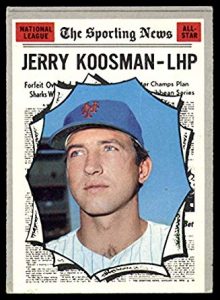 Jerry Koosman breaks through. I had been clued in recently that something might be stirring in this area, yet Kooz didn’t immediately jump to mind. Now that he’s there, I love that 36 is next. Best lefty pitcher the Mets ever had. Best postseason pitcher the Mets ever had. Long and meritorious service and then some across twelve seasons. For the past forty years, you looked at 36 on anybody else, from Wayne Twitchell to Mickey Callaway (now clad in 26), and you thought, “Koosman,” regardless of current occupant. He’s owned 36 since 1967. Might as well make it official that it belongs to no Met but him.
Jeff Wilpon (hold your applause) indicates a few more number retirements are on the table, that the Mets have some catching up to do where filling the left field rafters are concerned. I say good. Celebrate this franchise’s cream of the crop. We’re already proud when we’re not disgusted. A little reminder to peek up and remember our best helps the cause. Certainly doesn’t hurt.
Kiner’s mic. Shea’s name. Robinson’s American history. 37. 14. 41. 31. 36. A few more to come.
I can definitely see it.
by Jason Fry on 24 September 2019 10:40 am It’s the faces I’ll remember.
Steven Matz, hunkered down on the mound with his knees bent as Jorge Alfaro jogged around the bases, having authored a grand slam and a 6-0 Marlins lead. Matz’s face was a mask of horror and self-loathing, and for a moment I wondered if he’d be able to get back up.
Pete Alonso and Jeff McNeil, standing side by side in the infield at much the same moment, their faces cycling through shock and anger and determination and the rapid-fire realizations that a) at some point determination, however admirable a quality, isn’t enough; and b) that point had arrived.
Brad Brach sitting in the dugout after seeing an inning flip from “over and the Mets are only down 6-4” to “not over, the Mets are down 8-4, and I’m no longer pitching.” All of the Matz/Alonso/McNeil expressions were visible on his face, with maybe one more in the mix. Brach grew up an avid Mets fan, so perhaps this was his Joe Boyd moment. He got to wear his childhood colors, only to be wearing them at center stage during an oh-so-Metsian moment of reversal.
Yes, the Mets lost. And so did the Phillies, which pushes the Mets’ tragic number to a depressingly imminent 2. They’re not dead yet, but their collective head is on the block, the executioner has donned his hood and taken his money, and I’m afraid that whisper of air ruffling the little hairs on the back of the neck was from an ax — not coming down, true, but going up, which is generally preface to a disagreeable conclusion.
And of course it’s the Marlins holding the ax. Because baseball fandom means the pain of your spiritual forefathers will one day become yours.
Though, if we’re being honest, the real executioner of 2019 won’t have been the Marlins, or the Nats or the Brewers, but time. Monday night’s loss wasn’t a killer like the one against the Nats right after Labor Day or against the Dodgers two weekends ago. It was a merely frustrating one, like the one against the Reds on Saturday. Matz’s location was poor and an inning snowballed, Brach was a little slow getting off the mound on a quirky play, and the Mets had about a zillion chances to score runs but limited themselves to one swing of the bat by Amed Rosario.
And, I should add, the Marlins showed resilience and grit and character and all those attributes we tend to reserve for our own team, either praising them for being gallantly employed or lamenting that they were shamefully withheld. Alfaro went deep twice, Jon Berti was all over the bases and center field, and Harold Ramirez busted it to first to beat Brach by the slimmest of margins. Even good teams lose 20-odd games like that each and every year. In May or June, they’re the cause of grumbling. It’s only in the last week of September, when a team’s out of survivable mistakes, that they’re the stuff of tragedy.
But back to the faces.
During one of the weekend’s broadcasts, Howie Rose recalled how Willie Randolph had wound up sharing a cab with David Wright at the end of a season turned to dust, and urged Wright not to wash away what he was feeling, but to remember it — remember it and use it.
Or there’s the end of Davey Johnson‘s Bats, an as-told-to baseball book elevated to something more worthy by Johnson’s lifelong allergy to bullshit. There was a paperback edition of Bats, with a lengthy afterword about the 1986 championship season, but the hardcover edition didn’t have that. It ended with the 1985 Mets coming up just a little short, and Johnson telling Peter Golenbock what he thought and said after it was over.
Johnson thought about his last moments as a 1969 Oriole, when he’d accepted having been beaten by some band of upstart Mets and vowed his team wouldn’t be stopped in 1970. In 1985, now a Met himself, he told his charges that he wanted them to make up their minds that they’d win it all in 1986. And then Johnson retreated to his office and made the promise that ends the book: “Next year, by God, nothing is going to stop us.”
I’d like to think I saw some of that in the expressions worn by Matz, Alonso, McNeil and Brach. That they’ll remember this, and use it, and maybe make a vow or two. And that the paperback edition will be something special.
|
|






