The blog for Mets fans
who like to read
ABOUT US

Faith and Fear in Flushing made its debut on Feb. 16, 2005, the brainchild of two longtime friends and lifelong Met fans.
Greg Prince discovered the Mets when he was 6, during the magical summer of 1969. He is a Long Island-based writer, editor and communications consultant. Contact him here.
Jason Fry is a Brooklyn writer whose first memories include his mom leaping up and down cheering for Rusty Staub. Check out his other writing here.
Got something to say? Leave a comment, or email us at faithandfear@gmail.com. (Sorry, but we have no interest in ads, sponsored content or guest posts.)
Need our RSS feed? It's here.
Visit our Facebook page, or drop by the personal pages for Greg and Jason.
Or follow us on Twitter: Here's Greg, and here's Jason.
|
by Greg Prince on 24 September 2019 4:38 pm On the fiftieth anniversary of the clinching of the 1969 National League East, we learn the New York Mets are retiring No. 36 in honor of Jerry Koosman. My, it feels good to write that.
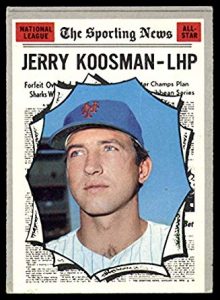 Jerry Koosman breaks through. I had been clued in recently that something might be stirring in this area, yet Kooz didn’t immediately jump to mind. Now that he’s there, I love that 36 is next. Best lefty pitcher the Mets ever had. Best postseason pitcher the Mets ever had. Long and meritorious service and then some across twelve seasons. For the past forty years, you looked at 36 on anybody else, from Wayne Twitchell to Mickey Callaway (now clad in 26), and you thought, “Koosman,” regardless of current occupant. He’s owned 36 since 1967. Might as well make it official that it belongs to no Met but him.
Jeff Wilpon (hold your applause) indicates a few more number retirements are on the table, that the Mets have some catching up to do where filling the left field rafters are concerned. I say good. Celebrate this franchise’s cream of the crop. We’re already proud when we’re not disgusted. A little reminder to peek up and remember our best helps the cause. Certainly doesn’t hurt.
Kiner’s mic. Shea’s name. Robinson’s American history. 37. 14. 41. 31. 36. A few more to come.
I can definitely see it.
by Jason Fry on 24 September 2019 10:40 am It’s the faces I’ll remember.
Steven Matz, hunkered down on the mound with his knees bent as Jorge Alfaro jogged around the bases, having authored a grand slam and a 6-0 Marlins lead. Matz’s face was a mask of horror and self-loathing, and for a moment I wondered if he’d be able to get back up.
Pete Alonso and Jeff McNeil, standing side by side in the infield at much the same moment, their faces cycling through shock and anger and determination and the rapid-fire realizations that a) at some point determination, however admirable a quality, isn’t enough; and b) that point had arrived.
Brad Brach sitting in the dugout after seeing an inning flip from “over and the Mets are only down 6-4” to “not over, the Mets are down 8-4, and I’m no longer pitching.” All of the Matz/Alonso/McNeil expressions were visible on his face, with maybe one more in the mix. Brach grew up an avid Mets fan, so perhaps this was his Joe Boyd moment. He got to wear his childhood colors, only to be wearing them at center stage during an oh-so-Metsian moment of reversal.
Yes, the Mets lost. And so did the Phillies, which pushes the Mets’ tragic number to a depressingly imminent 2. They’re not dead yet, but their collective head is on the block, the executioner has donned his hood and taken his money, and I’m afraid that whisper of air ruffling the little hairs on the back of the neck was from an ax — not coming down, true, but going up, which is generally preface to a disagreeable conclusion.
And of course it’s the Marlins holding the ax. Because baseball fandom means the pain of your spiritual forefathers will one day become yours.
Though, if we’re being honest, the real executioner of 2019 won’t have been the Marlins, or the Nats or the Brewers, but time. Monday night’s loss wasn’t a killer like the one against the Nats right after Labor Day or against the Dodgers two weekends ago. It was a merely frustrating one, like the one against the Reds on Saturday. Matz’s location was poor and an inning snowballed, Brach was a little slow getting off the mound on a quirky play, and the Mets had about a zillion chances to score runs but limited themselves to one swing of the bat by Amed Rosario.
And, I should add, the Marlins showed resilience and grit and character and all those attributes we tend to reserve for our own team, either praising them for being gallantly employed or lamenting that they were shamefully withheld. Alfaro went deep twice, Jon Berti was all over the bases and center field, and Harold Ramirez busted it to first to beat Brach by the slimmest of margins. Even good teams lose 20-odd games like that each and every year. In May or June, they’re the cause of grumbling. It’s only in the last week of September, when a team’s out of survivable mistakes, that they’re the stuff of tragedy.
But back to the faces.
During one of the weekend’s broadcasts, Howie Rose recalled how Willie Randolph had wound up sharing a cab with David Wright at the end of a season turned to dust, and urged Wright not to wash away what he was feeling, but to remember it — remember it and use it.
Or there’s the end of Davey Johnson‘s Bats, an as-told-to baseball book elevated to something more worthy by Johnson’s lifelong allergy to bullshit. There was a paperback edition of Bats, with a lengthy afterword about the 1986 championship season, but the hardcover edition didn’t have that. It ended with the 1985 Mets coming up just a little short, and Johnson telling Peter Golenbock what he thought and said after it was over.
Johnson thought about his last moments as a 1969 Oriole, when he’d accepted having been beaten by some band of upstart Mets and vowed his team wouldn’t be stopped in 1970. In 1985, now a Met himself, he told his charges that he wanted them to make up their minds that they’d win it all in 1986. And then Johnson retreated to his office and made the promise that ends the book: “Next year, by God, nothing is going to stop us.”
I’d like to think I saw some of that in the expressions worn by Matz, Alonso, McNeil and Brach. That they’ll remember this, and use it, and maybe make a vow or two. And that the paperback edition will be something special.
by Jason Fry on 23 September 2019 11:23 am The Mets kept their heartbeat faint but detectable by beating the Reds on Sunday afternoon — a game I started listening to on the Tripper Bus back from D.C. and that ended with me standing in my living room in Brooklyn. (First comment: “I know they’re throwbacks, but the Reds really need to retire those uniforms.”)
Your orange-and-blue heroes: Michael Conforto, who tagged Trevor Bauer for a first-inning three-run homer; J.D. Davis and Brandon Nimmo, whose solo shots shoved the Reds back in a way the Mets needed to do but couldn’t on Saturday; Marcus Stroman, who outlasted both the Cincinnati hitters and his own rebellious guts; and Brad Brach, who entered to retire Eugenio Suarez on a single very important pitch.
Speaking of nausea, the Cubs finished being dismantled by the Cardinals, the finale of a late-season sweep that leaves them just a half-game ahead of us and four behind the Nationals and Brewers, currently tied as wild-card leaders. That one will leave a mark in Chicago that will last quite a while. The Nats are stumbling around up there on the leaderboard, having lost to the Marlins, while the Brewers just keep winning, despite being without Christian Yelich. It helps that the Brewers got to play the Pirates, who decided to play a 140-game schedule this year. Pittsburgh has been roiled by clubhouse fisticuffs and revelations of vile behavior by players, and the Pirates’ braintrust will have to find a way to move on from the fact that, to put it bluntly, this year’s club quit.
Add up all that and you have an odd scenario in which the Mets are behind the Cubs, Brewers and Nationals but it really only feels like they’re chasing the Nats, since the Cubs are Icarus plunging towards the Aegean of the offseason and the Brewers don’t seem interested in ever losing another baseball game.
The Mets emerging from that scenario to play a 163rd game is unlikely, to put it mildly, but “unlikely, to put it mildly” is not the same as “impossible,” and the fan-emotion rollercoaster has looped back around to the point where the chase is fun again, which is what baseball ought to be and what Mets baseball too often hasn’t been in the final week of seasons.
I was struck by Conforto and Davis being front and center in the Mets’ Sunday win. Both have become favorites of mine — Conforto a few years back and Davis recently — but both are at least mildly confounding to assess as players.
Conforto has endured a lot as a New York Met, a soapbox I’ve climbed on before and a rant I’ll largely spare you this time. (Short version: The Mets did everything possible to wreck his development as a hitter and then repeatedly set him up to fail as a defender, only to wind up with a 3 WAR player despite themselves.) The only thing I’ll add is that Conforto has to be the unluckiest hitter in baseball — if you turn on Howie and Wayne just in time to hear them lament a ball that hung up or an enemy fielder’s tricky catch, odds are Conforto was at the plate.
After writing that I did some nervous Googling, waiting to discover that I’d succumbed yet again to confirmation bias. But no, Conforto’s BABIP this year really is a head-scratching .283, the lowest among Met regulars. (For the uninitiated, the average MLB batting average on balls in play hovers around .300 year to year.) Conforto attracts more than his share of Met fans somehow dissatisfied with 30+ homer/90+ RBI seasons; if he’d like to silence them, his best bet would be to figure out some ceremony that will propitiate the BABIP gods and make them torment someone else.
(I find BABIP one of the more interesting “advanced” stats for its value finding players whose current circumstances may owe a lot to luck, whether fair or foul. Looking at other Mets, the BABIP leaders are Jeff McNeil and Amed Rosario, both at .338; Wilson Ramos is at .315, and down there with Conforto you’ll find Pete Alonso at .284. McNeil had a starry BABIP last year too and Rosario is helped by his speed, but the Ramos and Alonso numbers are pretty interesting.)
As for Davis, we all know him as the adorable Solar Bear, Alonso’s goofy, endearing sidekick. (“WHADDYA GONNA THROW ‘IM? WHAT NOW?”) He’s also a guy without an obvious position, unless “boy can he hit” counts. Baseball Reference has J.D. at 0.8 WAR, which is shorthand for “this player needs to be kept out of your starting lineup.” That surprised me, as I would have thought Davis would net out as at least a useful piece. The statistical shortcoming is all defense — he’s worth a highly useful 2.8 WAR as an offensive player, but gives back most of that with the glove.
Defensive stats are still something of the wild west in baseball, with the formulas and methodology in motion. (Which is part of the process, and not a reason for anyone who wants to be taken seriously to dismiss them.) I’d love to know more about Davis at different positions and over time. But outfield defense is also where I put the least faith in the eye test — catches are made or not made based on instinct, footwork and first steps, which are the hardest things for a non-scout to assess and a broadcast to break down.
Barring a miracle (and hey, they’re not unknown in these parts), the 2019 Mets will be remembered as a team that came up just a little short of October baseball, undone by its bullpen and its defense. (Having a dunderheaded manager didn’t help.) The Mets need to improve defensively and have a glut of outfielders — of whom, unfortunately, only McNeil nets out as a positive contributor by defensive stats. Could the Mets improve by packaging Davis for help they need elsewhere?
That would make me sad — I want J.D. Davis to play 20 years, create a long playlist of goofy celebratory moments with Alonso, and retire as a Met with an on-field ceremony that ends with one of his squeaky-voiced calls to arms and Alonso sneaking up from behind him to tear off his jersey one last time. But then I always want that ending (or, OK, something like that but a lot less specific) for a player I’ve come to enjoy, and the construction of baseball teams is a job for the head, not the heart.
For now, the Solar Bear is here, hammering dingers and doing whatever he does in the outfield, and it’s a story I’ve found compelling and entertaining and thrilling and even heart-warming, and I’m going to enjoy the heck out of the last week of it.
And then, as always, we’ll see.
by Greg Prince on 22 September 2019 8:10 am With apologies to Elisabeth Kübler-Ross, who identified five distinct stages of grief, I have determined there are only two steps to a Mets fan’s mourning for a dying season:
1) Acceptance
2) Ah, fuck
Who needs five when you can do what we do, which is simply cycle between our two for several weeks? Following the conclusion of Saturday’s probably definitive killer loss to the Reds, I pinged back and forth, accepting that the loss indeed probably definitively ended our quest for a Wild Card berth and cursing out the way the defeat went down.
Ah, fuck. We shouldn’t have lost to the Reds, 3-2. Or 30-2. I suppose the score doesn’t matter, but when it’s that close…Ah, fuck. The Mets didn’t hit, but they had their chances. The Mets didn’t field, though Todd Frazier had his chances. Zack Wheeler, as seems to be his role, single-handedly stemmed the tide of looming gruesome inevitability, same as he did against the Dodgers last Sunday. The Reds aren’t nearly the team the Dodgers are, but like the score, the opponent doesn’t matter. All opponents come prepared to beat you when you’re straining to win something valuable. Except for the Pirates, whose new logo is a doormat that says “WELCOME TO MILLER PARK!”
Is bitterness a stage of grief? Or can I just file that under Ah, fuck?
Wheeler was Wheeler for seven innings, which feels good to say in a positive manner. I hope Wheeler will be Wheeler for us in 2020 and beyond, but that’s for winter. Summer hung in there on Zack’s shoulders for seven strong, his only blemished inning the first, and that was from Frazier making like a B-movie evil scientist who replaces the Clearasil in all the medicine cabinets in town with zit-inducing cream so every teen will show up for school on Monday too embarrassed to live.
I doubt Todd was that cunning in making first an error on a potential double play ball, and then what he called “a bonehead play” on a foul ball ruled fair, the bonehead aspect being his not throwing the ball to first for an out because, gosh, it looked foul to him. It looked foul to many, but not to third base umpire Mark Ripperger. Throw first, judge second, Todd. By reversing that order, Frazier enabled the initial Cincinnati run. A second followed on a soft single. The Reds led, 2-0.
Two runs shouldn’t have been insurmountable for the Mets, who merrily tallied eight the night before. They managed one on Wheeler’s groundout in the third and another from Brandon Nimmo conveniently placing his elbow pad in harm’s way with the bases loaded in the fifth, but no more off Cincy starter Anthony DeSclafini or any Red reliever. They didn’t have to “save some of that for tomorrow” on Friday. Somebody should have informed our offense that making more “of that” is permissible.
Zack threw 109 pitches to get through his seven innings, and as in his previous start versus L.A., Mickey Callaway relied on his compressed circle-of-trust to take care of whatever came next. Unfortunately, neither Justin Wilson nor Seth Lugo matched their dependable profiles. In the eighth, Wilson allowed a walk and a dying quail (which might make a good fill-in mascot on the upcoming homestand should Mr. Met require a mental health day). Lugo came in with two on and one out. He struck out one of the 2019 Cincinnati Reds, but then was done in by a 2015 Kansas City Royal masquerading as a 2019 Cincinnati Red.
I have to confess that for all the Metsiana I retain, Christian Colon’s role in ending our most recent attempt to capture a world championship never fully registered with me. Colon, little-used in KC, delivered the go-ahead hit for the Royals in the twelfth inning of Game Five four years ago. It was his only plate appearance of the entire Series. I fully comprehend this fact at last because Gary Cohen mentioned it in Colorado and dwelled on it in Cincinnati. I did vaguely recall the name and the hit, yet somehow my mind shuts out the potency of the details related to anything that happened after Lucas Duda threw a mile above Travis d’Arnaud’s head and Eric Hosmer scored from third in the ninth to tie Game Five, which was when I reluctantly approached Acceptance of our 2015 fate. Colon’s single for Kansas City breached the floodgates, driving in the first of five twelve-inning runs. By the time it got to the ultimate final of 7-2, they all looked alike to me and I was mentally incapable of sorting through the villains.
Ah, fuck.
Stealth bastard Colon, who flitted through Las Vegas as a Met farmhand in 2018, demonstrated he hasn’t lost his black magic touch, singling sharply up the middle to drive in what became the winning Red run on Saturday. The only solace I could find was in suddenly remembering Don Draper’s snippy retort to upstart copywriter Michael Ginsberg during a tense elevator ride on Mad Men.
GINSBERG: I feel bad for you.
DON: I don’t think about you at all.
For four years I hadn’t thought about Christian Colon at all. Now I don’t even have that going for me.
Postgame, Callaway’s usual unbothered veneer cracked. “This one hurts,” he said a lot. Wheeler pumped out clichés like they were four-seam fastballs: “crunch time”; “bear down”; “give it all ya got”; “put your head down”; and “keep grindin’”. Self-described bonehead Frazier explained he’d already calculated the Mets could afford to lose only one game in their final ten and defiantly declared, “Here’s the one, so let’s roll.”
In Milwaukee, the Pirates heeded his call and said, “Yes, let’s roll over.” Somebody’s gotta check their hearing and maybe their credentials, for they’ve ceased playing like major leaguers, again bowing to the Brewers, this time by nine runs. The score may not matter, but it did serve to illustrate how impossible catching Milwaukee will be. Not that it’s gonna be possible when the Mets experience one season-ending setback per series. You can only have so many of those. The camel rightly complained his back couldn’t take another on Saturday. No, losing this game wasn’t a very good idea.
At the risk of being impolite, it seems worth noting that the Mets’ middling record of the moment — 80-74 — isn’t truly the stuff of a title contender. Except for the eternal anomaly of 1973, no Mets team with this few wins at this late a stage of a season has ever nosed its way into the playoffs. Two Wild Cards have lowered the barrier to entry somewhat (we hosted in 2016 with an 87-75 mark), but really, 80-74 does not normally qualify a club for MLB’s heavyweight division.
Yet let’s not explicitly throw in the towel at 4½ back with 8 to play. Let’s burnish the 80-74, GB column be damned. Eighty wins is better than any non-postseason total we’ve accumulated in this decade. Faint praise, I know, but it amounts to a taller stack of Met victories than every year from 2010 to 2014 yielded, not to mention 2017 and ’18, and we really hate to mention those seasons. An 81st win guarantees we don’t root for a bleeping bunch of losers. An 82nd win allows us to spin a winning record, the twenty-sixth in our history should it come to pass. Getting to eight over .500 would be particularly pleasant because it would mean that after peaking at 67-60 once we swept the Cleveland series, we didn’t totally come apart at the seams. Mostly we’ve held together the seams, even climbing back to seven over .500 as of Friday night. A slate weighing in at 85-77 would literally reverse last year’s 77-85, making for fairly sweet symbolism.
Does any of this matter? Not much, but we each carve out our own path to Acceptance.
by Greg Prince on 21 September 2019 12:35 pm Oh, those beautiful round numbers coming out of the most roundly spelled state in the union, O-H-I-O…
10 wins for the preeminent pitcher in the league.
50 homers for the most prodigious slugger in the world.
80 wins for the team that still allows us to dream.
Three-and-a-half out of where we wanna be with nine to play. That’s less a round number than a big block of Wisconsin cheese in our way, but you can’t have everything. Isn’t it enough that we have Jacob deGrom, Pete Alonso and the continuously contending New York Mets?
Not really, but we’ll take what we can get ’round here. Especially when you consider how true this description of the Mets season, as published in the September 21 edition of the New York Times, rings:
The Mets now have only nine games left in a season that has seen them hurt, slumping, vilified and resurrected at various stages.
Thing is, that perspective on a Met season hanging in the balance at a very late hour in the schedule was written not after the 153rd game of 2019, but the 153rd game of 1973, which happened to have occurred on the same date forty-six years earlier.
That’s right, kindred history-minded spirits, September 20, 1973, which we immediately recognize as the “when” in the legendary Ball Off the Top of the Wall play, which some refer to as simply the Ball off the Wall, but that doesn’t do it justice, for it was the peak of the left field fence where Dave Augustine’s almost-certain two-run home run landed for a second split so finely that, before the clock struck :01 in the top of the thirteenth at Shea, that non-home run bounced up and into Cleon Jones’s glove.
Cleon wasted no time in relaying the ball to shortstop Wayne Garrett — not third baseman Wayne Garrett, nor shortstop Bud Harrelson (Buddy had been pinch-hit for) — and Garrett turned and fired said Wall Ball to catcher Ron Hodges (Jerry Grote had been pinch-hit for, too). Hodges used it to tag Richie Zisk, the runner/lumberer from first, out at the plate.
Seven. Six. Two. Not round numbers, but Amazin’ ones. The Ball Off the Top of the Wall play kept the Mets tied in that game, a game they would win, 4-3, when rookie Hodges singled home John Milner in the bottom of the inning. As the Times went on to report on September 21, 1973, in the wake of the 153rd game of that season, “[W]ith all their adventures, they will probably remember last night’s four-hour thriller as one of the soap operas of the year.”
We will, or certainly should, remember last night’s 8-1 thumping of the Reds in Cincinnati as one of this year’s most satisfying triumphs, considering it featured sizable contributions from our preeminent pitcher, deGrom; our prodigious slugger, Alonso; and the other among their teammates to have been dubbed an All-Star in 2019, versatile player of multiple talents Jeff McNeil. The trio traveled together to Ohio in July, Cleveland, and together they constituted the brightest lights in the Metropolitan galaxy. We’re in a different month, they are in a different section of the Buckeye State, and the Mets are in a far better place than they were at the break, but when these three come together do their best, it is inevitably a starry, starry night.
Start with deGrom. Always start with deGrom if you can. Finish with deGrom should the pitch count stars align. They never do, but wishing upon a star never goes out of style. When deGrom is pitching, you feel like you can have whatever Met eventuality you seek. For seven innings, we could have a shutout going that — despite the presence of a pretty prolific power source on the other side (Eugenio Suarez and his not so parenthetical 48 HRs) — you sensed could go on forever if need be. Consider that within deGrom’s Friday night 9-K universe, our ace induced strike three four times on a slider, three times on a four-seam fastball, and twice via changeup. Jake’s out pitch is basically whatever he feels like throwing.
His mound opponent, Luis Castillo, was no easy customer. The game stayed scoreless through five (another symptom of a deGrom start). It would be left to Met All-Star McNeil, whose face presumably appeared accurately on the Great American Ball Park scoreboard, to get the Mets off the schneid as effectively as Cleon got Augustine’s ball off the top of the Shea wall, blasting a Castillo changeup where no Red outfielder could hope to perform miracles with it. Jeff thrust us in front, 1-0, which isn’t enough for most pitchers, and not a fair margin to depend on deGrom to flawlessly defend, but it was better than 0-0.
Better still, in the seventh, with Castillo still throwing, Amed Rosario, a second-half All-Star candidate if such a thing existed, belted one of Luis’s sliders even further for even more runs, as J.D. Davis had walked just ahead of him. Now it was 3-0 and deGrom could more or less cruise along the banks of the Ohio. After the home seventh was complete, however, so was deGrom’s evening. Jake had thrown fewer than a hundred pitches, but he revealed later he wasn’t feeling all that great. Imagine deGrom against the Reds in the pink.
Before we had much chance to experience discomfort from deGrom not feeling his best — THERE ARE STILL SIX OUTS TO GET!!!!!! — Jacob’s fellow All-Stars made us feel all better. With one out and Castillo replaced by stylish Sal Romano, McNeil made an artistic choice to single to right. That brought up Alonso, and that brought the house down.
If you were listening to Howie Rose on the radio, here is what Gary Cohen said on SNY about what Alonso did to a Romano fastball:
“And Pete crashes one, deep right-center field, that’s headed toward the wall…it’s OUTTA HERE! NUMBER FIFTY — PETE ALONSO! Deep into the night! Only the second rookie in major league HISTORY to hit fifty home runs in a season! And Pete hit one outta SIGHT into the Ohio night.”
If you were listening to Gary Cohen on television, here is what Howie Rose said over WCBS about that very same swing:
“Two-two to Alonso. Fastball hit HIGH IN THE AIR! Deep to right center. Ervin goin’ back…ladies and gentlemen, the New York Mets have a FIFTY-HOME RUN HITTER! Pete ALONSO, the first player in franchise history to hit the magic FIFTY mark! He hit it into the stands in right-center field, NUMBER FIFTY, RBIs number one-hundred FOURTEEN and one-hundred FIFTEEN, the Mets have a FIVE-to-nothing lead, and Alonso is now just two home runs behind Aaron Judge’s rookie record of FIFTY-two! Congratulations PETE ALONSO on joining Major League Baseball’s hallowed FIFTY-home run club.”
Either way you heard it, it looked like it would never come down. It finally did, somewhere amid Great American’s kitschy riverboat backdrop, appropriate enough in that Pete has sailed away with every single-season Met home run record that used to seem impressive.
Geez, a Met has hit 50 home runs. Did you ever think such a total was possible from one of our guys?
Mets up 5-0 on Alonso’s big 5-0 was pure poetry, but with this bullpen, you don’t mind governing in prose. After a Mets trio less decorated than deGrom, McNeil and Alonso (Brach, Avilán and 2018 American League All-Star Edwin Diaz) wriggled us out of our bottom-of-the-eighth anxiety, the Mets tacked on three runs to make it 8-0, the kind of score we used to not so kiddingly refer to as Francoproof. Or Benitezproof. Or Looperproof. You get the idea.
I’m delighted to report 8-0 was Familiaproof, too, even if it did wind up 8-1. The important thing is we had the eight and picked up a game on the Cubs for second place in the very specific National League Second Wild Card standings. If only trailing Chicago by a game-and-a-half was the goal in all of this, then we could be digging deep for postseason fees right now. Instead, our 80-73 Mets are still looking up at the Brewers from a distance of three-and-half games. I’m less delighted to report the Brewers’ opponents, the Pittsburgh Pirates, remain in the league and will continue to play Milwaukee this weekend. A predilection for believing the Mets aren’t too far back to charge at the playoff spot the Brew Crew is currently strangleholding prevents me from explicitly adding the Pirates will probably continue to play dead as well. If you’ve seen the Buccos of late, you can draw your own conclusions.
Three-and-a-half out with nine to go is by no means statistically impossible, but I gotta tell ya that no Mets team in this particular circumstance has navigated waters this choppy and discovered dry October land. Your wonder-of-wonders, miracle-of-miracles 1969 Mets were on the verge of clinching the NL East after 153 games. Your Ball off the Top of the Wall, balls to the wall 1973 Mets had moved practically into port, edging to within a half-game of those scurvy Pirates. The 2016 Mets, who made a mini-’73 out of erasing a late-August deficit of 5½ games to win a Wild Card, were already tied at the top of their ad hoc division through Game 153 (an Asdrubally memorable affair you hopefully still recall three years after the fact). As for the handful of teams we cheered on who were still reasonably alive yet not exactly well at this stage of previous schedules…their omission from the roll call of inspirational Metropolitan September stories tends to speak for itself.
If you’re thinking of deriving precedent and taking heart from beloved 1999, me too, of course, yet those Mets were saving both their worst and best for the final week of the season. We were actually in OK playoff shape twenty years ago at this very interval, two up on Cincy for the Wild Card following our 153rd game, despite getting ignominiously swept out of Turner Field. And if you’re contemplating karmic compensation via a 2007 or 2008 in reverse, those races had already tightened up in the wrong direction prior to Game 153 (and, besides, who wants to take inspiration from the Chase Utley Phillies?).
So we’ll have to do something unprecedented in Mets history. We’ll have to turn being 3½ GB into no worse than tied over the course of approximately 81 innings. We’ll need good teams to suddenly go bad, and bad teams to suddenly get good, and teams with nothing to play for play like nothing, and, oh yeah, we’ll definitely need the Mets, in a season that has seen them hurt, slumping, vilified and resurrected repeatedly at various stages, to be pretty much infallible over the nine games they have left.
And if not, we still have deGrom, Alonso and a ballclub that has won more than it’s lost keeping us engaged clear down to the nub of a year we assumed was over repeatedly at various stages. Beats the hell out of the parts where we were hurt, slumping and vilified.
by Greg Prince on 20 September 2019 9:41 pm
by Greg Prince on 19 September 2019 1:45 pm To paraphrase a distinguished United States senator from her exchange with an overmatched opponent in a recent presidential debate, I don’t understand why anybody goes to all the trouble of rooting for the New York Mets just to talk about what they really can’t do and shouldn’t fight for.
The Mets are three games behind the Cubs and Brewers for the final Wild Card spot in the National League with ten games to play. Implicit in that equation is a difficult journey made tougher by how necessarily short the road ahead is. Ten games! The Mets were three games out of the playoffs with plenty more than ten games left!
But we didn’t get through 152 games of a 162-game season still alive only to rue that we’re not more alive. Alive is alive. Let’s have a plan for that. Let’s plan to stay alive.
Wednesday afternoon in Denver made that the plan, as the brink of nearly definitive extinction yet again proved overly distasteful to these Mets who can’t seem to process how dead they’re supposed to be. Generalissimo Francisco Franco is incapable of fathoming how these Mets still aren’t dead. The lot of us has written them off in coal-black ink nearly as often as Pete Alonso has launched tape-measure home runs. Yet Alonso keeps launching tape-measure home runs, the Mets keep discovering ways to win, and definitive death posthumously eludes the heretofore pronounced-deceased objects of our disturbed affection approximately twice a week.
Against the Rockies in the Mets’ series finale, Noah Syndergaard perhaps put too much faith in the powers of a personal catcher. Despite the residual simpatico Noah feels for René Rivera’s core skill set from their splendid 2016 together, the Syndergaard who faced Colorado wasn’t markedly better than the Syndergaard who faced Los Angeles five days earlier or the Syndergaard who took on Philadelphia five days before that, both times with Wilson Ramos behind the plate. Those previous starts loomed as dead-letter days in the history of the 2019 Mets, each of them among the myriad losses that buried us for good (with probably a couple more death blows in between).
This Syndergaard start — 5.2 IP, 10 H, 4 ER, 2 BB, 4 SB — was similarly grabbing the shovel from the garage and commencing to dig. When Noah exited in the sixth, the Mets trailed, 4-2, a margin that shouldn’t have felt like it required a hike up nearby Lookout Mountain, yet the Mets had numerous Golden opportunities to score taken away from them by impenetrable Rockie defense. The Blake Street Bombers of popular thin-air imagination had been transformed into a bunch of lowdown LoDo thieves, stealing bases from our battery and runs from our batters. Jeff Hoffman and his amazing, colossal earned run average completely outdoing the allegedly mighty Thor over five-and-a-third wasn’t helping matters.
My mind wandered in frustration to September 1990, particularly a pair of doubleheaders in which the Mets, with the National League East lead sitting and waiting to be taken by them, sat and watched it go in the other direction.
September 5, at Pittsburgh:
Bucs 1 Mets 0;
Bucs 3 Mets 1.
September 20, at Shea:
Expos 6 Mets 4;
Expos 2 Mets 0.
The respective pitching matchups:
Frank Viola vs. Zane Smith;
Bobby Ojeda vs. Neil Heaton;
Viola vs. Brian Barnes;
Sid Fernandez vs. Chris Nabholz.
Plus we had Darryl Strawberry.
You’d have to like our chances to win between one and four of the aforementioned games. We won none of them. Losing the pair to the Pirates was painful because that’s who we were dueling for first place, but bowing to Montreal was worse, because it was later and — though the visitors to Flushing were by no means easy pickin’s — we were “s’posed” to beat the ’Spos. We had Sweet Music and El Sid. They had Br!@n B@rnes and Chr!s N@bh#lz, if you catch my profane drift. On Wednesday, the Rockies had Jeff Hoffman, who entered the matinee with a 7.03 ERA and enough F’s in his name to make my point about the Mets not breaking through against him without me resorting to typographical tricks. Down 4-2 going to the eighth and seemingly going nowhere, I could have sworn it was effing September of 1990 all over again.
Then we got to the eighth and back to September of 2019, with one run scratched out so tenuously you wondered whether it worth the trouble of trudging to the medicine cabinet to find the tube of cortisone you were pretty sure was still in there from your last bout with hives. Alonso, who briefly raised hope and unfurled tape measures in the sixth with his 49th homer of the season (distance: somewhere on the outskirts of Boulder), led off with a single. Robinson Cano grounded to the pitcher, advancing Pete to second. Todd Frazier walked. A passed ball pushed Pete and Todd up a base apiece. Michael Conforto grounded out. The Polar Bear rumbled home to make it 4-3. The Mets were still…what’s that chronic condition of theirs again?
Oh yes, alive. The Mets were alive. And they stayed alive via the reassuring right arm of Six-Out Seth Lugo, who retired the Rockies in order in the eighth, following on the fine work of presumed missing person Brad Brach in the seventh and the post-Noah escape job engineered by Jeurys Familia in the sixth. The bullpen was keeping us in this game. How about that?
How about this? Wilson Ramos led off the ninth pinch-hitting for Rivera. There was a pretty juicy opportunity to pinch-hit for Rivera in the sixth, the inning when Alonso homered solo to cut the Rockies’ lead to 3-2 and the Mets proceeded to load the bases with two out. Mickey Callaway either showed extreme confidence in his veteran backup backstop or didn’t want to inflict upon Syndergaard the slightest discomfort by changing catchers on him midstream. Whatever the reasoning, Rivera — who doesn’t play very often and was decidedly in this game solely for his defense — hit for himself (in September, with ample alternatives on the bench). René grounded out to leave the Mets behind by a run.
That’s where the Mets were again, to start the ninth. It was later, but what they say about late’s advantages over never applied to the game just as it applies to this unfinished symphony of a season. Wilson worked out a walk versus Rockies reliever Jairo Diaz. Callaway, suddenly cognizant of his reserve depth, pinch-ran Juan Lagares for the Buffalo. J.D. Davis, the so-called Sun Bear himself, emerged from the double-switch that had catapulted him into the game in the eighth and singled. Polar or Solar, you gotta keep an eye on these ursine types.
You know who plays well with bears and other creatures of nature? Brandon Nimmo, a product of neighboring Wyoming. Wyoming is so close to Colorado that Alonso’s home run Tuesday night landed there Wednesday morning. Nimmo is so comfortable in Colorado that he singled home Lagares with little fuss to tie the game at four. And let’s not forget the Bears’ furry friend the Squirrel. Jeff McNeil nibbled at nine pitches before scurrying to first on a walk of his own, thereby placing Brandon on second and J.D. on third.
Say, the bases were loaded. That led the Mets into a brick wall in the sixth, but this was the ninth, nobody was out and maybe it was the presence of the Solar Bear, but somehow things seemed to have brightened immensely since the innings when I was stuck stewing over losing two frigging games to a team that no longer exists twenty-nine years ago. Alonso was up next, facing Joe Harvey. (A pitcher named Diaz, a pitcher named Harvey…were the Rockies trying to troll us, or what?) The narrative-driven fan would have thought this was an ideal moment for the Polar Bear’s 50th home run, a notion most grand, but the reality-based fan just thought, “get a run home somehow.”
And Pete did. He walked on four pitches, bringing Davis home from third to forge a 5-4 lead. The Mets’ aliveness was as tangible as it had been since Saturday night. All Cano had to do next was not hit into a triple play, and we could continue not being dead. Robbie came through…sort of, bounding a ball up the middle that tried very hard to be something better than a double play. Alas, it was exactly that, but that was way better than a triple play, for even as Cano’s grounder bounced off one Rockie to another to effect one out, and that second Rockie threw the ball high above first, but not Rocky Mountain High enough to facilitate avoidance of a DP (nice hustle, Cano), Nimmo whooshed across the plate with the Mets’ sixth run.
Robinson may have inadvertently performed a public service by not beating out the double play, because had Mickey eyeballed a multitude of Metsies on the basepaths, he probably would have pinch-hit for Lugo. And honestly, what kind of idiot would do that with three outs to secure in the bottom of the ninth? Mickey, nobody’s fool too often in the course of a must-have game, let Seth bat for himself. It didn’t weigh too heavily on the course of events what our irreplaceable reliever might do in his first plate appearance of 2019, but it certainly crossed my mind that one fine evening in 2017, Seth Lugo hit a home run.
Seth Lugo did not hit a home run at Coors Field on Wednesday afternoon, but he did line a very useful single into center field, scoring McNeil from first to increase the Mets’ lead to 7-4 and sprinkling the daily recommended amount of magic over this entire enterprise to make it feel as if destiny was not about to depart Denver without the Mets aboard its bus.
C’mon, we need a little narrative in our life. We also needed three outs to have life. We had Seth Lugo and a three-run lead, so confidence wasn’t the problem it usually is. Six-Out Seth surrendered a single, but otherwise emerged unscathed from all his hitting and pitching. The only thing SOS couldn’t do for us was ensure that the Brewers would lose to the Padres and the Reds would best the Cubs come nighttime. If those events came to pass, then instead of being delusional about a Mets club four behind one or two competitors with ten to play, we could be slightly less delusional because — look out, mountains! — we’re climbing to three behind two teams with ten to play.
The Padres beat the Brewers. The Cubs lost to the Reds. We’re three out with ten to play. It’s good to be alive.
by Jason Fry on 18 September 2019 2:04 am While watching Tuesday night’s game against the Rockies, I thought of a good idea and immediately decided I wanted nothing to do with it for a while.
The idea came from the shame bell in Game of Thrones, which you may know as an Internet meme even if you’re not familiar with the show. I was wondering how many games the 2019 Mets lost through terrible bullpenning, horrid defense or managerial dipshittery (shame shame shame for them all), and if listing those games might a) be cathartic; and b) show how close the Mets came to a postseason berth, and where improvements might be most profitably made in pursuit of not missing one next season. Now, a disappointed fan’s hindsight is a lot sharper than 20/20 — confirmation bias and bemoaned what-ifs make for powerful lenses — but I’m pretty sure the shame bell would toll a lot more times than the number of games separating the Mets from the wild-card teams.
And yet, I quickly decided to put this gloomy project aside. Because the Mets were playing the Rockies and I wanted to enjoy the game, even if it was highly unlikely that its outcome mattered the way the outcome of games mattered only last week.
And the Mets gave me a lot to enjoy — not just for 2019, but possibly for 2020.
There was Marcus Stroman riding an improved cutter — with which he’s apparently been tinkering — and a sharp slider to seven scoreless innings of four-hit ball, which would be impressive even if it hadn’t happened at Coors Field. I would have considered Stroman an upgrade over Jason Vargas no matter what he did, because I detested Vargas as both a pitcher and a person, but Stroman has proved easy to root for, demonstrative and energetic whether finishing pitches, hustling to cover first, or just cheering his teammates on from the dugout.
There was Amed Rosario breaking up an unlikely scoreless pitchers’ duel with a tomahawked home run in the sixth. Rosario has evolved from an unsteady fielder with an oversized strike zone to an adequate shortstop with much better judgment at the plate, raising his average from .255 at the close of June to .289 now and committing just four errors during that span, compared with 12 earlier in the year. It’s tantalizing to imagine what his 2020 might look like if he can be the player we’ve now seen for two and a half months.
It’s also tantalizing to imagine 2020 with a full measure of Brandon Nimmo, who also went deep in the sixth. Nimmo has had a very strange season. It’s easy to forget that he looked hopeless before running into a fence, starting off with bushels of strikeouts, then making a valiant but ill-advised attempt to play through his neck injury. When he returned in September it was somehow as if his weird April had never happened. Almost from the jump, Nimmo was back to providing the mix of power and plate discipline he’d shown a year earlier. Being able to count on a full season from Nimmo would also make one of the Mets’ offensively potent but defensively challenged outfielders an interesting trade commodity, but that’s another thought and post to consider later.
And, of course, there’s Pete Alonso. The Polar Bear awoke from his home-run slumber to club a ball 467 feet into the Denver night, his 48th of the season. The club RBI mark is probably out of reach, but 50 homers is not, and “I’m disappointed Alonso won’t also break the single-season RBI record as a rookie” is a complaint deserving a truly microscopic violin as accompaniment. Even Alonso’s overly enthusiastic moments make me like him more — for the last play of the game, he fell on a ball that was headed for Robinson Cano, turning a play of average difficulty into a more complicated one. (Luis Avilan‘s expression at finding himself involved in the resulting play at the first-base bag was entertaining.) But asking Alonso to forbear in such situations would be like asking your golden retriever not to wag its tail when you come home — sure, you might mourn the occasional thing swept off the coffee table to its demise, but is a broken tchotchke or two really too high a price for a little joy in your life?
Those three homers in the sixth proved more than enough for the Mets, as Justin Wilson navigated the eighth and Avilan completed the ninth, with a Charlie Blackmon moon shot the only blemish in the box score. The Mets even made up ground on the Cubs. It’s almost certainly too late for that to matter, but an evening watching your team win a baseball is always an evening well spent. Too soon — all too soon — we’ll have to get our baseball joy from the heroics of other teams and the attendant, highly temporary loyalties of October. And too soon after that, there will be no baseball joy at all. What we bank now will have to sustain us, until spring comes around again and hope blooms anew.
by Jason Fry on 17 September 2019 12:23 pm The ample lady of renown may not be singing quite yet, but I heard another singer last night. Not exactly a matinee idol, this one — he had a puffy face, jet-black hair, and big black-rimmed Coke-bottle glasses. But his voice was a rich burr that rose to an unearthly falsetto.
It’s over, it’s over, it’s OHHHHHHHHH-VERRRRRRRRRRRRRR…
There’s a fascinating race afoot in the National League, one that’s now expanded to include both wild-card spots and the N.L. Central title. But the Mets are no longer part of it in any meaningful way. When you’re five back with 12 to play, you’re not on the stage, but in the audience.
And I could feel that from the get-go Monday night. Brandon Nimmo led off the game with a home run and a joyful romp around the bases — I imagined his monologue being something like, “Gosh, the ball went all the way over that the fence! And now I get to run! Neat! And see all my base friends! HELLO, FIRST BASE, GLAD TO SEE YOU! HOWDY, SECOND BASE! HI HI HI, THIRD BASE! GEE WILLIKERS THIS IS FUN! OH, HOME PLATE, YOU’RE MY BEST FRIEND TOO! YAY!” That was a good start, but trouble awaited Steven Matz in the fourth. Given a 4-1 lead, Matz lost the plate and then threw a high sinker to opposing pitcher Antonio Senzatela, who was 0-for-2019 and whose lack of hitting prowess had been marveled at on the broadcast. Anything with a wrinkle would have probably been a swing and a miss for strike three, but Matz threw a fastball and Senzatela bashed it into left-center to tie the game. The next batter was Trevor Story, who turned on an inside sinker and hit it over the fence.
Matz was self-lacerating after the game, lamenting “a stupid pitch” made to Senzatela. For me, the moment had an added helping of surreal — I was watching on the Spectrum app, which kept switching over to the Spanish-language feed for no apparent reason. That was fine with me — if it meant the Mets winning, I would have happily listened to commentary in Esperanto, click language or whale song — except Matz wasn’t any good in any available language. He lost focus, made poor decisions, and the game went down the tubes.
If that sounds like a quick dismissal of a game with postseason implications, well, that’s the point. It didn’t feel like it had any, a realization that arrived accompanied by a hollow feeling in my stomach that I couldn’t will away. This was just a typical Coors Field farce — early lead, mid-innings land mine, slog to the end — similar to a couple of dozen others that I’ve endured. The Mets’ death struggle with the Dodgers on Sunday night felt like the conclusion of something glorious and thrilling for all it turned out to be futile. This was just another game.
Just another game, but one that delivered a bit of goofball solace in the late innings.
In the bottom of the eighth, J.D. Davis took an extra-base hit away from Story with a nifty running catch, then slammed into the fence, with the point of contact the same area where he took a fastball to the ribs from ludicrous-looking Dodger reliever Dustin May on Sunday night. Davis held onto the ball but crumpled onto his back on the warning track, with Nimmo calling for the trainers.
Thankfully, it was determined that Davis had merely knocked the wind out of himself. (Though let’s verify that — given that it’s the Mets, it’s entirely possible he actually has two ribs piercing internal organs.) One of the Mets who came out to investigate was Pete Alonso, whose normal area of responsibility lies hundreds of feet away.
Davis, despite the whole needing-to-breathe thing, managed to ask Alonso what, exactly, he was doing out there.
“Gotta check on the Sun Bear,” replied Alonso.
So yes, Alonso has dubbed Davis the Sun Bear, a revelation Davis looked faintly embarrassed about during his postgame interview. It was a chuckle I needed, and more evidence that those two need their own buddy movie. One of my favorite moments of the season was when the cameras (and mics) caught Davis, post Alonso homer, yelling out a mocking question for the Cubs: “Whaddya gonna throw ‘im? WHAT NOW?” Now, Davis has revealed a lot of talents in 2019, and become one of my favorite Mets. But despite his best efforts, his HWAR — that’s Heckling WAR, for the non-analytically inclined — remains below replacement level. This isn’t his fault: Some people have voices pitched to travel, but Davis’s is somewhere between “chirpy” and “pinched,” best suited for a cartoon sidekick.
And you know what? That works. In fact, it’s perfect. Catch Bear Patrol: Polar and Sun, coming to Disney+ this fall! In a few weeks, memories like that will make me smile, when the disappointment of a season that ended with an “almost” has receded.
by Greg Prince on 16 September 2019 1:08 pm The knots were back Sunday night. Troops of Boy Scouts, fleets of fishermen and stomachs belonging to Mets fans watching their team in the playoffs — these are the entities that know knots well. Except the Mets weren’t in the playoffs on Sunday night. It was the middle of September. Too soon for playoffs, but not too soon for a playoff atmosphere among the acids, which the truly initiated understand is where the real playoff atmosphere gurgles. Never mind the folderol about bright lights and cheering crowds. Your gut tells you when it’s go time.
If the series finale versus the Dodgers at Citi Field didn’t technically represent a play-in game, it felt like something more than a standard rubber match. Even at a juncture of the schedule when every outcome is important, this one loomed as crucial with a capital CRU. Mathematical elimination wasn’t at stake. Mathematical viability was.
Plus, the game aired on ESPN, which is capital CRUEL usually, but lent to the feeling that this was a dress rehearsal for October, when national telecasts take over and the volume on the television heads south. Howie Rose and Wayne Randazzo were thrust into a starring role for the evening, talking about a dozen seconds ahead of the network announcers, which was fitting, since I’m certain Howie and Wayne are far faster on the draw when it comes to the Mets than anybody parachuting into our storyline for a few hours.
Brandon Nimmo did his best to ease the knotty nature of the night with a two-run triple in the second off Walker Buehler, no small task. Nimmo, we were reminded on Saturday, knows how to attract a pitch to his person. Good to see he hasn’t forgotten how to make contact with a ball via his bat.
Unfortunately, that was it for Met scoring. The lead was 2-0, which was halved in the fourth inning to 2-1, after which it stayed 2-1 seemingly forever, though deep in my gut, I knew forever was incapable of lasting without the lead lengthening. Game Five of the 2015 World Series was like that. I probably didn’t have to say the “2015” part, because it’s the only Game Five of a World Series (or a World Series at all) we’ve known from lately. Matt Harvey went eight before Terry Collins decided to take him out with the Mets ahead, 2-0, then decided to keep him in. I probably didn’t have to spell that part out, either. We’re good at remembering the parts we wish we hadn’t learned to begin with.
The prime inflection point of Matt Harvey’s career is neither here nor there in 2019, except it segues into Zack Wheeler and the game I think we’d all been waiting for him to pitch since July 28, 2011, when most of us heard of him for the first time. We were giving up Carlos Beltran, in the waning weeks of his Met contract, for a single-A pitcher in the Giants system. Carlos loomed as catnip for a contender. What we got back needed to be golden. Just wait, we were told. Wheeler’s a get.
So we waited. We waited two years for Wheeler’s major league debut, which was fine. We waited through two seasons of Wheeler’s further development, which was promising enough if not incredibly tantalizing. We waited through two years of injury and rehabilitation, which was unfortunate, but the way these things go sometimes. We waited through a choppy comeback year curtailed by another physical setback, which was frustrating. We waited until the latter half of yet another year to see, once and for all, the Zack Wheeler for whom the Mets traded a likely future Hall of Famer. That was uplifting in a downbeat kind of year, which meant Zack’s excellent last three months of 2018 got us and him only so far.
On September 15, 2019, the Zack Wheeler we heard about and imagined on July 28, 2011, arrived in full at Citi Field. Not that he hadn’t pitched wonderfully before, but he’d never had a stage like this before. The Wheeler who dominated in the shadow of Jacob deGrom in the second half of 2018 was doing his thing in a vacuum. It mattered that he pitch well, but it wasn’t CRUcial. The Wheeler who was a little up and down the way the 2019 Mets were for months could operate below the radar. On Sunday night, however, we had a game that had to be pitched beautifully against an intimidating opponent that had to be tamed in a circumstance where the fate of the season potentially rode on every last detail.
A pitcher suited to this moment was the bounty said to be worthy of Beltran eight years ago. A pitcher suited to this moment was who we got. We know that now. If nothing else is left for us from 2019 when the regular season is history two weeks hence, we have Zack Wheeler who stymied the Western Division champion Dodgers for seven innings, sometimes getting in trouble, every time getting out of it in front, keeping that game 2-1 forever for as long as he could.
All that talk about all the aces the Mets had brought through their system always rang a little hollow when it got to Wheeler. Zack was an ace in theory, on paper. Injuries were part of the explanation for why it never felt totally tangible. Context was, too. Either you’re so good you can’t be ignored regardless of how your team is going or you step up and carry your team where it needs to go. For seven innings, against the toughest opponent the league offers with as much on the line as there can be in the middle of September, Zack Wheeler was definitely who you trade a future Hall of Famer to get.
Those were seven extraordinary innings. One run; six hits; no walks; five Dodgers stranded on base; nine strikeouts; a lead held that had to be held; and, as with Wheeler’s old teammate Harvey on another Sunday night on another national telecast, the question of whether he had another inning in him.
To Harvey’s manager nearly four years ago, the answer was no, yes, no, yes, oh go ahead. To Wheeler’s manager, there didn’t seem to be much question. Wheeler was done after seven if you watched the dugout with the TV sound off as I did. I didn’t expect any different, honestly. The seventh was what they nowadays call a stressful inning. Corey Seager led off with a single. With one out, Gavin Lux singled Seager to second. An ace calls on something extra and ends an inning like that with the score unchanged. Wheeler struck out Kiké Hernandez and Matt Beaty, the last strike to Beaty his 97th pitch. The stuff of aces, to be sure.
“Zack’s done,” I thought. If this were some game in some year prior to Wheeler’s debut in 2013, or his birth in 1990, I wouldn’t have thought that. But in 2019, certain innings are defined as stressful and all pitches are counted. I’m not saying I wouldn’t have suggested leaving him in had Mickey Callaway for some strange reason asked me. I’m saying I had little expectation he’d be left in. That is just not done these days. Teams build bullpens on the foundation of a core belief that starting pitchers can’t be pushed beyond so many total pitches and so many stressful innings.
Well, teams try to build such bullpens. The Mets tried. I swear they did. What they wound up with instead was a coupla guys. The coupla guys, Justin Wilson and Seth Lugo, have held the bullpen together essentially by themselves for weeks, most recently the night before. On Saturday, it was deGrom for seven, Lugo for one, Wilson for one. It worked perfectly. Now Callaway would ask it — them — to work perfectly again on no nights’ rest.
It didn’t work. The Dodgers reached Wilson for a run in the eighth to tie the game and Lugo for a run in the ninth to take the lead. The go-ahead hit, a Jedd Gyorko ground ball up the middle, appeared uncannily like balls hit substantially farther by men whose names still summer in our subconscious. Pendleton. Scioscia. Molina. Hosmer. None of the balls those fellows hit ended Mets games, seasons or postseasons. The one Eric Hosmer lined to left for a double to drive in Lorenzo Cain didn’t even tie its game, which was the one Harvey was pitching in the ninth, but in each instance, I could feel my knots giving up a little, as if they wondered if maybe getting a step on traffic wouldn’t be the worst the idea in the world. In every case, my stomach and the rest of me hung in there to the bitter end. But in every case the end was bitter.
Sunday night, the end gave us Dodgers 3 Mets 2, the Mets never scoring after the second, thus slipping back to four behind the Cubs and three behind the Brewers with thirteen games to go. The Mets finished the previous weekend four out of that second Wild Card spot we didn’t spend a serious instant thinking about until late July yet have aspired to ceaselessly ever since, because these Mets raised our sights. Another week went by, encompassing a 5-2 stretch that included a muscular four-game sweep of Arizona and a thriller of a win over Los Angeles, and we’re still four out. The distance hasn’t changed, yet the calendar has turned relentless.
All the Mets can do, starting tonight in Colorado, is win a lot. All we as Mets fans can do is hope a lot that they do, and that the Cubs, the Brewers and anybody else who may present an obstacle to our happiness don’t. Should this brilliant strategy of mine not produce the desired effect, at least we had one night that felt like a playoff game. All the tension. All the anxiety. All the knots.
It’s hard to believe this is what we root for, but it is.
|
|






