The blog for Mets fans
who like to read
ABOUT US

Faith and Fear in Flushing made its debut on Feb. 16, 2005, the brainchild of two longtime friends and lifelong Met fans.
Greg Prince discovered the Mets when he was 6, during the magical summer of 1969. He is a Long Island-based writer, editor and communications consultant. Contact him here.
Jason Fry is a Brooklyn writer whose first memories include his mom leaping up and down cheering for Rusty Staub. Check out his other writing here.
Got something to say? Leave a comment, or email us at faithandfear@gmail.com. (Sorry, but we have no interest in ads, sponsored content or guest posts.)
Need our RSS feed? It's here.
Visit our Facebook page, or drop by the personal pages for Greg and Jason.
Or follow us on Twitter: Here's Greg, and here's Jason.
|
by Greg Prince on 7 March 2019 5:41 pm Tom Seaver is no longer a public figure. Lyme disease and its long-term effects have assured we won’t see him when the living members of the 1969 Mets gather at Citi Field in late June to commemorate the 50th anniversary of a world championship that Seaver never viewed as a miracle. Tom had a point, as there could be nothing miraculous about a team led by Tom Seaver proving itself the best on the planet.
When word spread on Thursday afternoon that one of the greatest pitchers ever and the greatest Met there will ever be has been diagnosed with dementia and has thus “chosen to completely retire from public life,” it was simultaneously a shock to the system and not exactly surprising. We’ve read and heard about Tom dealing with Lyme disease for ages and had more than an inkling that it was taking an inevitable toll on someone who rarely gave into anything or anybody during that extended period when so many of us chose him as our idol. Seaver had already stopped traveling across the country to attend Hall of Fame induction weekend, an event he never seemed to miss in the first couple of decades after he himself was honored. I’d noticed that when the Mets put out statements and releases celebrating Jacob deGrom’s Cy Young last November, there was no boilerplate quote from the Met who’d won three of them. The media guide stopped listing him as a Club Ambassador in 2018. I can’t recall him having been present in Flushing since the 2013 All-Star Game, when he threw out the ceremonial first pitch to David Wright. Quietly, Tom slipped from view.
Except when you thought about the Mets. There he was and is and forever will be — No. 41, on the mound, pitcher-perfect motion, striking out any of 2,541 batters between 1967 and 1977 and then again in 1983 who dared thought of connecting with his fastball. Yes, there’s a 41 at the end of that figure, just as there’s a 41 at the top of any list of anybody who’s ever played for the Mets. He’s been the greatest of Mets since his debut in 1967, he’ll be the greatest of Mets come 2067. We’re open to auditions between now and then, but we don’t seriously expect anybody to supplant Tom Seaver atop our chart.
Tom’s family says he’ll continue to work in his California vineyard. In that spirit, if you’re so inclined, raise a glass to Tom Terrific and those who will care for him as he goes on. Think of him at his best. There’s a ton to think about there.
by Greg Prince on 25 February 2019 2:30 am The Oscars were handed out Sunday night. Thus, per Monday morning-after tradition, the Academy pauses to remember those Mets who have, in the baseball sense, left us in the past year.
Cue the montage…
___
GEORGE CHARLES “Buddy” BAUMANN IV
Relief Pitcher
May 16, 2018 – June 2, 2018
Baumann looked good in his first inning of work but terrible in his second, establishing beyond a shadow of a doubt that he’s suited to be a member of this ridiculous, ramshackle franchise.
—May 17, 2018
(Free agent, 11/2/2018; currently unsigned)
___
KEVIN MICHAEL McGOWAN
Relief Pitcher
August 22, 2017 – October 1, 2017
Out came Terry. On the scoreboard, his expression was in plain view: he looked not so much like a deer in the headlights, as a deer uncertain what headlights are, but vaguely aware that they’re nothing good. As Terry waited for Kevin McGowan, I thought about the situation. Here was Terry Collins, in the last game of his Mets managerial career, standing on the mound in the middle of an inning that had gone to hell, making a pitching change four batters too late. And as I took this incredibly representative situation in, I couldn’t help but smile again.
—October 2, 2017
(Released, 9/25/2018; signed with Sugar Land Skeeters, 3/19/2019)
___
SCOTT REAST COPELAND
Relief Pitcher
May 31, 2018
Scott Copeland — with Tim Peterson one half of the Who? Brothers Show Band and Revue — acquitted himself nicely from out of nowhere and that can surely be interpreted as inspirational.
—June 1, 2018
(Free agent, 10/1/2018; signed with Nationals, 12/30/2018)
___
CHRISTOPHER MICHAEL “Chris” BECK
Relief Pitcher
June 15, 2018 – July 8, 2018
Where were we? Oh yeah, losing. Losing 3-2 after four, losing 5-2 after five (Daniel Descalso doing the longball honors), losing 6-2 after Jon Jay drove in pesky Dyson, who had walked, stolen second and stolen third off the inspiring duo of Plawecki and Chris Beck, the latest Mets pitcher you’d never heard of until basically just now.
—June 16, 2018
(Free agent, 10/1/2018; signed with Cardinals, 11/29/2018)
___
GERSON BAUTISTA
Relief Pitcher
April 17, 2018 – June 2, 2018
As Rose Marie advised, wait for your laugh. It’s coming. It will take a while if you’re a Mets fan. Perhaps the tale of the team whose first six pitchers struck out 24 batters in thirteen innings before its final two gave up six runs in the fourteenth will come off as amusing in a future context. Not hilarious at this juncture, however. Buddy Baumann didn’t strike out any Cubs. Nor did Gerson Bautista. Outs of any sort were elusive for that duo until the barn door was detached from its hinges.
—June 3, 2018
(Traded to Mariners, 12/3/2018)
___
JAMES DOUGLAS “Jamie” CALLAHAN
Relief Pitcher
September 2, 2017 – October 1, 2017
[Ron] Ziegler would have loved flacking for the Mets relief corps, as inoperative a unit as you’ll stumble across on a September evening this sad season. Hansel pointed the Mets toward a loss; Chasen Bradford confirmed the direction the game was going in; and the rest of the poor little lambs who’ve yet to find their way waved home wave after wave of Cub after Cub. By the time Kevin McGowan, Jacob Rhame and Jamie Callahan had clocked some of that all-important valuable experience, the Mets were down, 17-5.
—September 14, 2017
(Free agent, 11/3/2018; signed with Giants, 12/28/2018)
___
PHILLIP MATTHEW “Phil” EVANS
Infielder
September 8, 2017 – August 1, 2018
It doesn’t get more athletic in the middle of the infield than Reyes at second and Amed Rosario at short. And it doesn’t look less athletic at the corners than Smith at first and Phil Evans at third. They are athletes, they are skilled, they have futures at the highest level of professional baseball…but it is striking how they each — as rookies — appear to have wandered over from a keg-intensive softball game in Flushing Meadows Corona Park. On the other hand, the limber and lithe Rosario seems to display a little less savvy every diamond day. Let’s give everybody a clean slate come spring. This season hasn’t honed anybody to a fine edge, physically or mentally.
—September 25, 2017
(Free agent, 11/2/2018; signed with Cubs, 12/17/2018)
___
MATTHEW G. “Matt” den DEKKER
Outfielder
August 29, 2013 – September 28, 2014
July 11, 2018 – July 26, 2018
We learned “den Dekker” is Dutch for “not Lagares”. This is linguistic clarification gleaned after the Mets center fielder of the moment lost three fourth-inning fly balls in translation. Mets fans with memories longer than a Yankee Stadium short porch home run will recall Matt den Dekker was originally cast as the can’t miss defensive whiz in the attempted 2013 reboot of the Mets as a competitive baseball entity. Turned out den Dekker did miss — loads of time, due to the injury which opened the gates for Lagares to take his projected Gold Glove role — and could miss, specifically a trio of not easy yet not impossible chances hit in his general direction Saturday. They went for a triple, a double and a single, but when measured by cringe factor, the first was a boot and the next two were reboots. Given that Matt is 0-for-17 since his surprise recall from obscurity, one wonders what his particular major league acumen is at present.
—July 22, 2018
(Free agent, 10/1/2018; signed with Long Island Ducks, 3/26/2019)
___
JOSE MANUEL LOBATON
Catcher
April 13, 2018 – September 28, 2018
Jose Lobaton, presumably aboard an eastbound flight from Vegas, you’ll recall from killing the Mets as a National. Now he gets a chance to make it up to us.
—April 13, 2018
(Free agent, 10/29/2018; signed with Mariners, 1/24/2019)
___
ROBERT MARTIN “Bobby” WAHL
Relief Pitcher
August 2, 2018 – August 16, 2018
There was a plethora of contributors. One of them was Bobby Wahl, another very recently introduced name (called up August 2) growing suddenly into a person we recognize as our guy. Wahl replaced Noah Syndergaard with the bases loaded and one out, Joey Votto up to bat. The Mets were ahead by five, so maybe the leverage didn’t soar as high as McNeil’s homer, but it was a tall enough order for a reliever with minimal cachet. Wahl walked Votto, which should probably count as a rite of National League initiation, but then struck out another All-Star, Scooter Gennett, before giving way to Robert Gsellman and, ultimately, closer du nuit Jerry Blevins.
—August 7, 2018
(Traded to Brewers, 1/5/2019)
___
JOHN PATRICK “Jack” REINHEIMER
Utilityman
August 15, 2018 – September 29, 2018
Oh, and Jack Reinheimer collected his first major league base hit. That’s more of a Jack Reinheimer highlight, but he’s entitled to one for himself, just like we were entitled to a night of swimming in Mets-related jubilation. The pool has been empty all summer. What fun to find it filled.
—August 16, 2018
(Selected off waivers by Cubs, 11/2/2018)
___
AUSTIN JARRIEL JACKSON
Outfielder
July 27, 2018 – September 30, 2018
Austin Jackson’s .350 as a Met has been fashioned in a similarly brief span. Unlike McNeil, who excelled at Binghamton and Las Vegas after an otherwise off-radar minor league run, no Mets fan was rattling cages to get Jackson on our roster. Jackson’s been on most everybody else’s roster since 2010. We usually get a turn at guys like that, generally when we’re desperate for help and they could use an opportunity.
—August 5, 2018
(Free agent, 10/29/2018; currently unsigned)
___
ANTHONY RAY SWARZAK
Relief Pitcher
March 29, 2018 – September 29, 2018
Then, suddenly, Anthony Swarzak got up and, almost just as suddenly, Anthony Swarzak was in the game. Nobody fast-forwarded to skip over the boring warming process. They got him in there just before it was too late. A couple of instants later, it was too late. The stilted two-pitcher process that permitted four Pittsburgh runs required 25 pitches in all. The eventual result approached our rainy shoreline with the relentlessness of Superstorm Sandy. You could see it in the forecast. You knew it was coming. You braced for the worst. There went the trees.
—June 28, 2018
(Traded to Mariners, 12/3/2018)
___
TYLER PATRICK “Ty” KELLY
Utilityman
May 24, 2016 – April 5, 2017
July 9, 2018 – July 23, 2018
In a sense, Mets at Pirates was an understudy’s gala, with the unlikely character of the rookie third baseman, played by little-known Ty Kelly, rescuing the first act with a display of power clearly at odds with the script’s prevailing narrative arc. There was no hint that Mr. Kelly — whose name was familiar only to those whose Playbills were properly supplemented with squares of white paper alerting the audience to his existence — had such a forceful outburst in him, but proponents of baseball will always default to their pastime’s capacity to jar as explanation for such illogical turns of event.
—June 9, 2016
(Free agent, 10/1/2018; signed with Angels, 2/5/2019)
___
ADRIAN SABIN GONZALEZ
First Baseman
March 29, 2018 – June 10, 2018
I’m not looking to rush Adrian to the exit, but most of what I see when I look at him is a large man with a bad back who I’m kind of surprised to learn used to play professional baseball. I’m impressed he’s on an active roster. I’m impressed that he’s active in the older adult who takes walks in the woods now that his doctor has recommended this new bladder control prescription sense. I should talk; I’ve done nothing for two games but sit on the couch and form opinions. Gonzalez was thrown out going first to third on a Juan Lagares single in the sixth, which didn’t really hurt our sacred cause, and could be taken as evidence that Mickey Callaway is running a suitably aggressive ship. Things are so borderline giddy right now, I was convinced he was going to be safe. Someday, somebody will be surprised to come across evidence that Adrian Gonzalez was a Met. Maybe it will be in the 2018 World Series highlight film. That would be sweet.
—April 1, 2018
(Released, 6/11/2018; currently unsigned)
___
ALEJANDRO “AJ” RAMOS
Relief Pitcher
July 30, 2017 – May 26, 2018
AJ Ramos, who not so long ago was considered by experts a major league closer, a major league setup man and/or a major league pitcher, was called on next, perhaps as some sort of immersion therapy so he and we could face our worst fears. We all feared seeing Ramos facing the Brewers approximately ten psychic minutes after he walked them to victory the night before. Our fears couldn’t have been any more founded: three runs in a mere two-thirds of an inning. Ramos truly puts the frack in fraction.
—May 27, 2018
(Free agent, 10/29/2018; currently unsigned)
___
JOSE ANTONIO BAUTISTA
Outfielder
May 22, 2018 – August 27, 2018
I got a particular kick out of sitting practically directly behind Jose Bautista, who spent his defensive day doing what appeared to be tai-chi to stay loose. Jose had no putouts but was a crowdpleaser between innings, consistently reaching fans with balls and smiles. That stuff goes a long way when batting averages no longer climb very high.
—August 23, 2018
(Traded to Phillies, 8/28/2018)
___
RAFAEL MONTERO
Pitcher
May 14, 2014 – October 1, 2017
Rafael Montero doesn’t normally pitch into the ninth inning. Rafael Montero doesn’t normally limit his opposition to no more hits than there are bases. Rafael Montero doesn’t normally get a Mets fan excited, except to see what else is on. To be fair, almost nothing gets a Mets fan excited at this juncture of the current Mets season, save for the knowledge that the current Mets season will eventually give way to a different Mets season. But Rafael Montero and what we’ll refer to as the Rafael Montero Game (at least until we have another one remotely like it) did. You wouldn’t have thought any Met starter whose last name begins with an upper-case letter could, but Montero was as good as any Met not named Jacob deGrom could possibly be. Against the Reds, he was sublime.
—August 31, 2017
(Free agent, 11/2/2018; signed with Rangers, 1/4/2019)
___
KEVIN JEFFREY PLAWECKI
Catcher
April 21, 2015 – September 29, 2018
You know who looked happy? The guy from the charter bus company who threw out the second first pitch (a guy from a car company threw out the first first pitch). The charter bus company guy was stoked to stand at the lip of the same mound Steven Matz was about to tread, even more stoked to toss one on the fly to Kevin Plawecki. Imagine being that happy to see Kevin Plawecki.
—July 7, 2018
(Traded to Indians, 1/6/2019)
___
HANSEL MANUEL ROBLES
Relief Pitcher
April 24, 2015 – June 19, 2018
During the third game Wednesday, in the bottom of the sixth, Wheeler the ace was — because this will happen in a pitcher’s second start after two years’ absence — huffing and puffing in an effort to blow away three more batters. The wolf, however, wouldn’t exit the doorway. Zack got two outs but loaded the bases. Away went Wheeler, along came Hansel Robles, making his eighty-fifth appearance of the thus far nine-game season…check that: it was his third night in a row pitching. Seems like more. Robles is too talented to dismiss, too enigmatic to trust fully. Enigmatic is one of those words you use when you want to acknowledge a reliever’s talent but chronically cringe when he shows up with runners on base, especially when all of the bases have runners. Cringing turned to caterwauling when the first pitch Robles threw to Maikel Franco turned into a grand slam and chopped the Mets’ lead to 5-4.
—April 13, 2017
(Selected off waivers by Angels, 6/23/2018)
___
JERRY RICHARD BLEVINS
Relief Pitcher
April 6, 2015 – September 29, 2018
Blevins and Bourn battled for eight pitches. The count reached three-and-two. The Mets led by three. The Diamondbacks had two on. Sixteen runs had scored on Monday. Eleven runs were in on Tuesday. I didn’t know it for a fact that Bourn was going to drive in anywhere between one and three runs imminently. I just knew it was true. Here’s some truth: Blevins struck out Bourn on the eighth pitch. Three innings later, Jeurys Familia would come on to record his fortieth save of the season by pitching a one-two-three ninth and officially preserving a nervous 7-5 Mets victory — their first over these demons of the desert — but, really, Jerry saved the day. Syndergaard’s swing was more glamorous, but the one Blevins coaxed from Bourn proved the most vital.
—August 17, 2016
(Free agent, 10/29/2018; signed with A’s, 2/4/2019)
___
JAY ALLEN BRUCE
Outfielder
August 2, 2016 – August 9, 2017
March 29, 2018 – September 30, 2018
Bruce is productive. Other Met hitters are sporadic. A couple are dinged up — contusions of the wrist (d’Arnaud) and hyperextended elbows (Duda) are all the rage this spring — but only one lately seems prone to produce dingers, plural. That’s the Jay Hey Kid, as we’ve been calling him ever since I wrote the first part of this sentence. If breathless cable news talking heads applied their talents to baseball, they’d declare that Jay Bruce launching those missiles is when he became president.
—April 20, 2017
(Traded to Mariners, 12/3/2018)
___
ASDRUBAL JOSE CABRERA
Infielder
April 3, 2016 – July 26, 2018
Cabrera simply gets the job done. The job at hand in the bottom of the eleventh with two on and one out was monumental. If Asdrubal could avoid grounding into a double play, it would rate as a net-positive. If he could as much as walk, it would be welcome, since it would set up Cespedes as the potential game-winning hitter for a third consecutive night, and you know what they say about third times and charms. If indispensable Asdrubal could manage to stay in one piece amid the myriad possible outcomes given the precarious condition of his continually balky knee, well, that would be keen, too. Asdrubal transcended all ancillary aspects of the job when he connected authoritatively with the final pitch Ramos threw, the last of 409 delivered by nineteen pitchers in all. As soon as Cabrera swung, he knew it was gone. His bat was flipped, his arms were raised, his trot was jubilant. The camera stayed on him an instant before it cut to the ball Gary Cohen was describing in flight, so we could tell it was going to land easily beyond harm’s way a tick ahead of the rarely uttered double-OUTTA HERE! the home run so richly deserved. Ender Inciarte was in another city and no Phillie could climb, leap or pray high enough to do a darn thing about this one. It was indeed outta here, outta here. The Mets were 9-8 winners.
—September 23, 2016
(Traded to Phillies, 7/27/2018)
___
WILMER ALEJANDRO FLORES
Infielder
August 6, 2013 – September 18, 2018
Asdrubal and Yoenis each made an out, leading to (assuming Steve Henderson was unavailable) Wilmer Flores as humankind’s last great hope to win the game on one magical swing. Wilmer had done that before, my companion reminded me, as if I needed the nudge. Wilmer Flores might as well approach every one of his late-and-close at-bats tugging at the wordmark on his jersey. He is the walking, talking, swinging, stinging embodiment of Tears of Joy™, one of the Citi’s most humble and lovable characters, a veritable Shoeshine Boy who, whenever there is a call for help, emerges as Underdog! Wilmer could make forays into the sciences, the arts, public policy, anything you name, and the first question he’d be asked is how it compares to that home run he hit against the Nationals two nights after he was weeping on the field over being traded, which he wasn’t. Flores’s Flushing calling card is made of such sturdy stock that nobody ever mentions he took called strike three to end the 2015 World Series. Carlos Beltran might go into the Hall of Fame…might go into the Hall of Fame as a Met…and he will never not be reminded in Metsian circles that he took a strike three to end a postseason series. Different strokes for different folks — and not all Met folks are certified Met folk heroes. Wilmer Flores is assuredly that, and his legend grew on Saturday night, July 22, 2017, when he lined a Simon Castro pitch over the left field fence for a game-winning homer not exactly like the one from July 31, 2015, but close enough to exhilarate 39,629 skeptics, 15,000 of whom thought they’d be leaving the park with nothing better than a bobblehead, none of whom (save for my companion) sensed they’d get to take home a 6-5 walkoff win boxed inside a stirring comeback from five runs down. Prof. Flores, in the parallel universe in which he takes up laboratory work, had just found a cure for chronic doubt. As he accepted his Nobel, he was asked how it compared to that time he beat the Nationals.
—July 23, 2017
(Free agent, 11/30/2018; signed with Diamondbacks, 1/21/2019)
___
MATTHEW EDWARD “Matt” HARVEY
Starting Pitcher
July 26, 2012 – May 3, 2018
If long-term health and contractual status hold out, there will be plenty of time and way more evidence provided to determine if, indeed, Matt Harvey is better than Stephen Strasburg or, heaven forefend, Stephen Strasburg is better than Matt Harvey. Matt Harvey will go up against other aces from other rivals, too. Matt Harvey will draw crowds and focus in an age when crowds are usually sparse and focus tends to be fractured. Matt Harvey will win and the Mets will be forced to follow if they care to keep up. Inevitably, it will all be traced back to the “Harvey’s better” game, one of those nights destined to stay with those who were in on its ground floor. Mets fans from 2013 who have yet to be introduced will sit next to one another some night up the road and trade reminiscences as Mets fans do. They will feel each other out, who was where for what and so forth. If it’s the relatively near future, one of them will say “Harvey’s better,” and the other of them will know what it means. If it’s far off, there will be a prelude to set the scene, about this game I was at when Matt Harvey was in his first or second year, against the Nationals, and the sentence will be finished by a different voice: you mean the ‘Harvey’s better’ game? I was there, too!
—April 20, 2013
(Traded to Reds, 5/8/2018)
___
JOSE BERNABE REYES
Infielder
June 10, 2003 – September 28, 2011
July 5, 2016 – September 30, 2018
The Mets wouldn’t have won on July 23, 2005, without young Jose Reyes, and they wouldn’t have won as they did — 5-3 — on July 22, 2016, without older Jose Reyes. As if to bookend the eleven-year trail of Reyes runs, we even got another nifty quote from his starting pitcher, this time Logan Verrett, who said, “He’s like a can of Red Bull balled up into a human being, and that’s something we were lacking.” Jose is indeed energetic, but also a human being, and we know, through the circumstances under which he was available to re-emerge as a Met earlier this month, that human beings are capable of doing lousy things to their fellow human beings. Upon his return, it was hard to look at Jose, not see the domestic violence charge and instinctively not want to look at him at all. It was nearly impossible to look at Jose and see the Jose-Jose-Jose wunderkind to whom we took such a melodic shine a long time ago. The vision is changing. I suppose it’s transactional. Now that he’s hitting and running and resembling the Reyes of yore, I’m less inclined to dwell on the legitimately negative (human beings will do that in exchange for a couple of runs sometimes). I’m seeing the Met again, the above-average baseball player. I’m hearing the kid we once embraced in pre- and postgame interviews and he sounds like Jose, except older and perhaps wiser. He is full of pep and positivity and, where the rest of his life is concerned, hopefully nothing else. I’m rooting for my longtime favorite player again. I don’t know that he’s my favorite player anymore, but he’s here, he’s getting on base and I’m getting used to him.
—July 23, 2016
(Free agent, 10/29/2018; currently unsigned)
___
DAVID ALLEN WRIGHT
Third Baseman
July 21, 2004 – September 29, 2018
David Wright was up to stay and David Wright, unlike his worthy predecessors of the preceding quarter-century, wasn’t going anywhere…in the good sense. With Wright’s arrival, the Zimmer-Wigginton epoch was over. With Wright’s recall, recalling Met third base travails became trivial, not troubling. David Wright is the best third baseman in Mets history. When all is said and done, even though the saying and doing is barely out of the first inning, we will likely recall him as the best third baseman New York has ever seen. And as great as the feats in front of him will be, he is to be admired now for something he’s accomplished already: he has put all the laughable, cryable, mystifyable connotations attached to “playing third base for the New York Mets” far, far behind us. It’s no wonder that so many of us are willing to wear his name and number on our backs.
—July 11, 2006
(Released, 1/7/2019; joined Mets front office as special advisor upon release)
by Greg Prince on 23 February 2019 5:10 am First exhibition game? I know people get excited, and that’s great, but for me, having done this over so many Springs, it’s about knowing what I can do and when I’m ready to do it. Believe me, I’m excited, too, but I’m not gonna do anything crazy today.
What I plan to do is get my watching in, nice and simple. Gonna take it easy. Don’t wanna overdo it on the first day or even the first weekend.
I’ll see a few pitches, then ramp up to full plate appearances. I’ll listen to the announcers, settle in for a couple of innings, let the remote get comfortable in my palm again. Work on thumb flexibility — volume mostly. I watched TV during the offseason, but watching TV under game conditions is a whole other discipline.
Checking out other games between innings comes later in Spring. Picture-in-picture you save for the last week.
I’m scheduled to switch to the radio for the middle innings, hear how that sounds, probably alternate with the TV a little. Then, the next day, I start with the radio and then go to the TV. Ideally you wanna get to the point where you can listen to both at the same time while tweeting. You don’t do that too early in these games, though. That’s a headache waiting to happen.
TV and scroll. Radio and scroll. Then TV and radio and scroll. Only then do you wanna start tweeting. Besides, observations this early are gonna be half-baked by their very nature. “Baseball’s back!” gets repetitious fast. I mean you hafta do the drills — the disparity in weather between here and Florida; uniform numbers above 90; Darren Reed comparisons; Tebow pro or con — but you gotta keep in mind that you’re preparing for a long season. Short threads now keep your tweets fresh later.
At this stage, really, you just look to build up strength and stamina. No sense trying to follow the action. Right now it’s about anecdotes and generalizations, forming vague impressions. Noticing the score is the last thing you wanna do right out of the box.
You wanna make the roster, natch, but you hafta be conscious that making the roster in February is literally impossible. Somebody’s gonna get injured, and there goes your roster. Somebody’s gonna have a good outing and you’ll wanna put him on your roster. But wait: is somebody else out of options? What about the Rule 5 guy? Three catchers? How versatile is versatile? How deep is a deep bullpen? Seven relievers? Eight? And if so, where’s your third catcher then?
Syracuse, that’s where. See?
You don’t start making a 25-man roster on the first day of games or even the first week. Make a 10-man roster, then a 12-man and keep going. Use a pencil with a thick eraser and keep a sharpener nearby. I like a legal pad. Scratch paper is OK, too. I know they have apps for it now, but fundamentals are key in Spring. You wanna make the roster? Write it out in longhand.
Most of all, remember that you have more than a month to get ready. I know it’s a cliché, but you gotta take it one game that doesn’t count at a time.
by Greg Prince on 17 February 2019 1:53 am When we began this blog fourteen years and one day ago, we didn’t have Jacob deGrom to root for and write about. Jacob deGrom was a high school kid four months shy of his seventeenth birthday and nine years away from making himself known to us. But had Jacob deGrom been a 2005 Met coming off a Cy Young season and glimpsing forward toward eventual free agency, I would have fiercely believed there was no way he and the Mets would part ways. Maybe eventually, after his next contract played out to everybody’s satisfaction, but not while he was in his prime, not when he was so comfortable in orange and blue, not while the Mets were benefiting so bountifully from his excellence.
Here in 2019, as FAFIF’s fifteenth Spring Training gets underway, we have the actual Jacob deGrom coming off an actual Cy Young season, yet I wouldn’t be surprised if he’s wearing some other team’s threads by this time in 2021, if not sooner. Maybe that won’t happen. Maybe the Mets and their ace will stare deeply into each other’s eyes and realize they’re unquestionably better together than they are apart, sealing their sentiments not with a kiss but the appropriate extraordinary dollar amount.
But maybe not. I’m leaning that way based on the inability of the two parties to have gotten anywhere despite the installation of deGrom’s former agent as Mets general manager (there’s a sentence you don’t expect to type). Jake and Brodie Van Wagenen blandly platituded this week, save for the modest dollop of newslike information that Jake wouldn’t rule out seeking an innings limit to preserve his right arm so it is fit to carry a boatload of money wherever he might happen to encounter it in due time.
If that characterization sounds a bit harsh, well, everybody’s a professional here. Everybody but the fans. Jake’s a pro’s pro. I don’t really expect him to put himself on ice for self-preservation’s sake (he’s welcome to skip a start between the division clinching and the postseason). I’ve seen nothing out of him across five superb years of pitching to suggest he’ll put forth anything less than a full-tilt effort when on the mound. Still, “I think that’s a discussion that’s going to have to be had with my agents” is a far cry from “just give me the ball, Skip.”
I don’t blame Jake, even with a $17 million arbitration award in his pocket, for theoretically hedging his bets. He’s the best pitcher in the game, but the game is weird right now. The game is weird enough right now that Jacob deGrom has to be asked whether he might want to keep his innings in check in the season ahead because, $17 million notwithstanding, way more money might be sitting on another table elsewhere. There are enough variables floating around to make nothing automatic, not for the star performer who says he loves being a part of the only team he’s ever known in the bigs, not for the team that has seen him succeed wildly whenever he’s performed for them.
Still, what’s the point of being a Major League Baseball franchise if you’re not going to secure the best talent possible, especially when that best talent already dresses in your clubhouse and doesn’t appear in any rush to leave it? In a perfect world, Jake remains a Met more or less forever. Nobody connected to the Mets wants another outcome. But anybody watching the Mets these past fourteen seasons — or any team in this era — knows other outcomes are waiting to engulf and devour what is ideal. Ideal is Jake continuing to pitch and pitch very well for the Mets well beyond 2020. His early Tommy John surgery and his relatively late promotion to the majors implies less wear and tear than your typical thirtysomething pitcher. Jake is hardly typical of his breed to begin with. If you’re gonna sign any pitcher up for keeps, sign this pitcher up for keeps.
Or don’t. Because maybe the best pitcher in the game in 2018 will never be quite as good again. Maybe? Probably. Getting a six-month ride of 1.7 earned runs allowed per nine innings seems a ton to ask for more than once in a lifetime. But if you got something approximating last year mixed in with what you got the four years before, you’d take that, right? DeGrom doesn’t have to learn to pitch. Doesn’t need to mature. Doesn’t need to get used to New York. That’s worth plenty, you’d think. Even if we are to assume that a pitcher who passes age 32, 33 and so on might have a little less on the ball every year, we would also figure this pitcher will know what to make of what he has.
Yeah, that would be swell. So would David Wright gracefully entering the penultimate year of his long-term contract in tandem with Yoenis Cespedes continuing his more compressed megadeal uninterrupted. Wright’s a front office guy now and Cespedes is guessing when his heels will be up for baseball activities. On some since-erased drawing board in St. Lucie, they were marked down as batting third and fourth in 2019.
Emotionally, which is where fandom comes in, I know I would cringe hard at Jacob deGrom buttoning another jersey over his shirt and tie and announcing that, though he’ll always cherish the memories he has as a Met, he and his family are grateful for this opportunity with this new team in this new city and he can’t wait to get out there and pitch for these great fans.
It’s as likely to happen that way as it’s not. In 2005, despite a lifetime to that point of seeing almost all of my favorites slip or storm away, I would not have accepted this a fifty-fifty likelihood. Intermittently since 2005 I’ve generally refused to accept lurking departures as faits accomplis. The Mets would never let their homegrown batting champion go away. The Mets would never let their first twenty-game winner in more than twenty years go away. The Mets would never do less than everything they can to keep their best players on the team.
Handshakes and lifts to the airport aren’t a 21st-century invention, but perhaps my acceptance that they’re inevitable is. I’m heading into my fifty-first season as a fan. I’m still a little shaken that the Mets traded Ron Swoboda after my second, never mind Tom Seaver in the middle of my ninth. This has been going on forever. What hasn’t is my preparing myself to sort of shrug the day Jacob deGrom becomes an ex-Met, should that day occur. I won’t like it. I will despise it. But I half-expect it. I will reason that though I will always cherish the memories he brought us as a Met, I really look forward to this new season.
Will I really? That’s a discussion that’s going to have to be had with my agents.
by Greg Prince on 13 February 2019 1:46 am Snow. Sleet. Rain. Wind. All of it inundated the Metropolitan Area on Tuesday, yet we convinced ourselves it was Springtime in New York by way of St. Lucie. If you avoided looking out the window and just took Florida’s word for it, it was as Spring as you wanted it to be.
The pitchers, the catchers and many of the others professionally engaged to wrap themselves in Mets garb have congregated where we can keep a distant eye on them and be vicariously warmed by their proximity to one another. Yay, of course. The fact that Pitchers & Catchers occurs 44 days prior to Opening Day doesn’t mean you’re not welcome to treat the calendar equivalent of November 18 as New Year’s Eve if that’s how you choose to roll. Celebrate the slow-burn onset of good times, come on!
How good will Met times be in 2019 — so good, so good? We’ll see. I mean that. We’ll see. That’s all I’ve got in the way of predictions and projections. Predicting the outcome of a baseball season yet to be played is always silly and projecting it like you have the answer tucked inside your shirt pocket is even dopier. There are no spoilers to avoid. There’s only statistically delineated fan fiction.
Predictions have always been around. They’re good-natured enough. “How do you think the Mets will do this year?” “Hmmm… I think if everything goes well, and nobody gets hurt, maybe the Mets will finish…” seems harmless if you don’t take it overly seriously. We probably take it overly seriously because it soon dawns on us that Spring, with its Pitchers & Catchers & Co., doesn’t really have much meat on its bone. There are no games for the first dozen or so days and then there are games that totally don’t count for weeks on end. Predictions give us something to talk about, whether they’re our own or those of experts — experts being anybody with an opinion that gets printed somewhere. I used to seek validation in preseason magazines that showed the enlightenment to pick the Mets to win their division and curse as clueless the ones that consigned us to also-ran territory. Little did I know I understood decades in advance the concept of media outlet as personally curated echo chamber.
Projections seem more insidious for their insistence on being taken overly seriously. One of the last baseball rites of winter (note the lower-case for the season that deserves the least respect) is the dissemination of PECOTA by Baseball Prospectus. To be confused on some level with Bill the 1992 Met utilityman New York wound up not loving, PECOTA stands for Player Empirical Comparison and Optimization Test Algorithm. It’s supposed to tell you, via complex sabermetric formulations and such, how a player might do in the season ahead. From there, if you add all a team’s players together, it’s supposed to tell you how a team might do. All the teams, actually. Every year around this time, I see PECOTA quoted in certain circles as if it’s gospel. Or GOSPEL.
In 2018, the PECOTA horseshoe came admirably close to a team’s final record in some cases and missed by a veritable mile in others. Which figures, because who the hell knows what’s going to happen? Moreover, who the hell wants to know? Guessing can be fun. Educated guessing of a PECOTA nature can be a kick to construct and dissect if that’s how you choose to roll. Gathering intelligence to fuel your forays within the gambling community or fantasy league jungle is simply due diligence.
The most educated guess is still a guess, though, no matter what disappointing former Mets jack-of-all-trades donates his identity to your clever acronym. The Mets and their twenty-nine sets of colleagues will produce the only results that matter 162 separate times in 2019. And when they do, I will react in accordance with their winning and their losing and how they play the game. If you could tell me in advance exactly what the Mets will do between March 28 and September 29, I’d politely request you get that bleep outta my face. Just as I can wait for Opening Day through six weeks of Spring, I can wait through six months of baseball for six months of baseball. I want to revel in the wins when they arrive. I want to cope with the losses even if I don’t want any. I want to figure out for myself whether I think they have a chance and discover thereafter how wrong or right I was.
I don’t want the answers. I want the experience.
There are pleasures in being right in advance, but think about happy you’ve been to have been wrong in your certainty where the Mets are concerned. Getting it wrong, as in having no idea they were going to be as good as they turned out, is what makes seasons you remember seasons you remember. Even the rare seasons when you were right that they’d be really good were really better because you had no idea how they’d make it as far as they did. Journey edges destination; losing or winning, reality is eventual.
Or JED LOWRIE for short.
by Greg Prince on 8 February 2019 5:45 pm Frank Robinson managed among us not so long ago, in 2005 and 2006, skippering the Washington Nationals upon their transfer from Montreal. As Mets fans, we mostly rolled our eyes at or rooted against Robinson when he poked his head out of the RFK or Shea dugout. He was the opposing manager trying to beat the Mets. We couldn’t have that. Almost without exception we roll our eyes at and root against every manager who tries to beat the Mets.
Yet simmering underneath the surface as the Expos morphed into their new identity was an inescapable constant: this was Frank Robinson. It didn’t matter who he was managing or what he was doing. This was Frank Robinson. It bears repeating. Amid average, run-of-the-mill baseball games between the Mets and the Nationals, one of the people in the middle of everything — holding a lineup card, making a pitching change, having a word with an umpire — was Frank Robinson.
Do you realize how incredible that was? How incredible that is? Frank Robinson was in baseball his entire adult life, yet Frank Robinson was no ordinary baseball lifer. Mind you, there’s nothing wrong with being an ordinary baseball lifer. As baseball fans we memorize more about ordinary baseball lifers’ careers than they probably do themselves. Being hired to manage a major league team is the pinnacle of professional achievement for the vast majority of ordinary baseball lifers.
In 2005 and 2006, it was just something else Frank Robinson was doing. We were compelled to treat the sight of him making moves as ordinary. Just another manager in just another season.
Yeah, right.
If you were a baseball fan born in the second half of the twentieth century, you learned the name Frank Robinson quickly and you weren’t likely to forget it. He was a towering figure from his beginnings in the game, an enormous figure throughout his tenure in the game. The game cannot be thoroughly explained from 1956 onward without Frank Robinson’s name coming up repeatedly.
He was National League Rookie of the Year for the Cincinnati Redlegs when, as Terry Cashman would so elegantly put it in “Talkin’ Baseball (Willie, Mickey & The Duke),” there was one Robby going out, one coming in. Frank debuted in Jackie’s last season, too much of the nation and its pastime still mired in the repugnant attitudes of institutionalized racism. Jackie’s story of fighting back (and not necessarily being able to fight as much as he would have preferred) is rightly celebrated to this day. The stories of black players whose careers followed in his wake encountering the same insidious obstacles sometimes get overlooked. Steve Jacobson, the former Newsday columnist, examined their trials in Carrying Jackie’s Torch: The Players Who Integrated Baseball — and America. As Jacobson noted, Frank’s excelling on the field might have earned him plaudits, like winning the MVP as he led the Reds to a first-place finish in 1961, but it cut him only so much slack in the town where he starred.
“They clinched the pennant in Chicago,” Jacobson wrote, “and Cincinnati was dancing in the streets when the Reds got off their plane and headed to a downtown club for a team party. Robinson and [Vada] Pinson got out of their taxi at the club as they went to the door, the owner intercepted them. They couldn’t come in. Negroes weren’t welcome. It was 1961 in Cincinnati.”
Frank lasted ten years as a Red (garnering MVP votes in nine of them), taking him to age thirty, which is hard to forget in baseball lore because Cincinnati general manager Bill DeWitt decided, in terms so quotable that they are invoked regularly to this day, that Robinson was an old thirty. The right fielder had just belted 33 home runs, drove in 113 runs, scored 109 runs and batted .296, but OK, sure. DeWitt traded Robinson to Baltimore for pitcher Milt Pappas. It’s worth pointing out that Pappas had been a fine pitcher and would continue to be quite reliable for several seasons beyond 1965, finishing his career with more than 200 wins.
Yet it still goes down as one of the most lopsided trades of all time because Frank Robinson, at 31, put up a season for the ages, young or old: 49 home runs, 122 runs batted in, 122 runs scored, .316 average, all of it leading the American League to earn him the triple crown and vaulting the Orioles to their first-ever pennant and world championship. Frank became the first to win the MVP in each league, a feat that hasn’t been matched yet. Think about how superstars nowadays move fairly frequently between the National and American, which they didn’t do then, and consider that what Robinson did in 1961 and 1966 remains a singular standard for individual performance.
Consider also that Baltimore in 1966 wasn’t so far removed from Cincinnati in 1961. The future Hall of Famer who was transforming the local ballclub into a nearly unparalleled powerhouse met resistance when he tried moving his family into an otherwise white neighborhood. In defying DeWitt’s assessment of his abilities, Robinson had already proven age wasn’t the most accurate of gauges. Meanwhile, America had passed its 190th birthday, yet it surely had a lot of maturing left to do.
The two-time MVP wouldn’t be stopped. In concert with another Robinson, third baseman Brooks, Frank led the Orioles to three more pennants, with each league champion totaling more than 100 wins. It is not hyperbole to say Frank Robinson led those clubs. He did it with his style of play (manager Hank Bauer observed that once his teammates saw Frank slide hard into second during Spring Training, “pretty soon they’re all doing it”) and he did it with the kind of clubhouse presence that couldn’t be quantified. One of the legends of the Baltimore Orioles you learned if you were growing up in the midst of their AL dynasty was that of the kangaroo court, the Honorable Judge Frank Robinson presiding, a mop atop his head to make certain all who had business before him knew he meant business.
It was both as silly as it sounds yet serious enough to matter. Kangaroo court convened only after wins so every Oriole was in a good mood. Mistakes were brought before the bench with the intent to assure they wouldn’t happen again. A player could be fined for missing a sign or not getting a runner over or not paying attention. The team served as jury, Frank keeping the mood light. Fines were levied. Lessons were learned. Games were won.
Oh, how they were won. When the leagues split themselves into divisions, the Orioles took out a lease on the Eastern Division penthouse, going all but unchallenged in their native habitat in 1969, 1970 and 1971, winning those first three flags by 19, 15 and 12 games, respectively. The American League Championship Series — we just called them “the playoffs” back then — was similarly easy pickin’s, with the O’s sweeping three from the Twins twice and the A’s once, evoking their four-game dusting of the Dodgers in the 1966 World Series. In the middle, the Orioles overwhelmed the burgeoning Big Red Machine in five games to take the world championship in 1970 (and deny the team that cast off Robinson). They fell short in 1971, losing the seventh game to the Pirates after Robinson, forever sliding hard, practically willed Baltimore a win in the tenth inning of Game Six. Frank had walked with one out, took third on a single to center and scored on a sacrifice fly to center.
Not that simple exactly. As F. Robby himself recounted in John Eisenberg’s From 33rd Street to Camden Yards: An Oral History of the Baltimore Orioles, “Both of my Achilles tendons were hurting, really aching. My hamstring was bugging me, too.” He booked his own trip from first to third: “I hit second and I said, ‘I’m gone.’ I didn’t need a coach.” His headfirst slide beat Vic Davalillo’s throw. “Then Brooks came up and hit a 250-foot fly ball. Billy Hunter’s standing there and says ‘Go!’ and I said, ‘What?’ I took off.” This throw from Davalillo was slowed just enough by a bounce off the mound to allow Frank to slide in under Manny Sanguillen’s tag, a tableau captured the following spring when Topps released its World Series cards.
The 1971 World Series is remembered primarily as Roberto Clemente’s showcase, sparking the Pirates to their championship from every angle, and that’s a legitimate portrayal, but I can still see Frank Robinson winning Game Six with that slide. It was celebrated that Saturday afternoon because it was what we were regularly told Frank Robinson did as a matter of course. Frank Robinson led the Orioles. Frank Robinson played all out. Frank Robinson won.
Maybe all he didn’t do was read his most current scouting reports. Whatever Robinson knew about the New York Mets from his time concurrent with theirs in the National League between 1962 and 1965 was woefully out of date by October of 1969. Frank and his teammates had a date with the Mets in the upcoming World Series. After 109 wins and a dismissal of Minnesota in the first ALCS, maybe they thought all they needed to learn was what time to show up and take four more games.
“Under the frank regime of [Earl] Weaver,” George Vecsey wrote in Joy in Mudville, “the Orioles were casual enough to admit they didn’t know much about the Mets. They didn’t know who played third base, for example.” The Judge also wasn’t shy about showing how little he’d studied the Mets’ depth chart.
“Bring on Ron Gaspar!” Frank Robinson dared the NL champs in the victorious ALCS clubhouse.
Young Merv Rettenmund dared correct his elder: “Rod, stupid!”
Duly noted, Robinson more or less said. What he actually said was, “Bring on Rod Stupid!”
The prevailing Oriole attitude didn’t begin to look dumb until Game Two, when one of those anonymous Mets third basemen, Ed Charles, scored what turned out to be the winning run in the top of the ninth inning at Memorial Stadium to tie the Series. Ignorance exploded in Baltimore’s collective face when Rod Gaspar — that’s who — scored the winning run in the bottom of the tenth of Game Four at Shea to push the Mets toward the heretofore ungraspable. As for Game Five, Frank Robinson homered but got no satisfaction. He was sure he was hit by a pitch later, but home plate umpire Lou DiMuro overruled him. Cleon Jones, on the other hand (or polished shoe), got an HBP call, came around on Donn Clendenon’s subsequent home run and the Mets were on their way to their fourth straight victory and a world championship. Though the Mets had won 100 games and featured a couple of pitchers named Seaver and Koosman, it was considered an upset…which is what the Orioles remained decades later in Eisenberg’s book.
“We were better,” Frank maintained, “but what did that matter?”
After the 1971 World Series, Robinson was 36 and the Orioles decided they had to clear space for an up-and-coming outfielder named Don Baylor. They traded Frank back to the National League, to the Dodgers. One year later, the Dodgers traded him down the Santa Ana Freeway to the Angels (along with, among others, promising youngster Bobby Valentine), where a sinecure of sorts awaited him. The American League was instituting a new quasi-position called the designated hitter. It was perfect for a slugger whose legs couldn’t tolerate the outfield any longer. In 1973, the season he turned 38, Angels DH Frank Robinson blasted 30 homers and knocked in 97 runs.
Late the year after that, Frank was sent from California to Cleveland, setting the stage for history baseball had been waiting too long for. After the 1974 season ended, the Indians announced their manager for 1975 — their player-manager — would be Frank Robinson. There hadn’t been an African-American manager in the majors to that point. Jackie Robinson died two years earlier expressing as his last public desire that there be one soon. It didn’t happen in time for Jackie to experience it. Based on everything but regrettable precedent, it was destined to happen for Frank. He’d managed in Puerto Rico winter after winter. Reggie Jackson was one of his charges and attributed his growth as a player to Robinson’s guidance. Of course Frank Robinson would manage in the major leagues. He’d be the precedent.
It was a big story. Barriers being broken usually are. Player-managers are, too. Frank reluctantly wrote himself into his first Opening Day lineup in Cleveland. He homered. The Tribe beat the Yankees. In his first two seasons as manager, Robinson molded a perfectly competent Indians team. That was an accomplishment on the shores of Lake Erie. He finished playing in 1976, completing his career with 586 home runs, 2,943 base hits and a passel of other Cooperstown-worthy numbers the BBWAA would validate on his first ballot. Frank managed until Indians ownership let him go partway through the 1977 season. All managers, whatever their background, are hired to be fired.
Frank was hired anew in 1981 by the Giants. San Francisco hadn’t been going anywhere for a while, but in 1982, Frank drove them on a late-season surge that nearly stole the NL West out from under the Braves. It didn’t quite happen, but they knocked out the Dodgers on the final weekend, which is nearly as delightful for a Giants fan to dwell on. A four-season stretch in San Fran ended amid a disappointing 1984. After a stint coaching for the Brewers, Robinson gravitated back to Baltimore, eventually elevated to his third managerial post in 1988. It wasn’t an ideal situation. These weren’t the dynastic Orioles of Frank’s extensive prime. These O’s were 0-6 and cost an organizational icon, Cal Ripken, Sr., his job.
First thing Robinson’s Orioles did for him was lose their next fifteen games, burying them at 0-21. A player as dedicated to winning as any whoever lived — he didn’t want teammates chatting up opponents around the batting cage when they were supposed to be focused on thrashing him a couple of hours later — absorbed most of a 107-loss season. Then, a year later, twenty years after the Mets redefined “Miracle,” Frank Robinson’s Orioles executed nearly as dramatic a turnaround. The 1989 O’s battled the Blue Jays down to the wire before ceding the American League East. This dose of Oriole magic earned Frank AL Manager of the Year honors.
Two years later, he was fired. It was the third time, each time with a season in progress, a team told him they had to make a change. This is a fate that befalls baseball lifers, no matter that they are in the Hall of Fame, no matter that they were the performance peers of Aaron, Mays and Clemente. Roberto died young, not only too soon in general but too soon to manage. Hank and Willie either didn’t get those opportunities or didn’t fully pursue them. Frank, an immortal not only as a player but as a leader when he played, got treated like any other manager who didn’t finish in first place.
Robinson seemed to have left dugouts behind for good when he joined MLB as its vice president of on-field operations in the late 1990s. The kangaroo court judge was now given greater jurisdiction over player behavior. He had worked as an assistant GM for the Orioles after managing and then oversaw the Arizona Fall League and other projects in the Commissioner’s office. He was qualified to be a VP. He was qualified to be Commissioner.
The incumbent in that role, Bud Selig, had let the Montreal Expos wither on his watch. The team became a ward of its competitors, the worst kind of fraternization. With Major League Baseball running the show, MLB turned to one of its executives to take on the thankless task of managing a franchise that was about to float somewhere between relocation and dissolution.
Frank Robinson was a manager again in 2002, first time since 1991. With nobody expecting them to go anywhere but away, Robinson guided the Expos deep into the NL Wild Card race in ’02 and ’03. He posted winning records in consecutive seasons in Montreal, something that hadn’t been done since the Expos were run like a big league operation in 1993 and 1994. Robinson stayed with the ’Spos to the end, which came at Shea on October 3, 2004. When MLB finally gave up Montreal’s ghost and transferred it to Washington, DC, they asked Frank to continue doing what he did.
For a half-season, he did it magnificently. The Washington Nationals, still seeking full-time ownership, took the District by storm in 2005, on pace to win a 1969 Metslike 100 games at the halfway point of their inaugural season. Reality caught up to the Nats come high summer; the second half was a mirror image of the first — 50-31 to 31-50 — but Frank brought his orphans home at .500. As with the Indians, the Giants, the Orioles and the Expos a team managed by Frank Robinson exceeded expectations.
He’d have one more season running the team. Nobody would interrupt his tenure this time. He’d get all of 2006, but no more. New ownership took over midway in the Nats’ second season and, as the campaign wound down, Frank was informed he wouldn’t be invited back for 2007. The job was still thankless.
But the Nats did give him a farewell, not something every baseball lifer gets. It came on the last day of the 2006 season, October 1, in a ceremony preceding Game 162 at RFK Stadium. The NL East champion Mets happened to be the opponent, so I happened to be watching. It’s stayed with me to this day. On Thursday, when Frank Robinson died at 83, I found it on YouTube and watched it again. I’d advise you to do the same.
Watching Robinson say goodbye more than a dozen years ago on that Sunday afternoon was and is breathtaking. The player who made his name in places that were now only memories — Crosley Field, Ebbets Field, the Polo Grounds — found himself reflecting on more than a half-century in baseball. “It’s a great game,” he told the Washington crowd. “And it’s getting better all the time.” He wasn’t there to tell you baseball was better when he played. Frank was by no means an old 71.
Parochially, I was impressed because of what this avatar of the big, bad 1969 Orioles who hadn’t thought it necessary to know the names Garrett, Charles or Gaspar did next. I’d always held a bit of a grudge that Frank Robinson had tried to beat the Mets on the biggest stage when I was six years old. How dare he? I saw him at an offseason banquet thirty years later and was conflicted. On one hand, that was Frank Robinson, who if he had never ascended to the managerial chair still would have been an outsize historical figure in his sport. On the other hand, he was someone who took the 1969 Mets too lightly, which I grudgingly continued to consider bad form.
Well, he never did care for fraternization. Yet by 2006, moments from his last game in uniform, he could look past his ancient antipathy for how the Mets beat him and his team. The graciousness he was about to display was overwhelming.
“I would really like to take the time to congratulate the New York Mets organization for winning the Eastern Division championship,” Frank said, eliciting a hearty cap tip from his opposite number, Willie Randolph, and applause from the visitors’ dugout. He acknowledged Randolph, Omar Minaya (previously his GM in Montreal) and the rest of the Mets.
“Great season, guys.”
Great gesture, too. It would be returned once Frank was done speaking — which he wasn’t yet. He thanked the “great baseball city” that had been barren for 33 years for opening its heart to this team of transplants. He praised the effort from everybody associated with the Nationals, singling out the equipment managers and trainers as well as the players. He emphasized that though this was a goodbye, “I’m not retiring,” and sure enough he’d return to MLB’s offices, eventually serving as executive vice president of Baseball Development between 2012 and 2015 and as a senior adviser to the next Commissioner thereafter.
“I have had my time as far as managing,” Frank said, which lent an air of sadness to the sunny day. Robinson didn’t want to leave the stadium feeling blue, however, so he closed on an upbeat note: “I don’t have any regrets for anything that happened to me in this game.” He ticked off a couple of the questions he said he tended to receive about having “come up a little bit short” of 3,000 hits and 600 homers, but underscored his theme: “I have no regrets…no regrets…no regrets about this game. All I tried to do was make this game a little better, because that’s what I do, and respect this game, and always will.”
After giving Washington one final blessing as a worthy baseball town, he copped to having to do something harder than anything he’d done before: “And that’s to say goodbye.”
Upon conclusion of his remarks, Robinson was saluted from the stands by Nationals fans and immediately surrounded on the field, though not by Nats, but by Mets. Randolph, his coaches, his players, everybody in orange, blue, black and gray streamed toward the manager whose team they’d strive directly to defeat one final time. The Mets were going to the playoffs. They could be generous of spirit. They recognized the moment and its protagonist. They understood this towering, enormous figure was one of their own and then some. Everybody’s a baseball lifer while they’re living a baseball life.
One hug for Frank after another ensued. Paul Lo Duca. Jose Valentin. David Wright. Shawn Green. Michael Tucker. The relievers jogged in from the bullpen to take part. Then his own players added their props, swallowing him in a home plate circle and cheering their manager as if he himself were a walkoff hit. Game recognized game.
What a game Frank Robinson gave us.
by Greg Prince on 6 February 2019 6:36 pm Winter does what it can to get us through itself. Every year it pounds signposts into the frozen tundra so we understand what feels like it will last forever doesn’t. We don’t anticipate the baseball rituals that get us through winter because we’re too busy anticipating the baseball spring that lies beyond them — and resenting that we have to wait at all.
The signposts of baseball winter are best observed in the rearview. But they were there all along.
There was the Arizona Fall League.
There were the Caribbean Winter Leagues.
There were the Winter Meetings.
There were the GM meetings.
There was SABR Day if you were so inclined.
There were fanfests put on by teams who believe reaching out to their fans and giving them a fun day is all to the good — and there was good ol’ QBC, put on by Mets fans for Mets fans because the Mets aren’t one of those teams.
There were all those awards the BBWAA announces and that banquet the BBWAA holds to hand out those awards and other accolades besides. They gave a prize to the 1969 Mets, several of whom showed up to remind us that fifty years on, the 1969 Mets are all-time winners.
There were grips and grins as applicable, with jerseys counterintuitively modeled over dress shirts and ties, as if baseballwear isn’t formal enough.
There was the tiresome Hall of Fame speculation and the tedious Hall of Fame debate and the actual Hall of Fame election and the heartening Hall of Fame press conference where you wind up feeling good for whoever made it regardless that you didn’t root for them and probably wouldn’t have voted for them.
There was the MLB Network concocting lists for you to yell at when they don’t rate Jacob deGrom the best pitcher in baseball.
There were coat drives and blood drives and canned food drives, with ticket vouchers and holiday spirit serving as lure.
There was a Met dressing as Santa Claus for the benefit of local schoolkids and the inevitable finger-crossing that the nebulous Curse of Santa Claus doesn’t strike the player in question. (Brandon Nimmo’s still with us, I’m pretty sure.)
There were glances at what the new baseball cards will look like, including the new old Heritage set, which this year will reincarnate the 1970 style from my first full season collecting, which, like the 1969 World Series, is rumored to have taken place almost fifty years ago.
There were sporadic bulletins regarding where old Mets are heading next, one more unlikely than the one before it. Neil Walker and Curtis Granderson in Miami. Jordany Valdespin in Minneapolis. Jennry Mejia in Boston. James Loney in Sugar Land, Tex., where our contingency Wild Card first baseman of yore will attempt to do a little of everything for the Atlantic League Skeeters: hit, field, coach and pitch.
There were the pitches from Mets season ticket reps, which I used to field politely, or at least curiously, but now I just duck.
There was remembering not to forget what’s about to change. Most pressingly this year, our new flagship radio station is WCBS, 880 on your AM dial; delete 710 for your presets at will. Wayne Randazzo is full-time with Howie Rose. Ed Coleman is the pregame host again. Brad Heller is the voice on the periphery. (It is with no slight intended toward the new team to note Josh Lewin and Pete McCarthy will be missed.)
There was the ubiquitous use of the phrase “hot stove” and the reflexive rejoinder when nothing much was going on that “the hot stove has grown cold.” WCBS will host a “Mets Hot Stove” show Thursday, February 21 at 7 PM. SNY continues to air a similarly named program every Thursday night at 10:30.
Swings in New York temperature notwithstanding, we are at about the spot where we can store said stove away until next winter. Oh, the weather outside is still capable of turning frightful, but winter for the baseball fan is all but over. The countdown to Pitchers & Catchers is so ritualized that we’ve not bothered to notice Spring Training has become a soft-launch proposition. Players of all positions trickle in ASAP. They wear t-shirts and shorts instead of the otherwise required uniform, and the workouts appear less regimented, but they arrive under the radar and ahead of the report date. There’s been a “pre-camp” in quiet progress this week. I’ve not heard that expression before. Perhaps it’s no different from a mini-camp. Perhaps a collective of baseball players preparing to play baseball needs a name, lest anarchy reign. Syndergaard, Matz, deGrom are stretching out those golden arms under the St. Lucie sun already. Todd Frazier’s on hand, talking up everything everything between taking grounders everywhere.
So Spring (as opposed to spring) is basically here. It comes earlier every year even if it is universally agreed it can’t come soon enough. The powers that be have cleverly manipulated the winter to ensure that, as Arthur Jensen suggested in Network, all boredom is amused.
• When the Jets won Super Bowl III, on January 12, 1969, the Opening Day that presaged another Flushing-based miracle was 86 days hence.
• XVIII years later, when the Giants won Super Bowl XXI, on January 25, 1987, the beginning of the title defense of the fairly miraculous World Series championship from the October before awaited 72 days in the future.
• There was no New York angle to Super Bowl LIII, but once the Pats and Rams were done Sunday doing as little as offensively possible with their prolate spheroid, we didn’t have to count nearly so high to measure the return to the horsehide portion of our lives. Opening Day, once the clock struck 0:00 on February 3, 2019, was only 53 days away. Official Spring Training sat no more than a Thor toss away.
Winter still drags on forever, but the NFL has successfully elongated January and MLB has cleverly compressed March to make February more tolerable than was ever dreamed. We distract ourselves with some football — better prolate than never — then tackle the specter of another Mets season the second it materializes on the horizon. The Super Bowl was the penultimate signpost. Truck Day, a rather recent contrivance in terms of sponsorship and being A Thing, was the last.
The first? That was the day after the Red Sox won the World Series. On October 29, Bryce Harper and Manny Machado filed for free agency. The Red Sox got a parade. Harper N. Machado — I’m beginning to think they’re one person — haven’t gotten substantively closer to not being free agents. They’ve just passed the hundred-day mark of not being affiliated with a particular team, as if that’s a milestone steeped in the grand tradition of Truck Day. The year is now divided into baseball season and wondering where Funny Girl descendant Manny Bryce will play in the next baseball season.
Baseball’s reluctance to shower him…er, them with hundreds of millions has rained on their parade. Those fellas are not my concern. They could have been had somebody around here wanted to engage them in a little hot stove talk. Somebody didn’t. Brodie Van Wagenen didn’t exactly approach the winter as if Second Hand Rose — Cano! Diaz! Ramos! Lowrie! Familia 2.0! Justin Wilson, even! — but BVW and Jeff Wilpon have apparently decided to direct their resources elsewhere. I say “apparently,” because players aren’t unavailable until they’re unavailable. Nevertheless, the trucks that rolled south Monday don’t seem likely to be sent back to fetch either Manny’s or Bryce’s gear.
Maybe just as well when you try to envision Year Eight of any megadeal (or Year Three of Cespedes’s). Maybe not when you consider those perk-imbued fans chosen to say “Play Ball!” on CitiVision and how a plurality of them seem to have been “season ticketholders since” either directly after a World Series run or one of those winters when the Mets made an outsize move to catapult them toward a World Series run. More than three decades since they traded for him and lucratively extended his contract, I still hear “season ticketholder since 1985” and conclude shelling out for Gary Carter continues to pay dividends. “Hi, I’m calling from the New York Mets and we just brought a likely future Hall of Famer on board” is a call a Mets fan is less likely to duck.
I don’t know if Harper N. Machado will go to Cooperstown, let alone hustle there. I don’t know if either of him/them would earn the 2019 Mets a fiftieth-anniversary invitation to the 2069 BBWAA dinner. I don’t know if Justin Wilson will strike out the lefty he’s specifically inserted to retire or, for that matter, if he’d be compelled by law to face more than one batter. But I do know making it through another baseball winter was an accomplishment for all of us.
Let’s not do it again real soon.
by Jason Fry on 28 January 2019 8:49 am Ah, the THB Class of 2018! Greet ’em quick, because many of ’em are already gone!
Background: I have a trio of binders, long ago dubbed The Holy Books (THB) by Greg, that contain a baseball card for every Met on the all-time roster. They’re in order of matriculation: Tom Seaver is Class of ’67, Mike Piazza is Class of ’98, Noah Syndergaard is Class of ’15, etc. There are extra pages for the rosters of the two World Series winners, the managers, and one for the 1961 Expansion Draft. That page begins with Hobie Landrith and ends with the infamous Lee Walls, the only THB resident who neither played for the Mets, managed the Mets, or got stuck with the dubious status of Met ghost.
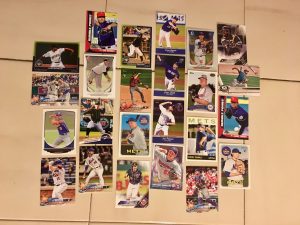 Here they are, your THB Class of 2018! If a player gets a Topps card as a Met, I use it unless it’s truly horrible — Topps was here a decade before there were Mets, so they get to be the card of record. No Mets card by Topps? Then I look for a minor-league card, a non-Topps Mets card, a Topps non-Mets card, or anything else. That means I spend the season scrutinizing new card sets in hopes of finding a) better cards of established Mets; b) cards to stockpile for prospects who might make the Show; and most importantly c) a card for each new big-league Met. At the end of the year I go through the stockpile and subtract the maybe somedays who became nopes. (Circle of Life, y’all.) Eventually that yields this column, previous versions of which can be found here, here, here, here, here, here, here, here, here, here, here, here and here.)
Before the rest of them become Mariners, minor-league free agents or otherwise move on, here are your 2018 Mets, in order of matriculation:
Adrian Gonzalez: The first Met to matriculate in 2018 was an aggressively pointless acquisition, arguably emblematic of this franchise’s recent wheel-spinning. Gonzalez, a former star much dimmed by back woes, blocked Dom Smith and prevented Wilmer Flores and Jay Bruce from getting more reps at first, three more sensible answers (from a long list) than employing Adrian Gonzalez. His redeeming quality in the team’s eye was that he was cheap, which may not be a redeeming quality in your eye. Anyway, it was an old song we’re tired of hearing played: Proven Veteran™ Will Nuture Young Player and If Everything Goes Right He’ll Also Bounce Back and Then We’re in the World Series! Everything didn’t go right and Gonzalez was cut after a third of a season wasted. Insult to injury: His 2018 Topps Series 2 card was a horizontal. All right-thinking people know that horizontal cards are designed to lure kids to Satan worship now that backwards messages on LPs are no longer an option.
Todd Frazier: Perhaps you know him from such Mets-media beats as “from Toms River,” “the most enthusiastic teammate ever” and “once played in the Little League World Series.” Frazier arrived on a two-year below-market deal, an admittedly not-crazy find in the free-agent supermarket’s dented-cans and day-old bread aisle. (As always, the real problem is that the owners of the National League’s New York franchise do most of their shopping in that aisle, with no interest in, say, a prime cut of Bryce Harper.) Frazier was, well, Frazier: he didn’t hit for average, did draw walks, played pretty good defense, was the most enthusiastic teammate ever, and continued to be from Toms River. Being a Met, he also spent a ton of time on the disabled list. Notable highlights included somehow stealing an out thanks to a flop in the Los Angeles stands and the discovery of a kid’s rubber mock baseball, and umpire Tom Hallion being so steamed about this chicanery that he pulled a Tiananmen Square as Frazier finished a walk-off home-run trot. Seriously, how weird was that? 2018 Topps Heritage card in which he looks like Todd From Toms River.
Anthony Swarzak: First he was hurt, then he was horrible. Honestly, how many new Mets of recent vintage does that describe? On paper, Swarzak seemed like a pretty good addition: he’d put up the best year of his career in 2017 after knocking around with fly-by-night outfits such as the Doosan Bears, the Scranton/Wilkes-Barre RailRiders, and the New York Yankees. But he got hurt in spring training, had to leave his second outing of the season, didn’t return until June and then was reliably awful. That glugging sound was $6 million of grimly extracted WilponBucks clogging up the toilet, with another $8 million ready to pour in 2019. The Mets then offloaded Swarzak on the Seattle Mariners, to the relief of all concerned. 2015 Topps card as a Twin.
Jose Lobaton: Every THB class includes an aged catcher or two, signed as Triple-A depth and summoned after that depth proves necessary, catching being what it is. (This goes from probability to lead-pipe cinch when you employ Travis d’Arnaud, who’s probably plummeting through a skylight at this very moment.) Generally it’s not worth getting too worked up about emergency backstops — sometimes they get one big moment (Taylor Teagarden) before being forgotten, but usually they go in the I Forgot That Guy Was a Met stack (Rick Wilkins, Tom Wilson, Taylor Teagarden again). Lobaton hit a triple in his first Mets AB, was rendered superfluous by the arrival of Devin Mesoraco, spent the summer in Triple-A and then returned in September as a reward for good behavior. [Author is carefully expressionless except for a slight upturn at the corner of his mouth.] While the Mets were at Fenway, a plus-sized rat caused various Mets to vacate their dugout positions, and cameras caught Lobaton trying to flush the rat from its hiding place beneath the bench. “Why on Earth is he doing that?” I asked anybody who’d listen, which at that point was nobody. “Is he actually planning to beat the rat to death on national television? Does he think it’ll reconsider its options and board a hidden rats-only elevator?” Honestly, if you can’t count on ancient catchers to show common sense, what can you count on them for? 2016 Topps card as a National.
Gerson Bautista: A right-handed fireballer who wasn’t ready for prime time, Bautista made five appearances for the Mets, looked awful in four of them and left the impression that a) he had cool hair and b) some nice person should buy him a cheeseburger. His existence then nagged at me because he was the one THB Met who didn’t have a card, and I was goddamned if I was going to spent nearly $20 on a Salem Red Sox set to fix that. For some reason Topps then included 1.5 Gerson Bautista cards in its update set: he has one of his own and shares another one with Luis Guillorme. Recidivist Met Jason Vargas, by the way, got a Series 2 card and an Update card. I love Topps, but every year they offer a reminder that monopolies are not good for quality control. Anyway, Bautista is now a Mariner and I hope someone feeds him.
Corey Oswalt: Oswalt was serviceable as a starter, not so great as a reliever, but only turned 25 in September and never really had a defined role. Honestly, a limitation of these THB write-ups is a lot of them are first impressions of players when no one can know what those players will be. (This lament is particularly true for pitchers.) Anyway, Oswalt made the big leagues after six years in the minors and many years of hard work and dreaming before that. That makes him an immortal, however the rest of his story unfolds, and we shouldn’t forget that. Stuck with a 2013 Topps Heritage Minors card, because Topps consigned him to one of its lamentable new duo cards in its Update set.
P.J. Conlon: Recalled for a spot start in Cincinnati, Conlon became the first Irish-born player in the big leagues since World War II, which seems like something that would have been a big deal in the Eisenhower administration. After a pair of not particularly successful appearances, he was designated for assignment, claimed by the Dodgers, and posted a classy Twitter thank-you to New York on his way out the door. Then, after less than a week as a theoretical Dodger minor leaguer, he wound up back with the Mets. Which led to this amended tweet:
That’s genuinely funny! Anyway, Conlon will be a spring-training invitee in 2019, and still born in Ireland. I’m sure some bored beat writer will get a March story out of it. 2018 Topps Heritage card.
Devin Mesoraco: A catcher with a doctor’s chart that would make Travis d’Arnaud blanch, Mesoraco came over from the Reds when Matt Harvey was finally exiled and crushed five home runs in his first two weeks. Alas, his Mets career path then followed the John Buck arc: he cooled off, got hurt, and only had 12 plate appearances in September. Still, he earned plaudits as a catcher from Jacob deGrom, whom one can regard as an authority on such things. Got a not bad 2018 Topps Update card in which he’s trotting off the field in full catcher’s armor, mask in one hand and weary expression on his face.
Luis Guillorme: Coolly caught a bat one-handed in spring training in 2016, a highlight you’ve probably seen. Made his big-league debut this year and was given very little opportunity to show what he could do, but honestly, can you blame the Mets? I mean, when you get the chance to use a roster spot on the fly-laden corpse of Jose Reyes, you take it instead of worrying about trivialities such as the further development of excellent defensive shortstops. The Mets’ infield has only gotten more crowded since the season ended, and Guillorme’s likely to be an odd man out. Some old Bowman card, as Topps Update stuck him on one of those damn duo things.
Buddy Baumann: A May acquisition from the Padres, Baumann was put on the active roster for a game that got rained out, and then sent back down having never occupied a roster spot for an official game, leaving me with a conundrum: If Baumann never pitched for the Mets, would he count as a ghost? Or would he be, somehow, the ghost of a ghost? Considerable angst was avoided when Baumann was recalled again, and this time he actually got to pitch. It seems like an anticlimax to write that I remember the roster debate more than I do anything he did on the mound, but it’s actually the perfect ending. Some card as an Omaha Storm Chaser, which sounds like the kind of thing Jose Lobaton would do if not properly supervised.
Jose Bautista: Another piece of bruised, discarded fruit that Mets ownership brushed off and assured us would be tasty and nutritious. And to be fair, it kind of was. The former Blue Jays star (and long-ago Met on paper) arrived after the Braves had no spot for him, but proved moderately useful in a half-season as a Met before being flipped to Philadelphia. He connected for a walkoff grand slam against Tampa Bay that was, somehow, his first-ever walkoff homer. He also reportedly played a crucial role mentoring Amed Rosario, which is the kind of thing that different segments of a fandom can simultaneously undervalue and overvalue. Pretty decent 2018 Topps Update card.
Tim Peterson: Arrived at the end of May as part of a grab bag of new relievers and pitched really well in June, then not so well after that — as a lowlight, there was a game against the Pirates in which the abracadabra-walk rule meant he allowed four baserunners on six pitches. Yikes! In fairness, Peterson was also a victim of Mickey Callaway’s growing pains managing a bullpen, at one point spending nearly two weeks on the active roster without appearing in a game. And he wasn’t the only one. Anyway, one of a string of basically interchangeable right-handed relievers. 2018 51s card.
Scott Copeland: Nope, don’t remember him. The record shows that he pitched on May 31 against the Cubs at Citi Field, a night Seth Lugo started and was relieved by Hansel Robles, Jerry Blevins, Buddy Baumann, Copeland and Gerson Bautista. Yikes! Copeland pitched better than any of his fellow relievers in that game, facing five batters and giving up a lone single. He apparently wore 62, which is the kind of number big-leaguers once refused to wear unless it was March. I liked it that way better. Some old Topps Pro Debut card.
Chris Beck: No memory of him either. I looked at his horrific pitching line and am glad I’m coming up empty. Pitching 10.1 innings and giving up 10 hits, nine walks and three home runs is not something you want to put on your resume. Some old White Sox card.
Drew Smith: A big right-handed reliever (honestly, they may as well grow on trees), Smith was vaguely handsome in an utterly unmemorable way. Seriously, the guy looked like a generic action figure before some Chinese prisoner glued the cowl on and made you go, “Ohh, it’s Batman/Captain America/the Green Hornet/etc.” Smith pitched pretty well though, only walking six guys in 28 IP. He’ll now probably walk everyone and his grandmother, because middle relievers. 2018 51s card.
Kevin Kaczmarski: Ya got me. Apparently I bought a 2016 Columbia Fireflies set to get a card of him. That qualifies as dedication. And it seems he wore No. 16? Did I get mad about that in some forgotten post? No offense to Kaczmarski, but who let that happen?
Tyler Bashlor: Right-handed reliever. Came in the same Fireflies set that yielded a Kevin Kaczmarski card. Be thankful for small favors.
Drew Gagnon: Right-handed reliever who looked vaguely like Matthew McConaughey, at least to me. Didn’t do much … and will be 29 in June. Good luck. 2018 51s card.
Jeff McNeil: Is there a worse career move than succeeding as a rookie hitter for the New York Mets? After two years lost to injury, McNeil got his Daniel Murphy on as a member of the 51s in 2018, but the team stubbornly refused to call him up until late July, when the trade of Asdrubal Cabrera finally opened up the spot he’d earned about two months earlier. He actually got to play — another thing the Mets have been reliably terrible about in recent years — and took advantage, hitting .329 and proving almost impossible to strike out. He was a success story in the field, too: despite having his defense habitually derided, he worked his butt off and by the end of the season looked more than adequate at second. Honestly, it was everything you could reasonably ask of a rookie, both in terms of preparation and results. So how did the Mets reward him? By bringing in not only Robinson Cano but also Jed Lowrie. McNeil is now being talked up as an outfielder. Maybe that will work out and he’ll be a Ben Zobrist type. Or maybe the Mets are setting up yet another promising young hitter to fail. Old Bowman card, but he has a 2019 Topps card coming out in a week or so.
Austin Jackson: A quietly aggravating player, Jackson had a good first month after being discarded by the Rangers and then went back to being the kind of guy who’d get discarded by the Rangers. His lone skill as a baseball player was his ability to be terrible without being obvious about it. For instance, Jackson was a consistently horrible center fielder, but it took close scrutiny to reveal it: he failed by freezing on contact and having a slow first step, which won’t make highlight films but is actually more damaging on a night-to-night basis than occasionally diving and missing or getting hit in the head by an enemy double. It’s giving guys like this 200 ABs that kills seasons. Jackson won David Wright’s farewell game with a walkoff double, which doesn’t change my verdict appreciably but ought to be acknowledged. 2016 Topps card as a White Sock.
Bobby Wahl: Big right-handed reliever. See anywhere above. 2017 Topps card as an Athletic.
Jack Reinheimer: Nondescript utilityman who came over from the Diamondbacks on waivers in an acquisition that proved serenely pointless. Since the season ended he’s been waived by the Cubs, designated for assignment by the Rangers and claimed off waivers by the Orioles. Sometimes I wonder how stuff like that works. Does poor Reinheimer have a stack of HR paperwork to deal with in addition to having to figure out where the heck to get an apartment? Got a 2018 Topps Update card as a Diamondback, a team he last played for on Aug. 2, 2017. C’mon, Topps.
Daniel Zamora: Big right-handed … oh wait, Zamora was left-handed and actually useful out of the Mets bullpen. It was a small sample size and he’s a middle reliever, but something to build on, maybe. 2018 Rumble Ponies card.
Eric Hanhold: The final new Met of the year was … a big right-handed reliever who didn’t do much but about whom any conclusive judgment would be premature and unfair. If you couldn’t see that one coming by now, I don’t know what to tell you. 2018 Rumble Ponies card.
by Greg Prince on 17 January 2019 4:07 am Jed Lowrie was sitting next to Brodie Van Wagenen on Wednesday answering a reporter’s question about being reunited with Chili Davis, which is a scene that would have been a rather random one to describe as recently as the middle of October — a perfectly viable page of Baseball Mad-Libs come to life. Yet Lowrie was wearing a Mets jersey, the backdrop was comprised of Met and Met-adjacent logos and it’s the middle of January. We know who these people are in our lives now. We will rely on them, among others with whom we were heretofore familiar but not intimately so, to heighten our hope and happiness as the year ahead of us unfolds.
Before returning to treating this essentially overnight transformation of individuals from ”yeah, I’ve heard of him, I guess” to “C’MON JED!” as a perfectly normal evolution, let us acknowledge its inherent weirdness. It’s weird that Van Wagenen is the point man for our dreams, not because he’s Brodie the ex-agent turned GM (which is specifically weird), but because he’s a person none of us ever gave five seconds of thought to until last July when he asserted the Mets better get on the ball where Jacob deGrom’s long-term contractual needs were concerned. And then we thought about him for five minutes.
I’d rarely thought about Davis over the past couple of decades, save for a couple of anecdotes from his playing career (“he ain’t God, man,” Chili memorably declared when asked why he was able to hit universally unhittable young Doc Gooden). He was a hitting coach? Yeah, I suppose I knew that. Now he’s our hitting coach. He used to be Jed Lowrie’s hitting coach? I can honestly say I didn’t know that.
Lowrie was a member in good standing of the Vague Brigade, one of those players I kind of knew played for some team that wasn’t the Mets and didn’t play the Mets very often. I might have even voted for him to start at shortstop on an All-Star ballot once when I needed to fill out the American League half with a shortstop who sure as hell wasn’t Jeter. To say I didn’t otherwise care about Jed Lowrie sounds crueler than I would intend, but I didn’t care about Jed Lowrie. Now I do, apparently.
Fine. That’s how we roll. We get a new, relatively accomplished infielder (position to be determined daily). We get a new, presumably qualified hitting coach, as teams will when they were judged not to have hit enough under the old one. We have this still new general manager who hires and acquires all kinds of slight acquaintances and total strangers in advance of making them our guys. Keon Broxton hit home runs off deGrom in consecutive series in the same month two years ago. Hector Santiago matched some zeroes with Matt Harvey the night Harvey and Bobby Parnell one-hit the White Sox across ten innings, which is now six years ago. Rajai Davis hit that home run for the Indians in the World Series. Gregor Blanco made that catch behind Matt Cain in his perfect game. All of the above are Mets now and, if things go well for them, will be Mets in 2019, perhaps longer.
Same goes for J.D. Davis, formerly of Houston, no relation to Chili as far as I know. I’d retained no recognition of J.D. Davis before we got him. Or Walker Lockett, who we got from Cleveland for Kevin Plawecki. Davis is a utility infielder type, Lockett a righthanded pitcher, should you be keeping score some day in the near future and wonder what it is they do and why it of import to you. I’d heard of Luis Avilan, though I couldn’t have told you from where (despite his having made his major league debut versus the Mets in 2012), but I’m willing to believe he’s a good candidate to throw lefthanded relief for us because that’s why he’s here, thus let’s be positive on Luis Avilan’s behalf.
It goes like this to some degree every winter. It goes like this to some degree every season. Last summer I was a little dumbstruck that a slice of my specific partisan attentions were now given over to Jeff McNeil, Austin Jackson and Bobby Wahl because basically the week before, McNeil was some name on the organizational depth chart; Jackson was an ex-Tiger I’d lost track as the Vague Brigade drilled in characteristic out of sight/out of mind fashion; and who the hell was Bobby Wahl? Now it is up to Brewers fans to ask that question in the present tense, given that Wahl is who we traded to Milwaukee to get Broxton, who, you might recall from a past paragraph, took the soon-to-be best pitcher in baseball deep twice, yet isn’t really considered much of a hitter. Maybe Chili Davis can work with him.
I got used to McNeil, who’s still a Met, albeit of undetermined application. I got used to Jackson, who is no longer a Met. I got used to Wahl before he went on the DL after seven Met appearances and into the Met past after the Broxton trade. And I’ll get used to Lowrie and the rest of this lot rather quickly as they blend with the players and coaches Van Wagenen previously hired and acquired and the crew of holdovers who haven’t been traded, released or bid adieu ceremoniously or routinely. Every year it’s a little weird. Then it isn’t.
by Greg Prince on 31 December 2018 4:39 pm Today is the last fiftieth anniversary of any day in 1968, the last year whose baseball season I don’t personally remember. No memories whatsoever. When I think of the 1968 baseball season, I think of sitting on the edge of my bed in some undetermined year a few years later studying a New York Times-sponsored sports record book my parents gave me for my birthday in 1969, which was forty-nine years ago today, but never mind 1969 for the moment (or the fact that I’m about to have baseball memories measuring a half-century in length). We’re on the cusp of the fiftieth anniversary of 1969 and will be reveling in it in 2019. But this topic for these first few paragraphs is 1968, which was the subject of that sports record book. It had “1969” in the title, so I assumed it had very current results, like how the Knicks did the night before. I didn’t know how publishing worked (and, honestly, still don’t). I didn’t know they sometimes put next year’s year on the cover before next year becomes this year. I would learn that when I became a devoted World Almanac reader, which I would be for a very long time, but not yet.
Despite the “1969” sports record book sponsored by the New York Times not having last night’s Knicks game or this morning’s NBA standings in it, I tore into it. It had sports in it, all of them. It had statistics. It had a lengthy section on the most recent baseball season that had been played, 1968. Everything I first knew about 1968 I got from that book. I learned Denny McLain won 31 games. I learned Bob Gibson registered a 1.12 ERA. I learned Carl Yastrzemski led the American League in hitting with a relatively low-sounding .301 average. And I discovered that Jerry Koosman, whom I considered pretty good but not great as I sat on the edge of my bed gleaning, had a great rookie season: 19-12, 2.08 ERA. Those were practically Seaver numbers to my early 1970s mind. Yet the Mets themselves had been 73-89 and in ninth place.
Ninth place? Thirty-one wins for one pitcher? How did the pitcher who had the 1.12 ERA not have the 31 wins? How could only one batter in an entire league hit above .300? What was this Year of the Pitcher all about? How come the Mets couldn’t get Koosman a twentieth win? How could Koosman not have won Rookie of the Year? It was the pitchers’ year. I knew who Johnny Bench was. I knew he was nonpareil, even if I didn’t know the word “nonpareil”. But Johnny Bench didn’t win 19 games.
What a bizarre world the 1968 baseball season must have been. It might as well have been 1868 from where I sat on the edge of my bed.
The Tigers were world champions. Denny McLain wasn’t the big hero, though. It was Mickey Lolich, three wins in the World Series, 17-9 in the regular season, same as Koosman in 1969. Lolich and Koosman were second fiddles to McLain and Seaver, respectively. Koosman also had a bigger World Series than Seaver, though that I picked up on later. It wasn’t included in that 1969 sports record book. It went to press too soon for that.
All of this raced through my head as I sat on the edge of my bed some sunny morning, shades closed, lights off, probably home sick from school, a few years after December 31, 1968, the end of the last year whose baseball season would have to exist exclusively for me on pages practically falling out of a paperback book. The cover had come off pretty quickly. That’s how much I handled that sports record book. That’s how much I yearned to learn about baseball from right before I got to baseball.
—
Today is the last fortieth anniversary of any day in 1978, the last year whose baseball season I couldn’t fully follow every last day. When I say “fully follow,” I mean that from August 10 to the end of the season, there was a New York newspaper strike, meaning the game stories and columns I was used to weren’t there. No Post. No News. No Times. Newsday published; a suburban paper from Jersey showed up at our local luncheonette on Long Island; and there were a few thin strike papers that were mostly day-old wire copy, but it wasn’t the same. My well-developed baseball habits — watch the Mets game tonight, read about it the next day — were unmoored. The games went on, but without the stories and the columns, it just wasn’t as textured. Still, I stayed attuned. John Stearns was breaking a stolen bases record for catchers. Jerry Koosman remained snakebitten. That was a term Bob Murphy used for a pitcher who pitched well but never seemed to win (he used it a lot for Lolich when he became a Met). Willie Montañez was piling up RBIs. The Mets weren’t doing very well after a reasonably good start — 23-24 in late May — but at least it wasn’t as depressing as 1977 when we traded Seaver. At least I don’t think it was. It was hard to be sure without the newspapers.
Enough data was delivered through whatever channels were available to let me know that Craig Swan was leading the National League in ERA. You wouldn’t have guessed it from his won-lost record. He wasn’t going to win ten games from the looks of things, but you could still have a low earned run average regardless of how little your team supported you. Swannie’s ERA wasn’t as low as Guidry’s in the American League (TV talked ad nauseum about what Guidry’s team was up to) but it was better than his cohort. The pitchers closest to Craig — Steve Rogers of the Expos, Pete Vukovich of the Cardinals, Bob Knepper of the Giants — didn’t have the biggest names. The pitchers with the biggest names — Perry of the Padres, Blue of the Giants, Carlton of the Phillies, even Seaver of the Reds — didn’t have the smallest ERAs. They were all under 3.00, but they weren’t under Swan.
Which is to say that in the pitching category that counted most if you were aware of snakebittenness, they were all under Swan.
In his final start, Swannie allowed one earned run to St. Louis in seven innings, lowering his ERA from 2.47 to 2.43 and raising his won-lost record to 9-6. Word got around that he won the ERA title. The Post made its own deal and resumed publication in early October, in time for the overly covered ALCS. The News andTimes were out for another month, completely missing the Yankees winning another World Series from the Dodgers, though I wouldn’t say they missed anything. The Mets, who ended up in last place three games behind the Cards, wouldn’t truly be back until 1984, the year they released Craig Swan. He wound up an Angel, which I remember as really strange.
—
Today is the last thirtieth anniversary of any day in 1988, the last year when the Mets won 100 games in the regular season. It’s not automatically the last where perpetuity is concerned. They are theoretically eligible to win 100 games in any season in which at least 100 are played, certainly when there are 162. But it has not happened since.
Lord, those Mets were good. A tad schizophrenic from a chronological standpoint, but when they were in good mode, they were dynamite. I inevitably split the season into three sectors: the 30-11 start (dynamite); the 41-41 middle (fizzle); and the 29-8 conclusion (dynamite redux). The hitting was the inconsistent personality element. Except for Strawberry. Strawberry carried the offense. He’d homer in the first or second inning and the pitching would make it hold up. The pitching was consistent. Consistently astounding, nobody more so than David Cone, whose leapt from “this guy could be pretty good” to “how did this guy get so great so fast?” in a blink. From 5-6 and rotation insurance in ’87 to en route to 20 wins and near-ace status in ’88. I say near-ace because Doc Gooden was having a fine season and nobody could out-ace Doc in my heart (just as nobody could out-ace Seaver, win totals and ERA crowns in a given campaign be damned).
But Coney was as good a pitcher as anybody during the biggest chunk of the year. Danny Jackson got going sooner (David wasn’t even in the Mets’ rotation when the season began) and Orel Hershiser was grabbing headlines later (something about a shutout streak), but Cone was baffling hitters from May through September, the month when all the Mets asserted themselves. What had been a nervous divisional race with the Pirates evolved into a blowout. Kevin McReynolds joined Darryl as an MVP candidate. Mookie caught fire. HoJo was blazing. Gregg Jefferies, the projected story of tomorrow, became the phenom of today. And David Cone, on Friday night, September 30, threw a two-hit complete game to beat the Cardinals, 4-2, and pick up his twentieth win — 20-3, 2.22 ERA, plus 213 strikeouts.
It was the Mets’ 98th win. On Saturday, Sid Fernandez won his twelfth and the Mets their 99th. On Sunday, Ron Darling won his 17th (notching the same 17-9 record as Kooz had in ’69 and Lolich had in ’68) and the Mets their 100th. Perfect round number. It took them only 160 games. Two rainouts weren’t rescheduled, meaning that from a winning-percentage perspective, we had just finished watching the second-best Mets team ever. Not quite the 108-54 1986 Mets, but .008 better than the 100-62 1969 Mets. The playoffs and the World Series awaited, and once those were won, then we could figure out where to rank this incredibly talented team. Gooden would pitch Game One in the NLCS against the Dodgers, Coney Game Two. You had to feel good about our chances. L.A. had won only 94.
—
Today is the last twentieth anniversary of any day in 1998, the last year when it had been forever since the Mets had been to the postseason. Psychically, every year when the Mets aren’t in the postseason feels like forever, but one must calibrate rationally. The last time the Mets had been in the playoffs was 1988, when we didn’t beat the Dodgers. We contended legitimately if half-assedly in 1989 and a little more seriously in 1990 but came up short both times. I can’t say “it was OK,” but it had been only two years and when there was only one playoff position to be had from a given division, it was greedy to assume we’d be granted one. The ’80s were over. Greed wasn’t good.
We continued to contend in 1991 until early August. Then we quit cold turkey. It was hard to think of ourselves and the playoffs in the same thought bubble anymore. A makeover prior to 1992 yielded pretty much the same effect: hanging in there until early August, then an utter implosion. Nineteen Ninety-Three was worse than the two previous disasters combined. We were a seventh-place team, which seemed as impossible to grasp as ninth place had been when I first found about it post-1968.
Simply not being as abysmal as 1993 was the goal in 1994 and we achieved it. I thought we’d be much better in 1995, and we were, but not until fairly late in the season when it was too late to cobble together anything resembling a playoff push. Both seasons following ’93 were strike-shortened. If we could have added together the respectable portions, maybe that would have gotten us into a race.
That’s not how it worked in baseball by then, but it was indeed working differently. There were three divisions, not two, in each league. There were two playoff positions attainable. You couldn’t have them both, but if you didn’t win your division, you could be a Wild Card. The encouraging ending in 1995 had me thinking the Mets could be that Card in 1996. Didn’t happen. Didn’t come close to happening. I didn’t come close to thinking Wild Card in August and September. Get a winning record, then we’ll talk. We hadn’t had one since 1990.
In 1997, we had a winning record. Shorn of expectations, we exceeded them. From nowhere we shot into the Wild Card picture. It was real and it was spectacular. It fell a little short (four games), but for the first time in a long time, I could enter the next season with legitimate expectations.
The next season would be 1998. We were taking our 88-74 pepperpot and spicing it up with cast-off world champion Marlins. The Marlins weren’t like other world champions. The Marlins won the Wild Card, then two rounds of playoffs, then the World Series. It was legal. They were entitled to call themselves world champs and defend their title accordingly. They didn’t bother with the latter. Their owner didn’t think even a world championship team was going to attract fans in regularly rainy Miami. He wanted a ballpark with a roof. If he wasn’t going to get one, he wasn’t going to keep his world champions intact. So off they were scattered, trade by trade. Two trades directly benefited us. One was for a dependable lefty reliever named Dennis Cook, the other for an intermittently successful lefty starter named Al Leiter.
Leiter turned into the prize of the offseason and the ace of the next season. He was never better for any team than he was for the 1998 Mets. Control didn’t elude him. Health didn’t much hinder him. Little went wrong when he was on the mound. Plus he was from New Jersey and talked constantly about having been a Mets fan as a kid, loving Seaver, loving Koosman. How could we not love Al Leiter?
How could we not love the 1998 Mets and the prospect that they could make the playoffs? A strong start of 9-4 indicated 1997 was no fluke. They muddled for a bit thereafter while injuries occurred, but come May the Marlins came to their rescue again. Florida had acquired Mike Piazza. They had to if they wanted to rid themselves of Gary Sheffield and a few other well-compensated players. They also wanted to rid themselves of Piazza ASAP. The Mets, to the surprise of many, wanted to add the All-Star catcher, the former Dodger universally recognized as the best hitter at his position since at least Bench, maybe ever.
We got him. We got Mike Piazza. Mike Piazza showed up on a Saturday in late May, caught a shutout from Al Leiter and away we went. Not without obstacles, perhaps, but definitely for real. We were in it to win it, it being the Wild Card. Atlanta, now in the East, was too far ahead for us to touch, but this second playoff spot was really and truly in our grasp. Us, the Cubs, the Giants…it was gonna be one of us.
Why not us? We had Al Leiter. On the penultimate Sunday of the season, Al shut out the depleted Marlins for eight innings, hiking his won-lost record to 17-6 and lowering his ERA to 2.47, third-best in the National League when the regular season was over. Unfortunately, when the regular season was over, so were the Mets. They carried a one-game Wild Card lead into the final week of 1998, yet neither embellished nor defended it. The Mets lost their last five games, including Al’s decent until it wasn’t start in Game 161 at dreaded Turner Field. The Mets were eliminated in Game 162. Their playoffless streak had reached ten years. For the first time since 1988, because it was so very much the goal of the season, it really felt like it had been forever.
Like I said, it always feels like forever, but this one really hurt. I was pretty much ready to give up baseball the way the Mets gave up the playoff hunt. I got over it. I stayed engaged to see the Mets end their drought in 1999. They haven’t gone ten consecutive seasons without a playoff appearance since the end of the 1998 season. They’ve come close, but they’ve snapped to just in time to keep their strings of annual absences in single digits.
This is not a dare, by the way, just an observation.
—
Today is the last tenth anniversary of any day in 2008, the last season when going to “the Mets game” instinctively meant going to Shea Stadium. I went to Shea Stadium for 44 Mets game at Shea Stadium in 2008. I wasn’t going to let go of it without a fight.
The fight was futile. The Mets announced in 2005 that they’d be replacing Shea, began digging up the parking lot to accommodate its replacement in 2006 and had erected the outlines of what appeared to be a ballpark in 2007. It would be called Citi Field and it would be what meant going to “the Mets game” would mean from 2009 until it was decided a new state-of-the-art facility was necessary.
I fumed with resentment over this encroaching affront to my instincts. Never mind whatever was icky or sticky about the incumbent. Never mind my fondness for retro baseball palaces I’d visited out of town. I knew what going to the Mets game meant. You weren’t going to change my meaning on me.
Shea gave 2008 much of its meaning. Johan Santana gave it the rest. Oh my gosh, we got Johan Santana? Who saw that coming? This was like Piazza, but for pitching. He was one of those hypotheticals you floated with friends and strangers, as in “maybe we can get Santana next year if the Twins want to dump his contract,” but we didn’t really think it would happen.
We didn’t really think Shea Stadium’s demise would happen, but it did, so why not Johan? Right around the moment the Giants were preparing to defeat the undefeated Patriots in Super Bowl XLII (speaking of things you didn’t think would happen), we got Johan. We got Santana, formerly the best pitcher in the American League, to go with Pedro Martinez, also formerly the best pitcher in the American League, though longer ago. The rest of the rotation was whoever. The important thing was Johan. What a makegood for the way 2007 ended.
We needed more than Johan, actually. He was all right as the season got going, but the Mets stumbled along, posting a losing record into July and getting their manager dismissed in the mediocre process. Then, as if they remembered they were good, the Mets heated up. Our core of Wright, Reyes, Beltran and Delgado (especially Delgado) played like the stars they had been in previous seasons. And our ace reminded us of why were so excited in February. Johan was positively Twinsome. Shea was alive. So were the Mets. We led the East into September. Then, thanks primarily to a barren bullpen — plenty of bodies, but a paucity of ability — another stumble. The Mets were probably competing more for a Wild Card than the division as the schedule wound down. Whatever it took, we would take it, as long as we had Johan.
On the final Saturday of the 2008 season, the final Saturday of Shea Stadium’s life, the formula was foolproof. Those of us who attended will never forget it. I imagine the same could be said for anybody who watched it on television, listened to it on radio or sensed its vibes through any medium. Oh my gosh, we had Johan Santana. Pitching on three days’ rest (which nobody ever did anymore), on a bad knee (which nobody knew about in advance), Johan went nine innings (which everybody understood was essential in light of the bullpen being marked a hazardous waste site). The nine innings were of the shutout variety. Johan, completing a 16-7, 2.53 season that didn’t being to describe how masterful he’d been, scattered three hits and beat the Marlins, 2-0. He didn’t drive in the two runs and he didn’t record every putout, but it feels absolutely accurate to say it was he who beat the Marlins, 2-0. He kept Shea alive and the Mets alive. Johan hadn’t lost a decision since late June and the Mets were 13-3 in his final sixteen starts.
That was Game 161, my forty-third at Shea on the season. It might have been the ideal juncture for us all, Mets included, to stop going right then and there.
—
Today is the last day in which anniversaries of 2018 can be expressed in no more than months. This is the last day of 2018, also the forty-ninth anniversary of my seventh birthday when I got that sports record book (you do the math). I became a Mets fan fifty years ago this coming season, 1969, but like I said, we’ll talk about 1969 in 2019. This is 2018, the year whose season was the only one we talked about in the present tense. We talked mostly about how this wasn’t a very good season but we had the very best pitcher, Jacob deGrom: 1.70 ERA, 269 strikeouts, all kinds of metrics that have been developed over the decades to further confirm his magnificence. His won-lost mark is more Swannish than is fathomable in light of his other numbers, but when we read all about it these days (rarely in newspapers let alone almanac-style record books), we get that a 10-9 record means only what you want it to.
We generally agreed it meant nothing at all in 2018 when it came to deGrom. We generally agreed we’d never seen anything like deGrom, not even in the Year of the Pitcher…though I already made clear I saw nothing in the Year of the Pitcher. I saw the Year of the Pitcher when it was history. Sometimes, because I studied those statistics so carefully, I feel as if I was there for Koosman’s 19-12, just as I was for Swan’s 2.43, Coney’s 20-3, Al’s 2.47 and Johan’s closing kick. All these years ending in 8s were all years of the pitcher to me.
And all these pitchers have kept me coming back for the years that followed, even when I swore I was done.
|
|