The blog for Mets fans
who like to read
ABOUT US

Faith and Fear in Flushing made its debut on Feb. 16, 2005, the brainchild of two longtime friends and lifelong Met fans.
Greg Prince discovered the Mets when he was 6, during the magical summer of 1969. He is a Long Island-based writer, editor and communications consultant. Contact him here.
Jason Fry is a Brooklyn writer whose first memories include his mom leaping up and down cheering for Rusty Staub. Check out his other writing here.
Got something to say? Leave a comment, or email us at faithandfear@gmail.com. (Sorry, but we have no interest in ads, sponsored content or guest posts.)
Need our RSS feed? It's here.
Visit our Facebook page, or drop by the personal pages for Greg and Jason.
Or follow us on Twitter: Here's Greg, and here's Jason.
|
by Jason Fry on 4 April 2018 2:05 am Somehow Matt Harvey‘s in his seventh season as a New York Met.
Which means he’s seen some shit.
Some of the troubles that have attached themselves to Harvey like so many barnacles have been typical New York bullshit, ginned up by the profoundly cynical sports-talk industry for which our town is ground zero. But some of them have been entirely his fault. Late nights and studied pissiness and outsized personas are fine if you win — just ask Keith Hernandez and the rest of the ’86 Mets — but if you don’t deliver, you’ll find those moments turned into brickbats. And you’d better duck.
The rise of Noah Syndergaard turned Harvey into the last thing he ever imagined he’d be — an also-ran, his light outshone by a pitcher younger, more comfortable in his own skin, and most importantly better. If you’re feeling uncharitable, you could call that karma. Lord knows I’ve thought it a time or two.
But I take no satisfaction — not even the meanest, bitterest sort — in the physical horrors that Harvey has had to endure. First came Tommy John, which has become so routine that we forget it can still be a career killer and not just an unwelcome sabbatical. Next came thoracic outlet syndrome, which is about the farthest thing from routine. Harvey came through the former; he has struggled mightily with the latter, as has every pitcher who’s been struck down by it.
I can’t imagine being robbed of the thing I’m best at and love to do, the thing I’ve worked my entire life for. That’s what’s happened to Harvey. The arm that once delivered 98 MPH fastballs with evil movement no longer can do that. The breaking stuff that was a perfect complement to that heavy, tumbling fastball has become inconsistent. Nothing that was once so effortless for Harvey is anything close to reliable now, and perhaps it never will be again.
In St. Lucie Harvey was an afterthought — a candidate to be cut late in the spring, if things had gone badly enough. His upside has shrunk correspondingly. Back in the days of “Harvey’s better” and his ferocious World Series performance, the one that went on just a bit too tragically long, we muttered bitterly about how Harvey would leave us for a mega-payday in Yankee pinstripes. Now, a comeback year in 2018 might mean a incentive-laden deal from some mid-market team.
Infatuation, awe, exhilaration, fury, despair, bitterness … they were all a long time ago. These days most Mets fans regard Harvey with weary indifference. He’s important to our fortunes, diminished though they are by injuries and skinflint ownership, but we don’t trust him enough to invest much hope in him. We want him to succeed, but if he hits a rough patch we’ll turn our eyes to Zack Wheeler or Seth Lugo (who looked terrific following Harvey to the mound, incidentally) or Robert Gsellman.
As Harvey took the mound last night in the cold and mist, I thought to myself that a few years ago such weather conditions would have meant some luckless spot starter was thrown to the wolves in his place. But that was when Harvey was a key part of the Mets’ golden future, and not a by-default part of their uncertain present. It was his turn, so he trudged out to the mound against the Phillies, and we didn’t exactly hold our breath, because that day is gone too. We just folded our arms (good idea on such a night) and waited skeptically.
And Harvey … did pretty well.
The performance wasn’t one to elicit hosannas. The fastball sat at 92 to 93, which somehow has become pedestrian in this era of godlike hurlers. Nobody on either team was particularly thrilled about hitting. The ball wasn’t exactly traveling. The strike zone was a little big.
But Harvey’s location was superb — and more importantly, it looked like he was pitching to a plan. He limited the Phils to one hit over five innings by staying doggedly away from the middle of the plate, bedeviling hitters with high fastballs and breaking stuff on the corners. It wasn’t a night for rearing back and throwing it by someone, but it’s entirely possible Harvey has seen his last such night. Maybe, just maybe, he’ll look back at this wintry no-decision as the night he accepted that, and started turning Plan B into a reality.
by Jason Fry on 1 April 2018 9:30 pm The biggest reason for optimism about the 2018 Mets? It’s that Noah Syndergaard and Jacob deGrom could pitch nearly 30% of their innings.
The biggest reason for pessimism? Even in an ideal scenario, more than 70% of their innings will have to be pitched by someone else. Which puts the spotlight squarely on a line of guys led by Steven Matz, Matt Harvey and the fifth starter. (At the moment that’s Seth Lugo, but check back next week until notified otherwise.)
Syndergaard and deGrom got the campaign off to a rollicking start, but that screeched to a halt soon after Matz took his left arm and its latest repairs to the mound on Sunday afternoon.
It would be unfair to say Matz was bad, but it would be far too generous to say he was good. His fastball was down a tick and lacking command, which left him overly reliant on his curve, a reasonably effective pitch today but one that got overexposed. That was uncertainty enough; throw in C.B. Bucknor calling balls and strikes via Magic-8 Ball and you had a mess. The kindest thing I can say about Bucknor is the eccentricity of his strike zone was impartial: Matz, Luke Weaver, Dexter Fowler, Paul deJong, Wilmer Flores and Todd Frazier headed the list of players left wondering what, exactly, the lower dimensions of Bucknor’s zone might be on any given pitch.
But look, that’s baseball. Bad umps are gonna bad-ump, and it’s not news that Bucknor is down there with our old friend Angel Hernandez in terms of umpirical competence. And much as I enjoyed three days without evidence to the contrary, the Mets weren’t going to go 162-0.
161-1 would be perfectly acceptable as a consolation prize.
(I’ll give us all a moment.)
161-1 isn’t going to happen either. Which leaves us settling into the season, complete with weirdo Friday off-days and April snowstorms.
This is the delicate part of the new season, the part you remind yourself not to squeeze to hard for fear of crushing it. It’s the time when you can remember every final score, when you’re keenly aware of who’s left to hit the roster (just Harvey and Lugo now), when batting averages and ERAs soar and crash on the basis of a single ball in play, when you spin ridiculous projections out of the thinnest skeins and laugh at yourself and then spin them all over again.
Before we know it things will be different. First the games will become a blur, and then the series and homestands and road trips will follow. Statistics will have been slowed by accumulated weight. We’ll have sufficient data points to elevate our impressions into arguments or maybe even a certainty or two. The roster will ebb and flow — rumor has it there’s a Michael Conforto sighting set for later this week, which means Brandon Nimmo picked a lousy time to get the flu. The disabled list will come into play, hopefully because an injured Met is actually on it instead of being forced to turn a nagging injury into a prolonged absence. Someone will go down and say the right things about what they have to work on. Someone will come up and say the right things about what they’ve been up to. Someone will move on to another team. Someone will arrive from one.
And little by little the season will acquire a story and a shape. A shape that for a while will be as amorphous as a C.B. Bucknor strike zone, but that’s baseball too.
by Greg Prince on 1 April 2018 11:17 am Baseball’s decision to use Sunday afternoon games as platforms to test its new extra inning rules is a little baffling. I thought the whole idea was to not let games go on all night, with the implication being night games were the issue. If there’s a segment of the week when a fan doesn’t have to choose between staying to the end or getting home in time for a decent interval of sleep, it would seem to be Sunday afternoon. But Rob Manfred wants to ease the new rules in slowly, and maybe this is the way to do it, almost under the radar (which explains why the test doesn’t extend to Sunday Night Baseball).
As a Mets fan, my impulse is to inform Manfred and his thugs that they can have my extra innings when they pry them from my cold, drowsy fingers. We are the franchise of the 23-inning game, the 24-inning game, the 25-inning game and Fireworks Night at four in the morning. We win 20-inning games, lose 20-inning games and make Keith Hernandez sigh for 18 innings. The Mets’ 2017 peaked in the sixteenth inning in Miami last April. The Mets’ 1986 peaked in the sixteenth inning in Houston that October (and peaked anew nine nights later in another extra inning at Shea). Ours are marathon Mets.
Yet I’m really and truly trying to see the point of limiting extra innings. Take a look around the ballpark when the clock strikes ten, so to speak. As Joe Garagiola liked to say, it’s like somebody’s selling fire. Sticking around to conclusion after regulation seems anathema in some circles. The diehards die hard. The rest seek rest in quest of living a longer life. A longer life without seeing every out may not be one worth surviving, but priorities differ, even among baseball’s constituents.
So we come to this, the Sunday afternoon experiment, starting today everywhere there’s a ballgame, including Citi Field. If the Mets have beaten the Cardinals once more in nine, we won’t see any difference. If the opposite occurs, well, nothing to see here, folks, move along. Ah, but if the game is still tied, how — as they’ve been saying around Seder tables — will this late afternoon be different from all other late afternoons?
At first, it won’t be. MLB will play tenth innings as it always has. Regular baseball. Go ahead in the tenth while your opponent doesn’t score, you win. Now you can go home.
But if not? Oy vey. Hold on to your matzoh…
In the eleventh, we get that whole weird scheme in which the half-inning begins with the runner from the last out of the last inning on second. It was supposed to be a minor league deal only, but one thing led to another on the competition committee (co-chaired by Sandy Alderson, not incidentally), and here we are. Talk about short attention span theater. Yet they swear they’ve done research and this is what people want. Anything to keep it tight and get it over.
If, after eleven innings, the tie has not been broken, they go to the Twelfth Inning Doubles Derby, sponsored by Doublemint Gum. This is the inning where you have to double to reach base and then double to score the runner. Two of the three defensive outs in both half-innings have to be turned on double plays. What I don’t understand is why you’re not rewarding the team that can score a runner from second on a single. Or penalizing a pitching staff that loads the bases and walks in what would have been the winning runs. Under this facet of the plan, nothing matters but doubles and, to a certain extent, double plays. Then again, I’m forgetting that this is sponsored by Doublemint. I can’t imagine the Twins won’t have a built-in advantage.
Should the doubles not fall into place, we move on to the Lucky Thirteenth. MLB’s style guide insists we capitalize Lucky Thirteenth, since Powerball is the title sponsor. (After all these years of casino-themed clubs and commercials, a lottery tying into baseball is the logical next step.) Not surprisingly, anything attached to something called Powerball is going to involve home runs. But it’s so complicated. One hitter has to homer to a certain section of left, another one can only go to right. If a player wearing an odd-numbered jersey hits straight away to center, his team loses a run. Good luck explaining that to Nimmo.
When that doesn’t work (and I don’t know how it will), the fourteenth inning will be the Quiznos Quiz Inning. One pitcher, one position player and one coach will have to answer a series of questions on baseball and sandwich history transmitted by the replay officials in Chelsea. I don’t even know if we have many Quiznos around here anymore, but I guess they’re big in the Midwest. Answers will have the legal force of singles, outs, that sort of thing. Each manager gets a challenge. If one team “scores a delicious run,” as the press release puts it, the other team will have to “add a topping.” Somehow this is supposed to be faster than a regular fourteenth inning. Essentially, they’re turning the greatest game ever invented into a game show. Plus I fear it will make me hungry. I was into them briefly.
Surveys MLB cites say fans don’t like fifteenth innings, so if the game is tied after the Quiznos Quiz Inning in the fourteenth, it will skip directly to the sixteenth inning, where they’ll replay the eighth inning. (The surveys allegedly say the eighth is consistently the most popular of all innings.) Whoever batted, whoever pitched, whatever the temperature was in the domed and retractable roofed stadiums in the eighth will all go into effect again, and the teams will try to recreate or improve upon what they did eight innings earlier. I don’t know how they’re going to account for the outdoor climate in Flushing, especially early in the season when it only gets colder the later it gets.
The seventeenth inning is when they bring out the soccer goals, the basketball hoops, the thoroughbreds. Maybe the hockey rink left over from the Winter Classic. Whichever sport each team chooses to play in its half-inning “at bat” will be played. Runs will be calculated on a prorated scale from however scoring is tabulated in those other endeavors. The idea is that fans are losing interest in baseball because it’s not fast enough, so they’ll inject faster sports into baseball. (Tim Tebow could actually come in handy once in a blue and orange moon.)
If we’re still tied after seventeen, each team is awarded a point. The points will serve as playoff tiebreakers and help determine draft order. Joe Torre, when he was on the FAN the other day, said the commissioner doesn’t expect many games to get that far without resolution, but added, “new and innovative ways are being developed to create both natural tension and effect prompt endings to games that go eighteen innings or longer, which we and our customers don’t necessarily view as desirable outcomes.” I don’t even know what the hell that’s supposed to mean. But despite having just entered my fiftieth season as a baseball fan, I don’t seem to know much.
They could just play baseball like they always do, but that may not be how today goes down. I guess we’ll see where we are after nine.
Innings, that is. Or o’clock. Whichever comes first.
by Greg Prince on 1 April 2018 12:20 am The second chapter of the perfect season completed itself Saturday, confirming that every good vibe we felt on Thursday was accurate. The Mets are 2-0 after beating St. Louis at Citi Field, 6-2. Clearly, they’ve gotten the hang of baseball and need only repeat everything they’ve done 81 times.
Ah, if only so easy. Start Syndergaard one afternoon, deGrom two afternoons later. That part is relatively simple. Also, hit a spit ton and be helped along by the New Cardinals Way, which is probably more popular in New York than it is in Missouri. This whole season the Mets have looked formidable, the Cardinals fragile. My sample size is twice is what it was when Saturday begun. What more do you want — another 160 games?
We’ll take them, even if we won’t necessarily win them. The Mets will probably lose at some point. Pity that theory has to be proven. I’m loving life at 2-0.
Though deGrom appeared to have been dragged to the barber by his mother, his performance remained as luscious (1 run allowed, 7 Redbirds struck out) if not as long as it had when he was the Hair Apparent. Jake lasted not quite six innings, throwing 101 pitches, or more than you’d care for if you didn’t have an exceedingly well-rested bullpen. Nobody pitched (or played) Friday. The same three guys from Thursday — Gsellman, Swarzak and Familia — kept the scoreboard manageable. The versatile Asdrubal Cabrera, who floated from cleanup to leadoff, whacked three hits. Todd Frazier from somewhere in New Jersey, drove home three runs. Yoenis Cespedes stood for being walked three times. What is it they say about Trivial Pursuit? If you don’t know the answer, guess “three”. Or Vida Blue.
The Mets won on Thursday without homering, which is standard Opening Day procedure for them. The Mets haven’t homered on an Opening Day since 2014, when one of the dingers was dung by Andrew Brown. They hadn’t homered in an Opening Day win since Collin Cowgill’s difficult to discern grand slam in 2013. Having observed their tradition of abstaining, the Mets got around to going all the way Saturday. Travis d’Arnaud broke the longball seal in the fourth, taking Michael Wacha deep to left. Cespedes took Wacha deeper to left in the fifth. Rusty Staub, memorialized on well-meaning if sort of illegible sleeve patches, would approve.
Amid the offensive onslaught infecting almost everybody, Adrian Gonzalez is batting .429. He’ll probably keep that up, as long as we’re dreaming baseball games get won because we want them to. I love watching mileage-worn veterans show the stuff that carried them to the heights in their career. There’s a difference between players who weren’t much to begin with and players who get all they can get out of what little they likely have left. Gonzalez 2018 reminds me of Gary Sheffield 2009. I loved watching Gary Sheffield flex his twilight bat, even knowing that after a while there were going to be only so many hits emanating from said lumber.
I’m not looking to rush Adrian to the exit, but most of what I see when I look at him is a large man with a bad back who I’m kind of surprised to learn used to play professional baseball. I’m impressed he’s on an active roster. I’m impressed that he’s active in the older adult who takes walks in the woods now that his doctor has recommended this new bladder control prescription sense. I should talk; I’ve done nothing for two games but sit on the couch and form opinions. Gonzalez was thrown out going first to third on a Juan Lagares single in the sixth, which didn’t really hurt our sacred cause, and could be taken as evidence that Mickey Callaway is running a suitably aggressive ship. Things are so borderline giddy right now, I was convinced he was going to be safe.
Someday, somebody will be surprised to come across evidence that Adrian Gonzalez was a Met. Maybe it will be in the 2018 World Series highlight film. That would be sweet. More probable is some semi-obsessive will scroll through the list of Opening Day lineups and be jarred by the presence of “Gonzalez 1B” the same way I imagine those whose memories don’t retain all Met details are surprised to relearn that the Mets have begun seasons in this very decade by trotting out veterans from elsewhere like Willie Harris, Rod Barajas, Andres Torres, Alex Cora, Marlon Byrd and the Recidivist Met duo of Mike Jacobs and Gary Matthews, Jr. It’s names we don’t reflexively associate with our team — along with names we wouldn’t otherwise associate with any team, like the aforementioned Brown, Cowgill and immortal Brad Emaus — that make Opening Day concomitantly memorable and obscure.
You can look this stuff up fairly easily. Opening Day lineups are special because they’re the first of every year. The Mets print them in their media guide and Baseball-Reference kindly cordons off an entire page devoted to them. I spent some time with the latter on the off day Friday, even though Opening Day was already old news. I was curious about something.
I didn’t necessarily want to know who started for the Mets on every Opening Day. I wanted to know who never started for the Mets on an Opening Day. This isn’t about pitchers, a subject we mulled recently. This is about the rest of the lineup, the players who play positions, the avenues by which it becomes possible for the stray Emausesque oddities to roll briefly to the forefront of our early-season consciousness.
No disrespect intended to Brad Emaus, who has started in one more Mets Opening Day lineup than I ever will.
Thanks to Callaway’s swift deployment of the franchise’s newest entities (Gonzalez, Frazier, the already oblique-tweaked Swarzak), the all-time Mets count is up to 1,046. A little toggling of Baseball-Reference reveals 549 of those 1,046 Mets have been position players. And of those 549 Mets position players, 195 have started in an Mets Opening Day lineup at least once.
That total includes Ellis Valentine, who started only in the 1981 Second Season opener, which was the first game of a discrete slate, so I count it as its own Opening Day. It also includes Michael Conforto, who keeps missing starting seasons in the outfield but was the designated hitter on Opening Night in Kansas City in 2016. The designated hitter was and is a worse idea than the split season, but half of baseball insists on keeping it around, so I guess DH qualifies as a position.
For every generational mainstay along the lines of David Wright (third baseman every Opening Day from ’05 to ’16) or Bud Harrelson (the shortstop you could set the first box of your pocket schedule to, 1967 through 1977), there are oodles of Emauses. It just happens that way. Somebody is injured. Somebody becomes a father. A lefty is going. A hand is hot coming out of Spring Training. In some cases, talent is greatly misjudged, or the Mets wake up Opening Day morning and realize they came back from the store with only seven legitimate starters for eight positions. “Go figure — the one thing I meant to pick up was a second baseman, and I plum forgot to grab one. Hey, do you need an extra righthanded reliever? They were having a sale.”
Thus, Emaus or Cowgill or Brown. Or Anderson Hernandez when his glove loomed as large as all outdoors. Or Tim Spehr when Bobby V didn’t have Todd Hundley; thought Todd Pratt took too much for granted; and could only dream of Mike Piazza. Or Brett Butler four years after Brett Butler would have been a great idea. Or Tony Fernandez during a superstar’s interlude of being resolutely ordinary. Or Bill Pecota while briefly billed as the object of a city’s prospective affection. Or Keith Miller because it’s not like defense is something you need in center field. Or Barry Lyons and Mike Marshall because replacing Gary Carter and Keith Hernandez was apparently so easy anybody could do it.
In their moment, some of those fellows made a decent amount of sense. And had they been the starters in Game 23 or 37 or 115, their names wouldn’t be on a list. But the list for Opening Day starters exists. The list reminds us what the Mets were thinking, or at least lets us infer. The Mets decided seasons would be best started under the impression that Lucas Duda was a right fielder, that David Segui was a left fielder, that Howard Johnson was a center fielder, that Ryan Thompson was the Next Big Thing. That Mike Howard…
Well, Mike Howard started in right field in 1983, drove in the winning run and instantly vanished from the Mets’ plans. Darryl Strawberry was waiting in the Tidewater wings to start in right field for the next seven seasons. The Mets won the middle five of Straw’s Opening Day starts. As you know, the Mets win most of their Opening Days, no matter who plays where. They won Mike Howard’s Opening Day (also recalled as the Opening Day Tom Seaver returned). They won that Second Season Opening Day in 1981 with Ellis Valentine. They won the First Season Opening Day that same year, before they knew it was going to be “the First Season,” before they had Ellis Valentine. Two years before that, Joe Torre shoved future Gold Glove second baseman Doug Flynn to shortstop to make room for Kelvin Chapman. They won. One year, 1991, almost everybody lined up at the wrong position: a third baseman was at short, a left fielder in center, a second baseman played third and another infielder was in right. Worst of all, Darryl Strawberry was in a Dodgers uniform. The Mets won regardless.
There are exceptions, however. They didn’t win with Keith Miller in center. They didn’t win despite Andrew Brown’s power surge. They didn’t win the night Conforto DHed, probably because nobody wins when a Met DHes. And they didn’t win the night of Brad Emaus’s big break. You can have your Brad Emauses, but that’s just indicative that you can’t have everything.
I’m still going on about which Mets started on Opening Day. That’s not fair to those Mets who didn’t. There’s more of the latter than the former. If 195 Mets position players have been tabbed to trot out to their spots for the first game of a year, that means 354 haven’t. The haven’ts outweigh the haves, 64.48% to 35.52%.
They’re important, too. We relearned that on Saturday. Within the framework of 2018, Kevin Plawecki was the Opening Day catcher, Brandon Nimmo the Opening Day center fielder. Both acquitted themselves brilliantly. Plawecki is, six years after being drafted, kicking up his value several notches. Nimmo? Nimmo just keeps hitting and just keeps hustling. Someday Brandon Nimmo is gonna walk and be called out for passing the runner on first.
But come the second day of this season, neither was in Mickey Callaway’s starting lineup. D’Arnaud (Opening Day catcher, 2014-2016) was in for Plawecki; Juan Lagares (Opening Day center fielder, 2014-2016) in for Nimmo. The moves worked. Of course the moves worked. Callaway is a genius, we’re 2-0, everything’s groovy. D’Arnaud had that homer, Lagares a couple of hits, including the one Gonzalez couldn’t quite take third on, but, hey, look, there’s Juan landing at second and besides, do you really want Adrian’s body standing outside on a chilly spring day any longer than it has to? My back is hurting just from sympathy for his back.
You need everybody to win all 162 (or, to be a damp doily about it, compete). You need those who didn’t start for us this Opening Day, those who have never started for us on Opening Day, those who might never start on Opening Day for anybody. The only Mets bench players thus far who haven’t seen action in 2018 are Jose Reyes and Phillip Evans. Reyes has been a Mets Opening Day starter at short or third (!) every Opening Day that he’s been a Met and healthy. Evans is almost brand new. We saw him last September. He impressed Callaway in Florida. Not as much as Chapman impressed Torre, but sufficiently. Evans is here as long as there’s room for him and he can make himself useful. Part of his utility will come from conceivably catching should one too many double-switches befuddle Mickey and suddenly there’s no Plawecki or d’Arnaud.
Being the designated emergency catcher usually guarantees two things: 1) you’ll never catch; 2) you’ll rarely start at all. But it doesn’t bar you from being a Met who can make things happen. Things need to happen beyond first games and first lineups.
The Met who played the most games as a Met yet never started an Opening Day was Joe McEwing. He was an emergency catcher who never caught, but he played everywhere else. He was astoundingly competent and occasionally rocked Randy Johnson. Joe gave the Mets 502 games. The Mets gave Joe a seat on the bench every Opening Day. Somewhere in there McEwing contributed to a pennant.
Second-most games among Mets who never started on Opening Day: Matt Franco. Well, geez, now you’re talking about the ultimate Subway Series hero, he who came off the bench in the bottom of the ninth, the Mets down, 8-7, on July 10, 1999, and stroked a three-two cutter to right to bring home two runs and defeat Mariano Rivera. Matt played 452 games as a Met. None of them was an Opening Day start. None of them could have been as gratifying as that one game with that one at-bat.
The rest of the Top Ten is a blend of Super Joe types with nicknames to match (including Ready Teddy Martinez and Hot Rod Kanehl, though I just made up Martinez’s nickname) and part-timers whose timing was just a bit off. Danny Heep, for instance, is fifth, with 395 games. On paper, Heep, recently acquired from Houston for 1981 Second Season Opening Day starter Mike Scott, should have gotten the start over Howard in 1983, but the Phillies were starting not just a lefty, but Lefty — Steve Carlton. Danny was a lefty, too. Mike was a righty. George Bamberger gave him the nod before disappearing him altogether. By 1984, the Mets had Darryl Strawberry, and nobody worried much over who was pitching when making out the Opening Day lineup.
Beyond the Top Ten lie a couple of examples illustrating that Opening Day only begins a season’s personnel story. The Mets had this third baseman in the mid-80s who never got an Opening Day start for them. But did anybody close better than Ray Knight? Ray was acquired in August of ’84 and edged out for Opening Day honors by HoJo in ’85 and ’86, yet persevered pretty well for himself. He was last seen as a Met player belting the Game Seven home run that ultimately won the 1986 World Series and earned Ray the World Series MVP award. Not counting postseason (though why wouldn’t you want to in Knight’s case?), Ray played in 254 Mets games, none of them an Opening Day start.
Doesn’t seem to detract from his legend. Nor does having participated in 279 Mets games without an Opening Day start say anything definitive about the Mets career of Al Weis. Al started Game Five of the 1969 World Series and hit the home run that tied it at three. That was the game that ended the World Series in the Mets’ favor. Al batted .455 in the Series. I’d say he got over starting the season on the bench all right.
Endy Chavez played in 337 games as a Met, tenth-most among Mets who never started a Mets Opening Day. It didn’t stop him from making the most amazing catch a Met ever made. Alberto Castillo made only one Opening Day roster for the Mets, on March 31, 1998, exactly twenty years before d’Arnaud succeeded Plawecki to start this season’s second game. Castillo had to sit behind Spehr. Did he sulk? Did he wither? No, he drove in the winning run in the fourteenth inning, still the latest a Met has done anything on any Opening Day.
We look forward all winter to Opening Day. Then we look forward a day or two to the next game. Then they just keep coming, bless their hearts. Given the relentless nature of how baseball seasons operate, we’re gonna need every Met we got. We always do.
by Jason Fry on 30 March 2018 2:10 am So. I pretty much took the winter off.
I was busy with my other dorky obsession, writing books related to this oddball space-fantasy movie you might have heard of. But that’s an excuse. I was weirdly disengaged — to an extent that began to worry me.
Granted, my disengaged would be a lot of folks’ full-throated fandom. I made another batch of custom Mets cards to fill some stubborn gaps in The Holy Books. (Luis Rosado had a Tides card but not a big-league card! How could this dreadful state of affairs be allowed to continue!) I fumed about why the Mets weren’t grabbing one of the talented starting pitchers looking for work, then tried to figure out if Jason Vargas changed my mind. I read up on Mickey Callaway, and the many injured Mets trying to get less injured.
But what other people do isn’t how you measure engagement. My head and heart were elsewhere, and I knew it. Knew it, and wondered why. Spring training didn’t fix it, but then it never does — my interest in the Grapefruit League has shrunk to the first and last couple of innings. No, I’d have to wait for Opening Day to see if something had changed, or if I’d just had a weird winter.
The early signs were good. On Wednesday night my mind kept jumping ahead to 1 o’clock the next afternoon. I had work stuff to line up, and kept checking the Mets’ schedule and happily declaring myself unavailable on various afternoons and evenings. Until it actually was 1 o’clock on Thursday, and there were Gary, Keith and Ron, and there was Citi Field, beneath skies that could be charitably described as leaden but were not actually spitting out rain. And there were the Cardinals, and there were the Mets.
Which meant that winter was finally officially over, and we’d won our way through to another year.
By the time a pitch was thrown in anger my offseason worries seemed as threatening as the clumps of dirty snow still hiding in shadows here and there around the city — I’d been happy just soaking up the usual doofy pomp and circumstance of Opening Day. There were the Cardinal bullpen catchers, gazing into SNY’s cameras with the joy of people being directed to a new line at the DMV. There were the Cardinal regulars, with Yadier Molina cheerfully acknowledging our displeasure at his existence. (In storytelling this is called foreshadowing.) And then there were the Mets. The crowd cheered whoever the new head trainer is for not being Ray Ramirez. Wilmer Flores was greeted like a conquering hero, as was the delocked Jacob deGrom. David Wright made an appearance, his body shrunken by inactivity but his smile undimmed. Phillip Evans beamed happily to find himself on an Opening Day roster, as he should. Yoenis Cespedes fist-bumped his teammates and I was briefly terrified that he would break a finger, because the Mets. And there was Noah Syndergaard, who barely looked up from the bullpen where he was preparing for war.
I would have been reasonably happy with just that — Mets wearing actual Mets uniforms instead of terrible spring-training motley, and doing baseball-like stuff in Flushing instead of in an anonymous chunk of Florida. But then we got an actual game — and a fun one, too.
Opening Day lends itself to dopey predictions based on the smallest of sample sizes. I’ll try not to do that. I’ll try to remember that the Mets are not going to hit over .300 with runners in scoring position, or see every starter fan 10 every time out. Brandon Nimmo won’t be on base every time I look up, Amed Rosario‘s aggression won’t always be rewarded, and the bullpen won’t be close to flawless every time out.
But good luck with avoiding that. By the late innings I’d worked myself into a fit about Nimmo not being in center and the leadoff spot once Michael Conforto returns, advocating that Jay Bruce take up residence at first and Adrian Gonzalez hit the links to make room for him. Gonzalez was 2 for 3 with the go-ahead double, so this demanded tunnel vision that was striking even for me.
I’d also covered every point of the opinion compass on how Noah’s day had gone, eventually winding up in the right place. The numbers didn’t look quite Asgardian, but that was misleading: half of the runs Syndergaard allowed came on a fluky little jam shot by Molina (of course) that somehow plunked the foul pole, leaving GKR, the crowd, Syndergaard and Yadi himself wondering how exactly that had happened. Syndergaard fanned 10, walked nobody, and had every pitch working. His fifth-inning punch-out of Tommy Pham was particularly brutal, a combination of fastball, sliders and change-ups worthy of categorization as a war crime.
But don’t miss Robert Gsellman in running down what went right, at least for a day. Or Kevin Plawecki, whose bat showed signs of life during last season’s painfully extended garbage time and did nothing to dispel the notion that he might have figured something out. Or Gonzalez, for that matter. Or — because what the heck, if you can’t be generous on Opening Day when can you be? — Mickey Callaway repeatedly asking Syndergaard to bunt. Callaway will learn you send Thor out with Mjolnir to crush some Jotuns into smears of jam, and not to tap a few nails into a squeaky floor board. But today even that strategy turned out just fine.
For a day, everything the Mets needed to work worked. It won’t always go like that — there will be days and even weeks when the opposite is true — so enjoy it whenever you can. I’ve learned a few things over the decades, and that’s high on the list.
* * *
Speaking of decades, Rusty Staub is the reason I’m a Mets fan. He’s the reason I’m a baseball fan.
One of my earliest memories is my mother leaping up and down in our living room, whooping and yelling the mysterious word “Rusty!” like it was the happiest sound in the world. Finding out what had her so excited was the first step I took down a road I’m still traveling. It took me a while to figure out what baseball was, how it worked and why I liked it, but from the beginning I understood one thing: I loved Rusty Staub. I loved his strange name, pairing a friendly and fanciful nickname with a brusque and serious last name. I loved his hair, which looked molten and impossible. I loved his ancient-looking batting gloves and the way he stood stock-still at the plate, studious and determined.
When I was going to play Little League, I told my parents that I wanted a Rusty Staub mitt. But that’s understating what I meant. Nothing that wasn’t a Rusty Staub mitt would be acceptable. I’d rather not play than go out there with some poor substitute — with a Bill Madlock or Joe Morgan or Carl Yastrzemski or Graig Nettles model on my hand.
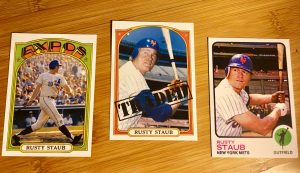 There was only one problem: there was no such thing as a Rusty Staub mitt. Rusty — famously absent from Topps card sets for two years of his Mets tenure — didn’t sell his name for stuff like that. There was only one problem: there was no such thing as a Rusty Staub mitt. Rusty — famously absent from Topps card sets for two years of his Mets tenure — didn’t sell his name for stuff like that.
So my parents made it work. They surreptitiously acquired a generic mitt, a yearbook with Rusty’s facsimile signature, and a leather-burning tool. Then they copied my hero’s autograph and gave me the good news. I was none the wiser, and thrilled. I used that mitt until it wouldn’t fit anymore, and then for a while longer after that.
In addition to being my first hero, Rusty was my introduction to baseball heartbreak. After he was sent off to Detroit, a distant city in the wrong league, I hoarded copies of his 1976 card — the rare baseball card made better by its subject being hatless — and bemoaned that it said he was a Met even though he no longer was. When he came back to New York a few years later I’d become a baseball exile, distracted by new interests and ground down by labor unrest and my team’s bedrock terribleness. It was Dwight Gooden who brought me back to the fold, but I was grateful to return and find the familiar, comforting presence of Rusty Staub.
No, he wasn’t the Rusty I’d loved as a little boy — he was bigger and slower, in fact he was a lot bigger and slower. But he could still hit, and he had that familiar self-possessed calm, an almost-scholarly air of silent readiness. He was the Mets’ secret weapon during that wonderful ’85 season, a pinch-hitter whose success you almost took for granted. I loved reading Keith Hernandez‘s warts-and-all book If at First…, particularly the sections in which he recounted how Staub had been a steadying hand for him. The idea that my favorite player as a boy was a mentor for my favorite player as a teenager struck me as perfect then and still does now. The only thing I was sad about in 1986? It was that Rusty Staub had retired and missed the party.
Except he wasn’t really gone. He became a familiar voice in the TV booth — though much as I loved Rusty, I can’t bring myself to claim that was his forte. And as the years went on, all of a sudden he kept popping up in my life.
I saw him on the street after running a charity race through the Battery Tunnel, one of the many charities to which he contributed so much. I noticed him walking along by himself, did a double take, and then froze. I’m not particularly interested in meeting athletes, but this was Rusty Staub. How could I not shake his hand and say a few words about how much he’d meant to me? Wouldn’t I regret not doing so forever?
So I did. I ran up to him, looking sweaty and mildly insane, but I couldn’t settle for just a few words. I shotgunned approximately 1,000 of them at him in a frenzied minute, somehow working my way around to my parents’ custom mitt, at which point I realized I sounded deeply crazy, gathered myself, and told him he’d been my favorite player as a kid and I’d just had to tell him that. He didn’t break stride — I’m sure something like that happened to him several times a day — but thanked me and said that meant a lot.
Then he seemed to be everywhere. I saw him in the San Francisco airport and managed not to make a pest out of myself that time. In New Orleans a cab driver had played high-school ball against him and regaled me with Staub stories, for which I happily gave him a ludicrously outsized tip. When I started making custom cards for missing Mets who hadn’t got their due, few creations satisfied me more than the cards that filled in Rusty’s missing years.
Now he really is gone, and the world is a far less interesting place. But he won’t be forgotten — not here, or in Montreal or Houston or Detroit or New Orleans. If you haven’t read Greg’s reflection, do so. If you have read it, read it again. Rusty will always be crashing shoulder-first into the outfield wall, pleading with the unruly fans at Shea, flicking a homer over Joe Rudi‘s head, lurking in the dugout, or looking mildly embarrassed but pleased to be surrounded by Mets in flame-red wigs.
And he certainly won’t be forgotten by me. Somewhere in my memory my mom will always be jumping around and cheering for him — a long-ago moment that led to so much else, and that has seen me through so many Opening Days. With so many yet to come.
by Greg Prince on 29 March 2018 9:14 am Few baseball players attracted more nouns than Rusty Staub. Anybody can be described with adjectives. Most players are known simply as players, maybe identified by position. The late Daniel Joseph Staub, who died overnight in South Florida three days shy of his 74th birthday, had that part down cold: right fielder; first baseman; pinch-hitter deluxe. But he was so much more.
Raconteur. Bon vivant. Gourmet. Gourmand. Connoisseur. Philanthropist. Ambassador. New Yorker. Legend.
And, of course, Met.
Rusty Staub was born to be a Met. He had to be, right? He was a George Plimpton character who didn’t have to be invented. Entered this world on April 1, but nobody’s fool. Bare arms. Black gloves. Red hair. Lethal bat. A stroke that could not be easily neutralized. A big man in this town not once, not twice, but forever. Opened a restaurant. Opened another. Traded not on his fame but on his food. Provided ballast for a league champion. Mentored most of a world champion. Spent a decade talking about baseball in the broadcast booth. Devoted himself continually to the aid of others.
A 500-hit man in Houston, in Montreal, in Detroit and in New York. One city couldn’t contain this son of New Orleans, but we got the most of him. We got him when we needed him, in April of 1972. We needed him in our lineup and we needed him to brighten our outlook. We’d just lost Gil Hodges. Rusty told a story about Gil. Rusty told a story about everything, and you were always delighted to listen. The trade that was about to make the most vital of Expos a Met was in progress, but not yet official. Gil knew, but couldn’t say anything when he and Rusty crossed paths in church on Easter Sunday toward the end of Spring Training. Rusty had no idea what was up, but was touched by how much in the spirit of the day Gil was to be so friendly to him, a division rival.
In a matter of hours, Gil was gone. In a matter of days, Rusty was on his team. It was a blur of a time. The manager was taken from us, an All-Star was delivered to us, the game was on hold in deference to a strike. Then baseball came back and, quite suddenly, Yogi Berra and Rusty Staub were leading the Mets into first place.
First place didn’t last in 1972. Rusty was hit in the hand, and that was pretty much all she wrote. But he’d be healed by 1973 and, when he had enough healthy company, the Mets got well. Rusty and his teammates absconded with September. The rest of the National League East didn’t know what hit them. Then the Mets made off with the first half of October despite facing a universally believed better opponent. The believing was definitively on the Mets’ side then. Rusty Staub, too: a homer in Game Two; two homers in Game Three; the day temporarily saved when he crashed into the wall to make a breathtaking catch in the eleventh inning of Game Four. Cincinnati had the Big Red Machine. New York had Le Grand Orange.
He almost won us the World Series. Tried to do it on one shoulder. Batted .423 the only time he went to the Fall Classic. Led us through seven games. The Mets couldn’t beat the A’s in ’73 nor many opponents in general in ’74, but Rusty kept plugging, kept hitting, kept patrolling right, throwing out more runners than anybody else in the league from his station. And in 1975, Rusty grabbed the wheel, driving in more runners than any Met ever had before, 105. No Met was more popular. No Met was more clutch.
Then, because the ballclub he worked for had fallen ever more tightly into the grip of idiots, Rusty Staub was traded to the Tigers. The Tigers’ gain, to be sure. The Mets would keep making trades that baffled the mind and offended the senses. Rusty simply kept hitting. The Mets sadly kept getting worse.
Then we got him again when we needed him again. We always needed a Rusty Staub…make that the Rusty Staub. There was only one. He wasn’t as agile as he once was, but the parts of his considerable anatomy he used to swing the bat functioned just fine. Rusty was two or three rare breeds in one as soon as he settled in for his second Met term: that pinch-hitter you were sure you could count on; that Met who returned to the team and built on rather than detracted from our established memories; and a veteran presence that transcended the clichéd overtones attached to that phrase. Listen to Keith Hernandez. Listen to Ron Darling. Read Dwight Gooden’s autobiography. Rusty guided each of them through their first months and years in New York. He knew the town. He knew the sport. He knew what he was doing.
And he continued to hit. He passed 40 and homered, just as he had before he reached 20. That coupled him with Ty Cobb in the annals of baseball. One late April day versus the Pirates, when Davey Johnson’s options were severely limited, he asked Rusty to do more than bat. He played right and left and right and left — Davey tried to hide Rusty in extra innings from any encounters with fly balls. It almost worked. Rusty had to do some fielding. As with most everything he went after, he accomplished his task with élan.
Players come and go, in and out of lineups, on and off of rosters. Rusty made an indelible impression that only deepened. He may have been the de facto 25th man on the roster by 1985, but there was no forgetting he was waiting on the bench for one more call, one more swing, one more hit among 2,716 collected across 23 seasons. We chanted for him. We stood for him. We applauded him right up through his final at-bat in his final game, October 6, 1985. His groundout ended his career as well as the greatest season a Mets club that didn’t win admission to the postseason ever had. The Mets would keep climbing without him in their immediate ranks.
Still, we held on to him. The first place by a mile Mets had a day for him in 1986. His former teammates wore orange wigs and white visors bearing his restaurant’s logo. A couple of months later, he was inducted into the Mets Hall of Fame, alongside Buddy Harrelson, in the first class devoted strictly to players. They were both born to be Mets. It just took Rusty a little longer to find his way home.
Rusty kept cooking in Manhattan. He kept talking in Queens. Eventually he gave up both gigs, but he remained around. He took care of the families of fallen cops and firefighters. There were a lot of people to take care of after September 11, 2001. Rusty’s foundation looked after each of them. His barbecues on their behalf at Shea and Citi were enormous annual events. His fellow MLB alumni benefited from his attention, too. And if you were lucky enough to meet Rusty during the three-plus decades during his retirement from playing baseball, you came away utterly enhanced by the experience.
He was Rusty Staub. He was something.
by Greg Prince on 28 March 2018 2:35 am Pitchers and catchers reported to Mets camp on February 12. Position players, if they weren’t already on hand, checked in on February 17. The first full-squad workout under the auspices of new manager Mickey Callaway was February 19. Exhibition games began on February 23.
On March 13, 29 days after the 2018 Mets commenced the process of evolving from amorphous concept to tangible entity, the first cut of Spring Training was revealed. The Mets were dispatching to the minor league side of St. Lucie…outfielder Tim Tebow.
They required a full month of baseball activity to decide to demote a football player. The entertainment business is funny that way.
Roster wheels grind slowly, but they do grind. Ground up moments after the Tebow news broke (because everything related to Binghamton-bound Tebow is considered news) were more minor league cuts: Kevin McGowan and Jamie Callahan, who we saw pitch for us last season, and Marcos Molina, Corey Oswalt and Gerson Bautista, who maybe we’ll see pitch for us someday. The next day, six more players were told for sure they wouldn’t immediately be making the Mets: 2017 contingency starter Chris Flexen, plus pitcher Tyler Bashlor; first baseman Peter Alonso; outfielders Zach Borenstein and Kevin Kaczmarski; catcher Patrick Mazeika; and third baseman David Thompson.
The Mets continued to play games that didn’t count, often deploying players they weren’t counting on anyway, including some of the above. Nobody minds in Spring Training. Games have to get played if not completed. There were three ties.
On March 20, the Mets deleted ten more players from their imminent plans, including three with a Mets past — second baseman Gavin Cecchini, utilityman Ty Kelly and outfielder Matt den Dekker — along with seven others of varying backgrounds and foregrounds: pitchers P.J. Conlon, A.J. Griffin, Matt Purke, Drew Smith and Corey Taylor; infielder Luis Guillorme; and catcher/erstwhile enemy of the people Jose Lobaton. Three days later, two 2017 Mets were instructed to take a similar short hike: catcher Tomàs Nido and everybody’s favorite point man, reliever Hansel Robles.
All that was left to do by March 24 was sort out who was injured and who wouldn’t be in the rotation. The former group encompassed non-surprises Rafael Montero, David Wright and T.J. Rivera and better safe-than-sorry guys Jason Vargas and Michael Conforto. Dom Smith seems destined for both the DL and AAA. Zack Wheeler is healthy but not deemed major league-caliber at this time.
The part of Spring Training devoted to weeding out who wouldn’t be a Met was complete. So was the part in which those who would be Mets were prepared to be Mets, either for the first time or yet again. Hence, step right up and greet your first-edition 2018 New York Mets:
Syndergaard and Plawecki.
DeGrom and d’Arnaud.
Gonzalez, Cabrera, Rosario and Frazier. Cespedes, Nimmo and Bruce.
Reyes. Flores. Lagares. Evans. (Every non-catcher likely to sit on the first Met bench has a name that ends in an ‘s’.)
Harvey, Matz and Lugo.
Gsellman and Rhame.
Sewald and Swarzak.
Blevins.
Ramos.
Familia to close things out, unless something goes awry or Callaway gets creative.
That’s 25. That’s a roster. That’s the Mets on the eve of when we shall need Mets. All we need now is a season. One of those, per the forecast of an optimistic orphan named Annie, is only an Opening Day away.
We can’t do anything about the weather beyond hoping the sun will come out tomorrow and that rain will stay at bay. The temperature will peak nowhere near that which measures as comfortable, but when was the last time you heard of the Mets postponing a game due to cold? Barring torrents of precipitation, they will play. They will win or perhaps lose. They will be One and Oh, which will match the greatest late-March/early-April feeling you’ve ever known, or they will be Oh and One, which won’t be remotely as great, but will beat the hell out of the Oh and Oh we’ve been stuck on since last autumn’s universal reset.
The Mets played 31 Spring Training games. Their record was 10-18-3. I note that here in the event that next February it’s wondered how the Mets did last Spring. Nobody will remember. We will be correct to have forgotten. It won’t matter by then. It no longer matters now. It didn’t matter while it was going on. We passed the competitively inconsequential time monitoring the professional dips in the road encountered by the Tebows, the Coreys and so on. Their performance within those games that nobody will remember may have been consequential to organizational perceptions of their development, but not very telling to the rest of us. Depending on your ballplaying classification, the downside of getting invited to Spring Training is getting invited out of Spring Training before Spring Training ends.
Eventually, we got our men, all 25 of them. We were pretty certain of the identities of the vast majority going in, but Spring Training is a well-established, long-ass ritual that must be abided. The least we can do is act as if we’ve learned something profound when told Phillip Evans and Jacob Rhame have made the squad.
The 25-man roster we took six weeks to fully confirm will have its episodes of attrition and replacement. Several of whom we said “so long” to in March we’ll say “hey” to sooner than we anticipate. Knock wood, we stand to get Vargas and Conforto back ASAP if not ASAP enough. We stand a decent chance of getting to know lefty reliever Fernando Abad and outfielder Bryce Brentz, two major league veterans snagged for presumably minor league purposes just as the Mets were boarding the last Delta out of West Palm. There’ll be downs, countered by ups. The Mets started 2017 with a 25-man roster. By the time they ended 2017, there had been 52 Mets.
It was like looking in a funhouse mirror, except without the fun.
The 2017 Mets are gone. Never mind that 22 of our first 25 2018 Mets were 2017 Mets. That can no longer be held against them. These Mets of this brand new year are Oh and Oh on March 28, the last day that Oh and Oh is the best we can hope for.
by Greg Prince on 27 March 2018 5:16 pm While you’re waiting for 2018 to commence in earnest, or should you find yourself jonesing for compelling content amid the plethora of upcoming off days (why have off days when we just had an offseason?), I suggest treating yourself to some quality streaming, courtesy of Nine Network of Public Media, the St. Louis PBS affiliate. On their Web site, you can access The St. Louis Browns: The Team that Baseball Forgot, a wonderful documentary that sentimentally remembers one of the town’s baseball teams, the one few outside of St. Louis invoke anymore.
To be fair, it’s tough to generate too many thoughts in 2018 regarding the St. Louis Browns, a franchise that changed its name and address in 1954. They just don’t come up in internal conversation all that often without a reason. Until very recently, the last instance in which the Browns crossed my mind more than incidentally — and one of the only times it ever happened — was in the winter preceding the 2016 baseball season, specifically Super Bowl Sunday. Jonathan Schwartz, then with WNYC, was airing his annual Salute to Baseball, blending long-ago play-by-play, the host’s wistful musings and the best music ever made about the best game ever invented. Some of the song choices were more predictable than others. A pair of lines from one song wasn’t.
“The St. Louis Browns were a baseball team. And they lost more than the Mets could ever dream.”
Browns versus Mets. An unlikely matchup, albeit not fully unprecedented when you consider bloodlines of postseason rivals once removed. Never mind the nostalgia that in 1972 fueled singer-songwriter Skip Battin to record an ode to a ballclub that was already more than half-forgotten. America was just getting the hang of nostalgia as a going concern in 1972. Battin released his number the same year Roger Kahn published The Boys of Summer. The Brooklyn Dodgers went on a decades-long retroactive winning streak, clinching first place in the warm memories division. Battin’s best efforts notwithstanding, the St. Louis Browns forgottenness quotient only expanded.
They did, however, rate a mention in another nostalgia-rising period classic, The Great American Baseball Card Flipping, Trading and Bubble Gum Book by Brendan C. Boyd and Fred Harris. Unsurprisingly, it was unflattering. In assessing the family structure of the early 1950s American League, the authors pegged the Browns as “the stupid distant cousins,” which may or may not have been worse than how outsiders saw the hapless Mets of the early 1960s. He may have grabbed a few winks on the bench, but nobody ever accused Casey Stengel of stupidity.
Despite the desire to compare the historic levels of losing committed by the Browns to the early if profound stumbles of our Mets, the ballclubs crossed paths at their heights…if you want to take a leap roughly the distance that the Browns took when they moved to Baltimore after 52 seasons in St. Louis. In October of 1969, the New York Mets took on and defeated the direct descendants of the St. Louis Browns for the championship of the world.
Of all the many millions have words that have been devoted to the 1969 Mets, I’ve never heard or read anything that brought the Baltimore Orioles’ St. Louis lineage into play. I never thought of it myself until maybe a week ago. No wonder. By 1969, there was no visible connection between the Browns and the Orioles. Sixteen years had passed since the last Browns game. They moved and disappeared in a way none of the other franchises that shifted in the ’50s so thoroughly disappeared from the scene. The Dodgers, the Giants, the Braves and the Athletics each pulled up stakes, taking their identity with them. To this day, in Los Angeles, San Francisco, Atlanta and Oakland, homage gets paid to the ancestral players and records. Whoever did the packing for the Browns left their name off the truck. Baltimore had the Orioles in the 19th century and they were delighted to revive their heritage in the middle of the 20th.
The Orioles could be accused of being the former Browns in their first season. They went 54-100 in Baltimore, same as they’d gone 54-100 in St. Louis a year earlier. Then they got rid of as many former Browns as possible. Among the handful of Brown-tinged facts I gleaned as a religious reader of Baseball Digest in my youth (George Sisler collected 257 hits in 1920; the World Series was an all-St. Louis affair in 1944; Pete Gray played the outfield with one arm as World War II dragged on; Satchel Paige brought his legend to bear; Ned Garver won 20 while his team lost 102; try-anything Bill Veeck signed 3’ 7” Eddie Gaedel to pinch-hit) was the post-Brown Orioles made a 17-player trade with the Yankees after finishing last in 1954. Among those the Orioles sent Bronxward were erstwhile Brownies Don Larsen and Bob Turley. Larsen pitched a perfect game to help the Yankees win one World Series; Turley won 20 games en route to the Yankees winning another World Series. While the Yankees were augmenting their jewelry box, the Orioles were content to shed most of what was left of their lingering Brown aura. “By the middle of the ’56 season,” John Eisenberg wrote in his 2001 Oriole oral history, From 33rd Street to Camden Yards, “all remnants of the St. Louis Browns were gone.”
From a Baltimore perspective, the future was all that mattered, and the Orioles eventually developed a practically dynastic one. But without any players staying on and without the name in regular use, who besides Skip Battan and the editors of Baseball Digest would make a point of keeping alive the memory of the St. Louis Browns?
The only contemporary reference point we have is the Montreal Expos, who themselves stopped existing fourteen years ago, close to the amount of time that lapsed between the Browns leaving St. Louis and the Orioles losing to the Mets. The Expos may not be active at the moment, but they haven’t completely flitted from our collective subconscious. We are programmed differently today. We do nostalgia as a matter of course. We go to YouTube and marvel at the kinds of musical tributes we no longer need a radio host to play for us annually. We offer opinions on ex-Expos and their Hall of Fame plaques. We snarl at the ingrate Washington Nationals for not doing more to tip their caps to those who wore their franchise’s previous caps (though we, as Mets fans, snarl at the Nationals at the drop of a deciding NLDS game). We keep tabs on the last Expo still active in the bigs (Bartolo Colon is hanging on in the Ranger rotation) and a few other stragglers (final Expo outmaker Endy Chavez is a Somerset Patriot; 1995 draft choice Tom Brady is a New England Patriot). Those of us who retain a soft spot for what we hazily remember as unique to MLB between 1969 and 2004 get a kick out of the annual Olympic Stadium series the Blue Jays host on the eve of the next season. And I think we all wish Montreal luck in their quest to rejoin the major leagues.
When a team name is dispatched to the circular file, it’s challenging to fish it out or do any kind of makegood. The Washington Senators vanished twice, but were always replaced (sometimes it took a while). The Seattle Pilots vanished, but they were replaced in their city and, more importantly, live on in Ball Four. The Browns, though, despite Skip Battan’s song and the efforts of some dedicated preservationists, got next to nothing of substance until this new documentary. And what they did get, they received from the team that shoved them onto their eastbound path.
You don’t get three minutes into the PBS film about the St. Louis Browns until the St. Louis Cardinals poke their head into the narrative. Well, of course they do. This is a St. Louis production (even the narrator, Jon Hamm, is a Cardinal celebrity fan). They can’t talk baseball out there without the Cardinals, and it seems difficult to tell a Browns story without nodding to the survivors. St. Louis may be considered a quintessential baseball town, but it was never going to be big enough for two teams in the long haul. The Browns had the edge until the middle of the 1920s. The Browns owned the ballpark both teams called home. But the Browns stood forever on shaky ground until the ground gave way. They couldn’t beat their National League counterparts in the ’44 Series and they couldn’t beat them at the turnstiles. Dust settled, Cardinals remained.
With the Cardinals on deck as the Mets’ first opponents of 2018, I’d like to take a gratuitous shot at the Cardinals. As with the Nationals, we rarely need an excuse. But it’s nice what the Cardinals do where the memory of the Browns is concerned. They exhibit Browns memorabilia in their museum. They present a Sisler statue outside Busch Stadium. They invite the still vital St. Louis Browns Fan Club to their winter fanfest. Their owner, Bill DeWitt, was a Browns batboy, though he had to know somebody to get the gig. He did — his father (also named Bill DeWitt) was one of the club’s pre-Veeck owners. When little Eddie Gaedel needed a uniform for his only big league plate appearance, he used the junior DeWitt’s.
Perhaps its fitting that the Blue Jays are taking on the Cardinals in Montreal this week, two teams briefly brandishing a torch on behalf of their fallen regional rivals before getting back to baseball that counts, without Expos, without Browns.
___
As long as we’re magnanimously linking the words “nice” and “Cardinals,” I’ll allow that it’s nice to see the Mets opening their season against the Cardinals. It feels traditional. It reminds me of all those Opening Days when Tom Seaver faced off against Bob Gibson, never mind that Tom Seaver and Bob Gibson never faced off on Opening Day, because during the time they overlapped as mound masters, the Mets and Cardinals never opened the season in tandem. Seemed like they did, though. I’m probably thinking of how the Mets and Cardinals shared St. Petersburg all those years, usually kicking off their exhibition slate against each other at Al Lang, one team the home team one day, the other the home team the next.
Gibson most definitely opened the Spring schedule against the Mets in 1968, responsible for one of the few legitimately memorable (and truly unfortunate) moments in Mets Grapefruit League history. The first batter Gibby faced was the Mets’ new leadoff hitter Tommie Agee. Gibson infamously came in high and tight on Agee, beaning him on the helmet, inflicting the White Sox import with a concussion. Tommie never really recovered his batting eye that season. Gibson being Gibson, it was assumed fifty years ago that Bob was simply welcoming Agee to the National League.
(Concussion protocols apparently weren’t taken all that seriously in sports fifty years ago.)
In 1980, recollecting on his career with Roger Angell, specifically the day he knocked down Agee, Gibson implied hitting a batter in the body was fair game, adding, “It’s a lot harder to hit him in the head. Any time you hit him in the head, it’s really his own fault. Anyway, that was just Spring Training.”
Yet somebody, per Gibson’s memory, kept track of these sorts of wayward pitches from games that didn’t count. “I did throw at John Milner in Spring Training once,” Gibson told Angell. The pitcher didn’t like the way Milner swung — “that dive at the ball. […] it doesn’t show any respect for the pitcher.” So Gibson took care of business in that way baseball people have praised Gibson for taking care of business for a half-century. Also taking care of business was Gibson’s opposite Mets number:
“So I got Milner that once, and then, months later, at Shea Stadium, Tom Seaver began to pitch me up and inside, knocking me down, and it took me a minute to realize that it must have been to pay me back for something in Spring Training. I couldn’t believe that.”
___
Maybe the Mets and Cardinals were bound to get on each other’s nerves having spent so many weeks in proximity in St. Pete. Long before Seaver showed up in any Mets camp — and before Gibson was automatically the pitcher a Cardinals manager would turn to start a season — the two clubs not only shared a Spring Training base, but one helped the other begin its life for real. Some help. The Cardinals were the Mets’ first Opening Day opponent, which is to say the Cardinals were the Mets’ first opponent ever. If you know your 1962 as I’m sure do, you can infer the Cardinals, playing at the first Busch Stadium (formerly Sportsman’s Park, formerly property of the Browns), whacked the Mets good, 11-4, behind budding Met-killer Larry Jackson. One loss down, 119 to go, including the first nine overall. Thanks for the shove, Cardinals. Now we know how the Browns felt.
As if they hadn’t seen enough of each other by then, the Mets and Cards hooked up again to start the 1963 season. More not great times for New York, though at least they were in New York. At the Polo Grounds, Ernie Broglio and the Cardinals throttled the Mets, 7-0. The Mets were headed in the wrong direction once more, losing their first eight and 111 overall. Somehow the Cardinals convinced themselves to part with Broglio a year later in order to secure the services of Cubs outfielder Lou Brock.
Brock, like Gibson, would craft a Hall of Fame career as a Cardinal, but neither would display his talents versus the Mets on Opening Day. Despite their St. Petersburg connection and the scheduling precedent set at the outset of the first two Met seasons, there were no more Mets-Cardinals Openers during the rest of the 1960s, any of the 1970s, nor the first half of the 1980s. It wasn’t until 1985 that Opening Day again meant Cardinals versus Mets.
The meaning got much better than it was at the time of the franchise’s birth. The 1962 Mets didn’t have Gary Carter. The 1963 Mets didn’t feature Dwight Gooden. The 1985 Mets trotted both out, sixty feet, six inches apart at Shea Stadium. With Gooden pitching and Carter catching — as well as swinging and belting the game-winning home run in the tenth inning — the Mets began to get even with the Cardinals.
They haven’t stopped. After Kid (who is scheduled to be the subject of his own documentary on SNY, 6:30 this Thursday night) took it to Neil Allen to allow the Mets to prevail, 6-5, the Mets won the second game of the season, completing a series sweep. The tone was set for all Mets-Cardinal opening rounds forever more…pending what happens later this week.
Seriously, we’re on a roll against the Cardinals when it comes to getting out of the gate. We won, 8-4, on Opening Day 1989 (HoJo homered and Don Aase supplanted Tommie Agee in the Mets’ all-time alphabetical leadoff position). We won, 4-2, on Opening Night 1992 (Bobby Bonilla went deep twice, ensuring we’d embrace him into eternity). We won, 7-6, on Opening Day 1996 (one of the few instances of defense trumping offense in the so-called Steroids Era, as Rey Ordoñez’s dazzling throw home from his knees to nail Royce Clayton obscured the Mets’ comeback from a six-run hole). And we won, 6-1, on Opening Night 2007 (an ESPN affair framed as a rematch of the 2006 NLCS, which we tied at four games apiece, apparently). That brings us to a five-game Opener winning streak at the expense of the Cardinals, not to mention every opening series versus the Cardinals either won or split since 1985.
Plus we won the Keith Hernandez trade. We won it as soon as Keith put on a Mets uniform in 1983 and we won it again with Carter’s blast off Allen. So, yeah, I’d say we’ve done a decent job avenging the wrong feet we got off to in ’62 and ’63.
Feels good knowing that, doesn’t it? We dislike the Cardinals in a way we dislike nobody else. To paraphrase from Full Metal Jacket, we dislike them long time. We still dislike them despite not having shared the same division with them since 1993. We still hold 1985 — after early April — against them. We still hold October of 2006 against them. We still resent Yadier Molina’s continued insistence on excelling. We still gloat about the Keith Hernandez trade. We can add the Cardinals’ squeezing the Browns out of town to or list of grievances if we wish just to be thorough.
Yet — and I don’t usually go for this sort of thing when it comes to old-line opponents whose success speaks overbearingly for itself — I dislike the Cardinals while maintaining an embedded core of respect for the whole Cardinal thing. I probably wouldn’t have been happy picking up the next day’s papers in the spring of ’68 and reading about Gibson plunking Agee, but how do you not respect Bob Gibson? Or Lou Brock? Or Stan Musial? Or (despite his role in spoiling the ending of 1985) Ozzie Smith? Despite the worst efforts of the worst of their worst fans, how do you not salute the better angels of Cardinals fans on their good days? The monochromatic aesthetic isn’t my thing, but everybody wanting to all wear red together 81 times a year says something about allegiances. They seem to get baseball as a people. I try to judge other tribes on their best feet forward. Based on my personal interactions, they take some honorable steps along the way.
Bonus points for the Sisler statue and the Browns stuff in the museum. The Cardinals could be myopic about St. Louis baseball history, but they’re not. The DeWitts make telling the franchise’s and the city’s story a priority. Any fan of any team should appreciate that.
I still dislike the Cardinals. I’ll hate the Cardinals this Thursday, Saturday and Sunday, with the off day Friday given over to recriminations as necessary. Then I’ll get on to hating the Phillies. I can hate any team the pocket schedule tells me to. But I have to hand it to the Cardinals for achieving the kind of success the Cubs and Astros have achieved lately without having to resort to the determined losing the Cubs and Astros undertook to achieve it. It’s news when the Cardinals don’t make the postseason. It’s shocking if the Cardinals don’t finish over. 500. They haven’t finished under .500 since 2007 (served them right after 2006). They haven’t finished under .500 in consecutive seasons since strike-shortened 1994 and 1995. They haven’t finished under .500 in as many three consecutive seasons since the Browns were the sultans of St. Louis, which is to say the Cardinals don’t do tanking. They rebuild in plain sight.
___
“The Cardinals Way” is a loaded phrase, but The Cardinals Way by my friend Howard Megdal is a fine book that examines how St. Louis stays St. Louis year after year. No matter that the Cubs and Astros have perfected new Ways to be (and many in baseball are salivating over certain franchises innovating the concept of adding one 50+ HR slugger to another). Howard’s book from 2016 remains compelling reading no matter how much you dislike the Redbirds. The second chapter alone, devoted to the teachings of longtime instructor George Kissell, is worth the price of admission. Kissell, according to everybody he touched, embodied The Cardinals Way. You might have heard Hernandez attest to his impact during SNY broadcasts. Keith’s testimony is included in the Kissell chapter, as is a passage in which another Cardinal-cum-Met, Joe McEwing, shares some Super memories of one of baseball’s all-time teachers. Many who’d been Redbirds do. “The language of Branch Rickey,” Megdal writes, is also “the language of George Kissell. And it’s how the Cardinals talk to each other and have for nearly a hundred years.”
Hard to not respect that kind of consistency. But we’re welcome to dislike the results. We wouldn’t be Mets fans if we didn’t.
by Greg Prince on 24 March 2018 8:27 pm Spring Training games so brim with pointlessness that my subconscious had to invent a meaningful game to fill the pre-March 29 void. Actually, I don’t know what meaning there was in this baseball game of which I dreamt earlier this week, but it did happen. In my dreams, I mean.
I dreamt R.A. Dickey was a Met again. This was surprising news to me in the dream. Throughout the dream, including the parts where I half woke up and 90% understood everything I was deconstructing was, in fact, a dream, I kept wondering who had suffered an injury to necessitate the signing of Dickey. You dream about Mets pitchers, of course there’s going to be an injury. My guess was Harvey; I never got further in my calculating how the rotation now shook out than there was deGrom and Harvey and something must have gone wrong. Maybe I heard Gary Cohen say R.A. Dickey was signed to replace Matt Harvey over the loudspeakers in the dream (I definitely heard Gary doing play-by-play). Maybe I had just deduced the transaction’s genesis on my own.
The game Dickey was pitching in my dream was a home game, but it wasn’t at Citi Field. It took place in my hometown of Long Beach, not at a ballpark, but across the length of a somewhat recognizable boulevard. Though it wasn’t the exact boulevard that I remember housing an Orthodox shul, I seemed to be watching the game, such as it was, from around the corner of that shul. I was watching from above, like on a porch, somewhere between home and third. There were fans, but no stands per se. The closest thing I could compare it to is how everybody gathered off to the side of the train tracks in The Natural to watch young Roy Hobbs strike out the Whammer, though less bucolic.
But this was an actual game. Mets vs. Braves, second game of the regular season, presumably this season. It was being broadcast over SNY (thus Cohen’s voice). Home plate was more or less on the east side of the boulevard, second base on the west side. There were houses behind second base, or maybe that was the outfield. I think the width from third to first stretched more than the regulation 180 feet. There was no grass. They played on asphalt.
The backstop was the wall from that shul I noted. Either Travis d’Arnaud was catching, or the strike zone was painted onto the wall à la the brand of stickball we played when I was a kid. One of the strikes Dickey threw, more an eephus pitch than a knuckleball (but it was identified as a knuckler by Cohen and perhaps Ron Darling), clocked in at 18 miles per hour. Whoever was at bat for the Braves swung through it. Many oohs and aahs ensued. There might have been another pitch similar to it. I seem to recall assuming it would be another strike and that Dickey would be unhittable, but I also remember being worried that R.A.’s 18 MPH stuff was suddenly hittable and was mad at myself for making assumptions.
I should also mention that R.A. wasn’t dressed in a Mets uniform, but in a black suit, white shirt and bolo tie reminiscent of a 19th century Old West preacher. Or what I imagine a 19th century preacher man wore. He also wore a flattish, wide-brimmed black hat that fit with that motif. Maybe Amish would be a more precise reference point. Given that he was not wearing any clothes that suggested baseball, I was thinking that perhaps R.A. was the star attraction of a barnstorming exhibition. Come to think of it, other than d’Arnaud, I don’t remember any other specific Mets around. Indistinguishable teammates were there somewhere, I’m pretty sure. Maybe Wright was stationed at third. Let’s say he was.
It was nice to have R.A. back on the Mets for however long this dream went on, despite the unusual atmospherics I encountered (as well as my concern over who was injured). I am at a loss to trace this dream to an incident or thought I had prior to the chunk of sleep I undertook. As Spring Training was starting, I quietly hoped the Mets might invite R.A. to camp, seeing as how he was unsigned and they could have used a veteran, but then they inked Jason Vargas and I forgot about it. I did recently catch the final moments of the Mets Classic in which R.A. becomes a 20-game winner, and I was overcome by the notion that we will never fully let go of pitcher wins as a statistic because the emotion attached to a numerical achievement like that resonates so resoundingly. We stayed at Citi Field that afternoon following the last out to continue applauding R.A. and to chant his and Cy Young’s name. It was huge that somebody like R.A. Dickey won a 20th game. We’ll never stand and cheer for minutes on end in acknowledgement of a pitcher passing 8.0 in WAR or whatever would be considered a phenomenal ERA+.
But I doubt that weighed terribly deep in my subconscious directly in advance of my dream. And I don’t think I’m walking around Field of Dreams-style stressed deep down about easing Dickey’s pain. No, he never did sign with anybody this spring and, from what I can tell, he’s done pitching. I can’t speak for R.A., but I experienced my closure on his behalf last September when he left the mound at Citi Field and tipped his cap to Mets fans despite wearing a Braves uniform. That was his last time pitching, which seemed like the way to go out. He wore the uniform of the team he liked when he was a kid, and he was in the ballpark where he experienced his professional rebirth.
So why did I dream of 19th Century Old West Preacher Man R.A. Dickey throwing an 18 MPH eephus pitch against the wall of an Orthodox shul a handful of blocks from where I grew up?
Damned if I know.
___
The dream we all dreamt, wherein Syndergaard would give way to deGrom, then Matz, then Harvey, then Wheeler, then we’d look back on five games started by the five locally sourced prospects whose futures we nourished in the minors for years…well, that one’s as likely to take place as the game I saw in my subconscious. While his presumed rotationmates spent the past several weeks honing themselves for the National League season ahead, Zack Wheeler won himself a trip to Las Vegas, which sounds like a grand prize unless your goal was to be a New York Met on or slightly after Opening Day.
Zack’s spring was not the stuff Mets fans dreams were made of. It’s way too early in the year and the Mickey Callaway regime to jury-rig the rotation to give us our Big Five medal just for the sake of saying it has happened. It won’t, not in the immediate future. Seth Lugo is the provisional fifth starter, and Jason Vargas, despite his being a Mets pitcher with an injury, likely won’t be out forever.
(Always use phrases implying “barring injury” when referring to Mets pitchers doing anything from tying their shoes to throwing their sliders.)
I’m not overly distraught that we won’t get the alleged five aces going in succession. I mean, yeah, sure, it would have been swell, but I never heavily anticipated a shall we say dream scenario involving both Matz and Wheeler until somebody took their picture in the company of the other three a couple of springs ago. If you rewind our idealization a half-decade or more, you’ll remember Harvey and Wheeler loomed as our Big Two in waiting, the promising righties we couldn’t wait to get a glimpse of from St. Lucie. Syndergaard, not long after we learned to spell his name post-Dickey trade, dripped with that kind of cachet as well. DeGrom lurked a littler further down in the scheme of things — below the Montero Line — but he bubbled up fast enough.
Matz, despite he and I both being Long Islanders, didn’t exist on my radar until 2015. Like deGrom, he was a young Tommy John patient. Unlike deGrom, I managed not to have heard of him when he was in the mid-minors, not even a little bit. He healed and progressed without my observing it, and good for him for overcoming the obstacle that was my obliviousness. The big deal in ’15 was bringing up Thor in May. It took a while for our impatience to crest to Matzian proportions. Then Steven, who was gaining everybody’s attention in Las Vegas, made his pitching/hitting splash in late June and we retrofitted him into our previous long-term plans.
Which was where Wheeler planted himself from the time we traded for him in 2011. As we’ve noted on previous occasions, it was a genuine milestone in the life of the franchise when Zack was called up in 2013. It was a stat-letter day when he got his first win. We proudly marked every inch of his growth on the wall of the family room the way we also do for prospects whose progress we follow anxiously and lovingly. Wheeler didn’t develop as spectacularly as Harvey, but he was coming along just dandy.
Then Zack Wheeler met Tommy John, and things haven’t been the same since. His biggest moment as a Met, once he was scratched from a Spring Training start three Marches ago, came when he asked Sandy Alderson, fresh from not trading Wilmer Flores, to not trade him, either. It was touching, if a footnote to all the tears of joy we were on the verge of shedding in 2015. The Big Four of Harvey, deGrom, Syndergaard and Matz carried the ball that October. Not pictured: Zack Wheeler.
When we started seeing the Mets pitching depth illustrated by photograph the next spring, we counted six arms. Colon was still around (and growing dangerous with the bat), so you couldn’t leave him out. And Wheeler was, I inferred, grandfathered into the big picture. The first Met to be born in the 1990s, the second projected Met ace to debut in the 2010s, deserved more than afterthought status, but he also had to get better and pitch well. He wasn’t able to do either for two full seasons. In the interim, the organization mutedly unveiled the unheralded Seth Lugo and Robert Gsellman, each of whom, unlike Wheeler, contributed substantively to a successful Mets playoff drive. It took until 2017 to get the faded phenom back on a mound for real — and not much more than a half-season to sideline him again.
Zack is a very likable character and is forever embedded within a tantalizing storyline, thus I shall continue to root for him to fulfill his (and our) destiny. I really thought he was on his way to legitimately big things circa 2014. I also thought he had scaled his most daunting hump just by returning to the bigs last year. Maybe he’ll find his way back once more in 2018, but it won’t be via direct route. Throwing fewer pitches per batter would be a great first step. I guess going to Vegas — known for many pleasures, throwing a baseball not among them — is intended to point him in that direction.
The one thing every conceivable 2018 Mets starting pitcher has in common (including Dickey, who, after all, I conceived pitching for the current Mets in my dreams) is not having been launched into his first start as a Met from an Opening Day roster. Vargas started his lone prior Met season, 2007, as a New Orleans Zephyr. Harvey, like his rookie-season teammate Dickey did two years earlier, began his break-in season, 2012, as a Buffalo Bison. Everybody else spent more time in Las Vegas than any of them (or us) desired. The pitchers whose futures were fussed over, including Wheeler, had to be kept far from Flushing so their Super Two status wouldn’t get the best of the front office. Each fella who wasn’t a Super prospect simply didn’t rate a promotion until injuries made his respective presence necessary. Decisions made on March 24 by no means lead to the same five pitchers earning decisions every fifth day from March 29 forward. Or have you not met the New York Mets?
All we can do in spring is dream of indestructible starting pitching. Reality inevitably has its own ideas.
by Greg Prince on 22 March 2018 9:09 pm They scheduled a baseball game in the northeastern United States for March 29 and snow was on the ground within a week of its first pitch. Imagine that. You’ll have a harder time imagining the baseball being played under climate conditions ideally associated with the sport in question, but bundle up and begin picturing the game that’s coming. Barring snowout, rainout, chillout or (shiver) blowout of a vital ligament à la what’s happened to Rafael Montero, we know that somewhere within the shadows frosting Citi Field on Thursday, March 29, Noah Syndergaard will throw the first pitch of the 2018 season.
And he’s “super jacked” to do it, according to himself and his own sense of occasion, which I heartily applaud. The hell with “it’s an honor, but it’s just another game” or bland words to that effect. Thor embraces being Thor, and Thor embraces being the Opening Day starter: “It’s just a great feeling, second year, starting Opening Day and coming out of the gates hot.”
Noah also offered up some blandness so nobody handing him the ball would regret the choice: “It kind of benefits me to just go out there and pretend it’s another game. I feel like we kind of put it on this pedestal,” he said upon accepting his assignment, before throwing together the best of both attitudes: “The hype gets a little overwhelming, the same thing with playoff games, Wild Card games. It’s just another game of baseball.”
Thor would know, for he has pitched all of the above, generally living up to the hype. He is the only pitcher in Mets history to start a Wild Card game. He is the first starting pitcher in Mets history since Al Leiter to have pitched in multiple Met postseasons. Matt Harvey, Jacob deGrom and Steven Matz, his compadres from 2015, were all on the shelf by the fall of 2016. Had the Mets won that 2016 Wild Card game of his and moved on, he’d have been blending his talents with an entirely different cast (as Bartolo Colon was a bullpen inhabitant during the ’15 postseason). The Mets didn’t advance, but there is no blaming Thor. He was The Man in that game, particularly if you watched only the tops of innings and then turned the whole thing off after eight. Even given his team’s eventual bottoming out versus Madison Bumgarner, Thor etched his name into the annals of Mets big name pitchers for the ages that night and, after largely carrying the Mets rotation from April to October, totally deserved the Opening Day start that followed in 2017.
One year later…sure, why not? In one of those facts that’s repeated so often that it’s no longer fun to invoke, no Mets pitcher has started consecutive Opening Days since Johan Santana in 2008, 2009 and 2010. Because Johan was recovering from anterior capsule surgery, Mike Pelfrey emerged from the All Other pile to toss the first horsehide of 2011. Pelfrey, who has lately slipped into MLB retirement and taken up college coaching, was coming off a 15-9 season, which certainly looks Opening Dayworthy in a vacuum. No chance he would have gotten near the ball on the night the Mets began 2011 had Johan been healthy, because Johan was Johan, very much The Man, and even if Johan hadn’t thrown a single major league inning the year before, you’d give Johan the ball to start the next season.
That’s exactly what Terry Collins did in 2012. Santana was out all of 2011, but it didn’t matter. Johan was an ace deluxe and resumed his reign in style on April 5, 2012, throwing five shutout innings against the Braves at Citi Field. He didn’t get the decision — it went to the immortal Ramon Ramirez — but the Mets won, 1-0, thanks to David Wright’s sixth-inning RBI single.
Santana starting, Wright hitting, the Mets winning on Opening Day. Talk about Baseball Like It Oughta Be. As midseason Wrigley Field attendee Ferris Bueller once reminded us, life moves pretty fast. If you don’t stop and look around once in a while, you could miss it.
Eventually we’d be missing Wright (the missing still in progress) and very soon we’d be missing Santana, who would be done pitching as a major leaguer by August and hence be unavailable on April 1, 2013, when his traditional first turn in the rotation came up. Thus began the parade of Ones who were soon done as Opening Day starters: Niese, Gee, Colon, Harvey. They all made a certain kind of sense in context, though none was a fella you’d automatically tab after pitching no innings the year before. (Harvey missed all of 2014 and had to wait for the third game of 2015 to make his next start.)
The closest the Mets have had to that kind of Johanian presence since Santana, apparently, is Syndergaard, because Mickey Callaway is giving the ball to a guy who threw all of thirty-and-a-third innings last year. Next to Santana in 2012, that looms as the fewest innings a Mets Opening Day starter has come off of from the previous year. Prior to Johan setting a standard that can not be undersold — try pitching fewer than 0.0 IP — the record was held by 1982 Opening Day starter Randy Jones, who threw a scant 59.1 innings in 1981. A 1981 sighting should always set off your sensors, given the strike that split what is normally a 162-game season into two chunks of barely more than fifty apiece. There’s more to the Jones aberration than the strike, though. Even with the ruptured asterisk glued to the Humpty Dumpty of baseball years, understand that Jones missed time to injury in 1981 (cruelly and ironically spraining an ankle during a hastily arranged exhibition game in Toronto to prepare for the second half), and he wasn’t supposed to be the 1982 Opening Day starter.
“Supposed to” is a loaded phrase when it comes to the Mets and pitching.
Nineteen Eighty-Two was the year snow fell in spring, not near the baseball season, but on the baseball season. New manager George Bamberger’s best laid plans to go with Pat Zachry wound up buried under a cold, white blanket. Not that Zachry was the perfect choice to lift the lid on 1982, either. Pat hadn’t thrown as many innings as Bambi would have preferred during Spring Training, but he was slotted for Opening Day. Then it snowed a ton in the Northeast, which not only postponed the Mets’ Opener in Philadelphia twice (the last time the Mets had their first game kiboshed by anything but labor strife), but kept the Mets stuck in New York while confining Zachry to his home in Greenwich. Try getting your throwing in in Connecticut. Explained Bamberger with impeccable logic, “You can’t tell somebody from Connecticut to drive here in a snowstorm and work out.”
So George went with Jones (the Cy Young winner from six years earlier). Jones pitched a solid six innings and the Mets beat the Phillies in front of 15,000 at the Vet some 48 hours beyond the season’s projected starting time, providing fodder for the killjoy camp that likes to remind you it doesn’t matter who starts Opening Day, it’s just one game, it’s forgotten the next day, yada cubed.
The very next year, Bamberger was in something of a similar pickle. He had his Opening Day starter chosen, but a fly circled the ointment, and a last-minute replacement simply wouldn’t have jibed with the desired aesthetics. It wasn’t snow messing with Bambi, but a potential injury. The slated starter had pulled a quad muscle in his left thigh during Spring Training and Bamberger couldn’t be certain the guy was going to be ready to throw that first pitch. He had Ed Lynch ready in reserve, and Ed Lynch was no doubt capable of throwing six solid innings à la Randy Jones, and perhaps the Mets could have beaten Philadelphia again.
Except this game was at sold-out Shea Stadium, and the Greenwich-residing starter Lynch would have been subbing for was not Pat Zachry, but the pitcher for whom Zachry was traded in the first place: Tom Seaver, back in a Mets uniform for the first time since (shiver again) June 15, 1977.
“All these people were here to see him pitch,” Lynch said, “and if I’d had to start, I could just hear the boos. No, actually, I’d have heard a lot of whos: ‘Who the hell is Ed Lynch?’”
The question never needed to be asked. Seaver — The Man, if ever there was one — decided he was fine, Bambi gave him the ball, the fans exulted, and the Mets won by shutout, 2-0. As with Santana generations later (and Syndergaard last year), the decision went to a reliever. Also as with Santana in 2012 and Syndergaard presumably in 2017, nobody held it against Seaver in 1983 that he was coming off a light previous year’s workload. The 111.1 innings pitched by Tom as a miscast Red in 1982 ranked as the fewest by the next year’s Mets Opening Day starter since Jones’s 59.1 in 1981 until Santana’s nada in 2011.
One inning per team game qualifies a pitcher for the league ERA title. In Mets history, only six Opening Day starters to date haven’t been mathematical qualifiers the year before: Santana, Jones and Seaver in the seasons mentioned, along with Dwight Gooden in 1990 (118.1 IP in a 1989 interrupted by a shoulder injury); Roger Craig in 1962 (112.2 IP for the Dodgers in 1961, when there were no Mets and therefore no ace in place); and Don Cardwell in 1967 (101.2 IP for the Pirates in 1966, when there was not yet a Seaver on the Mets; Wes Westrum reportedly wanted to start Tom on Opening Day ’67, but couldn’t bring himself to give the ball to a nominally raw rookie). Syndergaard, barring bad weather or darkness of the soul, will make it seven.
In the yin-and-yang or what have you of figuring out who is an Opening Day pitcher by birthright and who makes for a decent contingency plan, Syndergaard rates as close enough to Seaver and Santana so that you don’t have to check his totals before trusting him with Opening Day, the game that transcends, at least for a few inherent first-inning jitters, Just Another Game status. Thing is, unlike your peak Mike Pelfreys, your latter-career Randy Joneses and your “Who the hell is Ed Lynch?” substitutes, it’s not like the Mets don’t have a worthy alternative to Noah as 2018 approaches.
More than worthy.
Jacob deGrom could very well be our Opening Day starter. If you’d asked me when 2017 ended who we would, could and should look forward to striding to the mound to begin 2018, I would have said Jacob deGrom. When 2017 ended, Noah had been mostly inactive for months (though he did start the final game of last year, making it four years in a row now that the final starter from the season before — Colon, Harvey in Game Five of the World Series, Syndergaard in the Wild Card Game and tentatively Syndergaard again — is the first starter in the season at hand). DeGrom won Cy Young votes last season. He won Faith and Fear’s Richie Ashburn MVM award. The only thing of note he lost was some hair, and those locks were shorn of his own choosing.
But then deGrom went and had his lower back tighten up on him for a bit in February, and Callaway’s wheels of progress moved forward, and Thor was clearly healthier than Jake, and there you have the beginning of your 2018 rotation, unless there’s a blizzard or goodness knows what. It’s Thor one, Jake two.
I can live with that. In my heart, based on the lone consistently positive aspect of 2017, I’d go with Jake one and Thor two, but by Game Three, we’re supposed to be on to Matz, then Harvey, then (if his shaky Spring hasn’t utterly expended his goodwill with the new regime) Wheeler, which itself will be a milestone development in the history of Metkind should it really and truly happen. The Mets make plans, the fates have their own ideas. We’ll see if the five-phenom rotation that never was actually is. It would be fun to behold at least once before Vargas returns and/or the rest of us disappear.
Jacob has looked swell all Spring. His Spring just hasn’t encompassed as many reps as Noah’s. But you’re not losing an ounce of credibility starting Syndergaard before deGrom. In the optics department, it’s all pretty much equal. Jacob would likely be more on message about the Just Another Gameness of Opening Day, but his relative lack of flair (and hair) would be made up for by everything he did to cement ace status in 2017: 15-10, 239 strikeouts, 201.1 innings, staying in one piece when each of his staring pitching colleagues shattered into multiple fragments.
No matter. Jake will start Game Two. Jake has started Game Two before. He started Game Two in 2015 and 2017 (the pending Syndergaard-deGrom consecutive-year One-Two combo will be the first of its kind since Gooden-Viola in 1990 and 1991; now that’s fun to invoke). He started the home version of Opening Day in 2016, which was the third game of the season. He started Game Two of the World Series in 2015. He also threw the Mets’ first postseason pitch in nine years when he started the first game of the 2015 NLDS. He was quite wonderful that night.
You’d think there’d be some order to who starts a season’s second game. You’d think that if you have Tom Seaver starting Opening Day ten consecutive seasons as the Mets did between 1968 and 1977, that the guy who is considered the ultimate No. 2 pitcher in franchise history, Jerry Koosman, must have started most of the Game Twos that directly followed. Koosman was a rookie the year after Seaver. Koosman stayed with the Mets beyond Seaver. Other than Gooden, nobody really gets between Seaver and Koosman when it comes to appraisal of all-time Mets starters.
Surprise, surprise, as Gomer Pyle liked to say when Tom and Jerry were young. A dive into Baseball-Reference reveals Koosman didn’t get that many Game Two starts. In 1968, as the Mets doubled down on brilliant young starting, yes, it was Seaver (who let a win get away) on Opening Day, then Koosman (who evened the Mets at 1-1) in Game Two. Jerry went on to outwin Tom in ’68, 19 to 16. Still, Tom was The Man, and Gil Hodges didn’t mess with the natural flow of Met things. Of course Seaver started Opening Day 1969 (and, not of course, got blasted by the brand new Montreal Expos at Shea Stadium). Just as naturally, the second game’s start went to…
Jim McAndrew? Yup, Jim McAndrew, a flashy rookie himself in 1968. It was by no means a disavowal of Jerry Koosman. Kooz’s left elbow had given him trouble in Spring Training. Sort of like deGrom’s lower back. Hodges had his own wheels of progress to attend to. Thus, McAndrew got Game Two (which the Mets won, 9-5, thanks to a lot of long relief from Tug McGraw once McAndrew imploded), and Koosman had to wait until Game Four for his season debut. Kooz was back in the secondary saddle in 1970, yet would not pitch immediately behind Seaver again until 1977. In ’71 and ’72, Gary Gentry followed Seaver. From ’73 through ’76, the role belonged to Jon Matlack, who was having a heckuva prime in those days. Koosman wasn’t forgotten, just slotted a bit further down the line. When Seaver was no longer available to start Opening Day for the New York Mets, in 1978, Jerry finally got to throw a season’s first pitch (and notch that season’s first win, via complete game, no less).
While Opening Day assignments often come down to obvious aces or something going awry, second games are mostly if not always a function of Just Anotherness. Sure, you will get your de facto rotation vice presidents locked into place sometimes. Witness Ron Darling starting the season’s second game five consecutive years from 1984 through 1988 (the best five-year period in Mets history). Witness imported virtuosos Frank Viola (1990 and 1991) and Bret Saberhagen (1992 and 1993) being asked to play second fiddle to maestro-in-residence Gooden most of the time (in 1992, when Doc was still recovering from his 1991 rotator cuff injury and was held back a few days, nobody’s afterthought David Cone started Opening Night in St. Louis ahead of KC Sabes). Those were pretty good bananas to bring out behind your top ones.
But some years a manager simply goes with who he has ready, whether in the first game or the second game or, as we saw in 2017, most of 162 games. A little rain here, a little soreness there, suddenly you’re going with Braves castoff Pete Smith as your No. 2 starter in the first series of 1994 (Gooden went first and Saberhagen was serving his leftover firecracker suspension from 1993). A year later, coming off the winter’s long labor layoff, Dallas Green skipped his biggest name, Saberhagen, and opted for Bobby Jones for Openers and Jason Jacome for the game after. Jones would pitch two more Opening Days for the Mets in the ’90s; Jacome would pitch for them four more times altogether. It looks weirder now than it did then. The Mets had two lefty aces up their sleeves to commence the current millennium in 2000, having brought in former Astro Mike Hampton to join born Met Al Leiter. One and Two, you’d assume. Ah, but the first two games were in Tokyo, and Bobby Valentine figured leaving Leiter home to prepare for the next week’s US opener at Shea made better sense, thus Rick Reed — not a slouch on any continent — became the second Met to start a game in Japan (and the first to start a game the Mets won there).
Mets history is dotted with “huh?” second-game starters, names that slotted in rationally in their day, but read strange from a distance. Mark Clark in 1997; Kevin Appier in 2001; Brian Bannister in 2006, a year the Mets went on to run roughshod over the National League East mostly without Brian Bannister, who hurt himself running the bases in San Francisco in late April. Bannister, making his major league debut, started second in ’06 mostly because nobody else who would have could have. Pedro Martinez was nursing a malady and had to miss Opening Day. T#m Gl@v!ne, who started behind Martinez to get 2005 off on a future Hall of Fame footing, took Pedro’s slot, and everybody else seemed to be aching.
Of such arrangement is the honor of second start of the year constructed.
You can look up Opening Day starters with ease. You have to dig to identify second game starters. The first of them, in 1962, was Sherman “Roadblock” Jones, who had about as much Mets longevity ahead of him as Jason “Rhymes With Block-a-Me” Jacome. Rain had disturbed the first week of the Mets’ first season, so Roadblock provided access to the Mets’ Home Opener. Three years later, in the final second game of Casey Stengel’s illustrious managing career, the Ol’ Perfesser went with new Met Warren Spahn. That was all that was new about Spahn, who famously said of Stengel that he pitched for Casey before and after he was a genius. Spahnnie was 44 by then. Neither he, who was sold to the Giants, nor Stengel, who retired, would make it to the end of the 1965 season at Shea, but boy were those four-year-old Mets experienced.
Two men who recently passed on were second game starters in the early days: Tracy Stallard in 1964 and Jack Hamilton in 1966. Stallard is known mostly for surrendering Roger Maris’s 61st home run on the final regular season day when the Mets didn’t exist, October 1, 1961. Hamilton, sadly, is tagged as the pitcher who beaned Tony Conigliaro in the horrible 1967 incident that derailed a promising career. We remember them here late this snowy spring for getting our seasons going in fairly mundane fashion. Stallard lost his Game Two, but gave Stengel a complete eight innings at Connie Mack Stadium. Hamilton went all the way in beating the newly transplanted Atlanta Braves at Shea and evening the Mets’ record at 1-1. That was no small feat, for it positioned the Mets, for the first time in their history — and the last time until 1969 — to rise above .500. The Mets won their third game of 1966 and briefly brandished a winning rather than a losing percentage.
When the 1980s began, the Mets’ ace of record was Craig Swan, and Zachry was, when well, the back half of a decent one-two punch. Alas, in April 1980, Pat was not well, so the Magic is Back cards fell of their own volition. Ray Burris, better remembered as a Cub, was Joe Torre’s next in line at the dawn of that decade. Two years prior, after Kooz, Torre went with neither the emerging Swannie nor Zachry, but Nino Espinosa, who had a sound arm and a ’fro you couldn’t miss. Other second-gamers who it might not occur to you ranked in a given Met rotation’s Top Two at the top of a season included Mike Scott in snow-delayed 1982 (he also started the second season’s Opening Day in 1981), Steve Trachsel in 2002 and 2004 (no, wise guy, those games are not still going on) and John Maine in 2010 (bet you totally forgot that John Maine was a key Met pitcher in the past ten or so years). Bobby Ojeda, who filled in for Gooden when Doc had a sudden appointment at Smithers on Opening Day 1987, took what had become the Darling start in 1989, essentially ending Ronnie’s vice presidency. In addition to pitching the second game of the 21st century in Tokyo, Reed got the ball for the final second game of the 20th century, at Joe Robbie Stadium in 1999. Orlando Hernandez, a.k.a. El Duque, was starting pitcher dos in 2007, at Busch Stadium. And R.A. Dickey, who was about to embark on a Cy Young season, got going with a second game start in 2012, right after Santana’s encouraging return.
For the most part, any pretty to very good pitcher in Mets history has started either the first or second game of a Mets season…with a couple of noteworthy exceptions. First among non-first/non-seconds is Jay Hook. Stengel didn’t start hook until Game Five of the 1962 season. The Mets lost. Hook’s second start was the Mets’ first win, in Game Ten. Obviously Casey forgot to pack his genius-period crystal ball when he took the Mets job. Then, in far more successful Met times, there was Sid Fernandez, who never got the ball any earlier than in a season’s third game. His managers had so many options that they could peer past El Sid, who is right — or left — up there among the greatest southpaw starters the Mets have ever thrown at any point on their schedule. As Fernandez taught us amid his indelible championship-preserving relief outing in Game Seven of the 1986 World Series, it’s not where you start, and it’s not only where you finish. Sometimes it’s where you middle.
In whatever order they appear, please bring on the pitchers. And get rid of the snow.
|
|