The blog for Mets fans
who like to read
ABOUT US

Faith and Fear in Flushing made its debut on Feb. 16, 2005, the brainchild of two longtime friends and lifelong Met fans.
Greg Prince discovered the Mets when he was 6, during the magical summer of 1969. He is a Long Island-based writer, editor and communications consultant. Contact him here.
Jason Fry is a Brooklyn writer whose first memories include his mom leaping up and down cheering for Rusty Staub. Check out his other writing here.
Got something to say? Leave a comment, or email us at faithandfear@gmail.com. (Sorry, but we have no interest in ads, sponsored content or guest posts.)
Need our RSS feed? It's here.
Visit our Facebook page, or drop by the personal pages for Greg and Jason.
Or follow us on Twitter: Here's Greg, and here's Jason.
|
by Greg Prince on 12 November 2014 3:06 pm In the spirit of one Miss Mary Richards, a spunky Minneapolis television news producer who probably rooted for the Rod Carew Twins if she rooted for any baseball team between 1970 and 1977, we offer a pressing two-part question.
1) Who can turn Mets fans on with his smile?
2) Who just took a nothing year and suddenly made it all seem worthwhile?
Well, it’s Jacob deGrom, folks — and he should know it; with each pitch and every little movement he showed it. Now the National League Rookie of the Year should know something else, namely that he is Faith and Fear in Flushing’s Most Valuable Met of 2014.
Cue toss of Mets cap in air.
In a season that needed a Jacob deGrom, we got a Jacob deGrom. We got a really good pitcher who got on a really great roll and we got a really good story that captivated us with really little advance notice. You put it all together, as Jacob did between the time he came up in May and the time he mowed down batters in September, you’ve got a Met who put an indelible imprint on a campaign that was otherwise drifting toward all too familiar oblivion.
You’ve also got a pitcher who’s got spunk. And we love spunk.
DeGrom defined the Mets season when it lacked meaning. Definitive deGrom came to stand for something special.
• For strikeouts. Most notable were the record-tying eight in a row he reeled off to commence his September 15 outing against the Marlins, the night that won deGrom the full and focused attention of the baseball world (even if his bullpen eventually lost the game). In all, deGrom struck out 144 batters in 140⅓ innings, including 23 in 13 over his final two starts.
• For consistency. Between July 8 and September 21, Jacob made 12 starts and all but one of them was “quality”: six innings or more, three earned runs or less…usually less. His ERA in the deGrom dozen: 1.90. The Mets won nine of those twelve; the pitcher won eight of nine.
• For story. What wasn’t there to love about Jacob deGrom? If he wasn’t the total package, his contents were increasingly intriguing the more we saw of them. The unconventional spelling of the last name. Those flowing and luxurious locks. The ability to hit like the position player he’d been in college a scant four years earlier. The hypelessness of this great, righthanded hope.
Some of it you could see right away, but maybe the best part of deGrom’s 2014 is that most of us didn’t see it coming at all. Baseball America ranked him 10th among Mets prospects entering 2014; Baseball Prospectus didn’t have him in its Top 10; Amazin’ Avenue placed him 15th out of 25; Mets Minor League Blog 16th of 41. When you heard him mentioned, as late as March, you thought there was an extra syllable to him, as in “and deGrom”. He was generally the last Triple-A pitching prospect rattled off, after Noah Syndergaard, after Rafael Montero, after nobody else was readily available to take a Subway Series start in mid-May.
DeGrom made his major league debut at Citi Field against the Yankees and impressed: 7 IP, 4 H, 2 BB, 1 ER, 6 SO. There was no going back to Las Vegas and no detour to the bullpen. His first win required an eighth start and seven innings of shutout ball in Miami, but once he scaled that hump, he was on his way to pretty much excelling every fifth day. Inexperience didn’t stop him. A second trip around the league didn’t stop him. The briefest of DL stints didn’t stop him. Like the Mets down their version of the stretch (17-11), he only got better.
Yet even hindsight doesn’t indicate we saw him coming. Matt Harvey in 2012 and Zack Wheeler in 2013 were not only seen coming, their every step along the way was tracked, detailed and heralded. DeGrom, conversely, was no hot child in the city. He just showed up and pitched like a phenom without attendant phenomenal publicity, which probably made his success that much more delicious.
If the core of our Mets rotation of dreams — Harvey, Wheeler, deGrom, Syndergaard, and the survivor among Montero, Matz, Niese and Gee — becomes reality, it will always be true that only one showed up simply when he showed up and performed without expectations. Pending any further hardware earned by Syndergaard, Montero or Steven Matz, we know that the one who arrived without as much as elevator talk about how good he was going to be was good enough to win Rookie of the Year.
Which is something you can win only once, and deGrom won it. When he did so earlier this week, it felt unprecedented in modern Mets history, probably because it was. Four previous Rookie of the Year awards are displayed among the Mets’ most cherished mementoes, of course, but none had been captured in thirty years. There was Seaver in ’67, Matlack in ’72, Strawberry in ’83, Gooden in ’84…and then the procession stopped cold. Even the near Met misses over which some of us still grip grudges — Hunt/Rose 1963, Koosman/Bench 1968, Henderson/Dawson 1977 — were ancient.
Whatever became of Mets Rookies of the Year?
Farm systems ebb and flow. The Mets’ ebbed a whole lot between Gregg Jefferies’s splashy debut (he won ROY votes in both 1988 and 1989) and Jay Payton’s long-delayed breakthrough in 2000. Between their respective third-place finishes, freshman Mets garnered only scattered support in the 1990s, with Bobby Jones, Jason Isringhausen and Rey Ordoñez finishing out of the money in their respective neophyte seasons’ voting.
To paraphrase Cubs fans regarding their fallow century, anybody can have a bad decade. But after Payton, ROY things appeared no more promising for the Mets. The award that signals something good is about to happen stayed well out of their grasp. From 2001 to 2013, Ty Wigginton, Jose Reyes, Kaz Matsui and Ike Davis combined for five points’ worth of third-place votes. Harvey, Wheeler and David Wright combined for zero, or one less than the one point apiece Jeurys Familia and Travis d’Arnaud pulled down this year.
The overall story of the Mets from Reyes in 2003 and Wright in 2004 to Harvey in 2012 and Wheeler in 2013 was a lack of rookie talent good enough to gain award consideration. But the subtext, particularly in recent years, was the Mets, probably without meaning to, avoided the chance to have a night like they did with deGrom this past Monday. Wheeler had to be confined to the farm so his service-time clock didn’t start ticking. Same for Harvey. Same for Davis, come to think of it. The Mets were keeping a farsighted eye on the future but demonstrated a crying need for corrective lenses where seeing what was right in front of them was concerned.
Super Two was a big subject for their big prospects in 2012 and 2013. It was a prominent topic in 2014 when the promotion of their biggest prospect, Syndergaard, was broached. DeGrom? Not a big prospect. Nobody mentioned Super Two on May 15 when he was handed the ball and asked to hold the Yankees in check. Nobody gave a second thought to how his arbitration and free agency eligibility would be affected when he struck out eleven Phillies on May 31. Nobody groaned about how much it might cost the Mets when he was taking care of the Braves, the Marlins, the Mariners, the Brewers and the Giants in successive starts in July and early August. The only issue that concerned us was how did Billy Hamilton’s speed and defense stack up against Jacob deGrom’s win after win?
We were thinking about a Met being Rookie of the Year for the first time since, really, Gooden. Doc had no genuine competition in 1984. DeGrom’s only authentic foe was Hamilton, unless you counted time. Hamilton had been up with the Reds from Opening Day onward. He had hype. He had numbers in April while Jacob had a month in Vegas. But Hamilton stalled, deGrom blossomed and all those strikeouts in September put our guy over the top.
It was invigorating for a Met to not only be a part of that conversation let alone on top of that conversation. I don’t know how tangible a Rookie of the Year award is in terms of franchise value, but I have to believe having one in the middle of your immediate future plans is worth whatever the Mets might have to cough up to pay deGrom when he’s eligible for arbitration in 2018 and/or becomes a free agent in 2021. The last line of the announcement the Mets sent to their fans after the prize became Jacob’s included an invitation to “catch Jacob deGrom and the rest of the 2015 Mets with a Season Ticket Plan,” so it certainly seems marketable.
Winning usually is.
FAITH AND FEAR’S PREVIOUS MOST VALUABLE METS
2005: Pedro Martinez
2006: Carlos Beltran
2007: David Wright
2008: Johan Santana
2009: Pedro Feliciano
2010: R.A. Dickey
2011: Jose Reyes
2012: R.A. Dickey
2013: Daniel Murphy, Dillon Gee and LaTroy Hawkins
Still to come: The Nikon Camera Player of the Year for 2014.
by Greg Prince on 11 November 2014 2:40 pm With the fifteenth pick in the 2015 draft, the New York Mets selected the present. They didn’t put their trust in a marker for the future. They went with a Michael for the season directly in front of them.
If the Mets’ signing of Michael Cuddyer — 36 years old in 2015, which will be his fifteenth season in the majors — has anything in common with the amateur they won’t be drafting in the amateur draft come June, it’s that the “best available” descriptor leaps to mind. In draft terms (albeit usually in football), “best available athlete” is the catch-all explanation for why someone gets picked as high as he does. For the Mets, substitute “outfielder who we’re pretty sure will hit” for “athlete,” and Cuddyer totally becomes worth the surrender of the first-round pick they have to turn over to Colorado as compensation for nabbing their qualifying-offered free agent. Same can be said for the $21 million the player himself will receive over the next two years. Twenty-one million dollars used to sound like a lot, even in baseball, especially for the Mets. These days, who can tell?
This isn’t how the Mets have operated lately. The Mets weren’t all about this year. Or next year. They were about the three or four or five years it takes to develop a top-notch minor leaguer into a serviceable major leaguer. They were about waiting on Brandon Nimmo or Dominic Smith. The subtext had been no rush is necessary; it’s not like a good player is going to make us substantially better. That’s why a draft pick trumped Michael Bourn as 2013 loomed. That (plus money) helps explain the reluctance to go after Stephen Drew on the eve of 2014.
We still wait on young Nimmo and young Smith, but we won’t have to wait for an outfielder who figures to make us somewhere from marginally to substantially better in 2015. Whatever shortcomings are inherent in Monday’s signing of Cuddyer — age, injury history, defense or lack thereof — he was the one guy the Mets identified as the best available outfielder. They decided he’d improve their team right away and they decided improving their team right away was imperative.
How novel! And how pleasant!
Two years of Cuddyer represents a sturdy and visible bridge from how well 2014 ended to how promising 2015 appears. In early September, I dared to list three wishes on top of my previously stated desire for a .500-plus record after the All-Star break. Lucas Duda should hit 30 home runs. Juan Lagares should be voted a Gold Glove. Jacob deGrom should be awarded the National League Rookie of the Year. All of it has come true. Now, well before we figured anything would happen, we have one of those “pieces” we knew we’d need to build on those individual accomplishments and that 34-33 finish. We have the addition of Cuddyer.
There’s a gathering critical mass of position-playing ability in Flushing. It hasn’t fully come together yet, but Cuddyer pushes it toward coalescing. I’d be a bit more excited if our core wasn’t leaning a bit heavily on older guys who you hope haven’t aged too much and younger guys who still need to completely ripen. Those who are approaching their prime (Lagares, d’Arnaud) and those who are drifting past it (Wright, Granderson, Cuddyer) surround a couple of guys (Duda, Murphy) who are as at high a level as they’re probably gonna get. Somewhere amid these demographics, there is a best-case scenario developing, with bases being reached and runs being scored and an offense that isn’t so shaky or shallow anymore.
Then you throw in the freshly minted Rookie of the Year deGrom and prospective Returnee of the Year Harvey and whoever among the rest of the pitchers isn’t traded for a shortstop, and the 79-83 Mets of 2014 are easily pictured evolving into an outfit with more wins than losses — and from there, as we’ve just seen, it doesn’t take much beyond vaulting over .500 to earn a playoff ticket. As a couple of Wild Cards could tell you, that ticket can take a team a long way.
That’s a trip one shouldn’t plan too hastily, but thinking about it as a decent possibility beats what had been the status quo, which amounted to maintaining mid-market mediocrity offseason after offseason. Why not roll the dice on a Bourn or a Drew, either of whom would have represented, at least on paper, upgrades at the positions they would have filled? It was judged not yet worth it, not for the money (tens of millions in both cases) and not for the draft picks (first-round for Bourn, third-round for Drew).
If Cuddyer doesn’t heal or doesn’t hit or falls down a lot, well, that will be too bad. If he does enough that a den Dekker or Nieuwenhuis probably wasn’t going to do, then it will be all good. A productive Cuddyer means a better lineup. A better lineup means a better team. A better team means a better season. A better season means a second half that isn’t played for hints of forward momentum amid auditions for the year after. And while that’s not the pot of gold at the end of the rainbow, it’s the side of the rainbow we’ve been dying to be on for too long.
By the time the pot of gold is within unassailable reach, Cuddyer — and Granderson, who’s likely moving to left — might be supplanted by Nimmo, 21, and 2014 first-rounder Michael Conforto, also 21. Smith, 19, could chase Duda off first when the whole thing’s ready to come to fruition. The restocking of the farm system via the draft wasn’t folly. That’s where you get most of your future from. But sometimes you have to stock the present. That’s what the Mets did on Monday when they sacrificed a first-round selection upon the altar of winning sooner rather than later.
by Greg Prince on 10 November 2014 2:41 pm When (no ifs about it, let’s hope) Jacob deGrom is awarded the National League Rookie of the Year tonight, there will be a highlight package that features most prominently his record-tying eight consecutive strikeouts to begin his September 15 game against the Marlins at Citi Field. For the next year, probably for the rest of his career, at least a few pitches from that game will air every time somebody wants to illustrate the full scope of Jake’s achievements. Thirty years on, clips of Doc Gooden debuting in Houston in a blue Mets pullover top remain staples of his B-roll.
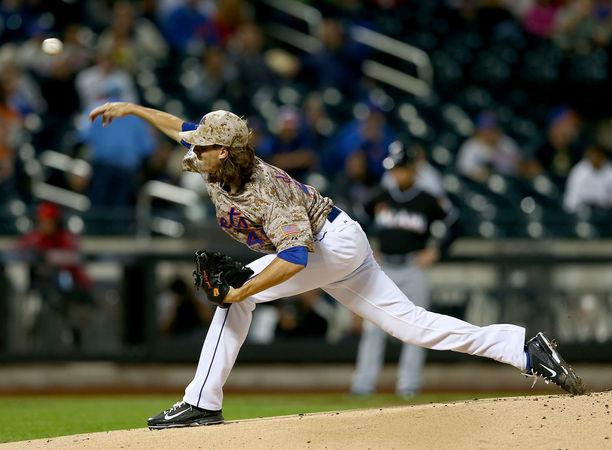
It so happens that deGrom’s biggest night occurred on a Monday, which means the worst uniform in Mets history likely lives forever.
 Just the way Jake looked that night. (Photo courtesy nj.com.) As long as the jersey says “Mets” or the right shade of “New York” across the chest, even the ugliest uniform can be beautiful. Take my least favorite regular look in Mets history, the road jersey of 1988-1992. Big block letters, no numbers on the front, a font that evoked the wrong shade of New York, overbearing racing stripes on the shoulders, white outline on those stripes…where there was less, there should have been more and where there was more there shouldn’t have anything. It was a shirt I wouldn’t have bought on clearance at Modell’s.
And yet, the first time I saw it in action, after proper amounts of aesthetic revulsion, I walked away happy, because one of the batters wearing it, a fellow by the name of Strawberry, launched a baseball to the top of Olympic Stadium. Straw hit two homers that Opening Day in Montreal; the Mets hit six total and went on to win a division title, achieving victory 44 times away from Shea. They outplayed their road uniforms in 1988.
Some good things happened in those clothes over their years. Frank Viola outdueled Orel Hershiser in the first showdown between defending Cy Young winners; Dave Magadan broke out all over Wrigley Field; David Cone struck out 19 Phillies; even Bobby Bonilla made a decent first impression in St. Louis. The apparel on display didn’t bother me those given days or nights.
And the fact that Jacob deGrom was camouflaged while K’ing didn’t hurt my appreciation of him on that “Military Monday” he made us all stand at attention, even if I can’t quite get behind the uniforms themselves. The jerseys are well-intentioned tributes to truly admirable Americans, and perhaps they would almost complement a Mets-blue cap, but the accompanying camo hats the Mets insisted on adding causes the whole ensemble cry out for dishonorable discharge. At a juncture when we’re daring to dream of Octobers when the Mets aren’t automatically directed to the offseason, it’s dispiriting to see the lot of them appear outfitted for nothing more than hunting and fishing.
The camo (available, amazingly, for purchase) will be back in 2015, as will the Military Monday theme, a concept co-opted from what the Padres have been doing to honor locally stationed Marines for nearly two decades. In theory, it’s a righteous gesture, but the execution is dubious, and what benefit there is in obfuscating the Mets’ identity — to either the Mets or the men and women of the United States military — is so cleverly disguised that I can’t see it.
Except deGrom is about to win a major award, boosted by the night he wore a major’s garb, so now the camo isn’t an outlier. It’s part of the narrative. Just like all that black the Mets ditched to much applause a couple of years ago. That was the black in which Robin Ventura whacked a single over a fence, Mike Hampton took care of pennant business and Cliff Floyd caught the last out of the first division-clincher in 18 years. Mets-black was beautiful in the proper light. I don’t miss it on a going basis, but seeing it — no matter that, like the camo, it was an unnecessary sartorial addition — can take me back to some good places between 1998 and 2012.
Now joining black in the garment dustbin of Mets history are, the club let on last week, the snow whites, introduced as special-occasion duds on Jackie Robinson Night, April 15, 1997, and worn for the last time (at least until they’re reintroduced for Turn Back The Clock Night somewhere up the highway) on Closing Day, September 28, 2014. In their eighteenth and final season, the snow whites had transcended their status. They were conceived as alternates, to be modeled mostly on Sundays; there was even a matching hat. The hat was gone before June. The uniforms hung on for close to an eternity, hanging in Met lockers as gameday togs so often that for a generation, they served as the Mets’ de facto primary uniforms.
The snow whites got the start every Opening Day for the longest of spells, as best as I can recall. Bobby Jones, Al Leiter, Kevin Appier and the rest who threw the first pitch of a new Shea season dressed Ivory-fresh clear through to 2008. Mike Piazza emerged dazed and confused from a trade and into the bright Met sunlight in snow whites. John Olerud took it to Curt Schilling in snow whites. Matt Franco beat Mariano Rivera a ninth inning in snow whites. Melvin Mora duckwalked across home plate in snow whites. Todd Pratt created postseason walkoff lore in snow whites. Benny Agbayani created more of it in snow whites a year later (on him they fit like pajamas).
On September 21, 2001, Piazza, in snow whites, took a swing people still talk about. Four years later he was wearing the very same get-up when he said goodbye to his stadium. David Wright pulled his socks real high against the cuffs of those pants. Jose Reyes slid into myriad bases before slipping out of town wearing that top. The snow whites endured to see Citi Field open with Mike Pelfrey being overly welcoming to Jody Gerut; Johan Santana make HI57ORY; R.A. Dickey notch a 20th; and Lucas Duda connect for a 30th.
And yet, I won’t miss the snow whites. Something always seemed wrong about them. They were the first alternate home uniform the Mets ever unveiled. In the late 1990s, almost everybody had figured out a way to sell more jerseys by making more jerseys. Why shouldn’t the Mets get in on the action? Besides, what could be more special than the night 42 was retired at Shea? Why shouldn’t the Mets play the Dodgers wearing something vaguely Dodgerish in nature? Why must the Mets cling to pinstripes at a moment when pinstripes in New York implied something decidedly unMetsian?
So the Mets ran away from their own uniforms. They pre-empted the pinstripes now and then in ’97 (two years after reviving their most classic iteration) and gave the snow whites ever greater priority as the ’90s became the next century. The pinstriped uniform that was the one constant of Mets home games from 1962 through 1996 was relegated to sporadic use. When the Mets played in their only World Series to date since 1986, they wore white jerseys with white pants and they worn black jerseys with white pants, but they never wore pinstriped jerseys and they never wore blue caps.
Mets pinstripes were all but invisible from 1998 to 2006. They were camouflaged, you might say. They almost went the way of Banner Day and Old Timers Day and any number of signifiers of what it meant to be Met.
Without fanfare, however, they crept back into consciousness on October 18, 2006. When the Mets took the field for Game Six of the National League Championship Series, needing to win in order to play again, it was decided they would be the Mets in pinstripes and blue caps again. It was hard not to notice from the Upper Deck; it was the sort of thing a Mets fan would notice, given how absent pinstripes in particular (but blue caps, too) had been from the 1999 and 2000 postseasons. The Mets looked right and they played well and they won. The next night they didn’t win but they still looked right. Possibly the greatest catch in Mets history occurred in pinstripes. It was a small detail in a crushing defeat, but the seeds of a spiritual victory had been planted.
In their desperate hour, the Mets decided to look like the Mets. It was no more than a passing thought in the final hours of 2006, but I had a sense we were turning a corner. It didn’t seem an accident that when snow white-era Mets were introduced on Shea’s last day, they wore pinstriped jerseys the likes of which they almost never wore while active. When we finally turned it, we’d be true to our selves: the blue, the orange, the pinstripes. It took longer than I would have thought, but in 2012, the Mets began to wear them with frequency and without dropshadow. There was even an attempt at regulating uniformity: pinstripes at night, snow whites in the afternoon. But these were the Mets, who get easily distracted. Johan was, by all rights, supposed to be no-hitting the Cardinals in pinstripes since it was a Friday night, but Johan preferred the snow whites, and are you gonna really gonna tell Johan Santana to go change?
Later came blue tops, because they sell, and camouflage tops, because maybe they would, too. But the pinstripe tops — promised in 2015 to shine as bright as they did circa 1969 — were back to stay. And, at last, the snow whites, that never served any great purpose except to make the Mets’ image just a little more pale, were ruled out of play for 2015. Essential Metness triumphed, at least off the field. Or off the rack.
Good night, snow whites. We had joy. We had fun. But you had too many seasons in the sun.
by Greg Prince on 8 November 2014 11:48 am During the endless (or so it seemed) New York City newspaper strike of 1978, when checking one’s phone for headlines was somehow not an option, a parody of the so-called Paper of Record made the rounds. Not The New York Times, it was called, the brainchild of George Plimpton, the industrious correspondent who would go on to scoop all competitors regarding the tantalizing prospects of fireballing Sidd Finch seven springs later. I mention this because if you ever wanted to see what Not The New York Mets’ Ownership looks like, read this letter from a guy who runs a much different baseball team.
To post a note of this nature, you have to follow something akin to the advice Steve Martin once offered for being a millionaire and never paying taxes:
First, win the World Series.
From there, I suppose it’s easy to emit graciousness and take a few miles off one’s triumphalist fastball when you’ve just been crowned champions of the baseball world (and had plenty of practice at it), yet Larry Baer, San Francisco Giants president and CEO, gives good letter even when the Giants go home at the same time as the rest of us. The man is, per something I learned watching The Simpsons, an anagram of Alec Guinness: genuine class.
“We’re back in our offices now, confetti still stuck to our shoes, and diving into the preparations for 2015,” Baer began. “But my first order of business is to thank you.” And that he does.
• He noticed that Giants fans “showed up with Panda hats and Hunter Pence signs and orange everything”.
• He credited the Giants’ success to “what happens when a community lifts a team, and a team lifts a community […] when we’re all in this together — the fans, the players, the coaches, the front office, the ownership group, every usher and vendor in the park”.
• He praised the Giants front office as a bastion of “exceptional, tireless and passionate employees. They collaborate, they innovate and they are customer-centric and community-centric. They are the unsung heroes of our organization…”
• He thanked Giants fans “again for carrying us through” to victory.
• He signed off by telling them, “We look forward to seeing you at FanFest in February!”
FanFest, in case you’re not sure, is an offseason celebration of the team, put on by the team, for the fans, because fans like being fans of the team. Many teams hold FanFests. The Mets don’t. (Though these guys do, and it’s lots of fun.)
As delightful as Baer’s letter is from a warm & fuzzy not to mention results-oriented standpoint, it’s also instructive to see what’s not in it. No urging Giants fans to send in their season ticket payments right now so you don’t miss out on all the 2015 action; no links to the team shop so you can buy more official championship merchandise before it’s out of stock; nothing about signing an oath declaring one’s True San Franciscan-ness. I’m sure the Giants are more than happy to accept their customers’ cash contributions, but Baer (and his communications people) didn’t decide this was the moment to pounce. Instead, this was the moment for everyone to enjoy.
Can’t imagine receiving anything like this from the admittedly preoccupied folks who own the Mets. Their traditional messaging tends to be more commercial and less emotional. Then again, there hasn’t been a World Series parade to come back to the office from in a while. I’d be willing to read just about anything they’d write us when there’s confetti still stuck to their shoes.
Time has flown since the World Series ended, but its conclusion provided a good jumping-off point for a lively four-sided conversation among the fellas at Rising Apple and myself. You can listen to it here.
by Greg Prince on 4 November 2014 2:48 am Happy Election Day! It’s your Metstitutional duty to vote for the candidates of your choice. You could do worse — and no better, in this analyst’s opinion — than theoretically casting a ballot for the following slate.
• Juan Lagares, National League Gold Glove center fielder. This race will be called tonight. If Juan grabs the Gold Glove, it will nicely accessorize his place on the Fielding Bible team. Of course we’re used to Lagares grabbing everything within his grasp. His mantel is where defensive awards go to live.
• Jacob deGrom, National League Rookie of the Year. The Sporting News primary and the Players Choice caucuses have already thrown their support to the DeLand Delight. We’ll know if the BBWAA puts our man over the top come Monday.
• Gil Hodges, Hall of Fame. While you don’t need Nate Silver to tell you Lagares and deGrom are solid favorites to win their elections (objections of the Billy Hamilton Party notwithstanding), Hodges and his fate will remain a mystery until December 8, when the loosely defined Golden Era Veterans Committee reveals its picks. Gil’s on the same ballot with another ex-Met, Ken Boyer, as well as post-integraton/pre-DH stars Dick Allen, Jim Kaat, Minnie Minoso, Tony Oliva, Billy Pierce, Luis Tiant and Maury Wills plus Big Red Machine architect Bob Howsam.
Their status lies in the hands of a 16-man committee, 12 of whose voters I hope will say “yea” to Gil Hodges. Generations after his passing, it’s stunning to me that Gil’s career is still sitting in electoral purgatory, waiting on the good graces of whoever happens to have a say in a given year. Those who severely admire Gil and watched him come oh-so-close under varying formats are left to wonder who on this committee seems most amenable to putting him over the top. That guy grew up in New York when Gil was an elite first baseman; this guy worked in the Mets organization and can’t be unaware of the impact Hodges had on the sport; hey, this one covered baseball right here in town for a long time; and that one pitched for the Dodgers, which should mean something if he was at all paying attention to his franchise’s history.
Is this any way to potentially bestow immortality on a figure who has been widely and fiercely considered transcendent for six decades? Frankly, it’s as good as any at this point. You could just run the numbers, depending on which numbers you like. I like some better than others. But I’m human. And a Mets fan. And I’m old enough to remember Gil as a manager and to have heard contemporary after contemporary of his recall him as a player, and I’m still waiting to hear anybody with a bad word to say about the totality of his playing and managing career, never mind his character — and I don’t mean, “well, this statistic doesn’t quite measure up to those of a relatively comparable first baseman who came along later.”
If Gil doesn’t make it this time, I’ll go back to dismissing the Hall of Fame’s authority as ultimate arbiter of greatness. Who are they to tell me who to revere? I’ve been watching, reading and breathing baseball for 46 seasons. I haven’t come across anybody greater than Gil Hodges. Electing him to the Hall of Fame won’t make him any greater. It will just mean that, by a particular process, his greatness will be more widely acknowledged.
I’ve just used some variation on “great” four times in one paragraph. I hate to repeat myself, but if repeating oneself is what one must do on behalf of a worthy candidate who repeatedly doesn’t win his election, then it’s worth the repetition.
Gil Hodges for the Hall of Fame. If you endorse the notion, consider signing this petition that will be sent to Cooperstown in the coming weeks. It won’t count as a vote but your voice will be heard. It’s the American way.
by Greg Prince on 30 October 2014 2:36 am In the end, it was the year of the pitcher…one pitcher in particular. It was the year of Madison Bumgarner. The towering lefty won the 2014 World Series Wednesday night, accompanied by 24 San Francisco Giants, several of whom he couldn’t have done it without. The rest will likely stare down at their third shiny bauble in five years and count themselves fortunate to work at the same place as him.
Bumgarner owns the lowest World Series ERA ever recorded. He owns a World Series MVP award. He owns a brand new Chevy Colorado, which was easier for him to receive than it was for the dude from Chevrolet to present. He owns the month that henceforth deserves to be known as Bumtober. He owns just about every hitter he’s faced since baseball shed its 20 also-ran teams and winnowed itself down to just two pennant-winners. Then Madison found himself an antitrust loophole and took ownership of the Kansas City Royals early, midway and late. Especially late. The ace starter who won Games One and Five was dispatched to the bullpen to lurk and loom until summoned to end the Royals’ hopes of being any more marvelous than they’d already been.
It was the fifth inning when Bruce Bochy (without rending of garments in the dugout about the decision) ignored previously established contours, deployed his singular weapon and never bothered looking for backup. How long could Bumgarner, two nights removed from a complete game shutout, go in relief? For as long as it damn took, apparently. Bumgarner didn’t depart the Kauffman Stadium mound until every last out was collected. He recorded a five-inning save. Not a five-out save, but a five-inning save. He saved Game Seven; the World Series; and baseball’s best for last.
Through six games, the highest praise one could offer for the most recent iteration of the sport’s showcase was it wasn’t yet over. There had been a lot of baseball but not a lot of superb baseball, except for when Bumgarner pitched. Game Seven was supposed to be different, if only on principle. Game Sevens are the Elysian Fields of our minds. They’re Jack Morris and John Smoltz; Curt Schilling and Randy Johnson; Roberto Clemente and Steve Blass; Ralph Terry and Bill Mazeroski; Bob Gibson and Mickey Lolich; Johnny Podres and Sandy Amoros; Craig Counsell and Edgar Renteria; Ray Knight and Jesse Orosco and don’t forget El Sid. Sometimes they’re less than all that, but we gloss over those episodes which don’t prove legendary. Plus they already happened. This Game Seven didn’t have the luxury of being filed away. It had to fill in its blanks and use ballpoint.
Bumgarner was this Game Seven’s calligrapher, what with those five shutout innings on top of all those other shutout innings, never mind his straight-up presence. For six months, baseball is about matchups: lefties replacing righties to face lefties who are pinch-hit for by righties and nobody throwing too many pitches and everybody knowing their roles. In a seventh game, though, you delete that outline if it’s not pushing your plot toward its desired outcome.
The Royals and Giants weren’t getting anywhere with their starters, Jeremy Guthrie and Tim Hudson. Hudson was completely hittable and replaced in the second by Jeremy Affeldt, no mean October reliever himself. Guthrie had a moment during which he seemed to settle down but his staying power proved evanescent. San Francisco defense — particularly a 4-6-3 double play begun by a Joe Panik flip and ended by a Samsung review — and the usual dash of Pablo Sandoval offensive kung fu shoved the Giants out in front, 3-2, in the fourth. Kelvin Herrera was, like Affeldt, brought on many innings before he was accustomed. Like Affeldt, he was fine as a fish out of rigidly defined water. Hell, the four Royal pitchers used struck out a dozen Giants.
But nobody’s buzzing about anybody who doesn’t share a first name with the capital of Wisconsin. Bumgarner is the talk of the town for the way he took over in the fifth inning and wouldn’t let go of Game Seven. Madison gave up a hit to his first batter. He gave up a hit to his penultimate batter — an Alex Gordon single that Gregor Blanco misplayed into the tying run suddenly materializing on third with two out in the ninth. He gave up nothing in between or after. With a chance to break Bumgarner’s spell, Salvador Perez popped to the Panda in foul territory and the Giants were champions yet again, just as in 2010 and 2012, though differently and maybe more so.
By my accounting, the Giants disappeared three separate ghosts this postseason. Just by making it to October as the so-called second Wild Card, they made up for being left out in 1993 when they won 15 more games but made the mistake of playing in the same division as the Braves at the end of the era when there was no consolation prize for coming in a strong second. By going on the road with a three-two lead and taking one of the two games they needed, they put their bitter loss to the Angels in 2002 behind them. And by stranding the opposing tying run on third in the ninth, nobody need ever again reference Charlie Brown’s anguish regarding Willie McCovey’s liner not being hit three feet higher, over Bobby Richardson’s glove, at the finish line of the 1962 World Series. Matty Alou didn’t score then, Alex Gordon didn’t score now.
I’m not a San Francisco Giants fan, though I play one in October. I’m happy for them. I’m happy for the organization, which is an odd thing to say on the surface, but twice, because of my activity with fellow New York Giants preservationists/nostalgists and the San Francisco front office taking such transcontinental sentiments seriously, I’ve gotten to meet some people who run their ballclub. “Classy” is the word I keep coming back to. As mentioned at the outset of October, I’m friendly with my share of Giants diehards and I’m pleased for them. The pains in the ass who take up too many seats at Citi Field when the Giants come to town I could do without, but I could say that about anybody who comes to our park and doesn’t root for our team. I’m sure they’d consider not being beloved outside the Bay Area a fair tradeoff for three World Series championships won in the past half-decade.
At the same time, I’m not a Kansas City Royals fan and I technically wasn’t rooting for them to win this round, yet the 2014 World Series was one of those instances when you really wanted to buy into the line about how “there are no losers.” There are, but there shouldn’t be. The Royals rekindled a great passion this year in their neck of the woods. It wasn’t just 1985, you know. Kansas City was a baseball capital for more than a decade. They were a likable staple of October and their followers always showed up. As processed through the television, the Royals fans are total champs.
From their Wild Card games through their LCSes, the Royals and Giants each gave us a nice MLB Network retrospective’s worth of highlights, and after leaving us a little restless through six World Series contests, provided us with a Seventh Game good enough to burrow into our guts. Which starter would fold first? Which reliever would ride to the rescue next? Was that ball gonna fall in? Are they gonna call him safe or out? For nine innings, the championship of our sport hung on the line and you couldn’t watch without a small knot in your stomach. Bumgarner’s triumph may have been inevitable, but only fully in hindsight. This thing could have gone either way, and if that doesn’t make for a superb Game Seven, I don’t know what does.
And now these two objects of our fleeting concerns and affections recede from our consciousness, reverting solely to the agendas of Giants fans and Royals fans, which is how it’s supposed to be. We’re supposed to care for a little while — I wouldn’t think of not watching all of it and blogging most of it — and then we’re supposed to withdraw. The postseason is methadone to the regular Met season’s more addictive harder stuff. It’s designed to transition us from a state of intoxication to cold turkey. The first day will be the hardest, but the night sweats will eventually dissipate. Our bodies know we can’t live in a constant state of baseball. Our brains don’t, but sooner or later they get the message.
October was fun. April will be even better. The intervening months we’ll figure out as we go along. We always do.
by Greg Prince on 29 October 2014 11:57 am Welcome to Cliché Stadium for the last Major League Baseball game of this year. It takes place tonight. When it is over, there will be no tomorrow.
Not one necessarily worth contemplating anyway.
Except for Giants partisans who would have preferred the opportunity to bubble-wrap the Commissioner’s Trophy, fasten its seatbelt and fly it home, nobody didn’t want a Game Seven, what with it containing all those marbles to say nothing of that whole ball of wax. Save your nuance for when there is a tomorrow. Tonight, the result will be stark: a winner, a loser, a conclusion.
Great that it ends this way. Too bad it must end, but as long as it does, make it definitive.
Game Six arrived with its own cultish credentials, though the fact that most of them are recited on demand whenever we have a Game Six dampens my expectation that anything Bucknerish will explode in our midst. Sometimes the legend is lived up to, but you can’t special-order the David Freese to go, y’know? Tuesday night’s Game Six blowout served its purpose of keeping the Royals going so there could be a Game Seven. My favorite part of the non-drama came while I listened to the early innings on the radio and heard K.C. fans robustly cheer everything remotely positive. That, I thought, is the way to be. My favorite part of the last Game Six the Mets played, besides the Mets winning it, was rising among 56,334 at Shea and not giving up on the 2006 NLCS. We made unceasing noise with little provocation from the start and raised the volume exponentially when Jose Reyes homered on the third pitch of the bottom of the first.
It worked. We got our Game Seven (which worked less well, but never mind that right now). We and the Mets kept going, which is all you can ask when you’re down three-two. It was all the Royals could ask for and they got it. As someone who’s been pulling for the Giants, I wasn’t too happy with the seven runs Big Game Jake Peavy and the previously impenetrable Yusmeiro Petit allowed in the second, but as the night dragged on in AfterGl@v!ne fashion — minus the angst, of course — I couldn’t come out against the end result being Game Seven.
I mean, c’mon, Game Seven! When we’re officially unaligned, Game Seven is our team. That’s our rooting interest. We’re all stakeholders in the National Pastime at a moment like this. We beseech the gods to give us first a Game Seven, then a good Game Seven, maybe, if we are so bold, a great Game Seven. The first six games have had their moments but never quite enough of them strung together to evangelize over. The 2014 World Series has been one of those shows you reflexively tell your apathetic friends who haven’t been watching, “ya gotta see this!” but when they tune in, it’s inevitably while one side is steamrolling the other side and you swear, no, really, it’s better than this usually.
A seven-game World Series is supposed to be the best World Series. I think back to 2005, though, which went the minimum four games. But they were four fantastic games. The only thing that was objectively wrong with them as a set was the White Sox won all of them and the Astros lost all of them. It, like its Nielsens, sank into oblivion, which is too bad. Aesthetically, you couldn’t get a fabber four. But few pay mind to a quartet come late October. Six games is the commonly accepted currency for what constitutes a good Series, seven games the universally agreed amount you must exchange to obtain greatness.
The quality of this World Series has thus far ebbed more than it’s flowed, but the quantity is perfect. Game Seven tonight. If the actual game matches the circumstances’ reputation, it will leave us a little something to enjoy remembering tomorrow.
(Spoiler alert: there will be a tomorrow.)
by Greg Prince on 28 October 2014 5:46 pm It’s a long way from Matty vanquishing Athletics in 1905 to MadBum mowing down Royals in 2014, though if you’ve pitched yourself into the same conversation, the gap grows short. In Game Five of the current World Series, Madison Bumgarner threw a shutout for the ages, certainly one that would have fit comfortably within the age of Christy Mathewson throwing three of them at the same opponent in the same week with the championship of the baseball world on the line.
Going nine and allowing nothing in a World Series game has always been impressive but you used to need to toss a trio of such games to really stand out historically. Today, a CG ShO is as rare as a fence that doesn’t eventually get moved in at Citi Field every couple of years. Whether the larger-than-his-competition Giant pitcher in question roams the earth in misty legend or high-definition living color, posting zeroes from beginning to end makes for an enormous World Series feat.
Tonight in Kansas City, mere mortals (performances pending) will take the mound for Game Six. When their and presumably their relievers’ work is done, either the Giants will have wrapped up their third title in five years or the Royals will stay alive with a chance to capture their second in thirty. When at last there’s no more baseball, come Wednesday or Thursday, then you’re talking about a really long way, the one that winds from the last out of the World Series to the first pitch some Brave throws to some Met on March 4 in games that won’t count but we’ll greet them as if nothing matters more.
Until then, after the Giants and Royals are done, there’s the opportunity to catch up on other things. I’ll recommend two.
If your DVR has been patiently waiting for the offseason to grab your attention, then go watch those installments of The Roosevelts you recorded in September. Or if you didn’t, go find the entire PBS series on iTunes. Deprived of any reason to turn to SNY at 7:10 every night (except for instinct), I just got around to knocking off all seven episodes of Ken Burns’s latest epic, which follows Teddy’s birth in 1858 to Eleanor’s death in 1962, the same year the Mets and I were born. In between, there’s a lot of Franklin, which is appropriate. Franklin Roosevelt of the Hyde Park Roosevelts was elected to four terms as president of these United States; transformed the executive branch; led his nation through the most dire of times; and visited Ebbets Field.
FDR also visited the Polo Grounds, for the 1936 World Series between two of his home state’s three teams, the Giants and the Yankees. That part wasn’t in The Roosevelts. I read about it in Richard Ben Cramer’s 2000 biography of Joe DiMaggio. It was the second game of the Series, a blowout in the wrong direction (Yankees 18 Giants 4). Late in the festivities, an announcement was made: the remaining crowd was instructed to “stay at their seats until one special fan, Franklin D. Roosevelt, could get to his open limousine and ride off the field through the center field gates.”
The Giants’ last licks ensued. Their final batter, Hank Leiber, sent one to very deep center field, which at the Polo Grounds meant very deep and very near the staircase to the clubhouse. DiMaggio, an incipient national phenomenon by the fall of ’36, raced back there, a good 475 feet from home plate, and nabbed Leiber’s ball in over-the-shoulder fashion. Running as he had and being as close to the exit as he was, Cramer wrote Joe “just kept running, through the notch in the fence, up the steep stairs that led to the players’ clubhouse, in deepest center field.
“Then he remembered — Roosevelt!”
DiMaggio had not only the last out in his glove but the presence of mind to halt his departure in deference to the fan-in-chief’s. Cramer describes the rookie center fielder “stiffen[ing] to attention” as FDR’s car rounded the warning track that would lead him to the Polo Grounds exit. All eyes in the house were on his vehicle, “save for Roosevelt’s eyes. He looked to the stands, then to the stairway, until he found Joe…and then FDR lifted a hand in a jaunty wave from the brim of his hat. And from the crowd there was a final, rippling cheer, as the Dago boy from Fisherman’s Wharf was saluted by the President of the United States.”
Eight years and two elections later, the president was still president, seeking to continue as such in the face of continuing world war and inevitable personal deterioration. As Burns’s documentary retells it, FDR was not a good bet to live through a fourth term, but nobody knew that for sure in the fall of 1944. What Roosevelt knew was he had to campaign yet again to win yet again, and for more than four hours on one terribly cold and rainy October day, the ailing 62-year-old incumbent submitted himself to a strenuous 51-mile, open-car motorcade through four of New York’s five boroughs. One of them was Brooklyn, where he entered, for the first time, Ebbets Field.
There was no World Series at Ebbets that fall, but there was a rally. Nobody knew how to reach out and touch voters prepared to rally to his cause — they were chanting “We Want Roosevelt!” — the way FDR did. Newsreel footage Burns features captured the president’s sentiments:
“I’ve got to make a terrible confession to you. I come from the State of New York and I practiced law in New York City, but I have never been to Ebbets Field before. I rooted for the Dodgers! And I hope to come back here someday and see ’em play. Thanks ever so much.”
There’s something about that desire to watch the Dodgers going unfulfilled and knowing with full hindsight it would go unfulfilled and knowing further Roosevelt likely knew it would go unfulfilled that made it more poignant than a politician pandering to local interests should have been. In that moment, I thought about an FDR who didn’t die in office the following April. I imagined that he lived to see the Allied victory to conclusion and, with the stress of his job eased, didn’t succumb to a cerebral hemorrhage. I think about him in the back half of his fourth term taking it relatively easy. Maybe, with World War II successfully concluded, he steps down and hands the keys to the White House to Harry Truman.
However it happens, an FDR who lives beyond 1945 perhaps visits Ebbets Field again and watches Jack Roosevelt Robinson — the infielder named up the middle for Franklin’s cousin Theodore — play ball for the team he said he wanted to see play a home game. I can see Franklin Roosevelt and Jackie Robinson smiling and shaking hands before a game in 1947, while Branch Rickey looks on approvingly in the background. I can see the photograph showing up in at least one Ken Burns film, probably several. It might be no more than a footnote, but I can see another paragraph or two added to the great interwoven American story of the 20th century.
None of that ever happened, but The Roosevelts documents what did, so watch it if you get a chance. And if you want to know more about what else happened at Ebbets Field, pick up the recently released Rickey & Robinson by Roger Kahn, the great author’s final volume showing what it was like to be a reporter at the epicenter of the shifting plates of culture, sport and life.
It’s rich material Kahn — who did his share of ghostwriting on Robinson’s behalf, as Grantland’s Bryan Curtis explores — has covered in previous books, but this one promises a particularly sharp focus on “the true, untold story of the integration of baseball.” As Kostya Kennedy noted in Sports Illustrated, “the broad strokes…may be familiar to readers, but Kahn spins the tale well and delivers, along with a knowing perspective, memorable scenes.”
I’m not looking forward to months without watching baseball, but I am looking forward to reading Roger Kahn writing about baseball. He gave us The Boys of Summer and now he gives us something to get us through the oncoming winter.
by Greg Prince on 26 October 2014 5:56 pm If we’re being fair to the primary participants and their loyal fans, this would be a good time to end the World Series. Each side has won twice, once at home, once on the road. Everybody’s had a chance to show their best selves. There’s something to feel good about from most every angle.
We’ve seen San Francisco and Kansas City trade decisive wins. We’ve seen K.C.’s bullpen totally stymie San Fran. We’ve seen the Giants storm from behind and continue to rain runs down on the Royals. We’ve seen bounces go every which way. We’ve seen Jarrod Dyson rob Hunter Pence of a short single in center. We’ve seen Yusmeiro Petit single into short center where Dyson couldn’t hope to make a catch. We’ve seen Petit record the first base hit of any World Series reliever since Al Leiter and total more career World Series base hits than Carlos Delgado. We’ve seen ephemeral 21st-century Mets Joaquin Arias and Jason Vargas in case we’d been missing them. We’ve seen the heart of the Giant order represent the target audience for those ubiquitous Viagra ads and we’ve seen their bats in action for hours at a time. We’ve seen — as if we needed to be reminded from a similar calendar confluence 28 years earlier — that World Series games played on Saturday night, October 25, are never to be assumed over before they’re over.
After four games, nobody’s a loser. After two or three more games, a team that doesn’t deserve to be thought of as one will have lost.
But that’s the Giants’ and Royals’ problem. For the rest of us, I hope this thing goes seven. No, actually, I hope this thing goes seventy-seven. What do I care if these teams wear themselves out for 2015? Give ’em Christmas off and arrange a Boxing Day doubleheader.
This Series, only the fourth since 2003 to go at least six games, has served as not just a wonderful baseball showcase but a terrific baseball laboratory. How long to go with the starter? When to pinch-hit? How does anybody refer to Big Game James Shields (postseason ERA: 7.11) with a straight face?
Actually, I think I’ve got that one figured out. It was explained in this exchange between Woody Allen and Jon Lovitz from Allen’s 2000 film, Small Time Crooks.
“Remember my nickname when we were in the joint?”
“The Brain?”
“The Brain. That’s what the guys used to call me, right?”
“But Ray! That was sarcastic!”
“That wasn’t sarcastic, that was real.”
“No, it was sarcastic.”
“There was nothing sarcastic about it!”
“No, really, it was.”
“It was real. I was The Brain.”
“No, it was sarcastic.”
Maybe Shields will be sincerely Big Game tonight. Maybe Madison Bumgarner somehow won’t be Enormous Game for a change. No matter what happens at Phone Company Park in Game Five, there will be a Game Six for ex-Met Bruce Bochy and ex-Met farmhand Ned Yost to manage on Tuesday. One of them will have earned or re-earned a place in World Series managing history in the same glorious Leaders Of Men procession that includes Gil Hodges and Davey Johnson. One of them will have to suck up less desirable results in the tradition of Yogi Berra and Bobby Valentine. Neither can have the pennants attached to their permanent records taken away from them.
Players play. Managers manage. Or manage to stay out of the way of their players. Or inspire their players to elevated heights. Or keep all keels even. Or, per Casey Stengel, keep the guys who hate you away from the guys who are undecided. Or tactically manipulate matchups. Or strategically configure outcomes. Or can’t do a thing once the ball is in the hand of the guys they sent on the field.
Few of us have played the game. All of us have watched the game and figured out what should be done to win the game. We all manage in our heads. I managed along with Yost for a while Saturday night, diverging from his decision to allow Vargas to bat with the bases loaded and two out in the third, even with his team already up by three. Stengel dared to pinch-hit, no matter how early, when the opponent’s throat was within his grasp. It would have been unconventional in 2014 (as it was unconventional in 1964 and 1954) but if you sent up Billy Butler or Nori Aoki to bring down the hammer, what would have you lost — three more theoretical innings of Jason Vargas?
As was, Vargas worked the count to 3-and-2 against a wild Jean Machi, thought he walked and then struck out. It was one of those moments when you — whether you’re thinking like a manager or a fan — are overcome by the sense that something has just gone very wrong for the team that scored four but could’ve scored more. Though, to be fair, it was during that same third inning that I began composing comparisons between the Royals and a certain 1969 team that lost its first World Series game and swept their next four.
Anyway, managers manage and none of us can say for sure all that entails and what all of it means. At the moment, there’s a universally acclaimed manager with a ledger of success suddenly on the open market. There’s a team near and dear to all of us that could use some success. Joe Maddon and the Mets could maybe make beautiful music together. They could maybe make us not be interested in teams from Kansas City and San Francisco in October because our season wouldn’t yet be over.
Or this team that Terry Collins has steered from 79 sullen wins when he took over four years ago to 79 uplifting wins lately is ready to soar under the guidance of his steady hand. Everybody who is in regular professional contact with him says nothing but nice things about Collins. Plus the Mets have already signed him for presumably less dollars and time than a commitment to a more glamorous alternative would require. Not long after Maddon emancipated himself from the front-office turmoil in Tampa Bay, Jeff Wilpon and Sandy Alderson each gave Terry Collins rare offseason votes of confidence just two months after confirming that the manager would continue to fulfill the terms of their agreement with him and manage in 2015. It brought to mind Jay Leno’s line after David Letterman left for CBS, causing rumors that he’d lose his tenuous hold on The Tonight Show to finally dissipate: “You know what NBC stands for? Never Believe Your Contract.”
Maddon might do better than Collins in Flushing. Or he might not be the right fit. The last big-name manager (depending on your view of the size of Art Howe’s name) who the Mets nabbed between seasons was Jeff Torborg in October 1991. The 1990 A.L. Manager of the Year seemed the greatest of gets. Then 1992 rolled around. Because something didn’t work 22 going on 23 years ago doesn’t mean it wouldn’t work now. But it does imply that not everything that sounds great when the Mets aren’t playing would work when they are.
That said, let me invoke the name Les Moss, onetime manager of the Detroit Tigers….literally onetime.
Les Moss, like Terry Collins, had worked in his team’s minor league system. Moss, like Collins, knew his personnel. Moss, like Collins, was generally well regarded. Unlike Collins, Moss managed his team to a winning record. In 1979, Moss’s Tigers were 27-26. That, however, was the extent of Les’s winning record, however. Although Detroit was off to a good start in his first year at the helm, upper management replaced him in June.
Sparky Anderson, you see, was suddenly available. He’d been let go by second-place Cincinnati the year before despite five division titles, four pennants, two world championships and eight winning records in his nine years running the Reds. He was going to take the next season off but then decided he wanted to manage again ASAP. Some other team had apparently put out feelers. Moss’s promising start notwithstanding, the Tigers pounced. They hired Anderson. Five years later (each of them carrying a winning mark), Anderson managed them to 104 victories and his third world championship, or as many as Bochy sits two wins away from claiming. Sparky stayed on the job through 1995 and was inducted into the Hall of Fame in 2000.
It is impossible to determine whether Les Moss would have accomplished for Detroit what Sparky Anderson did. It is certain that being replaced 53 games into his tenure — while holding that winning record — was a tough break. “Well,” Moss told Tiger GM Jim Campbell after absorbing the bad news, “that’s baseball.”
That’s as much baseball as Rod Kanehl batting for Bill Wakefield in the second inning in ’64 or Eddie Robinson hitting for Moose Skowron in the first almost exactly 10 years earlier. Both of those Stengelian moves, like Campbell throwing Moss overboard in order to swiftly scoop up Anderson, worked out just fine. Of course baseball is also “the best moves are the ones you don’t make.” One example in the managerial realm: quiet Walter Alston was allegedly on the verge of being fired in favor of his vocal coach (and voluble critic) Leo Durocher following the Dodgers’ 1962 collapse. Instead, Alston — with three league flags and two world championships already stuffed in his pocket — was retained. Los Angeles won three of the next four pennants, two of the next three World Series, kept Alston until 1976 and watched his induction into the Hall of Fame in 1983.
So you never know. But you’ll never find out unless you at least reach out to Joe Maddon, who transformed the historically sad Devil Rays into the perennially formidable Rays, and seriously consider whether he, rather than Terry Collins, is the manager who might accelerate the Mets’ journey to a Giant- or Royal-like October.
by Greg Prince on 23 October 2014 12:58 pm The Royals’ 7-2 victory in Wednesday night’s Game Two provided a healthy reminder that there are two league champions vying in this World Series. Or, more cynically, the Giants’ 7-2 defeat in Wednesday night’s Game Two provided a pointed reminder that an 89-win team is playing an 88-win team for the championship of the world. Either way — and despite Major League Baseball yet again ignoring my annual plea that it grant television rights to C-Span so we can be spared their godawful announcers and analysts — we know two things.
1) Baseball in 2014 goes on at least through Sunday night.
2) No Met from 2001 will be in uniform for any of it.
We were well into Kansas City’s dismantling of the American League elite when it occurred to me we hadn’t seen Bruce Chen, who, last I had noticed, had been pitching in the Royals’ rotation since the days of Dennis Leonard and Paul Splittorff. Or maybe it just felt that way. In fact, Chen had been a K.C. mainstay since 2009, when after nine major league stops since 1998 and a year spent recovering from Tommy John surgery, he signed with the Royals and pitched for them when nobody was bothering to count how many years they had gone without a World Series. Like Chen’s total of previous teams, it was understood to be a lot.
In Kansas City, Chen posted winning records for perennially losing teams. He relieved. He spot-started. In 2012, he led the American League in starts with 34. In 2013, he went 9-4 for a club that won more than it lost for the first time in a decade. Most importantly, for my tracking purposes, I knew where to find him, for as long as Bruce Chen pitched, I could identify the Longest Ago Met Still Active (LAMSA), not to mention the Last Met Standing from 2001.
Once his absence drifted into my mental airspace, I investigated the Kansas City postseason roster and discovered Bruce Chen wasn’t on it. Not only was he left off for October, he was released in September. Who releases a veteran lefty from a pennant contender in September? A veteran lefty who had appeared in 156 games for you over the past six years? Even if the veteran lefty in question is 37, had spent two months between April and June on the DL with a bad back and was saddled with an ERA of 7.45?
C’mon! He’s Bruce Chen! He was a 2001 Met!
That probably doesn’t cut a modicum of ice in Kansas City, but it meant something here, as Chen had succeeded Octavio Dotel as the reigning LAMSA of MLB. Dotel, who recently announced his retirement as official, hadn’t pitched since April 19, 2013. With Dotel — the final active player to have been a Met in the 20th century — stepping off the rubber for good, the honor of being the active player who had been a Met before any other active player had been a Met fell to Chen.
Chen, it might be recalled, made his major league debut as a hot-shot Brave prospect on September 7, 1998, at Shea Stadium. On the same day the world stood and applauded the feelgood sight of Mark McGwire tying Roger Maris’s single-season home run record of 61, the 21-year-old Panamanian southpaw threw three shaky innings in a Labor Day matinee that was interrupted by a monsoon so violent that manager Bobby Valentine and first base coach Mookie Wilson had to assist the grounds crew in keeping the tarp in place. The Wild Card-pursuing Mets teed off against Chen before and after the rains came, with homers from noted sluggers Luis Lopez and Tony Phillips and an RBI single via the bat of Brian McRae.
Need more names to convince you this was a long time ago? Masato Yoshii started for the Mets; Willie Blair came on for Yoshii after the nearly two-hour storm delay; Rigo Beltran replaced Blair when Willie found trouble; Dennis Martinez, who was a 1976 Baltimore Oriole alongside Brooks Robinson and Reggie Jackson, replaced Chen; and after blowing a 4-0 lead, the Mets prevailed, 8-7, when Edgardo Alfonzo blasted a two-run, eighth-inning homer off another lefthanded Brave rookie, John Rocker.
Out of all those players, Chen proved the ultimate big league survivor, making it all the way to August 28, 2014, when he gave up six runs in the tenth inning of the Royals’ 11-5 loss to the Twins. On September 5, two days shy of the 16th anniversary of his MLB debut, he was released, with no hard feelings apparent. Under similar circumstances in 1986, Ed Lynch, who had persevered as a Met from 1980 onward only to be traded away slightly before things got really good, came to view his involuntary departure as “living with a family the whole year and getting thrown out of the house on Christmas Eve”. No such tidings from Bruce. The last tweet sent forth by @ChenMusic, after they swept the Birds, extended “Congrats to the @Royals. The team, organization and most importantly the fans deserve this.”
No mention made by Chen of Chen perhaps deserving his only postseason action after such a long career without a shred of it. He never made a playoff appearance as a Brave, and once Atlanta traded him to Philadelphia for Andy Ashby in 2000, he would find himself pitching mostly for also-rans across a staggeringly itinerant major league journey.
He wasn’t yet “Bruce Chen” in the Suitcase Simpson (or Octavio Dotel) sense when he returned to Shea in July 2001 not as a visitor but as a Met. With his club buried far under .500 and the Wild Card deemed out of reach, Steve Phillips was selling off the defending 2000 N.L. champs for parts. Two pieces he was willing to detach from the Mets were erstwhile bullpen stalwarts Turk Wendell and Dennis Cook, sent to the Phillies in exchange for Chen and minor leaguer Adam Walker. Given that two-time All-Star Rick Reed had been shipped off days earlier as well, a spot was open in Valentine’s rotation and it was given to Chen for the duration of the season.
Bruce took it and mostly ran with it, keeping the Mets in every game he started. His modest success was no more than something to keep tabs on with an eye toward 2002 until something unexpected happened. The Mets began to win almost every game they played. Neither of Chen’s former teams could quite pull away from them. The Mets were making up ground like crazy on the Braves and Phillies. By early September, Bruce and the Mets had charged into an honest-to-goodness divisional race.
Then September 11 happened, which rendered the whole effort as irrelevant as could possibly be. But baseball did return. The Mets swept three in Pittsburgh. They closed to within 5½ of Atlanta with 18 to play, including six versus the Braves. They came home to Shea on September 21 to face Atlanta amid circumstances unlike any that had ever surrounded a home team in New York or baseball history.
And their starting pitcher was Bruce Chen.
The story of 9/21/01 at Shea was at first about everything but baseball and, nine innings later, about how baseball still meant something in the scheme of everything. In baseball terms, it instantly became all about Mike Piazza and the home run he hit in the eighth inning to put the Mets ahead, 3-2, the score by which the Mets would go on to win. Implicit in Piazza’s starring role that Friday night was he caught as well as hit. He caught Chen for seven innings when Bruce didn’t give up a single earned run to his original team. The only Brave to score scored when Mike committed an error.
Chen was pinch-hit for in the bottom of the seventh of a 1-1 game. He’d be no-decisioned and his contribution to an unforgettable event would be mostly forgotten. Eleven years later, when asked about his part in it, Bruce deflected any sense of self. What he remembered was “people were cheering for us when we got a base hit, and people were laughing and clapping. That was the first time since September 11 that I saw a bunch of people from New York laughing and having a good time — cheering for something and having their minds distracted from what happened.”
The Mets couldn’t ride their momentum much further beyond September 21. Chen made two more starts in 2001, one relief appearance early in 2002 and was sent to yet another N.L. East club, the Expos, in exchange for Scott Strickland (who was no great shakes as a Met but probably would have been a better bet than Hunter Strickland last night for the Giants). The tour was off and running in earnest for Chen, a lefty who would always get at least a look from somebody. Montreal; Cincinnati; Houston; Boston; Baltimore by way of Ottawa before Toronto gave up on him; Texas; then 2008 lost to Tommy John; then, at long last, a relatively permanent landing spot in Kansas City.
Then, barring the unforeseen, done. The Last Met Standing from 2001 — and perhaps 2002 — stands active no longer.
Let’s slot him in his place in the pantheon.
LONGEST AGO MET STILL ACTIVE: Chronology
• Felix Mantilla, debuted as a Met, 4/11/1962; last game in the major leagues, 10/2/1966
• Al Jackson, 4/14/1962; 9/26/1969
• Chris Cannizzaro, 4/14/1962*; 9/28/1974
• Ed Kranepool, 9/22/1962; 9/30/1979
• Tug McGraw, 4/18/1965; 9/25/1984
• Nolan Ryan, 9/11/1966; 9/22/1993
• Jesse Orosco, 4/5/1979; 9/27/2003
• John Franco, 4/11/1990; 7/1/2005
• Jeff Kent, 8/28/1992; 9/27/2008
• Jason Isringhausen**, 7/17/1995; 9/19/2012
• Octavio Dotel, 6/26/1999; 4/19/2013
• Bruce Chen, 8/1/2001; 8/28/2014
• Jose Reyes, 6/10/2003; still active***
*Cannizzaro was Jackson’s catcher on April 14, 1962, at the Polo Grounds, so for LAMSA purposes, he debuted as a Met after his pitcher.
**During Isringhausen’s extensive injury rehabilitation period, Paul Byrd (debuted as a Met on 7/28/1995); Jay Payton (9/1/1998); and Melvin Mora (5/30/1999) could each temporarily lay claim to LAMSA status, but Izzy ultimately outlasted them all.
***Marco Scutaro (debuted as a Met on 7/21/2002) is on the Giants’ 60-day DL, having last played on 7/24/2014.
LAST MET STANDING: 1962-2003
1962-1964: Ed Kranepool (final MLB game: 9/30/1979)
1965: Tug McGraw (9/25/1984)
1966: Nolan Ryan (9/22/1993)
1967: Tom Seaver (9/19/1986)
1968-1971: Nolan Ryan (9/22/1993)
1972-1974: Tom Seaver (9/19/1986)
1975: Dave Kingman (10/5/1986)
1976-1977: Lee Mazzilli (10/7/1989)
1978: Alex Treviño (9/30/1990)
1979: Jesse Orosco (9/27/2003)
1980: Hubie Brooks (7/2/1994)
1981-1987: Jesse Orosco (9/27/2003)
1988-1989: David Cone (5/28/2003)
1990-1991: John Franco (7/1/2005)
1992-1994: Jeff Kent (9/27/2008)
1995-1997: Jason Isringhausen (9/19/2012)
1998: Jay Payton (10/3/2010)
1999: Octavio Dotel (4/19/2013)
2000: Melvin Mora (6/29/2011)
2001-2002: Bruce Chen (8/28/2014)
2003: Jose Reyes (still active)
Though we can put a seal on 2001, 2002 is a little less certain. When last we scoured the Mets’ back catalogue for active players from the end of the Bobby Valentine era (though 2002 was more like pre-Art Howe), three former Mets were still suiting up in big league clubhouses: Chen, Marco Scutaro and Ty Wigginton — with Pedro Feliciano getting loose in the minors. Since then, before noticing Chen was no longer a Royal, we’ve seen the last of Wiggy (47 games a Cardinal in 2013, released by the Marlins this past spring) and probably the end of Perpetual Pedro, who gave Terry Collins the last of his 484 Met and nothing but Met major league appearances on September 28, 2013. Feliciano signed with St. Louis in 2014, but flew no further north than Memphis before being let go.
That leaves Scutaro, who remains a San Francisco Giant on paper. Marco currently sits on the Giants’ 60-day disabled list following a five-game 2014 stint that ended on July 24. On one hand, Scutaro is signed through 2015 and is owed a third of the three-year, $20 million deal he signed after helping San Francisco to the 2012 world championship. On the other hand, he’ll be 39 at month’s end and is out because of a bulging disc, giving him the kind of chronic pain that back surgery could ease, except such surgery would likely end any hopes of resuming a baseball-playing career. Sidelined teammate and fellow ex-Met Angel Pagan relayed word in September that Scutaro plans to “give this another try and see what happens,” but that might be asking a lot out of somebody who played on the same minor league team as Mike Glavine in 1996, never mind doing the same on the Mets of 2003.
If we set aside Scutaro, then the reigning LAMSA — the Longest Ago Met who is Still Active for sure as 2015 approaches — is Jose Reyes.
Yes, that’s how old we’ve all gotten. Jose Reyes, who was called up from the minors to replace Rey Sanchez on June 10, 2003, has been around longer than any other active player who has played for the New York Mets. Jose was 19 when he debuted. He turned 20 the next day. Mathematical sources indicate he is currently 31, though that figure should probably be vetted more thoroughly because how the hell is Jose Reyes any older than maybe 23?
We knew this day was coming. Even if Scutaro fights his way back, Jose has always loomed as the 2003 firewall in LAMSA Land. For all the folderol about his own injury-proneness, Reyes — the only player remaining who was a Met when Bob Murphy was calling games — isn’t going anywhere…except maybe from Toronto to Flushing in my dreams.
One more list to tide us over before we get back to aging. Here are the Mets — some current, some former, one who’s slated to start Game Four of the present World Series for the Royals — still active in the majors who played as Mets at dear, departed Shea Stadium:
Jose Reyes
David Wright
Carlos Beltran
Endy Chavez
Mike Pelfrey
Oliver Perez
Joe Smith
Carlos Gomez
Jason Vargas
Angel Pagan
Daniel Murphy
Jon Niese
Bobby Parnell
This baker’s dozen doesn’t include Chen, Scutaro, Feliciano, Heath Bell, Mike Jacobs, Xavier Nady, Phil Humber or Luis Ayala, each of whom played affiliated professional baseball in 2014, but none of whom concluded the season as definitively active major leaguers. It also doesn’t include Anderson Hernandez, a Chunichi Dragon in the Japan Central League as recently as August, or ageless Julio Franco, who spent seven days in May as a United Baseball League Fort Worth Cat before his not-so-ageless 55-year-old right knee needed to stop. You can count ’em all if you want, though. There’s no game until Friday night, no Mets game until late February at the earliest and no real Mets game until April 6.
Time may fly as a rule, but you’ll be amazed by how much it’s about to drag.
|
|