The blog for Mets fans
who like to read
ABOUT US

Faith and Fear in Flushing made its debut on Feb. 16, 2005, the brainchild of two longtime friends and lifelong Met fans.
Greg Prince discovered the Mets when he was 6, during the magical summer of 1969. He is a Long Island-based writer, editor and communications consultant. Contact him here.
Jason Fry is a Brooklyn writer whose first memories include his mom leaping up and down cheering for Rusty Staub. Check out his other writing here.
Got something to say? Leave a comment, or email us at faithandfear@gmail.com. (Sorry, but we have no interest in ads, sponsored content or guest posts.)
Need our RSS feed? It's here.
Visit our Facebook page, or drop by the personal pages for Greg and Jason.
Or follow us on Twitter: Here's Greg, and here's Jason.
|
by Greg Prince on 20 May 2014 1:53 pm Some won-lost records just jump out at me. For example, the Mets losing Sunday and falling to 20-23 sparked my recognition that the Mets hit that very same mark 24 years earlier. In 1990, losing and falling to 20-23 presented a platform for firing the most successful manager in franchise history.
After guiding the Mets to six consecutive winning seasons, including one that led to a world championship, Davey Johnson was axed at 20-23. It sounds shocking in retrospect, especially when 20-23 today earns the manager a pat on the head from a front office that demands little in the way of actual results. Even in the context of the times — a high-profile Mets team falling well off the pace set by first-place Pittsburgh while playing some legitimately lethargic post-Carter, post-Hernandez ball — it was surprising. You’d think doing nothing but posting winning records from 1984 through 1989 would have earned Johnson a little slack, but those were very different days with very different expectations.
Terry Collins is no Davey Johnson, but these Mets of his find themselves paused at that familiar 20-23 milepost, which marks the first time a Mets club has been three games under .500 since…well, that’s easy. They reached 19-22 just two days earlier. Overall, this team’s nadir to date has been three games below .500, while its peak was four games above .500 right around the moment loyalty oaths were being passed back to the rest of the class. When our boys surged to their thus-far 2014 high point of 15-11, I noticed a few “this is the first time the Mets have been this many games above .500 since…” notes making the rounds.
That sort of thing has to be looked up. For future reference, it can be looked up here, where you will find 135 separate won-lost data points, accounting for every most-recent stop relative to .500 the Mets have made across their long, strange strip: from the lowest of lows to the highest of highs and encompassing every landing spot inside the big, squishy, Metsian middle.
This is all pretty self-explanatory from here, though I will explain that when you see a figure in bold, it’s a season’s final record. And when you follow the trail down far enough, I ask you to fully consider what you’re examining. The next time you are moved to remark that the Mets, at 20-23 or some record whose winning percentage is expressed by a number south of .500 must be the worst team they’ve ever run onto a field, think about what it felt like to root your heart out for a team that had twice as many wins but more than five times as many losses. Because that’s happened in Mets history.
By the same token, soak in the majesty of the upper tier of these listings and try to comprehend, if you didn’t experience it first-hand, just how gratifying winning twice as many games as you lose can be. May it happen to all of us again real soon.
The last time the Mets were ____ was ____ (and their record was __-__)…
54 Games Over .500: October 5, 1986 (108-54)
53 Games Over .500: October 4, 1986-2nd Game (107-54)
52 Games Over .500: October 4, 1986-1st Game (106-54)
51 Games Over .500: October 2, 1986 (105-54)
50 Games Over .500: October 1, 1986 (104-54)
49 Games Over .500: September 30, 1986 (103-54)
48 Games Over .500: September 26, 1986 (101-53)
47 Games Over .500: September 25, 1986 (100-53)
46 Games Over .500: September 24, 1986 (99-53)
45 Games Over .500: September 21, 1986 (97-52)
44 Games Over .500: September 16, 1986 (94-50)
43 Games Over .500: September 15, 1986 (93-50)
42 Games Over .500: August 26, 1986 (84-42)
41 Games Over .500: August 25, 1986 (83-42)
QUICK THOUGHT ON 1986:This is basically what life was like every day for six months if you were a Mets fan 28 years ago.
40 Games Over .500: October 2, 1988 (100-60)
39 Games Over .500: October 1, 1988 (99-60)
38 Games Over .500: September 30, 1988 (98-60)
37 Games Over .500: September 28, 1988 (97-60)
36 Games Over .500: September 23, 1988 (94-58)
QUICK THOUGHT ON 1988:The Mets crested like crazy toward season’s end, so no wonder there is still so much teeth-wringing and hand-gnashing (or whatever) over Scioscia. In my quieter moments I like to revel in how the regular season ended, and then I just mentally cancel the playoffs.
35 Games Over .500: September 13, 2006 (90-55)
34 Games Over .500: September 19, 2006 (92-58)
33 Games Over .500: September 20, 2006 (92-59)
32 Games Over .500: October 1, 2006 (97-65)
31 Games Over .500: September 30, 2006 (96-65)
30 Games Over .500: September 29, 2006 (95-65)
29 Games Over .500: September 28, 2006 (94-65)
28 Games Over .500: September 27, 2006 (93-65)
27 Games Over .500: August 20, 2006 (75-48)
26 Games Over .500: August 19, 2006 (74-48)
25 Games Over .500: August 18, 2006 (73-48)
24 Games Over .500: August 17, 2006 (72-48)
23 Games Over .500: August 16, 2006 (71-48)
22 Games Over .500: August 6, 2006 (66-44)
QUICK THOUGHT ON 2006: Did these gaps by which wins outstretched losses really exist in the Mets’ past decade? This same decade that has stressed mostly heartbreak, heartache and headache? Yes, they really did. 2006 was so great until it wasn’t.
21 Games Over .500: September 12, 2007 (83-62)
20 Games Over .500: September 14, 2007 (83-63)
QUICK THOUGHT ON 2007: If you’re eagle-eyed, you’ll recognize the significance of 83-62. Not only have the Mets not flown so high since, but that was the apogee from which the ’07 edition tumbled into The Greatest Collapse Ever. Or was it The Worst Collapse Ever? We’ll accept both, sadly.
19 Games Over .500: September 19, 2008 (86-67)
18 Games Over .500: September 20, 2008 (86-68)
17 Games Over .500: September 27, 2008 (89-72)
16 Games Over .500: September 28, 2008 (89-73)
15 Games Over .500: August 31, 2008 (76-61)
14 Games Over .500: August 30, 2008 (75-61)
13 Games Over .500: August 26, 2008 (73-60)
12 Games Over .500: August 19, 2008 (69-57)
QUICK THOUGHT ON 2008: The ending at Shea was so absolutely miserable that you wouldn’t have believed that some 5½ years later the numbers it left behind would appear aspirational.
11 Games Over .500: June 27, 2010 (43-32)
10 Games Over .500: July 6, 2010 (47-37)
9 Games Over .500: July 7, 2010 (47-38)
QUICK THOUGHT ON 2010: I’m gonna go out on a limb and guess nobody except for me and maybe two statistically retentive friends of mine remembers how well these Mets were doing for a spell. Their temporarily very good record was built mostly on kicking a handful of dogass opponents while they were down, but that’s what teams with very good records do.
8 Games Over .500: June 3, 2012 (31-23)
7 Games Over .500: July 7, 2012 (47-40)
6 Games Over .500: July 8, 2012 (46-40)
5 Games Over .500: July 13, 2012 (45-40)
QUICK THOUGHT ON 2012: The oasis of false midseason hope, which I suppose was better than no hope at all.
4 Games Over .500: April 29, 2014 (15-11)
3 Games Over .500: May 1, 2014 (15-12)
2 Games Over .500: May 4, 2014 (16-14)
1 Game Over .500: May 5, 2014 (16-15)
At .500: May 13, 2014 (19-19)
1 Game Under .500: May 14, 2014 (19-20)
2 Games Under .500: May 17, 2014 (20-22)
3 Games Under .500: May 18, 2014 (20-23)
QUICK THOUGHT ON 2014: Subject to change. Obviously.
4 Games Under .500: May 10, 2013 (14-18)
5 Games Under .500: May 11, 2013 (14-19)
6 Games Under .500: May 12, 2013 (14-20)
7 Games Under .500: August 11, 2013 (54-61)
8 Games Under .500: August 20, 2013 (58-66)
9 Games Under .500: August 21, 2013 (58-67)
10 Games Under .500: August 31, 2013 (62-72)
11 Games Under .500: September 1, 2013 (62-73)
12 Games Under .500: September 25, 2013 (73-85)
13 Games Under .500: September 26, 2013 (73-86)
14 Games Under .500: September 29, 2013 (74-88)
15 Games Under .500: September 28, 2013 (73-88)
16 Games Under .500: September 19, 2013 (68-84)
17 Games Under .500: September 14, 2013-1st Game (65-82)
QUICK THOUGHT ON 2013: Except for when they inducted Mike Piazza into the Mets Hall of Fame, there was essentially nobody at Citi Field last September. Any wonder why?
18 Games Under .500: September 13, 2009-2nd Game (63-81)
19 Games Under .500: September 15, 2009 (63-82)
20 Games Under .500: September 20, 2009 (65-85)
21 Games Under .500: September 21, 2009 (65-86)
22 Games Under .500: October 4, 2009 (70-92)
23 Games Under .500: October 3, 2009 (69-92)
24 Games Under .500: October 2, 2009 (68-92)
25 Games Under .500: September 30, 2009 (67-92)
QUICK THOUGHT ON 2009: In an era when every lousy year has been pretty much like every other lousy year, the lousiness of 2009 towers above all the sub-mediocrity that’s followed…thank goodness.
26 Games Under .500: September 18, 2003 (63-89)
27 Games Under .500: September 24, 2003 (65-92)
28 Games Under .500: September 27, 2003 (66-94)
29 Games Under .500: September 28, 2003 (66-95)
QUICK THOUGHT ON 2003: A most underrated season in hell, as Met seasons in hell go.
30 Games Under .500: July 28, 1993 (35-65)
31 Games Under .500: August 2, 1993 (37-68)
32 Games Under .500: August 7, 1993-2nd Game (39-71)
33 Games Under .500: August 8, 1993 (39-72)
34 Games Under .500: August 10, 1993 (39-73)
35 Games Under .500: August 11, 1993 (39-74)
36 Games Under .500: August 18, 1993 (42-78)
37 Games Under .500: August 21, 1993-1st Game (42-79)
38 Games Under .500: August 27, 1993 (45-83)
39 Games Under .500: August 28, 1993 (45-84)
40 Games Under .500: September 2, 1993 (47-87)
41 Games Under .500: September 3, 1993 (47-88)
42 Games Under .500: September 4, 1993 (47-89)
43 Games Under .500: September 5, 1993 (47-90)
44 Games Under .500: October 3, 1993 (59-103)
45 Games Under .500: October 2, 1993 (58-103)
46 Games Under .500: October 1, 1993 (57-103)
47 Games Under .500: September 30, 1993 (56-103)
48 Games Under .500: September 29, 1993 (55-103)
49 Games Under .500: September 28, 1993 (54-103)
50 Games Under .500: September 27, 1993 (53-103)
QUICK THOUGHT ON 1993: If you want to see a grown man cry, just watch me stare at this section for a while. The easily detectable kick in the head is the Mets went on a hot streak in order to finish 46 games under, proving not all six-game winning streaks are created equal.
51 Games Under .500: September 6, 1965-2nd Game (45-96)
52 Games Under .500: September 8, 1965 (45-97)
53 Games Under .500: September 9, 1965 (45-98)
54 Games Under .500: September 10, 1965 (46-100)
55 Games Under .500: September 19, 1965 (48-103)
56 Games Under .500: September 20, 1965 (48-104)
57 Games Under .500: September 21, 1965 (48-105)
58 Games Under .500: September 28, 1965 (50-108)
59 Games Under .500: September 29, 1965 (50-109)
60 Games Under .500: October 1, 1965 (50-110)
61 Games Under .500: October 3, 1965-1st Game (50-111)
62 Games Under .500: October 3, 1965-2nd Game (50-112)
QUICK THOUGHT ON 1965: The second-worst record in Mets history. And four years later, with five players from that season still in tow, a World Series was won. The most glorious “go figure” in the annals of humans and other species.
63 Games Under .500: August 20, 1962-1st Game (30-93)
64 Games Under .500: August 20, 1962-2nd Game (30-94)
65 Games Under .500: August 28, 1962-2nd Game (34-99)
66 Games Under .500: August 29, 1962 (34-100)
67 Games Under .500: August 30, 1962 (34-101)
68 Games Under .500: September 2, 1962 (35-103)
69 Games Under .500: September 3, 1962-1st Game (35-104)
70 Games Under .500: September 3, 1962-2nd Game (35-105)
71 Games Under .500: September 4, 1962 (35-106)
72 Games Under .500: September 7, 1962 (35-107)
73 Games Under .500: September 8, 1962-1st Game (35-108)
74 Games Under .500: September 16, 1962 (37-111)
75 Games Under .500: September 18, 1962-1st Game (37-112)
76 Games Under .500: September 18, 1962-2nd Game (37-113)
77 Games Under .500: September 23, 1962 (39-116)
78 Games Under .500: September 25, 1962 (39-117)
79 Games Under .500: September 29, 1962 (40-119)
80 Games Under .500: September 30, 1962 (40-120)
QUICK THOUGHT ON 1962: The greatest improvement in club lore had to be vaulting from 40-120 at inaugural season’s end to 0-0 at the succeeding season’s beginning. Ah, good old next year — is there anything you can’t do?
Lots, and I mean LOTS of Mets talk with your favorite bloggers on the Rising Apple podcast, as Jason and I join Sam Maxwell, Danny Abriano and Mike Lecolant. By deep inside the second hour, I’m pretty sure I’m speaking in Stengelese. Listen here.
by Jason Fry on 19 May 2014 11:45 am A couple of years ago I went on book tour in April and added three new parks — Safeco, AT&T and the Big A — to my ledger of stadiums visited. I just got back from another book tour, one that followed the Johnny Cashian itinerary of Indianapolis-Chicago-St. Louis-Seattle-Carlsbad-San Francisco-Phoenix-Houston-Nashville, leading me to conclude that recently I have indeed been everywhere, man.
This time around, that everywhere included four new parks. Last week I wrote about finally getting to go to Wrigley Field; here’s a recounting of the rest of my ballpark adventures.
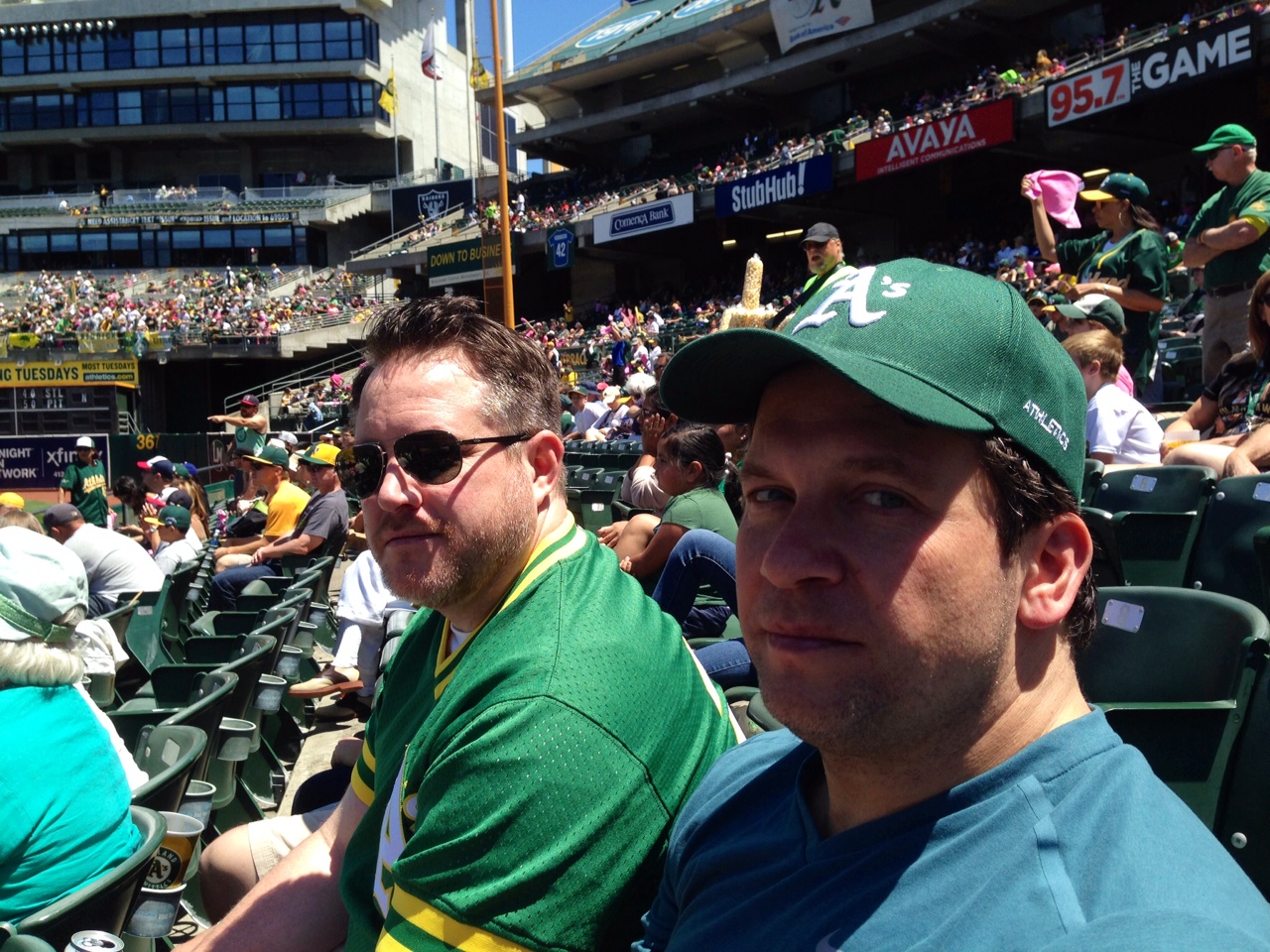
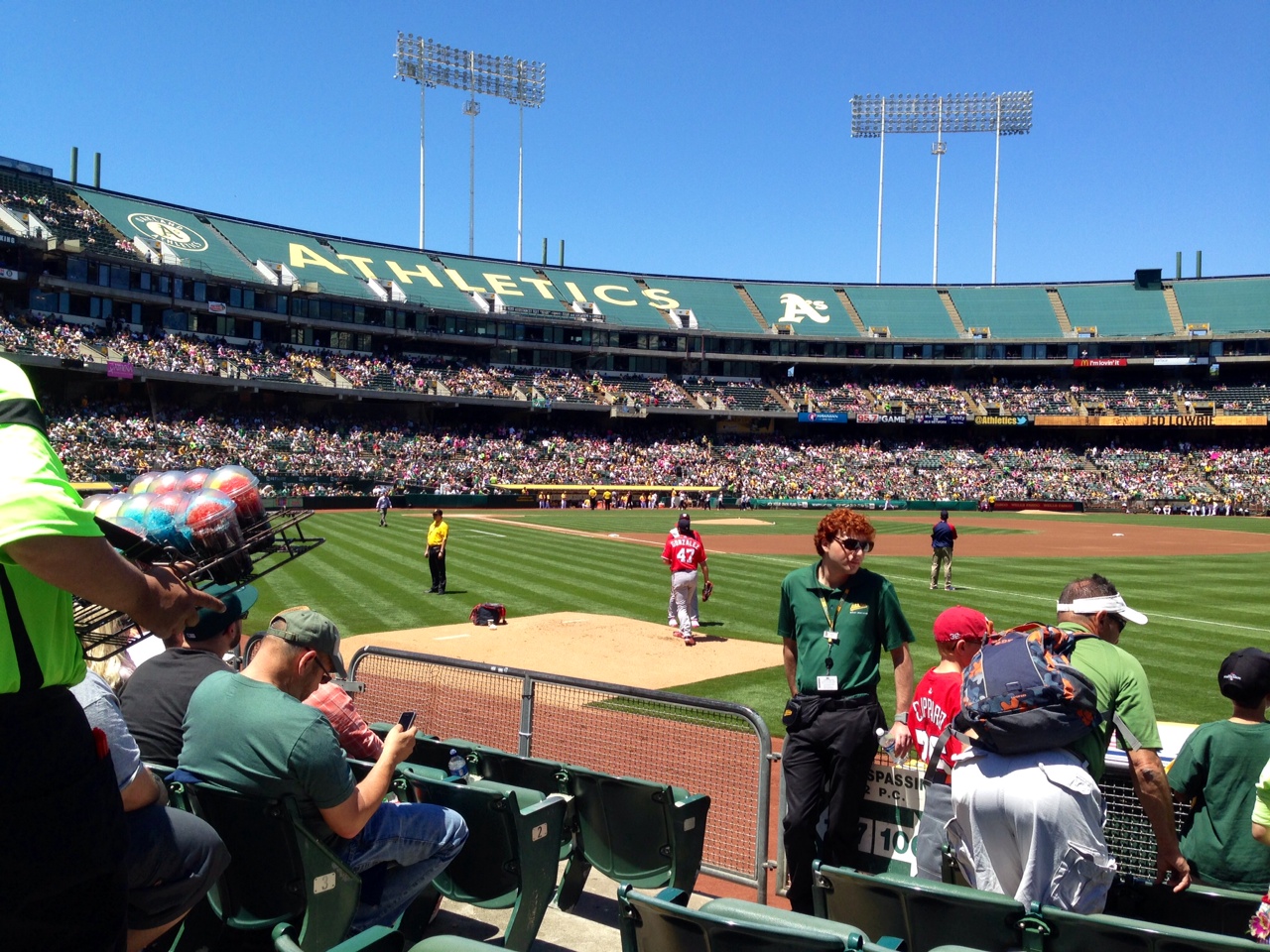
The second stop on the GEBNBT ’14 was O.co Coliseum, the home of the Oakland A’s. Here’s Greg’s take from 14 years ago, when it was Network Associates Coliseum. My take: The O.co is a giant pile of concrete that should be demolished posthaste, with the rubble used to build statues of Lew Wolff and Bud Selig with their pants at their knees while they piss on the city of Oakland.
Selig’s right to be half of such a monument is easily understood; his spavined final years as commissioner will end with some imaginary committee continuing to “study” whether the A’s should go to San Jose, stay in Oakland, return to Kansas City or Philadelphia, or cease to exist after they all drown in another sewage backup. (Undoubtedly the commissioner is busy preventing the Mets from being run like a fourth-rate orphanage and keeping some nihilistic con man from turning the Marlins into a cynical three-card monte game. Oh wait.) As for Wolff, I was surprised to hear Bay Area fans lambaste him, mostly for having ignored clear signals he had no path to setting up shop in San Jose and for actively resisting plans for a new stadium next to Oakland’s thriving Jackson Square neighborhood. I trust the intensity of their venon; if you’ve studied the issue more than I have, I’d be interested in a good explainer.
Anyway, the O.co struck me as a Mad Max version of Shea. Instead of Shea/Citi’s tangle of chop shops and unpaved streets and rumbling els, you get caged walkways leading over industrial yards. Eventually, the caged walkways dump you in the vicinity of an ugly gray concrete pile that rises from a weird hill of xeroscaped dirt, which you search for entrances a la Tomb of Horrors.
 Welcome to Oakland! The O.co’s employees would fit in at Shea too. The O.co has metal detectors, though not enough of them — more were waiting forlornly inside, of no use to anyone. The people running the metal detectors that were in use didn’t seem to have ever seen such devices before, leading to long lines that moved when attendants got distracted, which they did often enough that one’s faith in the deterrent value of the metal detectors became vestigal. At one point one employee dragged a barrier across the end of a line and then wandered away; a couple of minutes later another employee happened by, scratched his head and then shoved the barrier aside again. I used to explain Shea to the uninitiated by saying that it was like a DMV with baseball in it; well, the O.co is like a Supermax with baseball in it.
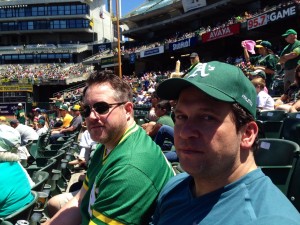 Hey, at least it’s sunny. If you’re thinking that’s unfair, you’re right — prisons are run a lot better than this place. No one at the O.co seems to have thought about how lines should work — every concessions stand’s line goes straight out into the concourse, blocking the path of fans trying to reach their seats. So you go about 25 feet, hit an insane bottleneck created by people trying to buy a beer or a hot dog, wait patiently to clear the area, then repeat the process. A bright eight-year-old with a modest budget for Tensa-barriers could fix this problem in about half a day; no one at the O.co seems to understand something’s wrong.
Once you reach your seat, you can appreciate the quirks of the place — until you notice that none of them were put there on purpose. The legendary foul territory is even more amazing up close, except that you aren’t up close. We were in pretty good seats — sixth row down the right-field line — but home plate was still a distant rumor. Seriously, you could put a decent-sized street of suburban houses on either side of the baselines in Oakland and still play ball. Never mind what it does to the game — it’s self-evident suicide for selling fancy seats. The scoreboard is the old Shea Lite Brite type (I flashed back to INSANE APE sightings in support of Kevin Appier). And 95% of the upper deck has been turned into a huge, forlorn semicircular A’s ad.
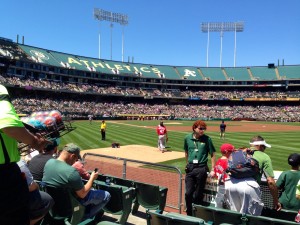 There’s a game over there somewhere. For all this, the park itself isn’t too bad — the view of the mountains was destroyed long ago by Mount Davis, but the music’s pretty good and the fans are great. I can’t say that enough — we were surrounded by East Bay gangbanger-looking dudes, merry bearded drunks, families with hyperactive kids and old sun-leathered military types. Everybody got along swell and everybody was mad for the A’s, who paid them back by stomping the Nationals behind a pair of three-run homers from Derek Norris. Once you’re inside the O.co, the game’s the thing, and that’s not all bad.
But the game’s the thing in Wrigley Field too. The difference is Wrigley Field is a remnant of baseball in a simpler age, while the O.co is a living fossil from an era of bad decisions, still with us because of a recalcitrant owner and a negligent commissioner. The A’s are a good team; their fans are great fans. They deserve so, so, so much better than this.
My next stop was Chase Field, home of the Diamondbacks. The D’backs are a deeply weird team, one given to overhauling rosters and philosophies and uniforms at a dizzying pace. They’ve always bugged me on some level — I suspect I’d despise them if I had to see them as often as I do the Marlins. Part of it is the uniforms — the Diamondbacks aren’t quite the sartorial tire fire on display down in Miami, but they make up for it by switching madly between bad ideas: random colors, the stupid snake as D, and the stupider “db” as snake head. I once described their brand identity as “Barfed-Up Pueblo, a dog’s breakfast of vaguely Southwestern motifs run through a blender by a meth-addled dude in a trailer,” and I think that pretty much summed it up.
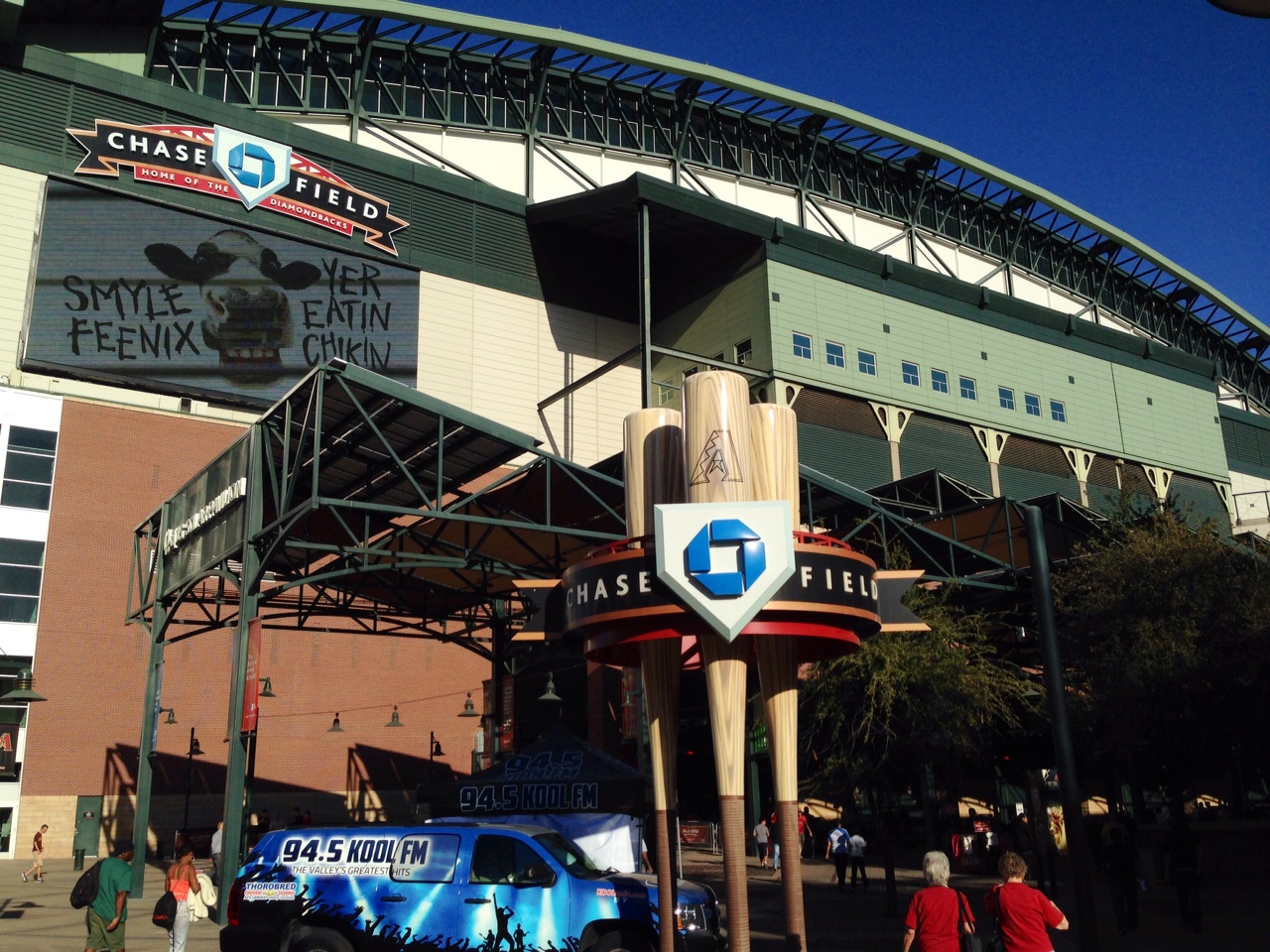
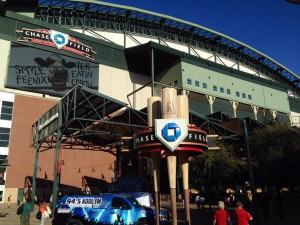 Welcome to Chase Field! So how’s their park? Similarly addled. It’s not a bad place to see a baseball game, by any means. But like its team, it’s … deeply weird.
Some aspects of Chase Field work pretty well. The customer-service people I met were unfailingly nice and good at their jobs. The park presents a friendly face to the city outside it, leading you under a covered concourse to a rotunda with a giant map of Arizona on the floor and the D’backs’ World Series trophy prominently and proudly displayed, along with uniforms once worn by Randy Johnson and Luis Gonzalez. Inside, you’re likely to run into oversized mascots of those two, along with a giant Matt Williams and Mark Grace. Peculiar? To say the least — I can’t think of another team that’s turned living ballplayers of relatively recent vintage into mascots, and it was a bit strange to sit behind Nationals manager Matt Williams as he watched a massive cartoon version of himself participate in a between-innings race. But the fans seemed to like it, and it’s harmless enough.
 The Sonoran dog meets its Value Meal cousin. Chase Field is also a rarity among today’s ballparks in that the people who run it have thought about fans of more modest means. A lot of the concession stands have value items — you can get a hot dog, 12. oz drink or a popcorn for $1.50, and a beer for $4. For a family that doesn’t have a lot of money but wants to take kids to the park, that can make a big difference — the parents don’t have to panic about spending a week’s pay at the park and the kids don’t feel like they’re missing out. I was curious, so I tried the $1.50 dog alongside the $7 Sonoran dog, a bacon-wrapped gutbomb with various Mexicanish stuff. The $1.50 dog is small and honestly not great, but a kid would munch on it perfectly happily. Kudos for the D’backs, and another idea I wish the Mets would steal.
Not everything about Chase Field works quite so well, alas. The D’backs have another mascot, D. Baxter the Bobcat, who exists because back in 2000 Jay Bell’s kid thought Bank One Ballpark needed a BOBcat. That’s kind of cute, but Baxter is not. He’s annoying, which is a peril of the mascot trade, but he’s also creepy. I think it’s because his head is more or less normal-sized, which means he comes off less as a cartoon than as a vaguely menacing felinoid alien — it’s the mascot version of the Uncanny Valley, I suppose. I didn’t get a picture of the thing because I didn’t want to look at it; the D’backs should trap Baxter and release him in some minor-league affiliate’s park, never to be spoken of again.
 What the actual f— is this? Then there’s the park itself. I know it had to have a roof — playing baseball in Phoenix is like playing on the surface of Mercury. But while I’ve seen retractable-roof parks that still feel like baseball stadiums (Safeco and Minute Maid, for instance), Chase Field feels like an all-purpose arena, with everything aligned slightly incorrectly for baseball. It’s better when the roof opens, which happened a few minutes before game time, letting us enjoy a pleasant desert evening. But while the roof was closed, it was frankly pretty awful inside — the huge space nonetheless felt claustrophobic, and the place was hot and stuffy, like being stuck in someone’s giant attic.
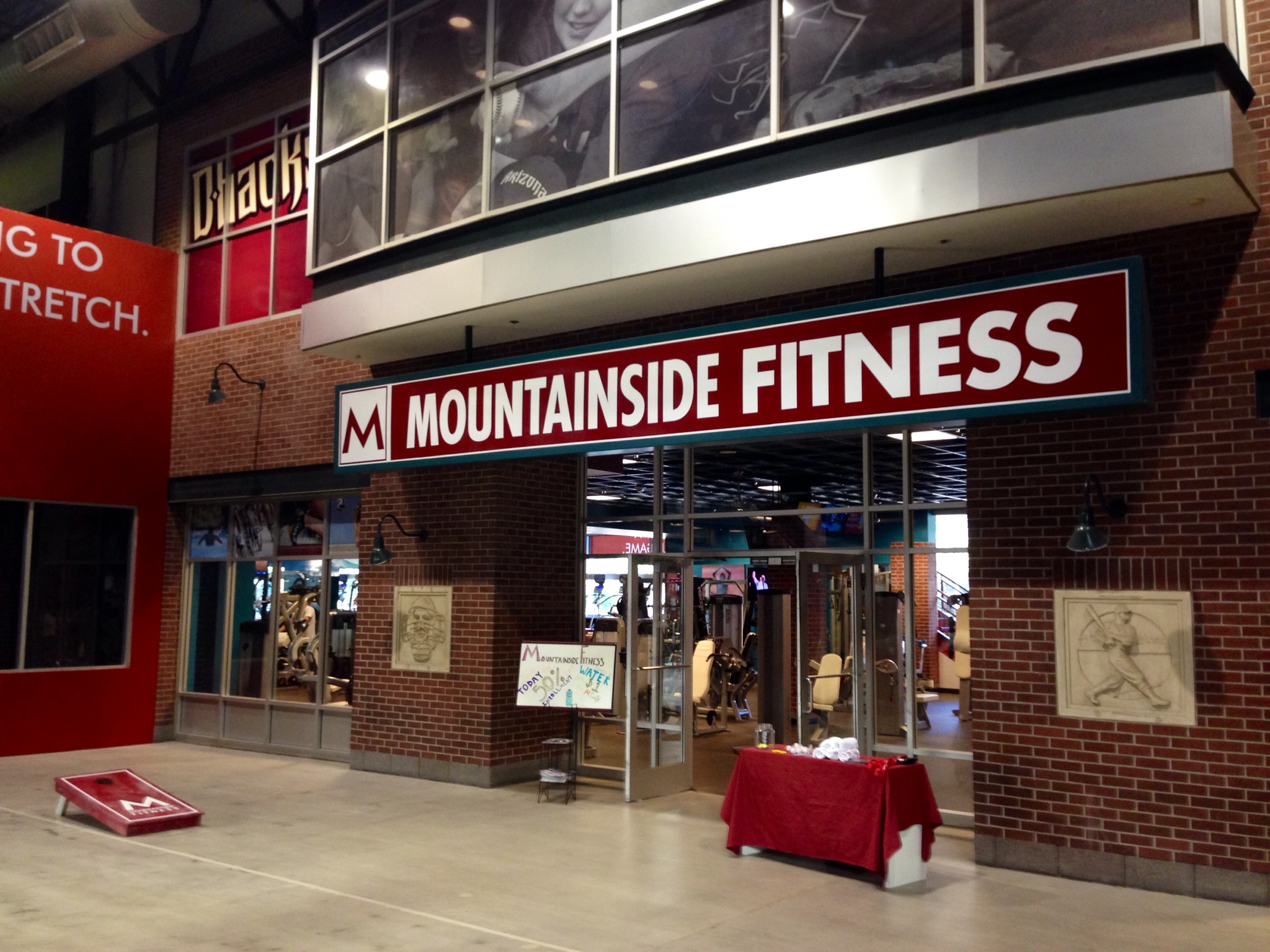
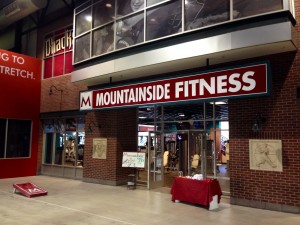
Ultimately, Chase Field feels less like a stadium than it does like a big mall. It’s a well-run mall with nice folks and more brand identity than it used to have — I’m still not convinced Sedona red is an actual thing, but it’s used well inside. But it’s still a mall with baseball in it. (Which is better than baseball inside a DMV or a Supermax, granted.) For instance, behind center field you find Mountainside Fitness, which I stared at in puzzlement. There appeared to be doors in and out of the place from the concourse and the outside world, and there were people working out inside — not Diamondbacks and Nationals, but men and women riding bikes and doing crunches and stuff. You can read a bunch of marketing hoo-ha about it here, but don’t bother. What in the world is this doing taking up space inside a ballpark? Who thought this was a good idea? The people who make a lot of the decisions about Chase Field, that’s who.
My final stop was Minute Maid Field, home of the Astros — and my favorite ballpark of the three. (Greg wasn’t as fond of it back in 2003, though he admits there may have been other factors at work.) I watched the Astros and Rangers play (a rivalry that’s fairly lacking in Minute Maid product) on a startlingly lovely night with the roof open, and found the place friendly and inviting.
 Yes, this is just outside a ballpark. For one thing, it’s a street-level park — there are innumerable doors that open directly onto the street, instead of sending you through concourses and ballpark add-ons or past the guard towers and razor wire of the O.co. The neighborhood around Minute Maid remains stubbornly desolate, but there are nice touches — you walk from a little forestlike park right outside center field (with birds happily chirping in profusion) to a portico of Houston’s old Union Station, incorporated as the ballpark’s main lobby. Though many fans seemed not to be aware of that — one helpful verging on slightly desperate Astros employee chased down an out-of-town couple who tried the wrong door and kept going.
Both inside and outside, there’s lots and lots of Astros stuff. Every Houston award of note is celebrated outside, from Gold Gloves to plaques for the retired numbers, which is something I’d love to see the Mets do. Inside, famous Astros get banners, and the epic deeds of Biggio and Bagwell are oft-chronicled, which is as it should be.
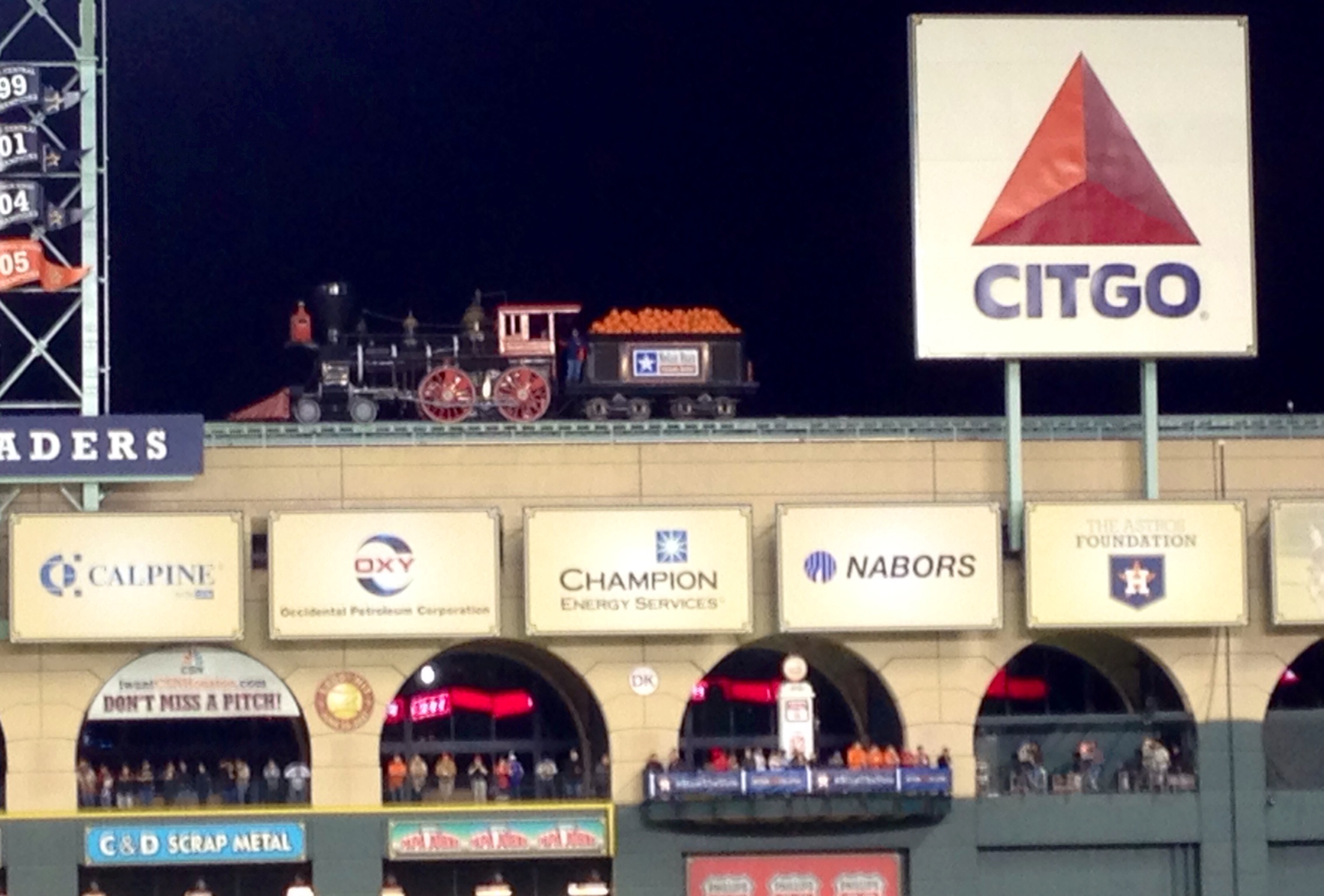
As for Minute Maid’s quirks, your review of them will ultimately say more about how you feel about ballpark quirks than it will about the quirks themselves. I mostly liked Minute Maid’s, from the Crawford boxes in left to the Home Run Pump with its altar-like prow above left-center to the famous (or infamous) Tal’s Hill. And the fans get an up-close view of these areas, even without proper seats — I liked that I could hang out at the Home Run Pump and gawk at Tal’s Hill without some maroon-clad Pinkerton telling me I gotta move it. Is it all a bit too much? Maybe. I detested the stupid Chick-fil-A “fowl”poles, the PA announcer was trying way too hard, and the mini-Citgo sign feels like a small-town homage to the real thing — you don’t want any part of your ballpark to feel like a theme-park ride.
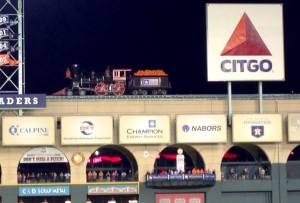 Too much.  Just right. But I liked Minute Maid — I really did. It helped that I liked the Astros — with Houston at bat Jose Altuve and George Springer hung out on the top step of the dugout, bopping along to the music and grinning at each other like Little Leaguers, which was adorable. Plus they’re both good — Altuve is like an Energizer bunny, and Springer brought the Astros all the way back from a 4-0 deficit against the Rangers with a bolt into the Crawford boxes and then practically floated around the bases in happiness. The Astros don’t make enough contact, but you can see the talent there, and they play like they’re having fun. In a few years, if things go right, watch out.
And OK, it was a beautiful night. That makes up for a lot — I saw all four parks on nice days, with the kind of weather that made you perfectly happy to imagine a big comeback, extra innings and more baseball. O.co is a disaster, yes, but it’s got green grass, happy fans and a good baseball team inside. Chase Field is a mall, but I enjoyed chatting with the woman next to me, an old New Yorker who made sardonic sport of the park’s overreach but was there till the end cheering on the home team. Minute Maid Park might be a tad overdone, but it’s friendly and gives you moments of beauty. Like the train silhouetted against the sunset of a perfect Texas night. Or the familiar sights of fielders carving out routes across green grass to intercept fly balls. Or the sight of the home team happily dogpiling after a trudge to defeat turned into a victory lap.
That works anywhere, whatever the surroundings.
(More photos over here on my Tumblr.)
by Jason Fry on 18 May 2014 11:27 pm Zack Wheeler will be 24 years old on May 30. This is easy to forget, but we’d do well to remember it. He’s a work in progress.
Wheeler lost today against the Nationals, victimized by Wilson Ramos, dimwitted baserunning by his teammates, Ian Desmond and his own command. There’s no particular shame in falling prey to Ramos — when he sees a pitcher wearing blue and orange, Ramos is transformed from journeyman catcher to Mike Piazza channeling Rico Carty, Freddie Freeman and Greg Dobbs. The misadventures of Daniel Murphy and Juan Centeno are obviously their own problems. And Desmond smashed a long home run off a Wheeler slider that didn’t slide, which brings up the issue of command.
Wheeler’s pitches haven’t gone where he’s wanted them to in three of his last four starts — a debacle against the Rockies, a mess against the Yankees and now what happened vs. the Nats. What’s wrong? To my admittedly civilian eye, it looks mechanical and not mental.
Wheeler’s not exactly electric in postgame interviews, but it’s a fannish mistake to dismiss a laid-back Southern pitcher who fails to breathe fire after a loss as missing the Will to Win. Are there Mets pitchers who have lacked that ineffable quality? Sure. Mike Pelfrey‘s lack of focus and general weirdness was a huge problem for him, and Jonathon Niese’s conspicuous lack of interest in his craft drives me crazy. But I don’t see evidence of that in Wheeler. Rather, what I see is a failure to repeat his motion and stick to his release point, which leads to imprecise location, which leads to glum glances at balls heading for another ZIP code and kicking at the dirt. (Talk that Wheeler’s been tipping his pitches sounds like another manifestation of the same problem.) Nothing against Gary and Keith, but I really wanted Ron around for today’s broadcast to talk mechanics.
Wheeler has another problem that isn’t his fault: He isn’t Matt Harvey.
Harvey followed an intriguing half-season with a dominant sophomore campaign, and when Wheeler seemed to follow the same script (complete with a delayed debut because of service-time considerations), I think we decided his 2014 would be like Harvey’s 2013, though hopefully without Tommy John surgery. But not every pitcher is Matt Harvey, sprung like some pitching Athena out of the head of Tom Seaver. Most 23-year-olds still have things to learn, and there’s no shame in that.
Plus watching Wheeler get into trouble and fail to extricate himself from it, I found myself thinking how extraordinarily hard pitching is.
First you need superhuman DNA — the ability to throw a baseball at extraordinary speed, ideally with natural movement, and to command one, two or ideally three other pitches well enough to get the best hitters on the planet out consistently. There’s no question Wheeler passes this test– his arsenal is scary good.
Next you need consistent mechanics — the ability to do something physically and mentally difficult again and again and again, even if you’re exhausted and 40,000 people are screaming and a game, season or your own career might depend on how you execute. Wheeler’s still working on this, though every pitcher struggles with it at times.
Finally you need the intangible part — a good memory for batters’ tendencies and tells, the ability to adjust and improvise from inning to inning and at-bat to at-bat, and a ferocious desire to compete and win. (A good catcher helps, of course.) Does Wheeler have that? We should let him master the mechanical part before we make judgments.
Oh, and of course even if you can do all these things, pitching does awful things to your elbow and shoulder. It’s painful and profoundly unnatural — every pitcher knows his elbow is a ticking bomb, and this next pitch might leave him with a horrible feeling that something inside has tightened or popped, which at best means a year of rehab and at worst means everything you’ve worked for is gone.
Zack Wheeler’s 23 and still learning to do something incredibly hard. Rather than sigh that he isn’t Matt Harvey, let’s give him time to become Zack Wheeler.
by Jason Fry on 18 May 2014 12:24 am FREE [SO-AND-SO]!!!
It’s a common cry when things start to go south for a team, meant to rally the segment of the fanbase that self-identifies as sensible, but it can be used in different ways. Sometimes it’s a sabermetric cudgel for bashing those whose reliance on “old” stats keep them from seeing an underutilized player’s true value. Other times it’s a call for a promising rookie to be unleashed from the minors, where he’s tethered by service-time considerations or the perception that he’s still light on seasoning. And it can be an all-purpose clamor for change — less a vote for Player A than a vote against Player B.
Nick Evans. Lastings Milledge. Heath Bell. Val Pascucci. Fernando Martinez. Matt Harvey. Mike Baxter. Andrew Brown. Josh Satin. That’s just a short list of recent Mets in bondage whom we beseeched the front office to bring forth.
Most of the time, the player we seek to free turns out to have been more desirable in the abstract than in reality, which can lead to the ironic campaign for them to once again be consigned to wherever they came from. But not all the time. We don’t know what we’ll ultimately decide about Juan Lagares, the Mets’ interestingly utilized center fielder. Perhaps it will be this — that would be very, very nice. Or perhaps it will be a collective shake of the head, with time having turned the disappointment into a dull ache — oh yeah, him.
But we can say two things with certainty:
1) The petition for Lagares’s freedom has circulated amid rather strange circumstances; and
2) few players have celebrated their freedom quite like Lagares did today in Washington.
First, the petition.
A converted second baseman, Lagares came out of nowhere last year to show off superlative skills in center, moving up the charts in our estimation from “as good as Kirk Nieuwenhuis” to “maybe Carlos Beltran‘s equal” and finally to “yes, Carlos Beltran’s equal.” The bat remained a question, however, and over the offseason the additions of high-priced free agent Curtis Granderson and roll-of-the-dice project Chris Young left us nervous about how much playing time Lagares would get.
These things sorted themselves out, as they tend to — Young got hurt and Granderson began the race to October in tortoise fashion. Lagares, meanwhile, whacked a home run on Opening Day and kept flying from there. His defense was routinely spectacular, and while cautions about small sample sizes abounded, in the early going he showed signs of having become more selective at the plate. The point is that he wasn’t competing to be the Mets’ center fielder — he was the Mets’ center fielder. At one point Terry Collins even said so.
Few things are more dangerous in Met Land than Terry declaring ownership of a position, though. Lagares came back from a DL stint, kept hitting, then began to slump a bit. It happens, and it wasn’t like Lagares was awful. But his woes were enough for Collins to park him on the bench, choosing instead to give starting assignments to Eric Young Jr. and Bobby Abreu.
You don’t need to be a sabermetrician to know this is insane: EY is a fourth outfielder/pinch-runner and Abreu is a pinch-hitter. Terry burbled that he needed offense (which he didn’t get from those other guys either) and that Lagares needed to clear his head. His pitchers probably muttered that they needed defenders who could catch the ball reliably. If there was any comfort for Lagares, it was that Terry was making strange decisions about other young players, too: Wilmer Flores was called up to play shortstop, then sat on the bench and watched Ruben Tejada do that, which seems like a curious way to learn. Josh Satin became the invisible half of a supposed platoon, failed to hit when given no opportunity to do so, and got shipped off to Las Vegas. His replacement, Eric Campbell, would be advised to rent rather than buy.
But it was the treatment of Lagares that caused Mets fans to rise up in indignation, which is to say that we struggled to lift our heads while in our default position of prone despair and wailed on Twitter, with the first rumblings of FIRE TERRY beginning to take hashtag form. That isn’t going to happen and isn’t worth discussing — Collins’ deal runs through next year, which is basically a job guarantee for a franchise that probably orders weekly searches of the office couches for nickels. What might be hoped instead is that Sandy Alderson gets tired of Terry’s infatuation with players who can only do one thing and either orders him to use those guys differently or goes full Moneyball and takes his favorite toys away. (“I don’t think you’re starting EY — he plays for the Cubs now.”)
But enough about why Juan Lagares needed to be freed. Because the good news is that today he was, and boy did he make the most of it. In the first inning he laced a 1-1 Gio Gonzalez offering the other way to make the score 3-0 Mets. (By the way, Gio behaves like the kind of guy you edge away from when encountered on the subway.) In the third he clubbed a two-run homer to left-center to make the score 5-0. But the best was yet to come: In the sixth, with the Nats having to drawn to within three, Jayson Werth cranked a Bartolo Colon fastball to dead center. Lagares turned and raced to the center-field fence, leapt, and came down with the ball. Werth stuck out his tongue and slowed to a trot near second, looking even more truculent than usual, while Colon applauded into his mitt.
And this doesn’t even count the plays that didn’t register because Lagares did what he nearly always does — read the ball properly, got an excellent first step, ran hard and made a potentially difficult play look routine.
If you’re scoring at home, Lagares’ ledger includes three runs contributed on offense and one subtracted from the other guys on defense. Which, a bit simplistically, meant the difference between a 5-2 Mets win and a 3-2 Mets loss.
It’s fine with me if Collins wants to frame recent events as Lagares clearing his head and returning to the diamond with renewed purpose, or some such folderol. As long as the outcome is the right one, I don’t particularly care. There was no need to make the case for Lagares a week ago, but there’s certainly no reason to do so now. What Lagares did today was a convincing demonstration to anyone sentient that he should never be kept away from center field again.
by Greg Prince on 17 May 2014 12:29 am The place: Cooperstown, New York.
The time: A sunny Sunday afternoon, date to be determined.
The occasion: Juan Lagares accepting his induction into the Baseball Hall of Fame.
Let’s listen in…
It would be easy to look back on my career, filled as it is with Gold Gloves, MVP awards and world championship rings, and say it was predestined. I always played with faith in my heart, but I know it took not just what was Up There to help me succeed, but it took what was down here.
I think back to the early days when I had the good fortune of being able to take a good long look at what surrounded me. It was my second year in the big leagues. My first year had gone pretty well. I came up without much fanfare and showed I could field and throw. The next year I was hitting pretty well, though maybe I had fallen into a little slump around the middle of May.
I’d always thought the best way to get going as a hitter was to work hard, stay in there and, most importantly, keep swinging. You can’t break out of a slump if you don’t get a chance.
Yet on our team, there was a different philosophy mandated by those in charge. The people who ran the team didn’t much want you to swing. They instituted a system that I’m sure was well-meaning but it fouled up just about everybody on the team. Before you knew it, everybody, even our beloved captain, was in a slump.
But it was me who found myself on the bench, night after night. We’d score no runs, but they wouldn’t play me. I grew frustrated but kept quiet. I was only in my second year, so I couldn’t complain. Still, I did wonder what was going on.
It all came to a head one Friday night in Washington. We were playing the Nationals, who always seemed to beat us. This was right after a couple of shutout losses. Surely I’ll be in the lineup tonight, I figured. I looked for my name on the card and no go. No Juan Lagares listed anywhere.
I thought I was through as a ballplayer. I mean if I couldn’t start for a team where almost nobody was hitting, maybe I wasn’t very good.
But a Higher Power had other plans for me. I sat, yes, but also I stopped feeling sorry for myself. Instead I looked around. I looked at who was playing instead of me. I looked at some players even you dedicated fans probably don’t remember. They were good guys, but as players they may not have been what we needed. Players who were one-dimensional. Players who played because they were paid lots of money. Really old players who hadn’t been in the big leagues for a couple of years until that year.
Did I see them do great things that I learned from? No, not really. They didn’t hit any more that night in Washington than they did the several nights before. But as I watched them, I thought, hey, they’re in the big leagues and I’m in the big leagues. They’re not much good but they get to start. If they get to start and have not helped turn us around, I’m bound to get a chance sooner or later. I told myself to have the confidence to show what I could do so that even the most obstinate manager or general manager couldn’t reject me.
Eventually I got my chance. And here I am today, humbled to be joining Tom Seaver and Mike Piazza in representing the New York Mets in the Hall of Fame. They might not have believed in me that night in Washington, but the fans did and I did, too.
Thank you all for your support through those confusing early days. And thank you for giving me that nickname. Maybe you’ve never heard the story of why they started calling me “The Lion King” that very same weekend in Washington. It’s actually pretty funny…
by Greg Prince on 16 May 2014 1:53 pm Subway Series wins used to exhilarate me to a 52 on a scale from 1 to 10. The wins from this past Monday and Tuesday rated a 9.8 and a solid 7, respectively. Not bad, but not Matt Franco. Subway Series losses, when the Subway Series was new, cast black clouds all about me. From Wednesday’s and Thursday’s I thought I felt a slight drizzle.
It’s not the same as it was when Bobby Valentine was manning the dugout instead of a studio. Bobby V made everything feel like life and death…except for life and death, which he made feel secondary to the Mets. That’s probably for the best, because you can only take so much life and death in the course of a season. But Mary Hopkin wasn’t kidding when she said those were the days, my friend. Like her, I thought they’d never end. They did, though. Whether it’s faded novelty, saturation or turning weekend theater into midweek humdrum, the Subway Series is a four-game set against an Interleague opponent that you sure as hell want to win and sure as hell don’t want to lose, but also only a few degrees more intense than four games against anybody in May would be.
I’m not happy the Mets couldn’t beat the Yankees in two games at Citi Field after beating them twice at Yankee Stadium, but I’m less happy that the Mets didn’t score a run, an unhappiness that would apply in exact proportion to not scoring against St. Louis, Miami or whoever. There is no particular shame in being shut out across eighteen innings by the Yankees. There is great alarm in being shut out across eighteen innings by anybody.
Gazed upon with Collector’s Cups half full, these are the days of Jacob deGrom and Rafael Montero, which produced two days of good sidebar news in a pair of senses. One, of course, is that two reasonably highly touted rookie pitchers were promoted and matched their hype, at least on an introductory basis. DeGrom exceeded it, actually, doing everything he could to win his debut. Not only did he throw seven innings and give up but one run — the product of shaky defense, mostly — but the kid ended the notorious hitless-by-pitchers streak at last. Jacob singled in the third and somewhere, I’d like to believe, Tom Seaver stood on first base snapping his warmup jacket shut as he looked to Eddie Yost to see if the hit-and-run was on. DeGrom also laid down a beautiful bunt, proving the young man was born under the sign of Chub Feeney…or at least the former National League president’s signature on a Spalding baseball.
Of course it’s wonderful that deGrom pitched (and hit) well and Montero pitched well. Of course it will be wonderful when Zack Wheeler settles down a bit and Noah Syndergaard Super 2’s his way up and Matt Harvey recovers and Steven Matz maybe keeps coming. Take those guys, mix in Niese and Gee and whoever else is bubbling under the Hot 100, and you know what you might very well have in the not-too-distant future?
A genuine pitching surplus. And you know what you can do then? Trade for some hitting, because Jacob deGrom and his hurling brethren can’t do it all alone. You can never have enough starting pitching, but you also can never ask your starting pitching to bear the burden of getting outs without somebody on his side getting runs for him. Unless the Mets are playing in a certified bandbox or facing a depleted bullpen, they don’t hit and therefore they don’t score. Every National League president from Harry Pulliam to Leonard Coleman could tell you that.
While the Mets christen some careers while impeding others (reserve outfielder Juan Lagares’s, for instance), the Yankees go about their business of trying to be the Yankees, which at the moment doesn’t seem to be happening. Putting aside their so-so, similar-to-the-Mets record, they just didn’t seem all that frightening this series, did they? I was going to say “all that intimidating” or “all that imposing,” but frightening seems more accurate. Frightening is what the Yankees have been almost without pause through the history of the Subway Series. There was always this lurking terror in their dugout. No lead was safe. Didn’t matter if it was the heyday of Paul O’Neill or the denouement of Vernon Wells. Either they were going to stick it to us or they were going to make us hang on for dear life.
I gotta tell ya — I didn’t feel it this time. It’s gone. There is no Frightening Factor to these Yankees, and I say that without intent to needle or declare a shift in municipal fortunes. The Mets have their own problems. The Yankees aren’t one of them, but they have their own problems, too. I enjoyed the wins on Monday and Tuesday but not so much that they vaulted me into a heretofore undiscovered stratosphere of ecstasy. I was annoyed by the losses on Wednesday and Thursday, but just garden-variety annoyed, not it’s the end of the world as we know it and I feel the diametric opposite of fine annoyed.
I’d hate to think the “maturity” everybody warned me about is finally kicking in. I’m pegging this lack of emotional resonance partly to the Yankees hosting a roster packed with relative strangers (some handsomely compensated, some totally anonymous, few as sensational to date as Masahiro Tanaka or Yangervis Solarte) and partly to the impending retirement of the Yankee who’d defined the Yankees for the past two decades.
“Why are the Mets giving Derek Jeter bathroom tiles?” was my wife’s reaction to the Subway-themed sculpture Jeff Wilpon presented the other team’s shortstop Thursday evening. After I made a few extraordinarily mature references to “No. 2,” vis-à-vis the bathroom theme, I took in the tableau of Jeter accepting the Mets’ gifts (including a nice tax-deductible donation of some of that Farnsworth money to his foundation) and realized that at this moment when his media-driven beatification is mounting to absurd levels, I no longer despise Derek Jeter.
Maturity did get to me. Or perspective. Or whatever. Jeter’s no longer frightening. Except for the ceremonial aspects, he didn’t impact these four games whatsoever. His final swing in his final Subway Series contest, in the eighth inning, produced a fielder’s choice ground ball to Ruben Tejada, who threw it home to nail Kelly Johnson as the batter wound up on first, where he’d be stranded once Josh Edgin flied out Jacoby Ellsbury. In years past, you know that the ball he hit would’ve gotten by Tejada; or Ruben’s throw would have sailed past Juan Centeno; or Jeter would’ve taken off for second and scored in a flash and the Yankees would have added another eight or nine runs off Armando Benitez in short order. That was the Frightening Factor that always loomed the moment Derek Jeter stepped to the plate, raised a hand in the air to signal to the umpire that he was prepared to be pitched to, and wrought irreparable harm to our collective psyche.
But not last night and not this week. There were hits and walks through Jeter’s final Subway Series, yet only remnants of mystique and aura. He’s a rangeless almost 40-year-old middle infielder whose OPS hovers below .650. What’s the point of despising that?
To the world at large he was treated as the Face of Baseball before they started having silly contests to determine such things. To most of us on this side of the New York divide he was the face of baseball oppression. The more Jeter and the Yankees won, the further the Mets were stomped — inadvertently or otherwise — into the depths of obscurity. That is what I despised. He had dozens of accomplices, but Jeter was the poster boy for all of it.
I resented Derek Jeter in 1996 for overwhelming defensive savant Rey Ordoñez in the battle of rookie shortstops that was concluded before it could commence. I resented Derek Jeter c. 2000 for being placed on the same pedestal as Mike Piazza when Piazza was carrying the Mets on his back and Jeter had all kinds of high-priced help. I resented Derek Jeter by 2004 when the Mets brass was preemptively positioning young David Wright as “our Jeter,” which might have been meant to flatter but (like everything the Mets brass says) landed on a sour note. Wasn’t it enough that Jeter had conquered the universe without infiltrating my Mets consciousness?
No doubt Jeter never gave the Mets a second thought when he wasn’t playing and beating them. Perhaps if Interleague hadn’t been invented, I’d have accepted Jeter’s status as an all-time great in progress with more grace and less bile. If you come across Mets Yearbook: 1968 on SNY, you’ll see Mickey Mantle at that year’s Mayor’s Trophy Game being presented a retirement gift of his own (a painting, and not of the 7 train). Mantle never played the Mets for real. He was an icon before the Mets existed. If I were at Shea that night in 1968, I imagine I would’ve stood and applauded Mickey Mantle. I was at Shea Stadium and Citi Field several nights and days between 1998 and 2009 and never did anything of the sort for Derek Jeter.
Last night, upon his final regular-season appearance against the Mets, I probably wouldn’t have, either. But I wouldn’t have booed him the way I did most every time he appeared in my midst when he and his frightening teammates always seemed to be getting in our way, blotting out our sun and snatching away our city. My imagined respectful silence toward Derek Jeter would have been the most heartfelt going-away present I could bestow on him.
I would have given it to him gladly.
by Greg Prince on 15 May 2014 9:47 am There are nights when you love how much you love sports. And then there are nights like Wednesday when you prefer to drown your sporting sorrows in prime time soap operas.
The Nets, who occasionally lift my spirits in spite of my knowing that eventually they will find a way to pull them down, mishandle them and turn them over, departed their postseason under ignominious, lead-blowing, ref-abetted circumstances. Their sudden, disgusting elimination from the NBA Eastern Conference semifinals left me in that playoffs-are-suddenly-over zone every sports fan is now and then compelled to visit, the one where you have to convince yourself not to destroy your television as you rue your failure to have added Yukon Jack to the week’s grocery list.
By the time the Nets definitively proved they couldn’t take the inevitable Heat, the Mets were still technically engaged in their relatively lower-stakes competition versus their intracity rivals, yet I had witnessed enough of it to have become resigned to the imminent expiration of the delightful six-game Subway Series winning streak Good had cobbled over Evil (or, if you’re touchy about hyperbole, Irksome). As the immediate sting of the basketball wore off, the frustration from the baseball sank in like a Ray Allen three-pointer with 32 seconds to go. I was so put out by the combination of conclusions that when both contests were over, all I could stand to do was switch to DVR mode and watch the season finale of Nashville — where melodrama always paints the corners — and try to forget about the whole thing.
What whole thing?
The Mets were a lost cause by the time the Mike Scott comparisons came rolling out of the SNY booth on behalf of Masahiro Tanaka. The Ghost of Splitters Past, sans sandpaper, was showing no mercy to the lineup that doesn’t do much at Citi Field to begin with. Hernandez, Carter and Strawberry would have flailed against Tanaka, so could you really expect a whole lot more from their less capable descendants? After the Mets captured two quintessential Yankee Stadium III slugfests, it was only fitting they returned to their home park and demonstrated complete offensive impotence.
Met starting pitching wasn’t nearly Tanakan enough to make a difference, but it looked pretty good nonetheless. Rafael Montero debuted and didn’t disappoint. The kid didn’t blow the opposition away as Matt Harvey did in Arizona two Julys ago, but I don’t think that was the long-range forecast to begin with. He was competent, poised and promising enough for now: 6 IP, 3 ER (one of them the direct result of Eric Young, Jr.’s insipid decision to dive in front of an uncatchable ball) and a lovely parting gift basket to Derek Jeter, consisting of Montero’s first major league strikeout and some fancy lotions. Overall, there was enough to make you want to see more, which is all you can ask of a recalled rookie.
We have another one of those tonight, as Jacob deGrom earned a promotion from reliever to starter by being on the premises when it was learned Dillon Gee was going to the DL with a strained right lat muscle. That’s not supposed to be a serious injury (also, Ryan Church is well enough to fly cross-country with a concussion), so I’m willing to believe Gee’s misfortune is temporary and the opportunity it grants deGrom is a bonus.
If that’s not enough hurlers in motion for you, there’s one more to consider: Kyle Farnsworth walking through the exit. Farnsworth was the closer on Monday — a successful closer in that he was on the mound as his defense notched him a save. Otherwise, he was a ticking suckbomb who Sandy Alderson defused just in time to withhold most of his pending salary.
It was one of those cold business moves a team occasionally executes because it can and you can’t really argue with it since it’s contractually valid, and lord knows when it comes to late-game clutch, Kyle Farnsworth was no LeBron James. Most of his career he’s been the guy LeBron James dunks over. It fells a little icky nonetheless. Yet within the bottom line-savvy circles where we do our hardest rooting, I don’t expect to hear, when the next late Met lead slips away, cries of “Why ever did we get rid of Farnsworth?”
So good luck to Kyle Farnsworth. At any rate, don’t strain your right lat muscle as you ratchet up your bitterness at your former employers.
Perhaps it’s discovering the sun rose this morning despite my prediction to the contrary last night, but maybe fewer leads will slip away now that our bullpen’s been revamped. Jenrry Mejia is, as Jerry Manuel and I always thought he would become, an accomplished reliever now…if we can stretch the concept of “accomplished” to encompass one encouraging appearance. Jeurys Familia has closer stuff if not control. Josh Edgin is returning, and Josh’s ability to throw with his left hand makes him, theoretically, a valuable commodity. Daisuke Matsuzaka extricated Zack Wheeler’s overcooked fat from the pitch-count fire the other night; nobody will ever fully trust Daisuke Matsuzaka but he hasn’t completely betrayed us yet. Plus, once Gee and Gonzalez Germen return to active duty, there’s every chance Jose Valverde will receive a kinder, gentler but just as definitive Farnsworthian farewell.
See? Sometimes you wait for the light of day and things do look so much better. It’s enough to make you believe Rayna James will spurn Luke Wheeler and wind up with her one true love Deacon Claybourne.
by Jason Fry on 14 May 2014 2:22 am Just for an evening, it would be pretty fun to be a big-league ballplayer. I don’t mean as a walk-on — a Joe Boyd thrust onto a stage not normally yours. I mean, wouldn’t it be fun to be an invisible traveling companion — someone who could see what the player sees, hear what the player hears and most importantly do what the player does?
Who would you choose to be? I’m sure it would be fun to be scoop up balls at third base like David Wright, or throw an ungodly slider and moonwalk off the mound like Jenrry Mejia, or even jiggle the belly fat in an impressive way like Bartolo Colon. (Though hmm, after this long on book tour I can do that one myself.)
But if I were going to get my ridealong day, I think I’d be Daniel Murphy.
When he’s on — and part of what makes Murph Murph is neither you nor he can predict when he’ll be on — no one has more fun on the field, and no one manages to be less cool about his successes. Which, endearingly enough, is very cool.
To be clear, Tuesday night wasn’t the night I’d have chosen to be Zack Wheeler. Wheeler threw 118 pitches — 64 strikes and 54 balls. He faced 24 batters and 13 of them reached base. In any normal game, that would be a recipe for absorbing a beating and huddling in dismay at one end of the bench while the regulars were excused from further duty. Tonight, though, it was enough — not to get the win, despite Terry Collins’ best efforts on Wheeler’s behalf — but to wind up on the winning side. Wheeler couldn’t screw this game up badly enough to lose, not with Murph and Ruben Tejada pulling off unlikely double plays and the Mets walloping Vidal Nuno and Alfredo Aceves. Wheeler has great stuff, and has pitched in bad luck and in front of bad defense, but tonight there was no excuse to be made for him.
No, I’d be Daniel Murphy. There was Murph in the second, smothering a Kelly Johnson grounder that was ticketed for the outfield while skidding across the Yankee Stadium infield dirt on one palm, then somehow turning and shooting a throw to Tejada before topping onto his backside. That had to hurt, I thought when I saw the replay, but Murph looked down at his palm and brushed at his forearm as if it were all a great adventure.
Or there’s Murph standing tall after Tejada grabs a short hop or watches a ball spin out of his glove but into his hand or otherwise is forced to improvise. I always worry about him standing at second with a knee locked and vulnerable, but he doesn’t seem to worry — if something happens it’ll happen. It’s the Zen of Murph, I suppose.
But the most fun moment to be Daniel Murphy on Tuesday night would of course have been the fifth inning, when he clocked a pedestrian fastball from Aceves to deep right, sending it clanging off the foul pole. High off the foul pole — this was not a cheap Yankee Stadium home run but a Mo Vaughn special, a threat to unwary hot-dog vendors in the deepest environs of the yard. Murph chugged around the bases, seemingly deep in thought about the cool thing he’d just done, until it burst out of him with a yell as he faced his own dugout.
I don’t know quite how Murph does these things; it’s fairly obvious Murph doesn’t know either. When things go badly he’s as pissed and befuddled as you are; when things go well he’s ready to leap off his couch and high-five everyone, except he was the one who just did the high-fiveable thing. You’re in awe and he’s in awe and things will go wrong again soon enough, but right now, oh my goodness isn’t it fun to be Daniel Murphy, New York Met?
Programming note: This was also gonna be about Chase Field, where I was watching the D’backs beat the Nats while listening to Howie and Josh from Yankee Stadium. But I’m way too tired and have to get up way too early. It’ll wait.
by Greg Prince on 13 May 2014 2:56 am GAME NOTES: The Mets scored nine runs Monday night at Yankee Stadium, defeating the Yankees, 9-7 … The Mets belted four home runs Monday night at Yankee Stadium, defeating the Yankees, 9-7 … Curtis Granderson, Eric Young and Travis d’Arnaud all took advantage of Yankee Stadium’s extremely generous right field dimensions, each hitting a short-porch home run that contributed to the Mets’ 9-7 defeat of the Yankees … Chris Young went deep to left field in the Mets’ 9-7 defeat of the Yankees … The Mets overcame deficits of 4-1 and 7-4 to defeat the Yankees, 9-7 … The Mets’ outfield, consisting Monday of the two Youngs and Granderson, combined to record seven hits in the Mets’ 9-7 defeat of the Yankees … Clutch relief work by newly deployed bullpen weapon Jenrry Mejia proved vital as the Mets defeated the Yankees, 9-7 … Recently recalled rookie Eric Campbell produced a key eighth-inning pinch-hit and displayed impressive baserunning acumen in the Mets’ 9-7 defeat of the Yankees at Yankee Stadium, Monday night … Lucas Duda turned a nifty 3-5-3 game-ending double play — with David Wright covering second — to seal the Mets’ 9-7 defeat of the Yankees … The Mets announced plans to promote Jacob deGrom and Rafael Montero, with the latter set to start the third game of the Subway Series that began Monday with the Mets defeating the Yankees, 9-7 … Media reports of “energy” and “electricity” at Yankee Stadium Monday night were directly attributable to the presence of the consistently enthusiastic 7 Line Army, which made its voice heard and its presence felt throughout the Mets’ 9-7 defeat of the Yankees … the New York Times reported Saul Katz is looking to sell his share of the Mets, who defeated the Yankees, 9-7, Monday night … Katz issued a denial that any sale of his ownership stake is underway, a transaction that could potentially eventually liberate Mets fans from the Wilpon family’s control of their beloved baseball team, which, despite acting as an ongoing source of aggravation in their lives, defeated the Yankees, 9-7, Monday night at Yankee Stadium … The Mets defeated the Yankees at Yankee Stadium Monday night by a score of 9-7.
by Greg Prince on 12 May 2014 1:29 pm I’m glad the Mets seem to like each other as much as they do. Or do at the moment the lot of them accomplish something unforeseeable, which is score a fifth run in an eleventh inning. When Ruben Tejada lined a single through the drawn-in Phillies infield to plate the Young who isn’t Eric as Sunday afternoon was morphing into Sunday evening, every Met on the roster and maybe a few flown in from extended spring training burst out of the dugout to embrace Ruben, perhaps out of gratitude for snapping a five-game losing streak, maybe just for letting them go home after the longest, most drawn-out three-game series in human history.
I was grateful that I got to see the Mets win in dramatic fashion not quite nineteen hours after I saw the Mets lose in excruciating fashion and less than 48 hours after they flailed in astounding fashion. The Mets are not much in fashion these days, but they do have their elements of style.
One of their signature pieces of flair, if you will, is to celebrate every walkoff win as if it had just been preceded by a ball rolling through a first baseman’s legs. Zack Wheeler laying down a perfect sacrifice bunt to have moved Young to second after the revivified Young singled may not have been the spiritual equivalent of Kevin Mitchell deciding that he, like Gary Carter, wasn’t going to make the last out of any bleepity-bleep World Series, but you go to walk off with the circumstances you have — not the circumstances you might want or wish to have at a later time.
And is there anything more exhilarating, despite what it says about personnel depletion, than a pitcher coming to bat in extra innings? Even a Mets pitcher? Take that, designated hitter rule!
Young hits. Wheeler bunts. Juan Lagares walks via the intentions of Ryne Sandberg and without objection from Chase Utley. Anthony Recker — the Mets’ Mothers Day gift to swooning moms and aesthetically appreciative dads everywhere — taps a ball Cody Asche can’t turn into an out. (I’m guessing Cody Asche will be the current generation’s default player with whom they were legendarily inundated when they grow up and reflect upon their 2010s baseball card collection: “All I ever wanted was one lousy Mike Trout, but every pack I opened had like six-dozen Cody Asches instead.”) Up steps Ruben Tejada. In steps the Phillie infield. It steps in a little further. It steps in some more until it is inside the Delta Sky360 Club asking if the kitchen is still open because, gosh, it’s getting close to dinnertime and we have quite the bus ride ahead of us and the traffic on the Turnpike is a bear and maybe you can look in the back?
The Phillies’ barely disguised desire to get this thing over with was complemented by Sandberg’s strategy of sidelining three of his usual relievers — they were supposedly tired, but who wasn’t by 5:30? — and playing the infield in. You know the old saying: when you play the infield in, you turn a .186 hitter into a .195 hitter, which is exactly what happened when Ruben laced the next pitch from Jeff Manship (not his real name; can’t be) into short left. I thought for a sec that if shallowly positioned Dominic Brown charged the ball, he might have had a play on Young, if only because the Mets are the Mets and what are the odds a fast runner from third might score on a base hit to win a game? But Brown turned away from Ruben’s souvenir with what appeared to be, from the vantage point of graciously appointed Excelsior level seats, utter disdain.
Chris makes it home. Ruben, who isn’t big on attempting to beat out grounders, makes it to first. It is officially Mets 5 Phillies 4. The final is confirmed when Randy Bachman and Fred Turner are hauled out of cold storage to perform the song that the Mets present whenever they win at home. As soon as the B and the T of BTO flip through their catalogue so as to remember what song that is — it had been so long — the first notes of that old favorite begin to blare over the Citi Field public address system.
The Mets had taken care of business. It was good to see and it was great to hear. “Takin’ Care Of Business” is positively Proustian to the Mets fan ears, instantly transporting them to a land of happy recaps and magic numbers. “Takin’ Care Of Business” evokes a division clinched inside a stadium that shook amid expectations that were regularly matched and sometimes exceeded. The 1974 classic rock staple that served to accent 2006’s N.L. East domination only sounds dated if you don’t think the Mets are supposed to take care of the business of winning ballgames.
It was nice to be rewarded for four hours and twenty-two minutes of rooting on Sunday, particularly after being punished for three hours and sixteen minutes (plus a rain delay of thirty-nine minutes) on Saturday…never mind the four hours and thirty-nine minutes of televised flagellation from Friday. It was nice to bop along with Bachman-Turner Overdrive and to shout “METS WIN!” at a register so high that the “WIN!” cracked. Losing too much unhinges a fan. Winning once in a while merely irritates a vocal cord, and that heals soon enough.
While the Mets engaged in their madcap marathon of Ruben On The Pony, my wife and I high-tenned with middle-aged moderation. I used to bring my palm(s) to Stephanie’s with force appropriate to “METS WIN!” euphoria, but I’ve learned across the exactly 27 years we’ve known each other that six balls could roll through the twelve legs of six Bill Buckners and she wouldn’t appreciate a full-on high-five because no matter the occasion, she always says, “ow.”
Sometime before the ninth, when the Mets staged the rally that lifted them from near-extinction to deadlock, I remarked to my wife that here it was, my 162nd game at Citi Field — marking a full season’s worth in my Log since the no longer new joint opened in 2009 — and I might never have borne witness to a duller one. What, she asked in all earnestness, made this game any worse than any of the others?
“I just realized something,” I said before sincerely answering her question. “All baseball games must look alike to you.”
She didn’t disagree. My wife doesn’t jot down the particulars of every game she attends in a steno notebook as I do, nor will she dissect the Mets’ ineptitude like her middle name is Elias, yet continued exposure to the Mets through the prism of marriage hasn’t disabused her of the notion that an occasional ballgame is more pleasant than painful — assuming intemperate cold winds or excessively sunlit humidity can be avoided. Neither of those meteorological conditions were in effect Sunday, and if they were, refuge awaited in the Caesars Club, an option she doesn’t avail herself of all that much, champ that she is, but she likes knowing it’s there.
As indicated above, we were celebrating our 27th anniversary of being introduced to one another. It was on May 11, 1987, that I stopped listening to Bob Murphy and Gary Thorne on my knockoff Walkman long enough to be introduced to the woman who would in an instant become the other love of my life. Stephanie, the Mets and I have been enjoying one another’s company ever since, the Mets aggravating only one of us to fleeting excess now and then.
Sunday’s synergy provided an effective antidote to Saturday’s disillusionment. I knew when we walked across Mets Plaza to inspect our brick and I hummed involuntarily along with the loop of “Meet The Mets” that no matter how disgusted I get with my team, I’ll always see through to something better than whatever they’re doing to me at a given moment. It makes me a lousy consumer but it reassures my instincts. Of course I sing in sync with the team song. Of course I bring my wife (if not my kitties) on our Night We Met anniversary to remeet our team together. Stephanie had actually requested a visit to the ol’ ballpark. She does that sort of thing after 27 years.
Her name’s Mrs. Prince, bub, and she likes me.
We went with May 11 for her 2014 debut since it’s worked so well before, not only in the sense of what I was listening to that Monday night in 1987 but where we commemorated our big date in 2008 and again in 2010. We were 2-0 at Mets games on May 11s. Now we are 3-0, a rare slice of perfection connected to a franchise otherwise allergic to flawlessness.
Those eight innings before the Mets decided to awaken (and Sandberg let Jonathan Papelbon rest) were, despite the inherent charms of a baseball-laden May 11, dull as Duda. Cole Hamels, the subject of the best t-shirt I saw all weekend — “COLE HAMELS IS A CHOKE ARTIST” — dipped his toe into recurring trouble but never got bit. He gave up a run to the Mets in the first, which is what every opposing starter does, and then nothing for the rest of seven pitchy innings. He kept throwing, the Mets kept not producing. When Curtis Granderson came up to bat for Jonathon Niese in the sixth with Eric Campbell on third and Tejada oddly on second, it was a classic encounter of lavishly compensated reputations. In this case, overpaid pitching stopped overpaid hitting and the Mets continued to trail, 3-1.
It was a quintessentially Queens version of New York on Sunday, as Bobby Darin can still be counted on to belt out — Mets offense takin’ a nap. They trailed, 3-1, forever. That’s why this game felt as if it was never going to improve, though that’s also why this game felt as if it wasn’t completely gone. Niese was solid for six and Daisuke Matsuzaka was a pro for two more. But the scoring simply ceased.
As I can attest to after a full 162 (89-73), there are worse places than Citi Field to watch the Mets avert success. I don’t know if it’s necessary to layer “Family Sunday” on top of the experience of baseball played without weather concerns, but the themed in-game entertainment was certainly poured on. Big Mom has quite the lobby in this country, so of course Mother’s Day was invoked a few thousand times on the video screen. Several Mets mentioned how much they adore their mothers. Prizes were showered on mothers. The Mets had a mother of a time doing anything with Cole Hamels. It was a very thoroughly executed theme.
We survived seven innings of Hamels and an inning of Mario Hollands besides. We somehow endured Jose “Papa Grandé” Valverde digging the Mets a slightly deeper hole to climb out from when he issued a two-out walk to Jimmy Rollins and a triple to Chase Utley (do these guys ever go away?). After Valverde walked Ryan Howard to get to Marlon Byrd, I muttered without malice, “ah, go ahead, Marlon, for old time’s sake,” thinking 7-1 wasn’t any worse than 4-1 and at least we would be guaranteed an imminent departure to that Indian restaurant in Jackson Heights where we were headed postgame.
But Valverde struck out Byrd to end the top of the ninth, Antonio Bastardo (strange choice for a day celebrating parentage) imploded to start the bottom of the ninth and the tease appeared on.
The Young who isn’t Chris doubled. The Murph who is Daniel homered as if Mets do that all the time at Citi Field. Bam, 4-3. I felt this thrill going up my leg as I recalled Robin Ventura doing something similar to Curt Schilling to rouse a similarly torpid game against this very same opponent in this very same inning in this very same month in this very same vicinity in 1999. Now I had to brush off the dullness of the first eight innings, take our chances seriously and hope somebody would emerge as our John Olerud for the current century.
The Mets wouldn’t reveal their true intentions for many minutes. They never do. A strikeout. A double. A pitching change. A pinch-hitting appearance. A soft line drive whose destination was literally and figuratively up for grabs. A diving second baseman whose glove would touch a ball but not grasp it. A baserunner who by necessity would have to hold up at third. An effectively placed grounder that tied the game. A strikeout that continued it.
Yeah, dinner would wait through the onset of extra innings, a Met threat gone awry in the tenth and a Phillie opportunity extinguished in the eleventh. But the Tandoori oven would be fired up sooner than later once Ruben Tejada refused to keep playing in the best way possible. As the English translation to Juan Lagares’s walkup music strongly suggests once one is compelled to look it up after hearing it six times in eleven innings, “I will believe, I will believe, I will believe.”
That’s how they get ya. That’s how they keep ya.
|
|