The blog for Mets fans
who like to read
ABOUT US

Faith and Fear in Flushing made its debut on Feb. 16, 2005, the brainchild of two longtime friends and lifelong Met fans.
Greg Prince discovered the Mets when he was 6, during the magical summer of 1969. He is a Long Island-based writer, editor and communications consultant. Contact him here.
Jason Fry is a Brooklyn writer whose first memories include his mom leaping up and down cheering for Rusty Staub. Check out his other writing here.
Got something to say? Leave a comment, or email us at faithandfear@gmail.com. (Sorry, but we have no interest in ads, sponsored content or guest posts.)
Need our RSS feed? It's here.
Visit our Facebook page, or drop by the personal pages for Greg and Jason.
Or follow us on Twitter: Here's Greg, and here's Jason.
|
by Greg Prince on 5 April 2014 7:30 am Utter pessimism is dead! Long live tempered pessimism!
Losing, Lewis Grizzard once wrote, hurts worse than winning feels good. We’ve known plenty from losing and hurting. We’re only now processing again how winning feels. I’m not certain. After the 0-3 start that weighed 0-30 in Met-ric emotional tonnage, the simple act of not losing feels pretty damn adequate.
We knew they’d win one eventually. It’s just that we’d forgotten how that worked. Never mind the three-game series they graciously presented the Washington Nationals as a welcome gift to the 2014 season. The Mets lost twice to Toronto in Montreal on TV last weekend and — though nobody remembers it anymore — the final three Spring Training games they played in Florida. There hadn’t been a major league score of any sort with the “Mets” portion expressed first since March 24.
But, on April 4, we could say this:
Mets a total of runs;
Opponent a lesser sum.
For those of you who like specifics, it was Mets 4 Reds 3. For those of you who really like specifics, here are the rest of the relevant scores from Friday night in Flushing:
• It was Lucas Duda 4, Ike Davis staking out a seat near the space heaters for the best view of two Mike Leake pitches soaring toward parts unknown.
• It was Jenrry Mejia 6 innings, 1 earned run, 8 strikeouts, 1 ball lined off his horsehide-magnet of a body, 0 apparent debilitating injuries for a change.
• It was Eric Young 1 Endy Chavez impression atop the left field wall, Brandon Phillips in the unwanted Scott Rolen role.
• It was Anthony Recker 2-6 in your scorebook, Billy Hamilton 1 disturbing flashback to Juan Centeno.
• And, most shockingly of all, it was Kyle Farnsworth and Jose Valverde for 2.1 scoreless innings that recalled the best of Roger McDowell and Jesse Orosco, or at least not the worst of practically everybody who’s pitched relief in a Mets uniform since Roger McDowell and Jesse Orosco.
As Daniel Murphy could tell you, victory has many fathers. The born-again Mets were more than happy to orphan futility and put the specter of 0-162 on permanent paternity leave. When your team is oh-and-anything, you have to keep reminding yourself that The Stork does eventually deliver a bouncing baby win to your doorstep (provided he doesn’t crash into Don Hahn en route), yet until the blessed event arrives, it’s seems impossible to imagine it will truly happen. But we imagine no more in 2014, for it is reality. The Mets are, in the strictest and most recent sense of the word, winners.
Let the Reds be the team to tip their caps. Compel Leake to call Duda his daddy. Make Hamilton write 500 times on the visiting clubhouse blackboard “I WILL NOT RUN ON MET BACKUP CATCHERS”. They lost. We won. If one can legitimately huff that it had been long enough after all of three games, it had been long enough.
Now the Mets are 1-3, or on pace to go 40-120, give or take a couple of rainouts. You’ll recognize that mark from 1962, when George Weiss was smart enough to not suggest the Original Mets were good enough to win 41 games or allow such an insane projection to leak (or Leake) to the press. After the Mets have put one whole win in the books, all I look forward to is a second win, accomplished perhaps as soon as this afternoon.
And after that? I refuse to squint that far into the future. What’s the point? I’ve seen Young make dazzling catches. I’ve seen Duda homer in pairs. I’ve seen Mejia briefly healthy and impressively effective. I’ve seen unsung catchers cut down speedy baserunners. I’ve even seen a few journeyman Met relievers before Farnsworth and Valverde get critical outs (even if I’d never seen Joey Votto helpfully foul out on a first pitch that wasn’t fully in the strike zone, thus short-circuiting the ninth-inning Red rally we all reasonably feared). And I’ve seen the Mets win one-run games in the past half-decade. In isolation, all of it was and is splendid.
In larger context, none of it has been the harbinger of more wins than losses in a given season or the kind of sustained progress that makes a simple three-game losing streak resonate as something less than apocalyptic. Thus, the morning after, I’m basking primarily in the sensation of not losing. After nothing but losing since March 24 — particularly since March 31 — it’s as close to synonymous with winning as I need to be.
by Greg Prince on 4 April 2014 12:54 am Back in the day, the Mets confined most of their April home games to afternoons. The thinking went something like this: it gets cold here at night. You might even say it gets bitter.
Thursday the Mets went back to the day, a scheduling decision we “20,561” on hand (an accurate figure if you count inner selves) couldn’t help but appreciate. The newly installed temperature readout on the scoreboard indicated we were blessed by as many as 63 degrees. Seventy-two hours after shivering my Schatzeder off, I spent several innings in shirtsleeves.
The warmth represented an outstanding antidote to what I was watching. The Mets were about as bad as they were the night before, but this presentation felt better, not bitter. You could get mad at them for losing 8-2 and starting the season 0-3…but it was sunny and 63, and the only reason you got to bask in those conditions for a few hours was the Mets were foresightful enough to plant a baseball game in the broadest of daylight.
So that part was good.
Said baseball game, however, peaked early and not very often. The friendly sun did a number on Denard Span in the first inning, serving to set up two Met runs. Zack Wheeler’s hard stuff as viewed from spectacular Delta Club seats procured by dear friend Sharon Chapman (and enhanced by her and John “Metstradamus” Coppinger’s presence) held its own against a Nationals lineup that, from a Citi Field demon perspective, seems to be constructed of nine Troy Tulowitzkis. But Zack never quite had command and Ryan Zimmerman refused to retire, which really put a crimp in the part of the day that wasn’t weather or eating or conversation. Wheeler threw 114 pitches in six innings.
The bullpen, of course, threw too many if it threw even one. Tough to pin the third act in this week’s Trilogy of Trounce squarely on our relief remainders, however, since the Mets effectively held their fire against emergency starter Tanner Roark. It was good to see Curtis Granderson’s hellacious swings convert a couple of strikes into doubles and welcome Daniel Murphy back from his unintentional inflammation of the Troglodytic set, but the club’s final eight inning-bottoms encompassed precisely four hits, three walks, no runs and zero fight.
Nothing clicked. Nothing’s clicked since Bobby Parnell didn’t get a borderline call on Monday. Nothing except for Juan Lagares is a positive revelation…Juan and the weather.
Maybe I should be as prickly about losing Thursday afternoon as I was Wednesday night. I wasn’t at the game Wednesday night but I could taste the bile through the TV. It’s hard to watch these walking-dead Mets stumble around in the dark and not generate bitterness toward them. But you get a sweet afternoon like Thursday, you don’t get that riled up over getting swept. Like the players you’re close enough to sense a vibe from (these were really good seats), you just accept it. You say, ehh, the Nationals are deeply talented, we have a bizarrely unbalanced roster, somebody goes on the DL practically every day, management never did get around to improving the bullpen, and you forget to be disgusted. One Nationals sweep blends into another. Last September becomes this April. The hapless home start of 2011 — when the incumbent brain trust was new so it was granted the first in its endless series of passes and mulligans — comes back around to be reincarnated in 2014. You are cognizant of all that won’t click but you don’t let it do an Anthony Rendon on your psyche, which is to say you don’t let it get the best of you.
Keep telling yourself it’s only three games even if you’ve been subject to hundreds and hundreds like these over the past five seasons. Keep telling yourself something special is under construction despite all the same old debris you see blowing around. Better yet, take off your jacket and feel the sun on your arms.
It’s the brightest thing going in Flushing these days.
by Jason Fry on 3 April 2014 12:18 am It’s two games. 1/81 of the schedule. Calm down already. I’m speaking to myself as much as I am to you.
But man oh man, this isn’t going well.
The bullpen’s terrible — and while I’m no scout, something tells me wheeling the embalmed corpse of Kyle Farnsworth onto the mound isn’t going to help things.
The lineup has struck out in an amazin’ 47% of its plate appearances so far. (While drawing five walks.) Curtis Granderson looks utterly lost, but he has company.
Ruben Tejada still makes you wonder what, if anything, is going through his head. Tejada tiptoed into home in the fifth, giving Jose Lobaton minimal trouble in getting tagged out standing. If he’d scored, it would have been 3-2 Nats with the tying run on second; instead it was inning over. I was walking back home from an errand, and on WOR Howie Rose and Josh Lewin needed a substantial part of the top of the sixth to inventory all the things Tejada had done wrong: He’d gotten a lousy jump, failed to pick up Tim Teufel at third, taken too wide a turn between third and home and then, of course, approached home plate like his mission was to put a daisy in a rifle muzzle. After the game, Terry Collins showed not the slightest hesitation in throwing Tejada under the bus, which might be his best position: Tejada, he said, didn’t understand the new rule about plays at the plate. If you immediately thought “potential failure of coaching,” I was with you — but Terry then noted, without changing expression, that they’d covered this at length in spring training.
Normally, one would inch a teensy way out on a limb and predict Tejada’s days are numbered, but the Mets want no part of Stephen Drew (not that I blame them, given Drew’s price tag and the fact that the team would still be lousy with him) and have so far refused to do business with the Mariners. So Tejada, rather amazingly, seems to have a sinecure. And the only thing that’s more galling than thinking of further head-in-behindery by Ruben is remembering that this year’s Mets actually gave a roster spot to the spectacularly useless Omar Quintanilla. As for Wilmer Flores at short, I think we’re in enough pain as it is, thanks.
Overlooked in all this: Ruben would have scored from second (OK, presumably) if Bartolo Colon had been able to get a bunt down. Colon is charming and entertaining to watch with his collection of finely calibrated fastballs and pinpoint control, but his debut wasn’t exactly the stuff of a Mets classic — I have no “nowstalgia” for it, to use a horrible catch phrase the Mets unveiled on Opening Day. If starting pitching becomes a problem for this team as well, forget September — it’ll be a long way to May.
It’s two games. But what I can’t get out of my head is that so far the 2014 Mets look appallingly similar to the 2013 Mets — not just a bad team, but a lethargic and unwatchable one. Last year’s team nearly broke me by summer; this one is trying my patience before there are buds on the trees. I don’t want to think about what that means.
by Greg Prince on 2 April 2014 10:38 am Longtime Friend of FAFIF Ben Nathan, who in 2010 gave us his dissertation on why Jerry Manuel was a Woodrow Wilson for our 20-inning times, continues to put his mind to only the finest intellectual pursuits. Of late he has been in Indonesia teaching schoolchildren. And what has Ben been teaching them?
Why, to Meet the Mets, of course!
Ruth Roberts and Bill Katz would be proud. I sure as hell am.
by Greg Prince on 1 April 2014 10:53 am One of the benefits of sticking around to the final out when many have flocked despairingly to the exits in the face of howling winds and widening deficits is seeing things you wouldn’t believe if you didn’t experience them for yourself. Minutes after Jason bolted the imminent initial Met demise of 2014, he was joined by most of the lower half of Section 523. By the bottom of the tenth, I was literally one of four people left in the front ten rows of what had been a packed Promenade perch innings earlier — and two of those who remained were Nationals fans.
But you do see a few things. For example, when David Wright lifted a two-run homer off Jerry Blevins to pull the Mets to within 9-7, I was jumping up and down, partly for warmth, but mostly because I was delusional enough to think if Curtis Granderson could work his way on, Anthony Recker would tie it up. That would get us only to 9-9, and I wasn’t necessarily anticipating John Lannan morphing into the better long-relief angels of Shaun Marcum — and goodness knows I was cold enough to want to seek shelter inside a room with a roof ASAP — but this was Opening Day. Who wants to see the Mets lose on Opening Day?
I didn’t. But I saw it anyway. My best-case scenario turned into a called third strike and the Mets lost in ten. Oh well, I thought, that’s it.
But that wasn’t it. Because the Mets aren’t done with you just because their players are.
Y’know those “in-game hosts” the Mets introduced Monday? It seems Alexa and Branden weren’t hired simply to entertain the Citi Field patrons. One game’s worth of watching them on the video screens would convince you there’s nothing the least bit entertaining about what the Mets have them doing. Their job descriptions, however, go far beyond conducting contests and filling space between innings.
I learned this as I was leaving. Alexa and Branden stopped me right outside 523 in very cheery fashion.
“Sir, do you have a moment?” Branden asked. “We’d really like a moment of your time.”
I wanted to make the 5:24 at Woodside, but I figured I had a minute, so I said sure.
“Sir,” Alexa explained, “we noticed you seemed very happy when David Wright hit that home run.”
Sure, I said. I thought we had a chance to come back. Branden cut me off right there:
“It’s great you said ‘we,’ there. Not everybody in the stands would.”
Well, I explained, it’s kind of a figure of speech. I’m a big Mets fan and when you’re a fan of a team, you tend to speak interchangeably between the first- and third-person.
“That’s great, sir,” Alexa said. “Because as part of the team, you know ‘we’ all have to contribute something.”
Uh-huh, I said, nodding but not exactly sure what she was getting at.
“Sir,” Branden explained, “we were watching you all day.”
“Excuse me?” I asked.
“Sir, as you know Citi Field is a World Class ballpark that is always enhancing its world class technology,” Alexa said. “Maybe you noticed the upgraded scoreboard, for example.”
Yes, I said, I had. I told them I thought the graphics were much improved, though the balls and strikes were a little hard to find at first…kind of like they were for Tim Welke, I added with a chuckle.
Branden didn’t acknowledge my little shot at the umpiring, instead choosing to continue as if he had memorized a script. “Sir,” he said, “as a loyal member of Team Mets, you’ll be happy to know that Citi Field’s world class technology has allowed us to install multiple cameras that allow us to monitor every movement of our most loyal Team Mets fans, Team Mets fans very much like yourself.”
I told him I wasn’t sure I understood. And what was this “Team Mets” business?
“Sir,” Alexa said, picking up the script, “when you cheer in exceedingly loyal Team Mets fashion, our Fan Focus cameras record in algorithmic detail just how much you are enjoying the game. And when you enjoy the game to an excessive degree, we deduct an Improvement Fee from your Mets First account.”
Mets First account? What the hell were they talking about? Branden was all too happy to explain.
“Sir,” he said, “Citi Field’s World Class technology now incorporates Amazin’ Face recognition software so it can be inferred to a 99.94% accuracy rate your level of enjoyment, hope, belief and other Positivity Indicators.”
Even as I noticed Rockwell’s “Somebody’s Watching Me” played over the PA instead of the usual post-loss recording of Billy Joel’s “New York State Of Mind,” I still wasn’t getting it. Alexa filled in the rest:
“Sir, during game action, not including pauses for pitching changes or replay challenges, your every exclamation and gesture is recorded so an accurate tabulation of how much your Mets First account should be debited can be made.”
She then withdrew a tablet from a tote bag she’d been carrying to show me a split-screen highlight reel. On the left were the Mets doing good things, like Andrew Brown homering or Jose Valverde getting out of that bases-loaded jam and on the right were my joyous reactions to it.
Holy crap, I said — that’s me.
“Sir,” Branden said while quickly tapping keys on one of those handheld devices you see the vendors in the Delta Club seats carry, “you enjoyed today’s Mets game to an excessive degree on eleven discrete Action Occasions, for which you owe Sterling Mets, L.P., and its affiliate companies and shareholders nine dollars and ninety cents. Along with the nine-dollar convenience fee that we apply in advance as a courtesy to all loyal members of Team Mets, your total owed comes to $18.90.”
Hold it, I said. I owe the Mets eighteen dollars and ninety cents after a game I bought a ticket to?
“Sir,” Alexa said, “loyal members of Team Mets all want the Mets to do well and win 90 games this year and say they’d do anything to make that happen, which is why the Get Better challenge has been instituted. It’s an Interactive Way we can all help the Mets ‘get better’. This and all elements of the Money Mouth initiative are detailed on the back of your legally binding ticket.”
I reached into my back pocket, took off my glasses and squinted. Sure enough, right between the boilerplate about how “the ticketholder assumes all risk” and “injuries, death, or loss of property,” was everything Branden and Alexa were telling me, down to the letter. It was all on the back of the ticket the Mets sold me the whole time.
OK, I said, I see it here for myself, but how did you get that total?
“Sir,” Branden said, “our 90 Wins goal will not be reached merely with ticket, television, radio, parking, merchandise and concession revenue or the financial resources of Sterling Mets, L.P. and affiliate companies and shareholders. Team Mets needs everybody to pitch in. That’s why in 2014 we have instituted Dig Deep Days, including but not limited to games played on weekdays, weeknights and weekends, in which select fans will be Drafted Specially to help make Our Mets the 90-win team we all want them to be.”
“To make certain this is a Fun Investment,” Alexa continued, “every Game Development to which loyal members of Team Mets like yourself; members of your family; friends and acquaintances of you; those sitting in sections adjacent to you; or those with whom you exchanged pre-game eye contact in the concourses, restrooms, shops or Jackie Robinson Rotunda of Citi Field demonstrate enthusiasm for is subject to a 90-cent Get Better surcharge — plus the overall nine-dollar convenience fee that we apply in advance as a courtesy.”
“Sir,” Branden said, “90 cents to win 90 games is the Team Mets way.”
I didn’t know what else to say, so I went into my wallet for a twenty. But Alexa stopped me.
“Sir,” she said, “cash is not necessary. As a loyal member of Team Mets like yourself you have already made payment of $18.90…along with an additional $9.90 Full Explanation fee.”
Alexa handed me a receipt for the entire Emotional Transaction and assured me the proper deductions had been made from my Mets First account that was helpfully linked to my major bank debit or credit card.
“All part of the service,” Branden said. “Have an Amazin’ Day!”
I reflexively thanked them but was otherwise left speechless, with no time to think if I wanted to make the 5:24, so I just shoved the receipt in my coat and got a move on. But at least I know what’s going on now with the whole 90-win thing. So just be warned on this day after Opening Day: If you stick around to the end of a game and get your hopes up, I imagine it’s gonna cost you.
by Jason Fry on 31 March 2014 11:01 pm Every baseball fan worth her salt knows it’s one of the fundamental rules of fandom: You extrapolate from Opening Day at your peril.
Collin Cowgill‘s grand slam on Opening Day 2013 didn’t kickstart a 162-0 season and a World Series title, or keep Cowgill in the major leagues until early May.
On Opening Day 1969 Tom Seaver and the Mets lost an 11-10 horror show to the newborn Expos. Both the Franchise and the franchise ended the campaign just fine.
Losing on Opening Day hurts less than it does any other day, because even if you end it at 0-1 and looking up in the standings, it’s Opening Day. You’ve got bunting and flyovers and first pitches and introductions and video tributes and pomp and circumstance and firsts and old friendships renewed and best of all, you’ve got the promise that for the next six months (at least) this is normal. 1:10 and 7:10 mean something again, and the calendar is blissfully full instead of horribly empty.
But still.
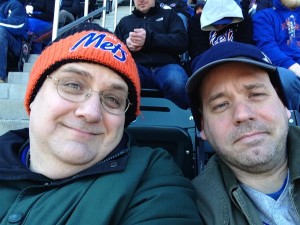 You should have seen us after they lost. I saw the second half of the Ralph Kiner tribute while getting and devouring tacos, then headed up to the Promenade to meet Greg, where we sat under bright skies and in the teeth of a nasty, whipping wind. When I woke up this morning the radar map looked like a bruise, an end-of-days mix of blue and red and purple, so it felt faintly miraculous to see the field bathed in sunshine. But that’s not the same as saying it was a nice day up there — it was cold, particularly after the sun dipped below the perimeter of the stadium, not to return. Not Jackie Robinson Night cold or Candlestick cold or Harvey Against the Padres cold (we discussed it at length), but cold enough. The crowd was cheerful but restless, eager to pounce on any and all targets, starting with Ruben Tejada and ending with the bullpen. Greg and I had opinions on all of the above, of course, but also discussed the various new Citi Field skits and bits and other between-innings marginalia. As with all other things, it’s unfair to extrapolate from one day, but the trio of Everybody Get Psyched! designated Mets rooters should try less caffeine or they’ll wear out their welcome by Tax Day. Cuppy’s back, you’ll be glad to know, though he’s now mute witness to Simon Says instead of vaguely hiding somewhere in the stands. Poor Howie Rose has been pressed into service as a triviameister, which seems like the kind of thing he’ll endure rather than enjoy. The kids in the mini-Citi beyond left field no longer swing for the fences but try to snag grounders, a competition that punishes failure rather than applauding success. But we’ll give all of the above a chance to mature — who would have predicted the Dada joy of finding Cuppy last April?
As for the game, well, Dillon Gee and Jose Valverde and Juan Lagares and David Wright and Andrew Brown were swell — Brown’s bolt into the left-field seats was one of those swats that’s instantly and obviously gone, bringing the crowd to its feet for a Cowgillian roar, and Valverde’s antics were welcome after the antics of Carlos Torres and Scott Rice, which involved not throwing a strike even once. John Lannan‘s homecoming wasn’t quite what he had in mind, and Eric Young Jr. did nothing on either side of the ball to make anyone but Terry Collins think he should be starting. (To be fair, Daniel Murphy was off becoming a dad, pushing EY to second base, which no one seriously contemplated him playing except in such an emergency.) More worrisome: Bobby Parnell got squeezed on one critical pitch in the ninth but had no excuse for several others, and his velocity mostly sat in the low 90s. At one point I watched as the scoreboard showed 90 MPH FASTBALL and then 88 MPH CHANGEUP, which is a recipe for further disasters.
So the Mets’ bullpen gave up one lead and then another and then the game. By the time Curtis Granderson had stuck out for the third and final time (yeesh), I was on the subway, called away to fetch Joshua from school. And on the way out of Citi Field, I ran into a metaphor I wish I’d avoided.
Like I’ve said, it was cold — my feet were numb as I descended the stairwell, tracking the game through snatches of Lewin-Rose and crowd reaction that leaked out from each level. Leaving the stadium, I braced myself for further wind and cold. But to my surprise, it wasn’t too bad outside. The sun was bright, and it was actually … warm. I frowned, and double-checked what I was feeling. I wasn’t imagining things — it had turned into a very nice early-spring day, the kind that lets you dream of soft, warm June nights. It was only my fellow fans inside who were still suffering, the ones stuck in the shadows watching the Mets lose.
by Greg Prince on 30 March 2014 9:03 pm I stumbled into a realization a few weeks ago: baseball is a metaphor for baseball. It’s not a metaphor for life. It doesn’t serve as our symbolic rebirth or any of that folderol. Opening Day means that after too many months without regulation games, we get one, to be followed almost immediately by another, and then one almost every night or day for half a year.
That’s it. That’s enough.
It also means we get to go outside again without reluctance. The weather in Flushing at 1:10 Monday afternoon will probably lean toward miserable, but if you’ve spent your interminable winter and thus far overly shy spring in the northeastern quadrant of North America, you’re used to miserable weather. Might as well drizzle baseball into the forecast. Bundle up and enjoy the summer game as soon as you can.
As for the 2014 Mets, enjoy them, too. Enjoy them so much that when I bring up the 2014 Mets years from now, you’ll remember exactly who and what I’m talking about and you won’t flinch. Citi Field has yet to host a Mets season that feels substantively different from all the others. Handfuls of highlights notwithstanding (SNY showed Johan’s no-hitter Sunday and, surprise of surprises, I watched it), it’s been five years of mediocrity again and again. The gloomy last month of these seasons rarely reminds you of their hopeful first day.
May the first day of 2014 be the first day of many when you’re beside yourself with happiness to be at this ballpark this year.
Citi Field is in its sixth season. When Shea Stadium was in its sixth season, we experienced 1969. I don’t mean to set the bar too high, but when your ballpark that’s neither exemplary nor execrable is neither novel nor vintage, it needs something besides The 7 Line’s kiosk to mark it for the ages (though that 7 Line news is pretty spectacular).
Did you catch the Mets in Montreal over the weekend? Wasn’t the undimmed enthusiasm something? I used to miss the Expos as an opponent like I missed Shea as a home park. Then I moved on, pausing now and then to recall with vague bilingual fondness that there used to be a ballclub there — even if the “there” Olympic Stadium represented was in dire need of replacement, far more than Shea ever was. But mon Dieu, to see and hear those abandoned Expos fans come out and support the act of baseball in a decade-dormant major league setting…it’s not so much that it makes me miss the Expos anew. It makes me feel blessed that I’ve got my team still and I’m gonna go spend some time bundled up with it on Monday.
What kind of team will it be? Finding out is why they play the season. I suspect they’ll be a little closer to good than they were when 2013 fizzled to its traditional conclusion. I don’t necessarily seek 90 wins and therefore won’t be disappointed if/when they don’t materialize. Dear Mets, just don’t seem hopeless by August; don’t have me questioning my priorities in September; and please get me to October in such a state that I can’t wait for the following April.
But I’m getting ahead of myself here. How about nobody trips on the foul line Monday afternoon? Baby steps.
I read with interest some insights in the Star-Ledger of how the Alderson Group, now in its fourth year of running things on the mid-market shoestring it was handed, is putting its universally acclaimed wits to work. As fans, we drool over the various Oriole, Dodger and, lately, Cardinal “Way” of doing things. It’s encouraging to know a Met Way is being instituted. One really hopes it’s an effective way, particularly as it takes hold through the system. The way Craig Wolff writes it, this Met Way — kind of a ball-control offense, you might say — sounds perfectly logical, though the implementation as described comes off as chillingly corporate, stubbornly rigid and a bit self-satisfied (and is probably playing head games with Daniel Murphy, the one hitter who gave the Mets a full, solid season last year). But if it works, we’ll gladly hail it as visionary.
In the meantime, we have potential above-the-marquee pitching on the verge of settling in for the rest of the 2010s. Ironically, none of those young guns will fire to open 2014. Instead, it’s Dillon Gee, playing the role of Bobby Jones from 1996. That is to say when Generation K was supposedly coalescing, Dallas Green gave us last year’s boring second-line righty as our Opening Day starter. “Last time Bobby Jones gets the ball to start the season,” I chuckled to my buddy Jason on that wintry Flushing afternoon.
Long story short, Generation K never demographically dazzled, while Bobby Jones was back on the mound two Opening Days later. You never know. When Gee came up without hype in September 2010, nobody tagged him as a future Opening Day starter. But the guys who “should” have the assignment aren’t available and nobody at this moment deserves it more. It’s sweet as hell that it’s Dillon Gee, actually. I feel a little like the Notre Dame equipment manager in Rudy handing Rudy his uniform and telling him how great it is he’s finally getting his big chance. True, Gee’s been suiting up competently with the varsity for a spell, but something about him says “one of ours” that reaches beyond homegrown status and modest longevity.
I’d prefer warmer weather Monday, but given the conditions, I look forward to chillin’ with Dillon. I look forward to sitting next to Jason as we did 18 and 16 years ago for Bobby Jones. I look forward to being among the representative sample of the 27% of New Yorkers who expressed to the Quinnipiac folks the best taste possible in baseball allegiances. I look forward to being one of 42,000 or so paying unanimous tribute to Ralph Kiner and being in the likely minority of those respectfully greeting the city’s new mayor (mayors have been throwing out first pitches at Met Openers since Robert Wagner, you know). I’d prefer to not freeze my kishkes off, but if that’s what the winds of Promenade dictate, I’ll be doing it in a good cause. I’ll be welcoming back baseball and shooing away whatever’s left of that nasty ol’ vortex.
We’re shedding the polar and closing in on solar. Best-case scenario is we’re a first-place club by the evening rush hour. Worst-case scenario we’re 0-1 and one back of the Nationals. Either outcome surely beats NO GAME TODAY.
Bonus essay on the uncertainty of Opening Day at Purple Clover.
by Greg Prince on 29 March 2014 12:24 pm The headline didn’t have much on The Onion. “Farnsworth,” it reported, “rides bus without being Met.” Well, I thought, that’s too bad. It would have been nice if somebody had picked up Farnsworth, but sometimes you just have to walk home from the bus stop.
Of course it didn’t require much of a double-take to realize what the headline on ESPN New York’s dedicated Mets blog was really conveying. I knew the contractual status of Farnsworth (Kyle) had been double-parked for a couple of days, though it was mostly a matter of t-crossing and i-dotting to provisionally retain his Quadruple-A services. If you were a reasonably engaged Mets fan in the last week of Spring Training 2014, this bit of roster minutia was readily accessible and regularly disseminated to the point where there was little chance you wouldn’t understand what “Farnsworth rides bus without being Met” meant.
Then again, given the tarpaulin of coverage applied to every last Met tic of Spring Training, would it really surprise you if it had been a story about Kyle Farnsworth needing a ride home?
If it had occurred to me to have invented a medium through which I could have been kept continually updated on a hundred details of what dozens of people with Mets connections were up to around the clock, I would have invented it. Oh, to have been privy to the transportation manifest of Mac Scarce when I was 12! Except I’m not that kind of imaginative. I couldn’t have imagined Twitter. I couldn’t have imagined blogs. I’m still fascinated that when my parents took us to Florida for Christmas vacation when we were kids, I could insert a dime in a slot, pull down a door on a box and remove a very recently printed copy of the Miami News every weekday afternoon. I was more amazed that the paper itself existed, coming out as it did hours after the bigger-deal Miami Herald, replete with final basketball scores from the West Coast and slightly fresher information overall.
I’m instinctually a very one-and-done consumer of technological advances. I can handle a single major new development every couple of years. It’s the constant upgrading that blows me away. I’m not yet bereft of surprise that I can communicate competently on a phone without ever speaking into it. It’s not the technology that captures my fancy. It’s that the technology delivers me the content I want, and that I occasionally deliver content through it. And I’m just some reader/blogger.
Those who are professionally filling my devices with Metsiana live from Port St. Lucie, Montreal, wherever…here’s to them. Here’s especially to Adam Rubin of ESPN New York, the guy who Tweeted the Farnsworth bus note at 2:07 PM on March 25 and had a brief, explanatory story blogged and posted at 2:43. It’s so routine to receive a dispatch like this that we probably don’t fully grasp how amazing it is that we live in a world where all the news that’s fit to print — as well as a large majority of the stuff that’s no more than vaguely interesting to us — winds up recorded for something akin to posterity.
Did we need to know that Kyle Farnsworth wasn’t technically signed to the Mets’ organization on Tuesday when he rode their bus from St. Lucie to Viera? Inform to taste, I suppose. Point is, I know it. I follow Rubin on Twitter (as I recommend you do) and I check his blog frequently (as I also recommend you do). The information snowball rolls downhill at astounding speeds. It’s hard to not want to grab a handful even as it does nothing but accelerate.
Gone in the bargain for volume and velocity isn’t necessarily depth; the Internet’s an expansive playing field and if your favorite beat reporter isn’t painting a big picture every day, you can always find somebody who is. What really turned out to be the element to be named later in the trade-off for immediacy was a certain strain of romance. That is if you can be romantic about how you get your baseball news.
Which of course I am.
I loved newspapers, whether they came out of a box outside the entrance to the Chateau Motel on Collins Avenue in North Miami Beach or were stacked up against the front window at the Cozy Nook on East Park Street in Long Beach or wherever and however I got them. I still love much of what’s in newspapers but even my romance gave way to technology (except on Sundays, when I maintain my diehard habit). The act of purchasing, opening and reading was one of my most reliable thrills as a baseball fan. The clicking and scrolling, now matter how much more it gives me and how much sooner I get it, just doesn’t feel as much a part of the game that I embraced growing up.
You rooted for your team. You watched or listened to their games. You read about them the next day. Maybe you picked up on a partial line score if it was a day game and your dad brought home the afternoon Post, but you were conditioned to wait. It didn’t occur to you that it was a wait. It was just the way it worked. Somebody who was watching the game at the same time you were — at the ballpark in some unseen place called the press box — had to write about it. Then it had to get printed and put on a truck. These things took time. Would have you wanted it sooner? Maybe, but reading about last night’s game the next morning helped keep the game alive that much longer. It smoothed the transition to the next game. Over 162 games, the flow couldn’t have felt more natural.
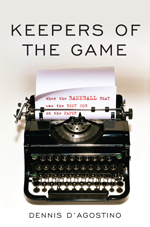 Where’s a Western Union operator when you need one? My deeply ingrained fondness for that aspect of rooting for my team is what led me to (irony of ironies) download a book about how baseball used to be covered by newspapers onto my iPad’s Kindle app during the offseason. In 2013’s Keepers Of The Game by Dennis D’Agostino, twenty-three mostly former beat writers from across the major league map hold forth oral history-style on how they did their jobs when their kind, as the author puts it, “was the unquestioned primary source for any and all baseball news, opinion and analysis.”
D’Agostino, who worked for a while in the Mets PR department (and before that wrote the essential This Date In New York Mets History), confesses to a bit of a proprietary interest in the subject. He was, albeit for a single season, a member of the Baseball Writers’ Association of America, a body we tend to think about mostly in terms of what a clumsy job they did in not electing who we wanted to the Hall of Fame. D’Agostino knew and worked among these BBWAA men. He was in baseball and they were in baseball. Now he worries their collective significance is “quietly being lost to history”.
Those the author sought out were often synonymous with the clubs they covered. If you read The Sporting News’s team-by-team reports, you learned who they were from afar, but within their home cities, they were authentic celebrities. In New York, where we had a few more newspapers than most towns, you certainly knew “our” writers’ bylines even if, pre-Twitter, you didn’t necessarily know much else about them.
It’s a splendid idea for a book, borrowed, D’Agostino happily admits, from Jerome Holtzman’s seminal No Cheering In The Press Box, which brought the same approach to an earlier generation of baseball writers. It’s also well executed. These writers were on the beat primarily between the ’60s and the ’90s, with some lasting into the 21st century and others remaining on the scene today as columnists, be they in print or pixel. They lived the changes that we read. It’s fascinating to learn what it was like for the likes of them to get their stories to the likes of me.
One name came up repeatedly in Keepers Of The Game, a name that tells you these writers entered a business far different from the one that exists today. It wasn’t Pete Rose or Hank Aaron or Bowie Kuhn. It was Western Union. Almost everybody who went back far enough seemed to have a Western Union story. No second baseman on a 6-4-3 double play was ever as important as the middleman whose cooperation ensured deadlines were met and white space didn’t sit where a story was supposed to run. You had to take care of the Western Union operator at the ballpark or you had to know where to find one on the road if you were writing for an afternoon paper. Later deadlines meant more time spent gathering quotes, and the Western Union operator didn’t necessarily stick around just for you.
That’ll slow your avalanche of news, won’t it? Yet these Keepers Of The Game don’t seem to mind having coming along in prehistoric technological times. “I don’t think they have as much fun today,” Phil Pepe reflected on those who’ve succeeded him, “but I used to hear the same thing from the old guys.”
There may be a wisp of “in our day” edge to some of the reminiscences, but little rancor is spewed toward modernity and only episodic grudges are held. And the ones that are you can’t help but admire for their longevity. For example, Chicago Sun-Times veteran Joe Goddard — who said it was “difficult [for him] to be critical of somebody” — found our lovable Dave Kingman “aloof and rude” as a Cub and didn’t mind mentioning decades after the fact that he drank heartily when he learned Kingman’s career was over. (The less than delightful baseball player apparently remains an evergreen occupational hazard, per this revealing first-person account from Eno Sarris at The Hardball Times.)
The writers D’Agostino interviewed in 2010 — whose New York ranks included Pepe, Bill Madden and the since-deceased Maury Allen and Stan Isaacs — expressed a real respect and affection for the craft they plied on a daily and nightly basis. It mattered to Wayne Minshew of the Atlanta Constitution that he was covering Aaron’s quest for a 715th home run, yet “when Hank hit it, I had a blank sheet of paper in the typewriter, and the words wouldn’t come.” Minshew “wanted it to be classic,” but settled for whatever came. More than thirty-five years later, he seemed both regretful and proud that, “It’d never win an award, but I got it in.”
Not every game is that historic, but they are all history in their own way, and the baseball fan who relished the game story, the sidebar and the “diamond dust” type elliptical notes that accompanied them appreciated the output even if that fan was never all that aware of how the complete package arrived in his hands every day. “I was writing for the guy on the subway,” Allen said, stressing that he tried his best “to entertain that that fourteen- or fifteen-year-old kid that’s really a fanatic about sports”.
As someone who’s been both that guy and that kid, it’s nice to know someone was looking out for us.
by Greg Prince on 28 March 2014 12:39 am Someday Spring Training will end, and when it does…what’s that? It’s over? More or less?
Didn’t see that coming.
Hallelujah, the Mets are done with grapefruits and slot machines at last, saving a couple of days here near March’s conclusion for un petit peu de poutine up Montreal way. Nice to pretend the Expos exist again for a weekend, unless somebody gets hurt on that mashugana Olympic Stadium carpet, in which case, what a terrible idea this was.
Canadian detour notwithstanding, Opening Day finally awaits, though there’s still a bit of roster business to be settled around the uninspiring margins. It doesn’t get much more marginal than choosing a backup for Ruben Tejada, himself a dubious Met starter unless/until he makes me eat those words smothered in cheese curds and gravy. The role could be awarded once more to Omar Quintanilla, who has familiarity going for him if nothing else (which there doesn’t appear to be after Q’s batted .158 thus far this spring), or Anthony Seratelli, a personable local boy who would be a great story, save for his having done close to nothing to take a job from Omar Quintanilla.
Seratelli is 31, a lifelong baseball underdog and totally untested at the major league level. Plus he’s local, which we already mentioned. One is tempted to guess the Mets are considering him instead of Quintanilla because then they’d have the chance to sell a few more tickets in the otherwise untapped Edison, N.J., market. If he rockets a few balls off the ol’ Big O concrete, hikes his exhibition average well above its current .213 and handles grounders competently, maybe he’ll overtake valuably experienced Omar and line up for introductions at Citi Field on Monday.
If that happens, then for a few moments before Anthony Seratelli inevitably wears out his utilityman welcome (or makes me ingest my cynicism like it’s smoked meat smuggled through customs), it would loom as the heartwarmingest of chilly March 31 moments. A pristine rookie tipping his cap on Opening Day — whether or not the stands include family and friends — would and should move everybody who realizes what’s going on to heartily applaud. When Scott Rice emerged from utter obscurity last Opening Day to hear Alex Anthony announce his name, you could feel the part of the crowd that was cognizant of the significance of his hard-earned beam with onlookers’ pride.
You don’t always get a major league debut on Opening Day (especially if you’re nurturing Super Two concerns more than you are hopes of contending) and you don’t necessarily get the major league debut you want on Opening Day, but what better setting could you conjure for a first day as a big leaguer than the first day of a new season? There’s no bad day to make the majors for the first time, of course, but making it on Day One is the stuff of cotton candy dreams and puffy cumulus reality.
Then there’s the opposite. There’s the day you stop being a major leaguer. There’s no good day for that.
Thing is you probably don’t know that it’s happening even as it happens. Certainly if you’re Chipper Jones in 2012 or Mariano Rivera in 2013 or Derek Jeter in 2014, you can lavishly choreograph your farewell (if it were up to me, all three would have taken their final bows in early 1996 and, by their subsequent collective absence, made the turn of the millennium a Metsian paradise), but most players aren’t those players. Most players don’t or can’t announce in advance that this is it for them. It’s not necessarily their call.
As much of a premium as we put on who’s gonna make a team coming out of Spring Training, we lose sight that this also tends to be the time of year when not only do guys not make the cut, they sometimes hang it up with no warning and minimal fanfare. Among the stream of longtime major leaguers who have quietly nodded over the past couple of months that, yup, that’s it, I’m done, are old friends or at least acquaintances Dan Wheeler, Liván Hernandez, Rick Ankiel, Rod Barajas, Valentino Pascucci, Jason Bay and the ever popular Guillermo Mota. No goodbye tours, no hauling parting gifts back to the mansion. Just the need to find something else to do.
Some of the above had been hanging on in what we used to call the bushes or had been reserving final self-judgment just to make certain they were really and truly done. They didn’t have to be officially released to know they weren’t going to be major leaguers anymore. If somebody had wanted them to play, they’d probably be playing. This weekend, Tim Byrdak, Met lefty specialist from 2011 through 2013, will be Josh Lewin’s radio partner for the games against the Blue Jays in Montreal. It’s not because Byrdak would rather be broadcasting than pitching. Tim’s let it be known he’s available to face lefties for a major league team. Thirty major league teams didn’t take him up on his generous offer.
The game goes on without any one player, which has to be the most humbling realization for an athlete to face. There are no more chances to make an enormous paycheck and, just as unfortunately for them, there are no more chances to compete on the highest plane in the world. They were major league baseball players. They might not have always succeeded (and fans like us might have taken strenuous note of their shortcomings), but they were at the top of their profession. The profession proceeds and the individuals move on.
When they’re gone, the retired players also miss out on the chance to create the best memories possible, both for them and for us. They don’t get to win anymore. They don’t get to try to win anymore. It’s quite possible the last thing they did on a big league field was lose. Their final act might not define their careers, but talk about going out on a low note.
Here are some more names you’ll probably recognize: Brian Lawrence, Dave Williams, Aaron Sele, Shawn Green, Willie Collazo, Orlando “El Duque” Hernandez, Jeff Conine and Sandy Alomar, Jr. All of them are attached to a rather dismaying thread. Each man played his final major league game as a Met. As a 2007 Met. As a 2007 Met in the second half of that September.
Every one of these guys was a component of the Worst Collapse in Baseball History and never got to redeem himself. Their respective last acts as active major leaguers, aside from tipping the clubhouse staff, was to help blow a lead of seven games with seventeen to play and keep from the Mets from returning to the playoffs…where the Mets still haven’t been since.
The Collapse of 2007 — to differentiate it from the deflation of 2008 — was every bit the team effort 1969 and 1986 were, except in reverse. It was the fault of no given Met; it was the fault of every given Met. Some of the 2007 Mets continued being Mets in the year or years following and were able to leave better impressions. They had the opportunity, at any rate. The aforementioned octet didn’t. They retired. Or they tried to hook on elsewhere but were left to sink at sea. They didn’t play another major league game for anybody after they didn’t boost the 2007 Mets to the postseason. They weren’t able to turn the page or put it all behind them or activate whichever cliché they leaned on to get them through a slump.
Not only didn’t they get to go out on their own terms, they didn’t get to go out on our own terms.
If you’re a ballplayer, you’ve looked forward since you became a ballplayer to the moment that might await Anthony Seratelli on Monday, the same moment that likely awaits Noah Syndergaard and Rafael Montero within the next few months. You’re gonna be breaking in. But someday, hopefully after many seasons and many successes, you’ll be going out. And when you do, a word of advice from someone who’s never played the game, but watched it a whole lot:
Try not to leave the Worst Collapse in Baseball History in your wake. Your fans will appreciate it. Thank you and best of luck in your careers.
I had the pleasure of joining Taryn “Coop” Cooper in the Mets Lounge for a little season preview talk. Listen here to all of it, find me a little after the 35-minute mark.
by Greg Prince on 24 March 2014 3:51 pm There’s a scene in a church in one of my wife’s and my favorite movies, The Commitments. A lady, dutifully scraping away at the hardened wax countless candles have dripped in the name of divine intervention, rhetorically asks, “If ya didn’t do it for God, who would ya do it for?”
We were going to watch The Commitments on St. Patrick’s Day, but we didn’t get around to it. I was, however, thoughtful enough to stop flipping the ol’ remote long enough to provide us with a glimpse of a Mets Classic a few nights later. I don’t consider the game SNY was re-re-re-rebroadcasting all that worthy of enshrinement, but when Opening Day has yet to arrive, everything that evokes baseball is a Classic if you squint purposefully enough.
Anyway, Mike Pelfrey was pitching in this long-ago game, prompting Stephanie to ask me whatever became of Big Pelf. He’s a Twin, I said (assuming she knew I meant the Minnesota kind and wasn’t implying there are two tall pitchers roaming this earth licking themselves into submission). Then I noted that several of the Mets taking part in this well-worn 2010 contest shared a certain Pelfness.
Remember Mike Pelfrey? Probably, but I mean do you remember how large a share of mind Mike Pelfrey held in our collective head? He was one of those guys whose progress or lack thereof we ruminated the fudge out of. When’s Pelfrey coming up? Has Pelfrey shown enough to stay? When’s Pelfrey coming back? What’s wrong with Pelfrey? Pelfrey looks good! Pelfrey looks terrible. What’s with Pelfrey now?
If you were a friend or relative of Mike Pelfrey, that level of concentration regarding someone close to you would be understandable. If you weren’t, and you acted on your concern enough to proactively check on Pelfrey’s well-being, you’d likely earn yourself a sizable restraining order along with court-mandated therapy. “Who are you and what’s your business outside the Pelfrey home?” But in context, it’s perfectly OK to think deeply about fellows we don’t actually know because they play for the Mets. And we’re Mets fans.
And if ya didn’t do it for the Mets, who would ya do it for?
Everywhere I looked amid this Mets Classic, I could recall all the Pelfritude we put into that team. Our 2010 Fruitgum Company of a roster harbored several characters in whom Metsopotamia invested a little too much emotional capital. Some guys you accept as transient. Others you’re convinced you can pull fortune-altering improvement from if only you dwell on them hard enough. They become the center of your baseball-loving universe all out of proportion to their potential to help your cause. Four years ago, on that May night against the Giants, there was Pelfrey, who merely had to settle down and find his confidence. There was Jason Bay, who was bound to snap out of it if only he could relax. There was Angel Pagan, who only needed to get his head on straight to fully tap his abilities. There was Jeff Francoeur, who if he could discipline himself at the plate would put up numbers as immense as his smile.
And there was 23-year-old Ike Davis, who was fresh and promising and not one of those guys in 2010. Instead, Ike was a different kind of Met, a Met whose shortcomings we weren’t going to have to obsess over. He was going to run out to his position like David Wright and Jose Reyes. We were going to enjoy him every time we saw him. We were going to ride his inevitable development to better times, him and us, together.
That was four years ago. It’s four years later. Ike Davis is now one of “those guys”. On a good day he’s one of those guys. On a bad day, he’s the ghost of Ike Davis. You’re pretty sure that’s Ike you’re looking at out there, yet you can’t quite fathom that you’re seeing this person in a Mets uniform preparing to play for the Mets in this upcoming season.
You hope for everything to work out, yet you’re already resigned to one of his Mets Classics coming on in the not so distant future and someone who hasn’t been fully keeping up asking you, “Whatever became of Ike Davis?”
Ike turned 27 over the weekend, which in terms of math is perfectly logical, yet in terms of emotional aging seems almost impossible. Ike Davis has been haunting Citi Field practically forever. Only he and Wright remain from the eleven Mets Jerry Manuel deployed to defeat the Giants on May 7, 2010. Of course Manuel isn’t here anymore, either.
The continual Met presence of Ike Davis isn’t the story here, though. It’s more about something that’s been absent. At the moment, there’s no middle to Ike Davis’s career arc. He went from that rookie who was going to help lead us into a better era to a veteran struggling to put the pieces back together (while we still await the onset of that better era). His age feels immaterial. Ike, as we speak, is a not exactly old, not exactly young 27. He’s a ghostly 27. That’ll happen when you’ve disappeared a couple of times without ever actually going away.
Saturday he swatted a long home run. Sunday he needed to exit in the fourth inning due to what was described as fatigue. Ike’s calf demands caution, but there’s probably a touch of Ike fatigue within the Mets’ planning for 2014 and beyond. They treated him as if he had faded into the past-tense during the offseason. For three consecutive winters they invited Ike to Citi Field to model some updated jersey and chat up the media. He was as personable as he’d been promising. Why wouldn’t you want to show him off? This past winter, however, the only Ike talk in Flushing transpired in the third-person, as in, “How’s that trade of Ike Davis going?”
It didn’t go and Ike came to Spring Training, played a couple of games, got hurt and has played a couple more. He’s not, with a week to go, fully inked in as the projected starting first baseman for the season ahead, but there’s nobody obviously poised to take his spot. The Mets maintain a fistful of players who can play the position and contribute something valuable, but none is thought to add up to what Ike could be…not what he is, but what he could be. If he heals. If he doesn’t contract another malady. If his swing is fixed. If he doesn’t listen to too many voices. If he gets in a groove. If he doesn’t get down on himself. If he isn’t traded.
Four years after the only year when nothing went wrong for him, Ike Davis still beckons with potential. Of course he does. He’s only 27.
|
|