The blog for Mets fans
who like to read
ABOUT US

Faith and Fear in Flushing made its debut on Feb. 16, 2005, the brainchild of two longtime friends and lifelong Met fans.
Greg Prince discovered the Mets when he was 6, during the magical summer of 1969. He is a Long Island-based writer, editor and communications consultant. Contact him here.
Jason Fry is a Brooklyn writer whose first memories include his mom leaping up and down cheering for Rusty Staub. Check out his other writing here.
Got something to say? Leave a comment, or email us at faithandfear@gmail.com. (Sorry, but we have no interest in ads, sponsored content or guest posts.)
Need our RSS feed? It's here.
Visit our Facebook page, or drop by the personal pages for Greg and Jason.
Or follow us on Twitter: Here's Greg, and here's Jason.
|
by Greg Prince on 15 March 2014 11:58 pm Late last season I was moved to recall a childhood friend named Evan Radler. We knew each other for one baseball-laden summer and saw each other exactly once more when it was over. He grew up to be a rabbi who died well ahead of his time, two facts I discovered long after they occurred.
Somewhere in the middle of the offseason, I heard from Rabbi Radler’s widow, proving the you-never-know quotient remains unfathomably high in our digital age.
Mindy-Lu Radler Glickman (since remarried) was kind enough to share the following reasonably relevant anecdote with me — as reasonably relevant as an anecdote from 1999 regarding a guy I hadn’t seen since 1974 could be.
That is to say it has baseball in it.
We had just moved to Atlanta. Evan had recently started a new pulpit.
Evan was very cute and often irreverent. They did not know what to make of him. This was a congregation that since its inception had not known laughter during services.
Stan Kasten was a member of the synagogue. He generously invited us to sit in his seats during the playoffs. We ate boiled peanuts.
One Shabbat following a game that the Braves lost, Evan stood up and announced that the Braves don’t have a prayer. The following Shabbat, after a decisive loss, he closed the service this way:
“After much consideration, I realize that I erred last week when I said the Braves don’t have a prayer. They do. Please rise.
“Yitkadal, v’yitkadash shemay rabah…”
Everyone burst out laughing.
Even if you’re not a maven when it comes to the Hebrew language, you might have inferred what Evan was reciting was the Mourner’s Kaddish, which made his solemn intonation quite hilarious. And because it was said on behalf of the Braves (no disrespect to their gracious former president, who now runs the Dodgers)…well, we gotta love that.
In remembering Evan in September, I stressed how our preadolescent relationship at kosher Camp Avnet was mutually respectful despite our religious differences regarding choice of ballclub. Turns out that despite the Radlers eventually winding up in Queens, “where my kids seemed to have no choice but to be Mets fans,” Mindy reports with apparent empathy for our cause that “my son Tai chose the Yanks anyway.”
Well, you can’t have everything. But I do come away from this unexpected encounter with a heartening coincidence or something like it.
Mindy let me know that Evan nurtured a passion for fantasy adventure, which manifested itself in a book he was working on before his passing. In a beautiful gesture, Mindy recently published it as an e-book. It’s called The Flying Lion and it certainly merits a look if that’s your kind of genre.
The coincidence? I mentioned in my earlier post on Rabbi Radler that for no particularly discernible reason, I tended to conflate Evan and Jason when I first met my future blog partner. As you may know — and if you don’t, you should — Jason writes quite a bit in the science fiction arena when he’s not getting fed up with Spring Training and such. He’s in the midst of a series geared to young readers called The Jupiter Pirates, the first volume of which is available in all formats and is receiving enthusiastic reviews throughout the universe.
I won’t pretend to know a lot about this stuff, because I find Met reality far stranger than any fiction, but it’s written by Jason, so what else do you need to know to (as I hope you will with Evan’s work) check it out?
by Greg Prince on 14 March 2014 1:55 pm Leo Durocher would have relished this weekend in Las Vegas. The Cactus League Cubs — the team he managed to its only oasis of success in a nearly 40-year schlep through a desert of futility, and the Grapefruit Circuit Mets — the team that inevitably turned 1969 into a Near North Side mirage, will square off in a pair of exhibitions in so-called Sin City. Durocher would’ve gotten a kick out of this geographically illogical Spring Training detour because it would’ve given him an excuse to visit Vegas on somebody else’s dime. Seeing as how these games don’t count, Leo probably would’ve handed the reins to coach Pete Reiser and looked up Frank as soon as the Cubs’ plane landed.
Leo liked to live the life (not always to everybody’s satisfaction). The Lip also wasn’t afraid to speak up in favor of whatever pies Leo had his fingers in. Maybe you’ve heard the line about Durocher from when he took over the Cubs after their eighth-place finish in 1965. This, he said with characteristic brio, is no eighth-place ballclub.
His figurative money laid down where his mouth was, Leo charged into his first season as Chicago’s skipper…and led the 1966 Cubs straight into tenth place.
In something approaching that spirit, wouldn’t it be great if the business about Mets management fancying their team a 90-win outfit was proven inaccurate, except in the other direction? Wouldn’t it be great if somebody was repeating an anecdote in the far-off future about how somebody running the 2014 Mets suggested, “this is a 90-win team,” but it turned out to be wrong because they won so many more?
Yeah, that would rule. As would many largely elusive fantasies that pop to mind across a weekend in Las Vegas.
The Mets probably should have more good players set to play more positions. That is if they’re serious about this 90-win thing, which they probably aren’t. The 90-win goal that’s become this spring’s Underdog t-shirt wasn’t something they issued a statement to explain or deputized Mr. Met to Tweet. Sandy Alderson reportedly dropped that number in an internal meeting and Fred Wilpon reportedly got caught up in the moment and endorsed it less as an aspiration than an imperative.
“We better win 90,” said Fred, channeling his inner Christopher Moltisanti.
Can the Mets, who at the very least have no chance of finishing eighth in the five-team National League East, win 90 games? Hell yes. They can win 162. They can also win none. Or any total in between. There’s a divergent array of potential outcomes. Consult your local numerologist for a more accurately assessed win total if you really want one pulled out of the air or any given ass.
But can the Mets really win 90 games? No. Don’t be silly. Do Alderson or Wilpon remember what 90 wins look like? The Mets have hit that mark once in the last thirteen years, and that includes years when they had certifiable talent rarin’ to go, not a pool of ellipses bracketed by bold-faced question marks.
Have you seen this team? It lacks legitimacy at two of eight positions. There’s 25% of your defensive alignment right there. Put aside normal questions about leadoff hitters and which partially accomplished outfielder will be granted playing time over which other partially accomplished outfielder and whether the rookie catcher is ready to not only strap it on but step it up. The Mets entered the offseason with only the faintest outlines of a shortstop and the iffiest conception of a first baseman. Two-and-a-half weeks before the season starts, the possible solutions have grown less certain.
Terry Collins recently speculated aloud about batting his pitcher eighth and some underwhelming non-pitcher ninth. He was thinking about doing it, he said, to generate as many opportunities as possible for Murphy, Wright and Granderson to drive in runs. Well, sure, you strategize over lineups to create the most offense you can. Whether any of it amounts to any kind of net-plus is always up for grabs. I wouldn’t automatically dismiss the pitcher batting eighth on principle, because not doing something because almost nobody’s ever done it isn’t a valid reason for avoiding it. Not doing something because Tony La Russa did it and Tony La Russa strikes most of us as a plague isn’t a disqualifying element, either.
But what got me when I read that Collins was resorting to considering this unorthodox tactic was it was early March and he was already groping in Something/Anything territory. A powerhouse lineup doesn’t figure to be built on Niese batting eighth and Lagares batting ninth. A powerhouse lineup is leading off Henderson and surrounding Piazza with lefties like Olerud and Ventura. Or it’s figuring out where to best bat Beltran and Delgado in order to maximize your Carlos quotient. Those are the offensive versions of pleasant problems. Digging deep into the eight- and nine-spots and juggling .138-hitting pitchers with .219-hitting anybody-elses is what you do when you’re desperate.
It’s March. It’s not supposed to be desperation time yet. Or it’s not supposed to be desperation time at all if your front office is talking and your owner is demanding 90 wins. (And if the pitcher batting eighth is real, why do we keep using DHs in exhibition games?)
Where’d they get 90 wins from, other than it’s a round figure and it implies a very imposing team? Best I can come up with is the old saw about every team winning a third and losing a third, which puts the Mets at 54-54 no matter what. That other third, where the gold supposedly lies, comes to those who execute and angle and hustle and get breaks and avoid injuries and are led by real men of genius. Perhaps when the Mets look in the figurative mirror, they see all the attributes that show up in neither the scouting reports nor Baseball Prospectus and they are charmed by their appearance. They fancy themselves a scrappy collective set to outmaneuver opponents, a unit overdue for some dumb luck to land their way.
“We live clean. We take pitches. We don’t unduly raise the league average payroll just because we need more good players at more positions. We apologize for insensitive remarks. We can win 90 games!”
They can, if they go 1-0 90 times, which is more in line with how I like to approach seasons. I’m a disciple of Bobby V, who never failed to identify tonight’s game as the most important game of the year because it’s the only one we’re playing tonight. Or they can go 36-18 in the mystery 54. If an inside straight is drawn, they can go 82-79 as in 1973 and keep going well into October (or, should playoff systems revert, they can go 98-64 and go home like they did in 1985 — though that wouldn’t be much fun).
Or you can forget anybody said anything about 90 wins and brace for the worst, thus being satisfied when something less bad happens. We do that a lot around here.
And yet…when you commence to sneaking up on two weeks from Opening Day, you scrunch your face, squint your eyes and focus real hard to see if there’s a way into this almost prohibitive phony-baloney goal that would be inarguably neat to meet. You give d’Arnaud a gently sloping learning curve. You give every pitcher — each of them at least pretty good at base — his best possible season and then sprinkle a little more WAR on top for good measure. You wipe away your wondering about Granderson having been out almost all of last year and check those bulging statistics of campaigns past. You bolster yourself with the knowledge that Grandy (Grandy?), CY2 and Colon have all been recent playoff participants and experience as winners has to count for something. You take Lagares’s defense, EYJ’s speed and the other Young’s 2010 and create a three-headed left-center fielder that will, in the sainted memory of Ralph Kiner, cover two-thirds of the earth.
You think back to Gil Hodges projecting 85 wins for his team the spring after they won an all-time franchise high of 73 and challenging himself to come up with a few more — 15 more, as it turned out in ’69, plus another seven in the postseason. You recall having little confidence in the myriad second base candidates of March 2006 and winding up by May with Jose Valentin and his 18 home runs. You even remember (because you are the way you are) that the Mets made late trades twenty years ago this very spring, filling holes at short and first with Jose Vizcaino and David Segui, each of whose modern equivalent would be an upgrade over Ruben Tejada and Ikas Duvis. If you like harbingers of something other than doom, those 1994 deals were pulled off by then general manager Joe McIlvaine, the same Joe Mac who’s been scouting the Mets for the Mariners all spring, the same Mariners who are said to have a talented shortstop to spare.
But that’s best-casing this scenario. Sure, maybe someone emerges from the crowd to make a Valentin type of difference and maybe a Vizcainoish transaction emerges. Summoning 1969, though? When the best possible answer to my doubting George Thomas tendencies is invocation of the most Amazin’ aberration of all as precedent, I’m mostly saying you need something that happens once in a lifetime to happen again…to happen right away.
Y’know what ya do? Ya hope anyway.
Ya hope other teams aren’t very good.
Ya hope our team is better than I believe it is.
Ya hope a cable-ready kid pitcher can be plugged in as soon as fiscally amenable.
Ya hope Pythagorean lightning can be caught in a bottle, as it was thirty years ago; the 1984 Mets, expected to do nothing, scored and allowed enough runs so they “should” have won 78 games — they wound up with 90.
Ya hope the BABIP bounces charitably and the FIP flies our way.
Ya hope magical thinking translates to a 16-game improvement from a year ago, even if there’s no Byrd anymore, no Harvey for now and no Syndergaard yet.
Mostly, ya keep your feet on the ground and keep reaching for the stars, one game at a time. You can only win that many at once anyway.
by Greg Prince on 13 March 2014 12:46 pm One National League East Narrative Reinforcement comin’ right up!
While the Braves were doing everything they could on Wednesday to earn their fans’ gratitude, the Mets were finding new, characteristically clumsy ways to show they’re as sorry as any organization can be.
Atlanta invested more than $14 million in Ervin Santana, the best available pitcher on the open market, to fill the stud-sized hole in their rotation left by the recurrence of pain that flared up in the previously surgically repaired right elbow of Kris Medlen. Despite mounting an inspiring comeback since undergoing Tommy John surgery in 2010, the Brave righty’s fate has to be taken in Flushing as a cautionary red flag against anybody confidently penciling in Matt Harvey as he misses all of 2014 antsily rehabilitating his right elbow from the same kind of procedure. Mets brass were already visibly uncomfortable with how Harvey has conducted his rehab. This latest of turn of events can only add to their unease.
But it wouldn’t be spring in Port St. Lucie without the Mets visibly squirming and their fans feeling none too good about them either.
Nearly two hours to the east of Braves spring HQ in Kissimmee — and presumably dozens of games south of Santana’s new pennant-minded team in the standings — the Mattless Mets not only continued to maintain they’re fine with their present assortment of subpar in-house shortstop and first base candidates, but had to be publicly shamed into acknowledging a private apology with racially charged ramifications wasn’t suitably contrite.
The Braves train at a complex adjacent to Walt Disney World, the so-called happiest place on earth. It’s a title the barren east coast wasteland of Port St. Lucie isn’t likely to vie for anytime soon — and you can add it to the list of titles Mets-related enterprises don’t look to be competing for this year.
Except, perhaps, sorriest team ever. The Mets seem to have that locked down in every sense of the word.
***
If you haven’t read something like that in one of your fancy professional sports columns, you probably will sooner or later. Everything comes back to haunt the Mets and make them look like amateurs, whether they deserve it or not.
Do they deserve grief for the Braves being the Braves and deciding winning is so important that they’d go above budget and replace Medlen with Santana? No. That’s the Braves’ business. Is there an unflattering parallel to be drawn between Atlanta not sitting still and New York’s stubborn inertia in the upgrade department? Probably a Granny Smith and Valencia comparison, though you’d like to think somebody would closely examine the Tejadas, Davises and Dudas, notice they’re not particularly ripe and find us crisper, juicier produce, even if it costs a little more than anticipated.
And whither Warthen? Remember when you didn’t think about Dan Warthen whatsoever? Remember when he was the pitching coach who was either doing a perfectly adequate job, assuming somebody was pitching well, or needed to be replaced because somebody got lit up? That’s usually how we are moved to think about coaches.
That was yesterday.
We don’t think about coaches at all unless a reason arises. A reason arose in what I’m tempted to say was the most Metsian way possible, but only because I’ve been conditioned by events to assume if there’s something counterproductive to come out of something vaguely positive, the Mets will find the counterproductive. Or, at the very least, they’ll meet in the murky middle.
The vaguely positive is Warthen, the Mets’ pitching coach since 2008, was observed apologizing to Jeff Cutler, Daisuke Matsuzaka’s interpreter, for having used an archaic ethnic slur in his direction. It wasn’t a staged or lawyered apology. It was somebody coming up to somebody else at work saying, in essence, “I’m sorry I said that to you.”
How could that little slice of internal interaction turn counterproductive? Well, let’s see…
• The person who did the observing was a reporter.
• The reporter, Stu Woo of the Wall Street Journal, is a self-described Chinese-American.
• The phrase for which Warthen apologized was “Chinaman”.
• The apology was observed by the reporter as “I’m sorry I called you a ‘Chinaman’ yesterday,” and was followed with “I didn’t mean to insinuate — I know you’re not Chinese” and “I thought it was a good joke, though.”
• Cutler is described in the story Woo wrote about the encounter as Japanese-American, leading Woo to wonder about the context of Warthen having said he was sorry.
Was he saying that he wanted to apologize for saying “Chinaman” only because he’d said it to a man of Japanese, rather than Chinese, descent? Did he think that the word itself was OK to use — or that it was acceptable material for jokes?
It’s a question that apparently nagged at Woo, who observed the encounter Monday morning and asked Cutler about it Tuesday morning. Cutler told him he wasn’t offended by Warthen’s joke and otherwise deferred to the pitching coach on its content. (If somebody doesn’t want to repeat a joke, you can assume it has transcended its potential to elicit laughs in polite/on-the-record company.)
Woo wrote he later “caught up” with Jay Horwitz, presumably to seek clarification. Horwitz, in his role as vice president of media relations, arranged a meeting that was to include the two of them plus Warthen early Wednesday morning, “[b]ut when I got to the Mets facility Wednesday, Horwitz said Warthen wasn’t going to comment. Cutler wasn’t in the locker room.”
That’s where Woo’s story ended when it first appeared on the Journal’s site Wednesday night. Soon enough, in this world of microscopic news cycles, the Mets were moved to respond via written statements, which have since been added to the originally posted article. Warthen apologized for “thoughtless remarks”; a “poor attempt at humor”; and words that were “wrong and inappropriate in any setting”. The pitching coach was “very sorry”. Sandy Alderson apologized “for the insensitive remarks made by one of our staff members,” describing what Warthen had said to Cutler in front of Woo (and perhaps to Cutler via the joke in question) “offensive and inappropriate”. The organization, the GM added, “is very sorry”.
This morning, the Mets moved into to putting-it-behind-them mode, save for an unusually feisty Jon Niese, who, according to Newsday’s Anthony Rieber, told “a group of reporters: ‘Stop Tweeting about our clubhouse. That —-’s gotta stop.’” (Rieber, naturally, Tweeted that nugget.) They could’ve avoided it altogether had Warthen chosen to speak to Woo Wednesday morning. Or if Warthen wasn’t moved to use words like “Chinaman” in conversation in 2014. Or if Jared Diamond hadn’t gotten married over the offseason.
Diamond normally covers the Mets for the Journal. He was taking a few days off to be with his new bride. If Diamond is on the beat, whatever conversation Woo — who mostly covers football — has with Cutler doesn’t take place and is therefore not interrupted by Warthen’s overheard conditional apology. It could be Warthen seeks out Cutler with nobody around, Cutler nods and says “it’s OK,” just as he did with Woo on hand, and nobody ever knows anybody ever made a poor attempt at humor.
But Woo was there and the makings of a story coalesced. Spring Training is enough of a production to merit not just continual beat coverage but fill-in beat coverage. As Jason pointed out most insightfully the other day, nothing much of enduring significance happens in Spring Training, so therefore anything and everything becomes a potential story. (There are only so many times in six weeks you can read David Wright pledge fealty to the front office’s long-term vision.) Then consider the media outlet. The Journal, in particular, pursues angles that the New York dailies don’t, generally seeking the less obvious ones. A fantastic example came a few years ago when Brian Costa wrote about the logistics involved when a ballplayer is called up from the minors: where they sleep, how that works, who pays for what. It was a fascinating glimpse inside a sliver of the major league existence that we don’t normally see. Similarly, Woo tackled the Senior Bowl not through the prism of scouting reports but how the college all-star game serves as de facto job fair for potential NFL players.
So you have the Journal ethos of striving to cobble the interesting amid the mundane. And then you take into account that Woo is not a regular on the Mets beat. In a way, that could be a disadvantage in that there’s no base of familiarity from which to deal, but it also means he’s looking at the clubhouse and the players with fewer preconceived notions. Continued access to sources doesn’t loom as an unspoken concern. If someone has to be around the Mets most every day, he’s probably going to be more hesitant to spill what feels, after a while, like family business. He may also be more inured to it. As Woo himself acknowledged in his story, he knows how athletes talk in clubhouses and locker rooms. Still, he came to this situation as an outsider. An insider and an outsider may hear the same thing, but they’re likely to process it quite differently. One reporter’s “that’s nothing new” is another reporter’s “that’s something else.”
And there’s no overlooking Woo’s ethnic identity here because Woo emphasized it himself:
As a 27-year-old Chinese American who grew up in San Francisco, I couldn’t remember the last time I heard the term “Chinaman,” a derogatory word originally given by white Americans to Chinese immigrants in the 19th century. I might have heard it used on the grade-school playground, but never before in dozens of NFL, NBA and Major League Baseball locker rooms I’ve been to as a sports reporter.
Woo admitted he had a first-person interest in this story. The phrase Warthen uttered caught his ear. It wasn’t enough for him to think, “that’s something you don’t hear every day,” and then share it only on the sly. He indicated he decided to pursue it as an angle in print as opposed to an anecdote passed on opaquely because, “Warthen had used the term in front of two people who had every reason to be offended. And he did so in a casual way in a work environment — one where he holds a position of power. I didn’t want to be complicit in tolerating the use of a slur that should have been retired long ago.”
You wouldn’t necessarily think of the Wall Street Journal’s sports section as a platform for social advocacy journalism, but Woo (and his editor) went in that direction, and today you have a Metsian contretemps.
To be cynical about it, Warthen probably should’ve waited until Cutler was done speaking to a guy with a media credential hanging around his neck during open-clubhouse hours to approach him. Having failed to do that, Warthen shouldn’t have blown off the appointment Horwitz made with Woo. That it took Woo’s story being posted on wsj.com to flush out prepared statements of regret makes the Mets look a little craven. Then again, Warthen did offer Cutler an apology in the first place…and the Mets did play catchup as quickly as they could in condemning their own behavior.
It would be easy to write off Warthen’s “Chinaman” slur as a symptom of age. I won’t. Warthen is 61. He’s not from the Stone Age. Sixty-one probably sounds ancient to many of you. To me it’s my age plus ten years. Warthen’s old enough to know better and not so old that an unfortunate choice of words can be winked away.
On the subject of age, I find Woo’s more intriguing. He’s 27, pretty young, all things considered. Is he old enough to “know how things work,” that men who coach other men are sometimes salty in their speech and say things that are indelicate? He basically says so in his story. But he decided not to care, and that’s probably an encouraging sign in a societal sense. Woo wrote he didn’t want to be “complicit” in going along with the program, the one that that silently certifies otherness as something inherently worthy of derision. At 27, he’s adhering to a higher standard. It takes a bit of courage to do that, especially in an industry that’s traditionally looked the other way when its protagonists have routinely ostracized otherness.
And if we’re cheering on Jason Collins and Michael Sam as they attempt to blaze new paths of acceptance in professional sports, I find it hard to ignore vestiges of the old ways that make otherness so pronounced. Stu Woo is entitled to do his job and not hear “Chinaman” from someone in a position of authority. So is Jeff Cutler. So are the clubhouse attendants and interns and lackluster first basemen. So is everybody who comes in and out of the Met sphere, regardless of descent.
Dan Warthen is entitled to think whatever he wants. If he sees Cutler and thinks, “there goes that Chinaman who interprets my advice to Dice-K,” that’s extraordinarily sad, but that’s a heart-and-mind issue. If he’s desperate to ask somebody away from his place of employment, “did I ever tell ya the one about the Chinaman who walked into grocery store…” that’s unfortunate, yet that’s his right. But if Warthen’s going to come to work and throw a word like that around, whether in the form of a joke or a relatively benign reference, geez, what’s wrong with that guy?
Never mind that there’s a considerateness aspect to life that is too often dismissed as overly sensitive or (speaking of offensive phrases) politically correct. Baseball is a business predicated on teams attracting all the people they can to buy tickets to their games. The Mets needn’t come remotely close to offending any potential customers on any basis that has nothing to do with not acquiring a better shortstop. The Mets play in Flushing, for goodness sake. Ride the 7 one stop to Main St. and meet your neighbors.
If we’re a forgiving people, then we forgive Dan Warthen for saying something cloddish and let Alderson decide on merit if he’s the pitching coach best suited to further develop Harvey, Wheeler, Syndergaard, Montero and all the other young arms in his care. If the results Warthen yields are outstanding — starting pitching seems to be the one Met area about which nobody has any real complaints — the slur fades until the next time somebody says something anachronistically stupid. If team ERA wafts to intolerable levels, what Woo reported Warthen saying to Cutler probably doesn’t help his cause.
The great Dan Jenkins (probably not someone who’d have a problem with how Warthen expressed himself) built a career on observing truths and turning them into fiction. In a terrific profile synced to the release of Jenkins’s autobiography, Grantland’s Bryan Curtis discusses how the author of Semi-Tough would linger over drinks in the company of colorful characters and gather what became his prose.
“He would disappear once in a while,” said David Israel. “You knew nobody had to take a leak that often. He was off writing down all his overheards. That’s what he would call them. Just writing down great lines overheard in bars. He didn’t want to write them down in front of somebody.” Jenkins knew if he didn’t write down those lines — that material — they would float into the ether and he’d never remember them again.”
Jenkins, Curtis continued, absorbed “locker-room philosophizing” from the likes of Don Meredith and Sonny Jurgensen, stuff that was “too interesting for Sports Illustrated. By placing their words in the mouths of Billy Clyde [Puckett] and Shake [Tiller], Jenkins could show readers what the life of a pro football player was really like.”
“I wrote a novel with people talking the way I know they talk,” Jenkins told Curtis. Woo wrote a brief news feature with Warthen talking the way he knows he talked, and we saw a little of what the life of a major league clubhouse is really like. Sometimes these narratives write themselves. Sometimes somebody has to decide to write them.
by Jason Fry on 10 March 2014 9:11 am I have a modest proposal: dismantle the spring-training media-entertainment industry.
No, really. Because it’s making us all crazy.
Spring training exists for two reasons:
1) Pitchers need time to strengthen their arms to do a better job at something profoundly unnatural that will eventually hurt them, possibly in a catastrophic, career-ending way.
2) Towns in Florida and Arizona like money.
That’s it.
Today’s hitters need spring training the same way you and I need to go spend six weeks in an anonymous subset of Florida scrub choosing which sub shop and Wal-Mart to visit. Spring training for hitters is a vestige of when players drove trucks in the winter or served as ornamental employees of insurance shops and auto dealers. They’d show up to huff and puff off their winter weight. Now hitters spend the offseasons tinkering with nutritional regimens and hitting. They’re there because they’ve always been there and because pitchers need someone to throw to.
The rest of spring training is stupid and maddening and ultimately counterproductive.
We watch games in which teams wear parodies of real uniforms, nobody we’ve heard of is around after the fifth inning and the outcome matters not a whit — yet dingbat fans act as if it does. If there’s a subspecies of fan dumber than the spring-training heckler, I’ve yet to meet him. “If David Wright doesn’t drive this ball against this Double-A palooka I’m gonna GIVE HIM THE BUSINESS!” Uh-huh. It’s March, champ — have another hot dog and be grateful for the sunshine.
Yesterday it was breathlessly announced that the Semi-Mets and Sorta-Braves had set an attendance record for Whatever Field in Port St. Lucie. Outside of five to seven guys at Whatever Field, I cannot think of a sentient being who could possibly care about this.
The media passed that tidbit on, because what else are they going to do? They’re stuck in Port St. Lucie for six weeks like everybody else, going slowly crazy reporting things that we all know don’t qualify as news. Bartolo Colon will start today. Lucas Duda might start at some point. The Mets don’t have a real shortstop. Matt Harvey is still hurt. Noah Syndergaard will be awesome, but he won’t be awesome in a way that matters until June, because contracts and money. Riveting!
It would be no less honest and only slightly less interesting to report the reps guys do on weight machines.
BREAKING: Niese sets calf press to 90. Second set of reps may follow. #Mets
But that wouldn’t bring in fans and ad dollars the way pretend baseball games do. (And even then, have you seen SNY’s spring-training ads? If you’re a maker of crummy furniture on Long Island and can’t figure out where to spend your ad dollars, you’re obviously not trying.)
Players go crazy too, of course. Harvey tweeted that he’d be back this year. Someone on the Mets presumably scolded him about this, so he untweeted it, which was about as effective in making the story go away as you’d guess. I don’t blame Harvey. If I were in Port St. Lucie I’d be re-enacting “A Beautiful Mind” in my motel room by now or making a Fortress of Solitude out of gum wrappers and spit. Veterans fall prey to this too: Carlos Beltran dutifully answered the old question about the Mets being lousy to him and so created a one-day quasi-story. It had the desired effect of getting idiots riled up and bringing us a day closer to no longer having to endure this period of non-anything.
Oh, and I just read that Ike Davis is in a walking boot. Terrific. I’m sure all matter of insightful medical analysis and level-headed fan forecasting is on tap.
I’m not going to link to any of the above because it’s all profoundly pointless. It’s intellectual rotor wash generated by trapped people who have no choice. I don’t blame Port St. Lucie’s hostages for this behavior. Instead, I want to help them.
Let’s untelevise spring training. Send the reporters home to be with the families they’ll have to miss from April to October. Create a list of fun apps for players to occupy themselves so they don’t wind up driving anywhere else at 825 MPH or assaulting pizza delivery boys in parking lots. The reporters can show up the day rosters are cut down to 27 or 28 to write one story about the guy in the best shape of his life, another about a roster battle that no one will remember in June, and to make predictions about the entire baseball season, down to the exact second the World Series will end and what the DJIA will be that day. Maybe we can even televise a game or two. That would take about a week, which would be about right.
We’d be sad at first. But then we’d realize it was for the best. Spring training doesn’t make me happy anymore. I don’t think it makes anybody else happy either. The idea of it is fabulous, but the reality is tedious and witless and is making us all crazy. And it’s got to stop.
by Greg Prince on 8 March 2014 4:41 am Not so long ago, three ships passed in the Met night. We probably didn’t grasp the transient nature of what was transpiring right in front of us because we didn’t know their night sharing the same waters would be over so soon.
On August 9, 2012, R.A. Dickey threw a complete-game, ten-strikeout five-hitter to defeat the Marlins at Citi Field, 5-1. Not only did R.A.’s 15th win (against only three losses) halt a three-game Met slide, it marked the first time the Mets had won at home in more than a month.
On August 10, 2012, the Mets’ discomfort in their own ballpark returned, as the Braves came to Queens and greeted Matt Harvey rudely. Harvey’s home debut was a far cry from his first major league start just over two weeks early. The rookie righty was behind, 2-0, after three batters, as Jason Heyward nailed him for a two-run homer. Matt lasted six and finished strong, retiring his final nine batters, but four walks in the first two innings told most of the story of the 4-0 loss.
On August 11, 2012, Johan Santana was making his first start in three weeks, having been placed on the disabled list in late July with what was listed as an ankle injury but probably had a little something to do with the surgically repaired left shoulder that had kept him out of action for all of 2011. Either way, Johan didn’t look sharp after Reed Johnson of the Cubs stepped on his ankle during a play at first base on July 6, so a little rest couldn’t hurt. In this Saturday night matchup with the Braves, however, it was obvious it didn’t help. Atlanta (whose lineup now included the very same Johnson) jumped all over Santana, knocking him out in the second inning. He left trailing, 5-0; Jeremy Hefner came in with the bases loaded and immediately surrendered a grand slam to Freddie Freeman. The Mets would lose, 9-1.
Fast-forward a few days later to Cincinnati. R.A. Dickey is gamesmanshipped by the Reds into removing two unobtrusive bracelets from his glove hand and loses, 6-1, on August 15. Matt Harvey finds the form that had the league buzzing upon his callup, striking out eight Reds while giving up just one run in 7⅔ innings en route to an 8-4 Mets win on August 16. Johan Santana starts the series-opener that follows the next evening in Washington and it doesn’t go nearly as well. Three perfect innings are wiped away in the fourth on three consecutive singles and the Michael Morse home run that drives in four on one swing. Johan gives up another homer in the fifth, a two-run job to Bryce Harper, before getting out of the inning by flying Morse deep to center.
It’s the last pitch Johan Santana will ever throw for the New York Mets, and August 17 marks the end of the era when the Met rotation features the team’s three most storied starters of the 21st century. One story was prematurely over, another was reaching its climax and the third was just filling its first pages. The era that encompassed all three of them lasted exactly two turns, but it happened. There was a time when the Mets would send R.A. Dickey, Matt Harvey and Johan Santana out to pitch in succession.
The time measured nine days in 2012.
The Mets could overwhelm opponents with dazzling starpower from the mound in the more distant, less fleeting past. In 1990, for example, it wasn’t uncommon to watch consecutive games started by Frank Viola, David Cone and Dwight Gooden. In 1976, we were regularly treated to some variation of Tom Seaver, Jerry Koosman and Jon Matlack starting in succession. Down the stretch in 1969, Gil Hodges rolled out Koosman, Seaver and Nolan Ryan in a row.
But the ships that passed in the 2012 night — or sailed one behind the other ever so briefly before peeling off in three distinct directions — make for an unlikely unit in hindsight. It’s not two years later and it’s hard to picture those three together. Besides, in August of 2012, we couldn’t be quite certain that those three were Those Three. Unlike the other aforementioned groupings of yore, this was not a trio of contemporaries. You had no guarantee you’d have reason to think of them as peers in the “most storied starters” sense.
Today, their stories are still in flux, as they retain only one undeniable similar circumstance: the Mets are putting together a rotation for 2014 and none of them is slated to be a part of it.
Funny how time picks up speed and sails away. Funny, too, how quickly the names that are etched into our collective top-of-mind can be plastered over by other names.
Every March from 2008 to 2013, Johan Santana was the first pitching name we thought about, either because we were thrilled he was here or were worried that he wasn’t. Now, after an uncomfortably uncertain pause, we know for sure that Johan is in camp…but not ours. He signed a minor league deal with the Orioles the other day. He’s confident he’ll be back in pitching trim soon enough, ready to help his team at some point this season. We used to hear him offer those kinds of resolute projections, cross our fingers and hope for the best. I suspect we still hope for the best where Johan Santana is concerned, but his seemingly endless comeback trail winds through Sarasota, not St. Lucie. His salvation may be somebody else’s solution eventually, but right now, his status is somebody else’s problem.
We didn’t think about R.A. Dickey at all in the first March he flitted across our radar. In 2010, he was, as he likes to tell it, the first cut in Spring Training. Indeed, he and Josh Thole were reassigned to the minor league side of the Mets’ complex on March 15 that year, having been given all of five innings to impress Jerry Manuel. The journeyman and his knuckleball didn’t make much of an impression: nine hits, three walks, five earned runs. Two months later, he was called up from Buffalo. Two years later, he was crafting the best season by any pitcher in the National League and the best story by any player in the known universe. Then having literally and figuratively scaled every mountain available to him, the man who morphed into the undisputed Met ace once Santana was no longer physically able to maintain that mantle was traded to Toronto. This past week, as Johan was attempting to take flight as an Oriole, R.A. was up the coast in Clearwater loosening his wing for the Blue Jays. He gave up a home run to the Phillies’ Marlon Byrd but was in no danger of being shuffled off to Buffalo. Jays manager John Gibbons has already named the fully proven veteran his Opening Day starter.
This is our third spring fully cognizant of Matt Harvey. In 2012, as Santana was making his way back from surgery and Dickey was promoting the autobiography whose release foreshadowed The Year of R.A., Matt was that tantalizing staple of every preseason: the unknown quantity we’d heard plenty about and couldn’t wait to see. He had a future, but it wasn’t going to be immediate. Triple-A Buffalo was young Matt’s destination but not without a quick detour to big league camp. 2010’s first-round draft choice was already impressing. “Did you see him?” Thole asked a reporter. “(Bleeping) unbelievable.”
Harvey was sent down on March 16, but was converting agnostics into believers in his very first major league start on July 27, fanning eleven Diamondbacks in Phoenix and setting the stage for two intensely promising months of pitching. The only reason he wasn’t the biggest story of the back half of the 2012 season was Dickey had taken off into the stratosphere, chasing and notching a 20th win and earning a Cy Young. Dickey’s ascension was also the best reason we didn’t miss Santana quite so much as August turned to September. Likewise, Harvey’s subsequent rocket ride to all-world prominence explained why, despite the justified Sturm und Drang surrounding Dickey’s trade, R.A.’s absence wasn’t mourned quite as much as it might have been in 2013.
And now? Now we know we miss Matt Harvey and track every dispatch regarding his post-Tommy John (or, more accurately, post-Frank Jobe) rehabilitation, yet we have a fancy that requires capturing in the interim. In the spring of 2013, reasonably assured by Harvey’s first ten starts that he was for real, we were already peering ahead to the Next Big Thing, looking for proof that Zack Wheeler was as good as advertised. Byrd, then a Met, said Zack was “looking like a No. 1” and compared him to Justin Verlander. Wheeler’s now sufficiently old enough news that we’re obsessing on Noah Syndergaard, the flamethrower who looms as the ultimate prize in the Dickey deal…once he’s served enough time in Las Vegas to keep him from getting paid too soon. We didn’t want to wait for Matt or Zack and we don’t much want to wait on Noah’s clerical work to be processed, either. One exhibition start in and Terry Collins says, “He’s on track to be special.”
That’s the idea: a triple-helping of special, Harvey, Wheeler, Syndergaard, perhaps all in a row. Like when the Mets could string together trios of starts from the youthful and the accomplished. They have the youth. They just need the accomplishments. And uninterrupted health.
Santana had the accomplishments before coming to the Mets and racked up a few more during his New York tenure, one in particular that will live for as long as there is a Mets franchise (and another that nobody who saw it will ever forget). But he had only intermittent health. Dickey’s most admirable accomplishment pre-Met was professional survival. Then he came here and became an icon, captivating us whenever he spoke and dominating batters whenever he threw. Then he was gone in a transaction that we might not readily identify under his name in a couple of years. That left Harvey, who turned out, in a distressingly limited sample size, to be at least as good as either of his erstwhile rotationmates ever were as Mets. We assume Harvey Days will be bountiful again come 2015 (if not sooner…though probably not sooner). We assume that, because to imagine anything else would undercut our trio of dreams and be just too goddamn cruel to fathom.
We didn’t assume after that second turn through the rotation that went Dickey to Harvey to Santana that we’d never see Johan pitch for us again and we sure as hell had no idea only nine starts remained in R.A.’s Met career. We’d only recently come to understand how special it was to have the two of them burnishing their legends on a back-to-back basis. Then Matt was dropped in between them and there was no time in real time to comprehend just what we were seeing.
The idea was never quite Santana, Dickey and Harvey. It just kind of happened that way. Then, without warning, it wasn’t happening at all. That’s OK, though. Something seems to be happening here. We’ll just have to keep one eye on the horizon and try to figure out what it’s going to be.
My thanks to Annie Levy and the Photo ID Foundation for inviting me to take part in the Baseball As Good Medicine evening of storytelling Thursday night and thanks, as ever, to Jay Goldberg for his superlative hosting at the Bergino Baseball Clubhouse, a shrine each and every one of you should visit. Hat tip as well to my fellow storytellers, including Mets fan Paul Lukas, who not only knows how to wear a uniform but exchange a rain check.
by Greg Prince on 5 March 2014 2:51 pm Like the swallows that return to Capistrano every March, Mets fans dependably make the pilgrimage to Port St. Lucie every spring. It’s not so much what they see that spurs them onto southbound flights but what they feel. And what Ryder Chasin felt when he was treated to a longer than expected weekend in the temporary center of our universe is something we can all experience vicariously thanks to him being kind enough to write it up exclusively for Faith and Fear in Flushing readers.
Ryder last wrote for us when he covered the first Citi Field sleepover. Now our good friend and special correspondent presents his impressions of the 2014 baseball season as it begins to stir far from home.
***
It was a cold winter, mostly spent huddled in the dark, unblinking and mouth agape, ceaselessly and helplessly watching MLB Network — I could probably recite most of the Top Ten Right Now lists by memory — and scrolling through the 2013 archives of my fantasy league to try to relive the days of summer. But The Bite still itched.
Any moment not spent staring at the TV was reluctantly spent at school, where doodles of team logos and theoretical Mets lineups decorated my desks; I paid a little less attention to physics and a little more attention to where Juan Lagares looks best in the order (6? 7? 2? Then where does Murph go?). But The Bite still itched.
The QBC gave it a good, hard scratch, and the 2014 FanGraphs and ESPN projections provided sweet, albeit temporary, relief. But, suffice it to say, The Bite still itched.
See, it takes more than talk to satisfy The Bite of the baseball bug. It takes sun. It takes crowds. Put simply, it takes baseball. Right?
Well thanks to my wonderfully accommodating parents, that prescription was filled. My father and I, with the hope of there being tickets available at the door, hopped on a plane and took our fifth annual trip down to Port St. Lucie in an attempt to heal the infamous, if not abominable, Bite.
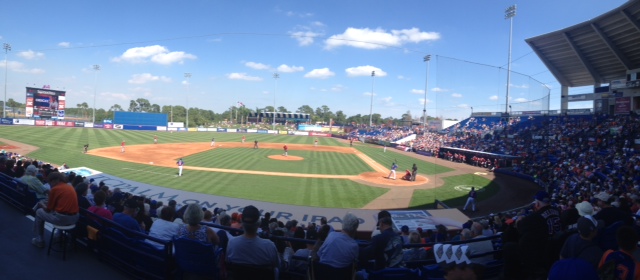
 Tradition Field, whose traditions include tacos in helmets. (Photo by Ed Witty.) Opening Day, Friday, 2/28:
Nationals 5 Mets 4
Though it was our fifth trip to camp, going to Spring Training Opening Day was a Chasin first. Our flight landed two hours before the national anthem, leaving us just enough time to hustle our way over to Tradition Field, buy our tickets, grab a Taco-in-a-Helmet (for those who haven’t had the pleasure, it truly is a disgusting yet delicious staple of Mets spring training) and get seated. We decided to celebrate being there for the first game, so we splurged and spent an exorbitant $20 a pop to sit first row, right next to the Mets bullpen.
The seats allowed me the pleasure of giving an acknowledged head-nod to Dave Racaniello; the silent bliss of watching the exceptionally sharp Rafael Montero pitch his pregame bullpen from ten feet away; the starstruck joy of waving down Dan Warthen after the game to ask him, since I hadn’t heard any news, how Jenrry was looking.
“Outstanding,” he said.
The game itself went down as a Met loss. Then again, every Spring Training game is a wash. But it wasn’t the result that mattered. No, what mattered was the Ike Davis moonshot and seeing Granderson in right and watching the jersey numbers ascend from the teens to the 60s as the game grew older. I didn’t care that the Mets were losing. I cared that the Mets were playing.
However, just as I felt the obtrusive Bite finally being scratched, the unfortunate metaphor physically manifested itself, and — perhaps due to the previously taco-filled helmets gathered under our seats — a swarm of flies started to loiter around us. The brave men and women of section 116 tried to combat the hive, but it was to no avail. We mutually decided just to ignore the bugs and try to enjoy the last few innings of the game. Nonetheless, metaphorically or otherwise, I was bitten. Again.
Day 2, Saturday, 3/1:
Marlins 9 Mets 1
Thankfully we had another day to try to cure the fresh Bite. This time we had no flight to keep us from getting to the park early and walking through camp. We again saw Montero, from even closer than ten feet, and my dad shook his hand to wish him luck this year. I’m not sure how much he understood, but he still said thank you and gave him a smile. If only all players were so courteous.
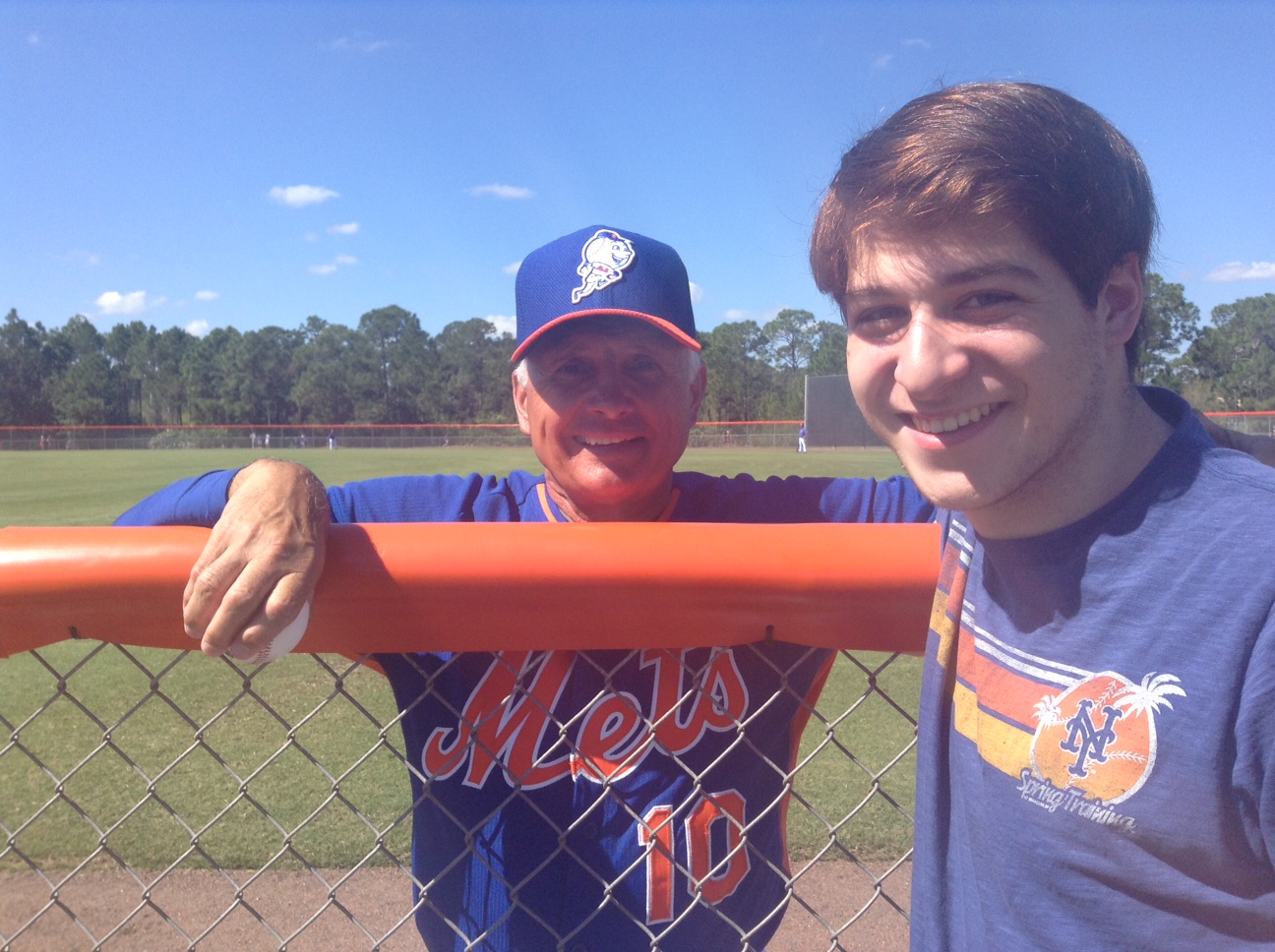
One courteous man was Terry Collins, who not only smiled and laughed through a good 15-second conversation, but who was kind enough to take a picture with me, putting himself in an uncomfortable pose where he had to reach his arm both over the fence and over my shoulder to make it look amicable. Despite the discomfort, and the fact that my FAFIF shirt did not make an appearance, I think it turned out just fine.
 Managing to take a pretty good picture. Before too long, though, we were kicked from our spot at batting practice, and had to make our way inside the stadium. Another Taco-in-a-Helmet later, and we were in seats with which we’re more accustomed, in the second deck, but at a perfect vantage point to see the misplaced John Lannan take on the Marlins.
Duda’s tape-measure blast was the only Mets Magic of note at the game. It turned out, of course, to be a 9-1 rout, and, though I said the results don’t matter, the deflation wasn’t just seen on the scoreboard, but also on the field. So, while Opening Day brought so much to cheer for, Saturday’s game brought nothing but wonted pessimism — not to mention it didn’t much help The Bite.
Day 3, Sunday, 3/2:
No Game Attended
I woke up expecting to go home Sunday night, with The Bite still itchy as ever. We had packed our bags in the morning and headed out to do non-baseball-related (thus, I suppose, uninteresting) activities, when we got word that our flight into JFK was canceled due to the impending superstorm that was projected to hit the New York area. With that, my dad and I had won a bonus day in Florida, separated by only a two-hour drive from Champion Stadium in Kissimmee, where the Mets would play the Braves on Monday. Our agenda was immediately set.
Side note: I hear now that the storm never really hit. I don’t know if I believe in fate, but I’m starting to think that maybe there was never going to be a storm at all; that maybe it was the work of some gracious Baseball God who understood the feeling of The Bite and knew I had to see just one more game. But I digress.
Day 4, Monday, 3/3:
Mets 6 Braves 2
It wasn’t until the morning that I discovered Syndergaard was starting. I let out a giddy yelp and sent a text to three of my other Mets friends, eliciting justifiably mixed responses.
“Tell me how Thor looks,” one said.
“Lucky man,” said another.
“I hate you,” said the third.
With ample excitement in my heart and ample sunscreen on my nose, we made our way to the stadium. Champion Stadium is a part of the ESPN Wide World of Sports complex at Disney, and so the employees are all Disney-programmed to be extraordinarily cheerful. Used to Citi Field, I was certainly a bit taken aback.
Nonetheless, aided by these unconditional smiles, we were directed into the stadium. We got there exceptionally early once again, and passed the time by sitting in the row immediately behind the Mets dugout, waving to unfamiliar faces of the non-roster invitees while pseudo-fans tossed their balls and pens to the Danny Munos and Eric Campbells of the traveling roster.
Somewhere along the way, we found out we were sitting near Matt den Dekker’s grandfather and Anthony Seratelli’s uncle-in-law. It made for some interesting conversation, and Seratelli tossed some sugar-free dugout Dubble Bubble our way.
We stayed in the seats we found behind the dugout; by another touch of the Baseball Gods, nobody came to claim them. It gave us the perfect vantage point to watch Syndergaard’s relaxed elegance — his easy 97 — through to the end of his two-inning tease. The anticipation was well worth the result, but, while I thought Syndergaard might be my fix, The Bite stayed.
Next, Familia came out throwing 98 with life, and he held the Braves to nothing over a couple of frames. He left. The Bite stayed.
Suddenly, if not fittingly, flies again swarmed our section, this time unprompted by Tacos in Helmets. I had a flashback to Friday, to the bugs — quite literally the baseball bugs — flitting around us as our row sat still, trying to ignore them and watch the game. We weren’t kidding anybody. The bugs were there, and so were their Bites. They weren’t just going to go away.
I decided that this time it was going to be different. This time I wasn’t going to sit idly by waiting for the bugs to leave. To beat this eerily accurate metaphor, this time I was going to Bite back.
What ensued was a gruesome battle, lasting the better part of four innings. More flies would swoop in, and I would swat them down or bat them with my scorecard. By the bottom of the eighth, the ground, not the air, was full of flies.
That inning, though, the Braves surged ahead to take a 2-1 lead, and the Mets looked defeated. Wild pitches and inopportune hits forced the beautiful outings from Syndergaard and Familia to go in vain. The day was almost over, and The Bite itched terribly. We trudged into the top of ninth, ready to head home.
But then an Amazin’ thing happened. A triple. Andy Brown, without warning, sliding safely into third base. And then, before I had time to mark it down in the book, a base knock. The Mets had tied it in the ninth. A few hits and a blink later, it was 5-2, and the Braves pitcher was now the one trudging off the field. A stolen base and another hit brought the Mets to threefold the opposing score as we headed into the bottom of the inning, and a “Let’s Go Mets” chant erupted at the Braves’ ballpark. After the raucous ended and the hum of the crowd reformed, I felt something I hadn’t felt in months: no itch. No Bite.
The bottom of the ninth started with good ol’ Gonzalez Germen on the bump, but the game wasn’t the focus anymore. Even if Germen gave up 20 runs — which I suppose would be impossible given how the bottom of the ninth works — there was no question as to which team won. Just then, as Germen was delivering his final pitch, my dad looked around our seats.
“No more bugs,” he said. “Guess you must have gotten them all.”
I looked at my scorecard, and recorded the final out.
“Guess so,” I said back with a smile.
Epilogue
Now with three games under my belt and a glimpse into happier times for the Mets, I can rest easy. No longer do I constantly feel the need to chew off my nails like an addict on withdrawal. Instead I feel content; happy. I feel, perhaps foolishly, optimistic.
But I think in the end that’s the cure to The Bite: a little optimism. There’s so much unfeeling analysis in FanGraphs and ESPN projections, and only so much speculation to make about offseason moves and top ten lists. Sometimes maybe it’s best to take a page out of Warthen’s book and look at things as though they might really be, well, outstanding.
by Greg Prince on 4 March 2014 2:07 am Mike Piazza is a special instructor in Mets camp. He is among the most special of all Mets, so the title fits. Nice of him to swing by St. Lucie, just as it was good thinking on Jeff Wilpon’s part to invite him.
(We will now take the keyboard on which I’m typing out of play and send it to Cooperstown, as it’s the first keyboard ever used by a Mets blogger to express a complimentary thought toward Jeff Wilpon.)
What instruction can Piazza give the Mets of today, particularly their catchers? Besides “wear extra padding in your mitt when Syndergaard pitches”? Whatever it is, I’m willing to bet it will be useful. He’s Mike Piazza, for goodness sake. We don’t regularly tout his election to the Hall of Fame just to be friendly. He was one of the all-time greats as a hitter and — the occasional floating throw into center notwithstanding — a hard-nosed catcher who seemed to work well with his pitchers. If you weren’t convinced of his credentials after experiencing his eight breathtaking seasons at Shea, then read his 2013 autobiography, which I just got around to doing. Mike will make sure to let you know he was one of the best…whether you appreciate him or not.
Sadly, he doesn’t think you do, which seems to be the point of the book.
Long Shot (written with Lonnie Wheeler) is the richly detailed life story of a public figure you thought about plenty while he was in your line of sight but, honestly, never thought about nearly as much the public figure himself did. You couldn’t have. We are all our own protagonists, but Long Shot takes the concept well beyond focused self-examination. The book seems to assume every moon, planet and sun revolved around Mike Piazza from the first time a scout watched him take his cuts to the last time he left a major league field as an active player…and none of those heavenly bodies spun quite to the center of Piazza Universe’s satisfaction.
The Piazza of Long Shot lays out a canvas unfortunately skewed to slights. Mike never got over the doubts of anybody who didn’t think he belonged in professional baseball, anybody who wasn’t convinced of his merits as a catcher or hitter, anybody who…well, everybody. Everybody doubted Mike Piazza and he showed them. That’s the tone of the book. That’s the substance. If he was as defensive during his playing career as he is in his recollections, he’d have more Gold Gloves than Johnny Bench. Every now and then he drops in a note about how lucky he was and how grateful he is to have been so blessed, but then he gets back to ticking off all the times somebody ticked him off.
As exhilarating as it was to watch Piazza hit to all fields is how exhausting it was to read Piazza remember selectively. He portrays New York as incredibly tough on him, what with all the booing after he was traded here. I went to 18 games in 1998 with Mike a member of the Mets and I have to say I mostly recall standing and cheering in the company of tens of thousands who were doing the same. Granted, the random 6-4-3 DP wasn’t greeted with “aw, you’ll get ’em next time, big fella,” from everybody populating Loge and Mezzanine, but No. 31 was the most popular Met from the moment he boarded the plane that carried him definitively north from Fort Lauderdale. Dissenters notwithstanding, we Mets fans absolutely adored Mike Piazza. We were overjoyed when we got him. We were ecstatic when he signed to stay on. We were saddened when he waved goodbye. I didn’t know we were not living up to his expectations while we were emoting overwhelmingly in favor of his being Our Guy from 1998 through 2005.
Then again, he has far less good to say about Dodger fans, so I don’t feel so bad about inadvertently making him feel episodically put upon. The Dodger crowd made him feel worse. So did Dodger management. So did many of his L.A. teammates, not to mention those with whom he played in the minors. By comparison, New York was nothing but peaches, cream and perfectly permissible protein shakes (the rich detail includes an exploration of Mike’s workout regimen, presumably included to deflect the inane bacne assertions that have undermined his Hall candidacy to date).
Plus, he’s still Mike Piazza of the New York Mets and will always be Mike Piazza of the New York Mets. No overly touchy memoir can take that away from me.
While I came away from Long Shot wishing Mike was more comfortable as the Hall of Fame-caliber star who inhabits his own skin, I wasn’t altogether sorry I read it. His inherent affability shone through despite pursuing his agenda of dismay, plus I learned a good bit about how a spectacular hitter and stalwart catcher sees the game, and now that he’s special-instructing, I imagine he has a few pointers (besides “dude, hit the ball real hard”) to pass on to the likes of Travis d’Arnaud.
I was also reminded you don’t have to have been Piazza-level as a player to accumulate and dispense wisdom to the next generation. One of the names that jumped out from the pages of grudges in Long Shot was that of Frank Estrada. Estrada was Piazza’s winter league manager in Mexico in 1991 — and Frank is short for Francisco.
Recognize him? Francisco Estrada was one of the four players the Mets gave up to get Jim Fregosi from the Angels in 1971. That’s usually as far as he gets in the Met canon, but if you read Long Shot, you’ll find out that Estrada played a role in Mets history that outweighs his throw-in status in the Nolan Ryan deal.
Francisco Estrada taught Mike Piazza how to catch. Not singlehandedly, but enough so that Piazza saw fit to single him out for his instruction more than 20 years after the fact. “He taught me a lot,” Mike wrote of the man known as Paquin. “In the end, going to Mexico was absolutely the best thing I could have done that winter…it was when I started to become a polished hitter.”
Ryan + 3 for Fregosi was a bust of epic proportions for the Mets. But if you consider Piazza, by way of Estrada’s tutelage, a de facto throw-in to the deal coming back this way (albeit 27 years after the fact), I’d say the worst trade ever made eventually evened out just fine.
by Greg Prince on 3 March 2014 12:25 am The Oscars were handed out Sunday night. Thus, per Monday morning-after tradition, the Academy pauses to remember those Mets who have, in the baseball sense, left us in the past year.
AARON STEVEN LAFFEY
April 7, 2013 – April 20, 2013
[T]he Mets are so shallow in the starting pitching pool and so determined to not “start the clock” on Wheeler any sooner than they have to that they are confusing Aaron Laffey with Johan Santana. Johan Santana gave the Mets eight solid innings on the Tuesday of the final week of the 2008 season when a playoff spot was on the line and then brought him back, meniscus and all, to carry them as far as he could on the succeeding Saturday. This will be the last time Aaron Laffey will be compared to Johan Santana, but before we leave the profane comparison, consider that was a September with everything on the line and Johan was our ace. This is April and the Mets, because of a doubleheader (or two, pending the next couple of days) are “forced” to preserve Aaron Laffey so he can be deployed on short rest. Not because he’s that splendid, but because he’s that here.
—April 17, 2013
(Selected off waivers by Blue Jays, 4/23/2013)
JUSTIN MICHAEL HAMPSON
June 25, 2012 – October 2, 2012
Maybe a team whose bench feels thin because they had to DFA Vinny Rottino to make room in their bullpen for Justin Hampson has been more mirage than previously acknowledged.
—June 26, 2012
(Free agent, 11/5/2013; currently unsigned)
ELVIN (Rodriguez) RAMIREZ
June 3, 2012 – October 2, 2012
The 11th belonged to young Elvin Ramirez, thrown into the deep, shark-infested, acid-filled end of the pool. Ramirez showed a precocious awareness of the game by embracing the principle of pitching to his defense, meaning he struck out three Nats rather than allow any of his incompetent teammates to touch the ball. It seemed Ramirez would be rewarded in the 12th, when Hairston mashed a home run off Ross Detwiler, but he looked gassed in the bottom of the frame, with Terry Collins out of relievers and unwilling to call on Jeremy Hefner, tomorrow’s starter. There were instant back-to-back doubles for the tie, a wild pitch, Ramirez attempting to lose the game by nearly tossing the ball to the backstop on an intentional walk (yes really), an unintentional walk to Detwiler (who baffled everyone by repeatedly trying to bunt ball four), and eventually Harper’s fatal two-out hit.
—June 6, 2012
(Sold to Angels, 3/17/2013)
SEAN MICHAEL HENN
September 9, 2013 – September 23, 2013
Ex-Yankees began crossing the Macombs Dam Bridge to the Polo Grounds in 1962 when Marv Throneberry (by way of Baltimore) and Gene Woodling (Washington) made the trip. They were greeted in Upper Manhattan by their old skipper Casey Stengel and might have recognized in their midst a onetime Yankee farmhand by the name of Rod Kanehl when they arrived. It’s a recurring phenomenon now more than 50 years old. In 2013, Aaron Laffey, David Aardsma and Sean Henn all showed they knew the way to Flushing Bay: just jump off a scrap heap and transfer at Grand Central for the Queens-bound 7.
—December 11, 2013
(Free agent, 10/20/2013; currently unsigned)
DANIEL RAY HERRERA
September 2, 2011 – September 27, 2011
The principal PTBNL in K-Rod’s trade to Milwaukee, Herrera was about four feet tall, had a Muppetesque mop of hair and pulled his cap down so low that it was a week before you could verify he had eyes. And he didn’t want to be called Danny. All that was endearing; so was the fact that he pitched pretty effectively, admittedly in garbage-time conditions.
—November 3, 2011
(Released, 3/30/2013; signed with Long Island Ducks, 7/19/2013)
AARON MICHAEL HARANG
September 12, 2013 – September 28, 2013
Surprise! Aaron Harang was…not that bad. He wasn’t great, but he pitched capably enough — a team with an iota of offense might have had a chance out there, which unfortunately doesn’t describe the current Mets.
—September 12, 2013
(Free agent, 10/31/2013; signed with Indians, 2/15/2014)
CHRISTOPHER ANTHONY “Chris” SCHWINDEN
September 8, 2011 – May 30, 2012
[A]fter identifying him as a prime protagonist in losses of 10-1, 18-9 and now 8-1… with little in the way of contradictory evidence to suggest he was simply pitching in tough luck…Chris Schwinden can go find himself another gig. Or go get more experience at Buffalo and return later and make me Met-a culpa. I’ll be happy to do so. I’m not in this to rag on Chris Schwinden. I’m in it to not give up on games as soon as I recognize Chris Schwinden is starting them.
—May 3, 2012
(Cleared waivers, July 10, 2012; pitched for Triple-A Buffalo in 2012 and Las Vegas in 2013 and remains in the Mets organization, but has never been restored to the 40-man roster and wasn’t invited to major league camp in 2014. For the purposes of this feature, Chris Schwinden is no longer with us.
UPDATE: Released, 3/24/2014)
DAVID ALLAN AARDSMA
June 8, 2013 – September 28, 2013
The bullpen that succeeded Harvey and preceded Marcum was real good. Or they faced the Marlins. Whichever, it wasn’t their fault. David Aardsma looked Aa-OK as he knocked Don Aase from the top of the Mets’ all-time alphabetical chart.
—June 9, 2013
(Free agent, 10/31/2013; signed with Indians, 1/23/2014)
GREGORY FRANCIS “Greg” BURKE
April 3, 2013 – September 23, 2013
I saw Greg Burke, who might be more tolerable if he were Australian or a beet farmer in the offseason, pick up where he left off the last time he was around, which is to say wondering where that damn thing just landed.
—September 10, 2013
(Free agent, 11/5/2013; signed with Rockies, 11/18/2013)
SCOTT BARHAM ATCHISON
April 1, 2013 – September 28, 2013
Scott Atchison, who gets ample play despite being Mr. Gray, kept the Fish at bay in the home sixth.
—May 1, 2013
(Free agent, 12/2/2013; signed with Indians, 1/6/2014)
SHAUN MICHAL MARCUM
April 27, 2013 – July 6, 2013
May my blood stop running orange and blue if I can’t deliver unto you an assessment of Shaun Marcum’s pitching, so here goes, albeit borrowed from John Adams as he critiqued a portrait intended to preserve Benjamin Franklin for posterity in 1776: “It stinks.” […] This blogger may be no Botticelli, but the subject of this blog is no Venus.
—July 7, 2013
(July 23, 2013; signed with Indians, 12/16/2013)
COLLIN BRANNEN COWGILL
April 1, 2013 – June 18, 2013
Less fantastic was we couldn’t make out from Section 526 that Cowgill had indeed cleared the blue wall and banged Brad Brach’s ball off the black backdrop. For what the Mets charged on Opening Day, the least they could do is provide a geometrically sound view. Old news, I suppose. But where was the live-action look on any of the multiple video screens lining the outfield? Nowhere. And where was the conclusive replay? Cut off right before the ball reached its destination. And what about the next half-inning? Delta sponsored the presentation of a Collin Cowgill-autographed baseball to One Lucky Fan. For the rest of us? We would’ve been fortunate to see a replay of the mysterious triplish hit that spurred the gift. But all we saw was Collin swing and an ad for Delta. Or as the wise beyond her years little girl sitting behind us commented, “They don’t show the home run, but they show an airplane.”
—April 5, 2013
(Traded to Angels, 6/25/2013)
BRANDON JAMES LYON
April 1, 2013 – July 4, 2013
Then we got back to being idiots, sitting through intermittent showers, invisible offense and Brandon Lyon.
—June 30, 2013
(Released, 7/9/2013; signed with Red Sox, 7/19/2013)
ROBERT N. CARSON
May 18, 2012 – August 28, 2013
Some positive developments for the Mets Saturday. Shaun Marcum got his throwing in, working his way up to 71 pitches. He only lasted four innings, but it’s not like anybody was counting. Then Terry Collins experimented a little and brought Robert Carson in for the fifth, which isn’t where you’d expect to see him, but roles are still undefined, so it didn’t really matter. The Phillies brought their A-club with them and Carson was kind of roughed up. Still, it was good experience for him.
—April 27, 2013
(Selected off waivers by Angels, 10/17/2013)
COLLIN ALEXANDER McHUGH
August 23, 2012 – June 1, 2013
And on Thursday afternoon, a beautiful day for a ballgame if only the Mets had decided to take part in one, a young fellow named Collin McHugh made his major league debut, shut out Colorado for seven innings on two hits while striking out nine. Mets lose, 1-0.
—August 24, 2012
(Traded to Rockies, June 18, 2013)
RICHARD ALEXANDER “Rick” ANKIEL
May 13, 2013 – June 8, 2013
Picking up Ankiel in mid-May after the Astros no longer wanted him was one of the more mystifying decisions of the Alderson regime, transferring playing time from young guys who needed it to an old guy who all too obviously no longer merited it. Ankiel’s final big-league AB was a strikeout that ended a 20-inning loss against the Marlins in June, a sad end to a final chapter that never should have been written in the first place.
—October 23, 2013
(Free agent, 6/11/2013; currently unsigned
UPDATE: Reported retired, 3/5/2014)
JOHNATHAN RICHARD “John” BUCK
April 1, 2013 – August 24, 2013
It’s the golden hour for John Buck right now, that fleeting interregnum when the journeyman is master craftsman. It is a time to be savored. John Buck drives in nine runs in five games, four of them in his fifth game to propel the Mets to a Saturday victory. John Buck draws a roughing the catcher penalty the likes of which struck everybody as completely novel. John Buck offers pitchers wise counsel, teammates unyielding support and every fanny in sight a manly slap for a job well done. All things considered, John Buck is the best Met we’ve seen this year until he’s not — which is swell for now and whatever it is for later. Let’s enjoy the swell. Let’s enjoy every professional at-bat that produces all manner of RBI, from two-run double to two sac flies against the Marlins to move the Mets back above .500 and Buck to the front of the National League ribeye steak line. We have a hitter who leads the league in something. Didn’t see that coming.
—April 7, 2013
(Traded to Pirates, 8/27/2013)
TIMOTHY CHRISTOPHER “Tim” Byrdak
April 3, 2011 – September 26, 2013
Who’s in? Byrdak? Why not? Will Terry let him face lefties and righties with a seven-run lead? I feel like I just started watching this game and now I’m totally invested in it. C’mon Byrdak, don’t make this messy. I don’t wanna see Manny Acosta come in. I never wanna see Manny Acosta come in. Nice slow grounder, Reyes to Tejada to Murphy…double play! We win. That was fun.
—June 11, 2011
(Free agent, 10/31/2013; currently unsigned)
FRANKLIN “Frank” FRANCISCO
April 5, 2012 – September 29, 2013
We can cluck about it now because after Andres Torres had to do a little Jim Edmonds number to retire Russell Martin, and Frank walked Ibañez and gave up a single to Captain Pause Sign to inject unwanted drama into the ninth inning at Citi Field, Francisco emerged only slightly scathed. Our closer of record (because apparently we have to have one) struck out the murderously dangerous Curtis Granderson and popped Mark Teixeira and his ill-fitting helmet to Omar Quintanilla, who apparently hasn’t seen enough ninth-inning, two-out highlight films to USE TWO HANDS! but cradled the ball anyway, and it was a win for Jon Niese, a save for Frank Francisco and a great relief to us all.
—June 23, 2012
(Free agent, 10/31/2013; currently unsigned)
LaTROY HAWKINS
April 3, 2013 – September 28, 2013
Enter (after a failed cameo by David Aardsma) the Hawk, who didn’t exactly swoop in with glee. LaTroy understood he was signed to serve not just as a pitcher but as a mentor. As the season was concluding, he mentioned the veterans who taught him the ropes when he was a neophyte Twin in the 1990s. One of the names belonged to Rick Aguilera, then the resident closer at the Metrodome, a decade earlier a building block of great Met things to come. Now, in his own baseball autumn, LaTroy Hawkins hoped he could set an example for the Parnells, the Gonzalez Germens and the Vic Blacks who were following in his footsteps. Whatever words of wisdom he offered were more than backed up by what he demonstrated from the mound. Hawkins had exactly zero saves through four months of the season. Beginning August 6, he compiled 13, blowing only one along the way. It wasn’t the plan to send a 40-year-old right arm to pitch so many ninths, but he became the best possible option and he didn’t disappoint. When 2013 was over, Hawkins had saved more games, logged more innings and chalked up more appearances than he had in any season since 2004.
—November 16, 2013
(Free agent, 10/31/2013; signed with Rockies, 11/21/2013)
JORDANY V. (Guzman) VALDESPIN
April 23, 2012 – July 13, 2013
To the hypothetical introductory highlight package of today, please add footage from last night. Please add Jordany Valdespin socking it to Jonathan Papelbon. Please follow that ball into the right field stands, its flight both instant and eternal. Please evoke the shock that a minor league callup who was a minor league senddown rescued only by physical setback to another Met chose this moment for his first major league hit, a pinch-hit three-run home run that broke a 2-2 tie with two out in the ninth inning in a ballpark where very little good has occurred over the past five years. Please don’t cut away until we see Jordany Valdespin round first base and shake with delight, one innocent fist briefly raised, because for all the standard jockish admonitions to act like you’ve been there before, Jordany Valdespin hadn’t.
—May 8, 2012
(Free agent, 12/2/2013; signed with Marlins, 12/20/2013)
PEDRO JUAN (Molina) FELICIANO
September 4, 2002 – October 1, 2004
April 18, 2006 – October 2, 2010
August 2, 2013 – September 28, 2013
If you’ve ever felt a little charge upon reacquainting yourself with an old song that wasn’t exactly a favorite back in the day but it’s surprisingly good to hear playing again from out of nowhere, then you know how I feel upon seeing Pedro Feliciano in a Mets uniform this Spring Training. For me and my vintage ear, spotting Pedro in Port St. Lucie is akin to turning on CBS-FM and hearing something by Firefall instead of the Eagles for the 4,000th time this month. Pedro’s not the pitcher that I always dreamed of, but he’s a damn comforting sight. He was a survivor in his Met prime and he’s even more of one now. He’s survived four managers, two collapses, several departures, enough spins around the mound turntable to have worn out the sturdiest copy of “Hotel California” plus an injury that has kept him MLB-inactive since the last time he pitched for us. When I saw him wearing one of those adorable Mr. Met caps a couple of weeks ago, I realized the picture wasn’t quite right. Pedro Feliciano needn’t wear a cap with Mr. Met’s image emblazoned on it. Mr. Met should be wearing a cap with Pedro Feliciano’s face affixed squarely above the bill.
—March 7, 2013
(Free agent, 10/31/2013; currently unsigned)
MARLON JERRARD BYRD
April 1, 2013 – August 26, 2013
Nobody was amending their “what outfield?” cracks when Byrd landed amid the Mets’ pasture of uncertainty in Port St. Lucie. There was no sense of we’re only dealing with two-thirds of a mess because this Marlon Byrd, he who had suffered beanings and bannings in the previous two years, was gonna clear everything up. He hasn’t. Yet on a team in which Razzies could be awarded to many, Byrd’s not close to being in the bottom five, which is like being one of the best players on a good team. Or, put another way, Byrd has actually been one of the best players on this bad team.
—June 6, 2013
(Traded to Pirates, 8/27/2013)
JUSTIN MATTHEW TURNER
July 16, 2010 – September 29, 2013
BuffaMets fever broke a little Saturday night, though Justin Turner continued to hit, which was good news for Americans from coast to coast wondering breathlessly whether Turner would break the longstanding record for most consecutive games with a run batted in by a Mets rookie. It was one of the most cherished records in all of sport, dating back to 1965 and embedding itself in the consciousness of fans everywhere since at least Friday when it was casually mentioned on SNY. I love worrying about records I not only never heard of before but records I had never stopped to consider were records. “Most consecutive games by a Mets rookie with a run batted in”…who knew? Once I did know, it became imperative to me that Justin Turner would come to own it. While I’m tickled orange and blue over Turner having knocked in a run in seven straight games as a relative neophyte, I have to admit I was disappointed to learn that until Friday night he had never heard of Ron Swoboda, the man who established the heretofore unbreakable consecutive rookie RBI game streak 46 years ago. It’s one thing to not know you’re making obscure history. It’s another to not know that you’re unseating a legend. A Met legend, certainly. When I read Turner’s admission of ignorance, I couldn’t be disappointed in Turner. How can any Mets fan be disappointed in Justin Turner?
—May 22, 2011
(Free agent, 12/2/2013; signed with Dodgers, 2/6/2014)
MICHAEL JOSEPH “Mike” BAXTER
August 8, 2011 – September 29, 2013
The man who once drew five walks in a single game wasn’t even getting on base incidentally in 2013, and it was impossible to not notice that after the May homestand during which he drove in two giddy walkoff runs, he hadn’t accumulated a single RBI…not one. So you’d see Baxter in the lineup five times in the final six games and you weren’t heartened. You wanted to know why den Dekker wasn’t in right. Or why den Dekker wasn’t in center and Lagares wasn’t in right. Or where the next Darryl Strawberry was coming from and when was he gonna get here? We were sure we had seen enough of Mike Baxter to last a lifetime. Which wasn’t quite accurate, because there’s a moment of Mike Baxter we could spool up daily from here to eternity and never get tired of looking at. The Mike Baxter of the present couldn’t compete with the players — real or conceptual — who we conceived of as having a future. And it wasn’t fair to have that Mike Baxter obscure the Mike Baxter of the recent yet undeniably distancing-itself past. For the best interests off all concerned, today’s Mike Baxter had to become a former Met. The more we watched ordinary, limited-tool Mike Baxter struggle at the plate, the more we were forced to rue that the Mets were forced to rely on this Mike Baxter. This Mike Baxter should have never been allowed to interfere with the Mike Baxter we cherish.
—October 18, 2013
(Selected off waivers by Dodgers, 10/17/2013)
JOHAN ALEXANDER SANTANA
March 31, 2008 – August 17, 2012
Johan Santana pitched the First No-Hitter in New York Mets History. It happened. It really and truly happened. I shouted and I cried and I hugged my wife and we drank champagne from the same Mets mugs with which we toasted the 2006 N.L. East championship, none of which will show up in the box score, but I always wondered what I would do if it happened, and now I know. We can all go count something else now.
—June 2, 2012
(Free agent, 11/1/2013; currently unsigned
UPDATE: Signed with Orioles, 3/4/2014)
by Greg Prince on 2 March 2014 2:47 am
Who cares how the Mets look after two exhibition games? I’m just happy to hear their names again, most of which meet the ear in a pleasingly lyrical fashion. These guys might not quite match up with Dave Frishberg’s legendary lineup, but the mellifluous Mets of 2014 sound pretty formidable to me.
Taylor Teagarden.
Dillon Gee.
Andrew Brown, Daniel Murphy.
Jonny Niese.
Jeurys Familia…
Matthew den Dekker!
Cory Mazzoni.
Josh Edgin.
Kyle Farnsworth and Gonzalez Germen.
Jose Valverde…
Matthew den Dekker!
Jenrry Mejia.
Kevin Plawecki.
Kirk Nieuwenhuis and Bartolo Colon —
Jake deGrom…
Lucas Duda and Eric Young.
Scott Rice and Curtis Granderson.
Dice Matsuzaka. Trav d’Arnaud.
Logan Verrett, Juan Centeno.
Anth’ Seratelli…
Matthew den Dekker!
Ruben Tejada.
Miguel Socolovich.
Isaac Davis and Raffy Montero —
Cez Puello…
Thor Syndergaard, Bob Parnell.
Omar Quintanilla, Erik Goeddel.
Carlos Torres and John Lannan.
Wilmer Flores and Josh Satin…
Zachary Wheeler.
Wilfredo Tovar.
Anthony Recker.
Matthew den…
Matthew den Dekker!
And in the spirit of the era Dave Frishberg evoked, listen in as Sam Maxwell and I talk New York Giants, Brooklyn Dodgers and, inevitably, New York Mets on Sam’s Bedford & Sullivan podcast.
by Jason Fry on 28 February 2014 5:47 pm Today was crowded.
Joshua had no school because of parent-teacher conferences. Our first order of business was to get him a new passport, which for the under-16 set means showing up in person, photocopying lots of stuff, and getting a notary to OK the absent parent’s permission. Oh, and waiting in line at the post office.
Since that wasn’t the most entertaining way to spend a morning, I’d promised the kid a special no-school-today lunch in Chinatown, followed by a trip to a famous Italian bakery in Little Italy to sample various awesome pastry concoctions. After which we’d have that school conference, and then run some assorted errands.
A lot to do, and it was another bone-chilling day, with winter clamping its jaws on you after walking but a block or two. But I had a bit of a spring in my step despite the frozen conditions — because this was the day that 1:10 pm started to mean something again. That thought was new enough and the day was busy enough that I kept forgetting, which was even better, because remembering made me happy.
We didn’t make first pitch against the Nationals, which was fine. I only saw a couple of innings, which was fine too. It’s spring training. Nobody’s wearing respectable uniforms, the varsity (such as it is in Metland) departs early, the ball makes an odd sound off the bat, the crowd is far too amped, and so on and so on. My first glance was of Jacob deGrom. My first thought was “Dude’s hirsute,” which won’t earn high marks for analysis but was accurate. My first claps were for Cesar Puello’s double. My first moment spoiled by looking at Twitter while on iPad-induced TV delay was Ike Davis’ homer.
All good. Like I said, it’s spring training. Each year I watch the first telecast avidly for about 20 minutes, then wind up emailing or reading a magazine or devoting half my attention to something else. I like that about spring training, and (to a lesser extent) about baseball that matters too. Sure, baseball rewards unwavering attention — there’s always something new to learn, something to understand better, or just the chance to immerse yourself in the beauty of the game. But baseball’s also a good companion even if you’re just hanging out together. You can enjoy it if you look up a few times an inning. Baseball doesn’t mind your haphazard attention — the two of you will have all spring and summer and if you’re lucky a chunk of the fall too.
So I watched a little deGrom and Puello and Ike and tweeted a bit and then it was time to head over for school for our conference. When I got back the Mets had lost, which isn’t ideal but doesn’t particularly matter now. They’ll be on TV this weekend, which I’ll have to miss, but that’s OK. Because they’ll be on TV again Tuesday. And then for so many days after that. Whether we win 90 or lose 90, that makes me happy.
Hello again, old friend. I’ve missed you. We all have.
|
|

 Comments closed | |