The blog for Mets fans
who like to read
ABOUT US

Faith and Fear in Flushing made its debut on Feb. 16, 2005, the brainchild of two longtime friends and lifelong Met fans.
Greg Prince discovered the Mets when he was 6, during the magical summer of 1969. He is a Long Island-based writer, editor and communications consultant. Contact him here.
Jason Fry is a Brooklyn writer whose first memories include his mom leaping up and down cheering for Rusty Staub. Check out his other writing here.
Got something to say? Leave a comment, or email us at faithandfear@gmail.com. (Sorry, but we have no interest in ads, sponsored content or guest posts.)
Need our RSS feed? It's here.
Visit our Facebook page, or drop by the personal pages for Greg and Jason.
Or follow us on Twitter: Here's Greg, and here's Jason.
|
by Greg Prince on 27 February 2014 12:18 pm Need a cure for the common winter? It’s coming 1:10 PM Friday. Just because what the Mets do against the Nationals in their exhibition opener won’t count doesn’t mean it won’t be good for what ails us.
It’s baseball, featuring players we’ve heard of, beamed to our screens by SNY and through our speakers by WOR. Tune in. Savor it. Inhale. Drool. Get some Mets into your system, for goodness sake. You haven’t had nearly enough lately.
The potential inherent in baseball’s medicinal properties should be obvious to everyone who’s been exposed to any five-day forecast since December. The Mets on Grapefruit League TV and radio is an effective inoculation against the pointlessness of March, but if you need a little booster shot, I have a referral for you.
On Thursday night, March 6, at 7 o’clock, come on over to Bergino Baseball Clubhouse in Manhattan (67 E. 11th St., between Broadway and University) for “Baseball As Good Medicine,” a fundraising event in which stories centered on the “amazing, magical, mysterious healing qualities” of our beloved game will be told — including by yours truly — and money will be raised to help the Photo ID Foundation help some deserving kids.
Here’s what Photo ID does:
“Our work puts cameras and other tools in the hands of young people with medical challenges/life threatening illnesses to enable them to create media projects that communicate, educate and transform their experiences.”
Purchase a ticket here for as little as $25 and enjoy an evening of baseball, food, drink and a little more baseball while supporting a fine cause. And if I didn’t mention it, there’ll be baseball.
I hope to see you there.
by Greg Prince on 25 February 2014 6:41 pm This just in (and in…and in again, because boy does the novelty of Spring Training wear off fast): wave after wave of Met after Met has descended upon Port St. Lucie, led by approximately 54 power-armed young pitchers, all of whom brandish can’t-miss stuff, a couple of whom might even be permitted to make the Opening Day roster and not be shut down by mid-September…but probably not.
Pardon my impatience in the face of the wise long-term planning that it is sworn will be our ultimate salvation. After enduring five years of nothingness in the standings and staring at six months that will (very likely) refuse to include a single Harvey Day, I want to be Syndergaarded and Monteroed and perhaps deGromed as soon as possible, never mind Wheelered as much as possible. I’m not in the mood for the caution preached by pitch-limiters and the logic calculated inside the Department of Super-Twoitude. I want 97 MPH fastballs crashing into Travis d’Arnaud’s mitt to drown out the nagging voice of John Fiedler as Mr. Duke reminding Felix and Oscar that every safety feature built into the impregnable Security Arms is there “for your own good”.
I want the Mets to be good. The wait continues to grate.
Although he turned back time over his last few 2013 starts — or at least stopped the gears of the Matsuclocka from grinding ever so slowly — I’m not delirious for Dice-K. Even if he and I share a hometown, I’m not shaking the Long Beach sand out of my shoes in a race to see John Lannan do the ol’ City by the Sea proud. Invite all the experienced hands you want to Spring Training, but back here in the world, the only thought that truly warms my Metsian soul amid this endlessly stubborn dead of winter is those kids pounding the strike zone in the next available regulation baseball season. And as long as I’m dreaming, how about fewer positional question marks and more bold-faced exclamation points to end this hellish period of Met noncontention?
The Mets are preparing to pounce pretty soon, but not now. They’ll be ready later. Check back in a dozen or so months and the time should be arriving. If everybody else promises to not get any better in the interim, that shapes up as a clever Tortoise v. Hare strategy. Yet the division does not stand still. In Washington, they’ve loaded up on pitching. In Atlanta they’re signing young talent to contracts that will keep them Braves long past the life of Turner Field. In Miami, they have Jose Fernandez, the subject of an adoring Sports Illustrated profile in which his mentor dares to compare him, rather than Matt Harvey, to Tom Seaver: “Same body, same intelligence — both aggressive, but with quiet and balance on the mound.” They’re still the Marlins, but didn’t we used to say that about the Nationals?
At the moment, the National League feels particularly top-heavy. Get past the Dodgers, Cardinals, Braves and Nationals and nobody else feels like a preseason postseason lock. If a half-decent team can cobble together a Plan B — stay vaguely viable for four months and create a little trade-deadline luck — one can envision a genuine Wild Card II bid materializing. Goodness it would be great to chase a playoff spot from March 31 onward. Imagine being in the market for that one additional piece on July 28 instead of somebody trying to convince us how healthy it will be for our self-esteem that we’re gonna spend August and September lunging toward .500 until that ad-hoc goal slips inevitably into the sunset.
Up Flushing way, where the facility is regularly fuller than the one in Florida and doesn’t seem noticeably emptier than the one in Georgia (including at playoff time), we’re told that if we don’t get our asses to more games, you ingrates can forget more money being spent on more players. At least that’s how it sounds when the general manager suggests “ya get what ya pay for” to season-ticket holders on the eve of Pitchers & Catchers, a stance that comes off as nervy to express no matter how sensibly it plays in a vacuum.
Don’t send out more than you take in? It’s a fairly basic business principle, which is perfectly reasonable to invoke until you remember the Mets aren’t the humble dry cleaners up the block trying to squeeze out a livable profit. They’re a Major League Baseball franchise in New York whose annual goal, you grew up believing, was to pursue a championship.
I miss the days when it was assumed teams tried to win every season even when they had no great shot nor the deepest well of resources. Sandy Alderson — the man who has brought us Zack Wheeler, Noah Syndergaard and Vic Black if not as much as a 78th win in a given year yet —knows how to present his opaqueness in the most transparent manner possible. He doesn’t make a show of holding his metaphorical cards close to his vest. So when he says “our goal is to try to make the team as good as it can be for this season. I think we’ve gotten pretty close to achieving what we hoped to,” it’s hard to not infer short-term resignation has edged out urgency yet again where the franchise that hasn’t legitimately competed in six years is concerned.
Dice-K at his most Trachsellian works faster than that.
Winning isn’t framed as mandatory. Trying like crazy to win isn’t necessary. Nodding silently that it’s not worth trying, but give it a couple of years and it will be fantastic — that’ll be plenty adequate for now.
Thus, we are left to shuffle the tantalizing hopefuls among the proven mediocrities and cross our fingers that we can draw a few extra wins from the deck. We have pitchers who we’re holding off fully unleashing until 2015 and players who you thought would’ve been moved along after 2013. Somewhere in the middle is 2014, perhaps infused with the wherewithal to pump up the present…but probably not. Loans are allegedly being restructured, television windfalls are supposedly landing, Stephen Drew and Nick Franklin are names that loiter on the margins of possibility, yet until further notice, the Mets we have are the Mets we have.
Sometimes the most effective way to improve a team is by removing its lesser players and replacing them with better players. That’s not wholly the Mets’ style right now. If it was, Tejada and Davis (and probably Duda) would be telling somebody else’s beat reporter that as much as they enjoyed being Mets, this change of scenery they’ve received is exactly what they needed. And maybe we’d be giddily constructing lineups in our heads while pretending to pay attention as somebody who isn’t a Mets fan talks something other than baseball to us.
The Mets we have will be enough for exhibition purposes. We’ll be so delighted to see them in anything approximating action that we’ll squeal at the televised sight of them. That’ll last two, maybe three games. Then the pitchers at whom we figure to ooh and aah will be whisked to the minor league side of St. Lucie and we’ll be left to sort through the assets we know plenty well. Barring trades and signings you’d guess would have been made by now, we’ll satisfy ourselves with the notion that this year is one year closer to the year after.
Consider my expectations managed.
by Greg Prince on 20 February 2014 1:58 pm There are no guarantees in baseball (just as there are no “slam dunks” or “no-brainers”), but I guess you can make a promise. Sick kids have been known to return to good health on promises of home runs hit in their name — not just in the movies and Felix Unger-produced radio serials, either — and at least one free agent outfielder signed on the dotted line after he was made a promise…and, y’know, offered $7.25 million.
It stuck out among the offseason platitudes I was jotting down at the Mets’ holiday party when Sandy Alderson mentioned that “we promised Chris Young some at-bats.” I’ve heard him say it in other venues, too. I wondered how that would work and what that meant exactly. What is “some”? How many ABs fulfills what was “promised”? Does an April average of .200, which is what CY2 batted as an Athletic for all of last year, render the promise null and void? And though it may be just baseball semantics, it’s a little intriguing that the general manager of the ballclub that stresses hitters working counts and values walks as much as hits doesn’t say “we promised Chris Young some plate appearances” instead.
Of course Young could come out smoking like a Seventh Avenue office worker on a mid-morning break and nobody would have to be reminded to keep any playing-time promises because he’d never be removed from the lineup. John Buck wasn’t made any specific promises of playing time that were mentioned publicly. Buck was the starting catcher by universal pre-d’Arnaud acclamation and he commenced to own April of 2013 lock, stock and RBI barrel. Then May, June and July evicted his bat from the premises of effectiveness, but hardly ever from Terry Collins’s immediate plans, save for the occasional breather or baby.
Geez. It seems the Mets have been stuck in the mud so long that I’m now reflexively wary of new guys getting off to blazing starts because I just assume they won’t keep it up and then the whole thing will sink into more mud. Chris Young hasn’t had one AB or PA yet and I’m wondering what can go wrong — besides Juan Lagares’s glorious glove going unused for uncomfortable stretches. Apologies in advance to CY2, who should at least get the meaningless exhibition schedule under his belt before I grow precautionarily discouraged about his Met tenure.
I think I’m in backlash mode against my long-held instinct to automatically embrace former All-Stars joining the Mets. Chris Young is a former All-Star, even if I had no idea who he was when he made the N.L.’s stellar squad in 2010, and that should be enough to earn him February goodwill. But, oh gosh, so much “former” in those former All-Stars and too often so little left when they join the Mets. The lesson that credentials aren’t necessarily transferable to imminent Metsian success had to be learned and relearned many times over before I began to figure out that bit about no guarantees. It probably didn’t finally kick in until the Mets traded for 2010 A.L. All-Star catcher John Buck in December 2012 and I managed to keep my enthusiasm in check.
My first hint of how these things can go and, more frustratingly, how they can stall was probably dropped in my youthful lap when the Mets went out and bagged themselves a six-time All-Star to fill a glaring positional void and most of what it took to obtain him was a pitcher who sometimes threw as if the strike zone was in the next county.
That transaction was better known as Jim Fregosi for Nolan Ryan. Out of respect for Fregosi — someone acknowledged far and wide upon news of his passing last week as a great baseball man in every sense of the phrase — let’s just say it was a heckuva trade for the California Angels.
 Six-time All-Star? To the Mets? Excitement was in the air. In the months before it revealed itself as kinda the opposite for the New York Mets, there was no guarantee that Fregosi, the premier American League shortstop of the 1960s, was going to solve the Mets’ perennial third base shortcomings, which was the organizational plan in December 1971, but he arrived with an outsize reputation and it was at the very least promising to imagine a name of Fregosi’s caliber wedged in among the Joneses, the Agees, the Grotes and the Harrelsons to whom we were accustomed by the spring of 1972. Then the Mets traded a few kids for another former All-Star, Rusty Staub, and it appeared we had a genuine major league lineup on our hands. By May, the Mets would acquire the most glittering All-Star there ever was, Willie Mays, and now it felt like were stacked.
We were. The Mets roared into late May, cresting at 25-7 and leading the N.L. East by six games. One of the reasons they heated up was Jim Fregosi, who, despite a nagging Spring Training injury and his own sense that he was done as an everyday player, shook off a chilly April and contributed a sizzling seven-game span in which he hit .462, drove in a half-dozen runs and lifted his season average over .300.
That was basically it for Fregosi and the Mets in 1972 when it came to meeting expectations. The team fell back to third place and Jim wouldn’t last through 1973 in New York, while Ryan…ah, hell, you know what happened with Ryan. For that matter, one of the three additional throw-ins to the Angels, Leroy Stanton, accumulated 101 hits in ’72, which isn’t remarkable except it was five more than any Met collected that same season. There were a lot of injuries on that club. There was also, sad to say, more than a dollop of used-to-be in that lineup.
Fregosi’s career got back on a righteous path once he left the Mets. He’d be considered a valuable pinch-hitter type for a few years, manage Ryan and the Angels to their first division title, run the White Sox between Tony La Russa and Jeff Torborg, lead a most colorful Phillies squad to an improbable pennant and keep the Blue Jays very respectable amid the heat of the hypercompetitive A.L. East. After managing, he served as a top major league scout for the Braves, who you might have noticed have been more than pretty good for a very long time.
No, it didn’t work out for Jim Fregosi, New York Mets third baseman. But it was exciting thinking it might.
by Greg Prince on 19 February 2014 12:36 am WOR still hasn’t found a pregame host for Mets baseball, but that — in case the name doesn’t give it away — is only about what happens before the game starts. Before the game starts doesn’t count. Just like Spring Training. Just like all the talk that fires up the Hot Stove.
It doesn’t count that Clear Channel and the Mets dragged their corporate feet from the end of September to the middle of February before making official that Howie Rose and Josh Lewin would continue to do what they’ve done so well. It’s unfortunate that it took that long for internal machinations to play out, but the important thing is they played out to an agreeable result. When the Mets begin to play in search of the most agreeable results of all, it will be Howie and Josh maintaining their half of the best broadcasting tradition in baseball.
You know what I’m talking about. We’ve heard it uninterrupted since 1962. It’s why we were so sorry to lose Ralph Kiner and are so gratified that the Mets have announced steps to pay him the tribute he deserves this season. It’s why even the hardest-to-take Mets games have made for easy listening. Howie and Josh are strong links in the chain that extend back to the beginning, deeply resonant voices speaking on our behalf. They know what we’re thinking because they’re thinking it, too. They know what we want to know and they tell us.
We already knew they’d be happy to be certified for 2014 and hopefully many years beyond, but it’s nice to read it in their own words before they take to 710 AM to tell it to us personally. It seems appropriate that Howie would go through a solid sports media columnist like Newsday’s Neil Best to express his enthusiasm for continuity at a new Met frequency while Josh would start a blog in order to thank the fans from the bottom of his ever audible heart and offer to buy us a beverage in appreciation of our collective support. They are who they are individually and they’re something else together.
I don’t need a drink. I need a Mets game, even one that doesn’t count. Here’s to the fact that one is coming to a radio near us in just over a week. Here’s to the fact it’s those two who will be bringing us every pitch.
by Greg Prince on 16 February 2014 5:41 pm There are four teams in Mets history that are instantly iconic, teams that don’t require an introduction to the world at large. The years they represent are de facto brands when you’re talking baseball with those who know baseball.
The 1962 Mets.
The 1969 Mets.
The 1973 Mets.
The 1986 Mets.
Bring any of those up to somebody who isn’t a Mets fan and chances are very good they’ll have at least an idea of who and what you’re talking about.
The Mets celebrated the 40th anniversary of the 1969 Mets’ Miracle world championship in 2009 and the 20th anniversary of the 1986 Mets’ Dominant world championship in 2006 by gathering most of the players from those teams and honoring them at Citi Field and Shea Stadium, respectively. The Mets didn’t invite the living members of the 1962 Original Mets back in 2012 (perhaps for fear of eliciting unflattering comparisons) but they did wear a patch commemorating their 50th anniversary as a franchise and used the occasion to update their uniforms to better reflect their classic look.
For the 40th anniversary of the 1973 You Gotta Believe Mets, the team that roared from last place on August 30, to a division title on October 1 and a pennant on October 10, the Mets in 2013 handed out a deck of playing cards on August 3.
Mine was missing the 5 of diamonds.
I’ve been over the recent lack of organizational appreciation for 1973 before, but it still bothers me. It got me wondering if the 1973 Mets had gone just a wee bit further four decades earlier, would have they been given their historical due last year? There had been celebrations of the 1973 Mets in 1983, 1993 and 2003. It had been established that despite losing the World Series they were secure within the canon of Metsiana; that when you sat down to tell or listen to stories about the most famous of Mets teams — the iconic ones — they would always be in the conversation. The 1973 Mets, like those of 1962, 1969 and 1986 were long ago chiseled onto the face of Mount RushMora.
Yet the Mets in 2013 all but ignored 1973.
And the Mets in 2010 paid the shortest of shrift to the 2000 National League champions, the only National League champions the Mets have produced in the past quarter-century.
And the Mets in 2009 paid no homage to the 1999 Wild Card & National League Division Series winners, whose bulkily described feats by no means detract from their status as the most beloved Met ensemble since 1986.
And the Mets in 1998 and 2008 didn’t as much as tip a cap to the 1988 National League Eastern Division champions, the club that finished the regular season with a 15-game bulge over their closest opponents and the second-highest winning percentage in team history.
And, if form holds, the Mets will never lift a finger to officially recall the 2006 National League East champions, the team that broke an 18-year first-place drought and energized Shea Stadium like crazy across the spring, the summer and the early fall.
What, I wondered, does a team have to do to be taken to heart by a franchise that isn’t exactly dripping in postseason experiences? Is it really no longer enough to have given millions of New Yorkers an indelible thrill ride? Is making the playoffs that slight an accomplishment in the new historical math? Are the rare teams that made you open your gates beyond the first week of October truly not worthy of a “thank you” every ten or so years? Are the fans who adored those teams not worth indulging for roughly one home date out of every 810?
Is it really as simple as we only care about the big prize? That if all you could bring us is a silver or bronze from the final rounds of autumnal competition, that lesser medal should be shoved in a drawer forever more?
In case you were wondering, that’s why I asked the question the other day that apparently struck some sort of chord in the Mets fan soul, because we haven’t had anything on Faith and Fear generate this much response since Johan Santana struck out David Freese. Usually the Mets have to blow an enormous September lead, fire a manager in the dead of night, stand by innocently as their two most despised rivals engage each other’s skills or play ball while an international terrorist is hunted down and killed to get people really going around here.
This was something else altogether. This was you, like me, not forgetting that we are the sum of all the seasons that have come before the one that’s coming together at present…especially the ones that came oh so close to paying off in spades that it didn’t seem silly to ask which one you most deeply wished had hit the historical jackpot.
Thanks again to all who offered a choice for the New York Mets’ retroactive third world championship or, for that matter, their multiple choices. Yesterday we published a de facto oral history of the five postseasons when the Mets didn’t win the World Series. Today, before tossing in my nickel’s worth, I’ll share a few sentiments that didn’t quite answer the question that was posed but I enjoyed reading nonetheless.
Like those belonging to the less decisive:
• “This is a beautiful thing to think about. Although, what Met-respecting fan could pick anything other than ’99 or ’00?”
• “Gotta go with 2006. Was at Game 7. 20-year anniversary synergy would have been sweet. Or 2000…ultimate trump card…argh.”
• “Split between ’99 and ’06: 2 authentically great teams (nothing against other 3 yrs) + history (back from 3-0 down vs Braves, Endy). It’s so easy, too! Benitez gets 2 more outs in the 10th, Valentin brings home the run from 3rd with 1 out in the 6th, etc.”
• “(2000 pitching + 1999 offense) ^ (1999 defense) = juggernaut.”
• “’99 is the best team, ’06 was better than its opponents, ’73 = 2 rings for Seaver in 2 CY years, 2000 means Yankees lose. Tough…”
• “I wonder if you’d be surprised if I told you it’s a tie, ’73 & ’88. Both years we thought it was it beginning. It was really the end.”
• “I’d have to take either ’99 or 2000…loved that team…the greatest IF, Olerud and Robin and of course the Monster outta the cage…”
• “’88 for nostalgia, ’06 for pain relief.”
• “2006 for my 13 year-old-son. 1988 for my brother. 1999 for the Bellerose Boys who I watched every game with. 2000 for all that’s right with the world. 1973 for me.”
In addition, as I read the FAFIF comments section as well as the responses on Facebook, Twitter, the Crane Pool Forum, a very fine blog and in my own e-mail, I found a boomlet on behalf of non-nominated squads, particularly 1985. Those 98-win wonders were supported by the sense that one of the best Mets teams ever was robbed by being born too soon to take advantage of the Wild Card. As someone who, at 22, considered 1985 the season to which my entire life was leading, I sympathized. But I didn’t include it in the article because it seemed catapulting a non-playoff team from three games back in the division standings to a world championship required too much cosmic grace from the baseball gods.
I also found a write-in vote for 1962 that imagined “a ragtag team winning games right out of the box, brilliantly managed by an Old Perfesser seeking vengeance on the Yankees for blithely tossing him on his ear for the crime of reaching 70, vanquishing those self-same Yankees in October,” and concluded, “Oh, to have had that!”
Oh, indeed, to have had that. Despite having spent the Mets’ first season in utero, I wouldn’t mind having that in our backstory. A younger, newer fan, however, wasn’t quite as selfless and asked the third world championship be achieved “this year” — which would make it not at all retroactive — because then “I would get a chance to witness it first-hand.”
Nice sentiment for going-forward purposes, but that — as more than one English teacher liked to tell me — was not the assignment. Still, hats off to anybody who became a Mets fan after 2006 and hasn’t had as much as a spoonful of postseason to tide him over.
One reader agonized more than most of his fellow fans because he was worried about disrupting the Mets’ time-space continuum. He wrote, “I’m still torn on which team to choose. Every one except for the 1999 team saw the franchise move toward rock bottom after losing in the playoffs.” Eventually, citing the havoc wrought in Back To The Future 2, he decided that the potential ripple effects of tinkering with the past were too daunting and took a pass on the whole idea.
Somebody else drove a bullpen cart through my loophole that you were welcome to speculate about how succeeding Met fortunes might be affected by the historical do-over, but you had to leave 1969 and 1986 alone. I figured I was safe with that caveat since 1969 preceded all five seasons in question and a thirteen-year gap separated 1973 and 1986. But, this thought-provoking reader countered, if the Mets win in ’73 and consequently have their act together just a little more in the late ’70s, then maybe they don’t finish with the worst record in the National League in 1979 and then they don’t get to draft Darryl Strawberry in 1980…and where’s your undisturbed 1986 then? “I feel,” he admitted, “as if I’m now in one of those ‘who would win a fight between Aquaman and Wonder Woman?’ discussions.”
Point taken. (And if it’s 1974 Lynda Carter vs. 2006 Vincent Chase, Wonder Woman, I sure hope.)
A few of you worried Mike Hampton being persuaded to stay at Shea by a 2000 world championship would mean no compensation pick in 2001, thus meaning no David Wright selected with that pick. On the other hand, someone was willing to ponder an “unscrambling of the eggs” to such an extent that “maybe at the private owner’s party” following the 1999 world championship, “Bernie Madoff gets drunk and comes clean.”
Somebody else preferred to know if we could instead pick a season to “toss in the wastebasket forever” and then nominated two from the ’90s and three from the ’00s. Another reader suggested that if I really wanted to do over history, “How about the Mets don’t trade Nolan Ryan for Jim Fregosi?” One fellow, while being very civil about it, copped to “this entire topic” making him “sick to my stomach”. And not surprisingly, someone played the old standard, “I’d say this guy has too much time on his hands,” though he was nice enough to leaven his dismissal with, “except he really does make inspiring use of it, doesn’t he?”
Hey, I couldn’t have done it without all of you. We don’t have too much time on our hands. We just don’t have enough Mets. Or enough Mets champions, apparently.
Yet we’re still here. We’re still rooting for the Mets, we’re still reading blogs about the Mets and Jason and I are still writing a blog about the Mets exactly nine years after we started this one. When we began, we had six postseason appearances and two world champions in our shared memory. Since February 16, 2005, we’ve upped the former number by one and the latter by none.
Yet we’re still here.
How great it would have been to have blogged a world championship on Faith and Fear in Flushing. It’s been great to have blogged the pair we have in Flashback form. It’s been great to revisit the near-misses as events and impulse have warranted. I wasn’t ten posts into my FAFIF life before I was pivoting from the present of February 25, 2005, and dwelling on what went wrong on October 9, 1988. Before that first year of blogging was over, I’d gone back over 1973, 1999 and 2000 with all manner of fine-toothed combs, too, making sure to leave each file open for further inspection.
But the playoff year I got the biggest kick writing about was the one I got to do while it was in progress — which is why 2006 has my vote in this non-binding celestial primary.
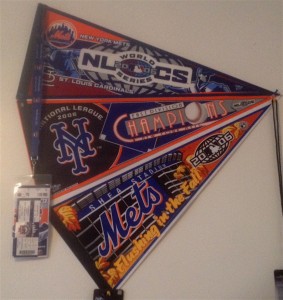 I thought there’d be more to this little display. I have some of the same reasons you who chose 2006 did. The most recent span of Mets baseball would have been more palatable, even delectable. Endy’s catch would have occurred in service to a transcendent cause. Called Strike Three and its lingering fallout would have never occurred. New York would’ve been a better place to cheer. It was the perfect 20-year bookend to 1986. We’d remember a team that owned April through September more lovingly and frequently. El Duque would’ve come back from his calf injury and stymied the Tigers. Delgado would’ve gone deep. Chris Woodward or Julio Franco would’ve come off the bench and done something significant. Endy would’ve made another catch. Wagner would’ve gotten the last out and embraced Lo Duca. Wright would have a ring. Reyes would have a ring. Every Mets fan sentient that October would have the moral equivalent of a ring let alone a winter spent plucking ticker-tape out of our clothes.
On some level the same could be said for all the prematurely truncated playoff years preceding 2006. Undesirable results could’ve been reversed. The Yankees could’ve been overshadowed (a not insignificant factor for the 2000 crowd, I noticed). The one play or pitch or move that’s haunted the premises for too long could’ve been dispatched into the cornfield. Players with whom you empathize would’ve been rewarded. And the current Mets management would be forced to fully acknowledge something spectacular happened. If we could do over 1973 or 1988 or 1999 or 2000 (or 1985 or 1962), hell yes, let’s do it over.
But if I can only do over one that came so close, give me the one I could’ve blogged about on Faith and Fear in Flushing. Give me the one Jason could’ve blogged about on Faith and Fear in Flushing. Give me the one the best damn readers in all of Metsopotamia could’ve shared with us while it was happening. Give me one that would’ve stayed stuck in the collective consciousness for seasons to come, whether or not it kickstarted 2007 and 2008 toward greater heights (it certainly wouldn’t have made the subsequent seasons substantially worse).
Give us one in the general vicinity of now while I’m doing this. That would edge all other factors. I’m a Mets fan and blogger since this date in 2005. The two are hopelessly (or should that be hopefully?) intertwined.
I truly loved the 2006 Mets, though not necessarily more than the other seasons in question. Nothing could top 1999 for My Favorite Met Year consideration, which may be why I’m willing to deny it a theoretical world championship. How could something I love more than any other thing get any better? With two more NLCS wins over the Braves and a World Series won against the Yankees, of course, but you know what I mean. It’s not that I’m at peace with how those playoffs ended, exactly. Yesterday, in a bit of correspondence with someone who’d just read the Do-Over post, I found myself right back on the razor’s edge of the early morning hours of October 20, 1999:
“I would’ve started Reed in Game Six — two days’ rest would not have bothered him after throwing 77 pitches in Game Four, three nights earlier — and reserved Leiter for Game Seven; that’s not hindsight, that was my plan right after Ventura’s ball went deep enough to score Cedeño from third. Then I would’ve opened the World Series with Rogers, who was unbeatable at Shea.”
So no, I have not found inner peace 14 years and four months later, even if 1999 is the non-championship team whose journey (if not destination) strikes me as the most satisfying. I learned to live with how 1999 turned out. Though its ghosts would come out of the woodwork 32 years after the fact, I learned to live with 1973’s one-game shortfall, which seems a pittance compared to the un-Believable bounty of happiness that preceded it. Though I hate that we didn’t win the only Subway Series in which we ever played…let’s just say that although I always thought losing the World Series to the Yankees would be the end of the world, it wasn’t. It only felt like it. The sun came up on consecutive mornings, somehow, and the earth continued its spinning unabated. 1988 is still a disgusting outcome, but at least it taught me something about hubris and expectations. I guess.
There are valuable lessons embedded into my faith not being fully rewarded in 1973, 1988, 1999 and 2000 and I can still appreciate the successes they let me revel in en route to the edge of the cliff from whence the Mets and I plunged together. I appreciate the 97 wins and NLDS sweep from eight years ago as well, yet other than “don’t let your setup man get into a cab late at night in Miami” and “have more starting pitching in case two of your projected starters go down with injuries at the last minute,” I don’t know what the lesson was from 2006’s unfinished symphony. I was ready for another world championship. I was ready from April onward. I was ready to skip upstairs to this very spot and write about what it meant to have secured the third world championship in New York Mets history.
I’m still ready. I hope you’ll be here when I get that opportunity.
by Greg Prince on 15 February 2014 5:16 pm The New York Mets have reached seven postseasons in 52 years. Two of them ended perfectly. Five of them didn’t. Those five were forwarded to you for your cosmic reconstructive surgery consideration, along with the request that you choose only one for historical repair. I read everything that was written in response — not just in the FAFIF comments section, but throughout other venues where the question was posed and the subject given careful thought — and I have to agree with your conclusion.
***
You guys say it has to be 1973, and for very good reason.
• “A World Series for Willie as a Met.”
• “Rusty should have one.”
• “I was 13 years old and many of the guys from 1969 were still on the team.”
• “Those guys worked hard and almost got it. I will never ever forget that team, and I have forgotten most of all the other seasons.”
• “I was 15 years old. Every kid should have their team win a championship when they are 15 years old (with certain notable exceptions, of course).”
• “My second year of Mets fandom — would have been wonderful.”
• “You had me at Rusty Staub, Series MVP, plus the serious Hall of Fame consideration he deserved. ’73 had that perfect combination of scrappy, high-spirited underdogs, with a foundation of amazing talent. Seaver, Koosman, Matlack, and Tug; Rusty, Cleon, Buddy, Felix Millan, and just-an-honor-to-be-on-the-field-with-him Willie Mays. Merely typing those names is a thrill. And after that rollercoaster playoff series against the Big Red Machine, to then wipe the A’s dynasty off the map? Such celebrations the baseball world has not seen since…well, we didn’t get to see it then either.”
• “I have to choose 1973, because my father would be alive to enjoy it with me, and because Ya Gotta Believe.”
• “1973 changes everything. The pain of all the other near-misses is quenched if Yogi does not mismanage his rotation for games 6 and 7. The Mets are forever cast as a good or decent team, and not the accidental champions of 1969 and 1986. And perhaps so many more championships would have followed, with fewer of the near-misses listed above. Without question, 1973.”
• “No Wild Card — just a wild season!! That delirious ending, that five-game playoff win!! Beating the A’s would have been glorious.”
• “Maybe the late ’70s Mets malaise wouldn’t have happened if the 1973 Mets were WS champs. Willie Mays, on his knees, pleading.
The damned Wilpons made short shrift of 1973 this past season, the cheapskates. Should have been a full tribute with those California critters G.T. Seaver and Willie Howard Mays the stars, along with Le Grand Orange. With a Tim McGraw post-game concert.”
***
Also, you guys say it has to be 1988, and your reasoning was very sound.
• “For me the one that got away was 1988. We had the better team by far, and they got overconfident, then underplayed, and went out with a whimper. Plus, the pain of losing the playoffs is worse than the pain of losing the World Series. That was in the bag. And then it was gone.”
• “The ’88 team was by far the best of that bunch.”
• “It would have solidified the Mets as the team of the ’80s and unlike 1986, I was old enough to remember and enjoy it.”
• “1988 was the best Mets team there ever was or ever will be. They had upgraded several positions since 86. The rotation was better. They didn’t win quite as many games as they did in ’86, but they dominated the NL and the 1980-83 Islanders had already showed us the trick of dialing it down a bit during the long regular season, saving something for the playoffs. Maybe the Mets had recurring issues with the Cardinals, but once they made the playoffs, they were unbeatable. Even in the most dire October circumstance, they would always rally. Such was the false lesson of 1986. 1988 was the year the dynasty finally materialized. There was no way we were going to lose to the Dodgers, who had lost so many lopsided games to us during the season. Mets-A’s was going to pit the two best teams of a generation, but the Mets’ rotation was going to be the difference. I KNEW this. And a Mets Series victory would have cemented the Mets as permanent fixtures at the top of NY sports. They have never had so much at stake, and they never had so much reason to believe that THIS was the defining year for the franchise. 1988.”
• “The ones that hurt the most were ’88 and ’06 because of the ways that they lost. Reading your prose, I could feel the pain and regret return for those two more than the others. I went with ’88 because of Davey, Doc, Keith and Gary and how that would have been a dynasty, not a one-off.”
• “I have to pick 1988. I still can’t believe they lost to that Dodger team. Game 4 is the worst day of being a Mets fan.”
• “I don’t see how you can pick anything except 1988. That team was better than any of the others, they had already won once, and they should have won the NLCS, if not the whole enchilada.”
• “It has to be 1988. Imagine having our own mini dynasty to point to.”
• “Two titles in three years would have cemented the late-’80s Mets as an all-time great in the game, not just the best teams in franchise history. I remember the last weekend of July and first one in August quite vividly, which is when I thought they really won the NL East. Bobby O and El Sid pitched shutouts at Shea, with Elster homering in the 8th inning of the Friday game against John Smiley. Watching that night on Channel 9, it was the loudest Shea had been since the ’86 Series as Elster circled the bases and later came out for a curtain call. Pendleton game in reverse perhaps? That’s actually one of several 1988 games I wish SNY would air as a Mets Classic. Then the next weekend at Three Rivers, hamstring-addled Keith homers one night to win a game, they rally from 3-1 down the next night, then score 4 in the 9th on Sunday. (They lost 1-0 the next night to some guy named Rick Reed. Whatever became of him?)”
• “The 1988 team was superb, much better balanced than the later ones that lost.”
• “1988 would have changed the team’s history.”
• “I’ll go with 1988, because it’s the one that made me the most unhappy. Actually, I guess 1973 did (I was ten, and they sent me to the guidance counselor to find out what the hell was wrong with me. Smart lady, she figured it out.) But that’s mitigated by how lucky they were to be there. I voted for 1988 because the Mets were more important to me then than they were in 2000.”
• “’88 hurt the most as IMO the Mets were the class of the NL that year and a WS appearance seemed so inevitable. that was a real blow. It wasn’t just that they lost to a clearly inferior (except for that series) team, it was HOW they lost. Soscia’s (I know it’s misspelled but I don’t care) wasn’t just a death blow to the Mets, it was the end of ‘dominant Doc’ as well. If only Bobby O had waited until the season was over to trim those hedges, if only Coney had kept his trap shut, if only Keith and Gary didn’t suddenly get old….sigh.”
***
Furthermore, you guys say it has to be 1999, and I can’t argue with any of the reasons given.
• “90% of my moral upbringing was learning to be OK with crushed Metsian hopes. But sublime happiness > character building. ’99.”
• “Put me down for ’99 over the Yanks. Leiter for MVP. All three Mets WS MVPs wear #22.”
• “1999!”
• “Beat the Braves and the Yankees in 1999 and the whole world of baseball changes.”
• “Shea Stadium is a madhouse on Saturday night, October 30th, as the Mets, behind Al Leiter, close out the Yankees…winning the final game of the 20th Century and bringing home their 3rd World Series Championship. Afterward, Bobby Valentine proclaims the 1999 Mets ‘The Greatest Mets team ever assembled.’ Reserve Outfielder Shawon Dunston, tears streaming down his cheeks, gives his now-legendary ‘I am so proud to be a Met’ speech. The quote is posted above the doors to the Mets Hall of Fame and Museum at Citi Field. Piazza, who played the entire month on fumes, is jubilant, saying ‘This is why I stayed here! Winning a World Series outdistances anything I’ve ever accomplished in my career.’ Many Mets fans agree with Valentine. The 1999 team lives forever in the hearts of Mets fans. Sound good? I like it too.”
• “That team was so likable and hard-working that if they didn’t win a championship since then it wouldn’t have mattered.”
• “It really was The Best Infield Ever (no offense to Todd Zeile & Mike Bordick).”
• “The Grand Slam Single could be part of the first-ever comeback from 3 games down to win the LCS.”
• “Definitely 1999 because we would’ve been the first to come back down 3-0 and then beat that other team. Mojo Risin’!”
• “Of course, ’99 also means Yankees lose, and gives momentum for the 2000 WS that I greedily want as well.”
• “In addition to getting to beat the Yankees in the Series, they’d get to beat the Braves in the NLCS. I’m biased by the fact that I was 16 that year & had the time to fully enjoy it. Plus my grandpa would’ve been alive to see it.”
• “1999, because 13-year-old me deserves it.”
• “Loved that team more than any other in my adult life, still believe if Olerud is back in 2000 the ring is ours.”
• “Had they won in ’99, the LCS victory would have been the first-ever comeback from 3-0 in MLB.”
• “Would have loved for them to beat those f-ing Braves. Plus, that was some of the most exciting postseason baseball of my life, despite them losing all the marbles.”
• “The Grand Slam Single isn’t just important-to-Met-fans weirdness, it’s the nationally-famous keystone of a Met comeback, Kirk Gibson and Dave Roberts in ’04 wrapped into one. Fonzie’s slam in NLDS Game 1, Pratt’s in Game 4…these are Moments now. And who’s to say ’00 ends the same way if you roll the bones on ’99? Who’s to say the MFYs don’t make some more ill-advised spending than they did? Who’s to say Joe Torre is a Hall of Famer now? Who’s to say 1999 isn’t a magic bullet for BOTH years?”
• “The parameters say the Mets won’t win those other years, but it doesn’t say the way it doesn’t happen remains the same. So in my fantasy, the Yankees losing in ’99 makes them make different moves that don’t work out the same way and the Mets lose to the Mariners, not the Yankees, in ’00.”
• “I’m sticking with 1999 cuz I loved that team, and it means the Mets will play in back-to-back World Series for the first and only time, and even though it means losing to the Yankees in 2000, the Mets will still have won the first postseason meeting between the two teams.”
• “I agree Clemens would have gone down as a thug and a dud and the Yankees would never have had the three-peat that’s given them a stranglehold on baseball in this town to this day. The Met teams of that era never got the credit they deserved.”
• “I’ve gotta go with ’99, but only if the changing point is Game 6. Think about how celebrated the 2004 Red Sox have been, now picture the Mets beating them to the punch, only even better — Mets come back from 3 games to none deficit against division rival that has had their number for a decade, with 3 straight classic games (come from behind win in 8th inning in Game 4, Grand Slam single in Game 5, come back from 5-run first-inning deficit to win in extras in Game 6), and then win however they wanted to in Game 7. Then, off to the first Subway Series in 43 years (everyone voting for 2000 seems to forget that they would have gone through the Yankees in ’99 as well), and they beat the freaking Evil Empire, preventing them from becoming a dynasty. That was my favorite Mets team, and it would have been amazing for them to win it all. Mike Piazza would already be in the Hall of Fame in a Mets hat, Edgardo Alfonzo would rightly be recognized as an all-time great Met (and would have at the very least been on the freaking HOF Ballot — what a snub that he was left off a few years ago). Even if 2000 played out exactly the same way, the sting of losing to the Yankees would be so much less if it was just them evening up the tally.”
• “’99 felt right going through the playoffs, was a great combination of players and after the grand slam single everything seemed to come together. Then Kenny Rogers didn’t know when to hold them, fold them or throw them into the strike zone.”
• “They were better than the Yankees and top to bottom they were a monster team. If Kenny Rogers was a man and didn’t WALK Andruw Jones, we would have won that series and defeated the Yankees.”
• “That team was stacked & that postseason was epic.”
• “When I first started reading this post, I automatically pointed to 2000 since beating the Evil Ones makes everything right with the world. But by the end of the post, I saw that 1999 would really have been the one to get. First, we would get to beat that team from the Confederacy thereby changing the aura of that place they call a ballfield. And then, totally break up the dominance and 4 out of 5 titles that the Evil Ones amassed. Maybe even shaking things up enough to change the 2000 results as well. 1999 would have become the first Subway Series and the one to get. The ’99 team was a lot of fun to watch and a championship that year would have gone a long way toward restoring the Mets to their rightful place as NY’s team.”
• “I would like to see the ’99 team as WS champs. The greatest infield ever receives the national and historical recognition only we in the blue and orange glasses duly give them.”
• “That team was so good. Maybe the perspective of the Mets as champions and the Yankees as losers alters the offseason philosophy enough so that it leads to a Mets loss to Seattle in 2000 instead. Maybe John Olerud sticks around more. Maybe we get Bobby Valentine longer, because he gets a longer leash for having won a title.”
• “It has to be 1999. If they had finished the job against Atlanta and then beat the Yankees (who, in my opinion, were better in ’99 than in ’98)? After that incredible, magical run and all of those ridiculously Amazin’ moments?? That goes down as the greatest championship run by any team in baseball history. AND that team was only getting better. So I’ll take my 1999 World Champion New York Mets, my first-ballot hall of famer and forever #31 Mike Piazza and run with it. And I’ll rest peacefully knowing my favorite player growing up, Mr. Alois Terry Leiter, never called a single game for the Yankees on YES.”
• “The Mets beat the Braves and the MFYs and Mike ‘Dolphin Face’ Hampton never becomes a Met.”
• “1999, but only if Griffey ends up a Met the off season afterwards. Yes, that means trading Fonzie but I get to see my all-time favorite player in Griffey play for my favorite team.”
• “Since we’re fantasizing, can’t we just win in ’99 & somehow trade for Hampton, lose him to Colorado and still draft Wright?”
• “I like to think that winning in ’99 begets winning again in 2000. Both vs the Yankees. Quickly and decisively returning us to the top dog in town, the destination of choice for free agents. The fin de siècle Mets are remembered as one of the greatest dynasties of all time. Runaway financial success ensues, meaning the Wilpons aren’t dumb/desperate enough to fall for the Madoff scam. Mike Piazza is, as he should be, a first-ballot HoFer sporting a Mets cap. Yankee attendance and ratings plunge, Steinbrenner panics and trades Rivera and Jeter for, I dunno, Nomar, and the team moves to New Jersey and becomes an afterthought, the Padres of the East Coast. All is well.”
***
Did I mention you guys say it has to be 2000? And you’ve got all the reason-bases covered as far as I’m concerned.
• “Gotta be the Subway Series. Winning that would dominate every Metsian highlight reel for all time.”
• “My choice would be a 2000 WS victory over the hated crosstown rivals, without hesitation or reservation. We would always have had that trophy to hold over the pointed little heads of their fans, regardless of the other 26 they hold. Instead, as things unfolded, we heard their braying without end. So, the year 2000 has my vote.”
• “I am shocked 2000 isn’t the unanimous vote. Beating the Yankees would carried us for decades.”
• “2000, because it was the goddamn Yankees. Think of how easy it would be to shut down obnoxious Yankee fans forever if only they had beaten them the one time they met. It was there for the taking, they just didn’t take it. This would have worked for 1999 as well, but there would have been an extra layer of playoffs to undo.”
• “Beating the Skanks would have been the ultimate.”
• “It’s 2000. There really isn’t an argument. Multiply the Mlicki game by a million and you have a starting-off point.”
• “’00 of course, to beat the Yanks.”
• “Had to go for 2000. In fact, given the ’roided-up nature of those cheating MFY bastards, I want it awarded retroactively. So many moments in that series just hurt. RUN, TIMO!!!”
• “’00 so I could shut Yankee fans up.”
• “The 2000 postseason has a frustration all its own due, of course, to the opponent. Add to that that we were probably the better team there, too, despite the lopsided previous half-decade, that all the losses (and the lone win for that matter) were 1- or 2-run games, and mainly to the fact that the team just played so shitty in those five games.”
• “Nothing would’ve topped taking down that other NY team.”
• “2000. Can’t imagine anything being better than beating the Yankees in the W.S.”
• “I’ll go with 2000. Beating the Yankees in the World Series would have been the best.”
• “Ditto on ’00. All this would be worth it if they’d won against Satan’s nine, or if I could know that they’d one day right that wrong. I’ll go to my grave wishing on a 2000 win vs. NYY.”
• “I assume that with all of the good side effects, it wouldn’t lead to any more championships. I choose beating the yanks in ’00.”
• “I’d trade Jets ’69 SB win for ’00 WS win.”
• “It’s 2000 for me. Zeile’s drive isn’t swatted down by the hand of god in Game 1, Mets win. Clemens is ejected in Game 2 and Piazza gives the Mets the lead after taking Rivera deep. Armando pitches the 9th inning of Game 4 and the Yanks get only one, Piazza takes Rivera deep again to win the World Series in a sweep. I’d STILL be smiling. The rest of the decade would play out exactly the same, most likely. There’d still be a lot of hurt. But we’d have made up for ’99’s shortcomings, and we’d have crushed the Yankees when it mattered. The inferiority complex that’s been nourished since 1996 would be drastically reduced, possibly done away with.”
• “I’d say the 2000 subway series. Heartbreaker. I was at game five, so that’s partly why.”
• “2000, since the steroid-riddled Yankees shouldn’t have even been there.”
• “2000! Take ’roids out of the game and they likely would have been the champs.”
• “The injustice of them getting away with the attempted bat assault, NEGATED!”
• “I took 2000, probably because I remember it the best and it was the MFY’s who won so lopsidedly. And this.”
• “My gut says 2000, because the city would have been won back. In 1973 and 1988, that wasn’t an issue. In 2006, well, it wouldn’t have been an issue had they won in 2000. It would snatch a CRIMINALLY REPUGNANT championship from the Yankees. Dawn of a new century and sunset on the cheating-assed Yankees and sunrise on the Mets? Where do I sign? 2-0-0-0. Winning the championship is wonderful. Taking it away from the Yankees, well, glory be.”
• “2000. Fuck the Yankees.”
• “I’m leaning toward picking 2000 for the Mets 3d WS. In doing so, I’m sacrificing my personal needs for the greater good of the Mets community. I sure as hell wasn’t no wide-eyed and still mostly innocent elementary schooler in 2000 — like I was in 1973 — but many other Met fans were.”
• “Loved the 2000 team. That was a magical time, plus it was my first real taste of Mets playoffs. Loved that postseason.”
• “The 2006 team was dominant wire-to-wire and was fun to root for. That said, nothing would have been better than beating the Yankees in 2000.”
• “I’m torn between 1999, the year of the best infield ever, according to Sports Illustrated, and 2000. I think 2000 gets it, just to best the Yankees and shut up all those fans.”
• “’99 would have been great but the loss in 2000 still hurts today.”
• “I was strongly considering ’06. Despite my greater age, I was much more into that team than I was the ’88 squad. But there’s no way to turn down ’00.”
• “Wow. Tough! Going w/2000. ’73 diminishes ’69. ’88 diminishes ’86. ’99 still loses to Yanks in ’00. Oliver Perez a WS champ in ’06? Ha!”
• “While a strong argument can be made for each choice and even 40 years haven’t softened all of the sting from ’73, for me it’s 2000, hands down. And for all of Greg’s eloquent explanations and what-if dominoes falling tied to that contingency, I could take the liberty of editing everything he wrote down to ‘Mets beat Yankees.’ ’Nuff said.”
• “How can anyone not vote for the Mets to retroactively beat the MFYs in ’00? I don’t know how any other year is even a consideration. Even the ’99 season didn’t end with us actually losing a WS to the MFYs, so it doesn’t present us with the opportunity to reverse that very real loss, just a theoretical loss that never happened, because we never made it the Series to begin with.”
• “I would vote for 2000, 2000 out of 2000 times. Think of how less stressful our lives would be. I can’t keep going to the Mlicki well.”
• “Why any Mets fan would not choose 2000 above all other seasons is beyond me. If they beat the Yankees in that World Series it does two things: 1) Once and for all shut up all the incessant Yankees fans and their puffy-chested nonsense by always referring to the World Series they lost to the Mets.
2) See no. 1.”
• “I’d even settle for taking it to a sixth game so I didn’t have to watch the Yankees celebrate in our house.”
***
Finally, you guys say it has to be 2006. I can’t say you’re wrong about any of the reasons.
• “I agonized over this one. I distinctly remember crying over Sunday dinner in 1973 as the Mets lost game 7. But I think if the Mets win in 2006, the collapses of 2007 & 08 never happen, 3 straight division titles happen and away we go.”
• “2006. That one really crushed me.”
• “That really hurt.”
• “2006. Those guys deserved it.”
• “I moved to St. Louis from New Jersey in April 2006. I was the only guy walking around here in Mets gear. That loss will haunt me for as long as I live here. They still show that Beltran AB a million times a year on TV here, even 8 years later. It rubbed salt in the wound even more when Beltran actually PLAYED for the Cardinals. Plus, I have to listen to these pretentious “Cardinal Way, I’m better than you and I know it” Cardinals fans who nearly make you fall asleep when watching their games at Busch. I’d take that one back in a heartbeat. Oh, and one more thing: Don’t you think we’d still be talking about Endy’s catch if the Mets won the game? I’m 33 and that’s the greatest play of my lifetime, hands down.”
• “2006, if only because it would validate Endy’s catch as the greatest in postseason history.”
• “Endy’s catch goes from memorable to all-time greatest.”
• “Hmmm, ’73 for Willie Mays…no. ’88 because I hate the Dodgers…no. ’99 because I hate the Braves…no. ’00 because I hate the Yankees…no. 2006 because they were the best team that year and Endy’s catch should have taken them to the Series.”
• “I’m torn between ’99 and ’06. Making the Grand Slam Single or The Catch mean something would be Amazin’. I’m siding with ’06, as ’99 & ’00 being close together are pretty special already, but ’06 is the ripest of unplucked fruits. So much potential. Besides The Catch, the memory of Paulie taking out 2 Dodgers at home plate on the same play would be even sweeter. Delgado and Beltran leading the way, and Wright and Reyes learning the taste of winning and what it took to get there would stand them in good stead in ’07 & ’08 when the going got rough.”
• “2006. The endings to the ’99 and ’00 seasons are colored by but aren’t defined by how they ended.”
• “Not choosing ’06 in this survey is boggling. The Endy highlight always ends w/Beltran looking. What I wouldn’t give to change that.”
• “That’s when we became the Cubbies or 21st-century Red Sox.”
• “Molina doesn’t hit that homer and the fate of the franchise changes forever.”
• “I picked 2006. Beltran just sitting on that big dumb curveball and then punching that thing into outer fucking space.”
• “2006. If only to erase Beltran’s strikeout against Wainwright. To me, the most painful, deflating moment in Mets postseason history.”
• “After that, it was one heartbreaking season after another.”
• “2000 would have been awesome, but losing in 2006 after Endy Chavez’s catch seemed like something more sinister.”
• “They were better — they should’ve won that series. Definitely would’ve beaten Detroit.”
• “This is a pretty easy choice for me. 2006 all the way. I grew up in NY and now live in NC. I was only 9 years old during 2000 and though I’ll never forget that, I wasn’t really old enough to truly grasp the magnitude of that series. 2006, however, still hurts…badly. I remember driving home with my dad from school the day of game seven and saying to my dad, ‘if we win today, we’re going to the World Series,’ and I proceeded to pace around the house for the next several hours. After Endy’s catch I immediately got a phone call from a friend who knew how important it was to me and it was one of those moments where you felt like they just couldn’t lose after that. Obviously they did and the memory haunts me to this day and I’d probably give anything to get that one back. However, that season truly defined the fan that I am today.”
• “I have been a fan for 50 years. 1988 was brutal and I still have emotional scars from 2000 (need I say that I live in Yankee country) but I have to vote for 2006. I understand how good Beltran was for us but I will never be able to erase that strikeout from my mind. Absolutely devastating.”
• “It’s really tempting to go with beating the Yankees in 2000, but, as an eternal pessimist, I worry about the Law of Unintended Consequences. If, for instance, Mike Hampton sticks around…well, those great Colorado schools would perhaps suffer from the lack of Hampton kids, but the Mets would also not get the compensatory draft pick from losing him that netted them David Wright. So I’m going with 2006. Because out of all the unfairly scapegoated individuals in Mets history, Carlos Beltran is my #1 pick for ‘deserved better’. And, more importantly, any Unintended Consequences certainly won’t make the following years noticeably worse.”
• “’06, if only because it’s so recent. I am still in the post-’06 phase of my life.”
• “’06 is the only one I would be old enough to remember.”
• “2006 so that I could have truly appreciated it.”
• “’06. It’s pretty good now, but I’m convinced my life would be entirely different if they’d won.”
• “2006. We were there and it was a dejected group of fans leaving Shea that night. It would have been awesome. I was with my son I have never heard Shea louder than when Endy caught that ball.”
• “I gotta go with 2006. of all the vibrations we’re living with from each of these losses, the biggest bang is from a called strike three. Beltran, the best center fielder the Mets have ever had, the best free agent signing the team ever made, leaves under a cloud, instead of staying and being regarded in the club’s pantheon where he belongs. And my son, now 16, would have at least one championship to sustain him in tough times. Yes, if 2006 happens, then 2007 and 2008 probably resolve more favorably too. And we don’t have to remember the last day at Shea as something tinged with such loss and memory that only poets can summon it. It’s remarkable the club doesn’t have more than two series wins. because each in its own way, all these teams were champions.”
• “I would choose 2006 because they would have had a good chance of bringing back the same guys the next year and repeating.”
• “I would clearly pick 2007 if you could pick any season, but given the limitations, 2006. I think this franchise is vastly different right now less than a decade removed from a title.”
• “’88 is a lesson in unpredictability, ’99 brought back hope, ’00 was a lost cause. ’06 is the one that got away.”
• “2006, if only for the symmetry.”
• “Without question 2006. Sure I would have loved to see ’73, ’88, ’99 and 2000. But those losses helped make me into the fan I am today. I think having a championship in recent years would remove much of the doom and gloom some Mets fans feel and the struggles the franchise has had in general. I also really loved that team. Jose Reyes and David Wright were so young, Beltran had a great year, Wagner proved to be a great closer and radical improvement over Braden Looper. Carlos Delgado was like Strawberry in the ’80s. So many great memories from that season — what about Endy Chavez’s catch? Woo-hoo! I so loved that team. We dominated for really the second time in our history. I’ll take that do-over please!”
• “2006. Period. Full stop.”
***
Well, there you have it. Great job, every one of you. Thanks for your input.
Tomorrow, to commemorate the ninth anniversary of Faith and Fear in Flushing, the Blog for Mets Fans Who Like to Read (and ruminate), I’ll chime in with my choice. It’s not gonna be any better than yours, but what the hell? I have my reasons, too.
by Greg Prince on 11 February 2014 3:13 pm I’m tempted to label this is a limited-time offer, SO ACT NOW, but actually, it’s an offer not limited by time. If it was, then it couldn’t be offered. But I’m gonna offer it.
You get to pick another Mets world championship for your collection. The catch is you have to pick it from the past, and you can choose only from the five seasons when they came close to being world champions — the five seasons when they went to the playoffs but didn’t go all the way.
On your say-so, they do go all the way. On your say-so, the Mets will have three world championships: 1969, 1986 and…
…that’s the question. Which one do you add to the wall, to the trophy case, to the flagpoles, to the media guide, to the family album? Which one, if you had to do it all over again — and by the parameters of this exercise, you do — would you pluck from the dustbin of disappointment and elevate to exalted?
Which retroactive world championship changes the course of Metropolitan events for not just the better but the best by your reckoning? Which one changes your life as a Mets fan for the best? What’s the one you’ve always wanted inverted? And why that one as opposed to the other ones?
Just to be clear, none of this dislodges 1969 or 1986. Everything you know about those two championship seasons stays exactly as is. It’s just that they now have a brother. And none of this necessarily affects 2014 and beyond. You don’t get to apply the third world championship to a future date. The Mets can still win another as soon as possible, but when they do, it will be their fourth.
Can’t help you with when that will be. I don’t do future.
You’re welcome to your ripple effect in that you can speculate as to how the Mets winning in this other year altered history, that perhaps winning that one time led to a string of successes…or somehow backfired and brought on dark times. Or you could decide that everything is as it’s always been…except now instead of the franchise narrative reading, “The Mets won the World Series twice,” it will be thrice.
The other rule is we deal in the relatively knowable. Everything that brought the Mets to the postseason series in question is as it was. If the Mets played a specific team in a particular World Series, that’s the team they retroactively defeat now. If the Mets played a specific team in a particular NLCS, that’s the team they retroactively defeat now — and then they go on to defeat the American League team that would’ve been waiting for them in the World Series that followed.
And to be clear, you have to choose. You can have only ONE historical do-over of this nature. Call it a Soler’s Choice.
Here are your Metropolitan candidates for cosmic reconstructive surgery.
1973
Instead of the Mets losing to the A’s in seven games, the Mets beat the A’s in the 1973 World Series. It could’ve very easily happened. In reality, all the Mets needed was one more win.
Maybe the ninth-inning rally that produced one run in Game Seven kept going and the Mets stormed from behind to upset the defending champions. Maybe Willie Mays came off the bench to hit for Wayne Garrett, tied the game with a three-run homer, it went to extras and Tug McGraw finished off the A’s one final time. Maybe the Mets led the whole way and Jon Matlack came out of the bullpen to relieve a tiring Tom Seaver in the bottom of the ninth after George Stone couldn’t quite close the deal the day before. Or maybe George Stone got the ball in Game Six and lived up to his 12-3 success of the regular season. Maybe Felix Millan got his glove down in Game One and Don Hahn found the warning track in Game Three and the Mets swept.
Doesn’t matter how they did it. The point is the Mets did it. The Mets won the 1973 World Series. What does it mean?
It means there is no “George Stone” decision to regret for 40 years and counting. It means Willie Mays went out on top and nobody much remembers that he fell down in center field in Game Two. It means a pair of World Series rings for Tom Seaver, Cleon Jones, Ed Kranepool and a whole bunch of 1969 & 1973 Mets. It means a championship for Rusty Staub, possibly (based on existing evidence) the World Series MVP award, maybe enough of a rise in his historical profile to merit him receiving serious Hall of Fame consideration.
It means 1969 and 1973 are a fully accredited tandem. It means nobody outside Metsopotamia doesn’t know “You Gotta Believe” isn’t a Mets thing. It means that whatever Tug does or doesn’t do for the Phillies down the road, he is primarily associated with the Mets, the team for whom he won two world championships. It means that when 2013 rolls around, the Mets don’t think about not reconvening the World Champion 1973 Mets so the fans give them the standing ovation they deserve.
It means there is no Oakland A’s dynasty as such. It means, perhaps, that Reggie Jackson enters free agentry as a less transcendent figure and perhaps doesn’t attract quite as much attention on the open market. Perhaps because he is not so glittering a star he signs with San Diego or Montreal (two teams with whom he negotiated in the fall of 1976). It means, maybe, that Catfish Hunter is a slightly less desirable commodity in 1974 when he suddenly becomes a free agent. It means, one could suppose, that the Yankees don’t necessarily sign either Jackson or Hunter and their position in New York in the late 1970s is altered.
Does it mean the Mets, winners of two world championships in five years, are differently positioned for the seasons after 1973? Do the defending world champion Mets upgrade for 1974 instead of proceeding with essentially the same cast of characters? Is Yogi Berra given more slack in 1975 because he managed the Mets to a world championship in 1973? Is Yogi still the manager by 1977? Does winning those two World Series change Seaver’s attitude toward remaining a Met? Are the Mets bigger spenders by then because they’ve continued their tradition of success?
And you — if you were around in 1973, would erasing the loss and replacing it with a win have meant everything? Would it have continued to mean everything? Would your life as a Mets fan be substantially better if you could point back to the 1973 world champion Mets? The pain you knew and have carried around with you from coming so close would be, now and forever, unadulterated pleasure. And if you weren’t around, based on everything you know, you’ve read and you’ve thought about, would you love more than anything to have the Mets have been world champions in 1969, 1973 and 1986?
How great would it be to have that one back and have it turn out right this time?
1988
Instead of the Mets losing to the Dodgers in seven games, the Mets beat the Dodgers in the 1988 National League Championship Series and then went on to defeat the A’s in the 1988 World Series. It could’ve very easily happened. In reality, all the Mets needed were five more wins.
Maybe the Mets get the best of Orel Hershiser while Ron Darling pitches a gem in Game Seven. Or buoyed by Dwight Gooden’s first career relief appearance, the Mets begin to peck away at Hershiser en route to pulling off a dramatic 7-6 comeback victory that sends them to the pennant. Or maybe it never goes seven. Maybe David Cone doesn’t sign up for a ghosted column in the Daily News and Bob Klapisch doesn’t attribute quotes about Jay Howell looking like a high school pitcher to him and Tommy Lasorda doesn’t fire up his players with such bulletin board material and the Mets leave Dodger Stadium with a 2-0 series lead. Maybe Gregg Jefferies doesn’t get hit by a batted ball while on the basepaths in Game Five.
Maybe Gooden doesn’t walk John Shelby to lead off the ninth inning of Game Four. Maybe when he does, Davey Johnson emerges from the dugout and signals with his left arm to the right field bullpen to bring in Randy Myers, whom Johnson had the foresight to have warming up entering the ninth. Or Myers started the ninth, retired Shelby and then the next batter, Mike Scioscia. Maybe Myers gets one more out besides and the Mets are on their way to dismantling the Dodgers, setting up the clash of the titans everybody anticipates against the A’s.
Doesn’t matter how they did it. The point is the Mets did it. The Mets won the 1988 World Series. What does it mean?
It means there is no “Mike Scioscia” in the Mets vernacular. It means there is no blanket dismissal of the late-’80s Mets as a dynasty that never happened. It means there are two world championships in three seasons. It means a pair of World Series rings for Gary Carter, Sid Fernandez, Mookie Wilson and a whole bunch of 1986 & 1988 Mets. It means Mackey Sasser and Kevin McReynolds, among others, are forever world champion Mets. It means Keith Hernandez and Ron Darling have an entirely different set of stories to tell as Met announcers two decades hence.
It means a comparison and contrast between 1986 and 1988 for years to come — which world championship team was better? Which ticker-tape parade was attended by more people? It means a reflexive roar goes up at Shea and later Citi when 1988 highlights are shown on the video screen. It means that in 2008, a day would’ve been set aside for the 20th anniversary celebration of the 1988 world champion Mets. It means that nearly every reference to the Mets of this era is accompanied by the phrase, “the team of the ’80s”.
It means Mike Scioscia is a vaguely recalled catcher from way back when. It means Kirk Gibson was that guy from the Tigers, wasn’t he? It means that for all of Tommy Lasorda’s bluster, he only won one World Series. It means Orel Hershiser had that sensational scoreless innings streak at the end of the 1988 regular season, but remember how he couldn’t stop the Mets when it mattered? (He was asked in 1999 about what it was like to join the team that broke his heart eleven Octobers earlier and he didn’t want to talk about it.)
Does it mean the Dodgers don’t hold quite the same attraction for free agent Darryl Strawberry in 1990 and the two-time world champion thus realizes he’s better off staying put in New York? Does it mean the Mets are more patient in 1989 and don’t trade Lenny Dykstra? Does Davey Johnson’s masterful managerial job from October 1988, when he outfoxed both Lasorda and Tony LaRussa, convince Frank Cashen once and for all that Davey deserves every benefit of the doubt going forward, even if there’s a rocky stretch now and then? Is Cone, who was such a big part of the world championship pitching staff of 1988, considered too valuable to deal away at the 1992 trading deadline? Do the Mets of 1989 and beyond, perhaps righted toward perennial contention, present Gooden with a more stable professional setting and curb his addictive tendencies? Do Gooden, Strawberry and Cone play out their careers as Mets and thus never wind up Yankees who, in turn, never quite put together all the pieces in 1996? Do Gooden and Cone pitch their no-hitters for the Mets?
And you — if you were around in 1988, would erasing the loss and replacing it with a win have meant everything? Would it have continued to mean everything? Would your life as a Mets fan be substantially better if you could point back to the 1988 world champion Mets? The pain you knew and have carried around with you from coming so close would be, now and forever, unadulterated pleasure. And if you weren’t around, based on everything you know, you’ve read and you’ve thought about, would you love more than anything to have the Mets have been world champions in 1969, 1986 and 1988?
How great would it be to have that one back and have it turn out right this time?
1999
Instead of the Mets losing to the Braves in six games, the Mets beat the Braves in the 1999 National League Championship Series and then went on to defeat the Yankees in the 1999 World Series. It could’ve very easily happened. In reality, all the Mets needed were six more wins.
Maybe Al Leiter pitches another game of his life on three days rest in Game Six, setting up Rick Reed for a triumph in Game Seven. Or after the Mets have fought valiantly back in Game Six, John Franco holds an 8-7 lead in the eighth, setting up Armando Benitez to save it in the ninth. Or Benitez preserves a 9-8 lead in the tenth to ensure Game Seven. Or Kenny Rogers works out of trouble in the eleventh, leading to a twelfth-inning or later Met victory. Then comes a Mets win in the seventh game, the National League pennant and a truckload of momentum that the Mets take back to Shea to start the 1999 World Series, momentum that carries through to a third world championship, the Mets’ first since 1986. Or the Mets won one, some, or all of the close games that started the NLCS and had an easy time with the Braves before taking care of the Yanks.
Doesn’t matter how they did it. The point is the Mets did it. The Mets won the 1999 World Series. What does it mean?
It means “Kenny Rogers” is that pitcher we picked up down the stretch drive who really solidified the staff. It means the Grand Slam Single isn’t a piece of team trivia but a hit that is instantly recognized by all baseball fans. It means Robin Ventura and Todd Pratt go on the MLB Network to recall their exploits in what are automatically considered two of the greatest games ever played…there’s probably an entire evening set aside to explore the 1999 Mets postseason. It means the game of hearts in which Rickey Henderson and Bobby Bonilla engaged during the sixth game at Turner Field becomes a charming anecdote in the tapestry of “it was just meant to be” 1999 recollections. It means Mike Piazza, Edgardo Alfonzo and John Franco have World Series rings. It means a career-defining achievement for someone like Turk Wendell, who becomes a transcendent Met folk hero on the order of Al Weis and Lenny Dykstra. It means Bobby Valentine joins Gil Hodges and Davey Johnson as Mets managers who won the World Series.
It means a ticker-tape parade that honors the Mets for the first time in thirteen years. It means Piazza is on the cover of every magazine from the last out of the World Series to the beginning of the new millennium. It means that when the Mets open the season in Japan in 2000, they are an international sensation. It means the New York Mets are the flagship team of baseball. It means the rush from behind in the Wild Card race to the championship of the world guarantees the 1999 Mets is embroidered securely into the Met narrative for eternity, that when 2009 rolls around, the Mets have to figure out how to best schedule their commemorations of the 40th anniversary of the 1969 world champion Mets and the 10th anniversary of the 1999 world champion Mets. It means, given the vagaries of how we view numbers, that the 1969 and 1999 Mets come up in conversation together all the time.
It means Turner Field is hallowed Met ground, because that’s where the Mets conquered the Braves in 1999. It means the Braves never made it back to a World Series after 1996. It means that the second team to win the World Series as a Wild Card reduced the long-term historical status of the Braves as perennial division champions even further. It means there was no late-’90s Yankee dynasty as such. It means the Yankees’ championships in 1996 and 1998 were overshadowed immediately, It means the Mets won the first Subway Series since 1956.
Does it mean the 1999 Mets were the beginning of a dynasty? Does it mean John Olerud couldn’t bear to leave, having been part of such a great team that was only going to get better? Does it mean that Ken Griffey couldn’t resist the trade the Mets had tentatively made to get him in the ensuing offseason and enthusiastically gave his approval? Does it mean the Mets boasted a lineup that included Piazza, Olerud and Griffey in the early 2000s? Does it mean the Mets didn’t trade for Mike Hampton and never attempted to replace Hampton with Kevin Appier and therefore couldn’t have traded Appier for Vaughn and there was no panicky winter devoted to securing big names who wouldn’t quite fit at Shea? Does it mean that Valentine, having beaten both the Braves and Yankees, earned the upper hand in his internal battles with Steve Phillips and wasn’t going anywhere for a very long time? Does it mean that the Mets, flush with World Series riches and a slew of new season-ticket subscribers, don’t care that they have to eat Bobby Bo’s contract and after giving him his World Series ring, they pay him what he is owed and never have to think about him again?
And you — if you were around in 1999, would erasing the loss and replacing it with a win have meant everything? Would it have continued to mean everything? Would your life as a Mets fan be substantially better if you could point back to the 1999 world champion Mets? The pain you knew and have carried around with you from coming so close would be, now and forever unadulterated pleasure. And if you weren’t around, based on everything you know, you’ve read and you’ve thought about, would you love more than anything to have the Mets have been world champions in 1969, 1986 and 1999?
How great would it be to have that one back and have it turn out right this time?
2000
Instead of the Mets losing to the Yankees in five games, the Mets beat the Yankees in the 2000 World Series. It could’ve very easily happened. In reality, all the Mets needed were three more wins.
Maybe Todd Zeile’s double to left in the sixth inning of Game One travels a few inches farther. Maybe Timo Perez runs hard all the way from first base. Maybe Todd Pratt breaks from third in the top of the ninth. Maybe Armando Benitez strikes out Paul O’Neill in the bottom of the ninth. Maybe Jose Vizcaino grounds out to end the twelfth. Maybe Roger Clemens is ejected in top of the first of Game Two. Maybe the Mets come all the way back on Mariano Rivera in that ninth inning. Maybe Mike Piazza gets to David Cone in Game Four. Maybe Al Leiter, who’s pitched like a Series MVP, comes out before his 142nd pitch of Game Five. Maybe Luis Sojo gets hit by a bus. Or maybe the 94-win Mets maintain their blistering pace of 12 wins in 14 games covering the end of the regular season and their playoff dismantling of the Giants and Cardinals and annihilate the 87-win Yankees who looked like no great shakes getting past the A’s in the ALDS and were in trouble early in the ALCS against the Mariners.
Doesn’t matter how they did it. The point is the Mets did it. The Mets won the 2000 World Series. What does it mean?
It means the Mets won the battle of New York. It means that in the long and glorious history of the New York Yankees, they have never beaten the New York Mets when it counted. It means the Mets got a ticker-tape parade in October 2000 and received keys to the city from a grin-and-bear-it Rudy Giuliani. It means that every Yankees fan you knew had to suck up whatever you said in the wake of your team beating their team in the World Series. It means the Yankees may have beaten the Giants and the Dodgers long ago, but they couldn’t overcome the Mets in the only modern Subway Series. It means the Yankee bandwagon of the late ’90s was stopped dead in its tracks and that next sound you heard was the roar of the engine on the Met bandwagon.
It means “Timo Perez” is that sparkplug who sent the Mets on their way to their third world championship and that “Armando Benitez” is synonymous with saving the big games. It means John Franco has much the same historical cachet as Tug McGraw and Jesse Orosco. It means that one slugger like Mike Piazza, one paragon of everyday excellence like Edgardo Alfonzo and a pair of portsiding aces like Mike Hampton and Al Leiter were enough to form the foundation of a world champion. It means Benny Agbayani, Jay Payton and Mike Bordick were part of the plucky corps that captured the Mets their first Series in 14 years. It means that Bobby Valentine outmanaged Dusty Baker, Tony La Russa and Joe Torre all in the same postseason. It means a case can be made that the 2000 world championship was the Mets’ greatest yet because it required three rather than merely two postseason series wins. It means 2010 was brightened immensely when the Mets gathered the 2000 world champion Mets at Citi Field for the first of what figured to be many reunions of that team that remains every bit as beloved as 1969’s and 1986’s…maybe more so given whom they had to beat to prevail.
It means Roger Clemens goes down in Yankee history as something of a dud not really worth trading David Wells for. It means that the Yankees, for all their money, aren’t necessarily the brightest option for free agent Mike Mussina. It means that for all their achievement to date, the Jeters, Williamses and Riveras could never truly own New York — at least not when they faced the Mets in the World Series. It means Torre has to tip his cap to Valentine. It means George Steinbrenner either doesn’t live another 10 years because he physically can’t bear to or he never lives down this defeat at the hands of the Mets in the 2000 World Series.
Does it mean Mike Piazza, world champion, is enough of a presence in baseball history to transcend all doubts and make the Hall of Fame within his first two years on the ballot? Does it mean nobody has to ask what cap Piazza wears on his plaque in Cooperstown when he’s inducted no later than 2014? Does it mean 31 is retired by the Mets? Does it mean Fonzie becomes the best player to have played his entire career as a Met when he retired, never having left the organization? Does their status as defending world champions in 2001 mean Valentine and the Mets throwing themselves into post-9/11 relief efforts was recognized as more than a footnote on that unfortunate page of municipal history? Do the 2001 Mets retain the services of Mike Hampton? Does it mean they and Alex Rodriguez couldn’t resist each other after 2000? And does it mean that the Mets, doing so well on and off the field, signed both A-Rod and Mussina? Does the Mets winning a world championship in black, orange and blue mean a permanent tri-color scheme because so many fans associate it with the franchise’s success? Did the Mets of 2001 dig deep into their winning experience and return to the playoffs? Did that run of success mean a firmer footing for when they were ready to promote young Jose Reyes and David Wright a couple of years later? Does it mean that they were managed in their salad days by Edgardo Alfonzo, who took over the job in a smooth transition of power when Bobby V was promoted to GM?
And you — if you were around in 2000, would erasing the loss and replacing it with a win have meant everything? Would it have continued to mean everything? Would your life as a Mets fan be substantially better if you could point back to the 2000 world champion Mets? The pain you knew and have carried around with you from coming so close would be, now and forever, unadulterated pleasure. And if you weren’t around, based on everything you know, you’ve read and you’ve thought about, would you love more than anything to have the Mets have been world champions in 1969, 1986 and 2000?
How great would it be to have that one back and have it turn out right this time?
2006
Instead of the Mets losing to the Cardinals in seven games, the Mets beat the Cardinals in the 2006 National League Championship Series and then went on to defeat the Tigers in the 2006 World Series. It could’ve very easily happened. In reality, all the Mets needed were five more wins.
Maybe Carlos Beltran fought off Adam Wainwright’s curveball and eventually walked to make it 3-2 in the bottom of the ninth of the seventh game and Carlos Delgado drove in the tying and winning runs. Maybe Aaron Heilman didn’t give up a home run to Yadier Molina in the top of the ninth. Maybe Jose Valentin and Endy Chavez delivered hits with the bases loaded in the bottom of the sixth. Maybe the Mets put more than one run on the board against Jeff Suppan in the first. Maybe the Game Seven victory over the Cardinals was all the Mets needed to propel them to a beatdown of the Tigers. Or maybe a seventh game was never necessary because Guillermo Mota and Billy Wagner held off the Cardinals in Game Two. Maybe Steve Trachsel didn’t fall apart in his final Met start in Game Three.
Doesn’t matter how they did it. The point is the Mets did it. The Mets won the 2006 World Series. What does it mean?
 Adam Rubin shared this just-in-case proof of the back page of the October 20, 2006, edition of the Daily News last week, evidence of how close alternate history came to being actual history. It means there is no “Beltran taking strike three,” and Carlos’s will to win is never seriously questioned. It means David Wright and Jose Reyes are world champions before either of them is 24 years old. It means Omar Minaya and Willie Randolph are confirmed as saviors and geniuses. It means Fred and Jeff Wilpon have led the Mets to the promised land without Nelson Doubleday. It means Billy Wagner, Paul Lo Duca and Carlos Delgado go down in Met history as the best trio of veteran acquisitions the Mets ever made in one offseason. It means there are no emotional qualifiers to apply to Endy Chavez’s catch. It means Oliver Perez and John Maine came out of nowhere to win World Series rings as Mets. It means Julio Franco emerged as a candidate for AARP’s person of the year. It means T#m Gl@v!ne never had to have his name typographically changed.
It means “2006” is in the conversation with “1969” and “1986,” and that 1986 and 2006 can’t help be linked as seasons when the Mets stood head and shoulders above the rest of baseball for seven Amazin’ months. It means that come 2016 you’re expecting some sort of dual celebration, maybe with appropriate pairs of world champion teammates — Delgado and Keith Hernandez, Wagner and Jesse Orosco — being introduced together. It means that a 20-year world championship drought was snapped. It means fans born in the 1980s and 1990s have a championship to savor. It means the dynasty talk heats up in earnest in Flushing. It means the “Jose-Jose-Jose!” song is sung on the steps of City Hall. It means the Mets are held up by Mayor Bloomberg as an example of the best New York can be. It means the Mets own New York as they haven’t for a generation. It means that as of 2014, only Mets fans under the age of 15 haven’t had a reasonable chance of fully experiencing a world championship in their lifetimes. It means that as of this moment, the Mets have gone no more than eight years since winning a World Series.
It means Tony La Russa has lost to the Mets twice in a pair of postseason showdowns. It means Yadier Molina is no more than an impressive defensive catcher. It means beating a team with Albert Pujols in the middle of its lineup wasn’t really that hard. It means baseball’s supposedly model franchise is looking at a quarter-century without having won the big one and that the “best fans in baseball” would have to dig deep to paint a big red smile over their bruised feelings. It means Jim Leyland has been avenged after he triumphed over the Mets as manager of the Pirates and Marlins. It means sticking it to Kenny Rogers in the World Series seven years after Kenny Rogers threw ball four to Andruw Jones.
Does it mean that the Mets find the wherewithal to repeat in 2007? Does it mean the Mets leave Shea Stadium on an indisputable high note in 2008? Does it mean Minaya and Randolph are forgiven their transient mistakes because these are the guys who won a World Series in just two years’ time? Does it mean Citi Field is the happiest place on earth in 2009 because it’s home of the Mets who are still at or near the top of their sport? Does it mean, somehow, that the entanglement that ensnares the Mets within the web woven by Bernie Madoff is somehow easier to slip out of? Does it mean Jose Reyes endures in a Mets uniform? Does it mean Carlos Beltran never leaves the franchise where he is embraced for having been the best player on the team that won it all? Does it mean that because perhaps there isn’t the same urgency to bolster the rotation after 2007 that the Mets never trade for Johan Santana and that after 52 seasons the Mets still don’t have a no-hitter? Does it mean that though the Mets might’ve been a joke for a couple of years early in the century that for the most part since the late 1990s they’ve been one of the best teams in baseball?
And you — if you were around in 2006, would erasing the loss and replacing it with a win have meant everything? Would it have continued to mean everything? Would your life as a Mets fan be substantially better if you could point back to the 2006 world champion Mets? The pain you knew and have carried around with you from coming so close would be, now and forever, unadulterated pleasure. And if you weren’t around, based on everything you know, you’ve read and you’ve thought about, would you love more than anything to have the Mets have been world champions in 1969, 1986 and 2006?
How great would it be to have that one back and have it turn out right this time?
***
There you have them:
• 1973 World Champion New York Mets
• 1988 World Champion New York Mets
• 1999 World Champion New York Mets
• 2000 World Champion New York Mets
• 2006 World Champion New York Mets
Choose one.
by Greg Prince on 10 February 2014 1:42 am Whatever scale of tribute they pursue, I trust the Mets to do right by Ralph Kiner in death. They did just fine by him in life.
Ralph Kiner was inducted into the Mets Hall of Fame, alongside Bob Murphy and Lindsey Nelson, in 1984, nine years after the team heartily toasted his induction as a (non-Met) player into Cooperstown. A plaque portraying his likeness has been hung in the Mets museum since it opened in 2010. In that same exhibit space, there is an interactive kiosk devoted to Mets announcers, with Lindsey, Bob and Ralph featured prominently.
The television broadcast booth at Shea Stadium was named for Ralph Kiner in 2002 and the designation was seamlessly transferred to the Citi Field press level. In 2003, Ralph and Murph were the subjects of a shared bobblehead that more or less resembled the men in question. The Mets threw a stupendous Ralph Kiner Night in 2007, attended by 51,742 and appreciated by the vast majority who witnessed it. Over the past decade-and-a-half, as his everyday presence diminished, Ralph was invited to throw out first pitches on outsize occasions, was given special on-field introductions and remained part of the Mets announcing corps on whatever basis he could contribute. It was good for the Mets, it was good for the last of the three original Mets announcers, it was fantastic for us.
The Mets clearly recognized the gem they had in Ralph Kiner and the 14-karat connection he forged with multiple generations of Mets fans. Management treated him as an heirloom rather than a relic and allowed him to shine to the very end. I doubt they’d do anything to dismantle his legacy now that he’s gone, and of course I hope they take every step possible to not just preserve it but embellish it.
Most importantly, though, they did right by him in life.
Since Ralph’s passing Thursday, I’ve seen the outpouring of affection and emotion encompass an impulse that has become common when a beloved figure leaves us, particularly in sports. The news barely sinks in before it is wondered what will be done to honor the individual we lost. Perhaps it’s a reflection of how we reflexively wish to keep the spirit of the departed alive for as many extra innings as we can that we are almost instantly moved to want to name, erect, emblazon, display and enshrine. Quiet remembrance amongst ourselves just never seems sufficient when public sadness overtakes us.
In the case of the Mets, the wondering tends to be laced with wariness. This is the Mets, the organization that generally has to be badgered into celebrating or sometimes simply acknowledging what they represent to the people who love them most — the Mets who seem to take perverse pride in not getting what their lore means to their fans. To put it kindly, when it comes to reveling in Metsiana, the Mets veer to the suffocatingly subtle.
Will the Mets wear a patch honoring the memory of Ralph Kiner in 2014? I’d book it. Will there be a ceremony to mark the totality of his 52 seasons as a Mets icon? On Opening Day, I’d assume. Will some segment of left field be officially dubbed Kiner’s Korner, as has been suggested by several bright people? I don’t know. I’d like that. You probably would, too. Will the Mets break their persistent boycott of statuary for, ideally, a substantial work of art that portrays Messrs. Kiner, Murphy and Nelson occupying the airwaves they made theirs forever more in 1962? Based on the Mets’ track record in such matters, I wouldn’t bet on it.
The Mets will probably be the Mets about it. Whatever they do will inevitably be tasteful, classy, heartfelt and somehow not quite perfect enough. That, I’ve come to realize, is how it can’t help but be.
But isn’t it the Mets’ job to make Met things perfect? Yes it is — which is why they will never come close to achieving and maintaining Met perfection. What is their job is our passion. We are going to care more than they do. It’s unavoidable. The caringest Met employee will not care about hundreds of Met details as much as tens of thousands of the caringest Mets fans care. They can only think about so many Met things in the course of a day. We never stop dwelling on Met things. When they get a Met thing right, they can take satisfaction in a job well done. We are never satisfied, because we know Met things can always be done better. They are paid to take care of Met things. It is our mission to perfect every Met thing that crosses our collective mind and it never occurs to us that there’s a reward beyond the perfection itself.
Not that we’d ever achieve perfection, because our process doesn’t allow it. We’d always have one more idea to put into action, one more flourish with which to adorn the tableau, one more “wouldn’t it be great if…?” morsel to make complete our feast of expression. I’ve rarely been in a conversation with fellow Mets fans that ends with one person putting forth a thought and everybody else concurring that the issue at hand has been solved. We’re not about solutions. We’re about taking issues to the next level.
Nevertheless, Metsopotamia’s insatiable appetite to achieve a state of Marvana should not be taken by the Mets as license to squirm out of their responsibility as tenders of the family jewels (so to speak). They can’t say, “ah, these fans, they’ll never be satisfied, just play ‘Sweet Caroline’ really loud and shoot a few more t-shirts at ’em.” They have to absorb our passion and our energy and spin it back to us in a manner that will take our breath away. They may not be able to do it this year with a proven major league shortstop — and they don’t necessarily have to do it with a statue of Ralph Kiner — but they’d be well-served to recognize what makes our souls hum and our pulses pound.
They should notice at times like these, when each and every one of us takes the death of someone most of us never met absolutely personally, that the Mets are more than a “brand” or a “product” to us…and we’re more than an “audience” or “customers” for what we continue to invest in from them. They should realize, if they haven’t already (and they probably haven’t), that we interpret Mets history as our history. It’s the history of the people who wear the team on their sleeve and in their heart as much as it’s any nine players who’ve taken the field on our behalf.
We — that is us and what the Mets mean to us — are no less intertwined than Ralph, Bob and Lindsey. Nobody’s building a statue to Mets fandom, either, but it ought to be evident how monumental it really is.
by Greg Prince on 6 February 2014 5:34 pm Y’know, I had just been thinking about Ralph Kiner. This was before the Super Bowl, when I read Edwin Pope of the Miami Herald wouldn’t be covering the game at MetLife Stadium. Pope, you see, had never missed a Super Bowl. The Super Bowl is still young enough so there are people who can be said to have been directly involved with all of them. The Roman numerals would keep accumulating: X…XX…XXX. Players and coaches and commissioners came and went, but a critical mass of those charged with reporting it to us would reappear year after year. By the IVth decade, however, the ranks of orginals and forevers began to thin noticeably. That’s just how the flipping of calendar pages works.
Every few Januarys in recent years, I’d come across an article about the group of writers who’d covered each and every one of pro football’s championships from 1967 forward and was about to cover another. Their numbers couldn’t help but dwindle as time went by. With Pope missing Super Bowl XLVIII, the corps was down to three, including, I learned last week, two from our vicinity: Jerry Izenberg and Dave Klein, both from New Jersey, and Jerry Green, out of Detroit.
Those guys and their constancy made me think of Ralph Kiner, specifically how Ralph Kiner, 53 years into the franchise’s history, was the only person you could be sure was affiliated with the New York Mets when they started and remained affiliated with them throughout. For the longest time growing up with the Mets, you’d hear this person or that person had been there from the beginning. It wasn’t all that unusual for a while. Then it became a badge of genuine longevity. Bob Mandt. Pete Flynn. Bob Murphy, quite obviously. And Ralph Kiner.
Retirements. Illnesses. Deaths. But Ralph Kiner was still a part of the Mets every year. He was 1962 and 1969, 1973 and 1986, 1999 and maybe a dozen day games right up to the very present. He was Ralph Kiner, voice of the New York Mets when they were new, when they were grand, when they were atrocious, when they were there no matter what. Ralph was there no matter what. Not like he used to be, maybe, but just enough so you didn’t have to imagine he wouldn’t be.
Nobody was more original. Nobody was more forever.
Ralph Kiner will not be dropping by the booth in 2014. I want to say he’s unavailable and leave it at that. It’s too tough to believe, even after he lived 91 years, that the Mets go on without him. There’s never been the Mets without Ralph Kiner calling their games or, per his more recent part-time role, interrupting them. The Ralph of whom we were treated to select innings in the SNY era was the dandiest of intermittent presences. He was a baseball sage who could address any element his partners steered his way, and in doing so, he transported his audience to bundle after bundle of games, years and personalities that nobody else was telling us about anymore. It was a gift he kept on giving, and knowing that the gifts wouldn’t always pile up under the baseball tree made them that much more precious when we were lucky enough to receive them.
Before SNY, before MSG, before FSNY and before SportsChannel usurped most of the function that Channel 9 served, he was Ralph Kiner, voice of the Mets. Ralph with Tim McCarver and Steve Zabriskie on TV. Ralph, of course, with Bob Murphy and Lindsey Nelson, switching between TV and radio for 17 fraternal-triplet seasons. Ralph with others along the way, too. And Ralph, quite naturally, with the star of the game coming up right after the game on Kiner’s Korner. But always Ralph.
Eternally Ralph.
Ralph Kiner, Gary Cohen once calculated, had to have dispensed more autographs than any man alive. Ralph Kiner, as far as I can fathom, enhanced the expertise and experience of more Mets fans than anybody who ever lived, maybe anybody who will ever live. Ralph played it straight, balls-and-strikeswise. Ralph danced among the malapropisms that, for an amiable stretch, became his unwitting signature. Ralph analyzed swings and held forth on hitting. Ralph told and retold stories. Ralph didn’t necessarily kiss and tell, but it was pretty clear fate puckered up when it saw him making his way from Southern California to Pittsburgh to, eventually, us.
Ralph embraced us and embellished our baseball-loving lives while he was here. His statistical standing among all-time power producers may have fallen when homers became commodities rather than events, but when it came to grace and class and style and solid-gold professionalism, Ralph Kiner never vacated his spot atop the charts.
Now and then it would be pointed out Ralph hit home runs at rates almost unmatched in the annals of slugging and was inducted into the Hall of Fame in recognition of his prodigious skills. It was almost like finding out your parents used to have this whole other life. “You mean you were somebody before I was born?” Oh, Ralph was somebody, all right. And he remained somebody, a whole other transcendent Met figure that seemed to materialize independent of what he accomplished as a Pirate, a Cub and an Indian.
He could’ve rested on the laurels of being Ralph Kiner and made hay that way. But instead of being impressed with himself, he transmitted the Mets to us first and foremost. He looked to the plate and described Richie Ashburn and Cleon Jones and Lee Mazzilli and Darryl Strawberry and Bobby Bonilla and Mike Piazza and David Wright. He peered out to the mound and let us know the situations facing Roger Craig and Jerry Koosman and Craig Swan and Dwight Gooden and David Cone and Al Leiter and Johan Santana. He processed the thinking of Casey Stengel and Gil Hodges and Yogi Berra and Joe Torre and Davey Johnson and Bobby Valentine and Terry Collins. He shared air time with Bob Murphy and Lindsey Nelson and Steve Albert and Art Shamsky and Lorn Brown and Tim McCarver and Steve Zabriskie and Fran Healy and Rusty Staub and Gary Thorne and Howie Rose and Ted Robinson and Dave O’Brien and Tom Seaver and Gary Cohen and Ron Darling and Keith Hernandez.
He interviewed every big star for generations or, more accurately, every big star got to be interviewed by him. He made every scrub with whom he crossed paths look and feel like a king for a day.
Because of what he did, how long he did it and how well he did it, Ralph Kiner, as much as anybody, made me the Mets fan that I am today and figure I always will be. I’m guessing he did something similar for you.
by Jason Fry on 6 February 2014 1:34 am Past
Here’s a sign of spring: The 2014 Topps cards are out.
 Let’s not go overboard: This isn’t the greatest set. The photography’s good again, but Topps has developed an unfortunate predilection for novelty shots, with far too many players romping with teammates (and often on dreaded horizontal cards), getting doused with Gatorade or showing off Oscar Gamblean coifs. The card design is boring and redundant — why a little ribbon displaying the team name when the logo’s already there? The strange numbering system in which players once ascended the rank of stardom from 5s to 10s to 50s to the coveted 100s is but a memory. And while I like the idea of adding WAR to the statistics on the back, it just seems like fuel for pointless Internet fights. Let’s not go overboard: This isn’t the greatest set. The photography’s good again, but Topps has developed an unfortunate predilection for novelty shots, with far too many players romping with teammates (and often on dreaded horizontal cards), getting doused with Gatorade or showing off Oscar Gamblean coifs. The card design is boring and redundant — why a little ribbon displaying the team name when the logo’s already there? The strange numbering system in which players once ascended the rank of stardom from 5s to 10s to 50s to the coveted 100s is but a memory. And while I like the idea of adding WAR to the statistics on the back, it just seems like fuel for pointless Internet fights.
But in the dead of winter any sign of spring is welcome, and this one fixes thoughts happily on spring training and changes to The Holy Books. Of which there are four from the first series:
1) Travis d’Arnaud gets his first-ever big-league card, and it’s not bad. Added bonus: It replaces d’Arnaud’s 2013 Topps minor-league card, which Photoshopped him into being a Buffalo Bison. This is one team d’Arnaud never played for: Thanks to affiliation changes that one might expect Topps to keep track of, d’Arnaud pulled off the odd trick of playing for Las Vegas in 2012, getting traded and returning to Las Vegas in 2013.
2) Wilmer Flores gets a card. It bills him as a shortstop. Hrrm. We’ll see about that.
3) Daniel Murphy, long victimized by subpar cards, finally gets a winner in which he’s jogging around the bases with the Apple, um, tumescent behind him. Murph being Murph, he looks intense and mildly put upon. Great shot.
4) Justin Turner finally gets a decent Mets card, replacing some strange Japanese thing I picked up somewhere. Turner, you may recall, is now the newest member of the Los Angeles Dodgers, and it was apparently quite a while ago that he wouldn’t be a 2014 Met. In this case, Topps’ sloth is my gain. (Though I’d trade my 2013 Topps Update Shaun Marcum for never having to think about Shaun Marcum again.)
Present
I’m just going to say it: I don’t care if the Mets sign Stephen Drew or not.
PECOTA forecasts the Mets as once again a 74-win team. With Drew the Mets would net out as … a 75-win team.
PRINT THOSE SEASON TICKETS!
Now, I don’t take PECOTA as gospel. I’m not as pessimistic as it seems to be on either score, but the point is much the same: Drew is not the missing piece of the Mets’ championship puzzle. If Ruben Tejada’s lost it, Drew would make the Mets slightly better, but not in any way we’ll remember a couple of years from now. If Tejada’s annus horribilis was an exception, the two might be a wash. The Mets’ financial health remains an unresolved question, with their payroll still awful paltry compared with what one would expect from the National League’s New York team. But Drew isn’t going to settle that question, or likely any other that we care about. If the Mets projected as an 88-win team and had money to spend, I’d be lighting Twitter aflame screeching for the Mets to add Drew. But they’re not. The whole thing is pointless, and not worth talking about even by the low standards of the hot-stove league.
Future
Despite all that, I’ve been trying to get my arms around an emotion that I haven’t felt in quite a while.
I think it’s hope.
For the third year in a row, the Mets are poised to promote a prized young arm to the big-league rotation come mid-July. In fact, this year there are two intriguing pitchers who could get the call: Noah Syndergaard and Rafael Montero. Nothing is certain, but the team can reasonably expect to have Matt Harvey hurling thunderbolts once more in 2015. Bartolo Colon, Jon Niese and Dillon Gee are all capable or more than that. Zack Wheeler has tremendous talent. Jenrry Mejia and Jeurys Familia are rifle-armed young pitchers with big-league experience. Jacob deGrom ascended three minor-league levels last year and could develop into a Gee type starting this year.
Again, nothing is certain in baseball — and nothing is more uncertain than the health and development of pitchers. But with a little luck — which this franchise is certainly due for — the Mets could approach the trade deadline with a stockpile of TEN very interesting 2015 big-league starters. Teams that go into a season with four of those are generally considered to be worth paying attention to.
The Mets’ farm system has been rebuilt, but that restoration has come with a nagging question: Where are the young bats?
Perhaps the answer is that they’re in other teams’ organizations.
If things go right (and again, that’s not a small if), Sandy Alderson could deal two or three or more arms from that stockpile this summer for the bats everyone agrees the Mets need. If Sandy nets his usual high return, the Mets could report for duty in 2015 looking talented and dangerous. Maybe we could be talking about the difference between 88 and 90 wins, instead of 74 and 75.
And wouldn’t that be the stuff of wonderful emotions?
|
|