The blog for Mets fans
who like to read
ABOUT US
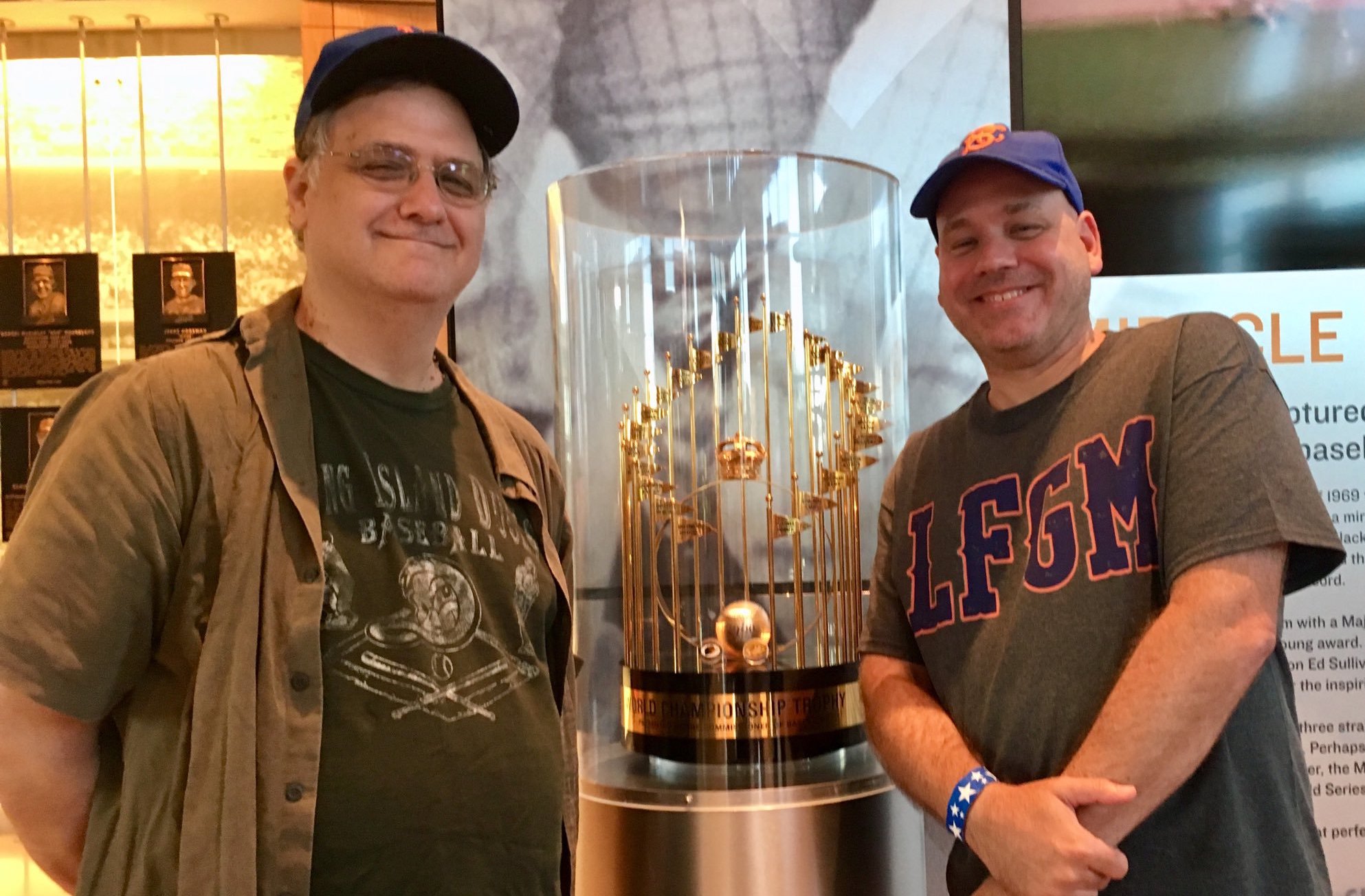
Faith and Fear in Flushing made its debut on Feb. 16, 2005, the brainchild of two longtime friends and lifelong Met fans.
Greg Prince discovered the Mets when he was 6, during the magical summer of 1969. He is a Long Island-based writer, editor and communications consultant. Contact him here.
Jason Fry is a Brooklyn writer whose first memories include his mom leaping up and down cheering for Rusty Staub. Check out his other writing here.
Got something to say? Leave a comment, or email us at faithandfear@gmail.com. (Sorry, but we have no interest in ads, sponsored content or guest posts.)
Need our RSS feed? It's here.
Visit our Facebook page, or drop by the personal pages for Greg and Jason.
Or follow us on Twitter: Here's Greg, and here's Jason.
|
by Jason Fry on 21 April 2014 12:34 am Curtis Granderson isn’t having fun so far.
There’s the .127 batting average, the $60 million contract, and even the defense — what, exactly, that throw in the nightmarish top of the fifth was is a question best not pondered. Granderson is by all accounts a peach of a guy, but he’s been hearing boos from fans who have a growing sense of dread that he’s a rather well-disguised Jason Bay.
Of course, Granderson has plenty of company. The Mets’ .227 team batting average is 28th in baseball. Their .301 OBP is 25th. Their .636 OPS is 29th. They’ve hit 12 home runs, good for a three-way tie for 25th. They’re on their third closer of the season, and that closer is Kyle Farnsworth. They can’t win at home. Their fans are fed up with trying to figure out what the payroll is going to be, and with waiting for endlessly promised better days, and most of all with bad baseball.
And yet, somehow, the Mets are 9-9. David Wright is hitting, the first-base conundrum hasn’t been solved but at least has been decided, the starting pitching’s pretty good even with Matt Harvey attending public events in disguise to avoid the wrath of talk-radio trolls, and the aforementioned Kyle Farnsworth pitched just fine today, as did fellow former stars Daisuke Matsuzaka and even Jose Valverde, Ol’ Gopher Ball himself.
The Mets even withstood the might of Freddie Freeman, the man who makes Chipper Jones look like an eighth-place hitter. Scott Rice arrived in the seventh with the game tied and Braves on first and third. I was trying to figure out how Freeman’s blast would count for six runs, but before I could even frame a doomed tweet Rice had delivered the only pitch he’d throw. Freeman rolled it to Daniel Murphy, who fed it to Omar Quintanilla, who fired it to Lucas Duda, and all was well.
Wait, what?
The Mets seem like the worst 9-9 team in the universe primarily because we’re Mets fans and we’ve had enough. But it’s also that they’ve gagged up some games in atrocious ways — such as watching a promising start undone by a lone inning of spastic defense (Zack Wheeler‘s implosion could have been modeled after Bartolo Colon‘s the previous day), then having bullpen horrors shred a plucky comeback. Games like that make your shoulders sag, as a fan and probably as a player as well.
But the bullpen horrors didn’t come today. The pen held the line long enough for the bats to piece something together. Granderson didn’t hit a cannonball of a homer that blasted open a bank vault of pre-Madoff money; he hit a lazy fly ball that was just deep enough given that Kirk Nieuwenhuis was just fast enough. Either way, it was enough.
And hey, if you were a Braves fan, by then you’d had enough. Dan Uggla played second base this series like a guy you should spoon-feed to keep him from hurting himself with utensils, and Justin Upton sometimes seems like he’d rather be doing anything than playing baseball. Even at 12-6, the Braves have issues of their own.
So the Mets won. It may not feel like it, but they won … just as they’ve done as often as they’ve lost, though it doesn’t feel like that either. I don’t know what to make of Granderson, or Colon, or Wheeler, or Travis d’Arnaud, or Chris Young, or any of the guys we’re counting on for better days. But perhaps that’s because they’ve played 18 games over less than a month. Of course we don’t know anything yet. Ask again on June 1. In the meantime, well, we played a baseball game today and somehow eventually we won. And ain’t that grand? Or at least grand enough?
by Greg Prince on 20 April 2014 2:02 am They gave us quality-mounted canvas prints of a photo taken at the first game Shea Stadium ever hosted. It’s the reason I snapped up tickets in January, the reason I schlepped my stubborn cold and a hundred or so tissues to Citi Field Saturday night. I wanted the Mets to remind me of Shea.
Oh, they did, all right. They reminded me of all those nights that melded sloppy baseball, listless baseball and idiotic baseball and how, within the span of a few innings, they would turn all of it into unreasonably hopeful baseball, only to surrender just enough additional runs to ultimately put the game an inch out of reach once they mounted a final and furious comeback that was equal parts valiant and futile.
I was at Saturday night’s game at Citi Field plenty of times at Shea. The names of the villainous visitors and the non-heroic homestanders change as surely as the facilities did between 2008 and 2009, but the story arc remains the same. Everything that can go wrong begs to go right, but the pleas fall on deaf ears. A win lurks inside a loss but is too shy to come out to play. Some reliever makes life a little more difficult than it has to be. And when things begin to get exciting, the contest is brought to a numbing halt because the Mets have run out of outs and left all their chances on base.
Call it an opportunitease. Bad calls, bad throws, bad swings, bad slumps, badly miscast personnel, yet a good chance to pull it out. If only a long fly would have flown a little longer. If only a ball in the hole had carved itself a little more leeway. If only situations that were made for replay review were permitted to be replayed for review. If only, if only, if only.
The Mets lose by two to the Braves but outhit them instead of losing by five and garnering just one hit. They make it interesting the way my cold or whatever it is makes my bronchial passages interesting. They make the masses who upped and left when a Valverde meatball Upton left over the center field fence seem brutally misguided in their priorities. You’re hanging in there. You’re coughing your head off and blowing your nose to Kingman come, yet you’re helping Tim Teufel wave a carousel’s worth of runners around the bases in the bottom of the ninth, undeterred by your quiet observation that the Mets have been batting for 20 minutes and battering Craig Kimbrel but somehow still trail by two.
And they lose by two. But they made it interesting. You hoped more in the eighth and ninth than you dared believe you would from the first through the seventh. You take that and your print and the remnants of your tissue supply and you go home.
You always returned to Shea Stadium. You’ll return to Citi Field, too. You can put it on canvas and mount it.
by Greg Prince on 19 April 2014 2:54 am He was a Met — maybe he didn’t perform to the standards we set for him or to our satisfaction of what we decided he could be, but he was one of ours. He went out there and he did his best. Then one day he was gone and we could only imagine the damage he’d do for his new team and the regret he’d cause his old team.
But enough about Aaron Harang.
Harang (3-1, 0.70) threw seven no-hit innings Friday night before Fredi Gonzalez decided a complete game no-hitter against these Mets in their home ballpark probably wasn’t going to be worth the trouble of running up the pitch count of the best starter in the National League. Luis Avilan gave up a hit in the eighth but no runs. Jordan Walden gave up nothing, which is what the Mets scored in their 6-0 loss that was — thanks to Jonathon Niese’s six solid frames — closer than the score indicates for a while, though what that counts for, I’m not sure.
You’re excused for not remembering Aaron Harang (7 IP 0 H 6 BB 0 R) was a Met. He pitched in that segment of 2013 when you probably weren’t watching: four starts at its ass end, none of them totally embarrassing, each of them reasonably effective. To use the blanket description that fits every Met September over the past half-decade, you didn’t miss much. For the also-ran Mets late last year, he was a rotation temp.
For the first-place Braves early this year, he’s basically the ace. But like I said, enough about Aaron Harang, who was never in anybody’s plans for 2014, not even the Braves’. Friday night’s ex-Met in the spotlight was supposed to be Ike Davis.
Davis was supposed to be an ex-Met long before Friday, but between calculating imposing offensive metrics and diligently upgrading the shortstop situation from Ruben Tejada and Omar Quintanilla to Ruben Tejada and Omar Quintaniila, the Met front office was too busy to sort through its glut of first basemen and thus carried into the season two lefthanded starters at the position. Given that the Ike half of the glut launched a game-winning grand slam the day after the Lucas Duda half blasted a pair of homers himself, it didn’t really hurt anybody to have them both around for a couple of weeks, but it couldn’t go on like that forever.
It didn’t, which is why Ike Davis was finally sent packing, to Pittsburgh, in exchange for a Triple-A righty reliever of little advance renown named Zack Thornton and that player whose name has yet to arrive, but is said to be a more exciting get than Zack Thornton.
Ike Davis, Pittsburgh Pirate, will become Willie Stargell in about ten minutes, you’ve likely determined. Maybe. Probably not. He’s still Ike Davis who’s been searching for his swing, his comfort zone, his batting eye, his eye of the tiger and now his eyepatch (aarrgghh!!). In the midst of his obligatory remarks about being alternately saddened and gladdened by the turn of transactional events, I heard Ike say he’s been feeling “a lot better in the box”. You know which hitters are feeling a lot better in the box? Hitters like Ike who are hitting .208. Hitters who are hitting a lot better in the box are able to have their hitting speak for itself. And they’re not traded three weeks into the season.
Continuing exposure to his groping for answers over the past two seasons convinced me it was never going to come together again for Ike Davis as a New York Met. I came to that conclusion last summer, so I can’t say going Ikeless will be a hardship for the .500 Mets (yes, the team that was one-hit Friday night hasn’t lost any more than it’s won; hard to believe, I know). The Davis powerburst of the second half of 2012 seemed like an illusion when it was in progress and there was nothing of substance to be mined from 2013. But in the scheme of what might have been or could have been or should have been, the trade is an emotional blow.
Ike was the homegrown slugging first baseman who did everything right from the moment he was given the chance, and from that small sample size, we dreamed. We dreamed this guy was the next step — or maybe the first step — in the necessary rebuilding of our team. It was gonna be, left to right around the horn, Wright, Reyes, Tejada, Davis. He was free and easy at the plate and in his manner. He fell over railings and came up with catches. He was in the middle of every Citi Field celebration back when the Mets used to win home games by the bushel. He brushed up against cocky, especially for a rookie, but that was all right, I thought. It was refreshing. The players who have “swagger” don’t have to talk about it. Ike, I was sure, had it.
Whatever he has left after parts of five seasons as a Met, it wasn’t enough anymore. He may have started up, but unlike the rest of the refrain from his stubbornly unchanging walkup music, he sure as hell stopped. Some of it was no doubt physical. Some of it was likely mental. All of it was a shame given the menschy aura he exuded whether he was hitting them far or not at all. That’s too bad in terms of the dreams we dreamed, but it’s the way it goes in reality.
Now first base is Duda territory, which may mean a player with a genuine talent for generating line drives will finally settle in and produce consistently. Or it may mean the man with the Mona Lucas smile will struggle because, let’s face it, Duda hasn’t proven all that much across parts of his five seasons as a Met. I guess the only thing Lucas Duda proved to those who decide such matters was he was a less worse bet than Ike Davis.
by Greg Prince on 17 April 2014 2:22 pm In honor of the 50th anniversary of the opening of Shea Stadium, I thought I’d reprint my post from April 17, 1964, in case you missed it the first time around.
Well, you can’t say it isn’t big. Or bright. They said it would be both and it surely is.
I’m just not sure it feels like home yet.
Listen, we’ve all known this place has been coming for more than two years, but that doesn’t make Shea Stadium any less shocking upon entering it for the first time. It’s not just the structure, which is so obviously different from our beloved Polo Grounds. It’s the location. Now when I want to go to a game, I have to go to Queens.
Queens? Who goes to Queens? Unless you’re catching a flight, who makes Queens their destination? The Beatles came to Queens in February, but it’s not like they hung around. They vamoosed to Manhattan, just like we used to. The World’s Fair is in Queens (and won’t we know it from the traffic?), but that’s temporary. Soon enough, the “World” will move on, but the Mets will still be there.
In Flushing. Now that I’m compelled to stare at it, that’s not exactly the most enticing-sounding of locales. Of course “sound” is all relevant when you take into account all those planes heading into and out of neighboring LaGuardia. Yup, a lot of people are still catching flights in Queens and you’ll hear all about it, especially when you’re sitting in the top section of the stadium as I was. You can hear the planes. You can hear the trains. You can hear the organ, which is pretty nice, actually. And if you squint real hard, you can see Casey Stengel.
Wake up, Case. We’ve got a new stadium.
Shea (can we just call it that for short?) is more dazzling than comforting, though I suppose familiarity will come with time. True to the propaganda, I wasn’t stuck behind a post. I was stuck in front of some idiot taunting Ed Bauta, “Hey, BAUTA, you shouldn’ta BOUGHT A house! Just rent!” Clever the first time, not so much the twentieth time.
Hearing yourself think at Shea will be a challenge, but not as much as tuning out the occasional rotten apple. Goodness I hope that guy or his spiritual equivalent doesn’t happen every time I go to a game.
The game itself, you might have heard over WHN, was a Mets game, which is to say it was a Mets loss, no big surprise there. New plot of real estate, same plot in the standings. Three games into the season, still no wins. Ceremonial folderol notwithstanding (whose idea was that square Guy Lombardo?), the real christening was provided by Willie Stargell homering over the green fence in the second inning to put the Pirates out in front with the first run in the history of Shea Stadium. Stargell would probably hit a lot of home runs if he played half his games at Shea…except they wouldn’t let him face Jack Fisher, so never mind that. We did get a lead in the fifth — ignited by Ron Hunt; gosh, I love Ron Hunt — but could it last? Can anything last with this team?
Shea Stadium appears built to last. Like I said, it’s huge. You don’t plant something like that upon a meadow and expect it not to be there someday. They probably said something similar about the Polo Grounds, but progress said something different. Shea feels very progressive, though, like this is where we’re headed, if I can get sociological for a minute. That big globe at the World’s Fair, this big stadium with its space-age scoreboard, those enormous blue and orange speckles on the side and all the stuff that just shouts “NOW!” There’s an unfinishedness to it all, but that’s all right. There’s an unfinishedness to our civilization (unless Barry Goldwater finishes us all off). There’s certainly an unfinishedness to our ballclub.
There’s gotta be. There’s gotta be more to the Mets than what we’ve seen through two years plus three games. We do have Hunt. We do have Hickman, who I think is gonna come around one of these years. Kranepool pinch-hit (hard to remember he’s not even twenty yet). Gonder is up to .444 and Fisher is only 25, which isn’t really that old. Jerk behind me had a point about Bauta’s housing plans (gave up five hits in two-and-a-third for the loss), but there’s supposed to be some real talent somewhere in this system.
Then again, that’s what they’ve been telling us since 1962. Considering they’re charging an outrageous $3.50 for box seats, it would be nice if the talk could turn into action by, I don’t know, the end of this decade maybe? I don’t mean to be an impatient New Yorker, but I’m an impatient New Yorker. If they can build a stadium inside of three years, even accounting for construction delays, why can’t they build the Mets into something sooner?
Sorry, I shouldn’t be so cynical on the day we were presented with this new and impressive ballpark. To be fair (if not worldly), I can see virtually the entire field at Shea but I can’t see the future. Still, think how much bigger and brighter it would look if we could win a few games. Or one.
At least the escalators work, the staff is unfailingly friendly and the men’s rooms are clean and efficient. If that’s not progress, I don’t know what is.
by Jason Fry on 16 April 2014 10:02 pm “A diamondback without venom is a belt.”
Points to our pal Metstradamus for the line of the series and an unsparingly accurate take on the National League’s Arizona franchise.
As a lifelong Mets fan, I’m well acquainted with terrible baseball, and the Diamondbacks are supplying it by the truckload right now. I’ve been listening to Howie and Josh via MLB At Bat, as I’m doing school visits in Louisiana for Jupiter Pirates, and each night they’ve sounded both more pitying and more disgusted. I’ve supplemented Howie and Josh with peeks at footage of temporarily gravel-voiced Gary and the happily returned Keith, who’s the perfect person for chronicling misdeeds at the major-league level.
But I don’t need a TV to know what this kind of baseball looks like. I know Kirk Gibson is staring out at the field with rage churning under his carefully blank expression, just like I know players are plodding off the field, remaining prone for an extra few defeated seconds, and staring into the bowls of their no-longer-needed batting helmets. I know because I remember it from the Joe Torre era, and the George Bamberger era, and the Dallas Green era, and the….
Games like these are rarities to be savored — free passes in the hard slog of a long season. (And even more to be savored when they come on a tough West Coast swing, of which the Mets have approximately a dozen this year.) Even at 2-0 this game didn’t feel particularly close, and Jose Valverde‘s throwing BP to Aaron Hill and Paul Goldschmidt felt more like a long-term problem for the Mets than a short-term threat to a victory. That’s how bad the Diamondbacks are right now.
(By the way, I’m terrified that if Valverde’s struggles continue, our closer will be Kyle Farnsworth. If you’re thinking that’s insane, I’m not going to argue — it should be Gonzalez Germen. But remember that Farnsworth is a Proven Veteran (TM), which I fear in TerryLand means he’ll get every chance to be bad.)
But back to the D’backs and their string of d’bacles. You know what? Too bad for them. I’ve watched the Mets get so thoroughly lost that another win seemed impossible. Nobody took pity on them — they just beat them, as they should have. Moral victories count for nothing — they’re defeats. Amoral victories — beating up on an essentially defenseless opponent — don’t come with a discount. They’re wins, plain and simple. You take them whenever you can, without apology.
By the way, if you haven’t seen this, it’s so so so great. Enjoy.
by Greg Prince on 16 April 2014 1:23 am Definitely a blowout. Something like a laugher. Never in doubt.
The Mets scored three runs before Bronson Arroyo threw 15 pitches. Then I drifted off under the influence of Coricidin Cough & Cold. When I woke up, the Mets were ahead, I think, 7-0. I missed four runs? I guess I could’ve been sore (and achy) that the Mets were clobbering an opponent without me hanging on every delicious swing, but if I was going to be sick anyway, and I needed to wake up to a score of some sort, Mets 7 Diamondbacks 0 represented quite the remedy.
And then, so I wouldn’t feel entirely left out, they put up a couple more runs. Ya can’t go wrong with 9-0. Well, you can brace for bad news from Jenrry Mejia’s blister and snarl through Kirk Gibson and Oliver Perez flashbacks, but only lightly. You gotta enjoy these romps through the desert when they come around.
The return of Kirk Nieuwenhuis brought with it predictable results: three hits, three RBIs, a two-run homer, some fancy catches in center as well. Did I predict Kirk would lay out a box score line as long as his last name? Let’s just say I had a sense he’d reintroduce himself with authority. He has a Don Draper thing going vis-à-vis what Dr. Faye Miller said to him in Season Four’s finale when he broke up with her to marry Megan: Kirk mostly likes beginnings of things. He comes up without fanfare, he conducts a symphony of power and defense in the face of initial indifference, he ascends to People’s Choice territory, yet he usually exits the stage sotto voce.
But he had superb stage presence Tuesday night. With Juan Lagares sadly unavailable, Nieuwenhuis spelled relief. And on the date everybody wore 42, you wondered for a while if the Mets would total at least half that many runs. They backed off after four innings, which Jackie Robinson probably wouldn’t have approved of, but these aren’t the Boys of Summer. They’re the .500 Mets, the statistical epitome of not half bad.
Which in itself is not half bad…or a whole lot better than I’m feeling with this cough & cold.
by Greg Prince on 15 April 2014 10:02 am On a night when I felt like Gary Cohen sounded and the Diamondbacks played, the Mets overcame the most miserable Monday malady imaginable: the loss of two outfielders, one of whom is very good and the other of whom presumably sooner or later will be.
They persevered to a 7-3 victory, thanks to Zack Wheeler holding it together for six-and-a-third (losing his grip only when I stupidly thought to myself, “He’s gonna get through seven easy…”); Carlos Torres clearly begging Terry Collins to overuse him (it’s April, he can handle it); and Lucas Duda producing the way we wish to believe he could if he was just left alone to hit and not think. It helped that Arizona’s currently playing with its diamonds up its backs, but it takes two to tango. The Mets are entitled to top a lesser-performing opponent. It’s just that it’s been a while since we’ve definitively encountered one.
Gary’s voice, nursed through nine by hot tea and Keith Hernandez’s surprise appearance in the booth to pick up the promotional slack, announced a satisfying result. He said he felt fine except for trouble from a throat that works more innings than Torres and Scott Rice combined. Me, I felt (feel) buggy all over but couldn’t (can’t) tell you what was (is) wrong with me — none of which has shown up in the box score, best as I can tell — but I was happy to make it awake to the last out and then immediately fall into my own postgame show of the subconscious. Usually I hang on every dispatch from the manager’s office, but I figured I’d wake up this morning and find out if, like Old Glory, the franchise was still there.
It is, but it has an outfield problem, and not the outfield problem that was taking shape before Monday’s game. That was when Terry was declaring that two Young men would be sharing time with Juan Lagares as soon as Chris came back. It wasn’t a surprising decree, just a silly one, given that Juan Lagares has been the Mets’ best outfielder, while their best-compensated outfielder, Curtis Granderson, hadn’t really done anything in his admittedly brief National League tenure to earn unquestioned playing time in the land of the shoehorned.
How ever would the Mets figure out the best solution to this ordeal of having too many at least partly deserving starting outfield candidates but only the regulation number of starting outfield slots?
Well, go worry about what you’ll do if you hit the Mega Millions instead, because the Great Met Outfield Glut of 2014 conveniently depleted itself in Phoenix. There was Granderson running into the part of the wall that can hurt a fella in three places — wrist, rib cage, knee — and there was Lagares furtively grabbing at a hamstring, and there went two of our three pre-Chris Young starting outfielders, and out to left for a return engagement nobody booked went smokin’ Lucas Duda, toting his ashtray of a glove, the kind of curio you really don’t expect to put out for company these days.
Granderson probably gets a breather to wonder why he’s not hitting whatsoever and how it is when he finally knocks in a run (going the other way against a shift) he has to leave the game. Lagares seems destined for the DL, which is wise with a hamstring and sad when he was generating the most fun a Mets fan could see this side of a Matt Harvey rehab update. EYJ, whose speed has convinced nobody he’s much of a leadoff or any other spot hitter, maintains his role for now. Meanwhile, the other Young will soon get a chance to restart his season and reignite his career without being seen as the goon who snatched playing time from Our Beloved Juan.
Also, Kirk Nieuwenhuis probably gets called up in the short term. Two years ago around now we were Nieuwenhuead over Nieuwenhueels for this otherwise forgotten sixth or seventh outfielder, which makes for a healthy reminder that nobody’s forever a savior or eternally a lummox in these situations. Duda went 4-for-5 last night and erred not at all between his stints at first and in left. Expectations that the distant precincts of Chase Field would open up and swallow him whole proved unwarranted.
Yet again, Chuck Berry provides the most accurate forecast in town when it comes to baseball: It goes to show you never can tell.
by Greg Prince on 13 April 2014 9:10 pm They hit ’em out of Anaheim. They hit ’em into Los Angeles. They hit ’em until geographic borders were obliterated.
They scored 14 times. They were Ram-tough in Orange County as if they still had a team there that takes the field in blue and yellow. It was such a thorough thumping of New Yorkers that I’m pretty sure I saw Flipper Anderson trot into a tunnel.
They left the visitors part grumbly, part speechless. A substitute umpire named Toby Basner created a strike zone that was more impressionistic than actual. Two visiting victims were ejected for noticing, or as many who crossed the same home plate whose width seemed to baffle Basner.
They treated the starter like a piñata. Oh, the offensive treats that spilled out of him as soon as they began whacking him around! And the bullpen produced no less in the way of delicious offensive goodies for the home team’s bake sale.
The manager said, “We got through it.” The captain said something about knowing you’re going to get no more than a minimum of runs. It was certainly said as a compliment to the home team’s pitcher, but it was also quite accurate in hindsight. The visitors understood in advance they’d score maybe twice. Given how many arms it took to push through 23 innings over the previous two evenings, it wasn’t surprising the staff would surrender seven times as many tallies as were generated on its behalf.
Add it up, and it was Sunday carnage. I suppose it was embarrassment, too, but it felt suspiciously routine, or no worse than routine gone awry. Sometimes these Mets win. A little more often they lose. This time they lost by a margin of 14-2.
You tell yourself it’s just one game. A defeat by a dozen isn’t materially different from a loss by a lot less. It’s still a loss. The Mets were pounded but it only counts against them once.
Yet another moral victory is secured.
by Greg Prince on 13 April 2014 8:19 am My deepest apologies to anybody who wanted and expected to turn in no later than midnight Saturday after a calmly resolved 6-3 Mets win over the Angels, one saved without incident by Jose Valverde. Don’t blame Valverde for the three-batter sequence that commenced with two out and nobody on in the bottom of the ninth, the one that ensured a much longer night awaited. Jose was probably on his way to a very simple save and you were on your way to a welcoming bed. The only thing that could have gotten in the way was my thinking this thing was over.
Oh no. No. Never think that. Never mind never say that and never Tweet anything suggesting it.
You’d think I’d have relearned this eternal lesson on Opening Day when I dared to stand with two out in the bottom of the ninth, the Mets ahead, 5-4, and Bobby Parnell the pitcher in whom I’d invested qualified episodic confidence. I stood, I grabbed my stuff and I dared to think not just “this will be over in a minute,” but began to sort through my reactions to other presumed reactions to the impending victory, such as, “Gads, am I going to have to hear about how great Bobby Parnell, who obviously isn’t throwing as hard as he did year, is after just one save?”
Very soon I was relieved of that burden. There was no save and there’s been no more Parnell. He was shortly thereafter provisionally replaced by the veteran Valverde for those few/far-between situations calling for a Met closer. Provisional, however, was beginning to feel permanent — or as permanent as a closer of 36 years and diminishing reputation could feel — when Jose emerged unscored upon in his first five outings as a Met. And on Saturday, in the otherwise unmapped Anaheim section of Los Angeles, given how the Mets had already overcome a two-run deficit and the vengeful specter of Collin Cowgill, it didn’t seem out of line to think Valverde would gently tuck in a three-run lead, especially once he got ahead of David Freese one-and-two and needed only one more strike to wish us and the Angels sweet dreams.
I apologize for thinking it was as simple as a third strike and resulting third out right there. I neglected to take into account the doom factor I had unleashed. You won’t find “doom factor” on the back of your baseball cards or among your more advanced statistics. No metric properly reflects that when I begin to think a Met closer is certain to escape a danger-fraught scenario with ease, that same Met closer inevitably implodes. It happened to Bobby Parnell on Opening Day. It’s been happening with alarming regularity since at least Skip Lockwood in the mid-1970s.
Somehow I missed the alarms.
It happened to Jose Valverde Saturday night at Angel Stadium, where David Freese singled instead of making an out and ending the game. True, all Valverde had to do after not retiring Freese was take care of Erick Aybar, but already I sensed karma was issuing me a bill for daring to contemplate not only how Valverde off the scrap heap seemed a better bet to save games in 2014 than post-neck, pre-elbow Parnell, but for having been perversely glad the Mets didn’t extend their advantage beyond three runs in the top of the ninth. This way, I cleverly reasoned, Valverde will focus. Give a closer of his caliber a three-run lead, and he concentrates. Give him too many runs with which to work, his mind will perilously wander.
Yeah, that was an insipid insight. The Mets should have scored more than two when — bases loaded, one out — they had the chance to pad their newly wrought three-run lead. But that seemed almost greedy. They had overcome a 3-1 deficit in the seventh, thanks to all kinds of small encouragements, most notably Jon Niese’s grinding endurance and Anthony Recker’s glamorous aura. They had leapt from 4-3 to 6-3 on an Omar Quintanilla two-RBI single, for goodness sake. Omar Quintanilla played 66 games between July 3 and the end of the season in 2013 and knocked in all of nine runs; on only one of those occasions did he drive in as many as two on one swing.
We got Omar Quintanilla to do something he’s utterly incapable of and then didn’t build upon it. Of course karma’s going to add that to our tab. Of course when we go to the bottom of the ninth up, 6-3, instead of, say, 8-3, Valverde recording the first two outs is going to guarantee nothing. Of course getting ahead of Freese didn’t mean Freese wasn’t going to line a single up the middle to give the Angels life. Of course Aybar, who had two hits the night before and was surely a Brave in a previous life, was going to walk.
And of course ex-Phillie, ex-Yankee and only active major league non-pitcher actuarially entitled to call Bartolo Colon “kid” Raul Ibañez socked the three-run homer that tied the score at six and sent the game into a tenth and eventually thirteenth inning, a frame that didn’t conclude until after two o’clock Eastern time Sunday morning. That Anthony Recker used the overtime period to grow even handsomer and belt what revealed itself to be the winning home run — and that John Lannan at last earned the spot he’d been soaking up on the roster by pitching flawlessly in the twelfth and thirteenth — is gratifying yet immaterial where my irresponsibility is concerned. The Mets could have won in nine had I not thought this thing was in the bag.
This thing is never in the bag until the zipper is pulled completely shut, the clasps are securely fastened and the Met closer of record has actually closed the deal. After all these decades and all these Met closers, you’d think I’d have figured that out by now.
by Jason Fry on 12 April 2014 3:09 am Can we talk about the Angels?
I’ll grant you that the entire AL West is essentially uncharted on my personal baseball map, but the Angels are the true terra incognita. This shouldn’t be — the Angels are essentially us, a mere year older thanks to the AL pushing to the head of the expansion line. But they must rival the Padres and Rangers for most years without a real identity, having cycled endlessly and fruitlessly through uniforms, logos and even names until recently, when they stopped after achieving a subtly amazing level of focus-grouped anonymity. Today’s Angels look like the Cardinals wearing spring training uniforms, and the franchise name might be the worst in all sports — “Los Angeles Angels of Anaheim” is a bizarre formulation that no commissioner worthy of the position would have ever allowed. It’s equal parts deeply cynical and laughably spineless, a blunderbuss of quarter-assed marketing that once ducked leaves you embarrassed for all involved, yourself included.
To be clear, I have nothing against Angels fans or the guys wearing their thoroughly unmemorable uniforms. The Angels are practically our brothers, I sympathize with the second team in town thing, and their park is no classic but tries hard — it’s gleefully overstuffed with Angeliana in a way I wish the Citi Field braintrust would copy. And hey, any sporting event that lets you watch Mike Trout do what he does is worth the price of admission. But for all our inglorious and fitfully embarrassing history, the Mets have at least avoided spastic branding reboots — the shade of blue has wandered, the script briefly sprouted a tail and black jerseys ruled the land for a while, but a New Breed fan transported from 1962 to any other year in Mets history would immediately know what team she was rooting for. The Angels are in their fifth decade as a spastic branding reboot.
Which was honestly kind of perfect for the start of a strangely early West Coast swing, with the first game of course rumbling into extra innings and the New York night.
There are extra-inning games that keep you engaged, trying desperately to outguess the baseball gods but feeling certain that somehow you’re going to win. There are extra-inning games where you keep waiting for the snick of the guillotine and wondering why you haven’t heard it yet. And there are extra-inning games that turn into a sort of baseball Eastern Front, where eventually all you want is for it to be over.
This one was somewhere between the second and the third case — though before things got weird there was a rather entertaining and more or less conventional baseball game to watch. Josh Satin got the start at first and delivered a two-run double, making me wonder if Terry Collins will soon declare that Lucas Duda is the starting first baseman, Ike Davis is the regular first baseman and Satin is the everyday first baseman. (After which he’ll look faintly amazed that the beat writers need this explained.) Travis d’Arnaud cracked his first home run of the season, and while Dillon Gee was so-so, the Mets’ bullpen was surprisingly capable, as it has been for a week or so. (When will we stop being surprised? I dunno. Maybe July.)
Plus you got the spectacle of Scott Boras in his suite behind home plate, like the Banquo’s Ghost of Embarrassingly Low Payrolls. Boras, I noticed, observed each of Ruben Tejada‘s at-bats standing, so the center field camera got a group shot of Tejada, Angels catcher Chris Iannetta/Hank Conger, spatially challenged umpire Manny Gonzalez and Boras. I swear to God Boras was doing that deliberately, perhaps in the hope that one of the New York tabloids would use a screen grab for a front page after some Tejada-related disaster. It was a little bit funny and a little bit irritating, and what I really wanted was for SNY to pixelate him, like in Japanese porn.
With the game becoming a stalemate, I kept waiting for Trout to beat us — and winding up startled when it didn’t happen. Carlos Torres struck him out with two on and two out in the sixth. Kyle Farnsworth rather wisely walked him with two on and two out in the eighth. And then Jeurys Familia gave up a two-out single to him in the 11th, but it wasn’t fatal.
My second thought was that Albert Pujols would beat us — Pujols who’s been through a lot in Los Angeles or Anaheim or whatever municipality is being catered to at the time, but to me remains a name to conjures terror and despair. But that didn’t happen either. Farnsworth got him to ground out to David Wright with the bases loaded and Familia retired him with two on. Sorry, Albert.
(By the way, what would you have said a few years back if I told you there’d soon be a baseball player whom you’d be glad to see walked so a retread reliever could pitch to Albert Freaking Pujols?)
Anyway, Trout didn’t land the fatal blow and neither did Pujols and it was the 11th and the Mets had to load the bases with one out and so of course Familia hits Conger with a 2-2 pitch, shades of Daryl Boston winding up with a ball in his shirt. Not what I saw coming, but you generally don’t see it coming in affairs like this one. They just end, with a mutter and a shrug in the middle of the night.
|
|