The blog for Mets fans
who like to read
ABOUT US
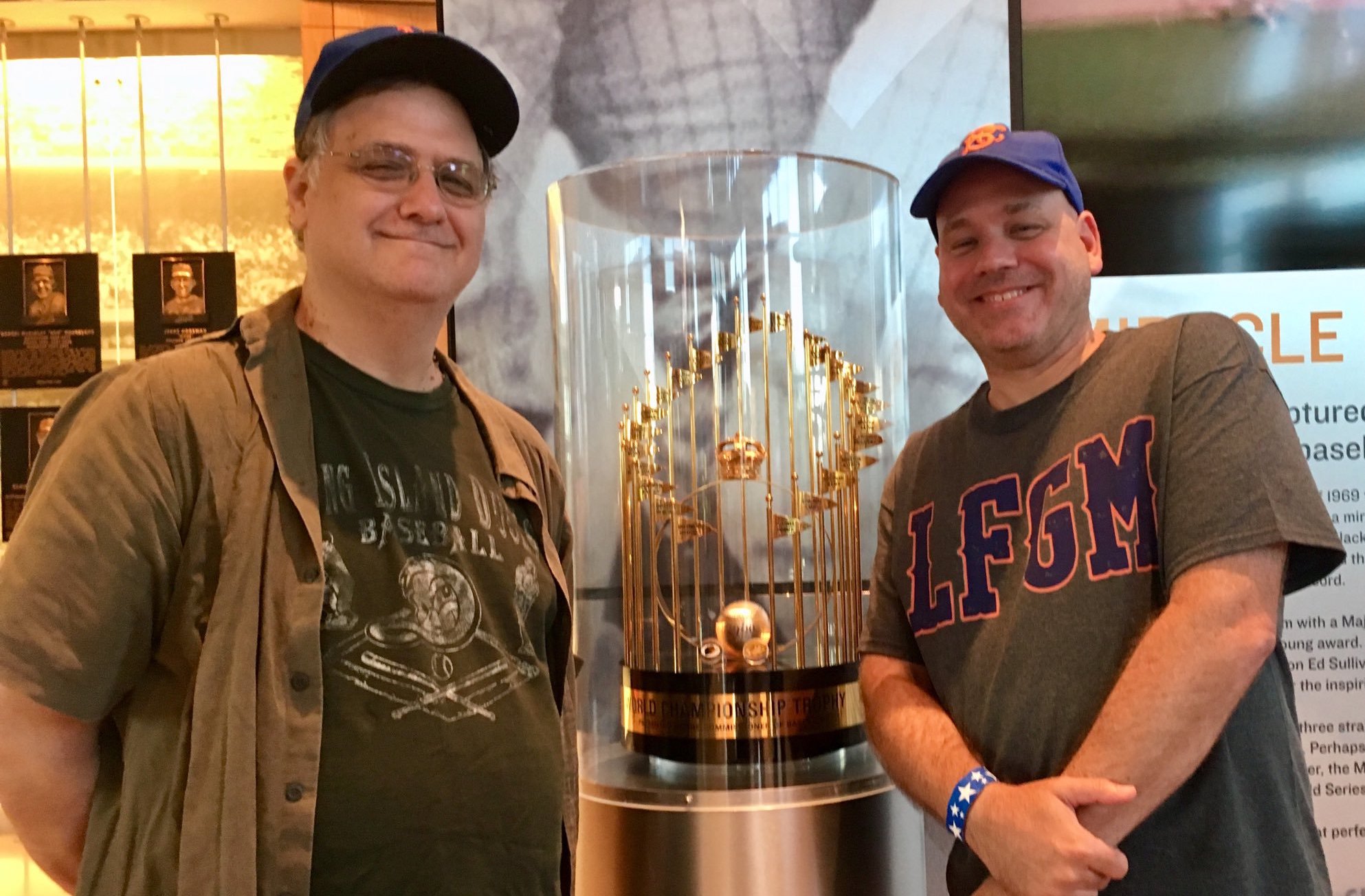
Faith and Fear in Flushing made its debut on Feb. 16, 2005, the brainchild of two longtime friends and lifelong Met fans.
Greg Prince discovered the Mets when he was 6, during the magical summer of 1969. He is a Long Island-based writer, editor and communications consultant. Contact him here.
Jason Fry is a Brooklyn writer whose first memories include his mom leaping up and down cheering for Rusty Staub. Check out his other writing here.
Got something to say? Leave a comment, or email us at faithandfear@gmail.com. (Sorry, but we have no interest in ads, sponsored content or guest posts.)
Need our RSS feed? It's here.
Visit our Facebook page, or drop by the personal pages for Greg and Jason.
Or follow us on Twitter: Here's Greg, and here's Jason.
|
by Greg Prince on 8 October 2013 11:30 am Just when I think one of the funnest days of non-Mets baseball ever couldn’t get any more funner, I nod off in the eighth inning of the last reel of this rollicking quadruple-feature, the overly familiar Atlanta Braves leading the Los Angeles Dodgers by a run. I open my eyes maybe fifteen minutes later and the Los Angeles Dodgers are jumping all over one another, and probably not with Brian McCann’s approval. Hours later, by morning’s light, I tell Stephanie how the Dodgers won and how the Braves lost.
Without missing a beat, she lilts, “See ya, Braves!”
If that’s not the funnest way to cap off a daylong postseason festival, I don’t know what is. But I’ll check with McCann and wait for his ruling.
As recently as Saturday, I was drifting unmoored from the Mets, even the 2013 Mets, with whom, I assure you, I was quite done. Yet early Saturday I sat myself down on my couch, looked at the clock, and thought, “1:10 or 7:10?” But there was to be no :10 on Saturday. No Mets. No setting my ballological clock by their seventysomething wins and timeless hopes. Their season was over nearly a week, yet my insides hadn’t come to grips with it.
Now they seem a million miles away in both directions. The 2013 Mets belong permanently to the past, never to pop up with two out and a runner on first again. The 2014 Mets are nothing but unprovable theory until further notice, and I have a hunch the notices are a ways off. If it’s October, it’s not about the Mets.
Well, it’s always a little about the Mets. I wouldn’t find the Braves falling to earth with such a plodding thud so enjoyable if I didn’t retain some good, healthy Cublike enmity for them from when we were serious rivals. I’ve always thought we sucked the life out of them heading into the 1999 World Series by pushing them to something approaching the limit in that year’s NLCS (though the Mets never did receive royalty checks from the eventual world champions). I now believe the Braves have never, ever recovered from mustering all the strength it took to draw ball four from Kenny Rogers. They used to loom. They loomed in 2000 for our dreaded/anticipated playoff rematch until we got word at Shea, in advance of Game Three versus the Giants, that they’d been swept by St. Louis. A mocking Tomahawk chop ‘n’ chant went up.
How cheeky of us!
At some point Monday, while feasting intermittently on the four-game smorgasbord MLB laid out before me, I decided there was to be no mocking of any current playoff participant. They were all worthy competitors, none blessedly was the Yankees and each was where I’d very much like my team to be again before a mall stands on the site of Shea Stadium. That thought, however, occurred to me before Juan Uribe beat the Braves with an eighth-inning home run. If you can’t mock the Braves going down in their first playoff series of the year in the seventh consecutive year in which the Braves have been in the playoffs, then you’re just not extracting all the joy — Sheadenfreudic or otherwise — there is to watching baseball in this unfortunately Metless month.
I turned on my office TV a little after the start of the A’s-Tigers game, the third in the division series in which I had the least emotional capital invested. My relative lack of interest was appropriate, since the MLB Network telecast mysteriously came to me in Spanish. I checked my Panasonic and Optimum settings; they said I was loco and everything was as it was supposed to be. Nevertheless, the audio stayed in Spanish for innings on end. I shrugged and went back to my computer, now and again perking up at mentions of “Moneyball”; “Jim Leyland” and “Home Run Derby”. It’s easier than I would suspect to half-follow a baseball game in a second language. Eventually, I figured out how to bring back the English (I actually had to set my cable to “Español”) which was both too bad, because it exposed me to the inane American Matt Vasgersian, and great, because I could hear loud and clear the well-mic’d Grant Balfour and Victor Martinez inform each other of their respective shortcomings.
It was the long-awaited sequel to Bert Campaneris and Lerrin LaGrow, except with the pitcher and hitter on different sides and hostilities limited to verbiage. No bats or punches were thrown; only glares went awry. Balfour is apparently a piece of work and Martinez plays for a team that has suddenly forgotten how fearsome it can be. The A’s came out ahead in the end, which was fine with me, though I feel bad I can never conjure any genuine autumnal passion for the grand old Tigers, helmed by grand old Jim Leyland, representing a grand old city that could use a boost and is owed one after doing the lord’s work so effectively for two consecutive Octobers. Conversely, if it’s not October 1973, I tend to have a default setting that supports the Athletics, whoever happens to be on them in a given year. I’ve looked in on and listened in to three A’s playoff games in a row and probably still can’t identify half the roster. My problem, not Oakland’s.
By the time matters were settled, 6-3, at Comerica Park, Michael Wacha was deep into perfect-gaming the Pirates in Pittsburgh, which was both too bad for those of us wishing the Bucs all the best after two decades of them experiencing mostly the worst, and pretty darn impressive in that Michael Wacha has less big league experience than Zack Wheeler. But Wacha’s flirted with a no-hitter before, so maybe it wasn’t surprising that this rookie was completely suppressing an opponent in a do-or-die showcase. Wacha didn’t get the perfecto or the no-no, but he and his Cardinal comrades stayed alive, which is swell if you love Game Five drama in a short series, yet is too bad if you’d like the Cardinals to fly south for the winter. Unlike the Braves, they have a penchant for overstaying their welcome most Octobers.
Natch the one Cardinal I can’t root against is Carlos Beltran. The most I can ask of him is not to break too many Pirate hearts the next time he revises the postseason record book (I’ll bet “postseason” didn’t exist as a going phrase when Babe Ruth was belting 15 World Series home runs but doing absolutely nothing in the then-nonexistent preceding playoff rounds). Can’t not cheer for the greatest center fielder we ever had, however. Ideally, I thought early in the Pirate-Cardinal series, Carlos changes uniforms and joins Marlon Byrd on the Bucs. Then I decided that was only a temporary solution. Let us instead have Carlos, Marlon and 23 other really good, really likable players be Mets and cut out the middlemen.
But this isn’t about the Mets, remember?
Wacha’s 2-1 gem, with supporting jewelry provided by Charlie Morton, Pedro Alvarez and, most tellingly, Matt Holliday, took only 2:36 to craft, which allowed the baseball-gluttonous among us plenty of space to fill our bellies with the Rays and the Red Sox. Those guys required the same nine innings they used at PNC Park, yet somehow needed 4:19 to bring their affairs to resolution. If you were rooting for the Red Sox, it went on far too long. If you were rooting for the Rays as I am — USF’s surprise victory over Cincinnati the other night must have stirred my long-dormant inner Tampan — it went exactly as long as necessary, until Jose Lobaton could end it with a home run.
During the TBS telecast from Tropicana Field, the announcers kept insisting that due up in the bottom of the ninth were Ben Zobrist, Evan Longoria and the pitcher’s spot…that’s right, the pitcher’s spot, because so many moves were made and the Rays’ DH had come out and…oh, wait, Joe Maddon double-switched Lobaton into the game. That’s how obscure Jose Lobaton, imminent postseason hero, was before his swing for history. He had replaced Jose Molina a half-inning earlier and it wasn’t fully comprehended where he was batting.
Well, that’s been taken care of. Now Lobaton is up there with other catchers whose low profiles were irrevocably raised on their final swings in a given October game. Like Francisco Cabrera in 1992. Like Todd Pratt in 1999. Sort of like J.C. Martin in 1969, though Martin bunted to win Game Four of the World Series and reached first via clever baserunning. Gary Carter (for us) and Johnny Bench (against us) also had hits that ended tense postseason matches, but those fellas were fairly recognizable to the public at large already.
The Rays’ 5-4 victory ensured at least one more game in their ALDS, which — unless you’re going to be an actual Sox fan about it — is preferable to a sweep. Sweeps are boring if your team isn’t doing the sweeping. Double-elimination games, where somebody will be forced to go home, are the most enticing propositions for the unaligned. Thanks to Wacha, we knew we’d be getting that in St. Louis on Wednesday. Thanks in great part to Freddy Garcia, whom I’ve never forgiven for prickishly walking across the outfield while R.A. Dickey was preparing to pitch to Brett Gardner on July 3, 2011, it appeared we’d get a Game Five at Turner Field, too.
If I had my druthers, every starting pitcher would go nine and every ace would go on three days’ rest when his team absolutely, positively has to win, and that’s with knowing that the latter almost never really works. It worked with Johan Santana down the stretch in 2008 and it worked with Josh Beckett in 2003, but those were exceptions. The most famous example of the gamble not paying off, at least where we were concerned, was Yogi sending Seaver to the Coliseum mound when I wasn’t defaulting to the A’s 40 years ago. Tom had given his all on a Tuesday night but was back out there on a Saturday afternoon, pitching merely well when pitching fabulously was necessary. That was the George Stone business we still mutter about. If you caught George on with Gary, Keith and Ron during the final Saturday of the season — and I really hope you did — Stone came off as somebody who wasn’t bitter about Berra’s decision to bypass him in Oakland in 1973…but nevertheless maintained that he, not Tom, should’ve pitched Game Six.
If he had…well, never mind all that right now.
Someday, nobody will ask Ricky Nolasco about not taking what was supposed to be his turn with the 2013 Dodgers one game from clinching the LDS because Don Mattingly’s decision to start his ace of aces, Clayton Kershaw, on three days’ rest didn’t backfire. That is to say Kershaw started, was very good if not typically spectacular, and the Dodgers eventually won. Had Garcia’s efforts, which permitted the same two runs over the same six innings as Kershaw’s, gone suitably rewarded, then Mattingly would’ve faced a Game Five and not had his best pitcher available. That’s the drawback to my druthers.
But it all worked out in the end at Dodger Stadium. The Braves’ 3-2 lead transformed itself into a 4-3 loss while I dozed and Craig Kimbrel stood by not pitching. And though I have no affinity for the Dodgers, I was as giddy as could be through the fog of my 1 AM drowsiness. The Braves lost! HA! How can you not love that? Never mind the ancient Metsian brooding and think about their self-appointed roles as chiefs of MLB protocol in telling phenomenal Jose Fernandez and lovable Carlos Gomez what they were doing wrong after homering against Atlanta. If the 2013 Braves had played the 2001 Mets, they probably would’ve whined about wearing the first-responder caps so much that Bud Selig would’ve told them to cool it already.
The only downside of the Dodgers clinching in L.A. is they couldn’t continue their celebration by jumping into McCann’s swimming pool afterwards. Then again, they’ve got a couple of days before their next game and probably plenty of frequent flyer mileage.
The Braves’ next game is March 31, same day as ours.
by Greg Prince on 7 October 2013 9:23 am Forty years ago today, the Eastern Division champion Mets were visiting Cincinnati, down one game to none to the Western Division champion Reds in the National League Championship Series…and they were about to post one of the 500 most Amazin’ wins of their first 50 years.
From The Happiest Recap (First Base: 1962-1973)…
***
Jon Matlack took on and took out the core of the Reds lineup. Batting first through fourth, Pete Rose, Joe Morgan, Tony Perez and Johnny Bench went a collective 0-for-16 against the lefty. The only hitter to do anything — anything — versus Matlack was journeyman outfielder Andy Kosco, who started in right and collected a pair of singles. Jon’s ledger was nearly spotless, resulting in a line of two hits, three walks and nine strikeouts. Only in the fifth did the Reds mount a semblance of a threat, when shortstop Darrel Chaney drew a base on balls to push Kosco, who had also walked, to second. Sparky Anderson, true to his Captain Hook reputation, pinch-hit for his starting pitcher, Don Gullett, but Phil Gagliano struck out.
Gullett had given up only a fourth-inning homer to one of the redder Mets, Le Grand Orange Rusty Staub. He and Clay Carroll, who took over in the sixth, combined to keep the game at 1-0 until the top of the ninth when Cleon Jones, Jerry Grote and Bud Harrelson all delivered run-scoring singles, giving Matlack ample breathing room to complete his gem. When he flied out Morgan and Perez and struck out Bench, the Mets put a deceptively easy 5-0 win in the books and tied the series at one.
The Ohio portion of the NLCS was over. The teams headed east, to Shea. There the alleged machine that won 99 games and the hot hands whose 82 victories landed them a flukish division flag would start all over, best-of-three, to determine the identity of the 1973 league champion.
***
What happened next?
You’ll find out when you read The Happiest Recap (First Base: 1962-1973).
Print edition available here.
Kindle version available here.
Personally inscribed copy available here.
Pick up The Happiest Recap and get the whole Amazin’ story of the Mets’ most unbelievable stretch drive ever…and everything else.
by Greg Prince on 2 October 2013 11:05 am With Marlon Byrd and the Pittsburgh Pirates having taken the all-important first game of their one-game playoff series versus the Cincinnati Reds — teams that go up 1-0 in these situations tend to build insurmountable advantages — the sentimental favorite of every decent otherwise-unaligned baseball fan moves on to face St. Louis Cardinals in the Division Series round. Here’s to the Buccos keeping their ride going, at least until the Tike Redman flashbacks fully kick in.
And here’s to beautiful PNC Park continuing to host postseason baseball. A backlash will inevitably develop against the Pirates, as every adorable underdog eventually morphs into an irritating overcat (just ask a Patriot-hating nation), but PNC Park should be granted a lifetime bye into the playoffs. It’s intimate, it’s glistening and it’s just happy to be here. I visited it once, in 2002, and after taking about five seconds to fall in love with it, I’ve been wistfully waiting for it to shine in October. Tuesday night I felt like a proud distant relative watching it arrive at its first debutante ball.
Pirate fans celebrated by dressing to create a “blackout” effect in the stands. Meanwhile, a certain ballpark closer to home simply remained dark.
It took PNC Park 13 seasons to get a meaningful October game. Once it entered this month of months, I got to wondering if a) that’s a particularly lengthy admissions period and b) whose current home park has now stood longest with its nose pressed against the window of the postseason cotillion.
You’re not going to love the answer to the second half of that question.
There are 30 ballparks in use by major league franchises. Now that PNC has joined the upper crust, 28 have seen postseason action. The two that haven’t? They are, in ascending order of how long they’ve waited for their first such game:
1) Marlins Park, opened 2012.
2) Citi Field, opened 2009.
That’s it. Every other building that MLB teams call home has hosted at least one playoff game. But not the Marlins’ home field and not the Mets’. The Marlins just got to their stadium — plus they’re the Marlins. As for the Mets…
Can we still claim Citi Field is too new to burden with the tag of “longest active ballpark without postseason activity” and mean it meaningfully as opposed to technically? Is five going on six seasons a particularly long time to go without?
Next to PNC, it ain’t. Next to a bunch of others, it really, really is. Just for fun — and because our entire 2013 postseason spectator experience boils down to staring wantingly at Marlon Byrd at-bats — let’s see how long it’s taken the rest of the contemporary ballpark world to contract their respective first cases of the playoff fever.
ONE YEAR
Fenway Park, 1912
SkyDome (now Rogers Centre), 1989
Coors Field, 1995
Turner Field, 1997
Pac Bell Park (AT&T Park), 2000
Busch Stadium, 2006
Yankee Stadium, 2009
Target Field, 2010
TWO YEARS
Dodger Stadium, 1963
Jacobs Field (Progressive Field), 1995
Bank One Ballpark (Chase Field), 1999
Safeco Field, 2000
Minute Maid Park, 2001
Petco Park, 2005
THREE YEARS
Comiskey Park (U.S. Cellular Field), 1993
The Ballpark in Arlington (Rangers Ballpark in Arlington), 1996
FOUR YEARS
Oakland-Alameda County Coliseum (O.co Coliseum), 1971
Royals Stadium (Kauffman Stadium), 1976
Citizens Bank Park, 2007
FIVE YEARS
Orioles Park at Camden Yards, 1996
Nationals Park, 2012
We’ll pause in the countdown here to note 21 of the 28 current ballparks had hosted a postseason game within five seasons of their occupancy by their baseball tenant. These 21 teams’ circumstances, competitive standings and eventual fortunes varied before and after those October initiations. It may say something definitive or fleeting about where the franchises involved were coming from or headed to. But just to view this matter narrowly, no, it’s not too soon to instinctively ask after five seasons at Citi Field, where the hell are our playoffs?
As for the rest of the pack…
SEVEN YEARS
Comerica Park, 2006
EIGHT YEARS
Miller Park, 2008
Great American Ball Park, 2010
ELEVEN YEARS
Tropicana Field, 2008
THIRTEEN YEARS
PNC Park, 2013
FOURTEEN YEARS
Wrigley Field, 1929
Anaheim Stadium (Angel Stadium of Anaheim), 1979
Quick word on Wrigley: It opened in 1914 as Weeghman Park, home of the Chicago Whales of the Federal League. The Whales won the Federal League’s second and final championship in 1915 but there was no postseason in the soon-to-be-defunct circuit, just a hard-earned pennant. The Cubs moved in in 1916 and won the National League flag in their third season there, 1918. They chose, however, to play their World Series home games that year at Comiskey Park because it was bigger; more seats equaled greater revenue. The Red Sox chose Braves Field for its World Series home games in 1915 and 1916 for the same reason, so it wasn’t a totally unprecedented decision.
Still, if you’re searching for Cubbie curses, you might want to consider that the first time they had a chance to play a World Series in their new park, they ditched it for a few more bucks on the other side of town.
As long as we’re being historically minded, let’s consider Citi Field’s at least six-season wait for postseason baseball in the context of every ballpark that’s been (to use the word loosely) permanent home to a major league franchise while the New York Mets have existed. Y’know, just for fun.
ONE YEAR
Forbes Field, 1909
The Glorious Polo Grounds, 1911
Original Yankee Stadium, 1923
Three Rivers Stadium, 1970
Riverfront Stadium, 1970
Renovated Yankee Stadium, 1976 (if they had to move out and share Shea for two years, then it counts as a whole new ballpark by my reckoning)
TWO TO FIVE YEARS
Shibe Park/Connie Mack Stadium, 1910 (2)
Busch Stadium, 1967 (2)
Candlestick Park, 1962 (3)
Atlanta-Fulton County Stadium, 1969 (4)
Milwaukee County Stadium, 1957 (5)
Metropolitan Stadium, 1965 (5)
Olympic Stadium, 1981 (5)
Joe Robbie Stadium/Pro Player (et al), 1997 (5)
SIX TO TEN YEARS
Beautiful Shea Stadium, 1969 (6)
Veterans Stadium, 1976 (6)
Metrodome, 1987 (6)
Crosley Field, 1919 (8)
Exhibition Stadium, 1985 (9)
Original Comiskey Park, 1919 (10 for the White Sox…or 9 if you go with the Cubs’ cravenly renting it out for the 1918 World Series)
MORE THAN TEN YEARS
Memorial Stadium, 1966 (13)
Astrodome, 1980 (16)
Jack Murphy Stadium, 1984 (16)
Cleveland Municipal Stadium, 1948 (17, we’ll say, since the Indians began playing there in 1932, even if they didn’t fully commit to their cavernous lakefront ballpark until 1947, choosing to play some, most or all of many seasons at smaller League Park)
Sportsman’s Park/oldest Busch Stadium, 1926 (18)
Kingdome, 1995 (19)
Tiger Stadium, 1934 (23)
NEVER
Wrigley Field — The Los Angeles version, home of the Angels for 1 season, 1961, before they killed a few years at Dodger Stadium.
Sick’s Stadium — Where the Seattle Pilots took flight for 1 artistically legendary if competitively unsuccessful season, 1969.
Mile High Stadium — Big crowds for the expansion Rockies in 1993 and 1994, but no playoffs in those 2 years.
Colt Stadium — Drew mosquitoes but not postseason crowds in its 3 years hosting the Houston Colt .45s, 1962 to 1964.
Jarry Park — Where the Expos chilled without results for 8 seasons, 1969 to 1976.
RFK Stadium — The Senators couldn’t agree on a continuing resolution to October from 1961 through 1971; the Nationals were shut down prior to the playoffs from 2005 through 2007. Total: 14 seasons of second-division gridlock.
Municipal Stadium — The Kansas City Athletics were a helluva Yankee farm club for much of 1955-1967, but that wasn’t the idea, so they drifted to Oakland; the Royals were just help K.C. get the hang of legitimate big league baseball from 1969 through 1972. Total: 17 seasons without playoffs.
Arlington Stadium — The second Senators became the Texas Rangers in 1972 and remained spiritually the same sorry lot through 1993 before moving to their gorgeous new theme park. 22 seasons, 0 postseasons.
It’s not likely Citi Field will sit unoccupied post-September forever, but there’s no point in waiting merely so it can gather tenure on these kinds of lists. Let’s get our playoff on, already yet!
Screw the Marlins, of course.
by Greg Prince on 1 October 2013 2:03 pm Forty years ago today, the Mets were visiting Chicago, sitting in first place, 1 game ahead of the second-place Cardinals in the N.L. East with a record of 81-79…and they were about to post one of the 500 most Amazin’ wins of their first 50 years.
From The Happiest Recap (First Base: 1962-1973)…
***
Never mind that as the Monday after the “final” Sunday dawned in Chicago, Tom Seaver was a tired ace pitcher, coming to the end of a season in which he surpassed 250 innings for the seventh time in his seven-year career. Never mind that two of his most recent outings went only three innings and two innings. Never mind that, at 18-10, his standard of 20 wins was out of reach. Tom Seaver, 19-Game Winner, might not quite roll gracefully off the tongue after he’d won 25, 20 and 21 in three of his previous four seasons, but this was no ordinary nineteenth win sitting on the Wrigley Field table.
“When you get to where Tom Seaver is,” Larry Merchant wrote in the Post, “it doesn’t only matter how many you win, but which ones you win.”
He was Tom Seaver. He was the Franchise. He was going to lead the National League in strikeouts with 251, in ERA at 2.08, and in the as yet uncalculated category of walks and hits per innings pitched (0.976). He had the bona fides to match his reputation. And he was ready. “I’m not going to put intangible pressure to bear on myself,” Tom promised. He was just going to try to put his team in the postseason any way he could and then look forward to having “more work to do” five days hence at Riverfront Stadium.
After Seaver and Burt Hooton swapped zeroes in the first inning, Cleon Jones got the first big swing of the day in, belting one of the Cub starter’s knuckle-curves into the mostly deserted right-center field bleachers (paid attendance in Wrigleyville, where the Mets’ fortunes didn’t elicit much interest: 1,913). The score stayed 1-0 through three, with Seaver’s first brush with adversity — two on, one out in the third — cleared away by a Bud Harrelson–Felix Millan–John Milner DP.
Hooton loaded the bases in the fourth on a single to Rusty Staub and walks to Milner and Jones. Perfectly set up, Jerry Grote lined a single to center to increase the Mets’ lead to 3-0. Seaver gave up two more hits in the fourth, bringing the Cubs’ total to five, but again emerged undamaged.
The top of the fifth appeared to bury the Cubs once and for all. Wayne Garrett led off with a double. Millan singled him to third. Cub skipper Whitey Lockman (a teammate of Willie Mays’s on the Giants’ championship clubs of ’51 and ’54) pulled Hooton and inserted Mike Paul. Paul was greeted by a run-scoring single from Rusty and a sac fly off the bat of the Hammer. The Mets led, 5-0, and the division title was so close the Mets could taste it…a fact the Pirates no doubt wanted to spit out. At Three Rivers Stadium, the score from Chicago flashed as the national anthem was performed. Pittsburgh assumed its fate was sealed.
The only actor not reading from the script was Seaver. Instead of being buoyed by the relative surfeit of Met runs, he struggled. Four Cubs recorded base hits in the fourth, with the last two producing runs. It was 5-2 heading to the sixth. It stayed 5-2 until the seventh when a Ron Santo error allowed a sixth Met run to plate. Tom Seaver and a four-run lead were all anybody who bled orange and blue could wish for three innings shy of a divisional dream coming true.
Nevertheless, at the end of a season that had been so nightmarish for so long, sweet dreams were elusive. The home seventh began with Dave Rosello dunking a single into center. It was the Cubs’ tenth single of the day. Then Rick Monday, Seaver’s teammate almost a decade earlier on the semi-pro Alaska Goldpanners, mined Seaver’s exhaustion for a two-run homer. It was now 6-4. It was now getting dicey.
It was now time to take out one ace and call on another.
If Tom Seaver had to be the pitcher to start the game that could put a cap on the 1973 regular season, Tug McGraw had to be the pitcher to end it. Like Seaver, he was ready to take the ball.
“I was pretty hot by now,” Tug wrote in Screwball, “all jacked up and believing like hell.”
Sure enough, Tug set down the Cubs 1-2-3 in the seventh…and 1-2-3 in the eighth. His streak was snapped when Ken Rudolph opened the ninth with a single, but he then struck out Rosello. Still leading 6-4, Tug faced pinch-hitter Glenn Beckert with Rudolph on first.
Which brings us, as all Happiest Recaps should, to Bob Murphy:
“Now the stretch by McGraw, the three-two delivery…the runner goes, and a little popup! Milner grabs it — he’ll run to first…double play! The Mets win the pennant! The Mets have just won the pennant in the Eastern Division! It’s all over, the Mets have won it with a magnificent stretch drive. They won nineteen and lost only eight in September, they’ve won their first October ballgame, and with it, they have won the pennant in the Eastern Division.”
The Mets were a 21-8 club dating back to the final day of August, the day they moved out of the cellar. They were an 82-79 team overall, which in every other season to that point in major league history would have meant a ticket home. Instead, in the wild and wacky year of 1973 — when “eternal optimist” Tom Seaver admitted the odds facing the Mets in summer “strained even my eternal optimism” — it was a ticket to the National League Championship Series against the Western Division-winning Reds. They were division champs for the second time in five years, creating a miracle every bit as incomprehensible as the one from 1969.
Stranger, probably.
In ’69, the Mets materialized as if from thin air, but they did it sooner and grabbed first place earlier. This team took it to the wire and then needed one more day besides. They had four teams on their tail on the supposed last day, two more still hanging around the day after. But now the Cards were done, the Pirates (losing to San Diego) were done and even they could finally take a breath. The makeup doubleheader’s second half was no longer needed, and the umpires didn’t need much of an excuse to defer to the endlessly gray skies that enveloped Chicago’s north side and call it off.
Geez, these Mets had, like McGraw, gotten so hot, that they didn’t even need an entire season to zoom from last on August 30 to a clinch of first on October 1. They wrapped things up in 161 games. The stubbornness of this fractured fairy tale of a season may have been taking a nine-inning break, but now it insisted on continuing deep into October. Per Yogi Berra’s summertime pronouncement, it really wasn’t going to be over until it was over.
***
What happened next?
You’ll find out when you read The Happiest Recap (First Base: 1962-1973).
Print edition available here.
Kindle version available here.
Personally inscribed copy available here.
Pick up The Happiest Recap and get the whole Amazin’ story of the Mets’ most unbelievable stretch drive ever…and everything else.
by Greg Prince on 30 September 2013 10:00 pm That Sunday was Closing Day, an inescapable fact of the schedule, was never far from my consciousness. Yet it wasn’t until I was on the outbound 7 Super Express, rushing away from Citi Field, that it fully hit me that the Mets’ 2013 season was over. Perhaps I was lost in the kind of series-finale reverie that captivated Larry Sanders Show producer Artie in that program’s concluding episode when Bruno Kirby confronted him with his gripe that he’d been bumped from the host’s couch yet again.
“We’ll have you on another time,” Artie distractedly reassured the aggravated actor.
“There is no ‘another time,’” Kirby protested. “The party is over, this is it!”
Artie wasn’t really listening to Bruno, and in contemporary baseball terms, my ending things for the year with the Mets didn’t begin to completely sink in until I was somewhere west of Willets Point not that many minutes after Frank Francisco put the ninth inning of the 162nd game in Howie Rose’s suddenly transient books. I slowly but surely deduced that these third-place, 74-88 Mets wouldn’t be inviting me over for a 35th afternoon or evening together despite the reasonably pleasant 34 games I had spent in their relatively inoffensive company since April 1. I was now schlepping my 14-20 record with me to Woodside, where a Long Island Rail Road train would whisk me to Jamaica and another one would carry me home. There was to be no “another time” in 2013. This was it.
And I barely stuck around to comprehend that.
That was very uncharacteristic of me, the Mets fan who likes to believe he invented Closing Day as a phenomenon, even if it’s only a personal one. I’ve made it a point to attend every last slated regular-season home game since 1995. Somewhere along the way, it stopped being a coincidence and started being a streak. I’m at 19 in a row, 21 overall. Perhaps, like Artie the producer, I’ve grown a little robotic about it.
That’s not how I approached my 21st Closing Day at its opening, however. I was, to use the kind of phrase I imagine Mike Piazza must’ve uttered as a Los Angeles Dodger, totally stoked to watch No. 31 inducted into our New York Mets Hall of Fame. That’s an institution — Sunday’s spectacular sellout crowd notwithstanding — that remains something of a secret weapon where this franchise’s sporadic celebrations of itself are concerned. I’m speaking less of the small, sunny space allotted to it adjacent to the main team store than the concept itself. We have a Hall of Fame, ladies and gentlemen. It’s ours. It’s where our most significant figures and outstanding players reside in Metropolitan immortality. It’s the ideal destination for the Mets who weren’t quite Seaver, Hodges, Stengel and Shea but left a legacy worthy of as permanent a marker as possible.
When we argue over retired numbers (and gads, I don’t feel like doing that right now), it’s almost overlooked that the Mets Hall of Fame exists and provides proper recognition for the cream of Met careers. The Mets have actually done right by it in recent years, inducting six new members since 2010. Each of those HOF 2.0 ceremonies has been splendidly executed, Piazza’s as much as anybody’s. When your ballclub has passed its 50th birthday, it shouldn’t be surprising that it delivers historical pomp and circumstance with an appropriate flourish, but with the Mets, everything positive tends to come off as a stunner.
All Mike had to do, really, was fling an equipment bag over his right shoulder and enter the field in a state of dazed confusion and he would have received a thunderous ovation. That’s how it worked for him when the Brewers were visiting on May 23, 1998, and it would have been sufficient on Sunday. But this time, after MC Howie introduced the Mets alumni in attendance — I love when they span 1962 (Al Jackson and Ed Kranepool) to the 21st century (Edgardo Alfonzo and John Franco) — Mike looked like he knew where he was going. When he spoke, he certainly indicated he knew where he’d been.
Piazza thanked Nelson Doubleday “who is no longer with us,” which was a strange if technically accurate way to refer to someone who sold his share of the team and is not dead at the present time. Mike informed us he’s keeping the Mets in his prayers, which sounds like something you do when you think somebody’s en route to seriously being no longer with us. The warmest moment of all came when our beloved superstar catcher/first baseman — but mostly catcher — suggested you can count your true friends on one hand…and raised an index finger to indicate how he counts “you guys,” meaning us. We, he said, are “right here”.
Mike left me with the impression that he’d been paying attention from 1998 to 2005, that he knew the difference between being a Met and anything else, that he knew the difference between Mets fans and fans of other entities. I particularly loved that he chose the collective embrace he received upon returning to Shea as a Padre in 2006 as the Met moment that meant the most to him.
You don’t need to be a Harry Minor to recognize Mike Piazza displayed Hall of Fame perceiving skills on Sunday.
I would’ve been at Closing Day anyway, but Mike was the biggest reason I wanted to be there this time around. I wanted to hear Hendrix usher him into one more spotlight. I wanted to respond with Pavlovian applause at every mention of his every mammoth home run. I wanted to slip ever so briefly from Closing Day 2013 to two of its predecessors when standing for Mike Piazza was instinctive: 2005, as he waved au revoir; and 1999, as he cleared a path for Melvin Mora. Ceremonies of this ilk and final days of seasons both serve as necessary links between why we showed up before and why we’ll show up again.
Showing up wasn’t a problem Sunday. Sticking around is what proved the challenge. Witnessing the nine innings the Mets and Brewers would play to end their professional obligations felt more like a penalty than a bonus. I’m glad the Mets ultimately pulled their record even with their previous year’s while simultaneously allowing me to snap the six-game losing streak that had infested The Log II throughout September. I’m glad Eric Young compiled a league-leading 45th and 46th stolen base and Juan Lagares nailed his 15th foolish runner. Because I seem to maintain an inexplicable soft spot for otherwise universally reviled bad actors, I’m glad Francisco finally remembered to post a save at the close of the second year of his two-year closer’s contract.
Y’know, yippee, we won.
But I paid minimal attention to the actual game. After a few innings, Stephanie and I joined our friend Sharon on a trip to the Hall of Fame to confirm Piazza’s plaque really exists (it does) and discover where it’s mounted (it’s not). My lovely wife and I then moved on to examine the 50% OFF yet still overpriced All-Star merchandise in the team store, before using what we saved from resisting the purchase of another t-shirt to secure a Last Snack of the season. We gave a slight bump to the receipts at Catch of the Day and then El Verano in what evolved into a most delightful walking feast.
We stopped. We chatted. We shook some hands. We shook our heads. We wondered if 2014 would bring with it better baseball. We wished our comrades the best of luck until circumstances would align to have us bumping into one another on these premises once again. Usually I frown on permitting myself to drift so far from the Mets while they’re busy being the Mets, but I decided to be not such hard-ass on myself for a few innings, even if a few innings were all that remained to our season.
When the game was done, though, so was I. Not with the Mets as a whole, just with the 2013 edition of them. I usually like to stand at my seat and take it all in one final time, but not this time. Momentum lured me to the exits. I wanted to listen to WFAN’s last broadcast wind down on the way out; I wanted to be sure to make all transit connections; I wanted to be home soon more than I wanted to be at my home away from home indefinitely. Thus, my goodbyes unfurled a bit hastier than usual and an informed glance served as my long last look around.
I think I thought that leaving Citi Field in rather routine fashion was no big deal because I’d be back again before I knew it. I’m always back again before I know it. I was back 34 times in 2013, for goodness sake. It wasn’t until I peeked out the window of that Super Express and ascertained the ballpark wasn’t getting any closer that I realized the extent of my miscalculation. Of course I’ll be back — but not before I know it’s been a very long while.
***
If you joined me for any of my 14 victories or my far larger pool of 20 defeats, thank you for making the good games better and the bad games just as wonderful. If you’re somebody who stopped me on a Bridge or near an Apple or, as happened at least once, in the Promenade food court men’s room, thank you for thinking enough of what we do here to tell us.
They say that you can count the best readerships in all of blogdom on one hand. This is where you guys are. Right here.
by Greg Prince on 30 September 2013 2:52 pm Forty years ago today, the Mets were visiting Chicago, sitting in first place, 1½ games ahead of the second-place Cardinals in the N.L. East with a record of 80-78…and they were about to post one of the 500 most Amazin’ wins of their first 50 years.
From The Happiest Recap (First Base: 1962-1973)…
***
For a pennant race that came along all at once, the lunge for the 1973 N.L. East flag sure got stubborn about getting over with. But by the time this unfathomable season was reaching its inevitable conclusion, only recalcitrance threatened to stop the New York Mets.
First, the weather over Chicago, where the Mets were slated to play their final series, wouldn’t budge. After a scheduled off day Thursday, it poured Friday, knocking out one game. It poured Saturday, too, taking out a planned doubleheader. As of Sunday, they hadn’t played since Wednesday, when their seven-game winning streak was snapped by the Expos. The Mets left their last homestand with a record of 80-78 and a lead of a half-game over second-place Pittsburgh. Sitting inactive for three days hadn’t exactly damaged them. They were still 80-78, but their divisional lead had increased to a game-and-a-half, though it was now the Cardinals who were their closest competitor.
That’s indicative of the other element that wouldn’t get a move on in the Mets’ world: the race. Like the rain, it wouldn’t go away. Everybody who was ever a contender in 1973 remained a contender as the final scheduled day of the season commenced. Five teams — five! — were still mathematically alive that Sunday. Taking into account makeup dates that still loomed as playable for Monday, the following scenario was, at the very least, conceivable on September 30:
• The Mets could drop two doubleheaders to the Cubs and fall from 80-78 to 80-82; the Cubs, in turn, would correspondingly rise from 76-82 to 80-82.
• The Cardinals could lose to the Phillies and drop from 80-81 to 80-82.
• The Pirates (79-81) could lose to the Expos — who would complete their schedule at 80-82 — but then beat the Padres in a makeup game and move up to 80-82.
That would create the first five-way tie for first place in the history of baseball, and the Federal Reserve couldn’t authorize enough coins to toss to determine how a quintuple-tiebreaker might work. It wasn’t very likely the National League East would come down to that daffy a conclusion, but the fact that the possibility existed spoke to the unhinged nature of the 1973 stretch drive.
Which, in turn, spoke to how spectacularly the Mets had to play to drive the division into such glorious disarray. It’s fair to say that no 80-78 team has ever sat in first place on the final scheduled day of the season more deservedly.
***
What happened next?
You’ll find out when you read The Happiest Recap (First Base: 1962-1973).
Print edition available here.
Kindle version available here.
Personally inscribed copy available here.
Pick up The Happiest Recap and get the whole Amazin’ story of the Mets’ most unbelievable stretch drive ever…and everything else.
by Jason Fry on 30 September 2013 12:15 am I’m going to deal with the lousy part of the day first, because I don’t want it to be the last thing on the page when you’re done reading.
Frank Francisco got a called strike three, the Mets shook hands and then threw their hats into the crowd, and the video board started replaying the highlights of Mike Piazza’s day, accompanied by Semisonic’s “Closing Time.”
Up where we were sitting in the Pepsi Porch, it was a nice scene, as it had been all game. Fans were taking farewell pictures in the sunshine with the field as a backdrop. Emily and I were looking at the big screen, wondering if there’d be a season-highlights video and good-naturedly debating if there should be. I noticed with a smile that Joshua — whose fandom has become a tenuous thing in these tough recent campaigns — was standing with his program against his chest, saluting the departing Mets and then Citi Field.
Enter the men in maroon, Citi Field security.
“Time to get moving, folks,” they intoned as they moved down the rows. “Time to clear out.”
This was not an hour after the last pitch, mind you. This was halfway through the song the Mets themselves had chosen to end the day’s festivities — a song that is all of four and a half minutes long.
You came to salute a Mets hero returned for his induction into the team Hall of Fame? Time to get moving.
You actually want to stick around for another minute or two with a team that last finished above .500 five seasons ago? Time to clear out.
In recent years I’ve gotten to chat now and then with some of the folks who decide how things work at Citi Field, and while I don’t always agree with their decisions, I respect them as good folks who want fans to have positive experiences and are pained when things go awry. But there’s a chronic disconnect between those folks and the Mets personnel that fans actually encounter in the park — too often, you have tone-deaf, brain-dead encounters like today’s.
I guarantee that the Mets spent a lot of time and a money planning and choreographing today’s tribute to Piazza, and they did a great job. But my last memory of 2013 at Citi Field won’t be the ceremony, or the Mets winning a game in the sunshine. Instead, it will be guys in maroon shooing me and my family away while the A/V guys’ carefully chosen music was still playing.
The Mets’ biggest enemy in providing a great customer experience in the park isn’t the win-loss record, or the payroll — it’s the Mets themselves. They screw up the little things with depressing consistency, which undoes the good work done on the bigger things.
* * *
So yeah, that sucked. But I refused to let it define the day, and I’m not going to let it define this post.
The novelist Don DeLillo once wrote that “nostalgia is a product of dissatisfaction and rage,” and I think even a cursory look at the newspaper will demonstrate that he was right.
But sports can be an exception. Not all the time, but in the right circumstances it’s possible to revel in the past without deploring the present and dismissing the future.
I was thinking about that up in the Pepsi Porch, watching Piazza emerge from the dugout and exchange hugs with the likes of Rusty Staub and Al Jackson and Buddy Harrelson and Keith Hernandez and John Franco and Edgardo Alfonzo. Piazza himself still looks young for anyone but a ballplayer — he looks relaxed and at peace, and for all that I loved the ferocious, tightly wound competitor he was, I was happy to see this side of him too.
But note I said “young for anyone but a ballplayer.” It was easy to think Hey, Piazza looks like he could strap on the catcher’s gear and get after it, but the calendar doesn’t lie — Mike’s 45, ancient for a ballplayer and positively cruel for a catcher. Alfonzo, now finally truly retired, is grayer and thicker, while Franco’s pugnacity has mellowed into a kind of grizzled gravitas. Keith looks dapper and rakish in his vest, as if headed off to swap stories over Dos Equises with other most interesting men in the world. As for the players who came before his time, they’re now old men — old men with a grace and glamour, to be sure, as witnessed by Ed Charles’s gleeful twirl of his cane, but very far from turning two and taking the extra base.
That’s not meant to be insulting or upsetting — it’s the way of things. When David Wright crouched behind the plate to catch the ceremonial toss from his old teammate, my mind flashed forward to Wright’s own ceremony at Citi Field, when Piazza will be the gray elder statesman, Keith white-haired but still regal and faintly amused, and so on up the chain. But the thought made me happy, not sad — because all those old warriors will be Mets, however big the gap between the men on the field and their younger selves preserved on video. Wright will head to the mound, faintly awkward in street clothes, toe the rubber and then think better of it and set up camp a bit down the slope of the mound. Then he’ll fire the ball to someone in a Mets uniform whose name I don’t know yet but who is on the way nonetheless, to be heralded and awaited and fretted over and dissected and dismissed and accepted and embraced and finally just loved, as Buddy and Keith and Dwight and Mike are loved.
And that sense of double vision stuck with me through the game. Almost immediately we saw Eric Young Jr. racing around the field like an overcaffeinated greyhound, stealing bases and scrambling for home and throwing runners out and claiming a stolen-base crown that’s 83% ours. I’m always faintly embarrassed that I get Young confused with his father, but today that struck me as a cheerful tangle — just like I was cheered by the sight of Juan Centeno. Centeno’s all of four games into his big-league career, and a Shetland pony to Piazza’s warhorse. But he’s awfully quick, coming down with a Young throw to smack Jeff Bianchi in the back before he could score and then flying across the plate to connect with Sean Halton’s neck before he took possession of the plate.
One day, perhaps, I’ll get Eric Young Jr. confused with Eric Young III. Years from now, maybe, some Mets backstop will make an acrobatic tag and I’ll remember Juan Centeno. If so, I hope I’ll remember that Young and Centeno played with David Wright, who played with Mike Piazza, and they were together for one sunny day, at the end of a September and a now long-ago season.
by Greg Prince on 29 September 2013 12:56 am It’s a cheap and easy bit for writers to place somebody’s longevity within the context of some long-ago president’s term of office. The device is losing a bit of its oomph as a marker of time in this electoral era of two-term chief executives — two decades ago only takes you back two presidencies — but I still see it. Here, though, I’ve found a different metric to express the passage of the years.
We’ve been blogging so long that Mike Piazza was still on the Mets when we began.
When I think of the period in which Faith and Fear has operated, I think of the Mets of David Wright and Jose Reyes and Carlos Beltran, peppered by significant appearances from Pedro Martinez and Carlos Delgado and Johan Santana and R.A. Dickey until we get to Matt Harvey and whoever winds up helping him help our cause. Mixed in around the core of whom we’ve covered most closely are the guys who logged significant innings for better — Billy Wagner, Paul Lo Duca, Endy Chavez, Daniel Murphy — or worse (let’s not punish ourselves with names). Plus there have been plenty of Mets who’ve strolled in and out our consciousness, including a surfeit of guys who’ve stood in to bear the brunt of the inevitable “he’s so old/been around so long” asides: Julio Franco, Moises Alou, LaTroy Hawkins, Scott Atchison…
But Mike Piazza, while not ancient when we set up non-profit shop, had them all beat. He was a Met from the ’90s. He was a Met from 2000. He was this thing that was not like the others. He wasn’t promoted from within like Reyes and Wright to make things better or acquired on the open market like Beltran or Pedro to facilitate the process. He was all that remained extant of a glorious Met age, one that was growing ever more distant when Faith and Fear first logged on.
Piazza’s prime crested in 2001, maybe 2002. The next two years were about consolidating his historical standing…and, unfortunately, propping up the greatest-hitting catcher of all time at first base. Then came 2005 and us and bloggers like us, which isn’t really important in considering the story of Mike Piazza, New York Mets Hall of Famer, but gets my attention nonetheless. Piazza was, at most, four years removed from his peak when the Mets were trying to rebuild from the wreckage that was left in the wake of the glory of Mike’s times. It was only four years from 2001 to 2005. Yet it already seemed so long ago. His impending exit, a recurring storyline everywhere you looked in Metsopotamia that season, only sharpened the sense of loss all of us were facing once October 2, 2005 — which also seems longer ago than eight years — rolled around. We took it as our charge to hail him repeatedly as he inevitably left us.
Mike Piazza isn’t just part of our collective Met past the way all the other Mets Hall of Famers are. He’s part of Faith and Fear’s fabric. Jason and I wrote posts about him in the present-tense. These weren’t paeans to Seaver or Gooden and the way it was. These were “good thing Mike got that double” or “too bad Piazza struck out” or other fleeting concerns that fill a baseball fan’s head night after night. He was a legend for sure, but also a player in our midst. The same man who connected for lightning bolts in playoff games and capped unprecedented comebacks and lifted a wounded city on his shoulders was batting in the same lineups with Doug Mientkiewicz and Miguel Cairo and Jose Offerman. Mike Piazza was necessarily just another player to us. An extraordinary presence, mind you, but also the hitter we hoped could lift a fly ball deep enough to score Kaz Matsui, and if he didn’t, well, maybe Danny Graves can hold ’em in the top of the next inning.
The End of Piazza was always in sight in 2005. He was running out the clock on a long and lucrative contract. He wasn’t the future. He was only intermittently the present. But his presence among us wasn’t incidental, either: 19 home runs, 62 runs batted in, 34 times Willie Randolph’s cleanup hitter. And he was still the signature star of the Mets in a time of transition. He was the one Met everybody everywhere knew. You didn’t have to explain Mike Piazza. He’d explained himself fully to New York years before.
Nobody’s exactly filled that role since, it occurs to me. We’ve had guys who are baseball-famous, but I’m not 100% convinced any of them walking into a randomly chosen public place in the Metropolitan Area would elicit automatic recognition from all on hand. Piazza had that going for him and going for us. He was how we greeted the world. We were Mike Piazza and the Mets. As long as we had Piazza, how bad could we be?
Actually, we got pretty bad there from 2002 to 2004, but a renaissance, no matter how brief its ultimate shelf life, took hold soon enough to encompass both Mike Piazza and Faith and Fear in Flushing. I, for one, am grateful, we got this thing going in time to cast him as a character in our ongoing chronicling, if only in its first chapter. It was our privilege to send him off in our way in 2005 and it is our honor as bloggers and fans to give him our best today.
by Greg Prince on 28 September 2013 11:20 pm The Mets on Saturday lost their third dull game in a row by the same dull score to the same dull opponent. With a win Sunday, they can forge the same dull 74-88 record they compiled last year. They still have a chance to finish in third place, which would be a step up from fourth, where they have finished for four years in a row — but with a loss Sunday, they could finish fourth again. We know they will finish with one of the draft picks that can’t be forfeited should they sign an upper-tier free agent, but it’s considered unlikely they’ll sign somebody of that ilk. Oh, and the manager who has steered them to the last three years of non-winning non-contention reportedly will be back.
Terry Collins is set to return with a two-year contract because, the informed consensus has it, the Mets were never going to be any good anyway. Whether Collins will make a genuine difference in their performance in 2014 or 2015 doesn’t seem as vital to the Mets’ front office as do Collins’s vaunted communications skills and the vague sense that 2011 through 2013 could have been worse without Terry so effectively telling his players what’s what. Also, since nobody thought these Mets were going to be any good anyway, it would be somewhere between cruel and pointless to take it out on such a decent person and too much trouble to dive headfirst into another nationwide managerial talent hunt.
Something akin to a Cult of Mediocrity prevails in Flushing. The team’s lack of evident progress — win totals stuck in the 70s for a half-decade and no more than three position players on hand who can be penciled in confidently as Opening Day starters for next year — is generally dismissed as something close to irrelevant within the perpetually nebulous big picture. The manager holds the fort and is acclaimed as unquestionably worthy of extension. The general manager, consistently hailed for his sophistication, occasionally makes noises about the need for improvement, but tangible steps forward have been slow to develop and sluggish in materializing. The notorious/penurious ownership…well, who can say for certain what resources it will be able or willing to direct toward roster construction in the months ahead? If you can’t divine anything about ownership’s intentions, it just seems unfair to hold the general manager or the manager or the coaches or the players overly accountable for subpar results. Raise a fuss over wins and losses and you’re condescendingly written off as an unenlightened crank.
The single best reason to watch the 2013 Mets hasn’t been available to shine for more than a month and may not be around at all next season. Injuries seem to befall this bunch no less frequently than they did their predecessors and the organization seems chronically incapable of adequately plugging the holes they produce. Most of the system’s minor league teams competed for championships this summer, yet among the young players we’ve seen come up — the ones who are theoretically essential to fortifying the foundation of a brighter future — encouraging flashes of promise tend to be dimmed by cautionary signs that most of them aren’t close to producing as fully formed major leaguers.
The long term may beckon with bountiful rewards for the Alderson group’s hard work and shrewd planning as well as for our steadfast faith. The short term, however, just keeps growing longer.
In nine or so innings, the Mets will stop going nowhere and simply go home. After a decent interval, we’ll forget how hopeless the lot of them looked at end of this season and commence to convincing ourselves how much better an enhanced version of them will appear come spring. That hopefulness, sprung from the heart and nurtured by habit, is the critical element that ensures baseball’s ecosystem functions properly. The whole thing breaks down without people like us knowing better yet acting otherwise.
We shall hope. We always do.
by Greg Prince on 28 September 2013 9:41 am Y’know that saying about how you have to be a pretty good pitcher to lose 20 games? Well, if I can take the liberty of substituting that supposition with “supporter,” I think I’ve proven myself one of the better Mets fans of 2013.
I am Jerry Koosman, 1977.
I am Jack Fisher, 1965.
I am Tracy Stallard, 1964.
I am Roger Craig, twice.
I am Al Jackson, twice.
I am a 20-game loser at Citi Field this year.
Your New York Mets, it has been noted, are a surprisingly decent road team or at least seem to be because they are so dreadful when not living out of a suitcase. On the road they finished the season at 41-40. If they had played to the concept of breaking even in their away games while making hay at home, we’d be talking about them in terms that are, at the moment, reserved for Atlanta, St. Louis and Los Angeles.
Instead, we’re attempting to figure out where they’ll draft (and how it theoretically affects who they might sign) within the context of Colorado, San Francisco, Philadelphia and every other club for whom 77 wins is an aspirational figure. Our Mets — the same Mets who toughed out a .506 winning percentage away from Citi Field — are 32-47 at home. At this time of year you can basically double that and deduce that if the Mets never left Flushing, it would always be something like 1977 in the 2013 standings.
The Mets have lost 47 times in 79 tries where they theoretically hold home-field advantage. As of Friday night, 20 of those losses belong to me, too. I’ve personally spectated/supported my favorite baseball team 33 times in 2013 and have come away whistling a happy tune about the result on a scant 13 occasions.
I’m 13-20 at home. Or 13-20 when I leave the house. It didn’t necessarily seem preordained. When Jordany Valdespin landed a grand slam on the roof of the Mo’s Zone on April 24, I was 5-1. Then came nine consecutive losses that left me, as of June 30, at 5-10. Yet when Jonathon Niese shut out the Phillies on August 27, I was 13-14, leading to the possible conclusion that my year was more streaky than sickly.
But one final skein came to clarify matters for me in September: three losses to the Nationals, two losses to the Giants, one loss at least to the Brewers, Closing Day’s mercies pending. It was Friday’s misstep versus Milwaukee that sunk me to 13-20 and has me keeping less than celebratory company with Kooz & the Gang.
It’s not the first time I’ve absorbed a 20th loss. In 2008, I registered 21 setbacks in The Log, but that had more of a Phil Niekro 1979 (21-20) or Wilbur Wood 1973 (24-20) vibe to it. Five years ago, when I threw myself into Sheaing Goodbye, I attended an unprecedented and since unmatched 44 games and came home from the last of them, on this very date one half-decade ago, 23-21.
So while there have been more losses for me in other seasons — I lost an entire stadium in ’08 to go with those 21 official setbacks; and worse proportions percentagewise — 6-10 in ’93 just about perfectly mirroring how bad that 59-103 team played home and away; and a handful of ohfers when my attendance was sadly and severely limited — three 0-1s and one 0-3 between the ages of 13 and 17…this 13-20 jumps out at me like the ball jumps off the bat of whoever leads off against Carlos Torres every time he starts and I’m on hand to observe it.
13-20 is a bad mark. The only worse one I can think of to have potentially garnered would have been 0-0.
Better, I think, to have lost 33 straight than never to have gone at all.
I didn’t go to Citi Field on Friday night to stave off 20 losses. I could have done that by confining myself to SNY. I went to spend eight lovely innings with the perennially Most Valuable Chapmans of Central Jersey. I went to exchange a few minutes of gratifying greetings with the Patersons of somewhere in Scotland — yes, people cross the Atlantic to enjoy Mets baseball, even this version of Mets baseball. I went to secure (thanks to Sharon Chapman’s characteristic generosity and attention to the special-promotions calendar) a gleaming Oktoberfest glass in the shape of a boot that will hold 42 ounces of beer or any beverage. I went, too, it turns out, to add an unadvertised Collector’s Cup to my cup collection after the Mets apparently had a gross or two left over from their last rousingly successful Collector’s Cup Night.
I went to pick peppers off my only sweet sausage with onions of the season when it occurred to me, with Oktoberfest in the air, if not now, then when? I went to exchange drink vouchers for our little group, patiently working with the concession stand personnel until we had two sodas and one Stella secured safely in one carton — it sounds simpler to arrange than it actually is. I went to alternately butter up Juan Lagares and Carlos Gomez from the second row of the Big Apple seats so maybe one center fielder or another (or both!) would throw Kevin Chapman a ball the way Angel Pagan did four years ago under similar circumstances (neither bought it). I went to loudly advise the guy on the video screen who’d been chosen to partake in the Topps guessing contest to hold his arrow “UP! UP!” when the clue was 1983 Rookie of the Year and his previous card had been Gil Hodges.
I went to keep an eye over left field on what R.A. Dickey was doing to the Rays as a Jay one year after he defeated the Pirates as a Met for his 20th win (how novel!) and to see if the Tribe could take advantage against the Twins. I went for probably my 54th chance meeting of the season with Matt Silverman. I went to make the 10:19 with ease facilitated by a game that was over in 2:40 at the end of a season that always expires sooner than you can fathom.
I went to witness starter Carlos Torres give up a leadoff home run to Nori Aoki the way I saw our best long reliever give up leadoff home runs to Andrelton Simmons in July and Denard Span earlier this month when he was also pressed into starting. I went to watch Martin Maldonado simultaneously put a dent in the Parts Authority sign and Scott Atchison’s ERA. I went to shake my head at Justin Turner batting cleanup. I went to marvel at Desperate Daniel Murphy showing more aggressiveness than discretion in the sixth when he ran and tumbled the Mets out of their last best chance to cobble together a genuine rally as he tried to score from third on a pitch that was undeniably in the dirt but easily accessible to the catcher.
I went so I could stand on the Shea Bridge for the ninth, the Chapmans having recently departed in deference to NJTransit, myself positioned to beat whatever line might develop at the Bullpen Gate exit for the beer boot since the beer boot wouldn’t be handed out until the game was over, which struck us as fairly sound if slightly inconvenient policy. I went so I could stare hard at Andrew Brown, Juan Lagares and Travis d’Arnaud and wonder if, at 4-2, they could keep me standing by a little longer, keep me waiting to pick up my glassware, keep me from making my first available train, keep me in the ballpark for as long as they could before there are suddenly no more records to keep after Sunday…but a foulout, a strikeout and a flyout quashed that fleeting fantasy in no time at all.
No avoiding 20 losses. No hint of the Mets being capable of playing in October or Oktober. Create your own sense of festiveness at Citi Field, however, and you can head for the 7 in a far better mood than your record would indicate.
|
|