The blog for Mets fans
who like to read
ABOUT US

Faith and Fear in Flushing made its debut on Feb. 16, 2005, the brainchild of two longtime friends and lifelong Met fans.
Greg Prince discovered the Mets when he was 6, during the magical summer of 1969. He is a Long Island-based writer, editor and communications consultant. Contact him here.
Jason Fry is a Brooklyn writer whose first memories include his mom leaping up and down cheering for Rusty Staub. Check out his other writing here.
Got something to say? Leave a comment, or email us at faithandfear@gmail.com. (Sorry, but we have no interest in ads, sponsored content or guest posts.)
Need our RSS feed? It's here.
Visit our Facebook page, or drop by the personal pages for Greg and Jason.
Or follow us on Twitter: Here's Greg, and here's Jason.
|
by Greg Prince on 25 May 2013 3:12 am Well, that was inconclusive.
I would love to exult in a thrilling Mets victory or, barring that, dissect a frustrating Mets loss. Instead, let’s just all stare out the window and wait for 6:10 PM, for we have ourselves a suspended game, something I don’t know the Mets have had at home since Ed Kranepool couldn’t wait for the third out of the ninth inning to hit the clubhouse on August 21, 1979, and something I know the Mets haven’t had anywhere since lightless Wrigley Field sent the second game of a doubleheader into the next afternoon on August 6, 1986. In both those cases, the Mets won the games that were halted once they were resumed.
The most famous suspended game in Mets history, from July 13, 1977, occurred the night Con Edison had the poor sense to stick one of its substations in the path of a lightning strike. That contest took two months to complete. The Mets trailed the Cubs, 2-1, as Lenny Randle came to bat in well-lighted (if not particularly clean) Shea Stadium. An instant later, the ballpark and the city were enveloped in a pitch-blackout, which Randle — not without logic born of prevailing evidence — mistook for the Big General Manager in the Sky “calling me”. A 1977 Met should have only escaped yet another defeat so easily. The Mets picked up their game with the Cubs two months later and lost it, 5-2, though Lenny Randle lived to bat .304 on the season.
And on May 24, 2013? Jeremy Hefner made his one big mistake early by way of a monster two-out, two-run home run to Freddie Freeman in the first. Then he settled down as you kind of knew he would in that Hefner may be the only pitcher on Earth who could enter his ninth start of the season with an ERA of 5.00 and be described as “hard luck”. Either everything goes terribly wrong for Hefner or barely a thing goes wrong, but, oh, when that solitary thing goes wrong, it lands on a porch far from home plate and we’re compelled to start every sentence regarding the upstanding Oklahoman with “Jeremy Hefner deserved better, but…”
Hefner gave up those two runs and nothing else for six innings, long enough for the Mets to mount a surprise attack on Kris Medlen. That is to say they scored three runs in six innings despite a) being the Mets and b) ceding the seven-spot in their batting order to Ike Davis and thus effectively playing a game of eight-on-nine versus Atlanta. Davis struck out four times for what is known in baseball circles as “the golden sombrero”. Interestingly, manufacturers of golden sombreros refer to a very productive day at the factory as “an Ike Davis”. Among the eight hitters who surrounded the offensively comatose Davis (now carrying a .143 average so light that he won’t be charged a baggage fee on his impending flight to Vegas) during that Medlen kid’s stay on the mound, Lucas Duda had the good sense to loop a ball in the general direction of Uptonia Parkway in the first, where gloves are not permitted in the fast lane; John Buck hit a home run clear to April in the fourth; and Marlon Byrd exhibited veteran leadership by veteraningly leading a liner to center in the fifth.
Terry Collins decided the 3-2 lead Hefner handled through six was best passed along to LaTroy Hawkins because Collins obviously bet on the Braves and was damned if he wasn’t going to cash in. Hawkins rather predictably gave up a leadoff homer to Dan Uggla in the seventh. How could that not happen when Collins theatrically or perhaps valiantly threw himself on the grenade of Hefner’s 0-5 record after Jeremy threw 94 pitches and looked as solid as Sadecki out there? The Mets were 0-8 in Hefner’s starts, which trumps good ol’ Jeremy’s statistical shortfall. Harvey’s Cy Young monitoring aside, who cares what a pitcher’s won-lost record is? One more inning out of Hefner might have brought the Mets one inning closer to victory.
Or one more inning out of Hefner might have brought a black cat traipsing across the infield. And another blackout. And Ed Kranepool exiting prematurely from wherever Ed Kranepool was enjoying his Friday night. To be fair to the manager, something is always going to go wrong for Mr. Hard Luck. Friday it was LaTroy Hawkins.
So the Mets went to the bottom of the seventh, tied 3-3, with Hefner no-decisioned and laser-hot Daniel Murphy making his way on base yet again via shortstop’s error…and making his way off base via baserunner’s aggressiveness. When Daniel morphs into Marvelous Murph, getting himself thrown out at second by the proverbial country mile, it’s a bad sign. When the next two batters reach via walk and HBP but are stranded by Duda and Byrd, it’s a worse sign. When Scott Rice and Greg Burke collaborate on a bases-loading situation that sets up another heartwarming chapter in the life and times of Evan Gattis, and the Mets fall behind, 5-3 in the top of the eighth, you figure the Mets had had their moments and they blew them all.
But the Mets and Braves on a Friday night, fireworks or no fireworks (and there were to be no fireworks on this sparsely attended Fireworks Night), can be interesting. They were interesting a few Friday nights ago at Turner Field. They were interesting at Shea in 2000, when 8-1, Braves, became 11-8, Mets, in the blink of an eighth. There was even a Friday night in Atlanta in godforsaken 2003 that ended with Tsuyoshi Shinjo enlivening his otherwise depressing second Met go-round by gunning down Chipper Jones — remember that guy? — at the plate to ensure a 6-5 Met victory that Armando Benitez seemed determined to let unravel into a 7-6 loss.
Thus, it was interesting that with the Mets spiritually down a ton in the bottom of the eighth at Citi Field, they were really only two runs in arrears. And despite the ghostly presence of Ike Davis striking out with a runner on first, the Mets got two on and Jordany Valdespin up, and Valdespin worked the kind of at-bat against Anthony Varvaro that, if it were Tejada or Murphy doing it, would present cause to praise the Hudgens Approach to deep counts, except it was Valdespin, so Collins probably sent word to Fredi Gonzalez to drill the cocky punk bastard (you know, for his own good). Anyway, Jordany got it to 3-and-2 and didn’t offend any of the veteran leaders or anything. I had a really good feeling about this.
But then Valdespin struck out on Varvaro’s eighth pitch, which indicated it was going to be another lost opportunity in another lost season in another lost era…except Murphy was up again and he scalded a ball to center to score Buck from second. And because for the Braves, Uptonia Parkway runs through left and center, Tejada — who had just broken out of his own mostly obscured Ikeness with a single — was able to go from first to third with the potential tying run. Maybe B.J. Upton would have fielded Murphy’s hit cleanly had everything not been getting drenched, but like his brother Justin, he plays Uptonian defense, so probably not.
Rick Ankiel, so incongruously a member of this team that he appears to have been Photoshopped into his Mets uniform, was up next, though his role was to play wet bystander as Varvaro slipped a soaked baseball past Brian McCann. Tejada bolted in from third. McCann’s throw to Varvaro covering the plate beat Ruben, but it also bypassed his pitcher. Tejada was safe and our sopping Friday night affair was knotted at five.
Ankiel struck out, the tarp spread out, Gary and Ron gave way to that horrible SNY sports highlights show and, after I nodded off, I learned the game was put on hold. It is to be resumed before the Fox game tonight, though that seems to assume an awful lot about the Mets and Braves resolving their preliminary issues in plenty of time for 25% of the nation to see what it’s nominally tuning in for.
Oh, like we care about inconveniencing Fox.
Still, the suspended game’s juxtaposition alongside what used to be known as the Game of the Week seems appropriate. This is network television, where May means the TV season is ending and prime time programming endeavors to hold your attention until fall with cliffhangers — or “cliffdwellers,” as Wes Westrum called close contests back in the days when tie games would be put in the books as such and played all over again as if they had never happened (save for the individual stats). On October 2, 1965, the Mets and Phillies took a Saturday night Shea nightcap to 18 innings at 0-0 before the municipal curfew law kicked in. Rather than being suspended, the game was considered forever deadlocked, one of eight official ties the Mets played between 1962 and 1981. The season ended the next day, though not before the two going-nowhere-but-home teams were forced to plow through yet another doubleheader (which the 50-112 Mets lost). They don’t have curfews on ballgames anymore and they almost never call ties. Hence, we find ourselves smack in the midst of an old-fashioned cliffdweller.
Will Jeremy Hefner finally technically participate in a Mets win?
Which Met reliever will be discombobulated by having to “start” a game already in progress?
How will Dillon Gee be affected by having his routine interrupted in advance of the regularly scheduled game?
During which inevitable losing streak will Terry Collins blame “that suspended game with the Braves” for upsetting the Mets’ finely honed equilibrium?
Do they make sombreros in platinum?
Who’s Anthony Recker and will we find out why Kevin Burkhardt was interviewing him?
Is it going to rain again?
And, most importantly, what about me, dammit? The Mets sent me a postcard offering me two free tickets for a non-Subway Series game in May, which was bureaucratic hell to actually turn into two free tickets. The tickets are for tonight. If I show up and see the end of a Mets loss, do I have to enter it in my Log? Can I take credit for the win? Will my wife endure this mini-doubleheader she’s suddenly signed onto? Will we stick around for ad hoc Fireworks Night?
Then there’s the matter of some recurring oral pain — not the kind thousands inflict on Ike Davis when he strikes out, but the kind for which I have oral surgery scheduled Tuesday (a.k.a. Worst Harvey Day Ever). During the rain delay, hoo-boy, did I have a flareup, the kind of episode where you find yourself thinking, “No bleeping way I’m going tomorrow night.” Then it subsided. Will it arise again? Will it be worse? How could it possibly be worse? If my pain was a baseball player, it would be Ike Davis, for crissake.
For answers to these and other burning questions, tune into the shocking conclusion of The Suspended Game (though, ironically, the suspended game may not be televised).
Also, get ahold of my book if you haven’t. It’s full of great stories about these sorts of games…except the Mets always win.
by Greg Prince on 23 May 2013 12:51 pm I was gonna bitch about Ike Davis specifically or the bleak state of affairs surrounding our woeful, third-worst-in-baseball, 17-27 Mets (45-76 since July 8, 2012) generally, but I figure we’ll have Ike and the Mets to kick around for months to come. So I decided to go in a different direction.
Back. Back to happier times. Back to the happiest time I can remember since the inception of Faith and Fear in Flushing. The following is from June 15, 2006, with the Mets having just completed a 9-1 jaunt to Los Angeles, Phoenix and Philadelphia. They came home from their journey 19 games above .500, 9½ games in first place. I’d be very happy when the division got officially clinched three months later and at least as happy when a playoff series got won a few weeks thereafter, but in retrospect, nothing quite matched the feeling of knowing how good the Mets were and how unlikely it was that anyone would catch them.
The headline on this post was, “Why They’re Not Gonna Get Us,” and for the balance of the regular season, nobody did. I present it again as a reminder that sometimes good things happen to great fans.
***
I’m going to Friday night’s game against the Orioles. I have three standing ovations planned.
One will be for the home team, returning to its headquarters office after the road trip from heaven.
One will be for Melvin Mora. It will be his first appearance at Shea since he was traded away in 2000. He was one of my favorites long ago and I always like to let my favorites from long ago know that I haven’t forgotten them.
And a completely non-sarcastic one is reserved for the pitching coach of the Baltimore Orioles, Leo Mazzone. THANK YOU for taking your current position. THANK YOU for leaving your former employer. THANK YOU for packing up your genius and leaving none of it behind in Atlanta.
Leo Mazzone’s in Maryland, which means the lights have gone out in Georgia. And that is why I am as sure as one can be without being totally sure about anything in life (a blanket “just-in-case” for injuries, lightning, falling objects from the sky…because you truly never know) that the Mets will win the National League East.
Mike’s Mets had the headline of the week this morning: Things To Do in Atlanta When You’re Dead. It’s not like the Braves “faithful” really put baseball games high on their agenda to begin with, but I anticipate backyard barbecues and trips to The World of Coca-Cola will increase exponentially down Peachtree way over the next few months. And October? Well, I don’t know who’s going to win the Wild Card, but let’s just say Turner Field appears available for dances, Youth for Christ jamborees and rock ‘n’ roll shows when Games One and Two of the National League Division Series will be going on elsewhere. That thing the Braves do in the Eastern Division? It’s done.
Any team can get ungodly hot for a few days as we did in Arizona and continued to be for the first two games in Philadelphia. But wins like today’s, the one that sealed the sweep and, for my two bits, the fate of the Phillies, are what separates the top of a division from the remainder of a division. Forget Trachsel’s serviceable six innings (subtract Pat Burrell and they’d have been tremendous) and forget the four-run first if you can, even though four-run firsts have become a Met trademark. Dig on this sequence from the top of the fifth when the Mets were leading 4-2:
• Reyes doubles.
• Chavez bunts him to third.
• Beltran drives him home with a fly to right.
There. That’s it. That’s the beauty of these Mets. That’s what I like to call the Build-A-Run Workshop. During a pause in our ongoing offensive onslaught — I was a bit nervous that Lidle had calmed down since Wright’s three-run blast in the first and that Burrell hadn’t yet been arrested on charges of cruelty to Met pitchers — we manufactured a score when we needed one. Nothing fancy; everybody did what he had to do. Jose hit and ran. Endy executed. Carlos B. drove a ball.
5-2…boom! Those actions provided Trachsel enough breathing room to give into Burrell when it got to 5-4. From there, we were revisited by our old friend, the invincible back end of our bullpen. Remember that? Remember Heilman, Sanchez and Wagner from early in the season? Remember when we played one-run games and usually won them? It was the big three from the seventh, eighth and ninth innings who made the difference.
Their role has been diminished of late. The games haven’t been close, so it’s been starters and long/middle relievers keeping opponents at bay while our ridiculously awesome lineup took center stage. Yet it was somehow appropriate on the afternoon that we clinched all there is to clinch in the middle of June that we resorted to our core competency as the difference-maker.
It was more than competent.
Whether it was a restored arm angle for Aaron, necessary rest for Duaner or mental replenishment for Billy (those phans really got to him, huh?), it worked. Nine Phillies up, nine Phillies down in the final three innings. Those guys can hit, but they didn’t. With every opportunity to pull one of those patented Vet/Cit comebacks on the Mets — for whom a one-run lead has never seemed to be enough in that part of town — the home team couldn’t do spit.
The Phillies may rally for a run at the Wild Card, but the East is out of their reach. The Braves have enough talent to find second place and make it count, but Leo Mazzone is in Baltimore and Roger McDowell, whom we’ll always love, ain’t no Leo Mazzone. The Braves’ viability in 2006, from what I’ve seen, hinged on their ability to outlast the Marlins whom they beat in three walkoff heartbreakers last month. Last night, the Marlins turned the tables on the Braves, making Atlanta look like the all-rookie, all-thumbs, all-out-of-their-element pretenders. It wasn’t the first time the Braves looked that way either. The Nationals? There’s only so much Alfonso Soriano can do before he’s traded.
The Mets have no genuine competition in their division. Now that I’ve said that, those words are on my head. I’ll accept them. It doesn’t necessarily mean we’ll steamroll through The Ted on our next trip south. It doesn’t mean Jakey & The Fish won’t annoy us as they gain experience. It doesn’t mean Frank Robinson won’t order some green kid to throw at one of our heads. And it doesn’t mean the Phillies or Braves won’t reappear amid some October situation. But I don’t see any of these teams being a problem in the big picture, the one that’s developed over the course of 162 games. I only see the National League East title back where it originated in 1969, back where it hasn’t been since 1988, back where it belongs.
I see no competition from our competitors and I see no letdown from us. Again, allowing for ugly acts of nature or a horrible two-bus pileup, this team, our team, gives me no reason to doubt them. What if one or two of the pitchers has a poor stretch? We’ve already persevered through that sort of bump in the hump. What if one of the big bats slumps? We’ve lived through that, too. What if the bullpen…seen it happen and survived quite nicely.
I don’t shout out loud proclamations of practical infallibility lightly. I have the longest, deepest, most tortured memory of any Mets fan you’ve ever Met, and my catalogue of things that have gone wrong can fill three Camden Yards warehouses. But I also remember what it was like to know that things were going to go well. I remember September and October 1969, culminating in the first time we played the Orioles for real. I remember the stretch drive of 1973. I remember all of 1986 and the awesome parts of 1988 and how we took off in 1999 and how we did what we had to do in 2000.
I also remember 1970, 1971, 1972, 1975, 1976, 1978, 1980, 1981, 1982, 1984, 1985, 1987, 1989, 1990, 1991, 1992, 1994, 1995, 1996, 1997, 1998, 2001, 2002, 2004 and 2005. Those were seasons when I thought — sometimes for a moment, sometimes for six months — that something capital-S Special might happen. It didn’t. I know capital-D Disappointment. I know all about tempting fate and not wanting to say too much and not wanting to feel too happy only to regret something too awful to contemplate.
I know that’s not the case this year.
I know we’re going somewhere we haven’t been in quite a while.
I know we’re gonna win something we haven’t won in quite a while.
And in the name of the Casey, the Gil and the Holy Murph, I know that from now until the end of the regular season — at least — that they’re not gonna get us.
First pitch of the rest of our lives, 7:10 Friday night. Stand up and cheer.
by Jason Fry on 22 May 2013 11:28 pm Matt Harvey wasn’t great, but he battled, to use a term from a similarly downtrodden era. The Mets’ bats were better than they’ve been, not that that’s saying much — they actually took an early lead, then came back against the Reds to tie the score. Daniel Murphy is back to demonstrating that none of this is his fault, while Rick Ankiel is welcome to keep proving me wrong for as long as he can. As for Lucas Duda, his BABFS — that’s a sabermetrics term meaning “Batting Average on Balls Freaking Smoked” — remains an unlikely .000 in May, which one hopes is unsustainable. Minus several superb plays by Cincinnati fielders, in fact, this might be a happy recap with a side of shrugging about a little tarnish on the Harvey halo.
Even Ike Davis didn’t look too bad — at least not with a bat in his hand. Ike drew a pair of walks and hit a ball to deep center field that might have gone out in August. Which would count as progress of a mildly pathetic sort, except it was overshadowed by what Ike did in the field with one out and two on in a tie game in the ninth.
Brandon Phillips and his enormous smile were at the plate. Shin-Soo Choo was at third. (By the way, we all know Soo will suck if he’s a Met next year, so don’t be too disappointed in December when the Wilpons force Sandy out in front of the cameras with a new story and timetable.) Joey Votto was at first. On an 0-1 count, Phillips hit a little bounder right down the first-base line. As the ball came towards him, Davis decided three things: 1) he didn’t have time to get Choo at the plate; 2) if he stepped on first, the force on Votto would be removed and Choo would score before a double play could be completed; and 3) the ball seemed destined to spin foul, leaving Phillips looking up at Bobby Parnell from an 0-2 hole.
So Ike let it go, Phil Cuzzi called it fair (correctly, I thought), Ike looked like an idiot and the Mets were on their way to another loss.
Ron Darling was indignant, as was Bobby Ojeda, though that’s Bobby O’s default condition. I wish I could have heard Keith Hernandez’s take. Probably Keith would have sighed and lamented the extinction of manliness — in his day first basemen caught balls in their teeth, shot umpires just to watch them die, etc. But possibly he would have sympathized with Ike’s dilemma, acknowledged the split-second he had to make a decision, and shrugged that sometimes you guess wrong.
Like everything else in this wrecked season, it doesn’t matter. Ike was on the field and so one way or another disaster found him. Simple as that.
Ike has been pretty even-keeled, all things considered. But while that’s admirable, I suspect he’s simply gone numb. He’s lost at the plate, he’s lost in the field, he’s probably lost picking out shirts and socks. The games rain down on his head in a drumbeat of futility, and he vaguely remembers that this used to be fun, and knows he needs help but has no idea what form that help should take. So he goes about what he’s doing waiting for something to change, but with no idea what that change will be or when it will happen.
In that regard, at least, I think we all know how he feels.
* * *
I’m off to Orlando until Sunday, so Greg will bear witness to this weekend’s curb-stomping by the Braves. But let me leave you with something Mets-related that doesn’t make you want to lie down in the road.
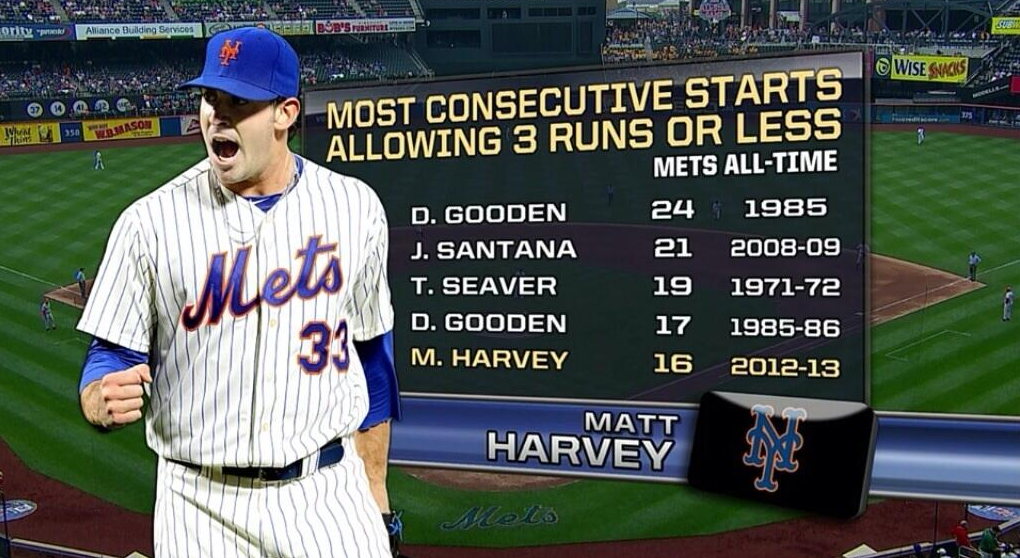
 During the broadcast, SNY put up this interesting graphic about the most consecutive starts allowing 3 runs or less. (I filched it from Michael Baron‘s Twitter feed.) I noticed that Doc’s streak of 24 was in the same year that his streak of 17 began, and wondered how many starts separated the two. During the broadcast, SNY put up this interesting graphic about the most consecutive starts allowing 3 runs or less. (I filched it from Michael Baron‘s Twitter feed.) I noticed that Doc’s streak of 24 was in the same year that his streak of 17 began, and wondered how many starts separated the two.
The answer: one.
Gooden gave up four runs (three earned) on Opening Day of 1985, then reeled off those 24 straight superb starts. On August 15 he gave up five runs in five innings against the Phillies. (He still won.) The next start in which he gave up more than three runs was May 22, 1986.
So over a stretch of 42 starts, Dwight Gooden gave up more than three runs exactly once.
Wow. Just … wow. Matt Harvey is a wonderful pitcher, and it’s been enormous fun watching Doc become Harvey’s Twitter cheering section. But what Doc did a generation go was otherworldly.
by Jason Fry on 21 May 2013 10:46 pm This was just a joke between your bloggers on Twitter. But screw it. It’s fitting.
http://storify.com/jasoncfry/your-mets-recap
by Greg Prince on 21 May 2013 6:12 am On Monday night, the Mets got not quite enough of what they needed and a bit too much of what they didn’t. While that may sound like a description of any given one-run loss, this one struck me as quintessentially Metsian. I know I’ve seen it before, again and again.
Their starting pitcher could have gotten out of the first relatively unscathed, but didn’t.
Their first baseman could have gotten out of the way of a baserunner, but didn’t.
Their slumping slugger could have delivered a key hit, but didn’t.
Their myriad fly balls that jumped off their bats could have traveled farther, but didn’t.
Their uplifting three-run home run could have completely turned the tide, but didn’t.
Their starting pitcher who righted himself after his rough first inning could have translated his momentum into a great overall outing, but didn’t.
Their perfectly placed bloop between second and center could have fallen in and sparked a rally, but didn’t.
Their relievers working out of potential trouble in tops of innings could have set the stage for redemptive bottoms of innings, but didn’t.
Their manager could have argued an umpire or two into more favorable calls or at least an agreement to seek help from other umpires, but didn’t.
Their last chance against a flamethrowing closer who had recently struggled could have paid off, but didn’t.
This is the Mets loss I saw in 1975 or 1983 or any number of seasons that didn’t — and were never going to — add up to much despite my youthful protestations to the contrary. The difference between now and then is I’m not considerably younger and don’t come away from 4-3 losses like this one to the Reds convinced that we should have won; that by coming close we sort of accomplished something; that because the likes of Shaun Marcum and LaTroy Hawkins pitched somewhat admirably and Marlon Byrd briefly evened the score and Rick Ankiel hit two home runs last week and Ike Davis hit 32 home runs last year and Brandon Phillips couldn’t possibly catch that kind of dying quail again and we really hung in there against Cueto and the umps kind of screwed us when we weren’t screwing ourselves and if only we had a Phillips or a Votto or a Bruce, that, no, the Mets are really good — why does everybody say they’re not?
They’re not. I’m older now and age has granted me the wisdom and insight to recognize the Mets for what they are when they’re not much.
Oh well.
by Jason Fry on 19 May 2013 10:21 pm Don’t look now, but your woebegone New York Mets are winners of three of four. They’re hot!
My recent advice stands: Find something else to do with your summer, with the possible exception of every fifth day, and let the Christmas carolers be a reminder to check on the team’s financial condition. That, more than anything else, will determine whether you should pay attention in 2014 or wait for new ownership.
But the fact that you’re reading this suggests you aren’t any better at taking advice than I am at practicing what I preach, so there we were at 2:20 p.m., a time that will always suggest “Wrigley Field matinee.” Which is a thing to be appreciated even in the worst of seasons.
The Mets fell behind early, thanks to Dillon Gee surrendering a titanic shot to opposing pitcher Travis Wood, which seems more pathetic than it was — I’m not familiar with Wood but he looks doggone Hamptonesque up there. They fell behind, but they kept the snowball from turning into an avalanche leaving behind nothing but scattered orange and blue gear and pissy calls to the FAN. David Wright got them within one on a little bloop, they fell back again when Ryan Sweeney homered and thus avoided being called out at third while actually being safe, but in the seventh Juan Lagares got a 2-2 curveball that hung right over the middle of the plate. Wood gazed at the unrecallable pitch in horror for a split-second before Lagares mashed it into the back of the left-field bleachers for his first big-league home run. (Lagares would get the ball back when a bleacher inhabitant heaved it back onto the field, a tradition that’s fine at Wrigley and annoying everywhere else.)
An inning later Daniel Murphy — who’d hallooed the Cubs batboy into handing over his teammate’s dinger — golfed a Kyuji Fujikawa fastball to the back of the right-field bleachers for an honest-to-goodness Mets lead, leaving Bobby Parnell to record a spotless ninth and sending the Mets home with a 3-and-4 road trip when 0-and-7 would have surprised none of us.
A win in the daytime at Wrigley is always a satisfying thing, but the reason for this post’s title is that the clout that mattered came from Lagares. He’s 24, one of those maybe-prospects whose weaknesses get discussed as much as his strengths. Lagares, it’s generally agreed, shouldn’t be in the big leagues yet — he’s been rushed. Yet when the Mets acquired Rick Ankiel, they compounded the weirdness of that acquisition by keeping Lagares around as half of a platoon instead of sending him back and taking a peek at the barely glimpsed Andrew Brown.
Ankiel’s story is one to admire, yes, but all of that was long ago, and what you get now is a soon-to-be 34-year-old outfielder who struck out 35 times in 62 at-bats with the Astros, who decided even they could do better than that. Lagares is raw, but even as he’s struggled you’ve been able to see that sweet swing and the power potential. This is a platoon between “Maybe” and “Why?” — Lagares has a slim to moderate chance to be something, where Ankiel has an excellent chance at making us think more fondly of Jeff Francoeur.
Given that the Mets aren’t going anywhere near the playoffs this year, I’d sure rather watch “Maybe” than “Why?” All of our hopes for this club are bets on some future that isn’t slated to arrive until 2014 or 2015 … if it arrives at all. The uncertainty is corrosive and infuriating, but we’re stuck with it. Since we are, it would be a small mercy to see the Mets win or lose with guys who might be a part of that future, instead of worn-out vets whose role in the present is baffling enough.
by Greg Prince on 18 May 2013 10:02 pm I’m picturing Mets marketing types watching the games from St. Louis and Chicago this week. They see the deep-seated allegiance in the home crowds set against the respective backdrops of Cardinalia and Cubbishness. There are symbols and there are statues and there is total engagement between the fans and the franchises, one of which has been far more successful than the other, but you don’t necessarily get that sense from the turnout and enthusiasm. The Cardinals and their fans are all in. The Cubs and their fans are just as all in, which is a helluva lot harder after a century-plus of not going all the way.
And then those Met marketing types turn off their TVs and hold meetings to congratulate themselves on their brilliant decision-making.
“Hey, good job deciding to pass on commemorating the 40th anniversary of the 1973 pennant!”
“You mean the Mets’ 1973 pennant? One of four the Mets have won? One of the most iconic pennants in modern baseball history? One that spawned all manner of positive resonance where the Mets brand is concerned?”
“That’s the one.”
“Well, thanks! I’m particularly proud of ignoring that accomplishment. You know, those guys are getting up there. I think it would be best to, at most, invite a few back in dribs and drabs and disperse them through the community quietly and not make much of a deal out of it otherwise.”
“That’s Met executive thinking! We were careful to not gather every living 1962 Met on the occasion of the 50th anniversary last year, and that was only our inaugural team.”
“Caution paid off. We didn’t shower undue attention on those players who survived a historic season and helped create a legacy of goodwill, which means we achieved our goal of not being bothered.”
“Don’t forget how lucky we were to not be disappointed by trying to do something and not necessarily making it translate to a one-day profit.”
“That’s the thing. It’s not about embellishing what the Mets mean in a broad sense and burnishing the memorable moments so they live on as something the Mets stand for over time. It’s about one day and only one day. If having a day to honor the 1962 Mets on their 50th anniversary or the 1973 Mets on their 40th anniversary puts us out, it’s jut not worth it.”
“Any extra effort that speaks to our most loyal fans, let alone cultivates an ongoing connection for our newer fans, is never worth it. We wouldn’t be working for the Mets if we thought it was.”
“I know! That’s why I really respect Terry for telling reporters that fans don’t know anything. Good for Terry!”
“Listen, Terry’s a nice guy, but he kind of backed off that the other day.”
“Really? That’s too bad.”
“Turns out Terry was just frustrated by all the losing and he didn’t mean to take it out on our fans.”
“You mean our consumers? Why not? Screw them and their thinking they have any clue!”
“I agree, but what’re ya gonna do? Terry must not be totally on board with our philosophy.”
“Maybe we need to get him to sit in on another ‘what it means to be a Met executive’ seminar. He must’ve missed the part about not caring what the people most loyal to our brand think.”
“Well, he is busy trying to win games.”
“Oh, you’re funny! Like it matters what he does.”
“Yeah, I thought you’d like that one. Terry gets a pass. Sandy gets a pass, too.”
“Of course he does! We all get a pass! And if anybody complains, they just don’t understand!”
“Hey, if we’re so dumb, why do we still get several thousand people in here most games?”
“If we’re so dumb, how did almost a hundred banners get made going on about how great the Mets are and how people love the Mets?”
“Hundred more than I would’ve guessed.”
“Well, we tried to bury it at like ten in the morning.”
“Good thing we took those instructions seriously.”
“You mean when they sent out those pictures of thousands of people on the field at Shea between games of doubleheaders?”
“Yup, When we were told, ‘let’s not let this happen,’ we made sure it wouldn’t.”
“You’d think the constant losing and never-ending bad publicity would be enough to turn off everybody.”
“Go figure.”
“But we get fans anyway. Fans who pay hard-earned money.”
“Dopes.”
“And we get questions about why there are no statues like in Chicago and St. Louis or why we don’t retire another number or do more with our Hall of Fame.”
“Weirdoes.”
“And they want to celebrate our history and heritage like that’s an important part of being a Mets fan.”
“Insane!”
“You gotta believe they’re crazy.”
“‘You gotta believe’? Hey, that’s a catchy phrase! Is that from something?”
“I don’t know. I might have heard it somewhere. Not sure where.”
“Just wondering. Oh, I forgot to ask, how did the Mets do today? Gary and Keith were talking about what a fun, vibrant scene Wrigley Field is so much that I got tired of hearing that that sort of thing is allowed at a baseball stadium and turned it off.”
“Tell me about it. Uh, let me check…lost again.”
“Hefner?”
“Who else?”
“Was it close at least?”
“Stop! You’re killing me here!”
“Sorry. Didn’t mean to get you laughing that hard. You know when Harvey’s pitching again?”
“Every day of the homestand, I hope.”
“Any ideas for effective promotions next week?”
“You mean besides Harvey pitching every home game?”
“Thought so.”
“Hey, wanna grab some lunch?”
“Definitely. Mishandling our responsibility as tenders of the Mets’ legacy always gives me an appetite.”
by Greg Prince on 17 May 2013 9:46 pm They walked on Ninth Avenue, with Harvey and the two friends in front, his sister and her husband behind them. When they arrived at the restaurant, his sister was laughing about what had just happened on the street. “Do you know how many people just did the second take on you?” she said to her brother.
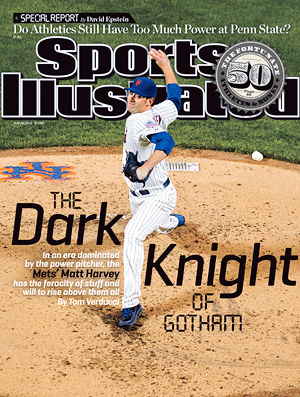
—Tom Verducci, Sports Illustrated, current issue’s cover story
Tom’s brother, Charles, had moved to New York [and] went to work as a caseworker with the New York City Department of Welfare. One day he walked into a tenement to visit a client. Charles saw a photo staring at him from the side of a refrigerator. “That’s my brother,” Charles said, a little surprised.
—John Devaney, Tom Seaver: An Intimate Portrait, recounting a story from 1967
Tonight’s snippet of movie dialogue I’ve fished from my subconscious and retrofitted to reflect the prevailing Metropolitan zeitgeist comes to us courtesy of the 1993 political comedy, Dave, a line uttered by Kevin Kline in the title role:
“It’s Harvey Day. Everything works on Harvey Day, OK?”
Friday was Harvey Day. And everything did work, didn’t it?
It was mostly Matt Harvey making sure functionality didn’t go out of fashion in Wrigleyville. He pitched the Mets to a win, he hit the Mets to a win, he willed the Mets to a win. He had help, but I’m going to assume it was generated by teammates who couldn’t bring themselves to let their ace down.
You only get so many Harveys in a lifetime. A Matt is a terrible thing to waste.
So would have been 7⅓ innings of two-run, five-hit ball, no-walk ball that should be draped with a bigger asterisk than any imagined for Roger Maris or Barry Bonds. If Ike Davis had made himself the slightest bit useful in the first inning and picked a wide but pickable throw from Ruben Tejada, half of Harvey’s runs don’t score. But allowing for humans being human — 24 non-Harvey Mets qualify under that heading — errors happen. Except Davis’s error, committed with Cubs on second and third and one out, was scored a base hit for Alfonso Soriano (with an error tacked onto Tejada’s ledger despite this perfectly decent throw) and one earned run became two. It’s the Chicago way, I guess.
But the Chicago way hadn’t come up against the Harvey way. They pull a home-cooked scoring decision, you pull an almost flawless shutout for the next seven innings. They send your ERA up a little, you send their batters back to the bench without mercy. So just to be clear, in real life, Harvey gave up only four hits and allowed only one earned run. It may not go in the books as such, but that was how it actually happened.
Listen to me fretting over the earned run average of a pitcher who can probably bear the burden of his number rising from 1.44 to 1.55 and not lose a whole lot of sleep. Look at me worried over whether Matt Harvey would go 5-0, stay 4-0 or be saddled with 4-1. Unless somebody’s in serious September Cy Young competition, I don’t pay more than fleeting attention to these kinds of details.
But this is Matt Harvey. I only get so many Harveys in a lifetime, too. I’ve been at this Mets fan thing for 45 seasons and I’m only on my third.
In the past decade, we’ve been occasionally blessed with an ace pitcher commanding games as if everybody else on the field is playing a supporting role in his drama. Pedro Martinez was that pitcher in 2005 and early 2006. Johan Santana was that pitcher during those intermittent stretches when he was healthy enough to be worth every penny of his enormous salary. R.A. Dickey was that pitcher to award-winning satisfaction last year. Hence, it’s not like we’ve been wholly deprived of aces. There is a tendency every time something brilliant crosses our path to forget that it’s not the first instant we’ve encountered something very much like it in the relatively recent past.
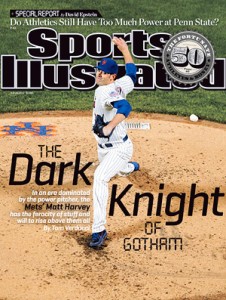 You…you light up our life. Yet Harvey is different. He’s a solid gold throwback to the platinum standards of Met acedom, just as he’s his own singular phenomenon. Some nights he’s another Gooden. Some days he’s another Seaver. Start after start, he’s Matt Harvey and all that’s come to imply. I’ve been careful to not go nuts with these comparisons, partly because it’s kind of lazy, partly because it’s still ridiculously early in his career, partly because it’s Seaver and Gooden, for goodness sake.
I’m willing to go there tonight, though, because Harvey was just so Seaverian against the Cubs. Not one-hit shutout Tom, but putting aside the bumpy first inning Tom and letting the opposing hitters know their fun for the day was over now.
And that was before the most beautifully Seaverian flourish of all kicked in: the helping of his own cause.
With Rick Ankiel on second in a tie game with two out in the seventh, the manager didn’t pinch-hit for his starting pitcher. Worst that could happen from that decision was Harvey would still be pitching in a tie game in the bottom of the inning. Best that could happen was Harvey would do what every starting pitcher is capable of but none of them seem to do anymore.
Harvey we know is capable, and Harvey, we had a pretty good hunch, isn’t the kind to leave his capabilities in a sock drawer. Matt thus singled Ankiel home when he absolutely had to break the 2-2 tie himself. It felt rare enough that Collins didn’t remove him in the first place. But to actually Help His Own Cause? I’m telling you, at that moment, I bought fully into the Seaver comparison because that’s exactly the sort of thing Tom would have done.
No, actually, that’s exactly the sort of thing Tom did. Three times as a Met starting pitcher, Tom drove in a run from the seventh inning on to break a tie he was nursing before going back to work to nail down his win. Once, in 1973, against the Astros, he did it with a squeeze bunt. The other two times were with home runs: off Ross Grimsley of the Reds in a 1-1 tie in the seventh inning in 1972; and off Bill Stoneman of the Expos in a 1-1 tie in the eighth inning in 1971. These were good pitchers late in games. But this was Tom Seaver, who could handle the bat as well as he could handle any lineup. Of course Gil Hodges was going to leave Seaver in. Of course Yogi Berra was going to leave Seaver in. (Mark Simon of ESPN Stats & Information let us know Met starters Gerry Arrigo, in 1966, and Sid Fernandez, in 1993, also drove in go-ahead runs late and went on to win their games.)
I want to say, “Of course Terry Collins was going to leave Harvey in,” but this isn’t 1971 or 1972. Almost nobody leaves anybody in to pitch, let alone to hit. Everybody has a standing conniption over workload and pitch count. But Collins, not necessarily the most innovative (nor most recalcitrant) of managers, understood who was best suited to butter his team’s bread Friday in the seventh. It wasn’t a pinch-hitter to face Edwin Jackson and it wasn’t a reliever to start the eighth.
Harvey, Collins affirmed later, “is a different animal.”
Granted, Matt wasn’t judged an exotic enough species so that when a runner got to second with one out in the eighth that Terry would do the sensible thing and keep faith in his ace. Harvey reluctantly came out, Scott Rice came in and — because Met aces since time immemorial tend to be starved for margin of error — David DeJesus singled to right. The hit sent baserunner Darwin Barney toward home with what seemed like the potential tying tally, the run that appeared destined to non-decision Harvey yet again…except the ball was retrieved and fired quickly and accurately by Marlon Byrd, and Barney couldn’t have been more out had being tagged by John Buck been his intention all along. Greg Burke and Bobby Parnell held the 3-2 fort from there.
No Met wanted to leave Harvey hanging. No Met wants to leave Gee, Hefner or whoever hanging, either, but this is a step up in class. Every fifth day, the 2013 Mets might as well be visitors from 1969 or 1986. Harvey makes their chances of winning that good. Wright homers into the wind. Murphy remains ablaze. Byrd channels Clemente. Parnell is calm and confident. Even Ike Davis eventually gets a base hit.
And Matt Harvey goes to 5-0.
by Greg Prince on 16 May 2013 7:53 pm When the Mets interrupt one of their concentrated spans of ineptitude with a rare show of net-competence — such as that displayed Thursday afternoon at Busch Stadium in an unlikely 5-2 victory over the exalted St. Louis Cardinals of Keith Hernandez’s fundamentally sound fantasies — I am moved to recall an exchange from the 1984 film, Teachers, between conscientious educator Alex Jurel (Nick Nolte) and stodgy disciplinarian Ditto Stiles (Royal Dano), the latter so named because his teaching method consists solely of passing out quizzes he joylessly reproduces at John F. Kennedy High School’s overworked ditto machine. The discussion in question centers around a problem student whom another teacher would prefer to dump in Ditto’s pin-drop quiet classroom.
DITTO: Oh, it’s fine with me. I’ll handle him.
ALEX: You’d bore him to death.
DITTO: What’s that supposed to mean?
ALEX: Whaddaya think it means, Ditto? Your class is boring. Your students don’t learn a thing. If it weren’t for tenure, you’d be selling vacuum cleaners. Have I left anything out?
DITTO: I don’t have to take that from you. I have received three consecutive teaching awards for the most orderly class.
ALEX: Uh-huh.
DITTO: Three consecutive teaching awards for the most orderly class! And what do you think of that about that, mister?
ALEX: Gee Ditto — you sure don’t stink.
And for one day, neither does our baseball team, give or take a .157-batting (as opposed to hitting) first baseman. They’re 1-0 since completing their second six-game losing streak of 2013 and a robust 43-72 dating back to July 8, 2012.
Friday they attempt their first winning streak in two weeks.
How about them Mets?!
by Jason Fry on 15 May 2013 11:44 pm Instead of kicking a ball into foul territory and failing to cover home plate, Scott Rice found a way to lose more efficiently by throwing a wild pitch.
John Buck got caught off second base when he inexplicably thought a lineout to the outfield was up the gap falling in, and got thrown out inexplicably trying to steal.
David Wright had a ball flop out of his mitt on a tag play on John Jay, giving the Cardinals an extra out, which they turned into a run-scoring single.
Wright struck out with Daniel Murphy on third with one out. The Mets didn’t score.
Apparently discomfited by Carlos Beltran coming into second standing instead of sliding, Murph heaved one past Ike Davis, giving the Cards a runner on second with one out instead of nobody on with two out. Yadier Molina, to the surprise of no sentient Mets fan, promptly rapped a single to right to give the Cards an insurance run.
The amazing thing? This sad parade of boneheaded mistakes and failures actually amounts to progress for this broken, pathetic team.
How many times must you put your hand on this particular hot stove? Find something else to do with your summer.
|
|