The blog for Mets fans
who like to read
ABOUT US

Faith and Fear in Flushing made its debut on Feb. 16, 2005, the brainchild of two longtime friends and lifelong Met fans.
Greg Prince discovered the Mets when he was 6, during the magical summer of 1969. He is a Long Island-based writer, editor and communications consultant. Contact him here.
Jason Fry is a Brooklyn writer whose first memories include his mom leaping up and down cheering for Rusty Staub. Check out his other writing here.
Got something to say? Leave a comment, or email us at faithandfear@gmail.com. (Sorry, but we have no interest in ads, sponsored content or guest posts.)
Need our RSS feed? It's here.
Visit our Facebook page, or drop by the personal pages for Greg and Jason.
Or follow us on Twitter: Here's Greg, and here's Jason.
|
by Greg Prince on 17 March 2013 2:23 am You never know, but now and then you’re overcome by an inkling, and at the moment I’m inkled that the Mets aren’t going to be the mildly surprising success story I sort of thought that maybe, if enough went well, they could be in 2013. The injuries, the traditional vaguely defined recovery periods, the thin layer of talent, the speed at which depth has gone shallow and something about how there’s always a “Mets official,” “Mets source” or “Mets person” willing to whisper a discouraging word in some reporter’s ear have combined to take the edge off the moderate state of sanguinity I could swear I was packing when Spring Training began five or six months ago.
On the positive side for the near term? The Mets are still 0-0…and you never know. Plus Matt Harvey.
But enough doom and gloom and fitting the Mets for a tomb. We weren’t expecting a surge from 74 wins to remarkably more than 74 wins, were we? It’s kind of pointless to put a number on these things at this stage anyway. The next time somebody offers up a bunch of all-knowing projections of exactly how many games 30 major league teams are going to win and lose, take out a calculator and see if the numbers add up to a collective .500. If they don’t, then they’re full of it. And if they do, they’re also full of it.
You can pick a number out of a hat during Spring Training and it’s meaningless. The team you’re contemplating in March will change and change again by September. The personnel will evolve. The competitive circumstances around them will evolve, too. The team you decided would be 12 games better than the Mets might itself be 20 games worse than you realized when you were assigning guesses to the unknowable. Yet another lesson in you never know.
So barring miraculous health, brilliant strategy, a lossless campaign and a romp through the postseason, here’s what I’d like to see from 2013: a much-improved arc over what we’re used to. Even if we can’t have a winning team, I want the sense that things are getting better — tangibly, I mean, not just because somebody is waving prospect rankings at me — and I want a reality that doesn’t feel worse in the interim.
I’m not asking for 1969 or 1984 or 1997, the three patron-saint seasons of delightful surprise. If a reasonable facsimile emerges against all expectations, I’ll accept it with relish (not to mention sauerkraut), but I’m not setting myself up to be disappointed. The Mets of those years produced 100 wins and a championship; 90 wins and a spirited second-place finish; and 88 wins and legitimate Wild Card contention on the heels of, respectively, years that produced 73 wins, 68 wins and 71 wins. You can’t expect to be delightfully surprised like that. You have to allow for the element of surprise to do its thing.
I’m not pegging my desire to a precise result. What I want is that better arc, something like 1994, a season I’m guessing nobody old enough to remember remembers much at all. And well you shouldn’t, to a certain extent. 1994 ended in the second week of August, and not just Metaphorically. The owners tried to be hard-asses, the players struck and it was a mess. The Mets played 113 games that year. If the Mets could’ve lopped 49 games off their dance cards the last three years, we’d probably think more kindly of their 2010, 2011 and 2012 accomplishments.
Nineteen years ago, the Mets finished 55-58. It wasn’t gorgeous, but it was uplifting. For one, it represented a massive turnaround from the year before, 1993, when the Mets went 59-103 and (according to one of my pet theories) dug themselves an image hole from which they as a franchise have never fully recovered. If our damaged self-esteem was going to be in need of intensive psychotherapy until Bobby Valentine came along, 1994 was at least a cup of chicken soup for the Mets fan soul: not all that filling, but at least we could warm up from those terrible chills we’d been feeling.
But it wasn’t just a 55-58 record that made 1994 a little nourishing. It was how the Mets went about compiling it.
• There was a start that was good — not set-the-world-on-fire good, but uncharacteristically positive for the era: 18-14. They were eight games better than they were a year earlier. They were in position for the newfangled Wild Card, though it was a little early to be tracking playoff spots (not that I wasn’t). They were a breath of fresh air, mostly. The Mets don’t suck!
• There was the inevitable backslide — a 15-29 stretch that disarmed any notions that a full-scale revival was underway. It came early enough so as not to undermine any seriously developed dreams but not so early that it crushed one’s Mets enthusiasm out of the gate. OK, the Mets are sucking, but at least it was fun there for a while.
• There was a reversal of form — a solid 22-15 ascent that catapulted the Mets into third place when the bats and balls were prematurely put away on August 11. Mind you, the Mets were a million miles behind Montreal and Atlanta and had generated no buzz in New York while summer was still in progress, but if you were a Mets fan, so what? You created your own buzz. Your team didn’t curl up and die as it had done at the back end of 1991 (24-46), 1992 (21-37) and 1993 (the whole damn thing, really). It showed just enough life to make you wish there was no strike beyond simply wanting baseball to continue. There was no guarantee another, more unfortunate reversal wouldn’t have transpired, but all you could do was go with what you had: a team that had fought its way out of the basement and close to a winning record. And while you cursed the strike, you thought about Hundley and Brogna and Kent and Vizcaino and bought into Pulsipher and Isringhausen and Wilson and…geez, the Mets were not terrible this truncated year and maybe they’ll keep getting better whenever they play ball again.
That’s essentially where I want to be when 2013 ends and that’s how I want to get there. I don’t want to be buried early as we were in 2011 (5-13) or 2010 (4-8). I don’t need to be suckered into believing there’s more going for us than there really is as was done last year (31-23) if it’s not going to take. I just need something decent to hang my hopes on early, something less than total dissolution in the middle and a nice comeback with which to conclude. Get me to the end of a season for the first time since 2006 where I’m actually looking forward to the next season convinced we’re going to build on what’s already there. Not another sorry winter of “we may have to keep sucking before we can get better,” but actual better-getting as the year ends, making it impossible to be reflexively cynical about this entire operation.
I’m not asking for 1969. I’m not asking for 1986. I’m asking for 1994. That’s really not so much to ask for.
And if you’ve ever asked to meet David Wright, here’s your chance (rib cage pending, one supposes) to make it happen, courtesy of the Ride of Fame and your own video creativity.
by Greg Prince on 15 March 2013 5:41 pm We ran into our across-the-hall neighbor the other day, which shouldn’t have been unusual as we live across the hall from each other, but neither Stephanie nor I had seen him in months. Just the way that goes sometimes. We converged at the elevator on the way up to our respective apartments and I noticed something different about him: he was wearing a Mets cap. I’d never seen one on him before. I’m pretty sure I’d seen him wearing some sort of Yankee garb, but not often and not obnoxiously, which is to say he never cracked wise about my own Mets stuff.
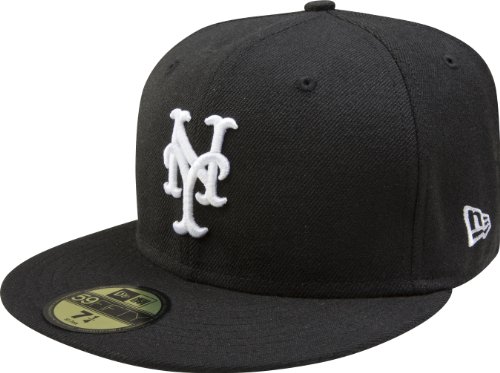
 Way to support New York? The Mets cap was one of those black-and-white numbers, the kind Shannon Shark at Mets Police would call on the carpet for all kinds of crimes against good Metropolitan fashion sense. As he should, regardless of my neighbor being a pleasant sort, because it’s one of those caps the Mets offer so they can sell something to non-Mets fans. It has to be.
A real Mets fan might wear it if (like Shannon) his closet was bulging with Met apparel, but if you lived across the hall from a real Mets fan for three years and had never once seen him sporting any kind of Mets gear prior to this elevator ride, you’d figure there was something less than hardcore going on here.
I was thinking all that as we exchanged pleasantries. Stephanie probably wasn’t thinking that deeply on the subject. She just saw the curly NY and said the friendly thing to say:
“That’s a very nice Mets cap!”
Our neighbor smiled and thanked her. She asked if he was a Mets fan. Well, he said, in the sense that he roots for all the New York teams — which is one of those admissions that used to make me cringe mightily but he’s a nice guy and I’ve come to accept that sometimes people don’t care enough to definitively choose good over evil. Our neighbor, I thought, wasn’t the kind to worry about Johan Santana’s relationship with the front office or David Wright potentially harming himself in the name of the USA or whether Jordany Valdespin was going to remember to make every night Cup Night. Not everybody who pokes the bill of his cap into this thing of ours immerses himself. Sometimes it’s as simple as somebody offering somebody else free tickets to a game and that somebody else buying a cap while he’s there.
Sure enough, that was exactly the story with our neighbor. A friend of his wife’s works at a law office or something like that. They get great tickets for everything, so last year he went and had a wonderful time. The seats they had…what really made them great was you didn’t have to get up to buy food! They came around and brought it to you!
Not that long ago I would’ve had to have controlled my impulse to scream — you’re not a fan yet you’re getting the royal Metsian treatment and you bought the absolute least Metsian Mets cap you could find? — but que sera sera, I decided. It’s not like our neighbor was depriving a long line of dedicated Mets fans from sitting wherever this seat was. I don’t remember looking around Citi Field in 2012 and noting to myself, “It sure is crowded here with phonies.” It wasn’t crowded there with anybody. If our neighbor found his way to Flushing and enjoyed a couple of hours of recreation while, to his mind, supporting the greater “New York” cause, good for him.
That was my internal rationalization doing its best to block out my disgust that this happens, but it’s a great big world let alone Metropolitan Area. Besides, like I said, he’s struck us as a perfectly nice guy in our scant interactions with him since 2010. We could say the same for his wife (on whose head I had occasionally noticed a very discreet “NY” cap of the non-curly nature), though we hadn’t seen her in an even longer time than we’d seen him. We knew she’d been ill and that her car had been parked permanently for what seemed like ages. Stephanie and I hadn’t discussed why we hadn’t seen her, but we each had a hunch.
So with the Mets cap having opened up a long enough stream of small talk to get us all the way up in the elevator and out into the hallway between our respective front doors, Stephanie asked what I swore I’d been meaning to ask all winter, but I never managed to run into the guy until now:
How is your wife doing?
Oh, you didn’t know? She passed away. Six months ago.
This tells you how little we see of our neighbors and how incredibly uninquisitive we can be. That she’d been in the hospital for three months before passing away…well, we really do keep to ourselves.
Now we were off Mets caps and Mets seats and Mets food delivery and onto how much he missed his wife, how difficult it was to get through this at first, how he’s still coming along, how they were childhood sweethearts. It was a conversation I’m sure he’s had countless times since last September, so the words came easily, whatever the emotion beneath them was. For us, there was nodding and monosyllabic confirmation that whatever he was doing was “good…yeah…that’s good” and sincere if ridiculously late condolences for a woman we liked fine without ever knowing all that much. Eventually, there was a slow extension of “if you need anything, we’re right here” goodwill from me, though I’m thinking six months after the fact, our neighbor’s figured out where to go and who to call as necessity dictates.
Then we sighed, we smiled and we exchanged a round of “have a good evening” or words to that effect. Soon enough, he was in his home and we were in our home, and I’m pretty sure I had the MLB Network on before long.
***
Mets fandom comes in many sizes, many shades and — even with Shannon Shark’s best efforts on behalf of the orange and blue — many color combinations. I mention this because if you’ve never been drawn into the Mets Police orbit, you should know Shannon has released an e-book called Send The Beer Guy. It walks a very familiar beat, that of what it’s like to be a lifelong Mets fan of the first degree, but Shannon brings his own engaging take to the task and produces a highly readable, not insubstantial brief trip through what the Mets have meant to him all these years. Some of it’s a little surprising, some of it’s very affecting. All of it is Shannon…and, as the author himself would be quick to point out, it’s only $3.99 for Kindle.
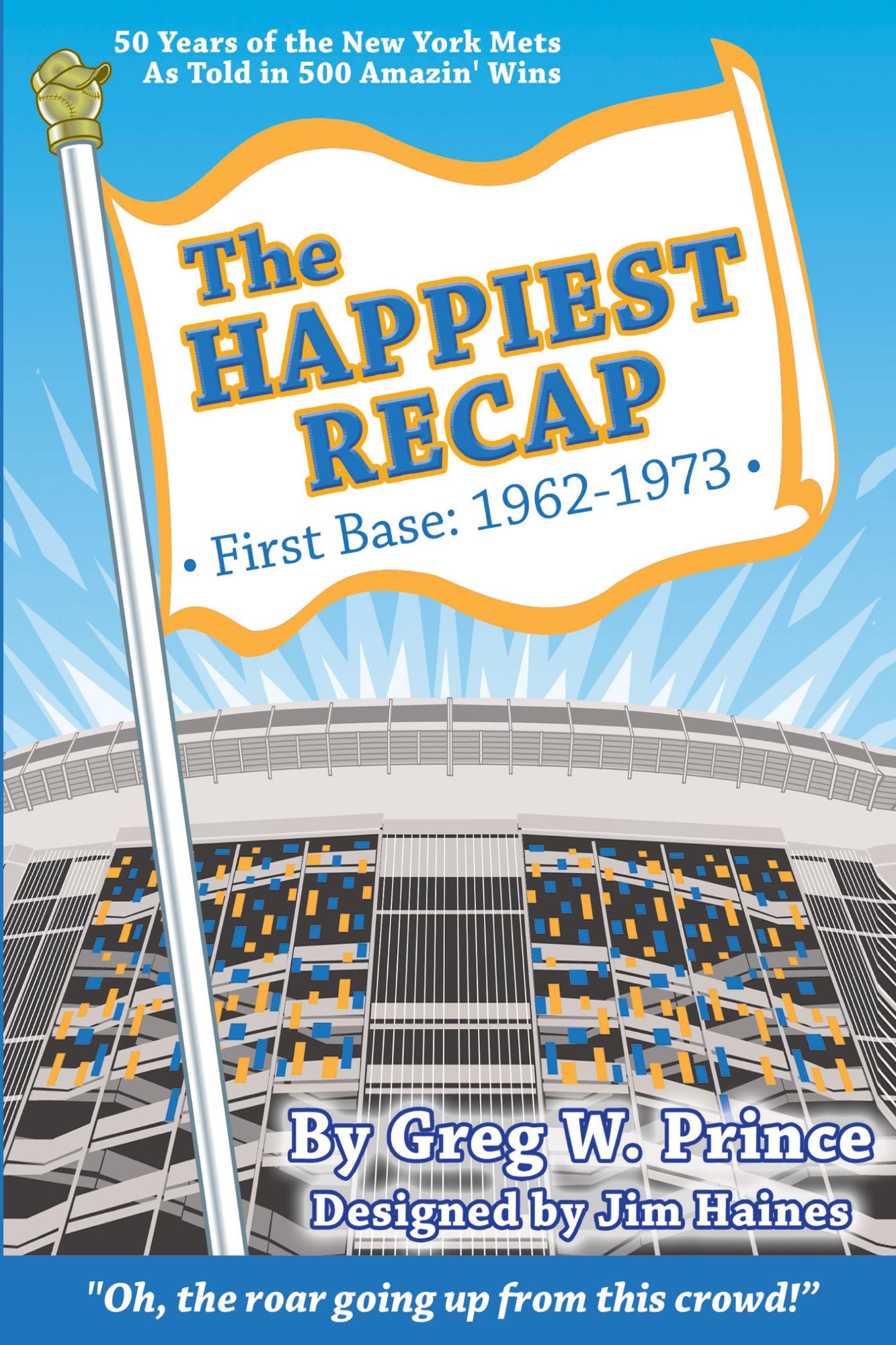
Since Shannon is one of my role models when it comes to effective/relentless self-promotion, my book, The Happiest Recap: First Base (1962-1973) is available on Kindle ($8.99) and in soft cover ($16.95) and you can arrange for an inscribed copy via the Team Recap shop on eBay. Like Mets Police and Faith and Fear in Flushing, these books are quite different yet share a lot of the same heart. You’ll enjoy them both.
Besides, think how much you’re already saving by not buying one of those black and white caps.
***
One other quick book-related note: Faith and Fear reader Rob Livingston has a swell Mets library that his living circumstances dictate must be lightened. His loss can be your gain, as he has dozens of great titles of all vintages available at bargain prices. (I’ve already vultured quite a few from him.) Hardcover books are five bucks, paperbacks just one dollar apiece. You pay book-rate postage, unless you’re in Bergen County and want to pick up your purchases in person. For info on titles and anything else, you can get in touch with Rob via rblivingston@gmail.com.
by Jason Fry on 13 March 2013 10:41 pm Johangate, thank goodness, seems to be over.
The Mets were unhappy about Johan Santana, introducing him to the underside of various buses in wondering how he came to camp not in pitching shape. Johan was unhappy with the Mets, throwing bullpen sessions to prove points and then being surly/silent, or so we’ve been told by the army of bored scribes trapped in Port St. Lucie.
Now everybody’s happy with everybody else, or at least everybody’s over it. The Mets are saying old familiar things about Johan being ready when Johan is ready. Johan says air was cleared. Sandy Alderson says air didn’t need to be cleared but a conversation has been had, which we’ll take as meaning that air’s been cleared. Johan even got a birthday cake, with Jeff Wilpon making an oh-look-cameras appearance to wish him well.
As a veteran observer of Metsian misbehavior, it seems to me that this ballclub could get better results by realizing it’s not only ineffective but also deeply embarrassing to give players a good Walter Reeding periodically instead of having conversations behind closed doors like normal people. But since the air has been cleared, let’s not re-fog it — we can revisit this when Ike Davis or Ruben Tejada or Matt Harvey or someone else crosses some perceived line and needs to be publicly abused by “sources.”
In the wake of Johangate, I was left feeling sad — because it seems like what happened to the man who made us a normal franchise wasn’t so much a disagreement between player and management as an unhappy reminder of baseball mortality.
Santana went through a lot last year. He’s been through a lot every year, racking up injury after injury. So, mindful that his 34th birthday was looming, he took it easy on his usual offseason throwing program, with the approval — perhaps active, perhaps tacit — of the Mets. He came to camp feeling good, got down to business, and discovered that his arm wouldn’t respond. The mind issued its usual commands, but the body wouldn’t heed them.
This is the fate of all superstar athletes — the only thing to be determined is the date. The sad thing is that the athletes are always the last to know. What made them great, long ago in their early springtimes, guarantees that they will be blindsided in their autumns.
If you’re a baseball fan who’s paying attention, you realize by your teens or early twenties that those guys down on the field are practically a different species physically, gifted with eyesight and reaction times and quick-twitch muscles that you can only dream of. What took me years more to realize was the mental aspect of superstardom — that most of these athletes also possess extraordinary focus, highly specialized memories and a level of will that’s equally superhuman. Sure, there are see-ball hit-ball guys who drift through 20-year careers on a pillow of their own physical gifts. But most professional athletes got to where they are by essentially creating their own reality — by having an extraordinary ability to shut out distractions, failure and competitors. The athletes who can’t will themselves into being what they become fall by the wayside and are forgotten.
It’s a high-wire act that works until it doesn’t. Last year’s home run is caught at the warning track. That fastball on the inner edge can’t quite a beat a hitter’s hands. That first step isn’t quite enough to snag the liner in the gap or the bouncer in the hole. That 34-year-old shoulder can’t make the baseball do what it’s supposed to.
The tragic part is we know before the athletes do. Everyone knows before the athletes do. Because refusing to know is how they got here. It’s worked for them for 20+ years, and it’s impossible — hell, it’s obscene and insulting — to suggest that anything’s changed. But it has. Autumn’s here, and winter will follow. Goodness knows there are compensations — Santana probably makes more in a day than I do in a year — but I’ve always found that idea haunting. What is it like to begin your life’s work guaranteed that it will be taken from you through someone else’s public declaration that you can’t do it any more? What is it like to deny that and deny that and then realize that it’s true?
It’s happening to Johan Santana now, just like it will happen to Matt Harvey, and to Zack Wheeler, and to some teenaged fireballer none of us have heard of yet. It’s the way it’s always been and the way it always will be. But that can’t make it any easier for those it happens to.
by Greg Prince on 12 March 2013 5:34 am David Wright as Mets captain? Don’t be silly. David Wright’s not a captain. David Wright’s an ambassador.
David Wright puts the Mets’ best foot forward. David Wright makes everybody feel good about the Mets, including all those new Mets to whom he shows apartments, restaurants and the ropes.
David Wright represents the Mets in other places, even to other countries. Look what he did while wearing a USA uniform versus Italy and Canada. Whatever people in those strange lands thought of the Mets before (if they thought them about them at all), they’re thinking one thing above all now: That’s the team that has David Wright.
How bad could a team with David Wright be?
Where I went to college, there was and still is a special group of students called the Ambassadors. To be one of them, you have to be “committed, disciplined, strive for excellence and most of all, love to be a USF Bull.” No bull — that sure sounds like how David Wright handles his Met business.
If you were an Ambassador at USF, you got to drive VIPs around in a golf cart while you wore a green jacket. As the Ambassador of the New York Mets, David Wright can wear whatever he likes. He can wear an A for Ambassador, a C for Captain or a D for Diplomat, as no one phrases his statements more tactfully than Ambassador Wright. Or he can wear nothing at all, so to speak. Nothing but No. 5 in blue and orange.
The moment David Wright sees his first action of 2013 is the moment he makes a bit of history. Just by getting in the lineup on Opening Day (assuming the World Baseball Classic doesn’t do something stupid like injure him), David Wright becomes the first Met since John Franco to play in 10 or more seasons as a Met. Only 14 Mets have logged that many seasons or season-fragments in our colors. Hardly any of them made such good individual use of such extended tenure. In David Wright’s nine seasons, he’s taken over the bulk of the offensive portion of the franchise record book. He has a contract — let alone the ability — that will allow him to sign his name across the top of almost every category well before his pact runs out.
And you know it will run out before he ever does.
Conventionally thinking, that’s one of the reasons David Wright’s been talked up as captain. To me, it’s more ambassadorship material. He chose to remain a Met for the long term when that sort of relationship is rarely forged for anything beyond the mid term. Others of whom we’ve been fond in recent seasons (or whose accomplishments we greatly enjoyed) have been out of here in a few years…or a fewish years when compared to David Wright. Those were, when they were said and done, business relations. David Wright’s ties to the Mets are fastened by diplomatic relations. He’s the man on the inside, the man on the outside. I don’t know if he’s The Man as we frame the athletic ideal. I think he could use a few good men around him to make his diplomatic missions more worthwhile from win-column perspective.
Will he complain about it if he doesn’t get them? Does that sound like the actions of an ambassador to you?
David Wright is the embodiment of goodwill in a Mets uniform. Forget stitching him an extra letter and never mind the special jackets. At the very least let him park anywhere he wants. A solid decade as a Met in this era ought to be enough to earn anyone diplomatic immunity.
by Greg Prince on 9 March 2013 3:21 am  Avery does a lap. The Mets traveled to Lakeland Friday and were declawed by the Tigers, but there’s better feline-related baseball news to be had in the Cactus League. I read a heartwarming article the other day about O the Oakland A’s Spring Training Cat, a kitty of indeterminate gender who hangs around the Athletics’ ballpark in Phoenix and does his/her thing while the players prepare for the season ahead.
What ballplayers do in February and March and what cats do all year round, based on what I’ve read annually of the former and experienced first-hand of the latter, convinces me it’s all pretty much the same deal.
Both species are known to…
Stretch.
Go through the motions.
Engage in bursts of modest physical activity.
Occasionally make a big deal about something that turns out to be a whole lot of yowling about nothing.
Do a couple of laps.
Think about dinner.
Differences? Well, when our Hozzie and Avery finish sharpening their skills, our furniture is most definitely not in the best shape of its life.
by Jason Fry on 7 March 2013 5:00 pm So over in the Daily News, Andy Martino says the Mets could have gotten Travis d’Arnaud and Noah Syndergaard from the Blue Jays for Jonathon Niese instead of R.A. Dickey.
Talk about your fascinating what-ifs.
Full warning: The rest of this is going to be an unquantitative mess, red meat for a stats guys to tear apart without even trying hard. But so be it.
I loved R.A. Dickey. Not just because he was a great pitcher, though let’s not pretend that wasn’t the foundation for the rest of it. More than that, I loved him because I could barely believe he existed. He was everything that egghead young fans like me dream baseball players might be, only to quickly realize they’re anything but. Professional athletes are trained to be dull and surly, but Dickey was by turns philosophical, reflective, curious and goofy, a W.P. Kinsella character who not only escaped from the page but also romped off with 20 wins and a Cy Young award. I’d never dreamed of a player who might happily join a blogger in mythopoetic dorking out about baseball; Dickey not only thought that way but was a good bet to come up with richer, more evocative stuff than any of us pixel-wranglers could.
And just so we don’t get lost in the Ken Burns mist: 20-6, 2.73 ERA, 230 Ks.
Jon Niese, on the other hand, is basically what I’d come up with if you asked me to imagine a fictional athlete who was as dull and uninspiring as possible. Niese plays the central role in the finest art form ever created by humanity, and he inhabits that role with all the verve of a DMV clerk who’s got seven hours left on her shift. I’ve seen a lot of Mets that don’t exactly seem like they’d light up a room if the conversation strayed past attaboying, but no Met in recent memory has ever exuded wanting to be somewhere else more than Niese.
And that’s happened between the lines: The nadir of Nieseness came, ironically, against the Blue Jays who reportedly coveted him so much. Last summer the Jays gave Niese a truly vicious shellacking, after which Dan Warthen one-upped them, telling reporters that Niese needed to study more. Before his next start against the Pirates, Niese was hauled into a room for a mandatory review session with Warthen, Rickey Bones, Dickey and Johan Santana.
It was a Come to Jesus moment, and to be fair, after that it seemed like Niese found religion. He was 11-7 the rest of the way, a particularly impressive turnaround considering the Mets went in the tank and Niese had gotten a reputation for faltering in second halves. It felt like he figured something out, and Niese deserves a good chunk of the credit for that.
And, to stick with the whole being fair thing, Niese’s job begins and ends with winning games. He’s under no orders to be introspective about his profession or to open up about his private life. He’s not obligated to supply beat writers with good copy. There’s no commandment that he entertain me in any way that doesn’t involve throwing a baseball. If he wins games, that’s enough — and hey, nothing would make me happier than getting to write a post grousing about how boring Niese was when hoisting the World Series trophy.
If that trophy is the goal (which it obviously is), Niese is a better bet for getting there than Dickey. He’s a 26-year-old lefty with great stuff and a team-friendly contract covering what should be his prime years. You build around players like that, not 38-year-old knuckleballers with vanished ligaments, no matter how much they love Star Wars or what they name their bats.
I know this. But it doesn’t help. I miss R.A. Dickey every day, and for all his potential I struggle to remember Jon Niese is on the roster. Given the choice, the Mets traded the right guy. That’s obvious. But I was happier when I didn’t think there was a choice involved.
by Greg Prince on 7 March 2013 1:04 am If you’ve ever felt a little charge upon reacquainting yourself with an old song that wasn’t exactly a favorite back in the day but it’s surprisingly good to hear playing again from out of nowhere, then you know how I feel upon seeing Pedro Feliciano in a Mets uniform this Spring Training. For me and my vintage ear, spotting Pedro in Port St. Lucie is akin to turning on CBS-FM and hearing something by Firefall instead of the Eagles for the 4,000th time this month.
Pedro’s not the pitcher that I always dreamed of, but he’s a damn comforting sight. He was a survivor in his Met prime and he’s even more of one now. He’s survived four managers, two collapses, several departures, enough spins around the mound turntable to have worn out the sturdiest copy of “Hotel California” plus an injury that has kept him MLB-inactive since the last time he pitched for us.
When I saw him wearing one of those adorable Mr. Met caps a couple of weeks ago, I realized the picture wasn’t quite right. Pedro Feliciano needn’t wear a cap with Mr. Met’s image emblazoned on it. Mr. Met should be wearing a cap with Pedro Felicano’s face affixed squarely above the bill.
That’s how much a part of the Mets Pedro Feliciano had become over his final three seasons, when two of his four Met managers handed him the ball on 266 different occasions, enabling his setting of three consecutive franchise records for appearances in a season. That’s 266 games for one pitcher in three years. From 2008 through 2010, it was tough enough to watch the Mets 266 times.
Pedro, who first warmed up in our pen in 2002 while 19-year-old David Wright was working his way up from Single-A Capital City, was part of the 2006 Mets, too, yet his provisional return to the team — competing among an armful of southpaws for the role of lefty reliever who isn’t Josh Edgin — doesn’t instantly spark memories of fleeting triumph (though Feliciano and Chad Bradford were a super set of specialists back when relief was an honest-to-god Met strength). Pedro is 2009 and 2010 to me, which doesn’t sound like much of an endorsement, but in the long view, you need an avatar of affirmation for your bad old days. You need a good guy to stick out when you’re stuck pondering the lesser personalities and performers you rooted through. You need a Tony Clark, a Rico Brogna, a Bruce Boisclair. I need a Pedro Feliciano, a game lefty who would do his job fairly well incredibly frequently. He wasn’t the reason the Mets sucked, nor was he going to do enough to elevate the Mets from sucking. Mostly he was definitively, resolutely here.
It’s not so much that he announced his presence with authority, à la Nuke LaLoosh. It’s more like his presence was authoritatively implied. Tonight the Mets are playing the Braves and Pedro Feliciano will be warming up in the seventh inning. The consequences were rarely disastrous. The outcome was occasionally rewarding. And the next day there’d be a new opponent, a different starter who couldn’t go any further and good ol’ Feliciano getting loose, ready to nullify whatever lefty hitter lurked in the opposition’s on-deck circle. You could set your device’s clock app by it.
That all ended after the 2010 season when allegedly Perpetual Pedro eschewed his core competency of Met survival by signing with New York’s other baseball team, which was antithetical to all that was implicitly decent. So is New York’s other baseball team, but Pedro Feliciano of all Mets going to the dark side? Pedro Feliciano who was a one-team man the way Odia Coates assured Paul Anka she was a one-man woman? Pedro who slipped away on waivers to the Detroit Tigers following 2002 and spent the summer of 2005 abroad as a Fukuoka Daiei Hawk yet never actually pitched for a big league team not named the New York Mets? Why would Pedro challenge taste and propriety in a fashion similar to how he so often challenged Ryan Howard?
It took us two years to understand Pedro Feliciano’s clever plot. What he did required sheer, righteously diabolical genius combined with nerves of steel. He accepted $8 million from New York’s other baseball team for 2011 and 2012 and then brazenly lammed it, never once appearing in any of their games. His cover story was that his shoulder was in bad shape from overuse at the hands of Jerry Manuel and Dan Warthen, but that was just a smokescreen. What Pedro did recalls Pat Buchanan’s rationalization for the Iran-Contra affair:
“If Colonel North ripped off the Ayatollah and took $30 million and gave it to the contras, then God bless Colonel North!”
Except what Pedro Feliciano did wasn’t illegal and raised no questions of morality. And better yet, now he’s home, in the only baseball home he’s ever really had. The shoulder’s going to be an issue until proven otherwise, and they’re monitoring his heart carefully, though anybody pitching more than every other day for the New York Mets across three mostly depressing seasons has already proven heart is the last thing he’s lacking. There’s no guarantee that he makes the team and there’s no guarantee that he can pitch as soundly let alone as constantly as he did in his heyday, but he’s here now like he was here always and the friendly Feliciano familiarity of it all brings me a smile even brighter than that of Mr. Met’s on those caps.
Nothing wrong with a little Perpetuity now and then.
by Greg Prince on 5 March 2013 3:40 am In the aftermath of the Mets’ failure to sign Michael Bourn (or their success at retaining the 11th Draft Pick), I wondered if the resolution would have struck me as so disappointing had not so many details of its progress emerged during the process leading up to it. The Mets were talking to Bourn…the Mets were talking to MLB…the Mets were maybe going to get a favorable ruling on the draft pick…the Mets and Bourn were getting closer…
Then nothing. Nothing but a barren pasture masquerading as a big league outfield (or a landscape of opportunity for the as yet unproven). Bourn, a legitimate pro in his prime, never loomed as a savior, but how good does a legitimate pro in his prime sound right about now? Right about the beginning of April? Either way, he’s Cleveland’s asset/burden for the next few years.
But back to my disappointment, which I think was many times magnified by how public the process of not nabbing him was. I don’t think I would’ve been nearly as bothered had the Mets come up empty quietly. If it had become known eventually that they looked at all available options, even made a run at that really excellent center fielder who sat on the market longer than expected but it just didn’t work out, then I have a feeling I would’ve thought, “at least they were trying, can’t fault them there.” Instead, being given the impression that Bourn was kind of, sort of within their grasp and then having him slip away wound up detracting from my goodwill toward Mets.
So when I had the chance to play the Mets blogger’s version of Howard Stern’s old “One Question and One Question Only” game via conference call with Sandy Alderson last week, I chose to ask not exactly, “Where’s the frigging outfield at?” but about trying to get a deal done — which I assume requires massive amounts of discretion in addition to money — while indulging in what seemed like play-by-play of the entire affair while it was still in progress.
In less polite terms, and even taking into account that the baseball media is a voracious beast that requires constant feeding, why didn’t/couldn’t you guys just shut the bleep up and sign him or not sign him?
Sandy’s answer was, in so many words, that there are too many words out there for quietude to prevail.
“You have to realize that it’s next to impossible to keep a transaction of that type confidential,” the GM said. “It’s just not going to be possible with the number of people involved from our side and the number of people involved on the agent’s side. [And] there are other teams that are involved. There can be communications with Major League Baseball. There’s just so many different entities that you just have to assume that these things are going to eventually become known and become public.”
Implicit is an acknowledgement of the media’s role, specifically that of the Mets beat reporters who talk to Sandy Alderson because their vocation is secular rather than spiritual (and it’s their job to find something to report). They have ways of making people talk, which may be as simple as repeatedly asking “so, what’s new?” and taking copious notes. Word does tend to get out and, from there, Alderson seemed to be telling me, it becomes pretty close to impossible to manage.
Dissemination of what intuition would tell you are delicate negotiations is “difficult to avoid,” he admitted, unless a deal can get done very quickly and thus relatively quietly. “Sometimes I’m just not available rather than no-commenting,” Sandy explained. “Even a ‘no comment’ conveys a certain amount of information; probably being unavailable does too, but rather than provide misinformation, sometimes I just go radio silent. That way it’s just the best of, possibly, several bad options.”
“The best of several bad options” sounds like another of Alderson’s outfield punchlines, but I appreciate the thoughtful answer he gave me. As a consumer of baseball news as well as a citizen of the United States of America, I appreciate openness and honesty from those in charge of the institutions we cherish. As a Mets fan, I mostly care about having a good team, and if I need to be purposely misled so we could wake up with Giancarlo Stanton batting cleanup, well, to borrow a phrase a former co-worker enjoyed attributing to an executive neither of us liked, “lie to me — tell I’m beautiful!”
Sounds practicable in theory, but really there’s too much truth out there, starting with the box scores and the standings, let alone honestly observed impressions, to airbrush actual circumstances. When the Mets try to spin 16-1 defeats with bright-side Tweets that inform us, “No fatalities evident as Mets come up short,” we rightfully mock them. Baseball’s an enormous business, but you can’t view the Mets as a corporation. Baseball’s full of anglers and operators (what isn’t?), but it would be a mistake to think of someone in Alderson’s position as purely a politician. The parameters of message discipline just don’t apply as easily here. Stories take on their own lives. There is no single page on which everybody can be expected to gather. And there’s no credible medium through which a desired message can be filtered cleanly. The best way for the Mets to have prevented the Johan Santana hysteria of recent days from whipping up ever frothier frenzy wasn’t retaking some step missed in overall organizational image cultivation — it was having Dan Warthen or whoever check in regularly with Johan Santana from Christmas on and asking, “How’s the ol’ left arm doin’?”
I continue to be intrigued by something I saw when I attended the Mets’ holiday party in December, the day R.A. Dickey made his unbilled farewell address to New York. The event was supposed to be fairly innocuous yet it turned into news: the Cy Young winner copped to contract talks stalling enough to dismay him badly. That’s not what players in Santa hats usually do at these luncheons, especially on the employer club’s home turf. As I watched it unfold, I instinctively waited for someone from the Mets to step forward and put an end to this utterly off-message episode, somebody to say, “thank you, ladies and gentlemen” and all but unplug the power cords. Instead, I noticed someone who works for the ballclub helping a camera operator on the edge of the media knot surrounding Dickey get a slightly better shot of the guy who was, however articulately, pointedly criticizing the ballclub’s actions.
There was no press secretary steering the proceedings to a halt. There were no functionaries trying to tell you what you just heard wasn’t what you just heard. This was baseball, and in baseball, people talk, sometimes at odds with an organization’s best interests, sometimes at odds with other people, sometimes at odds with other people standing a few feet away saying something else even if, theoretically, they’re all on the same side.
When I don’t take into account, as Alderson plainly has, that that’s the way baseball is, I’m somewhat gobsmacked it works that way as often as it does. And it’s not like 29 teams are message-disciplined and the Mets are a mess. This seems to happen to varying degrees everywhere in the sport. People go on and off the record to air their grievances all the time. Sometimes it makes a club look amateurish, but if the players play like professionals, it’s more colorful than harmful.
Baseball folks like to talk baseball so much that they can’t or won’t stop themselves. I was going to say that maybe they talk too much for their own good, but that’s probably an overstatement on my part. Baseball fans like to talk baseball, too, and we can’t hear about it or read about it enough. It’s when nobody wants to talk baseball that somebody should be worried.
Big thanks to Amazin’ Avenue for the transcript of the February 27 blogger conference call, particularly ace transcriber Steve Ferguson.
And speaking of people who like to talk baseball, I highly recommend a listen to a conversation between Matthew Callan and myself regarding the Metropolitan events of October 3, 1999, a.k.a Melvin Mora Day. If there’s a place where two Mets fans can rivet each other (and hopefully you) for 80 minutes over a 13-year-old game, it’s Replacement Players.
by Jason Fry on 2 March 2013 8:45 pm I’m the LaTroy Hawkins of Mets fandom.
At least I hope I am.
LaTroy Hawkins, 40 and a veteran pitcher, hasn’t pitched in a game yet and is not particularly concerned about that. He thinks spring training is too long, doesn’t seem too interested in the World Baseball Classic, and says he’ll be ready for the season.
Jason Fry, 43 and a veteran fan, has watched games somewhat half-heartedly so far and is … well, I don’t think I’m terribly concerned about that. I think spring training is too long, don’t give a fig about the World Baseball Classic, and sure hope I’ll be ready for the season.
I’ve thought spring training is too long for years, largely because it is: Pitchers need time to force their arms to adapt to the unnatural, ultimately destructive things done to them while standing on a mound, but for batters spring training is a holdover from generations ago, when guys drove trucks or sold clothes all winter, and a good chunk of them arrived in Florida needing to be turned back into athletes after an offseason spent like the rest of us. (Or, it seems, like Johan Santana, here thrown under the bus by Sandy Alderson via six or seven different conditionals and circumlocutions.) Now baseball players spend their off-seasons under the thumbs of nutritionists and personal trainers and hopefully staying away from dodgy Florida clinics. While pitchers torture their arms into surrender for another season, hitters arrive more or less ready and as fans we just hope they can make it six weeks without getting hurt/bitten by an alligator/succumbing to trouble in restaurant parking lots/going dangerously stir-crazy.
Yeah, hitters talk about getting their timing down, but of course they do — they’re hitters. It’s like CPAs chattering about taxes. Hitters talk about losing their timing when they wind up in slumps in May or July or September, too. Is that because spring training’s lessons have faded away? It’s all silly.
What would make more sense would be for pitchers to face minor-leaguers — who are gung-ho and have tons to prove — until St. Patrick’s Day, at which point the hitters would show up, everybody would don horrible green uniforms for a day, and the real not-real games would begin, to mercifully end after two weeks, which is pretty much when the novelty of spring training wears off and becomes a plodding grind.
Since my plan has zero chance of being adopted, I’m approaching spring training on the LaTroy Hawkins plan — and this year, at least, I’m finding that a fit for the 2013 Mets.
I’m interested in seeing more of Matt Harvey, of Zack Wheeler, and of Travis d’Arnaud — those guys are the keys to our medium-term future, which means no sifting through tea leaves is too much. I of course want the best for Jon Niese and Dillon Gee and David Wright and Ike Davis and Daniel Murphy and Ruben Tejada, whose years will probably determine whether the Mets leave 2013 looking ready for their resurrection or in need of an execution. But those players are making the team and I have baseline expectations for them — their dramas will unfold during the regular season, not March.
As for the rest of the club, I can’t get myself worked up about what bullpen spaghetti will be judged to have stuck to the wall by April 1, since those judgments will likely have little to do with how things go in the regular season and they’ll soon be replaced by newfound sagacity. Nor am I interested in an early read on what synonyms for “bad” and/or “pathetic” will prove most appropriate for our outfield. I’ll have six months to torture myself about that problem, so why start now?
I used to know it was truly spring when my blog partner would get anxious that this was the year he really wasn’t feeling it, and his fandom was in peril. (In case you haven’t noticed, that’s never happened and never will.) For my part, I’ve come to accept that this is a normal March for me — a mixture of anticipation for the season and increasing certainty that all this noise and makework has little to do with that season.
April 1 really is coming. And I’ll be ready. But I’m getting ready on the LaTroy plan.
by Greg Prince on 1 March 2013 5:08 pm For those who have been kind enough to inquire, why yes, the first volume of The Happiest Recap is now available on Kindle. The book that covers the truly Amazin’ games that transpired between 1962 and 1973 and forever defined the New York Mets’ DNA is $8.99 and can be downloaded here. (Kindle apps are easily downloaded, too, I’ve learned since recently joining the iPad generation.)
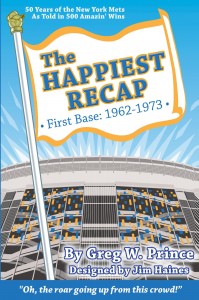 The Happiest Recap is the Mets family history as it’s never been presented before, great win by great win, covering every season and every facet of the Metropolitan baseball experience. This initial volume builds from the last days of the Polo Grounds and the opening of Shea Stadium through the maturation process of the ’60s to the miracle of 1969 and its aftermath, climaxing in the heart of the autumn of 1973, when we all learned to Believe. There are new spins on cherished Mets tales and there are Met stories I guarantee you didn’t know before, but will be Mets-thrilled that you do now. The Happiest Recap is the Mets family history as it’s never been presented before, great win by great win, covering every season and every facet of the Metropolitan baseball experience. This initial volume builds from the last days of the Polo Grounds and the opening of Shea Stadium through the maturation process of the ’60s to the miracle of 1969 and its aftermath, climaxing in the heart of the autumn of 1973, when we all learned to Believe. There are new spins on cherished Mets tales and there are Met stories I guarantee you didn’t know before, but will be Mets-thrilled that you do now.
On the print side, the “classic” version of the book remains available on Amazon and, if you’re the kind who likes your books inscribed, signed copies are available through the special Team Recap eBay store. Check it out here.
Volume 2, a.k.a. Second Base: 1974-1986, is in production currently and should be coming in both formats very soon. The early buzz on it is very promising. And if Second Base is in sight, Third Base: 1987-1999 can’t be more than 90 feet beyond.
|
|