The blog for Mets fans
who like to read
ABOUT US

Faith and Fear in Flushing made its debut on Feb. 16, 2005, the brainchild of two longtime friends and lifelong Met fans.
Greg Prince discovered the Mets when he was 6, during the magical summer of 1969. He is a Long Island-based writer, editor and communications consultant. Contact him here.
Jason Fry is a Brooklyn writer whose first memories include his mom leaping up and down cheering for Rusty Staub. Check out his other writing here.
Got something to say? Leave a comment, or email us at faithandfear@gmail.com. (Sorry, but we have no interest in ads, sponsored content or guest posts.)
Need our RSS feed? It's here.
Visit our Facebook page, or drop by the personal pages for Greg and Jason.
Or follow us on Twitter: Here's Greg, and here's Jason.
|
by Greg Prince on 30 August 2024 11:32 am I liked it better when ballplayers talked about “turning the page” on bad days. Sometime in the past decade or so, turning the page morphed into flushing, and not the charming village in Queens whose northwestern edge we know so well. “You gotta flush it” became the page-turning mantra of choice. Maybe nobody reads printed material enough to know from turning pages. Maybe Mickey Callaway irreversibly coarsened the culture. However the de rigueur phrase to articulate a wish to send the surrendering of a game-losing grand slam swirling through the municipal waste-disposal system became prevalent, the sentiment is immediately understandable in any vernacular.
“I just flush it” is indeed what Edwin Diaz said he does to get past nights like Wednesday. Had he been holding a periodical, perhaps he might have invoked page-turning. Had any of us been holding anything when he threw his fateful slider to Corbin Carroll (the one that was “floating in the zone” like something you’d definitely want to flush), we likely threw it as hard as we could. It wouldn’t have traveled as far as Carroll’s 396-foot four-run homer, but we probably would have launched our object at an exit velocity greater than his dinger’s 102.5 MPH.
But that was Wednesday. Thursday came along. In The Old Ball Game, Frank Deford reminded readers a hundred years after the fact that in 1905, “days of the week in the United States were designated for the appointed household chores.” Monday, he noted, was Washing Day. We can confidently confer upon at least one Thursday in 2024 the designation of Flushing Day. If not for the sticky residue Wednesday left in the Wild Card standings — and within our collective psyche — the Mets played on Thursday afternoon as if Wednesday night’s debacle had surged out to sea with a million tons of raw sewage.
With the first pitch Thursday, the Diamondbacks were no longer the victors from Wednesday. They were a new day’s opponents. The Mets were no longer defeated. The score was even from the get-go. Scoring got going only when Pete Alonso declared it did, at the say-so of his bat, which swatted his 221st career home run in the second inning. With that one swing, the Mets moved one run ahead of Arizona and the Polar Bear moved one homer ahead of Mike Piazza on the franchise’s all-time list. Another swing, this one from Randal Grichuk with Geraldo Perdomo on first, changed the immediate order of things in the third: Snakes 2 Mets 1.
Lucky for us, we’ve got Francisco Lindor and nobody else does. The pitching duel between David Peterson and Ryne Nelson proved unbudging until Lindor led off the top of the sixth by taking three balls, fouling off many a strike and, on the eleventh delivery he saw, smacking a home run to right, not far from the spot Carroll torpedoed his the night before, but who remembered that anymore? In the present, Lindor tied things up at two. Our season all but ended on Wednesday. On Thursday, we were right back in it.
Peterson lasted seven without giving up anything else. David and Sean Manaea are lately Koosman and Matlack for a new century, two lefties you can count on to complement a Seaver (we have a Severino if not a Seaver; you can’t have everything). Nelson was similarly impenetrable, save for the two solo homers belted by the two Met sluggers. Bullpen zeroes were swapped in the eighth, Jose Butto dealing ours, helped by Luis Torrens nailing Joc Pederson trying to steal second with two out amid a three-one count…and Joc Pederson putting his mind aside long enough to attempt such dubious thievery.
In the ninth versus Justin Martinez, Jesse Winker doubled with one out. Tyrone Taylor ran for him. J.D. Martinez shot a liner to deep right that allowed Taylor to tag and advance to third. Do you like where this is going? Jose Iglesias sure did. Iglesias sent a sizzling grounder up the middle that Lindor might have gotten to, but he plays for us, not them. They had Perdomo. If we’d learned anything in this series to this point, beyond the value of turning and flushing, it was that the best place to hit a ball if you can’t hit it over a fence is in the vicinity surrounding Perdomo. The Diamondbacks’ shortstop’s glove made a sweet clanking sound as Iglesias’s ball trickled into center, scoring Taylor with the go-ahead run.
Great, a 3-2 lead to carry into the ninth for our closer.
I said “great.”
No, really.
Our closer was back from Wednesday and ready to be somebody else on Thursday, or at least throw different pitches. Wednesday’s were sliders that didn’t go where we he or we wanted. Thursday he had fastballs. If it were as easy as changing repertoires, every Met in 2012 would have followed R.A. Dickey’s lead and thrown a high, hard knuckleball. For Diaz in 2024, a mechanical flaw was reportedly repaired between Wednesday and Thursday. Will it remain under warranty? That’s for Friday and beyond. On Thursday, Edwin Diaz didn’t generate flashing red lights, screaming sirens and the robot from Lost in Space warning of DANGER! DANGER! That’s what Wednesday felt like even before Edwin made it to the mound. On Thursday, the erstwhile All-Star struck out his first two batters and popped up the third, saving the win for Butto and the season for the rest of us.
Later, the Braves lost to the Phillies, so we’re three out of the six-seed, a pursuit we are compelled to again take seriously now that Flushing Day has passed and Momentum Day has hopefully arrived.
by Jason Fry on 29 August 2024 12:54 am That was a bad one.
A bad one as in you shut off the TV and kept fixing it with a thousand-yard stare.
It’s even crueler because once upon a time that was a good one: The Mets came back from a 4-0 deficit, with Harrison Bader striking the big blow, then went ahead when Starling Marte engineered a small-ball run: bunt single, steal, move to third on a Brandon Nimmo grounder to the right side and then score by okey-dokeing rookie catcher Adrian Del Castillo, whose perfunctory tag proved all too easy for Marte to slide around. (The shot of Lourdes Gurriel Jr. sitting in the outfield after seeing a perfect throw go for naught was priceless.)
But that was once upon a time. In the eighth Phil Maton (not Dedniel Nunez, for some reason) walked the leadoff hitter, got a pair of outs and then gave way to Edwin Diaz, who arrived with red flights flashing, as neither the fastball nor the slider looked crisp. He walked Pavin Smith on four pitches, then walked Geraldo Perdomo to load the bases for a resurrected Corbin Carroll. Diaz got a first-pitch strike that probably wasn’t a strike, but you could feel the ax about to fall, as indeed it did: Diaz left a slider in the middle of the plate and Carroll demolished it. It was the same pitch Diaz threw to Jackson Merrill last time we saw him in San Diego, with the same result.
Diaz’s time in New York has certainly been dramatic. His inaugural season was one of the more high-profile debacles in club history, as a lights-out closer turned walking disaster and head case. Somehow he clawed his way out of that vale of despond, and on one of the toughest stages in sports no less, and was embraced as a fan favorite and an icon.
And now, well, he’s turned into Dizzy Dean.
Dean famously suffered a broken toe in an All-Star Game — an innocuous injury, as it didn’t involve Dean’s precious right arm. Except the toe injury caused him to change his mechanics, leading to a cascade of maladies that finished him as a pitcher. Diaz needed a year to recover from a torn patellar tendon suffered in the World Baseball Classic, and while his arm appears sound, clearly something has gone terribly wrong. His slider has lost its bite, going from an unhittable thing that haunts hitters’ dreams to a BP offering that has them licking their chops.
I’m sure the Mets will say stoic and loyal things, sticking by their teammate and believing in him and themselves and all that, but Diaz has become fundamentally untrustworthy. We know it and they know it and worst of all I suspect Diaz knows it.
Meanwhile, the Braves (those annoyingly resilient Braves) are threatening to disappear from view in the wild-card chase, taking the Mets’ playoff hopes with them. But even if the Mets have another hot streak in them, even if they persevere and wind up playing games past No. 162, look me in the eye and tell me you see them getting through October with Diaz closing high-pressure games.
It’s easy to overreact after losing a tough game like that, and it’s even easier to overreact after losing a tough game that ends after midnight, making you question your life choices on top of everything else. But that one felt like the end, didn’t it?
by Jason Fry on 28 August 2024 1:16 am You can never outguess baseball.
Last time we saw the Mets, they were getting walked off in excruciating fashion by the Padres, a wrenching reversal that denied them a series win and an off-day on which to exhale. Next up: the other National League team threatening to run away and hide in the wild-card race. The Diamondbacks’ August has been like our June, a 24-6 run of walk-on-water baseball that leaves you thinking anything is possible.
But it’s also true that momentum is tomorrow’s starting pitcher, and fortunately Sean Manaea has been a force of nature since the break. He mowed down D-back after D-back, and meanwhile the Mets were all over Brandon Pfaadt: Pete Alonso homered early (tying Mike Piazza in the all-time ranks) and he and his teammates took full advantage of a nightmarish game for Arizona shortstop Geraldo Perdomo, whose glove turned to stone in a fifth inning that saw 12 Mets come to the plate and six runs score.
That was more than enough for Manaea, who shook off a little bother in the seventh and handed things over to the bullpen, which held the line this time as the Mets walked away with a relatively easy win.
I thought Greg summed up this team perfectly after the San Diego debacle — so many ups and downs, a lot of entertainment delivered in ways expected and decidedly not, but weighing all this you get the feeling they’re seventh-best in a six-team field. And yet, to quote Joaquin Andujar‘s favorite word, youneverknow. They have 30 games to make up three and hey, we’ve taken late-season body blows from Padres before and had things turn out OK.
With 30 games left in the season, a new enemy enters the ring: time. Losses become excruciating not just for their effect on the standings but also because they’re a day off the calendar; wins that don’t get you closer to your prey feel empty and frustrating. But the calendar will do what the calendar does; the Mets can only take them one game at a time. That’s a cliche, but it’s a cliche for a reason — a formula designed to offer comfort amid the drip-drip-drip of opportunities diminishing. One game at a time: Tonight it worked out, tomorrow awaits, and on we’ll go until there are no tomorrows and a verdict is rendered.
by Greg Prince on 26 August 2024 11:39 am After their 131st game, the 2024 New York Mets accomplished something Sunday they hadn’t managed to do after their previous 130: they posted their first Unique Record of the year. With their loss to the Padres, they appear in the standings at 68-63. No Mets team has ever been 68-63 after 131 games.
I can’t say I’d been waiting breathlessly for this, but I had noticed (because I keep track of such things) that for 130 games, the Mets inevitably had the same record they’d had in at least one other year.
• When they fell to 0-5, that put them in the company of the 1962, 1963 and 2005 Mets.
• When they shook off their wretched start and climbed to 12-8, they matched exactly what the 1971, 1973, 1984 and 1991 Mets had done after 20 games.
• When they plummeted to their first eleven-games-under nadir at 22-33, the details may have been unprecedented — did any of their predecessors have a reliever fling his glove into the stands on his way to designation for assignment? — but the record wasn’t; the 1966, 1977 and 2013 Mets had all posted it.
• And when they rocketed to seven games above .500 for the first time all season, their record of 55-48 was the same as that of the 1975, 1991, 1998 and 2021 Mets.
The irony here is the 2024 Mets have felt unique in so many ways, good and not so good, but in the won and lost columns, they were doing nothing that hadn’t been done by some edition of the Mets before. Until Sunday, that is…which leads to another ironic note, certainly to me.
On Sunday, I concluded that this is no ordinary club, yet they are producing very ordinary results.
Ever since that peak you see in the last bullet point above, the Mets have played some marvelous games and some dismal games. They’ve played games you wish SNY would reair as Mets Classics one commercial break after Gary Apple and Todd Zeile wrap up, and they’ve played games you’d be cool with some intern accidentally erasing. Some very high ups. Some very low downs. But the ups have been punctuated with a banger of a soundtrack and embellished with some hellacious celebrations, so the ups stand out, especially against the backdrop of the April and May downs that threatened to swallow the season at its most indigestible.
No doubt it was the pervasiveness of political-convention rhetoric a week ago that brought to mind this dig a major-party nominee took at his opponent in 1988: “He sees America as another pleasant country on the U.N. roll call, somewhere between Albania and Zimbabwe.” I thought of that George Herbert Walker Bush-ism while the Mets, for all their flair when they won, stood firm and resolute in the standings, their platform of losing approximately as often as they didn’t not moving the public-opinion needle. Beat the A’s. Lose to the A’s. Beat the Marlins. Lose to the Marlins. Beat the Orioles. Lose to the Orioles. Yes, another pleasant ballclub somewhere in the middle of the pack. GHWB, naturally, claimed he held a different viewpoint than the one he attributed to Michael Dukakis 36 Augusts ago: “I see America as the leader, a unique nation with a special role in the world.” Indeed, that’s how we like to enivision our Mets within the National League East…or Wild Card race, as applicable. You know — when we fight, we win, and nobody’s more fun or more special, regardless of record. #LGM! #LFGM! #OMG! #OMFGLFGM!
Yet, as politicians like to say, you can’t ignore the record. In the span that’s brought them from 55-48 to 68-63, the 2024 Mets have gone 13-15, one net-game shy of perfectly epitomizing win one/lose one. They’ve essentially run in place for a month, which would be adequate had other teams vying for the same prize they seek done the same. On July 26, when they ascended to 55-48, they also grabbed the very first Wild Card spot. Every team that wanted to enter the playoffs by the National League’s sanctioned side door lined up behind them. It was the Mets in the driver’s seat, a half-game up on both the Braves and Padres, with the Diamondbacks on the outside looking in, one game away from us. Assorted contenders and pretenders loitered close by, but we wouldn’t have to concern ourselves too much with the rabble if we kept up something resembling the Amazin’ pace that lifted us from 24-35 (our second eleven-games-under nadir) to 55-48.
That promising pecking order dissolved once the Mets commenced to producing very ordinary results, and their primary competition refused to do the same.
• Arizona, who the Mets play next, is now seven games ahead of New York. While the upcoming series against the Diamondbacks is critical to us, we’re not exactly in a position where it can be said we’re chasing them. Those Snakes have slithered into another league.
• San Diego, with whom the Mets just finished splitting a quartet of contests — when taking three of four was doable and close to necessary — has elevated itself into likely unreachable territory, leading us by five-and-a-half games, meaning that that the multiteam scramble we once led by an eyelash has transformed, basically, into us trying to keep up with the one rival we’re always trying (and traditionally failing) to keep up with.
• Atlanta, who it’s always a thrill to be ahead of, even for a day, holds a 2½-game edge on us. The Braves haven’t been their usual great, but they’ve been good enough to leave us looking up at them, which is never a thrill. If the Mets are fortunate enough to still be scrambling by the last week of this season, our three-game set at Truist Park September 24-26 offers two kinds of possibilities. I’ll leave it to you to infer the probabilities.
But that’s a ways away. Looking ahead any further than 9:40 PM ET Tuesday night in Phoenix won’t do anybody any good. Looking back one day is a matter of taste. Nonetheless, here goes.
I made a deal with myself as Sunday’s Mets-Padres game grew deeper and more tense that I’d think of it as a good game regardless of outcome. I rarely maintain much regard for Met losses, but I understand that a fan sometimes has to tip his hat to what he’s just seen and listened to. On SNY and over what remained until midnight WCBS-AM, it was a good game. I felt that way last Wednesday afternoon when Sean Manaea was flirting with perfection before the Orioles upended his come-on. No matter what happens, I thought, this is a good game. You have to respect that. I also thought the Orioles were going to emerge as the winners. When Jesse Winker prevented that circumstance, I didn’t have to make any judgments. The Mets had won in dramatic fashion. Of course it was a good game!
This, Sunday, was a good game. Subjectively speaking, it would have been better had J.D. Martinez’s fourth-inning solo homer been supplemented by more Met runs, particularly when the Mets immediately followed their DH’s blast by loading the bases to no avail. It would have been better had Jose Quintana’s inning after inning of shutout ball wasn’t being left to tiptoe along a tight rope à la Leon Russell. One side ice. One side fire. Yet a resurgent Quintana kept surviving. After second baseman Jose Iglesias recorded his biggest hit of the summer with a 4-unassisted in the bottom of the sixth that left eye- and earwitnesses spouting “Oh! My! God!” for real (not just a diving stop of a hot grounder, but the presence of mind and foot to tag second to force the oncoming runner); and after Mark Vientos at last doubled the Mets’ lead with a solo homer of his own in the top of the sixth; and after the Mets escaped the bottom of the seventh — the last inning in which Quintana pitched — when Luis Torrens and Francisco Lindor combined to cut down a two-out stolen base attempt, I considered the setting and declared in my head that if this game at Petco Park was taking place in any other season, the Mets would find a way to lose it.
You know how certain perceptions don’t keep up with reality? I perceive the Mets as perennially getting walked off in San Diego at least once every annual trip they make out there. The Padres get to Billy Wagner or Francisco Rodriguez, and the blue skies and sunshine couldn’t appear any grayer or cloudier. The Mets did indeed suffer some last at-bat devastation in the days of closers past (even if Wagner was never the losing pitcher of record in those particular games), but entering Sunday it hadn’t happened to them since 2014. Funny how time compresses the more we age. Still, just the fact that I processed Jose Butto and defensive assistance clearing out the bit of mess Jose Quintana left behind in the seventh as a sign that this was part of a special year warmed my heart’s cockles. In any other year, the Mets would find a way to lose a game I was believing the Mets were destined to grasp and win.
Alas, San Diego reverted to the San Diego of my perception, a getaway day hellhole into which the Mets stumble like Ozzie Smith into the Springfield Mystery Spot, never to be found. There’s Jurickson Profar belting a two-run homer off Butto to tie it at two in the bottom of the eighth. There’s Robert Suarez setting the Mets down sans sweat in the top of the ninth. And there’s Jackson Merrill ending everything versus Edwin Diaz, announcing our departure with 104.4 miles per hour of exit velocity, 379 feet of home run distance, and unquestioned authority. Next stop: Arizona and a whole lot more scuffling.
Good game, sure. Lousy result, absolutely. Unique Record? For what it’s worth, yeah. Also for what it’s worth, had the Mets held on and won what instead landed as a 3-2 loss, their record would not be unique. The Mets have been 69-62 twice in their past, in 1975 and 2005, which I mention not for bookkeeping but for context. Those were both seasons when we as Mets fans got our hopes up in late August. We were closing in on where we needed to be when were 69-62 in 1975 and 2005. The first-place Pirates were in sight 49 years ago after the Mets had played their 131st game (Tom Seaver threw a six-hit, 7-0 shutout at San Diego long before it became a getaway day hellhole). The lone available Wild Card was a half-game from our reach 19 years ago after the Mets had played their 131st game (Ramon Castro, whose physique bore a passing resemblance to Grimace’s, socked an electrifying three-run homer in the eighth for a 6-4 lead Braden Looper didn’t blow).
A record of 69-62 wasn’t enough to launch those respective Mets clubs into the September stratosphere, and I doubt the 2024 Mets’ record of 68-63 will be sufficient to do the same in the next month, regardless that six teams now qualify for the postseason in each league. The Mets’ wonderful days don’t bring them enough extra credit in the standings to counter their crummier days. Neither Winker’s walkoff nor Alvarez’s last week counted as more than one win, even if each coursed through my veins like five wins apiece.
I won’t stop allowing for the chance the Mets will cease averaging out to ordinary and become consistently extraordinary, which they pretty much have to be to make up all the ground that’s opened up between them and the NL’s top six. I’ve given up on giving up on all kinds of ordinary seasons at the first hint that they were capable of morphing into something better. Fans make those deals with themselves all the time. If it doesn’t happen, it will be frustrating, but I’ll have to remind myself it can be worse. Last year, when the Mets were 60-71 after 131 games, was far worse. Though it seems extreme to invoke them, this year’s White Sox are far, far, far worse. Since the Mets wouldn’t be playing until 4:10 PM Eastern on Sunday, I decided to tune into the 31-99 White Sox on the MLB app. An Indianan friend of mine was at the game, so I thought I’d offer a little audio solidarity. Besides, I was curious to hear what a genuine pursuit of the 1962 Mets sounded like live (before we get to watch it for ourselves this coming weekend).
It sounded grim. It sounded like their announcers knew that the Sox’s early 3-1 lead over the Tigers wouldn’t last. It sounded like waterboarding, joined already in progress, compared to the overtones of festiveness I’ve picked up in the background when I’ve listened to recordings of Mets games preserved from 1962. It sounded exponentially worse than any combination of 1979 and 1993 Mets games I listened to as they happened. The 1979 Mets were 52-79 after 131 games, the 1993 Mets 46-85. After losing Sunday, the White Sox fell to 31-100, two games off the pace of the 1962 Mets, representing a strain of unique nobody who looks at records should know from.
What I’m saying is going 13-15 in our previous 28 and being 68-63 with 31 games to go isn’t ideal, but there are worse things than not being quite good enough in a given year. The best thing about where we are? Somehow, we still might be good enough. We just aren’t at this moment.
by Jason Fry on 25 August 2024 9:20 am A night after looking all but moribund against Joe Musgrove (seriously, you’re the wise one if you slept through it), the Mets put together one of their more satisfying wins of the season against Michael King and the rest of the Padres.
A common exhortation heard on my couch is, “C’mon, don’t let him get out of it.” King looked shaky in the first, walking three Mets, and the Forces of Good tallied an early run when Pete Alonso “hit” a 40 MPH grounder that had just enough oomph to pop into the air after impacting the third-base bag, startling Manny Machado and winding up an unlikely double. But that was it — J.D. Martinez struck out with runners on second and third and one out and Starling Marte did the same with the bases loaded.
They’d let King get out of it.
And for a while it looked like they might very much regret that, as King settled down and had no particular trouble with the Mets in the second and third, then retired the first two Mets in the fourth. Marte singled, but Francisco Alvarez hit a soft, head-high liner to third. It popped out of Machado’s glove and the Mets were still alive. After Jeff McNeil was hit by a pitch to load the bases, King’s first two pitches to Francisco Lindor were outside.
Cue my line: “C’mon, don’t let him get out of it!”
King’s third pitch was a sweeper that was more of a sleeper, sitting middle-middle, and Lindor didn’t miss it, hammering it into the right-field stands for a 5-0 Met lead and, as it turned out, the ballgame. He’d also contribute a solo shot later in the proceedings (hit right-handed this time), a couple of sparkling defensive plays at short and his usual uptempo cheerleading and cajoling as the infield’s captain. The Athletic has a nice write-up of Lindor’s MVP case (TLDR: Unfortunately he’s in the same circuit as Shohei Ohtani) with a couple of facts that made me smile in appreciation: Lindor called the team’s now-famous meeting and went 4-for-4 the next day and he’s spent exactly one day not in the lineup, back on May 2 when he had the flu, and that was the day he delivered a pinch-hit, walkoff double. No word on if Lindor advocated for Jose Iglesias‘ callup or arranged for Grimace’s first pitch, but I wouldn’t put it past him.
David Peterson isn’t going to be National League MVP either, but he’s quietly having an excellent season. Saturday night was impressive overall, with Peterson working into the eighth before giving way to Dedniel Nunez, who looked exactly like his old self in his return. But Peterson was particularly good in the bottom of the fifth, after the Padres loaded the bases on a pair of singles sandwiched around the walk. The first single was almost an out, with Peterson making a superb play but replay review not going the Mets way. With one out Peterson had to face Luis Arraez, not exactly the man you’re hoping to see up there.
Peterson coaxed a grounder to third, with Mark Vientos wisely taking the sure out at first instead of trying for a double play, then made a nifty play to retire Jurickson Profar and end the threat. Those are the kind of situations that have a way of caving in on not only young pitchers but also pitchers who need to stop looking like young pitchers, a label you could staple on Tylor Megill and one that would have been affixed to Peterson not so long ago. (I am going to bite my lip and not mention All-Time Least Favorite Met Jon Niese … oh wait, too late.) But Peterson looks like he’s past that, as well as finally being healthy again. Which makes you intrigued about what might be next for him.
by Greg Prince on 24 August 2024 11:44 am I hung in through six grisly innings from San Diego. I nodded off in the seventh. I awoke in the eighth. “Is there any point to staying up for the rest of this?” I asked my groggy self. The Mets were down, 6-0. They’d had one hit, not counting the one Paul Blackburn took off his pitching hand. I turned off the TV and shut my eyes, soon to be out like 27 lights versus Joe Musgrove & Co. When I came to life in the morning, I imagined how delightful it would be to check the score and discover that I missed a comeback for the ages.
The Padres had added another run and won, 7-0. Sleep got the save.
by Jason Fry on 23 August 2024 12:56 pm Take a moment and consider the life of Huascar Brazoban.
Not long ago he was stuck on the Marlins, with Jazz Chisholm Jr. offering near-daily examples of being a bad teammate, Skip Schumaker staring out of the dugout like a man who can’t bear to think how long he’ll be on county work release, and the whole proceedings weighed down by the usual Marlins air of shoddiness and drift.
Now he’s a Met, in the middle of a race for a playoff spot, and things are just a little different.
For those who were sleeping, Brazoban was summoned in the ninth inning in San Diego after the Mets had scored five runs to make a taut, tight game into something to be dispensed with.
It didn’t go well: After retiring the first hitter, Brazoban walked the next two and allowed an RBI single. A pop-up to the infield secured the second out, but then Brazoban allowed another run on a Jurickson Profar single. In stepped Jake Cronenworth, who’d ripped a laser-beam grounder in the fifth inning that Jose Iglesias somehow corralled and turned into a double play. The laugher had already become a mutterer and a long ball from Cronenworth would return it to teeth-gritter status.
Brazoban looked saucer-eyed, like all the air had been sucked out of Petco Park when he needed it most. At shortstop, Francisco Lindor was clearly as exasperated as all of us still watching. But he was also clapping madly and shouting encouragement at Brazoban, as well as his teammates and the cosmos in general. Behind the plate, Francisco Alvarez had his helmet lifted atop his face and was also exhorting Brazoban.
What must that be like? Don’t you think Brazoban sometimes thinks, “What happened to me that I’ve wound up here?”
The teammate full-court press worked: Brazoban coaxed a groundout from Cronenworth to end the game, and his infielders mobbed him on the mound and jumped up and down, which was a little bit funny in its bit-too-muchness but also oddly sweet.
Between Lindor’s slow start and the usual lack of appreciation from Mets fans who ought to know better, one could miss that he’s having yet another phenomenal season. And even when his bat’s gone inexplicably cold, Lindor has never let his offensive struggles interfere with being the captain of the infield, constantly repositioning and strategizing and cheerleading. In that role he reminds me of Keith Hernandez, all but oozing intensity and issuing commands that were obeyed without question. (Except Hernandez’s intensity was faintly scary, while Lindor invariably looks cheerful even when the scoreboard looks dour.)
I also love the way Alvarez goes about his business: His offensive approach still needs refining but he looks like an old veteran calling a game. He reminds me of Rene Rivera, who saw his share of spooked-horse relievers and excelled at shifting between soothing, cajoling and browbeating, doing whatever was needed to get them across the finish line.
If that was the most interesting part of the game, it followed some pretty satisfying developments: another solid (or at least solid-adjacent) start by Luis Severino; offensive contributions from Mark Vientos, Pete Alonso and Jeff McNeil; that game-saving Iglesias play; solid relief work from Reed Garrett and Phil Maton; and a Jesse Winker serve into left-center that looked like a carbon copy of his walkoff homer, except this time Winker had to settle for a triple.
And, it should be noted, the Mets did all this after flying coast to coast without an off-day; they would have been forgiven a lethargic emotional letdown of a game but instead hammered out 17 hits and claimed the season series from the Padres.
The Mets are four games into a 10-game stretch that loomed as a potential season breaker; so far they’ve taken two out of three from the Orioles and grabbed the first of four from San Diego. Still work to be done of course, but that’s a good start. Here’s to the Franciscos continuing to holler and direct, and to more happy postgame mobs on enemy infields.
by Greg Prince on 21 August 2024 8:42 pm The chair recognizes the delegate from Manaea.
Mister Secretary! The great state of Manaea wishes to cast all seven-plus of its innings, including the first five-and-two-thirds that were absolutely PERFECT, for the team that allows its starting pitcher to consistently go at least seven innings when able, the team we will strive like HECK to bring to October, the Metropolitan Baseball Club of New York!
The chair recognizes the delegate from Lindor.
Mister Secretary and all our good friends in the stadium, aloha from shortstop! Lindor provides the constant of every season, holding down the space between second base and third base EVERY… SINGLE… DAY! And Mister Secretary, Lindor stands not only out in the field but tall and proud at the plate, again clearing a fence and providing the first lead of an afternoon game when runs are precious. Mister Secretary, the commonwealth of Lindor casts every ounce of its ability and all of its votes for the next Wild Card team from the National League, the New York Mets!
The chair recognizes the delegate from Vientos.
Mister Secretary, greetings from Vientos, where third base transforms from a traditional franchise trouble spot to an asset for the future. Mister Secretary, Vientos, with untold power and unlimited potential, casts its votes for making sure the Atlanta Braves have a comfortable seat in the postseason to watch the derring-do of the NEXT team to make a SUBSTANTIAL move in the playoff race, New York’s Amazin’, Amazin’, AMAZIN’ METS!
The chair recognizes the delegate from Butto.
Mister Secretary, Butto is proud to be part of America’s Undiscovered Gem, the bullpen, where when we can’t hold leads, we at least keep games close. Please come visit us to enjoy our natural attributes of excitement, uncertainty and, ultimately, a tight ballgame. Mister Secretary, Butto, where our motto “It’s Not Whether You Start, It’s That You Help Get Us To The Finish” is a way of life, is THRILLED to cast all its votes for a victory for ALL of the New York Mets!
 Casting a vote for another exciting Met win. The chair recognizes the delegate from Iglesias.
Mister Secretary, Iglesias wishes this convention a melodic afternoon and a soundtrack intended to score a winning score! Mister Secretary, Iglesias is always fielding, always hitting, always hustling, and always giving a spiritual lift to those whose cause we share. Mister Secretary, Iglesias casts every “O!”; every “M!’” and every “G!” for the team that, like its 1969 predecessors, taps its toes in the face of Baltimore foes, the New York Mets!
The chair recognizes the delegate from Diaz.
Mister Secretary, Diaz again rides to the fore of battle at the sound of trumpets. Diaz, the “last” state in the union, is ready to present a “final” line of defense against all interlopers, foreign and domestic, as it has since Two-Thousand and Nineteen. Diaz, where we make ourselves available for EVERY ninth inning and sometimes the EIGHTH, casts each of its innings not for personal glory, but for the good of the team. Mister Secretary, Diaz says LET’S GO METS and requests its votes be recorded accordingly.
The chair recognizes the delegate from Winker.
Mister Secretary, no delegation at this convention is more enthusiastic to have a presence here, no delegation is happier to come off the bench when needed, and no delegation has waited longer to have these words said on its behalf: IT’S OUTTA HERE! Mister Secretary, the great state of Winker not only casts a pinch-hit walkoff home run to defeat the Baltimore Orioles, four to three, but casts aside its batting helmet and inhibitions in quest of the most memorable trip around the bases Winker has ever known! Mister Secretary, Winker votes for a Mets win today, Wednesday, and hopes it will be the first of many in the nights ahead.
The chair offers a resolution to make Met victory a recurring event, not necessarily as dramatic and tense on a daily basis, but just as satisfying on the eve of yet another daunting road trip. Will all in favor signal their agreement by saying “aye”?
The ayes have it.
by Jason Fry on 21 August 2024 12:33 am Present at Tuesday night’s game against the Orioles: my wife, my kid, and my father-in-law.
Not present at Tuesday night’s game against the Orioles: me, AKA your recapper.
Honestly I got by far the better part of the deal.
Well, sort of.
I had a previous commitment with my buddies in the Brooklyn Bridge Park free kayaking program — this was the night of our annual group outing to the Brooklyn Cyclones, and also my first 2024 trip out to Maimonides Park. But I had my phone, MLB Audio, an earbud and my correspondents on the scene up at Citi Field, available via text message.
I’ve been going to Cyclones games since their inaugural 2001 season, which has somehow added up to just short of a quarter-century. Back then the Cyclones were an unexpected sensation, packing KeySpan Park and showing off a raffish charm and sly wit that their big brothers in the majors never managed. Sandy the Seagull had a Big Lebowski bod, the Beach Bums gyrated to much cooler music than you’d hear at Shea, and you could see opposing teams used to sleepy, near-empty stadiums gawk at their surroundings and wonder what, exactly, was happening in Brooklyn.
Sandy the Seagull has now been Ozempic’ed; the Beach Bums have morphed into the more staid Surf Squad; the field is turf; the park has been renamed more times than I can remember; and the Staten Island Yankees, who arrived as yin to the Cyclones’ yang, are extinct. The Cyclones are a full-season team now, having swapped places in the hierarchy with the St. Lucie Mets, and they play in the South Atlantic League, as the New York-Penn League is also extinct. (Though hey, the Cyclones did win its final championship.)
All of this makes me faintly sad — the Cyclones were more fun before their edges got sanded off. But most of what worked then still works now: It’s baseball on Coney Island, with the Parachute Jump looming over the stadium and neon hoops adorning the light poles; the between-innings skits are still cheerfully bush league; and the quality of play, well, let’s just say it’s a nightly journey. “Anything can happen in the New York-Penn League,” we’d say to each other back in 2001; “anything can happen in the Sally League” is just as true.
It was a cool night down on Coney Island, with the ball carrying — the Cyclones hit a pair of two-run homers in the bottom of the first to take a 4-1 lead. The tidings from Citi Field were not as good, however: Jose Quintana gave up a home run to Baltimore’s Gunnar Henderson on a curve ball the radio guys described as sitting in the middle of the plate.
The Cyclones jumped out to a six-run league, but up in Queens former Cyclone Brandon Nimmo had a close encounter with the ball and the wall, with the outcome eventually ruled as a Colton Cowser triple. After Cowser came in on a sac fly I surrendered my earbud — watching the Cyclones, keeping track of the Mets and talking to my kayak pals was one ball more than I could juggle, and it wasn’t like my bearing witness was doing the Mets much good.
When it was 7-1 I texted my kid that they’d all be so glad they were there for the comeback; a little later I noticed that hey, it was now 7-5. I reached for the earbud but then reconsidered — I’m not above a little superstition. Instead I watched the supermoon rising above Coney Island, looking as big as a Jose Quintana curveball sitting middle-middle. And I peered at Gameday as former Cyclone Pete Alonso came up short in a lengthy AB and the rally fizzled. I’m not sad to say I missed whatever the hell that was in the ninth that put the game out of reach, but hey, “anything can happen in Major League Baseball.”
And the Cyclones? They blew that six-run lead, gave up the go-ahead run on a ball that went through the second baseman’s legs, and wound up losing 10-9, with the final out of the game recorded on an attempt to stretch a single into a double.
Baseball’s like that sometimes — whether you’re in field-level seats or a county away from the action, whether you’re watching a big-league game that’s part of a pennant race or a contest in the low minors that no one will remember a week from now. It’ll drive you crazy if you let it; my only advice, after 48 years of watching, is not to let it. And good luck with that.
by Greg Prince on 20 August 2024 10:32 am Three-and-oh? You take. Of course you take. You always take on three-and-oh. Maybe not always always, but when you’re tied in the bottom of the ninth, there’s one out, and what you need more than anything else is a baserunner, you stand and you take.
Francisco Alvarez? You take. You’re like two-for-your-last-eighty (actually 12-for-72 entering Monday night). You reach and chase and pull the trigger far too quickly and anxiously pretty much all the time. Francisco, young man of 22 in whom we’ve invested so much hope and trust, please stand and take when the count is three-and-oh. Just reach base so a pinch-runner can take your place and a run can be methodically built.
Seranthony Dominguez? The Phillie refugee suddenly clad in orange and black with a smiling bird on his cap, comes up in the zone with a fastball on three-and-oh. Obviously you have to let that one go by, because it’s in a spot where swinging at it isn’t going to…
Francisco swings.
Oh.
But he hit it.
Uh…
It’s flying!
OH?
And…
YEAH?
It’s outta here!
WHOA!!!!
So sometimes you do swing on three-and-oh, even if you’ve been in a slump for more than a month, even if all you think you need is a baserunner, even if your batting eye is not as well-honed as one would like. Sometimes you do because you’re Francisco Alvarez and you understand a few things about pitches coming your way, given that you’ve usually got a mitt on one of your hands rather than a bat in both of them. Plus, as much as we lean on orthodoxy, such as you NEVER do this or that in that or this situation, exceptions — like a runner on first with one out in the bottom of the ninth of a tie game is valuable, but not as valuable as a runner rounding first on his way home to end the game — occasionally rule.
 King Korn, 1962. Francisco Alvarez did, too, Monday night, swinging, hitting, homering, OMG’ing and winning the game for the Mets over the Orioles in walkoff fashion, 4-3. Until that split-second decision paid off, the best part of what we’d watched was provided by Kingston Nahm-Korn, this year’s SNY Kidcaster for a half-inning. Kingston is all of nine, yet apparently grew up listening to baseball religiously during radio’s golden age, for he had the cadences of play-by-play down cold like somebody who went to sleep with his ears glued to Lindsey Nelson coming through the transistor under his pillow. Treated as a true peer by Gary, Keith and Ron, the youngster already has a better feel for the booth than (fill in the blank with whichever professional announcer it makes you feel good to put down). Whether he and his parents know it or not, Kingston is practically the namesake of a Mets sponsor from the franchise’s beginnings: King Korn trading stamps. Calling this club’s games may be his destiny.
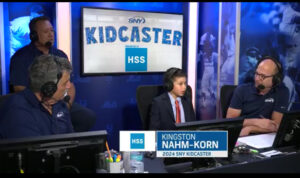 King Korn, 2024. The Kidcaster came on in the fourth. The kid catcher came through in the ninth. No kidding — that was fun.
|
|






