The blog for Mets fans
who like to read
ABOUT US

Faith and Fear in Flushing made its debut on Feb. 16, 2005, the brainchild of two longtime friends and lifelong Met fans.
Greg Prince discovered the Mets when he was 6, during the magical summer of 1969. He is a Long Island-based writer, editor and communications consultant. Contact him here.
Jason Fry is a Brooklyn writer whose first memories include his mom leaping up and down cheering for Rusty Staub. Check out his other writing here.
Got something to say? Leave a comment, or email us at faithandfear@gmail.com. (Sorry, but we have no interest in ads, sponsored content or guest posts.)
Need our RSS feed? It's here.
Visit our Facebook page, or drop by the personal pages for Greg and Jason.
Or follow us on Twitter: Here's Greg, and here's Jason.
|
by Greg Prince on 5 July 2012 3:50 am When the Mets receive a really good start, as they did on Tuesday night, or plate a whole lot of runs, as they did on Tuesday night — or if they do both (Tuesday night again) — then they’re pretty damn unbeatable. I guess you could say that for any club in receipt of those happenstances, but we’ve seen it enough lately when Dickey or Santana or, increasingly, Niese pitches so that it’s almost a Met thing. Same for when they get such a plethora of two-out hits that you don’t notice the runners left behind when the third out comes.
But when the Mets get a start that’s really good and then just…stops; and when the Mets get hits but not enough of them in succession; and when the other team’s pitcher is the last guy you want to see show up in the middle of the season almost being owed a win for his trouble; and, finally, when Miguel Batista…
Miguel Batista. Tim Byrdak. Jeremy Hefner. These men and their companions are more or less the Budweiser bullpen, for when you’ve said the names of multiple Met relievers in recounting how a sixth-inning 2-0 lead became a nine-inning 9-2 loss, you’ve said it all.
The record will show it was Chris Young who had the lead and lost it along with the game when he allowed two too many flies. While Keith Hernandez was marinating lamb and consigning half the population to salad duty, Ron Darling was eerily prescient in letting us know Young was about to be skewered by a Phillie lineup that had seen enough of him to grill him but good. Out went Young, the Mets trailing, 3-2. In came Batista, like that would be a solution to anything. Then Byrdak, asked to do something besides retire one lefty. Then Hefner, who is no longer with us in the Metropolitan sense.
Then it was 9-2, with New York abstaining (courteously) from scoring since the fifth and that, as Thomas Jefferson assured John Hancock 236 years ago yesterday in some city relatively nearby, was all she wrote.
Ya wanna be a pal about it, and not spit too much marinade over an ostentatiously crummy final score that’s kind of an outlier in the feelgood context of what the first 50.6% of this season has been. Plus, sooner or later that fella on the mound in the offending colors was going to change that conspicuous “0” of his to a “1” where the W’s are concerned. His name is Clifford Phifer Lee and the loss column is not his home.
I looked up after five innings and noticed the Mets had totaled two runs on seven hits, with one of the hits being a solo home run, meaning too few runs were being produced in conjunction with so many hits. That might have been a function of the Mets not taking advantage of opportunities — or it might have been a function of Cliff Lee extricating himself from potential trouble before remembering how to avoid danger altogether. You can tell yourself the Mets are averaging 6.5 runs per game in this series and you wouldn’t necessarily be kidding yourself.
But there’s no excusing that bullpen, where the cast changes but the sense of dread as the final act opens never dissipates. Out goes Justin Hampson. Out goes Jeremy Hefner. In comes Pedro Beato. Back will come Frank Francisco soon enough. Parnell will have his ups and downs. Byrdak will have his ups and downs. Rauch will have his downs and ups. Ramirez…you know how every couple of winters we get some “sleeper” or “hidden gem” in whatever deal occupies our attention for 20 minutes? That was supposed to be Ramon Ramirez. I knew it wouldn’t be. I’d love to provide a link to prove I knew this in December, but the acquisitions of Ramirez, Rauch and Francisco didn’t seem worth commenting on, because I knew at least one of those guys would be hit and miss, the other would be stop and go and the third would just suck out loud. Since all the smart money was on Ramirez to be “the steal” in the Andres Torres deal, I assumed it would be him.
It’s always that guy. It’s been that way since Gene Walter was going to be death on lefthanders and it stayed that way clear through interesting weapon/real find/however they overhyped Sean Green. Ramon Ramirez? In through the out door, buddy.
The subject of Miguel Batista speaks for itself.
Even the bullpens we remember with revisionist fondness required injections of helium to stay afloat in the Julys and Augusts of their discontent. The 1999 Mets of relatively sainted reliever memory actually needed Billy Taylor badly enough so that they traded Jason Isringhausen 300 saves ahead of his time. It (like obtaining the ineffective Chuck McElroy) wasn’t crazy, it just wasn’t thought through. The Mets were loading up on bullpen help a year later despite the pretty good unit of Benitez, Franco, Wendell and Cook, reaching out for Rick White. The ’06 Mets, whose bullpen was, in case you’ve forgotten, a strength as they were building an insurmountable lead, were likely going to grope around for an extra arm even if Duaner Sanchez hadn’t hailed that cab in Miami. Duaner had stopped being invincible by late July, same for Heilman. You know one way or another Omar Minaya was going to find a reason to lunge for and come up with Roberto Hernandez redux and/or Guillermo Mota.
I seem to be off on one of my historical rambles here, but the point is even good Met bullpens need reinforcements if there’s any hope of contending, let alone winning — and this isn’t a good Met bullpen.
Oh, and as for contending, let alone winning, I have to confess I’m still grappling with that concept where our favorite baseball team is concerned. On a day like the Fourth of July, one was tempted to think it’s a bad bullpen that stands between us and Washington or us and leading the Wild Card pack instead of being jammed within the first tier of challengers. That’s until you look around at the catching and the outfield and the persistent question marks or at least ellipses that define much of the infield at any given moment and, oh yeah, Chris Young and that six-inning problem Ron Darling told us about in the seventh when he should have told Dan Warthen about it after six (though that would have meant earlier exposure to Batista, so who knows?).
The larger issue is the Mets…contending? The Mets…maybe winning? The Mets…seriously?
Seriously?
It wasn’t until we arrived at the halfway point of the schedule having won several more games than we’d lost and having lost many fewer games than most of the league that I was forced to do something it hadn’t even occurred to me that I might have to do: take the Mets seriously.
It’s a strange situation for a Mets fan to be in or at least to realize he’s in. The whole point of these baseball seasons is to want your team to win so often that of course you’re thinking about them winning it all. That’s the goal. That was the goal for me when I was a kid and not such a kid anymore. I always thought in those terms, certainly in a desired outcome sense. Even in the truly awful years, I wanted, in February, to see my way through a thousand obstacles to October, no matter that I’d be disabused of my most fanciful notions by the second week of April.
With these Mets at 44-37 after 81 games (now 44-38 after one more) and every day in proximity to a playoff spot, how could I not be thinking that there’s at least a possibility of greater things? I look at the standings. I check the schedule. I think about advancing at the close of every night’s business.
Yet honest to god, I really haven’t considered that it might lead where you’re supposed to be focused on it leading. I haven’t considered that by having one of the two best non-division title records in the National League, we’d be in the playoffs. I understand it statistically but I haven’t made sense of it. I see us within striking range of the Nationals, and I want us to make up ground on them, but I haven’t really put the pieces together in such a way to understand that that would mean we’d be in first place, and if we stayed there, we’d be a division champion and in those playoffs. Forget about calculating that a playoff berth qualifies you to keep playing and keep winning.
There’s a disconnect here. I’ve seen these Mets win at a respectable pace. I don’t see any other team being demonstrably better. I see Dickey every fifth day and Santana every fifth day and Niese every fifth day and Young for six innings every fifth day and Wright every darn day and a net positive from all those other guys who don’t seem to add up to much, yet there they are more often than not getting the job done…and I still don’t see it.
I want to see it, I think. I say “I think” because the bigger deal to me is not that I haven’t seen it but that I hadn’t even allowed it to enter my mind until 81 games were played.
As best as I can figure, I’ve never fully gotten over the denouement to the 2007 season, the spillover effect into the first half of 2008, the way the conclusion of 2008 sequeled 2007’s, the destruction of Shea, my initial dismay with Citi, everything about 2009, much about 2010, the sense I was being sold a bill of goods during 2011, all the Madoff stuff coalescing to make retaining Reyes prohibitive and those stupid Underdog shirts in Spring Training this year. The accumulated avalanche of ill will buried my “We Can Do It!” instinct to the point where digging it out didn’t seem worth the bother.
This season’s refreshing and resilient breeze, however, blew enough of the debris away so I was able to find my Met enthusiasm and feel it in ways I hadn’t since roughly the first half of 2007, yet the instinct’s been pretty badly bruised. I’m cheering mostly without inhibition again. I’m cautiously upbeat again. I now and then notice I’m expecting the Mets to win again, which is so much better than waiting for the next thing to go wrong. But I can’t quite push myself into believing they will continue to win enough so that “winning it all” remains in sight. It transcends the second-half dropoffs of recent vintage. It’s looking at the Mets and not being capable of seeing a team that you automatically take seriously in accordance with a seriously not bad or dare I say good record. Perhaps five years of self-defeating performance on, off and around the field has infected my instinct to believe. How could the Mets possibly win a playoff spot, a playoff series, a pennant or more when they’re…you know…the Mets?
I’m trying to catch up to my team. I just hope my enthusiasm doesn’t well surpass their reality by the time I do. Trust me, it’s more than a bad bullpen that’s holding me back.
by Jason Fry on 4 July 2012 1:12 pm 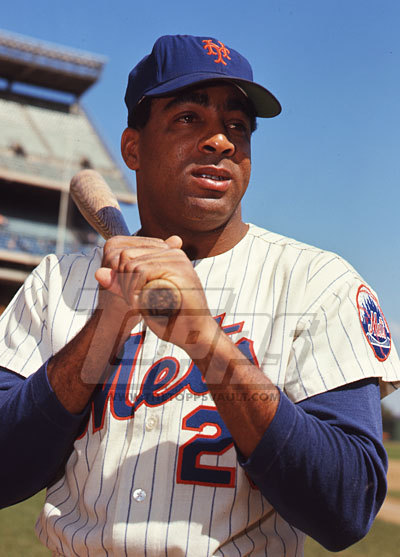
The latest batch of old photos auctioned off by Topps on eBay includes this gem — a shot of World Series hero Tommie Agee taken at Shea in 1970, if Topps’s records are to be believed.
The Topps Vault, as it’s called, has yielded lots of gems — I bought a photo of Hank McGraw, Tug’s brother, though I missed out on a Dave Schneck photo originally labeled as John Stearns. (Plus there are ironic gems — from the plane in the background to Stork himself, this George Theodore picture might be the most mid-70s Mets photo ever.) But this one is particularly great — I love the fact that Agee’s bat is pointing to more or less the exact spot where he hit the only fair ball to land in the upper deck at Shea, an April 10, 1969 shot commemorated with a marker in the old rattletrap’s final years.
Anyway, as you were. We won last night. With luck we’ll win again today. There’s 1776 and 1964, and the Hot Dog Eating Contest, and lots more. Happy 4th!
by Jason Fry on 4 July 2012 1:58 am So that was awesome.
An 11-1 pasting of the Phillies would be awesome any time.
An 11-1 pasting of the Phillies before a huge crowd is even more awesome.
An 11-1 pasting of the Phillies to finish the halfway point of the season on pace for 88 wins is more awesome still, particularly since the Phils are in the basement and shopping their players.
That said, we may as well break out the caveats. (Don’t worry, I promise this post gets fun again later.)
First off, the big crowd was there for postgame fireworks — the Mets said it was the biggest crowd in Citi Field history, but they’ve said that before and I get the feeling they’ve built a certain amount of elasticity into stadium capacity so they can keep trumpeting increasingly meaningless declarations.
Second, and of more note, the Mets looked somewhere between not bad and very good at the midpoint of the last three seasons too.
I’m sorry to say it, but it’s true. You could look it up.
In 2009 the Mets were a surprisingly OK 39-42 at the halfway point, four games out of the division lead. They went a horrifying 31-50 the rest of the way.
The 2010 Mets were a robust 45-36 at the midpoint, three games out of first and alone as your wild-card leaders. They stumbled home an anemic 34-47.
The 2011 Mets hit the midpoint with a glass-half-full 41-40 mark, three games out of first. They went a glass-mostly-empty 36-45 for the duration.
I know I’m being no fun, but this has been in the back of my head every time I fall in love with this year’s girl-with-a-curl club. They’re gutsy and resilient and promising and likeable, they really are … but I thought the same things in previous Julys about squads that included the likes of Omir Santos and Henry Blanco and Willie Harris, teams that have not gone down in our collective memory as particularly beloved. The second half of the season is when young players get fatigued, when BABIPs and FIPs regress to the cruel mean, when thin ice skated over finally cracks.
Can the Mets make October? Of course they can — I’m not sold on the Nationals, the Braves have plenty of their own problems, the Marlins are a disaster and the Phillies’ window may have slammed on their fingers faster than we thought. Not to mention there’s not one but two wild cards to play for now. But if the Mets stumble on the way to October and you’re surprised, well, you’ve forgotten recent events.
And with that, let’s get back to everything that did go right — which tonight was quite a lot.
There was Ruben Tejada, setting the tone immediately with a tough 11-pitch at-bat that resulted in an out, but also made Vance Worley work a lot harder than he wanted to, and gave everyone in the Mets’ dugout a good look at his pitches. Ruben was 3-for-4 the rest of the way and played sparkling defense, continuing his apparently trouble-free comeback from his injury and a season that could end with him as an emerging star. That’s something I find particularly gratifying, since I’ve believed in Tejada ever since he came up, and have enjoyed watching him get better and better seemingly every month. He reminds me of Edgardo Alfonzo — a player we saw grow before our eyes, and turn into a sure-handed fielder and deadly hitter with unerring instincts.
Daniel Murphy had a terrific game too, continuing to hit and contributing in a leaping grab of his own, part of our middle infielders’ plan to torment grasshopper-legged Hunter Pence whenever he tried to line one over the infield. The lone disappointment was that Murph didn’t collect the homer he needed for the cycle, settling instead for a two-run double and two RBIs in his final at-bat. (If he played in San Francisco, Giants fans would have tried to vote it into a home run.) On the subject of Murphy, his airborne leap for Pence’s liner was a useful reminder of something I tend to forget. Murph doesn’t have a lot of power, lacks a steady glove afield and strikes us as a lunch-pail scrapper compared with more accomplished teammates. But to snag Pence’s drive, he leapt higher than I could jump if I started out standing on my coffee table. When it comes to hand-eye coordination, fast-twitch muscles and other genetic gifts, Daniel Murphy and are barely the same species.
And David Wright was David Wright, from his thoroughly improved glovework at third to his booming homer into Apple Land late. (If you’re wondering, Pedro Sandoval went 1 for 2 tonight in a loss to the Nationals, an accomplishment Giants fans rewarded by voting that he get the key to the city.) Wright’s heroics were more impressive not only statistically but also morally: His fine fielding took a hit away from Shane Victorino, and whenever something bad happens to Shane Victorino, God creates a kitten.
And then there was Jonathon Niese, who shrugged off a second-inning summertime home run from Chico Ruiz to allow just two more hits over eight innings. Since the Come to Jesus session with Dan Warthen, Johan Santana and R.A. Dickey that followed Niese’s disaster in Toronto, he’s 6-1 and has lowered his ERA from 4.85 to 3.35. Like the previously discussed teams, Niese has had a history of second-half fades. But his recent run of success suggests he may be figuring it out.
And history isn’t destiny — as any broker will tell you, past performance is no guarantee of future returns. The Mets are 44-37, fun to watch, easy to root for and worth investing hope in. Those 42,000 folks who got in-game fireworks before the postgame variety had to have noticed that. Here’s hoping they’ll be back — and that the guys down there on the field are too.
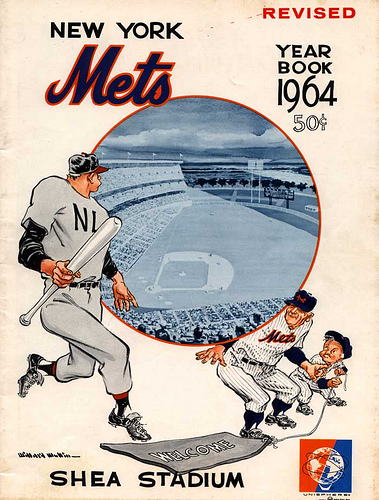
by Greg Prince on 2 July 2012 1:22 pm  Wednesday night, the Fourth of July, you’ll want to pause your annual viewing of 1776 to be reminded of another year that made our country great: 1964, as SNY debuts Mets Yearbook: 1964 at 6:30. As every Mets fan was taught in school, our ballpark was founded in 1964, sewn together from patches of orange and blue by team seamstress Betsy Ross, with the white stripes perfectly laid in by colonial groundskeeper Pete Flynn. Wednesday night, the Fourth of July, you’ll want to pause your annual viewing of 1776 to be reminded of another year that made our country great: 1964, as SNY debuts Mets Yearbook: 1964 at 6:30. As every Mets fan was taught in school, our ballpark was founded in 1964, sewn together from patches of orange and blue by team seamstress Betsy Ross, with the white stripes perfectly laid in by colonial groundskeeper Pete Flynn.
I may be confusing my patriotic folktales, but in any event, the highlight film that includes the opening of Shea Stadium is the highlight film that is not to be missed. If your DVR is like mine, it can handle two simultaneous recordings, which I mention because at the same time SNY shows 1964, TCM shows 1776. The greatest movie musical ever made airs there on the off chance you don’t already own the director’s cut on DVD. 1776 (or America Yearbook: 1776, as I’ve come to think of it) has been regularly anticipated Fourth of July viewing here since 1991, and its 22nd consecutive annual screening is as anticipated as all the others before it.
But I’m really looking forward to Mets Yearbook: 1964 to find out whether those escalators they mentioned in 1963 pan out.
Image courtesy of “Mario Mendoza…HOF lock” at Baseball-Fever.
by Jason Fry on 2 July 2012 12:48 am The o gers’ lone concession to competitiveness Sun ay night was sen ing the rather won erful Clayton Kershaw to the moun , but in the early going not even a Cy Young awar -winning lefty with an evil curveball was enough to ispel the funk that’s settle over o ger Sta ium for the last week — a week that ha seen the o gers possess a lea for a gran total of zero innings. The reason the collapse continue in those early frames? Mostly it was the presence of the luckless ee Gor on, son of Tom. He’ll be goo one ay, but right now he’s as ma ening as young players often are, a rather immature fiel er with his heart stuck on his sleeve to an unhealthy egree. The Mets an o gers were tie at 1-1 in the thir when Gor on turne an inning-en ing ouble play into a fiel er’s choice an a run-scoring error by heaving the ball into the ugout. Was Ruben Teja a further en earing himself to Mets fans with a nifty take-out sli e at secon , you ask? Nope — Gor on just messe it up. Then he promptly messe up the next play too, pulling James Loney off the bag — an Loney contribute a mini- avi Cone by arguing with the ump while avi Wright scampere home with a thir run.
It was enough to rive Kershaw to rink — but if he’ waite a few innings, he might have hit the town with illon Gee, who was un one by his own efense.
That first o ger run came on a Juan Rivera ouble over Lucas u a’s hea — a ball that most right fiel ers woul catch, but u a was frozen for a fatal secon an then lumbere after it to no avail, with the ball plopping own on the e ge of the warning track. Unfortunate, but as his own manager will attest, u a isn’t a right fiel er. Unless they eci e to shift him permanently to left (which woul n’t be a terrible i ea provi e it’s a one-way trip), the Mets will just have to live with such things.
What they shoul n’t have to live with is Ronny Ce eno making painful errors too. In the fifth, Ce eno turne Tony Gwynn Jr.’s attempt to hit into a fiel er’s choice into an all-han s-are-safe affair, failing to erase Juan Uribe at secon . Two hitters later, the Mets gave L.A. another extra out (an a run) when Justin Turner muffe Gor on’s little bouncer at first. Another run came in, an Gee ha given up three where he i n’t eserve to have surren ere any.
An , well, you ha the istinct impression this one wasn’t going the Mets’ way. There was Gor on, running wil in an effort to atone, an Kershaw hol ing the fort, an the Mets’ bullpen in too early for the walls not to start blee ing. Though give the pen mil cre it: With one out an the bases loa e in the seventh, Miguel Batista got Rivera to hit a little comebacker his way. Batista scoope it up an threw it to Mike Nickeas, waiting not terribly far away an rea y to continue what sure looke like an inning-en ing 1-2-3 ouble play, leaving the Mets own just 4-3 an with a puncher’s chance.
The ball went right by Nickeas. Of course it i . After all, it’s har to win baseball games when you’re lacking a certain something that’s conspicuous in its absence, something you take for grante an on’t miss till it’s gone an you realize how often you epen on it.
Long plane ri e back through the night — but a ay off tomorrow. Which is best, because I think it’s safe to say all of us involve — 25 guys in blue an orange an several million frustrate rooters — coul use a blank spot on the sche ule.
by Greg Prince on 1 July 2012 3:54 pm I guess I should be more up in Panda arms over David Wright not starting the All-Star Game despite his being not just a better all-around third baseman but probably a better cuddly zoo animal than Pablo Sandoval, yet given the system that produced this silly result, it’s funnier than it is an outrage. David Wright is all-world in 2012 (.355/.449/.564) and a candidate for both MVP and Comeback Player of the Year (if Johan Santana doesn’t win the latter and R.A. Dickey capture the former). Pablo Sandoval is all-nickname and has a momentarily rabid fan base behind him, one that likes hitting “send” a lot. Sure you could get outraged, but why anger at something so clearly farcical? David will show up, be the great team man he always is, enter the game when he is needed and probably get a couple of hits to secure the Mets home-field advantage in the World Series.
Congratulations to the National League for knowing enough to notice it has one of the best third basemen of the past quarter-century in its midst and tap him as a reserve. And same regarding R.A., who should not start the game only if he takes a vow of solidarity to sit with David for a couple of innings. Would have been nice if Johan could be there, but the pitching staff is crowded and he could always use his rest.
Parochial view, but it also has the benefit of truth to it.
by Greg Prince on 1 July 2012 9:46 am I used to watch my team’s games and hope for the best in the vaguest sense of the word. Then June 2012 came along and on its very First night, I received the best. I received the best thing a June game could give. I received the one thing I’d been waiting for my entire life.
Johan Santana tosses first no-hitter in Mets franchise history
And everything changed.
I was so enraptured by that First Night of June that I almost didn’t notice that on the Second afternoon of the month, I got a pretty good day to go with it.
R.A. Dickey shuts out Cards the day after Johan Santana’s no-hitter
Then, five days after that, when I was moping over how my team had reverted to the kind of form that made hoping for the best an exercise in low expectations, the Seventh Afternoon of June assured me a pretty good day
R.A. Dickey first pitcher to nine wins as Mets avert sweep
It was easy to overlook, however, because the next night, the Eighth Night of June, was pretty brutal.
Robinson Cano homers twice as Yankees rough up Johan Santana
There’d been so much hand-wringing on what would happen on that night, particularly by the manager (fretting as he did over all the effort that had gone into giving me the one thing I’d been waiting for my entire life), that you could almost feel it coming. What maybe you couldn’t see coming is what happened five nights later, on the Thirteenth Night of June.
R.A. Dickey allows one hit as Mets topple Rays
This one felt on a par with that First great night of June, which is saying something, because that First great night of June — and forgive me my repetition — is what I’d been waiting for my entire life. This wasn’t quite that, but to say it was almost as good doesn’t do it justice. If it wasn’t what I was waiting for, that’s probably because I had never thought to imagine something quite like it.
And everything changed again.
I was so enraptured by that Thirteenth Night of June, I almost didn’t notice that on the Fourteenth afternoon of the month, I got a different kind of good day to go with it.
Kirk Nieuwenhuis has first career multihomer game as Mets sweep Rays
Lost in the headlines over the big Mets win was the poor performance put forth by the guy who started the month. Then the euphoria attached to these various wins was lost in another momentum-killing swoon. Yet just when I was about to mope as I usually moped, there was what transpired on the Eighteenth Night of June.
Mets’ R.A. Dickey K’s 13 in second one-hitter in row
It was as if an encore had been arranged. It was as if this kind of result and gratification was something you could expect in the way you had trained yourself over a lifetime to expect the worst when you hoped for the best. Now you were almost expecting nothing but the best every five or so nights. You didn’t want to feel entitled, but it wasn’t that kind of expectation. It was the expectation of anticipation…which in itself was almost the reward. You couldn’t wait for what would happen next.
But while I would wait, there’d be another reward on the Nineteenth Night of June.
Johan Santana leads way as Mets blank Orioles for 2nd straight night
Before the First Night of June, you’d have been overjoyed by this kind of evening, for it reminded you of resiliency and determination and indefatigable excellence. Now you were appreciative…but you were mostly hung up on the guy from the night before and what his next outing, on the Twenty-Fourth Night of June, might bring.
Robinson Cano HR lifts Yanks by Mets in Subway Series finale
There’d been so much hyperbolic chatter regarding what would happen on that night, that you could almost see it coming. You were forced to write it off as just one of those things, same as you did the next evening, the Twenty-Fifth Night of June.
Travis Wood, Joe Mather lead way as Cubs down Mets
The entire episode was a disappointment, though embedded in the episode were some satisfying scenes from the guy who had kicked off this month in such high style. Even as his team crumbled around him, he was all right. In another month, “all right” would have been OK…or vice-versa. It’s just that your hopes and your sights had been raised so very high by the so many highlights you had absorbed since the First Night of June.
A couple of which were still to come.
Mets’ R.A. Dickey beats Dodgers, is majors’ first 12-game winner
Yes, your sights had been raised to something like that, something like what you were privileged to stay awake and witness late on the Twenty-Ninth Night of June. And they stayed just as high on the final night of what had been — overall pedestrian team record aside — one of the most magical months through which you as a Mets fan had ever lived.
Johan Santana helps blank Dodgers for 5th time in 6 games
By the Thirtieth Night of June, you could ask for no more. Except, perhaps, whatever July had in store.
THE WONDERS OF JUNE 2012
JUNE 01, 2012: 9.0 IP, 0 H, 0 R, 0 ER, 5 BB, 8 K (J.S.)
JUNE 02, 2012: 9.0 IP, 7 H, 0 R, 0 ER, 0 BB, 9 K (R.A.D.)
JUNE 07, 2012: 7.1 IP, 4 H, 0 R, 0 ER, 2 BB, 8 K (R.A.D.)
JUNE 08, 2012: 5.0 IP, 7 H, 6 R, 6 ER, 1 BB, 5 K (J.S.)
JUNE 13, 2012: 9.0 IP, 1 H, 1 R, 0 ER, 0 BB, 12 K (R.A.D.)
JUNE 14, 2012: 5.0 IP, 6 H, 4 R, 4 ER, 4 BB, 6 K (J.S.)
JUNE 18, 2012: 9.0 IP, 1 H, 0 R, 0 ER, 2 BB, 13 K (R.A.D)
JUNE 19, 2012: 6.0 IP, 4 H, 0 R, 0 ER, 2 BB, 5 K (J.S.)
JUNE 24, 2012: 6.0 IP, 5 H, 5 R, 5 ER, 3 BB, 3 K (R.A.D.)
JUNE 25, 2012: 6.0 IP, 5 H, 2 R, 2 ER, 3 BB, 6 K (J.S.)
JUNE 29, 2012: 8.0 IP, 3 H, 0 R, 0 ER, 1 BB, 10 K (R.A.D.)
JUNE 30, 2012: 8.0 IP, 3 H, 0 R, 0 ER, 2 BB, 3 K (J.S.)
by Jason Fry on 30 June 2012 2:14 am …because we’re running out of them for R.A. Dickey.
The already-undermanned Dodgers had no chance against a knuckler that was once again unhittable. None whatsoever. The degree of their no-chanceness was such that for a good part of the night we were all grousing about whatever happened to Andres Torres out there on Aaron Harang’s pop fly in the third. Harang’s hit fell in, to the visible irritation of Dickey, as Torres seemed either not to see it or not to react the way you need a center fielder to react. The Dodgers didn’t collect another hit until A.J. Ellis singled in the seventh, which was something of a relief under the circumstances.
(Man, give a fan base a no-hitter every half-century and we immediately get all entitled.)
But then watching R.A. makes you feel like perfection’s within your grasp.
He pitched beautifully, once again, resuming where he left off before that hiccup against Satan’s insurgents. He’s 12-1, with a shot at going into the break (and one presumes the starting assignment for the All-Star Game) with 13 wins. He struck out 10 for the fifth time this season. His numbers in June: 5-0, 0.93 ERA, three complete games.
He can hit too — he put together an intelligent at-bat against Shawn Tolleson in the seventh, singling up the middle.
Oh, and he defends his turf the way the Mets haven’t done in years. After Aaron Harang ended his evening with a suspicious plunking of Ruben Tejada, R.A. waited for the opposing shortstop, Dee Gordon, and hit him in the fanny. Glowers, warnings issued, point made and taken, everyone moved on.
And that’s just what we saw. Between innings perhaps he was improving his calligraphy, or composing a heartbreaking sonnet that works in both English and Latin, or experimenting with cold fusion. He’s R.A. Dickey — I wouldn’t put anything past him.
Nor would I put much past the Mets right now — as is their recent pattern, they’ve followed a frustratingly narcoleptic string of games by walloping the tar out of any team foolish enough to get in their way. Tejada went 4 for 5, continuing his marvelous breakout season, Daniel Murphy slammed another homer, and David Wright started the scoring and made a couple of sparkling plays in the field. It’s an excellent time for another Mets manic phase — the Dodgers are trying to stay afloat until Matt Kemp and Andre Ethier return, the Phillies are teetering on the brink of irrelevance, and the Cubs suck. This is the soft underbelly of the schedule, and here’s hoping the Mets go Wild Kingdom on it.
Which isn’t to say they will, of course: The Mets look alternately like world-beaters and the downtrodden of the Earth, and I’ve decided the truth is that they’ve found the most exciting way to demonstrate that they’re somewhere in between. But that doesn’t apply to Dickey. His rare bad starts are just Amish stitches, humanizing demonstrations of fallibility. And increasingly when he starts, his teammates look on point in a Johanesque way. As with Johan, everyone else involved understands the man on the hill means business, and they’d better live up to his example.
by Greg Prince on 29 June 2012 4:52 pm Gosh, I hope the passage directly below doesn’t came back to haunt us tonight as R.A. Dickey of the Mets faces Aaron Harang of the Dodgers. Not that there’s anything nasty about what one of the starters said about the other, but the last time something less than flattering about the L.A. club appeared under a Met pitcher’s byline, the Dodgers were next seen torching David Cone and turning a playoff series irrevocably around.
Thank you, Aaron Harang, wherever you are. I don’t mean this flippantly, or obnoxiously. I mean it sincerely. I’ve never met Aaron Harang, a pitcher for the Padres, but he gives me a lift today and doesn’t even know it. Whenever I have a rough outing — and a I have a brutal one here today — I have a strange custom: I go on my laptop and surf baseball Web sites until I find somebody who had an even worse day than me. It’s not that I delight in other people’s misfortune; it’s just that misery does like company, and after my eighth start of the year I am definitely looking for somebody to point to and say, “Hey, this guy’s a respectable pitcher and he got lit up too.” Harang gave up nine hits and seven runs in four and a third innings against the Rockies. Today he supplies the comfort.
I feel less miserable for knowing this.
That’s R.A. Dickey in one of the 2011 interludes in his memoir, Wherever I Wind Up, recounting the atrocious afternoon he experienced at Minute Maid Park on May 14 of last year. It had indeed been a pretty bad day, dropping his record to 1-5 and inflating his ERA to 5.08. Even yours truly — who’d been nothing but smitten by him since he started surprising us in 2010 — made like an Astro and took a few swings:
We love him for his silver tongue, but only because it’s attached somewhere deep within his Dickeyness to his right arm. Well, we used to love his right arm, but lately the affection has been diminished. Our R.A. romance hinges upon his being a character we can root for: bedevils batters then charms reporters. That’s the bargain.
He’s not living up to the half that counts in the standings.
Sometimes you write something that reads as rather inane in hindsight. I’ve been writing here for eight seasons, so I have a few of those in the archives. This feels particularly stupid to me, not because R.A. — who inflamed my ire that Saturday not so much by pitching badly but by creeping to the edge of blaming his fielders for the base hits he gave up — is an all-world pitcher a year later, but because I rather cavalierly dismissed the way he expresses himself, as if he should only grunt “yep” or “I’uhno” after a loss.
Such a line of thinking proved particularly stupid on my part because once you’ve read Wherever I Wind Up, you realize he is the way he is, no matter how he’s pitching. And bless his heart for being who and what he is, because he’s clearly one of the most compelling characters to ever pull on a Mets uniform.
That we wouldn’t care very much about those personal qualities if he wasn’t getting batters out is beside the point. Of course we wouldn’t. We’re fans. That’s fine. We wouldn’t give a damn what Jon Rauch was Tweeting if he wasn’t on the Mets. We wouldn’t ponder Jason Bay’s headaches if he wasn’t on the Mets. And we wouldn’t get caught up in a singular personality like R.A. Dickey’s if he wasn’t on the Mets and winning like crazy for the Mets.
Though that would be our loss, at least a little.
The subtitle of Dickey’s book mentions “authenticity” and Wherever I Wind Up has plenty of that. It’s a collaboration with Daily News sportswriter Wayne Coffey, and it’s pretty easy to detect what comes from the pro and what comes from the pitcher, but Dickey’s voice is in abundance. What we hear is a guy who was publicly doubted in his profession in ways most of us never are and a guy who overcame the doubts after a long, arduous and humble journey. There’s no triumphalism about Dickey making it in New York after being disregarded by the rest of baseball. Really, there’s very little sense of his having succeeded or reached the end point of the journey. There’s a part of him on display that can’t quite believe he’s indisputably traversed that rubicon.
There’s also a part that seeps through, almost as subtext, that says R.A. Dickey is not a fluke, no matter the pitch he throws and the time it took him to learn it. It’s not as if he wandered out of an English lecture, shed his tweed jacket and decided to pick up a baseball for kicks. This guy was, from childhood on (and what a childhood he reveals), a jock. He doesn’t make a huge deal of it, but we might forget that even this most articulate of athletes is, in fact, an athlete: played all the sports in school, competed in the College World Series, made the Olympic team, was drafted in the first round by Texas. Once his ulnar collateral ligament was discovered to be AWOL, however, it was as if fate’s wires got crossed. In Metsian terms, I’d liken it to the 2006 NLCS: we were supposed to win the pennant, go to the World Series, be world champions and reign happily ever after, or at least have an era to call our own.
Dickey should have had it better than slogging through brief auditions in the majors and toiling season after season in the minors (“the mayor of Oklahoma City” was an office he didn’t seek but it became his unwanted nickname). Then again, if the Rangers don’t notice the picture in which his right arm isn’t hanging the way it’s supposed to…and he’s not thoroughly examined…and his bonus isn’t rescinded…then there’s no redefining struggle — physical as well as spiritual — to make him who he became and, well, then there’s no book. Surely there’d be no R.A. Dickey Met story. Maybe if all is well with that UCL, he gets his money early, he has a good or great career and he’s just some guy on Texas you might pick for your fantasy team.
And maybe if Pedro doesn’t go down and El Duque doesn’t have the calf issue and Trachsel isn’t distracted by marital problems and Wright doesn’t almost completely stop hitting and Duaner Sanchez doesn’t get in a cab, then Yadier Molina is just a swell defensive catcher and we all have framed photos of Carlos Beltran covered in Canyon of Heroes ticker-tape hanging in our dens.
You know how that goes, even if we don’t know exactly what we’re talking about when we talk about the baseball players we watch and criticize and subject to too much HE SUCKS! and maybe too much HE ROCKS! One of the most bracing passages in a book filled with them finds R.A. in a bookstore thumbing through a season preview from not too many springs ago. The authors couldn’t have been quicker to write off this Dickey person as an “alleged prospect,” a “marginal righthander” and someone “who has given no indication that he’s ever going to amount to anything.”
Dickey went on with his career and made the most of it. Everything happened for a reason, and these days it’s happening happily for the guy. You read Wherever I Wind Up, you’ll be glad for him, and not just because he’s 11-1 with a 2.31 ERA as a New York Met.
(Let’s just hope Aaron Harang waits until the offseason to purchase a copy. You never know what’s gonna motivate these fellows.)
by Greg Prince on 29 June 2012 9:48 am The more you watch baseball and the more you mature as a person, the less you are inclined to blithely dismiss the people who play the game in a glib, pejorative fashion. For example, it would have been shallow and unfair of me to have thought, in 2011, “My god, Chris Capuano and Chris Young are two of the most boring people I’ve ever seen pitch for the Mets.”
But I kind of thought so anyway. I was just a callow lad of 48 back then.
At the wised-up age of 49, I see the Chrises for what they are: calm veteran presences who have persevered through injury and recovery, using their wiles and wits to retire batters because their arms will never be what they were when they younger, yet their guts and guile more than make up for it. Sure they’re incredibly low-key and almost never said anything particularly interesting for public consumption when they were teammates — with Young going out for the season early and Capuano muddling through the schedule in a state of mostly mediocrity — but each is pitching at the top of his craft presently. We certainly are lucky to have Chris Young adding gravitas to our rotation; watching him outduel Chris Capuano, who is excelling in his post-Met incarnation, was a real treat Thursday night.
And I’m sure the only reason I kept nodding off on them was the West Coast start time.
|
|