The blog for Mets fans
who like to read
ABOUT US

Faith and Fear in Flushing made its debut on Feb. 16, 2005, the brainchild of two longtime friends and lifelong Met fans.
Greg Prince discovered the Mets when he was 6, during the magical summer of 1969. He is a Long Island-based writer, editor and communications consultant. Contact him here.
Jason Fry is a Brooklyn writer whose first memories include his mom leaping up and down cheering for Rusty Staub. Check out his other writing here.
Got something to say? Leave a comment, or email us at faithandfear@gmail.com. (Sorry, but we have no interest in ads, sponsored content or guest posts.)
Need our RSS feed? It's here.
Visit our Facebook page, or drop by the personal pages for Greg and Jason.
Or follow us on Twitter: Here's Greg, and here's Jason.
|
by Greg Prince on 8 May 2012 10:17 am But, Marge, that little guy hasn’t done anything yet. Look at him. He’s going to do something and you know it’s going to be good.
—Homer Simpson, “The Twisted World of Marge Simpson”
Mets fans of a certain age…essentially my age…have been giving themselves over to repeated cases of the goose bumps for the last couple of weeks, thanks to the wonders of YouTube and the archival sharing of a fellow traveler named MrMetsfan41 (with a name like that, he has to be good). Their presentation of “1970’s New York Mets WOR-T.V. Channel 9 Game Broadcast Intro,” as aired in 1973 from the looks of it, is setting geese abump and hearts aflutter because it encapsulates everything great about being a Mets fan from when we were allowing the Mets to tighten their grip on our psyches and their hold on our souls.
What I like about it now is the pure nostalgia of it, but what I liked about it then was how contemporary it seemed, especially when the Mets would make a major player move and update the reel. Because the same guys stayed Mets for years at a time in those days, you got used to Jones and Koosman and Harrelson entering to their cues — swear to Gil, I knew exactly when Buddy was going to leap to snare that liner despite not having seen it or much thought about it for decades. The bonus excitement came when the Mets got a Rusty Staub or a Willie Mays (as if there were more than one of each) and inserted a clip of the new star Met doing wondrous Met things. It brought the montage up to date and convinced me our newly reconfigured team was going to be more exciting than ever.
To the hypothetical introductory highlight package of today, please add footage from last night.
Please add Jordany Valdespin socking it to Jonathan Papelbon. Please follow that ball into the right field stands, its flight both instant and eternal. Please evoke the shock that a minor league callup who was a minor league senddown rescued only by physical setback to another Met chose this moment for his first major league hit, a pinch-hit three-run home run that broke a 2-2 tie with two out in the ninth inning in a ballpark where very little good has occurred over the past five years. Please don’t cut away until we see Jordany Valdespin round first base and shake with delight, one innocent fist briefly raised, because for all the standard jockish admonitions to act like you’ve been there before, Jordany Valdespin hadn’t.
Jordany Valdespin was called up to the Mets on April 23, meaning that the Channel 9 clip had been on YouTube longer than he’d been in the big leagues. His presence to date had been noteworthy mostly for his having composed, on April 26, one-ninth of the Mets’ first all-homegrown lineup since 1971. His impact in left field was underwhelming enough so that he was removed from the game before its incredible, unbelievable ninth-inning rally, the one in which Heath Bell threw 46 pitches (13 to Justin Turner alone) in defense of a one-run Marlin lead destined to melt in a steady drizzle of Met patience. Valdespin batted three times that day and one time each on three other days. Nothing good happened in any of those at-bats. When a sequence of events that had nothing to do with any of the several positions he occasionally plays unfolded — Pelfrey out, Schwinden down, Batista shifted, Carrasco required — his preliminary audition seemed to end with a whimper and a demotion Saturday.
But in baseball, things aren’t necessarily as they seem, you might have noticed again and again and again in your life. Ruben Tejada took a great fall on Sunday, landing on the uncomfortably crowded DL, and the Mets needed another infielder pronto. Valdespin was recalled to provide bench depth if not what one would have projected as bench strength in time for Monday night in Philadelphia. The Mets’ strengths are scattered, and their depth as measured by conventional means appears shallow, but in whatever advanced statistic you can rustle up to measure depth of character, I’m beginning to believe they are among the league leaders.
They withstood a revitalized Roy Halladay, for starters. Halladay’s status among the most elite starting pitchers going had come up for examination of late, his velocity not what it once was, his previous outing, against Atlanta, the stuff of the merest of mortals (5.1 IP, 8 ER). Doc Halladay found his cure in the visitors’ dugout. He hadn’t lost to the Mets since…had he ever lost to the Mets? He had, but not for a whole lot of starts. When Howie Rose is invoking Larry Jackson to illustrate an opposing pitcher’s longstanding domination of the Mets, you’re not wrong to assume it will be a quick, painful night. Throw in that wealthy young Jonathon Niese — pitching sometimes like he has to instantly justify his lucrative contract extension — was searching for command and seemed more than a little lost, and you’re pretty sure that if you want to be satisfied by watching the Mets this Monday night, you’re going to have to lean pretty heavily on YouTube.
Yet with Halladay on top of his game and Niese struggling for a while to find his, the Mets weren’t out of it. They were down by two, which can be an enormous deficit for a lineup on Halladay, but these Mets don’t easily submit to the insurmountable. Sometimes all it takes is one perfectly placed hit…say a double just inside the third base line, like the one David Wright snuck into fair territory in the sixth (two batters after Andres Torres worked Doc for his only walk of the night), and you have not a 2-0 blowout but a 2-2 tie.
By then, Niese was done, but honorably so, having not given the Phillies any more than single runs in the first and second. Now, though, it was the Mets’ bullpen’s turn, a unit so strapped for success that it was decided D.J. Carrasco would improve it. Nevertheless, Manny Acosta pitched an easy sixth and Bobby Parnell…
Well, nothing would be easy for Bobby Parnell, who always has this look about him that he’s waiting for something to inevitably go wrong. Maybe it comes from having a dad who’s a firefighter. You know an alarm is going to sound, you know there’s going to be trouble and you grow used to a faint whiff of smoke in the air.
There was trouble. Juan Pierre, a spark to Met flames for a generation, walked to lead off the seventh. Jimmy Rollins, long the personification of Hades, singled. After an out, damnation himself, Shane Victorino, was safe at first on an infield hit. The bases were loaded with three of the least appealing Phillies to ever draw breath (though to be fair, Pierre’s been a turnoff since he was a Marlin).
Parnell gets an irritatingly slow grounder to second out of Hunter Pence. Murphy (c’mon, c’mon, c’mon, get it over there) flips to Turner (I know you’re not really a shortstop, but c’mon, relay it already) who flings to Davis and…
SAFE?
Pence is safe?
No way!
Uh-uh!
I don’t think so, at any rate.
Maybe he was safe, but let’s see that again.
The newfangled, intuitively confusing SNY score box is understandable enough at this moment to post the state of things as 3-2, Phillies. Terry is coming out to argue, though I don’t know what that will do. I really do think Pence beat the play by a distressing hair. Now we’re behind and the bases are still loaded and…
Oh, never mind. It’s a double play, not because Turner’s throw nipped Pence (it didn’t) but because human canker sore Victorino barreled into Turner in the car pool lane of the Ben Franklin Bridge, or nowhere near second base. Interference…lovely interference was called on the Wailuku Pest and all I can say, in the name of Marlon Anderson being thumbed out when sliding much closer to second base in 2007, is fuck you, Shane Victorino, and enjoy it.
So it was 2-2 again. The Mets had a little action in the top of the eighth, but 26-year-old Lucas Duda proved to have feet of lead and hit into a 5-3 double play that a younger man might have beaten out. Thus it was back to Parnell and the visage of dread — his as well as mine. Ty Wigginton singles and augurs the worst if only because Ty Wigginton’s survival as the lone remaining major leaguer to have been a 2002, 2003 and 2004 New York Met proves there is something frighteningly unkillable about this guy. Sure enough, Carlos Ruiz bunts and Parnell practically falls on his face in a futile attempt to make a play. Two on. Placido Polanco bunts and it’s less dangerous but still effective. The same two are on and advanced to second and third. And now it’s Freddy Galvis with another ball that travels a distance calculated as easily in inches as it is in feet.
Parnell pounces. Wigginton approaches. Thole braces.
Parnell releases. Wigginton thunders. Thole snares.
Wigginton…Thole…Wigginton…Thole…
Wigginton is out.
Thole is down.
But Wigginton is out.
Clean play. Clean, hard play. I watched the replay probably a dozen times and looked for a reason to snarl at that Phillie bastard Wigginton, but no, good ol’ Wiggy slides like he does everything: at 100% and a little clumsily. He wasn’t trying to hurt anybody, just beat somebody fair and square. He is the anti-Hamels as a person and a player. Thole’s head was collateral damage amid the tag Josh applied to Ty. Thole plopped to the ground, sort of like Tejada did Sunday, sort of like Parnell did in the seventh. Regardless of the episode, Terry Collins’s people are spending as much time sprawled out on the floor this season as Matt Weiner’s.
Josh, no tender cookie, looked crumbled and had to exit, but he didn’t give up the ball until after the play was over. Wiggy was out, the Mets were closing in on escaping another fine mess. Parnell, having absorbed as much stress as one fatalistic-looking Met reliever could take, exited for Tim Byrdak, who’s sensational when not facing Todd Helton. He fanned Eric Kratz to end the inning.
Wow! So much intriguing stuff! And it was all only prelude to the really big moments.
That’s “moments” plural, because before Jordany Valdespin floated around the bases on a puffy, cumulus cloud of sheer joy, there was the matter of withstanding Papelbon, who inveterate Mets Classics viewers will recognize for his role as the foiled villain in 2009’s “The Omir Santos Game” (as if there was more than one of them). The Red Sock I found hardest to root for, even when the Red Sox were doing things of which I approved, is now a Phillie, which makes him prohibitive to root for…except to fail.
And I gotta tell ya, as soon as Daniel Murphy wasn’t out after three or four pitches, I got a very good feeling about this ninth inning. The Mets are sometimes too shy about swinging, but when their core competency of running long, industrious counts is played to, it takes a ton out of the opposing pitcher. Murphy saw nine pitches. Six of them he fouled off. The last of them he swung through. Yet if there could be said to be such a thing as a productive leadoff strikeout in the ninth inning of a tie game, this was it. Papelbon had worked his ass off. He wasn’t going to be his usual 2012 smooth self out there.
Therefore I wasn’t surprised when Ike Davis and his — what, .032 average? — were walked on six pitches. Ike remains in a state where he begs to be retired, so when you hand him a base, you’re handing yourself a gratuitous heap of trouble. Besides, it was the perfect setup for Justin Turner, who is an ordinary batter except when you really need him. He’s the guy who drove Bell into the ground by refusing to go gentle into that good ninth. He was the guy I wanted up there more than anybody.
But because you can’t immediately get what you want from your baseball instincts, Justin Turner struck out on three pitches. Sometimes you’re sure you know the game, and the game informs you you’re no more the seer than Sgt. Schultz; you know nooothiiing!
Unless you knew that losing lefty-swinging Thole for however long he is out wasn’t going to hurt the Mets as soon as his turn in the order came up. If you knew that, brother/sister, why are you reading this? Why don’t you pick up a MegaMillions as soon as you log off from E-Trade? You have fabulous, fortuitous forecasting ability if you knew righty Mike Nickeas was the man we wanted up there against righty Jonathan Papelbon with two outs. Yet, damn, Nickeas was doing a mini-Murphy, falling behind one-and-two, fouling off a couple until getting something less than Papelbon’s “A” material and belting it to as deep a left as Nickeas is capable of reaching.
“GET ON YOUR HORSE!” I screamed at Ike, forgetting the poor, barely ambulatory lad has no horse, settling for the sight of our two-legged first baseman chugging into third on Nickeas’s surprise double. Man, it would have been nice to have had a pinch-runner for Davis, I thought before remembering we don’t have the horses for that, either. In this 2-2 game, with Thole having taken that blow from Wigginton and Terry having removed Niese a wee bit early for Mike Baxter, our bench was down to…
Jordany Valdespin and Vinny Rottino. Valdespin might have been an excellent choice for pinch-running duties, but he had to be saved as the last lefty bat (“how about Santana here?” I genuinely wondered) to face Papelbon should it come to that.
It came to that. The big-time closer — rattled and put through the wringer some, but still certifiably big-time — versus the kid who experienced Bison interruptus only because of Tejada’s quad strain. Jordany was below the Mendoza Line. He was below the Davis Line. He was stalled at the .000 starting line of a big league career whose content was yet to be published.
But now he has a helluva first chapter.
I’d love to tell you I saw it coming, but my first spoken reaction to seeing Jordany Valdespin stride to the plate was “nothing good can come of this.” Valdespin would tap out weakly and Rollins would lead off the bottom of the ninth and wreak havoc, Victorino would make us eat our satisfaction from the interference call and Citizens Bank Park would smirk like it always does. My countervailing reaction, though, was to think it would be a sensational story if the callup who was a senddown got the big hit, not totally unlike Mike Jacobs at Shea in 2005 (who homered in his first at-bat, albeit in a losing cause, just before a return to Norfolk that never came) or Benny Agbayani in Tokyo in 2000 (whose post-dawn grand slam saved him from a roster numbers game ostensibly stacked against him). And then I reminded myself it’s when you decide something unexpected is going to happen that you’ve screwed everything up.
Or have you? Let’s ask Gary Cohen.
“He hasn’t given up a hit with a runner in scoring position yet this year. VALDESPIN HITS IT TO DEEP RIGHT FIELD! BACK GOES PENCE, AND IT’S OUTTA HERE! JORDANY VALDESPIN’S FIRST BIG LEAGUE HIT IS A THREE-RUN HOMER, AND THE METS TAKE A FIVE-TWO LEAD IN THE NINTH! A bolt from the blue, Valdespin, back from the minors, and a huge hit, gives the Mets the lead!
“Now THAT’S how you get your first big league hit.”
As if the night needed a coda, Frank Francisco and Ike Davis teamed to forge an improbable putout of Rollins in the bottom of the ninth, and that louse Victorino grounded to Murphy to end it. The Mets of Mike Nickeas and Jordany Valdespin were winners; the Phillies of Roy Halladay and Jonathan Papelbon resembled nothing of the kind.
It’s tempting to read waaaaaaaaay too much into this kind of Monday night baseball. After a little more than a sixth of a season, the Mets hold the new and ridiculous second Wild Card position in the National League. The Phillies — avenged for Marlon Anderson for an evening — are dead last. The first-place Nats just lost their Phillie, Jayson Werth, for quite a while. One can feel the N.L. East scrunching up a bit. It’s only one-sixth of a season, but still it’s something. The Mets haven’t fallen apart. And Jordany Valdespin just made himself part of this franchise’s highlight montage, if just a fraction of it.
When Channel 9 was showing Buddy leaping and Cleon sliding and all that good 1970s stuff as a matter of course, I would have processed a win like this as opening all kinds of competitive possibilities. But I’m older now, more mature, more experienced. I see a game like last night’s and…
…and man, am I excited!
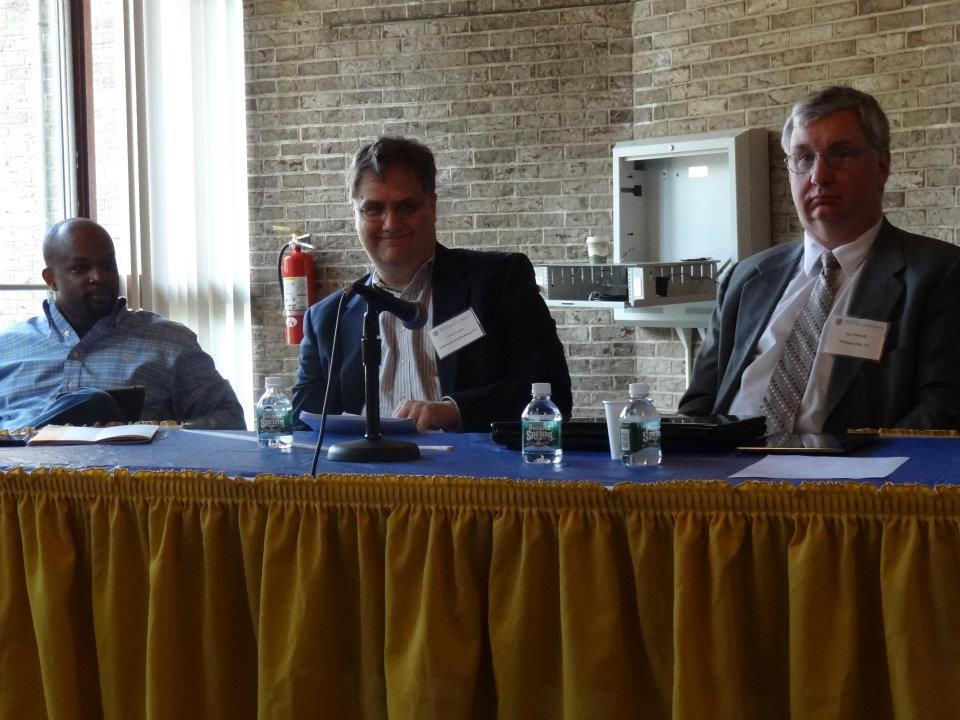
by Greg Prince on 7 May 2012 11:30 am  Among the many Mets bloggers carrying on for the one who couldn’t make it to Hofstra were Steve Keane, John Coppinger, Taryn Cooper and yours truly. (Photo courtesy of Jason Bornstein.) Dear Dana,
I either have to thank you or blame you for directing me to file my overdue report on the Hofstra Mets 50th Anniversary conference in this format. That I think it’s as good an idea as any is confirmed by something you wrote in reviewing my book three years ago, wherein you referred to the “inventiveness” of a particular chapter and how it would “remind readers of Greg’s blog of the way in which he loves to use unusual techniques and genres to present the experience of the Mets: lists, dialogues, fantasies, glossaries, etc.” So add to my alleged techniques a letter to the late Dana Brand, co-director of the aforementioned conference that, had circumstances not intervened, you would know all about and therefore wouldn’t need to be briefed. I’ve tried to write a relatively conventional blog post about the experience, but I find myself going on and on (nothing new for me where the Mets are concerned) yet never getting anywhere definitive.
Of course writing a letter to one who is no longer with us carries its own emotionally loaded challenges. This could get mawkish, one of those words I don’t think anybody uses except as a critique against stuff like this if it’s overdone. Thus, I’ll try to step around the sentimental potholes inherent in this format and attempt to stick with my thoughts as they pertain to the conference.
First off, congratulations. Congratulations on coming up with this idea of an academic conference to celebrate the Mets’ fiftieth anniversary, cultivating it from concept to the cusp of reality and seeing it through to the extent you were able. My box score has you down for working 6⅔ effective innings of conference planning. From there, it was a little dicey getting us out of the seventh in decent enough shape to enjoy “Lazy Mary,” but your colleagues at Hofstra made certain the game would go on. After the tarp was rolled up and the field was reasonably dry following the delay caused by your coming out of the game (hope the baseball metaphors aren’t making you cringe, ’cause there a few more en route), we got a bullpen by committee together and somehow patched together the eighth and ninth.
Individually, we may have been no more than Heilman, Schoeneweis, Ayala and Stokes at times, but together we took care of business and put the conference in the books in your honor.
I thought it was a terrific conference, but I’m biased. I’m a Mets fan. I’m supposed to think it was terrific. Something would have been terribly wrong if I didn’t. Also, somebody from your old school called me and asked me to help pitch those final two innings, which makes me even more biased. When you told me you had the idea for a Mets conference, I told you I’d do anything that was needed, including “holding Jerry Grote’s coat” (be it sheepskin, camelhair or Starter satin). You said of course I’d be involved, that Mets bloggers were a part of your plan. For that matter, your plan outlined we were a part of your plan.
Funny the way roads wind, Dana. My well-informed guess is that the only Mets blogger the folks at Hofstra had ever heard of was you. However it happened, by last fall, that title fell to me. Hence, I was drafted to bring bloggers on board for your conference. Not that they weren’t already on board in theory. Ever since you announced this conference was coming, it was a recurring topic of interest, to say the least. When you were compelled to excuse yourself from further event-planning (apologies for my continued uncomfortable use of euphemisms for “died”), the first post-delay question all your friends in the blogging community asked, me included, was is the Hofstra thing still on? Once it was confirmed it was, I had a new baseball metaphor on my hands: the university as manager, me as third base coach relaying the green light to whoever wanted to get involved.
It was your conference all the way, but I got a little bigger piece of it than I was looking for when Jerry Grote’s proverbial coat was all that was at stake. A few people congratulated me for putting on a great show, which was kind yet wildly inaccurate. I was a conduit, liaison, go-between, basically…like I said, the third base coach. But I did flash the “swing away” sign and a whole bunch of bloggers you knew and maybe a couple you would have liked to have known connected with the conference. My bias is obvious here, but I think that part was also terrific.
As for what this conference was intended to accomplish, I have to tell you about a thought I had while it was in progress. It involves another teacher. His name was Mr. Dubin, who held two jobs: principal of my Hebrew school and social studies teacher at Long Beach High School. My older sister had him at LBHS for a class called Jewish Cultural Studies. When I started high school several years later, I discovered that class was no longer offered, though Mr. Dubin was still around, teaching the state-required course Revolution and Nationalism. I had him for Rev & Nat, where somebody else with an older brother or sister must have heard about what had been dropped from the curriculum and thus asked Mr. Dubin how come there was no longer a Jewish Cultural Studies?
“You know what happened?” Mr. Dubin asked by way of answering. “The Jewish students would take Jewish Studies. The black students would take Black Studies. And so on.” The idea behind these classes in the first place, he explained, was for kids of different backgrounds to learn about each other and understand one another better. That never seemed to happen. What happened instead, according to Mr. Dubin, was somebody would take the class “to appreciate being Jewish or appreciate being black. And so on.”
I remember the way he said “appreciate” with a touch of contempt, as if further insulating yourself into the culture of your heritage was doing a disservice to your innate intellectual curiosity. I could see why my sister wanted to take Jewish Studies (genuine interest blended with the sense that there was probably a pretty gettable “A” in there somewhere), but I could see more why Mr. Dubin got tired of teaching it.
Taking the logic of the discontinuation of Jewish Cultural Studies at good old LBHS to heart, it occurred to me maybe I shouldn’t have spent three days at Hofstra for a conference dedicated so intensely to the New York Mets. Instead, I should have been at Drexel University in Philadelphia to better understand all things Phillie; I should have traveled to Xavier University in Cincinnati so I could identify with the hopes and dreams of Reds fans; I should have made the trip to Arizona State and sat in on seminars that would tell me what I needed to know about the deep meaning of the Diamondbacks.
But of course I wasn’t going to do that. For one, I don’t think any of those institutions has ever put on anything like Hofstra put on last week. Your proposal said this was a first in that regard. And at the risk of wallowing in my appreciation for being a Mets fan, I can’t imagine any other team being the subject of anything quite like what went on at Hofstra.
Oh, you could teach a class in Red Sox. You could offer a seminar on the Cubs. I don’t doubt you could fill a lecture hall with those interested in what the Royals are about. But three days knee-deep in Mets, Mets and more Mets? If you’re one of us, that doesn’t sound the least bit outlandish. Really, the only question to ask isn’t “why a Mets conference?” but rather “why not an entire Mets college?”
Still, I’m already about as appreciative of the Mets experience as a person can be (“this is someone who knows more and cares more about the Mets than anyone else we’ve ever met,” is how you described me in your review of my book), which led me to wonder if I really needed three days dipped, rolled and coated in Mets. Did any of us who are serious Mets fans? When one presenter said he couldn’t remember a particular fact, a dozen voices chimed in with the answer he sought. This is what happens at conferences like these, he said — the attendees always know more than the presenters.
Your proposal to Hofstra hit all the higher-education sweet spots — baseball as a “cultural phenomenon” and “social phenomenon” that had a “significant impact at important moments in the history of the United States” — but as the conference went on, and I found myself listening to this one guy talk about the home run ball he caught off the bat of Dave Kingman and how he devoted himself to bumping into Kingman again and again for the next three decades and borderline-stalking him…well, I wondered was there real value in all this or were we all just able to appreciate being Mets fans more?
My unacademic conclusion was you get out of your experiences what you get out of them, and I felt enhanced by my three days surrounded by Mets fans (peppered by the occasional unbiased Mets observer). This is the stuff we decide we care about. I was at the same game as that guy when he caught the Kingman ball. As he introduced his story, I could tell that was the game he was headed for. I was excited to hear what happened to him at Shea in 1979; where the ball took him; why the notoriously anti-social Kingman didn’t big-league him and instead tolerated his request for an autograph; how Kingman might have been different from his reputation; what their next interaction entailed when he tracked Kingman down at the end of his last-ditch minor league stint in 1987 and showed him the same ball plus the paper he wrote for high school about catching it and meeting him; what an allegedly cranky old ballplayer was like when confronted by unimpeachable fandom in retirement.
The Kingman guy couldn’t have been distilled into a thesis, or he could have but wasn’t, yet I was intellectually engaged in his Met experience — and his was just one experience that had such an effect on me. Not everything at the conference took on the shape his story did. Some of the presentations I heard tried to live up to more scholarly aspirations (just as I might have in college, I sort of half-assed my paper’s approach on a topic I think you would have enjoyed as a listener but demanded more of as a professor), and they had a different kind of value. Your pitch to Hofstra emphasized “diverse” viewpoints and promised that the program would “represent all different possible perspectives on baseball”. What you envisioned in 2008 turned out to be true in 2012. The conference was consistent with your aims.
You also said plainly enough that “the Hofstra Conference on the New York Mets would be a lot of fun.” Mission accomplished on that count. How could something that included Mr. Met not be fun? I know you wanted the Mets themselves to be involved and that proved tricky, but they did send their literally heaviest hitter to Hofstra (as measured by head weight, of course, though let’s not overlook prominence, either). Mr. Met made no small contribution to the proceedings. To that I can attest.
Mr. Met was sent to make his rounds midday Friday, which coincided with the second of our daily Blogger Bullpen sessions. Those were our free-form discussions that started with a few designated topics, expounded on by members of our blogging community, and then expanded to bring in the audience on either those subjects or wherever the room’s Mets fan instinct took them. Friday, I had, per the outline from which I was working, brought the talk to no-hitters and the Mets’ lack of them. While we contemplated the curse of Phil Humber — remember him starting that miserable game we went to together in 2007? —Mr. Met appeared at the door.
I discerned instantly that I wasn’t going to be moderating a damn thing while Mr. Met was coming to call. Jason told me the same thing happens at Star Wars conventions: stormtroopers arrive, you’re licked, no matter what you’re doing. Of course I turned the floor over to Mr. Met (who I swear was looking at me for permission to interrupt, courteous chap that he is), and he silently — how else? — whipped our crowd into a frenzy.
Fun? Absolutely. It’s Mr. Met. But a lesson to be drawn from his interlude? Well, I tell ya, once you’ve had Mr. Met whip your crowd into a frenzy, it would be counterproductive to return to your regularly scheduled programming. Who wants to talk about the Mets not having no-hitters when your environs have been graced by the Mets’ biggest slugger since Dave Kingman? Besides, as I suggested to the Bullpen audience, I was getting a little tired of hearing for the first day-and-a-half that the Mets’ reputation remains hardened in the image cast by 1962 and intermittent setbacks since. “Lovable losers,” was the phrase tossed around repeatedly.
Let’s change the tenor, I said; let’s open the floor up and hear somebody tell us about their favorite Met win. What followed may have been my favorite half-hour of the conference, with one committed Mets fan after another (is there any other kind?) telling stories of where they were when Duke Snider hit a home run to beat St. Louis 49 years ago; where they were when two World Series and a fistful of improbable games were won; to “yesterday” when Heath Bell imploded (I was in the cafeteria blowing off an entire session so I could listen to the ninth inning). You wanted fun out of your conference? That was fun. That was educational. The human condition demonstrates resiliency. The Mets fan condition —expecting defeat, persevering toward victory — demonstrates it constantly.
I understood that in theory, but a little lunchtime gabfest among Mets fans made it that much clearer.
Clarity was in abundance at your conference, Dana. I was clearer than ever that Casey Stengel was, as one of the reporters who covered him put it, “a great man,” right up there with Ali (as another put it) as a historical figure. The evergreen retired-number debate, I decided, shouldn’t be about who’s good enough to be honored alongside Seaver, but who did as much to match Stengel, who all kinds of witnesses to the creation of the Mets confirmed invented us, nurtured us and leavens us to this day.
Which doesn’t make the Mets eternal lovable losers, no matter Casey’s record. It just makes us lovable. And singular. If I had to disagree with any part of your proposal, Dana, it was the line that explained the Mets were a prime conference subject because “It would be impossible to have a similarly comprehensive conference on New York’s other, older franchise.” The first time somebody scored a laugh referring “to that other team,” I thought it was clever. The twentieth time, I wanted to scream. Let us, fellow Mets fans, stop obsessing on other New York teams that only incidentally inform our narrative. The Giants and Dodgers are part of our story, and nods to their contribution were appropriate and enlightening. But the Yankees? Are we really only about “otherness?” I never thought so. I’d like to think my fellow Mets fans can get past that, too.
My other wish, as long as I’m apparently mentally planning a 51st Anniversary conference, is that facts get checked and rechecked. It’s charming to a point when Marv Throneberry’s baserunning misadventures take on a slightly different tinge — ball hit to center; ball hit to right; Stengel said this; Stengel said that — when they’re told at 9 AM, noon and 3 PM. But it was all I could do to not mutter aloud “PIERSALL, NOT THRONEBERRY” when somebody assigned Marvelous Marv the role of Met who ran the bases backwards when he hit his hundredth home run. Mind you, the presentation that made that historical misstep wasn’t a biography of Marv Throneberry, but it set me on edge just the same. Ditto for the date of the installation of the Home Run Apple. Miss it by a week? Fine. Miss it by a year? Then the landscape and the history you wish to communicate to us necessarily differs from what actually happened.
I’ll bet you were never this pedantic with your classes, Dana, but we all have our hot buttons.
Rest assured, I won’t remember this conference as the place where easily checkable facts got caught in a rundown and tagged out by neglect. I will remember it instead as the place…
• where I silently swooned at being in the same auditorium with Ed Kranepool and Bud Harrelson as they transported us with them to 1969;
• where seven-year-old me couldn’t believe 49-year-old me was sitting at the same dinner table as Art Shamsky and dining out on his story about Tug McGraw telling reporters he couldn’t judge Astroturf’s viability versus grass because he’d never smoked Astroturf (and I didn’t even have to hang Art’s coat);
• where Ed Charles, who had regaled us with his poetry, was sitting back-to-back with me for a couple of hours;
• where I could personally tell Gil Hodges, Jr., that in the eyes of every lucid Mets fan his dad has always been a Hall of Famer — he’s probably heard stuff like that for forty years, but I wanted him to hear it again anyway;
• where Rusty Staub recounted his last meeting with Gil’s dad, having no idea he was about to be traded to Gil, Sr.’s team, and then never actually getting to play for Gil Hodges;
• where I could shake the hand of one of my favorite columnists ever and tell him that amid all these ballplayers, “you’re the one I’ve wanted to meet for thirty years”;
• where I could listen to Rob Emproto explain his theories on the Mets’ chronic failure to rebuild to a roomful of Mets fans the way he’d been explaining them to me for nearly twenty years;
• where I could watch Joe Dubin (no relation to Mr. Dubin the Hebrew school principal) describe the New Breed years as eloquently in his way as you would in your way;
• where I could meet Matthew Callan, who’d been engrossing me for the longest time with his Scratchbomb essays on the Bobby Valentine Mets, and hear him share some of his comprehensive research aloud;
• where three different ladies all but squealed with delight that Buddy let them try on his 1986 World Series ring (now there’s a real third base coach);
• where Eddie still bristled at the drafting of Steve Chilcott and the trading of Amos Otis;
• where my favorite New York historian, Peter Laskowich, detailed how the Giant roots meshed with the Dodger roots to produce the sapling we came to know as Metsie…Metsie;
• where a good guy named Paul surprised me with an original version of the Mets pennant that hangs in Lane Pryce’s office on Mad Men in appreciation for my having turned him onto the show;
• where plenty of good guys and good gals said wonderfully nice things about our blog, about my book, about my half-assed paper, about the Bullpen sessions in general and were simply great Mets fans to be around;
• where a Mookie Wilson bat, donated by the Mets, was drawn as a banquet door prize and was awarded to none other than Sonia Brand-Fisher, who won it fair and square, but I would have been thrilled had the drawing been rigged in her favor;
• where a generous donation of Mets baseball cards (by a Red Sox fan, no less) was turned into generous transactions that generated the proverbial nice chunk of change for the Dana Brand Memorial Scholarship Fund (hat tip to Darren Gurnick of New Hampshire who was glad to help a worthy cause while ridding himself of the Mookie Wilson cards that had been haunting him for a quarter-century);
• and where so many great things happened, but none better from my perspective than Mets blogging getting its due as outlined in your original conference proposal. There were those daily lunchtime sitdowns, as noted, and there was a session Saturday afternoon devoted to the art and craft of the blog, where I had the pleasure of joining in a discussion with Taryn Cooper, John Coppinger and Steve Keane. And as long as we’re calling the roll, Dana, you should know a passel of your fellow Mets bloggers besides participated in one facet or another throughout the conference. In no particular order, they included Jason Fry, Shannon Shark, Matthew Artus, Matthew Callan, Ray Stilwell, Kerel Cooper, Jon Springer, Matthew Silverman, Mark Simon, Howard Megdal, E.J. Stankiewicz, Jason Bornstein, Michael Donato and…this is why shout-outs of this nature are fraught with peril. I dread omitting anyone, and the whole was made whole only by the sum of its parts. Anyway, we were there in force and we did what we could to make this thing happen in the spirit we could best ascertain you intended.
Getting very close to mawkish here, so let me veer quickly to a detour you’d appreciate, given your well-deserved status as our Proustian blogger. This regards sense of place. There was plenty spoken about our favorite ballpark, Shea Stadium, and everybody who volunteered an opinion still misses it (those same Mets fans said they have yet to truly warm to Citi Field, but gosh darn it, every one of them swears he or she is still trying to embrace it), but the place I’m thinking of is your other old stomping grounds, Hofstra University. I’ve thrown around “Hofstra” as shorthand since getting involved in all this, but being there really brought certain things back for me.
Your proposal promoted Hofstra as an “appropriate location for a Mets conference because it is located in the Mets heartland.” I never thought to put the school in that context, but when you grow up on the South Shore of Nassau County as I did, you can’t help but grow up at least vaguely aware of Hofstra University. No disrespect intended toward Molloy or Adelphi or C.W. Post, but Hofstra always loomed in the background of my consciousness when I was a kid as “the local college”. I applied there and was accepted there. I had no intention of attending there, but I knew if I came down with a case of cold feet about going away to school, I’d wind up there, approximately fifteen minutes from home.
My interactions with the campus prior to a couple of weeks ago had been sporadic and brief. A day camp trip to gawk at Joe Namath from hundreds of yards’ remove…tagging along with the family when my sister had a National Honor Society reception…Joel Lugo and I following future music mogul Rick Rubin — Ricky in those days — in ditching the Shakespeare festival field trip (Othello) in favor of haute cuisine at the Jack in the Box down Hempstead Turnpike…aimless Saturday night drives through the campus with Fred Bunz when we were already sufficiently matriculated elsewhere…a sudden need to attend a baseball card show, sated at the tail end of the 1990s (the first time I ever carried a cell phone somewhere)…an impulse visit to the bookstore to buy Stephanie a Hofstra t-shirt for Chanukah one year — we’d always shared a fondness for college t-shirts, so why not one from the local college?
One episode, however, came rushing back to me more than any other. On March 30, 1981, a date that would come very close to red-letter status in United States history, Joel and I represented LBHS at Hofstra in a speech contest sponsored by the American Legion. We were last-minute insertions into the competition, asked by a friendly teacher (who I don’t think really planned this thing through) to speak extemporaneously on the First Amendment…an amendment for which I’m pretty sure each of us expressed our sincere support. Our efforts didn’t win us any prizes, but it did get us out of school for a day.
I hadn’t thought of that contest in ages, but an extended visit to Hofstra sparked a memory of Joel and me sitting in a hallway and waiting our turn, killing time with several games of hangman. I distinctly recall two of the answers Joel provided:
DAVE KINGMAN’S THUMB
SHEA STADIUM WILL HAVE A DOME
What else were we going to hangman about?
Thirty-one years and one month later, I was in that exact same hallway, zipping back and forth from presentations that touched on, among myriad Met matters, the Dave Kingman fielding injury that finished off his shot at breaking Hack Wilson’s home run record and the fanciful promises of Shea Stadium’s forever unbuilt roof — each of them a topic Joel and I had been known to dwell on between and during classes. “Hey,” I thought in 2012 of 1981, “I’ve been here before, and I was thinking about the Mets when I was.”
So yes, Mr. Proust of Mets Bloggers, appropriate location, indeed.
On behalf of every single person who made Hofstra the appropriate place to be for three days in April, thanks again for conceiving and creating this conference. Though the phrase couldn’t be more mundane, it also couldn’t be truer: wish you were there.
LGM,
Greg
by Jason Fry on 6 May 2012 11:08 pm As I’ve grown older, I’ve had to be less doctrinaire about 1:10 and 7:10 and where in the pecking order of life “WATCH METS” fits. There are business trips, social events, the duties of fatherhood — a whole welter of things that sometimes come between me and the game.
But most of the time, I can still keep tabs pretty well — there’s the single, semi-discreet earbud while something else happens around me, MLB At Bat silent but visible on a phone set off to the side, or if all else fails the quick retreat for a look at the game summary and maybe even a video or two.
As long as I can at least listen, I don’t mind having the game serve as sidekick to some other drama. In fact, I kind of like it — baseball is a friendly companion, chattering away in one ear while I navigate this and that, and ready to receive my full attention should events take a dramatic turn.
(If time travel existed, this is where my younger self would emerge from some glowing portal to berate the 2012 me for being a sellout and a bad fan. Settle down, younger self. Life gets complicated. Oh, and shave your head two years after graduation — by then you’ll no longer be fooling anybody.)
Anyway, today I caught the first couple of innings on SNY before heading south about a neighborhood and a half to deliver Joshua to Little League practice and his team’s Sunday afternoon game. My TV time was long enough to see that R.A. Dickey had a truly fiendish knuckler, one that left Diamondback after Diamondback yanking the upper body backwards, standing up straight in unhappy disbelief, or bending to one knee trying to net a tumbling butterfly of a pitch. The Mets grabbed a two-run lead on good baserunning by Andres Torres and David Wright and Daniel Murphy hitting a single up the middle that looked like a stone skipping across the surface of a pond; soon after that the kid and I were on our way and I was single-earbudding it for the duration.
R.A. lost his bid for a no-hitter somewhere around Joralemon Street, prompting a growled “GODDAMNIT” from me and an eager rebuke from Joshua, who regards fatherly swearing as an invitation to explore the inappropriateness of the just-heard profanity by asking several minutes’ worth of questions that involve repeating whatever it was I said. Our destination was DiMattina Field, a Little League diamond and abbreviated outfield at the bottom of Carroll Gardens, tucked between the BQE, Hamilton Avenue and an on-ramp. It’s an odd place to play, a little green space wedged in between various aspects of highway infrastructure, but the contrast is pretty neat. “Lyric little bandbox” would be laying it on thick, but “sneakily charming” isn’t too far from the mark.
Just before practice began, Ruben Tejada tumbled across the first-base bag and landed on his face, a misstep that initially sounded comical on the radio before it became apparent that it was anything but. (Howie Rose thought Ruben had slid headfirst, though he was quick to correct himself.) With Joshua and his fellow Red Devils battling a few feet below where I sat against a convenient lamppost overlooking the field, Dickey ran into trouble in the ninth and stalked off the mound to a well-deserved standing ovation. I held my breath as Tim Byrdak gave up a high fly ball to left by Jason Kubel, one Kirk Nieuwenhuis settled under on the track. Frank Francisco’s strikeout of Paul Goldschmidt brought a quick yell and fist pump, and then Miguel Montero hit a long drive to right.
Howie’s voice rose, becoming shrill with alarm. It was deep, and its arc led to territory patrolled by Lucas Duda, for whom every fly ball is a ticket to adventure. I tried to remember what the reconfigured Mo Zone looked like. I imagined Lucas … what was he doing? Stumbling backwards? Feeling for the wall? Pressing his broad back against the fence and looking up in dismay?
The ball settled into his glove, harmless now, the park just big enough to hold it. Howie remarked that twenty-odd thousand people had just finished holding their breath. In Carroll Gardens, one more was added to that tally. The Mets had won, and not long after that the Red Devils came back from a one-run deficit in the top of the sixth (that’s the Little League ninth), with two runners sliding home separated by several inches — and both safe. (Fortunately, Paul Lo Duca was not in attendance.) The Red Devils then held on for a 14-10 win thanks to their third baseman’s stab of a smash headed for the left-field corner. Victories everywhere!
It wasn’t until later that I was able to see the highlights. Duda’s final play was indeed something — I shook my head at his tentative reach to the side and chuckled at the fans in the Mo Zone remaining seated in terror, then rising in relief. Dickey looked petrified, and who could blame him? Tejada’s flop, on the other hand, was hard to watch — if I’d seen the replay before knowing the aftermath, I’d have been terrified that he’d broken his jaw, lost teeth, been concussed or all three. A quad strain, all things considered, seems lucky — though a Mets defense that features David Wright, Justin Turner, Murphy, Josh Thole, Duda and whoever’s in left is the kind of thing that causes starting pitchers think about during sleepless nights.
But hey, that’s a problem for tomorrow in Philadelphia. For today, the Mets won on a big green field surrounded by thousands of fans, and the Red Devils won on a little green field surrounded by two dozen parents, and all was well.
by Greg Prince on 6 May 2012 6:44 am Johan Santana knows from customer service. We ask the ace to pitch like an ace, his year away from acedom notwithstanding, and on Saturday he delivered like, well, an ace. Not Johan of the Twins nor Johan of the Trade (let alone Johan of His Finest Hour and several sublime Met moments before and after) but Johan who got done what needed to get done: using his outfielders, putting down bunts, bending without breaking. That’s an ace. That’s Johan with the win he’s been deserving all year, even if we innately understand wins assigned to pitchers are a vestige of simpler box score times and all that really matters are wins earned by teams.
Mike Nickeas and Andres Torres know from customer service. Each delivered the key fourth-inning base hits that gave Johan, themselves and their teammates the W the Mets have been needing all week. Nickeas barely ever hits and Torres has barely yet played, but their timing was spot on and their contributions to a 4-3 victory should be acknowledged.
Daniel Murphy knows from customer service. Four hits in four at-bats, raising his average to .315, suggests he has earned his territory as a regular, whatever position it is he has to spend time manning so he can come to the plate four times a game.
Bobby Parnell and Frank Francisco, for one day, know from customer service. Their mission was not only to protect a one-run advantage and preserve Santana’s diplomatic integrity (how many more times could Johan pretend not to be annoyed by leads blown and decisions evaporated?) but to re-establish the good name of the New York Mets bullpen. Not that it generally rates a name printable in family blogs, but this was going to be the season when a revamped relief corps was going to change perceptions and reputations. Of course that is said every year. It’s never true for more than a couple of weeks. If it can be true for a single Saturday, as it was when Bobby pitched the eighth and Frank took care of business (mostly) in the ninth, then they can respectively take a hold and a save out of petty cash.
Others earning high marks in customer service at Citi Field on Saturday: the guard who checked my bag efficiently and courteously; the guy who frisked me professionally and quickly; the man who scanned my ticket competently and with a hearty “enjoy your afternoon”; the fellow who handed me my Tom Seaver bobblehead (whose dirt-perfect knee was worth the rainy wait); the young lady in the small hobbyists concession in left field Promenade who didn’t know what I was talking about when I asked if there were “team sets,” but sweetly suggested a couple of stores where I could look; the lady at the counter in the main Promenade store who was super friendly as she rang up my team set (the 2012 version, at last) and asked if I needed a yearbook or scorecard; the gentlemen who held the door for me as I left the store; the gent at the Promenade Blue Smoke who provided me with my chicken sandwich sooner than he first thought it would be ready; and the girl who conducted the cash transaction for said sandwich. I’d also salute whoever made sure there were intermittent video visits from Tom Seaver on his bobbleday and whoever thought to salute the highly decorated World War II veteran celebrating his 69th wedding anniversary at the ballpark.
Sometimes what you read about from me after a visit to Citi Field is only the kvetching about how things don’t work. I want to be clear that Saturday a whole bunch of things, as outlined in the previous paragraph, worked fine, thanks to the people whose jobs it was to make them work. That the little details are supposed to function doesn’t mean it’s not appreciated when they do.
But when they don’t…
After my pal Joe and I made certain we were two of the 25,000 to collect our Seavers, I told him I wanted to detour to the advance ticket windows just upstairs from the Rotunda. This was approximately an hour and twenty minutes before first pitch. Both windows were shuttered and dark. One kid kind of hanging around said “the Internet is broken,” while a middle-aged guy, spitting mad, railed against a team that wants to sell tickets but didn’t have a ticket window open, adding that he’d “trade this place to have Shea Stadium back in a minute” (and no, I’m not quoting myself here). OK, I said, maybe we’re a little early, I’ll come back.
We went to our Promenade box seats and contemplated Terry’s lineup before I excused myself to visit a spell with my friends Sharon and Kevin by the World’s Fare Market and then Coop and Ed on the Shea Bridge (celebrating their own wedding anniversary at the ballpark, albeit their second). I said goodbye to those folks and figured, OK, it’s 3:25, surely those advance windows must be open by now. I wound my way back there to find they were still shuttered and dark, but one now had affixed to it a cryptic note to go to Window 33 in the Rotunda for advance tickets.
Back downstairs, I went in search of Window 33, which I found without too much trouble. It was the one with the insanely long line — and it was the one next to Window 34, which was the one with no line whatsoever. Window 34 was the will call window. As I stood and stood and stood in line at Window 33 for more than forty minutes, taking me past first pitch, I never saw more than a dollop of activity at Window 34. Thus, you had two windows, one devoted to a trickle of customers and another to a flood in need of some kind of levee.
As I stood and stood and stood, I learned (because someone asked one of those green-jacketed gentlemen whose sole assignment seemed to be keeping the hordes from storming the Delta Club) that the kid who said “the Internet is broken” more or less had it right. There was some kind of outage upstairs, which I suppose happens. On Saturday of all days, I truly empathized because I woke up to no electricity in my building, the product of a power failure that lasted all morning and hasn’t been fully resolved yet. Of course I don’t service 30,000 people nor charge admission to my home, but one’s computer access being even temporarily compromised is a hassle that can hobble anyone’s best-laid plans.
That’s the extent of my empathy for the Mets, however, because it became clear to me as I stood and stood and stood that the Mets — a commercial enterprise catering to a large number of customers — had enacted only the barest of contingency plans. What could have they done better? These things crossed my mind during the period of standing and standing and standing:
• Dispatch a responsible representative to the line once it became apparent there was a line to explain what happened. Quell the grumbling (believe me, there was grumbling). Say, in essence, we had a bit of bad luck, we’re really sorry, we so appreciate your patience and your patronage. Remember: these were people who had tickets to the game that was about to start lining up to secure tickets to another game, maybe more. These are your most loyal customers. Engage them. One never thinks to look to airlines for examples of customer service, but do as they have been known to do when a long check-in line develops and have someone ascertain what each customer needs; maybe some of the folks in line don’t know they can handle their transaction at a kiosk or somewhere else. Or let it be known this window will be open after the game (the green-jacketed guy didn’t know, but someone should have made the decision that on a Saturday afternoon with 30,000 in the house that the window should stay open longer than usual).
• Note who is most likely to use an advance ticket window. There were a lot of seniors standing in line. Without necessarily stereotyping, that makes sense. It’s a demographic that came of age before computers were commonplace. The first instinct of someone on the older end of the fan spectrum is probably, through experience, go to the window, buy a ticket. (Others in line were exchanging rainchecks, redeeming gift cards or wanting to avoid greedy service fees.) So if you see your older customers, particularly those standing and standing and standing with canes — and there were at least a couple of those — how about bringing over a few chairs? How about making it so they’re handed a number and can be called to the window when it’s their turn? How about pulling a few of the unnecessary greeters from the perimeter of Mets Plaza and having them stand for those who were physically burdened by standing for forty bleeping minutes?
• I recognize the need for a dedicated will call window, but having one long line at one window (manned by one hard-working individual) and having no line at another window mocked everybody who stood and stood and stood. Put both windows to advance ticket use. Set up a card table with another greeter to take the will call tickets and have that person hand them to somebody on the inside (it’s not that deep a transaction) and suddenly you’ve halved the problem.
• Set up a television monitor in that area of the Rotunda so anybody who has to wait can follow the game if it’s already started. I wanted to see every Johan Santana pitch, but once I put a half-hour into waiting, I wasn’t going to quit the line. Nor was anybody else, including the gentleman in front of me who expressed astonishment that he was getting close to the actual window — and, he noted, he’s a season-ticket holder “and my representative is going to hear about this.”
This was horrendous customer service. This was about as bad as blatant rudeness (and nobody on either side of the window was noticeably rude to anybody on the other side). This was obliviousness. This was the sense of abandonment that’s customer service at its worst, something that seems to be the default setting for the Mets, whatever stadium they call home.
I’m trying to figure out why the Mets operate like this; why there doesn’t seem to be a prevailing ethos that demands supervisors roll up their sleeves and pitch in to do what it takes in a situation like I encountered (and have encountered before); or why there doesn’t seem to be a contingency plan in place for when simple things go noticeably wrong (was this the first time the field level ticket windows’ Internet connection went down?); or why the organization is more concerned with appearing to be interested in customer service than actually serving its customers. Fan-friendliness isn’t accomplished by sending someone in a windbreaker to the curb to say “Welcome to Citi Field.” It’s achieved by making you welcome every step of your stay.
I rail at such shortcomings, yet I conducted my transaction, meaning I’d guaranteed I’d be back for another game. And I bought those cards. And I bought that sandwich. And I took my seat in the second inning and I cheered Johan and everybody else while wearing the Mets jacket I bought in 2000 and the Mets t-shirt I bought in 2008, and when it was over, I picked up the Mets sports bag I was handed for having attended in 2004, satisfied by the Mets win and by my possession of a bobblehead doll celebrating the player who’s been my favorite Met since 1969.
I’m a great Mets customer and a great Mets fan, but from this side of the window, I’m the most pathetic consumer imaginable.
by Jason Fry on 4 May 2012 11:08 pm It wasn’t fun watching Ike Davis strike out, roll an ankle and let a grounder play him into a helpless knot on its way into right field.
It wasn’t fun watching Jon Rauch hang sliders and snap his big, tattooed head around to follow their flight into faraway parts of Citi Field.
It wasn’t fun watching Scott Hairston doing whatever the hell he was doing on that ball that became a ground-rule double.
None of it was fun.
The Mets have lost four in a row, their bullpen resembles a gang of arsonists, Ike looks as lost as he did in the early going, and bad luck seems to be nipping at the team’s heels whenever some aspect of their game tires.
Not so long ago the Mets took two out of three from the Rockies, looking resilient in doing so, then donned their cowboy gear and strutted down to Houston, where the not-yet-rebuilt Astros seemed like easy pickings. Instead the Astros smacked the Mets around pitilessly, what looked like a workaday win against the Diamondbacks spiraled out of control and became a teeth-grinding loss, and after this brief homestead the Mets have to face the Phillies and the Marlins on the road. They’re .500 and that glass sure feels half-empty.
But this is the tough part of baseball fandom just as it’s the tough part of the real thing — days when balls don’t land quite where you need them to, weeks when the statistical ebb and flow of the season goes against you, and either way as a fan all you can do is sit on the couch and fume.
Hang in there. Shut your eyes, stick your fingers in your ears and find a quiet place, in hopes that there you can find a renewed perspective.
It’s a game of inches.
In the second, Andres Torres drove a ball off the orange line at the top of the No Longer So Great Wall of Flushing. Josh Thole and Dillon Gee promptly struck out; Torres didn’t score. In the fifth, with two men on, Scott Hairston crushed a ball down the left-field line that hit less than a foot on the wrong side of the foul pole, wrapping itself around it and seeming to startle a maroon-clad security guy rather badly. Given another chance, Wade Miley struck Hairston out and then got Ike to hit into a double play. Give the Mets about 18 inches between those two hits and they win 9-5, with Ike’s struggles and the bullpen’s failures discordant minor notes as we crow about the contributions of newcomers and complementary guys.
(And that’s without mentioning Thole turning in a good at-bat in the eighth, contending against both David Hernandez and the strike zone before ramming a ball that lumbering Jason Kubel was just able to stick up his glove and snag, or Daniel Murphy ending the game on a laser beam up the gap that Gerardo Parra grabbed parallel to the earth. Inches again.)
It’s also a game of streaks, statistics blowing hot and cold.
Rauch and Tim Byrdak look terrible right now, but they looked like world-beaters in the first couple of weeks of the season. Neither scouting report was accurate. This will be true other places as well. David Wright isn’t going to hit .395. Ike Davis isn’t going to hit .172. You’re sitting on the couch waiting to get socked in the gut this week; last week Todd Helton hit a pinch-hit grand slam and you thought, “Ah, they’ll probably come back.”
It’s baseball. Cheer and yell and groan and pout, but don’t let it kill you.
by Greg Prince on 4 May 2012 10:42 am Some days you have to go to the ‘pen and go with the arm that feels it most — feels it as a fan and feels it as a writer.
When we talk about Rivera’s pitching motion, his mulish imperturbability, his athletic grace under pressure, we think of artists not ball players: Buster Keaton, Fred Astaire, Al Hirschfeld. His career was a reminder that athletic excellence is closer to art than science.
For more typically graceful thoughts from Alex Belth on the unfortunately interrupted and possibly completed career of master closer Mariano Rivera, I suggest a visit to Bronx Banter, the blog that transcends mere Yankeedom.
In the meantime, decency, karma and appreciation for baseball played at its highest level all gather to add best of luck to the last of the 42s.
by Greg Prince on 3 May 2012 1:24 am Well it’s lonesome in this old town
Everybody puts me down
I’m a face without a name
Just walkin’ in the rain
Goin’ back to Houston
Houston
Houston
—Dean Martin
How many pitchers does it take to replace Mike Pelfrey?
More than one, we can now state with absolute certainty.
The front office that we reflexively tag with the genius label didn’t exactly have a light bulb go off over its head when it came to having adequate backups in place in case one of its five starting pitchers went down for any appreciable period. Which is an interesting way to plot for all eventualities.
We also don’t seem able, despite these swell taxi squads Adam Rubin keeps telling us about, to recall a catcher in case we’re down one of those for a couple of days, but 48 hours deprived of the services of flu-ridden Mike Nickeas is small potatoes compared to having an arm ready to go in the extended absence of one Big Pelf.
Joke’s on us, huh? Specifically those of us who’ve been waiting for the clock to run out on Pelfrey time. Five mostly frustrating seasons of the kid from Wichita never fully growing into a consistent big league winner or at least dependable mound presence seemed finally on the verge of ending in a good way. The Pelfrey of this season appeared a notch above the Pelfrey of other seasons. Hell, the last time we saw him pitch, two Saturdays ago against the Giants, we were actually dismayed to see him removed after eight innings.
That should have been the sign of the aPelfalypse. Next thing we hear is Pelfrey’s on the DL, Pelfrey’s going in for Tommy John and Pelfrey projects as a non-tender.
That’s it? That’s how it ends for us and Pelfrey? Nothing so dramatic as the big guy persevering until he wins that elusive big game that puts us over the top and casts him forever in a warm glow of Metsian appreciation? Or Pelfrey being shipped off for some “final piece of the puzzle” on this or next July 31? Just a quick disappearing act which leaves behind a half-Pelfed legacy and Chris Schwinden?
Mike probably feels worse about it than we do. It’s his right arm, and we wish it well. We are left in the uncomfortable position of wishing we had it healthy and rarin’ to go because Chris Schwinden…
Oh geez.
I’d like to pardon Chris Schwinden’s abysmal two starts — his last two starts as a 2012 Met, I really, really hope — because they were made in two ballparks not conducive to pitching. Coors Field wasn’t the place to be welcomed back to the bigs, particularly on the night somebody left the humidor open, and Minute Maid Park is, oxymoronically speaking, the biggest short porch I’ve ever seen. Then I remember I spent one of the gloomiest baseball afternoons of all time with Chris Schwinden last September at pre-haircut Citi Field, by no means a pitcher’s graveyard. It wasn’t Chris alone who caused all the damage that gray day against the Nationals (team debacles are rarely one man’s burden), but after identifying him as a prime protagonist in losses of 10-1, 18-9 and now 8-1…with little in the way of contradictory evidence to suggest he was simply pitching in tough luck…Chris Schwinden can go find himself another gig. Or go get more experience at Buffalo and return later and make me Met-a culpa. I’ll be happy to do so. I’m not in this to rag on Chris Schwinden. I’m in it to not give up on games as soon as I recognize Chris Schwinden is starting them.
This isn’t a Schwinden issue. This is an Alderson depth issue. The GM’s security blanket is Chris Young, who is one year removed from his most recent (and intensely memorable) major league action and working through his own post-surgery rehab. Young isn’t ready to be a Pelfrey replacement. There’s merit in not rushing the kids who were supposed to make us not miss Pelfrey eventually, but you’d figure there’d be a stopgap starter rattling around Triple-A we could have used instead of Schwinden. Better yet, there must be a stopgap starter we can use instead of Schwinden the next few times through the rotation. There’s a spot where patience has to overlap with urgency. The 162-game schedule kind of demands it.
Ignominious way to say goodbye to good ol’ Houston, where the next time we visit, it will be as an Interleague or, if you’ll excuse the expression, World Series opponent. The shifting of the Astros away from our annual travel itinerary is a shame in that anything that shreds the comforting regularity from our communal routines is a shame. I’d feel the same way if it was the Padres or the Reds or, heaven forefend, the Marlins (granted, maybe a little less so if it was the Marlins) transferring to the circuit where they play eight-ninths of the Grand Old Game. Part of baseball’s appeal is the clockwork-precision framework it presents us six months out of every year. From 1969 to 1992, you could set your Armitron by the alignment of the National League as it applied to the Mets: 18 games against each of five teams in the East, 12 apiece versus the six in the West.
Across that predictable canvas, the Mets made with their brush strokes. That’s where the element of surprise came in. You didn’t know how they’d do against their expansion-brother Astros every year but you knew the Astros would be there to greet them twice. And if there were trips to Houston, there’d be talk of mosquitoes the size of bullpen buggies; and Eighth Wonders that weren’t so wondrous; and a master of the split-finger fastball whose nefarious scuffery could never be fully proven; and the laborious, glorious sixteen innings devoted to avoiding him at all costs; and Killer B’s; and Toy Cannons; and Crawford Boxes; and Mets from when they weren’t Mets — from Rusty Staub to Nolan Ryan to Carlos Beltran…right on through to these last three days unsuccessfully attempting to overcome the likes of El Caballo, Wandy Rodriguez and some vance named Jose Altuve, who isn’t nearly as big as Ralph Kiner insists those Colt Stadium mosquitoes were.
The very first trip the Mets made to Houston, they were on fire, having won nine of twelve. These were the 1962 Mets, mind you, thus on fire meant elevating their record from 3-16 to 12-19, but it was progress nonetheless. They were seven games from .500 for the first time in their brief cumulative life (not counting when they were 0-7 en route to being 0-9). Then they flew to Houston — or tried to. There were mechanical troubles, there was inclement weather, there was a diversion to Dallas and before their long night/morning was over, Casey Stengel uttered his immortal press advisory to traveling secretary Lou Niss as Ol’ Case grabbed his room key and headed for the hotel elevator:
“If any of my writers come looking for me, tell ’em I’m being embalmed.”
Casey was alive and well in Houston, but whatever slim competitive aspirations the eighth-place Mets nurtured before touching down in Texas died an instant, muggy death. They lost both of their games to the Colt .45s and their next fifteen everywhere else. The Mets haven’t been cumulatively within seven games of .500 as a franchise since they first got to town.
Yet it’s a shame anyway that they won’t be going there anymore as a matter of National League course. If I can say that after being on the wrong end of a miserable three-game sweep, I must really mean it.
by Greg Prince on 2 May 2012 12:56 am We can all agree Niese didn’t have it and the Mets did little against Happ and missing the Astros is something that sounds good in theory, but at this moment they can’t move to the American League soon enough for our tastes. The Mets, a pretty good club in April, started May by losing again in Houston, home of a pretty lousy club…or so we thought.
 From Saturday's Mets Communication panel at Hofstra, left to right: Kerel Cooper, yours truly and Ray Stilwell. (Photo courtesy of Jason Bornstein.) Giving Tuesday’s game the perfunctory treatment it deserves, I’d now like to turn the agenda back to Saturday and share with you the paper I presented at the Hofstra Mets 50th Anniversary Conference, which I thank you for attending if you did (and wish you had if you didn’t). The topic is “The Shared Mets Fan Language: How Mets Fans Speak to One Another”. It was delivered as part of a panel that included On The Black’s Kerel Cooper’s examination of the Met social media landscape and Metphistopheles’s Ray Stilwell’s history tracing the decline of the Mets Radio Network. I hope you enjoy.
(And a more detailed appraisal of the conference will be coming by week’s end.)
***
You may not have heard this one before, but if you’ve been a New York Mets fan for very long, you’ve probably been involved in something like it.
Three Mets fans walk into a ballpark…separately, but their respective tickets have them sitting in the same row during a game in which the Mets are momentarily behind. A pitch is thrown to a Mets batter recently promoted from the minor leagues in a game taking place toward the end of the season. The batter produces the latest in a series of several recently clustered base hits. The first Mets fan says to the others, “Mike Vail.” The second replies, “Gregg Jefferies.” The third chimes in, “Victor Diaz.”
All three nod and wait for the next pitch.
The above is a brief, hypothetical exchange, but dialogue like this transpires regularly, whether spoken, e-mailed, texted, posted, Facebooked or Tweeted. Wherever Mets fans gather physically or interact virtually, there is a shorthand of shared language that eliminates barriers of unfamiliarity and facilitates instant communication among nominal strangers.
Mets fans speak Mets to one another almost without realizing they’re doing so. Their common tongue is cultivated via a layer of sources and influences, some dating back to their earliest exposure to Mets baseball, all regularly reinforced via continued exposure to Mets baseball.
Take our example of the rookie batter and the base hit. For a Mets fan, little is more satisfying than seeing a young player fill the first lines of his heretofore blank career slate with immediate success. The Mets fan senses promise and reflexively harks back to when he felt that sensation before. Depending on the fan’s tenure, he might reach back to August and September of 1975, when an unheralded rookie named Mike Vail emerged to hit in 23 consecutive games, which tied a team record. He might remember highly touted Gregg Jefferies coming up from Tidewater at a similar time of year in 1988 and making such a sudden impact that he drew Rookie of the Year votes based on five weeks of hot hitting. Or he might recall Victor Diaz, a minor leaguer of little notice, rising to prominence late in the otherwise desolate 2004 season by hitting a two-out, three-run home run in the bottom of the ninth inning, tying a game and ultimately helping to spoil the playoff plans of that day’s opponent, the Chicago Cubs.
The Mets fan doesn’t need to elaborate on what those ballplayers’ names imply. Vail, Jefferies and Diaz each gave his team a boost in fortunes from almost out of the blue. Each imbued Mets fans with a surge of optimism that a future star had landed in their orbit. Yet not long after Vail, Jefferies and Diaz made their initial impressions, each proved a short-term proposition. For the record, Vail’s progress was permanently sidetracked by an injury, Jefferies’ temperament was a poor long-term match for New York and Diaz’s passing resemblance to Red Sox slugger Manny Ramirez — remarked upon when he was raising hopes at Shea Stadium — was no more than physique-deep.
Thus, when the members of our Mets fan trio forge consensus by mention of players who briefly excited but eventually disappointed, they all understand one another completely. They are saying, in Mets fan shorthand, “This kid could really be something for us, but he probably isn’t going to amount to much.”
Whether they realize it or not, these fans are leaning on RECURRING PRECEDENT to inform their conversation. They’ve seen it before, they sense they’ll see it again. It is their badge of honor, a sign to each other that they’ve been around and they know their Mets. To every situation, the Mets fan brings a knowledge base that regularly regenerates upon another example of something startlingly similar to something that’s already happened. Events like the frenzy and fizzling attached to phenoms plant themselves in a million individual subconsciouses and, when excavated, provide an element of collective memory.
“Mike Vail,” “Gregg Jefferies” and “Victor Diaz” are code. So, in a different climate, are “Tom Seaver” and “Dwight Gooden” as regards less fatalistic forecasts for top hard-throwing, right-handed pitching prospects. Sometimes having seen it before is a reason to gather hope rather than lose it.
Having relied on recurring precedent to determine the young hitter our hypothetical trio has just seen is more likely to let them down than lift them up — it’s not that it’s happened once before, it’s that it’s happened over and over and over again — one of our Mets fans might suggest what they could really use right now is a beer. If the topic of beer leads anywhere besides the nearest beer vendor, it is almost a mortal lock that the discussion among these Mets fans will head in one direction: toward Rheingold the dry beer.
Rheingold was the official beer of the New York Mets from the club’s founding in 1962 to 1973, or until its parent company, Liebmann Breweries, was on the verge of shutting down its plant for good. Yet the brand equity of Rheingold, as it applies to Mets baseball, is seemingly eternal. For generations of Mets fans — even those born long after the brewery in Brooklyn was shuttered — the name Rheingold is inextricably linked to the Mets, no matter what beer is advertised or sold at Citi Field.
Say “Rheingold” to a Mets fan, and you stand a very good chance to turn that Mets fan into a karaoke jingle singer, reeling off the words burned into their brains from the television and radio commercials of the Mets’ first dozen seasons:
My beer is Rheingold the dry beer
Think of Rheingold whenever you buy beer
It’s refreshing, not sweet
It’s the extra dry treat
Won’t you try extra dry Rheingold beer?
Save for a brief late-1990s revival when the brand held limited radio sponsorship rights, Rheingold has been absent from Mets baseball for nearly four decades. Budweiser, meanwhile, plastered a billboard square in the middle of Shea Stadium’s scoreboard in the early 1980s and didn’t cede the space until Shea came down in 2008. The brand remains a prominent advertiser at Citi Field.
But no Mets fan is compelled to sing old (or recent) Budweiser jingles. Budweiser sponsored many teams; Rheingold was identified with the Mets, allowing it to feed a sense of PROPRIETARY NOSTALGIA. Mets fans yearn to celebrate what they feel belongs to them — and toast into perpetuity those who made them feel catered to. Its almost total absence from the modern marketplace (let alone the Mets’ ballpark) hasn’t curbed the brand’s psychic appeal to Mets fans. “Rheingold” needs no explanation among Mets fans. It is shorthand for more than “beer.” It is shorthand for “ours.”
As for our Mets fan trio, they don’t necessarily have to drown their sorrows for very long, for baseball, as Bob Murphy said, is a game of redeeming features. Murphy said many things in his 42 seasons as play-by-play announcer, and though his words were intended as on-the-spot reportage, some of them couldn’t help but form the foundation of the shared Mets fan language. Phrases such as “baseball is a game of redeeming features,” “that’s why they put erasers on pencils” and, most famously, “we’ll be back with the happy recap” were repeated regularly and thus became the lexicon by which Mets fans absorbed their favorite team and understood their favorite sport.
Murphy — along with his broadcast partner of 17 years, Lindsey Nelson, and Ralph Kiner, who is now in his 51st year as a Mets announcer (mostly in cameos these days) — took the lead in establishing much of the Mets fan vocabulary. Among the countless Mets fans whose perception of baseball they colored were two who grew up in Queens in the 1960s, Gary Cohen and Howie Rose, the Mets’ primary announcers today (Cohen on television, Rose on radio).
The long Mets broadcasting careers of Murphy and Kiner overlapped with those of Cohen and Rose, each on the air since the late 1980s, forming what has amounted to an UNBROKEN FAMILY TRADITION. The stories of the fathers became, to a significant extent, the stories of the sons. The fans, in turn, functioning in the role of Mets extended family, pick up on not just the phrases each announcer has used (for example, Rose’s exhortation to “put it in the books!” when the Mets seal a victory) but the myths and legends each regularly revisits. Stories reported by Murphy and Kiner when they were fresh became, over time, well-told tales.
The utterances of Casey Stengel, for example, lived on for Mets fans who never saw Stengel manage between 1962 and 1965, because Murphy and Kiner invoked him on a regular basis. Cohen and Rose, in turn, keep alive the name, the quotations and the image of the Mets’ first manager, albeit with less frequency than Murphy did or Kiner does given that those original announcers were present at the creation of the Mets. Murphy and Kiner shared amusing anecdotes about what Stengel used to say about Marv Throneberry or Greg Goossen, two of the many lesser lights who flickered through the Mets’ early years. Their eventual successors remembered them and repeated them. Mets fans who missed an entire era of Mets baseball are nevertheless made to feel as if they’ve been witness to the entire Amazin’ epoch.
Rose and Cohen also take the lead in serving as MEDIA GRIOTS. By dint of their respective places in front of the WFAN and SNY microphones, and aided by the sport’s built-in pauses and predilection for clinging to its own history, the lead voices of a ballclub are often its de facto oral storytellers. Announcers less engaged in Met lore would likely ignore this facet of their jobs (which hints at why “out-of-town” voices with no Met connection sound so foreign to the Mets fan ear), but Rose and Cohen, Mets fans before they were Mets announcers, embrace it thoroughly.
In 2011, a press note revealed the Mets had achieved two consecutive late-inning comebacks matching a set of statistical hurdles that hadn’t been overcome since 1965. One of the batters responsible for the Mets good fortune 46 years earlier was a utility player named Danny Napoleon. Rose immediately cut to the gist of the 1965 event, namely that Stengel exclaimed for reporters in the victorious Mets clubhouse, in his inimitable way of approving the worlds this Napoleon had just conquered, “Vive la France!” Rose knew the story so he shared it. Thousands of listeners who had never heard the tale now knew it, too, and were deputized to pass it along on their own.
In the spirit of the western African musician-entertainers whose performances include tribal histories and genealogies, the media griot keeps vital that which might otherwise die off. Rose and Cohen extend the Met story, and thus the shared Mets fan language, orally. Others have been essential media griots via the written word. Most prominently, there have been longtime Mets beat writers reaching back from Adam Rubin, producing copious amounts of copy every day for espn.com and before that the Daily News since 2003; through Marty Noble, today a columnist for mlb.com and earlier a steady presence around the Mets for Newsday and other newspapers from 1974 forward; to Jack Lang, who covered the Mets for the Long Island Press and the Daily News for more than a quarter-century after their 1962 inception. Each writer imbues or imbued his articles with references to what he has or had seen in his endless travels with the Mets.
When Gary Carter died in February 2012, Noble was uniquely qualified to recall the Hall of Famer catcher’s quirks, including his near-obsession with his uniform number, 8. Noble shared with his readers a story about renting Carter’s condominium one Spring Training. To enter the condo, he needed a five-digit security combination to unlock the entrance. The realtor accompanying Noble didn’t know the code. Noble, knowing Carter well, took a guess. He pressed 8-8-7-8-8. The door opened.
Most Mets fans know Carter wore No. 8 for the Mets. The voracious Mets fan now knows how much the number meant to him, thanks to Noble. Those fans, in turn, can pass that along orally or in writing (often in historically minded Mets blogs of their own). Visually, there is a segment of Mets fans who can’t look at an “8” without picturing Carter wearing it. With stories like Noble’s, the connection grows that much stronger.
The grandest Mets oral tradition of them all is one that does not require a microphone, a press card or even a blog. It is brief, it is loud and it is hopeful. At the first spark of a potential rally, our hypothetical Mets fan trio — the ones whose fatalistic conversation wandered off into failed phenoms and whose nostalgic thirsts could be slaked only by the Rheingold theme song — is capable of delivering it as if by instinct. There is no other single sentence in the shared language of Mets fans that has been shared as much or by as many across fifty years of the Mets experience.
The Mets weren’t two months old when one of their forebears, the former Brooklyn Dodgers, returned to New York to play National League baseball against their Metropolitan successors. As Roger Angell related in his first baseball essay in the New Yorker, in 1962, the Mets trailed Los Angeles, 10-0, in the fourth inning when Gil Hodges — formerly of Flatbush, now ensconced in the Polo Grounds — led off the bottom of the fourth with a home run, cutting the home team’s deficit to 10-1.
“Gil’s homer,” Angell wrote, “pulled the cork, and now there arose from all over the park a full furious, happy shout of ‘Let’s Go, Mets! Let’s Go, Mets!”
With that reduction of their team’s deficit to a mere nine runs, Mets fans created their own shorthand, and they did so without any prompting from precedent or quasi-authority figures. “Let’s Go Mets” wasn’t advertised or suggested by team management. It was a pure reaction to the action a sellout crowd witnessed in the first game of that Memorial Day doubleheader, May 30, 1962, and the relative handful of days before it. The Mets, who had lost the first nine games they ever played that April, were in the midst of an eight-game losing streak; by the time the twinbill was over, the streak would reach ten, en route to an eventual 17 — still (thankfully) the longest in Mets history. The Mets were a bad team getting worse. Yet the Mets fans took matters into their own hands and together they crafted a POSITIVE SELF-IMAGE that has defined the heart of the shared Mets fan language ever since.
This team may not be very good, “Let’s Go Mets” tacitly declared, but those who chant on its behalf are absolutely indefatigable.
“Let’s Go Mets” may not have led the Mets to top 40 victories in 1962, but its impact would resonate long beyond that first tough year of competition. Evidence that it translated as something more than a standard-issue rallying cry appeared in a most unexpected place, according to early beat writer Leonard Koppett, who noted that in 1963, “when President Kennedy landed at Frankfurt, West Germany, and in the crowd at the airport someone held up a ‘Let’s Go Mets’ sign, it was effective indeed.”
John F. Kennedy didn’t go so far as to punctuate his planned speech with “Ich bin ein Mets fan,” but Mets fans didn’t need the validation. They provided it themselves, no matter how bleak the circumstances. Consider the scene described by author Stanley Cohen in his 1988 tribute to the 1969 season, A Magic Summer:
“During one game in 1963 (the team’s last season at the old Polo Grounds), with the Mets trailing by thirteen runs in the bottom of the ninth, two out and no one on base, the New Breed sent up a chant of ‘Let’s go, Mets.’ With each new strike on the batter, the cry grew louder and more insistent. It was a battle cry that needed no battle; it betrayed neither a glimmer of hope nor the sneer of derision. It was a simple and joyous act of defiance, the declaration of a will that would not surrender to the inevitable.”
“Let’s Go Mets” endured, self-generated, as the Mets moved from the Polo Grounds to Shea Stadium, from the second division to first place, from the 1969 world championship to the dire late ’70s days ahead and on through a second world championship in 1986. That autumn, New York radio stations featured on their playlists a bouncy tune entitled, “Let’s Go Mets.”
We’ve got the teamwork
To make the dream work
Let’s Go
Let’s Go Mets!
Over time, Mets management co-opted the simple, fan-invented affirmation, perhaps sapping it of a bit of its organic strength as the seasons rolled by. In the 1990s, recorded exhortations of “Let’s Go Mets,” accompanied by DiamondVision graphics and ear-splitting drumbeats at the first sight of a Mets baserunner, detracted from the pleasure the crowd felt of starting the chant themselves. “Let’s Go Mets” tended to emanate on its own a little less often every year, but it still rises from the stands to this day, and not just at Citi Field (where the three words, sans exclamation point, stare out from the scoreboard as if by some silent statist decree).
“Let’s Go Mets” — or LGM, in common shorthand of the shorthand — simply works better when it is of the Mets fans, by the Mets fans, for the Mets fans. In 2007’s Mets Fan, Hofstra’s own Dana Brand offered an endorsement of “how Mets fans use ‘Lets [sic] Go Mets!’ to end letters and cards and e-mails, or even to say goodbye […] It is like Ciao! or Sholom Aleichem! or Cheers! It ends things with a statement of shared hope, of happy fellowship. It is only half-serious. But it’s serious enough.”
The positive self-image, as encapsulated and communicated in “Let’s Go Mets” and its spiritual sibling, “You Gotta Believe” (disseminated by emotional relief pitcher Tug McGraw during the unlikely 1973 pennant race and enduring in the collective Mets fan consciousness ever since), is essential in compelling Mets fans to be Mets fans and enables Mets fans to enthusiastically speak to one another as Mets fans. The language, as much as a blue cap or an orange t-shirt, provides a most critical thread of identity for individuals coalescing as a group. The identity woven by the shared Mets fan language transcends division standings and roster composition. And like the 7 Train, it unites Mets fans as a people while banding them together on a common journey.
***
NOTES FOR “THE SHARED METS FAN LANGUAGE”
The spirit of this paper is informed by an extensive series I wrote on Faith and Fear in Flushing (the blog I co-author) between March 11 and April 3, 2007, entitled “March Metness.” Meant to mimic the NCAA basketball tournament, “March Metness” set out 64 quintessential Met sayings, events and historical cues, spanning 1962 through 2006, exploring each of them as the “tournament” went along until a winner was determined. The entire series was happily recapped on December 23, 2007 and can be referenced here:
http://www.faithandfearinflushing.com/2007/12/23/march-metness-in-december/
The section on RECURRING PRECEDENT is based largely on experiential observation. As a Mets fan since 1969 and a Mets blogger since 2005, I’ve been party to multiple conversations in which late-season minor league callups quick to achieve have been written off as flashes in the pan on the order of Vail, Jefferies and Diaz, to name the three most prominent examples. It has always struck me what little introduction those players — particularly Vail and Diaz, whose careers were far more fleeting than Jefferies’s — require as Mets fans discuss the next would-be prospect’s chances of sticking and succeeding.
Similarly, PROPRIETARY NOSTALGIA is a phenomenon I’ve observed arise time and again, with Rheingold providing the most prominent example (the same principle could be applied to Jane Jarvis, the Shea Stadium organist from 1964 to 1979 who nonetheless remains, in the popular Mets fan imagination, the Mets’ organist for all time). On at least three occasions since 1994, I’ve witnessed the Rheingold jingle break out spontaneously at the drop of the brand’s name.
The UNBROKEN FAMILY TRADITION is apparent to anyone who grew up listening to Bob Murphy, Lindsey Nelson and Ralph Kiner serve as the Mets’ primary television and radio voices from 1962 into the 21st century (Nelson left the Mets after 1978; Murphy worked radio only from 1982 until 2003; Kiner has been exclusive to television since 1982). I examine their impact on passing down the Mets legacy in the foreword to the 2012 re-release of Tales From the 1962 New York Mets Dugout by Janet Paskin. The enduring place in the Mets soul of “the happy recap” is attested to by the online radio show of the same name, accessible at:
http://www.blogtalkradio.com/thehappyrecap
“Put it in the books!” or simply “Books!” is repeated in unison on Twitter every time the Mets (or #Mets) win a ballgame, testifying to how Howie Rose’s catchphrase has caught on since he introduced it as a television broadcaster in 1996.
I touched on the Murphy-Rose connection in appreciation of Murphy’s career for the New York Times shortly after his passing in 2004:
http://www.nytimes.com/2004/08/08/nyregion/city-people-mr-met.html
MEDIA GRIOTS’ role in perpetuating the Met language has shone through not just via some of the examples cited above but, conversely, when there was a lack of such well-versed storytelling emanating from the places where a fan might expect it. The four-year Met broadcasting career of Wayne Hagin (2008-2011) washed up on the same rocks that crushed Lorn Brown’s almost thirty years earlier (1982). In each case, two respected, experienced major league voices alienated Mets listeners and viewers because they were unable to “speak Mets” on the air. One extreme manifestation of anti-Hagin sentiment could be found in ESPN uniform critic (and Mets fan) Paul Lukas’s 2011 blog, Fire Wayne Hagin Already!
http://firewaynehagin.blogspot.com/
By contrast, the Mets’ latest full-time broadcasting hire, Josh Lewin, vigorously made clear during spring training 2012 that he grew up a Mets fan and could talk about Mets players, games and seasons with the kind of ease his partner, Rose, brings to the task. I noted the early indications that Lewin was warming to his new assignment on Faith and Fear in March 2012:
http://www.faithandfearinflushing.com/2012/03/08/rescue-from-radio-nowhere/
Rose’s sharing of the Danny Napoleon anecdote was appreciated in my Faith and Fear partner Jason Fry’s assessment of the Mets-Padres game of August 10, 2011:
http://www.faithandfearinflushing.com/2011/08/11/stupid-reality/
Adam Rubin’s role as Media Griot was exemplified in January 2012 when he drew from his nearly ten seasons on the Mets beat and took to Twitter to delineate nearly a decade of Mets’ injury woes, matching fact with insight. The entire run of his Tweets was captured by Mets Police:
http://metspolice.com/2012/01/18/adam-rubin-tweets-at-length-about-mets-injuries-of-past-few-tears/
Mets fans can be grateful Media Griot Jack Lang chose to outline the first quarter-century of Mets history, peppered greatly by what he personally experienced, in 1986’s New York Mets: Twenty-Five Years of Baseball Magic. Marty Noble has thus far not opted to write a similar history or memoir, but he freely shared a string of reminiscences with Mets By The Numbers in 2008:
http://mbtn.net/flip-side-45-marty-noble-interview-part-i
http://mbtn.net/97-baseball-marty-noble-interview-part-2
http://mbtn.net/marty-noble-interview-part-3-lightning-round
The aforementioned article regarding Gary Carter’s love of the number 8 is illustrative of Noble’s Media Griot tendencies. It’s likely no veteran baseball writer tells better Met stories on a consistent basis:
http://mlb.mlb.com/news/article.jsp?ymd=20120224&content_id=26841890&vkey=news_mlb&c_id=mlb
It is tempting to say “Let’s Go Mets” and what it says on behalf of POSITIVE SELF-IMAGE speaks for itself, and in a way, it really does. But as noted in the text, four essential books that tell the Mets story delved into the topic: The Summer Game by Roger Angell (the first collection of Angell’s New Yorker baseball essays); The New York Mets: The Whole Story by Leonard Koppett; A Magic Summer by Stanley Cohen; and Mets Fan by Dana Brand. These authors’ assessments of “Let’s Go Mets” were written, respectively, in 1962, 1970, 1988 and 2007, demonstrating that unlike Vail, Jefferies and Diaz, these are three words that cannot be mistaken for flashes in the pan. As recently as the outset of the 2012 baseball season, this past April 1, George Vecsey — who covered the Original Mets — advised Mets fans in the New York Times, “Just for sanity’s sake, it is time to revive the wonder of that spring, 50 years ago, when the chant first soared toward the heavens: Let’s go, Mets. What else is there?”
http://www.nytimes.com/2012/04/01/sports/baseball/for-mets-a-golden-anniversary-alchemists-needed.html
My comments on how Mets management has perhaps overreached by getting out in front of the “Let’s Go Mets” parade via excessive electronic cheerleading are based on the more than 500 home games I have attended at Shea Stadium and Citi Field since 1973. I would contend the use of “Let’s Go Mets” in commercials ostensibly for Mets baseball, sponsored by Citi, contributes further to the feeling that a classic fan-generated sensation today exists as yet another corporate marketing tool. Fortunately, as Professor Brand noted, it is the fans who own “Let’s Go Mets”. I personally have been signing e-mails to fellow Mets fans with “LGM” since 1995 and have been receiving responses in kind for just as long. It is, blessedly, a Met language tic that requires no explanation among the true believers.
by Jason Fry on 1 May 2012 12:14 am As I was heading down to tuck the kid into bed, Jose Altuve hit a little squibber in front of the plate, a play that ended with me looking back from the stairs to see Josh Thole and R.A. Dickey standing in annoyed proximity and Altuve far away on first.
Another day without a no-hitter, I thought reflexively, allowing myself the tiniest of sighs.
But no — I returned to discover it had been an error. The no-hit bid was still alive, and between Dickey’s knuckler and the Astros fielding a lineup of junior auxiliaries, why not dare to dream? And to my surprise, Twitter was full of Mets fans on no-hit patrol very, very early. Greg — no stranger to superstition — was noting innings pitched without hits allowed. The blogerati and digitally minded fans were tweeting and retweeting no-hit possibilities. Even Adam Rubin was marking milestones that were too early to be milestones.
You’ve all gone insane, I thought to myself — and then happily plunged in.
The Mets have been no-hit-free for 50 seasons, so it’s not like any of us can claim our carefully held superstitions have been the least bit effective — whatever we do to keep no-hit bids alive ought to be collected and passed around to other teams’ fans as what never to do when your pitcher has a zero in the relevant column.
For a while, it looked like this collective decision to spit in the eye of the baseball gods might actually work. Perhaps our merry thumbing of noses at karma would carry Dickey past the perils of bleeders and bloopers and things that go plunk into right, and wouldn’t that be something? He was 15 batters away, which in my experience is when Mets fans start to fantasize, and then he was within 12, which is when the rest of the world becomes at least minorly curious. On the Houston side, journeyman Bud Norris was making the most of a diving slider and the somewhat elastic edges of Gary Cederstrom’s strike zone, but that was cause for no particular alarm: The Mets were playing well, showing resilience, and who would be so uncouth as to stand between R.A. Dickey and history?
And then, pfft. With the speed of a plunging elevator, the game became a tragedy and then a goofy farce.
The tragedy was personified by Jordan Schafer, who opened the sixth by serving a soft single into left, untouchable. After a sacrifice, Jed Lowrie plopped one between an uncertain Kirk Nieuwenhuis and a scrambling Ruben Tejada for a single that shouldn’t have landed. Travis Buck spun Daniel Murphy around with a hard grounder that Murphy got one out on, but the run came home. And then Dickey threw his only bad pitch of the night, one Matt Downs slammed into the Crawford boxes for a sudden, shocking 3-0 Astros lead.
The Mets fought back, helped by some addlebrained Houston play. With two on and one out, Downs scrambled in front of his second baseman to give the Mets a gift runner and run. Lucas Duda, ill with the flu and looking sleepy and unhappy, somehow worked a walk. Houston manager Brad Mills remained glued to the dugout bench, convinced Norris could persevere. He couldn’t — Nieuwenhuis smacked a single into right to tie the score.
With Norris finally out of the game a little too late, Mills went into managing overdrive, using six relievers to face the next six batters. (Hey, when you average things out, he stuck with each pitcher for a reasonable amount of time.) Terry Collins, meanwhile, got an impressive seventh inning out of Manny Acosta, then a less-than-impressive inning out of Manny Acosta, which is about what one expects from that particular reliever. It was 4-3 Houston, magic seeping out of the night. The goateed, felonious Brett Myers arrived where he wasn’t wanted, and smothered the Mets on two groundouts and a fly ball. Having gone in rapid succession from half-convinced R.A. Dickey would throw a no-hitter to bummed to amused by the horrible baseball on display, I started at the TV in mild disbelief, out of things to feel. Game over; good guys lose.
I was honestly surprised they’d lost. Aside from that mess at Coors Field (what’s an 11-run inning between friends?), the Mets have been playing well of late. I was bummed but not particularly worried when Todd Helton buried one in the stands to erase a 4-0 lead, and so I was bummed but not particularly worried when Dickey’s masterpiece fell off the wall. It’s fun when your ballclub’s playing that way, when missteps and reversals seem like plot devices instead of fatal flaws. Of course, one game’s surprise can turn into two games’ disquiet and three games’ despair, but that’s life as a fan. Here’s hoping this one’s a bump — and that we’re all on Twitter tomorrow, gleefully noting that hey, Jon Niese only has 24 batters to get. Ya gotta believe, right?
If you’d like to second-screen it with us during games (which sounds vaguely dirty but isn’t), you can follow me at jasoncfry and Greg at greg_prince. Seriously, it’s fun.
by Greg Prince on 30 April 2012 11:48 am The first thing we do, let’s kill all the Moyers.
Not literally, of course. If we didn’t have Jamie Moyer pitching in the major leagues at the age of 49 years, 5 months and 12 days, what would those of us who clock in at a mere 49 years and 4 months have to feel relatively young about? When Jamie Moyer calls it a career, the last vestige of my faded boyishness officially falls away. Hence, I rooted like hell for Jamie Moyer to rehab from Tommy John surgery, for Jamie Moyer to make the Colorado Rockies in Spring Training, for Jamie Moyer to become the oldest pitcher to ever win a Major League Baseball game. I root like hell for Jamie Moyer every time he steps on a mound.
Except Sunday, obviously. That’s when I rooted for his temporary demise; live to pitch another day, Jamie, but live down to the “he’s so old…” jibes, snarks and factoids. There were oodles to go around, but the one that summed it up best from my perspective — besides “he’s so old, he’s older than me” — was when I turned to my wife and told her that guy pitching for the Rockies was pitching in the majors before we met.
We met 25 years ago next month.
The most commonly cited factoid illustrating the length of Jamie Moyer’s career is that his first start, on June 16, 1986, came against Steve Carlton, the lock Hall of Fame lefty whose own storied big league tenure extended back to 1965. Carlton plus Moyer equals a slightly overlapping approximate half-century’s worth of baseball. The last year neither of them was working to get paid as a professional pitcher — including Carlton’s signing as a Cardinal minor leaguer and Moyer rehabbing his left elbow — was 1962, the year Moyer, the Mets and I were born.
Yeah, he’s that old, et al, but never mind that for a sec. Consider Carlton, whose brilliance the Mets regularly and memorably punctured (no pitcher ever lost more games to our team and no team beat him more often than ours), was barely Carlton when Moyer matched his 23-year-old left arm against Silent Steve’s 41-year-old portside wing. 1986 was a great year for us, a gruesome one for Carlton. An ageless artist for so long, with four Cy Youngs joining the countless demons in his closet, Carlton was losing it quickly as titular Phillie ace. He entered his matchup with Moyer toting an ERA of 5.69. It was 5.88 after Moyer beat him, 7-5. It rose to 6.18 one start later…his last start for Philadelphia after 15 seasons of heading their rotation.
I never liked Carlton given his job description as Met opponent and demeanor as mute interview subject, but per Wes Mantooth’s acknowledgement of Ron Burgundy, damn, did I respect him. The classic arms of my National League childhood were on their last legs by 1986. Tom Seaver hung in there in two shades of socks. Phil Niekro was squeezing the last dances from his knuckleball. Bob Gibson and Juan Marichal were long gone. Ferguson Jenkins and Gaylord Perry were more recently gone but just as gone. To my way of mid-1980s thinking, Bert Blyleven was a journeyman, Don Sutton was always a No. 2 and Nolan Ryan was more phenomenon than classic, and besides, he didn’t begin to put it together until I reached the ripe old age of nine and he was in some other league, well after my initial impressions were made. My initial impressions had Steve Carlton — 17-11 in 1969, 20-9 in 1971, a drop-dead 27-10 for 59-97 Philadelphia in 1972 — in the pantheon of pitching.
In 1986, Carlton exited Olympus. The Phillies let him go and he began the hanging-on phase of his career, like some kind of Steve Miller/Terry Mulholland hybrid: 6 starts in San Francisco; 10 on the South Side of Chicago; 14 by the shores of Lake Erie for Cleveland; a final 8 for the Minnesota Twins, the team with whom Carlton ended his 24-season, 329-win career in April of 1988.
I’m all for athletes hanging in and hanging on if that’s what they choose, pitchers more than anybody. Notice it’s mostly hitters who announce retirements in advance and take definitive farewell tours. Few starting pitchers, especially top starting pitchers, say they’re going to be done and stay done without a fuss, a non-roster invite to a warm climate or a key limb falling off. Roger Clemens accepted gifts aplenty in 2003 (and managed to magically haul them back to his Hummer in one trip…such unusual strength!) as the one exception to the farewell rule, yet he kept returning for more. David Cone quit and then unquit. Andy Pettitte did the same. Mike Mussina, who won his first 20th game on Shea Stadium’s final day, may have been the only one of his kind to willingly go out on top and remain out on top.
Pitchers have to be hit over the head — and hit to all fields — to finally know when it’s time for them to go. Carlton was the premier example of this recurring pattern. Stoic, stuck-up, paranoid, whatever, Steve Carlton suddenly humbled himself and joined the rest of us on this planet (at least for a little while) when he wanted to hang on. Suddenly he spoke to the press. Suddenly he smiled. Suddenly his desire to pitch wasn’t matched by his ability to pitch. I won’t call it sad, because eff the guy who tried to beat the Mets in 76 starts as a Cardinal and Phillie, but there was something dispiriting about it nonetheless.
Jamie Moyer was never Steve Carlton, except for being lefthanded, a Phillie and almost ageless. He was never an artist. He was mostly a craftsman. I remember Jamie Moyer from 1986, from his three starts against the juggernaut Mets. I remember him as an opposing pitcher, anyway. I can’t say he say he made a distinct impression on me other than as one of those specks of dust I expected our guys to effortlessly wipe away on their march to bigger and better tasks. His Cubs beat us twice, which was annoying but inconsequential to the National League East standings. When we prevailed in one of his starts “at last,” in the post-clinch half of September, it was notable mostly because Kevin Mitchell hit the home run that broke the franchise record for most team homers in a season (the old number was 139, set in, of all years, 1962) and the Mets raised their record to 100-53, tying the 1969 Mets’ standard for most wins…a mark 1% ensured when Ron Swoboda ruined Steve Carlton’s 19-strikeout masterpiece with two two-run homers, as every schoolchild ought to know.
Moyer was an American Leaguer by 1989. I didn’t much notice. He landed in Seattle in 1996. I wasn’t paying attention. He was garnering Cy Young votes by 1999. Didn’t pierce my consciousness. He won 20 games in 2001 and 21 in 2003. Had other things on my mind. If you mentioned Jamie Moyer to me much after 1986, my initial reaction would have been, “That guy from the Cubs? Whatever happened to him?”
2006 was the first time since the late 1980s that I had reason to actively take note of Jamie Moyer’s whereabouts on a going basis. He was traded to the Wild Card-aspiring Phillies and, at what seemed like the relatively if not impossibly old age of 43 (remember, we still had Julio Franco back then), pitched against rookie John Maine in a Monday afternoon makeup game at Shea that I remember well for two reasons: 1) there was a really weird Solomonic umpire’s ruling; and 2) I was confident enough after we beat Jamie and the second-place Phillies — placing us 15½ ahead with 33 to play — to usher in the only successful Magic Number countdown in Faith and Fear history.
2007 was the year Jamie Moyer’s perseverance became a most unpleasant fact of my life. His ERA was late-period Carlton bad, but in this era, especially in Citizens Bank Park, 5.01 didn’t seem so unforgivably brutal. That September, when the Mets seemed prepared for another crack at bigger and better tasks, the Phillies visited Shea for three games intended to put them permanently in our rearview mirror. Alas, objects 6½ lengths behind were closer than they appeared. On Friday night, September 14, Moyer faced a lefty who’d been around almost as long as he’d been, someone with more sterling credentials as the kind of lefthander you’d want going for you with something on the line…an artist in his prime, a craftsman by then. As it happened, both lefties pitched well that night. Moyer went seven innings and gave up only two runs. His opponent, a fellow whose name I was a little more than two weeks from permanently spelling “T#m Gl@v!ne,” gave up the same number of runs while pitching until there were two out in the eighth. The 44-year-old Moyer and the 41-year-old Gl@v!ne were evenly matched.
And then they weren’t. The Mets lost that game (with an assist from a crummy home plate ump named Paul Emmel) and their losing ways became a cold they couldn’t shake. The Phillies swept the weekend set and went on what amounted to an uninterrupted five-year winning streak. As important as anybody to Philadelphia’s fortunes was the man to whom they entrusted their do-or-die 162nd game. With everything on the line, Jamie Moyer allowed one run to the Washington Nationals in 5⅓ innings as the Phillies won the game they absolutely had to have. At Shea that same Sunday…ah, you know what happened. Tim Marchman of the late New York Sun put it best among those who didn’t resort to profanity:
“Weeks away from turning 45, Phillies pitcher Jamie Moyer, the off-brand T#m Gl@v!ne, did what the Mets’ Hall of Famer couldn’t do and set down a young lineup with nothing but guile.”
I may have come to overwhelmingly hate all things Phillie by September 30, 2007, but now that I truly knew who Jamie Moyer was, I have to confess I rather liked him. Julio Franco was retired. Jamie Moyer was the oldest player in baseball. Jamie Moyer was the last player in baseball older than me. I was one guileful lefty removed from having no more baseball players to chronologically look up to, so I wanted him to hang in there as gracefully as possible for as long as possible. I rooted for the Rays to beat the Phillies in the 2008 World Series (duh) but I wasn’t sorry Jamie Moyer was a world champion for the team he grew up rooting for in Pennsylvania. All I wanted was for the team I grew up rooting for in New York to be a world champion, and I didn’t have to be on it. I had to admire that my fellow 1962 baby had helped make happen what he wanted when he was a kid.
When Moyer went out with an injury in the summer of 2010 and it was reported he would require surgery and a long road back to ever pitch again, I rooted for the surgery and the journey. I rooted for Jamie Moyer, the concept as well as the person, to be a 49-year-old pitcher when I was a 49-year-old fan. His mission to make the Rockies became my mission. His start against the Padres in which he became the oldest pitcher to earn a W became my start and, sort of, my W. He did all the work and deserves all the glory. I’ll take the most infinitesimal sliver of empathetic afterglow.
Then, Sunday, Jamie Moyer was pitching against the Mets for the first time since May 25, 2010, the series that we might remember as producing the Goose Egg Sweep. We spanked Moyer pretty good that night, which was swell, since Moyer’s Phillies uniform was still visible from the Promenade and, admiration or not, screw the Phillies. Sunday was the first time since stray Interleague matchups against the Mariners in 2003 and 2005 that Moyer approached us as something less loathsome than a Phillie, and otherwise it was the first time since 1988 that he wasn’t an A.L. novelty or part of a detested rival.
It was the first time he was fully the Jamie Moyer of my middle age admiration. He’s 49 while I’m 49. We 49-year-olds have to stick together in endeavors where 49 is considered ancient, I figure…most of the time, anyway. My age-related empathy for Moyer was necessarily blacked out Sunday because the only lefty starter I could wholeheartedly root for was Johan Santana, who if not yet ageless is certainly timeless and surely an artist in the Seaver/Carlton mode. He’s a Met lefty for the ages, and it had been ages since the Mets scored for him.
Until Sunday, that is. The Mets jumped on Jamie in the first, with Kirk Nieuwenhuis, Ruben Tejada and David Wright each crossing the plate, and it was as satisfying as Gary Carter and Rafael Santana scoring the first two runs of September 25, 1986. The 2012 Mets compiled five hits in the first inning, two hits in the second, two more in the third and another in the fourth. That’s ten hits in four innings. Yet it wasn’t until Josh Thole’s solo home run in the fifth that the Mets padded the lead for Santana (6 IP, 0 R, 2 H, 3 BB, 5 SO), who didn’t appear to need much help but experience (0-2, 2.25) shows could always use more.
The Mets should have knocked Jamie Moyer out of the box in the first. Or the second. Or the third. But at a stage of his life when guile is his best pitch, Moyer lasted through five and kept the Rockies in a game in which — Coors Field or no Coors Field — they had no business remaining. Jamie Moyer’s final line wound up being 5 innings, 4 runs, 11 hits, 2 walks, 7 strikeouts and 8 Mets left on base. We had him, and we led him, but between Rockie glovework and Met baserunning blunders, we couldn’t quite finish him or his teammates off.
Which is why I say the first thing we do, let’s kill all the Moyers. Let’s step on the throats and kick the spit out of the replaced ligaments of crafty lefthanders when it seems they’re begging us to. Let’s not permit them to stick around and leave games within the reach of mile-high air, Paul Emmel’s mysterious strike zone and Todd Helton’s heretofore rarely tapped pinch-hitting prowess. Let’s not let Johan Santana take a seat with a 4-0 lead and make him shower and dress amid a 4-4 tie. Let’s not hold the breath the thin atmosphere demands we lose in Denver and let a game like this go into a tenth, then an eleventh inning. Let’s not let a storyline like Johan Santana versus Jamie Moyer devolve into Ramon Ramirez versus Matt Belisle. It was statistical shame enough last week that Santana versus Josh Johnson went into the books as Jon Rauch trumping Edward Mujica.
Oh, by all means, celebrate that we overcame missed offensive opportunity after missed offensive opportunity — and Emmel — and won in ultimately heartening fashion (Ike! Kirk! Ruben!), 6-5 in eleven innings, but if we can do anything about it, let’s not make it any more difficult on ourselves than it has to be.
Let’s stick it to Jamie Moyer next time, assuming there is a next time against the last pitcher active who’s older than I am and keep it stuck on Jamie Moyer. We built a lead on him on September 25, 1986, but let him escape with a no-decision. The Cubs got the winning run on base against Jesse Orosco 26 years ago before we could win that record-tying 100th game. On April 29, 2012, Marco Scutaro came within a couple of feet of sending this one to a twelfth and maybe a twentieth inning the way things were going. That, I suppose, is why they refer to crafty lefthanders as they do. They really know how to ply their craft.
The craftsman may not be an artist, but damn I respect Jamie Moyer.
|
|