The blog for Mets fans
who like to read
ABOUT US

Faith and Fear in Flushing made its debut on Feb. 16, 2005, the brainchild of two longtime friends and lifelong Met fans.
Greg Prince discovered the Mets when he was 6, during the magical summer of 1969. He is a Long Island-based writer, editor and communications consultant. Contact him here.
Jason Fry is a Brooklyn writer whose first memories include his mom leaping up and down cheering for Rusty Staub. Check out his other writing here.
Got something to say? Leave a comment, or email us at faithandfear@gmail.com. (Sorry, but we have no interest in ads, sponsored content or guest posts.)
Need our RSS feed? It's here.
Visit our Facebook page, or drop by the personal pages for Greg and Jason.
Or follow us on Twitter: Here's Greg, and here's Jason.
|
by Greg Prince on 21 December 2011 1:41 pm 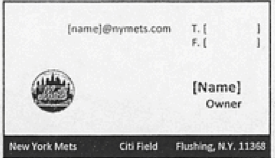 $20 million fills in a stack of these babies. I get the feeling that whoever conceived the already infamous Mets Investor Partnership Benefits section of the “term sheet” revealed by Richard Sandomir in the Times put it together as soon as he or she finished updating the Mets Fan Club for Kids membership form.
For $25, your child receives:
• Two tickets to a 2012 Mets home game
• Kids Club Jersey Backpack
• Window Cling courtesy of Kozy Shack
• Welcome Letter from the New York Mets
• Membership ID Card with Lanyard
• Membership Certificate
• Mets Folder
• Rewards Card redeemable for a free gift at Citi Field
• 3 Issues of the Kids Club Newsletter
• Birthday Card from the Mets
• Subway pre-loaded meal card
• 10% off retail at the Mets Clubhouse Shops
• Invitation to the Mets Fan Club for Kids Day at Citi Field events
• Special 5 year member gift
• Topps Baseball Cards
• Chances to win prizes and much more!
As our buddy Matt Silverman attested on December 5, that’s a pretty good deal. It’s a veritable ton of unquestionably neato Met stuff for $19,999,975 less than it would take to get you:
• One Preferred Limited Partnership Unit
But wait…there’s much more!
• Membership on an Advisory Board of the Club
• Regular updates regarding financial performance and other material developments
• Business card with “Owner” title
No mention on whether a lanyard is included with your card.
There’s more “much more!” to becoming a 4% owner of the New York Mets, and assuming you come up with the $20 mil, they probably work with you. Still, there is a weird, detached paternalism at play when you read the constraints the Mets placed on these potential benefits. For instance, besides trying to impress very rich people with their very own “Owner” card, prospective buyers are offered “the opportunity to attend a road trip in another city with hotel arrangements covered by the Mets,” with the parenthetical qualifier, “trip selected by Club prior to each season.”
So…if I’ve been a bad $20 million investor, I either go to Houston — or get nothing and like it? And if I prefer the trip to, say, San Francisco, the traveling secretary won’t return my texts? Then what would I do? Make other arrangements as someone of my theoretical means would be quite capable of doing?
Also, I get a “food and drink allowance” in my Empire Suite. At what point am I handed a bill for exceeding my allowance? If I’m giving you $20 million, you bring me all the damn burgers I want — and not from some Shake Shack, but from a frigging Shake Castle.
Listen, if you’re going to hand me an “Owner” card, I’m going to walk around Citi Field like I own the place.
The caveat to this very fun document is it was probably lawyered to death (“What if they want unlimited Blue Smoke? I mean sure, we’re experts at blowing smoke…better make that ‘food and drink allowance’.”) and, as Sandomir points out, it was likely intended as a starting point. Maybe someone who suddenly wants to give the Mets $20 million in exchange for no real say over anything doesn’t realize all the neato Met stuff being a minority owner entails. And while “discounts on all MLB-licensed merchandise” sounds like a pretty half-assed come-on…no, it is pretty half-assed. But it is essentially the same perk they offer the Fan Club kids.
And to think — they could have offered Much More!
• Relocation of Spring Training facility from Port St. Lucie to Port St. Your Name Here.
• R.A. Dickey will invoke three multisyllabic words per homestand to perfectly capture your essence.
• Complimentary Fanwalk brick (brick not included).
• You won’t broadcast any fewer innings on WFAN than will Wayne Hagin in 2012.
• Your bright red “Owner” windbreaker allows you to grope “Security” personnel in the same fashion “Security” personnel is allowed to under the auspices of wearing dark red “Security” windbreakers.
• None of the liquidity pertaining to your ownership share will be directed toward the compensation of Jason Bay.
• Pick a number between 15 and 36, and consider it retired in your honor.
• Citi Field concession personnel will be specially trained to make eye contact with you and cease conversations with coworkers as you order (they may still ignore you).
• Paper mâché head bearing your likeness replaces Home Run Apple on alternate Thursdays.
• D.J. Carrasco will D.J. the sweet sixteen, Bat Mitzvah or quinceañera of your choice.
• Team store personnel must show you their receipt as you leave store.
• Bring your kiddies, bring your wife, we’re legally obligated to guarantee the time of your life (legal obligation limited to minority share owner’s life on earth and does not extend to any form of you which is reincarnated; management not liable for minority share owner’s spiritual beliefs).
• Subsequent to one lefty-righty pitching change per series, Terry Collins will mix and serve you a Tom Collins.
• You may travel on your own personal “7 Train” (defined as your being carried aloft by Ed Kranepool, Hubie Brooks, Todd Pratt and Kevin Mitchell; Jeff McKnight may be substituted for any and all of the aforementioned).
• Throw out the first pitch of a Mets game, then maybe the next eighty if you don’t mind.
• You are the answer to the Acela Club trivia question; you present the prize to the surprised recipient; you are the surprised prize-recipient; you must use your prize in the Acela Club no later than the fifth inning.
• Mike Nickeas will serve as your “personal catcher” — no judgments.
• Have Section 538 all to yourself. Intentionally.
• Mike Pelfrey will lick your hand instead of his (may be considered a balk dependent upon the discretion of the first base umpire).
by Greg Prince on 19 December 2011 6:48 am An unnamed spokesman for my favorite baseball team referred to a friend of mine as conducting a “desperate self-promotional campaign for relevance,” which is a shame. That’s no way for my favorite baseball team to act.
As for my friend, Howard Megdal, I will echo his sentiments regarding his new e-book, Wilpon’s Folly, and suggest the reader judge his work — and its relevance regarding the long-term fate of the New York Mets — by reading it. The “desperate self-promotional” charge is just ill-conceived noise on the part of the Mets. You’ve got a specific gripe, spell it out. Otherwise, declining to comment on a book whose findings and/or assertions bug you is a perfectly reasonable response.
I root for the Mets and I root for Howard, so with that conflict of interest stated, I will add that I trust one party more than the other where the best interests of the ballclub are concerned, and it’s not the people who own the Mets. Howard and I became friends because we both love the Mets. I’ve watched him write, report and, yes, campaign for the better part of two years motivated by that love.
It’s an important distinction to note Howard is a Mets fan who is a journalist, and not a journalist who stuffs his personal baseball affection in a blind trust while wearing a media credential. He is what they used to call an advocacy journalist. He has a cause. His cause is Met-promotion more than it’s Megdal-promotion. Howard wouldn’t be chasing this story if it weren’t crucial to him that the root cause of the current Met morass be resolved. If the Mets aren’t working properly, that’s his business as much as it’s anybody’s — the franchise-owners included.
I can’t consider anything Howard’s writing about Madoff-Wilpon without thinking about his prior book, Taking The Field, which is ostensibly about Howard’s tongue-brushing-cheek campaign to be voted general manager of your New York Mets in the summer of 2010. He made like Teddy White and gave us a perfectly lovely time capsule by which to remember his clever Quixotic effort to be elected to a non-elective office across what proved to be The Last Days of Omar Minaya. It’s all very charming — and his theories on franchise-building are all perfectly worthy of debate — but that’s not why you’ll want to read Taking The Field as preface to Wilpon’s Folly.
You’ll want to read Taking The Field for Mirabelle Megdal, the designated heiress to the Megdal rooting passion. The book is woven tightly with Howard’s heartachingly sincere desire to pass along to his baby daughter a franchise worthy of the fandom he is intent on cultivating in her. He played play-by-play tapes (Scully, not Healy) for her while she was in her mother’s womb; he rocked her to sleep with bedtime stories downloaded from MLB Trade Rumors; he immersed her in Citi Field culture well before she would be able to crawl let alone stand in the Shake Shack line.
Howard wouldn’t and won’t wait to guide his child in the ways of Mets fandom. Mirabelle’s not nearly old enough to pay a convenience fee, yet I imagine she already has an opinion on who should play second next year.
Give or take the accelerated timetable, Howard is like any Met-loving parent in that he hates the idea of subjecting a beloved offspring to multiple decades of championship-free baseball, but is going to take that chance anyway. More than anybody else I know, however, Howard is determined to figure out how to make the Mets less of a risky proposition for his kid.
Which is where Wilpon’s Folly comes into play. Though Howard plies his investigative skills and honest curiosity in an attempt to unravel the root of the financial mess the Mets have become, I don’t think this is any more the work of a crack reporter and writer (even if he is both) than it is a dad and Mets fan who wants a better long-term baseball situation for his daughter. To put it in the context of one of the stingingest political one-liners of the last century, he wants Mets fans to be better off tomorrow than they’ve been in the past four or so years.
Howard Megdal’s loyalty isn’t to the story for the story’s sake. It’s to helping to craft understanding and forge solutions on a topic that means a ton to him personally, never mind professionally. It’s to trying to ascertain where the money went and whose fingerprints are on what moves. It’s to ultimately positioning the Mets of Mirabelle Megdal’s rooting years — and all of ours — as something with a fighting chance to be a consistently winning proposition.
If that’s a desperate quest, then so be it.
by Greg Prince on 16 December 2011 9:45 am So I’m walking across Mets Plaza in front of Citi Field the other day, quietest place you’d ever encounter late on a Tuesday morning in December. Nobody around for miles as far as I could tell. What a shame, I thought. I’m going to the holiday party the team holds for kids inside. To me it’s just another thing to cover. It should feel bigger, somehow.
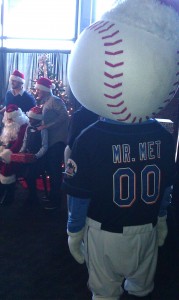 A Mets fan’s view of December. But then the silence was broken. There was this “thwack!” sound. Over and over again: “Thwack! … Thwack! … Thwack!” I figured it was coming from somewhere deep inside the chop shops. I sure didn’t see anybody or anything out of the ordinary until I looked down at my feet and saw a pink rubber ball rolled to a dead stop. It was a Spaldeen, as Pete Hamill would be quick to remind you.
Out of nowhere there’s a kid with a Mets cap, maybe 11 going on 12. It was his Spaldeen.
“Hey mister,” he said. “Can I have my ball?”
“This is yours?”
“Yeah. Thanks.”
He took the ball and returned to his business of bouncing it against the side of the stadium and catching it. Bouncing it and catching it. Bouncing it and catching it. It was almost hypnotic.
The ball got away from him again. He’s not really that good at this, I thought, but I admire his persistence. As it was rolling, I grabbed it and tossed it to him.
“Hey kid,” I say. “What are you doing out here? They don’t let people bounce balls off the side of Citi Field. Do they?”
“I dunno,” he said, though I got the feeling he did.
“Well, you should be careful. There’s security and stuff.” But there wasn’t any security. There wasn’t anybody. “Besides, it’s a Tuesday morning and it isn’t summer. You should be in school…shouldn’t you?”
“I dunno,” he said again.
I shrugged and let him be and started walking toward my appointment. I heard two more “thwack!”s and then his voice.
“Hey mister,” he says. “You going in there?”
“Yeah.”
“Can I go with you?”
“Go with me?”
“See, I’m like the biggest Mets fan I know, and I’m here ’cause I heard something was going on today. I thought maybe I’d see some ballplayers or something, but I haven’t seen anybody.”
“Well, yeah, they’re in there. At this party.”
“So can you take me inside?”
I started to explain that I was here in the role of quasi-media, that my job today is to be a dispassionate observer, maybe ask a few professional questions and not make a big deal out of it. He didn’t seem to be listening, though.
“So can you take me inside?”
“Well, I don’t know if the rules would allow that. I mean this is a kids’ thing…” I thought about how odd it sounded telling a kid that. “I don’t know if you can just walk in and get a present.”
“I don’t care about any of that stuff,” he insisted. “I just want to see the ballplayers. I just want to be around baseball in the middle of December.”
“Let’s go,” I said.
I thought I’d have to make my case for him at media check-in, but nobody asked me anything about the kid I brought with me. The guard inside didn’t say anything, either. Same thing when they opened the door to the Acela Club. It was like nobody saw this kid except me. Still, I figured I’d lay low on his account.
“Sorry I can’t let you line up for a present or a picture with Santa Claus or anything,” I told him. “I’m just worried they’ll see you and throw both of us out.”
“I told you I don’t care about presents or Christmas,” he reassured me.
“Do you celebrate some other holiday?” I asked so as to cover my multicultural bases.
“The only holiday I like is Opening Day,” he said. “The quicker Christmas is over, the sooner baseball season gets here.”
I liked the way this kid thought.
“What are you doing here again?” he asked me.
“Well, I write about the Mets and sometimes the Mets do these things they let me get a close-up look at. It’s mostly a bunch of PR jazz designed to help make the team seem more appealing when you get right down to it. Like last month, they had this thing where I got to talk to David Wright and Ike Davis…”
“YOU TALKED TO DAVID WRIGHT AND IKE DAVIS?”
When the kid said it like that, it sounded a lot more amazing than I thought it was at first.
“Yeah. See, I’m a blogger, which is kind of like a reporter or a columnist. So I have to maintain a veneer of professionalism and objectivity…”
“YOU TALKED TO DAVID WRIGHT AND IKE DAVIS?”
“Uh-huh.”
“How much money is involved for something like that?”
“Well, I don’t get paid. The blog is something my friend and I started because we like the Mets and all…”
“No. I mean how much do you have to pay to get to talk to Mets players?”
“Oh. Um, nothing. It doesn’t work that way.”
“THEY LET YOU TALK TO DAVID WRIGHT AND IKE DAVIS FOR FREE?”
Again, it sounded way cooler when he said it.
“So,” he asked, “what’s gonna happen here today?”
“Assuming I don’t get caught for letting some kid sneak in here with me, I’m going to stand behind a curtain with a bunch of other bloggers and writers and reporters and at some point, after the Santa stuff, the PR people will shuttle a few Mets in.”
“You’re going to talk to MORE Mets?”
“Uh-huh. Daniel Murphy, Justin Turner and Jon Niese, I think.”
“Murphy, Turner and Niese?”
“Yeah,” I said. “I guess they couldn’t get any bigger names up here for this.”
“THOSE ARE THREE OF MY FAVORITE PLAYERS!”
“They are?”
The kid looked at me like I was on the wrong planet.
“Of course! They’re on the Mets! The Mets are my favorite players! Murphy! Turner! Niese! They play for my favorite team! And you get to talk to them?”
“I guess. I don’t expect to learn a whole lot. They’re not much older than you and, besides, they aren’t going to say anything substantive to a dozen bloggers all pointing tape recorders in their face for five minutes. It’s all a big dog and pony show, to be honest.”
“WOW! YOU GET TO TALK TO DANIEL MURPHY AND JUSTIN TURNER AND JON NIESE!”
Maybe this kid should go into PR when he grows up, I thought. He has a real talent for spinning.
I told him we have to play it cool for a few minutes until they’re ready for us. We followed the media crowd behind a black curtain while the players, dressed as Santa (Murphy) and elves (Turner, Niese), handed out presents to Queens schoolchildren who got into the building by more legitimate means. After I nodded hello to a few acquaintances — none of whom noticed the kid who was with me — we wandered to the back of the room and looked out on the still and empty field.
“I see they’re working on bringing the fences in,” I said. “About time. What a badly conceived dimensional nightmare Citi Field has been.”
“WOW!” the kid answered. “THERE’S THE FIELD THE METS PLAY ON! IT’S RIGHT THERE BELOW US!”
“Yeah. It was too deep and high in left and that silly notch in right was too artificial to be taken seriously.”
“WOW! THAT’S WHERE JASON BAY IS GONNA BE! AND ANDRES TORRES WILL BE OVER THERE! AND LUCAS DUDA!”
“Of course maybe if you have a seat over there in the Left Field Landing, maybe you’ll get a better view of fly balls if the wall isn’t so far back. What a missed opportunity this whole place has been.”
“THIS IS WHERE THE METS PLAY AND I GET TO STAND HERE IN THE OFFSEASON AND JUST STARE AT IT! THIS IS THE GREATEST FEELING I CAN IMAGINE IN DECEMBER!”
Eventually the sanctioned festivities on the other side of the curtain broke up and the PR people began to bring the players in for the group interviews. I told the kid to stay quiet and out of the picture. I had work — or something like it — to do.
First they gave us Turner. Bubbly sort. Taking nothing for granted after several years in the minors.
Then Murphy. More of a firecracker than I would have guessed. I asked him about being one of the de facto veterans on this ever younger ballclub, at least in terms of Met tenure: he’s fourth, by my reckoning, behind Wright, Pelfrey and Santana. Murph said he didn’t know he was so far up the food chain. “That’s bold,” he proclaimed, which I found charming.
Niese…didn’t have much to say. Maybe he was tired.
All in all, a pleasant enough round of exchanges, most of it rather predictable. They’re all gonna work hard, they all want to win, they all said the kind of stuff they’ve probably been saying since people started asking them questions based on their athletic ability. Perfectly decent but nothing groundbreaking.
When we were done and back outside, and he was sure nobody would see or hear him, the kid with me all but squealed.
“THAT WAS FANTASTIC! JUSTIN TURNER TALKED TO YOU!”
“I wouldn’t say he talked to me. I was just one of a dozen faces, just another part of his job.”
“AND DANIEL MURPHY ANSWERED YOUR QUESTION! HE LOOKED AT YOU AND ANSWERED YOUR QUESTION! HE EVEN PATTED YOU ON THE BACK AS HE WALKED AWAY!”
“Well, he’s supposed to answer my question. As for the back-patting, I wasn’t expecting that, but it’s not that big a deal.”
“A MET TOUCHED YOU!”
“I’m in the communications business. I can’t make a big deal out of anything like that.”
The kid seemed confused by my nonchalance.
“But didn’t you say you’re a Mets fan?”
“Uh-huh.”
“So how can you not be excited by getting to talk, even a little bit, to guys who are on the Mets?”
“I am. I just have to, you know, keep it in check.”
“Really? Why?”
“I dunno. I just have to.”
“So you don’t cheer at the games or yell at the TV when they’re playing?”
“No, I do. That’s different.”
“It is?”
“It is…I guess.”
The kid didn’t seem any less confused by my lack of clarity, but he forgot about it soon enough. I told him that I should have asked somebody about bridge loans or other important issues — I did come face to face with one of the owners of the team for the fleetingest of moments — and that the goodwill of the party didn’t mean the Mets were actually going to be any better this season. But he wasn’t listening to me as I droned on cynically. The kid who was with me but who nobody else saw had his own agenda.
“Wow,” he said. “Turner and Murphy and Niese all up close. Just being inside Citi Field for an hour was great enough, but players, too? Hey mister, how did that happen?”
“I’m not sure, kid. But I guess I’m glad it did.”
by Greg Prince on 13 December 2011 9:54 am In observance of today’s Mets kids’ holiday party at Citi Field (an on-the-scene report from which will be coming later), I thought I’d dig out of the archives a little ditty I penned on Christmas Day 2002 and first published on Faith and Fear just prior to Christmas 2005. Many of the contemporary 2002 references are as dated as a good Jung Bong joke, but the overall vibe feels appropriate here in 2011 given that nine years ago I was trying to convince myself how much I still liked the Mets despite the Mets in those dreary days doing so many things I didn’t like.
After a spell of writing, I noticed I was no longer convincing myself, but celebrating all the things — the good, the bad, the Huskey — that made the Mets the Mets in my eyes and, really, all our eyes. Plenty more verses could have been added since to reflect the follies and foibles of the intervening decade (and, boy, do they keep on comin’), but I think the point is made pretty well by having mined the first forty-one years of Mets baseball.
So with that introduction, and requisite apologies to Richard Rodgers and Oscar Hammerstein, ladies and gentlemen, I give you a Metsopotamian take on the old chestnut, “My Favorite Things”.
***
Apples in top hats
That rise to occasion
Fran Healy announcing
A summer vacation
Steve Phillips’ cell phone
When it doesn’t ring
These are a few of my favorite things
Extra Dry Rheingold
And Carvel in helmets
Four-fifty pretzels
And three-dollar peanuts
Durocher’s black cat
And the dogs we let out
These are the things that I sing about
Eleven-game win streaks
And two ten-run innings
A happy recap
Born of humble beginnings
High fives and low fives
And Steve Henderson
These are what bring me back time and again
When Fred Wilpon
Pays T#m Gl@v!ne
While Fonzie goes unsigned
I simply remember I root for the Mets
And it’s much too late
For me to resign
Field level boxes
From corporate connections
Changing at Woodside
And catching the Seven
Liza Minnelli
And Jay Payton hug
These are the things that I dig and I’ve dug
Shipping Puleo
And retrieving Seaver
Since Seventy-Three
Saying I’m a believer
Olerud’s hard hat
And Shinjo’s wrist bands
These are some reasons I’m one of the fans
Serenading Chipper
By given name Larry
Exchanging Harry Chiti
For Chiti, yes, Harry
Takeoffs and landings
O’er everyone’s head
These must be why I’m loyal ’til I’m dead
When the GM
Gets Matt Lawton
And casts off Rick Reed
I simply remember the Mets are my team
That must be all I need
‘Rock and Roll Part Two’
As Mike circles bases
Shock and dismay
On the Rocket’s two faces
David Mlicki
Picking his spot
Makes me glad the Mets won and the Yankees did not
Len-ee! and Ben-ee!
And that Theodore stork
The National League
Returns to New York
Alex Ochoa
Hits for the cycle
These are the things that still make me smile
Banners and placards
And the original sign man
Agee making catches
That nobody else can
Swoboda’s dive
Cleon’s shoe polish
Miracles Orioles had to acknowledge
When Ordoñez
Learns some English
And calls us all stupid
I simply remember I’ve been a Mets fan
Ever since I was a kid
Throneberry, Strawberry
Koosman comma Jerry
A Todd Worrell fastball
For HoJo to bury
Corners of K’s
And Ojeda’s dead fish
Make summer’s arrival my next birthday wish
Davey’s short in the outfield
So uses Orosco
Joe Orsulak’s swing
Which was sweeter than Bosco
Hernandez on bunts
And Kranepool in a pinch
When it comes to the Mets, I won’t give an inch
Not sitting in front of
A loud, drunken yeller
Wes Westrum proclaiming
Another cliffdweller
Lindsey tells me
Shamsky’s around in right
These are what I recall by day and by night
When Grant Roberts
Is caught toking
In Newsday or the News
I simply remember that nobody’s perfect
And don’t let the Mets give me the blues
Ventura’s grand
But Tank stops him from scoring
Bobby V wore disguises
But never was boring
Mora crossed home on a pitch
That was wild
Things that make me cry like some kind of child
Grote going back
And grabbing a pop-up
Sisk coming in
But, relax, just to mop up
Mookie Wilson’s nubber
Trickling fair down the line
What happened next will always blow my mind
Not yet a no-hitter
But anticipation
Gregg Jefferies for five weeks
A rookie sensation
Knight against Davis
And Buddy v. Pete
These are the things, I admit, I find neat
When Armando
Blows his next save
As he inevitably will
I simply remember the leads he held onto
And then I don’t feel so ill
Number twenty-four
Staying mostly retired
Thanking the Good Lord
When Torborg got fired
Kingman’s second stay
When he handed out pens
Ralph breaking it down right after the end
‘Lazy Mary’ plays
And we keep on stretching
Mel Rojas would pitch
And he’d get us all kvetching
Mettle the Mule, DeRoulet
Richie Hebner
Seventy-Nine I can’t help but remember
Gary Carter’s knees
All wrapped up like a mummy
DiPoto made butterflies
Float in my tummy
Thinking we’re set
Because we’ve got Mike Vail
Yet I stick with the Mets, succeed or fail
When Burnitz and
Alomar crash
When Cedeño and Mo go down
I simply remember they all had bad luck
And convince myself they’ll turn it around
Calvin Schiraldi
Preceding Bob Stanley
A superstar catcher
Explains that he’s manly
Franco plays Santa
And Rusty serves ribs
The Mets speak to me in my second language
M. Donald Grant
Burning in hell
Knowing AY
Can’t be charged with an L
Clearing the clubhouse
Of sparklers and bleach
And knowing the Wild Card’s still within reach
A general manager
Who knows what he’s doing
Every position
Manned by McEwing
Best infield ever
Or so said SI
They’re all gone now, though I don’t know why
When the Mets are
Labeled quitters
And demand apologies
I simply remember they’re sensitive people
And then I don’t go, ‘oh geez’
Casey could choose from
A pair of Bob Miller
Al Jackson, pre-Michael
Original Thriller
¡Yo la tengo! Ashburn
Called out to Chacon
With the Mets on the West Coast, I don’t sleep alone
Part of ‘Men In Black’
And a scene from ‘Odd Couple’
Scrappy platoons
Like Backman and Teufel
Staiger, Mankowski
A parade of third basemen
When the Cubs finished sixth, we stayed out of the basement
Shea in the daytime
Enjoying it all
Gil Hodges eventually
Making the Hall
Clendenon and Brogna
And even Todd Zeile
Glad tidings to Mets is the feeling I feel
When Steve Trachsel’s
Paid by the hour
Or works as if that’s his deal
I simply remember his good Earned Run Average
And he’s practically a steal
Al Leiter’s cutter
And buddy Mike Bloomberg
A mayor to whom our team
Is more than a rumor
Dave Magadan speeds to
A deliberate crawl
Gosh I hope that the Mets are around in the fall
Prospects from Norfolk
And before that Visalia
Jane Jarvis’s organ
Would never assail ya
Chief Noc-A-Homa
Taking knocks from The Dude
If only Mets ushers weren’t nearly as rude
Old Timers Day inspiring
Terry Cashman
A less uptight version
Of bowtied Frank Cashen
Pretending Nolan Ryan
Had stayed his career
Wishing Sojo had been kicked in the rear
When the Mets win
None in August
And I’m there for every loss
I simply remember things can only get better
And then my cookies don’t go for a toss
Brent as in Mayne
Not the Maine of Ed Muskie
Schofield who’s skinny
And Butch who is Huskey
Piling on Rocker
A surfeit of malice
Sunny Frank Howard, the tart tongue of Dallas
Dependable backstops
The Gonders, the Dyers
The weight-lifting antics
Of Randall K. Myers
‘Bring on Ron Gaspar’
A gaffe of F. Robby
Waiting for Reyes becoming a hobby
Clipping coupons
From a Dairylea carton
The serendipitous wrist
Of the great J.C. Martin
McCarver says triples
Are better than sex
Just call Five Oh Seven T-I-X-X
When team meetings
Are more frequent
Than team victories
I simply remember when they’d shut up and play
And then I don’t feel unease
Bring your kids to see our kids
Said with a straight face
Beating the Expos
And entering first place
It not being over
When it hadn’t expired
Trading Bonilla when his act grew tired
McReynolds bolting
To beat city traffic
Rickey drawing walks
And then wreaking havoc
Debating Gerry Moses’s
Lifetime Met status
Responding when Bill Hands was throwing right at us
Don Bosch and Don Hahn
And good old Don Cardwell
Suddenly recalling
The right fielder’s Gus Bell
Topps, Upper Deck
Pinnacle, Fleer
Each pack should include at least two Bruce Boisclair
When one player
Accosts another
About his rookie card
I simply remember we’re talking grown men here
And then I don’t take it nearly as hard
Revising the yearbook
To include Lenny Randle
A roller toward Schmidt
And Schmidt losing the handle
Removing the tarp
To scattered applause
A call to the bullpen, back after this pause
Hypothetical swaps
Causing Howie to go nuts
A roster of players
Not twenty-five robots
The grass all torn up
Irritating Pete Flynn
Who cares if he’s angry, so long as we win?
A fortunate bounce
From a top-of-the-fence shot
Overcoming the scuffwork
Of devious Mike Scott
Dave Liddell disappearing
After one plate appearance
Not losing an out on lame interference
When Tarasco
And Mark Corey
Are found dabbling in drugs
I simply decide that it’s none of my business
And then I don’t blame those lugs
Carl Everett’s slam
Off of Uggie Urbina
Tomatoes by Piggy
And not Contadina
An unlikely dinger
By speedy Esix
Shortstops like Elster not committing e-six
Darryl Hamilton
Is served his release
Rich Rodriguez
Packs his valise
Counting on phenoms
Like Pulse and Tim Leary
Forgiving Hank Webb, he must’ve been weary
Happy birthday to dads
Kiner’s Father’s Day greeting
The occasional smart move
At some winter meeting
Nineteen-inning games
Won by dawn’s early light
Followed by fireworks, oh what a sight!
When our rivals
From across town
Win on our own field
I simply remember to turn off the TV
And then my venom might yield
Applauding old heroes
When they first come back
A Baltimore fly ball
That’s caught at the track
Bobby Jones beats the Giants
A Fresno one-hitter
Making Baker and Jeff Kent both act kinda bitter
Rain delay anecdotes
That never grow moldy
The Polo Grounds forever
A goody if oldie
Greg Goossen projected
To someday turn thirty
Finding no cork when Whitey played dirty
Game Three leadoff batters
Each hitting one out
Scoring twenty-three runs
En route to a rout
Two-dozen straight games
With hits by Hubie Brooks
The rosin was Wendell’s, the tantrums were Cook’s
When the playoffs
Elude the Mets
Thanks to five straight defeats
I simply remember to wait ’til next year
And then I go buy my seats
Bass and Barrett strike out
Sending gloves in the air
Our new stadium
Outdraws the World’s Fair
During those first years
No hint of a rise
Then by Eckert’s lot, we draw The Franchise
Simons and Walter
And southpaws of woe
They didn’t get saves
But at least were let go
Payson seemed generous
Doubleday dotty
Mazzilli’s a traitor but once was a hottie
Pitchers who’d battle
Throughout a run dearth
Decreeing D’Amico’d
Inherit the earth
Shawn Estes took aim
No way he could miss
All he hit was a homer, but that blast was bliss
When Mike Scioscia
Got to Gooden
And turned Game Four around
I simply remember results two years prior
And my mental state’s more sound
Hampton before
He worried ’bout schools
Escobar when the hype
Said he had tools
Dan Norman’s aborted
Switch-hitting trial
After Montañez tailed off, he still had style
With nobody out
Taking a pitch
Learning to spell
Gary Rajsich
Rally caps topping noggins
When contests get tight
That arm-twirling lady, her hex worked all right
Spahn and the Duke
And surly Eddie Murray
Immortals perhaps
Gone from here in a hurry
Four pennants waving
From the outfield flag pole
Terry Leach coming through in almost any role
When Pendleton
Hit that home run
And stopped us in that race
I simply remember something else would’ve gone wrong
And then I don’t feel disgrace
Promotional items
Handed to adults
Jumping on Nen
And on Hoffman and Smoltz
Picking up the FAN
In any location
Our runners not running from station to station
Gary and Murph
Broadcasting in sync
Sweeping the Pirates
When pushed to the brink
Sasser’s throw to the mound
Arrives on the fly
Twelve years of Ron Hodges, that seems rather high
A lineup that featured
Youngblood and Taveras
Showing Oil Can Boyd
That he didn’t scare us
A new media guide
Its cover so glossy
Ends with Don Zimmer, begins with Don Aase
When Atlanta
Beats the Mets out
Every time it counts
I simply ignore their stellar track record
And cheer for our boys in greater amounts
Sadecki, McAndrew
And every fifth starter
Timo except when
He could’ve run harder
Roger McDowell
Wearing mask after mask
The answer’s the Mets, you don’t have to ask
Salty and Cubbage
And interim skippers
Todd Hundley’s record
For receiver round-trippers
Lance Johnson never
Getting thrown out at third
Never mind ‘Grease,’ the Mets are the word
Teddy Martinez
Waved home by Eddie Yost
St. Lucie datelines
In the Times and the Post
The Magic Is Back
‘Ball Like It Oughta Be
Printing World Series tickets in Two Thousand Three
When they make bad trades
And guys lose their skills here
Amazing but it’s true
I simply remember the phrase, ‘Let’s Go Mets!’
And there’s not much more that I can tell you
by Greg Prince on 12 December 2011 4:28 am A friend and I were discussing recent Met developments over the weekend. He referred to “Gil and Reyes,” as in he perceives an anti-New York bias inherent in Gil Hodges not making the generally worthless National Baseball Hall of Fame and Jose Reyes not finishing in the Top Ten of the National League MVP voting. What struck me in his communiqué was Gil was dependably “Gil” yet Jose had been relegated to last-name status.
No way, I said.
Yeah, he retorted. Jose’s a Miamian now, thus he’s Reyes.
Nah, I fired back. Argenis Reyes, if he’s around anywhere in 2012, he can be Reyes. Jose is Jose. Jose will always be Jose to me.
I didn’t high-hat Fonzie into Alfonzo. Darryl didn’t become Strawberry. Doc in his darkest pinstriped hours never became Gooden. Rico was always Rico. Melvin was always Melvin. And Tom Seaver never stopped being my favorite Met.
I’ll allow Jose a little latitude when the Marlins come to Citi Field for the first of their forty or fifty annual games against the Mets on April 24. He’s granted a leadoff base hit; what’s one more night without a no-hitter? He’s permitted to steal second and take third on the throw. I’m undecided on whether he may score.
Then he can go into a six-year slump against Met pitching. He can tear up the rest of the National League the rest of the time as long as it doesn’t do the Marlins much good. The Marlins can beat the Phillies, Braves and Nationals just as the Phillies, Braves and Nationals can beat the Marlins. They can all beat each other up while the Mets sweep the whole lot of them into oblivion.
That’s the plan, though I suspect it doesn’t have much fiber to it.
I also suspect that the longer Jose Reyes is an actively competitive ex-Met — not just a West Coast rumor along the lines of John Olerud in Seattle — I’ll decrease my simmering sentimentality bit by bit. Forty or fifty games a year against the same team will do that. But unlike Olerud (another free agent whose departure left me groping for my December bearings), Jose grew up on my watch. It’s one thing to wave goodbye to the professionals when you previously knew them as something else. Gary Carter the Dodger or Rusty Staub the Tiger were essentially returns to form from when they were Expos. But the guys I never knew as anything but Mets…that’s tough. Rico Brogna morphed into a Phillie and a Brave yet I never didn’t applaud him when he swung by Shea. He was always a Met to me.
Tug McGraw was always a Met before he was traded, thus his Phillie incarnation — a pretty significant phase of his career and their history — never really seemed demonic in my eyes. Same for Lenny Dykstra when he wore a Phillie uniform instead of an orange jumpsuit. I wanted the Mets who faced them as rivals to prevail against them but I couldn’t root against them in any substantive “enemy” sense. Same for Wally Backman as a Pirate/Phillie when both identities were rather nauseating to a Mets fan of that era.
I’d have preferred some Met who broke in as a Met and blossomed as a Met had remained a Met for an entire enjoyable career and then tipped his cap on his last day as a Met. But that’s never happened. I mean never — neither Ed Kranepool nor Ron Hodges went out on their own terms, and they’re the only Mets of length to not sign somewhere else at some point.
Why I expected homegrown multitime All-Star Jose Reyes would be that Met I’m not sure. Cap-tipping lifetime one-franchise players are pretty rare to begin with these days. The best I can hope for is the Mets won’t pretend for years on end that Jose Reyes didn’t exist as an essential part of them for nine seasons; that his image won’t be erased from every 50th anniversary montage; that his pictures aren’t all shoved in storage; that bloggers of 2023 or whenever aren’t forced to demand to know when he’ll be inducted into the club’s Hall of Fame. The Mets can be chillingly Soviet that way.
Meanwhile, the Marlins of Miami are no more tenable as a taste than the Marlins of Florida, and a pox on Loria and the lot of them, but Jose is going to be Jose to me for a very long time. That much I know. When the Mets and Marlins are playing for low stakes, I’ll veer toward the Met on the mound, but a tiny bit of me won’t ever be not at least a smidgen happy when Jose gets the better of an isolated confrontation. Should they play for high stakes — meaningful games in September or a no-hitter on the line — that will almost certainly be a different story.
Right now, it’s all speculative and rather unknown. I’ve had to deal with beloved ex-Mets regularly but not at this level in a very long time. Not at the “he’s my favorite” tier. That’s a tough tier to negotiate. I regularly rooted for Fonzie to take the measure of the Gl@v!nes and Trachsels when he was a Giant and they were boring.
If you could convince me all this was part of a master strategic plan to improve the franchise, OK. Sometimes players have to go so as to bring in better or different players. I was in mad love with Melvin Mora in 2000 yet understood the need for a dependable defensive shortstop (even if what we got was Mike Bordick). If someday a champagne-soaked Sandy Alderson can trace a championship to the meeting he had with his braintrust in the fall of 2011 when they knew letting Jose Reyes go would be painful but ultimately baseball-beneficial, I’ll gather all the hindsight at my disposal and retroactively praise the thought process to the high heavens.
But this is about ownership not having the money to keep their best player in his prime because they figured out a way to lose it. It’s not about roster maximization and I don’t believe it’s about not giving six years to a dicey hamstring risk. No way Jose would have gone had Bernie Madoff not come along. This used to be a large-market, big-league operation. For the time being, we’re condemned to Bisonmania.
You’re welcome to your spin. Mine is our franchise, the one to which we pledge our fealty, has been diminished. Jose Reyes’s departure isn’t the cause of that but a symptom of it. I don’t have any idea when this trend will be reversed. I hope it won’t be too long.
I do a lot of hoping as a Mets fan.
by Greg Prince on 10 December 2011 4:17 pm An event and an image, each presented in the name of warmth…
Event: The Mets’ annual “Warm Up” Holiday Coat Drive, Wednesday, December 14, between 9 AM and 5 PM. Bring one or more coats to Citi Field’s Seaver entrance and receive a voucher redeemable for two tickets to a select April 2012 game and a 15%-off coupon for stuff at the Mets Team Store (valid December 14 only). If you’re a season ticket holder, you’ll get 20% off regularly priced items when you show your supersecret Season Ticket Holder ID card. The coat drive is thoughtfully presented in conjunction with SNY and New York Cares. And if you’re thoughtful enough to donate a coat, wear whatever you like while doing so.
Image: Discovered through the satisfyingly curious mind of Matthew Callan at Amazin’ Avenue.
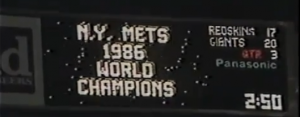 Mets win, Giants winning, all was calm, all was bright. October 27, 1986 was one of the great nights in the history of Western Civilization even before taking into account the extracurricular activities occurring at the Meadowlands. You didn’t need to be a total Bluenatic to appreciate the Met-Giant symmetry that Monday night, though allegiances to both teams probably helped. I remember it like it was yesterday despite it being too many yesterdays ago.
Sigh…
Anyway, donate a coat on Wednesday if you can and read Matthew’s piece and enjoy its attendant YouTube clip attesting to better times here.
by Greg Prince on 9 December 2011 8:18 am Monday night at 9, Tom Seaver is Bob Costas’s guest on MLB Network’s Studio 42. That’s an hour of Tom Seaver being interviewed about pitching…his own included, presumably. That looms as the best hour a Mets fan will have all December.
Your DVR has been warned.
by Jason Fry on 6 December 2011 10:16 pm So yesterday afternoon I tried to sum up my feelings about Jose Reyes leaving the sad, broken Mets for the temporarily nouveau riche Marlins. I wasn’t happy when I started writing that post, and I wasn’t any happier when I finished. I gave it a final read, posted it and promoted it.
But let me tell you what I did after that. It’s a little thing and a personal thing, but I think you’ll see why I’m sharing it, and maybe derive some comfort from it.
It was time to get my kid from school. I changed my shirt, settling after not particularly conscious thought on my orange ’69 Series Game 3 shirt, the one with a Nixon-era Mr. Met on it. Walking across my neighborhood, I pulled out my phone, put in my headphones and cranked a song I love — “Romance” by Wild Flag. This would be an awesome song to play at Citi Field, I thought idly — a conclusion that probably has to do with the line “sound is the blood between me and you” reminding me of the bond that develops, in good times, between a confident team and its hometown fans.
(This is a mildly insane idea. “Romance” is way too indie to work in the vast space of Citi Field. But that’s not the point. Bear with me.)
I listened to the song again, my footsteps drifting along the well-worn route, and found myself thinking of Ike Davis and Lucas Duda and Ruben Tejada in their new, much improved uniforms, of balls landing fair and clearing walls in walkoff victories yet to be. I thought about being at Shea for the Grand Slam Single and for Piazza lining a laser beam off Mulholland and how the stands had moved and flexed as we all bayed at the sky. I thought about getting your errands done early for that first weekend spring-training telecast and settling happily onto the couch, knowing that even though it was still vile outside, those players in mesh tops were a promise that kinder weather would be soon at hand. I thought about my family’s calendar defaulting to 1:10 and 7:10 and adjusting to the occasional 4:05 or 8:05 or enduring a hard week of 10:15s.
I walked along in my Mets shirt with all these thoughts playing tag in my head and the music in my ears, and I realized I was happy. I honestly was. I wasn’t thinking about Jose Reyes, or the Miami Marlins, or Bernie Madoff, or any of it. Not by a conscious act of will, but because my mind had wandered off somewhere better.
That’s my story. But if you read this blog, you’re not so different from me, or from Greg. And that’s why this will all be OK.
I’m not going to tell you exactly how it will be OK, or when. Because there’s more uncertainty and dismay and anger to work through before this star-crossed, scar-marked period in Mets’ history ends.
But it will end. There will be new players who we watch grow and learn before our eyes, going from coltish prospects to incandescent rookies to sturdy veterans, and we will love them all the more for having urged them through their early maybes. And even amid the gloom before they arrive, there will be gritty come-from-behind wins and unexpected laughers. There will be rising apples and Let’s Go Mets chants and hunches proved true and statistical glasses that all of a sudden you’re damn sure are half-full.
And even when you don’t feel that way, there will be Mets Classics and DVDs and just reliving the highlight reels in our own heads. There will be reconnections with old Mets fans and meetings with new ones, excited exchanges about first games seen and classics witnessed. There will be new fans drawn to impossible dreams and wise old heads who remember when those dreams came true.
There will even be nights when a little thing happens like a song proving evocative enough to lift you above the gloom and bad news, until you realize you’re happy not despite the fact that you’re a Mets fan, but because of it.
And that’s something nobody can take away from you. Bernie Madoff can’t steal it, Irving Picard can’t repossess it and Jeffrey Loria can’t buy it.
There is something beyond the reach of all these troubles, something that’s the Mets’ greatest strength — and it’s you. You, and me, and Greg, and all the rest of us. We’re the ones who define this franchise, who weave the thread of identity and life and hope even as the uniforms get tweaked and the stadiums go up and come down and the players arrive and depart and the win-loss records wax and wane. No matter how long you’ve been here, you’ve seen bright days of the baseball soul alongside dark nights. On the bright days, we add to the glitter and the gleam. In the dark nights, we are the only source of light. Either way, we’re there. And despite these recent trials and amid these current woes, we’re not going anywhere.
We are the silver lining.
by Jason Fry on 5 December 2011 4:40 pm Back in May I wondered what it would feel like when the number of Jose Reyes Mets highlights remaining were reduced to zero. Now we know.
It sucks.
Jose Reyes is no longer a Met. That’s awful enough right there, but of course it’s worse.
Jose Reyes is a Miami Marlin. Eighteen times a year, starting in late April, we’ll have to watch him take his accustomed spot on the field in an awful uniform next to the awful Hanley Ramirez. With the Mets of the foreseeable future put together from whatever can be scooped up from the factory floor, the Marlins are a good bet to win more of those games than they lose. Jose will beat us in some of them. He will drag his feet across third at the end of a head-first triple like a jet fighter getting arrested by the hook on the carrier deck. And then he’ll throw his arms out in joyous cruciform and do whatever the 2012 Marlins’ version of The Claw/Spotlight is, only this time David Wright will be standing there with a useless baseball looking glum.
It is going to suck. It sucks right now. Whatever you are — angry, sad, depressed, downhearted, blue, adrift — I’m feeling some pretty large measure of the same.
This is where the “yeah, but” comes in. You probably guessed that. But this isn’t your typical “yeah, but.”
I love Ruben Tejada — think he’ll be a star, even, and feel very sorry for him given all the stupid questions he’ll have to answer in Port St. Lucie. But he’s not Jose Reyes and I heartily wish he were going to become a star one defensive position to the right.
I trust Sandy Alderson and his front-office crew, but they’ve got a lot of desert to cross with nary an oasis in sight.
I do not trust the Wilpons, not one little bit. They give every indication of sticking around, with their worries and their lawyers and a commissioner to protect them. This protection comes at the expense of the rest of us.
Not much of a silver lining, is it? At the heart of these gray clouds you’ll find a bunch of black.
And yet here it is: The Marlins are going to give Jose Reyes six years and $106 million. In Sandy Alderson’s shoes, would you have done that even if you had the money? Thinking with your head instead of your broken heart, would you have done that?
I wouldn’t have.
The $106 million isn’t the problem as much as the sixth year. Five years for Jose is frankly scary. Six is insane. That makes this different from the Midnight Massacre, an indefensible trade driven by a culture clash and human pettiness. It makes it more like Darryl Strawberry heading west in the winter of 1990. It doesn’t make us feel any better, but that’s the fairer comparison here.
We cannot forget, on this day of misery, that every time Jose rounded first we held our breath a little. We asked the baseball gods to please not have him grab at his hamstring again. It happened way too often — in Jose’s stats we see a glorious four-year run, sandwiched by an uncertain beginning plagued by hamstring woes, a 2009 season lost to them, a merely OK 2010 season and then last year. And last year, we must remember, was really a tale of two seasons. Reyes I was the stuff of clapping your hand to your head and turning to hug your neighbor while screaming “Didja see THAT???!!!” But then Jose hurt his hamstring again, and when he came back for Reyes II, he was cautious and tentative and merely OK.
So how many years of Reyes I do the Marlins get, and how many years of Reyes II? In the last year of his new deal, he’ll be 34 years old. If he’s still a Marlin, it’s a good bet they’ll wish he weren’t. This is the Marlins’ Pedro contract, a premium paid by way of apology to their fans and as a beacon for other free agents. That Pedro contract didn’t work out so well. Worse, it was followed by other Omar Minaya specials that didn’t work out too well either. Those contracts are one of the reasons the current Mets are in their current mess.
But I’ve overcomplicated it. Again: Would you have given Jose Reyes six years and $106 million? If you would have, fine. I wouldn’t have. I thought that and said that, and being this sad and pissed and everything else won’t allow me to forget that that’s where I stood.
And given that, I’m not upset about some of the other things tormenting Mets fans. I don’t care that the Mets didn’t make a counteroffer, because there was no genuine counteroffer to be made. The Mets weren’t going to go six years, so they didn’t. The Mets probably weren’t going to go above $100 million, so they didn’t. Hearing that they’d offered four years and incentives to get Jose to $90 million wouldn’t have made Jose reconsider, or let me sleep any more soundly. The fewer lame gestures to paper over unpleasant truths, the better.
And forget the fact that under the new CBA, the draft-pick compensation is lousy. I didn’t want the Mets to trade Jose Reyes in July and neither did you and no one seriously advocated that they should, so no one is allowed to pretend otherwise.
Beyond that, well, lots of people think the Wilpons should sell the team. That’s an interesting one. The contrast between baseball’s treatment of the McCourts and the Wilpons is certainly thought-provoking, yes. But here, I’m torn. For one thing, it’s not a small thing to say people should be stripped of their property after a generation of being pretty good stewards overall. But I distrust the Wilpons enough to be willing to explore that. The real problem for me — and perhaps for Bud Selig — is not knowing whether the Wilpons’ current financial woes are the stuff of another year, or a few years, or forever.
If the Wilpons can settle the Madoff mess sometime this spring for somewhere north of $100 million, presumably the team’s payrolls can return to more-accustomed levels relatively soon, with a much smarter crew in charge of the checkbook. In that case, our crying for them to sell is raw emotion and strikes me as unfair, and no doubt strikes the commissioner’s office as chum for generations of very expensive lawyers.
If these penurious ways are to be the Mets’ fate forever, that makes me want to lie down in the road. I can’t stand the idea of Grant-De Roulet II. The thought of trying to raise Joshua as a Mets fan amid that level of pain makes me want to walk away from everything, and that idea terrifies me. I doubt Bud Selig’s feelings on the subject are quite that intense, but I’m sure he doesn’t want that either. Having New York’s National League franchise be a charity ward is not in the best interests of the game.
But what if the future of the Mets is somewhere in the messy middle between those two extremes? Well, then what the hell do you do?
But sadly, we have plenty of time to explore that one further. I’ll set a reminder for June, when the Mets’ latest losing streak is playing second fiddle to scenarios about what the inevitable trade of David Wright will bring. For now, I’m left with this: How will I greet Jose Reyes, Miami Marlin?
No, not when I first see him against us — when that happens, I’m going to cheer myself hoarse, giving him the ovation he deserved and didn’t get because of Terry Collins’ final-day pooch-screwing. I mean after that. I wish Jose the best, but the best for Jose means our task is even harder for the next six years. And yet I don’t want Jose to be Darryl Strawberry, though I think that’s more likely than six years of mid-Aughtsian glory. If the Marlins’ deal winds up looking wise, we are embittered. If it winds up looking dumb, Jose and baseball and all of us are diminished.
Like I said, today sucks.
by Greg Prince on 5 December 2011 6:42 am “When I’m finished, I’ll get the best seat to see him play. I’ll pay whatever price to see him play.”
—Pedro Martinez on Jose Reyes, July 23, 2005
Somewhere in the midst of the conference call Sandy Alderson held with some of us bloggers last Thursday night, the Mets’ general manager used an unremarkable phrase that caught my ear nonetheless. His front office, the GM said, was out to put a “better product on the field — better and more entertaining” in 2012.
I was instantly reminded of Mike “Meathead” Stivic’s reaction to a grocery item label that promised “NEW AND IMPROVED!” on All In The Family. What, he asked, were we using before: old and lousy? Whatever the Mets’ missteps over the years, it never occurred to me they were intentionally going for worse and more torpid.
What got me was the use of the word “entertaining,” as if it was a disparate competency from “better”. If winning is colorless, sign me up for the Monochromatic Pack at once. If the Mets are winning consistently, the fun generally reveals itself therein.
But embedded in Sandy’s well-chosen words, I supposed then (and feel certain of now), was a cushion of warning for Mets fans…as if we hadn’t figured where things were inevitably heading for ourselves. The Mets, he seemed to be saying, will strive to be entertaining next year, even if it doesn’t involve a ton of winning, let alone the presence of the most entertaining player we’ve ever employed.
No matter how drab the Mets turned post-2008, one colorful character leapt out from their tedious tableau. No matter what kind of film with which you metaphorically shot him in these digital days, there’s no way Jose Reyes would print in black and white.
I’ll miss that sense of dazzle. I’ll miss the runs, triples and stolen bases, of which he collected more than any Met in franchise history. I’ll miss the production at the plate and the prevention in the field (whatever your defensive metric of choice indicates). I’ll miss not having to wonder who would bat leadoff. I’ll miss the 1,300 hits and how somebody was finally going to catch Eddie Kranepool while wearing Eddie Kranepool’s number. I’ll miss that the last of the 2003 Mets was the one 2003 Met whose sudden presence and instant impact in 2003 cheered me up when I was as down as I’d ever been about the state of the Mets.
But that doesn’t even get to what I’ll miss most. Call it entertainment value if you like, though when you’re a fan of a team, you don’t worry about being entertained. You’re far too engaged for such superficial concerns. You want to be entertained? Download Adele. Go see George Clooney. Subscribe to the MLB package and watch the Miami Marlins. That’s dispassionate entertainment.
What it was to me was Jose being Jose. Jose lashing. Jose dashing. Jose gunning. Jose grinning. Jose and the Mets winning, Maybe not as much as they had been when they were an annual 89-win proposition (on average) for four straight years and he was leading off virtually every day, but enough so you could put together his legs and his arm and his bat and their fortunes. Gosh, it was fun to be in your seat by the start of the bottom of the first if you were going to the game or at your TV no later than 7:11 if they were on the road. Gosh, it was comforting crossed with exhilarating knowing the game couldn’t commence until Jose had the first of his ups. Gosh, he relished being a baseball player, and he did it as a New York Met.
Who else ever made us sing not just his praises but his name? Repeatedly? To say Jose was the most fun Met ever doesn’t quite get to his essence. It was more like he was funnest. You felt like a kid watching him play, so it’s only fitting to express yourself that way, too.
I joined in a knot of media last month at the event the Mets held to unveil their altered uniforms so I could hear what Ike Davis and David Wright each had to say about Jose Reyes. Ike was almost bubbly talking about how “excited” he was to have been Jose’s teammate. I asked David to share his thoughts on Ruben Tejada, noting he’d probably been asked plenty about Jose. I have to admit I wondered how much of a company man he’d be if given the opportunity to move on to the next shortstop. But David, bless his Metsian heart, didn’t bite. Jose was “one of a kind,” David said (before adding some respectful boilerplate about Ruben).
These tidbits occur to me because one of my favorite images from Jose Reyes’s nine years as a Met come from a game he didn’t play, the final Saturday night of last season, the second half of a day-nighter against the Phillies. The Mets won it with Jose on the bench, yet after the final out was made and the SNY cameras captured the lads funneling toward their clubhouse, the guy leading the charge — and the guy more ebullient than anybody else at having won an allegedly meaningless game — was Jose Reyes. You would have thought it was the Mets, not the Phillies, getting ready for the playoffs. In that moment, the notion that somebody was “just happy to be here” shone through as it rarely does. And this was no scrub. This was our star.
The Mets are fun to us because they’re the Mets; it’s the same reason the Mets are a pain to us. But some guys are just more fun and more meaningful than the rest. That was Jose. Jose made leading off a happening. Jose made his staying through the trade deadline a cause, even if it turned out to be a reprieve more than a pardon from the governor. Jose was a sunshine rod. If things were working even a little for him, you were having a better day because of it. You might not have trekked to Shea Stadium or Citi Field specifically to see him, but he was the one who drew you in once you were there.
It’s good to have that. It’s good to have someone to depend upon as a constant in your life as a fan. It’s a more sacred sensation than “entertainment”. If you’re caught up in the development and evolution of a player from the beginning of his career in your midst to the end, the entertainment takes care of itself. Your equity with your team tends to be tied up predominantly in a few special players at any one time. If you’re lucky enough, you have those players with you 100%, from hotly anticipated callup to final tip of the cap. Their ride is your ride.
Of course we never, ever have that over the long term, save for the aforementioned Kranepool and maybe Ron Hodges, depending on your definition of special player. I would have loved to have had it with Seaver, with Strawberry, with Alfonzo…but I didn’t get it. I won’t get it with Reyes, either. There are reasonable explanations for why this has come to pass, whether you count them to 70 million or 106 million, but it doesn’t make them feel any more legitimate.
I feel, on the most basic of levels, as if my trust in my team has been violated. For whatever reason I became a Mets fan at the age of six, it wasn’t to be calmly understanding of ownership when it led the club down a path of competitive ruin. And it wasn’t to make rationalizations on behalf of vague nods toward a better, more entertaining day after tomorrow. I’m pretty sure it was to root for a whole lot of players who played for my team and to fall in baseball love with one or two of them in every Met generation. Reyes was that guy for most of the past decade.
I have no idea who will be the next one or when/if it will happen again.
A little more recommended reading…
Last week’s Sandy Alderson conference call, still instructive despite being a little dated by now, was courteously transcribed by Amazin’ Avenue here.
Marvelous encomium to Jose Reyes from Patrick Flood, here.
The big picture, broken down stroke by insightful stroke by Metstradamus, here.
And one of my favorite Faith and Fear pieces, wherein Jason eavesdrops on a contentious conversation between scout and sabermetician as regards a young shortstop on the rise, here from 2005.
|
|