The blog for Mets fans
who like to read
ABOUT US

Faith and Fear in Flushing made its debut on Feb. 16, 2005, the brainchild of two longtime friends and lifelong Met fans.
Greg Prince discovered the Mets when he was 6, during the magical summer of 1969. He is a Long Island-based writer, editor and communications consultant. Contact him here.
Jason Fry is a Brooklyn writer whose first memories include his mom leaping up and down cheering for Rusty Staub. Check out his other writing here.
Got something to say? Leave a comment, or email us at faithandfear@gmail.com. (Sorry, but we have no interest in ads, sponsored content or guest posts.)
Need our RSS feed? It's here.
Visit our Facebook page, or drop by the personal pages for Greg and Jason.
Or follow us on Twitter: Here's Greg, and here's Jason.
|
by Greg Prince on 6 July 2011 1:00 pm 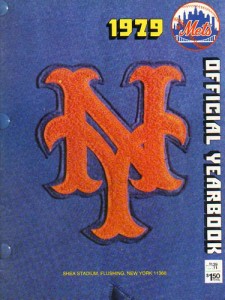 Thursday night at 9 o’clock, revisit the original sign of the apocalypse when SNY airs Mets Yearbook: 1979. I realize we express this type of sentiment fairly regularly where this dynamite series is concerned, but it defies the laws of nature that somebody actually produced a highlight film from a 63-99 season that in no way, shape or form included thirty minutes of Mets highlights. Thursday night at 9 o’clock, revisit the original sign of the apocalypse when SNY airs Mets Yearbook: 1979. I realize we express this type of sentiment fairly regularly where this dynamite series is concerned, but it defies the laws of nature that somebody actually produced a highlight film from a 63-99 season that in no way, shape or form included thirty minutes of Mets highlights.
But of course we kid 1979 because we lived through it. We know Lee Mazzilli exploded into the national consciousness like a discount bag of Pop Rocks, and that Frank Taveras sped his way from first to second and sometimes third, and that one June night the Mets scored ten runs before making three outs. But boy, if ever a year begged you to quit loving the Mets (besides 1977 and 1982 and 1993 and 2003 and 2009), it had to be 1979. Most of New York heeded the call to ignore and left the rest of us plenty of legroom at de Roulet Stadium.
Tune in, if only so you can understand what Father Mulchahy meant when he told Col. Potter in the final episode of M*A*S*H, “Look on the bright side: When they tell us to serve our time in Purgatory, we can say, ‘No thanks, I’ve done mine.'”
Image courtesy of “Mario Mendoza…HOF lock” at Baseball-Fever.
by Greg Prince on 6 July 2011 3:20 am “But I don’t believe it, because come this Sunday you’re going to be doing what you always do. You’re going to be sitting right in this chair drinking beer, watching TV and swearing at Joe Namath.”
—Mike Stivic, to Archie Bunker, after Archie suddenly gets religion
FACT: Mike Pelfrey sucks, especially on the road.
UPDATED FACT: Mike Pelfrey managed to not suck to any deleterious effect Tuesday night. He shut out the Dodgers — at Dodger Stadium — for six innings. He teetered a bit here and there but left very much in command.
FACT: Jason Bay sucks.
UPDATED FACT: Jason Bay has just about stopped sucking at all facets of his game. Jason Bay might finally be getting good.
FACT: The Mets suck at hitting home runs.
UPDATED FACT: Perhaps as a long-term trend this remains true, but Tuesday night the Mets scored six runs and all of them were on home runs —two by Bay and one by National League All-Star Carlos Beltran.
FACT: The Mets will suck if Jose Reyes misses any substantial amount of time.
UPDATED FACT: This is not a theory anybody wishes to test, but the Mets are 3-0 without the National League’s starting All-Star shortstop. And based on his presence on this trip, one continues to hope he’s back in the Met lineup soon and that we get to applaud him through the television screen as he trots out to take his position in Phoenix next week.
FACT: The Mets bullpen sucks.
UPDATED FACT: The Mets bullpen will always suck in spirit, but in actuality, they’ve been pretty splendid these past three games. Call it a small sample size if you like, but in relief pitching all it takes is one calamitous pitch, and the Mets ’pen has avoided throwing it lately.
FACT: The Mets suck.
UPDATED FACT: The Mets are two games above .500, which in and of itself isn’t rock-solid evidence they don’t suck or they won’t suck or they won’t morph into frustrating, injury-riddled ineptitude at any given moment…but no, the Mets don’t suck. It’s kind of fun that they don’t.
FACT: Late-night West Coast games suck.
UPDATED FACT: On principle, absolutely. In terms of results, they’re proving to be quite lovely thus far.
FACT: Mets fans need something or someone to tangibly suck lest they have nothing about which to complain.
UPDATED FACT: Don’t worry. I’m sure we’ll find something.
by Greg Prince on 5 July 2011 12:30 pm Welcome to The Happiest Recap, a solid gold slate of New York Mets games culled from every schedule the Mets have ever played en route to this, their fiftieth year in baseball. We’ve created a dream season consisting of the “best” 79th game in any Mets season, the “best” 80th game in any Mets season, the “best” 81st game in any Mets season…and we keep going from there until we have a completed schedule worthy of Bob Murphy coming back with the Happy Recap after this word from our sponsor on the WFAN Mets Radio Network.
GAME 079: July 3, 2004 — METS 10 Yankees 9
(Mets All-Time Game 079 Record: 23-26; Mets 2004 Record: 40-39)
From a Mets fan perspective, the Subway Series is only as good an idea as the Mets’ chances of winning are reasonable. In 2003, for example, when the eventually 66-95 Mets went 0-6 in this twice-annual rite of MLB marketing, the Subway Series was a ghastly idea. In 2004, however, it was looking pretty bright on this sunny Saturday.
Were Art Howe’s Mets suddenly a powerhouse? Not exactly. There was something particularly random about their roster as they continued on their four-year journey from defending league champions through -’00s oblivion to whichever route took them back to something approaching respectability. They were a hodgepodge of scattershot free agents, late-career transients, organizational fodder, a youngster or two of promise and holdovers from better days when the Mets beating the Yankees a few games didn’t seem like it should be all that daunting a task. The Mets were a pennant winner at the very beginning of the same decade, one that wasn’t even at its midpoint. Yet the Mets had less fallen on hard times than plummeted there post-2000.
But the records had to be thrown out when the Subway Series rolled around…though the Mets might not have been so quick to discard theirs, considering that as 2004 reached July, the Mets were straddling the line of not-bad/not great. After stumbling to the kind of start generally predicted for them (9-15), the Mets weren’t awful. They weren’t outstanding, but that would have been too much to ask. Since the out-of-the-gate misstep — and despite an 0-5 detour into deepest, darkest Howeville on a particularly gruesome trip through Minneapolis and Kansas City — they had arrived at the second game of the Shea half of intracity competition at 39-39, or 30-24 since they bottomed out.
For the 2004 Mets, it was progress. For the 2004 Yankees, the Mets were merely another item on a grinding itinerary of chores they had to check off because their contract with MLB apparently told them they had to. The Yankees tended to dismiss every Subway Series ahead of time as if it was optional, even though the six games were surely going to be wins or losses on their permanent record as much as any other 156 they had to play.
“It’s not a rivalry,” Yankee manager Joe Torre sniffed. “It’s a rivalry more to management than it is to me or the players, because you don’t have to beat them out for anything in terms of the division. It’s more a battle for recognition in the city — not in the standings, in the city. I still put it in the exhibition category. Not that you’re not trying to win, but you’re still playing a team from the other league.”
Exhibitions don’t count. These did. The Saturday game counted as much as any of 162 to the Mets, probably more. They had taken one of three in the Bronx the weekend before, and that one, a 9-3 win, certainly struck a chord for the boys from Queens. “This was a big deal for us because we had something to prove,” the ever frank Cliff Floyd offered. “From what I read, the Yankees were chilling, downplaying it. They were probably looking forward to the Red Sox. For the New York Mets, it was big.”
It got bigger once the Mets grabbed the Shea opener on Friday night, 11-2, when Kaz Matsui (5 RBI) had the game of his American career. Now the year’s competition had it Mets 2 Yankees 2 with two to play. One team was .500 but hungry. The other was eternally setting its playoff rotation months in advance, but had that luxury because, essentially, it was that good. How would all that translate on Saturday afternoon at Shea?
Messily is the first word that comes to mind, which isn’t a bad thing from the Met point of view, because if things are going a little too neatly, it usually means they aren’t going the Mets’ way. Give the Mets a mess — particularly if they’re in one of their mongrel roster phases — and they stand a fighting chance.
The first mess was Matt Ginter’s, a Quadruple-A righty who had never started a game in parts of four seasons with the White Sox. When the Mets called him up from Norfolk after he was acquired for 2000 remnant Timo Perez, Howe inserted him into the rotation and he was quite competent for a time. Ginter’s time, unfortunately, was running out in the first inning, as the Yankees hung a quick two-spot on him. Mike Piazza got half of that back in the bottom of the first when he drove in Matsui from second, but that run was returned post-haste to the Yankees when ex-Met Tony Clark led off the second with a home run. The Yankees led their “exhibition,” 3-1.
Floyd, who was not ashamed to care about winning, took the lead back for the Mets on a three-run homer in the bottom of the third…but Ginter couldn’t hold it. His own error allowed one run and Miguel Cairo’s double brought around two more and, just like that, the Yankees held a 6-4 edge.
But the Mets kept clawing as if something more than a modern-day Mayor’s Trophy was at stake. Yankee starter Jose Contreras, who shut them down with ease at Yankee Stadium six days earlier, wasn’t nearly as sharp this time around. In the bottom of the fourth, the Mets took advantage. Ex-Yankee Shane Spencer led off with a double and, one out later, Ty Wigginton homered. The Mets had Ty’d it at six. But soon enough, in the top of the sixth, the former Met Clark got his revenge with a second home run on the day, a two-run job off reliever Dan Wheeler that put the Yankees up, 8-6. Yet more power was coming from the Mets side in the bottom of the inning when recent acquisition Richard Hidalgo led off with yet another homer. The Mets were within one, at 8-7.
Yes, it was quite messy. And the Shea scoreboard grew only more cluttered in the bottom of the seventh when Spencer, six years earlier a September phenom in the Bronx, bloomed again, lashing a two-run double off Tom Gordon to give the Mets a 9-8 lead — a margin that didn’t make it to the middle of the eighth. A walk of Bernie Williams (by another Yankee castoff in Met clothing, Mike Stanton), a Wigginton error and a sacrifice bunt set the stage for Ruben Sierra to loft a sac fly off Ricky Bottalico to plate Williams from third to tie the game at nine.
Ginter. Spencer. Wheeler. Hidalgo. Bottalico. What a dizzying array of journeymen appearing as Mets, and what a deluge of runs to which they were party in one form or another. On some level, maybe Torre was right about these games playing as exhibitions. The box score was going to look like something scribbled once upon a time at Al Lang Field. But as the ninth approached, it was clear that the Yankee manager, for all his nonchalance, had his veterans make this bus trip.
The modern-day Murderers Row the Yankees sported (and paid handsomely) was due up. Gary Sheffield led off against Bottalico by grounding to Matsui. One out. Then Alex Rodriguez lined to the Japanese shortstop. Two out. Howe judged Bottalico to have done all he could, so he brought in the stubbornest of Met holdovers to get one more out: John Franco.
Franco had been a Met since 1990. He gave up the losing hit of the deciding game of the first Subway Series in 1997. He was the winning pitcher in Game Three of what some had come to view as the only “real” Subway Series between the Mets and Yankees, the 2000 Fall Classic. He was also the last pitcher to throw for the Mets in Game Five that October, coming into the top of the ninth after Al Leiter left his heart on the field for eight-and-two-third innings, or just long enough for Luis Sojo to smash it into 38 tiny pieces (one for every bounce his game-winning grounder took on its trek to the outfield).
John Franco had been around the Mets and the Yankees. And now it was his charge to keep the Mets viable for one more out, to get them to the bottom of the ninth in position to win. And John Franco, being John Franco, would find a way to turn Shea Stadium into Adventureland.
Jason Giambi took Franco to a 3-2 count and doubled. With first base open, Howe decided to put Williams on first and have Franco go after Tony Clark…the same Tony Clark who’d already homered twice in this game. The lefty Franco did not give up a home run to switch-hitter Clark. That’s not the sort of thing Franco did. Instead, he gave up an infield hit to load the bases. Vintage Franco. Now, though, the Mets required the other side of that vintage, the part of the Brooklyn boy who usually (or at least often) found a way to extract himself and his team from these kinds of messes.
Another murderous Yankee switch-hitter came to bat, Jorge Posada. As with Giambi, Franco worked Posada to three-and-two after (naturally) falling behind three-and-oh. The sixth pitch of the at-bat came down and in to the Yankee catcher and…
“It seemed like it took forever to call a strike,” Franco said, but that’s what home plate umpire Chuck Meriweather called it. Posada was livid. But more importantly, Posada was out and the game was still tied.
It had all been exhausting. Now came the time to strive for exhilarating. Either because it was a tie on the road or because Torre so disdained these affairs, he withheld Mariano Rivera from the battle and sent Tanyon Sturtze to the hill to start the bottom of the ninth. First thing the ex-Devil Ray did was walk Kaz Matsui. Mike Piazza came up with a chance to be a hero, but he popped out. Cliff Floyd walked and Sturtze hit Hidalgo to load the bases.
Up for the fifth time was Shane Spencer. Shane Spencer was a Met mostly because Vladimir Guerrero wasn’t. Guerrero was the prime free agent of the class of 2003-04. The market was such that he was quite available to the Mets for a relatively nice price. Rightly or wrongly, GM Jim Duquette judged him a less than ideal fit, and the best right fielder in the National League was off to Anaheim. Hence, pre-Hidalgo, the Mets endured with a platoon of two former Yankees, Karim Garcia and Shane Spencer in right. Garcia had just about worn out his welcome and would be shipped to Baltimore in a couple of weeks. Spencer’s expiration date was similarly imminent, but in the interim, he was making himself useful filling in in center for Mike Cameron, unavailable for this round of the Subway Series. If you were a Mets fan, you might have preferred Cameron (never mind Guerrero) up in this spot: bases loaded, one out, tie game.
But you had no complaints with what Spencer did. He swung at Sturtze’s 1-2 delivery and the ball squibbed maybe 35 feet up the first base line. The pitcher grabs it tentatively and then flings it toward Posada. It soars over the catcher’s head. Matsui, charging down from third, crosses the plate.
Mets win 10-9, and the ensuing celebration at Shea — in front of 55,120 alternately stunned and jubilant partisans and set to the team’s clubhouse-generated anthem, “The Way You Move” by OutKast — reminds nobody of an exhibition reaction. This was for keeps, and the Mets didn’t mind laying claim to it. It’s a triumph for every Met, no matter how tenured. Franco, the elder statesman, is the winning pitcher. It turns out to be the final win of his two-decade big league career. Spencer might not have been a Met for long and might not be a Met for long after, but he gets what it means to win in Queens: “For us, it was a test. It shows we can play with the best. To sweep ’em would be pretty sweet.”
The Mets would have that opportunity 24 hours hence.
ALSO QUITE HAPPY: On June 29, 2002, the Mets chose a particularly opportune afternoon and locale to be relentless in their scoring. In the second game of the season’s Yankee Stadium installment of the Subway Series, the Mets got on the board in the first. Then the second. Then the third. And like that, practically to the end. The Mets scored in eight of nine innings — all except the seventh — to romp to an 11-2 win. Highlights included a Jay Payton triple that comically exposed Yankee right fielder Enrique Wilson as the out-of-position shortstop he really was; home runs from DH Mike Piazza and his caddy, catcher Vance Wilson; an absolute moonshot (or sunshot, given that it was a day game) produced by Mo Vaughn; and a straight steal of home by Roger Cedeño, the first time any Met had taken that base that way in 31 years. Almost incidentally, Al Leiter pitched seven solid innings of one-run ball.
GAME 080: July 8, 1969 — METS 4 Cubs 3
(Mets All-Time Game 080 Record: 18-31; Mets 1969 Record: 46-34)
They don’t throw Bar Mitzvahs for baseball teams, but if ever a franchise noticeably came of age, it was the 1969 Mets on a Tuesday afternoon in July. When it was over, 25 men could collectively declare, “Today, we are a contender.”
Maybe they already were when the brilliant day at Shea commenced. After all, they were well above .500, in second place and a mere 5½ games out of first. There was a hurdle that had to be cleared, though, and it could be found in the 25 men wearing gray uniforms, the division-leading Chicago Cubs. At no point in the previous seven seasons of Mets baseball was there a sense that something beyond the “time of your life” (per Ruth Roberts and Bill Katz) was at stake when a baseball game was played at Shea. This here…this would be something different. This would be the time of the Mets’ lives, the time for them to step up in class, the time to make a statement, the time to bring an essential truth to Cliché Stadium.
It was time to tell the Cubs and everybody else that a pennant race was, for the first time ever, going to include the New York Mets. Gone as of July 8, 1969, were all traces of the old Mets. Well, the roster didn’t change in the dead of night, but then again, it didn’t have to. Throughout the first half of 1969, Mets fans were only waiting for their moment to arise.
Prior to their first date with destiny, when you spoke about the Mets, it was the Mets whose birthright was loss and last place. Those Mets shed that unwanted skin in April and May and June of ’69. Those Mets ceased to exist somewhere between Spring Training, when Gil Hodges suggested 85 wins was doable for a team that had never lost fewer than 89, and July 8, when the Mets laid out the not-so-welcome mat for the Cubs.
It was a whole new ballgame, and it had the good fortune to be monitored minute-by-minute by 17 different writers contributing notes, observations and asides to editors Dick Schaap and Paul Zimmerman for a book called The Year The Mets Lost Last Place. The book put a microscope to “nine crucial days” in the life of the franchise, starting with July 8. You couldn’t ask for a better opening chapter in baseball or literary terms.
On “the day the Mets became a contender,” as TYTMLLP put it, the world was ready and waiting. New York sat at the kitchen table with a knife in one hand, a fork in the other and a napkin tied around its neck, hungry for a baseball team like this. A Mets team like this.
“Ever since 1965, when they outdrew the Yankees by half a million spectators, the Mets have been the baseball team in New York, and the Yankees have been the other team,” the book said in real time. Problem was the Mets were locally pre-eminent without portfolio. National League baseball was the Metropolitan Area’s preferred variety, but what the people really wanted was winning National League baseball, a commodity absent since the heyday of Don Newcombe and Dusty Rhodes. Now they were getting it. “For the first time in at least five years,” TYTMLLP reported that summer, “New Yorkers by the millions were talking baseball.”
Mets baseball. Talking about it, relishing it, mainlining it. The laughs were of the “with us” rather than “at us” nature. Everybody was in on the joke that the Mets were no longer a joke.
Everybody included Joseph Ignac of Elizabeth, N.J., 65 and without a team to take seriously since the Giants won in ’54. He took two hours of buses and subways to be first in line at Gate E for a general admission seat the morning of July 8. “As he heads for the park, Ignac is looking forward for the first time to watching his team fight to become a pennant contender.” The boxscore says 55,095 other Mets fans had the same notion that Tuesday afternoon.
Everybody included Jerry Koosman of Morris, Minn., summering at a rented house near LaGuardia Airport. He stepped into his backyard and was gratified that it would be “a beautiful day for a ball game. Just the way I like it — not too hot, not too cool.” Thirty-seven years later, in the runup to the 2006 playoffs, Matt Yallof of SNY asked Kooz to reflect on what it was like to pitch in New York in October 1969. I always liked pitching in cool weather, Kooz answered literally and practically. Over four decades, whatever the season, Jerry Koosman always kept his cool.
Everybody included Frank Graddock, settled in front of his television in Ridgewood, Queens. Graddock stayed put there throughout the game, one that commenced at 2:05 PM. The action on Channel 9 was far along by 4 o’clock (this was 1969; nine innings took only 129 minutes), but it wasn’t over. Mrs. Graddock — Margaret — only knew 4 o’clock meant the serial Dark Shadows was coming on on Channel 7. Dark Shadows was a huge show then. Frank Graddock’s wife watched it every afternoon.
This, however, wasn’t just any afternoon in 1969. There were no VCRs, no DVRs and apparently Frank did not consider radio an option. As TYTMLLP chronicles, a screaming match over which channel the Graddock TV would be tuned to ensued. It would turn fatal. While the Mets were maturing, Frank Graddock had been drinking…drinking enough to lose all sense and perspective.
The Graddocks’ domestic dispute yielded dark shadows of its own. Of course Frank Graddock deserved to be charged, as he would be the next day, with the first-degree murder of his wife after literally beating the life out of her. Of course it was a heinous response to something as silly as what would appear on the TV screen. Yet if you read that Margaret Graddock tried to change the channel from 9 to 7 while the Cubs led 3 to 1…you can’t sympathize with Frank to the point of endorsing his actions, but you can’t help but think Margaret could have stood to have missed a few minutes of Dark Shadows.
Jerry Koosman kept his cool while the passions of the Metropolitan Area heated up: 8 hits, 4 walks but only 3 runs against the most dangerous lineup the N.L. had to offer through 9 innings. Ferguson Jenkins, though, was coolest of all. Cleon Jones reached on an Ernie Banks error in the fourth. Ed Kranepool touched him for a solo home run in the fifth. And that was it. For eight innings, Fergie Jenkins was almost perfect. The Mets trailed by two against a pitcher emerging as one of the best of his generation.
Then they didn’t.
Ken Boswell pinch-hits for Koosman to start the bottom of the ninth and lofts a ball that is catchable in a devil’s triangle among the shortstop Don Kessinger, the second baseman Glenn Beckert and an unaccomplished centerfielder named Don Young. Young would have had it had he seen it. He didn’t. Because Beckert and Kessinger had backpedaled on the ball, no one covered second. Boswell acts quickly enough to stand there with a gift double.
Tommie Agee fouls out. One out. Donn Clendenon steps up. Donn Clendenon stepped up in mid-June as the righty first baseman Gil Hodges required for his platoon with Kranepool. He’s gotten a slew of big hits since he was traded here from Montreal. Now Donn’s batting for Bobby Pfeil. Clendenon steps up for real: a long shot to left-center. Young’s got this one in the webbing of his glove.
Then he doesn’t.
He hits the fence and the ball squirts loose. Three months later Agee would make a similar play against the Orioles but hold on ice cream cone style. Nobody could know that on July 8, just as Boswell couldn’t know whether Don would maintain control of Donn’s ball. Ken thinks carefully before proceeding and goes only as far as third on the Clendenon double.
Cleon Jones, one of two Mets baserunners during the first eight innings, is up next. Cleon entered the game batting .354. He’s 0-for-3, including reaching on that earlier error. He will end the day at .352, 1-for-4, because he shoots a liner to left. Don Young has nothing to do with this play on which Boswell, then Clendenon score. It is 3-3. The Mets have tied the Cubs.
Jones on second. Art Shamsky up. Leo Durocher orders an intentional pass. Wayne Garrett, a rookie, grounds to second, a second out that moves the runners up. Durocher could walk the next batter, Kranepool, to face light-hitting J.C. Martin. Martin’s starting because he’s a lefty and Jenkins is a righty. It’s not like Jerry Grote, a righty, is a better option for Gil. It’s not like there’s another Clendenon waiting in the wings. (And it’s not like Leo’s making a call to the bullpen; again, this was 1969.) Leo tells Fergie to face Ed.
Ed Kranepool’s a Met from just after the Mets were born in 1962. Ed has not overly distinguished himself across the eight seasons he’s been a Met. A famous banner a few years earlier asked, “Is Ed Kranepool over the hill?” Ed isn’t old — he’s 24 — yet he’s already somehow ancient.
But Ed Kranepool did hit a home run off Ferguson Jenkins in the fifth inning, the only hit the Mets had most of Tuesday. And Ed Kranepool collects their fifth and final, a bloop single to left that scores Cleon from third. The Mets win, 4-3.
Ed Kranepool was an eternal disappointment and .227 hitter when the afternoon began. He is a hero when it ends.
Jerry Koosman was the winner, but so were the millions who had invested themselves in his team. Joseph Ignac, 65 of Elizabeth, for example. He had a two-hour trip home on the subway and the bus. So what? He could have flown. “Never once, in his eight seasons of cheering for the Mets,” it was written in The Year The Mets Lost Last Place, “has he felt so good. For the first time, he doesn’t miss Willie Mays quite so much.”
Less than seven hours later, the early edition of the Times is on the streets. “The story of the Mets’ rally is on the front page of the newspaper,” TYTMLLP reports. “The Mets have been on the front page before, but only once for winning a ball game, way back in 1962, when, after nine consecutive defeats, they scored the first victory of their existence.”
That existence was now from another time. The Mets existed on a different plane, in a different context, for different stakes starting July 8. The news was the stuff of the front page of the New York Times, but Don Young didn’t have to wait until eleven that night to read it. He hears it immediately from captain Ron Santo and skipper Leo Durocher. He absorbs the blame for the first-place Cubs losing to the second-place Mets — and he’s facing a benching the next day for sure. The Mets are a team coming together. The Cubs are individuals falling apart at the first sign of stress, the first instant they dip from 5½ to 4½ ahead of the team that couldn’t have possibly beaten them but did.
“Now it is 1969,” Mark Mulvoy wrote that July in Sports Illustrated as the dust settled from the Mets encountering the Cubs, “and in the fairyland of Shea Stadium, the toad has turned into a prince.”
The transformation was official as of July 8. The Mets were reborn and rebranded as an honest-to-goodness baseball team that was likely to beat any other baseball team any day of the week. Nothing would ever be the same. In the short-term of 1969, that (save for the tragic fate of the late Margaret Graddock) was all for the best.
Since? All for the best, too, considering you wouldn’t want to rewind to 1962 and its attendant follies. Yet you can only come of age so many times. The Mets would fall and rise and rise and fall repeatedly in the decades ahead, but expectations changed for the Mets that second week of July and they changed forever. The Mets would never get away with losing again. They’d be just like everybody else after 1969.
“It is different now, obviously,” Leonard Shecter reflected once the year the Mets lost last place was complete. “Casey Stengel is gone. A pennant has been won, and a world championship. It is a glorious thing, and yet it is somehow sad. For what we feel for the Mets now will never quite be the same as what we felt for them in [their] first two years. We have tasted victory and we shall root not for survival, but for more victory. It was inevitable, we understand now, for this to happen; it’s only that it happened so soon, so swiftly. Still, the Mets are still there (at slightly higher prices) and there is still much joy to take from them.”
ALSO QUITE HAPPY: On July 4, 2004, the City of New York experienced a shifting of its tectonic plates as the head-to-head balance of baseball power within the five boroughs undeniably transferred from the Bronx to Queens. It was on this Independence Sunday that the New York Mets swept the New York Yankees at Shea Stadium and clinched, for the first time ever, a season’s Subway Series.
The heretofore unbelievable came to pass primarily on the strength of a Met power surge and an episode of Yankee boneheadedness. Trailing 5-4 in the top of the eighth, Hideki Matsui led off against Orber Moreno with a double. Jorge Posada singled him in to tie the score at five. It may have looked like a typical backbreaking Yankee rally, except with one out, a grounder by Miguel Cairo struck Posada between first and second, eliminating the Yankee catcher from the basepaths. Joe Torre attempted to undo the fairly obvious correct call with a long-winded argument that the ball had passed first baseman Mike Piazza when it hit Posada (therefore Posada couldn’t be out) but crew chief Mike Reilly wasn’t buying what Torre was selling, since another Met infielder, second baseman Ty Wigginton, still had a chance to field the ball and was conceivably impeded by Posada’s poorly positioned body.
Speaking of Wigginton and chances, his opportunity to go down in franchise history as the Met who sparked the first-ever Mets’ sweep of a three-game Subway Series came leading off the bottom of the eighth, when it was still 5-5. It didn’t stay that way once Wiggy ripped into Tom Gordon’s second pitch and launched it over the left field wall to put the Mets out in front, 6-5. It was Ty’s second homer of the game and third of the weekend. Earlier, Met newcomer Richard Hidalgo homered for the third game in a row, all against Yankee pitching.
The 6-5 lead was placed in the hands of closer Braden Looper, and Looper, enjoying a superb first season in New York, retired Bernie Williams and Derek Jeter on three pitches, gave up a single to Gary Sheffield but then teased a grounder to third out of Alex Rodriguez. Wigginton, having moved to third, grabbed it and threw it to second baseman Jose Reyes…and there it was.
The Mets swept the Yankees out of Shea Stadium. That was a first, just as it was a first for the Mets to have taken the entire 2004 Subway Series four games to two. The Yankees were still a first-place club in the American League East and the Mets were still a striving unit a little over .500 in the National League East, but this was bigger than any given notch in the standings. Cliff Floyd summed up the feelings of not just the Mets but Mets fans everywhere when he analyzed the events of a weekend when the Mets outscored the Yankees 27-16 and outwon them 3-0:
“Does it mean anything? Probably not. But it means a lot to us.”
GAME 081: July 9, 1969 — METS 4 Cubs 0
(Mets All-Time Game 081 Record: 17-32; Mets 1969 Record: 47-34)
It’s known as the Imperfect Game, which is ironic in that it may be the most perfect regular-season game the New York Mets have ever played. The “imperfect” aspect refers to a base hit leaving an indelible blot on the otherwise sparkling ledger of the Mets’ starting pitcher.
As if every Mets starting pitcher hasn’t experienced such a smudge every time he has started as a Met.
The base hit that lingers as this game’s imperfection — a clean single off the preternaturally obscure bat of Jimmy Qualls that fell between Cleon Jones in left and Tommie Agee in center — has come to define the Wednesday night in question. As convenient a shorthand as it makes, Qualls’s ninth-inning, one-out safety shouldn’t. Everything that preceded it was too perfect.
Still is.
The perfection associated with the Imperfect Game peaked the inning before Tom Seaver lost his claim to universal baseball immortality. That was in the eighth inning, mere minutes before Qualls, playing center only because Don Young failed at fielding the prior afternoon, became not so much the answer to a trivia question as a phrase only Mets fans could truly understand when a no-hit bid grew serious en route to its inevitable evaporation.
Since July 9, 1969, everyone from icons like Ernie Banks to nonentities like Paul Hoover have done some version of what Jimmy Qualls did. There’s been Wade Boggs and Jim Lyttle and Joe Wallis and Chris Burke and Eric Young and Kit Pellow and Damon Berryhill and Chin-hui Tsao and Leron Lee and Cole Hamels and Antonio Perez and Phil Nevin and Edgar Renteria and Benny DiStefano and Geoff Jenkins and Cristian Guzman and Vince Coleman and Luis Rivera and Aaron Boone and Davey Concepcion and Keith Moreland and Paul Blair…all wrecking Met no-hitters when they felt within the grasp of possibility, but nobody else who ever became “Jimmy Qualls”. That’s because the role had been filled to — if you’ll excuse the expression — perfection.
But we know that. We also know that the Imperfect Game was, in actuality, a rousing 4-0 victory by the second-place Mets over the first-place Cubs, pulling the unlikely contenders to within 3½ of the suddenly vulnerable N.L. East frontrunners. We know that 59,083 (50,709 paid) jammed into Shea Stadium to see what Seaver and the Mets could do to the Cubs and that they saw more than they probably imagined. That they didn’t necessarily imagine a perfect game speaks to the limits of the Metsopotamian imagination after seven seasons when not losing 90 games seemed as good as anything could possibly get.
We know, too, if we’ve done our reading (The Perfect Game: Tom Seaver and the Mets by Tom Seaver with Dick Schaap) that Seaver threw Qualls a sinker and it sank Tom’s heart:
“I didn’t want to believe that I’d come so close to a perfect game and lost it.”
And that it sank Nancy Seaver’s heart as well, at least until her husband cheered her up with incredibly wise words for a 24-year-old:
“What are you crying for? We won, 4-0.”
To which, Nancy added her own hard-earned wisdom:
“I guess a one-hit shutout is better than nothing.”
What we might really want to keep in mind about this one-hit, eleven-strikeout masterpiece in the heat of a burgeoning pennant race against the team the Mets were aiming to catch was how divinely, absolutely, unceasingly perfect it was before Jimmy Qualls got in its way. And we can do that thanks to magic of the recording technology that captured Lindsey Nelson’s call of the top of the eighth inning over WJRZ-AM:
Tom Seaver on the mound for the New York Mets. Through seven innings he has retired twenty-one consecutive batters, and Ron Santo, who leads the National League in runs batted in with seventy-four, is up to lead off. He has struck out and flied to center.
Rod Gaspar has come in in right field now in place of Ron Swoboda for the New York Mets. Rod Gaspar, that’s a defensive move by manager Gil Hodges.
Wayne Garrett comes in at second base now and Bobby Pfeil moves over to third as Charles comes out of the ballgame.
Here’s the pitch to Ron Santo. Swung on — hit in the air to deep centerfield, Agee going back, he has a bead on it, he’s there, and he makes the catch.
Listen to the crowd, riding on every pitch of the ballgame now, riding on every play as Tom Seaver has retired twenty-two consecutive batters at the start of the ballgame.
Wayne Garrett is playing second base. Bobby Pfeil is playing third.
In the history of the Mets, the longest that any Met pitcher has ever gone without allowing a hit, seven-and-one-third innings, by Al Jackson, in Pittsburgh against the Pirates. Seaver has gone seven-and-one-third here.
The pitch to Ernie Banks is high for a ball.
The crowd is humming.
Here is the one-oh pitch now to Ernie Banks. Swung on and missed, it’s one-and-one. Seaver has struck out nine and he’s walked none in this game tonight.
This will be a one-one delivery, it’s on the way — curveball, swung on and missed, GOOD curveball. One-and-two now to Ernie Banks, as Seaver faces the heart of the batting order of the Chicago Cubs.
Santo opening up with a LONG fly to center, Banks is at the plate and Al Spangler’s on deck.
Here’s a one-two pitch — swung on and fouled back, he’s still alive at one-and-two.
In the first inning, Kessinger struck out, Beckert lined out, Williams struck out. In the second inning, Santo struck out, Banks struck out, Spangler struck out. In the third, Hundley flied out, Qualls flied out, Holtzman struck out. In the fourth, Kessinger struck out, Beckert grounded out, Williams grounded out. In the fifth, Santo flied out, Banks grounded out and Spangler struck out.
There’s a swing and a foul ball back and out of play.
In the sixth, Hundley grounded out, Qualls grounded out and Abernathy struck out. In the seventh, Kessinger lined out, Beckert flied out, Williams grounded out. Here in the eighth, Santo has flied to center.
The count is one-and-two to Ernie Banks and Seaver’s pitch is on the way — curveball misses WAY outside, caught in the webbing of the glove by catcher Jerry Grote, who leaned WAY out. Count goes to two balls and two strikes now.
Here is a two-two delivery to Ernie Banks. Swung on, fouled back, it’s out of play, the count HOLDS at two-two, as 38-year-old Ernie Banks continues to foul that ball off.
The Mets lead by a score of four to nothing. Here’s the two-two pitch — swung on and missed, he struck him out! Listen to the CROWD! Strikeout number TEN for Tom Seaver.
He has retired twenty-three consecutive batters from the start of the ballgame.
Left-hand batter Al Spangler’s coming up. He’s been up twice and he struck out swinging both times. The Cubs are batting in the top half of the eighth inning here at Shea Stadium.
There’s a swing and a miss at strike one!
Seaver again takes the sign from Jerry Grote, two men out and nobody on base. He’s into the motion again and here’s the strike one delivery.
It’s in there for a called strike two!
Oh-and-two the count now, to Al Spangler. Seaver again takes the sign. Here is the two-strike delivery — it’s high and away for a ball, one-and-two.
Nancy Seaver, Tom’s wife, seated in one of the lower field boxes, on the EDGE of her seat, RIDING with every pitch of this ballgame. Here’s a pitch now — swung on and missed, he struck him out!
The side is retired. Seaver has gone through EIGHT innings; he has retired TWENTY-FOUR consecutive batters; he has not allowed a HIT or a BASERUNNER; he’s getting a STANDING OVATION; he’s gone LONGER…without allowing a hit than any MET pitcher in the history of the New York Mets.
That was his ELEVENTH strikeout.
No runs, no hits, no errors and none left. In the middle of the eighth inning, the score IS the Mets FOUR and the Cubs nothing.
See? Perfect.
ALSO QUITE HAPPY: On July 8, 1984, the Mets couldn’t have closed the first act of their renaissance season with any more of a showstopper: the sweep of a five-game series from the Cincinnati Reds. It was only the second five-game sweep the Mets had ever executed, and it remains the only time they’ve reeled one off at home. The 7-3 win that finished quashed Cincinnati a fifth consecutive time was earned on the pitching of erstwhile Red Bruce Berenyi, who went seven-and-two-thirds innings, striking out ten of his former teammates. The June 15 trade deadline acquisition — picked up to bolster the Mets’ young staff — had his win secured by Jesse Orosco’s 17th save. Orosco would be flying after the game to San Francisco to join teammates Darryl Strawberry, Keith Hernandez and Dwight Gooden on the N.L. All-Star squad. It was the first time the Mets had sent that many players to the midsummer classic.
Of greater significance, 1984 was the first time the Mets ever went into the All-Star break as a first-place club. They led the Chicago Cubs by a half-game with exactly a half-season to go. Their success left the Mets in such a good mood that when the fifth game of the Cincy series was over, they treated some lucky Shea fans among a paid Bat Day attendance of 48,916 to an additional unexpected act of customer satisfaction, emerging from the first base dugout and tossing their caps into the crowd. “The fans have supported this team in bad times,” Danny Heep said, “and we just thought it would be a nice gesture.”
Thanks to Joe Dubin for providing audio from the game of July 9, 1969.
by Jason Fry on 5 July 2011 3:02 am Playing the Yankees is one of my least favorite parts of the season. The same goes for West Coast trips.
Yet over a stretch of 30 hours or so, both turned out pretty nicely.
I mostly missed the Mets’ marvelous, off-the-deck mauling of Mariano Rivera, as I was away with friends in Vermont in a place where no, Verizon, I couldn’t hear you now. I noted Dickey’s no-hitter gone by the boards, the Yankees’ tying it, the Yankees going ahead, and then that the Mets had won. But every byte was hard-fought and frankly I had lakes to swim in and interesting conversations to have, so I let go, contenting myself with noting that the Mets had tied it in the ninth, and oh, that would be some video to check out. As indeed it was.
Tonight I was back on station, a little bleary-eyed but happy to have the Mets front and center. Thing is, the Mets looked a little bleary-eyed themselves: The rather fantastically named Rubby De La Rosa seemed to have them off-balance, and Chris Capuano was pitching capably but not flawlessly on the other end. And of course this was Dodger Stadium, site of horrific errors and missed bases and injuries that were unavoidable and injuries that were most definitely avoidable, and it was getting on towards the middle of the night, and I had my usual reaction, which was to wonder if this trip to California had really been necessary and to think about how annoyed I was going to be about staying up too late watching the Mets lose and possibly have something awful happen to them.
But that didn’t happen. Rubby (let’s trot out Annie Savoy to note that you need a nickname, honey) lost his chance at immortality when Ruben Tejada wrecked the no-hitter in the sixth, the beginning of a very satisfying three-run inning that saw patient at-bats bear fruit and the Mets uncharacteristically make a young pitcher more and more frustrated. James Loney couldn’t quite corral balls down the line, and then Jason Bay made a very nice catch in the bottom of the sixth, chasing down an Aaron Miles liner and bouncing his face off the scoreboard. It was too close to where Bay’s 2010 had gone from star-crossed to full-on disastrous, and you could almost hear Insomniac Mets Nation give a little whimper of horror and disbelief. But Bay was apparently OK (let’s please shine a flashlight in his eyes tomorrow anyway) and there was Jose Reyes laughing in the dugout, and R.A. Dickey proclaiming himself not feeling too poorly, and no word that David Wright or Ike Davis had been moved to an iron lung or had a limb removed.
So perhaps things weren’t all bad, even out there on the other side of the continent in the middle of the night.
by Greg Prince on 3 July 2011 9:09 pm Perhaps the cosmic forces could handle only so much suck for one Sunday. It was gloomy outside. It was gloomier on TV. The Mets were one out from being swept out of Citi Field by the last people you’d ever want to let near a broom. Jose Reyes was, for all we knew, playing phantom catch with David Wright, Ike Davis, Johan Santana, Taylor Buchholz, Chris Young, the ghost of Kelvim Escobar, the glute of R.A. Dickey and whoever at Amazon is responsible for not letting this blog be read on Kindle despite selling subscriptions to it. And our last hope was Jason Bay…or as I’ve come to know him across the past 15 months, no hope at all.
My default vision of Jason Bay was up to date clear through the bottom of the seventh when he effortlessly grounded into a 6-4-3 rally-dulling double play, or as baseball experts call it, “a Jason Bay”. Given most of Bay’s lack of output since he mistakenly wandered into the Caesars Club in January 2010 and was too polite to turn around before trying on a Mets jersey and boarding a plane to St. Lucie, my instinct was to totally and completely give up.
Technically, my instinct was to hurl some sort of venomous invective (is there any other kind?) at the screen as prelude to however Bay planned to make the final out versus Mariano Rivera, The Greatest Closer Who Ever Lived, and I think I even began to call him one four-letter word or another when I stopped myself midcurse. I reminded myself that Jason Bay hit a grand slam earlier this week. I also reminded myself that as much as I haven’t been able to stand Jason Bay’s results, I really have nothing against the guy — sort of like I have nothing against Jason Bay’s home and native land. Canada seems like a nice place, just as Bay seems like a nice guy. I don’t know that I’d trust my well-being to either in the clutch, but how do you get, let alone stay mad at either Canada or Jason Bay?
And since the two of them are intertwined in my mind, I did the only relatively positive thing I could do with any conviction as Bay represented our last hope: I hummed “O Canada”.
I hummed it without pause for the entirety of Bay’s ninth-inning at-bat versus The Greatest Closer Who Ever Lived. I hummed it starting with ball one and kept it up through foul strike one, ball two, ball three and swinging strike two. I’m sure I was off key and I may have invented a bridge that wasn’t there when Robert Stanley Weir massaged the original French lyrics into English 103 years ago. Perhaps because today is July 3, nestled between Canada Day and our own Independence Day, something about the humming of “O Canada” on Long Island for British Columbian Jason Bay in Queens connected with those cosmic forces whom had been so unkind to us all weekend long. As I reached the final “we stand on guard for thee!” Bay took ball four from Rivera.
Humming patriotically worked for Bay, so I couldn’t stop there. Lucas Duda was up. Lucas Duda’s a Californian, so “O Canada” gave way to “The Star Spangled Banner”. Of course it did. I kept humming, and so did the previously dormant Met offense. Duda singled on the second pitch he saw. Bay sprinted to third.
God bless America!
Actually, I went with “America the Beautiful”. I heard the Ray Charles version Saturday night. I didn’t let pinch-hitter Ronny Paulino being from the Dominican Republic get in the way of my humming. I don’t know the Dominican national anthem and, besides, Ronny’s been an American hero since the night they drove Bin Laden down. He’s Mr. Sunday Night, besides. Got five hits in Philadelphia two months ago on that Sunday night. This game was getting on toward evening, too. When it comes to Sunday nights, Ronny Paulino’s practically Ed Sullivan. I started humming “America the Beautiful,” and Ronny Paulino delivered a most beautiful base hit right here in America, bringing home Bay with the tying run, all off Rivera, The Greatest Closer Who Ever Lived.
Talk about a really big show.
Ruben Tejada was up next. He’s from Panama, as is Rivera. That’s a wash (though I wouldn’t recommend doing any wash near Rivera’s pool). Anyway, I think I was on to “Battle Hymn of the Republic” — only humming, not saying a word — when Ruben’s ground ball completely fooled the one Yankee shortstop we have the ability to confound. True, Ramiro Peña’s E-6 didn’t net us a run, but it felt very good. Better yet, we were en route to extra innings.
No humming while the Mets were in the field. When they returned to batting in the bottom of the tenth, I kept reaching for anything that fit the theme: “Pink Houses”; “American Pie”; “Stars and Stripes Forever”…whatever I could think of that was more or less in the U.S.A. ballpark (without resorting to Lee Greenwood). Finally, the order was turned and it was Jason Bay’s time to stand on guard again: bases loaded, two out, tie game.
I don’t attend hockey games and have yet to see the Blue Jays at Citi Field, thus I haven’t had opportunity to rise and remove my cap for “O Canada” since October 3, 2004, the last time the Montreal Expos came to Shea Stadium (or anywhere). I’ll always associate that anthem with that franchise…but now I have someone else and something else with whom to share it. For wherever North Americans keep ninth and tenth innings humming along glorious and free until unwanted invaders can be vanquished and dispatched with timely base hits — none more timely than Bay’s single to center that scored Scott Hairston with the winning run in the final match of this most recent Subway Series — that is where “O Canada” will stand eternally for life, liberty and the pursuit of happiness.
Or something like that.
Jason Bay got a game-winning hit in the tenth inning. Reyes got an undiscouraging diagnosis in the morning. Dickey got to use words like “enlighten,” “community” and “rejoice” for reporters and probably won’t miss any time. The Yankees and their minions got of our sight. Interleague play got off our schedule finally. And we got back to .500.
May your Fourth of July hum as happily I did on the Third.
by Greg Prince on 2 July 2011 10:22 pm Things I Don’t Like to Think About
1. The Mets having to play the Yankees the third game of a Subway Series of which the Mets have already lost the first two-thirds at home.
2. The wait on MRI results for key Mets players who left their most recent game experiencing “tightness” in an essential segment of their physicality.
3. The prospect of the Mets being without their — or anybody else’s — best player for any meaningful passage of time.
So, if you don’t mind, I’d rather not detract from a lovely holiday weekend any more than it’s already been detracted from by thinking too deeply about any of the following:
• the Mets on the precipice of being swept by particularly unwelcome visitors at Citi Field;
• what another in an endless round of Metropolitan medical tests might show;
• a lineup that doesn’t start with Jose Reyes at its top.
Then again, it’s not like I’m not going to think about it. So I’ll think this much about it:
Mets: Don’t get swept.
MRI: Don’t show anything unusual.
Jose: Don’t be gone any longer than it takes for you to say, “Y’know what, it was just a little tight…I’m fine.”
More importantly, be fine. Even seven innings without you Saturday was seven too many. I don’t want to think about what much more beyond that will feel like.
Worse than a tight left hamstring, I imagine.
The above message was brought to you by the New York Mets Unpleasant Topic Avoidance Committee. Thank you.
by Jason Fry on 2 July 2011 12:20 am We don’t much like to admit it, but during Joe Torre’s long, successful tenure as the Yankees’ manager, most of us developed a deep respect for him. He was calm amid the typical Yankee typhoons of drama, deflected nonsense from his players consistently and gracefully, and rarely let the media hype around a moment change his style. At first, I grudgingly tipped my cap to him only because he drove Old Man Steinbrenner crazy — Torre was like a wise old cat snoozing in a sunbeam, just out of reach of the tied-up mongrel in a frothing, purple-tongued rage, and it was reliably hilarious. I was disappointed Steinbrenner never gave in to his worst impulses and tore down everything Torre and Gene Michael and Brian Cashman built, but if I had to endure the Yankees ruling the baseball world, at least they had a decent man in charge, who made their owner look petty and foolish so often.
Honestly, it’s like that with an annoying number of the Yankees — I find them irritatingly hard to loathe as players and people, and so have to hate them as proxies for their legions of braying, self-entitled fans. As human beings, it’s difficult to hate Derek Jeter, Jorge Posada, Mariano Rivera, Curtis Granderson and Nick Swisher. Except for the uniform and what they do while wearing it, it’s hard to even dislike them. OK, there’s A-Rod — but A-Rod is such a narcissistic child that mostly we just point and laugh.
But then there’s Joe Girardi. To steal an old joke, Will Rogers never met Joe Girardi.
First there’s the frantic overmanaging, which could embarrass Tony La Russa. Did Girardi really need to use seven pitchers tonight — including Mariano Rivera with the game not in serious jeopardy? And if you’re using pitchers like Lotto cards, with the Yanks up 4-1 with one out in the eighth, why use Boone Logan to bunt? Logan was coming out of the game anyway (Chris Dickerson took over his spot in the batting order), so why not send a real hitter to the plate and refuse to give up an out? I’m open to an answer beyond “it gave Girardi a chance to be DOING SOMETHING!!!!”
Then there’s the choice of uniform numbers. Girardi taking 27 as a statement of his fiery desire to win that hungered-for 27th World Championship was unctuous enough — the baseball equivalent of the new middle manager who shows up at a weekend corporate retreat in war paint, high-fiving everyone so hard that their palms sting for hours and relentlessly sketching human pyramids on cocktail napkins while only having mineral water. But then, having proved himself, Girardi showed up for the next spring training wearing 28. What part of “Dude, calm the fuck down already” does this man not understand?
It’s not an easy gig being Yankees manager — totally get that. And Girardi has an impossible act to follow in Torre — the Yankees could clone a chimera of John McGraw and Casey Stengel and even he probably wouldn’t win six pennants in 10 years. Totally get that too. Joe Girardi isn’t Joe Torre, and that isn’t his fault. But since we all know this, can’t he stop seeking out every opportunity to leg-hump management, wear out a perfectly good ballclub and otherwise call attention to himself? He’s won the highest-profile job in baseball and earned a World Series ring while in office; a little dignity would go nicely with those things.
* * *
What’s that? The game?
Well, much like Joe Girardi, it was relentlessly irritating. The Mets hit and fielded in just enough bad luck, made just enough mistakes and were just overanxious enough to come up short. Jon Niese looked too amped in the first, Angel Pagan looked too amped with the bases loaded and the game possibly in the balance, and Jose Reyes looked too amped trying to grab third with Carlos Beltran coming up behind him. Though how about Jerry Layne being a little more amped so that he’s not out of position on that call, falling for an admittedly good sales job on a phantom tag by A-Rod? (And that pitch on the outside corner to righties shouldn’t fluctuate randomly between “ball” and “strike.”)
While we’re at it, a couple of weeks ago I was grimly certain that Jeter would return for this series and collect his 3,000th hit in front of us, after which the Wilpons would stop the game to give him first base as a memento. That didn’t happen, but Eduardo Nunez sure reminded me to be careful what you wish for.
There’s nothing disastrous about dropping a game to Justin Verlander and the Tigers and then coming up short against the Yankees; the Mets continue to put together good at-bats, make adjustments and play hard for every out, which should yield positive results more often than not. But yeah, it sucks when the letdown comes with a record crowd in the seats and the Yankees in the other dugout. Particularly that guy wearing whatever number it is next.
by Greg Prince on 1 July 2011 11:00 am Welcome to The Happiest Recap, a solid gold slate of New York Mets games culled from every schedule the Mets have ever played en route to this, their fiftieth year in baseball. We’ve created a dream season consisting of the “best” 76th game in any Mets season, the “best” 77th game in any Mets season, the “best” 78th game in any Mets season…and we keep going from there until we have a completed schedule worthy of Bob Murphy coming back with the Happy Recap after this word from our sponsor on the WFAN Mets Radio Network.
GAME 076: July 4, 1985 — Mets 16 BRAVES 13 (19)
(Mets All-Time Game 076 Record: 17-32; Mets 1985 Record: 41-35)
First, it rains. It rains so much, they wait an hour and twenty-four minutes beyond what was planned as first pitch. This means the Thursday night game between the Mets and Braves at Fulton County Stadium wouldn’t get underway until after 9 o’clock — 9:04 PM Eastern Daylight Time, to be precise. Finally, Rick Mahler throws that first pitch to the Mets leadoff batter, rookie centerfielder Lenny Dykstra.
And the teams played on.
The Mets’ top of the first includes Dykstra groundout Wally Backman single; a pickoff of Backman by Mahler; a Keith Hernandez double; a Gary Carter RBI single that comes to a dead stop in a puddle; a Darryl Strawberry single; a bases-loading walk to George Foster; and a Ray Knight strikeout to end the threat. But the Mets emerge with a run before the Braves came to bat.
And the teams played on.
Dwight Gooden is going for the Mets, and often enough in 1985, one run is all he needs. In his previous start, against the Cardinals, he went eight innings and gave up only a run. The start before that, at Chicago, he won, having given up two runs while going the distance. And versus the Cubs at Shea the start before that, he was good for a six-hit, nine-strikeout 1-0 shutout. Doc is almost automatically untouchable in 1985. This time, though, Claudell Washington reaches him for a leadoff triple and the Braves tie the game at one after one inning.
And the teams played on.
Keith Hernandez lines a ball to center in the third which should be his second base hit of the night. Dale Murphy doesn’t catch it, but second base ump Gerry Davis says he did. Having slumped from a .287 average on June 5 to .251 on July 3, Hernandez confides to readers of his season diary If At First… that he isn’t upset at the bad call. He’s just happy to be hitting the ball hard.
And the teams played on.
Murphy singles to start the Braves’ third. Gooden struck out Horner. And then the rains pour down on Fulton County. The Morton’s Salt (“When It Rains, It Pours”) tarp comes on the field. The longer it stays on, the less the chances are that Gooden will come back to face the next batter, Terry Harper. Doc’s 20-year-old arm is too important to risk. The delay lasts 41 minutes — too long by Davey Johnson’s and pitching coach Mel Stottlemyre’s reckoning. For the only time in 1985, Gooden doesn’t pitch long enough to be eligible for a win…which certainly wasn’t in the bag. On a messy mound, the Doctor uncharacteristically walked four.
And the teams played on.
Johnson’s choice to replace Gooden, if he must, is his most reliable reliever, rookie Roger McDowell. Working off that damned damp mound, McDowell gives up a single to Harper and a double to Ken Oberkfell before he registers the final out on a Glenn Hubbard grounder. Two runs score during Roger’s third of an inning. The Mets trail 3-1.
And the teams played on.
After Rafael Santana singles to lead off the fourth, Clint Hurdle pinch-hits for McDowell. He must, even though that’s not Davey’s intention. The umpiring crew misinterprets the Mets’ post-tarp lineup intentions and McDowell is out of the game after 0.1 IP following Gooden’s 2.2 IP. Somehow Davey, officially playing the game under protest, is out his best starter and most trusted reliever, and the fourth has only just begun.
And the teams played on.
Hurdle doesn’t succeed but the Mets do in this inning, scoring four times in the top of the fourth, with puddles and slippery grass in the outfield conspiring against the Braves the way the rain and the umps are doing a number on the Mets. Somewhere in the middle of the rally, Hernandez triples. Mets lead 5-3.
And the teams played on.
Terry Leach, the sidearmer who once threw a ten-inning one-hitter for the Mets yet disappeared from their midst and the majors for the next two complete seasons, comes on and assumes long-man duty in the bottom of the fourth. He allows a Braves run when Rick Cerone drives in Harper in the bottom of the fifth. But the Mets get it back in the sixth when a single and stolen base by Backman precedes a Hernandez lineout (“my fourth solid contact of the night”) and singles from Carter and Strawberry. They are deprived of more when they load the bases with one out only to have Knight ground into a double play to end their half of the inning. Nevertheless, the Mets lead 6-4.
And the teams played on.
Leach, still pitching in the seventh, gets a groundout from Murphy, strikes out Horner and grounds out Harper. It’s the first 1-2-3 inning by any pitcher on either side since the second.
And the teams played on.
Hernandez lengthens the Mets’ lead to 7-4 when he homers off Steve Shields to begin the eighth. The club, in the doldrums for much of June, has scored its most runs in a game in more than three weeks. Keith, meanwhile, has each kind of extra-base hit. The bad call on the Murphy non-catch in the third begins to gnaw at him. “I would have had the fucking cycle!” he shouts at his former Cardinal teammate Oberkfell. “Fuck you, Keith,” Oberkfell replies.
And the teams played on.
Jesse Orosco replaces Leach to start the eighth, six outs from a Met victory. But the Braves stealthily ambush the two-time All-Star: Oberkfell singles and takes second on a passed ball, Cerone walks and, two outs later, Washington walks. With the bases loaded, Rafael Ramirez walks to force home a run. Orosco exits, Doug Sisk enters. Sisk has been in a slump for almost a full calendar year. He gives up a bases-clearing double to Murphy. Sisk is normally booed at Shea Stadium. He does not help his cause in this televised road game. The Braves lead 8-7.
And the teams played on.
Bruce Sutter comes on to protect the one-run lead in the ninth. Situations like these are why, the previous December, Ted Turner committed $10 million over six years to the National League’s premier closer and master of the split-finger fastball. Sutter won a Cy Young for the Cubs in 1979. He nailed down a World Series for the Cardinals in 1982. He set a major league single-season save record in 1984, totaling 45 while pitching a career-high 122.2 innings. For the Braves in 1985, he has saved 15 games in 34 appearances, but has also blown five saves and lost three games. Against the Mets, with 44,947 fans having endured two rain delays in anticipation of promised Fourth of July fireworks, Sutter appears ready to make it a short wait by striking out Knight. But then the night turns, as pinch-hitter Howard Johnson, left fielder Danny Heep and Dykstra string together three singles and produce a run. The Mets tie it at eight.
And the teams played on.
A Backman grounder forces Dykstra at second, but Heep goes to third. Hernandez comes up with a chance to put the Mets ahead in the ninth inning. “Against Sutter, I always move up in the box a little, hoping to catch the split-fingered fastball before the bottom falls out,” Hernandez is to write in If At First… In this encounter, however, Sutter “Pearl-Harbors” Keith by throwing him mostly straight fastballs and the first baseman flies to left and leaves the game tied going to the bottom of the ninth.
And the teams played on.
Sisk continues to pitch for the Mets. Channel 9’s audience is probably howling its displeasure. But the righty gets two quick outs before HoJo — who stayed in the game to play short — errs on a Cerone grounder. Albert Hall pinch-runs for Cerone. The man for whom Cerone was once traded, Chris Chambliss, pinch-hits for Sutter. Chambliss won a pennant with a ninth-inning home run in 1976, the year Sutter was a rookie. Chambliss is 36 and has 180 homers in a career that dates back to 1971, when he won the Rookie of the Year award for Cleveland. Time will show he has five major league home runs left in him. One will come in a July 1985 game against the Mets. But it won’t come in this one, against Sisk. Old Chris Chambliss grounds out to second. Regulation ends, with the Mets and Braves tied at eight.
And the teams played on.
Extra innings commence. Terry Forster, who eleven years earlier led the American League in saves, becomes the Braves’ fifth pitcher of the game. With one out, Strawberry walks. But Sisk, who stays in to bat, strikes out. Knight grounds out to end the inning. In the bottom half, Sisk gives up a two-out single to Ramirez, but Murphy forces him at second.
And the teams played on.
Forster will soon gain unwanted notoriety as a target of David Letterman’s mock ire. “A fat tub of goo,” will be Dave’s tweak of choice on Late Night, a show that airs on NBC in the time slot now dominated by the Mets and the Braves. While they present their own brand of mesmerizing late night television, Forster — listed at an implicitly athletic 6’ 3” and 200 lbs. — is as effective as any pitcher of any size. Johnson, Heep and Dykstra, the trio that caused Sutter so much grief in the ninth, go down 1-2-3 in the top of the eleventh. It’s the first clean inning for a Braves pitcher since Mahler retired Santana, Gooden and Dykstra in the top of the second. Mahler gave way to Jeff Dedmon in the fourth. Santana and Gooden are long gone, too. Dykstra has just made his seventh plate appearance.
And the teams played on.
Sisk works around a one-out double to Terry Harper to get out of the eleventh. Hernandez singles with one out in the top of the twelfth. He has now hit for the cycle, the first Met to do since Mike Phillips in 1976; the first Met to ever take advantage of extra innings to reach the milestone. Rusty Staub calls from the bench to retrieve the ball for his teammate’s collection “I get the ball,” Keith writes. Then he gets forced on Carter’s inning-ending 6-4-3 double play.
And the teams played on.
Sisk’s 1985 ERA crested in early May at 8.53. In a third-of-an-inning at Cincinnati, Doug entered a bases-loaded situation and, not unlike what happened with Murphy in the eighth, he cleared the bases — that time by giving up a grand slam to Nick Esasky. Then he started working on his own earned runs: a triple to Dave Concepcion, an RBI double to Ron Oester, one out, then a walk to pitcher Jay Tibbs. Oester and Tibbs each came around to score after Sisk left in favor of Joe Sambito. That result came on the heels of an outing at Shea when Sisk gave up five consecutive hits to the Astros: four singles and a three-run homer to Jose Cruz. These two appearances weren’t necessarily indicative of every Doug Sisk outing in 1985, but they had become representative of what every Mets fan expected. Sisk exceeded those low expectations here, pitching a 1-2-3 twelfth. Inherited runners notwithstanding, Doug Sisk pitches 4⅓ shutout innings to keep the game tied, 8-8.
And the teams played on.
Forster gets his first two batters in the top of the thirteenth: a strikeout of Strawberry and popup from Kelvin Chapman to shortstop Ramirez. He is about to complete his fourth scoreless frame when Knight — who was 0-for-6; made the third out of an inning four separate times; personally stranded nine runners through ten; and had drilled his average down to .173 — singles. The man to whom Knight is on the verge of losing playing time at third, Howard Johnson, is up next.
And the teams played on.
HoJo homers. Knight greets him at home plate like a long lost friend. The Mets lead 10-8 and hand that margin to their sixth pitcher of the game, Tom Gorman.
And the teams played on.
Gorman pitched seven innings as a reliever in the Mets’ April 28 eighteen-inning 5-4 win over Pittsburgh. He also pitched one-third of one inning as a starter in the Mets’ June 11 26-7 loss to Philadelphia. In 1985, the lefty long man/spot starter has — per the oft-quoted, generally misunderstood Chinese aphorism — pitched in interesting times. Naturally, it is Gorman’s goal to make the bottom of the thirteenth as dull as possible: dull and quick and efficient enough to earn himself his first major league save.
And the teams played on.
After giving up a leadoff single to Ramirez, the southpaw his teammates call Gorfax strikes out Murphy and Gerald Perry. One more out ends the game as a 10-8 Met victory and gives however many thousands of Braves fans who remain the fireworks they came for. Instead, they witness a different kind of explosion when Harper, 3-for-6 already, homers on an 0-2 pitch to knot the game at ten.
And the teams played on.
For the fourteenth, Braves manager Eddie Haas inserts his sixth pitcher of the game, Gene Garber. Garber led the National League in games finished in 1975. Indeed, finishing the game is what Haas has in mind here. The veteran righty’s most game finish came in this very same ballpark on August 1, 1978, when he faced Pete Rose with two out in the ninth inning. Rose’s National League record hitting streak off 44 games was on the line. Garber threw Rose a changeup and struck him out. Garber was euphoric at finishing Rose’s streak. Charlie Hustle, on the other hand, bitterly grumbled that Garber should have challenged him with a fastball. Now, seven years and many hours later, nobody is concerned with such niceties. The Braves want Garber to finish the game, or at least his portion thereof. The Mets, in turn, want to finish Garber. The fourteenth proves inconclusive in either regard. Garber holds the Mets scoreless in the top of the inning. Gorman does the same to the Braves in its bottom.
And the teams played on.
Knight, suddenly hot, singles with one out in the fifteenth, but the Mets can’t bring him home. Gorman’s Koufax impression kicks in as he retires his fifth, sixth and seventh batters in a row. Dykstra, Backman and Hernandez all ground out in the top of the sixteenth. Two more Braves go down before Oberkfell snaps Gorfax’s streak of perfection at nine batters by singling. Catcher Bruce Benedict then walks, but Tom recovers when Paul Runge, pinch-hitting for Garber, flies to Heep in left. Garber does not finish the game. Sixteen innings are complete and nobody is quite done.
And the teams played on.
Carter, catching from the very first pitch of the bottom of the first, leads off the top of the seventeenth with a single off seventh Braves pitcher Rick Camp. Strawberry is called out on strikes. Straw argues the point. In the seventeenth inning of a 10-10 game, home plate umpire Terry Tata ejects Darryl. Davey Johnson comes out to protect his player. Tata responds by ejecting the Mets’ pilot — who’s been protesting the game for fourteen innings, ever since he had to remove McDowell. Johnson relates Tata’s reasoning for tossing Strawberry in his diary, Bats: “It’s three o’clock in the morning, Dave.” And with that seamless logic expressed to him, Johnson exits to watch from the visiting manager’s office as Gorman strikes out and Knight grounds into a fielder’s choice.
And the teams played on.
John Christensen is the new Met right fielder in the bottom of the seventeenth. Tom Gorman is the same old Met pitcher, entering his fifth inning of work. He gets two quick outs, surrenders a single to Ramirez but then retires Murphy. Since tying the game with the bases-clearing double versus Sisk, Dale — one of the era’s most dangerous hitters — is 0-for-4.
And the teams played on.
HoJo, the home run hero from the thirteenth, opens the eighteenth by singling. Heep, presumably on orders relayed from the visiting manager’s office, bunts. Camp throws to second but it goes awry. HoJo scampers to third. Dykstra lifts a fly to Murphy in center. It scores Howard. The Mets lead 11-10 heading to the bottom of the eighteenth.
And the teams played on.
Gorman grounds Perry back to the mound. Piece of cake, even for a tired pitcher. He throws to Hernandez for the first out. Harper, trouble earlier, is none now. He grounds to Keith for the second out. The Braves’ last chance is Rick Camp, and he amounts to no chance at all. Rick Camp’s lifetime major league batting average as he steps to the plate for the 166th at-bat of his ten-year career is .060. It represents an improvement over his lifetime minor league average, which was .036.
And the teams played on.
Gorman works the count to oh-and-one. And then oh-and-two. “With the count at two strikes,” Hernandez recounts in his diary, “I don’t even get into my fielding crouch.”
And the teams played on.
Camp takes a desperate swing at Gorman’s third pitch. He lofts a fly ball to left…to deep left…to past Danny Heep who runs out of room.
And the teams played on.
Heep raised his hands to his head in disbelief at what he has just seen. Reliever Rick Camp has hit a two-out, two-strike game-tying home run in the bottom of the eighteenth to make the score Mets 11 Braves 11.
And the teams played on.
It’s the first home run of Camp’s professional career.
And the teams played on.
Gorman: “To give up a homer to the pitcher in the 18th inning is totally embarrassing.”
And the teams played on.
Hernandez: “Stumbling back to the dugout after the next guy grounds out, Gorman mumbles, ‘I didn’t know Garber had that kind of power.’ Garber?! Tom didn’t even know who was batting! Long night.”
And the teams played on.
Gorman, quite obviously, is fried. The Mets have run through their entire bullpen yet they’re not going to send their exhausted reliever to bat in the top of the nineteenth. According to what’s written in Bats, Stottlemyre pitches a plan to the ejected manager that goes something like this: we still have Ronn Reynolds on the bench, so let’s put him behind the plate, let’s send Carter, who’s caught all eighteen innings, to left; let’s bring in Heep from left to pitch.
And the teams played on.
It’s so late that Fulton County Stadium authorities are allowing passersby free admission to watch whatever remains of this marathon; it’s so late that all Mets caps not on the field are turned inside out in hopes of igniting a rally; it’s so late that the Fourth of July is rapidly giving way to dawn’s early light for the Fifth of July…but it’s not so late that Davey will permit Danny Heep to make his major league pitching debut in the top of the nineteenth inning of an 11-11 tie. He vetoes the proposal and orders starter Ron Darling warmed up in the Met bullpen.
And the teams played on.
Camp, having extended the evening/morning himself, begins his third inning on the mound. Carter leads off with another single, his fifth of the game in nine at-bats. Christensen bunts him to second. Staub, whom Johnson instructed his coaches to insert as a pinch-hitter, is intentionally walked. Knight, so often the goat in the first half of the 1985 season — and in what became the first half of this game — doubles Gary home and Rusty to third. “I think I’ve never been more excited about one base hit in my entire career,” Knight will be moved to say later. On that base hit, the Mets take a 12-11 lead, their third in extra innings.
And the teams played on.
Whatever magic Camp brought to bear as a hitter deserts him as a pitcher. After he intentionally walks HoJo, he gives up a singe to Heep (still the left fielder). Rusty and Ray score. When Claudell Washington’s throw from right goes astray, Johnson scores, too. Heep races to second. It’s 15-11, Mets.
And the teams played on.
Dykstra, up for the eleventh time, sends a fly to center deep enough to move Heep to third. Backman goes 4-for-10 (with a sac bunt) when he singles home Heep. Hernandez, his cycle long ago assured, completes the Mets bat-around by grounding to Hubbard at second. The Mets finish the top of the nineteenth with five runs on four hits and one error. They take a lead of 16-11 to the bottom of the inning.
And the teams played on.
The Mets have notched 28 hits, setting a franchise record. And by just having tallied five times, they’ve established a major league mark for most runs scored in a nineteenth inning.
And the teams played on.
No relievers remain for the Mets, so they turn to Darling for the nineteenth. Ronnie has never pitched out of the pen in the majors or the minors, but he did it as a freshman in college, which is good enough given the circumstances. Plus, Thursday was his throw day; never mind that he already threw or that Thursday became Friday nearly four hours before.
And the teams played on.
Paul Zuvella grounds to Backman for the first out of the bottom of the nineteenth. But perennial Gold Glove winner Keith Hernandez makes an error which lets the second batter, Washington, go to second. Ramirez flies out to Howard Johnson at short. That’s two outs. But now Darling goes wild; he walks Murphy; he walks Perry. A single by Terry Harper — 5-for-10 — plates a pair of Braves. The Mets’ lead is cut to 16-13. With two on and no position players left on Haas’s bench, the batter is Rick Camp.
And the teams played on.
Camp is 1-for-1 with a home run. If he can duplicate his eighteenth-inning offensive outburst…well, Rick isn’t exactly relishing the opportunity: “If we have to rely on me to win a game, we’re in bad shape.”
And the teams played on.
Darling gets two strikes on Camp. He rears back at 3:55 AM Eastern Daylight Time and throws the Mets’ 305th pitch of the game.
And the teams played on.
Camp swings and misses.
The teams were finished playing.
The Mets won 16-13 in nineteen innings that required six hours and ten minutes of game time along with two hours and five minutes expended on two rain delays. The moment of the final pitch certified it as the latest-ending game in major league history.
And six minutes after it was over, a crowd estimated at between 8,000 and 10,000 got the rest of what they came to Fulton County Stadium for: the Fourth of July fireworks show. While postgame bombs burst in air, Davey Johnson shook his head at reporters who wanted to know his state of mind after all that had just transpired. He just smiled and said, “Don’t even ask.”
When pressed if he had ever seen a game like this before, Davey referred to the inquiry as a “silly question. There’s never been a game like this before.”
The Mets and Braves players were more than willing to vouch for the history they had just made.
Keith Hernandez: “I saw things tonight that I’ve never seen in my career before.”
Tom Gorman: “I had never pitched at four o’clock in the morning. But then, I guess they’ve never hit at the four in the morning, either.”
Dale Murphy: “I’ll never forget this one. I’ll be feeling it for the next week.”
Gary Carter: “The game took a toll on me, but I wanted to be in there all the way.”
Ron Darling: “It’s a game everyone on this team will remember. I’m just glad I got my name in the box score.”
Bruce Benedict: “The tough thing about it is that there were a lot of lifetime memories in this game and we lost it. It’s hard to put those things in perspective.”
Ray Knight: “It was the most unbelievable game I’ve ever seen or been involved in.”
Howard Johnson: “This was the greatest game ever played. Ever.”
ALSO QUITE HAPPY: On June 29, 1988, the Pirates were one strike from winning the kind of series young second-place teams yearn to take from the more established teams they’re chasing. All Jim Gott had to do in the top of the ninth at Three Rivers Stadium this Wednesday night was get one more pitch by Howard Johnson and…nope, not gonna happen. HoJo ripped into Gott’s 1-2 fastball and sent it over the left field fence to tie the game at 7-7 much to the consternation of a crowd that helped break the Pittsburgh attendance record for a three-game series. Two innings later, Roger McDowell doubled — not a typo — and Kevin McReynolds singled him home. McDowell pitched the bottom of the eleventh to preserve his own 8-7 win and keep the Pirates at bay, 5½ behind the older and perhaps wiser Mets. “I think the momentum would have shifted if they would have won the series,” HoJo said. “We came back. Now we can’t let up. There are no letups now.”
GAME 077: June 30, 2000 — METS 11 Braves 8
(Mets All-Time Game 077 Record: 27-22; Mets 2000 Record: 45-32)
The Mets once trailed in a game by eight runs yet came back to win it. Another time, the Mets scored eleven runs in one inning. Neither of those impressive feats, each of them a franchise best, occurred in this game. Nevertheless, an almost airtight case can be made that on a Friday night at Shea, when the Mets didn’t overcome their biggest in-game deficit ever and didn’t post their highest one-inning run total ever, they still forged the most magnificent comeback in franchise history, doing so on the strength of the most monumental inning in franchise history.
With apologies to a previous eight-run comeback (1972) and a future eleven-run inning (2006), that’s the case this game makes, and nobody among the 52,831 in attendance would judge against it.
Passion would be the main reason. This weekend, the Mets were playing their archrivals, the Atlanta Braves, at home for the first time since Robin Ventura won the fifth game of the previous October’s National League Championship Series on the instantly legendary Grand Slam Single. The NLCS ended two nights later in Atlanta, but Mets fans had long memories. They were also holding a going grudge stoked in December by belligerent Atlanta lefty reliever John Rocker. In a Sports Illustrated profile that became as well-known as Ventura’s non-home run, Rocker memorably disparaged New York, the New York Mets, New York Mets fans and even the subway line New York Mets fans took to Shea Stadium.
The series began on Thursday night, and, with extra layers of security present and a canopy installed over the visitors’ bullpen, Rocker played the villain role to the hilt, absorbing the crowd’s disgust and, most disturbingly for those who disdained him, pitching effectively. His one perfect inning contributed to a 6-4 Braves win. Friday night, already a big deal because of the opponent and the scheduled postgame fireworks, grew bigger as Shea’s denizens yearned for even more vengeance than they desired 24 hours earlier.
They weren’t getting it.
Kevin Millwood stifled Mets bats for seven innings, allowing only a single run late, while Mike Hampton — added to the staff in the offseason with an eye on toppling Atlanta from its perch above the N.L. East — gave up five runs in his seven innings. Rookie reliever Eric Cammack deepened the Mets’ deficit in the top of the eighth when he was tagged for a three-run home run by Brian Jordan.
The passion was clearly in remission as the Mets trailed 8-1. If Shea didn’t empty out as the Mets took their second-to-last licks against Don Wengert, it was only because those fireworks were still a big draw. Nothing about the bottom of the eighth indicated the world-famous Grucci Brothers would have any competition for anybody’s attention as it commenced in routine fashion. Derek Bell singled, but Edgardo Alfonzo flied to center. Mike Piazza, who had a consecutive-games RBI streak of twelve in jeopardy, singled Bell to third and took second on shortstop Rafael Furcal’s bad throw to first. When Robin Ventura grounded out, it scored Bell and sent Piazza to third, but all that did, really, was trade an out for a run, a transaction the Braves, leading by six, were more than happy to conduct.
True, Todd Zeile singled Piazza in to make it 8-3 and Jay Payton lined another single to put Zeile on second, but still…two outs, five-run lead,. Not that Bobby Cox was taking any chances. He brought in his closer Kerry Ligtenberg to record the last out and get the game to the ninth.
Ligtenberg, who set the Mets down in order in the ninth on Thursday, was a different pitcher Friday. He was one without control. First he walked Benny Agbayani. Then he walked pinch-hitter Mark Johnson, which brought home the third run of the inning. And as Mets fans throughout Shea began to calculate that a four-run lead with the bases loaded no longer loomed as insurmountable, Ligtenberg walked Melvin Mora to make it Braves 8 Mets 5. The Mets had batted around and still had the bases loaded.
Cox was compelled to make another pitching change. Drama called for John Rocker, but Rocker essentially called in sick. He was in the canopied Brave bullpen yet unavailable to help his team as he nursed a split callous on his left thumb. With no Rocker at his disposal, Cox turned to another southpaw to extract his club from the prevailing mess, veteran Terry Mulholland.
Mulholland had been around the bigs since 1986, but he was most famous at Shea for something he did way back when he was a rookie, pitching for the Giants against the Mets. He received a bouncer from Keith Hernandez, an easy 1-3 putout. Except Mulholland couldn’t pry the ball from his glove. So thinking quickly if unorthodoxically, Terry removed the glove from his right hand, with the ball still in its webbing, and tossed the whole package to first baseman Bob Brenly. It was legal and Hernandez was out.
It was a staple of baseball blooper reels for fourteen years, yet Terry Mulholland was about to be remembered at Shea Stadium for something else altogether.
His first batter was the Mets’ tenth of the eighth inning, Derek Bell. And Bell did what the three batters before him did. He walked. Ligtenberg and Mulholland had just thrown 24 pitches to four batters, three times getting them to a 3-2 count but each time issuing ball four. Bell went to first, Mora to second, Joe McEwing (pinch-running for Johnson) to third and Agbayani across home plate. It was now Braves 8 Mets 6. The bases continued in their state of loadage. Alfonzo, with 52 runs batted in before the season’s halfway mark and a sterling reputation for clutchness, was coming to the plate.
The passion was back. Shea roared as it hadn’t since Ventura was taking Kevin McGlinchey over the fence eight months earlier and Todd Pratt was taking Ventura down before he could reach second base. Then the park roared for staying alive in the playoffs. Now it was for keeping alive one single inning in the middle of the season after.
On a 1-2 pitch, Alfonzo roared in reciprocity, poking a single through a hole on the left side of the Brave infield. McEwing and Mora ran home. Bell stopped at second. Fonzie was on first.
Tie game. Braves 8 Mets 8.
Or was it Mets 8 Braves 8?
There was no time to debate the phrasing. Mike Piazza wouldn’t permit debate. He was up next and he was looking for just one pitch.
He got it immediately.
Gary Cohen, on WFAN:
Bell is the lead run. He’s on second. Alfonzo at first with two out. Eight to eight, bottom of the eighth. Incredible. Mulholland ready to go. The pitch to Piazza…
Swing and a drive deep down the left field line…toward the corner…
IT’S OUTTA HERE! OUTTA HERE!
Mike Piazza with a LINE DRIVE three-run homer! Just inside the left field foul pole! The Mets have tied a club record with a ten-run inning! And they’ve taken the lead…eleven…to eight!
Piazza drives in a run for a thirteenth straight game, and for the first time in twenty-one years the Mets have put up a ten-run inning. They’ve done it against the Atlanta Braves, they’ve come from seven runs down…here in the bottom of the eighth inning.
They lead it eleven to eight. Incredible!
The denouement cooperated from there. Armando Benitez put a couple of Braves on in the ninth, but too much momentum had been generated for it to matter. He flied Wally Joyner to Payton in center and the Mets secured an 11-8 victory that put them within two games of the first-place Braves while rendering even the most spectacular fireworks display anticlimactic.
Ten runs in one inning: second most in franchise history.
Comeback from seven runs down: second largest in franchise history.
And ten runs in one inning to forge a comeback from seven runs down? Most magnificent, most monumental and absolutely unsurpassed.
ALSO QUITE HAPPY: On June 28, 1998, Shea Stadium witnessed something it hadn’t seen since September 28, 1975. Back then, Jim Palmer’s 3-0 shutout victory, his 23rd win of the season, was of no particular interest to Mets fans since the Mets were in Philadelphia on the last day of that season (with their own eventual Cy Young Award winner, Tom Seaver, winning his 22nd game of ’75). More than two decades later, what the New York Yankees did at Shea — their sublet home park for two years while their own stadium underwent a massive mid-’70s renovation — became very much the direct concern of Mets fans, because this Sunday night capped the first Mets-Yankees series that ever counted in Queens. Interleague baseball was in its second season in 1998. The Yankees hosted one three-game set in 1997, and now it was the Mets’ turn.
They were lousy hosts, at least as far as Mets fans were concerned, losing Friday night and Saturday afternoon. The Yankees were in the midst of a historically successful campaign, yet the Mets were in their own playoff race in ’98 and, honestly, needed to win the last of these three Subway Series games at home to salvage some dignity and avoid intracity embarrassment.
Victory would come, but it would not come easily. Orlando Hernandez and Masato Yoshii put on an international clinic of pitching (Hernandez: 8 IP, 1 ER, 4 H, 1 BB, 9 SO and no hits allowed until two out in the sixth; Yoshii: 7 IP, 1 ER, 2 H, 4 BB, 10 SO) but neither hurler was involved in the decision. It all came down to the bottom of the ninth, with Ramiro Mendoza pitching for the visitors and the score tied at one. Carlos Baerga led off with a double and was bunted to third by Butch Huskey. Brian McRae was intentionally walked. Needing just a flyball to win the game, pinch-hitter Luis Lopez delivered one to right.
Yet it wasn’t quite as simple as Baerga scoring on a sacrifice fly. Yankee right fielder Paul O’Neill threw what he caught into the infield, almost inadvertently doubling off McRae in an effort to create a 9-6-3 DP that could have only counted in a parallel universe…which it appeared the Yankees were playing in as they piled up 114 regular-season wins in 1998.
It got a little confusing for a moment as first base umpire Bruce Dreckman ignored Baerga tagging up at third and scoring well ahead of what Dreckman thought was going on in front of him. He briefly and erroneously ruled McRae out — ESPN posted the Mets’ second run in its score box and then removed it without restoring it before throwing its telecast to SportsCenter — but Tino Martinez had never gotten hold of Derek Jeter’s relay and, besides, Baerga clearly crossed the plate before the non-DP unfolded.
Of course, McRae could have removed all doubt by tagging up on Lopez’s fly to O’Neill. He admitted in the wake of Dreckman’s vapor lock, “I didn’t know what was going on. I thought the game was over when Baerga scored.”
Which, it turned out, it was. The 2-1 Met win withstood Yankee-panky when crew chief Frank Pulli overruled Dreckman and confirmed Baerga scored well ahead of any baserunning wounds the Mets nearly inflicted upon themselves at first base.
GAME 078: June 27, 2008 (D) — Mets 15 YANKEES 6
(Mets All-Time Game 078 Record: 31-18; Mets 2008 Record: 39-39)
What would it take for the Mets to sweep the Yankees out of Yankee Stadium? Try six weeks.
The Mets won the first two games of their annual obligation in the Bronx in mid-May, but the third (actually the first of those scheduled) was lost to rain and needed to slotted into late June as the afternoon half of a two-park doubleheader, the kind of split bill Mets fans had come to rue based on experience and good judgment.
Because of rain, the Mets and Yankees played a doubleheader in 2000 with the day game in Flushing and the nightcap in the other place. The Mets lost both. They played the same setup in 2003, except with the day game in the Bronx and the night game at Shea. The Mets lost both. If the Mets never played another gimmicky twinbill inside a gimmicky series, it would be too soon for most of the Met faithful.
But the 2008 version, perhaps because the Mets had so long to think about it — and had a road series sweep at stake — transpired differently. Come to think of it, the Mets prepared for it differently, at least as far as their uniforms were concerned. Given that this would be the Mets’ last trip ever to the renovated version of Yankee Stadium, the place the Bronx team had called home since 1976, equipment manager Charlie Samuels got sentimental and outfitted the Mets in their blue caps…the same caps worn by the Mets the first time they played a game that counted at Yankee Stadium, June 16, 1997. Dave Mlicki shut out the Yankees that first night. When the Mets returned in later seasons, they were compelled to wear their “road” caps, black models. But not this Friday afternoon.
On the other hand, Met starter Mike Pelfrey, as good as he looked topped in blue, didn’t appear to have anything like Mlicki had eleven Junes earlier. Big Pelf struggled through five ugly innings (8 hits, 4 walks, 4 earned runs), saved mostly by Yankee starter Dan Giese’s similar inelegance. Mike eased out of his 98-pitch stint with a 6-4 lead, thanks to Carlos Delgado putting the Mets ahead on a two-run double off reliever Edwar Ramirez. Those were Delgado’s first two RBI of the day.
But they wouldn’t be his last.
Delgado had been a key cog in the 2006 Mets’ rise to a division title but then spent the next season-and-a-half in an enigmatic fog. The fog didn’t fully lift until Delgado made his last northbound trip over the Triborough Bridge. With the Mets up 7-4 in the sixth, Delgado essentially parted all lingering clouds with a grand slam. The Mets now led 11-4 and Delgado was up to six RBI.
But they wouldn’t be his last, either. After David Wright singled in a tack-on run in the eighth, Delgado found himself up with two more Mets on base and he homered again. That meant three additional RBI, a 15-5 lead and a club record nine runs batted in for a single game. When the cheerily meandering contest (a plodding 3:54) went final, the Mets had a 15-6 win and the series sweep that had eluded them in ten previous Bronx engagements, even if this series happened to start on May 17 and end on June 27, and even if this Delgado day of days was compelled to continue back at Shea for a (less scintillating) nightcap.
ALSO QUITE HAPPY: On July 2, 2004, the Mets finally had the right Matsui on their side. In 2003, the Yankees lured (without too much sweat; just cash) superstar Japanese outfielder Hideki Matsui into pinstripes and “Godzilla,” as he was known, contributed to another American League pennant drive. The following offseason, the Mets availed themselves of the burgeoning Far East market for position players and gave a lucrative deal to — no relation — Kazuo Matsui. He was billed as such a superb infielder that they shifted phenom shortstop Jose Reyes to second base so Kaz could play his natural position. Alas, Kaz looked artificial attempting to keep up with ground balls and such, and he wasn’t exactly a global sensation with the bat.
Hideki Matsui was a Yankee star. Kaz Matsui was a Met bust. Now they’d share Shea Stadium for a weekend. Mets fans could be forgiven if they cringed in advance at what havoc Godzilla might wreak in their neighborhood.
Somehow, though, the first night of this Shea Subway Series belonged to Kaz. While Hideki took an 0-for-4 collar, Kaz went wild, blasting two home runs and driving in five as the Mets pounded Mike Mussina and Bret Prinz en route to a first-blood 11-2 walloping. Recent acquiree Richard Hidalgo would chip in a homer and three RBI, while Steve Trachsel scattered three hits over seven innings. And if only for a Friday, Kaz was New York’s most fearsome Matsui.
by Jason Fry on 1 July 2011 3:35 am Four of six on the road from a pair of division leaders in the big, bad American League? We’d all have taken it. Over .500 at the halfway point of the season? Back when we were 5-13 we would have taken that too.
Someone was going to get hung with an L after four inspiring Ws. Someone was going to come up short. Someone was going to draw a pitcher like Justin Verlander, who’s pretty awesome even when he’s not having his finest day at the office.
And yet, I wish I were surprised that the someone was Mike Pelfrey.
I have an unfortunate tendency as a fan to find some Met each year and conclude it’s all his fault. A few years ago it was Shawn Green. Then Luis Castillo pretty much owned that niche. Now, I fear I’m grooming Pelfrey for the role.
This isn’t fair, of course. Pelf isn’t a No. 1 pitcher — he’s just playing one on a depleted team in transition. But having been assigned that temporary status, he’s managed to be the Mets’ least-reliable starter, and the problems we’re witnessing aren’t new. He can’t seem to harness his stuff. Or he doesn’t seem to trust it even when he can, nibbling and subbing pitches and abandoning them willy-nilly. He gets spooked and loses his composure. He winds up with weird splits that get people talking about needing to pitch at home and doing better with a personal catcher. Psychological stuff, in other words. You get the feeling that, like Victor Zambrano, a lot of confrontations are lost in Pelfrey’s head before his arm has anything to do with it.
I know, I know, the Met bats were largely silent in the two games Pelf lost. And yeah, they put up a good effort against Verlander but came up empty — things seemed to go wrong as early as Jose Reyes getting caught off second on Jason Pridie’s little pop. It happens. But again, were you surprised it happened to Pelf?
He seems like a decent guy, a guy who works hard, and all the rest. He said the right things today, noting that both losses on the road trip went on his ledger. I wish him the best, but I keep thinking his best may not be extractable by these coaches and this organizational philosophy and this uniform. He might be best served pitching somewhere else, where someone else could peer into his head and figure out how to connect everything up.
by Greg Prince on 30 June 2011 7:25 am Perhaps only somebody who has spent the past fifteen months immersed in every box score of every game the Mets have ever won can truly appreciate the absurdity of absolutist statements along the lines of, “The Mets have never done anything like this!”
The Mets have absolutely done things like what they’re doing during this Interleague interlude, and you don’t need to be a Happiest Recap researcher to know it. Every time the Mets do something offensively extraordinary — which is blissfully frequently over the past few days — Gary Cohen alludes to its most relevant precedent in Mets history: the 1990 series at Chicago, for example, when Dave Magadan ousted Mike Marshall at first base and the Mets scored 43 runs across three games in two days; or the 2005 desert storm when Mike Jacobs led successive 14- and 18-run attacks on Arizona; or (as Ron Darling brought up) the 9-1 road trip to L.A., Phoenix and Philadelphia in 2006 when the Mets were scoring early and routinely often every single night and day.
When stretches like those are being brought up during Mets games, then those Mets games must be going awfully well. And that is very, very good for all of us in the present. Yet it’s a little bit the euphoria talking when precedents are dismissed (by Darling, by Bobby Ojeda, by whoever) as not possibly as good as what we’re seeing right now. Of course they were as good, give or take a run here — or another run here…and a couple more runs here (and, oh look, another run here!). The Mets were or felt unstoppable for a handful of games in 1990 and 2005 and 2006 because the Mets didn’t stop hitting, at least until they did. Eventually all teams stop hitting.
These 2011 Mets weren’t hitting as recently as a week ago. A week ago, I stood damp and disgusted after midnight in the Promenade beseeching Justin Turner to just take one for the team and get it over with in the bottom of the thirteenth because there was no way he and his teammates were ever going to score another run if they relied on proactive methods like swinging their bats. That clever use by Justin of his uniform fabric gave the Mets a 3-2 win. The next day, they scored four runs and won. The night after that, they scored one run and lost.
Eventually all teams start hitting, too, but you usually get a sense something’s coming. These Mets, however, offered no such hunches or hints before touching off this current round of hostilities toward American League pitching. Three games in which they scored eight runs indicated no sign of what was to come — no expectation, certainly, that 14 runs, 8 runs, 14 runs and, most recently, 16 runs would cross the plate on our behalf in consecutive contests. The Mets have now set two franchise records that a week ago were not just unimaginable but mostly unknown (even to your Happiest Recap research team).
As of Wednesday night in Detroit, the Mets have scored more runs (52) in a four-game span than they ever have before; and the Mets on Wednesday night scored more runs in a single game (16) than they ever have without benefit of a home run. Like the record they set in ’06 by scoring in the first inning in more consecutive road games than anybody in major league history, or Jacobs homering four times in his first four games in ’05, who even knew these were records? Who’s been sitting around since June of 1990 waiting for the Mets to finally put more than 50 runs on the board in four straight games?
I’m glad some tangible records have been involved in the offensive onslaught of 2011 since what’s being accomplished certainly deserves to be marked down somewhere. Left to anecdote, it’s likely to get lost. All these sorts of things fade, just as lineups that can’t be gotten out suddenly start taking ohfers. The 1990 Mets cooled off. The 2005 Mets cooled off. Even the 2006 Mets returned to Earth after seeming incapable of having their upward trajectory impeded by gravity. Depending on what becomes of our 2011 edition, I’m guessing years from now, when the Mets’ bats are scalding for four games or if they don’t hit homers yet string together singles, doubles and triples in almost endless fashion, it will come as news to most that there was precedent, that there was a Mets team that did something like this, first at Texas, then in Detroit. Whether four-hit names like Pagan and Paulino resonate or draw blank stares is probably dependent both on the intensity level of the Mets fan watching and what Angel, Ronny and their teammates do once the inevitable cooling effect sets in.
The precedents set in the aforementioned outbursts of 1990, 2005 and 2006 resonate for me because each takes me back to a respective moment of heightened Met expectation. The 1990 Mets were making a long-delayed move on the Pirates for first place. The 2005 Mets, after playing footsie with .500 for so long, were climbing in the Wild Card race. The 2006 Mets were inexorably separating themselves from the rest of the N.L. East. Each of the seasons in question took off in different directions once the bats ceased being magic wands, but while the balls were flying around and out of various yards from coast to coast, I couldn’t believe the Mets weren’t on their way to ever bigger and unquestionably better things.
That, maybe, is where 2011 parts company with precedent in my eyes. I honestly believed the Mets would continue to pound pitchers in 1990, stay in their groove in 2005 and rampage without pause in 2006. All those Mets convinced me they were destined to compete at a high level. These Mets? They seem destined to show up at Comerica Park today and do their best against Justin Verlander and then they seem destined to fly home to take on the Yankees before repacking their stuff and heading for California. Even after 52 runs in four games and even after showing they don’t need four-baggers to generate sixteen tallies, I have no expectations for these Mets’ continued success.
But there’s a flip side to that, because I also don’t expect them to utterly fail. I don’t expect them to “revert to form,” because I don’t expect they have a form. These numbers these last four games may be an aberration in the sense that, literally, 52 runs in four games never otherwise happens to the Mets, but their ability to succeed is as genuine as their ability to do the opposite. They could do either. We could be back to imploring Turner to stick an elbow out over the plate. We could be cringing at bases-loaded balks. We could be wondering why this one can’t find his knuckleball and what that one was thinking by trying to steal third in a situation that demands the runner stays put. But we could also be exhilarated and heartened and satisfied that these 2011 Mets never quit and often win, sometimes when the runs pile up in pleasing stacks, sometimes because they find a way to produce with only the most minimal of production.
I don’t know what to expect from this club that has won slightly more than it has lost with just about half a season in the books. But I’ve rarely been more willing to let a Mets club surprise me.
Thanks to Paul DePodesta for spending a half-hour on the phone with a bunch of bloggers last night. Read what the Mets VP of player development & amateur scouting had to say to us via the transcript diligently and courteously posted at Amazin’ Avenue.
|
|

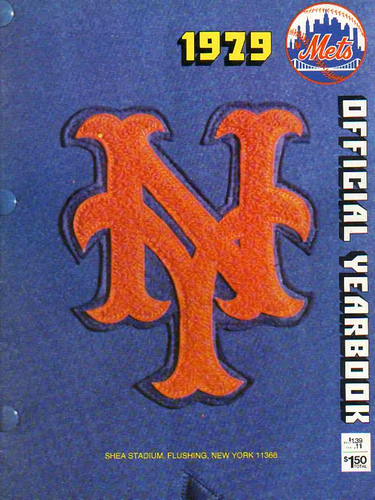 Thursday night at 9 o’clock, revisit the original sign of the apocalypse when SNY airs Mets Yearbook: 1979. I realize we express this type of sentiment fairly regularly where this dynamite series is concerned, but it defies the laws of nature that somebody actually produced a highlight film from a 63-99 season that in no way, shape or form included thirty minutes of Mets highlights.





