Faith and Fear in Flushing made its debut on Feb. 16, 2005, the brainchild of two longtime friends and lifelong Met fans.
Greg Prince discovered the Mets when he was 6, during the magical summer of 1969. He is a Long Island-based writer, editor and communications consultant. Contact him here.
Jason Fry is a Brooklyn writer whose first memories include his mom leaping up and down cheering for Rusty Staub. Check out his other writing here.
Got something to say? Leave a comment, or email us at faithandfear@gmail.com. (Sorry, but we have no interest in ads, sponsored content or guest posts.)
The Mets aren’t bad unless you’re a strict constructionist who sees a team with more losses than wins as definitively not good. Nineteen wins against twenty-one defeats is sub-.500. It doesn’t look great in isolation (or when you pull the 19-21 apart and notice the Mets are 8-14 against teams currently above .500).
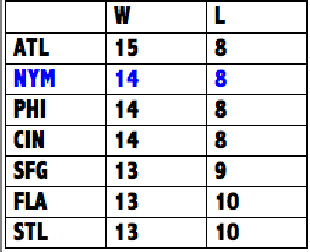
Within the context of how the 2011 season has unfolded, however, it’s damn good. When the Mets were 5-13, it felt highly unlikely that we’d be watching a team that was about to post almost the National League’s best record from that point forward, up to and including this very moment.
From April 21 through May 14:
Surely that’s encouraging. It’s a better trend than that we were riding before. But it’s also a trend. Seasons are comprised of trends. We’ve already seen several in 2011, as broken down by bundles of wins and losses:
3-1
2-12
6-0
1-5
7-3
As fans, we are entitled to grow overjoyed/disgusted with every twist and turn the schedule takes. Still, when the bottom line after 40 games is 19-21, or just about even, we might want to go with “not bad…not great” since there’s no guarantee that the latest upward trend is the definitive one.
A quarter of the season theoretically seems like a reasonable sample from which to draw conclusions about the overall direction of where 2011 will go. But that’s probably just theory. Consider not just how much the year thus far has twisted and turned in terms of winning and losing, but how the composition of the team keeps resetting itself.
• Josh Thole was the everyday catcher. Now he’s more or less in a platoon with Ronny Paulino.
• Ike Davis was the everyday first baseman. He got hurt.
• Daniel Murphy was a man without a position. Then he became the part-time second baseman, then pretty much the regular second baseman. Now, because of the injury to Ike, he’s the starting first baseman — for a while.
• Brad Emaus was the everyday second baseman. He’s gone. He gave way to Murphy and Justin Turner. In the short term, it’s mostly Turner’s position.
• Jason Bay was out for several weeks and left field was juggled unsuccessfully by Willie Harris and Scott Hairston. Bay is back, though there’s talk he may shift to center.
• Angel Pagan has been out for several weeks. Jason Pridie has more or less commandeered his position, subject to change.
• Other than Jose Reyes batting leadoff, David Wright batting third and Carlos Beltran hitting cleanup, the lineup has been in continual flux. The two-hole has been occupied by six different players. Thole, Turner and Harris have each batted in three different positions.
• Injury has removed one of the projected five starters (Chris Young) from the rotation. Inconsistent results notwithstanding, starting pitching personnel has managed to remain fairly stable. But the bullpen, except for Frankie Rodriguez closing, has evolved and morphed from the first week on.
• Through one circumstance or another, D.J. Carrasco, Blaine Boyer, Bobby Parnell and Tim Byrdak have each disappeared or been diminished. Pedro Beato earned greater responsibility sooner than envisioned, then he got injured. Jason Isringhausen reappeared and took hold of the eighth inning, a spot initially reserved for Parnell. Ryota Igarashi seemed to be working his way up the ladder, though lately may have slipped a rung. Only Rodriguez, Byrdak and Taylor Buchholz have been in the pen since Opening Night.
It’s been a roster in flux, a lineup in flux, a defense in flux and a relief corps in flux. But y’know what? That happens. That happens probably every year to some extent. Injuries and disappointing performance are nothing new to any Mets fan who’s been paying even moderate attention the past few years.
Baseball seasons are what happen while you’re busy making other plans. That’s why I can’t full-out look at the 14-8 since 5-13 and say, “That’s what the Mets really are.” The Mets have achieved their turnaround while in constant motion. The team that beat Houston two of three over the weekend isn’t wholly the same team that won six in a row in April — not in composition and not in form…not when so many roles keeps shifting.
They’ve had to shift. Players have gone down and players haven’t performed. Standing pat was not an option for Terry Collins, and he’s reshuffled the deck on the fly pretty much as best he could. It’s gotten him close to .500 less than a month after they seemed destined to drift inevitably south of that mark.
They’ve done it with their presumably best player, Wright, aching and almost not hitting at all. They’ve done it with their technically most vital slugger, Bay, not really slugging. They’ve done it having lost the services of their blossoming first baseman, Davis, and with their square peg, Murphy, squeezing himself into one round hole after another.
They’ve gotten more out of Beltran than could have been reasonably requested and they’re getting almost ideal production out of Reyes. It’s compensated for the ups and down of a young Thole and the uninterrupted downs that beset Pagan prior to disabling. That’s two everyday players who have exceeded expectations compensating for two projected everyday players who haven’t fully (or partially) lived up to them.
What if Pagan comes back and returns to his 2010 form? What if Thole builds on his successes and gains the confidence sufficient to limit his failures? Will Reyes still be running wild and Beltran still be smoking? If Wright comes around, will it be when Murphy slumps? If Bay gets it together, will it happen when Davis is back, and will Davis come back the same Ike as he was when he was at his best?
I don’t know. Nobody does. There really isn’t enough of a composite trend to be drawn out of the partial and individual trendlets, if you will, to say the Mets sure are on the right track, or the Mets can’t possibly keep this up. And then throw in that the roster rejiggering we’ve seen thus far may be of the “ain’t seen nothing yet” variety pending the trade deadline and all it implies in 2011.
All this is said without getting into the bench, which has either been a fine resource in terms of contributing useful fill-in starters or a terrible liability when it comes to extracting the occasional pinch-hit. It also overlooks the frightening fluctuations of Pelfrey, Niese, Gee and Dickey, three youngsters and one odd knuckleballing duck who have shown no reliable patterns of performance through forty games (except for R.A. being a Pagan-level disappointment). Bullpens and their inherent mysteries are a perennial given.
The not knowing is pretty standard, but the not truly sensing is particularly acute. We can make judgments based on past performance as constituted by one-quarter’s worth of performance, but I doubt they’re going to tell us a whole lot that can guide us to understand even partially what the next three-quarters hold in store.
Which is why we should really take care to watch these games, one game at a time.
***
Although one season differs from another in a style generally attributed to snowflakes, I wondered whether 40 games have traditionally offered any kind of Met clue for what the remainders of seasons past have brought us. So I looked — went back to the 40-game mark of every Mets season since 1962, excluding strike-torn 1981 and strike-truncated 1994. For 1972 (156 games) and 1995 (144 games), which we knew, once they started, would contain fewer than 162 games, I used a slightly smaller quarter-season sample size (39 and 36, respectively).
Do the Mets generally give us a reasonable accounting of themselves at the quarter turn? Is a 19-21 start — a .475 winning percentage — necessarily predictive of 77-85 final record…also a .475 winning percentage?
Sometimes. Which is to say not necessarily.
METS TEAMS WHOSE HELLACIOUS STARTS
WERE PREDICTIVE OF MAGNIFICENT RECORDS The 1986 and 1988 division winners rolled out to 29-11. They couldn’t main that pace but they didn’t have to. 108-54 and 100-60, respectively, were quite sufficient. Nobody wins 72.5% of 162 games, after all. The 25-15 1985 Mets kept it up as such to get near 100 wins (98), if not close enough to first place in those pre-Wild Card days. At 24-16, the 2006 Mets were on track to wind up with 96 wins; they wound up with 97, gripping first place in the process.
METS TEAMS WHOSE HELLACIOUS STARTS
PROVED A FRUSTRATING MIRAGE The 1971 Mets’ lack of offense caught up with them after a 25-15 launch; they finished an indifferent 83-79. The 1972 Mets seemed destined for greatness at 28-11, but they were dinged to death by injuries and lost 186 points off their winning percentage before whimpering out the door at 83-73. The 2007 Mets wasted an impressive 26-14 en route to an ultimately historic fizzle (88-74).
METS TEAMS WHOSE MIDDLING STARTS
BARELY HINTED AT GREATNESS TO COME The 1969 Mets were 18-22 after 40 games, the kings of the world before long; the 100-62 eventual world champions were one of only two Mets teams to lose as many as 22 of their first 40 decisions and finish with a winning record. The 1999 Mets were 22-18 and in a bit of a rut around the quarter turn. They’d turn it on and stay turned on to make the playoffs at 97-66. In 2000, the 20-20 Mets were still waiting to take off toward 94-68 and the World Series.
METS TEAMS WHOSE MIDDLING STARTS
NEED TO BE UNDERSTOOD IN CONTEXT The 1973 Mets were 20-20, a dead-on .500, and they finished the year .509 — but also with a pennant, so You Gotta Believe the rest of the N.L. East helped out by not being very good. The 1984 Mets were 22-18, or .550, and ended up .556, which doesn’t sound like much of a bump, but it meant 90 wins, second place and a renaissance. The 1987 Mets, on paper, got their act together, rising from a disappointing 19-21 start (.475) to win 92 games (.568). But not finishing first the year after 1986 couldn’t help but represent a massive letdown. At 19-21, the 1990 Mets were about to cost Davey Johnson his job; by ending 91-71, they made Bud Harrelson look like a Leader of Men. The .500 mark of the 1997 Mets was part of a seasonlong upward swing to 88 wins. The 2008 Mets would go on to play a little better than their 21-19 start presaged, but not better enough (89-73, blowing both the Wild Card and the division).
METS TEAMS WHOSE MIDDLING STARTS WERE PRETTY MUCH REPLICATED ALL SEASON These Mets got to 40 games with between 19 and 22 wins and wound up over .500, but didn’t garner enough momentum to create a resounding/uplifting stretch run: 1970 (19-21; 83-79); 1975 (21-19; 82-80); 1976 (22-18; 86-76); 1989 (22-18; 87-75); 1998 (21-19; 88-74); and 2005 (21-19; 83-79). Some edged closer to glory than others, but none ever fully got over their quarter-turn flirtation with mediocrity.
METS TEAMS WHOSE DECENT STARTS
EVENTUALLY TURNED IRRELEVANT A pox on those Mets who threw it all away: 1982 (22-18; 65-97 — the loss of 149 percentage points from the quarter turn to the finish line is the second-worst in Mets history, behind only 1972); 1991 (22-18; 77-84); 1992 (22-18; 72-90); 2002 (21-19; 75-86); 2004 (19-21; 71-91); 2009 (21-19; 70-92); and 2010 (19-21; 79-83).
METS TEAM WHOSE TERRIBLE START
CAST AN IMPOSSIBLY STUBBORN SHADOW The 2001 Mets couldn’t defend diddly, let alone their 2000 National League championship through 40 games, limping to a dreadful 15-25 start. Amazingly, they finished up over .500 at 82-80, a 131-percentage point in-season improvement, second-best to only 1969’s Miraculous 167-point gain.
METS TEAM WHOSE SUB-.500 START AND FINISH
DESERVE A PASS IN CONTEXT The 1968 edition needs to be judged apart from other losing efforts, since its 18-22 record stood as the best 40-game mark in Mets history to that point. Gil Hodges’s inaugural unit stayed true to its pace, finishing at 73-89, the best final record in Mets history…to that point.
METS TEAMS WHOSE LOUSY STARTS
ACCURATELY FORECAST LOUSY RECORDS All the rest, essentially. None of the 16 Mets clubs not mentioned above (excluding ’81 and ’94) exceeded the 18-win level in their first quarter-season, with 12-28 serving as the floor, in 1962 and 1964. All 16 of them compiled losing records when all was said and done.
METS TEAM WHOSE 19-21 START
MIGHT OR MIGHT NOT BE PROMISING The 2011 Mets. We’ll see what happens.
“Hi Justin. Great game!”
“Thanks.”
“I don’t think we’ve met. I’m a big Mets fan.”
“No, we met.”
“I don’t think so. I’m a huge Mets fan, and I know who all the Mets are. I never saw you before the other day.”
“That’s not accurate. We really did meet.”
“No way! I’d remember.”
“Well, we did.”
“You sure?”
“Yeah, I’m sure. It really sticks out in my mind.”
“When did we meet?”
“Last summer. On the West Coast trip.”
“Oh, the West Coast! That explains it. I got real depressed by the Mets by the time they were on the West Coast.”
“The Mets were still pretty good before they got to the West Coast, so while I was there, you wouldn’t have been in that dark a mood just yet.”
“Well, you know how it all blurs together.”
“Perhaps, but that doesn’t change the fact that I was there, on the Mets, and if you’re a Mets fan, it means we met.”
“The West Coast? It was late. I was probably asleep.”
“Maybe the night games. But one of them was a day game. I played the whole game.”
“Day game? I was at work.”
“It was a Sunday.”
“I see. Well, no offense, but it probably wasn’t much of a game.”
“It was an incredible game, actually — the one where we benefited from the bad call at home plate in San Francisco.”
“Oh. Well, I do kind of remember that. What did you do, again? Get announced as a pinch-hitter and then come out in a righty-lefty switch or something?”
“I started at second and had five at-bats. Got my first hit as a Met.”
“Really?”
“I just told you I played the whole game.”
“You were that guy they brought up when the Mets needed an extra player, right?”
“I can tell you’re groping. The transaction you describe could apply to any minor leaguer.”
“So?”
“So, honestly, I find people like you rude.”
“Rude? What’s so rude about a Mets fan forgetting a Met?”
“From less than a year ago? It’s incredibly rude. It sends the message that I’m not worth remembering.”
“Geez, I didn’t mean it like that.”
“I don’t care how you meant it. I worked hard to get back to the big leagues. I put on the uniform of your favorite team. I tried to help them win. And then you act as if I didn’t exist.”
“Why won’t you let me off the hook on this one? Why can’t you just abide by the social compact that instructs us to nod and smile when someone has obviously forgotten meeting you, and then go through the simple ritual of offering your hand anew?”
“Because when you let people forget you, there’s every chance they’ll never remember you. Next thing you know, you’re being sent down after getting only the briefest of chances in the middle of July. Then they don’t bring you back in September. Then they ostentatiously overlook you in Spring Training, ignoring whatever you can do because they’re worried about losing the flavor of the month on some technicality.”
“I didn’t do all that. I just couldn’t recall seeing you with the Mets last year.”
“It’s symptomatic of what’s wrong with society. And it kept me off the roster when there was no good reason I shouldn’t have been given every consideration to be on it.”
“Justin Turner?”
“Yes?”
“Hi, I’m a big Mets fan. After watching you contribute lately, I’m sorry I didn’t notice you sooner. I’m sorry your introduction escaped my shallow memory. I’m sorry I wasn’t there for you insisting you make the club on Opening Day instead of some nonentity Rule V pick. But mostly I’m glad you’re here now, that you’re playing a lot, and that you homered and drove in five runs to power the Mets past the Astros on Sunday.”
“Hi. I’m Justin Turner. Glad to know you, too.”
The lineup for today’s game has been posted in Houston. Chris Capuano will bat ninth. We are assuming that he’ll be OK with it, that he won’t need a day, that he doesn’t have to clear his head and that he won’t be the least bit insulted.
Capuano, incidentally, is batting .182 — or seventeen points higher than certain other would-be/wouldn’t-be ninth-place hitters.
What a fine teammate that Chris Capuano is, though he’d probably just see it as being professional and doing his job.
Although R.A. Dickey continued to pitch like something out of a Wes Craven horror movie Saturday, he still talked afterwards like he was created by Aaron Sorkin. Dickey spoke of “acute expectations,” “internal fortitude,” “conventional” pitching, a lack of “revelations,” things that “spiral” and things he needs to “arrest”. Classic R.A. in front of his locker. Nightmare on Dickey Street where the mound was concerned.
We love him for his silver tongue, but only because it’s attached somewhere deep within his Dickeyness to his right arm. Well, we used to love his right arm, but lately the affection has been diminished. Our R.A. romance hinges upon his being a character we can root for: bedevils batters then charms reporters. That’s the bargain.
He’s not living up to the half that counts in the standings.
Still, he’s highly listenable. He’s unconventional that way. We have acute expectations that he’ll speak from the brain and from the heart and from the perspective of someone who gave his team every chance to win. Against the Astros, we got only two out of three, and the one we missed is the one we can’t be without.
Dickey’s human. Highly human. So human as to seem too good to have been true in 2010, too human thus far to maintain that pace in 2011. And while one strains to cut him whatever slack is available for a 1-5, 5.08 ERA starter a quarter-way into the season, one was also disturbed to hear him amid his typically eloquent media session fall back on the excuse that he threw ground balls that got through, and if only we’d made some plays…
He stopped short of putting the onus on his infielders, but it took some nifty working of the brake pedal to not go that route. That’s a road taken by the (accomplished) veteran starting pitchers of relatively recent Met vintage who offered more alibis than outs as their careers wound down. They weren’t necessarily wrong to think, “I made my pitch, it just didn’t result in an out,” but they were crazy to even intimate it out loud. It’s bad form — just as bad as 1-5, 5.08.
If R.A. Dickey really were created by Aaron Sorkin, he’d also have a supporting cast created by Aaron Sorkin. I don’t mean a shortstop and a second baseman who would get to the balls that Dickey thought were gettable. Aaron Sorkin doesn’t write action flicks. He writes characters who offer sage counsel. He’d come up with somebody to give it straight to R.A.
• “Look, I don’t know anything about throwing a knuckleball, but we’re gonna have you sit with a guy who does. One of the Niekro brothers. Doesn’t matter which one. They both left their catchers with funny handshakes.”
• “Saying you had a good bullpen doesn’t make a lousy game any more palatable. You’re just calling attention to all the balls the other team hit into the bullpen.”
• “You can’t blame your fielders. You can’t blame bad luck. You can’t blame the wind or the humidity or the pull of the tides. They have a phrase for that in New York. It’s ‘T#m Gl@v!ne,’ and it’s not a compliment.”
• “Balls go through infields. Once you back up home plate, there’s nothing you can do about it except accept that as an irrefutable fact of baseball life, minimize the damage on the next pitch and volunteer to take the blame when somebody asks you about it. You’re from Tennessee. You people are supposed to love to volunteer.”
• “And if you’re really from Tennessee, could you maybe come off a little more like Andrew Jackson and a little less like Al Gore? At least until your earned run average drops by half a run?”
• “Your record isn’t materially better than Oliver Perez’s was when he started going to seed and everybody got mad at him for not going to Buffalo. You should be thankful you didn’t sign for half as much as him — and maybe that your accent’s southern instead of Spanish.”
• “You didn’t pitch any better than Dillon Gee did the night before. Dillon Gee is a 25-year-old from Cleburne, Texas, whose last name is an expression of wonderment. You don’t have that excuse.”
• “Stop naming your bats. It was cute when you were striking people out. Now it’s just plain weird. If ‘43’ printed on the knob was good enough for Jim McAndrew, it’s good enough for you.”
• “You’re articulate, R.A., but that’s value-added. It’s not your actual value. Mets fans have each other if they want articulate. And you won’t want to hear them articulate what they’re thinking if your ERA exceeds the size of your vocabulary.”
The most obvious fun of Friday night’s comeback win in Houston emanated from Mets bats exploding in accordance with their time-release settings. For more than six innings, nothing. Then the fuses went off and so did Bay (BOOM!), Martinez (SUPER BOOM!) and Wright (GO-AHEAD BOOM!). Pridie’s ringing insurance double made a nice noise, too (r-r-ring!).
But what I really got an Astrenfreude kick out of was watching Brad Mills and Dave Clark arguing in the Houston dugout. Clark’s the third base coach of the Astros or, from the looks of his skill set, their soon-to-be former third base coach. He sent one plodding baserunner (Carlos Lee) to a watery doom at home plate and then either misdirected or didn’t direct another (“knucklehead” Bill Hall, per Keith Hernandez) into a slow-moving 3-2 double play wherein Daniel Murphy came off as heady.
The fun of Clark’s clunkers was twofold. First, given that the Astros had a 4-0 lead that could have easily been 6-0, the Mets fan sat back and hoped it would come back to bite them — and it did. When Bud Norris was dealing, such speculation looked like a pipe dream, but when Bay’s internal baby monitor woke him up…and young Fernando resumed his prospectitude…and David loosened up at last…well, shoot (as they say in Texas), it sure was nice to watch the Astros get bit.
Second, in terms of fun — though this occurred before the Mets’ sudden surge of offense — was watching Astro manager Mills expressing his displeasure with Clark. Nothing against Clark, except my visceral dislike for him ever since he used to pound our pitchers as a pinch-hitter and spot starter (Dave Clark lifetime vs. the Mets: .342/.414/.547 in 133 plate appearances); I also tired quickly of the Dave Clark Five allusions he inspired (Gary Cohen made them incessantly and Bob Murphy never reacted to them…not even in bits and pieces). All I really cared about Friday night was Clark put his team, the team playing the Mets, in a position to lose, and Mills was as disgusted as I was delighted.
You don’t see the manager arguing with one of his coaches during a game. It was manly baseball-arguing, mind you. There was no eye contact. Can’t be eye contact. Each man had to keep his eyes on the game even while they were jawing away at each other. But they were clearly going at it. Because it was happening in the other team’s dugout, it was quite satisfying to take in. If it were happening between Terry Collins and Chip Hale, it would be a sign of the apocalypse.
That thought made me appreciate Collins a little bit more. Terry Collins wouldn’t do that. He’d get pissed off at a baserunning blunder, sure. We know he got pissed off at Daniel Murphy in Atlanta when Murphy took off for third in a most disadvantageous situation in April. We heard he took Murphy into the runway, away from cameras, away (more or less) from teammates and told him, essentially, enough with the errors of enthusiasm. Whatever hanging out to dry he did, he did if not quietly, then at least in the shadows.
Collins may not be unique in that respect. The Mills-Clark flapping was unusual, so Terry’s not the only manager not exploding in full view. What I liked Friday night about Terry was a shot of him standing alone, eyes fixed on the field, plotting and strategizing, completely into the game (or maybe that blonde in the third row…but I’m assuming the game). It put me in mind of a couple of weeks ago when something that passes for amusing rippled through the Met dugout. I don’t remember what it was — maybe Mike Pelfrey was wearing Chin-Lung Hu’s batting helmet before realizing it didn’t fit — but it was one of those incidents the telecast captures wherein everybody’s having a good laugh.
Except Terry wasn’t laughing. I don’t mean that in the Kirk Gibson “there’s nothing funny about eyeblack in my cap!” baseball is life and death sense. It wasn’t one of those moments when the manager straightened out his unserious charges and pointed them on the straight and narrow to a pennant (though we have finally moved into a fourth-place tie with the Nationals). He just didn’t notice, or if he did, he wasn’t interested. He was interested in the game. Gary Cohen noted that Terry, in so many words, isn’t exactly a barrel of laughs in the dugout.
I found myself respecting that. The guy isn’t, by all indications, a receptacle of hilarity. Perhaps in his private life. Perhaps his family finds him a scream. Perhaps he’s Keeping Everybody Loose in the clubhouse (though I’m guessing no). It may not make Terry Collins the life of any given party or someone with whom you’d want to share a particularly long elevator ride, but that’s not why we’ve been introduced to Terry Collins. He’s here to manage the Mets. He’s doing it his way, and his way doesn’t seem to be not working.
That sounds like a tepid endorsement of an 18-20 skipper, but putting aside you being what your record says you are, I’m actually modestly enthusiastic about Collins. Didn’t think I would be. Still might not be when all is said and done. He still seems on the precipice of a blowup or meltdown when the losing reappears, but who likes losing? He hasn’t embarrassed anybody when he’s seemed less than pleased. He hasn’t seem disengaged from the process by any means. And if he finds nothing funny about managing, it’s understandable. He’s back in a major league dugout after more than a decade’s absence. I doubt he found that funny.
I don’t mind witty, urbane managers, or managers who can multitask between baseball and the world around them or managers who can entertain multiple constituencies in between filling out lineup cards. Terry Collins isn’t any of those things as far as I can tell. He’s a baseball manager whose job is to manage baseball.
Welcome to The Happiest Recap,a solid gold slate of New York Mets games culled from every schedule the Mets have ever played en route to this, their fiftieth year in baseball. We’ve created a dream season consisting of the “best” 34th game in any Mets season, the “best” 35th game in any Mets season, the “best” 36th game in any Mets season…and we keep going from there until we have a completed schedule worthy of Bob Murphy coming back with the Happy Recap after this word from our sponsor on the WFAN Mets Radio Network.
GAME 034: May 11, 1996 — METS 7 Cubs 6 (Mets All-Time Game 034 Record: 22-29; Mets 1996 Record: 15-19)
What if they threw a day for you and then threw you out? That doesn’t sound very hospitable.
In a way, all of John Franco Day was backwards. The Mets’ longtime closer was being honored before a game for what he did at the end of games, for saving them 300 times. True, almost half had been in the service of the Cincinnati Reds, but Johnny was a Brooklyn boy and had wrapped himself effectively in the colors of his childhood team since coming home to pitch for them six years earlier. Thus, when he closed out the Expos on April 29 to reach his milestone save total, the Mets wanted to do something special for Franco.
It all looked pretty standard pre-game on his sunny Saturday. That’s when John made his uncharacteristic early appearance, receiving gifts and laudatory remarks and an uncommonly positive reaction from the Shea crowd. The only topper Franco could possibly have asked for was the opportunity to raise his save total to 301 nine innings hence. Doing so would move him into seventh place all alone on the all-time save list, one ahead of Bruce Sutter. Maybe today, against Sutter’s old team, the Cubs, he’d get his chance.
He’d get no such thing, but it was not a matter of Dallas Green’s game strategy or the Mets not providing a three-run (or fewer) lead to protect. This Saturday, John would get into the action much earlier than the ninth, even though his name never appeared in the box score.
John was minding his own business in the bottom of the first, as closers tend to do, when the stage for what was to become of his Day was set. The Mets had two on with one out when a little chin music was played in Todd Hundley’s honor. Cub starter Kevin Foster swore later his inside fastball was meant only to back the Mets’ slugging catcher (Todd had eight homers already) off the plate.
Hundley, who ducked, didn’t take it as such. Neither did Met starter Pete Harnisch, who conveniently found Foster’s elbow when his opposite number batted in the second. Tensions began to simmer a little more, particularly after Harnisch exchanged words with Cubs catcher Scott Servais, his former teammate with Houston. Foster would be out of the game in the third as the Mets built a 5-0 lead, but it was clear the two teams were on a collision course.
The flashpoint came in the home fifth, when Cub reliever Terry Adams threw a pitch in the general direction of Harnisch’s knees. Home plate umpire Greg Bonin finally issued a warning to somebody, Adams. As the Times’s Jason Diamos put it, “He should have warned the batter and catcher.” Harnisch and Servais went at it. Benches emptied. Bullpens emptied. It was an old-fashioned basebrawl the likes of which the Mets haven’t engaged in since.
“That was a donnybrook,” Green said, not without a touch of admiration. “No question about it. That was a dandy.”
How dandy? Fighting took place on the mound and all over the infield. The game had to be delayed 16 minutes and the teams had to regroup minus nine of their uniformed personnel. Four Cubs were ejected: Servais, Leo Gomez, Scott Bullett and Turk Wendell. Five Mets joined them, so to speak: Harnisch, Hundley, Blas Minor, coach Steve Swisher…and, on John Franco Day, John Franco.
“I’m too old to be doing that kind of stuff,” admitted the heretofore guest of honor. What bothered the 35-year-old southpaw the most was not getting caught up in defending his teammates’ honor but not being around at the finish when his services would have come in handy. The Mets held a 6-3 lead at the time of the ejections, but relievers Dave Mlicki and Doug Henry couldn’t hold it. Henry, filling in for Franco as de facto closer du jour, gave up a two-out, two-run single to Jose Hernandez in the ninth to allow the Cubs to tie it at six.
In the bottom of the inning, what had been John Franco Day and then Saturday Afternoon at the Fights became a standout moment in the Met career of Rico Brogna. With one out, the first baseman — who had driven in three runs off a collar-heated Foster in two at-bats — blasted a one-out Doug Jones delivery over the wall in right field for an exhilarating 7-6 Met victory.
Rico had reasons for ebullience besides totaling two homers and four RBIs on the day. He was as much a part of the melee as any Met, finding himself pinned against the wall of the Cub dugout. His right forearm was bruised, but by taking the walkoff swing, he could raise it in triumph.
“My emotions were stirred up,” Brogna said. All the Mets’ were, though Franco’s were tinged with regret as he was still thrown by getting thrown out long ahead of his traditional and preferred ending: “I could have been out there in the ninth.”
ALSO QUITE HAPPY: On May 16, 1970, Jerry Koosman put an emphatic period at the end of this sentence: “Boy do the Mets have good pitching.” Kooz had just completed perhaps the most remarkable three-game stretch of pitching his team has ever unfurled. First, there was Gary Gentry taking a no-hitter into the eighth against the Cubs at Wrigley Field and coming away with a one-hit, 4-0 victory. Then, in their next contest, at Connie Mack Stadium, Tom Seaver held the Phillies to one hit in nine innings (a third-inning Mike Compton single), striking out 15 en route to another 4-0 win. Koosman’s performance, by comparison, was almost pedestrian…but only by comparison. Jerry four-hit the Phillies, striking out ten of them as the Mets put a 6-0 Saturday night win in the books. That made it three complete game shutouts in three games. Gentry, Seaver and Koosman allowed all of six hits — five singles and one double — in 27 innings while striking out 32 batters.
GAME 035: May 14, 1994 — METS 11 Braves 4 (Mets All-Time Game 035 Record: 21-30; Mets 1994 Record: 19-16)
Dr. Hook & the Medicine Show sang of every rocker’s dream in 1973 when they saluted “the thrill that’ll getcha/when you get your picture/on the cover of the Rolling Stone.” For athletes, there’s a parallel level of excitement — or dread, depending on how you take your curses — to landing on the front of the latest issue of Sports Illustrated.
There has to be. Maybe the stirring of the soul wears off if you’re Tiger Woods (30 times on), Muhammad Ali (38) or Michael Jordan (the most, at 56), but if you’re there, it generally means you’ve accomplished something noteworthy, something national, something nice. It’s something you can frame, you can autograph, you can dine out on for years.
Or you can kind of cringe that that’s you there, because you’re not on the cover of Sports Illustrated for doing anything you wish to have illustrated.
Consider the case of John Cangelosi, cover boy on the issue of May 23, 1994. Well, Cangelosi and former Met Charlie O’Brien shared the honors, though not in some McGwire-Sosa or Stargell-Bradshaw “Sportsman of the Year” tableau. It wasn’t that friendly. It wasn’t friendly at all. O’Brien was in full Atlanta Braves catcher’s gear and clearly had the drop on Cangelosi, who had his back to the camera. The Braves were on top in this situation; the Mets were going down — an unfortunate if unintended commentary on the National League East standings ever since Atlanta was geographically rejiggered into the Mets’ division.
In pugilistic terms, it looked like the Mets were lightweights.
Who the hell was Charlie O’Brien and why was he about to put John Cangelosi down for the count? And what was Terry Pendleton, the ghost of pennant race nightmares past, doing rushing in from the corner of the cover? Was tag-team wrestling coming back to Shea for the first time since 1980? And why, in an era when cover story glory was going to be hard to come by for any Met, was it John Cangelosi, journeyman outfielder, carrying the flag (sort of) on the front of a magazine that used to feature Met icons like Casey Stengel, Tom Seaver and Darryl Strawberry?
The cover line says Enough Already, though it doesn’t seem tied into the Mets fan thought process, which would have been, “Enough with the Braves in the N.L. East, that can only be bad news in the long term. Enough with embarrassing situations and embarrassing photos one year after Vince Coleman was flinging firecrackers at little girls and Bobby Bonilla was offering tours of New York’s northernmost borough. Enough Charlie O’Brien, we saw too much of him when he was a Met, he couldn’t hit the ball, so now he’s gonna hit our spare outfielder?”
Of course a closer reading of the fine print indicates the cover story won’t really be about the Mets or Braves at all: “Another round of ugly brawls gives baseball and basketball a black eye.” The two players are supposed to be SI’s “tut-tut” example of how not to behave on the field of play (in two sports, no less). But if a picture tells a thousand words, five that come jumping off the full-color page seem to be, “The Mets can’t fight either.”
The article to which the image is tied doesn’t offer a lot of help for anyone curious as to why O’Brien and Cangelosi were mixing it up. It indeed takes a stand against fighting, but the Mets aren’t held up as an example of a new breed of plucky but righteous New York National Leaguers. Jack McCallum wrote that a “nasty bench clearer erupted last Saturday at Shea Stadium after Atlanta Brave pitcher John Smoltz plunked the New York Mets’ John Cangelosi, and Cangelosi charged the mound, provoking the scene depicted on this week’s cover.”
That’s it. That’s all the mention the episode gets. Nothing about O’Brien (6’ 2”, 195), wearing protective armor, pounding an unarmed Cangelosi (5’ 8”, 150). Nothing about the context of the plunking, thereby implying that Cangelosi was given, perhaps, to hissyfits. Smoltz’s “plunk” goes unremarked upon.
Why was John Smoltz plunking John Cangelosi? Because John Smoltz was having an awful day trying to throw the ball past Mets batters on the Saturday in question. Already down 3-0 in the bottom of the fifth, Smoltz retired the first two Mets he faced before giving up singles to Bonilla and Jeff Kent. After a wild pitch and an intentional walk to David Segui, Smoltz tried to extract himself from the jam by taking on Ryan Thompson. It was a bad call. Thompson launched a grand slam to left field, putting the Mets up 7-0 and getting John Smoltz’s goat.
After not getting the best of Thompson (6’ 3”, 200), Smoltz made the modestly constructed Cangelosi his target. And Cangelosi, Brooklyn-born, didn’t take kindly to the choice. Thus, the charging of the mound. Thus, the “ugly” scenario McCallum bemoaned. Thus, O’Brien with the attempted flying body slam on Cangelosi. Thus, the picture that made the cover of Sports Illustrated, the last time a Met would be “featured” on the cover of the nation’s premier sports magazine for a half-decade.
Infamy of sorts for John Cangelosi, but at least it emanated from a rousing 11-4 Mets win, albeit one that went unreported in SI. Some things simply look better before somebody influential goes to the trouble of immortalizing them.
ALSO QUITE HAPPY: On September 16, 1981, it was déjà vu all over again for Steve Carlton, who could have been forgiven for wondering whether what he was going through was a re-creation of one of the most paradoxical pitching performances ever. It was in another September, a dozen years before, that Carlton, then a Cardinal, set a major league record by striking out 19 Mets in a nine-inning game. Carlton had a record, but the Mets got the 4-3 win when Ron Swoboda tagged him for a pair of two-run homers, proof that strikeouts, while sensational to pile up, are just outs, and you have to limit the opposition’s hits in between the K’s. Carlton’s career went on to be quite successful over the next decade-plus, and he was still the game’s leading lefty in 1981 when he and the Phillies came to Shea, and the silent southpaw loudly muffled much of the Mets’ attack. In the nightcap of a sparsely attended Wednesday doubleheader, Carlton fanned 15 Mets as he went the distance for a Philadelphia club that was already guaranteed a playoff spot thanks to the split-season format implemented after the midsummer strike. If the Phillies weren’t playing for anything, the Mets were. They were still alive for the second-season title in a wide-open N.L. East scramble, so, just as in September 1969, they couldn’t afford to be set down helplessly by Carlton. And just as in September 1969, they weren’t. Yes, Carlton struck out 15 Mets, but he also walked four and gave up eight hits including a two-run homer to John Stearns in the bottom of the eighth that gave the Mets a 5-4 lead that another former Cy Young award winner, Mike Marshall, would preserve in the top of the ninth. The Mets were still alive in their mini-pennant race…as was the spirit of Ron Swoboda.
GAME 036: May 21, 1969 — Mets 5 BRAVES 0 (Mets All-Time Game 036 Record: 26-25; Mets 1969 Record: 18-18)
This was a big deal in the eyes of some, a complete non-event to those responsible for its execution. There was no denying something was going on that was worth capturing for the ages, but not for the reason those doing the capturing thought.
But that was impossible to know at the time. It usually is.
What was undeniable was Tom Seaver had just fired a complete game three-hitter past the Atlanta Braves in Georgia and won a 5-0 decision over Phil Niekro. Tommie Agee and Ken Boswell each doubled, Buddy Harrelson tripled, Ed Kranepool stole a base (the eighth of his eight-year career) and Cleon Jones drove in two runs as he raised his batting average to .391. The bottom line to the pack of Mets reporters was what happened in the standings because of the Wednesday night victory: the Mets were now a .500 ballclub.
To the scribes, and to many following the doings back in New York, it was no trifling feat. The Mets’ cachet for so long was their losing. It was their bête noire, too. What was framed as adorable, thanks to the efforts of correspondents who had to keep finding ways to make grinding, redundant defeat sound colorful, had become tedious. Mostly it was the norm. The Mets, from 1962 through 1968, went a combined 343 games under .500…and that was after achieving an uplifting mark of 73-89 (a.k.a. not losing 90 games) in 1968.
Their fate was cast early every season, never escaping the first week of a new year above the break-even point, never even sustaining a win-one/lose-one pace beyond eight games, which happened once, in 1967. It was all downhill from there. It was always downhill from there.
So of course when the Mets made it deep into May, all the way to their 36th game of the year with a .500 mark — 18 wins, 18 losses — there was bound to be excitement. What didn’t figure into the calculation was the people least excited by the “achievement” were the New York Mets themselves.
Reporters rushed into the visitors’ clubhouse and looked for a sign of celebration, for the presence of a party, for as much as a toast to provisional good fortune. They found none.
Jack Lang of the Long Island Press, one of the original Met writers, asked Seaver why there was no self-congratulations in the air: “You’re a .500 ballclub. Aren’t you going to celebrate?”
Why, no. Tom had no intention of getting charged up about breaking even. “What’s so good about .500?” he asked the media men. “That’s only mediocre. We didn’t come into this season to play .500 ball. I’m tired of the jokes about the old Mets. Let Rod Kanehl and Marvelous Marv laugh about the Mets. We’re out here to win. You know when we’ll have champagne? When we win the pennant.”
This sudden outburst of youthful hubris struck the reporters as amusing if inappropriate. They knew the Mets were always abysmal. They knew every victory better be savored. They knew Seaver had stuck his foot in it when the Mets promptly went out and lost their next five and fell to 18-23.
Turned out they didn’t know a damn thing.
ALSO QUITE HAPPY: On May 24, 1980, more than an approximate half-hour drive separated Shea Stadium from the Nassau Coliseum. The 22 or so miles between the two sports facilities may as well have been measured in light years. One jammed 14,995 into its rollicking confines. The other saw less than half that number of patrons pass through its turnstiles, even though its capacity allowed for seven times as many customers. To be fair, there was no comparing the venues when it came to the significance of what was going on in each place that Saturday afternoon. The Coliseum was hosting the sixth game of the Stanley Cup Finals, with the long-striving New York Islanders skating for their very first championship versus the hated Philadelphia Flyers. Shea, meanwhile, had the Mets playing the Braves: two teams that had finished last the year before, two teams maybe with a chance to not finish last this year. But there was this much in common: the Mets went to the tenth inning of their game tied at four, just as the Islanders found themselves in overtime, also tied at four. After Neil Allen set down Atlanta in order in the top of the tenth, Lee Mazzilli singled off Rick Camp, was bunted to second by John Stearns and — following an intentional walk to Steve Henderson and a fielder’s choice groundout by Jerry Morales that moved Mazz to third — scored on Elliott Maddox’s single to right. It made for a pleasant win in a spring span of several pleasant wins: the Mets had taken six of their last nine and were showing their devoted fans, particularly the 7,221 who opted to come to Shea, a little spark. Back in Uniondale, Bobby Nystrom scored a goal at 7:11 of overtime to beat the Flyers 5-4…same score the Mets won by in extras. Nystrom got to hoist one Cup more than Maddox, perhaps, but Mets fans — whether they rooted for that other orange and blue team or not — could resort to a little preliminary celebratory math if they were looking for signposts of progress. The Islanders had reached their ultimate goal six years after first showing their own little spark in the fall of 1974, the beginning of their first season when they weren’t at all bad. 1980 plus six years? There was, just maybe, a subliminal message buried in Nystrom’s winning shot: hang in there, Mets fans…hang in there to 1986, and you’ll be glad you did.
If I go down
I’m gonna go down swingin’
If I grow old
It won’t be gracefully —The Rainmakers
“I’ll show you something today,” Ty Cobb told reporters, or so the story goes. “I’m going for home runs for the first time in my career.” It was May 5, 1925, the year of Babe Ruth’s bellyache, as it was called, though what actually ached the Bambino remains an urban myth. Ruth may not have been atop his game in ’25, but he was still on top of The Game, as in baseball. Slugging had overtaken hitting in the public’s estimation. Ruth had overtaken Cobb, and Cobb — aging, cranky and the possessor of eleven batting titles from when home runs were rarities — didn’t care for it. Ty Cobb didn’t care for a lot, but this was one of his deeper snits.
So Cobb, per legend, went out that day at Sportsman’s Park 86 years ago and popped not one, not two but three home runs against St. Louis Browns pitching. The 38-year-old player-manager of the Detroit Tigers had made his point.
Carlos Beltran has never reminded me of Ty Cobb. Really, more DiMaggio — Joe, not Dom or Vince. What brought them together in my mind was one word: grace. Both made it look so easy, though no one ever thought DiMag was taking off innings or easing up even a notch. That was a centerfielder who gave it all he had all the time no matter the stakes because, he figured, somebody was seeing him play for the first time. The key for Joe D. was he made it look like he wasn’t trying all that hard.
Grace. It probably worked better when the media was mostly radio and newspapers.
Carlos Beltran’s grace came off better when he had two good knees and a few fewer years than the 34 he carries around now. Grace’s value has diminished since Joltin’ Joe has left and gone away, since SportsCenter came on the air, since a critical mass of opinion formed that it wasn’t so much what you did but how interested you looked while you were doing it. If you did it the hard way and succeeded, you were that much more impressive. If you made it look — because that’s just how you rolled — easy, and you made the mistake of not succeeding every time out…well, why isn’t that guy giving it his all?
We can only guess how difficult it’s been for Carlos Beltran to give it his all since his legs began to betray him a couple of years ago. It didn’t look that easy for him trying to come back from too much injury in 2009 and 2010. The obvious effort didn’t necessarily translate to the desired results. Yet he didn’t much let us see him sweat. Carlos Beltran isn’t given to the grimace. He has maybe two expressions: the one that’s practically blank and the one where he smiles. He wears the former about 95% of the time.
He wore the smile after Thursday’s game in Denver. It wasn’t a gloat, but there was definitely a twinkle to it, just a touch of “I could tell ya so, but I think my bat just did.” I saw that look back in December, at the Mets’ holiday party when all the questions were of the “will you be well enough to play?” nature. Beltran was unremarkably upbeat with his words, but just enough “watch me” with his eyes.
There was plenty to watch at cold, damp Coors Field. There were three home runs, to be specific: from the left, then the right, then the left, all with Willie Harris on base, each accounting for one-third of what the Mets needed to beat the Rockies. They won 9-5. Beltran drove in six of the nine runs. He didn’t have to grimace. He just had to trot.
After the third home run — a total produced in one game by only seven Mets before him — I caught a glimpse of the happy Beltran in the Mets dugout. One of his teammates sitting near him was Fernando Martinez, just called up to take disabled Ike Davis’s place. Martinez has been a hot prospect since debuting professionally as a 17-year-old in 2006, since Beltran was putting up MVP numbers when pain-free and worth every penny the Mets were paying him. Fernando Martinez, I thought, is the oldest 22 I’ve ever seen. He’s never been healthy or consistent for long. But he’s only 22.
Carlos Beltran is 34. He’s in the seventh year of a seven-year Met contract that no one thinks will be succeeded by another Met contract. His successes were what we paid for, so they weren’t automatically celebrated for the accomplishments they encompassed. His everything else? Like his demeanor? Or his non-MVP intervals? They weren’t universally popular, and he still isn’t. While well-meaning Twitterers tend to overcompensate with their increasingly tiresome #blamebeltran irony shtick, there really is a strain of Mets fan who isn’t easily satisfied by Carlos Beltran, who wishes for more expressive grimacing, more obvious sweating, more swinging at hellacious breaking pitches that landed in a catcher’s mitt five years ago and aren’t subject to do-over.
Plenty of swinging today, though. Plenty of reason to want to see Carlos Beltran play some more.
Tom Seaver. Nancy Seaver. Singing with the Lettermen. Awkwardly joking with Eddy Arnold. Referring in detailed fashion to the World Series just recently won. This aired on NBC’s Kraft Music Hall, November 5, 1969, not three weeks after the Mets commenced their reign as Earth’s baseball champions, only 17 days since Tom and teammates confirmed “You Gotta Have Heart” for Ed Sullivan.
Clearly, humanity had reached its peak.
I’d read of this variety show appearance, but I never dreamed I would see it. Great thanks to my old friend Joe F. for finding it.
Bad news is your late afternoon has been ruined by raintime in the Rockies. Good news is your previously pre-emptively ruined entire Thursday has been rescheduled as worthwhile, as the Mets will take on Coloradoans (be wary — they’re very well-schooled) tomorrow at 3 o’clock.
To fill the yawning gap from now until then, you can…
• Wish the best for Ike’s calf, David’s neck, Jason Bay’s who-knows-what and all the pitchers who aren’t able to pitch at this time. Stop getting hurt, Mets.
• Remember the legendary Daily News sports cartoonist and columnist Bill Gallo, who has passed away at age 88 by reading this wonderful profile by Nathaniel Vinton from just a couple of weeks ago. Basement Bertha wasn’t fashionable, but she did love her Mets. Joe Petruccio, not surprisingly, pays a lovely tribute here.
• Buy your Pepsi Porch tickets for Mets Brain Tumor Awareness Night, Saturday May 28 versus the Phillies, and be sure to buy them here. When you do, you’ll be supporting a worthy organization.
• Consider what a fine and consistent voice Howie Rose has provided Mets baseball for nearly a quarter-century, whether as host of Mets Extra, play-by-player on SportsChannel/Fox Sports Net or lead man on WFAN’s broadcasts. Radio has become mostly a reason to bash Wayne Hagin — and he is bashable — but I think we overlook how Metsian a conversationalist we have in Howie when all we do is bitch about the other guy. He also gets eclipsed by the Gary, Keith & Ron electricity a little more than he deserves, but I’d feel lost without Howie in the car, Howie by the bed, Howie while I’m brushing my teeth.
• Put TV and radio into unique perspective by checking out Bob Wolff’s Complete Guide to Sportscasting, a book by the dean of sportscasters. It’s a lot of fun and includes a chapter focusing on how radio announcers for losing baseball teams can still be entertaining. I’ll leave it to your imagination what losing team he picks as his prime example.
Beautiful and beautifully written.
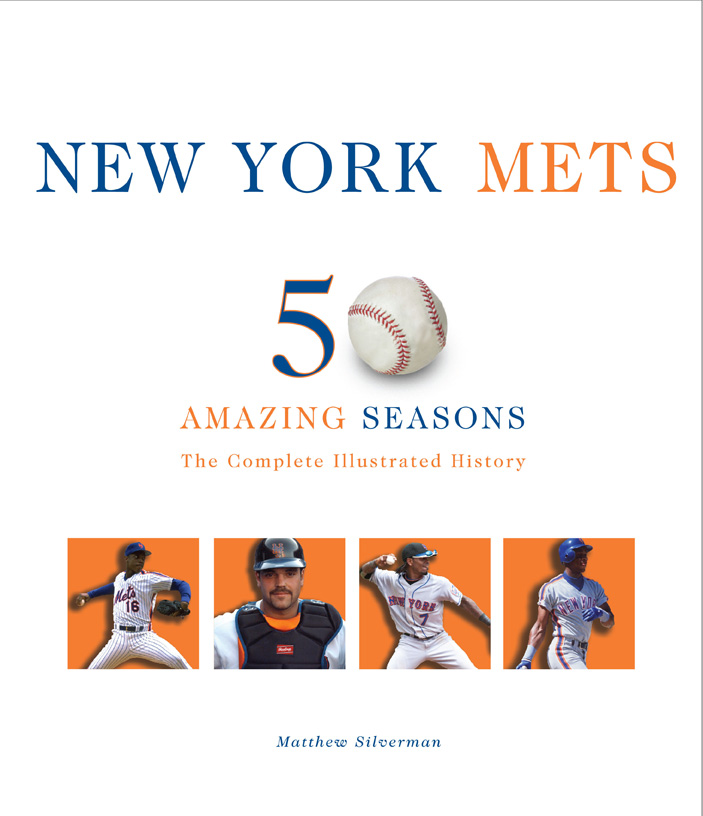
• Give yourself the present of 50 Met years with Matthew Silverman’s The New York Mets: The Complete Illustrated History. Mentioned it before, I’m mentioning it again. It’s an incredible tour of an incredible franchise. As good a looking book as you can imagine, yet the pictures only hold a candle to the writing, which is informed, intelligent and inviting. Buy one for you, buy another for a Mets fan you care about.
• Veer outside the Mets realm and consider The Cambridge Companion to Baseball. Very weighty title, but pretty accessible material on all the stuff you’ve kind of wondered about all your life.
• Come back to the Mets for Howard Megdal’s just-released Taking the Field: A Fan’s Quest to Run the Team He Loves. The cover is orange and blue, so if you didn’t know from Howard (and you should), you would be able to infer the identity of the team in question. You may recall Megdal’s candidacy for Mets GM last summer; the grand campaign and the ideas behind it are presented within. I’ve thus far mostly skipped around various chapters (which is how I tend to engage books when I first receive them), but it’s next on my reading list (though I don’t really have a list) and I’ll share my thoughts on it at a later date. But I’m really happy to see it come to fruition.
• Relive 33/66 great Mets wins through The Happiest Recap archives. If you’ve somehow scrolled right past this twice-weekly salute to the best games by Game Number in Mets history, get the lowdown on what it’s all about here.
• Say “hi” to people you might not otherwise greet and get some things done, but be back at your Met readiness 3:10 Thursday. It’s supposed to stop raining and they’re supposed to play ball.
The Mountain Time Zone and the mountainous rain delay combined to knock me out before the final pitch last night. Hung in there through Mets Yearbook: 1966 and Mets Yearbook: 1967 (which SNY cut away from just as Whitey Herzog was about to announce his intention to draft…what a cliffhanger!) and reveled, as Gary Cohen did, in the fact that it took two pitchers — Mike Pelfrey and Jason Isringhausen — and two batters — Dexter Fowler and Ryan Spilborghs — to complete the same plate appearance when play resumed because of the precipitation interruption and the rash of owwies that were taking down Mets and Rockies left and right. But I was growing very drowsy as their Paulino — Felipe — walked our Paulino — Ronny. And the last thing I remember was something about Willie Harris pinch-hitting.
At which point I assume I closed my eyes in the hopes that he wasn’t really still a Met.
Next thing I knew, it was later. My first thought upon stirring was, “Is it the bottom of the ninth yet? Is K-Rod on? Omigod, what has he done? Is it the fourteenth because he gave up the tying run in typically aggravating fashion?” My second thought was “Mets 4 Rockies 3,” because when my eyes were opened fully, the postgame show was on and the score was on the screen.
“Gosh,” I wondered in the seconds before I conked out again, “I wonder how difficult he made it.”
Color me delighted to have read the pitch-by-pitch transcripts this morning and discover that Frankie Rodriguez kept no one awake. He didn’t extend the game. He didn’t inject anxiety into the game. He didn’t subliminally boost sales for Stranahan’s Colorado Whiskey, the stuff I noticed advertised over the right field fence where Rockie home runs traveled earlier in the game. As far as I know, he didn’t react to anyone after the game the way he did when the sight of Colorado uniforms (or something) enraged him last August. Rodriguez just went out there, pitched the inning he was signed to pitch, pitched it cleanly and steered the Mets to the clubhouse with a win for all and a save for him.
Big-money free agent joins club and (eventually) performs as intended on consistent basis. Or as the headlines never seem to read, SOMETHING DOESN’T GO WRONG FOR METS.
Because of the creative contract to which the Mets signed Rodriguez, schoolkids no longer automatically associate “55” with Orel Hershiser, Shawn Estes or Chris Young (though Young’s shoulder will likely render him a well-meaning footnote in most Met textbooks). Frankie needs to finish 55 games this season — be the last Met to throw a pitch in just over a third of the scheduled contests — to have an option kick in that will allow him to serve as Mayor of Moneyville for another year. When he was Francisco Rodriguez, expensive, plea-bargaining, unreliable head case, this was cause for shudder. Now that he’s something like the K-Rod of American League legend again…still expensive but relatively reliable and no longer noticeably menacing society…I’d suggest taking an eye off his appearance clock.
Ideally, I’d rather the Mets not be on the hook for seventy-bajillion dollars in 2012 ($17.5 million, technically), but the clause is there and through no unfault of his own, Rodriguez is living up to his part of the bargain. The Mets occasionally take leads to ninth or maybe eighth innings; Terry Collins calls on Frankie; Frankie delivers the goods; Terry’s confidence grows; Frankie gets more calls.
He’s doing what he’s supposed to be doing. He’s also not doing what he’s not supposed to be doing away from the mound. I wouldn’t have blamed the Mets had they figured out a clever way to jettison his contract altogether after he attacked his girlfriend’s father last summer, but the Mets aren’t nearly clever enough to pull something like that off, so he’s here. What’s more, he’s presumably followed his proscribed course for good behavior. If we are to believe in redemption, then we have to believe that anger management programs might actually work.
Francisco Rodriguez will inevitably blow another game as the Mets closer. I wouldn’t be surprised if he blows his top, too, hopefully in a manner that harms neither human beings nor innocent animals. No doubt the guy is suspect, partly for a few too many ninth innings that went awry (in the tradition of all the other closers in whom we’ve misplaced faith for the past twenty years), mostly for what we learned about him in the wake of his temper overtaking him. If he slips in either way, we’re not going to be patient, more for Mets fan reasons than humanitarian ones, but in the meantime, he’s walked the straight and narrow off the field and he hasn’t given away much on it.
And unless we turn back time to when a quality start meant consistently going nine, somebody’s going to have to close games the rest of 2011 and into 2012. If the Mets want to be innovators and figure a better way to do it than automatically handing the ball to the same pitcher every time they’re ahead by three runs or fewer, fine. But until then, we have somebody who’s among the best in baseball at his particular core competency…and we don’t have many of those. We might as well get some use out of him.
As far as the $17.5 million fourth year for a reliever who was losing something off his fastball when we signed him…well, thanks Omar. But I’m disgusted enough that the Mets are likely positioning themselves as a small-market team — and not necessarily a good one — that I don’t want to hear about the need to shed gobs of salary to keep them afloat. Get the minority partner in here and act like a New York team. You don’t have to throw the multimegamillion-dollar deals around to impress us, but making it your priority to “unload” your better performers because you “can’t” re-sign them…it’s patently unacceptable. I don’t want to accept it. If you can honestly plot a trade of Francisco Rodriguez (or some other player whose name keeps coming up in this context but I don’t want to mention because I don’t want to think about him in terms of his not being a Met) to better the team in the long term without shooting it in the foot in the near term, you have my blessing. But nix to M. Donald Redux if it gets to that point.
If it’s late September and the Mets are long out of it and Rodriguez is sitting on 52, 53 appearances, I understand sending for a car and wishing him well as he leaves for the airport. If we’re long out of it with little hope of getting back into it right away, maybe a high-priced closer isn’t a priority (though ninth innings are still ninth innings, whatever the price). But if we’re in position to win games across the balance of this season, and there’s no better answer at the other end of the phone when Dan Warthen calls Jon Debus, then in the name of legitimacy, get Frankie up.
Piazza: Catcher, Slugger, Icon, Star by Greg Prince is available from Amazon, Barnes & Noble and other online booksellers.
Amazin' Again: How the 2015 New York Mets Brought the Magic Back to Queens by Greg Prince is available from Amazon, Barnes & Noble and other online booksellers.
Volume I of The Happiest Recap: 50+ Years of the New York Mets As Told in 500+ Amazin' Wins by Greg Prince is available in print and for Kindle on Amazon.
Faith and Fear in Flushing: An Intense Personal History by Greg Prince (foreword by Jason Fry), is available from Amazon, Barnes & Noble and other online booksellers.