The blog for Mets fans
who like to read
ABOUT US

Faith and Fear in Flushing made its debut on Feb. 16, 2005, the brainchild of two longtime friends and lifelong Met fans.
Greg Prince discovered the Mets when he was 6, during the magical summer of 1969. He is a Long Island-based writer, editor and communications consultant. Contact him here.
Jason Fry is a Brooklyn writer whose first memories include his mom leaping up and down cheering for Rusty Staub. Check out his other writing here.
Got something to say? Leave a comment, or email us at faithandfear@gmail.com. (Sorry, but we have no interest in ads, sponsored content or guest posts.)
Need our RSS feed? It's here.
Visit our Facebook page, or drop by the personal pages for Greg and Jason.
Or follow us on Twitter: Here's Greg, and here's Jason.
|
by Jason Fry on 9 May 2011 12:56 am One of my Little League career’s many lowlights was the day a searing liner was hit out to me amid the clover that covered right field — a place generally unexplored by balls and so not coincidentally where I and millions of other kids not destined for greatness have played. After some combination of misjudging the ball, chasing it and fumbling to pick it up, I got it in my grip and heaved it with all my might, nearly skulling the understandably startled center fielder.
I wasn’t completely useless, though. I had two talents which my coach learned to exploit, and that in hindsight seem like early signs pointing to a future as a blogger:
1. Though I had none of the physical skills required to play catcher, I knew quite a bit about the position from having my nose buried in baseball books all the time. So I was possibly the youngest catcher able to frame pitches and/or bring them back into the strike zone, at least to the satisfaction of the high-school umpires of late-1970s Long Island.
2. I could keep score, which freed up Coach to attend to such essential duties as breaking up rock fights and stopping half the team from making a beeline to the ice-cream truck mid-inning for Fun Dip and Pop Rocks.
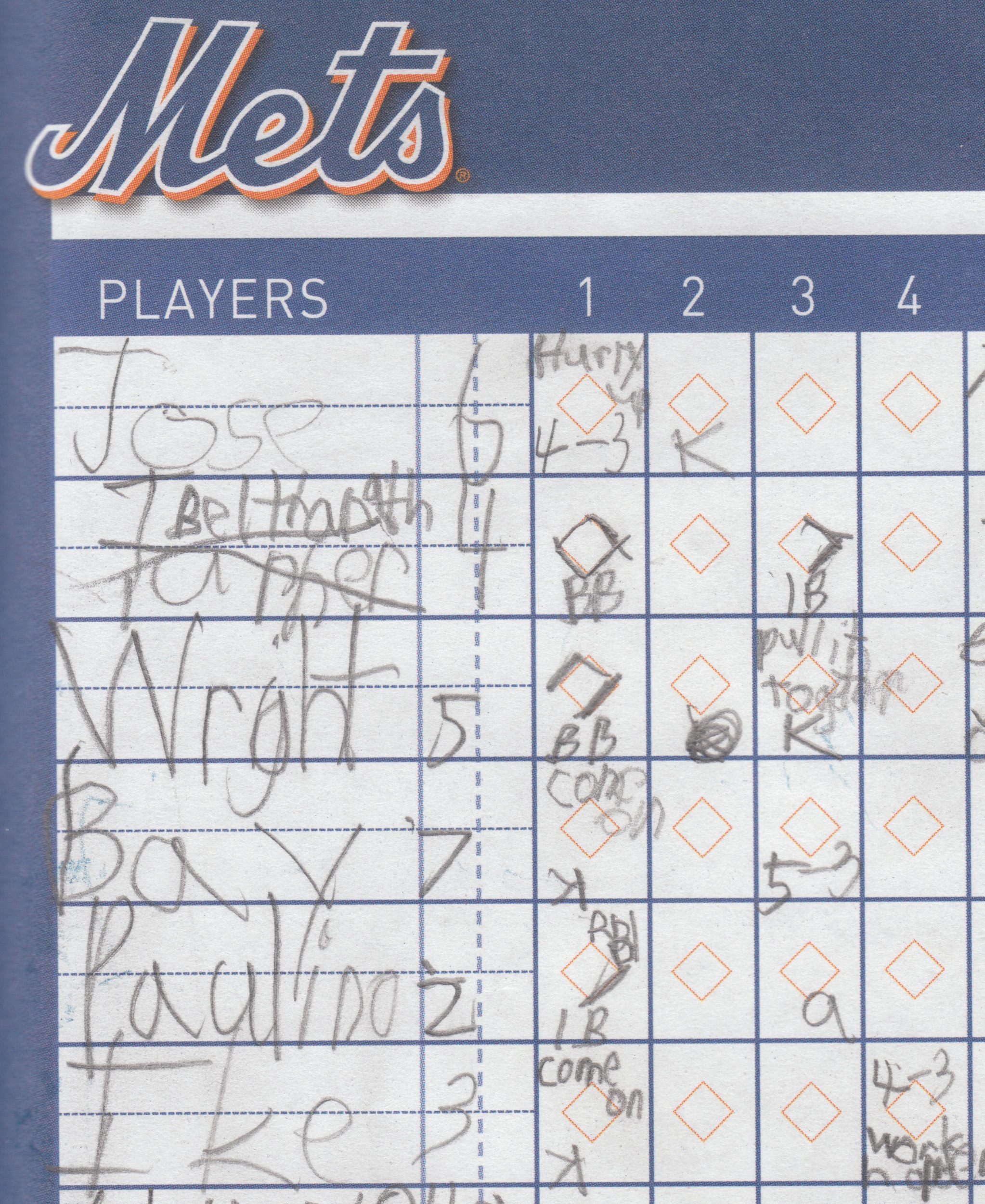
So far Joshua hasn’t had any on-the-field misadventures as cringeworthy as my 9-8 non-putout, thank goodness, and he can actually throw. But that aside, his Little League career is not all that different than mine. But now there’s a positive in that: Today he kept score avidly, save for the time needed to devour a Carvel cup of vanilla with rainbow sprinkles, recording every play from Jamey Carroll’s single to David Wright waving at strike three.
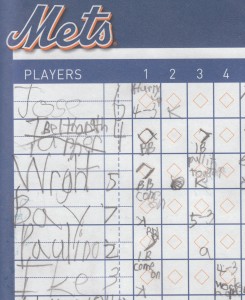 Part of the kid's handiwork He got the numerical equivalent of the positions at once, even shortstop, and was barely thrown by anything — the only play that caused him to furrow a brow was Matt Kemp’s fifth-inning GIDP, which was pretty challenging to account for up and down the scorecard. He even added editorial comments — Jason Bay’s first-inning strikeout includes a scrawled “come on,” Wright’s third-inning K is accompanied by “pull it together,” and Andre Ethier’s fatal home run is noted with “oh man.” Pretty much what I was thinking at the same time in each instance, minus the profanity and sputtered beer.
The Mets lost today. But all in all, that was a bump in the road:
1. It was my 42nd birthday, or my Jackie Robinson birthday as we decided to call it. I hope my Turk Wendell birthday sees a lot more pennants on the wall of World Bank Economic Liberalization Program Stadium, and doesn’t involve crabbing about the lack of a no-hitter.
2. My lovely wife graciously agreed to share Mother’s Day with me, and to mark it with seats for all three of us in the Pepsi Porch.
3. It was my first 2011 visit to Citi Field, the lack an issue of April deadlines and one brush with bad weather. We got a stupefyingly gorgeous day — hot in the sun, yes, but around the fourth inning the clouds came in and left everything pleasantly warm without the added touch of deep-frying.
4. Joshua proved impressively leather-lunged, bellowing at players and the Mets in general. Emily and I eventually tired of this, perhaps because we were hemorrhaging from the ear canals, but our Pepsi Porch neighbors were amused. Or at least tolerant.
5. Excused myself in the mid innings for a visit to the Promenade behind home plate with Mr. Prince. We drank foreign beers and discussed an upcoming project we’re excited about and hope you will be too.
6. Jose Reyes tripled. It was pretty great.
Not bad for a season debut. On the way out, with Joshua still a bit mopey about the loss, I tried to cheer him up by noting that “the second-best thing you can do with an afternoon is watch your baseball team lose a game.” He cocked his head a bit, curious, and I asked him what he thought the best thing would be.
He got that too. Time to teach him to frame pitches.
by Greg Prince on 8 May 2011 2:43 am Remember Angel Pagan? Me neither.
Just kidding. Of course I remember Angel Pagan. Angel Pagan was the Mets’ center fielder before Jason Pridie. Pagan was pretty good at one point, I vaguely recall. Finished in the Top 10 in triples among National League batters two years in a row.
You know who else hit a lot of triples? Wally Pipp. Wally Pipp led the American League in triples in 1924 with 19. He was also sixth in games played with 153. There were several years when Pipp barely missed a game. Real fine player, that Wally Pipp. Real good right up to the middle of 1925. You look at his numbers and you see an all-around consistent player who just suddenly disappears from his team’s lineup.
Gee, I wonder what happened to him.
And speaking of Gee, I wonder how many of us on the eve the 2011 season saw the Mets rampaging to a third consecutive victory in early May using a herd of recent Buffalo Bisons. You know how we hang on every element of the Opening Day roster right up until the trucks are packed in Port St. Lucie? Well, we’re idiots. Whatever we obsessed on getting exactly right at the end of March is irrelevant barely five weeks later.
Dillon Gee. Mike O’Connor. Ryota Igarashi. Justin Turner. Ronny Paulino (him we assumed would be here sooner than later though we didn’t much care). Not one of them was an active Met when the Mets met the Marlins to start the season; all of them played a role in beating the Dodgers Saturday night. It started with Gee, who was pressed into service when Chris Young’s tight right shoulder reminded us he’s too good to be true, and it crested with Turner, the second baseman who wasn’t deemed sound enough to beat out All-Star nominee Brad Emaus yet was perfectly fine as a pinch-hitter in the eighth. Together, these recent minor leaguers who weren’t necessarily expected up here so soon teamed with several longer-tenured Mets to short-circuit Andre Ethier and other assorted men in blue.
Leading their charge once again was Jason Pridie, another erstwhile Bison, now a staple of Met lineups for years to come as far as I can tell. Pridie of the Mets, as moviegoers everywhere will someday know, showed up in New York with little fanfare and was soon the everyday center fielder for thousands of consecutive games, many of them stirring. Like the Friday night affair he won with a three-run home run. Like the Saturday night triumph he helped seal with three base hits.
On the day they ran the Kentucky Derby in Louisville, Jason Pridie proved a real iron horse, you might say. Got his batting average up to .300. Galloped home a couple of times. No stopping this fellow. Just pencil him in for the next decade or so.
Angel Pagan…I wonder what he’s up to these nights.
by Jason Fry on 7 May 2011 1:46 am Being of inferior genetic stock, I don’t have the faintest idea what it must be like to be a major-league baseball player, blessed with amazing hand-eye coordination and fast-twitch muscles and everything else I lack.
But I’m willing to edge not very far out on a limb to say this: It must be awesome being Jose Reyes.
There he was tonight, tripling twice and doubling and walking and stealing and coming home to score. He was everywhere, in perpetual motion, churning legs and flying hair and clapping hands. It must be a blast to be in there doing all that.
When Jose is really on — as he’s been for a happily long stretch now — he doesn’t so much hit balls as he attacks them, slashing at them with his bat and then lighting out after them on the basepaths. He’s around first before you’ve gotten beyond that initial instinctive YEAAAHHHHH!!!!! and you catch up with him making calculations as he nears second. With most balls in the gap, you assume a double and figure if everything breaks right the batter might wind up with a triple. With Jose it’s the opposite — you assume triple and hurriedly downgrade your expectations when you remember there’s a plodding runner stuck in front of him or a particularly rifle-armed outfielder behind him with bad intent. When he’s standing on second Jose tends to look pleased but also slightly disappointed, like a kid who got a nice piece of cake but saw the knife placed just on the wrong side of a perfect frosting rose. Jose on third is something different. It starts with the body hurtling to the ground, dreadlocks aloft, the toes stretched to drag in the dirt. We all know he shouldn’t be sliding head-first, that it’s as crazy for him to put his hands and wrists in harm’s way as it would be for a violinist to punch it up with some drunk at a bar. Yet, at the same time, it’s so cool, the way he locks on to the base as he goes by, using it like a fighter uses the arresting wire on a carrier’s deck. And then the look at the ump, daring him to deny what he’s just seen and all those people have just enjoyed. He gets the safe sign (unless Marvin Hudson is involved), but there’s still all this extra energy from his flywheel trip around the bases. So he has to clap, except when Jose claps he doesn’t clap like you or I clap — he whacks his hands together like a sugared-up kid with the biggest erasers in the world. Or he finds someone to point to. Or he just grins a million watts’ worth. Or maybe he tries out all three.
Two such Reyes trips to third would have been treat enough for most any night at Citi Field, but we also got Carlos Beltran as the undercard.
Beltran is an entirely different player to watch: expressionless where Reyes is exuberant, a quietly graceful machine where Reyes is a manic eruption of windmilling limbs. When Jose’s on he lunges at balls with an almost palpable hunger; when Beltran’s locked in he knows exactly what pitch he wants, identifies it and makes whatever minute adjustments are necessary to catch the ball with the fat part of his bat, employing his lethal swing as he has so many times before. Then he’s off, gliding to whatever his destination is and stopping there, mission accomplished.
None of this inspires Reyesian flights of fancy — if anything it plays into the hands of Beltran’s detractors, who register the absence of grimaces and fist pumps rather than the presence of well-machined execution. But I love to watch him nonetheless: I sometimes find myself surprised that a well-struck Beltran hit went as far as it did, because that sniper’s swing is so quietly perfect that it seems like it shouldn’t send a ball rocketing off into some distant corner of Citi Field, or sailing off to settle down above the Great Wall of Flushing. And seeing Beltran whole again — or as close as he can come these days — feels like a gift. The Mets haven’t been particularly lucky this year, but there has been this: Beltran is an everyday player where we wondered how much we’d have to hear he was resting, and we no longer worry about him when there’s a tricky bloop to right or an extra base that needs taking. He’ll get it and he’ll get there, and then he’ll be in there tomorrow.
There was more tonight, of course: one of Ike Davis’s patented blasts out of the yard; the delightful, unexpected sight of Jason Pridie lashing a game-changing three-run homer beyond the David Wright DMZ; and the oddity of having every Dodger intentional walk backfire soon after enduring every Giant intentional walk working to perfection. Not to mention that the 10-year-old who very capably delivered the first pitch — the son of a Red Hook firefighter killed on 9/11 — was named Chris Cannizzaro and yes he was named for the Mets catcher and yes he really is a fan. “Always hated the Yankees,” he explained coolly. Great all around, but watching Reyes and Beltran was best of all.
The Mets are having a confounding, which-way-is-up year, one in which there are encouraging stories but also too many holes to fill, at least for this campaign. I’ve been a fan long enough to know what’s coming. I understand that Beltran is in his final Mets campaign, and should bring back a decent prospect or two in the summertime, particularly if he’s still looking as sound then as he does now. I understand Reyes isn’t on base as often as he could be, that he’s lost time to injuries, and that he might be too expensive to bring back. But he remains a monster talent at a critical position, and he too might fetch a decent reward from some playoff contender on his way to free agency and a new home.
And perhaps that will be the right thing to do in both cases. Perhaps they will leave us and in two or three years we will love the players we got in return, young stars who have us giddy with the possibilities and whose names are front and center when we crow about the new core. That could happen, and we could be grateful it did. But oh, what a price. Carlos Beltran in Angels red would hurt, but Jose Reyes in San Francisco black and orange, only seen six times a year, might really break my heart.
I’ll savor every sweet swing and tumbling third-base-as-brake slide. We all should. But the more of them we see, the more we will have to wonder how many are left, and how we will feel when the answer is none.
by Greg Prince on 6 May 2011 4:36 pm Welcome to The Happiest Recap, a solid gold slate of New York Mets games culled from every schedule the Mets have ever played en route to this, their fiftieth year in baseball. We’ve created a dream season consisting of the “best” 28th game in any Mets season, the “best” 29th game in any Mets season, the “best” 30th game in any Mets season…and we keep going from there until we have a completed schedule worthy of Bob Murphy coming back with the Happy Recap after this word from our sponsor on the WFAN Mets Radio Network.
GAME 028: May 1, 2011 — Mets 2 PHILLIES 1 (14)
Mets All-Time Game 028 Record: 23-28; Mets 2011 Record: 12-16)
Mets players had heard worse things shouted in their direction as they batted at Citizens Bank Park, but little in the Phillie fan verbal arsenal was as confusing as the chant that went up through the stands in the top of the ninth inning as they engaged the Phillies in a 1-1 tie. It wasn’t derogatory. It wasn’t about the game at all, but anyone tuned into ESPN’s Sunday Night Baseball could be excused for making the connection.
The real world made an unannounced appearance at the park the locals call the Bank. Daniel Murphy was pinch-hitting for Justin Turner against reliever Ryan Madson when the chants went up:
U-S-A! U-S-A! U-S-A!
Murphy clearly didn’t know what was going on. Shots of both dugouts indicated similar cluelessness among the Mets and the Phillies. But across Citizens Bank Park, right around 11 o’clock, the word had gotten out: The USA — its military, at any rate — had killed Osama Bin Laden. ESPN viewers learned about it a couple of minutes earlier when play-by-play voice Dan Shulman broke the news of an impending White House announcement to sports-minded America. Fans in the stadium, armed as they tend to be with portable mobile devices, picked up on the story right around the same time. They broadcast to each other what was going on.
U-S-A! U-S-A! U-S-A!
No Mets fan couldn’t be taken back ten years, to September 11, 2001, to when the name Osama Bin Laden became regrettably familiar. Wrapped in the reluctant flashbacks, however, was a baseball-shaped beacon of hope. Ten days after the terrorist attack on New York, baseball resumed in the city, at Shea Stadium. It was the Mets who took the first step toward bringing New Yorkers back to something resembling normality. It was Mike Piazza who made many forget the horrors of two Tuesdays earlier when on Friday night, September 21, he hit a breath-taking home run against Atlanta. The Mets won that game that just about everybody instantly decided was more than a game.
Now, a decade later, coincidence or something had the Mets on a baseball field when the engineer of those evil attacks had been at last eliminated. They weren’t in New York, they weren’t aware of what was about to be announced in Washington, they had no idea what had taken place that day in Pakistan. But there they were anyway, them and the Phillies and the wired fans who were letting it be known that this was suddenly also, maybe, more than a game.
U-S-A! U-S-A! U-S-A!
“I don’t like to give Philadelphia fans too much credit,” David Wright would say eventually, “but they got this one right.”
Murphy went down swinging for the second out of the top of the ninth. Wright walked and stole second but was left there when Jason Bay flied out to center. David was the thirteenth Mets runner left on base through nine innings. Their limited offense, combined with Chris Young’s strong seven, was enough to build a 1-0 lead, but the bullpen gave that back in the bottom of the eighth when Ryan Howard went the other way on Tim Byrdak for the tying RBI. Frankie Rodriguez allowed a couple of Phillies to reach in the bottom of the ninth — the Mets’ closer’s modus operandi early that season tended to involve baserunners — but Philadelphia didn’t score.
Extra innings commenced as President Barack Obama stepped to an East Room podium and confirmed what had been reported. Bin Laden was indeed dead. It took a painstakingly planned, rigorously executed operation, but the ten-year mission to take out this global public enemy was at last successful. Crowds were now gathering outside the White House to celebrate. Same thing was happening at Ground Zero in Lower Manhattan where the World Trade Center had stood until 9/11/01.
The Mets and Phillies played on. And on. They were the only game in baseball as Sunday night became Monday morning but hardly the only thing on anybody’s minds. One who had his thoughts divided was ESPN analyst Bobby Valentine. Valentine was the manager of the Mets in 2001. As those Mets threw themselves into lending their celebrity and their facility to recovery efforts (Shea’s parking lot served as a staging ground for rescue workers and Met players and coaches joined in loading supplies onto trucks when not quietly visiting firehouses and hospitals), nobody gave himself over to New York more forcefully than Valentine. Between directing logistics and comforting families of victims, he hardly slept during the middle of that September — and he still managed to lead the Mets to three consecutive wins in Pittsburgh before the game when Piazza homered and so many cheered so cathartically.
In the ESPN booth, Bobby V kept his emotions in check as best he could. He explained afterwards, “When I heard it was confirmed I got choked up.” The former manager conceded it was “an emotional couple of seconds there” before he “threw a little water on my face” and resumed analyzing.
As for the 2011 Mets, they went about business as usual. They kept leaving runners on base, sixteen through thirteen innings, not making the most of three shutout frames from rookie reliever Pedro Beato. But in the fourteenth, there was a breakthrough. Ronny Paulino, making his first start behind the plate for the Mets, notched his fifth hit of the long evening, a double to left that scored Wright to give the Mets a 2-1 lead. The Mets then left the bases loaded (nineteen through fourteen), but in the end, the LOBs proved as irrelevant as #OBL — Bin Laden in Twitterspeak — proved gone. Taylor Buchholz retired the Phils in order in the bottom of the inning to secure a 2-1 win for the Mets in fourteen.
Inside the victorious clubhouse, there was naturally enough talk about Paulino’s feat — and how the backstop, in a way, echoed Piazza’s accomplishment against Atlanta from 2001 — but mostly the questions for the Mets regarded what they were thinking when they heard the chants and what this all meant to them considering that their predecessors were such an enduring sidebar to the New York aftermath of 9/11. Young, a Princeton student that September, watched Obama’s speech in the clubhouse after his seven two-hit innings were done: “There are some things bigger than the game and our jobs.” Beato was a newly minted high school freshman in Brooklyn who went up to the roof and witnessed the smoke rising from the World Trade Center: “I couldn’t stay up there that long. We didn’t want to get in trouble.”
Manager Terry Collins admitted he had no idea why the fans were chanting in patriotic unison when they started but that bench coach Ken Oberkfell clued him in to what was going on far from Philadelphia, far from baseball. But baseball is never far from the minds of those paid to play it and guide it. Third base coach Chip Hale put the whole thing in perspective for Collins when the last out was recorded, telling the skipper, “That’s as big a night as we’ll have in a long time. We got Bin Laden and we won.”
ALSO QUITE HAPPY: On May 4, 2007, age was paired with beauty when Julio Franco broke his own record as the oldest man to homer in major league history. Starting at first base as the Mets took on the Diamondbacks in Phoenix, Franco, 48, made his feat that much more one for the ages by launching his second-inning four-bagger — into the Chase Field pool — off fellow fortysomething (43) Randy Johnson, no easy mark for any demographic. Although both men had been playing big league ball since the 1980s, it was the first time Julio had ever gone deep versus the Big Unit. Most of Franco’s perceived value as a Met was as a clubhouse sage, but in this 5-3 win at Arizona, he proved he could still get around the bases…and not just via the trot. Franco set himself a second record before turning in that Friday night when he became the oldest man in major league history to homer in the same game that he stole a base: second, in the ninth. Julio didn’t last much longer as a Met, but nobody ever got more mileage out of his own maturity.
GAME 029: May 5, 2006 — METS 8 Braves 7 (14)
Mets All-Time Game 029 Record: 31-20; Mets 2006 Record: 20-9)
Maybe the cliché that attaches itself to managers making every last move in an unyielding battle of wills versus their opposite numbers should be, “They played that game like it was the 29th game of the regular season.” It would have been true the Friday night that Willie Randolph, Bobby Cox and their respective units wore each other down across fourteen messy innings in 2006.
The Mets hoped they’d eventually land somewhere in the vicinity of the actual cliché, the one that invokes seventh games of World Series. They were off to a hot enough start in 2006 (in first place from the third game of the season on) and they were stubborn about not cooling off. The Mets had already immersed themselves in a monthlong stretch in which they would play sixteen home games and win eight of them in their final at-bat. Of those eight “walkoff wins,” this Shea showdown may have been the most thrilling, grueling and absurd of them all.
Consider that it was against the Braves, still perceived as the Mets’ great threat after nearly a decade of chasing them, though for a change it was the Mets looking down at third-place Atlanta in the standings. As the Mets attempted to add a little more distance between them and their southern foes, they undertook a mini-marathon that would have fit comfortably alongside the Grand Slam Single game.
At various points, the Braves held one-run leads of 1-0, 2-1 and 3-2, but it was a 6-2 deficit that stared the Mets in the face as they batted in the bottom of the seventh. Steve Trachsel had lasted six characteristically (for 2006) mediocre innings, leaving the Mets in a 4-2 hole. The usually reliable submarine specialist Chad Bradford didn’t help matters by giving up two in the top of the seventh. The offense sputtered, too, as the Mets left seven runners on base between the second and the fifth. Braves starter Kyle Davies had held the Mets mostly at bay, save for a Carlos Beltran homer in the first and a bout of wildness in the third that included three walks, a wild pitch and a bases-loaded fourth ball to David Wright.
Davies seemed in command when the seventh began, but he didn’t come close to seeing its end. Jose Reyes led off with a single to center and Paul Lo Duca ground-rule doubled, keeping the speedy Reyes from scoring. Davies left in favor of Macay McBride, who induced a grounder to third from Beltran, but it was not handled by Shea favorite Larry “Chipper” Jones and Reyes came home on the error. A Carlos Delgado ground ball found a hole to score Lo Duca, and suddenly it was 6-4 after batters.
Out went McBride, in came Ken Ray to go after Wright. Ray was partially successful, limiting David to a fly ball to right, but it moved Beltran to third. Cliff Floyd singled to right, getting Beltran home from there. After a passed ball and an intentional walk to Xavier Nady (the first of four Cox was to order), Kaz Matsui singled in Delgado from third.
Now it was tied 6-6. Airtight Met relief was provided for the next three innings by Aaron Heilman (seven up, six down) and Billy Wagner (a spotless tenth). The Mets generated leadoff baserunners in the eighth — a Reyes triple — and ninth — a Nady walk — but couldn’t cash them in as Ken Ray gave way to Oscar Villarreal, Oscar Villarreal gave way to Mike Remlinger, Mike Remlinger gave way to Chuck James and Chuck James gave way to Peter Moylan. Moylan, the seventh Coxman to pitch that night, put down the Mets 1-2-3 in the tenth.
There was finally movement on the scoreboard in the eleventh when Wilson Betemit led off the visitors’ half with a home run off Wagner. Billy, in his first season as Met closer, was proving a double-edged sword, usually stabilizing ninth innings for Randolph but being susceptible to some badly timed bombs — one to Washington’s Ryan Zimmerman at Shea in the first week of April, another, more frightening shot to Barry Bonds toward the end of the month in San Francisco. The Bonds bomb forged a ninth-inning tie and the Mets came back to win at AT&T Park, so Billy could be forgiven that faux pas (and besides, it was Barry Bonds). But would Wilson Betemit sink the Mets on Cinco de Mayo?
To borrow the native tongue of so many Los Mets, “¡No!”
Oh, Wagner would make it fairly interesting, by allowing a single to the next batter, Marcus Giles, who would steal second with one out and take third on a Chipper groundout. Randolph instructed Wagner to intentionally walk Andruw Jones (one of two IBBs by Met pitchers) and Billy threw sand in the eyes of the Braves rally when he induced a lineout to center from Braves rightfielder Jeff Francoeur.
Still, with Sandman exited, the Braves had just crafted their fourth one-run lead of the increasingly late night. Chris Reitsma came on to close out the Mets in the bottom of the eleventh, but he must have picked up something from Wagner, for he, too, came down with a bad case of first-batter gopheritis. Cliff Floyd, who entered the game with an unsightly .185 batting average, ripped Reitsma’s second pitch of the inning deep to right and the Mets had knotted their fourth tie of the night at 7-7.
Reitsma righted himself and sent the game to the twelfth. Duaner Sanchez, who hadn’t been touched for a run yet in his first 14 appearances covering 19 innings, kept up the phenomenal work. The Mets tried to make a winning pitcher of Sanchez when, with two out in the bottom of the twelfth, Beltran doubled. Cox made with another intentional walk, to Delgado, but then saw the strategy go shaky when Reitsma walked Wright unintentionally. Back to the plate came Floyd, with a chance to duplicate what he did to start the eleventh. This time, though, Reitsma prevailed, striking out Cliff and making this at least a thirteen-inning game.
No problem for Sanchez. He set down the Braves 1-2-3. Cox had issues in the pen by now, for he’d used everybody at his disposal, so he went to a starter, Jorge Sosa, to serve as Atlanta’s ninth pitcher of the night. After a leadoff walk to Nady — one of nine not sanctioned by the Braves manager — Sosa stiffened and escaped trouble. Randolph had to go to a seventh hurler himself (sixteenth overall between the two teams), Jorge Julio. The reliever who came over from Baltimore with minor leaguer John Maine during the offseason in exchange for Kris Benson got himself in trouble to open the fourteenth when he gave up a single to Chipper/Larry. Jones would get as far as second, on a stolen base, but Julio popped up Francoeur and grounded out Adam LaRoche to leave him there. The Braves had gone 4-for-18 with runners in scoring position.
In the bottom of the fourteenth, as the clock neared midnight, it would be the Braves’ catcher who would open the door to Atlanta disaster. Sosa didn’t help by walking Beltran with one out, but he popped up Delgado to Chipper for the second out. Now facing David Wright, he threw a pitch that got by Brian McCann for a passed ball (his second). This was key because with Beltran on second instead of first, Carlos was able to score the winning run when David Wright’s ground-rule double — his third hit and sixth time on base — bounced over the left field fence.
The Mets took their first lead of the night, 8-7, at one minute before midnight. No better time to get in front than on the last swing of the evening.
It wasn’t close to easy to get there. The Mets ran through five pinch-hitters, each of them going 0-for-1. They left nineteen baserunners on and went a dismal 4-for-21 with runners in scoring position, grounding into three double plays along the way. Leadoff man Jose Reyes alone reached base six times in eight opportunities but was brought home only twice. The leadoff triple that didn’t become the go-ahead run in the eighth (the bases were left loaded when Floyd grounded to first) was particularly gnawing.
In the end, however, these 2006 Mets were, per the British, quite chuffed with their Churchillian determination. Wright: “We are not going to roll over.” Beltran: “We are never going to give in.” Randolph, in the role of prime minister, added, “We kept scrapping and clawing. It was a big character win for us.” It was left to Cox to concede: “We had it won twice. We gave it up twice.”
So the Mets didn’t have to pay for their sins…at least not immediately. They won the game but they’d be back at work in almost no time, with a matinee scheduled a little more than thirteen hours hence. All Willie Randolph could hope for at that point was a long and effective outing from Saturday’s starter.
He’d find out soon enough what he was in for.
ALSO QUITE HAPPY: On May 9, 1982, Rusty Staub did something he never did the first time he was a Met. Le Grand Orange came to Queens from Montreal at the start of the 1972 season and, before he was unceremoniously traded to Detroit by M. Donald Grant, slugged 62 home runs in four years. It was the sixth-most in franchise history at the time of his departure, but not one of those 62 ended a game. Then again, all 62 were hit when Staub was in the game as a right fielder. As a regular in Yogi Berra’s and Roy McMillan’s lineups, he was going to come up when he was going to come up. But when Rusty returned to New York prior to 1981, he was on the verge of adapting to a new role: pinch-hitter deluxe. Staub began ’81 as the club’s starting first baseman, but with the emergence of Mookie Wilson in center, the trade for Ellis Valentine to play right and the realization that Dave Kingman’s defense was best hidden at first, Staub, 37, gravitated to the bench where became the Mets’ main man in a pinch. By 1982, he was ensconced in that job, and few could do it better. Rusty’s brilliance as the guy you’d count on to come through in a tight spot never shone brighter than it did when George Bamberger sent him to pinch-hit for Craig Swan with two out in the bottom of the ninth of a 5-5 game versus the Giants. Rusty came through in that tight spot, all right, belting his first Met walkoff homer. The game-ending shot versus Greg Minton gave the Mets a 6-5 win and went down as the one of two walkoff home runs (both pinch) of Staub’s two Met tenures.
GAME 030: May 6, 2006 — METS 6 Braves 5
Mets All-Time Game 030 Record: 26-25; Mets 2006 Record: 21-9)
Length. In the modern baseball parlance, it’s a manager’s fondest dream when he is starting a pitcher who isn’t particularly consistent. On a Saturday afternoon at Shea Stadium, Willie Randolph had a real bad hankering for length out of the righty to whom he was handing the ball against Atlanta, Victor Zambrano.
Leaving aside Zambrano’s credentials for a moment — and all Mets fans really cared about where Victor was concerned was that he wasn’t Scott Kazmir, the top pitching prospect the Mets mysteriously gave up to get him two years earlier — the biggest factor facing Randolph’s club at 1:10 PM was that they were barely out of Shea before coming right back to the ballpark.
It was as if the Mets had played Friday night for all the marbles only to discover a fresh set of marbles had been placed before them about, oh, ten minutes later. The game the night before was an 8-7, 14-inniing thriller of a win, but the nearly five-hour festival of attrition, which ended at 11:59 PM, took plenty out of the Mets’ bullpen, particularly its big three of Aaron Heilman, Duaner Sanchez and Billy Wagner. They’d each pitched two innings, and it would behoove Willie to not have to use any of them at all.
Thus, when Zambrano was given the marble, so to speak, it was imperative that he handle it for as long as he could.
That plan went out the window almost immediately.
Zambrano didn’t blow up in the first inning or anything like that. To the contrary, he looked fantastic, retiring Marcus Giles, Edgar Renteria and Chipper Jones in order, striking out the first and third of them (Jones on a 3-2 count). The Mets got him a run in the bottom of the first and Victor appeared poised to protect the 1-0 margin. His seventh pitch to leadoff batter Andruw Jones in the second — his 23rd overall — was as beautiful a pitch as he ever threw as a Met. It was a breaking ball that made Andruw appear amateur. He swung, he missed, he was out…and so, somehow, was Victor Zambrano.
Seemingly without waiting for strike three to be officially registered, Zambrano took off for the Met dugout, his left hand grabbing his right arm. Something was terribly wrong in two senses of the word. Obviously the righthander experienced something painful. It turned out to be a torn flexor tendon in his elbow. Victor Zambrano, a quiet soul who received a lot of flak from a lot of fans for not being Kazmir (the kid who was blossoming into a star for Tampa Bay), would never throw another pitch as a Met. He’d only garner 23 more innings with Toronto and Baltimore the next year before fading from the majors altogether.
That would become the long-term story for Victor Zambrano, and it’s rather sad, but its only immediate consequence for the Mets on May 6, 2006, was his departure left Willie Randolph shorthanded for pitching in the second inning after using seven arms the night before.
What to do?
First thing Randolph did was signal the bullpen for Darren Oliver, the one regular reliever he didn’t use on Friday night. Oliver was generally Randolph’s long man, and his assignment Saturday afternoon was to go as long as he possibly could. Darren warmed up, retired his first batter, Adam LaRoche, on three pitches…and gave up a home run on his fourth pitch to his second batter, Jeff Francoeur.
It loomed as a long day. The Mets would have to piece together more than seven innings of pitching with a badly strapped staff, they were now in a tie game and facing them was the Braves’ co-ace, Tim Hudson.
What to do, indeed.
All the Mets could do was grind and hope. It wasn’t the worst strategy. Carlos Beltran reached Hudson for a two-out homer in the third, and Oliver had a lead. He made it stand up until the sixth when a Renteria double and a Chipper Jones single tied things back up. Hudson had grown annoyingly effective in the interim, so the Mets were again looking at quite the challenge after Oliver extended himself as far as he could. The Mets’ long man had filled in very nicely: 4 innings, 4 hits, 2 runs, 1 walk on no notice.
Willie removed Darren after Jones’s RBI and brought in Bartolome Fortunato, who hadn’t pitched for the Mets since the last game of the 2004 season. Fortunato — who accompanied Zambrano to New York in the Kazmir trade — was brought up from Norfolk following Friday night to give Randolph a fresh arm (the Mets placed rookie starter John Maine on the Disabled List at the same time, meaning the manager would have to fill two holes in his rotation, but that was for later). The right arm of Bartolome was fresh enough to tease a 6-4-3 DP out of Andruw Jones to get out of the sixth, but maybe a little stale thereafter. In the top of the seventh, Fortunato gave up a leadoff home run to LaRoche, and the Mets trailed 3-2.
Bobby Cox had to be more relaxed than Randolph. He, too, had plundered his bullpen Friday night, using every reliever in an Atlanta uniform, but Hudson was fairly cruising into the seventh. He gave up a leadoff single to Xavier Nady but struck out Ramon Castro. Jose Valentin then pinch-hit for Fortunato and singled. Suddenly Hudson’s cruise grew rocky: Jose Reyes singled home Nady and Kaz Matsui (about as popular in Flushing as Victor Zambrano) doubled deep to right to score the Joses. The put-upon Mets were ahead 5-3. Two Cox pitching moves later, it was 6-3, with Peter Moylan allowing a double-steal to Kaz and Beltran (who Hudson intentionally walked as his last batter), a walk to David Wright to load the bases and a walk to Cliff Floyd to score Matsui.
With two innings to go, this is where Willie would normally bring in Sanchez, but Duaner was being avoided because of those innings the night before (and an inning the night before that). With he and Heilman on mandatory rest, the Mets started the eighth with righty Chad Bradford. Chad got one out but then surrendered a single to Giles and a walk to Renteria. Exit Bradford, enter his bookend in specialization, lefty Pedro Feliciano. Pedro K’d switch-hitting Chipper, but ancient Met-killer Brian Jordan — a righty — was another matter. Feliciano gave up a run-scoring single to Jordan, which made it 6-4. But Pedro’s core competency was getting out lefties, of which the next batter, LaRoche, was one. And Pedro popped him up to escape the eighth.
Another run would have come in handy, but the Mets didn’t get one in the bottom of the eighth. Randolph was forced to turn to Jorge Julio as his closer of the moment. Wagner’s 30 pitches in two innings Friday night made him literally untouchable Saturday afternoon. When Julio was acquired from Baltimore, the comparison most often made was to another talented, hard-throwing righty the Mets once received from the Orioles, Armando Benitez.
Not a single Mets fan took that as a comforting scouting report. But these were desperate times, and Julio was clearly a desperate measure.
A leadoff strikeout of Jeff Francoeur was encouraging, but then it was Armando time for Jorge: a walk to Ryan Langerhans; a single to Brian McCann; a single to the eternally dangerous Matt Diaz. Now it was 6-5, runners were on first and second, there was only one out and…well, this guy was compared to Benitez for a reason.
You would haven’t have expected the reason to be Benitez got a lot of saves between those high-profile instances when he was blowing them. Giles launched a fly to deep right, but Endy Chavez caught it. McCann tagged up and represented the tying run at third. If doom was going to come to the Mets, it would come soon.
But it didn’t come at all. Julio teased a grounder to Reyes out of Renteria. Jose threw to Delgado at first and an unlikely 6-5 Mets win had been cobbled together. Five relievers combined to give Randolph 7⅔ innings. They felt desperate, but they weren’t bad, all things considered. The five pen men struck out ten Braves, six succumbing to Oliver alone. It took Julio 29 pitches to record his first (and only) Met save, but the point is the save was recorded. Julio — traded within three weeks for godsend starter Orlando “El Duque” Hernandez — and his mostly unsung relief mates had rescued their team and accounted for a second Met win in less than 24 hours.
Nice save, all around.
ALSO QUITE HAPPY: On May 8, 1992, a major leaguer most famous for what he did in the minors made the most of his lone Met batting opportunity. When Rodney McCray showed up in Port St. Lucie, he was as celebrated as any fringe outfielder whose career encompassed only 14 plate appearances in the bigs (all with the White Sox). But McCray transcended statistics. You might say he was baseball’s version of the human highlight film because the only thing anyone really knew him for was the fly ball he chased as a Triple-A Vancouver Canadian in the summer of 1991. Portland Beaver batter Chip Hale — a future Mets coach — sent a fly ball to deep right field, in the direction of McCray. McCray didn’t catch it, but it wasn’t for lack of trying. Rodney’s effort took him, literally, through a wall. The kid sprinted straight through Portland’s wooden right field fence. The clip immediately became a sensation on SportsCenter, George Michael’s Sports Machine and videotape-going anchors’ sportscasts across North America. CNN declared the wallbuster its play of the year. It was fame, but it didn’t necessarily translate into what every ballplayer truly wants: playing time. As a Met in 1992, McCray wasn’t getting a whole lot of that. Manager Jeff Torborg used him for pinch-running and late-inning outfield defense exclusively. No fences were harmed during Rodney’s first month, but he did steal two bases and score three runs in sporadic action. On a rainy Friday night at Shea, Torborg had no choice but to ask Rodney McCray to do what he wasn’t famous for. In the bottom of the ninth inning of a 3-3 game, with the bases loaded and most of his bench spent, Torborg let McCray — who had come on as a pinch-runner for Eddie Murray in the eighth and then stayed in to play right as Bobby Bonilla moved to first — face Dodger reliever Tim Crews. Rodney picked up a bat for the first time all year, yet knew exactly what to do with it, slipping a single through a drawn-in L.A. infield. Junior Noboa scampered home from third to give the Mets a 4-3 win. And Rodney McCray had his first, last and only hit in his first, last and only Met at-bat. He’d play in only two more games with New York and never reach the majors again. To date, Rodney McCray is one of six Mets with a lifetime 1.000 batting average.
by Greg Prince on 6 May 2011 8:20 am Willie Mays is celebrating his 80th birthday today.
The Mets are having another Collector’s Cup Night tonight.
Willie Mays began his Hall of Fame career at the age of 20 with the New York Giants, baseball ancestors of the New York Mets.
The cup is orange.
Willie Mays hit his first home run 60 years ago this month off future Hall of Famer and New York Met Warren Spahn at the Polo Grounds, which would become the first home of the New York Mets.
The cup says “Mets”.
Willie Mays would win the National League Rookie of the Year award in 1951.
The cup also has a picture of Mr. Met.
Willie Mays was on deck when the greatest home run in baseball history ended the greatest game in baseball history to complete the greatest pennant race in baseball history, a duel that involved two teams based in the city of New York, the Giants and the other baseball ancestor of the New York Mets, the Brooklyn Dodgers. That pennant race, which culminated in Bobby Thomson‘s “Shot Heard ‘Round The World” off Ralph Branca, was the signature episode of the signature era of National League baseball in New York, a period that loomed so large in the collective consciousness that it was agreed National League baseball simply had to return to New York a few short years after it was mistakenly allowed to physically disappear. Spiritually, it remained. The Mets exist because the Giants and Dodgers did…because players like Willie Mays did…especially because players like Willie Mays did. Then again, there was no player quite like Willie Mays.
The cup also has a sponsor’s logo.
Willie Mays once turned around, ran like there was no tomorrow, tracked a fly ball to deepest center field in the outer expanses of the Polo Grounds and caught a ball that was destined to be at least a triple. In doing so, he turned around an entire World Series and helped send the New York National League franchise to the 1954 world championship.
The cup holds about 20 ounces of liquid.
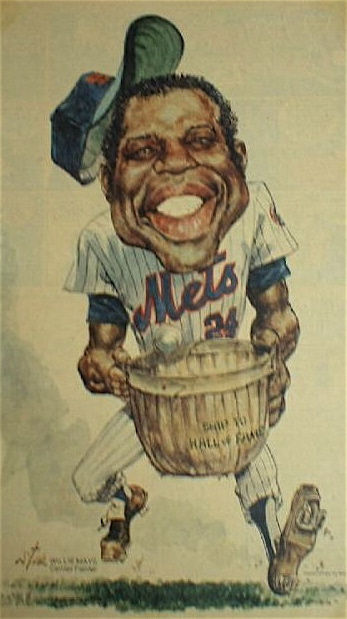
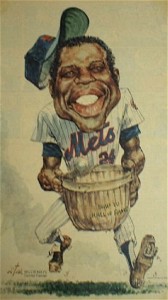 Willie Mays and his basket catch, as caught by Daily News cartoonist Bruce Stark in 1973. Willie Mays did so much so thrillingly as a New York Giant in the 1950s that Joan Payson, the owner of the New York Mets, made every effort to bring him back as a New York Met in the 1960s. She didn’t succeed until the 1970s, but when she did, Willie Mays put on a New York Mets uniform and captivated an entire city when he homered to win his first game as a Met, against the Giants no less, in 1972.
The cup is the kind of cup you used to be able to get with a large soda.
Willie Mays at his peak could hit, hit with power, run, field and throw like no other player before him or after him. He showed that as a New York Giant. He gave only hints of it as an aging New York Met, but he was a New York Met. The greatest player baseball ever saw last saw him as a New York Met helping his team to a pennant in 1973, just as he helped his New York Giant team to a pennant in 1951 and a world championship in 1954.
The cup can also hold pencils.
Willie Mays was honored by the New York Mets when they played at the Polo Grounds and he was a visitor from San Francisco. He was honored again by the New York Mets when they played at Shea Stadium and he had announced his imminent retirement. His “Willie, say goodbye to America” speech made for one of Shea’s most emotional moments.
The cup can hold any number of items, one supposes.
Willie Mays turns 80 today, just after the only two franchises for which he ever played, the Mets and the Giants, took part in a three-game series at Citi Field, where Willie Mays has yet to be acknowledged in any serious way.
The cup is plastic.
Happy 80th birthday to the Say Hey Kid. And enjoy Collector’s Cup Night tonight.
by Greg Prince on 5 May 2011 8:23 pm Isn’t it nice when the Mets behave as we prefer them to? Pelfrey slick instead of sick; Beltran boasting upper body strength and no discernible knee problems; Reyes on the fly; Rodriguez setting off anxiety attacks but giving up no runs. We can accept all that and we can enjoy the results.
The atmosphere surrounding a series between our humble little engine that occasionally can and the last team to win the World Series, however, is another matter. It was unacceptable and it was wholly unenjoyable.
Where did all these San Francisco Giants fans come from all of a sudden? Out of the success-carved woodwork, one presumes. It happens. You take a team from a large metropolitan area, have them achieve a substantial victory, and let their followers — however long they’ve been followers — know their recently successful team is going to be in town, and what happens is what I witnessed first-hand at Citi Field Tuesday and Wednesday nights and what I could make out intermittently while watching/listening semi-committedly Thursday afternoon.
I saw a ton of orange and black without the saving grace of any blue, and I heard a torrent of “LET’S GO…” without its logical conclusion. It was wa-a-a-a-ay too San Franciscan in Flushing this week, right down to the chill wind blowing off the water.
When I say I’d like to see some Giant influence represented within our Ebbets Faux ballpark, this isn’t what I had in mind.
Too many modern-day fans were rooting for the modern-day Giants, who were the modern-day New York (N.L.) team’s opponents. It’s distasteful, but except for the proportion, it wasn’t tangibly worse than Phillies fans materializing by the multitude in 2009 or Cubs fans taking up an uncomfortable chunk of Shea’s seats in 2004. Those teams became happenings and our town has lots of people from other places (as well as unfortunate proximity to Pennsylvania). It’s also reminiscent of the oodles of star-fudgers who donned Cardinal red or Cub blue at Shea in the late ’90s because they had absolutely adored Mark McGwire or Sammy Sosa ever since somebody told them to. Whereas any given Mets series used to attract a relative smidgen of the Other Team’s fans, I guess it’s become fashionable and fairly simple for every “Other” fan who wants in at a given series to get in.
(And it’s not like the mere presence of Mets fans by the Paysonload hasn’t annoyed hardcore patrons in Miami or Washington or Pittsburgh or Baltimore or, in days of yore, Philadelphia or Montreal.)
The sad part isn’t that Giants fans made more noise than Mets fans for three games. It’s that Giants fans felt they had more reason to make noise for three games — and that Mets fans are in such an ongoing funk that we tend to generate mostly the sounds of silence. Tuesday night, I overheard one excited younger Giants rooter innocently ask his companion, while the Mets were at bat in a very close game, “Why aren’t the Mets fans cheering? This is when their team needs their support.”
I don’t have a good answer for that guy, even as I agree with his premise. I mean, yeah, we’ve been beaten, battered, bruised, psychologically kicked in the mental nuts for the last bunch of seasons…we all know the litany. And I could throw in, as I have off and on since it was built, how Citi Field wasn’t designed to inspire organic fan enthusiasm for anything more than upscale eats. Though I still believe there’s something at odds between our ballpark’s legitimate appeal and the ideal of what a ballpark is actually for, I’m not going to blame Citi Field specifically for the shush factor that prevails at most Mets games.
We’re Mets fans. We know about behaving like Mets fans in the classic sense. We grew up with the Shea ethos and by now most of us have been reminded, courtesy of SNY’s Mets Yearbook series, of what that’s supposed to look like and sound like.
But we don’t look like that any more and we don’t sound like that anymore. Maybe, because of the miserable course of events that have suffocated our Metsian instincts, and because the amenities of post-Shea life distract us so, we just don’t have it in us anymore…or maybe we do, but it’s buried too deep down to instantly access in a late and close situation.
If we go to Citi Field and we don’t enjoy the sensation of the Other Team’s fans filling the silences with their excitement, we — as Mike Piazza puts it on the big screen during rare rallies — know what to do. Most of the time, there’s more of us than there are of them. Even this week, there were more of us than there were of them (though not by many and not by the ninth). So why don’t we outshout the opposition? Why don’t we have such a wall of sound going that it would never occur to them (whoever them may be) to challenge our vocal hegemony?
And why are there so many tickets available to them anyway?
’Cause we haven’t been buying what the Mets have been selling. We’re under no obligation to, of course. It’s a shame that we’re not running, mousing and clicking over each other to the box office, to mets.com, to StubHub, to whatever it would take to get a foot in the door. It’s a shame that the Mets in 2011 aren’t attracting us en masse like they did as recently as 2008. There’s a fistful of legitimate reasons — from tight money to lousy players — but it’s still a shame. On some level I love that I, as a diehard, can go when I want and sit, within reason, where I want and not have to stand in overly long lines (save one) but I’d rather be banging my head against the bricks that I can’t score a ticket for that big game, because I want there to be a big game and I want there to be filled sections and I want there to be more Mets fans than there are Mets seats.
There are more than 42,000 Mets fans, obviously. There are zillions of us out here as well as sometimes in there. Last-place team, $19 parking, geometrically skewed sightlines once you get deep into the 520s…good reasons why zillions aren’t crowding into Citi Field. Believe me, comrades, I’m not trying to lay a guilt trip on anybody for not going to more games. You’re probably paying for cable, you might have bought a nice TV, you count up your kids and multiply the cost of what they’ll want if you take the plunge and go to a game…and then you consider it’s not such a great product at the moment.
I wish it were. I wish it were shoutworthy. I wish I shouted more. I don’t know what the average age of the “LET’S GO METS!” shouter was when it was going strong, but I’m sure it was younger than me now. Still, I try. I joined one of my neighbors last night in a desperation chant in the ninth as Brian Wilson secured a 2-0 lead that may as well have been 20-0. What’s the point of straining your throat if you don’t think you’re really helping? It’s cold, our team’s not good, we’re terribly outnumbered by now…“LET’S GO…” ah, whatever.
If it occurs to anybody that maybe they ought to start shouting, likely futility is a reasonable reason to draw the opposite conclusion. If, that is, you’re the kind of fan who does a cost-benefit analysis as you root. Maybe you are. To invest in a night at Citi Field, you kind of have to be the kind of fan who does a cost-benefit analysis.
One thing I’ve noticed the last few years, maybe even back to the end of Shea but definitely at Citi, is how hard these chants are to sustain through one lousy pitch. A Met gets on base, “LET’S GO METS!” gets on the DiamondVision, a plurality of the crowd gets going and, as the Other Team’s reliever goes into his motion, everybody stops. Not sure when a baseball game turned into the Masters. You’re shouting, and then you halt, presumably to see what happens, maybe because by MLB rule the video board can’t continue prompting you once the batter is in the box and by now a generation has grown up thinking you only rev up when an electronic image instructs you to.
It’s weird. It’s antithetical to Mets fan behavior as we knew it. We — and by we, I mean the we you see in those ’60s and ’70s and ’80s highlight films — were fine making it about us. We cheered because we were Mets fans and didn’t get too hung up on whether it was going to be effective where the final score was concerned. We made it about us. I find it ironic that in a society in which individuals are increasingly making everything about them, the segment of society that goes to Citi Field to ostensibly support the home team is hesitant or reluctant or oblivious when it comes to a big, showy display of what “we” stand for.
Dance cam? Kiss cam? Pizza box cam? Green eggs and cam? At somebody else’s direction, in short spurts, the Mets fan can be as demonstrative as possible. Left to our own devices, figuratively and literally, we seem to want to be left alone. We’re still Mets fans. We’re still dwelling on what’s wrong with our team and what it would take to make our team right again, but it generally doesn’t occur to us to express it spontaneously, loudly and — should such expression gain a scintilla of momentum — in unison. It’s just not what we do anymore.
When I first saw and heard the San Francisco fans making a collective spectacle of themselves, I was surprised at how they overshadowed us. After experiencing it up close and from a distance for a few days, I’m surprised it doesn’t happen every series against every Other Team.
by Greg Prince on 5 May 2011 11:42 am
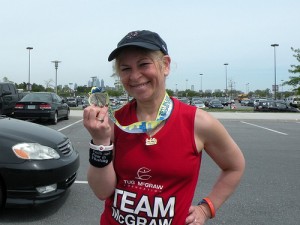 Philadelphia occasionally hosts nice sporting events.
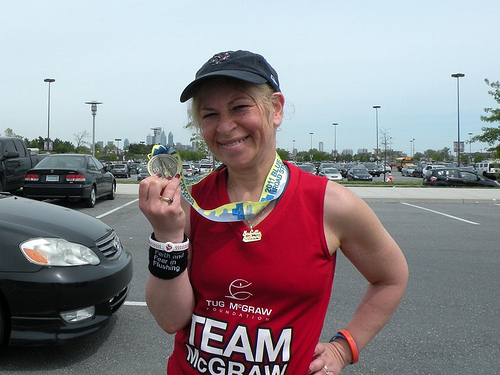
Somewhere between Halladay vs. Niese and Lee vs. Young, the Mets-Phillies pitching dynamic from last weekend was all Tug, as in Team McGraw member and Faith and Fear reader Sharon Chapman finishing her latest race, the Broad Street Run, while sporting the FAFIF wristband. Sharon has run at both ends of the New Jersey Turnpike to raise money and awareness for the Tug McGraw Foundation, a Team McGraw effort with which we’ve been happy and proud to assist, albeit from a sitting (and sometimes drinking) position.
Congratulations to Sharon on another race put in the books, and thanks for one more showing of the best wrist running.
by Jason Fry on 4 May 2011 11:31 pm I love Tim Lincecum, I really do. I love that perfect motion of his — my description of it last year was “the equation that solves a knotty physics problem, and leaves you smiling at the elegance and beauty of the answer,” which I’m not going to improve on. I love his God-given talents, his individuality, his doggedness, and most of all the fact that he somehow sailed through the anonymizing factory that is minor-league baseball without some idiot pitching coach ruining him or enough people deciding he was too small to meet their definition of success and so denying him any chance at it. Lincecum was so good so quickly that nobody had a chance to fuck him up, and now he sits atop the pitching mountain, walking on his hands before games and not bothering to ice his arm after starts, happily out of reach of the ligament-shredding groupthink that Organized Baseball calls wisdom. (The fact that Lincecum is nicknamed the Freak tells you everything you need to know about baseball and new ideas.) My goodness I love him.
Important caveat, though: I love him a lot more when he’s tormenting somebody else.
Lincecum didn’t look that good early — he was a bit wild, a bit out of kilter, and with Chris Capuano gritting his way through the Giants’ order you could at least imagine this was our night, a chance to put an Amish stitch in the grand tapestry recounting the Lincecum Conquest. In the sixth, the thoroughly revitalized Carlos Beltran led off with a double, after which Ike Davis trudged rather unhappily to the plate. Lincecum had fanned Ike twice already, and a third K looked like a question of when, not if — Ike was perilously close to helpless up there. But somehow he MacGyver’ed his way through tapping balls foul and watching balls slip just wide of the plate, fighting back to 3-2 over nine pitches and then serving the 10th neatly up the middle to put runners on first and third. If Ronny Paulino did just about anything it would be 1-1 Mets, and then we’d see.
Unfortunately, the Mets had Lincecum’s attention now. He got Paulino to send a little dandelion puff aloft that Freddy Sanchez converted into an out with a nice sliding catch, somehow springing up and heaving a perfect throw homeward to keep Beltran on third. (Staying put was unquestionably the right call.) Willie Harris then struck out. Let us pause for a deep sigh, a stare heavenward and a moment insisting that WILLIE HARRIS HAS TO HAVE AT LEAST ONE MOMENT THIS YEAR, RIGHT? (If he doesn’t have one soon, can he be crammed into the Boyer-Emaus chute and never spoken of again?) Jason Pridie also fanned, and that was that.
Seriously — that was that. Other than a Beltran single in the eighth, no other Met reached base. In fact, foul balls became the stuff of victory. After Ike’s single, here’s what the Giants did:
As recounted above, Lincecum needed 10 pitches to get Paulino to foul out and fan Harris and Pridie. Seven out of 10 pitches were strikes or went for outs.
In the seventh, Lincecum ended his night by striking out the side on 18 pitches — five balls, 13 strikes.
In the eighth, Ramon Ramirez, Javier Lopez and Sergio Romo faced four batters. They threw 16 pitches — just three of them balls — in collecting a flyout and two more Ks.
In the ninth, Brian Wilson threw 11 pitches — just one of them a ball — in fanning Josh Thole and Pridie and getting Lucas Duda to foul out for the ballgame.
Four innings total, nine Ks, 55 pitches — just 12 of them balls. It was impressive. It was dominant. If you like watching pitchers not overthinking things, changing speeds, and throwing strikes, it was even beautiful.
I sure wish I’d watched it happen to someone else.
* * *
Slightly less depressing: I chatted with New York Magazine’s Will Leitch about the Mets and their confounding lack of no-hitters earlier today. Check out it here.
by Greg Prince on 4 May 2011 12:00 pm
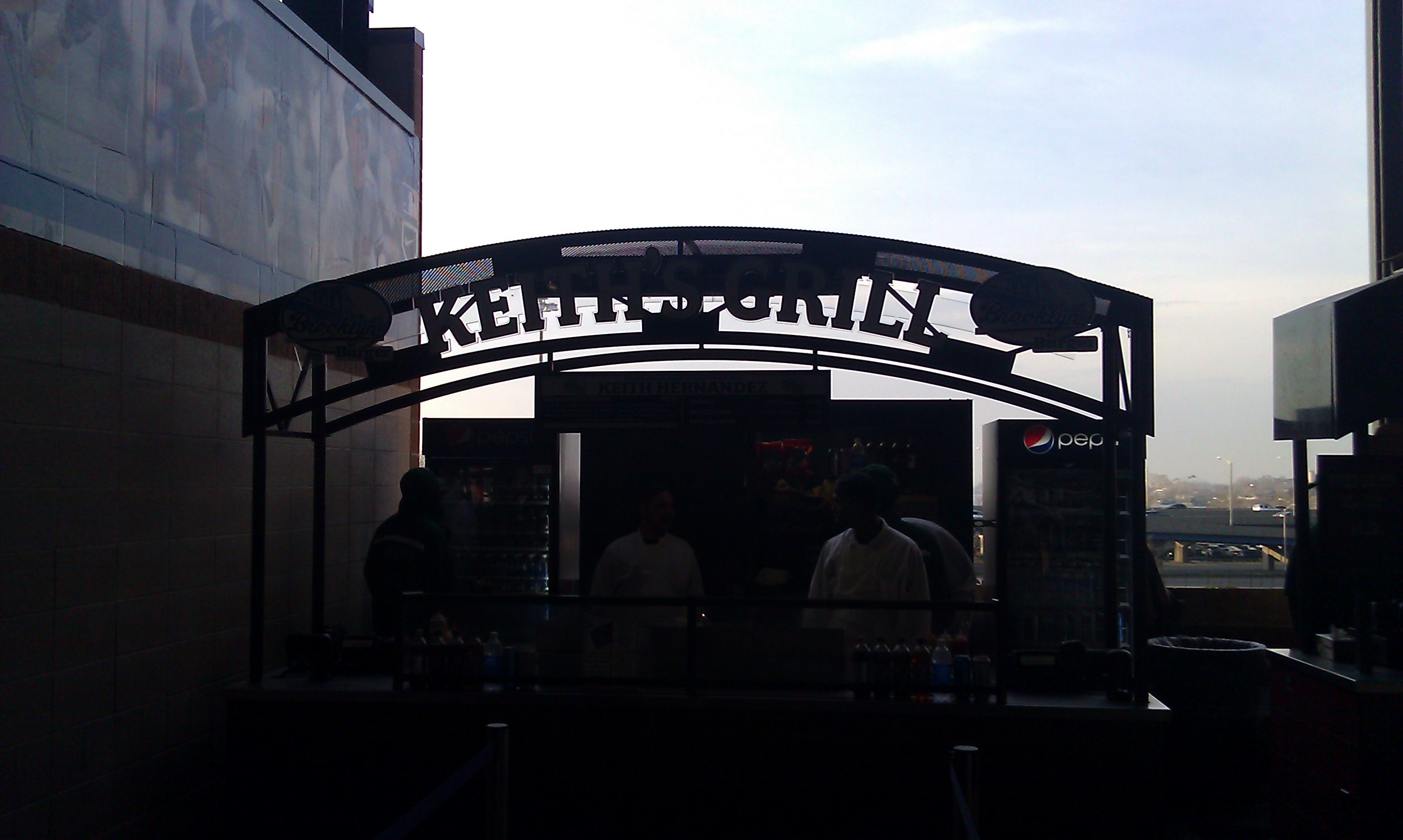
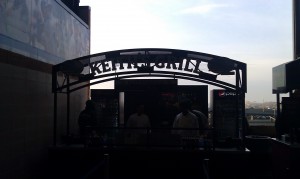 Keith's Grill, moving out of the shadows.
I love when the Mets take our advice before we even offer it. In Amazin’ Avenue Annual 2011, Jason and I offered up a slew of ideas on how to best extended the Mets legacy at Citi Field. One of them, which we expanded upon recently, was reinstituting the Banner Day doubleheader in 2012 and making it again a yearly Met tradition. The Mets haven’t gotten back to us on that.
But one thing they did go ahead and implement (presumably in the works before our article was published so we can’t take credit for it) was our suggestion that they Name More Stuff after Met legends. Camden Yards celebrates Boog Powell with barbecue. Citizens Bank Park pays homage to Greg Luzinski with barbecue. Manny Sanguillen has a barbecue stand in PNC Park. There seems to be a culinary theme there, and there’s already a popular barbecue concession at Citi Field, and one of the most beloved Mets of all time was a longtime spare rib chef of great renown…so we said, hey, how about hooking up Rusty Staub? What could be better than adding a touch of Le Grand Orange to the delectable aroma of Blue Smoke? (Actually, that idea was generated by FAFIF reader Kevin From Flushing, but he said go right ahead and co-opt it, so we did.)
I don’t know what the politics of barbecue sauce are, exactly, but I haven’t seen any famous red hair around the pulled pork, so there went that brilliant concept for now. We also didn’t see any movement on our notion that the Acela Club should be the Stork Club Presented by Acela, with George Theodore as official greeter; or Hershey’s Dunk Tank should be transformed into Hershey’s Krane Pool; or, one we (and Kevin) really thought was a natural, rechristening the El Verano Taqueria as Mex’s El Verano Taqueria.
Mex! Keith Hernandez! Tacos! C’mon!
That hasn’t flown, to date, but boy was I happy when on the first homestand of 2011 I noticed, tucked away in a corner of the left field Field Level concourse was a kiosk marked KEITH’S GRILL. I was even happier when I realized Keith wasn’t the name of some brokerage firm but actually Keith Hernandez, late of first base and more permanently of the SNY broadcast booth.
The Mets named something for a Met! Not as fluid a connection to the Met in question as we had proposed, but it was a step in the right direction. Only problem was nobody was going to Keith’s Grill. It was out of the way, it was unknown and it sold the one item everybody was already queuing up for just up the hallway: hamburgers. Keith in 2011 had an unenviable task: displacing (a little, anyway) Shake Shack. It looked to be way tougher than Keith’s assignment in 1983: displacing Dave Kingman.
Since first examining Keith’s Grill, some sizzle has gotten going. Keith himself has put on his straightest face and publicized the heck (if not hell) out of it. I saw a lengthy segment on Mets Weekly in which Keith explained why his burgers — the Mex and the Gold Glove — are constructed as they are. Then a half-inning or so was devoted during a telecast to showing how they’re made. Why watch Scott Hairston take a swing when you can watch Keith Hernandez take a much juicier bite?
I’m happy to report, based on experiential observation, that Keith’s Grill is catching on. Nice little line on Tuesday night for its two-piece menu, which I joined so I could see for myself if the Gold Glove glittered in real life as it did on TV. It wasn’t a Shake Shack wait by any means, but it also wasn’t ready to go. They really grill those burgers for you, which takes a few minutes. And they really do add kettle chips and a Tootsie Pop garnish for your ten bucks.
The verdict? I liked it. It’s a Brooklyn Burger, which means the meat is…well, let’s just say it’s not Shake Shack (which I think is dandy if not otherworldly), but the fixin’s are applied as Keith promised they’d be (ketchup holding the pickles in place, et al) and it’s a satisfying nosh. More than a nosh. It’s substantial. The chopped onions really make the burger an event and the kettle chips (generously doled) make it a meal.
Plus, it’s Keith’s Grill. Supporting Keith is not a bad thing to do at all.
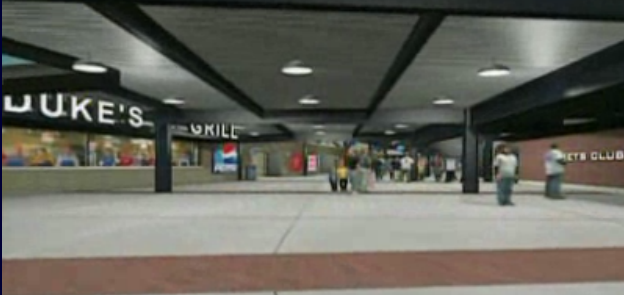
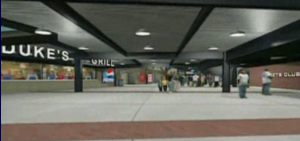 Duke's Grill, relegated to CGI.
The existence of something named for a Met put me in mind of the original plan for Citi Field, or at least one aspect of it as illustrated in the CGI renderings that made the rounds when the ballpark was yet to have as much a corporate sponsor. Across from the Ebbets Club was something named Duke’s Grill. It was presumably a placeholder, penciled in to give us an idea of what we were in for. I was less impressed by the grill than I was wary of Duke’s. We already knew we were in for an Ebbets Field facade and an Ebbets Club and a Jackie Robinson Rotunda. Duke’s Grill, too? Even as an example of what was to come, I found the prospective saturation-Dodgering of the Mets’ new home a Bummer.
Duke Snider was a Met for one season, but I seriously doubt Duke’s Grill was an homage to that, his 1963 All-Star status notwithstanding. I wouldn’t be surprised if there was a Pee Wee’s Ice Cream and a Furillo’s Pizza and a Gene Hermanski Ham ‘n’ Eggery on the drawing board somewhere. It riles me up a bit to think what a Brooklyn Dodger wonderland Citi Field was conceived as (for one man) and it sates me to know there was Mets fan blowback to the overdoing of the theme, and that a marvelous Mets museum was opened in the park’s second year, and that in the third year there is no longer an Ebbets Club but there is definitely a Keith’s Grill.
We still want our Banner Day Doubleheader back next year, but we appreciate the Gold Glove burger in the meantime.
by Greg Prince on 4 May 2011 3:14 am And we never failed to fail
It was the easiest thing to do
—Crosby Still & Nash
No doubt there are San Francisco Giants fans this morning (many of whom squealed with irritating delight at Citi Field) who took Tuesday’s night’s extra-inning win over the unformidable New York Mets as a sign of some sort. Their team was experiencing The Hangover, not winning much, hardly scoring at all, falling dangerously off the pace in their division. After 28 games, the 2011 Giants simply weren’t the 2010 Giants, at least not the Giants who finished 2010 as champions of the baseball world (Japan not included).
The Hangover, whatever its merits as a cinematic franchise, brings its own special burdens to fans of a defending titleholder. The first thing you learn is you’re not really defending anything. The game that ends a World Series ends everything about your championship season. Your next official game is about five months later and at that point, you’re tied for first, last and everything.
The Giants of 2011 may be in store for a better, more fortunate fate, but I recognize a certain underlying similarity between their present tires-in-the-mud status and that which afflicted the 1987 Mets through roughly a sixth of their Season After. You watch your team that you remember being so indefatigable, so clutch, so obviously bound for glory, and you just wait for that reality to reset. Thus, when you pull a win out of a mess as the Giants did against the failure-prone Mets, you might be moved to decide your magic is back.
But it doesn’t arrive so easily. It certainly doesn’t stick like glue. That was last year’s magic, and it’s rarely transferable. Sometimes you just win a game because the other team insisted on losing it, the way the Mets did Tuesday night. Yet you look for signs of what you still perceive as normality. We won! Aubrey Huff homered in the tenth and the Beard came on and got the save! Just like last year!
Nothing’s ever like last year. 1987 wasn’t like 1986, no matter how much I wanted it to be. My first Mets game that season was right around this juncture of the schedule and it happened to be a Mets-Giants game of surpassing importance where my personal life was concerned even if it told me little about my baseball team (although the two are usually interchangeable). That game, on May 15, 1987, was my first date with the woman who would eventually marry me. “Neat — my first baseball game!” was Stephanie’s reaction to the Shea tableau, and I didn’t have to hear much more.
As for the Mets that 1987 night, they sure looked like 1986. It was as lovely as my new girlfriend: El Sid holding San Fran hitless for five innings; Strawberry, Dykstra and HoJo homering; the Mets winning easily, 8-3. They’d looked mostly dismal up until that Friday night, losing nine of eleven dating back to May 2 (the day Tim Raines returned to the Expos from Collusion and treated Jesse Orosco like he was Manny Acosta). It was “still early” and all that, but the Mets of 1987 were clearly off their game. It didn’t make sense to me or to any Mets fan who had grown accustomed to a perfect blend of invincibility and destiny. Now the Mets were just another team…just another lousy team. But then they got this big win against the Giants, they looked like their “old” selves, and maybe this was going to be the turning point.
Even if you weren’t around in 1987, you’ve probably noticed it’s not represented on the upper left field wall at Citi Field. The Mets emerged from their mid-May morass eventually, but never again (and I mean never again) reached the heights of 1986. The Giants, for all I know, will pivot from raking R.A. Dickey, befuddling Josh Thole and tattering Taylor Buchholz and make a serious move on the Colorado Rockies, return to the postseason and not stop believin’ clear to the only result that can possibly satisfy their incredibly annoying fans after 2010. My well-documented fondness for the legacy of the New York Giants notwithstanding, I don’t really care what San Francisco does when they’re not playing us (or reportedly investigating trades with us). But I definitely recognize what’s going on with them.
And that they can’t play the Mets every night.
***
On the subject of magic that resists transfer, there was only one “First Baseball Game in the City of New York After,” and it was the one that took place following the horrifying events of September 11, 2001. Yet I got the distinct impression that Mets management thought hosting the first baseball game in the city of New York after May 1, 2011, would be automatically as momentous and memorable — that it would be an Upper Case affair waiting to happen.
It didn’t work out that way, and not just because the Mets lost to the Giants instead of beating the Braves.
The Mets organization showed genuine appreciation to members of the U.S. Military Tuesday night, they wore this year’s (dubious) model of the MLB-sanctioned red, white and blue caps ahead of schedule, and they even put on sale a sackful of special patriotic pins — Mets logo with American flag; Mets logo with Statue of Liberty — in one of the team stores I visited. But despite the flourishes, it was just another Tuesday night at Citi Field. We weren’t coming together. We weren’t making our stand against fear. We weren’t doing anything more special than watching the Mets play the Giants. That’s special enough.
As much as it feels sometimes like ten years haven’t added up to a decade’s remove in these parts, we are by no means embedded in the same precise municipal mental space as we were on September 21, 2001 — and praise be for that, of course. Nobody wants to wonder if it’s safe to go to a baseball game or if it’s appropriate to go to a baseball game. In 2011, we go to a baseball game or just about anywhere we want. It’s different than it used to be, pre-9/11, but it’s not the same as it was that one singular moment in time.
I was at Shea on September 21, 2001. Even though I honestly didn’t have the same reaction many did to Mike Piazza’s home run (how does a home run “heal a city” so emotionally overwhelmed, never mind physically altered?), I completely appreciated why it meant so much to so many. It meant plenty to me to be in that stadium that night. Opening the ballpark and playing the game…I thought that was the big victory.
What happened at Citizens Bank Park Sunday night in response to word organically spreading that Global Public Enemy No. 1 had been eliminated was beautiful. It made for a serendipitous bookend that the New York Mets were playing on ESPN ten years after the New York Mets kick-started baseball — and maybe our hearts — after the tragedy our military was finally able to avenge this past weekend. But that was Sunday, and it was spontaneous. This was Tuesday, and it seemed of questionable value to try to recreate those emotions, let alone play off whatever lingers from ten years before. Giving active military personnel free tickets? Fantastic. First ball honors for a representative of each branch? Classy. Adding an extra round of “God Bless America” on a weeknight? Fine, I guess.
Suggesting, however subtly (particularly via CitiVision), that the Mets are implicitly linked to a great national victory just because they as opposed to, say, the Texas Rangers happened to be playing baseball in prime time on this particular Sunday night? I don’t know.
But I did learn it’s impossible to instantly conjure an unforgettable evening just because it seemed like a neat thing to try.
|
|