The blog for Mets fans
who like to read
ABOUT US

Faith and Fear in Flushing made its debut on Feb. 16, 2005, the brainchild of two longtime friends and lifelong Met fans.
Greg Prince discovered the Mets when he was 6, during the magical summer of 1969. He is a Long Island-based writer, editor and communications consultant. Contact him here.
Jason Fry is a Brooklyn writer whose first memories include his mom leaping up and down cheering for Rusty Staub. Check out his other writing here.
Got something to say? Leave a comment, or email us at faithandfear@gmail.com. (Sorry, but we have no interest in ads, sponsored content or guest posts.)
Need our RSS feed? It's here.
Visit our Facebook page, or drop by the personal pages for Greg and Jason.
Or follow us on Twitter: Here's Greg, and here's Jason.
|
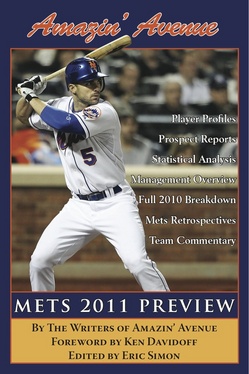
by Greg Prince on 18 April 2011 8:21 pm  A banner book in which we propose a Banner Day. It’s not too late to order yourself a copy of Amazin’ Avenue Annual 2011. Considering it’s an annual, that makes it good for the entire year. And it really is good…and I’m not just saying that because Jason and I were invited to write an article for it about ways the Mets could take steps to preserve their legacy at Citi Field.
And no, wise guy, not the legacy of losing. The good parts. The fun parts. The proud parts. We spell it out over not a few pages, and you should really make AAA part of your baseball library and soak up every word of it (and every word everybody else contributed — more information here).
But with AAA editor Eric Simon’s blessing, I’d like to call particular attention to one the ideas we are proposing, namely the reinstatement, for 2012, of the Banner Day Doubleheader.
You heard us: Banner Day Doubleheader: two games, one admission, on the schedule, in advance.
Why?
1) TRADITION! TRADITION! TRADITION!
Not tradition for tradition’s sake, but because Banner Day was, from 1963 through 1996, as Metsian as it got. Watch a Mets Yearbook lately? Have you noticed one common denominator (besides “I think I saw this one already”)? It’s that Banner Day was year-in, year-out the signature promotion on the Mets special events calendar. Nothing was more special or more of an event.
2) Gone but by no means forgotten
The Mets quietly folded up their beloved tradition fifteen years ago, yet Banner Day still comes up. It came up before Mets Yearbook began airing. It comes up from those who promenaded and from those who watched and those who’ve only heard about it. It comes up because it remains, even in absentia, as Metsian as it gets. The banner…the placard as Casey Stengel, godfather of all things Amazin’, put it…was the purest expression of the Metsian mind there ever was. Nobody asked Mets fans to spill their hearts out on bedsheets, they just did. Then they just kept coming. Then the Mets had the keen sense to lunge out front and lead the parade: Don’t just bring your banners to the Polo Grounds, management said — bring ’em onto the field. Magic was created and extended to Shea Stadium. Magic doesn’t just vanish because you inadvertently tried to make it disappear.
3) Fiscally prudent
We’ve seen that it’s tough for the Mets under current ownership to maintain a promotional schedule in line with that of recent years. Can’t rustle up sponsors for nicknack giveaways as readily as you used to? Don’t worry, Mets, we’ll bring our own. If you can talk Emerson Radio back in as presenter, great, but the point of Banner Day was never the prize. It was the process. It was the proximity to greatness — fan feet on the actual warning track patrolled by everyone from Jim Hickman to Don Hahn to Mookie Wilson — and it was the moment to say with paint what was on your mind, usually a message of unconditional love and eternal support. A hearty handshake from Mr. Met and whoever replaces Dan Warthen would serve as prize enough for the winning banner in 2012. That and attention. The winning banner on CitiVision! The winning banner on mets.com! The winning banner displayed in the Mets Museum! Fandom for the sake of fandom. Mets fans melt at the proposition.
4) Forget your troubles, c’mon get happy
Watch those film clips from the not-so-sublime years covered in Mets Yearbook. Do the banners say, “The Mets suck and we don’t like the Mets, when are they going to get better and they suck and you suck and everybody sucks”? No, they do not. It is always relentlessly hopeful and ridiculously optimistic. Mets fans, it might surprise Mets management, desire and seek reasons to believe. If they can’t believe in an imminent improvement, they want to believe in themselves. They want to believe there’s a reason they tromp on out to Citi Field when the non-believers around them ask, “Mets game? Why are you going to THAT?” We know why, and we want to show it from the heart. We can buy licensed merchandise (and we will, pending pricing) and some of us can blog up a storm (and we do), but we all want to be reminded that something makes us unique — and Banner Day, a Met creation, is one of those singular sensations that belonged first, last and always to the New York Mets. To the Mets and their fans, technically, but we tend to think they’re one and the same.
5) Brand equity
Current ownership — or new ownership, should it be in place by next season — will (or should) be groping about to make people look at the positives of what it means to be Metsian. They can focus-group this until we’re all asked to bring our own handheld fruit to meetings, but nothing means Mets like Banner Day means Mets. It will let the fan base knows that whoever’s running the show in 2012 gets it the way the Della Femina ads of 1980 were supposed to let the fan base know that Doubleday & Wilpon got it. I don’t mean so much the “The Magic Is Back” tagline but the ads that declared, “This is dedicated to the guys who cried when Thomson connected with Branca’s 0 and 1 pitch.” (Thirty-one years later, I think we should have seen Dodger trouble coming, but it was a reasonably effective come-on at the time.) If a new owner’s broom wants to sweep in some goodwill in its midst, bring back the Banner Day Doubleheader. If WilponCo wants to remind us why we trusted you in the first place, bring back the Banner Day Doubleheader.
And it has to be a doubleheader. It has to be. Forget the instinct to make it a corporate-sanitized Tropicana Pre-Game Banner Parade & Contest as it was when last the bedsheets fluttered in the Flushing breeze. Do it as Mrs. Payson’s minions intended, between games of an honest-to-goodness twinbill that has zero to do with whether it rained yesterday.
What? A doubleheader? An intentional doubleheader? Scheduled on purpose? That’s crazy! The next thing you’ll tell me is you want Jason Isringhausen back on the Mets.
It’s not crazy. I know baseball is generally brought to you by avarice, and that the Players Association is no more a proponent of two games in one day than the owners, but there is precedent here. I don’t refer to 1963 precedent, but rather 2011 precedent, provided by our friendly foes from the 1973 World Series. Check it out — the Oakland A’s have scheduled a single-admission doubleheader for Saturday, July 16.
It is not a typographical error, or even one of those typographical fielder’s choices that doesn’t show up in the box score. It’s an idea that looms as a hit come midsummer in the East Bay. The A’s figured they needed an attendance boost, so instead of putting on four single games against the Angels right after the All-Star break, they received permission from all concerned to skip Thursday and lay in two games on Friday.
How very unusual, this two-for-the-price-of-one gimmick. It used to happen in baseball as a matter of course. It was quite the bargain. I’m not going to tell you this is the start of something big — or double — sportwide (doubleheaders can feel long, especially when they lack a unifying theme or one lousy win) but the A’s are proving it can be done. Once a year, you can host two games on the same day and you can make a big deal out of it. In the Mets’ case (which doesn’t seem to be a case loaded with gate receipts at this juncture), the deal is it gives them a golden opportunity in 2012 — the year when they celebrate their golden anniversary — to revive Banner Day like it oughta be.
Take a cue from the A’s. Pick a spot on the calendar in which you can work in that extra off day so nobody whines too much about upsetting the mediocre pitching. Then figure out the physical logistics. In the old days, fans would be called to line up behind the center field fence at Shea around the seventh inning of the opener. Maybe at Citi Field you need to have folks on the left field ramp, or in the Bullpen Plaza or figure out a way to use 126th Street effectively. You can determine, just as you can give each placard a quick gander to make sure it’s family-friendly (though don’t be total jerks about it and try to exercise obsessive editorial control to the point of censoring any sentiment that isn’t WE LOVE DELTA CLUB AMENITIES; even M. Donald Grant eventually feigned good humor at the Grant’s Tomb cracks.) You can pull people away from the Shake Shack line or grab them mid-wave. I’ll bet it won’t be that difficult. I’ll bet the banner-bearers will be rarin’ to go. (With a lesser capacity than Shea, the banner traffic will potentially flow more smoothly, too.)
Promote the hell out of it, link it to the thrills of the first fifty years, make clear that this is Marvelous, Exciting, Tremendous, Spectacular — METS. You’ll get those of who grew up on this stuff to come out but, more importantly, you’ll get the newer generation of Mets fans that must ask itself, “Why am I a Mets fan? Nothing good ever happens.” Something good will happen. Those kids, teens, twentysomethings…they’ll get to partake in the first Mets Banner Day at Citi Field, the first Mets Banner Day since 1996, the first Mets Banner Day doubleheader since 1988.
They’ll be part of the Mets tradition. That’s world-class in ways that clubs, restaurants and cushioned seats could never be. That fills those seats, I’d be willing to wager. Even those who don’t plan to parade will want to be on hand for the rebirth. If all goes well, then you put in to MLB for an annual exemption to whatever rule has made scheduling doubleheaders obsolete. This becomes our version of the Patriots Day 11 A.M. start Fenway, our Lions/Cowboys Thanksgiving home game. This becomes, again, tradition. The best kind of Mets tradition.
Make it part of your big 50th Anniversary weekend: Casey Stengel Bobblehead Night on Friday; Banner Day twinbill on Saturday; Old Timers Reunion for the Amazin’ Ages on Sunday. Don’t halfway it. Don’t halfass it. Don’t blow it. You only turn 50 once. This is the moment to make your stand, Mets. This is the moment to be the Mets.
You know what you have to do. Do it.
In that same vein of celebrating that which is good and Metsian, join us at McFadden’s Citi Field, Thursday, April 21, at 6 P.M., prior to that night’s Mets-Astros game when Faith and Fear invites you to Buy Tug a Beer. It’s all part of our ongoing efforts to help Sharon Chapman raise funds for the Tug McGraw Foundation’s battle against brain cancer and other insidious diseases. Details here.
by Greg Prince on 17 April 2011 6:40 pm Nothing like a little desperation and a helpful handful of Fredi Gonzalez to right your ship, or at least make your plane ride home from Atlanta a damn sight more pleasant than anything about your life has been in more than a week.
Was it desperate to move Josh Thole into the two-hole? It certainly wasn’t unprecedented. Josh batted there once in September 2009 and again in September 2010. I’d expect he’ll bat there more than once the rest of April 2011 now that he’s proven the (temporary) perfect fit behind Jose Reyes. Thole was a prime difference maker in turning the ongoing Mets losing streak into a thing of the past. Got the big hit in the first, sending Jose home to make it 1-0; made the outstanding slide a couple of batters later to make it 2-0; and went on to chase Jose around the bases in the fifth to up the lead to 3-1. The kid looked as found up there in the order as Angel Pagan has seemed definitively lost.
Move your pieces around when your pieces aren’t doing jack. Terry Collins found a piece that worked in a new slice of the puzzle. Yet it all still felt a little perilous as recent Bison Dillon Gee — ripe enough to be recalled to take Chris Young’s place — held the Braves mostly in check into the sixth inning. Gee and Thole operated in greater sync than any Met pitcher and catcher have to date this young season, though let’s face it: every battery gets a charge when given a jump by the likes of Fredi Gonzalez.
It takes nothing away from the Mets’ quest to stop losing to note Gonzalez was determined to keep the Braves from winning, just as he often got in the way of his erstwhile Marlins’ success. Tommy Hanson bunting with two strikes and the bases loaded and one out in the second? Brian McCann stealing after Jason Heyward homered in the eighth? Alex Gonzalez — the same Alex Gonzalez (I know there are several) who homered twice in the first game Saturday, who hit 23 home runs last year, who once ended a World Series game with a home run — sacrificing after Chipper Jones walked on four pitches to lead off the ninth?
Thank you, thank you, thank you, Fredi Gonzalez. Whether you ordered every one of those boondoggles or your players felt free to implement them themselves, they all backfired gorgeously and they all saved the Mets from an eighth consecutive episode of ignominy. Wow, are you a terrible manager. You always have been and I am mystified that the rest of the world thought the Marlins were committing skippercide when they let you go last June. Edwin Rodriguez laughs at you.
As for Collins, he wasn’t taking anything for granted. On another day, with less on the line, we would have seen the usual suspects (and they sure as hell have been suspect) wheeled out of the pen to blow up Gee’s finely crafted lead. Instead, Terry went to two starters for relief, Chris Capuano and R.A. Dickey, each on their throw day, each to maintain order. Capuano’s sole matchup (facilitated by Gonzalez after Capuano entered the game to ostensibly face Freddie Freeman), versus pinch-Chipper, loomed as favorable for the Mets, with Capuano having limited Jones to 1-for-7 in previous at-bats. I know — a Met pitcher who Larry doesn’t automatically destroy; go figure. Terry did, and now it’s 1-for-8. Dickey and his knuckleball, meanwhile, steered clear of Mount Kilimanjaro for one inning (alert Bobby O!) and kept the Mets ahead for actual relievers Izzy and Frankie, each of whom made securing the Mets’ first win in eight days interesting but not impossible.
The Mets weren’t lucky to win this one, even though Tommy Hanson shut them down with numbing ease when not trying to handle Thole. The Mets weren’t lucky to win this one, even though it took Gonzalez’s thorough mangling of strategy to prevent at least two more Brave runs from materializing. The Mets weren’t lucky to win this one, even though Izzy’s first pitch landed in the outfield seats and Frankie’s first four pitches weren’t close to being strikes.
The Mets were good. Or good enough. They’re still, on the whole, pretty bad (they did strike out 14 times Sunday and 31 times in the series), but for one game, they weren’t suffocatingly atrocious. For one game, they prevailed in a low-scoring affair. For one game, they held their own in categories like pitching, running and thinking. Professionals can do that. It was quite pleasant to be reminded the Mets are still capable of performing as such.
by Greg Prince on 16 April 2011 11:46 pm Sometimes a sensible panic is the advisable course of action. For example, Friday night, at one of my periodic meetings of the New York Baseball Giants Nostalgia Society, I was attempting to open a large, round folding table, the kind that is difficult for one person to balance while unfolding. Somehow, in my attempt to do both simultaneously, I managed to get enough of my left ring finger caught between one of the legs and its metal hinge, and…OWWWWWWW!!!!!!
But I didn’t panic. Which was incredibly stupid, because I was losing blood like Mets outfielders lose track of fly balls. My attitude was “it’s just an oversized paper cut, let me get a Band-Aid.” I would have needed a box of them, and even that wouldn’t have solved my problem. Still, I had schlepped all the way to the Bronx, I looked forward to hearing from my fellow Nostalgists — who had the wisdom to open their large, round tables in conjunction with a partner — and enjoying my NYBGNS pizza and the whole bit. The whole bit, however, doesn’t include oozing blood like the Mets bullpen oozes leads.
“Hey, you all right?” asked a Society member who also happens to be an esteemed blolleague (albeit from the other, less angst-ridden side of the tracks). I said I thought so, even as the handkerchief I was wrapping around my finger was turning as red as the Mets line score routinely turns blank. A little friendly concern convinced me I wasn’t quite all right; concern soon turned into an extraordinary act of friendship as the blogger — not just alarmed but quick-thinking and locally versed — soon had me on my way to a nearby emergency room.
So I never got my Giants talk and I never got my pizza and the whole bit of schlepping up to the Bronx resulted in a tetanus shot and four stitches administered in Upper Manhattan, but I learned a valuable lesson (besides that I should ask for help when confronted by an imposing folding table): sometimes you should panic a little. It’s not normal to watch blood spurt from your finger like it’s hope spurting from the Mets’ season.
But I wouldn’t panic about the Mets’ season, at least not the state to which it continued to descend Saturday as they lost their sixth and seventh consecutive games by dropping yet another doubleheader, this one to the Braves. Fingers aren’t supposed to develop holes in them like the heart of the Mets’ order has. The Mets as a whole, though? Let’s face it, there’s something distressingly unsurprising about their hemorrhaging defeats like I (if you’ll allow me a little dramatic license) was hemorrhaging blood.
I’m fine now, thanks to my friend Alex Belth and the staff of the Allen Hospital of New York-Presbyterian. I’m even using my left ring finger to type letters like “S,” “W” and “X”. Friday night I would have had a tough time covering certain conferences, but that’s not a problem now. The Mets are a problem, but not one worth panicking over. They’ll be fine eventually, but — Chris Young notwithstanding — they really don’t require a gypsy cab ride to the nearest emergency room. They’re too far gone at the moment to be effectively treated by an injection and a few stitches.
They may need group therapy by the time they return to Citi Field, but that’s a much longer process.
by Greg Prince on 15 April 2011 12:58 pm Welcome to The Happiest Recap, a solid gold slate of New York Mets games culled from every schedule the Mets have ever played en route to this, their fiftieth year in baseball. We’ve created a dream season consisting of the “best” tenth game in any Mets season, the “best” eleventh game in any Mets season, the “best” twelfth game in any Mets season…and we keep going from there until we have a completed schedule worthy of Bob Murphy coming back with the Happy Recap after this word from our sponsor on the WFAN Mets Radio Network.
GAME 010: April 23, 1962 — Mets 9 PIRATES 1
(Mets All-Time Game 010 Record: 24-27; Mets 1962 Record: 1-9)
It had to happen sooner or later, right? No franchise goes through its life never winning. Even the Cleveland Spiders of 1899 infamy went 20-134. The Spiders’ web was all but spun out by the beginning of the 20th century, but even they got off the schneid faster than the 1962 Mets. The Spiders lost their first four contests prior to defeating the Louisville Colonels in their fifth game. (The Colonels, like the Spiders, were rewarded with imminent contraction — the National League didn’t screw around in 1899.)
Anyway, nobody, no matter how abysmal, loses ’em all, and the 1962 Mets were rapidly indicating they’d be taking abysmal to new depths. First game ever, at St. Louis: a loss. Six-game homestand at the Polo Grounds followed, as did a half-dozen defeats. Hitting the road again, the road hit Casey Stengel’s inaugural squad right back, with the Pittsburgh Pirates taking the first two games of a three-game series. That second loss dropped the Mets’ record — 1962 and all-time — to 0-9. Meanwhile, the Bucs had blazed their way to a 10-0 start, meaning the Mets were already 9½ games out of first place…or by a margin greater than the total amount of games they had ever played.
No, it couldn’t go on forever, and twelve days after the Mets were born, they learned to crawl.
At Forbes Field, on a Monday night literally like no other that had come before it, the Mets won. Sparked by three sacrifice flies in the first two innings, the Mets lunged to a 6-0 lead and handed their fate to starter Jay Hook. Hook’s legend, courtesy of Stengel, was that as the holder of an engineering degree, the righty could tell you why a curveball curved, but he couldn’t throw a decent curveball.
The hook worked fine for Hook, however. His entire arsenal did. Jay went the distance, stopping the Pirates’ winning streak at ten and, of more cosmic significance, introducing the Mets to the sensation of not losing. They won 9-1. Their record was 1-9. For the 1962 Mets, it was the spiritual equivalent of going .500…and, mathematically speaking, it was one of the last times their all-time record was within fewer than nine games of .500.
Sure the bad start buried the franchise in a statistical hole from which they will likely never fully dig out (they entered the 2011 season 330 games shy of the break-even point), but look at it this way — the New York Mets have won a whole lot more than the Cleveland Spiders have since 1962.
ALSO QUITE HAPPY: On April 15, 2005, there was little reason to believe the Mets could compete in that night’s Shea Stadium pitching matchup. The Florida Marlins were sending their ace and recent World Series hero Josh Beckett to the hill. The Mets were countering with stopgap starter Aaron Heilman, added to the roster after Opening Day only because Kris Benson was injured late in Spring Training. But that, as they say, is why the play the game. While the Mets drove Beckett from the mound after five innings, Heilman used this tax deadline day to file a gem: a complete game, one-hit, 4-0 shutout. The only Marlin batter exempt from Heilman’s outstanding accounting of himself? Second baseman Luis Castillo, who scratched out an infield hit in the top of the fourth.
GAME 011: April 17, 2010 — Mets 2 CARDINALS 1 (20)
(Mets All-Time Game 011 Record: 24-27; Mets 2010 Record: 4-7)
This was one for the ages, in that anybody watching it had to have marked at least two birthdays while it ensued. On the clock, the game lasted nearly seven hours, though a calendar would have been a more appropriate timekeeping device. It was the fourth time the Mets had ever seen a 20th inning, and the only a time a Mets win occurred that deep into a scorecard.
Longest win in Mets history sums up what transpired on a Saturday afternoon, evening and night in St. Louis not only accurately but conceptually. On and on the festivities unfurled from Busch Stadium, from a duel in the sun between two sharp southpaw starters — Johan Santana for the Mets, rookie Jaime Garcia for the Cardinals — to a twilight struggle between obstinate bullpens to, as the shadows gave way to utter darkness, desperation farce. That a first run of the game crossed the plate in the top of the 19th, seemed almost incidental. When a second run materialized in the bottom of the inning to tie the game and continue it presumably indefinitely, it wasn’t that much of a surprise. This Saturday Fox Game of the Week surely was destined to be spun off into a prime time series. The Mets and Cardinals pre-empted Cops. They pre-empted America’s Most Wanted. It appeared certain they’d pre-empt The Simpsons, even if The Simpsons wasn’t due up until Sunday night at 8.
For 18 innings, both offenses were underachievers and proud of it for all the television viewer at home could detect. Santana was his usual acelike self, striking out nine Redbirds over seven innings while allowing just four hits. Garcia, making only his third major league start, stymied the Mets just as effectively, maybe more so: seven innings pitched, two walks, only one hit, and that one, an Angel Pagan single, didn’t come until the sixth. No Met baserunner went beyond second while Garcia was on the mound.
In fact, no baserunner from either side got within 90 feet of scoring until the bottom of the 10th when, with two out, Pedro Feliciano, who had taken over for Ryota Igarashi, walked second baseman Skip Schumaker and gave up a ground ball single to right fielder Ryan Ludwick. Mets manager Jerry Manuel made a double-switch, replacing Feliciano with Fernando Nieve and first baseman Fernando Tatis with Alex Cora — a utility infielder who had previously played first exactly twice in his 14-season big league career.
Naturally enough, after Nieve walked Albert Pujols to load the bases, Cardinal left fielder Matt Holliday lifted a foul pop down the first base line that drifted toward the stands. Cora followed the ball, diving in after it and catching it for the third out. The fill-in first baseman was a hero for a moment, but his moment lapsed in the top of the eleventh when Manuel pinch-hit Gary Matthews, Jr., for him after St. Louis skipper Tony La Russa brought on lefty Trever Miller — his fourth pitcher of the day — to face the lefty Cora with Pagan on first and one down. Matthews struck out and Pagan, with Jose Reyes up, was picked off first by Miller.
The game continued. And continued some more. Its next credible threat arose in the bottom of the 12th when, again with two out, Nieve allowed a single to Schumaker; Ludwick reached when catcher’s interference was called on Rod Barajas; and the ever dangerous Pujols was intentionally walked. Holliday could have conceivably made up for that foul ball Cora caught with the bases loaded two innings earlier, but La Russa had removed him to start the twelfth in order to insert reliever Jason Motte into the game. Thus, Motte, making his second plate appearance ever, was serving as cleanup hitter.
He struck out swinging. And on it went.
The Mets’ rallies were short and forlorn. Barajas singled with two out in the top of the 13th. Manuel removed the lead-footed catcher in favor of pinch-runner John Maine. But Maine, a pitcher, was stranded on first when Pagan flied to center. An inning later, the Mets waited through another two outs to generate something/anything. Luis Castillo reached on a grounder to third base and David Wright walked. But they died on the basepaths when Jason Bay grounded to second.
The Cardinals’ rallies continued to produce drama if not results. With Hisanori Takahashi on in relief of Nieve in the bottom of the 14th, center fielder Joe Mather doubled. Takahashi committed an error on shortstop Brendan Ryan’s sacrifice bunt attempt, putting runners on first and third. Ryan took second on defensive indifference. Takahashi reared back and struck out Schumaker and Ludwick, yet again bringing up Pujols, who was yet again intentionally walked. La Russa’s latest cleanup hitter, pitcher Blake Hawksworth, struck out to leave the bases loaded, the third time in five innings the Cardinals couldn’t bring the winning run home despite every sack being filled.
Attrition was wearing down the rosters by now. Manuel had to send pitcher Jon Niese up to pinch-hit in the 15th; he struck out. Jenrry Mejia entered as Manuel’s sixth hurler in the bottom of the inning. A two-out walk put Cardinal third baseman Felipe Lopez on first and a Mather single moved him to third, but once more, 90 feet from home proved too great a distance for St. Louis, as Ryan grounded to second.
Pagan became the first Mets baserunner to reach third after leading off the 16th by singling. First baseman Mike Jacobs (who had taken over for Cora) bunted him to second and a Reyes grounder to the right side got him as close as possible to scoring. Alas, Castillo struck out — the 16th K by Cardinal pitching to that point — and the game remained scoreless.
But it wasn’t nearly as weird as it was soon to get. Mejia gave up one-out singles to Ludwick and Pujols in the bottom of the 16th. Rookie catcher Bryan Anderson, in his second plate appearance ever, grounded to second, forcing Pujols, on a toss from Castillo to Reyes. Ludwick, however, kept running, figuring stopping at third wasn’t working for the Cardinals. Reyes threw home and Henry Blanco (who had replaced Barajas after he was removed for pinch-runner Maine) tagged him for the third out. The Mets took some hope out of that escape and looked to forge it into genuine momentum. With Cardinal closer Ryan Franklin pitching — it wasn’t like anybody had any idea when things were going to literally close, and there’d be no save situation for the home team in any case — Wright led off the top of the 17th by beating out an infield grounder.
Momentum gasped almost immediately, however. Bay lined out and Jeff Francoeur — who had started the game batting .457 and would end it hitting 74 points lower — fouled out to third. As Blanco worked a count to one-and-one, Wright took off for second. Longtime Cardinal villain Yadier Molina gunned him down stealing. It was onto the bottom of the 17th.
Jerry Manuel had two relievers left: his closer, Francisco Rodriguez, and recently recalled 32-year-old rookie Raul Valdes. Rodriguez had been warming up every inning of late just in case there was a Met lead to protect. Since there wasn’t, Manuel turned to Valdes, who had pitched the night before…and surrendered a game-turning grand slam to Felipe Lopez. This time, Valdes was a much better bet, retiring the Cards 1-2-3, surviving a second encounter with Lopez when the infielder lined out to Pagan in deep center.
It wouldn’t, however, be the last time Valdes would see Lopez, for Tony La Russa decided overtime was going to be where he really earned his managerial money. Having burned through eight pitchers, including every member of his bullpen — though not at-liberty starters Kyle Lohse or Brad Penny — La Russa handed the ball to Lopez and told him to pitch. Felipe had never done so in the majors before, but 18th innings don’t come along every day (or night), either.
The Mets had collected six hits through 17 innings. You might think they’d be licking their chops at the prospect of facing a position player, yet they politely kept their offensive appetite in check. Blanco, who had been batting when Wright was thrown in the last Mets turn, popped up. Valdes, in his second plate appearance ever…against the hitter who reached him for a four-run, four-bagger approximately 24 hours earlier…crossed everybody up by a) making contact and b) reaching first base when whoever was playing third by now — Joe Mather, third guy on the Cardinals to do so — couldn’t throw him out. Even better for the Mets, Mather’s throw sailed wide of first. Valdes, ascertaining the unfolding scenario, decided to stretch his first big league single into something more.
It was indeed a stretch. Pujols tracked down the ball and threw it to Mather, covering second, and Valdes was out. With the bases clear, Pagan walked on four pitches, but Jacobs saw fit to swing at the second pitch infielder Lopez threw him. On a one-oh count, he flied to right.
Felipe Lopez had just pitched a scoreless inning.
Valdes, no worse for wear from his baserunning misadventure, resumed pitching in the bottom of the 18th and hung in there, aided by a 4-6-3 double play to end the inning. When the Mets came up to commence the 19th inning, they were no longer facing utility player Felipe Lopez.
They were facing utility player Joe Mather.
La Russa switched Mather and Lopez, sending Felipe to third and Joe to the mound. He must have liked the matchups. Or something. Whatever the widely admired managerial legend was thinking, Mather walked Reyes on five pitches to start off his first-ever pitching assignment. With a spare outfielder on the hill having immediately encountered a fairly predictable bout of wildness, Jerry Manuel opted to not instruct his hitters to just keep taking pitches. Instead, he had Castillo sacrifice Reyes to second. Mission (as it were) accomplished. Wright was walked intentionally. Bay was hit by a pitch to load the bases.
It was the first bases-loaded opportunity the Mets enjoyed all day, and it was against Joe Mather who, it bears repeating, was not a pitcher. So how did they take advantage of this sudden bounty of riches that had all but landed in their laps?
Francoeur swung at the second pitch he saw from Mather and drove it to deep left, where it was caught by Kyle Lohse…the pitcher who La Russa didn’t use to pitch but inserted for what one would have to call defense in the 18th when Lopez moved from third to the mound; Mather went from center to third; Ludwick shifted from right to center and Allen Craig went from left to right. Anyway, Lohse caught Francoeur’s fly ball, but Reyes raced home from third to give the Mets a 1-0 lead in the top of the 19th.
Lest the floodgates show any sign of completely opening, La Russa ordered Mather to walk Blanco and fill the bases for Valdes. This time Valdes grounded out to end the inning. The Mets had taken the first lead either team had taken, but it’s worth noting that after Reyes walked to lead off the 19th — putting aside the two intentional bases on balls — four Mets batters saw a total of eight Cardinal pitches.
From a Cardinal outfielder.
Well, a shred of normalcy could finally return to this acid trip of a ballgame because for the bottom of the 19th, Manuel was able, at last, to deploy his remaining legitimate reliever, his star closer, Frankie Rodriguez. Rodriguez couldn’t have been more ready. As had become commonplace in the modern era, Manuel saved his save stud for a save situation, even if the contest had moved into marathon territory long ago. Tight a game as it was, of course, Manuel had to be prepared to call on Rodriguez should a Met lead develop. That meant warming the righty up every extra inning there was.
That was more or less the equivalent of a full game, which probably isn’t advisable for anybody, let alone your high-priced closer. So when K-Rod entered in the 19th, he wasn’t bound to be tangibly more effective than, say, Joe Mather. Sure enough, Rodriguez walked Ludwick on a three-two pitch. This brought up Pujols, who had earlier accepted four distinct sets of four balls (three of them intentional passes) but simply couldn’t be walked strategically here. Pujols was universally considered the best hitter in the game, and La Russa couldn’t have had a greater gift than Prince Albert striding to the plate with a runner on first and nobody out.
The only thing La Russa didn’t have going for him was a “hold” sign transmitted to Ludwick at first. The second baseman who ran the Cardinals out of the 16th when he tried to score from second now tried to steal second — with Albert Pujols batting…on the first pitch, no less.
Blanco gunned him down (assisted by a fine, perhaps phantom tag by Castillo), emptying the bases for Pujols, allowing Rodriguez to relax and concentrate fully on the task at hand. He needed only two outs to end the game. But first he had to permit Pujols a double to left-center, putting the tying run on second base. Lohse (pitcher playing left, if you were scoring at home…or even if you were alone) tapped a grounder to short that was slow enough to move Albert to third base. Still, two out, and all that stood between the Mets and victory was…
…Yadier Molina. The same Yadier Molina who hit the ninth-inning home run at Shea Stadium that proved the difference in the seventh game of the 2006 National League Championship Series. It was four seasons later, Rodriguez hadn’t been a Met in 2006, but Molina was still Molina, and he singled to right to tie the game at 1-1
Of course he did.
Rodriguez struck out Allen Craig for the third out, ensuring the Mets would play their first 20th inning in 36 years. The last time the Mets dared to extend themselves this far into a baseball game, they took it to 25 and lost, to these very same Cardinals (or, technically speaking, their progenitors), 4-3 at Shea. Six years earlier, the Mets and Astros matched zeroes into the 24th when Houston came away victorious at the Astrodome, 1-0. And four years before that, in the second game of a Memorial Day doubleheader, no less, the Mets expended 23 innings in succumbing to the Giants, 8-6.
Each of those games was woven into the fabric of Met legend: Ed Sudol was the home plate ump for all three; Willie Mays had to play shortstop in 1964; Tommie Agee and Ron Swoboda went 0-for-10 in 1968; Bake McBride scampered home from first with the ultimate go-ahead run on an errant Hank Webb pickoff attempt in 1974. Three games that oozed into the twenties in terms of innings in Mets history, three losses.
Yet by some small miracle, not a fourth. Joe Mather was still pitching for the Cardinals in the top of the 20th. The Mets were still swinging, but at last they had gotten a good read on his stuff. Pagan led off with an infield single past the pitcher (Mather; it can’t be reiterated enough). Jacobs lined one to right field, sending Angel to third. With two on and one out, Reyes flied to deep enough center to bring home Pagan for a 2-1 lead. Mather retired Castillo and Wright on two pitches apiece, but the Mets had managed to sneak ahead for the second consecutive inning. They had a lead, and all they needed was three outs from…
…who? Good question.
Rodriguez had thrown 24 pitches in the bottom of the 19th on top of untold dozens in the bullpen. Valuable closer he was perceived to be, Manuel was reluctant to stretch him out any further. After Jerry had used eight of his own pitchers to pitch, one to pinch-hit and one to pinch-run, he was down to two active Mets in uniform: Oliver Perez, the previous night’s starter, and Mike Pelfrey, who had started the afternoon before Perez in Colorado. Pelfrey, despite not having thrown in relief since 2007, made himself available, and Manuel took the kindly Kansan up on his offer. (Students of Met lore nodded knowingly at all this, recalling Ron Darling slipped out of his traditional starter’s role to end a similarly absurd 19-inning affair a quarter-century earlier.)
The 24th Met of the day went about attempting to save the win for the only Met pitcher in eight who had given up a run. Pelfrey’s first two batters were his honorary fellow moundsmen. He induced a grounder to short from Lopez and a fly ball to right from Mather. Lest anything appear too easy as this game careened toward its 413th minute, Brendan Ryan singled past Wright and Skip Schumaker walked on four pitches. Up stepped baserunning antihero Ryan Ludwick, searching for redemption. And behind him loomed Albert Pujols.
Later Pelfrey admitted, “I thought it was never going to end.” But it did. On the 652nd pitch of this 6:53 minute affair, Schumaker grounded to Castillo, who tossed to Jacobs, who registered the 120th defensive out of the game.
It was, finally, a final: 2-1, Mets. It was the longest win in Mets history, yet quite possibly the most homely win in Mets history. Think about it — nine hits in twenty innings, all of them singles; fewer than half as many hits gathered as strikeouts incurred (19); nothing-nothing through seventeen, then three innings pitched by Cardinal position players and only two Met runs scored…both of them on sacrifice flies. Although Fox employed Kenny Albert and Tim McCarver as its announcers that endless Saturday, perhaps a more fitting voice behind the microphone would have been Marge Simpson’s, specifically from when she summed up her family’s horrifying eventful visit to Itchy & Scratchy Land:
“Come to think of it, this was the best vacation ever! Now let us never speak of it again.”
ALSO QUITE HAPPY: On April 24, 1986, with the Mets and Cardinals picking up roughly where they left off at the bitter end of the 1985 season, St. Louis closer Todd Worrell is one inning away from finishing off the so-called “pond scum” from New York, delighting a red-clad crowd luxuriating in their Redbirds’ 4-2 lead. There’s one out and one on when Worrell brings the heat once more. The flamethrowing righty, however, can’t get a third strike past fastball-loving shortstop Howard Johnson, who belts Worrell’s 2-2 pitch well over the right field fence. The Mets tie the Cardinals at four, and in the tenth, George Foster singles Wally Backman home from second base for a 5-4 lead that Roger McDowell holds in the bottom of the inning. The Mets increase their divisional lead to a game-and-a-half at the outset of this four-game series at Busch. By the time it’s done, so will be the Cardinals’ 1986 hopes. En route to an overall club record-tying eleven-game winning streak, the Mets will sweep away their archrivals as well as the remnants of the bad taste the unsuccessful conclusion of the ’85 pennant race left in their collective mouth.
GAME 012: April 17, 2006 — METS 4 Braves 3
(Mets All-Time Game 012 Record: 23-28; Mets 2010 Record: 10-2)
The Atlanta Braves had been so formidable for so long that their reign atop the National League East transcended several Mets eras. Already hot stuff when they were realigned from the N.L. West in the strike-curtailed 1994 campaign, the Braves won the 1995 East title with ease. The same could be said of their performance in 1996. Truthfully, this wasn’t much cause for Met concern, as they were nowhere near contention in those years.
The Braves kept winning mini-flags in 1997 and 1998. The Mets could now be said to be somewhat concerned with what was going on in Atlanta because they had ascended from also-rans to Wild Card contenders. The Braves were a league above that status, but still — the Mets were a good club and trying to make their bones in full. They weren’t necessarily chasing the Braves, but the games between them mattered more, particularly in ’98 when the Mets’ chance for their first at-large playoff berth depended on how they came through at Turner Field in the final three games of the season.
The Mets came through in tatters, with Atlanta — which was merely tuning up for the postseason — taking all three games at the Ted, all six for the season in Atlanta and eight consecutive in the state of Georgia dating back to September 1997 (when the Mets were barely hanging on to slim October hopes). Still climbing, still persevering, the Mets broke through as an indisputably serious playoff contender in 1999. They were good enough to take a run at the division title, but late in the season, as had been the case for the entire latter half of the ’90s, those frustratingly consistent Braves would not budge from the top of the East. The Mets finished second and had to scramble for the Wild Card. (A bonus meeting in Atlanta, in the NLCS, wouldn’t go all that well, either).
A new decade found the Mets still clawing and the Braves still swatting them away. The Mets finished a game back in 2000 (and didn’t mind Atlanta falling in the first round of the playoffs as they themselves, for once, moved on toward a pennant). In 2001, there was an incredible late run emanating out of Queens, but that last-minute stab at the division found the Braves as unyielding as ever. The Mets missed the playoffs entirely. Then they spiraled completely out of contention in 2002 and 2003 and 2004 while the Braves won the National League East in 2002 and 2003 and 2004. The Mets returned to legitimacy in 2005, hanging on in a Wild Card tussle until the dawn of September. No matter to the Braves, who won their eleventh straight division crown that season, remaining unwelcoming hosts at Turner Field whenever the Mets were obligated to drop by.
Given all that Atlanta hegemony, it had become the fondest of Metsopotamian dreams to put Atlanta in a place other than first. And with the 2006 season underway in the most encouraging fashion possible, the Mets were poised to do just that when the Braves made their first trip of the year to Shea Stadium.
This time, it was the Mets looking down from first place. This time, it was the Braves trying to get untracked. This time, it was the Mets pitching an All-Star — Pedro Martinez, who had not just a rivalry at stake, but a personal milestone. He was going for his 200th career victory, and he was going for it hard, striking out eight Braves in 6⅔ innings. Atlanta proved its usual fussy self, scoring a run in the first on an Andruw Jones sac fly, but the Mets answered back in the second on Xavier Nady’s fourth home run of the year. The Braves recaptured the lead in the third when Ryan Langerhans drove home Marcus Giles, but once more the Mets would not be deterred. In the bottom of the inning, Paul Lo Duca doubled with two out and Carlos Delgado launched his fifth homer of the season. Nady added an RBI single in the fourth to make it 4-2.
Jones (Andruw; Chipper wasn’t playing) reached Martinez for a solo homer of his own in the sixth, but that was where Pedro battened down all hatches, striking out Adam LaRoche and Jeff Francoeur, and getting Brian McCann to fly to center. When Pedro left in the seventh with two out and one on, Duaner Sanchez bailed him out by fanning Marcus Giles. Sanchez pitched a perfect eighth, handing the 4-3 lead to Billy Wagner. The decorated closer obtained the game’s final out by striking out former Met playoff icon Todd Pratt. When Lo Duca picked up dropped strike three and flung it to Delgado, the Monday night crowd of nearly 37,000 applauded several distinct happenings:
• They had just witnessed Pedro Martinez’s 200th win; Pedro was 3-0 on the season, a big factor in the Mets themselves starting 10-2, the best twelve-game mark in franchise history.
• They had just seen the Mets establish a five-game lead over the second-place Braves. Elias had let it be known that no team in the divisional era — not even impenetrable Atlanta — had ever built that large a margin over its closest competitor so quickly in a season.
• They had just watched a fistful of new-for-2006 Mets contribute to a critical win…and given all the Braves had done to the Mets for so long, it wasn’t too early to deem this game critical. Nady, Delgado, Lo Duca, Sanchez, Wagner: all acquired by GM Omar Minaya in the preceding offseason, none a participant in past Met humiliations at the hands of the Braves.
• They could sense that on some level the 2006 divisional dynamic had been settled. You can’t clinch the N.L. East with 150 games remaining, but you can sure make a statement, and with this 4-3 win, the Mets did. They stated that a certain southern squad’s dominance of their division was about to come to an overdue end.
ALSO QUITE HAPPY: On April 21, 1963, the Mets completed a doubleheader sweep of the Milwaukee Braves at the Polo Grounds. Winning two games in one day was a notable achievement for the second-year Mets; taking all four games of this series from the Braves was even better. But what made it historic was the 9-2 romp marked the longest winning streak the Mets had ever strung together: four games in a row. The 1962 Mets never made it past more than three consecutive victories, and the ’63 version had started the season a sorry 0-8. Now, however, thanks to Galen Cisco and Ken MacKenzie teaming on a seven-hitter, and Jim Hickman, Duke Snider and Al Moran each driving in a pair of runs, the Mets were a more presentable 4-8 and ended the day out of the National League cellar, rocketing, at last, all the way to ninth place. They led the Houston Colt .45s by a half-game — or one in the loss column.
by Greg Prince on 14 April 2011 8:58 pm If a restaurant you liked had gone downhill, you’d understand if it had changed hands and a sign appeared in its window that declared UNDER NEW MANAGEMENT. And unless you were personally attached to the people who used to run the place, you’d approve of the change and look forward to an improvement. You’d certainly understand if they had to close down for a spell while they made everything palatable again.
You can conceivably do that with a restaurant. You can’t do that with a baseball team. Analogies from the rest of life often run into something unique about baseball, and what makes baseball different from much of the rest of life is it brings you, most seasons, 162 games that cannot be avoided. The bistro known as baseball is dependent on seasonal business. It must remain open from April to October (otherwise, why would they play through cold, fog and general meteorological discomfort?). Hence, all the operators of that restaurant you used to really like but had grown wary of patronizing can do in the interim is add on another sign:
OPEN DURING RENOVATIONS — PARDON OUR APPEARANCE
Or as Troy Tulowitzki and the Rockies might have said to Terry Collins and the Mets on their way out of town with a four-game sweep packed away in their luggage, eat our dust.
The Mets are an atrocious baseball team right now. There is no contractor who could fix that immediately, not even one who’s a wizard with numbers. They’re atrocious. My proof is they have played atrociously almost the entirety of this season. Granted, the entirety of this season to date is thirteen games. Beginning with the fourteenth game and extending through the one-hundred sixty-second, there is, technically, the chance that they will reinvent themselves as a spectacular baseball team.
But that’s not going to happen, at least not that soon and not that permanently. They’re atrocious. They’ve played atrociously. They are not equipped to be a whole lot more than atrocious at this juncture. “At this juncture” isn’t forever, however, and atrocious may very well not reflect their state when the season reaches a third, fourth or fifth month. The Mets no doubt will have made significant personnel changes by then. Rosters get shaken up even on good teams. The atrocious are rarely shy about trying to see what works.
Not much is working now…now. Now is also not forever, but now shows no particular inclination to depart the premises soon. So let’s not kid ourselves. Let’s not pat the Mets on the back for not losing games by more runs than they do. Let’s not congratulate them for maintaining leads for innings at a time. Let’s not take solace that but for a hit here or a pitch there, their record could very well be far better than their current 4 wins and 9 losses.
You know what a baseball team that has a chance to win a bunch of games that it doesn’t is? Atrocious. A team that gives up leads, a team that does not take advantage of opportunities, a team that inevitably finds a way to lose is atrocious. That can’t be emphasized enough as we attempt to comprehend what we have in our midst.
It’s all right. It happens. Teams lose nine of thirteen, five in a row, eight of their last nine. Teams don’t do that based on a few random bounces, though, not really. Teams have to be playing atrociously to do that, whether the scores that doom them are 11-0 or 6-5 or whatever. Furthermore, teams that are playing atrociously are generally atrocious while they’re doing it. Good teams have bad stretches, but there’s usually some evidence they’re good teams to begin with.
The New York Mets are not a good team. They have no starting pitcher — not even the one we really, really like — whose mere presence reassures you a losing streak is about to cease. They have no single everyday player — not even the one who is considered among the best in the league at his position — who fills you with the opposite of the dread you feel when you encounter a Tulowitzki on the other team. Among 25 Mets, we can detect a few flickers of hope, a few bits of individual progress, a handful of potential successes.
But they don’t have a good team. And as long as we understand that, we’ll deal with it. We should understand it. We had an atrocious team as 2010 ended, the establishment (its management, anyway) changed hands and…what? There was very little renovation that could take place that was obvious to the patrons. The menu looked suspiciously similar in terms of the appetizing factor. A few side dishes had been renamed, but the overall ambiance and quality was not noticeably upgraded.
Behind the scenes? You hear good things. Good reputations. They’re capable of fixing this place up…but it’s not a quick fix. It’s a long-term repair job. In an ideal situation, they’d close, they’d gut the premises, they’d redo everything from soup to nuts and they’d target maybe April 2012 to hang out yet another sign:
GRAND RE-OPENING
They can’t do that. They have to serve up what they have as best as they can in the short term and beg your patience for the long haul. You, if you choose, have to believe there will be a few more flickers of hope, a few more bits of individual progress, another handful of potential successes to get you through the undeniably atrocious segments of 2011.
That’s your choice. You don’t have to buy what they’re selling, you don’t have to swallow what they’re dishing out. You are certainly entitled to take a bite and call it what it is: underdone, overcooked, not very good. You have that right. It doesn’t mean you’re not a good patron, it doesn’t mean you’re not a discerning patron. If anything, you’re showing a little judgment.
The Mets are 4-9, with most of what they need to do to regularly win baseball games at this moment beyond their grasp. Disarray may be too strong a word, but it sure isn’t array. You can see that for yourself. As long as you keep that in mind, and trust that it has a chance to get better without getting too much worse first, you’ll be OK.
At some point, they will, too. And that, indeed, will be most grand.
by Greg Prince on 14 April 2011 4:09 pm Terry Collins is right: the Mets are in every game lately. They’re the ones watching the players on the opposing team congratulate each other on yet another close victory. Close in terms of final score, anyway. The sense that the Mets will find a way to give up an extra run that will ultimately kill their inevitable “oh yeah, it’s not over yet” comeback has become as prevalent as wacky outfield dimensions and overmatched fill-in outfielders.
No reason that can’t change in the nightcap. No law against it. I don’t think there is. Maybe I should check with Troy Tulowitzki. Right now, it’s his world — the Mets are just losing in it.
by Jason Fry on 14 April 2011 12:33 am Actually the Mets aren’t 4-70. They’re 4-7, which is considerably different — smack dab in the middle of “small sample size” territory, within the bounds of which no wise person draws conclusions. And even if you can’t resist the temptation, a bit of further, mostly non-quantified reflection should be enough to coax you off the ledge.
Let me try:
* The Mets have been in nearly every game. Which hurts when you watch starters crumble in the middle innings or relievers get unlucky late, but isn’t at all the same as getting your brains beat in night after night after night. That isn’t happening here.
* Going into tonight’s game, Met relievers were getting socked around to the clip of a .375 BABIP. That’s unsustainable. (Granted, the bullpen was better tonight and the team still lost.)
* I don’t have the stats at my fingertips, but if I had to guess the Mets are something like 3 for 23,596 with runners in scoring position so far. Also unsustainable, though that says nothing about the incidence of bleeding ulcers in the faithful.
* There are positives. No, really. For instance, Daniel Murphy has been a joy to watch, playing adequate to pretty darn good defense, collecting some timely hits and being robbed of a couple of others, and most of all just being healthy and present again after a lost 2010 and no stock with the new regime in 2011.
* However much it may disappoint his bafflingly rabid detractors, Carlos Beltran looks very much alive. He’s not the lithe, gliding Beltran of old and never will be again — he looks thicker and slower on the bases and in the field. But that bat is still fast and deadly, and in the field he took several routes to balls tonight that reminded you of the Beltran who patrolled center so well for so long.
Granted, there are plenty of dark clouds one suspects hide dark linings, small sample size and all. Pelfrey looks awful, Niese can’t seem to prevent little skitterings of pebbles from turning into landslides, Reyes’s robust batting average isn’t masking that he’s neither walking nor stealing, Willie Harris is making us wonder if we acquired some player with the same name as the Atlanta/Washington outfield sniper but none of the same skills, and Scott Hairston comes to the plate with the bat already ground into sawdust in his hands. All of that is worth at least beginning to think of as problematic.
But again, it’s early — the ledger has a lot more empty space than filled-in lines.
Sometimes it’s a clammy foggy night and what sure looks like a fly ball to right somehow keeps carrying until it’s back in Utleyville (granted, this happens more often when the fly ball is swatted by a beast like Troy Tulowitzki) and your starter has a look on his face like a guy in a business suit who just got crapped on by the one pigeon in a cloudless blue sky. Sometimes that’s enough for you to lose. Sometimes you have a week’s worth of nights like that stacked up all in a row.
It happens.
It doesn’t portend anything, and there’s no causal link between it and grit or leadership or Bernie Madoff or the Yankees or abandoning the gold standard or Mayan prophecy or anything else.
We’re not 4-70. I know it feels that way, but we’re not. Be not afraid.
At least not yet.
Addendum: The Rockies were wearing one of the worst uniforms I’ve ever seen, if you exclude the Diamondbacks and baseball eras that are intrinsically terrible fashion-wise. There was the two-tone cap, which is awful in nearly every incarnation, particularly when one of the tones is black. There was the horrible spring-training-looking jersey, which also didn’t look like it matched the purple on the cap bill, or at least it didn’t on my set. And there were the road pinstripes, which any right-thinking commissioner would outlaw on the spot. What a trifecta of suck. At least we won the uniform competition, right?
by Greg Prince on 12 April 2011 3:28 pm Welcome to The Happiest Recap, a solid gold slate of New York Mets games culled from every schedule the Mets have ever played en route to this, their fiftieth year in baseball. We’ve created a dream season consisting of the “best” seventh game in any Mets season, the “best” eighth game in any Mets season, the “best” ninth game in any Mets season…and we keep going from there until we have a completed schedule worthy of Bob Murphy coming back with the Happy Recap after this word from our sponsor on the WFAN Mets Radio Network.
GAME 007: April 20, 1967 — METS 6 Cubs 1
(Mets All-Time Game 007 Record: 24-27; Mets 1967 Record: 3-4)
Someday he’d be an attraction. But on an inconspicuous Thursday afternoon, he was just a rookie making his second major league start and seeking his first major league win. No wonder no more than a typical-for-the era crowd of 5,379 gathered to watch. Whatever those Shea Stadium attendees’ motivation was, they picked a good day to go to a Mets game, for they bore witness to the birth of the Franchise.
Tom Seaver was 0-0. His first start was a no-decision — a win for the team, but nothing to show from a bottom-line pitching perspective, even if he did impress: two runs over five-and-a-third versus the powerful Pirates, striking out eight. For his second start, against the Cubs, that little bit of big league experience the former Jacksonville Sun, Alaska Goldpanner, USC Trojan, United States Marine and, most critically, disallowed Atlanta Brave prospect had accumulated against the Bucs served him well. After two scoreless frames, Billy Williams reached 22-year-old Seaver for an RBI triple in the third, putting Chicago up 1-0. But Tommy Davis evened matters in the fourth with a solo home run off veteran Curt Simmons.
From there, it was mostly Seaver. He retired the Cubs in order in the fifth and again in the sixth. With a two-run lead by the seventh, he got fly balls to center out of Ernie Banks and Randy Hundley, both nabbed by Don Bosch. Two singles followed, but pinch-hitter Clarence Jones popped to Buddy Harrelson at short. Through seven, Seaver had given up just the one run on seven hits, with five strikeouts to his credit.
The eighth would be Seaver’s last inning. Don Kessinger singled to lead off. Glenn Beckert then lined a pitch deep to left, which headed toward the wall. It took a leaping, spearing catch by Davis to turn it into an out. Then the rookie did something that impressed one of his most experienced teammates. Third baseman Ken Boyer visited the mound and asked Tom how he was feeling.
“I’m pooped,” he admitted. Young pitchers rarely came clean so readily, but Seaver wasn’t just about a promising fastball. He brought maturity to his job, and this may have been the first tangible sign of it. With Williams about to come up, and Tom’s hard stuff losing a little something late in the game, he didn’t hesitate tell the truth. Wes Westrum arrived at the mound, ascertained the situation and pulled the kid.
It worked out fine. Don Shaw came on and induced a double play grounder from Williams. The Mets padded their lead to 6-1 in the bottom of the eighth and Shaw set down the Cubs in the ninth.
Winning pitcher? Tom Seaver (1-0). It was the first of 198 Terrific Mets wins and the first of 311 in what was quickly revealing itself as a Hall of Fame career.
ALSO QUITE HAPPY: On April 9, 2001, Ralph Kiner, with an assist from Mr. Met, hoisted the 2000 National League Championship pennant over Shea Stadium — the final time the ballpark would add such an ornament. The Mets did their best to prove to their archrivals, the Atlanta Braves, that the previous October’s result was no fluke. On a warm and glorious Monday afternoon, reigning idol Mike Piazza blasted two homers, instant fan favorite Tsuyoshi Shinjo — orange hair with wristbands to match — added one of his own and new addition Kevin Appier went seven innings, outpitching Kevin Millwood. The Mets made the ’01 Home Opener a curtain-raiser to remember, 9-4.
GAME 008: April 15, 2009 — METS 7 Padres 2
(Mets All-Time Game 008 Record: 26-25; Mets 2009 Record: 4-4)
On the night the Mets played their first game that counted at Citi Field, Mike Pelfrey couldn’t maintain his footing, slipped from the pitching rubber and balked. Jody Gerut of San Diego socked the second pitch he saw — the second pitch anybody saw — for a homer. A cat darted out onto the field, but he didn’t provide much luck. The Mets did not christen the post-Shea era in style, unless you count as style the self-defeating hijinks that marked much of their inaugural season in their new ballpark.
The second official game ever played there provided a reset and a much more pleasing outcome in a setting that wasn’t necessarily a hit with every spectator. Make no mistake: Citi Field had its admirers, particularly Mets fans experiencing culture shock that their team now played in one of those fancy retro palaces every other team had been building for nearly twenty years (and the food! It was so good!). But there was a concomitant sense among other diehards that Citi Field’s simple act of being Not Shea Stadium wasn’t all it was cracked up to be. After all, Shea was Shea, dumpitude notwithstanding. It was the home of the Mets. This place? It wasn’t so easily defined, not when it was clearly modeled on somebody else’s old house.
Citi Field was designed as an homage to the late, lamented Ebbets Field, whose legend grew as it faded far into the Brooklyn past. Torn down in 1960, Ebbets continued to live on in many an imagination, none more fertile than that of Mets owner Fred Wilpon, a Lafayette High School graduate whose dream was to bring the Dodgers’ playpen from his childhood back to life.
Wilpon may have succeeded too well. Pretty? Absolutely. Metsian? Certainly not upon initial glance. It was almost ghostly how much like Ebbets Field (albeit with “amenities” no Bum could have easily afforded) Citi Field looked. Its signature piece, the Rotunda, did nothing to discourage complaining comparisons, particularly its focus. It was dedicated prior to Citi Field’s second outing as the Jackie Robinson Rotunda. Few would argue with the inclination to honor a true American hero, but many wanted to know exactly how many times Jackie Robinson stole home for the New York Mets.
The debate of just how Metsian a Mets ballpark needed to be would ensue all season (and beyond) but the date of the dedication was no accident. April 15 had become Jackie Robinson Day across the major leagues. It was on April 15, 1947, that Robinson debuted for Brooklyn, improving the team and the game with every step he took off third and every stride he made toward home. Beginning in 2008, by commissioner’s fiat, every player on every team every April 15 (not just those playing one borough over from Flatbush) would honor the man who broke baseball’s color line by wearing his number — 42…a sculpture of which stood in that Rotunda, and not in tribute to Ron Hodges.
Thus, on Citi Field’s second official night of baseball, nine Mets went out dressed as Jackie Robinson and put up the new park’s first home win. It wasn’t so much a performance born of the Mets channeling Robinson’s Boys of Summer championship form. If anything, the Mets benefited because the San Diego Padres resembled the infamous Daffiness Boys of the 1930s. In the bottom of the seventh, with the Mets up by a run, the Pads threw balls all over the “world-class” facility. There was a wild pitch; there was a passed ball; there was an errant throw by the catcher that allowed Jose Reyes to score on a play that began with Reyes on first base. The only thing the Padres didn’t do in that four-run half-inning was land three men on third, and that was probably because they weren’t batting.
When the 7-2 victory went final, Citi Field still had a long way to go toward feeling like the home of the Mets, but unpacking a first win in the new place certainly made those unfamiliar surroundings seem just a tad cozier.
ALSO QUITE HAPPY: On April 17, 1976, the Mets subscribed to the theory espoused by their first team president, George Weiss, when Weiss was employed by another, more successful outfit. Weiss liked his squads to score five in the first inning and then gradually pull away. The Mets of Joe Frazier took a page from Weiss’s strategic manual at Three Rivers Stadium, scoring five in the first off Bruce Kison and eventually pounding the Pirate pen for a dozen more. The winning margin would be 17-1. Every Met in the lineup had at least one hit; eight of nine of them drove in at least one run. Winning pitcher Jerry Koosman himself went 2-for-4, driving in a pair to help his own cause on a day when his cause couldn’t have required less self-assistance.
GAME 009: April 21, 1986 — METS 6 Pirates 5
(Mets All-Time Game 009 Record: 23-27-1; Mets 1986 Record: 6-3)
If you’re wondering when precisely the 1986 Mets became the 1986 Mets, you could do worse for a legitimate starting point to their ultimate world domination than one of the less auspicious nights of the year.
It was a cold, damp night from the days when paid attendance was actually based on paid attendance, not tickets sold. Given the weather and the general gloom attached to Monday nights in April off Flushing Bay, the Mets drew their smallest home crowd of the season, barely more than 10,000. Those who chose to sit and shiver had to have regretted their entertainment option that evening as the Pittsburgh Pirates — a doormat-in-waiting by all accounts, yet off to a healthy start under new skipper Jim Leyland — carried a 4-2 lead into the bottom of the eighth, having rapped around fifth starter Rick Aguilera over six innings.
The Mets were preseason favorites entering ’86, but they stumbled out of the gate a bit, losing three in a row after winning their first two. They seem to have straightened out over the weekend, when they swept the Phillies at Shea, but now in the moist chill of Monday night, they were six outs from a very dispiriting defeat. Not that the Pirates loomed as long-term 1986 competition, but Mets fans everywhere (mostly watching on TV) remembered the previous September, and how the Buccos sailed into Shea and took two of three at a critical juncture in the schedule. They also remembered the penultimate Friday night of 1985 when the Mets blew a big lead at Three Rivers. Those Mets finished three games behind the Cardinals…a difference that could be measured by those three late losses to a dismal 57-104 Pirate crew.
It would have to be different in 1986. The Mets would have to win the games that were there for the taking. Sure they’d have to overcome the Cardinals (who were off to a blazing start of their own), but they had to beat who they were supposed to beat. They had to beat Pittsburgh.
So they did — and in the kind of fashion that would six months later typify some of their most memorable 1986 wins.
Righty Cecilio Guante retired the first two Met batters in the bottom of the eighth, but allowed a walk to George Foster. Up next was Ray Knight, one of the weak links of the 1985 Mets. The veteran third baseman, overshadowed by platoon partner Howard Johnson, had faded so badly that the Mets were determined to give him away in Spring Training, but GM Frank Cashen could find no takers. He was hitting very well as 1986 got underway, but later admitted he rather expected Davey Johnson to pinch-hit the switch-hitting HoJo for him. He didn’t. Righty Knight faced Guante and homered. The small crowd emitted an immense roar as the Mets tied the Pirates at four. The previously regularly booed Knight was prevailed upon to take a curtain call.
And with that fantastic momentum on their side, the Mets gave it right back.
Roger McDowell, the Mets’ fourth pitcher of the evening, walked pinch-hitter and ex-Met Lee Mazzilli on four pitches to lead off the Pirate ninth. A bunt and a fielder’s choice sent him to second, then third. Joe Orsulak, something of a Met thorn from September ’85, drove home Mazzilli. It was Pittsburgh 5 New York 4.
The 1986 Mets then became the 1986 Mets in earnest. With lefty Pat Clements pitching, Lenny Dykstra singled to begin the bottom of the ninth. Rookie Kevin Mitchell bunted Dykstra to second. New platoon second baseman Tim Teufel doubled, scoring Lenny and tying the game at five. Clement walked lefty Keith Hernandez, bringing up righty Gary Carter. Leyland called on righthander Jim Winn.
Ironic name, Winn, because it was Carter who did the winning in short order, singling home Teufel, giving the Mets the 6-5 victory, the first of a club record seventeen they’d accomplish against Pittsburgh across the 1986 schedule. It was also their first walkoff triumph of the year, but it certainly wouldn’t be their last. Carter, as you might suspect, took an emphatic curtain call after Teufel crossed the plate.
It wouldn’t be the last of those, either.
ALSO QUITE HAPPY: On April 18, 1970, Nolan Ryan demonstrated why Mets management was willing to be patient regarding his nettlesome wildness. Against the Phillies at Shea, Ryan walked six, which wasn’t a good sign, but it could be overlooked considering he struck out 15 batters and gave up only one hit — to Denny Doyle, the first Philadelphia batter of the day — in a 7-0 complete game whitewashing. With Seaver, Koosman and Gary Gentry already at the top of their form, Mets fans could only imagine how impenetrable their pitching might be if Ryan could ever harness his control.
by Greg Prince on 12 April 2011 5:07 am “It’s just another ballpark to me,” Jason Isringhausen told reporters before he pitched for the first time at Citi Field. “But to put the ‘Mets’ across your chest, it’s pretty special.”
The destruction of the temple kind of took the edge off the symbolism in Izzy’s comma-confirming homecoming Monday night. It would be a lot more fun to say, “Jason Isringhausen pitched for the Mets at Shea Stadium for the first time since…” but that’s out. Still, anybody who can get turned on by “Mets” across his chest is our kind of guy.
Izzy originally came up to a Mets team that had been finding ways to lose winnable games for many a year, so maybe the “feel right at home” aspect was ratcheted up when the current Met relievers did their best Bob MacDonald, Blas Minor and Jerry DiPoto impressions, while Mike Pelfrey channeled every frustrating start filed once upon a time by the likes of Dave Mlicki. Izzy’s remarkable Metsian rebirth notwithstanding, the names inevitably change — except for the one on the front of the uniform and the one at the short end of the line score.
The Mets lost to the Rockies under Terry Collins as they might have under Dallas Green. Their pitchers threw batted balls past Josh Thole as their predecessors might have overshot Todd Hundley if given the opportunity. Worst of all, they were slain by Troy Tulowitzki as they were once put out of their misery by Dante Bichette.
Jason Isringhausen was the living link to a lot of Metsdom Monday night. A lousy loss wasn’t part of the plan, but those happen. Those happen a lot lately, I’m coming to notice. I’ve been to every home game played thus far in 2011, and most of them have been lousy losses. I’ve had uniformly wonderful afternoons and evenings in a place that too often feels like just another ballpark, but that doesn’t make the losses any less lousy (they are, after all, losses).
There is going to be a ton of iffy baseball from these Mets this year. Call me negative if you like, though I’d advise you not to worry about whether Mets fans aren’t positive enough. Just be glad there are Mets fans and that we’re attending every game we can. Though the hustle is still detectable and still appreciated, the baseball remains unquestionably iffy and there’s no reason to suspect it will soon turn certain, let alone certainly superb.
So let’s put aside the iffy and embrace the Izzy. Let’s try to put Jason Isringhausen’s return in some perspective.
He likes wearing “Mets” across his chest? Funny thing is the last time he could have worn “Mets” across his chest, forces conspired to prevent him. I’m not talking about the trade that made him an Oakland Athletic and Billy Taylor a total disaster. As was reported widely Monday, Izzy’s previous Met appearance came on July 31, 1999, at Wrigley Field, which meant “Mets” was not stitched on the front of his uniform. By 1999, Mets road uniforms said “NEW YORK”. What went unmentioned, as far as I noticed, was that the last time Izzy pitched at Shea as a Met (Izzy never pitched against the Mets at Shea — Jason Isringhausen pitched against the Mets; Met opponents aren’t identified by endearing nicknames) was July 27, 1999. If that date rings a bell, then it’s quite likely you are properly obsessed with everybody’s favorite worst uniform ever, the Mercury Mets.
Oh hell, you know the story of the Mercury Mets, and if you’ve somehow forgotten or landed here from another planet, there are galaxies not so far away that can fill you in on the details. The essence was it was supposed to be 2021 in 1999, and every Met in the present/future represented a rock searingly close to the sun rather than the geology of New York. That included Izzy…or IZZY, as it said on the back of his uniform on 7/27/99/21. Izzy got into that Turn Ahead The Clock Game, and it turned out to be the last game he got into as a Met at Shea.
Thus, it didn’t say “Mets” across his chest. It said “Mercury”. That was pretty special from an esoteric point of view, but maybe not in the way Izzy was thinking.
An examination of my Log (the notebook that tells me that I’ve now witnessed 501 official Mets games), cross-checked with the invaluable Baseball Reference, reveals that Monday night was the first time I saw Izzy pitch for the Mets at a Flushing- and Earth-based ballpark since May 24, 1996. How long ago was that? Besides an easily calculable 15 years? It was so long ago that Izzy’s opposition was another former phenom of yore: Fernando Valenzuela. The progenitor of Fernandomania — himself 15 years removed from his phenomenon — was a San Diego Padre by then. He was a very effective one when it came to facing the 1996 Mets. Fernando went eight innings, giving up only a late solo home run to Butch Huskey.
Izzy? Not much mania the year after he made a splash as a rookie. He lasted six innings, having given up seven hits, six hits and five earned runs. The Padres blasted the Mets 13-1 (with the bullpen of Bob MacDonald, Blas Minor and Jerry DiPoto getting torched for seven runs in three innings). It was an unusually lopsided loss for the Mets, but typical enough in that it was a loss. The 1996 Mets, for whom there were decent expectations, fell to 19-27. Izzy, for whom there were outsized expectations, dropped to 2-6.
The fun of those Mets was daring to develop expectations. The ’95 Mets Izzy joined at midseason had given us nothing upbeat to expect. But the elements of Isringhausen and Pulsipher — known best by their trade names Izzy and Pulse — were presented to us as genetic material for hope. That was the point of those Mets at mid-decade. Dare to hope. Attempt to expect.
Thanks to unkind injuries and deeply embedded ineptitude, we weren’t able to do either for very long. We hoped and expected for what…a while? A while sounds too long. It was more like a minute — and not even a New York minute. The heyday of Izzy and Pulse (and Paul Wilson) lasted about a Mercury minute. The hope surrounding them melted in an atmosphere chemically unable to sustain expectation.
Izzy had a second act as a Met, in 1997, though I don’t readily identify him with that Metropolitan edition, which happens to be one of my all-time favorites. He didn’t come back to Flushing until the end of August and never looked comfortable starting down the stretch. Izzy’s third act, in 1999, felt even more anachronistic. That was my absolute favorite Met season and Isringhausen barely fit into it. Izzy was relieving mostly because he couldn’t any longer last as a starter following his missing 1998 and requiring Tommy John surgery. And he was relieving primarily in low-leverage situations, never earning Bobby Valentine’s trust, never insinuating himself into the business end of the Benitez-Wendell-Cook bullpen. Billy Taylor was not a helpful addition when the Mets’ relief corps was depleted by an injury to John Franco, but it wasn’t like Taylor was appreciably worse than 1999 Met Jason Isringhausen, no matter what went right for the erstwhile Izzy immediately thereafter in Oakland.
This fourth act, on a Mets team that doesn’t appear destined to rank among my favorites, feels appropriate. Izzy’s here to give those of us who have made Citi Field a second home (because our first home was torn down) some variation on hope. He’s here to get batters out, I suppose, but for me he’s emblematic mostly. He’s not from 1999 or 1997, even if he technically was a part of those seasons. He’s from 1996 and 1995, years when Jason Isringhausen was supposed to connote promise. First he did. Then he didn’t, but we thought he would again, so we hung in there with him, and waited for him to return from his lengthy absences. When he finally got around to coming back those second and third times, all he represented was too many runs allowed. We had moved on. Our 1997 Mets were Wild Card contenders without him. Our 1999 Mets were fighting for first place without him. What good was an aching Jason Isringhausen? He was from the bad old days. He was from the past.
Past can look mighty good when your present is murky. Past is even better when you can pick and choose your rendition of it. The Jason Isringhausen I stood and applauded when he trotted in wearing the number of Tug McGraw, John Franco and Pedro Martinez in the seventh inning Monday night was not the Jason Isringhausen who lost 13-1 to Fernando Valenzuela in 1996. The Izzy I saw for the first time in 2011 was the best of 1995 personified.
The Izzy I saw was the cause célèbre of the All-Star break when the only Mets talk in town was “when is this Isringhausen kid going to be brought up?”
The Izzy I saw was the focus of a controversy in which his first start — Jason Isringhausen’s first start! — was not scheduled to be televised in New York because an abortion known as the Baseball Network rationed out broadcasts of local teams in local markets…but then it rained somewhere and Izzy’s start magically appeared on Channel 7.
The Izzy I saw was our answer to the Los Angeles sequel to Fernandomania: Nomomania. In August of 1995, Hideo Nomo came to Shea and was supposed to Tornado the Mets into oblivion. Instead he and the Dodgers were swept away by Izzy and the Mets. It was a great statement game for fans of a team who’d had nothing to crow out loud over in ages.
Jason Isringhausen gave us a 9-2 run that coincided almost exactly with the Mets’ 34-18 growth spurt that closed out 1995 and made us believe 1996 was going to be less of the same as we had come to accept it for so long and more of the same vis-à-vis the small sample size that intoxicated any and all of us who were paying rapt attention. Jason Isringhausen made that almost-forgotten fragment of Met history, those last couple of months of 1995, something resembling transcendent. It may not have lasted long, yet here I am, more than 15 years later, and I’m still talking about it.
Soon, because he’s a 38-year-old middle reliever coming off yet another Tommy John surgery, Jason Isringhausen won’t get out the batters he’s supposed to get out, not the way he took care of Chris Ianetta and Todd Helton Monday night. Soon, Jason Isringhausen won’t be any different in practicality from Blaine Boyer, an interchangeable part so undistinguished in his brief Met tenure that he was readily replaced by a 38-year-old middle reliever coming off yet another Tommy John surgery.
But for now, Izzy is a Met again. Izzy from Shea. Izzy from the selectively idealized past. Izzy from when things were about to turn a corner. Izzy, perhaps, from when things will turn a corner again.
“Mets” on the front of his chest. “ISRINGHAUSEN” crammed between his shoulder blades. It’s pretty special.
Join us at McFadden’s Citi Field, Thursday, April 21, at 6 P.M., prior to that night’s Mets-Astros game when Faith and Fear invites you to Buy Tug a Beer. It’s all part of our ongoing efforts to help Sharon Chapman raise funds for the Tug McGraw Foundation’s battle against brain cancer and other insidious diseases. Details here.
by Greg Prince on 11 April 2011 1:30 pm Some of you nice Faith and Fear readers occasionally make the gracious comment that you’d like to buy us a beer the next time you see us at Citi Field. Well, we’re ready to take you up on your generous offer, but we don’t want a beer from you, per se. We don’t even want a soft drink.
Here’s what we do want:
If you’re coming to the Mets-Astros game on Thursday evening, April 21, we’d like to meet you at McFadden’s between 6 and 7, prior to first pitch. And as we meet, we’d really, really appreciate it if you could help us and our good friend Sharon Chapman in her ongoing efforts to raise funds for the Tug McGraw Foundation.
 Sharon Chapman, keeping Tug McGraw's memory alive one race at a time. Sharon, as she’s been doing virtually nonstop since early 2010, will be running again soon with Team McGraw — in Philadelphia (while wearing a Mets cap, of course) on May 1 in the Blue Cross Broad Street Run. She and they do all this running to raise awareness as well as money for the Tug McGraw Foundation. This wonderful organization was started prior to Tug’s untimely 2004 death from brain cancer and serves as a living tribute to the spirit of the ultimate Believer as well as a beacon of hope for those fighting the same battle Tug knew too well.
The Foundation seeks to accelerate new treatments and cures to improve the quality of life for children and adults affected by neurological conditions such as brain tumors, Post Traumatic Stress and Traumatic Brain Injury. You can learn much more about its work by clicking here.
We’ve hocked on you good people several times in the past fifteen months about the Tug McGraw Foundation and you’ve come through like champs for this worthy cause. We’re hoping we can engage your patience and better angels just a little more in advance of Sharon’s next race.
We have three ways of asking for your help and hope you can get on board with whichever one works best for you.
1) Come to McFadden’s on April 21 and don’t buy us a beer — buy Tug a beer. We’re going to have a fundraising jar and will ask you to contribute the price of a beer — domestic, imported, whatever you’re comfortable with — to our container. All of the proceeds will go to Sharon’s fundraising kitty and from there, it all goes to support the research being done by the Tug McGraw Foundation.
2) If you yourself would like a drink or two before the game (and we can’t blame you if you do), we have a deal that you might like. McFadden’s has arranged to make available special wristbands that night. For $20, you get all the beer or well drinks you can responsibly enjoy between 6 and 7 on April 21, and 25% of that total will go to our Tug McGraw Foundation fundraising. So in essence you’re paying $15 for “all you can drink” (responsibly) for that hour and $5 to help further the Foundation’s important work. We thank McFadden’s Citi Field for their cooperation in putting this arrangement together.
As an added enticement (we hope), anybody who goes to the trouble of purchasing a wristband will be automatically qualified for a drawing (at around 6:45) for a signed copy of Faith and Fear in Flushing: An Intense Personal History of the New York Mets. This is the soft cover 2010 edition that includes an epilogue regarding the first year of Citi Field, in addition to a few hundred pages devoted to exploring a lifetime spent at Shea Stadium. We’ll have a few copies, actually, so your chances of winning are already increased.
3) We’d love to see you at McFadden’s. We’d be thrilled by a massive turnout for Tug, but we understand that not everybody will be going to that particular game (though plenty of good seats are still available). Thus, we’d like to remind you that you can make a contribution anytime by going to Sharon’s dedicated fundraising Web site here. If you can spare the price of a beer, that would be plenty.
We look forward to meeting you at McFadden’s on April 21 between 6 and 7 prior to that night’s Mets-Astros game. We look forward to talking Mets with you, talking Tug, talking running (ask Sharon about that part; I’m more of a sitter), talking Faith and Fear, talking whatever you’d like. We obviously seek your support for the Foundation, but we’d be happy to have you simply stop by and say hello.
And if you could buy Tug a beer, I’m guessing somewhere he’d really appreciate it.
|
|