The blog for Mets fans
who like to read
ABOUT US

Faith and Fear in Flushing made its debut on Feb. 16, 2005, the brainchild of two longtime friends and lifelong Met fans.
Greg Prince discovered the Mets when he was 6, during the magical summer of 1969. He is a Long Island-based writer, editor and communications consultant. Contact him here.
Jason Fry is a Brooklyn writer whose first memories include his mom leaping up and down cheering for Rusty Staub. Check out his other writing here.
Got something to say? Leave a comment, or email us at faithandfear@gmail.com. (Sorry, but we have no interest in ads, sponsored content or guest posts.)
Need our RSS feed? It's here.
Visit our Facebook page, or drop by the personal pages for Greg and Jason.
Or follow us on Twitter: Here's Greg, and here's Jason.
|
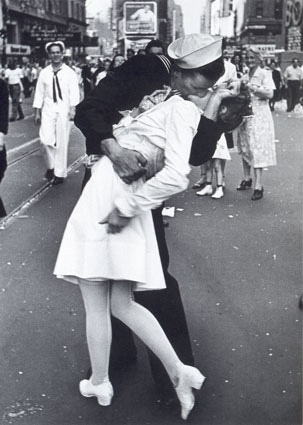
by Greg Prince on 18 March 2011 11:45 am 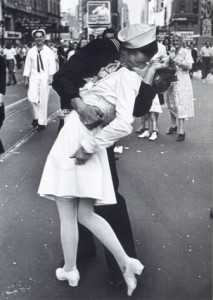 Kiss me! Luis Castillo has been released! By noon on Friday almost every man, woman and child in Metsopotamia was sure the war on second base was over. But most felt that they already lived through a sort of V-E-4 week, and across the great Roosevelt Avenue of Queens there was only a little cheering. In Woodside a housewife telephoned a newspaper: “Shall I go ahead and bake a pie for tomorrow?” In Astoria, N.Y., as in most of the Metropolitan Area’s towns and villages, it was another Friday and another washday. But on this Friday, Astoria got the news that four more second basemen were still in a battle.
In Manhattan, the most effervescent Metsopotamia borough, the carnival sights and sounds bubbled spontaneously, then subsided, then fizzed again. For a while on Friday, torn paper and ticker tape by the ton fluttered from skyscrapers, and the streets turned white. Half a million people clotted Times Square, sober and undemonstrative, waiting for somebody to start the fun. Nobody did.
The people milled for five hours, until in late afternoon Mayor Michael Bloomberg’s voice barked over a loudspeaker: “Go home … or return to your jobs.” Most of the people drifted away. The flags over Citi Field, half-staffed since the Wilpons began seeking minority partners, fluttered limply.
In the interest of accuracy, the above is a doctored description from Time magazine, May 1945, detailing America’s reaction to V-E Day as World War II neared an end. The news that’s just come down regarding the release of Luis Castillo may not be viewed in some quarters as quite so momentous, yet it does feel epic. One is tempted to note Castillo’s occupation of second base in Flushing lasted about as long as America’s involvement in the European Theatre, but let’s maintain some sense of proportion here.
Luis Castillo: not a scourge, not a villain, surely not a war criminal, just an overpaid, underperforming second baseman who (save for being in the right place at the right time with the rightest contract imaginable) couldn’t catch a break in New York. He certainly couldn’t catch a pop fly in the Bronx.
Luis Castillo: vouched for, practically up to the moment it was reported the Mets were surrendering to common sense, as a decent fellow who didn’t deserve to be disdained so vociferously. A former colleague of mine who grew up during World War II used to remind me that “hate is for Hitler.” Well…yeah. I didn’t hate Luis Castillo. I disliked his being signed to the MegaMillions Jackpot and waited for the day someone would redraw the roster so he wouldn’t be on it anymore. And now it is done.
When I first found out, I wanted to bolt straight into Times Square and kiss the first pretty nurse I saw, but then I remembered that (besides being married) the iconic image to which I refer occurred in response to V-J Day, three months after V-E Day. That was when the war was over in Japan, thus over for good. Here on V-E-4 Day, we can rejoice that Luis Castillo is no longer in the running to play second base for the New York Mets in 2011, but it’s not like we have achieved peace in our time, either.
Murphy…Emaus…Hernandez…Turner. Right now, it reads like a platoon of earnest grunts who are about to be ambushed by an enemy barrage of breaking balls out of the zone and sharp grounders in the hole.
Godspeed, boys. Godspeed.
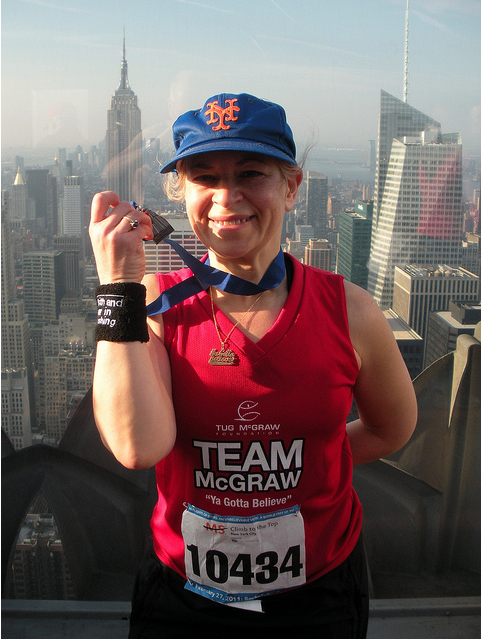
by Greg Prince on 17 March 2011 12:52 pm 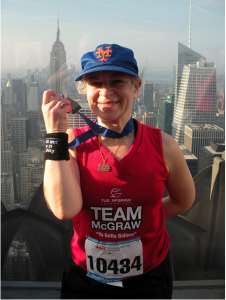 Sharon Chapman took the FAFIF wristband to the Top of the Rock (by stairs!) in February. March 17 seems like an ideal day to recall Met reliever extraordinaire Tug McGraw, who was known to enjoy every day like it was St. Patrick’s Day. Our friend Sharon Chapman has done a phenomenal job of keeping his memory alive by running in several events as a member of Team McGraw, raising funds for the Tug McGraw Foundation’s fight against brain cancer. She’ll be running that way again this season in Philadelphia (of all places) during the Broad Street Run on May 1. As well, Sharon will be sporting the same cap Tug wore from 1965 through 1974 and her Faith and Fear wristband, which makes us a little extra proud. Read more about the great work of the Tug McGraw Foundation here and donate whatever you can, if you can, here.
In the meantime, we wish Sharon the luck of the Irish and everybody else this weekend in the New York City Half Marathon.
by Jason Fry on 16 March 2011 1:20 am Depending on what you read, Johan Santana either remains on pace for a return in July or is actually already dead and the Mets are just covering it up.
Oliver Perez, meanwhile, continues to show unmistakable symptoms of being still around, a malady the Mets should probably cure.
Stillarounditis also continues to be exhibited by Luis Castillo, who hasn’t been medevac’d out of here mostly because no one else has shown any particular talent for playing second base. Not Daniel Murphy, the People’s Cherce despite an uncertain pedigree. Not Brad Emaus, who arrived with a Ricciardi stamp of approval but hasn’t hit. Not Luis Hernandez, appointed the starter by the New York Post but not apparently by Terry Collins. Not Jordany Valdespin, because the Mets appear to have learned their lesson about wasting a year of development, particularly for young players whose names are hell to spellcheck. Not Ruben Tejada, whose skills with the leather aren’t matched (yet) by utility with a length of ash. Not Justin Turner, Nick Evans’ed last year for no apparent reason.
If second base is the disease, we don’t seem to be getting any closer to the cure.
And heck, Willie Harris and Ike Davis have even been in traffic accidents.
As for the club’s financial health, don’t ask.
But lest you think Alderson & Co. have inherited not only bad contracts but also the grim little black cloud that’s followed the Mets around since September 2007, look west, at the other Florida coast.
This is what’s happened to the Phillies so far this spring:
Chase Utley — bad knee, is yet to appear in a spring-training game.
Domonic Brown — broken hamate bone (a bone that only exists to sideline baseball players), surgery, out for a month.
Brad Lidge — biceps tendinitis.
Placido Polanco — hyperextended elbow.
And Cliff Lee and Antonio Bastardo shut down their offseason regimens at certain points before camp.
None of this is desperate news for the Phillies just yet. Their pitching staff is still enviably deep and strong. And they battled a rash of injuries early in 2010 and came through it all just fine. But if what was happening in Clearwater was happening in Port St. Lucie, we’d be near-deaf from the lamentations and thuds of chest-beating, and getting ready to boo the trainers again.
Bad stuff happens to everybody. Even teams that aren’t the Mets.
by Greg Prince on 14 March 2011 7:07 pm “Mr. Met, can you come in for a minute?”
“Sure!”
“Have a seat.”
“What’s up?”
“Well, Mr. Met, you know we might be having some problems selling tickets this season.”
“Really? That sounds unlikely.”
“Believe it or not, Mr. Met, not everybody’s as big a Mets fan as you.”
“I don’t see why not. I love the Mets! They’re all I think about.”
“That’s why we love you, Mr. Met. And that’s why real Mets fans love you, too.”
“You’re too kind. How can I help with the ticket situation?”
“See, that’s so Mr. Met of you. I just mention there might be a problem, and you don’t wait to be asked what to do about it. That’s why we didn’t wait to ask.”
“Oh? Whad’dya do?”
“We created Mr. Met’s Landing.”
“Mr. Met’s Landing? Hey, that’s me! Tell me what that is!”
“It’s real nice. It’s Sections 338 and 339. In Left Field Landing. Except now it’s Mr. Met’s Landing — not the whole thing, just those two sections.”
“Gee, I’m honored!”
“Tickets will be ten bucks for kids, twenty bucks for adults — every game…except for the Marquee games.”
“Well, those are Marquee games.”
“Exactly what we were thinking. Then it’s $20 for kids, $30 for adults. But the rest of the time, it’s ten and twenty, plus service charges.”
“That’s pretty good of us!”
“We think so. We’ve never officially sold any ticket for less than $11 since we moved into Citi Field, and all of those were in Promenade, so it’s a good deal, we think.”
“I think so, too. I’m proud to have my name attached to that.”
“We thought you would. And you’ll probably want to know what exactly makes this Mr. Met’s Landing.”
“Now that you mention it, I was kind of curious.”
“”Mr. Met, you’re always thinking. A lot goes on in that head of yours.”
“All Mets, believe me. Now what do you need me to do?”
“You know that dedicated escalator we have for Left Field Landing?”
“The one that doesn’t stop anywhere else and often confuses people trying to get to Promenade?”
“Precisely. Your job will be to take a ride up there once a game and visit with everybody who’s seated in Mr. Met’s Landing.”
“That’s it? That’s not a job, that’s a treat! I love Mets fans!”
“Mr. Met, you’re an inspiration to everybody who works here.”
“I only wish I could visit every section during every game.”
“That’s the kind of team spirit we can always use more of around here.”
“Aw, shucks. I sometimes worry I don’t do enough for the Mets.”
“Mr. Met, if anything, we worry sometimes we ask you to do too much.”
“Me, too much — for the Mets? You’re kidding, right?”
“Well, we do ask a lot of you.”
“What do you ask that’s so much?”
“Let’s face it, Mr. Met, we deploy you every chance we get.”
“You do?”
“You haven’t noticed?”
“I’m Mr. Met. I’m happy to do whatever I’m asked. I’m happy in general.”
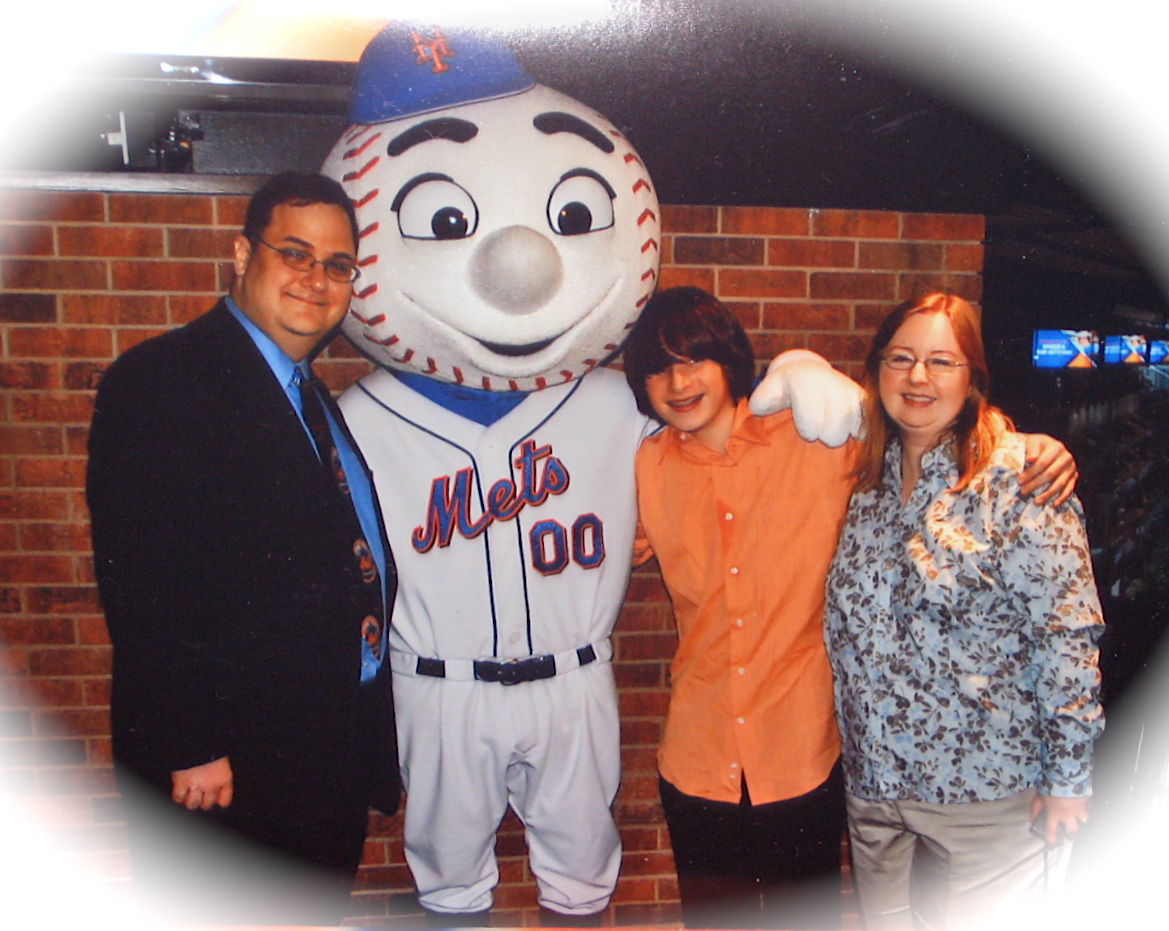
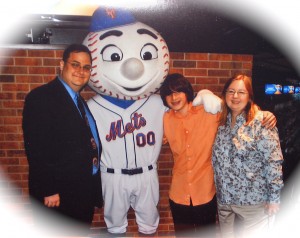 Mr. Met, doing some of his best work. “No one can accuse you of being a pessimist, Mr. Met, but our concern is that whenever we’re in a bind or stuck for an idea, we lean on you.”
“How so?”
“We’ve got you out and about inning after inning. We have you throwing t-shirts around. We have you leading ‘Take Me Out To The Ball Game’. We renamed the DynaMets Dash for you. We have you in commercials for Citi and Xerox. We’ve loaned you to ESPN. We send you to weddings and Bar Mitzvahs if there’s no game going on. We run you out for appearances at who knows how many internal functions. We license the absolute heck out of you. We’re making you our Opening Day bobblehead. And now we have this Mr. Met’s Landing.”
“And?”
“And. quite frankly, I wonder if we’re draining the brand equity out of you just a little.”
“Look, I don’t know what that is, but I do know I’m Mr. Met, I love the Mets, I love appearing on the Mets’ behalf and meeting the Mets fans…”
“Which we appreciate.”
“…and they seem to like meeting me.”
“That they do, Mr. Met.”
“Honestly, there was only one time I wasn’t quite sure I was being…what’s that word you used before?”
“Deployed?”
“That’s it — there was only one time I wasn’t quite sure I was being deployed appropriately.”
“I know what you’re going to say.”
“September 28, 2008.”
“Yeah, we feel bad about that, too.”
“I mean, I was flattered — totally, totally flattered — you let me remove the ‘1’ on the outfield wall on the last day at Shea. But there was something about it that didn’t feel right.”
“Say no more.”
“People have never not cheered me, but that day, I don’t know. Maybe it was the solemnity of the occasion and how it demanded more than a mascot, or maybe it was the tone-deaf blitheness of unveiling a corporate logo at such an emotional juncture or maybe everybody was just upset about our having lost the game and our chance to make the playoffs…”
“Mr. Met, really, we know now it wasn’t the best of platforms from which to display your immense charms and deep talents…”
“I never heard boos while I was on the field before. I didn’t like it at all. Gosh, I really got how Mel Rojas must have felt all those years ago.”
“We’re sorry about that, Mr. Met, we really are.”
“That one moment aside, though, I’m fine with everything. I want to be there for the Mets. I’m Mr. Met, after all.”
“Mr. Met, we’re glad you think so, because we’re mulling over some other situations where we think you can help the organization in a big way.”
“I’m all about helping the organization.”
“We knew you were, but we thought we should run a few of these by you before signing off on them.”
“That’s awfully nice of you, but don’t worry about it. I’m game.”
“So you wouldn’t mind, for example, making some Skype calls to help move ticket packages?”
“Skype? The thing where there’s video?”
“Yes.”
“Then it sounds like something I can do.”
“And if we’re a little shorthanded for middle relief now that Pedro Feliciano isn’t here anymore?”
“Look at me. I’m as longhanded as it gets.”
“You might have heard, too, that we can’t quite settle on a second baseman, so maybe if we can juggle your schedule a little…”
“You want me to play second?
“It’s a contingency, mind you. The union will have to agree, and we’ll have to work out the logistics…”
“Hmmm…if I can make my Mr. Met’s Landing visit during a half-inning when I wouldn’t be in the field and when I wouldn’t be due up at bat right away, I don’t see why not — if it’s for the team, of course I’ll do it.”
“Mr. Met! You’re a prince!”
“You can bat me ninth if you want. I don’t want to hurt anybody’s feelings.”
“They always say Mr. Met has a big head, but no ego. It’s true.”
“No ‘I’ in Mr. Met is my credo.”
“Well, technically there’s an ‘i’ in mister.”
“Huh?”
“You know, m-i-s-t…”
“Check my trademark. I’m Mr. Met. No ‘I.’”
“Oh, I hope I didn’t offend you.”
“No offense. I just prefer accuracy.”
“What about security?”
“I feel very secure.”
“No, I mean, how do you feel about providing security?”
“I’ll do whatever you want, but don’t you already have security? All those guys in the Phillie-colored golf shirts?”
“Well, this is a little different. See, compensation commitments being what they are, we may have to retain Oliver Perez on the roster, and we’re a little skittish about having him show his face unaccompanied.”
“I think I get it. You need me to provide a little cover for Ollie.”
“Mr. Met, you catch on faster than Ike Davis did at first base. Ollie’s a pretty fragile character — whereas you’re such a sturdy character. We’ve given you all kinds of makeovers over the years, and you’ve taken them like a champ. And we know if people see you next to Ollie, they wouldn’t dare boo…that much.”
“Unless we’re in the outfield unveiling corporate logos.”
“Right. And they wouldn’t attack him if he’s hanging out with you. We can even reimagine him as Mr. Met’s Special Pal.”
“Of course Ollie’s my special pal! All the Mets are my special pal!”
“Did I mention what a team player you are, Mr. Met?”
“For this team, I’ll be anything.”
“How about an enormous distraction?”
“What do you mean?”
“Well, you might have read we’re having a little legal trouble.”
“I don’t read much. I have to squint to make things out. Twitter really gives me a headache. But yeah, I heard something about lawsuits and finances and such.”
“Then you know we might need you more than ever in 2011.”
“You mean to be relentlessly cheerful and smiling and take Mets fans’ minds off everything that’s swirling around the team?”
“That, too, but we want you in on the meetings and hearings and anything else that comes up.”
“What do you mean?”
“Think about it, Mr. Met. The prosecutors, the mediators, the media, they’re going to be all over us. But if they see Mr. Met in court or at a press conference or wherever, who’s going to remember what they were so upset about?”
“Gosh, I don’t know if I can be that distracting.”
“You’re our best option, Mr. Met. Whaddaya say? Will you sit in on some meetings for the Mets?”
“For the Mets? Shoot, I’m Mr. Met! Hand me a stack of t-shirts and point me to the conference room!”
“Mr. Met, you really are the best. Just one more favor for now, though.”
“Anything.”
“Can you keep quiet about this?”
“Hey, who do you think you’re talking to? I’m Mr. Met!”
by Greg Prince on 11 March 2011 10:49 pm Chico Walker, Charlie Neal, Tom Veryzer, Rod Kanehl
Jerry Buchek, Shawn Gilbert, Elio Chacon
Kelvin Chapman, Billy Cowan, Bobby Klaus, Billy Almon
Keith Miller, Chuck Hiller, Jose Moreno
During the 1996 presidential election campaign, Richard Ben Cramer, who had written about Bob Dole with incredible depth and sensitivity, was asked to characterize the Republican nominee’s policy agenda if he theoretically took office. Given that Dole didn’t really go in for grand pronouncements, Cramer answered, “I think if you shot Dole up with truth serum and asked him what is a Dole presidency going to be about, you know what I think the answer would be?
“‘Ah, something’ll come up.’”
Well, entering the 2011 baseball campaign, the Mets’ second base situation couldn’t appear more doleful. It’s sad. It’s cheerless. It’s full of grief. And it carries the same odds of improving by Opening Day that Bob Dole does of ever cutting the ribbon on a presidential library. Yet, y’know what?
Something’ll come up. Somebody’ll be the starting second baseman three weeks from tonight. Whoever the winning candidate is, he won’t be ideal, but he won’t necessarily be unideal. He may even grow in the job.
This is not the freshly squeezed Florida OJ (optimism juice) spring should bring. I’m still clinging to a patina of hopefulness that the Mets will somehow be more glittering than ghastly in the coming months. And if they’re not, I can’t necessarily blame second base’s black hole. I spent several Marches of my adolescence convincing myself that a starting lineup three-quarters comprised of Stearns, Flynn, Taveras, Henderson, Mazzilli and Youngblood was such a sure thing that the uncertainties floating around a given vacant position couldn’t possibly hold us back. Somehow I don’t think it was the case of Maddox v. Mankowski that ruled against the 1980 Mets decisively blossoming when April rolled around.
So I’ll buy into the good cheer wrought by the presence of six fairly to very well-known quantities — Josh Thole, Ike Davis, Jose Reyes, David Wright, Jason Bay and Angel Pagan — and imagine that 33-year-old right fielder Carlos Beltran will return from experiencing “good” soreness before July and play great at a position he hasn’t played since he was 23. (Or that Lucas Duda in 2011 could be Ron Swoboda from 1965 cross-pollinated with Benny Agbayani c. 1999.)
And second base? Let the unideal chips fall where they may. Let the next verse of the Mets’ second base parody of “We Didn’t Start The Fire” be written. Given the stormfront through which our keystone stackers come and go, you’d have to imagine there’s already an extended mix on somebody’s iPod.
Jeff Kent, bad fit, spent four seasons in a snit
Kevin Collins, Heidemann, Leo Foster, Wigginton
Tatis, Relaford, Alvarado, Ashford
Matsui, Bart Shirley, can’t forget Ralph Milliard
As of March 10, we didn’t have a second baseman, per se. I counted as many as nine potential options for Opening Day and, just as crucially, all the days after. We had practically a minyan, though when you’re nearing double-digits for a single, solitary position, it probably means you don’t have a second baseman. Instead, you have a committee, and I’m pretty sure that’ll get you flagged for having too many men on the field.
I’ve never heard the “you can’t have too many pitchers” dictum applied to second base. You probably can have a surfeit of secondary sackers. What you can’t have, according to the rule book and common sense, is no second baseman.
I was growing antsy over the nine second basemen on March 10, and somebody in St. Lucie must have heard me, because now we’re down to seven, if minor league reassignments are to be believed. Gone from our midst is Jordany Valdespin, 23, whom I had gone into camp confusing within the blur of Kirk Nieuwenheis, Kai Gronauer and Jeurys Familia (eight names, counting firsts and lasts, and the only one I’d ever heard before was “Kirk”), and Ruben Tejada. I was developing a little fondness for Valdespin, especially after he blasted a three-run homer Thursday. Naturally, he is taken from me just as I was thinking of getting to know him.
And Tejada…boy, I liked him last year and hoped his inevitable demotion might get lost in the paperwork. I must have been watching a different Ruben Tejada than the rest of Metsopotamia in 2010, because I was penciling him in alongside Ike for the rest of the decade on the right side of the infield. Apparently I’ve been as blinded by his stellar defense (at a new position to him, no less) as I was once upon a time by Rey Ordoñez’s. It took me years to acknowledge Rey went from being not much of a hitter to never being much of a hitter. I had somehow convinced myself that by 1999 (60 RBIs at the bottom of a loaded lineup), Rey had gotten the hang of the other side of the ball.
He didn’t. But the new kid might. The first-year offensive numbers between shortstop Rey and second baseman Ruben were scarily similar. In a full 1996, Rey-Rey posted a .257 BA/.289 OBP/.303 SLG; his OPS+ was 60, or, as I’ve come to understand it, lousy. In half a 2010, Rube-Rube slashed a .213/.305/.282, making for a similarly lousy OPS+ of 62. Yet Tejada seems to have had a few things going for him that made his viability more than a figment of my second baseman-starved imagination.
• He picked up the pace in September (.284/.364/.433), highlighting his output with a new type of walkoff hit: The Ruben™, a heaping helping of hope sandwiched between two slices of despair.
• The Mets were six games over .500 in the 78 games he played (and, for what it’s worth, ten games under in the 84 he didn’t).
• He’s 21 and conceivably has a chance to improve with the hitting. Ordoñez was 25 his rookie year and pretty well settled into sub-mediocrity when not fielding.
Sadly, Sandy Alderson is ruining my Homegrown Infield dreamscape by sending Tejada to Buffalo to Gain Valuable Experience at shortstop, code for taking Jose Reyes’s spot when we trade him/don’t re-sign him. At least that’s what the prevailing winds suggest. Logically I’m not utterly averse to facing the future without Reyes, given that there may (may) be something to be said for cutting cords, moving on, proclaiming “we finished out of the money four consecutive years with you, we can invest our money elsewhere.” But emotionally, I hate it, hate it, hate it, mostly because Jose Reyes is Jose Reyes and a little because I really believe Ruben has a chance to clear away that second base stormfront.
But that’s another matter for another night.
Keppinger, Cairo, Anderson Hernandez
Doug Flynn, Phil Linz, Seton Hall’s John Valentin
Junior Noboa, New York’ll love Pecota
Marco Scutaro, that awful Jose Offerman
Rich Puig, Bob Heise, Gardenhire, Al Weis
Tommy Herr and Jay Bell, Alomar went straight to hell!
Seven other potential second basemen continue to prowl Digital Tradition J. White Stadium after the first eight plodding months of Spring Training, though we should probably eliminate Chin-lung Hu immediately, less because he’s more of a utility type and more because, as everybody knows, what — not Hu — is on second.
(Sorry. Had to do it once.)
OK, down to six, one of whom, I must confess, I completely forgot had been a second baseman. I knew there was something familiar about Willie Harris besides his being found guilty of Grand Theft Mets Win. Indeed, he was a fairly regular second baseman for the White Sox as recently as 2004 (more recently than Beltran was a cameo right fielder), and played 19 games there as a Nat in 2009. It’s not inconceivable Willie Harris might play second for us and stab somebody else’s sizzling ninth-inning liner.
But that’s not why we want him on our side. We want some outfield payback. We want Willie Harris to go Willie Harris on another team’s ass. Preferably all of them.
Luis Hernandez didn’t look at all terrible taking playing time away from Ruben Tejada last September (except that he was taking playing time away from Ruben Tejada). He hit more home runs than all other Met second basemen combined in 2010. Granted, it was two, but that second one — right after he fouled a ball off his foot and broke a bone in the process...it was a beaut’. He might have a better shot at winning the second base job in St. Lucie if he weren’t still rounding the bases in New York.
Justin Turner exists, I believe, to elicit a low buzz of outrage over how Justin Turner doesn’t get a legitimate chance, and then only if Nick Evans makes the team, thereby depriving us of gnashing for Nick. Somebody’s got to be the unproven quantity who seems worth the shot he’s simply not receiving. What makes Turner particularly worthy of filling this role (besides his five-year, 500-game line of .309/.373/.442 in the minors) is he has an option. An option, save for a spectacular Turner of events, is the same as a window seat on a late-March flight to Buffalo. In all other endeavors, we cherish having options. To Justin Turner, it’s merely gum on the soles of his shoes.
And oh yeah — what a raw deal that guy is getting!
Brad Emaus looms as a bargain-basement steal, except he’s more basement than bargain, thus far — and on the Mets, that’s saying something. The Mets’ front office would love, you’d figure, to confirm their brilliance by having plucked a starting second baseman in the Rule V draft, and Mets ownership would probably prefer 25 Rule V salaries constitute their payroll right about now. But Brad Emaus is thus far forgetting the first rule of Rule V draftees: prove your worth at some facet of the game.
This leaves us with the two guys it was probably going to come down to all along, the people’s choice, Daniel Murphy, and the pox on our soul, Luis Castillo; the relentless hard worker and the energy-saving appliance; the guy with the worst luck possible last year and the guy who stepped into a pile of cash four years ago.
In the land of the unideal, Murphy and Castillo are the princes of inadequacy. Daniel’s biggest problem as regards second base is he isn’t a second baseman. When they try to let him be a second baseman in the minors, he’s victimized by a dirty slide and he’s out for the season. When they try to let him be a second baseman in Spring Training, not a single double play grounder is hit while he’s in the field. The man whose name adorned so many green t-shirts in 2009 is the baseball equivalent of a no-leaf clover.
Luis Castillo has been a second baseman his entire career, and somewhere back in the earliest portions of it was plenty adequate. He was even rated in some quarters as stellar. His cleverness lies in having maintained his listing as a top-flight second baseman when Omar Minaya needed to replace a fallen Jose Valentin in the summer of 2007. Castillo wasn’t much help down the stretch, so you just had to thank Luis for giving it something approaching his best and move on.
But that’s not what Omar did. Perhaps haunted by the glut of itinerant second basemen who clogged Met rosters in the aftermath of Edgardo Alfonzo’s ill-advised shift to third base in 2002 (to make room for an alleged future Hall of Famer), the GM granted Castillo a lifetime services contract; fortunately, Commissioner Bud Selig voided it and a sympathetic arbitrator reduced Castillo’s Met term to four years. The first three years took a literal eternity to unfold (literally!), but the fourth year has arrived at last. Castillo is owed more than the Mets are worth. He gets paid no matter what he does in 2011, no matter where he does it.
Here’s the thing: Castillo, despite being almost completely useless in 2008 and across-the-board unimpressive in 2010 — and committing Bucknercide in the middle of his one decent Met year, 2009 — is a professional second baseman. It’s on his baseball card and everything. If he Rasputins his way onto the roster and into the lineup, we know what he’ll do.
He’ll suck, but he won’t suck nearly as badly as we assume he sucks. And that, in its own insidious way, will suck even more. Those of us who can’t stand to look at Luis Castillo in a Mets uniform — and that, I suspect, would be 110% of us — would be forced to admit that, no, Luis Castillo doesn’t bat .000, reach base at a .000 clip, slug to the tune of .000, and his Ultimate Zone Rating cannot be expressed as “I Don’t Care what his Ultimate Zone Rating is, Luis Castillo SUCKS!”
Whatever modest production, utility and element of pleasant surprise Luis Castillo is capable of providing the New York Mets in 2011 might not be worth being deprived of such certitude.
Daniel Murphy didn’t have a position when he had a position. That he can ease into starting at second, even if we allow for the notion that defense is overrated and that Murph can hit like it’s August 2008 again, seems well-meaning fantasy if not pure folly. Brad Emaus thus far isn’t worth the dollars we exchanged for Loonies at the First National Bank of Toronto. Justin Turner will have to go a long way to allow his option to be left untended. Willie Harris is an outfielder. Luis Hernandez is an afterthought. Chin-lung Hu isn’t much, really, let alone what the Mets need on second. Jordany Valdespin is relegated to a back field. Ruben Tejada is Reyes insurance. And, as long as we’re mentioning everyone under the St. Lucie sun, Reese Havens is an injury waiting to heal.
I’d still prefer any of them over Luis Castillo. But we’ve been saying something to that effect practically forever.
by Jason Fry on 9 March 2011 9:00 am Update: Here’s video. (And a Febreze ad, oh boy.)
The Mets, as various wags noted, manage to lose twice by one run yesterday, dropping split-squad decisions to the Astros and Nationals. The team continues to maintain a huffy silence amid no shortage of evidence that its owners are in dire financial difficulty. Luis Castillo and Oliver Perez are still on the roster. Frankie Rodriguez’s ridiculous vesting option continues to hover out there as a grim inevitability. Oh, and now Carlos Beltran isn’t going to play for the next four or five days because of tendinitis in his left knee — the one that wasn’t surgically repaired.
But he’s fine. Really he is.
Uh-huh. We all know Carlos Beltran is about as fine as the Wilpons are financially stable.
It wasn’t the greatest day to be a Mets fan — and yet, I enjoyed my one dip into fandom rather thoroughly.
I was typing away in my office with the TV on behind me and one earbud plugged in, halfheartedly monitoring the game except when the earbud would pull free of my apparently misshapen ear canal. Every so often I’d pick it up off the floor to listen to an at-bat, or turn to see what was going on there down in Port St. Lucie, shaking my head at the sight of the Mets wearing their regular-season white uniforms and the stadium people pumping up the get-psyched music and canned taunts like the sunbirds were at little Citi Field. (Seriously — why? It’s March in the middle of an anonymous tract of Florida scrub. Wear the blue mesh tops and let some old biddy play a rinky-dink organ. Spring training doesn’t need to be such a freaking production.)
Anyway, it was late in the afternoon, time for nameless players with uniform numbers in the 90s to get their licks, when something caught my eye. It was a big kid with a quiet stance at the plate. He was somehow familiar and I fumbled for the earbud, trying to figure out who he was. My knowledge of Mets prospects is somewhat less than encyclopedic, but I was pretty sure I’d seen him before.
WHAM!
The kid put a perfect swing on a ball thrown by a National with the you-need-a-nickname-honey moniker of Atahualpa Severino. (I will now declare with some confidence that this is the lone player to share a name with our WordPress theme.) Balls fly out to left in Port St. Lucie anyway, but this one might have been out even without the jet stream. It was socked, and I applauded quietly but happily as No. Ninetysomething cruised around the bases trying not to look as happy as he was.
And then they identified him, and I remembered: It was Cory Vaughn.
Last summer Vaughn was the star slugger for the Brooklyn Cyclones, and Joshua and Emily and I saw him several times down on Coney Island — a big kid with a cannon arm and the kind of bat that produces a sound that makes you look up at the hot dog stand, asking “Who was that?”
Vaughn isn’t a can’t-miss prospect, largely because there’s too much swing-and-miss in his game. But there’s potential there, and the kind of pedigree (Greg Vaughn is his dad) that will ensure he gets every possible shot to climb the minor-league ladder.
Will Cory Vaughn patrol the outfield at Citi Field one day? I have no idea — he might not make the majors in any capacity. But not so long ago, he was warming up in the Coney Island outfield while kids from Bay Ridge and Mill Basin competed in dizzy-bat races in front of the dugouts. And yesterday, even if it was just because half the team was on a bus somewhere, there he was wearing a Mets uniform, putting a gorgeous swing on a ball and touching them all.
Such moments are the raw material of spring-training dreams and brief office reveries, and the antidote to thoughts about clawback suits and contract options and tendinitis. Thanks, kid — I needed that. We all did.
by Greg Prince on 8 March 2011 10:32 pm
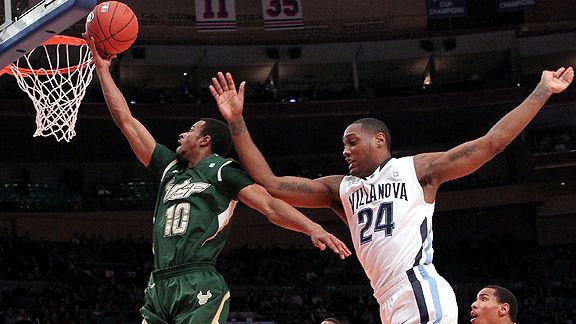
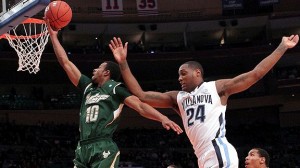 Anthony Crater, No. 10, presumably in tribute to Rusty Staub. My alma mater won’t see the Big Dance. It will be lucky to see a square dance. I’m guessing that by this time tomorrow, all they’ll be seeing is the plane home to Tampa. But by gum, after trailing Villanova by 16 at the half on the opening night of the Big East tournament, the University of South Florida Bulls stampeded back and, with 5.1 seconds left, took a one-point lead, thanks to the clutchest of layups from No. 10 (above), Anthony Crater.
We held on from there and won. USF won, that is. I realize for most if not all of you, “we” doesn’t apply to this institution. It’s my school and, technically, it hasn’t been my school since Rusty Staub was diving for sinking fly balls. But indulge me for a moment.
I had given up at halftime. I believe I e-mailed a friend the following message when I tracked down the midpoint score from a remote location:
USF down by 16 at half. Glad i’m not at msg. So no suspense there.
Then I made use of my spiffy little electronic device and saw they/we were down by 8. Then by 4. Then I raced to a television (the Bulls on television…what a conference!) and saw them/us commit two horrific turnovers in the final two minutes and pull it out anyway.
I’m a lousy college basketball prognosticator, I’ll happily admit. I pulled a VILLANOVA DEFEATS TRUMAN, and couldn’t be happier about it.
I’m a lousy college basketball prognosticator probably because I hadn’t intently watched a college basketball game in approximately 52 weeks. I attended my first college basketball game in a Staub’s age a year ago when USF played DePaul at the Garden in the 2010 Big East tourney’s opener. We won that afternoon. Stephanie and I were so ostentatious in our school spirit that we were picked to be the fans who moved down from so-so seats to closer seats. Also, we were the only ones in our section. Or our tier. At a quarter to twelve in the morning for a game involving low-seeded schools from Tampa and Chicago, you’re going to stand out in New York when you’re sitting alone.
I was charged up by our win last year. We were actually pretty good — good enough for me to notice we were in the Big East tournament (to which they nowadays invite everybody, I learned). I was so stoked I made a point of watching our second game on ESPN the next day, which was a rather predictable loss to Georgetown.
And I’m pretty sure I hadn’t watched any college basketball from last March until this March, unless catching a glimpse while channel-changing counts. I watched the last few minutes of the Bulls getting their tail kicked by St. John’s the other night on SNY, but really I was just waiting for Mets highlights to come on.
So I don’t know anything about college basketball at large. I really don’t. But I know we’re still in this tournament. And I know giving up never pays in sports. I should’ve remembered that from who knows how many happy recaps I’ve been fortunate enough to absorb, but it’s always nice to get a reminder about that.
Oh, and this — this, too, is nice. It’s from the AP writeup of tonight’s game:
The Wildcats squandered a 16-point halftime lead, completing their collapse when Wayns threw away an inbound pass with 22.8 seconds left that Crater converted into a go-ahead layup.
Why is that nice? Because somebody else collapsed for a change. A team I was rooting against for a couple of hours did the collapsing, not mine. That it was a team based in Philadelphia…well, that in basketball is what they call the bonus situation.
At least I think it is.
by Greg Prince on 8 March 2011 12:54 pm For the longest time, I adored our cats Hozzie and Avery, yet had a hard time thinking of them as “our cats”. “Our cats” meant Bernie and Casey, the cats Stephanie and I had before Hozzie and Avery. As cats will do (though nobody warns you when you plunge headfirst into petdom), Bernie and Casey eventually moved on to partake of that great bowl of Iams in the sky. Thus, Hozzie and Avery were the second generation for us. They were Cats 2.0. Their bells and whistles were impressive, and individually I fell in love with each of them from the word go (or, more accurately, from the words “hey, get off that thing!”)…but how could they be “our cats” when Bernie and Casey were that?
As I got used to the new kits in town, and as they got used to each other, I began to buy into these cats as “our cats”. I was all but there, in fact, when we got our first scanner. When the scanner went in, the old photo albums came out and Stephanie began adding familiar images to our computer.
That meant dozens of pictures of Bernie and Casey. On some weird level, it was like they were back in our lives again. How could they not be? They were right there on the screen. And if Bernie and Casey had (digitally) returned as “our cats,” what did that mean to Hozzie and Avery?
It meant they were still wonderful cats, and I loved them dearly, but it took me a little longer to totally and completely accept that they, and nobody else, were Our Cats.
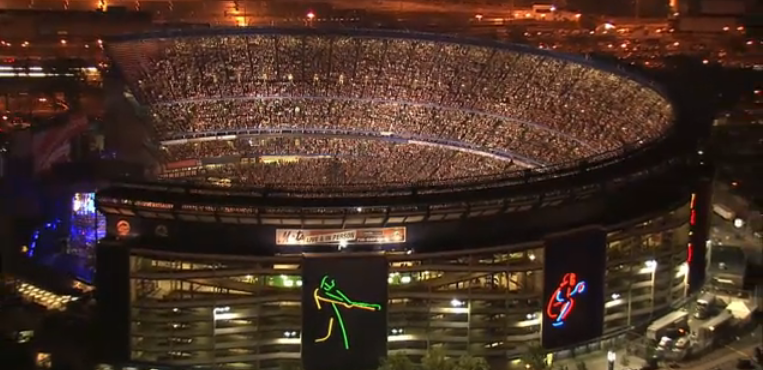
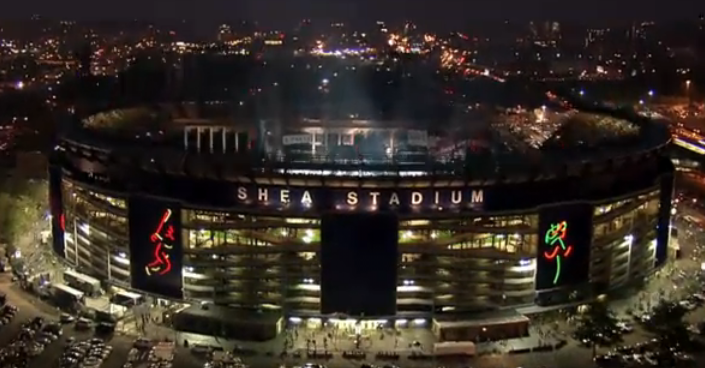
I bring this up because last night I watched PBS’s Great Performances presentation of Billy Joel’s final Shea Stadium concert, which is out today on DVD (makes a great accompaniment to the excellent documentary The Last Play at Shea). As I watched, I was overcome by how quickly Shea Stadium came back to life. It was alive again in HD, and I was sure that as soon as Billy Joel told everybody not to take any shit from anybody that they’d strike the stage, clear the seats and get the place ready for when the Mets come home to face the Phillies and Cardinals.
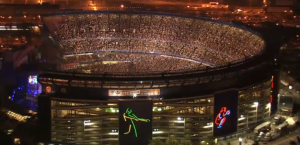 When's the next homestand? Shea Stadium, on TV, became my ballpark again. Not in the distant past, but right now. The Mets were playing at Shea again. I was sure of it. Shea was my ballpark.
Which left Citi Field as an oddly shaped parking structure beyond the outfield fence.
As the third season of the new place approaches, I thought I’d mostly gotten over all that. I held the torch aloft for much of the first two years there was no more Shea, but I’d settled into Citi. I’d come to think of it lately as where I go when it’s not winter. Maybe not in my subconscious (I’ve had several Shea dreams in winter; in one B.J. Upton is beating us a playoff game), and maybe not automatically (one trip on the 7 line in February had me anticipating the greeting of neon men), but mostly.
True, when SNY would report on the Mets’ efforts to sign the heretofore sidelined Chrises — Capuano and Young — I was extra excited because the only footage they had of them facing the Mets was from before 2009…when they pitched at Shea. But when the network aired stories about incumbent Mets, and Citi Field served as backdrop, it felt natural enough. When I began to look forward to the Home Opener and the days and nights that will follow in 2011, I instantly went to Citi Field in my expectations.
I was all but there until last night. Then, with Billy tickling his ivories and serenading that New York state of mind, I was back at Shea. All my post-2008 protestations bubbled to the surface.
C’mon, Mets, just do it.
Just bring back Shea as it was and we’ll call it even.
Citi Field? No problem. We can use it for outfield drills and snacks.
C’mon, Mets…
I think that’s what I missed about Shea last night, that it was so wrapped up in the identity of the Mets, and vice-versa. That’s what I saw when Billy’s camera crew filmed the wide shots. I see Shea and I see the Mets at their best and most vital. I see those multiple colors and think about its singular purpose: keeping us amazed every time we walked into that place. There were no readily accessible amenities of which to speak at Shea, and until somebody invented them for other parks, it never occurred to me we needed them.
There was baseball. There was the Mets. That was it. There may not have been all that many 1969s, 1986s or 1999s, but it always felt like one might break out for a couple of innings. That kept us focused. And that kept us going.
It doesn’t feel that way at Citi Field, most likely because there is no in-house template for indefatigable enthusiasm, but also because the place wasn’t built to nurture it. It was built to sell a better burger and a $35 t-shirt. It was built to offer access to amenities. Amenities are nice. Shake Shack, et al are swell (and swell is better than swill), but damn it, the place doesn’t feel like Shea.
And no, that’s not a good thing, because it doesn’t feel like the Mets. The Mets don’t truly feel like the Mets since Shea. Perhaps they will this year. Perhaps they will feel both comfortably reassuring and new and improved once the financial clouds clear, once the state of ownership’s composition is resolved and once the front office’s wits have a chance to work their rational magic. I believe that can happen even if I don’t necessarily believe it will happen immediately.
Until then, there’s Citi Field, which I’ve settled into and appreciate in my own way more than you’d think given my recurrent bursts of longing for what was. I know what was isn’t anymore. I get it and I’m as fine with that as I can be. Yet when what was (as filmed not three years ago) bursts onto my television in stunning orange and blue and green and red, I find it impossible to not be moved to wish it was still there.
There is this, however: There is the reality that once the novelty of scanned cat photos wore off and we amused ourselves with different computer wallpaper, the aura of Bernie and Casey receded as a going fixation. Still loved them, still revered them, will always cherish them, but they mostly curled up and napped in our past. Hozzie and Avery really did become Our Cats. They are totally Our Cats.
I know that for sure because Stephanie surprised me last week and changed our wallpaper to a classic pose of Bernie and Casey sharing a chair in our old apartment. I loved seeing it. I love seeing it now, as a matter of fact. But for the briefest of instances, I looked at Bernie and Casey and felt the slightest of disappointment I wasn’t looking Hozzie and Avery, because, instinctively, those are Our Cats now.
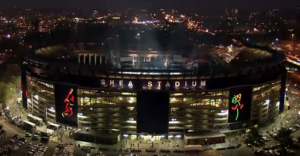 What an interesting parking facility back there. Something like that will happen for Citi Field someday. Someday I’ll have the TV on and hear something about the “home of the Mets,” and look up and it will be a shot of Shea, and I’ll be thrown off just a bit because I was expecting, even hoping to see what I now consider the home of the Mets.
It will happen. It just hasn’t happened yet.
Cap tip to Mets By The Numbers for reintroducing the world to Iron Duke and “We Want A Hit”.
by Greg Prince on 4 March 2011 9:43 pm The Mets’ 2011 promotional schedule seeped out quietly last Saturday morning, its highlights embedded in a press release. Given that I look forward to knowing what swag the Mets will be introducing into the Metsopotamian ecosystem, I’d prefer a midweek prime time press conference live from the East Room of the White House and expect it covered on every network. Still, as far as I’m concerned, anytime is a good time to announce the coming of Magnetic Schedule Day, Lunch Box Day, Build-A-Bear Workshop Day and other days devoted to the distribution of Mets goodies.
Except the Mets aren’t having Magnetic Schedule Day, Lunch Box Day and Build-A-Bear Workshop Day…in fact, they’re cutting back on the goodies in general.
Thankfully, Collector’s Cup Night remains in place.
It took the Mets longer than I’d like to say what they’d be giving away and when we could potentially sync it to our ticket plans. Not their ticket plans, but ours. The 5-, 11- and 17-Game Flex Packs may offer flexual healing to some (each includes a bonus game), but others just want a series of what Randy at The Apple invented last month: the 1-Game Flex Pack. The Mets didn’t announce until the Grapefruit League schedule was underway that on March 14 you could buy one ticket to one game.
And that they’d be giving away in the course of the season MORE THAN 300,000 ITEMS!
You heard right…MORE THAN 300,000 ITEMS!
The 2011 Mets: Quantity, If Not Quality.
But not so fast there with the quantity, because even though the Mets’ release emphasized the giving away of MORE THAN 300,000 ITEMS! the truth is that’s a big comedown from the very recent past of 2010 and 2009, when there were nine more promotional dates apiece, thus more promotional items handed out (or sitting in boxes awaiting a loving Mets fan home). Last year’s release touted MORE THAN 400,000 ITEMS! In 2008, in a different stadium, it was MORE THAN 500,000 ITEMS!
I have to confess I hadn’t before noticed the Mets counted everything they were giving away. Then again, before this spring, there weren’t far bigger numbers being thrown around attached to stories regarding loans and lawsuits. You probably don’t notice notations about total swaggage if stories aren’t appearing every day questioning your team’s ability to remain a viable big-market entity.
Yet you look at this promotional schedule and you can’t help but wonder if the Mets are heading if not geographically but figuratively to Pittsburgh…though that might not be fair.
The Pirates give out much better stuff. So will most every team whose Web site I checked. However many hundreds of thousands of pieces will be moving doesn’t seem to be an issue for those clubs.
The 2011 Mets: Like Nobody Else.
What worries me as a fan of the New York Mets as an institution is not that they’ve scheduled far fewer giveaway dates (pending in-season additions, a couple of which usually surface) but that far fewer giveaways indicates fewer sponsors are dying to get in on the action of promoting the Mets. Not that visiting Citi Field isn’t like living inside a commercial already, but we’ve come to accept that there’s no such thing as “Helmet Day” per se anymore, that these babies are sponsored, and that somebody’s footing the bill because they see it as good business.
It seems fewer companies are looking to get their feet wet with Mets giveaways this season, or dip their toes too deeply in the Mets’ troubled waters, contaminated as their image might be by the circling financial sharks. And if such giveaway merchandise isn’t sponsored, it won’t be given away nor have a day to call its own.
The following brands were title sponsors to promotional dates in 2010 and will be again in 2011:
Budweiser, Caesars, Chevrolet, Citi, Delta, Dunkin’, Geico, Gold’s, Harrah’s, Lincoln, Nathan’s, Premio.
The following brands were title sponsors to promotional dates in 2010, but — according to the promotional schedule on mets.com — won’t be in 2011:
Build-A-Bear, EmblemHealth, Goya, HealthPlus, Natural Balance, Pepsi, Subway, Toyota, United Healthcare, Verizon.
(Goya, HealthPlus and Natural Balance each sponsored events in 2010; the others sponsored merchandise.)
Only one promotional sponsor listed for 2011, Parts Authority, wasn’t a promotional sponsor in 2010. That represents, as of now, a net loss of nine promotional sponsors since last season.
Several of those companies not plastering logos on items remain Mets sponsors for the presumable long haul. There’s still a Pepsi Porch. There is still, as far as I know, a Verizon Studio. I haven’t heard that there won’t be a Subway sign off which Daniel Murphy can scrape a questionable home run. Citi Field will likely still feel like the inside of a commercial. But the promotional schedule’s paucity (“300,000” notwithstanding) indicates a palpable inching away from the Mets in some sense. And other than Parts Authority, nobody new has stepped up to fill the giveaway void.
Is it really a void, though? Will we be, if you’ll excuse the laughable expression, suffering because we’ll have fewer opportunities to purchase tickets that will entitle us to a thing with a Mets — and a sponsor — logo? I don’t think I’ve ever had my ticket scanned at Citi Field and felt deprived because no giveaway was scheduled that day (being Fan No. 25,001 is a different matter). I’d rather there be a handful of really good ones than a load of “whatever” any year.
Are we getting closer to that ideal? Let’s take a look.
In 2010, the following was given out, one to a customer, generally to the first 25,000 customers, and the rough equivalent of the same will be given out again in 2011:
• An Opening Day premium
• A ski cap
• A plastic cup
• A gift card for use at a coffee & donuts chain
• A sports bag
• A beach towel
• Two caps
• A player bobblehead
• A drawstring bag
• A koozie (like a sweater for your beer container)
• A t-shirt
 Some of the names of the items — “winter hat” has replaced “ski cap” — have changed. No doubt colors, designs and themes are up for grabs, too. Last year there was a Mets Hall of Fame cap; this year there is no Hall of Fame Day, but there is a “Cap and Hot Dog Eating Contest,” which sounds like a lot to digest (do you have to eat your cap before or after downing your frank?) — but we’ll assume two caps will be given away. There’s no Home Run Apple Bank this Opening Day, but there will be a Mr. Met bobblehead, so the “wow!” factor is a welcome wash. A Jose Reyes banner (after the trading deadline, FYI) replaces the Johan Santana koozie as accompaniment to Fiesta Latina. Some of the names of the items — “winter hat” has replaced “ski cap” — have changed. No doubt colors, designs and themes are up for grabs, too. Last year there was a Mets Hall of Fame cap; this year there is no Hall of Fame Day, but there is a “Cap and Hot Dog Eating Contest,” which sounds like a lot to digest (do you have to eat your cap before or after downing your frank?) — but we’ll assume two caps will be given away. There’s no Home Run Apple Bank this Opening Day, but there will be a Mr. Met bobblehead, so the “wow!” factor is a welcome wash. A Jose Reyes banner (after the trading deadline, FYI) replaces the Johan Santana koozie as accompaniment to Fiesta Latina.
New for 2011 is a tote bag, previously a hardy perennial, back after a one-year hiatus.
Gone from 2010? No magnetic schedule for the first time since 1996; no scarf; no water bottle; no travel mug; no Build-A-Bear; no blanket, no umbrella…and no Wright Foam Finger, though that was an All-Star add-on to get us all to vote our third baseman onto the National League squad.
As far as sponsored events — besides the Hall of Fame commencing a new gap between inductions — there is no Senior Stroll on the schedule and no Hispanic Heritage Night (also, no Pepsi Refresh Night, though that was a late addition last year). Bark in the Park will be back, but without a pet food sponsor.
Pyrotechnics Night, an unsponsored blast in 2010, is not scheduled to explode in 2011. It’s not listed, at any rate.
Cap Trade, a Subway Series tradition, returns, as does the companion ritual of fans making up addresses and phone numbers in order to nab one of the 5,000 Mets caps Chevy will trade you in exchange for your contact information (along with, theoretically, an old cap, but they’re not sticklers about that part). I’ve always assumed the idealized spirit of Cap Trade taking place when the Mets play their crosstown rivals imagines people who don’t usually attend Mets games showing up to Shea/Citi and becoming so moved by the occasion and atmosphere that they will switch allegiances on the spot. “Take this horrid piece of junk with its loathsome NY and give me that shiny new number with the splendid NY on it!”
Great symbolism. Betting it doesn’t actually happen.
My 2011 takeaway on the substance of the 2011 giveaways:
• I look forward to Ike Davis Bobblehead Night in July and sincerely hope Ike cuts a less bland ceramic figure than Jason Bay did last July.
• It’s great they’re enhancing Opening Day with Mr. Met. Opening Day would be plenty on its own.
• I’m sorry they’re skipping the Hall this year. It took so long to revive, and there are dozens of worthy candidates populating Ultimate Mets Database just clamoring for induction.
• My fridge will miss the magnetic schedule. 2010 still graces its side and I’d like it to shift into the Alderson/Collins Era, lest Jerry Manuel wander into my kitchen and insert Mike Hessman for defense.
The rest of the reduced slate could be swell or it could be lousy. When the Mets make the images available, I might be tempted to buy a ticket I wasn’t otherwise planning on purchasing. For example, if the towel features a Sistine Chapel-like rendering of the ball going through Buckner’s legs, I’m totally there on Towel Night. At the moment, all I see is the word “Towel” on a night the Mets are playing the Phillies. I hope the subliminal message doesn’t concerning throwing in the towel at the mere sight of Cliff Lee.
That there’s less slated than in past years bothers me from a State of the Franchise perspective more than a personal enrichment view. Last year’s blue and orange scarf will survive another windy April just fine, thank you. They can keep their Collector’s Cups and Cap Eating Contest. Give me a 1986 tribute (if not on the scale of what they did in 2006, which was only five years ago, then at least a little something with heart). Give me a salute to an icon along the lines of what the Cardinals are doing for Red Schoendienst and Stan Musial, the way the Dodgers are doing something for Fernando Valenzuela, the way the Giants are celebrating Willie Mays, the way the Royals are acknowledging Buck O’Neil and Willie Wilson…the way the ever-imaginitive Athletics are having not just Rickey Henderson Bobblehead Day but MC Hammer Bobblehead Day.
U can’t touch that. But U can try.
Props to the Mets for rolling out a raft of town and village nights and health awareness days and ethnic heritage nights and focused-interest theme dates every year. The Mets deserve credit for being aggressively community-minded and for supporting dozens of fine causes annually. Yay, as ever, to the Mr. Met Dash. Yay, even more, to 81 baseball games a year and winning as many of those as possible.
But would it kill them to produce a John Milner bobblehead? It’s not like the A’s are the only ones who had a Hammer.
Do a few fun and clever giveaways and keep your…I won’t call it crap, because I’d gladly accept it, but don’t try to impress me with sheer volume — or making less sheer volume sound like more sheer volume than it really is.
I’d probably press the point further, but I actually feel a little guilty asking the Mets to go the extra 90 feet for me, the customer, considering the trouble ownership is trying to ward off. When Daddy’s laid off at the plant on December 16, you don’t hand him your Christmas list the minute he arrives home, y’know? The Mets aren’t Daddy and we’re not the kids, but I do worry for their well-being. I’d like to think they’re doing their best by us given the circumstances.
That I find myself thinking of the big-market, large-payroll Mets who play in a still fresh ballpark carved by caste in these terms saddens me quite a bit. They are in a big market and they do have a large payroll and I don’t expect the Acela Club windows to be boarded up, but that feels like no more than a matter of keeping up appearances. I didn’t like the sense they looked down their nose on me as a non-fancy customer, but it never occurred to me they would lack the resources to match their high-end attitude. It makes me want to tell them, “T-shirt night? You don’t have to give ME a t-shirt. I have plenty of t-shirts. Can I bring YOU a t-shirt? I’ve got a VAUGHN 42 around here somewhere I’m not using…”
The 2011 Mets:
Maybe It’s Not That Dire Yet.
Or maybe it is.
Jason and I look in-depth at how the Mets can burnish their 50-year legacy in the just-released 2011 Amazin’ Avenue Annual. That’s just one of about 50 reasons to read the damn thing. Order it here. The 2011 Maple Street Press Mets Annual also includes contributions from each of us and a slew of really knowledgeable Mets writers. Order that one here. Both should be available at retail in the New York area as well, but don’t put off getting a copy of each. They are incredibly well worth your time and money.
by Jason Fry on 4 March 2011 9:24 am A season with 108 wins and a World Series title deserves every moment in the sun we can get it. Continuing/completing our series of guest posts at MSG.com, here’s my appreciation of Gary Carter and Keith Hernandez, two very different men who were equally important to that great team.
|
|