Faith and Fear in Flushing made its debut on Feb. 16, 2005, the brainchild of two longtime friends and lifelong Met fans.
Greg Prince discovered the Mets when he was 6, during the magical summer of 1969. He is a Long Island-based writer, editor and communications consultant. Contact him here.
Jason Fry is a Brooklyn writer whose first memories include his mom leaping up and down cheering for Rusty Staub. Check out his other writing here.
Got something to say? Leave a comment, or email us at faithandfear@gmail.com. (Sorry, but we have no interest in ads, sponsored content or guest posts.)
Always make the difference between optimism and hope. I’m not an optimist at all — I’m a prisoner of hope. I don’t believe in optimism. That’s too thin. —Dr. Cornel West, Real Time With Bill Maher, February 11, 2011
I hope Carlos Beltran is feeling 29 again. That Jose Reyes is all revved up to go at 27 and then doesn’t go anywhere. That David Wright swings free and easy, his shoulders and his mind less burdened than they’ve been in recent seasons.
I hope Daniel Murphy stitches together his several partial skills and creates a versatile monster. That Brad Emaus is the steal of the century at second. That the inevitable “Hu?” jokes give way to back page headlines along the lines of THAT’S HU!
I hope Angel Pagan and R.A. Dickey are not at all surprising in 2011, just more of what they were in 2010. That Mike Pelfrey’s bad outings are aberrations rather than indicators. That Jon Niese extends his June form into September.
I hope Francisco Rodriguez earns his way back to everyone’s trust off and on the field. That Johan Santana proves a medical marvel. That the National League Comeback Player of the Year is named Chris and that the award is split two ways.
I hope Nick Evans’s lack of options is balanced by a bounty of base hits. That Josh Thole and Ike Davis are the youngest old pros imaginable. That Oliver Perez inspires a round or two of stories about how “maybe Omar Minaya knew something after all.”
I hope Luis Castillo catches on with Oakland or Seattle. That Bobby Parnell is both a year older and wiser. That Jenrry Mejia’s next appearance, whenever it may be, is universally described as “polished”.
I hope Terry Collins is as ready as he says he is. That Luis Hernandez’s next home run is pain-free. That somebody can come in and get a lefty out as needed.
I hope Jason Bay hits this year like he hustled last year. That Sandy Alderson has cause to buy in July. That somebody to whom I’ve given no thought in mid-February is one of my favorite Mets come mid-season.
I don’t know that I’m all that optimistic about the 2011 Mets. But by god, on this day of all days, I am brimming with hope.
As more and more Mets crowd into Port St. Lucie just long enough for it to be exciting before it becomes amazingly tedious, here’s what I don’t get: The Mets have four — four! — alliterative pitchers in camp, and none of them has been issued an alliterative uniform number.
So Sandy Alderson goes to the trouble of assembling a quartet of alliterative pitchers and then Kevin Kierst, the Mets’ new and alliterative clubhouse manager, doesn’t think to clothe them in repeating numbers.
Rookie mistake. Or a communications breakdown. It’s too bad, whatever it is. The Mets need to be known for something positive on the off chance their wins aren’t frequent and their lawsuits aren’t rare. Alliteration can still be their ticket to ride if the numbers get switched appropriately. In a year when nobody dares to pronounce The Magic Is Back or that Baseball Like It Oughta Be is in effect, “Bring Your Kids To See Our Alliterative Athletes” looms as a splendid, no-cost marketing concept. Besides, check the calendar: ’11 is as alliterative a year as we’re going to have until 2020.
Let’s see who’s in the numbers that could conceivably belong to the pitchers who should be known as C.C., T.T., B.B. and the other B.B.
11: Ruben Tejada. He had it last season. He won’t have it this season, at least not right away. Tejada showed plenty of second base glove and a little bit of bat in 2010, but his youth (and perhaps a nefarious plot to unload Jose Reyes) will have him exiled to Buffalo this April where he’ll refamiliarize himself with shortstop. Wear a coat, kid. I hear it gets chilly up there. 11 may be the Opening Day temperature at Buffalo.
22: Willie Harris. Like this whole Willie Harris on the Mets thing isn’t some kind of counterintelligence plot undertaken by the Phillies. Let’s face it — Harris is just here to gather information on where to best play Mets hitters when he ultimately signs with Philadelphia. And by “best,” I mean how far away he can position himself as a defensive replacement for Raul Ibañez in order to make yet another soul-crushing circus catch to kill yet another ninth-inning comeback. Willie Harris on the Mets…yeah, right. Switch with Boyer, you phony.
33: Taylor Buchholz. Except for Taylor and his more accomplished cousin Clay, I don’t know that I’ve ever come across internal alliterative h’s on a baseball uniform. That alone is impressive, but not enough so that he couldn’t trade with Taylor Tankersley. Then Buchholz must pitch real well, for 47 needs an overwhelming presence to rid itself of whatever residual Gl@v!nism still lingers between the 4 and the 7. Hisanori Takahashi did a fine job last year, but his aura has faded as quickly as Casey Fossum’s (who will be wandering around the minor league complex this spring for some unknown reason).
44: Jason Bay. For a man who slammed his face into the Dodger Stadium fence and coped with a concussion for two months thereafter, the last thing we need is for him to see double. Bay starred in Pittsburgh as No. 38. Jason and Chris Capuano can switch at once.
55:Chris Young. I assumed he was 55 in his previous stops on the assumption that no veteran just winds up with 55 on a new team without a history with it. Orel Hershiser had been 55. Shawn Estes had been 55. I was going to bow to Chris Young’s veteran’s prerogative, but he’s never been 55 in the majors before, so the hell with that now. You want a new number? You be 27, and give 55 to Boof Bonser. Boof Bonser among all the alliterative pitchers cries out to be in an alliterative number (or annumerals). Two hashtags (BONSER ##) would be even better, but let’s not get carried away just yet. It’s only February.
OK, so now we are placing Blaine Boyer in 22, Taylor Tankersley in 33, Chris Capuano in 44 and Boof Bonser in 55.
There. You’re welcome.
As long as we’re fixing things in this vein, let’s move D.J. Carrasco and his internal double r’s (which are more noticeable than Harris’s) from 77 to 66. How can you have a “D.J.” and not align him with the frequency of your flagship radio station? For crissake, the Mets haven’t been on WABC-77 AM since 1963.
A real visionary would change the name on D.J.’s back from CARRASCO to WFAN and you’d open all kinds of potential revenue streams with WFAN 66 coming into pitch. (It didn’t work when Ted Turner tried to send Andy Messersmith to the mound as CHANNEL 17 on the old WTBS, but Bud Selig seems more amenable to playing ball.) This would click that much more perfectly if WFAN actually had DJs instead of sports talk hosts. They certainly have my blessing to go all-music every weekday afternoon at 1 o’clock.
In case you’ve forgotten (or somehow lived this long without ever knowing it), the Mets have already had one D.J., two-sport athlete D.J. Dozier, in 1992. He wore No. 7 and batted .191, going 9-for-47 and proving he was better suited for football than baseball, let alone radio.
What kind of D.J. can’t put together a Top Ten hits list?
This isn’t a piece on the Mets and Bernie Madoff, but as explained somewhere below, it was inspired by the current mishegas surrounding those unfortunately linked bedfellows. There is no literal tie between the 2011 mess and what it brought to mind — it’s just that something occurred to me in the wake of what’s been going on and I decided to write about it.
That established, we return now to the pre-apocalyptic final days of Spring Training 1991. The Mets had just completed a string of seven consecutive winning seasons. Thing is, they didn’t know they’d completed it. None of us necessarily did. Our team had averaged 95 wins per annum from 1984 through 1990. We were conditioned by perennial success to believe a similar total would pile up next to the Mets’ name in the standings in ’91, then ’92 and then indefinitely. Winning many more baseball games than they lost is simply what the New York Mets did every year.
If visible storm clouds weren’t yet gathering over Port St. Lucie, one’s Met radar might have detected a change in the weather was in the offing. This, remember, was the spring that followed the winter in which Darryl Strawberry made good on his recurring threats to leave New York for Los Angeles. Right there, 37 home runs and 108 runs batted in boarded a westbound 747. In exchange, essentially, came a theoretical boatload of stolen bases from one Vincent Maurice Coleman and the recently not altogether powerless bat of old friend Hubie Brooks. In modern terms, the 6.5 WAR posted by Straw in 1990 would be replaced by Coleman’s and Brooks’s combined 4.2 WAR.
I’m no sabermetrician, but two guys who were brought in to replace one guy and accounting for two fewer Wins Above Replacement doesn’t seem to add up.
It was a creative solution to the Strawberry void, all right, but that’s not the one Mets executive VP Al Harazin later gave himself a case of the back-pats over. Darryl Strawberry was gone. Replacing him with Vince Coleman and Hubie Brooks would prove a fool’s errand (combined 1991 WAR: 1.3, never mind Coleman’s winning personality), but that wasn’t yet known — even if it could have been predicted had we not developed Met myopia from staring hard at those 95 or so wins every season.
Replacing Dwight Gooden, on the other hand…
What’s that? Replace Dwight Gooden? Unthinkable!
Even with Frank Viola, David Cone, Sid Fernandez and Ron Darling returning from 1990’s 91-71 squad, the Mets wouldn’t have been the Mets without Doc…not even without the Doc who was no longer automatically threatening to go 24-4 in a given year. In 1990 — when a panel of leading National League hitters, convened by the Sporting News,named him after all those years the senior circuit’s toughest pitcher — Gooden’s won-lost record was 19-7, highlighted by a vintage 16-1 stretch that spanned the Mets’ surge into their seventh pennant race in seven seasons. Gooden received a ton of run support in ’90 (6 runs every 9 innings), but Doc returned the support when it mattered most intensely in September.
Four of the Mets’ ten best starting pitcher Game Scores in their final month of ultraserious pennant contention (until 1998, as it turned out) were achieved by Gooden. The Mets went 5-1 in Gooden’s September 1990 starts; the only loss occurred when they handed a 3-3 ninth-inning tie to John Franco and Franco a) couldn’t keep Tim Raines at first base (stole second, wild pitched to third) and b) couldn’t retire the immortal Junior Noboa (go-ahead single that, per usual, found a hole between infielders). When Gooden wasn’t starting that September, the Mets’ record was 10-14. They finished four behind the Pirates in 1990.
There was a security blanket aspect to Dwight Gooden pitching every fifth day, even when he wasn’t operating like the Doctor of his slowly receding youth. Doc would be 26 when the 1991 season began. It was young for most pitchers. It seemed young enough for Gooden, though by now he was an old fixture, someone on whom we had come to rely for his presence as much as his stuff.
But what if we were to go without any of it? Not for two sad months of Smithers Institute rehab as was the case in 1987 nor for a couple more months due to an aching shoulder in 1989, but for good? It was unthinkable, but the possibility loomed as St. Lucie filled up in February 1991. Dwight Gooden was entering his walk year. He had been a well-paid 24- and 25-year-old pitcher and would be handsomely compensated again, at 26. Prior to the 1989 season, Doc signed a then industry-leading deal that would earn him $6.7 million across the next three seasons, 1991 being the last of them. But this was baseball, where superstar salaries were (and are) always climbing upward. In the winter of 1991, Doc — staff ace for a team that had never not contended with him as its top gun — was due for a big raise.
The Mets avoided giving one to Darryl Strawberry in 1990, his walk year. Every night, after Darryl would launch a barrage against one National League scoreboard or another, Howie Rose would come on Mets Extra and offer his counsel to GM Frank Cashen: “Pay the man!” Cashen didn’t listen. The Dodgers did. It wasn’t a popular decision in New York. But, you could reason, that was Darryl, and Darryl was…you know, Darryl.
This was Dwight…Doc. You can’t lose Doc. You can’t even think about losing Doc.
But can you pay him what he wants? You can’t say Doc hadn’t earned a surgeon’s ransom: 119-46, 2.82 ERA, 8.2 strikeouts for every 9 innings pitched since 1984. Who had been better? More dominant? More consistent?
There was only one other pitcher in the conversation in the spring of 1991, and he was, if you’ll excuse the expression, Roger Clemens. Clemens crossed paths with the Mets memorably in the 1986 World Series and would present himself and his huge ass (Shawn Estes notwithstanding) again on a recurring basis between 1997 and 2007, but his role in 1991 was of an off-stage nature…off-stage and upstage, you might say.
Clemens got the contract he (grrr…) deserved that February, four years, a little more than $21.5 million, or $5.38 million annually. That was the kind of number on which Cashen choked the previous summer when it was suggested Strawberry had an enormous payday coming. Nevertheless, Gooden wanted to reside in Mr. Roger’s neighborhood.
The Mets were not rolling out the Welcome Wagon, as such.
Four years was one year too long by their calendar — a “dealbuster,” by Cashen’s reckoning. Thing is, Gooden not only wanted a Clemens-like deal but wanted it in place by the time pitchers and catchers reported (February 22, in 1991). As that Doc-imposed deadline approached, the Mets’ offer was three years for $13 million, or $4.33 million a year through 1994. When the deadline slid by like Vince Coleman under a shortstop’s tag in his Cardinal days, talks were broken off. Gooden made no secret of his miffedness when he told a press conference, “The next time I talk to the Mets, I’ll be talking to everybody. We’ll see what everybody feels about Dwight Gooden.”
Dwight Gooden was the Mets’ best pitcher entering 1991. He was the Mets’ best player. Next to Tom Seaver, he was the most important player they’d ever had, and it wasn’t heresy after seven seasons to suggest that by the time Gooden’s career was over, he might earn equivalency with Seaver in Franchise status. Tom, Doc…Doc, Tom…the historical race was too close to be called at that juncture.
Never mind experiencing another Darryl Strawberry-style exit. Imagine a replay of June 15, 1977. It was unimaginable to the Mets fan as winter became spring in 1991, yet here was The Franchise, Jr., suggesting he was being pushed out the door.
To think it, no matter what we know with twenty years’ hindsight, is to shudder at it.
Thankfully, in negotiations, absolute deadlines suddenly prove movable, just as hard and fast numbers tend to shift with the breeze. The Mets and Doc’s agent, Jim Neader, returned to the bargaining table and kept talking after pitchers and catchers arrived at camp; after position players joined them for full-squad workouts; after exhibition games began; after — as happens every spring — the whole March baseball panorama lost its novelty and everybody got antsy for the season to start already.
With one week remaining before Buddy Harrelson would hand Dwight Gooden the ball for his sixth Opening Day start, it got done. Doc had a new contract, effective with the expiration of his current pact. It wasn’t what Clemens got, but it more or less satisfied Team Doc.
“The bottom line is we got what we wanted,” agent Neader said. “The Mets got Dwight for three years and Dwight got his $5.4 million,” referring to his average annual compensation if you took all incentives, bonuses and other factors into account. Added up that way, it topped Clemens’ yearly number, making Doc the highest-paid player in the game. Calculated by base salary, Clemens held the edge by about $230,000 per year, a relatively minute amount in the world of baseball megabucks, even back then. Being No. 1 was “important,” Gooden said, “but when it’s that close, it doesn’t really matter.”
It must have mattered to the Mets, because it was that close, and they stopped just short of it and couldn’t bring themselves to simply pay The Man. “If we step up and make the Clemens standard the standard of the Mets,” Harazin said when negotiations took a sour turn in February, “it impacts on the entire organization. Everything flows from that.” Viola was entering his walk year, too, that spring, so the Mets had a multitiered interest in keeping the price of pitching down.
“To them, it’s a business,” Gooden reasoned in early April as regarded his not insignificant $5.15 million average annual base salary, “and so you can’t blame them for having tried to get me as cheap as possible.” Harazin, meanwhile, spun it as a win-win: “The beauty of the deal is that it can be perceived in different ways by different people. We’d like to think we stood up for things we believed in.”
Harazin labeled it a “unique contract for a unique player,” partly to signal to Frank Viola that, comparatively speaking, he wasn’t nearly as special to the Mets (Gooden was the “heart and soul of the club,” according to Cashen’s ranking deputy) and partly to take a bow for devising a clever-seeming contractual provision. Anybody could pay a pitcher millions of dollars. Anybody could lay out a signing bonus. Anybody could promise more money based on innings pitched. And Doc definitely had all of that coming if everything went to plan.
But only the Mets, it seemed, could come up with a clause paying Dwight Gooden $250,000 a year for three years for, as the New York Times put it, “the right to produce and use Gooden in commercial videos.” The Times’ Joe Sexton reported it was the video idea, proposed by the Mets late in negotiations, that “clinched the deal”.
So Clemens’ package was “irresponsible and incomprehensible,” in Harazin’s words, but guaranteeing Gooden three-quarters of a million dollars by saying it was for videos and not pitching…well, Al was right. It was unique.
Videos? What the hell did that mean? It certainly brought out the wiseacres in the New York press (proving, perhaps, that bloggers didn’t invent snark). George Vecsey of the Times wanted to know, “Will he carry a synthesizer with him on the road to work on some rap music?” Tom Verducci, then with Newsday, suggested, “The organization can build an entire Mets library of videotapes while thinking they are holding down salaries.” Verducci’s gems included:
• Duck Hunting with Kevin McReynolds
• Surfing with Sid
• Jeff Innis, Live at the Improv
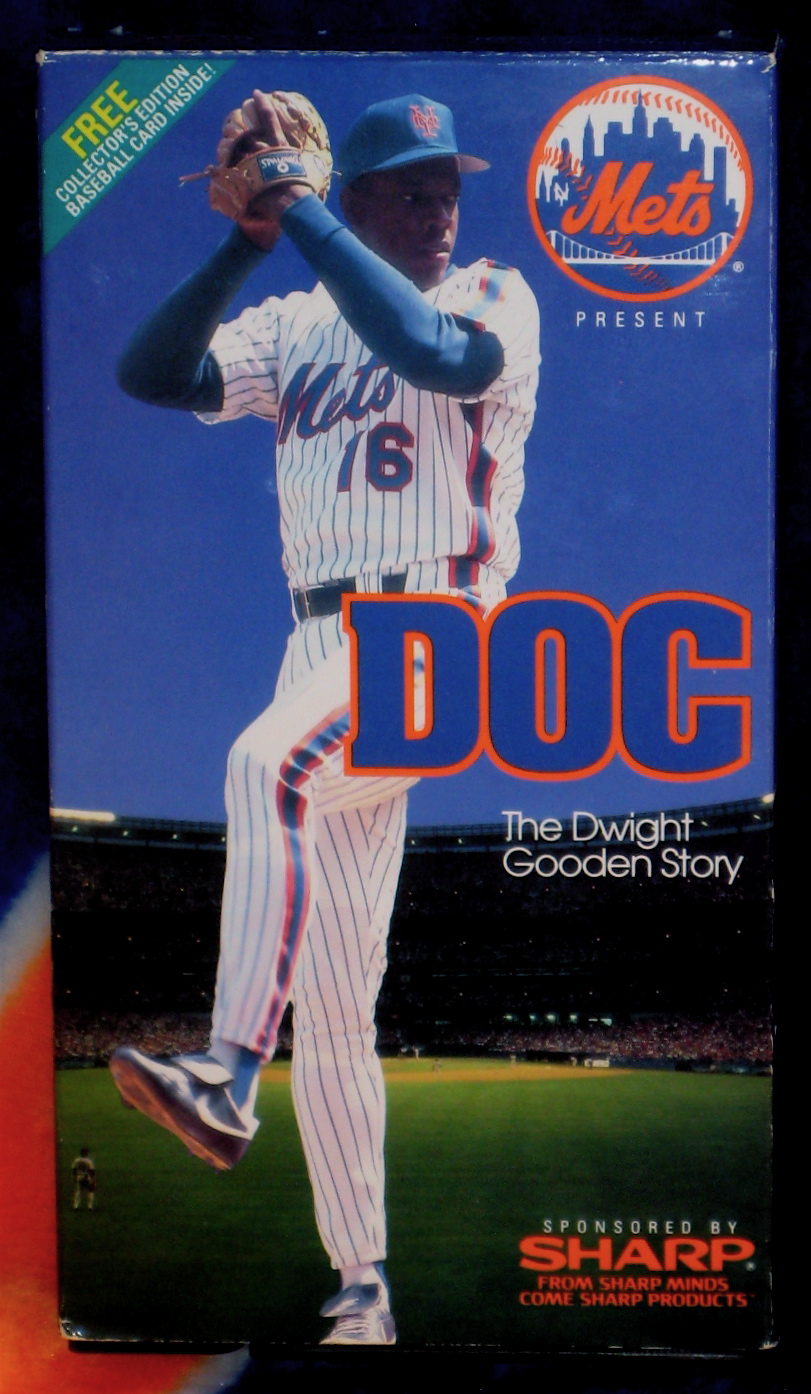
As for what that element of the contract actually yielded, there was one video produced, titled, Doc: The Dwight Gooden Story. It was filmed (taped, actually) during the 1991 season and — perhaps ominously — had its world-premiere screening that November, when Harazin, since promoted to succeed Cashen as GM, was preoccupied by free agent negotiations with Bobby Bonilla and Eddie Murray.
They’d be wanting money, not videos, but at the public screening for Doc, Harazin did not indicate any displeasure with the final product the previous spring’s dickerings brought about. “It solved a variety of objectives,” Harazin told the Times. “Desperation breeds creativity.”
There was a time when Nobody beat the Wiz or the Doctor.
I don’t recall the Mets advertising Doc quite that way, but as soon as they put the word out that the first (and only) Dwight Gooden video was available, I raced to my nearest Nobody beats the Wiz and purchased a VHS copy. I watched it immediately, stored it on a shelf, took it down a couple more times in the ensuing two decades to either cheer or depress myself during dark Met times and otherwise hadn’t given it any thought until just the other week. Those recent revelations about the unholy link between the clever deferred payments to Bobby Bonilla and how the money for them was supposed to be bearing interest in Bernie Madoff’s accounts, however, served for whatever reason to remind me of Al Harazin’s 1991 creativity — even if nobody has cause to sue anybody over Doc: The Dwight Gooden Story.
I’ve no reason to believe this video isn’t a perfectly legal 50 minutes of baseball entertainment.
However it came about, I found myself thinking about it lately, so I took the tape down from its shelf once more and watched Doc: The Dwight Gooden Story for the first time in who knows how long. I can report it remains alternately cheerful and depressing, depending on your Met mood.
Doc is clearly a curio from its time, both for production values and content. Anybody who’s excessively watched An Amazin’ Era or A Year to Remember will recognize it as emanating from the same basic school of Met video storytelling, save for the lack of a recognizable soundtrack. Amazin’, which commemorated the 25th anniversary of the Mets franchise,and Remember, the tribute to our second world championship, were both made in 1986, when MTV’s influence was cresting. Thus, “real” music was a must, whether you were setting highlights to Petula Clark and Neil Diamond (An Amazin’ Era) or Duran Duran and Bob Seger (A Year to Remember).
By 1991, the Mets weren’t paying the necessary rights fees to use anything you’d ever heard, though an original hip hop theme, “Doctor Doctor” was composed for the occasion — credited to Richard Fiocca and D.C. Smooth. Though it focuses on Gooden and his ability to throw strikes, “Doctor Doctor” is not to be confused with Mellow Mel’s 1986 recording, “Dr. K,” nor, for that matter, Robert Palmer’s 1979 hit, “Bad Case of Loving You (Doctor, Doctor)”.
Nothing about Dwight Gooden’s synthesizer was mentioned in the credits, but crafting scores for video productions was about the only thing Doc couldn’t do if you believed Doc. And why wouldn’t we? Who was going to buy this thing except Mets fans for whom Dwight Gooden indeed represented heart and soul, even at the late date of winter 1991-1992?
Doc, it should be noted, wasn’t a warts-free exercise in hagiography. There was always an elephant-sized drug test in the room when the subject was Gooden’s career and it was impossible to avoid. The video therefore dealt honestly with his 1987 brush with cocaine even if it couldn’t offer foolproof prophecy regarding relapse. Aside from that detail, and a little problem regarding arthroscopic surgery curtailing his most recent season — and, oh yeah, an ill-fated pitch to Mike Scioscia in October 1988 — it was all good.
“All good” always carries caveats when you’re a Mets fan.
The narrative is otherwise what you’d expect. It’s all about greatness. Doc was a great kid growing up in Tampa. Doc had great parents. Doc was, of course, a great rookie in 1984 and authored an all-time great season in 1985. Doc was a great Met among Met greats in 1986, the greatest season of them all. Doc has great career numbers. Doc’s a great teammate. Doc’s a great practical joker. Doc’s a great hitter (within reason). Doc’s a great guy to be around. Doc’s got great character. And once his shoulder is completely healed, goes Gary Cohen’s’ voiceover, “He’ll be here at Shea creating more memorable moments.”
Two ghosts hover over Doc — his and the Mets’ past, and his and the Mets’ future. Despite insisting that in terms of technique, “I’m a better pitcher now than in ’85,” we know his best days came when he was 20 years old. We intellectually understood that when this video came out, but we still held out hope that the Doc Gooden of 1985 (24-4; 1.53 ERA; 268 K’s in 276.2 IP) might peek his head in now and again in 1992 and thereafter. After Dwight went 13-7 (3.60 ERA; 150 K’s in 190 IP) in his injury-abbreviated 1991 campaign, it didn’t seem altogether out of the question.
But 1985 was long over by then, just as 1986 was. Doc: The Dwight Gooden Story was released by a company called Halcyon Days, and clearly the Mets’ halcyon days were fading by the early ’90s. While Doc footage was being recorded, the 1991 season — projected as the Mets’ eighth consecutive year of contending — unraveled like a cheap Fan Appreciation Day scarf. It’s no wonder, then, that references to ’86 feel like allusions to another time entirely. By late 1991, the 1986 Mets were of an era separate from the present. Except that Dwight Gooden and a handful of teammates were still on the roster, the 1986 Mets might as well have been the 1969 Mets, and that’s how they are treated in Doc: as distant, sepia-toned nostalgia.
Sigh.
As for what lay beyond 1991, it couldn’t help but spread out as “who knows?” territory, but you watch Doc, and you wish you could delete the parts all but promising for Gooden more World Series appearances, 300 wins and an inevitable landing spot in Cooperstown. There’s a moment when pitching coach Mel Stottlemyre is telling Doc, “The next time you’re out there in a playoff situation or World Series situation, somebody’s gonna pay.”
At that point, Mel is smacked in the face with a pie, which, in retrospect, is what happened to all of us where Doc and the Mets after 1991 were concerned.
Who could know, exactly? Who could know that Doc Gooden, like the Mets, would not post a winning record in 1992 or 1993, or that in 1994 he’d throw his last Met pitches (dreadful ones, mostly) on June 24. Who could have conceived he’d fall short of pitching 500 innings over the life of his three-year contract and not collect what was surely supposed to be one of his gimme bonuses? Who wanted to consider that the segment about cocaine and 1987 wasn’t a cautionary tale but a prequel?
If you dare to watch Doc, you have to glean from it the enjoyment you would from any random time capsule you come across. You have to enjoy Dwight’s fade haircut. You have to respect his wearing surgical scrubs and a Janet Jackson Rhythm Nation t-shirt while paying a goodwill visit to a hospital. You have to marvel that somebody thought to interview Gary Carter while he was a Dodger, Tim Teufel while he was a Padre and Dale Murphy while he was a Phillie. You have to remember when you see Mark Carreon and Mackey Sasser representing the 1991 Mets with “Gee, Doc is swell” testimonials that maybe it wasn’t so shocking the Mets were about to decline precipitously as a competitive entity.
With hindsight, we can see 1991 was this franchise’s sign of the apocalypse. They were so generally good in the years before it; they were so very bad in the years after. The Mets slipped from 91-71 in 1990 to 77-84 in 1991. Heart and soul notwithstanding, the Mets were less and less Dwight Gooden and more and more Sasser and Carreon, Coleman and Brooks, whoever and whoever, none of whom could ward off the impending storm of ineptitude that was about to drown Metsopotamia. 1992 brought a new-umbrella brigade to Flushing — Jeff Torborg in for Buddy Harrelson; Bobby Bonilla in (in essence) for Darryl Strawberry; Bret Saberhagen in for Frank Viola — but that didn’t provide protection, either, and the spiritual flood commenced.
I don’t know how many Mets fans need guidance on how best to watch Doc: The Dwight Gooden Story since I doubt there are many copies in circulation. It was offered in a doomed format that as far as I know never found new life in DVD or Blu-Ray, and YouTube yields no indication that any Mets fan ever transferred it to digital or dared attempt to sneak it by MLB’s watchful eye. Even in real time, during the twilight of the Doc, I don’t think it was what you’d call a hit. In the spring of 1994, more than two years after its release, I visited the Mets Clubhouse Shop in Roosevelt Field in search of a road batting practicing jersey that had caught my eye.
“We don’t have it,” I was told by a clerk who pointed to a rather dense display of blue VHS boxes. “But we have a ton of Doc the video.”
More recent Mets-related video release, available here, highly recommended.
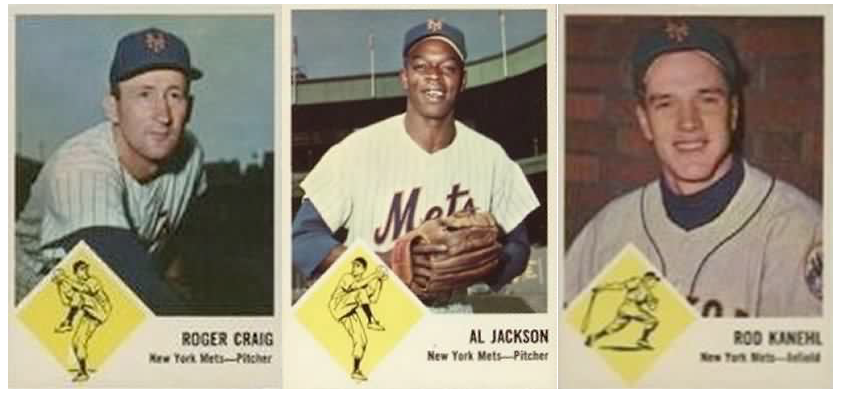
I live for learning something I never knew about the Mets, especially the early Mets. Today I learned, thanks to a conversation at Crane Pool Forum, that Fleer made Mets cards in 1963. It wasn’t so much that I previously thought they didn’t; it’s that it never occurred to me one way or another whether they did.
Fleer made only three Mets cards in a set of 67 overall, the only three Mets cards they printed in their first incarnation as a baseball card producer. This was before Topps came to monopolize the industry in toto through the ’60s and ’70s. Each 1963 Fleer Met is pictured above, courtesy of The Virtual Card Collection by Dan Austin. They may not be the clearest reproductions, but I do find these Original Mets glorious in these particular cardboard incarnations.I love the poses, I love the uniforms, I especially love the backdrops. There are Roger Craig and Al Jackson being Mets at the Polo Grounds. And Hot Rod Kanehl, quite obviously, is posing inside Citi Field, in front of that brick wall you practically run into when you come up the Rotunda escalator.
Which doesn’t explain why he’s wearing a road uniform.
If you’re loving any and all baseball cards, Dave Murray has completed his countdown of Topps’ 60 Greatest, which by Mets Guy In Michigan’s reckoning are all Mets cards. Go figure! Better yet, go check them out. His Nos. 4, 2 and 1 happen to constitute my own Big Three. Nos. 5 and 6 offer incredible style. Cripes, even No. 8 is pretty great if you don’t think about it too hard.
This cold February day requires a box score to keep us warm. Thus, I shall toss upon the fire the box score from the first game of a twinight doubleheader at Shea Stadium, September 22, 1967, courtesy of Baseball Reference. It describes an 8-0 loss by the Mets to the Houston Astros, but I won’t hold that against it.
This box score appeals to me for four reasons in particular:
1. Jerry Koosman started. It was the second start of Koosman’s career. The first one, a 4-3 loss at Houston five days earlier, was encouraging: 2 runs, 6 hits (if 5 walks) in 7 innings. In a season that turned into an open tryout camp — 54 Mets saw action in 1967 — Kooz’s initial audition showed promise. The second one, unfortunately, showed nothing. After retiring the side in order in the first, Kooz lost control in the top. He walked Doug Rader to start the second inning. After Rusty Staub reached on a bunt (try to picture that), Bob Aspromonte walked to load the bases. Ron Brand walked to force Rader home with the first run of the game. Lee Bales singled home Staub. Aspromonte followed behind him when Tommy Davis mishandled Bales’s hit in left. It was 3-0, runners on first and second, nobody out — except Koosman, who was removed from the game at once by skipper Salty Parker, running his first game as interim manager upon perpetually beleaguered Wes Westrum’s resignation the day before.
2. Jerry Grote caught Jerry Koosman and presumably grumbled a lot at the three walks. He’d catch Cal Koonce, who would get out of the inning with no further damage, and then Bill Graham and Joe Grzenda, both of whom inflicted plenty of damage. It was 8-0 by the time Grote (batting .194) left in the seventh to rest up for the nightcap.
3. Jerry Buchek replaced Buddy Harrelson at short in the sixth. Buddy’d had a bad early evening, going 0-for-2 and committing an error on a grounder from Rader that led to a four-run fifth. Though the horse was long out of the barn and spotted galloping toward Corona, Buchek acquitted himself well, handling three ground balls, pivoting on a 3-6-1 double play in the ninth and singling in two at-bats.
4. Jerry Hinsley came on to pitch the final three innings after Greg Goossen pinch-hit for Grzenda in the sixth. He gave up three singles and walked one Astro but allowed no further scoring. This was Hinsley’s second appearance of the 1967 season; he hadn’t pitched for the Mets since 1964, when as the leading edge of the franchise’s Youth of America brigade, he made the big club out of Spring Training as a 19-year-old. Hinsley got into nine games that April and May, two as a starter. With an 0-2 record and an ERA of 8.22, Hinsley was soon enough shuffled off to Buffalo. He spent the rest of 1964, all of 1965 and 1966 and most of 1967 moored in the minors.
Keep in mind, the Mets have had only nine Jerrys play for them in their entire history — not counting 1966 pitcher Gerry Arrigo; 1975 catcher Jerry Moses, whose brief Met tenure failed to net him one iota of playing time; nor, obviously, 2008-10 manager Jerry Manuel. Nine Jerrys, and 44.4% of them peppered Salty Parker’s debut.
In case you’re wondering — and I’d be disappointed if you weren’t — the others, all post-1967, were, in chronological order, Jerry May (backup catcher, 1973), Jerry Cram (relief pitcher, 1974-75), Jerry Morales (marginal spare outfielder, 1980), Jerry Martin (ineffective pinch-hitter, 1984) and Jerry DiPoto (unreliable reliever, 1995-96). The falloff in Jerry quality since the joyful days of Koosman and Grote speaks for itself, but the falloff in volume of Jerrys makes me think Jerry has peaked as a boy’s name in this country.
And you know what? It has. In 2009, it was the 371st most-popular baby boy name given in the United States, plunging from No. 319 in 2008. Plot that on a graph and it probably parallels the line that indicates the plunge the Mets took under Jerry Manuel during the same period.
But there was a time when parents really wanted Jerrys. According to the Social Security Administration, Jerry was the No. 14 name for baby boys born in the U.S. in 1940 and 1941. Then we went to war, and Jerry fell into steady decline. It was last a Top 20 name in 1947, a Top 50 name in 1971 and a Top 100 name in 1982. (And it never ranked higher than No. 194 during the years Seinfeld was a bona fide hit.) Demographically, the composition of the 1967 Mets Jerry much makes sense: Buchek, Grote and Koosman were all born in 1942, when Jerry was still going strong, at No. 16. By comparison, Jerry the Last — DiPoto — was born in 1968, when Jerry had slipped out of the Top 40 for good.
By then, Jerry Koosman and Jerry Grote were establishing themselves as Met mainstays — 1968 National League All-Stars, in fact. Jerry Buchek, meanwhile, was completing his second season as a Met utilityman, though he never again had as great a day as September 22, 1967…the second game of that twinight doubleheader versus the Astros. The Mets recovered big-time from the 8-0 whitewashing, and their nightcap shortstop was the main reason.
Trailing 4-2 in the bottom of the eighth, Jerry Buchek launched a two-out, three-run homer off Carroll Sembera to give the Mets a 5-4 lead. Being the ultimately 61-101 1967 Mets, it proved a short-lived edge. Jack Fisher, phased out of the rotation after serving as a Met starting stalwart since 1964, was pitching in relief of Dick Selma (who had been pitching in relief of starter Tug McGraw, who had struck out 10 Astros in 6 innings). Fisher got two Astro outs and was one batter from recording his second Met save in four seasons when catcher Dave Adlesh singled home Staub from second to knot the score at five.
The Mets would go quietly in their half of the ninth. In the Houston tenth, Ron Taylor would give up three line drives, but each was caught in the infield. Then, in the home tenth, with two Mets down, Bob Johnson doubled, Cleon Jones walked and Jerry Buchek stepped up and blasted his second two-out, three-run homer of the game, this one a walkoff job. The Mets won 8-5, giving Parker his first managerial triumph (Salty would finish out the 1967 season 4-7 before giving way to Gil Hodges). Buchek’s six RBI amounted to a personal peak. He’d spend most of the following year on the Met bench before being traded to the Cardinals in December 1968.
Though Jerry Buchek might seem to have suffered from unfortunate timing, missing spending 1969 in the company of Jerry Koosman and Jerry Grote in pursuit of the then-unimaginable, it surely beat the career trajectory experienced by Jerry Hinsley. When he mopped up those final three innings in the first game of September 22, 1967, he didn’t know he was getting, at age 22, his last shot at the majors.
Jerry Hinsley wouldn’t pitch for the Mets again. He wouldn’t pitch above Triple-A again for anybody. The Mets gave him his first big chance before he was ready, making him “the Mets’ first beardless wonder,” as Bill Ryczek put it in The Amazing Mets, 1962-1969. In retrospect, he was never ready.
Not altogether unlike young Dwight Gooden in 1984 and young Jenrry Mejia in 2009, Hinsley dazzled his manager in exhibition games in 1964. His Florida performance led Casey Stengel to argue to George Weiss that he had to have Jerry Hinsley on his team, even though the kid was barely 19, even though he had thrown zero minor league innings previously. The Mets had drafted Hinsley off the Pirates’ minor league roster when you could do that pretty easily. He had been a highly regarded high school phenom whom the Mets liked enough to keep an eye on his availability. Stengel liked him enough to give him first start in May.
Hinsley was lit up by the Cardinals, but Casey would give him the ball again, against the Giants. It came, however, with a caveat. He had to knock down Willie Mays in the first inning; it was a finable offense if he didn’t. So Hinsley, the 19-year-old rookie, sent Mays, the premier superstar in the sport, sprawling as directed.
“Mays was so intimidated,” Ryczek wrote, “he was barely able to struggle to his feet and hit a triple.”
Willie told Hinsley the next day that a) you need a couple of years in this league before you can throw at the likes of me; b) you should throw at a batter’s back if you mean to hit him; but c) you throw at his head if your intent is just to knock him down.
“I said, ‘Thank you, Mr. Mays,’” Hinsley recalled for Ryczek. “I’ll remember that.”
Hinsley didn’t get much opportunity to put Willie Mays’s advice to practical use for the Mets. He saw no more starts and only two more relief appearances before he was dispatched to the minors. While pitching for Double-A Williamsport in 1965, a line drive from Red Sox prospect Reggie Smith broke his jaw (karma’s repayment for knocking down Mays?). He told Ryczek his pitching wasn’t affected, but while 1966 Jacksonville Suns teammates like Tom Seaver were getting called up to New York, Hinsley continued to toil in the minors. His return to Shea came, finally, on September 8, 1967, with two difficult innings versus St. Louis. Then, the doubleheader opener, September 22, against the Astros.
Then that was it.
Jerry Hinsley’s last batter faced was Houston pitcher Mike Cuellar…the same Mike Cuellar who would, as a Baltimore Oriole, throw the first pitch of the first World Series game the Mets would ever play just over two years later. Jerry Hinsley, 24 (not quite five months younger than Tom Seaver), was a distant speck in the Mets’ rearview mirror by October 11, 1969. He pitched in the Mets organization in 1968, followed with a couple of years in Cleveland’s, and then pitched for Jacksonville again when the Suns were an unaffiliated Southern League franchise in 1971. Alas, Jerry Hinsley’s professional ledger lapses at age 26 — a shame on many levels, though one in particular when you stare at enough box scores in an effort to keep warm:
Jerry Hinsley never pitched in a winning game in the majors.
He pitched in eleven games for the Mets and the Mets lost all of them. That’s an 0-11 Met record when Jerry Hinsley’s name shows up in the box score. According to the Baseball Musings Day by Day Database, only one other Met shares that precise dubious distinction: Joe Grzenda…the same Joe Grzenda whom Jerry Hinsley relieved in the first game of the Mets-Astros twinight doubleheader of September 22, 1967. And only one Met exceeds that mark of team futility; only one Met, with a team record of 0-14, managed to cram more unalleviated losing into his battered Met portfolio.
That was yet another Jerry — Jerry Cram, who, on August 11, 1974, relieved in a game started by Jerry Koosman. Both pitchers were caught by Jerry Grote, who presumably grumbled quite a lot as the Mets fell behind 10-0 en route to losing 10-4 to the Reds at Shea. It was the last time the Mets crammed as many as three Jerrys into a single box score.
Which, as established above, remains one Jerry shy of the team record.
Update: Audio! Now you can say TLDL instead of TLDR!
Thought I’d post what I read at Varsity Letters’ fifth-anniversary shindig last week, for posterity but mostly because it’s a reflection on a Mets game we’d be better off to recall more often, particularly in these trying days. Odds are you’ll recognize it at once — and as you might imagine, we’ve written about it before. And no doubt we will do so again.
The 500th Time I Realized Baseball Is Mankind’s Greatest Achievement
My phone rings. It’s my friend Megan, calling from somewhere in the vast reaches of Shea’s upper deck.
“Your team sucks,” she says
She isn’t being mean. It’s true. It’s June 30, 2000. The night before, John Rocker returned to Shea for the first time after his inventory of the denizens of the 7 train for SI. We booed him and the Mets lost. Now it’s the middle of the eighth and the Mets are down 8-1. Those are the Braves. They’re only three games up in the East, but it feels like 30. I’m in the mezzanine next to my wife Emily and my friends Greg and Danielle. I’ve stopped booing. Greg has stopped complaining. Emily has stopped fuming. Danielle is reading the New Yorker, turning each page with angry little flips to demonstrate that she is not watching. All we want, given the apparent absence of other possibilities, is for it to be over.
Derek Bell singles, but Edgardo Alfonzo flies out. Mike Piazza singles. Robin Ventura grounds out to score a run. It’s cosmetic and we all know it – one of those too little, too late runs you almost resent. Todd Zeile singles and it’s 8-3. Still cosmetic. Jay Payton singles. Benny Agbayani walks. Bases loaded. We begin to stir.
We begin to stir — but we’re Mets fans. We are hurt and haunted and not falling for it this time. We know if we dare to believe, something bad will happen. Kenny Rogers will throw ball four. Bobby Bonilla will appear. Whatever it is, it will be awful and we will kick ourselves because we knew better.
But we’re Mets fans. We can’t help ourselves. Danielle is trying to burrow into her New Yorker. Emily is alternately urging on and berating our team. Greg is … yes, Greg is methodically chewing a Pepsi cup. I don’t know what I’m doing. I keep getting out of my seat and flopping back into it. I’m making noises. I don’t know what they are, exactly. But still – a grand slam here and we’d be … almost tied.
Mark Johnson doesn’t hit a grand slam. But he walks. It’s 8-4. Now a grand slam really would tie it. Melvin Mora doesn’t hit one either. He walks. It’s 8-5. Derek Bell is up again. And he … walks. It’s 8-6.
On the obvious, Team That Scores More Runs Wins hand, this is encouraging. On the other hand, this is the slowest of slow-motion rallies ever seen. It’s taking us 10 or 11 pitches to inch closer to a destination we probably won’t reach.
I find myself on my feet, denying everything at the top of my lungs. As Alfonzo comes to the plate, I confide in Greg that of course he understands they won’t actually do this, that everything will come to naught. I don’t mean it — I’m just trying the reverse-jinx, looking to stay the hands of the baseball gods. Greg fixes me with a look of betrayal, of real fury, and I realize too late that he’s struck his own cosmic bargain, the terms of which I’ve just violated.
Alfonzo singles through the hole. One run scores. Two runs score. It’s 8-8, two men on and two men out, with Mike Piazza beginning his dinosaur trudge to the plate.
Now, for once, all of us scarred, despairing Mets fans live up to our ancient credo. Ya gotta believe, and we do. Forty thousand of us are standing and screaming as Piazza goes through his routine, almost gingerly drawing the bat up and cocking it at the shoulder.
On one level, what happens next lacks all drama. There is no agonizingly extended at bat with close pitches and foul tips and just staying alive and finally squaring one up. Piazza hits the first pitch thrown by Terry Mulholland over the fence. It’s a line drive, instantly and obviously gone.
On every other level, it’s quite dramatic. All the accumulated tension of the last 20 minutes is released in a second. We are screaming and hugging each other and screaming and hugging the people next to us who are screaming and hugging the people next to them. I feel my stomach dip and look around to see Shea itself is flexing, the decks rising and falling as we leap up and down on top of them. Given Shea, I know this is a bad thing. Then I go back to screaming and hugging, even though I can’t breathe. It’s entirely possible that the old stadium will fall down. It’s entirely possible that I will have a heart attack. But now I know other things are possible, too — like the Mets cold-cocking the Braves with a 10-run eighth inning. I may be having a heart attack, and the stadium may fall down, but right now I’m so happy that I don’t care.
SUNDAY, OCTOBER 3, 1999
SHEA STADIUM
FLUSHING, NEW YORK
GARY COHEN
The last of the ninth inning in the final regular-season game of the year. The Mets and Pirates locked in a one-one duel. The Mets needing a win to guarantee there will be a tomorrow.
Greg Hansell, a well-traveled twenty-eight year-old righthander, will pitch the bottom of the ninth for the Pittsburgh Pirates, and BOBBY Bonilla is going to be a pinch-hitter for the Mets, batting for Shane Halter. Halter had just come in to execute a double-switch and give the Mets defense in right field for the last inning, but now Bonilla comes up with a chance to win it, leading off in the last of the ninth inning.
Greg Hansell has pitched just about everywhere. He was once the property of the New York Mets, way back in 1990, pitching at Port St. Lucie. He was in Spring Training this year with the Giants, but now pitching for the Pirates in the bottom of the ninth.
The pitch to Bonilla — swing and a miss, he had his home run cut, trying to win it with one swing, but he swung through it, nothing and one.
Bobby Bonilla hitting at one-sixty-one, four home runs — they all came a long time ago. Batting lefthanded against the much-traveled righthander, Greg Hansell. Melvin Mora on deck.
The oh-one pitch…in the dirt, a changeup, one ball and one strike.
Kris Benson pitched seven FABULOUS innings, allowed an unearned run on seven hits. Jason Christiansen pitched the eighth, no runs and no hits. And now Greg Hansell pitching in the bottom of the ninth, Mets one, Pirates one.
The outfield a stride toward right, Young guarding the line at first. The one-one to Bonilla, a changeup, misses outside and low, two balls and a strike.
Bobby Bonilla, who spent such an important part of his career with the Pittsburgh Pirates, trying to help facilitate the Mets against the Pirates here today.
BOB MURPHY
He could get reacquainted with a lot of old friends if he came through.
GARY COHEN
The two-one to Bonilla…pulled on the ground down to first base, right at Kevin Young, he’ll run it to the bag himself, and Bonilla retired for the first out of the ninth.
So Bonilla, with a big cut, grounds out weakly to first base, one man down, and Melvin Mora will come up for the first time.
Mora came on as a pinch-runner for an injured Rickey Henderson in the seventh inning. Bobby Valentine might be inclined to use a pinch-hitter here, except he’s starting to run out of players. He has only one outfielder left on his bench, and that’s Shawon Dunston, and he’ll need him to go to right field if we go the tenth inning, with Halter having left for the pinch-hitter, because Bonilla is not capable of playing in the field.
The Mets also have Jorge Toca, Mike Kinkade, Todd Pratt and Luis Lopez left on the bench.
A moment taken here, as the shortstop, Abraham Nuñez, reaches down to tie his shoe.
Melvin Mora hitting at one thirty-three on four hits in thirty times at bat.
One out and nobody on, last of the ninth, Edgardo Alfonzo on deck.
Hansell delivers, low and outside, one ball and no strikes.
Melvin Mora came up in a huge spot in the opening game of this series, Friday night, in the eighth inning.
The one-oh pitch…line drive right field FALLING FAST, that’ll be in there for a base hit! Mora turns at first and holds on THERE, throwing behind him now is BROWN, and Mora SCAMPERS back to the bag.
What a big base hit for MELVIN Mora! Only his FIFTH hit of the year, he went the other way and dunked it into right field, and now the Mets have the winning run aboard with one man out.
BOB MURPHY
I think Mora was thinking two-base hit. He went FLYING around the first base bag and realized he had to get the brakes on.
GARY COHEN
He had a lot of spin on that ball off the bat, and when it hit the grass, it almost bounced beyond Adrian Brown, and I think that’s what Mora saw, that Brown was going to have trouble picking it up. But Brown was able to field it cleanly and keep Mora at first base.
Well, here’s Alfonzo, an infield single and a walk, one-for-three officially. Flied out to right on a hit-and-run play his last time up.
Mora with good speed at first.
Here’s the pitch…fastball letter-high for a strike, nothing and one.
Alfonzo the batter, Olerud on deck, the Mets now have eight hits in the game, trying to win it in their final turn at bat, they’ve done it seventeen times this year, most recently on Friday night in the eleventh inning.
Everybody standing here at Shea, better than fifty-thousand on hand.
Hansell to the set, the oh-one to Alfonzo — line drive BASE HIT going into right field! Mora turns second! Mora will go to third! Brown picks it up. His throw will go to second base! The Mets have the winning run at third with one man down in the ninth!
Edgardo ALFONZO, an opposite-field SINGLE, back-to-back base hits by the two Venezuelans, MORA and ALFONZO, and now a fly ball can win the game for the New York Mets, and John Olerud is coming to the plate.
BOB MURPHY
Well, this is the moment right now.
GARY COHEN
They are ROCKING and they are ROLLING here in Flushing, they’re gonna WALK Olerud INTENTIONALLY and pitch to MIKE PIAZZA. Well, how about THAT?
BOB MURPHY
Boy, that’s a shocker.
GARY COHEN
Olerud will be INTENTIONALLY WALKED, they’ll fill the bases, set up the force everywhere and the double play possibility with Piazza coming up. There’s a righthander in the game in Hansell, and Gene Lamont would rather face Piazza than face Olerud.
BOB MURPHY
Well, there’s a chance, too, that Piazza might hit into a double play.
GARY COHEN
Of course there’s also that chance with Olerud, they’re one and two in the league in grounding into double plays. Right now the double play is in order, but they’re gonna walk Olerud anyway, and there’s ball four, and so it’s left in the hands of the Mets’ biggest bat.
Mike Piazza, with a chance to win it, in the final regular-season game, trying to guarantee the Mets another game in Nineteen Ninety-Nine.
Bases loaded, one out, bottom of the ninth, Mets one, Pirates one.
Here comes Gene Lamont, and he’s goin’ to the bullpen. We’ll take a break. One to one, last of the ninth, back in a moment on the WFAN Mets Radio Network.
[COMMERCIAL]
GARY COHEN
Gene Lamont brings in the veteran sidearming righthander Brad Clontz, who pitched briefly last year for the New York Mets, and Clontz will come in to face Mike Piazza with the bases loaded and one out in the bottom of the ninth with the Mets and Pirates tied one to one. This is a good idea by Lamont: Clontz is very tough on righthand hitters, and he’s done well against Piazza in the past. Mike is just ONE-for-six against this sidearmer.
BOB MURPHY
The Mets have speed at third base. If they can get a fly ball to the outfield, it should be over.
GARY COHEN
Well, the hope for the Pirates is they get Piazza to hit a ground ball at an infielder who would be able to turn a double play and get through the inning.
The infield will play halfway. The outfield will play only as deep as they can throw, a fly ball will win the game, with Mora standing at third base.
Alfonzo at second, Olerud at first.
Piazza stands in, oh-for-four on the afternoon.
Clontz is ready to go, pitching off the stretch. DEALS to Piazza. Low and outside, IT GETS AWAY! ONTO THE SCREEN!
MORA SCORES! THE METS WIN IT! THE METS WIN IT!
Mora is MOBBED by his teammates as he crosses home plate! Brad Clontz BOUNCED the first pitch up onto the SCREEN! Melvin Mora scores the winning RUN! The Mets win in game number one-hundred sixty-TWO, and the Mets will play again in Nineteen Ninety-NINE!
The Mets win it their final turn at bat, they win it two to one on a WILD PITCH by BRAD CLONTZ, and they’re going crazy here at Shea!
All the Mets out on the field, exchanging HIGH-FIVES and hugs. The Mets have played a hundred and sixty-two GAMES, they now lead the Wild Card by a half-a-game, waiting on CINCINNATI, scheduled to play in Milwaukee, waiting for the raindrops to cease, and it may be a long night before we know where the Mets are going, Bob, but now we know they’re goin’ somewhere.
BOB MURPHY
They’re goin’ somewhere, no doubt about it. The Mets will stay here until they see what happens in Milwaukee. They claim they’re going to have a window to play that game out there, and if only Milwaukee can beat Cincinnati, the Mets can go to their homes tonight and get a good night’s sleep, and leave tomorrow for Phoenix, Arizona.
GARY COHEN
Another EXCRUCIATING game here at Shea Stadium. The Mets were turned ASIDE and turned ASIDE and turned ASIDE, and they finally win it in the ninth, on base hits by Mora and Alfonzo, and a wild pitch to plate the WINNING run, and the Mets win it in their final turn at bat, their ninety-SIXTH win of the year.
In the ninth inning, one run, two hits and two men left. The final score, here at Shea, on Fan Appreciation Day, the Mets two and the Pirates one. Back to talk about it in a moment on the WFAN Mets Radio Network.
All longtime Yankee icons are equally detestable, but some are less equally detestable than others. That’s my grudging way of expressing a Mets fan’s appreciation for Andy Pettitte, the longtime Yankees icon I detested marginally less than the others, on the occasion of his departure from baseball.
This is detesting less, not not detesting. A Mets fan’s appreciation for any longtime Yankee icon is going to be pretty severely limited by overwhelming extenuating circumstances.
I detested the mere sight of Andy Pettitte on the mound almost every October because it was a reminder that October became a routinely terrible month to be a Mets fan. The simple fact that I was watching a Yankees game indicated the Mets weren’t playing anymore. Starting in 1995, when Pettitte was a rookie and the Yankees in the postseason was a novelty, it was either them or no baseball. Later on I decided no baseball was sometimes a decent alternative, but for the first few years of the last Yankee dynasty, I stared quite a lot at Pettitte pitching in October.
And Pettitte stared back. He stared back starting with the second game of the 1995 ALDS and would do the same in every second game of every ALDS in which the Yankees participated through 2003. That was his thing — the second game, the No. 2 starter. He pitched behind David Cone (three times), David Wells, Orlando “El Duque” Hernandez, rancid Roger Clemens (three times) and Mike Mussina. Some teams didn’t have the opportunity to set up their pitching for the postseason. The Yankees always did. The Yankees spent every September from ’96 on arranging their rotation just so. Whoever the designated ace was in a given year, he was backed up by Andy Pettitte.
I detested Pettitte for representing that kind of consistency and the way he served as a safety valve if something went wrong in any given Game One. Yet he generally avoided being labeled the ace of the Yankee staff. Just in terms of pecking order, it was hard to severely detest the nominal second-best pitcher in a rotation.
Don’t get me wrong, though. He won enough. He won more than enough. He won more postseason games (19) than anybody in the history of baseball. Even allowing for his rookie season coinciding with the year baseball expanded its playoffs to three rounds, and even understanding that it really, really helped to pitch for a team that reached at least that first playoff round every single year (due in part to his own efforts), that’s way too impressive not to detest if you’re watching it from the wrong side of October. In five of those first eight Pettitte seasons, the Yankees graduated from the ALDS to the ALCS and, always, to the World Series. When the Yankees competed for a pennant and a title, Pettitte always pitched in those rounds, too.
You know the basics from there: four World Series championships in that era. Pettitte started six games in the World Series of 1996, 1998, 1999 and 2000, and the Yankees won five of them. The last two starts were Games One and Five of the 2000 World Series. No need to remind you what team he pitched against on those dark October nights.
There’s little to like in any of that and everything to detest.
Yet I never quite detested Andy Pettitte on the level I detested his most iconic teammates. Detested his success; detested the success it brought his employer; detested that he got to keep pitching while none of the pitchers for whom I rooted from April to September had any mound appointments come very late October…except in 2000, and we’ve covered that.
Didn’t deeply detest Pettitte himself, though, not even in the baseball-detest sense. I’ve detested loads of Yankees. I detest the Yankee uniform. I detest the Yankee stadiums. I detest everything about the Yankees. But I detested Pettitte less.
How come? Allowing myself to think about Andy Pettitte now that he says he’s no longer pitching, I come up with the following reasons in no particular order.
• He left once. He walked away in December 2003 so he could pitch close to home and spend more time with his family. Nobody in public life ever says that and means it, but Pettitte apparently did (if only for three seasons). It meant dragging Clemens out of retirement so they could give each other foot massages at Minute Maid Park, but even that lingering image was worth it given the caterwauling his departure inspired in certain precincts of New York.
• He admitted he juiced. I’m not an HGH absolutist. I believe there’s room for interpretation and forgiveness. Pettitte had a somewhat silly defense (he used, but only a little, and only to get him back from injury — not to help him pitch…which was something he was able to do because he was back from injury) but he spit it out once he was cornered by the Mitchell Report, and his career went on without incident. It surely beats the way his old compadre has attempted to finagle the issue.
• He was hilariously atrocious in Game Six of the 2001 World Series, the Fall Classic that proved baseball wasn’t always tortuous and unfair. Two innings pitched, six earned runs, the explanation later that he was tipping his pitches, all part of a soul-saving 15-2 Diamondbacks win, which set up the deliverance of Game Seven and the end of the Yankee chokehold on the sport. My favorite part, besides the result, was the excuse for blowing up under pressure, which I worked into a November 2001 song parody of which I was quite proud (set to the tune of the bravado bridge of “New York, New York” — 2:08 here): Andy Pet-TITTE/Tipped his pitches…/Jay-Wita-SICK/Us in Stitch-ES…
• He was similarly pounded in the second game of the 2002 ALDS, the marvelous four-game set against the Angels that proved the outcome of the 2001 World Series was not a fluke. Pettitte, at Yankee Stadium no less, gave up four runs in three innings, was removed before the fourth trailing 4-1, and the series was never the same thereafter.
• He was the losing pitcher to Josh Beckett in the deciding game of the 2003 World Series. Pettitte pitched well, but Beckett was untouchable. It was not only a great victory for Not The Yankees (personified for a week by the otherwise disreputable Florida Marlins) but a nice jab in the ribs of Conventional Wisdom. “Beckett can’t pitch on three days’ rest!” He did and succeeded enormously. “Pettitte will be unbeatable with everything on the line!” He wasn’t, which was quite rewarding for those of us who didn’t buy into everything we’d been told about inevitability.
• He was less heralded than a fellow 1995 lefty rookie in New York, Bill Pulsipher. Granted, the heralding did not prove accurate — Pettitte slightly outpitched Pulsipher across their respective major league careers, 259 regular-season and postseason wins combined to 13 — but I still get a kick out of my friend Joe’s preseason prediction from 1996 that Pulse would outshine the other guy and emerge as the city’s preeminent sophomore southpaw. Ah, faith…
• He brought his then seven-year-old son, Josh, into the dugout during a Yankees intrasquad game in Spring Training 2002 while Josh was wearing a Mets cap. This drove Herr Steinbrenner into a vintage rage, but Pettitte didn’t budge. Turned out the “Mets” in question were the kid’s youth league team in Texas. Josh wanted to wear his favorite cap and his dad wasn’t going to rip it off his head at anybody’s behest. The detestability factor lowered greatly after that.
• He kept the Yankees waiting almost every offseason of late, which led to a little Bronx squirming, which made for a nice sideshow. Pettitte signed four one-year contracts following his term with the Astros. Only once did it take him less than a month after declaring free agency to inevitably re-sign with the Yankees. And this year, he outdid himself, keeping the “will he or won’t he?” storyline alive into February. Well done, procrastinator provocateur!
• He started two of the greatest midseason wins in Mets history. We know Dave Mlicki triumphed in the very first Subway Series matchup on June 16, 1997, a 6-0 route-going whitewashing of the Yankees replayed every roughly every 72 hours on SNY, but it may not be instantly recalled that the losing pitcher was Andy Pettitte. He allowed three quick first-inning runs, capped by a double-steal executed to a tee by Butch Huskey (second base) and Todd Hundley (home!) and surrendered five earned runs in seven innings overall. Two years later at Shea, on July 10, 1999, Pettitte struggled through six innings (four earned runs) before handing a tenuous 5-4 lead to the Yankees bullpen. The afternoon would eventually pass from Mike Piazza (three-run homer, Mets lead 7-6) to Jorge Posada (boo-run homer, Mets trail 8-7) to Matt Franco, as in, “MATT FRANCO WITH A LINE DRIVE SINGLE TO RIGHT AND HE’S BEING MOBBED BY HIS TEAMMATES! Matt Franco, a two-run single off Mariano Rivera in the bottom of the ninth inning, and the Mets win it, nine to eight!” (Call courtesy of Gary Cohen and heaven.)
• He continually brought to mind one of my favorite Kids In The Hall sketches, the lesbian league softball game between Sappho’s Sluggers and Pandora’s Jox. Once per postseason start, at a point when Pettitte’s trademark stare from behind his glove was captured by Fox’s cameras (which was invariably), I was moved to comment to Stephanie, “Look! It’s Pandora’s Jox!” because there’s a fleeting moment in that sketch when Mark McKinney stares out from over his glove that makes me comment, “Look! It’s Andy Pettitte!” Admittedly, this is an esoteric reason to detest one Yankee icon marginally less than other Yankee icons, but it was part of the package. Compare and contrast Pettitte the Yankee with McKinney the Jox. And watch the sketch here (pause at 3:47 for full effect), because it’s more fun than stewing over what Fred Wilpon knew and when he might have known it.
• He seemed like not a bad guy and didn’t say anything overly obnoxious and there was always somebody around him who annoyed me far more. Trust me — that’s the highest praise I can offer any Yankee icon.
Say, wanna get even more depressed about the state of your favorite baseball team? Scrape the ice off your keyboard and visit the Times. There you can read all about how brilliant Fred Wilpon long ago decided Bernie Madoff was and how the Mets put a lot their money — which on some level had been our money before we exchanged it for a ticket or a cable subscription or a piece of licensed apparel or merchandise — in Madoff’s hands. Madoff, before his Ponzi scheme became known, was a sure thing in Wilpon’s eyes, so sure that when there was a matter of deferred compensation, the Mets took the funds they’d eventually have to pay out and placed it in Madoff’s care. From there, it would grow, because that Bernie Madoff, he was brilliant.
According to the Times, “the role Mr. Madoff played in the financial life of the ball club” was “substantial”.
When the Mets negotiated their larger contracts with star players — complex deals with signing bonuses and performance incentives — they sometimes adopted the strategy of placing deferred money owed the players with Mr. Madoff’s investment firm. They would have to pay the player, but the owners of the club would be able to make money for themselves in the meantime. There never seemed to be much doubt about that, according to several people with knowledge of the arrangements.
“Bernie was part of the business plan for the Mets,” a former employee of the club said.
Makes you feel warm and fuzzy all over, doesn’t it? Just like those assurances that whatever Wilpon had going on with Madoff, it had nothing to do with the Mets — they were totally separate.
Being a hardcore Mets fan, meanwhile, you no doubt focused like a laser on the phrase “deferred compensation” and thought of one person in particular. Yup, he is indeed, reportedly, attached to this, too:
Bobby Bonilla was among the players who had their deferred money put with Mr. Madoff, one former employee said.
God only knows how whatever the hell is going on in the sordid Madpon affair affects anybody and everybody who is remotely touched by it, but I’m going to assume Bobby Bonilla’s deferred payments will be fine. Of course they’ll be. Bobby Bonilla always makes out fine where taking Met money is concerned. As the former third baseman/right fielder/albatross told the Wall Street Journal last summer when the specter of his impending neverending payoff arose, “Hey, a blind squirrel can find an acorn.”
Stupendous. Bernie Madoff robbed people blind, Fred Wilpon’s stewardship of our beloved franchise careens toward an iceberg and we are gently reminded that from the nexus of their close relationship, Bobby Bonilla will be collecting $1.19 million worth of acorns per year starting this July and continuing — as every schoolchild knows — through 2035.
This arrangement was crafted so the Mets didn’t have to immediately pay Bonilla the $5.9 million they owed him for 2000…and, lest we forget, Bonilla was on the Mets for a second golden term (after having been such a prize from 1992 to 1995) because they couldn’t bring themselves to simply eat the final year of Mel Rojas’s anvil of a contract, which would have cost them not quite $4.6 million in 1999.
To unhappily recap, they swapped one theoretically untenable season of the dreadful Rojas (from a deal the Mets inherited when they traded for him, Turk Wendell and Brian McRae in 1997) to the Dodgers for two untenable seasons of the washed-up Bonilla. It was a classic case of bad contract for bad contract, though it didn’t require hindsight to divine the bad contract the Mets were accepting was sizably worse than the one they were jettisoning. The Mets committed $11.8 million to Bonilla in order to save themselves from paying Rojas $4.6 million.
Where was brilliant Bernie Madoff’s financial acumen then?
Bobby Bonilla lacked both productivity and common human decency in 1999, eating up roster space, his manager’s patience and, presumably, a disproportionate share of the clubhouse spread. No way could Bobby V be asked to indulge Bobby Bo in 2000. But just making the mistake go away would have been too unclever for the Wilpon administration. That’s where the deferred compensation came in, that’s where almost $30 million will go out over the next 25 years, and now we learn that somehow Bernie Madoff was a part of this scheme, too.
Oh, and Oliver Perez and Luis Castillo are still under contract and expected to don Mets uniforms in a couple of weeks. Maybe they would have been granted the dazzling deferment package Bonilla has made famous had Madoff magic still been available to the Mets. Alas, that door was closed when Madoff’s massive malfeasance came to light the winter Perez was re-signed for $36 million over three years, which coincided with the universal realization that the $18.75 million Castillo was owed for 2009, 2010 and 2011 was not what you’d call a savvy investment.
Now and then I’ve read thoughtful explanations of how Bobby Bonilla being paid by the Mets for a quarter-century, long after he played his last hand of hearts at Turner Field, wasn’t such a bad financial deal for the Mets (which the Times article indicates in the first passage quoted above). And in the context of the 1999-2000 offseason, given the Mets’ reflexively hesitant approach to adding payroll during that era, putting off Bonilla’s payments way into the future — no matter how astronomical they would appear to the untrained eye — gave Steve Phillips perceived short-term flexibility. Issuing seven-figure checks to Bobby Bonilla clear into his seventies is an obvious punchline, but there was, I’ve been assured, a scintilla of logic to it.
But geez, y’know? Bobby Bonilla adds to his riches via a check cut by the Mets every year for 25 years; Bernard Madoff was reportedly the conduit to execute this sludgiest of slush funds; and none of this imbues us with anything resembling confidence regarding the future of this operation for however long Fred Wilpon is running it.
Makes the ice storm outside look pleasant by comparison.
Well, half of it anyway — I’ll be speaking at Varsity Letters’ fifth-anniversary reading/celebration/bash, as part of a pretty awesome lineup of sportswriters: Henry Abbott, Katie Baker, Alex Belth, Ben Cohen, Joe Drape, Chuck Klosterman, Will Leitch, Amy K. Nelson, Jeff Pearlman, Dan Shanoff, Emma Span, Sam Walker and Michael Weinreb. We’re each reading for three minutes — I’m going to talk about being in the stands for the 10-run inning against the Braves.
It’s at (Le) Poisson Rouge, 158 Bleecker Street between Sullivan and Thompson, this Thursday, Feb. 3 at 7:30 p.m. If you’re in the vicinity, or up for braving the ice/snow/sleet/cold/wolves, please stop by!
For more details, click here. And for brief interviews with the whole lineup, click here. I take the opportunity to be randomly bitter about the Yankees. As if that’s a surprise.
Piazza: Catcher, Slugger, Icon, Star by Greg Prince is available from Amazon, Barnes & Noble and other online booksellers.
Amazin' Again: How the 2015 New York Mets Brought the Magic Back to Queens by Greg Prince is available from Amazon, Barnes & Noble and other online booksellers.
Volume I of The Happiest Recap: 50+ Years of the New York Mets As Told in 500+ Amazin' Wins by Greg Prince is available in print and for Kindle on Amazon.
Faith and Fear in Flushing: An Intense Personal History by Greg Prince (foreword by Jason Fry), is available from Amazon, Barnes & Noble and other online booksellers.