The blog for Mets fans
who like to read
ABOUT US

Faith and Fear in Flushing made its debut on Feb. 16, 2005, the brainchild of two longtime friends and lifelong Met fans.
Greg Prince discovered the Mets when he was 6, during the magical summer of 1969. He is a Long Island-based writer, editor and communications consultant. Contact him here.
Jason Fry is a Brooklyn writer whose first memories include his mom leaping up and down cheering for Rusty Staub. Check out his other writing here.
Got something to say? Leave a comment, or email us at faithandfear@gmail.com. (Sorry, but we have no interest in ads, sponsored content or guest posts.)
Need our RSS feed? It's here.
Visit our Facebook page, or drop by the personal pages for Greg and Jason.
Or follow us on Twitter: Here's Greg, and here's Jason.
|
by Greg Prince on 21 September 2010 9:42 pm From the Department of the Painfully Obvious, the New York Mets have been eliminated from postseason contention following their 5-2 loss to the Florida Marlins. Time of death: 9:38 PM EDT, but really, they’ve been done since Puerto Rico. Record before San Juan: 43-32. Record from San Juan on: 31-45.
Autumnal equinox is tomorrow night. Very windy right now here where I am. Very barren where the Mets are. Late summer has never felt later.
by Greg Prince on 21 September 2010 7:32 pm Lucas Duda just blasted one out of Whatever It’s Called Stadium, his second homer, meaning Club Hessman loses yet another temporary member. Population of One Met Homer Village: 69 again.
If only it was ’69 again.
In other updating-type news, the war of attrition has claimed another victim: Bobby Parnell, out for the season with inflammation and stiffness in his pitching elbow. That’s four Mets who have been lost in September: Santana, Mejia, Hernandez, now Bobby. Also, Ollie Perez and Luis Castillo don’t seem to be available, ever.
Which is OK.
by Greg Prince on 20 September 2010 10:42 pm With our friends at Citizens Bank Park frantically waving white towels, the Atlanta Braves surrendered a 3-1 loss to the Philadelphia Phillies, reducing the Braves’ tenuous Wild Card lead over the New York Mets to a paltry 11½ games — 11 in the loss column. The Mets have 12 games remaining, Atlanta 11.
For the Mets to storm from behind and win the National League Wild Card, the following needs to occur:
• The Mets (74-76) must go 12-0.
• The Braves (86-75) must go 0-11.
• The Marlins (74-75) must go 3-0 against the Braves, 0-2 against the Mets; their other games are immaterial.
• The Reds (85-66) must go 3-0 against the Padres; their other games are immaterial.
• The Cardinals (77-72) must go at least 3-1 against the Rockies, no better than 5-4 against everybody else.
• The Rockies (82-67) must go 0-3 against the Giants, no better than 1-3 against the Cardinals, no better than 2-4 against everybody else.
• The Padres (83-66) must go 0-3 against the Giants, 0-3 against the Reds, no better than 2-5 against everybody else.
• The Giants (84-66) must go 3-0 against the Rockies, 3-0 against the Padres; their other games are immaterial.
Under this scenario, the Phillies, the Reds and the Giants will capture their respective division titles. The Mets and Braves will finish tied for the Wild Card at 86-76, necessitating a one-game playoff.
And the Mets will have to win that game to win the Wild Card at 87-76.
That’s all.
by Greg Prince on 19 September 2010 8:48 pm Come back Pirates! We promise we’ll show up! We’ll even clear the tornadoes out of the area for you!
Drat the luck that we had to play a good team with something on the line this weekend. For 24 dreamy hours before the Braves replaced the Pirates on the Citi Field scoreboard’s top half, we were a winning team again, our record floating three ethereal one-thousandths of a point over the .500 mark. We were 74-73, with 81-81 seeming graspable, 82-80 not looking so crazy and at least one delusional blogger wondering for approximately one-millionth of one microsecond, “What if we sweep the Braves? Is it even possible…”
No, it wasn’t possible. The Braves weren’t the Pirates. More substantially, the Mets — tragic number for playoff elimination: 1 — aren’t much of anything when they’re not playing the Pirates or their American League doppelgängers, the Orioles and Indians. When the Mets faced those three plucky if undersized baseball squadrons in 2010, their record was a tidy 12-1. When they didn’t, they’ve been a mess: 62-75. They all count, but after a while, you’re forced to pick on someone your own size. The Mets’ true calling, alas, has been swaggering bully against three teams, pliable punching bag for all the rest.
Another statistic to note: 0 vs. 12, as in the Mets have hit no grand slams this season but have surrendered a dozen. Is it even possible? Apparently it is, but it’s pretty much unprecedented. ESPN says no team has ever finished a season with this kind of ratio slamming them in the face over and over and over (times four) again.
You don’t have to be some journeyman junkballer to have gotten in on the action; two-time Cy Young winner Johan Santana gave up three grand slams on his own. Most of the four-run homers, however, have been served up the ham-and-egger corps of Met middle relievers, including two by the generally competent if quickly forgettable righty Manny Acosta. The former Brave didn’t exactly have it goin’ on Sunday against his old club when he entered a tie game in the top of the seventh. The bases were loaded, two were out (a situation facing seven of the previous eleven grand slam pitchers) and Acosta worked Derrek Lee to 3-and-2.
Manny threw a strike, and Lee struck it.
Twelve grand slams given up by Met pitchers this year…and the Mets’ record in those twelve games?
0-12, of course.
It seems almost unfair to equate these Mets of suddenly late September with the Mets who occasionally raised our hopes during frisky portions of April, June and those four games last week. These Mets are dropping like flies…or opposition grand slams into second decks of stadiums. Since this month dawned, Santana, Jenrry Mejia and Luis Hernandez have all gone out for the season. Even with an expanded roster, the Mets are losing the war of attrition.
Yet these Mets are technically those Mets, at least as far as the disappearing slate of 162 games in concerned. As things stand now, these/those Mets’ final record for 2010 will fall somewhere between 74-88 and 88-74. I think it’s safe to say it won’t be 88-74 and, even after getting swept by the Wild Carding Coxmen, it will probably be better than 74-88. Here’s what’s left to play and to ponder:
• 2 @ FLA (Mets 0-4 in Miami plus 1-2 in regrettable San Juan)
• 3 @ PHI (Mets 2-4 in Philly)
• 4 vs. MIL @ home (the Brewers haven’t been to Citi Field since April 19, 2009; have you missed them?)
• 3 vs. WAS @ home (Mets 2-4 in Queens against the Nats — a last-place team we can’t handle with ease)
If you’d like to accurately remember this season as a winning proposition, the Mets will have to go 8-4 in their final twelve. If you believe the Mets’ win one/lose one ethos should be properly reflected for posterity, they’ll need to put a 7-5 on the board. And if you’re pretty sure 2010 can be summed up by the way they’ve allowed grand slam after grand slam while hitting none, then you probably assume they’ve lost about a hundred games already.
They haven’t. It just feels that way when they’re not playing the Pirates.
by Greg Prince on 19 September 2010 7:00 am The Mets will honor Bobby Cox today, and that is right and proper. Cox, set to retire whenever the Braves stop playing in 2010, has more wins managed under his name, including those from which he was ejected before completion, than all but three men in major league history. Enough of them came at the expense of the Mets. As Mark Simon of ESPN New York outlined, nobody has managed more wins — 198 in the regular season and four in the 1999 National League Championship Series — at the Mets’ expense. Nobody else is close. Nobody else has managed long enough, often enough and successfully enough against the Mets to make it close. I’ve been grumbling at Bobby Cox for most of the past 15 years, but there are days when caps require tipping. This is one of those days.
Little bad is said of Cox in these closing weeks of his no-doubt Hall of Fame career. Why should there be? He took over a Braves club whose level of despair was de Rouletian in 1978 and steered it to the edge of respectability when he left in 1981; he boosted Toronto from stumbling toddlerhood in 1982 to A.L. East champs in 1985; and he drafted and traded devilishly well as Atlanta GM from 1986 to 1990.
Then his career really took off.
Bobby Cox has managed the Braves a second term since June 23, 1990. From 1991 to 2005, his club won every division title that was available to them, the last eleven of them in the National League East. It became such old hat after a while that every time Atlanta fizzled in the playoffs — which became a rite of autumn in the early 2000s — it was considered a glaring failure. Considering Cox had taken the Braves to five Fall Classics in the ’90s and led them to the world championship in 1995, it’s little wonder that standards shifted and bars rose.
But before Cox took over the Braves a second time, they were a glaring failure six months out of every year. There were no playoffs. There were 96 losses annually as a rule. The Braves were the Pirates as we’ve come to know the Pirates. Bobby Cox, more than anyone else, made the Braves the Braves as we’ve come to know them since 1991: perennial contenders, chronic winners, bad news for us.
While the Mets have been going through Bud Harrelson, Mike Cubbage, Jeff Torborg, Dallas Green, Bobby Valentine, Art Howe, Willie Randolph and Jerry Manuel, Bobby Cox has been a constant. His players swear by him, not at him. Former Brave Henry Blanco told the Daily News, “He is the best,” ignoring his current manager in his assessment. “He’s a great communicator, and you need communication.”
Anecdotes about Cox’s communications skills and what they have meant to his players keep coming as farewell hosannas are thrown his way. One is from Thomas Lake’s outstanding Sports Illustrated profile in July, harking back to his first stint managing the Braves, in 1979. It involved an infielder a the end of the line, Darrell Chaney. Cox hadn’t been playing him, and let him know the Braves wouldn’t be bringing him back the following season. But with two weeks remaining and the Braves going nowhere, Cox promised Chaney he’d play him daily to give him a chance to impress other teams. Thus inspired, Chaney, whose average had sunk to .111, went out and batted .333 the rest of the way. He then retired.
Chaney already loved Cox for beating up a toilet at Shea Stadium after he was ejected for arguing on the shortstop’s behalf. Writing him into the lineup every day was better. Players famous and forgotten always felt Bobby Cox was managing for them. Pitcher Tommy Boggs told SI in 2010: “I’ll be loyal to Bobby Cox for as long as I live.” Tommy Boggs last pitched for Bobby Cox in 1981.
Maybe the highest praise I’ve heard for Cox — the highest praise baseball men can give another baseball man, I imagine — may have come the last time the Mets were at Turner Field. It was a few minutes before gametime and Gary Cohen and Ron Darling were paying tribute to the home manager’s accomplishments and longevity, when they noted a special room had been built in the ballpark just for those occasions when Cox, the most ejected manager in baseball history, gets himself thrown out of games. Instead of making him stand in the tunnel to relay orders, Bobby gets to go to kind of a personal lounge where he can watch the game on TV in comfort and, presumably, dictate strategy with his feet up.
The room, just off the Brave dugout, also serves as something of a second office for Cox. You can go see him there before a game and, Gary explained, “he’ll talk baseball with anybody.”
I’m not sure what else you’d talk about with a baseball man at a baseball stadium, but I take it there’s something about routine and process that make this brand of putting others at ease unusual. There’s enormous pressure on a manager on a day-to-day basis. I suppose that’s why Jerry Manuel has one pregame gaggle for the media and then doesn’t want to be bothered with extraneous questions once BP begins. Every captain is entitled to steer his ship as he sees fit. Still, the way Gary put it — “He’ll talk baseball with anybody” — made the experience of chatting up Bobby Cox in his natural habitat sound absolutely transcendent.
Would I want to talk baseball with Bobby Cox? In theory, sure. Early this season, I met a retired player (not a Met) who went into television. It was a chance encounter and he was talking to somebody else, but I was on the scene and, quite frankly, I wanted in. Not because I had anything useful to say and not because I really wanted the ex-player’s insight. I just wanted to, you know, talk baseball with a real baseball man. When I sensed an opening in the conversation, I ducked in with a half-assed opinion. The retired player countered. I nodded.
And it was great!
Talking baseball with someone who actually knows baseball — who is in baseball — is an incredible sensation. Talking baseball with someone who’s been in baseball the way Bobby Cox has been, forever and brilliantly, must be as good as it gets. Yet what would I say to Bobby Cox if star-struck nervousness or reflexive ass-kissing didn’t kick in?
Probably something at odds with all the nice things everybody’s been saying about Bobby Cox all year, because the mere sight of him makes me sick.
Ohmigod, I can’t stand this guy. This guy beat us like a drum for most of two decades and he’s still doing it. I see Bobby Cox and I see this smug bastard who is pushing buttons and pulling motivational strings and irritating umpires and I see him winning. Him winning and us losing. I see him outmanaged by Bobby Valentine, our only manager who’s truly mattered since Cox has been ensconced in Atlanta, and he still wins. He wins when it matters deeply to both sides, as in 1999; he wins when it matters to us but not to him, as in 1998; he wins for the hell of it when it doesn’t matter to anybody. Needless to say, he wins yesterday when it matters to him and not to us.
And, at least until today is over, he’s omnipresent. He’s always managing the Braves. He’s managing them in 1990, in 2000, in 2010. He’s managing them from a little air-conditioned room after he’s told he can’t manage anymore. He’s managing to infiltrate Shea in 2007 when Atlanta is in Philadelphia because we’re having T#m Gl@v!ne Day in honor of the Manchurian Brave’s 300th win the week before. The Mets produce a video featuring all of the important baseball people in T#m’s life congratulating him on his milestone. Naturally just about all of those people are Braves.
I’m sitting at Shea and I’m watching the Mets project an image of smiling Bobby Cox telling T#m Gl@v!ne how wonderful it was to have him pitch for him and win for him and, if you listen between the lines, beat the Mets a lot.
When I see Bobby Cox’s face now, I see that. I see October 1999. I see September 1998. I see various and sundry outtakes from 198 regular-season losses dating back to the late ’70s. I’ve seen enough.
Tip your cap to Bobby Cox today. It’s right and proper. Then, for god’s sake, just once, send him out of here a loser. He’s been the other thing plenty.
by Jason Fry on 18 September 2010 11:28 pm The Twins, I read in passing elsewhere, have reduced their magic number to six.
The Mets have no magic number, just a day-at-a-time march through the rest of a shrinking schedule.
Which is OK.
Actually, it’s not OK. It’s more like its not-OK-ness doesn’t matter for the rest of September and the sliver of October that’s left to us. There will be time enough for recriminations and I-told-you-sos and fan-written plans and dire warnings and idle threats. Now there’s just a little bit of baseball left — and reminding ourselves that even baseball that doesn’t matter is better than its absence.
So Dillon Gee pitched well but proved mortal. It doesn’t particularly matter: Gee gave up a ton of home runs in the minors and you never trust September. Yet he looks like he knows what he’s doing out there, and that can make a guy with unimpressive stuff useful in the back end of a rotation. And it’s baseball. Pretty soon Dillon Gee will be sitting home like the rest of us.
So Lucas Duda keeps hitting. The monster’s out of the cage, delightfully free of the weight of the world and turning on balls and hitting them hard. Again, doesn’t particularly matter — Duda has a long way to go to escape the interstate, and looks lumbering and uncertain in left field. But it’s baseball. Pretty soon I’m going to miss Lucas Duda, feasts and famines and all.
Carlos Beltran made a splendid stumbling catch in short center. Didn’t save a game, let alone a season, but it was nice to see his old instincts and a touch more mobility. Given all the bad feeling of late, Carlos Beltran might be wearing another uniform come April, and looking dignified and faintly annoyed to be surrounded by New York reporters trying to get him to say the wrong thing, which will also be known as what he thinks of the Mets’ treatment of him. Still, it’s baseball. For now, he plays it for us, and I will miss him when he’s gone whether that refers to the offseason or the rest of his career.
Luis Hernandez broke a bone in his foot fouling a ball off. On the next Tim Hudson pitch he saw, he swung in a rather curious fashion, cringing and almost lifting his wounded front foot off the ground. The ball, somehow, left the park; the hitter, somehow, got around the bases. It was Kirk Gibson, except what Kirk Gibson did mattered. Still, it was an impressive display, and Hernandez earned well-deserved cheers as he limped to the dugout and likely to inactivity and some other team. I won’t particularly miss Luis Hernandez, as he was the kind of Quadruple-A player the Mets give too many at-bats to. Still, it’s baseball. I’ll miss seeing things like that, and marveling at them.
Tomorrow, given the way this series has gone, Billy Wagner will face the Mets for the final time. Bobby Cox will argue balls and strikes in a Mets game for the final time, and possibly be thrown out of a game against us for the final time. Chipper Jones won’t get on the field, but will make what could be his final visit to a Mets stadium in a baseball uniform. If all goes well for the Braves, I’ll see those three men on TV in October. If it doesn’t, I’ll never watch them on TV again. I’ll miss Billy, for his cussedness and sometimes ill-advised honesty and the way he willed a career for himself despite long odds and cruel luck. And I’ll miss Bobby too, for giving me all those years in which I hated him as an opponent and little by little came to respect him. (The same for Chipper, if his time has come.)
That’s baseball too: making enemies, and respecting them, and applauding them when they finally step aside.
by Greg Prince on 18 September 2010 5:48 pm In case you missed it this fine Saturday, Luis Hernandez hit his second Met home run, a shot under the Porch off Tim Hudson, happily booting him from Club Hessman barely two weeks after he first showed up there. Impressive enough, but he did it after fouling a ball off his foot and being attended to by the trainer. Next pitch: BOOM! And then? And then he limped around the bases as if he were Kirk Gibson making history off Dennis Eckersley…or the 2010 Mets’ version of it. It took Luis 34 seconds to make the trip from home to home.
Or about half as long as it took Darryl Strawberry to stroll around after taking Al Nipper deep.
Thanks for hanging in there, Luis. We need all the fond memories we can get to take into the winter.
In other Mets long ball news, Jose Reyes’s third-inning shot to the same general vicinity as Hernandez’s was his ninth at Citi Field, tying him for third all-time with Jeff Francoeur in the ballpark’s brief and mostly barren history. Top five as we speak: Wright 13; Pagan 11; Reyes 9; Francoeur 9; Davis 7; Murphy 7. Revisit the subject of New York ballpark home run leadership here.
UPDATE: Luis Hernandez broke a bone in his right foot on the pitch before he hit the home run. He deserves the Met medal of valor for that feat of foot. Get well, slugger!
by Greg Prince on 18 September 2010 2:48 am The Mets got to see how the other half lives, dies and resurrects itself Friday night. The Mets got to see what it’s like for a team to be fighting for its playoff life. The Mets got a real good look because, except for one half-inning, they were mostly spectators.
Remember pennant races and the Mets’ participation in them? Remember when meaningful games in September weren’t meaningful for only the other team? The Mets had a chance to inject a little definition into their otherwise meaningless season by beating the Braves or at least pressing them from beginning to end. For a little while, I thought that was their plan.
In the bottom of the second, everything was going wrong for the Braves, which meant everything was going right for the Mets. We were on the other side of the karmic divide from where we floundered two and three Septembers ago. Now we were the team that had no business winning a game from a team that really needed it, but too bad — we’re on your schedule, you have to beat us…and you can’t. At least that’s how it appeared in the second when Ike Davis walked and grand old disagreeable Bobby Cox padded his career ejection total (158) like Nolan Ryan randomly extending his strikeout record in 1993. Nobody was ever going to catch Nolan either.
Cox argued a while with Bill Hohn, Tommy Hanson waited on the mound as his manager’s fuse wore down and the Mets took advantage The Mets started hitting the ball with authority and in short order put three runs on the board.
The Braves trailed by three in a game that would kill them to lose. It wouldn’t eliminate them — they’re too close and it’s too early for that, but no contender wants to blow a winnable contest to a distant also-ran in the second half of September. While I enjoyed the Mets leading 3-0, I also cringed recalling when we were the team in the Braves’ shoes, footwear that trudged away from two straight losses to the Nationals at Turner Field earlier this week. As we were bolting ahead in Queens, the Phillies were toying with Washington, leading them by six after one. The Braves entered Friday three behind Philly in the East, while the Wild Card was becoming more and more of a scramble, which made Atlanta’s October no sure thing.
Fuck the Braves, of course, but also fuck the Nationals for sweeping us at Shea in September 2007. And fuck them for laying down to the Phillies in the series just after. And fuck the Cardinals for taking that makeup game in between. Oh and fuck the Marlins — I mean fuck the Marlins in the face for the two worst September baseball weekends of all time. And fuck Luis Aguayo and Darnell Coles for 1987 while we’re at it.
That fucking feeling never leaves you if you don’t win when you can. You hate everybody who was an impediment and an obstacle. Now was our shot to be that for the Braves (fuck the Braves yet again for 1998 and 2001) and I was enjoying the opportunity to stick it to them good. I was hoping that some Braves fan somewhere was making a list:
• Fuck Ike Davis for walking and get Cox ejected.
• Fuck Josh Thole for singling him to third.
• Fuck Lucas Duda — who? — for bringing home Davis.
• Fuck Jon Niese of all people for driving in Thole.
• And fuck that Jose Reyes for pushing across Duda.
Yes, Braves, taste it and eat it. Take a bite out of that pennant race sandwich and choke on it.
Then, of course, it went the other way. Wright makes an error. Niese doesn’t quite shake it off. He walks Hanson. BOOM! goes Infante with a double. BOOM! goes Heyward with a homer. BOOM! go the Braves with a six-run fourth.
Boom goes the dynamite sensation of deriving the slightest Sheadenfreude of doing in the Braves. The Braves weren’t done in at all. By the end of the evening they were 6-4 winners, hadn’t lost any ground to the Phillies and gained a little breathing room for the Wild Card. By the end of the same evening, having made the fatal mistake of not scheduling an entire month of visits from the Pirates, we had reverted to .500 and familiar form. With a chance to do lethal damage to somebody else’s chances, we served only as pennant race roadkill.
Fuck.
On a happier note, congratulations to Lucas Duda for briefly rising above his teammates’ torpidity and belting his first major league home run, making him — hopefully temporarily — the 71st member of Club Hessman, Mets with exactly one home run as Mets. After 40 at-bats, Duda has five hits as a Met, four of them for extra bases. His mentor in unbearably light top-heavy production, meanwhile, is currently 7-for-47, with four of his safeties accounting for more than one base.
Mike’s batting .149 with 19 strikeouts; Lucas is up to .125 with 11 whiffs. Some would say Duda is at last on the Interstate. I’m just glad the kid is no longer riding the O-29 bus.
by Greg Prince on 17 September 2010 11:00 am Welcome to Flashback Friday: Take Me Out to 34 Ballparks, a celebration, critique and countdown of every major league ballpark one baseball fan has been fortunate enough to visit in a lifetime of going to ballgames.
BALLPARK: Jacobs Field
LATER KNOWN AS: Progressive Field
HOME TEAM: Cleveland Indians
VISITS: 1, including a tour
VISITED: August 4, 2000
CHRONOLOGY: 22nd of 34
RANKING: 11th of 34
This is what Fred Wilpon had in mind. This is what everybody had in mind. We all reflexively credit Camden Yards for starting the retro ballpark trend — with good reason, since it was first throwback stadium to take root in the middle of a city and its originality was so darn striking. But Jacobs Field was the second and it really may have been the one that confirmed the formula worked.
If it can work in Cleveland, one franchise owner after another started thinking, it can work for us.
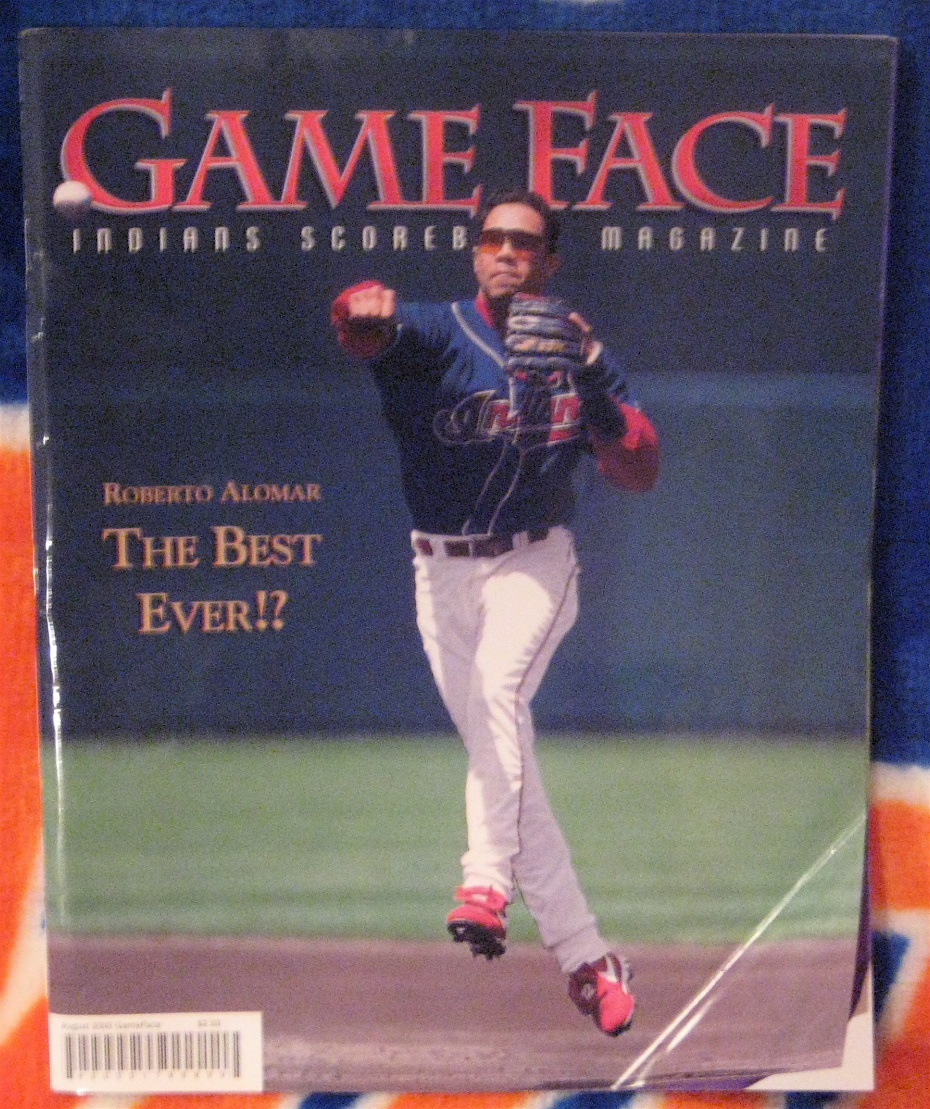
 Camden Yards deserves its iconic status, but Baltimore already had a bit of a downtown renaissance in progress when Oriole Park took wing. It had the Inner Harbor, the National Aquarium. Cleveland, on the other hand, was, no disrespect intended, Cleveland. You don’t have to be an urbanologist to understand what that meant prior to 1994. All you have to do is remember the opening scenes of 1989’s Major League, set to the strains of Randy Newman: Camden Yards deserves its iconic status, but Baltimore already had a bit of a downtown renaissance in progress when Oriole Park took wing. It had the Inner Harbor, the National Aquarium. Cleveland, on the other hand, was, no disrespect intended, Cleveland. You don’t have to be an urbanologist to understand what that meant prior to 1994. All you have to do is remember the opening scenes of 1989’s Major League, set to the strains of Randy Newman:
Cleveland city of light, city of magic
Cleveland city of light, you’re calling me
Cleveland, even now I can remember
‘Cause the Cuyahoga River
Goes smokin’ through my dreams
Randy Newman recorded “Burn On” in 1972, a tribute (if you will) to the Cuyahoga River oil fire of 1969. That was the image America had of Cleveland for the longest time: a city whose river went literally to blazes. There wasn’t much else you’d call hot about the city’s image. Cleveland was a reliable punchline for Johnny Carson, a default example when experts gathered to bemoan the fate of Our Dying Cities. It was the broken buckle of the Rust Belt, impervious to industrial-strength RustOleum. Cleveland was a joke and the Indians were a laughingstock. No wonder Major League was so funny.
And then came Jacobs Field.
Not long after we returned home from our trip there in the summer of 2000, Stephanie was catching up with the mother of her best friend from high school. She told her about our most recent vacation. We went to Cleveland, Stephanie said. Her friend’s mother very nearly fainted. She lived in Florida but was originally from Ohio. Why, she asked Stephanie, would you ever take a vacation in Cleveland? It’s the worst!
Stephanie’s friend’s mother hadn’t been back to Ohio in quite a while. And she wasn’t a baseball fan. Everybody else seemed to know things had changed on the shores of Lake Erie, or at least enough of them had been renovated to make “America’s North Coast,” as civic promoters once hailed it, palatable for a brief visit. The river wasn’t burning, the Indians weren’t losing and the downtown wasn’t a bad place at all.
In the middle of it, the ballpark. It was probably unimaginable when Jake Taylor was catching Ricky Vaughn in aging, enormous Cleveland Municipal Stadium (which was portrayed in Major League by County Stadium). I won’t call Municipal Stadium “decrepit” or “dilapidated” since I was never there — and I have a soft spot for allegedly outmoded stadia — but it’s fair to say it didn’t have the best PR, and there’s no arguing it didn’t attract many Clevelanders. As Bennett Tramer wrote lovingly of his hometown ballclub in 1979’s premiere issue of Inside Sports, he rooted for a team “so terrible that hometown kids leave the ballpark early to sneak back into school.”
From 1956 through 1992, the Indians finished among the bottom four in American league per-game attendance 33 of 37 seasons. Not coincidentally, the Indians spent the entirety of the 1960s, the 1970s and the 1980s out of contention. If the Tribe gave its fans a little hope, its fans would show up — ticket sales more than doubled when the Indians improved by 24 games in 1986 — but there wasn’t much hope. There was just a very large, very old, very deserted stadium. Bennett Tramer again:
In 25 years, the two most exciting moments have been Tito Francona’s TV commercials for Central National Bank and Valmy Thomas’s groin injury.
It would go on like that for another 15 years in the city “where the Cuyahoga River caught fire more frequently than the baseball team,” until four decades of futility at last burned away and Jacobs Field opened its gates. The Indians had a sensational young ballclub and Clevelanders couldn’t not show up. Second in the American League Central and fourth in A.L. attendance when the labor troubles hit in 1994. Second in attendance and first in all of baseball with a staggering 100-44 record in strike-shortened 1995. Division titles and sellouts became the norm. The Indians made the playoffs five years running, advancing to the World Series twice. For 455 consecutive games, the Jake, as it quickly became known, sold every ticket and filled every seat.
By 2000, with the Cleveland Indians entrenched among baseball’s most popular and powerful, I wanted in. I wanted to go to a game at Jacobs Field. I wanted a taste of Tribemania. I wanted a ticket. I wanted a seat at the table.
But how? How do you inject yourself into a crowd that regularly tops 43,000 in a ballpark that seats barely more than 43,000 (and stands a few hundred besides). Your online options were limited. StubHub was in its infancy. Scalpers? Were they legal in Ohio? How much would that cost? And where does one go in Cleveland to buy an already sold ticket? Our ballpark trips were almost always made with the baseball arrangements taken care of in advance. We weren’t going to travel great distances and get shut out. This wasn’t Municipal Stadium or Shea Stadium. You couldn’t just walk up to a window and ask for two, please.
As luck would have it, the reign of the Indians coincided with my knowing a handful of people who either lived in Cleveland or had relatives in Cleveland. Maybe it was the heat of the Tribe or the rise of the Rock and Roll Hall of Fame or the prestige of The Drew Carey Show, but every time I turned around in New York, I seemed to be in contact with somebody with some connection to Cleveland.
One of those people was a co-worker whose parents just happened to be season ticketholders at the Jake. Not just any season tickets either, but tickets that were four rows behind the first base dugout. This thoughtful young lady made a call and, voila!, the tickets were mine. Four tickets at that, which was terrific since at the center of my Cleveland network was my former co-worker Eric — his house had been our satellite office — and it would be swell to go to this game with him and his wife Shelley. I had made noises in 1993 about flying out there to take in a game with him before the old joint closed, but it never happened. This figured to more than make up for it.
The tickets we were provided were for Friday, August 4, so that automatically became the fulcrum of our vacation and the core of what became the closest I ever experienced to my version of a fantasy camp. The Saturday before, I went to Shea and saw the Mets win. I went back on Sunday, and I saw the Mets win. The Mets lost on Monday, but I didn’t go. I went Tuesday, the Mets won. Returned Wednesday afternoon, the Mets won again. Four games in five days, four consecutive wins.
And then it was off to Cleveland. Who could ask for anything more out of the middle of summer?
Take that, Randy Newman.
My ballpark fetish has exposed me to brief glimpses of America’s medium-sized cities, places I never would have visited otherwise. Unless there was business taking me to Cleveland, no way I’m there, even if they do have a Hall of Fame. So when Stephanie and I landed at Cleveland Hopkins International Airport and found our way to the light rail that (per Eric’s instructions) takes you to Tower City and then emerged in the middle of some “downtown” we’d never given any thought previously — downtown having a different connotation in all these other places than it does in New York — it was actually kind of exciting.
New Yorkers getting excited over Cleveland…go figure.
I liked the compactness of downtown Cleveland. It was just a few blocks from Tower City, the big mall/office complex, to our lakefront hotel, which itself wasn’t too many steps from the Hall and the Browns’ new stadium. We even figured out that Cleveland State University was within reasonable walking distance; procuring college t-shirts from universities we know little about are one of our vacation rituals.
As for the object of our desire, Jacobs Field, it was also nearby. Of course it was. It was the magnet in the middle of our minds from the moment we checked in until we got through our game. After dropping our luggage, we walked over and peeked in. There was no game in progress, but it was right there on the street waiting to be gazed upon. You could see the field and all the touches that made it special, like the toothbrush lights and the massive scoreboard (which seemed bigger in those days before everybody got one). You could enjoy the sandstone exterior, an unwitting antidote to the epidemic of Camden-style bricks almost everybody else building a ballpark was copying from Baltimore. Cleveland had itself an original.
The game was Friday night, but I couldn’t wait 24 hours for more Jake. It was just too damn alluring and we were just staying way too close to pretend it wasn’t calling to us. We learned they gave tours, so we showed up Friday afternoon after purchasing our CSU shirts (Go Vikings!) and got the inside look.
That was fun, too, though it revealed my only substantive gripe with the place: the suites. They were stacked atop each other so high — suite, suite, suite — until the upper deck could have been called America’s North Coast. I thought the idea of these retro parks was intimacy, yet the regular Tribe fans were pushed heavenward by the swells. My tickets weren’t in the upper deck, so it wasn’t going to affect me one bit, but I try to maintain an aesthetic standard on these trips. One thumb down for oversuiteing Jacobs Field.
And we could have done without what seemed like 20 minutes sitting around one of the suites as part of the tour. I don’t think that was planned, as our tour guide seemed flustered by some technical glitch and parked us on a bunch of private couches and barstools. It was nice, sure, and it’s novel compared to not sitting in a suite, but the more I think about it, the less these things have to do with baseball…and I don’t have to think that much about it. Yet no ballpark built in the past 20 years has been completed with the selling point being “we’ve eliminated suites.” The Jake sold them out like they sold every seat, so more power to ’em, I guess.
A couple of other Jake tour highlights: Charlie Manuel’s parking space (if I could have foreseen the future, I would have done something nasty to it); the tantrum room right off the Indians’ dugout (where players could take out their frustrations away from umpires and the looming threat of ejection); and standing and posing for pictures on the field itself. Prior to August of 2000, I’d given no thought to following in the tracks of Chief Wahoo. Now I just had to be photographed on his sacred ground.
Fine official tour to go with our sneak preview the evening before. On our walk back to the hotel, we stopped in Tower City to look around and found a store that sold ballpark photos from all over the American League. I snapped up Baltimore, Boston and Detroit. Ten years later, I’ve yet to figure out what to do with them, but I know had to have them while they sat on the counter of a store in Cleveland where I’d never be again.
The main course awaited at 7:05. I was excited about taking another stroll from our hotel, breathing in the bracing lakefront air, joining the parade of locals until we all, as one, got our Tribe on. But that little thrill was pre-empted because our friends were picking us up and, in appreciation for the tickets they — actual fans of this team — couldn’t hope to lay their hands on, taking us to dinner. Well, we could hardly complain about either of those options.
Eric and Shelley brought us to a steakhouse on the edge of downtown. One of the more impressive pregame dinners I’ve ever enjoyed. They made for great companions. It was my first time meeting Shelley. As for Eric, we generally only saw each other at trade shows or when our former employer would fly him in for a meeting. Friendly sort when we were discussing beverage or magazine matters, but move us toward baseball and man, this guy was a blast! Remind me never to go to a convention when I can go to a ballgame.
Full but hardly sated, it was off to the Jake. Eric parked in an off-site lot that charged $20 (downtown ballpark, limited parking) and we were in our fabulous seats just in time for first pitch. From there, nearly every pitch was whacked around. Turn of the Century DH league baseball..DUCK!
The Indians and the Angels each planted some sacrificial tomato can on the mound and their respective offenses let fly. Four for Cleveland in the bottom of the first. Four for Anaheim in the top of the second. Five for the home team in the third. Single runs for the visitors in the tops of the fourth and fifth. What did that make the score?
A lot. Yet all those base hits meant very little compared to a Roberto Alomar bunt attempt gone foul. Robbie, as we called him in our continual efforts to sort of fit in on these sojourns, bunted way too hard. He fouled it directly back, off the window of the press box. It bounced just as hard in the direction of the really good seats behind the first base dugout.
It was coming right toward us. A small mob converged and the ball disappeared. Stephanie, on my left, bent down as if she was going to find it sitting at her feet. Oh, I thought, that’s so cute! She actually thinks the ball landed, of all places, right by her shoes.
Guess what — it did. Stephanie got the ball.
WOW! My wife “caught” a foul ball! Sure, what she really did was pick it up off the ground, but they’re all acrobatic snares of sizzling liners in the paper the next day, so way to go!
Two aspects of this that still slay me:
1) Stephanie has never attended a baseball game in which she didn’t warn me of the terror lurking in her soul regarding a foul ball taking her head off (no matter how far we sat from likely foul ball territory), yet she couldn’t have been more blasé about her Jacobs find. While I was scouring the area to see where the sphere of dreams landed, she just sat and smiled and handed it to me. Is this what you were looking for?
2) Eric, lifelong fan of all Cleveland sporting combines, witness to no Cleveland championships, scarred as any Cuyahogan by the 1997 World Series that got away in the ninth inning of the seventh game…Eric had been to loads of Indians games at mammoth Municipal Stadium where your chances at a foul ball were mathematically excellent. He never got one. At the Jake, albeit with more competition, same thing — no dice. Somehow, Eric chose the half-inning of Roberto Alomar’s fateful at-bat as the half-inning to go to the men’s room. Thus, when he returned to his seat and saw me holding a baseball hit moments earlier by the biggest star on his favorite team…I believe the first two words uttered were “what” and “the”. Eric’s indignation was mock but still, out-of-towners just cruise in and grab a ball. Ouch.
Eric still has no championships from his teams, but if it makes him feel any better, we haven’t come up with any foul balls since 2000.
Our friends were such nice people, but not all Tribalists were so civilized. Specifically, a bunch of tanked-up teens were giving the business to one Angel in particular, Mo Vaughn. Mo, they deduced, was a large fellow, so they saw fit to remind him loudly and crudely that he wasn’t — fit, that is. As Mo led off the seventh with Anaheim two runs down, I must confess that I hoped he’d shove their taunts down their throats just on principle. In another stroke of luck, Vaughn’s fellow slugger Jim Thome, standing around first base for Cleveland between his own at-bats, couldn’t field a grounder. E-3 on the Thomenator, Mo Vaughn on first.
Then Justin Speier throws a wild pitch and Vaughn speeds to second. HA! He’d come around to score as the Angels eventually tied it 9-9.
9-9. Geez, the American League can be numbing.
I went back to nominally supporting the Indians out of courtesy, but I wasn’t too upset when Adam Kennedy singled home Garret Anderson in the top of the ninth to make it 10-9 Angels. This had been a long-ass game. We had our ball, we had a ball in general, but by the ninth, we’d seen just about everything Jacobs Field had to offer. The Mets were in Arizona (playing the “Rattlers” according to the out-of-town scoreboard). I was tired, I was full, now I was distracted. When can I get back to the room to track the Mets on the ESPN crawl?
No worries. There was one more thing Jacobs Field had to offer us. With one out and one on, Thome stepped in against Angels closer Troy Percival. The Thomenator had also decided it had been a long enough night and he creamed the fourth pitch he saw. Just like that, after nearly four hours, we had our final: Indians 11 Angels 10.
It meant more to Eric than it did to me, but that was a helluva way to end any game — no doubt the most exciting ending to what I’ll call an “other” game I’ve ever witnessed. Jerks who told Mo Vaughn how effing fat he was gaining satisfaction notwithstanding, it was a ton of fun leaving a ballpark in that kind of delirious crowd.
For Thome, it was career home run No. 225; he now has 587, eighth all-time. For Jacobs Field, it was consecutive sellout No. 423; the streak would snap at 455 the following April (the Red Sox have long since smashed that record, with Fenway selling out 622 straight games and counting). For the Indians, it was part of a late-season surge that would catapult them into Wild Card contention where they’d come up just short of their sixth consecutive postseason appearance. Another division title, unfortunately for them, was out of the question, as Charlie Manuel’s club was outpaced early in the A.L. Central by the White Sox of Jerry Manuel. Quite a manager that guy was supposed to be.
Roberto Alomar and Mo Vaughn were two superstars I’d remember from this night but presumably forget about as soon as Eric and Shelley dropped us off at our hotel where I’d race to turn on Baseball Tonight and learn Joe McEwing and the Mets were sticking it to Randy Johnson and those redubbed Rattlers. True, the next day Stephanie and I visited an Indians clubhouse store in a downtown mall and picked up a Beanie Baby-type keychain with ALOMAR 12 inscribed on its back because we were so grateful to Robbie for having such precise aim with his misfired bunt. We’d take Beanie Robbie home and put real Robbie’s ball in a case and place them both atop our bedroom dresser and glance at them now and then and remember what a good time we had in Cleveland in the summer of 2000.
But otherwise, we’d have no reason to let either Roberto Alomar or Mo Vaughn cross our Met minds on a going basis in the foreseeable future. Nope, no way.
A friend spent his own vacation this past June in Cleveland, timing it to catch the Mets at the Jake or whatever it’s called now. He was happy our team swept their team, but reported “that ballpark is kind of sad.” No crowds, no life, not well kept up — “it shows you what Citi Field could be like in ten years if they don’t take care of it.”
My Jacobs Field, however, will always look fantastic from the fourth row.
by Jason Fry on 17 September 2010 2:21 am As cool weather and tiny crowds herald the quiet of the offseason, rooting for the Mets threatens to become fun again, a story of kids trying to learn lessons and win jobs and make you eager for 2011. (Granted, playing the Pirates is an excellent recipe for feeling better about things.)
From tonight’s game, two moments that will stick with me long after the rest of this game has been forgotten.
The first was Angel Pagan going into a slide at the edge of the grass in right-center, his butt skidding across the grass as he flung one arm one way to steady himself and the other arm (the one with the glove) the other way, where it intersected the ball struck a moment before by John Bowker. Pagan caught the ball short of the 415 sign, rolled over on the warning track, sprang up (somehow in the right direction), fired to Ruben Tejada to start the double play, fell down again, then looked up wide-eyed and waved one hand in slightly woozy triumph. The Pirates’ relievers (soon to be employed for no particular reason by the unnecessarily thorough John Russell) gaped in amazement. Mike Pelfrey said wow. I did both.
It’s been a pleasure to watch Pagan go from prodigal son to slightly daffy semi-prospect to all-around star, but I can’t remember a moment for him quite like that one. That was a catch to rival Tommie Agee skidding on his belly at Shea, a grab that would adorn a gate if it had happened during the postseason. As it is, you should see it on replays for years. I’ve watched it about 12 times now and it still makes me laugh and shake my head in appreciation. Ain’t baseball wonderful?
The other moment belonged to Lucas Duda, the hulking rookie whose first big-league go-round has been beyond cruel, as in 1-for-33 beyond cruel. Duda got a hit in his third big-league game, in Chicago on Sept. 3, but hadn’t scratched anything in 23 at-bats since. That’s nearly two weeks without a hit, a solid 45 aggregate minutes or so of standing at the plate and watching pitches and swinging at them and getting nowhere while tens of thousands of people watch and wonder — as you must have once or twice — if you’re fated to ever get a hit.
Duda’s misery had become so pitiable that when he came up in the fourth I was thinking that something ought to be done. I’m all for the kids’ learning lessons, but one hit in the first 2 1/2 weeks of play is all stick and no carrot, and it seemed like a good idea for Duda to develop a mysterious minor ailment and be shut down for the year out of caution. A moment after I thought that, Duda ripped a Charlie Morton fastball down the right-field line for a double, scoring fellow Youts of America Ike Davis and Josh Thole. Standing on second, Duda looked carefully expressionless, but that was OK — I was smiling for both of us.
In his next at-bat, of course, Lucas Duda doubled again. Ain’t baseball wonderful?
|
|